Novelists, poets, playwrights, journalists, critics and memoirists: men who lived on or near Wandsworth Common, grew up beside it, or put it into their books.
The first part of the page is about the men who lived here or had a real connection with the Common, roughly in order of birth. The second part lists the many novels, plays and stories that use the Common as a setting.
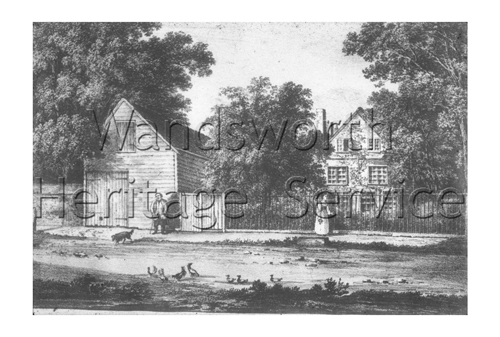
Mulberry Cottage, c.1795, “residence of the antiquary Francis Grose”. Wandsworth Heritage Service. (Click to enlarge.)
Grose lived for many years at Mulberry Cottage, on the edge of Wandsworth Common, and sketched the neighbourhood.
He is remembered for his volumes of the Antiquities of England, Wales and Scotland, and for his racy Classical Dictionary of the Vulgar Tongue (1785).
He was famously fat and famously good company. While he was collecting material in Scotland, Robert Burns became his friend and wrote “Tam o’ Shanter” for him, to go with his drawing of Alloway Kirk.
His diary of a tour in 1777 begins with a ride over Wandsworth Common, “the lower end of which was very bad owing to the late Rains”.
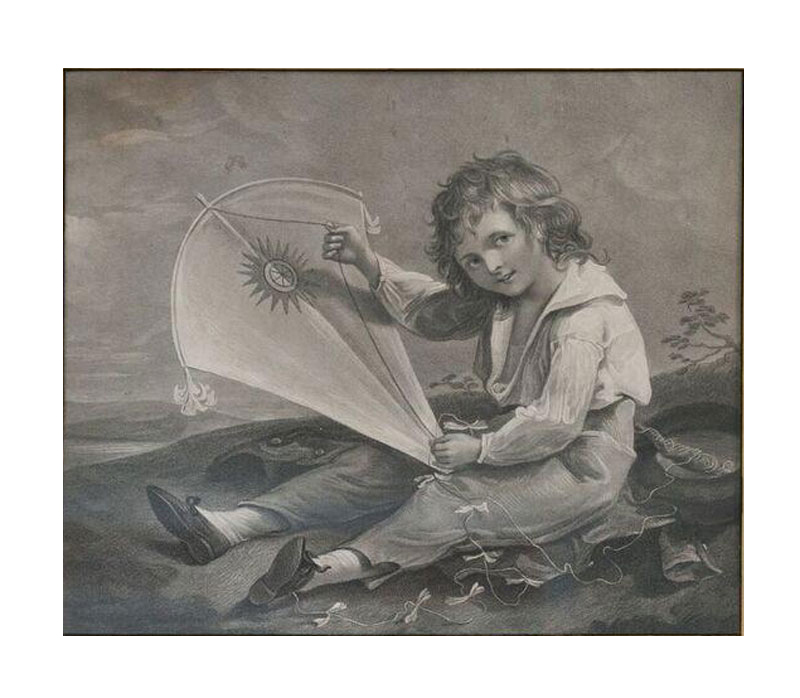
Illustration for “The Tale of a Kite”. (Click to enlarge.)
Webbe’s sketches of London life include “The Tale of a Kite”, in Glances at Life in City and Suburb. It is the true story of a donkey called Sir Isaac, after Newton, seen flying a kite on Wandsworth Common.
Could Sir Isaac be the ancestor of A. A. Milne’s Eeyore?
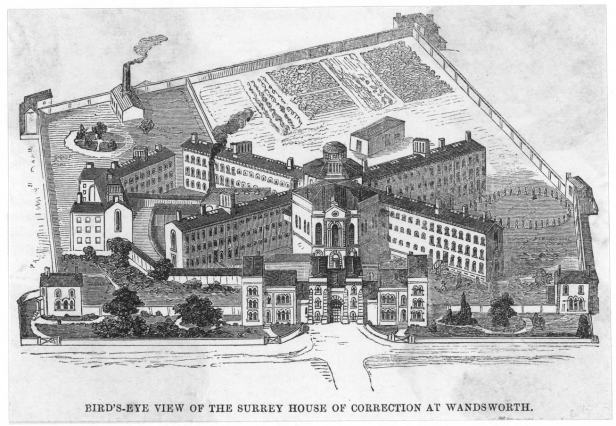
Bird’s-eye view of the Surrey House of Correction (Wandsworth Prison). (Click to enlarge.)
Co-founder of Punch and author of London Labour and the London Poor.
With John Binny he wrote The Criminal Prisons of London, and Scenes of Prison Life (1862). It includes a marvellous account of the train journey from central London to the Surrey House of Correction on Wandsworth Common, now Wandsworth Prison. The journey is told as if it were an expedition through distinct zones of vegetation.
The visit was probably made in about 1856, some years before the book came out.
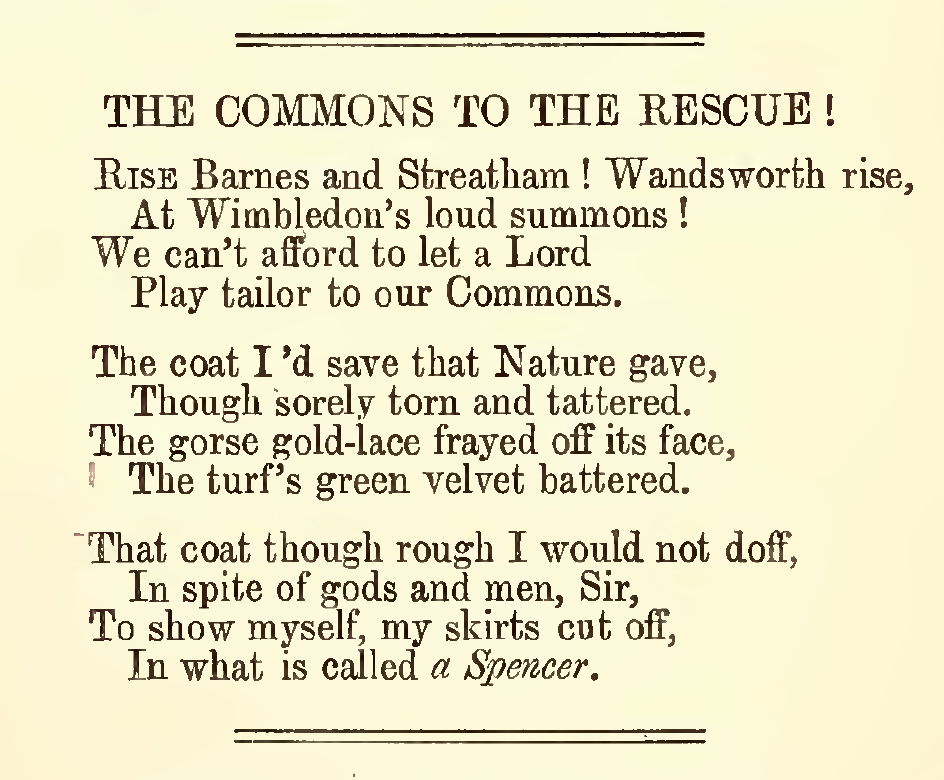
“The Commons to the Rescue”, Punch, 11 March 1865. (Click to enlarge.)
The author of Our American Cousin, the play Lincoln was watching when he was shot, and of The Ticket-of-Leave Man. He lived at Lavender Sweep House, where he and his wife, the composer Laura Barker, held famous Sunday gatherings.
He took an active part in the campaign to save the Common: his name is on the committee of the 1870 “Preservation of Wandsworth Common” poster. He wrote verses for the cause, including “The Warning of Wandsworth Common” (1865), “The Commons to the Rescue” (punning on Spencer and Taylor) and “The Cry of the Commoners” (1870).
He adapted Mrs Braddon’s Henry Dunbar for the stage.
The Battersea Society put up a plaque to Tom Taylor and Laura Barker at 84 Lavender Sweep on 28 September 2024.
As a boy at Stockwell Grammar School, Besant roamed the commons of south London. His autobiography remembers Wandsworth Common as “another wild heath with a lake called the Black Sea, wherein, it was rumoured, gigantic pike attacked and bit great holes in the boy who ventured to swim across”.
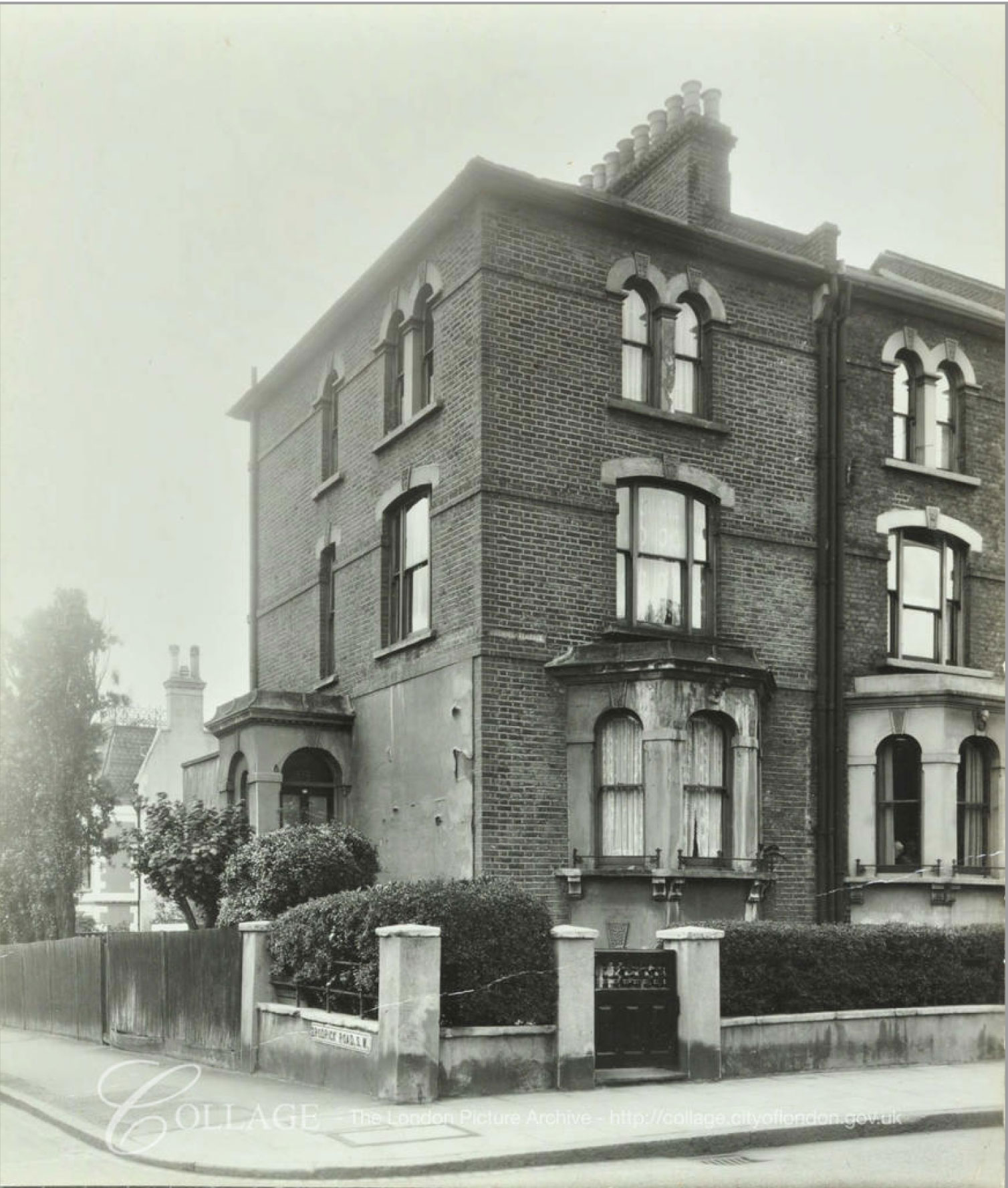
“The Larches”, 1 Arundel Terrace (now 172 Trinity Road), photographed in 1938. (Click to enlarge.)
Hardy and his wife Emma lived at “The Larches”, 1 Arundel Terrace (now 172 Trinity Road), from 22 March 1878 until 1881.
The house was cheap and the area still fairly rural, but above all it was close to Wandsworth Common station, opened in 1869, from which Victoria was only a few minutes away.
Here he wrote The Trumpet-Major. In the autumn of 1880 he fell seriously ill, and dictated much of his next novel from his bed. A plaque records that he “lived here 1878–1881”.
Wandsworth Common turns up in The Canterville Ghost (1887), where one of the family’s victims is “afterwards shot in a duel by Lord Canterville on Wandsworth Common”.
Eight years later Wilde knew the Common from the inside of Wandsworth Prison, where he was held for some months in 1895 before being moved to Reading.
Vicar of St Mary Magdalene, Wandsworth Common, he lived in the fine vicarage on the corner of Loxley Road and Lyford Road.
He and his father, the Rev. J. G. Wood, were among the most popular natural-history writers of the late nineteenth and early twentieth centuries. His books include Dwellers in the Woods (1908).
Thomas grew up beside the Common, first in Wakehurst Road and then in Shelgate Road, and went to Belleville School and to Battersea Grammar School. The Common was his first countryside.
He met Helen Noble, his future wife, at her father’s house nearby. In Pursuit of Spring (1914) opens with him setting off by bicycle over Wandsworth Common.
He was killed at Arras in April 1917. His parents were then living on the corner of Rusham Road and Sudbrooke Road.
During the First World War, Muir served as an orderly at the 3rd London General Hospital, in the Royal Victoria Patriotic building on the Common.
His Observations of an Orderly and The Happy Hospital describe its life. He also edited the hospital’s gazette and the fundraising book Happy – Though Wounded!
Great-grandson of the Wandsworth solicitor Arthur Alexander Corsellis. He began work in the Town Clerk’s office at Wandsworth in 1939, and wrote some of his poems about the Blitz.
He was killed in January 1941, aged nineteen, while serving as a ferry pilot.
He grew up in Battersea. His Borrible trilogy (1976–1986), about wild runaway children who live in the hidden corners of London, is rooted in the streets of his childhood.
Swift, who won the Booker Prize for Last Orders, lived in Jessica Road.
His collection of non-fiction, Making an Elephant (2009), includes an essay on Wandsworth and the history of the Common, with the County Arms on Trinity Road, “on the edge of Wandsworth Common”.
Sax Rohmer, The Hand of Fu-Manchu (1917): “. . . somewhere on the west side of Wandsworth Common!” (Click to enlarge.)
As a setting, Wandsworth Common pulls far above its weight in novels, stories and plays, especially where skulduggery is involved. These are by men; the women’s books are on the Literary Women page. Extracts from most of them are on the Wandsworth Common in Literature page.
William Makepeace Thackeray, Vanity Fair (1847–48)
Charles Kingsley, Alton Locke (1850)
James Grant, Second to None: A Military Romance (1864): a soldier crossing the Common on horseback hears a scream and meets a highwayman
The Earl of Desart, Mervyn O’Connor (1880): “A Visit to Wandsworth”, to the walled and bottle-topped Manor Lodge
Arthur Lillie, The Cobra Diamond (1890)
Arthur Conan Doyle, “The Greek Interpreter” (1893): Mr Melas is dumped on Wandsworth Common and only just catches the last train from Clapham Junction
Leonard Merrick, One Man’s View (1897)
Richard Marsh, Tom Ossington’s Ghost (1898)
Fred M. White, The Slave of Silence (1904)
Douglas Stewart, The Red Band (1910): “The Mystery of Rose Lodge, Nightingale Lane”
George Moore, Hail and Farewell (1911–14)
William Le Queux, The Bomb-Makers
Sax Rohmer, The Hand of Fu-Manchu (1917)
Noël Coward, Fallen Angels (1925)
R. C. Sherriff, The Fortnight in September (1931): the Stevens family’s annual journey to Bognor, by way of Clapham Junction
David Severn, A Cabin for Crusoe (1943), and his other “Waggoner” stories, which recall Wandsworth Common covered with Romany tents “as far as the eye could reach”
Geoffrey Kennell, The Upper Crust: a seduction in a Nissen hut on the wartime Common
Philip King and Falkland Cary, Big Bad Mouse (1964): a farce set off by a flasher on Wandsworth Common
M. G. Jackson, The Brixton Experiment (2003)
Alan Wall, China (2004)
Marcel Theroux, Strange Bodies (2013)
Peter May, Lockdown (2020, written in 2005): a London pandemic thriller, set partly in Routh Road and the “Toast Rack”
Robert Nuttall, Wandsworth Common (2020)
R. C. Sherriff, The Fortnight in September (1931). (Click to enlarge.)
Nearby
Writers just beyond the Common with pages on this site:
John Ruskin, “The Springs of Wandel” — the opening of his autobiography, Praeterita, on his mother’s family in Croydon and the springs of the river Wandle
Charles Dickens — his 1849 articles on Drouet’s “paradise at Tooting”, the pauper children’s farm where cholera struck
Charles Haddon Spurgeon — the great Baptist preacher, whose sermons sold in their millions, at 99 Nightingale Lane
Still to find
Lewis Carroll — a page started in 2021, the 150th anniversary of Through the Looking-Glass, but not yet written