Edward and Helen Thomas in Battersea and Wandsworth
John Haskey’s account of the Edward Thomas walk organised by the Wandsworth Society in June 2012, published in the Society’s newsletter, September 2012, pages 6–7. See also Richard Purver’s 2011 talk and the Edward Thomas birthday walk.
Transcribed from the newsletter pages: original pages (PDF). Section headings added.
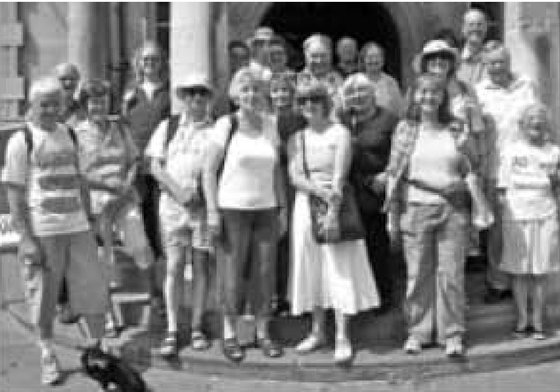
On a sun-baked Monday at 2.30pm, in equatorial South West London, Richard Purver, with noble (no pun intended) assistance from Anne Harvey, led a three-hour walk visiting the homes where Edward and Helen had lived, and other places with which they had important connections.
Twenty-one intrepid devotees, many members of the Wandsworth Society (who organised the walk), mostly sporting protective sunhats and carrying the obligatory bottle of water, plus a plucky little dog called Hetty, convened at Battersea Arts Centre in Lavender Hill, which had formerly been Battersea Town Hall, at the start of a most interesting talk and walk led by Richard.
Anne provided additional information, and also captivatingly read one or more of Edward’s poems or prose at each location.
Of course, the homes where Edward lived and the other houses we were to visit did not fall in a convenient straight line or in a perfect circle; so understandably the chosen route took in places in an order which was geographically efficient rather than chronologically accurate!
Battersea Town Hall and Clapham Common North Side
In the vestibule of what had been Battersea Town Hall, Richard mentioned that Edward’s father had been interested in philosophy and politics, and had stood, unsuccessfully, as a local Liberal candidate in Battersea. He walked regularly across St James’s Park with Lloyd George — who also lived in Wandsworth (although Battersea was a distinct borough from Wandsworth in those days).
Anne read two very appropriate poems, Battersea and Lavender Hill, from Nursery Rhymes of London Town by Edward’s friend Eleanor Farjeon.
We then walked through a street of handsome Victorian terrace houses — of which there are so many in London — to Clapham Common North Side, better known to motorists as “The South Circular”. Here, Richard pointed out a magnificent house where John Burns, a statesman and a (radical) Liberal politician, had lived; in Edward Thomas’s autobiography, Edward recalls being bowled out at cricket by John Burns on Clapham Common.
Close by lived Charles Barry, the architect who designed the Houses of Parliament; another neighbour was Edvard Grieg. In fact, many famous people have lived along Clapham Common North Side and nearby; there is a positive epidemic of LCC and English Heritage blue plaques in the area!
Wakehurst Road and Shelgate Road
Edward Thomas was born in Lansdowne Gardens, South Lambeth, near Stockwell, in March 1878. When he was 2, his parents moved to 49 Wakehurst Road (originally called 2 Tremorvah Villa[s], as Richard had recently discovered from the 1881 Census and other documents), at which several of Edward’s brothers were born.
When Edward was about 10, the family moved to 61 Shelgate Road, which was our next port of call. This large house, with very small front garden, and many-windowed attic, sports a plaque stating that Edward Thomas, Essayist and Poet, 1878–1917, lived here.
Helen and Edward’s first child, Merfyn, was born in this house in 1900, and Anne read Helen’s very vivid description of the room in which he was born, no doubt with emotions and sensibilities heightened by her pregnancy, followed by Edward’s poem about a similar place, The Long Small Room.
Helen became a writer in her own right; two books about her life with Edward (As It Was and World Without End) and children’s stories, although she never composed any poetry.
Belleville School
We then processed to Belleville Road, to an archetypal Victorian London primary school, Belleville School, built in the mid-1870s on a fairly steep hill. Edward attended this school, then the local Board School. He later recalled “crawling in (to school) and bursting out” — a feature perhaps common to all children, as we witnessed by the eruption of a multitude of energetic children from the school in mid-afternoon, ready to be collected by mums, dads, and grandparents!
By prior arrangement, we were able to visit the school, view a typical classroom and the assembly hall, and be able to imagine it as Edward had known it. Although very colourfully decorated, and with the children’s pictures on the walls and along the corridors, and the inevitable presence of modern technical equipment, the original structure of the building had evidently not been changed since it was built, so that it was not too great a leap of imagination.
Edward remembered his school as having lofty rooms and large windows — and smelling of carbolic soap! He progressed to the main school from the Infants here in 1886, when he was recorded as Edwy, his pet name.
After being shown round the school by two members of staff, Baki Gashi and Alexandra Turnbull, deputy head Sarah Atherton told us about the recent journey by 15 Year 5 Belleville pupils to Steep in Hampshire, where they visited sites associated with Edward Thomas and met pupils from Steep Primary School. A report of the visit is carried on the school’s website.
Wandsworth Common
We went on to look at 49 Wakehurst Road, where Edward’s world consisted of home, school, and the streets neighbouring the common (Wandsworth Common) where he would engage in mock battles, and take an increasing interest in wildlife and nature, while playing in and around the ponds and gravel pits. He visited blacksmiths and pigeon fanciers, and began keeping pigeons and white mice. He subsequently went on to attend Battersea Grammar School (and then St Paul’s School, before going up to Oxford).
We then walked onto Wandsworth Common by Bolingbroke Grove and set off across the common in the sun, glad at the beginning to experience some shade of the trees.
On 13 April 1895, when Edward was 17, he recorded that swallows, house martins and sand martins came to Wandsworth Common; his early work consisted in what we might term nature notes or natural history jottings, rather than poetry, and inspired him to write his first book, The Woodland Life. It was later that he used similar material to compose two poems, which Anne then read: How at once? [The Swifts] and Birds’ Nests.
Patten Road and Routh Road
We continued across the common, reaching the footbridge going over what must have been in Edward’s day the line of the London, Brighton and South Coast Railway, and crossed the common on the other side of the line to reach 6 Patten Road where Helen Noble had lived with her parents (they had previously lived in St Ann’s Hill).
Helen’s father was the writer and critic James Ashcroft Noble, and Edward met her through both families attending the Unitarian chapel in East Hill (no longer standing). Helen had been born in Liverpool in 1877, and the family returned to Wandsworth in 1893 after a previous stay, Helen attending Wimbledon High School. Helen and Edward took long walks to Merton and Wimbledon, as part of their courtship. Anne read Helen’s description of first meeting Edward and his later poem for her: And You, Helen.
We then passed some two blocks of fine large houses to view the home at 3 Routh Road where David Lloyd George, former Liberal Prime Minister had lived. As mentioned, Lloyd George knew Edward’s father through local politics, although, of course, Lloyd George was much more successful as a politician.
A further pleasant walk across another part of the common towards Wandsworth Common station provided an opportunity to hear another of Edward’s poems. Anne read Adlestrop on a patch of green near the station, from which it is possible that Edward and Helen set off on the railway journey which produced arguably the best-loved of all his poems. Interestingly, although the poem has a profound sense of solitariness, Helen was with him when he experienced arriving at Adlestrop station.
Rusham Road
Crossing the railway line again, near Nightingale Lane, we found 12 Rusham Road, a tall, handsome, well-built house surrounded by a garden of trees. Edward’s parents moved here from Shelgate Road, in 1902 and Edward and Helen and their children regularly used to travel up from Steep to visit them, despite Edward’s preference for the country. (Edward’s father was to die in this house in 1920, three years after Edward’s death at Arras in April 1917.)
Earlier though, in 1913, Edward wrote a travelogue of a bicycle journey from London to the West Country, In Pursuit of Spring. He started out from Rusham Road on 21 March 1913 and his route was followed on the 80th anniversary in a charity cycle ride by Mary Wynn-Jones. Anne had been in the party seeing her off and read for us the same passage from the book as she had that day in 1993.
Edward had been writing mostly prose, essays and nature notes, but his friendship with Robert Frost (who visited Edward here) proved decisive in encouraging Edward to write poetry. It was at Rusham Road that Edward said goodbye to his family before embarking for France on 29 January 1917.
Anne spoke Eleanor Farjeon’s elegiac poem for Edward Thomas, Easter Monday — and it was a much appreciated conclusion to an excellent afternoon, demonstrated by a spontaneous round of applause for Richard and Anne, much to the astonishment of some passers-by!
John Haskey
(with thanks to both Richard and Anne for some corrections)
June 2012