The History of Wandsworth Common
Added
March 2020
A virtual walk along
BELLE VUE ROAD
A History of 36 Shops
(and the Pubs at either end)
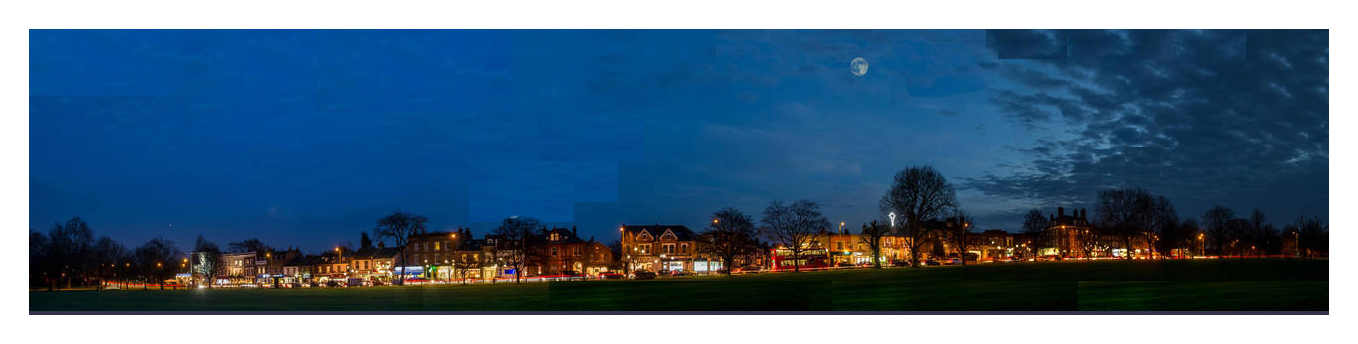
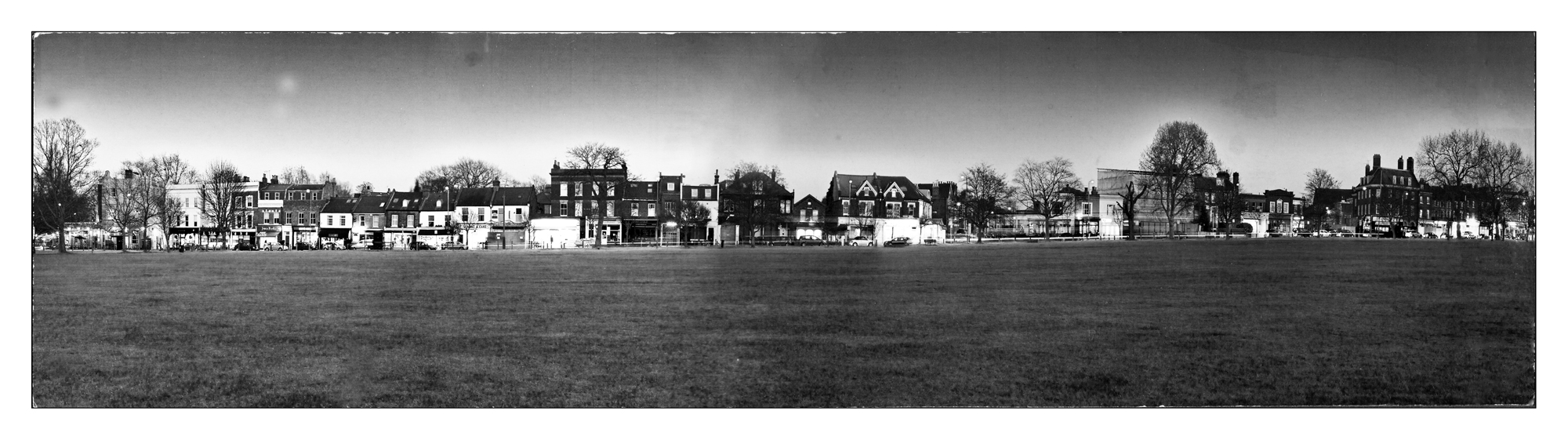
Bellevue panoramas
Dates? The large cross above the White Lodge on the night image suggests it must be near Christmas - c.2017? The black and white image must have been taken a year or so earlier as the White Lodge is still being (re-)built.
[Should I number all of the buildings on the B&W image as a key?]
(Click on image to enlarge)
A note by Jennifer Penny, Stephen Midlane, and Philip Boys:
Our intention had originally been to guide a group walk (on May 31st 2020) as a contribution to the Wandsworth Heritage Festival. Since this walk looks most unlikely now (thanks to rampant viruses), we are experimenting with this online perambulation instead.
These notes-in-progress are based on a U3A study and display by Jennifer Penny in 2017. We are augmenting these with pics, maps and additional info. The original study focused on shops, but material is now being added on the pubs at either end (Hope, Surrey Tavern), and the houses in-between. We still have images, memories and info to add - but everyone is welcome to pitch in.
Bellevue Rd was created in 1827 to provide an east-west link between Nightingale Lane and Burntwood Lane. Until then it was little more than a path or track across the rough grazing on the Common.
In 1869 Wandsworth Common Station was opened, and this led to an increase in the number of people living in the area and consequently a need for shops as well as more housing.
Since the 1870s Bellevue has remained a shopping street, with the shops located on the south side and Wandsworth Common on the other. In the early days, though probably until the mid 1960s/early 70s, its character was that of a typical village street, consisting mainly of shops where local residents could buy their everyday essentials and obtain services such as shoe repairs etc. But there have always been a few privately occupied houses as well.
For instance, to take a snapshot, in the 1950s Bellevue Rd contained a post office, a butcher's, a baker's, a greengrocer's, a branch of Macfisheries, a hardware shop, a newsagent/tobacconist and a Co-op grocery branch. [PB: and indeed a Waitrose! Where was the Coop?]
Most local residents did their shopping perhaps several times a week and very often on foot as many did not own cars and fewer women were able to drive than is the case now. Also, not everyone owned a fridge and freezers were in their infancy, so many items of food would not keep long and had to be bought quite frequently.
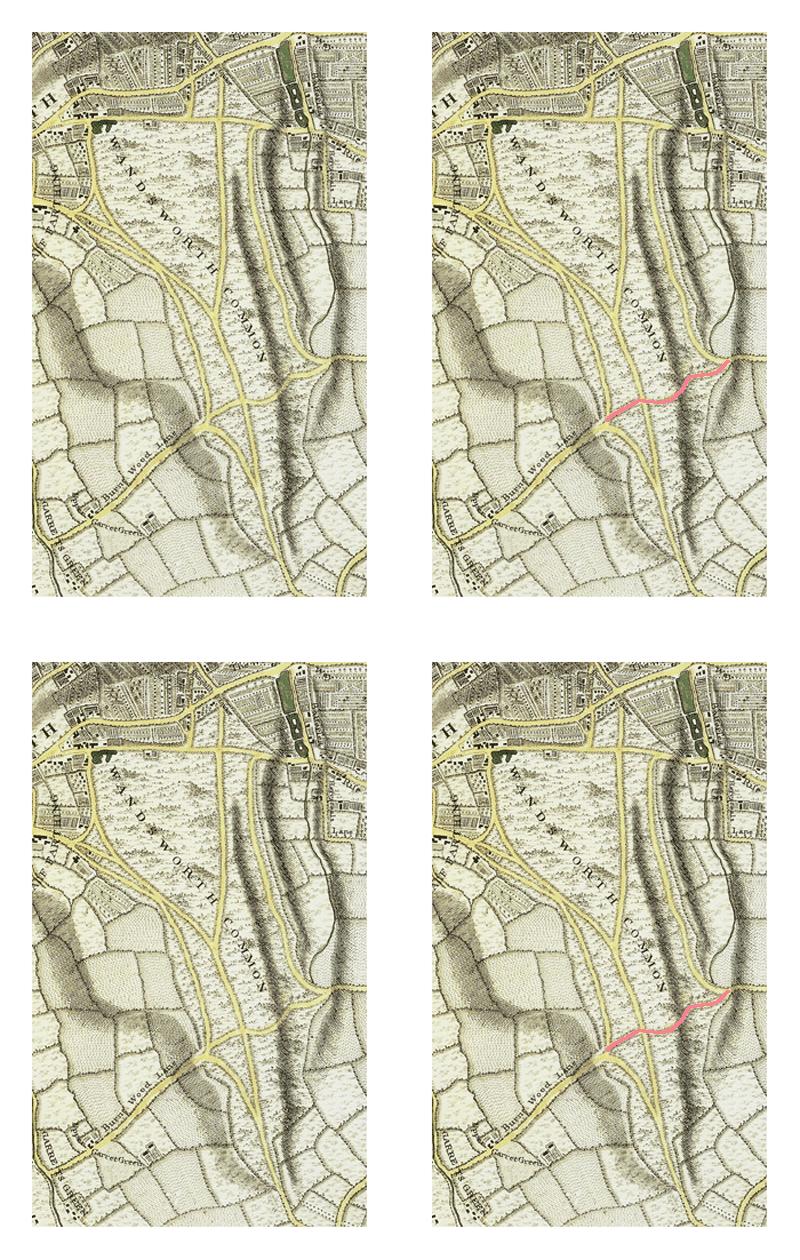
On John Rocque's maps of the mid-C18 the future Bellevue Road was no more than a meandering rough track (shown here in red). Some roughly contemporary maps, such as the Corris maps of 1787, don't show it all, though Milne's reliable map of 1800 marks it as a straight unfenced track.
[A history of Bellevue Rd in maps.]
(Click on image to enlarge)
When was it first called "Belle Vue" (or "Bellevue")?
It is not named at all on Stanford 1872, though both Althorp and Wiseton roads are. In 1893, the OS map names it and shows buildings more or less as they are today.
Bellevue also linked to St James's Rd (now Drive) and "The Five Houses Rd" (now Bolingbroke Grove). Bellevue and St James's (also built 1827 - check) were paid for by Earl Spencer to improve access for people going up to London via Clapham or travelling between Tooting and the toll bridge at Battersea (Spencer was a major shareholder). Better roads increased the desirability, and hence the leasehold value, of the large houses on the edge of the Common. The coming of the railway demanded a bridge over the track, which interrupted both roads close to the point they crossed. [PB: I believe there was some conflict between Spencer and the railway company over this bridge. Check.]
St James's Road/Drive took its name from the St James's Industrial School, built [dates?] [for the naughty boys of St James's parish, Westminster, where Earl Spencer owned a lavish town house (Spencer House).]
The coming of the railway in the 1860s demanded a bridge, which interrupted both Bellevue and St James's close to the point they crossed (where the Hope was built). [PB: I believe there was some conflict between Spencer and the railway company. Check.]
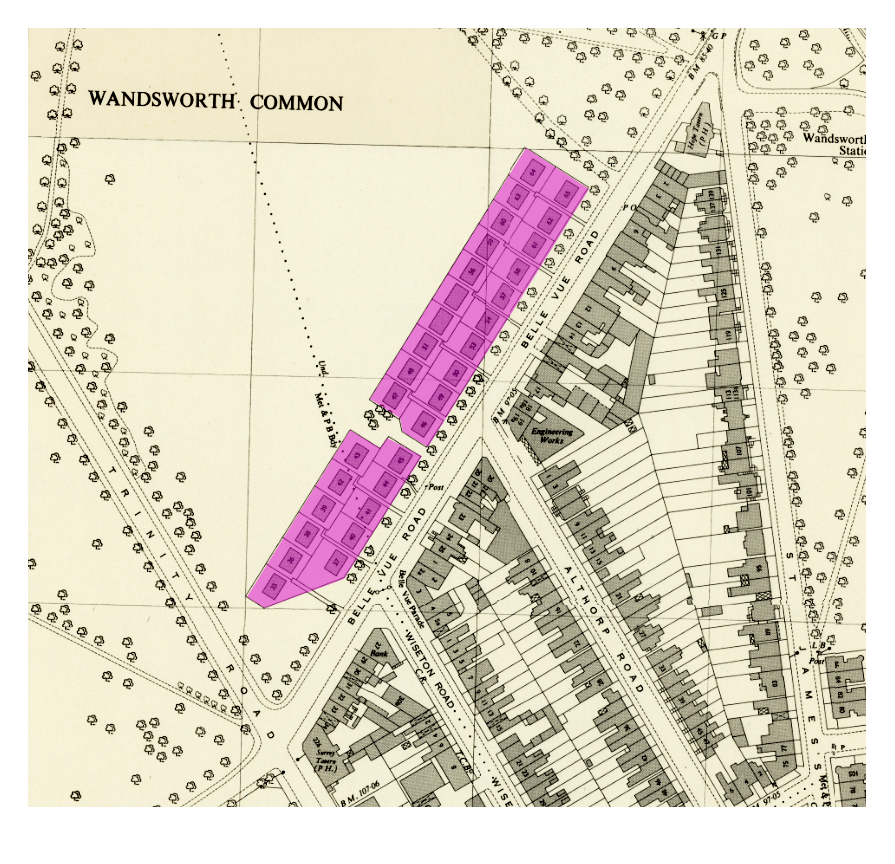
From c.1945 to until the mid-1950s, when they were all destroyed, numerous "prefabs" - prefabricated houses - lined the Bellevue on the Common side. They had been built swiftly to rehouse people whose homes had been bombed. [Try to find exact dates, and photographs].
Bellevue, c. 1955, showing numerous "pre-fabs" - prefabricated (i.e factory-made) concrete and steel-frame bungalows swiftly erecetd onsite. The highest number on Bellevue is 34, hence these prefabs on the Common were numbered from 35 upwards [to 65, with two unnumbered on the map]
These had been put up speedily to house some of the many people who had been bombed out during the war. Along with other prefabs on the edge of many parts of the Common, including nearby Bolingbroke Grove, they were demolished in the mid-1950s [?].
[A history of Bellevue Rd in maps.]
(Click on image to enlarge)
1970s
By the late 1970s, with the proliferation of supermarkets and increase in car ownership, people's shopping habits were changing and the small local businesses were suffering as a consequence. More professional people were moving into the area and there was an increasing interest in antique furniture and interior design.
A number of shops catering to these interests opened up: for instance Material Effects at no.15 and Compton Wallpapers at no.30. There were antique furniture shops at nos 6 and 29. Wine bars were also becoming popular and there were at least two in the Rd.
1980s and after
The latest phase in the life of Bellevue Rd brings us to the present day. The enormous rise in house prices in the area has had its effect on the demographic makeup, tastes and lifestyles and consequently on the type of shops and shopping habits. The post office has gone, as have most of the food shops. Wine bars have given way to expensive restaurants, and estate agents seem to outnumber any other type of shop - currently there are seven of them in the Rd.
An interesting development is the increase in shops which are part of a chain rather than being independent, such as Caffe Nero, Spirited Wines (part of the Nicolas chain), the Good Earth Chinese restaurant - and of course the estate agents! One reason for this may be that the Rd contains a number of different freeholders - as each lease becomes due for renewal the rent has been increased to the extent that very often independent traders are priced out of the market and only large organisations can afford to take on the lease. Some shops change hands quite quickly and one is now [March 2020] vacant.
With regard to shopping habits, a notable change over the years, which applies in any area, is that things seem to have come full circle: before the war many housewives would give a weekly order to, for instance, the local grocer, who would then deliver the goods. Later this habit almost died out until fairly recently and supermarket delivery vans are now a regular sight. This may well be due to increased use of the internet to place orders and the fact that in so many households all the adults are working full time. This applies not just to groceries, of course, but there has been an exponential increase in mail order shopping online.
1 Bellevue Rd - The Hope Tavern
The Hope and Belle Vue Rd, c.1910
The iron fencing on the right was in part to contain the sheep grazing on the Common.
[A history of Bellevue Rd in maps.]
(Click on image to enlarge)
[More info to follow.]
Bennet Court
Between the Hope and Chez Bruce is Bennet Court, which was created in the 1980s.
Previously a garage?
Units 1 and 2 are occupied by Jigsaw Clothing, with the entrance on Bellevue Rd. The court also contains a firm of solicitors, Alen Buckley, a hairdresser, Anthony Laban, and Tranquility physiotherapists.
A back (staff) entrance to the Hope opens on to the courtyard, which also forms a passageway through to St James's Drive.
Between the Hope and Jigsaw there is an open-air bicycle workshop [Bellevue Bicycle Workshop?], which has been there for 3 or 4 years [c.2017?].
2 Bellevue Rd [Chez Bruce]
Opened in 1868 as a butcher's shop by George Miller, who was originally from Dorset. Sheep were brought by sea from Scotland and grazed on the common opposite until ready for slaughter. The abattoir was round the corner in Wiseton Rd, behind what was then the National Westminster Bank and is now Sainsbury's Local.
Mr Miller had grazing rights on the common, and employed a shepherd and a sheepdog!
[PB: There was an article in a Wandsworth Historical Society newsletter (not the journal) - "Wandsworth Common, the last shepherd on, c.1919 N2/61". Neil Robson has kindly said he will send me a copy.]
[More pics of sheep on the Common.]
(Click on image to enlarge)
The Miller family business prospered. As well as serving the local community they supplied meat to the Royal Hospital, Chelsea, the army and other hospitals. Mr Miller acquired a large house with grounds in the nearby village of Tooting, where the family lived at weekends. The house was called "Lynwood", and there is now a Lynwood Rd just down the Rd from Tooting Bec Station.
The business remained in the family until the 1970s, when it was sold to Wares, who had a butcher's shop in Trinity Rd.
Shortly after this, the premises stopped being a butcher's and became a restaurant, called Harvey's, owned by Marco Pierre White. For a number of years now it has been Chez Bruce at which a number of local residents have probably eaten.
About 10 years ago the shop next door, 3 Bellevue Rd, became vacant and Chez Bruce expanded into this.
[PB: I seem to recall that by opening a restaurant in, of all places, Wandsworth Common, Marco Pierre White was considered to be signalling just how radical he was in both social and culinary terms. He was as it were giving the Common his seal of approval - thus "creating" Wandsworth Common as a socially acceptable place to eat - and live. Find some press statements from the time?]
Further info and links:
- "Harveys was a restaurant in Wandsworth, London run by chef Marco Pierre White between 1987 and 1993. Its French cuisine was warmly received by food critics, and it was named Restaurant of the Year by The Times in 1987" (Wikipedia: Harvey's (accessed 20.3.2020).
- "In 1987, White [aged c.26] opened Harvey's in Wandsworth Common, London, where he won his first Michelin star almost immediately, and his second a year later... During his early career working in the kitchen at Harveys, White regularly ejected patrons from the restaurant if he took offence at their comments. When a customer asked if he could have chips with his lunch, White hand-cut and personally cooked the chips, but charged the customer £25 for his time. A similar occurrence with a customer requesting fried potatoes, where he charged £$500 to the customer, feeling offended at the request. During his time at Harveys he would regularly act unpredictably, from throwing cheese plates onto the wall to assaulting his head chef who had recently broken his leg. "I used to go fucking insane" White remarked about this time. White once made Gordon Ramsay cry when Ramsay worked for him in Harveys early in Ramsay's career. "I don't recall what he'd done wrong but I yelled at him and he lost it. Gordon crouched down in the corner of the kitchen, buried his head in his hands and started sobbing." [Wikipedia: Marco Pierre White.]
- https://www.google.com/search?newwindow=1&sxsrf=ALeKk01gA4koRZf7HyfNh68L4njVANCO2A:1584714614458&q=Wandsworth+Common,+Marco+Pierre+White&tbm=isch&source=univ&client=firefox-b&sa=X&ved=2ahUKEwjP3qj9oanoAhUgQkEAHV8hBucQsAR6BAgJEAE&biw=1212&bih=941#imgrc=tMXz3e1-Hjq1XM
- Alamy photos of MPW on WC https://www.alamy.com/marco-pierre-white-chef-on-wandsworth-common-london-england-uk-1987-image239741775.html
3 Bellevue Rd [Chez Bruce]
Until the second world war this was a draper's shop. From 1945-1950 it was the French Cleaning & Dyeing Co, and after that Pritchard's Cleaners. In the 1970s the Post Office moved from no.5 to the back of no.3, the front portion of which became a café/delicatessen. When the Lebanese owners retired some 10 years ago it was taken over by Chez Bruce.
4 Bellevue Rd [James Pendleton estate agents]
In the late 19th century this was a draper's, and later a cycle shop. From 1907 it was a fishmonger's, owned by Thomas Pooley, until 1922 when it was taken over by the chain Macfisheries. They closed down in the 1970s, when it became Friend & Falke, estate agents, and it has now merged with or been taken over by another estate agent, James Pendleton.
Nos 1-8 Bellevue Rd [date?]
Photograph: link
(Click on image to enlarge)
1 - Hope
2 - Miller? butcher
3 - ?
4 - Thomas Pooley ?
5 - A Orton? grocer?
6 - Minnard bootmakers
7 - Stanley Bouts newsagent [also stationer and telephone call office?]
8 - Geoff Pike tobacconist and confectionery
[PB: the photograph must be earlier than 1922, because no.4 is Pooley fishmonger, not Macfisheries.]
5 Bellevue Rd [Caffe Nero]
This building was originally divided into two shops. From 1870 one half was the main post office, while the other was a grocer's until 1930, when it became London Provisions, Wines & Spirits. In the 1970s it was Cooper's Off Licence, and following that it was Victoria Wine, then a florist's, Blooming Marvellous. It is now a branch of Caffé Nero.
6 Bellevue Rd [March 2020: vacant]
From 1874 until 1950 this was Minnard the Bootmakers, a family business. It was then an antique furniture shop for a number of years, and then became a bookshop, Village Books. When they went out of business (thank you Amazon!) it became the American Dry Cleaning Co, until 2018 when it was a men's hairdresser, And Cut. Quite recently they left, and it was briefly Lucy's Laundry & Dry Cleaning, which closed at the end of February 2020.
7 Bellevue Rd [Pizza da Valter]
From 1881 the Bouts family ran this as a stationer's. It was also used as a Telephone Call Office until 1921 - very few people had their own telephones at this time.
In 1945 it was taken over by the Moon brothers as a Stationer and Newsagent; until the 1960s they also ran a lending library from the shop. I'm sure there are still people, like me, who remember ordering their newspapers from Moon's.
When the Moons retired in the late 1970s the shop became a Coffee shop and later a Wine bar/restaurant. It changed hands a few times over the years and was most recently called the Rotisserie. In the last few months it has become Pizza da Valter, an Italian restaurant.
8 Bellevue Rd [Shona Mac]
(on the right above)
From 1907 until early in the war this was Pike's tobacconist and confectioner. In 1945 it became Vernon's, a tobacconist and toyshop.
In 1979 it was taken over as a clothes shop by Patsy Hayes who named it Phase 8 (a combination of her name and the house number). It was very successful and the Phase 8 chain expanded enormously, with shops in many areas and concessions in department stores. Sadly, since we started research on this project this branch has closed. It reopened as Shona Mac, selling luxury and designer used clothes.
9 Bellevue Rd [Jo Partridge hairdresser]
From 1910 until the 1970s this was Baldwin's, an upholstery shop. It was then a dress shop, called Squash, and for the past several years has been a hairdresser's. (When I went in to ask which year they took over, nobody knew - could try again!)
10 Bellevue Rd [Trinity Hospice charity shop]
No information prior to 1940 (I must try harder) when it was a dyers and dry cleaners; from 1950 there was also a small café on the premises. At some date after this it became a bakery.
(Here we have a problem: Stephen thinks it became a children's shoe shop, Insteps, in 2008, whereas I think Insteps was next door at no 11 - pistols at dawn!)
In any case, the bakery closed and for a few years it was a do-it-yourself cake making enterprise aimed, I think, mainly at children, You Make a Cake. It is now the Trinity Hospice charity shop.
11 Bellevue Rd [The Good Earth Chinese Restaurant]
From 1897 this was a draper and ladies' outfitter. At some point (probably in the 70s) it became the Brasserie and was subsequently the Café du Village. It is now, since 2014, one of the Good Earth chain, allegedly Gordon Ramsay's favourite Chinese.
12 Bellevue Rd [Rason's Supermarket]
From 1914 this was a greengrocer's. Later it was a branch of Waitrose though there is some uncertainty about the dates. A few days before the coronavirus lockdown I spoke to the owner/manager of Rason's, who told me that the shop was taken over from Waitrose by Morrisons in the 1980s (though I suspect it was earlier than that). It then became Rusts and after that very briefly Nisa, I think part of a chain. The present owner said he bought it in 2014 from Nisa.
(Click on image to enlarge)
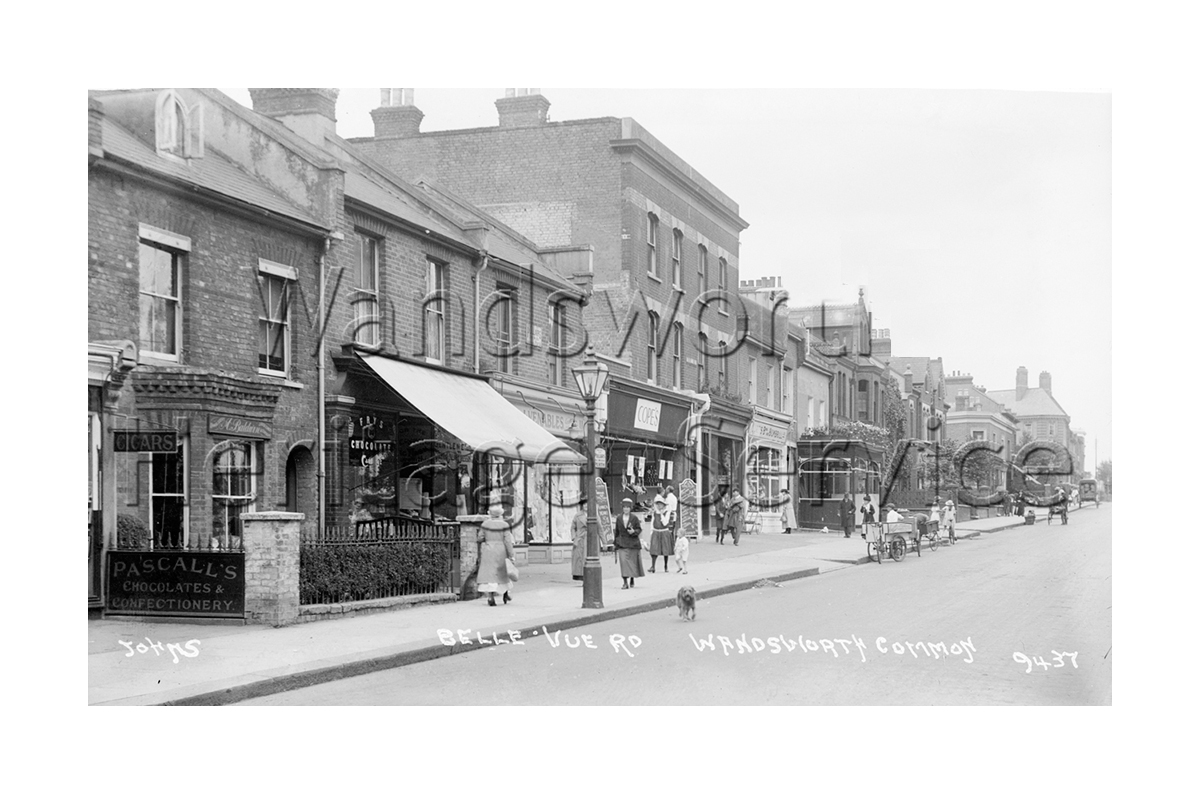
[PB: It would be good to identify and number all the other shops in this picture (which should also help us to date the photograph).
From left to right:
? "A Builders [no?]
Pascall's chocolates and confectionery shop [no?],
Venables
Cope's [12?],
[13?],
? [14],
? [15?],
? [16],
[9],
? newsagent/tobacconist [8], etc.]
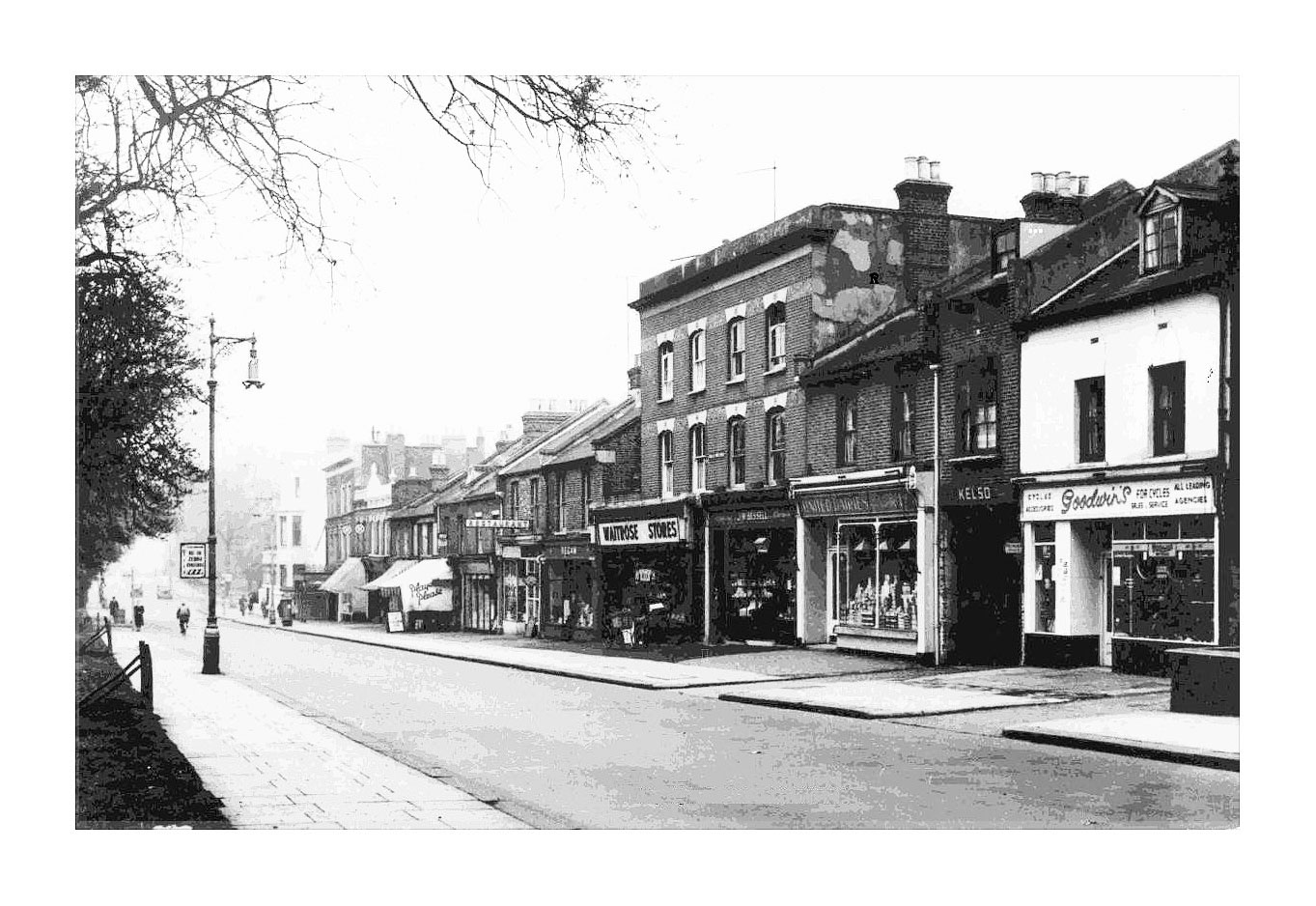
Notice we had our very own Waitrose at no.12. Photograph mid-1950s?
[PB: It would be good to identify and number all the other shops in this picture (which should also help us to date the photograph).
8 - ? newsagent/tobacconist
9 - ?
10 - ? restaurant
11 - ?
12 - Waitrose Stores
13 - ["Bessell"?]
14 - United Dairies
Bradley Mews? = Kelso?
15 - Goodwin's cycles
(Click on image to enlarge)
No.12 was once a Copes Store [grocery?]. At the end of WWII this was sold to Waitrose, the partners' newsletter [15 December 1945] reporting "Waitrose have now added two new branches. These were previously trading under the name of Copes Stores, and are situated at 33 and 35 Temple Fortune Parade, Golders Green and 12 Belle Vue Rd, Wandsworth Common. All of the staff connected with these businesses (of whom there are twenty) are continuing in the business, and we feel sure that all Partners will wish to extend a hearty welcome to them on joining the Partnership". Source: Link.
When did Waitrose sell up? In 2008 it was Rusts Supermarket, which became Rasons Supermarket in 2012.
13 Bellevue Rd [Bellevue Pharmacy]
From the 1880s this was Bessell's the Chemist. The Bessells (about whom Robert Trindle told me some unrepeatable anecdotes) were a local family and the shop remained in their hands until the 1980s, when it was taken over briefly by Herrods; for some years now it has been the Bellevue Pharmacy.
14 Bellevue Rd [Prestige Café]
Until 1930 this was a dairy belonging to Curtis Bros & Dunhill, who were cousins of the Millers [the butchers at no.2]. In 1930 it was taken over by United Dairies, who remained there until 1970, when it became a children's clothes shop, Pantalon & Chameleon. It is now the Prestige Café.
14a Bellevue Rd, Bradley Mews
This was formerly a yard containing a garage and car repair workshop. It was then empty for a while, and has now been redeveloped as Bradley Mews, containing five flats or maisonettes - one needs a code to get through the gate so I was unable to investigate.
15 Bellevue Rd, Smart Clinic
From 1881 until the second world war this was a butcher's shop; it then became an electrical shop and a "cycle agent". In the 1970s it was "Material Effects", an interior design and fabric shop. It was then a café, and is now occupied by a private GP and dental practice.
[So for nearly 100 years there were two butcher shops in the Rd.]
15a Bellevue Rd [The Courtyard]
This was originally a yard where the Millers kept their horses and delivery vehicles. It was then owned by Sutcliffe's, a firm of builders. There is now no access through the locked wooden gate, which is relatively new.
15 Bellevue Rd
The white house here is now a Dentist's. Through the archway to its right was a yard where Mr Miller the butcher kept his horses and delivery vehicles. Later it belonged to Sutcliffe's Builders, and is now known as "the Courtyard" - the wooden door is relatively new.
(Click on image to enlarge)
12 - ? with the white hanging cloth [what's the word?]
13 - ? grocer
14 - ?
15 - ? white house with fancy wrought iron pillars and balcony [same design as Chez Bruce's?]
16 - Dorrett & Martin photographer
16 Bellevue Rd
From 1900 to 1925 this house, with iron railings in front, was occupied by the photography firm Dorrett & Martin. The sign can be seen above the door in the picture above [SHOW]. They are responsible for having taken many of the old photographs now held in the Wandsworth Heritage Service archives, and the initials D & M can be seen in the bottom corner of some.
It then became the Rendezvous Restaurant until about 1950, after which it was briefly a dancing school and then a guest house. It is now a private house.
[PB: There's a date in a cartouche [if that's what it's called] at the top of the house - 1887? Photograph and show.]
17 Bellevue Rd [Oliver Contemporary Art Gallery]
[Find and add info about the Churzee GalleRy, which preceded Oliver Contemporary. It was set up by an artist, Cheryl Howeld, who lived next door, at no.18.
[From her website [2020]:
"Cheryl Howeld trained at Hornsey Art School in London in the early sixties. She went from there to being a regular exhibitor in the Mall Galleries and other galleries both in London and in the States. In 1988 she opened her own gallery beside her studio at Wandsworth Common. The Churzee Studio Gallery showed her own work alongside established and emerging artists, both English and International. Her artistic relationship with a group of Russian artists meant that Russian art was regularly shown...In 2016 Cheryl moved to Arundel, West Sussex."
[Source: CherylHowell.com (accessed 20.02.2020).]
[There's a date high on the building - 1866. Photograph and add.]
18 Bellevue Rd [POM clothes]
From 1916 until 1930 this was an optician's. It was then a private house for a number of years, and in about 2009 it became Siena Fashions, later Katie and Jo, and quite recently POM.
19 Bellevue Rd [Carter Jonas estate agents]
This was a private house until the 1930s, after which it was the Bellevue Garage, and later Althorpe Engineering. When they closed down, probably in the 1970s, it was taken over by Sullivan Thomas, estate agents, and is now occupied by another estate agent, Carter Jonas.
< Althorp Rd >
20 Bellevue Rd [The Althorp pub]
From 1870 this was a series of grocers', until 1950 when it became the Royal Arsenal Co-operative Society, who stayed there until 1970. It was then Holt's Wine Bar, and later Dexter's Wine Bar; since 2012 it has been the Althorp pub.
21 Bellevue Rd [Dog and Groom]
This was a bootmakers until 1925, when it became a chiropodist's (perhaps they were not very good bootmakers). From 1930 until the 1970s it was a series of ladies' hairdressers; in the mid 1970s Don, a partner in Don & Ron Barbers in Balham, moved to the shop. When he retired it became part of the Oddbins chain, and more recently (before 2016) it was Spirited Wines, part of the Nicolas chain. Very recently it has changed into a dog grooming supplies shop.
22 Bellevue Rd [Simple Interiors]
This was a greengrocer's until 1935, and then a hardware shop. In the 1970s it was Milton's Estate Agents, and later Jackson's Estate Agents. Following this it was empty for a while, before becoming Simple Interiors.
22b Bellevue Rd [Gardenia of London florists]
This was an antique shop until about 2010; it is now a florist's.
[PB: set back from other shop fronts.]
23 Bellevue Rd ("The White Lodge")
This is a private house - at one time it was lived in by Hugh Montefiore, the former Bishop of Kingston, but I'm not sure if it belonged to him or to the diocese; a good friend who knew him quite well is doing some research on this for me. In recent years it has undergone substantial alteration and redevelopment.
[PB: It was built recently, wasn't it - 2016?. It used to have spectacular lights at Christmas, suggesting falling golden snow. And who can forget the huge white cross on top (see the night panorama above). I don't recall any lights in 2019, though. My grandchildren were very disappointed.]
[SM: see the report of the death of HM.]
24 and 25 Bellevue Rd
These are two privately occupied houses, with steps leading up to the front doors. No. 24 has recently [2020?] been sold. At one time they formed the boundary between Wandsworth and Battersea.
[PB: Add a map etc this boundary, and perhaps on the road between Tooting and Battersea that once ran along it.]
Bellevue Parade [how does the numbering work? 26?
The site of these three shops was originally occupied by a large house with a garden. It was pulled down in the 1930s and became "Bellevue Parade", containing three shops: on the extreme left is now "Oliver's Lounge", next to it was for many years the "Lucky Parrot" but is now [2017] vacant, and on the corner the estate agents Knight Frank.
1, Bellevue Parade [Olivier's Lounge ladies clothes]
By the mid-1960s, (when I first lived here) this was Lionel Smith Removals; it was then Bellevue Interiors, and is now Olivier's Lounge. (Stephen has Siena as being here at some point, but I think they were at no. 18.)
2, Bellevue Parade [Lotus Spa beautician/health club]
Lionel Smith also had this as a general stores and hardware shop. He was followed by Penny's Hairdresser's, and after this it was the Lucky Parrot, a craft/gift etc shop. When the owner retired to Spain it became Tickled Pink, a similar type of shop. At the time of my original research [2017] it was vacant, and remained so for some time, but it has recently become Lotus Spa.
26 Bellevue Rd or 3 Bellevue Parade? [Knight Frank estate agents]
This was originally Randall Tools, and later a confectioner's. It then became Dean's Estate Agents, and is now another estate agent, Knight Frank.
< Wiseton Rd >
27 Bellevue Rd [Sainsbury's Local takes up 27-29]
On the corner of Wiseton Rd were originally two houses, which were demolished in 1915 to make room for the National Provincial Bank, later Natwest. When the bank closed the branch [approx date?] it became a branch of the Est Est Est restaurant chain for a while, and then another restaurant, Piccolino, before opening as a Sainsbury's Local.
Behind the bank on the right in Wiseton Rd [i.e. the Trinity Rd side] was Miller's slaughterhouse.
[PB: I recall that when the bank was transformed into a restaurant, everybody was amazed by the innovative use of immense seamless glass panels to create an external conservatory area by enveloping the arches of the old exterior walls. (This remains there today in the Sainsbury incarnation, but with nothing like the same visual impact. This is largely because the bottom metre or so of glass is now covered.)
The glassed-in area created a fine area for diners to see out over Bellevue and the Common, and for outsiders to see in. As a result, when it opened [approx. date?] you had to book weeks in advance to get a table in the window. Sadly, the company made the mistake of handing out crayons, which meant the rather fine stone surfaces, so recently cleaned, were soon covered in a thick waxy scrawl up to the height of about 2 metres. I was told that this layer proved very difficult even for specialist cleaners to deal with.
* The covering is a reproduction of an old map - which map? what area does it show?]
Which was the butcher's shop - was it 28?
The slaughterhouse in Wiseton Rd, with a shop front on Bellevue Rd.
(Click on image to enlarge)
Your Committee have also to report that they have had under consideration an application from Mr. Charles Newbury, of Hill-street, Walworth, for sanction to the establishment anew of the business of a Slaughterer of Cattle, at premises situate in Wiseton-Rd, Wandsworth-common.
The Slaughterhouse premises are attached to a new house and shop in Belle Vue-Rd [PB: which number was this - 27? 28?], but they abut upon and are entered from Wiseton-Rd, the houses in which are residential.
Your Committee have had before them a Memorial from some of the inhabitants of Wiseton-Rd, protesting against the establishment of a Slaughterhouse within a few yards of their residences.
Your Committee have viewed the premises, and find them to be well adapted to the business proposed to be carried on; and as they are enclosed by a wall, your Committee consider that the objections of the Memorialists will be sufficiently met by placing a trellis-work screen on the top of the wall. It will also be necessary to make an alteration as regards the poundage [PB: poundage?], and your Committee recommend:
That the application be granted, on condition that, prior to granting the formal sanction of the Board under Seal, the poundage be altered in accordance with the Board's conditions as to new Slaughterhouses; that a trellis-work screen, of a height of at least three feet, be constructed and placed on the top of the whole of the boundary-wall in Wiseton-Rd; and that the premises be altered and maintained, in all respects, in accordance with the conditions and Bye-laws of the Board.
(Click on image to enlarge)
29 Bellevue Rd [Sainsbury's Local takes up 27-29]
This was a children's dressmaker until 1940, when it became The Wool Shop, selling knitting wool and other items to do with sewing and knitting. It was then incorporated into Sainsbury's Local.
30 Bellevue Rd [Rampton Baseley estate agents]
Until 1913 the premises were occupied by a firm of builders, Johnson's. In 1915 Miss Warner moved her draper's shop here when no. 28 was demolished. In the 1920s she retired and the shop continued as Baldwins [as a drapers?]. It was then St James Laundry and a tobacconist's shop before being taken over by Compton Wallpapers during the 1970s. From about 2000 it was The Inside Man [gifts for men?], and it then became Rampton Baseley c.2014.
31 Bellevue Rd [Barnard Marcus estate agent]
This was a bakery from the 1930s; in the mid 1960s when I moved here it was the Bellevue Bakery.
It is now occupied by Barnard Marcus.
32 Bellevue Rd [Vacant]
This was Heaver Bellevue Estate Agents for a number of years, but I was unable to find out any earlier history. It has been empty for the past few months.
33 Bellevue Rd [Melissa Coupé - Skin, Face, Body]
This was a Coral's betting shop until probably the 1970s or 1980s, when Robert Trindle, an independent estate agent, took it over. By the time the "big boy" estate agents had arrived he decided to concentrate on private clients and gave up the shop. It then became Revamp Interiors, and has very recently become a beautician's salon.
[PB: Was Revamp Interiors.]
34 Bellevue Rd [Bonsai cafe]
The Estate agents on the right here, no.34, was for many years Sherrard's, a specialist clock and watch shop. A friend remembers how, as a child, waiting with her mother at the bus stop, she would be fascinated by all the different types of clock in the window. I believe that a member of the Sherrard family still lives, or did so until recently, in Wiseton Rd.
[PB: I wonder if they have any photographs of the shop?]
Since then Rymer Irens has gone and been replaced by the Bonsai Café.
35 Bellevue Rd [Brinkley's]
Surrey Tavern and Bellevue Rd, c.1910?
[The Surrey Tavern - once 35 Bellevue Rd, also numbered 172, Trinity Rd [1871?) now 226, Trinity rd...built around 1864...closed 2005..now Brinkley's...notice red brick on Trinity Rd side from Craig Telescope....]
(Click on image to enlarge)
[Info to follow]
[Pubwiki: Surrey Tavern - Census data etc - appears in ? as "172 Trinity rd"]
Acknowledgements
Jennifer Penny: With many thanks to Ron Elam, Susan Nollet, Robert Trindle.
Links and further information
THIS IS AN EXPERIMENT - HOW BEST TO PUT TABLES UP ONLINE
Links to references to Bellevue in gentrification studies e.g. UCL, AS level et.
Word document: Bellevue House Numbers (Stephen Midlane's list 27 Feb 2020).
pdf document: Bellevue House Numbers (Stephen Midlane's list 27 Feb 2020).
Webpage: Bellevue House Numbers (Stephen Midlane's list 27 Feb 2020).
TO ADD
(Click on image to enlarge)
. . . here is St James's Drive . . .
. . . here is Althorp Road . . .
. . . here is Wiseton Road . . .
. . . here is Trinity Road . . .