HISTORY OF
WANDSWORTH COMMON
Added 12.4.2019
IN PROGRESS — NOT FOR PUBLICATION
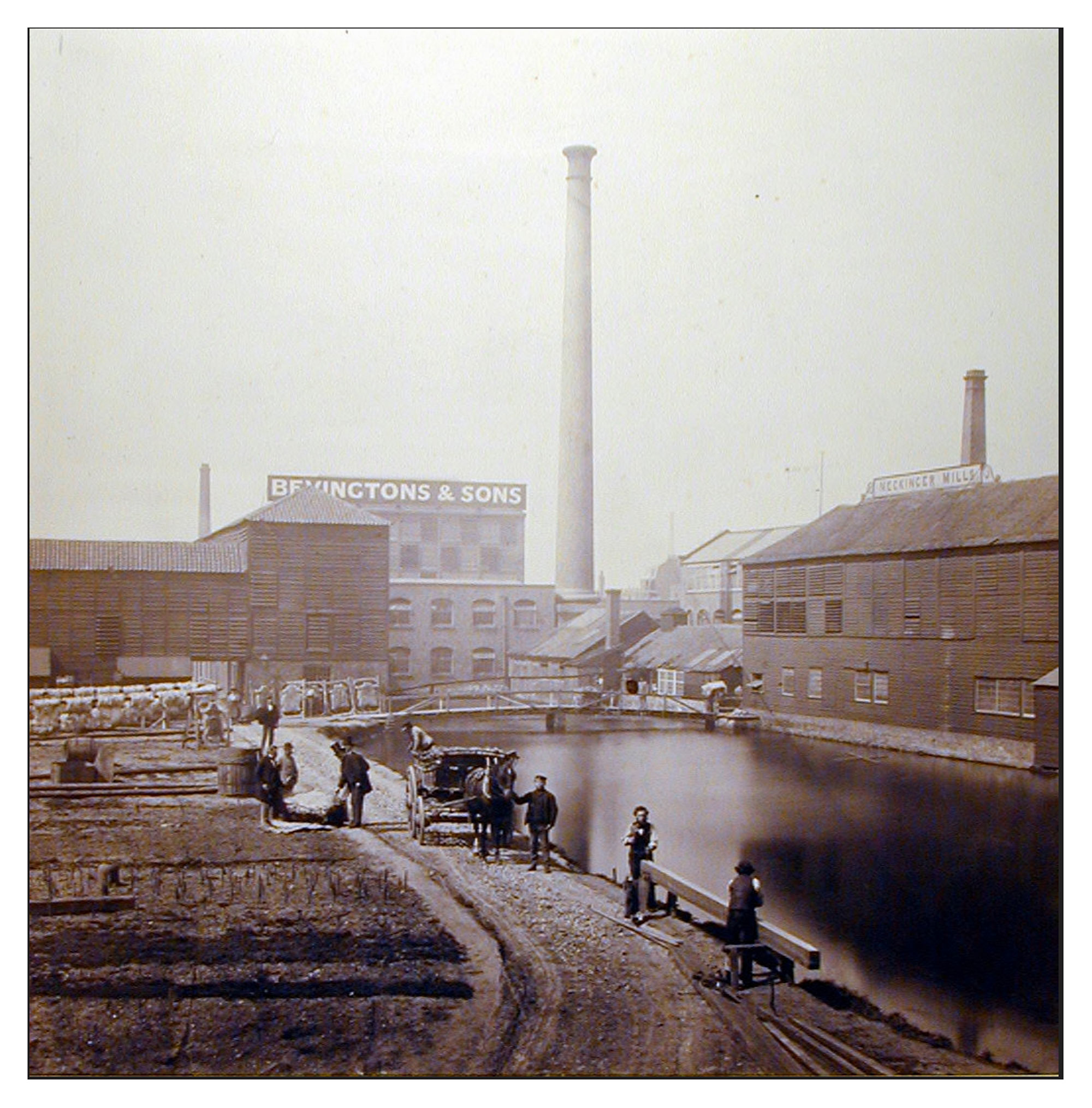
Bevingtons & Sons, Neckinger Mills, c.1862.
[Probably photographed by Geoffrey Bevington, c.1862. See the high-resolution version in the Amica/David Rumsey collection here.]
(Click on image to enlarge)
Bevingtons & Sons Leather Manufactory, Neckinger Mills, Bermondsey
Bevingtons and Sons
Bevingtons and Sons Limited, leather merchants and manufacturers were based at Neckinger Mills, Bermondsey, Southwark. The Bevington family were Quakers originating from Warwickshire and neighbouring Gloucestershire and had been associated with tanning since at least the mid-seventeenth century. For most of its history, the leather industry was in the hands of numerous family firms, of which Bevington and Sons Limited is recognised as a significant example.
By 1795 operations had been established under Samuel Bevington Senior at the former site of Neckinger Paper Mills. . . . At the Neckinger Mills factory, Bevington and Sons produced and dealt in a wide range of leathers and leather goods, such as gloves. Products were made from foreign and domestic skins including kid, lamb, sheepskin and fine seal-skins. Light leathers, such as Morocco, were produced for making shoes and fancy goods.
[London Metropolitan Archives. See below for longer quotation and source.]
Geoffrey Bevington, Finishing Skivers and Persians for Hats
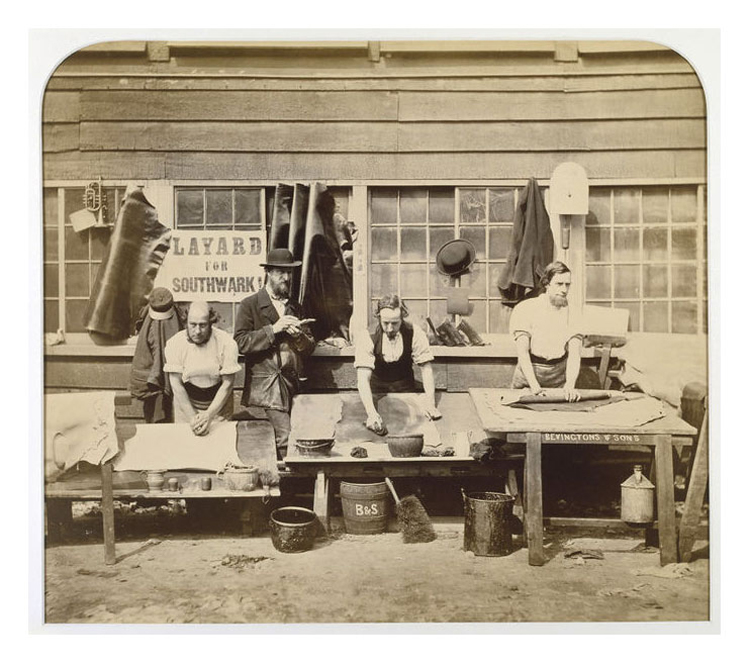
Finishing Skivers and Persians for Hats
[Copyright V&A]
(Click on image to enlarge)
This image is also recorded on the Museum of London website:
A Photograph recording the process of manufacturing leather, as produced by Bevington & Sons, Neckinger Mills, Bermondsey and St. Thomas's Street, Southwark, London. Three men are shown at work finishing skivers and persians for hat linings and boot making. Photographed outside the factory building. An overseer stands behind the working men. Tools and equipment lie in the foreground. An election bill poster hangs on one of the windows calling 'Layard for Southwark!'. Bevington & Sons Leather Manufactory was established in 1795. A young 23-year-old Geoffrey Bevington, a keen amateur photographer, recorded the scene and others for display on the firm's stand at the 1862 International Exhibition in South Kensington.
[Source: Museum of London: Geoffrey Bevington, ]Manufacturing leather, at Bevington & Sons; c.1875 (accessed 20.4.2019).]
"Layard for Southwark" and the dating of the photograph
The ML notes say c.1875, which may be a decade or more too late - GB died in 1872. Could the "Layard for Southwark" poster be dated? There were General Elections in 1859 [was 1860 a by-election?], 1865 and 1868. Layard was Liberal MP for Southwark December 12, 1860 - February 16, 1870. [Hansard: Mr Austen Layard. The poster could have been in place for some years, but this seems unlikely.
[Austen Henry Layard (1817-1894), author, art historian, archaeologist and collector] was elected for Southwark in 1860, and from 1861 to 1866 was Under-Secretary for Foreign Affairs in the successive administrations of Lord Palmerston and Lord John Russell. After the Liberals returned to office in 1868 under William Ewart Gladstone, Layard was made First Commissioner of Works and sworn of the Privy Council. Layard resigned from office in 1869, on being sent as envoy extraordinary to Madrid.
[Source: Archinform: Sir Austen Henry Layard (accessed 21.4.2019).]
In addition to proclaiming the Bevingtons' Liberal political allegiance, the Layard poster may also be hinting that the family was also interested in archeology and art - Layard had excavated Nineveh and Nimrud and was a well-known art collector.
See e.g.
- WikipediaL Austen Henry Layard
- An Art World Insider: Austen Henry Layard and the Nineteenth-Century European Art Trade (pdf).
- National Gallery Austen Henry Layard
In addition to his myriad other accomplishments Layard had also been a soldier in the Crimea. Did this also connect him to Samuel Bevington, who Geffrey Bevington photographed as an army major at this time? Samuel went on to set up the 3rd V.B. The Queens Royal West Surrey Regiment. [Follow up in Harts New Army Lists etc? Also Wikipedia: Queen's Royal regiment (West Surrey).]
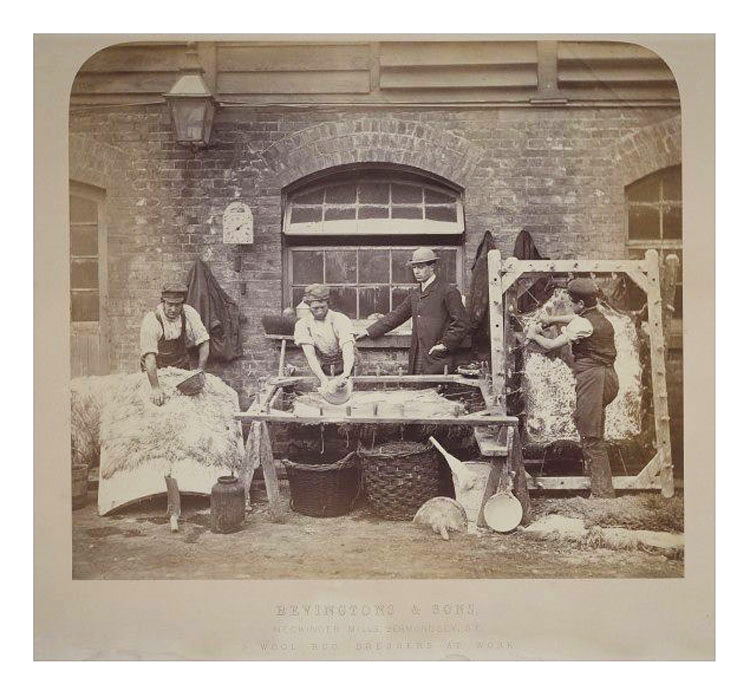
Geoffrey Bevington, Three Wool Rug Dressers at Works [check this is the right image & title]
[Copyright V&A]
(Click on image to enlarge)
Museum of London listing:
The process of manufacturing leather, as produced by Bevington & Sons, Neckinger Mills, Bermondsey and St. Thomas's Street.
Two men and two younger boys are shown at work splitting the sheep skins for skiver and chamois leather, outside the factory building. A pile of skins lie in the foreground. Bevington & Sons Leather Manufactory was established in 1795. A young 23 year old Geoffrey Bevington, a keen amateur photographer, recorded the scene and others for display on the firm's stand at the 1862 International Exhibition in South Kensington.
[Source: https://www.museumoflondonprints.com/image/750785/geoffrey-bevington-splitting-sheep-skins-for-skiver-and-chamois-leather-c-1885]
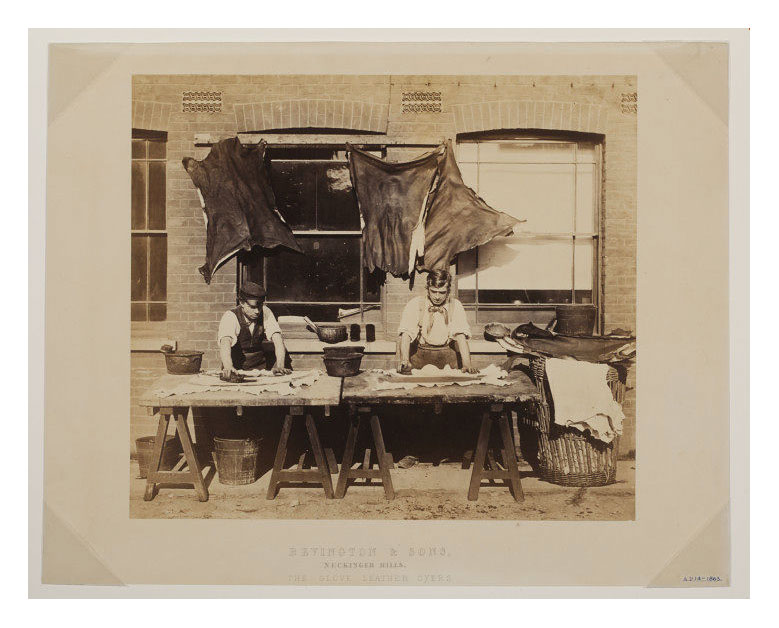
Geoffrey Bevington, "Leather Workers" [title?]
[Copyright V&A]
V&A: Leather tanning at Geoffrey Bevington and Sons: "Photograph of two leather workers tanning hides. They are working on tables outdoors with skins hanging behind them." PB: Why "Geoffrey Bevington and Sons"? Why "unknown photographer"? Some confusion at the VandA, I think.
(Click on image to enlarge)
Geoffrey Bevington, "Bevington & Sons Tannery (Curriers and Shavers at Work)", 1862
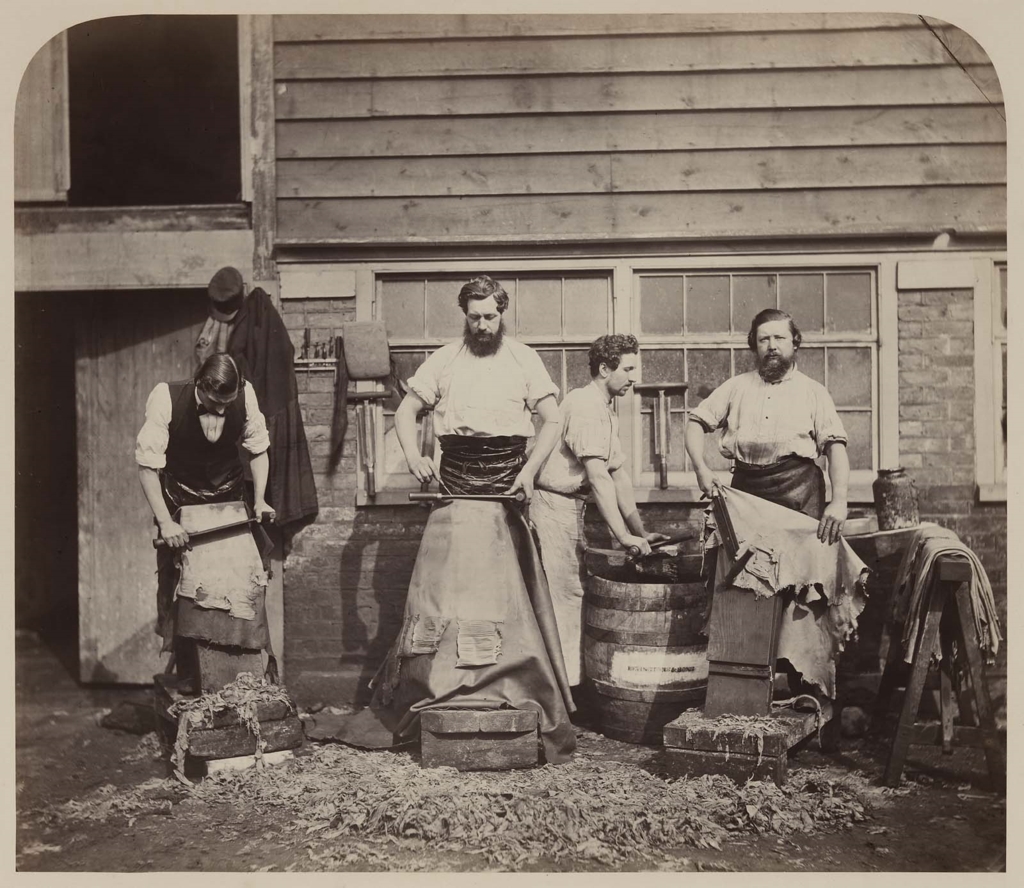
Geoffrey Bevington, "Bevington & Sons Tannery (Curriers and Shavers at Work)", 1862
[Museum of Fine Arts, Boston, USA. Also V&A.]
(Click on image to enlarge)
Henry Mayhew on Bermondsey's army of "Pure-Finders" - collectors of dog dung, a vital ingredient in the tanning of hides
Bermondsey was notoriously nineteenth-century London's smelliest district, largely because of the leather factories that clustered there. No wonder the Bevingtons moved out to salubrious Wandsworth Common. [Incidentally, what does Roy Porter, Social History of London, who grew up in Bermondsey, say about the area?]
Dogs'-dung is called 'Pure', from its cleansing and purifying properties. The name of 'Pure-finders,' however, has been applied to the men engaged in collecting dogs'-dung from the public streets only, within the last 20 or 30 years.
The pure-finders meet with a ready market for all the dogs' dung they are able to collect, at the numerous tanyards in Bermondsey, where they sell it by the stable-bucket full, and get from 6d. to 10d. per bucket, and sometimes 1s. and 1s. 2d. for it, according to its quality. The 'dry limy-looking sort' fetches the highest price at some yards, as it is found to possess more of the alkaline, or purifying properties; but others are found to prefer the dark moist quality.
Strange as it may appear, the preference for a particular kind has suggested to the finders of Pure the idea of adulterating it to a very considerable extent; this is effected by means of mortar broken away from old walls, and mixed up with the whole mass, which it closely resembles; in some cases, however, the mortar is rolled into small balls similar to those found. Hence it would appear, that there is no business or trade, however insignificant or contemptible, without its own peculiar and appropriate tricks.
From all the inquiries I have made on this subject, I have found that there cannot be less than from 200 to 300 persons constantly engaged solely in this business. I have stated that some of the pure-finders, especially the men, earn a considerable sum of money per week; their gains are sometimes as much as 15s.
The pure-finder may at once be distinguished from the bonegrubber and rag-gatherer; the latter carries a bag, and usually a stick armed with a spike, while he is most frequently to be met with in back streets, narrow lanes, yards and other places, where dust and rubbish are likely to be thrown out from the adjacent houses. The pure-finder, on the contrary, is often found in the open streets, as dogs wander where they like. The purefinders always carry a handle basket, generally with a cover, to hide the contents, and have their right hand covered with a black leather glove; many of them, however, dispense with the glove, as they say it is much easier to wash their hands than to keep the glove fit for use.
- https://windowthroughtime.wordpress.com/tag/pure-finder/
- https://everything2.com/title/Pure+finder
- Southwark Heritage: Search: Bevington
- Southwark Heritage: Search: Neckinger Mills
- Trace artwork: Tracing the history of Neckinger Mills (2005)
- British Listed Buildings: Neckinger Mills: A Grade II Listed Building in Southwark, London.
- FamLoc [?]: Image of the Leather Exchange, Bermondsey
- Historic England: Neckinger Mills
- Exploring Southwark: Bevingtons and Sons
- Bermondsey Boy: http://bermondseyboy.net/viewtopic.php?t=340
- National Archives: https://discovery.nationalarchives.gov.uk/details/r/9778f528-a557-4e39-8650-34e2439142a0
- A London Inheritance: A Private History of a Public City: A Return to Bermondsey Wall - Bevington Street etc [v. interesting tour of the area, with numerous maps and then-and-now photographs].
- The Guardian: David McKie, "A blight on Bermondsey" (8.3.2007).
- Infed: Exploring social action: A walk in Bermondsey and Rotherhithe (accessed 21.4.2019). PDF here.
- Exploring Southwark: Bevingtons and Sons (pdf)(/li>
- London Metropolitan Archives: BEVINGTONS AND SONS LIMITED {LEATHER MANUFACTURERS}, 1690 - 2001
Links to follow up
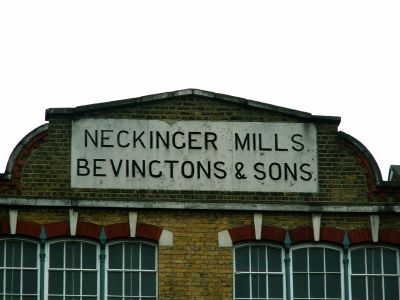
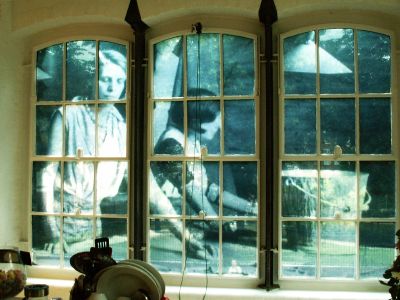
"Trace is a site-specific installation across the first floor windows of Neckinger Mills in Abbey Street recalling the female workers who played a key role in the building's past."
(Click on image to enlarge)
Archive
Anyone who wants to do serious work on the Bevingtons will have to explore the LMA. There are intriguing references to a book: "'Bevingtons & Sons Ltd, 1795-1995' by Geoffrey Bevington, published by Bevington and Sons, 1991" [I have also seen a reference to "Bevington, G. (1993). Bevingtons & Sons Bermondsey 1795 - 1950. Exeter, Short Run Press Ltd." But sadly no second-hand copy appears available. [There is Google Books link, but neither an eBook nor any physca cpy was available 21.4.2010. Shame.]. Also to extensive family correspondence:
"Correspondents include women in the family, as wives and daughters of the company partners. Accounts for female family members are also represented." Somewhere or other I came across something about how the company had bought a lot of photographic equipment for (the C19) Geoffrey Bevington.
Bevingtons and Sons Limited, leather merchants and manufacturers were based at Neckinger Mills, Bermondsey, Southwark. The Bevington family were Quakers originating from Warwickshire and neighbouring Gloucestershire and had been associated with tanning since at least the mid-seventeenth century. For most of its history, the leather industry was in the hands of numerous family firms, of which Bevington and Sons Limited is recognised as a significant example. By 1795 operations had been established under Samuel Bevington Senior at the former site of Neckinger Paper Mills. At this time his son Samuel Bourne Bevington was based in Yeovil, Somerset, another area associated with the leather industry.
From 1802, following the death of Samuel Bevington Senior, his sons Samuel Bourne, Henry, Richard and Timothy Bevington continued as partners in the family business. At the Neckinger Mills factory, Bevington and Sons produced and dealt in a wide range of leathers and leather goods, such as gloves. Products were made from foreign and domestic skins including kid, lamb, sheepskin and fine seal-skins. Light leathers, such as Morocco, were produced for making shoes and fancy goods. The company also had premises in Saint Thomas' Street, Bermondsey and in Cannon Street, City of London. The family had a home at 34 Gracechurch Street, City of London. Later business premises included Hawley Mills, Dartford, Kent. The now dissolved public limited company of Bevington and Sons (Neckinger) Limited was incorporated on 6/11/1931.
Members of the Bevington Family have been admitted to the Worshipful Company of Leathersellers. James Geoffrey Bevington, partner from 1927, became the last remaining member of the Bevington Family in the firm. The company moved to Leicester in 1980. As of 2012, Bevington Specialist Leathers exists as a division of Milton Leicester Ltd, North Street, Wigston, Leicester.
For further details see 'Bevingtons & Sons Ltd, 1795-1995' by Geoffrey Bevington, published by Bevington and Sons, 1991. Held in City of London Library Collection (Closed Access Pam 22433). An edition is also available in this collection (ACC/1616/G/01/004).
Records of Bevington and Sons, 1690-2001, including: partnership agreements, 1837-1946, minutes, 1859-1930, and partnership negotiations; financial records 1803-1949; records relating to types of stock, products and technical processes and innovations, 1879-1946; staff attendance books and
photograph album, 1860-1877 ; records relating to property, 1792-1967; records relating to stock and finance, 1862-1946.Also family correspondence 1690-1837, and publications and articles on the history of the firm. The family correspondence offers insights into business practice, family relationships and domestic concerns, often in a single letter. Correspondents include women in the family, as wives and daughters of the company partners. Accounts for female family members are also represented.
— In Search of Geoffrey Bevington (1838-1872) [start here]
— Geoffrey Bevington's Photograph Album in the V&A
— Portraits of Geoffrey Bevington
— Ivy House, Wandsworth Common
— Bevingtons and Sons Leather Manufactory, Neckinger Mills, Bermondsey
— Samuel Bourne Bevington [GB's big brother] (1832-1907) [Who's Who of the fight over enclosure]