A HISTORY OF
WANDSWORTH COMMON
Added 12.4.19
IN PROGRESS — NOT FOR PUBLICATION
In search of
Geoffrey Bevington (1838—1872)
(and his illustrious brother Samuel)
(Click on image to enlarge)
Until a couple of months ago [i.e. January 2019], I hadn't even heard of Geoffrey Bevington. Then I came across a couple of references on Greg Smye-Rumsby's awesome — sorry, I can't think of a better word — website devoted to "London's Lost Leviathan" of the 1850s, the Craig Telescope.
GSR had acquired numerous engravings, plans and artists' impressions, but for years had failed to find a seeing-is-believing photograph of this extraordinary structure, which seemed odd. A 19.5 metre (64-foot) high brick tower, the largest refractive telescope in the world at the time, was quite a spectacle. Surely photographers would have swarmed to Wandsworth Common to commemorate it in their new medium? But apparently not.
In the absence of a photograph, GSR and colleagues continued to accumulate detailed information, conduct excavations, and promote wider public knowledge about the telescope. Which itself brought about a remarkable find. His website records the moment:
" . . . the articles about searching for the telescope's remains made in the summer of 2003, provoked a marked interest in the local community of Wandsworth and it seems that some were moved to look in their own family albums. On 6th January 2004, the Craig Telescope Project Director's birthday, an email was received saying a photograph did exist!"
And here it is:

Geoffrey Bevington's photograph of the Craig Telescope on Wandsworth Common, unknown date [PB: 1862-64?]. Courtesy Bridget Bishop.
"Despite its tiny size, only being about 60mm on a side, it showed remarkable detail right down to the individual bricks . . . We know it was taken by Geoffrey Bevington in the mid-1850s [sic]. He lived at Ivy House, not far from this part of the Wandsworth Common. He was an accomplished amateur photographer."
(Click on image to enlarge)
" . . . His albums, now in the possession of his great-great-great niece, Bridget Bishop, contain many examples of his beautiful work. It is easy to see the effort that went into each and every photograph, lovingly capturing all aspects of Victorian life.
"His photograph of the Craig Telescope borrows much on his skills as an early pioneering photographer, for aspects of the image reveal something of the equipment used. Notice, for example, how the tower does not taper as it would in a simple camera. Bevington must have been able to skew his camera lens independently from the negative holder. This simple fact shows that he not only had some fairly sophisticated equipment, but that he also knew how to use it and use it well."
[Source: www.Craig-Telescope.co.uk/Photos (accessed 14.4.2019).]
References to Geoffrey Bevington on the Craig Telescope website:
— http://www.craig-telescope.co.uk/photos.html. The most extensive discussion.
— www.craig-telescope.co.uk/builders.html. A brief mention.
— www.craig-telescope.co.uk/site_positions.html. An analysis of how various images and maps suggested specific locations for the Craig Telescope (Beard Engraving date, Sargent Painting 1852, Diamond Photograph 1853, Bevington Photograph 1855 [PB: date?].
— www.craig-telescope.co.uk/telescope.htm.
But fascinated as I was by GSR's discovery I was even more excited by the thought that there might be further Geoffrey Bevington photographs of Wandsworth Common — perhaps even hundreds of them.
So who was Geoffrey Bevington, and where could I look for more of his photographs?
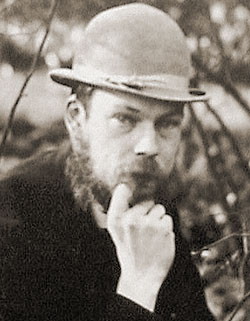
GSR mentions that Geoffrey Bevington lived at Ivy House, Wandsworth Common, and he provided a portrait (above). But before I contact GSR, and perhaps Bridget Bishop, I thought I'd do some scoping of my own. Inevitably I started with Google.
There were very few references to GB, but one was in a brief entry in John Hannavy's Encyclopedia of Nineteenth-Century Photography: A-I. This is all it says:
"Geoffrey Bevington managed to produce convincing photographic illustrations of workers engaged in their occupations in the 1860s."
Not much to go on. Here is the kind of scene Hannavy is referring to:
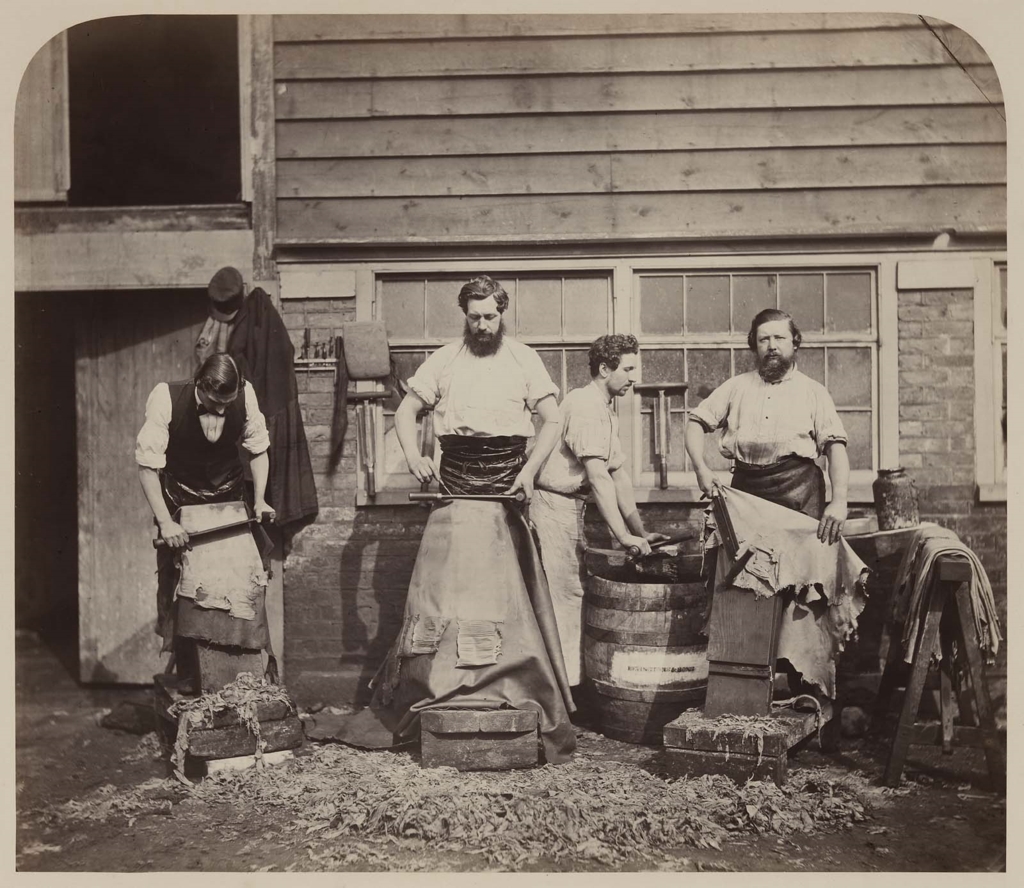
Geoffrey Bevington, "Bevington & Sons Tannery (Curriers and Shavers at Work)", 1862
[Museum of Fine Arts, Boston, USA. Also V&A.]
(Click on image to enlarge)
Plant photographs
A number of his photographs of plants can be found on the websites of major collections. For example:
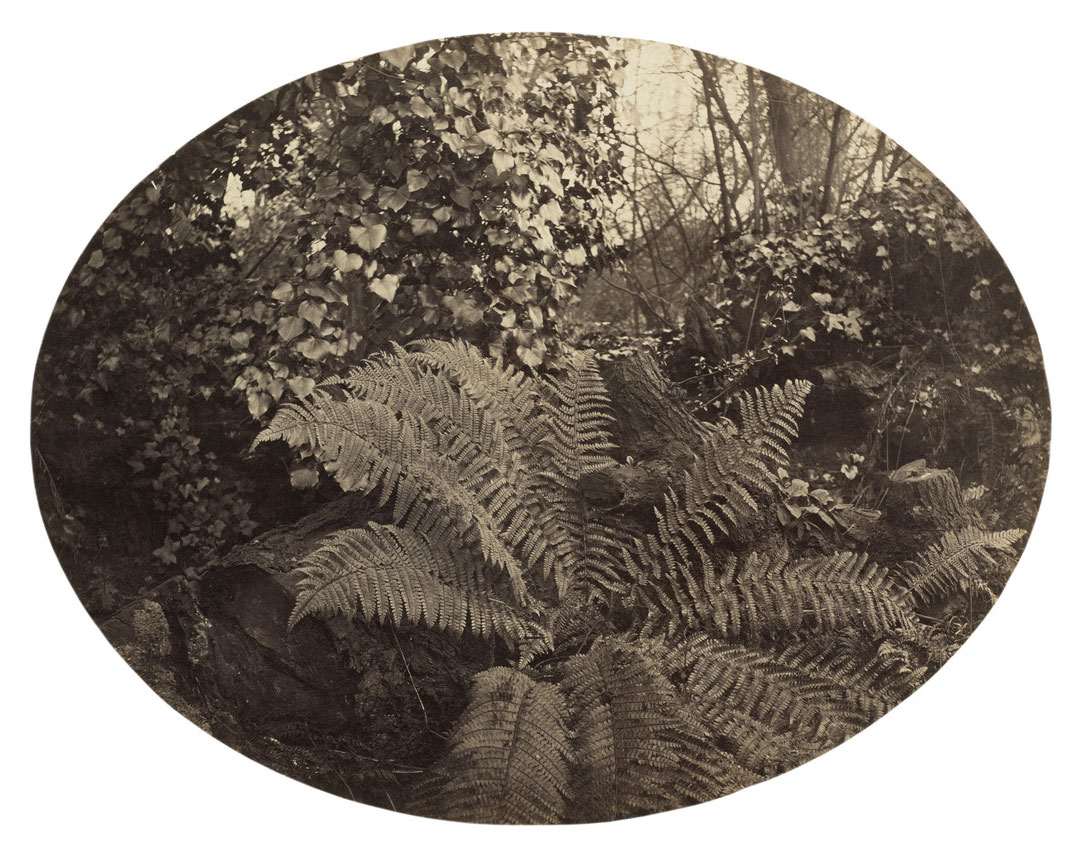
Geoffrey Bevington, Winter Fronds of the Prickly Fern, ca. 1862.
[National Gallery of Art, Washington, DC. Also in the GB album/V&A. It seems likely this was take in the garden of his home at Ivy House, Wandsworth Common.]
(Click on image to enlarge)
Geoffrey Bevington, Winter Fronds of the Prickly Fern, ca. 1862
Albumen print
7 5/16 x 9 7/16 in
18.6 x 24 cm
Permanent collection
National Gallery of Art, Washington D.C.
[Source: National Gallery of Art, Washington D.C., Geoffrey Bevington, 'Winter Fronds of the Prickly Fern', ca. 1862 (accessed 21.4.2019).]
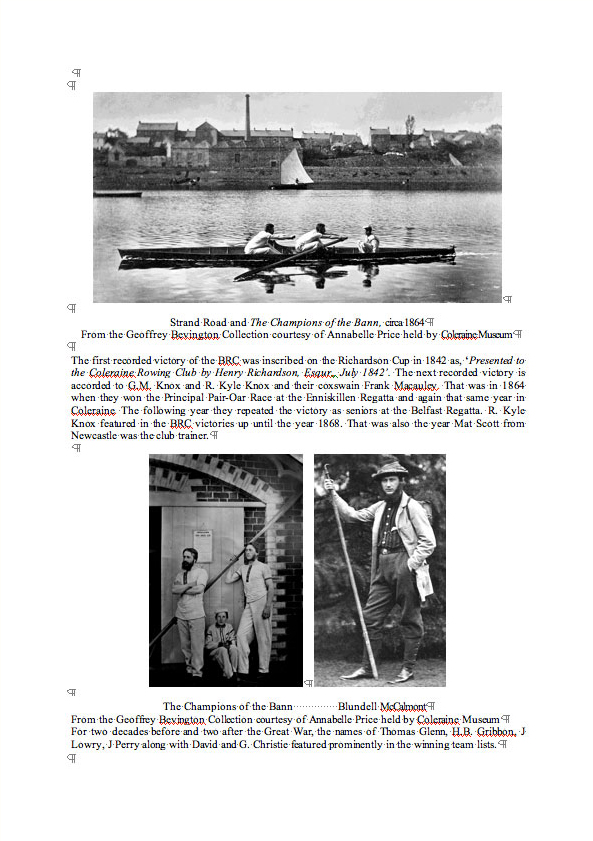
I also found a photograph by GB of croquet on a lawn in Wandsworth (which I'll show on another page) and rowing on the River Bann, Coleraine, Northern Ireland. Intriguing.
Geoffrey Bevington, A figure on a country lane, June 1868.
[Source: Bann Rowing Club: History (doc).]
(Click on image to enlarge)
GB as painter
Also online, I came across an example of a painting by GB that came up for auction at Bonham's in 2005.
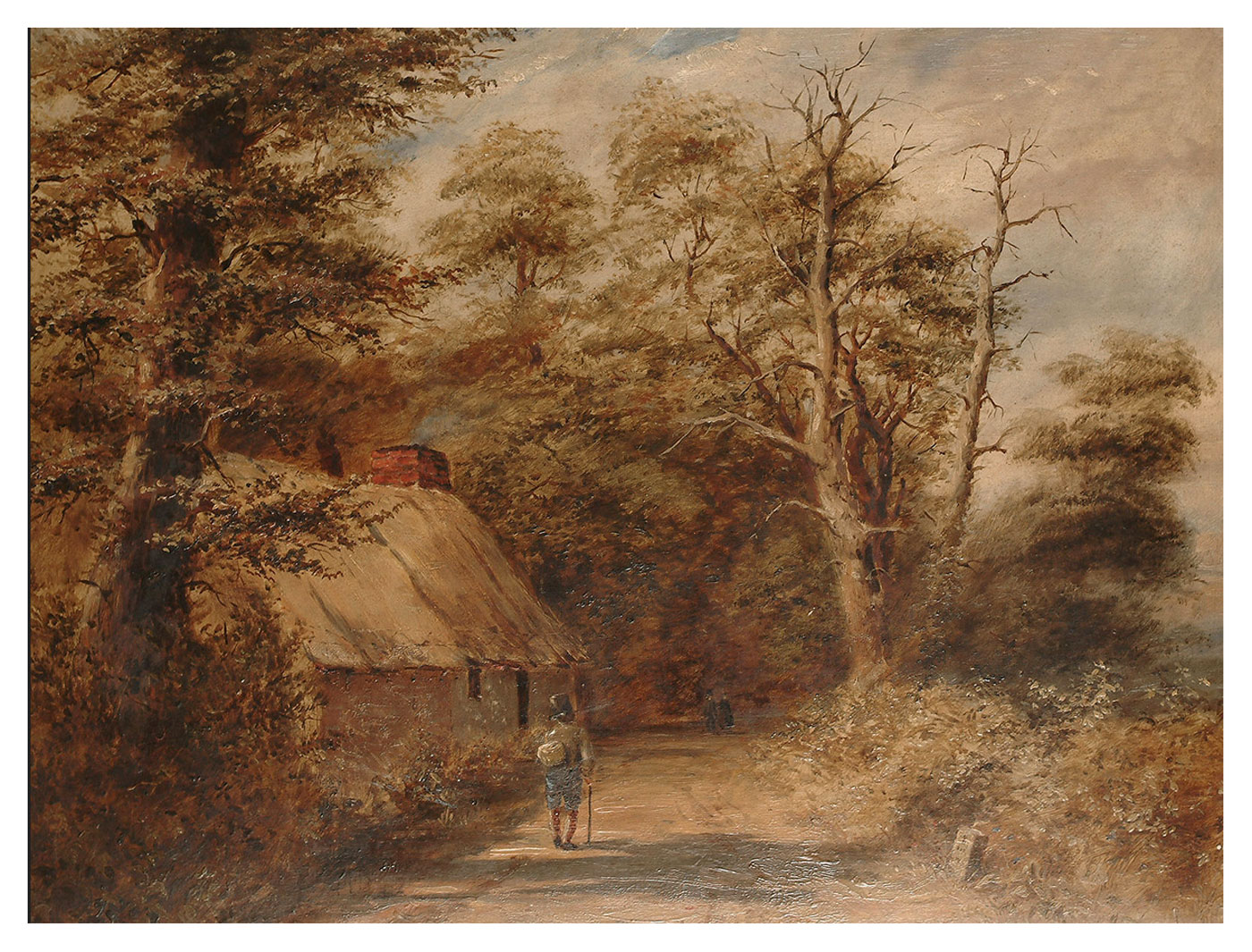
Geoffrey Bevington, A figure on a country lane, June 1868.
(Click on image to enlarge)
English School, 19th Century: A figure on a country lane, oil on board, signed 'Geoffrey Bevington' and dated 'June 1868' verso, oil on board, 34.2 x 44.4 cm (13 1/2 x 17 1/2 in. Estimate £300-500.
[I do not know how much it fetched.]
Incidentally, the painting bears a passing resemblance to John Westell painting "Tollgate in a Wood" (ArtUK/St Albans Museums), said to be painted 1856, around the same time that Geoffrey was painting. Was he perhaps a friend of the family? Did he instruct GB? Westell painted a number of pictures of Wandsworth Common and Tooting Common, but these are dated much later, in the 1880s and 1890s. [Check for possible connections.]
There are three of Westell's Wandsworth paintings on the ArtUK website: John Westell.
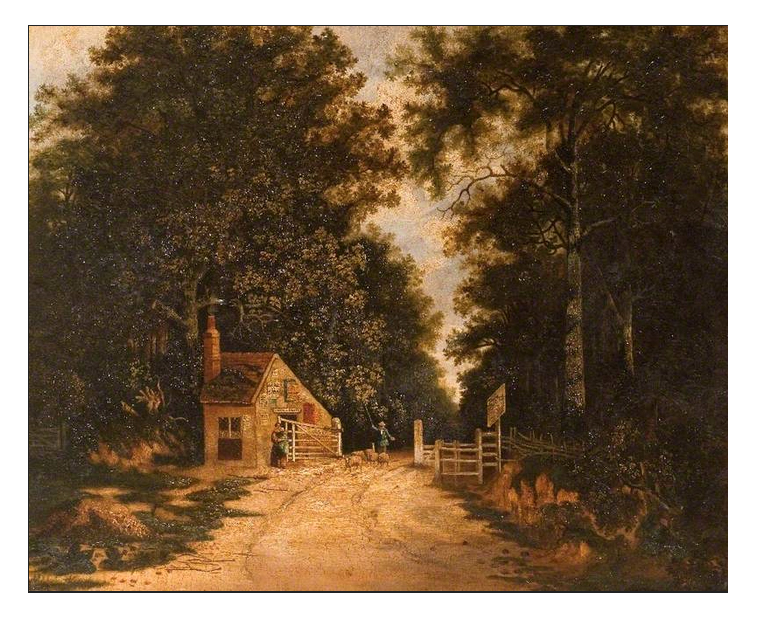
John Westell's 1856 painting "Tollgate in a Wood" (ArtUK/St Albans Museums)
(Click on image to enlarge)
I search the V&A Archive
The obvious next port of call was the V&A collection.
Initial results were spectacular. There were 810 entries on more than 50 pages of the V&A image database. Eight hundred and ten photographs! But my excitement couldn't last long, because this is what most of the pages looked like:

(Click on image to enlarge)
Click on any image, and this opened up:
(Click on image to enlarge)
In short, not so good. Plus there seemed some confusion in the catalogue about whether "Geoffrey Bevington" was a photographer, or the owner of a leather tannery — "Geoffrey Bevington and Sons".
But then something rather interesting happened.
True, only a tiny number of GB's photographs were shown (only five were relevant), which was disappointing. But on the other hand the immense number of images in the V&A archive suggested a different explanation — that the V&A might not have got round to digitising and cataloguing them yet.
And this turned out to be the case. I phoned and was told that a collection of hundreds of images had been assembled into a substantial album after Geoffrey Bevington's death. The album had been donated to the V&A in 2016. But the good news was that the album had now been conserved and was available to view. I could visit the department and view the album for myself the following day.
How could I resist?
— Geoffrey Bevington's Album in the V&A
Notes added since 25 April 2019
— There are no references to GB on ArtUK.org, which catalogues all paintings in public institutions.
— University of Glasgow: Special Collections: Material relating to Geoffrey Bevington . Lists but does not illustrate 3 marine-themed photographs by GB collected by R O Dougan, with the comment: "Geoffrey Bevington, fl 1864, Member of the Amateur Photographic Association. No further information found."
— GB and Pre-Raphaelite painting
I wonder whether GB had been inspired by Pre-Raphaelite painting. His photographs of small groups workers ranged across the image reminded me of Millais's Christ in the House of His Parents ('The Carpenter's Shop'), 1849-1850:
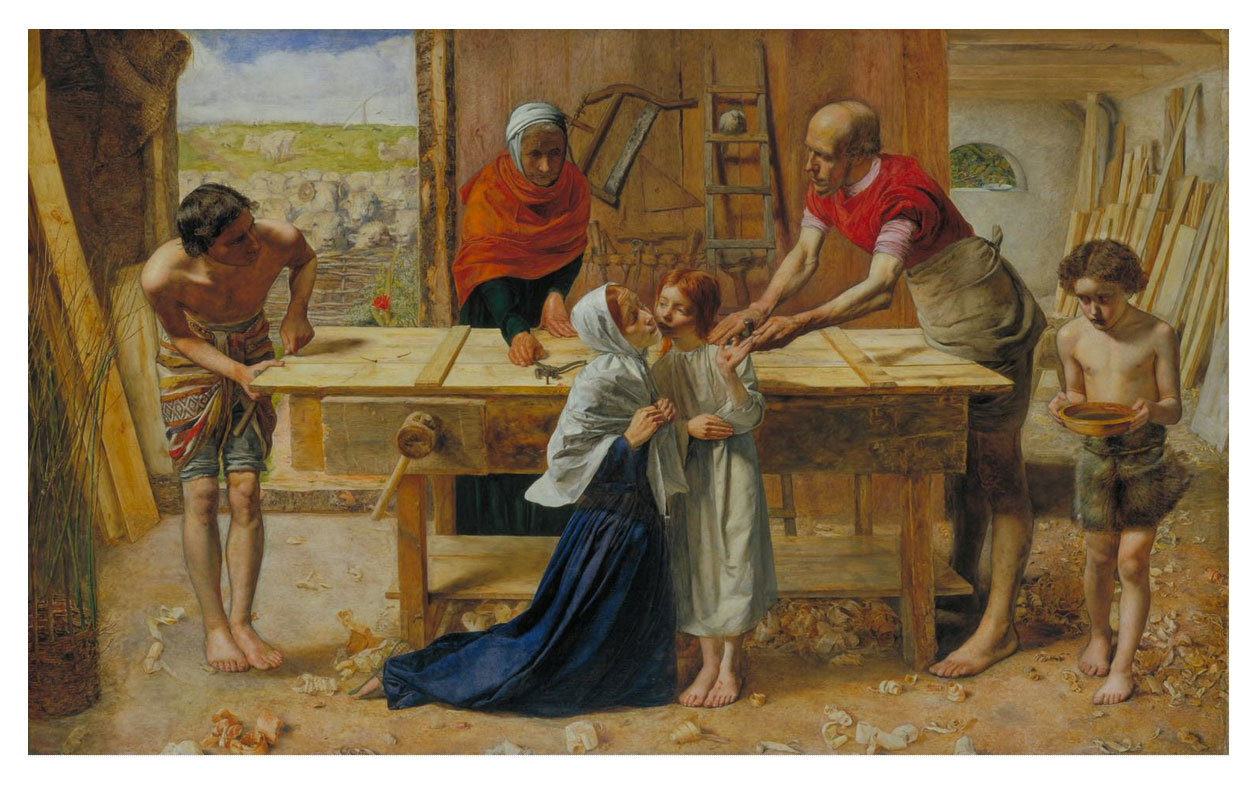
[Source: Tate Gallery: Sir John Everett Millais: Christ in the House of His Parents ('The Carpenter's Shop').], 1849-50
(Click on image to enlarge)
Pre-Raphaelites and photography
At least one of GB's photographs ("Prickly Fern", shown above) was singled out for comment in a review of a travelling exhibition: The Pre-Raphaelite Lens: British Photography and Painting, 1848-1875, "a concise and handsome exhibition that addressed an ambitious topic: the dynamic interaction between artistic media from the late 1840s until the 1870s". It is possible other photographs by GB were included in the exhibition, or the exhibition catalogue.
From Morna O'Neill's review:
"Photography's emphasis on the accurate depiction of details introduced new ways of seeing and representing the world". Pre-Raphaelite artists, including John Everett Millais, William Holman Hunt, and Dante Gabriel Rossetti, who were all represented in the exhibition, resisted the conventions of established artistic practice. As the exhibition demonstrated, photography played a vital, yet often unacknowledged, role in this resistance . . .
The exhibition was primarily a photographic one, focused on what might be termed British "art photography" of the 1850s and 1860s, in order to distinguish it from the more utilitarian and commercial uses of the medium. It boldly combined the one hundred photographs on display with twenty paintings across five galleries that engaged in a dialogue: what did Pre-Raphaelite painters learn about vision and pictorial truth from the photograph? And what did photographers learn about vision and pictorial truth from Pre-Raphaelite painting? . . .
Pre-Raphaelite visuality . . . heeds John Ruskin's vehement call for "modern painters" to study nature "rejecting nothing, selecting nothing, and scorning nothing" . . .
"Ruskin advocated a radical lack of selectiveness" that approximated the logic of the camera: cropping, framing, lighting effects, and even the close-up evident in Ruskin's own watercolors. Ruskin's theories, in turn, "profoundly shaped photographic practice". Geoffrey Bevington's radically cropped albumen print Winter Fronds of the Prickly Fern (1862) revels in the details of the fern leaves in the same way that Ruskin's own daguerreotype (executed with Frederick Cawley) of Bellinzona, Switzerland, Sheer Rock Face (ca. 1858) ignores the conventions of Alpine scenery in favor of the close-up, the fragment, the detail.
June 23, 2011
Diane Waggoner, ed.
The Pre-Raphaelite Lens: British Photography and Painting, 1848-1875
Exh. cat. Washington, DC and Aldershot, UK: Lund Humphries in association with National Gallery of Art, 2010. 240 pp.; 198 color ills.; 3 b/w ills. Cloth $65.00 (9781848220676)
Exhibition schedule: National Gallery of Art, Washington, DC, October 31, 2010-January 30, 2011; Musee d'Orsay, Paris, March 6-May 29, 2011
Morna O'Neill
CrossRef DOI: 10.3202/caa.reviews.2011.71
[Source: CAA reviews: Morna O'Neill, Review of Diane Waggoner, ed. The Pre-Raphaelite Lens: British Photography and Painting, 1848-1875
The Great Irish Famine, 1845-1849
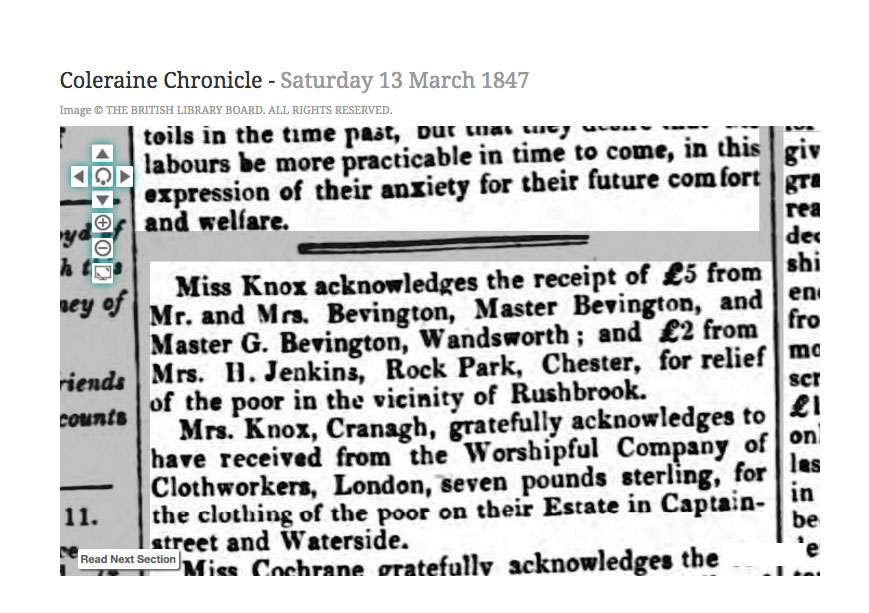
NB. Geoffrey Bevington's mother was born in Coleraine. Also the Bevingtons were (or had been) Quakers — Quakers were deeply involved in famine relief, particularly the provision of soup kitchens. Follow up.
(Click on image to enlarge)
Coleraine Chronicle, Saturday 13 March 1847
Miss Knox acknowledges the receipt of £5 from Mr. and Mrs. Bevington, Master Bevington, and Master G. Bevington, Wandsworth ; and from Mrs. 11. Jenkins, Rock Park, Chester, for relief of the poor in the vicinity of Rushbrook.
Londonderry Standard — Saturday 24 September 1864
HONORARY LAUNCH OF THE PORTRUSH LIFEBOAT.
On Wednesday last, the life-boat on this station was launched in honour of Laura, Countess of Antrim. may not be known to many of our readers that it was through her ladyship the life-boat was first placed on this station.
Lady Cotton having presented to the Royal National Life-boat Institution the sum necessary for three life-boats, naming the places for two, Richard Lewis, Esq., the Secretary, offered to place the third boat at Lady Antrim's disposal, she having previously expressed to him the very deep interest she felt in Portrush.
Her ladyship accepted, wrote her brother-in-law the present Earl of Antrim, and secured the ground for the boat-house, with £25 subscription from his lordship. her unwearied exertions, the sum was soon secured, as well as the money for the boat-carriage.
The circumstances connected with the proposed removal of the life-boat from Portrush are fresh in the memory of our readers. When appeal was lodged with Laura, Lady Antrim, against that removal, backed by her ladyship's powerful influence in London, the boat was ordered to remain, new committee organized, and put in working order.
Her ladyship having expressed a desire go out in the Life-boat on her ladyship's visit to Portrush, the boat, fully manned, was placed at her ladyship's service on Wednesday, 21st instant.
Accompanying her ladyship was her only child, Lady Helen M'Donnell, and Capt. Sir Malcolm Macgregor, R.N.; the Chairman of the Portrush Committee, William Chaine, Esq.; Revs. Henry Ffolliott and Jonathan Simpson; John Carr, Esq., Chief Officer of Customs; Geo. Murray Knox, Esq., Coleraine, and Geoffrey Bevington Esq., London.
The Life-boat sailed round, under the White Rocks to Dunluce Castle, and the crew pulled back to the harbour, assisted by Mr. Knox and Mr. Carr, well known oarsmen.
Lady Antrim and Lady Helen M'Donnell and Capt. M'Gregor expressed themselves greatly delighted with the trip. The vessels the harbour, in honour of her ladyship, displayed every inch bunting, the Antrim Arms' Hotel flag-pole was gaily decked, and the Custom House flag, with Mr. Black's at the Fish-house. Lady Antrim asked the members of Committee to lunch with her ladyship at the hotel. Her ladyship also ordered most substantial dinner for the Life-boat crew in the old Billiard-room of the Antrim Arms — Captain Massey and Mr. Carr, also members the Life-boat Committee, acting as Chair and vice-Chair.
Her ladyship, before leaving with her daughter and intended son-in-law, went down and saw the men at dinner, each of them successively shaking hands with all the men, and thanking them for their good seamanship in managing the boat.
The men gave three hearty cheers each (such as Irish fishermen can give) for Lady Antrim, three for Lady Helen M Donnell, and three for Captain Sir Malcolm M'Gregor; and, after enjoying right hearty dinner, broke up, giving three cheers more for Lady Antrim, and one for Rev. Jonathan Simpson, Honorary Secretary of the Life-boat Committee.
[Source: Link]
[Source: Link]
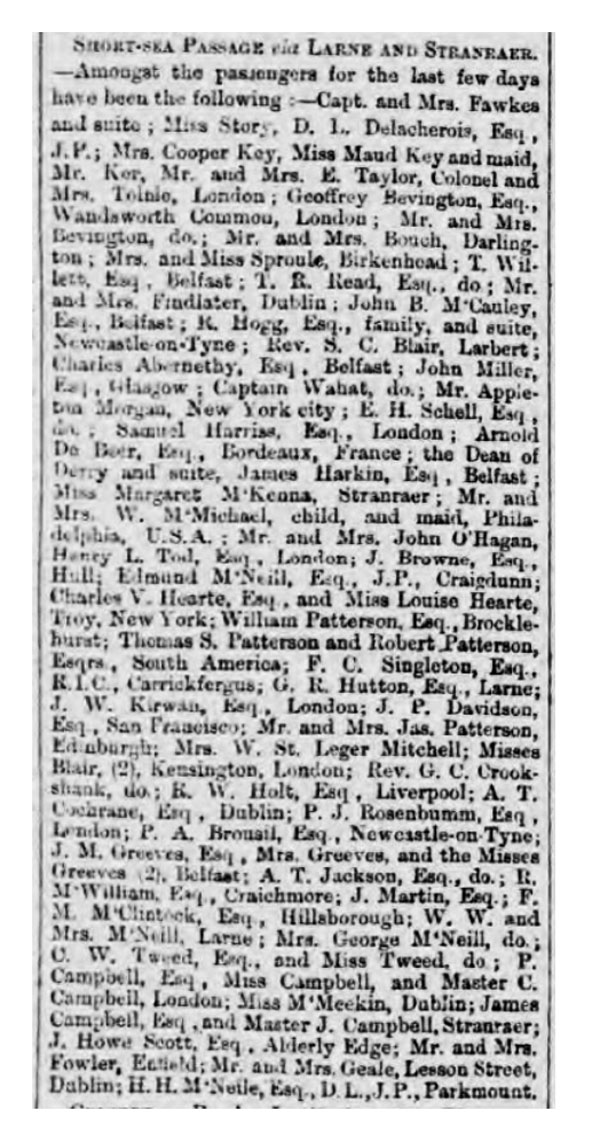
To follow up . . .
[If the dates are correct, it appears he died in Wandsworth the same week that he was on a sea cruise in Northern Ireland — CHECK!]
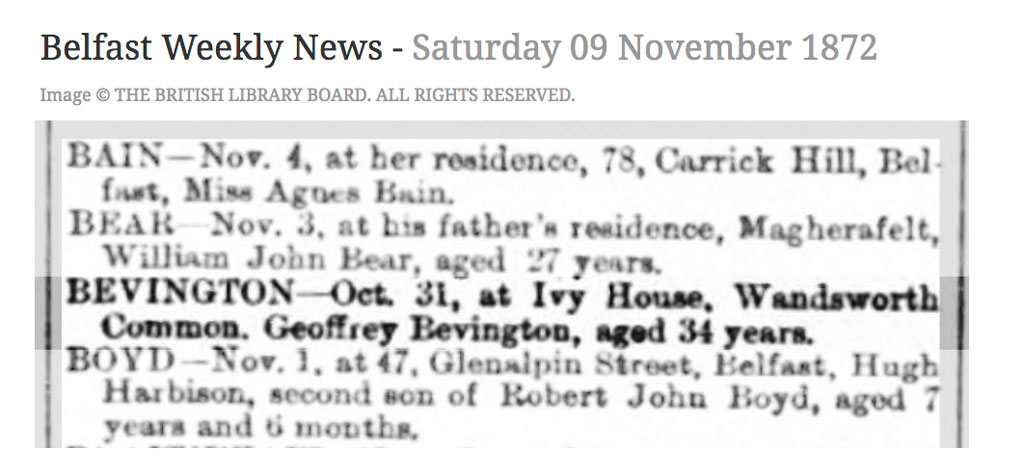
Belfast Weekly News — Saturday 09 November 1872
DEATHS
BEVINGTON — Oct. 31, at Ivy House. Wandsworth Common. Geoffrey Bevington, aged 34 years.
[Source: Link]
[geoffrey_bevington_sea_trip_BelfastWeeklyNews_9nov1872.jpg]
(Click on image to enlarge)
geoffrey_bevington_death_BelfastWeekly_9nov1872.jpg
(Click on image to enlarge)
— In Search of Geoffrey Bevington (1838-1872) [start here]
— Geoffrey Bevington's Photograph Album in the V&A
— Portraits of Geoffrey Bevington
— Ivy House, Wandsworth Common
— Bevingtons and Sons Leather Manufactory, Neckinger Mills, Bermondsey
— Samuel Bourne Bevington [GB's big brother] (1832-1907) [Who's Who of the fight over enclosure]