John Buckmaster was a remarkable man who, beginning life as an agricultural labourer, became successively a joiner, a well-known platform speaker in the cause of free trade, and, under the patronage of the Prince Consort whom he had advised and helped in the matter of the Great Exhibition of 1851, an inspector in the Department of Science and Art at South Kensington, which has since developed into the Imperial College of Science and Technology.
[One of his sons became: "Buckmaster, Stanley Owen, first Viscount Buckmaster 1861-1934, lord chancellor and statesman, was born at Slapton, Cheddington, Buckinghamshire, 9 January 1861, the third of the four sons of John Charles Buckmaster, of Slapton, afterwards of Wandsworth, by his wife, Emily Anne, eldest daughter of George Goodliffe, of Trumpington, near Cambridge.]
[Source: http://www.thepeerage.com/e671.htm (accessed 10.5.2019). This appears to come from his son's DNB entry.]
As elsewhere around London, local opposition to enclosure and development on Wandsworth Common had been gathering pace during the 1860s. The key figure here was John C. Buckmaster, a local activist who orchestrated much of the campaign, and whose colourful autobiography dwells at some length on this period.169 [REF?]
[Source: 49.5._parks_and_open_spaces_chapter.pdf]
Wandsworth Common is the remains of more extensive commonland which earlier went by a number of names including Battersea West Heath and Wandsworth East Heath. It was part of the wastes of the Manor of Battersea and Wandsworth.
Between 1794 & 1866, 53 enclosures reduced its size; most of the enclosures were carried out by local bigwigs the Spencer family (later of Princess Di fame). Earl Spencer's actions sparked protests in December 1827, when "a very numerous meeting of the most affluent and respectable gentry" of Battersea, Wandsworth and Clapham (held at the Swan in Stockwell) opposed an impending inclosure Bill for the 3 respective Commons. They were partly concerned at threats to their own livelihoods, but also greatly worried that many poor folk would be deprived of a subsistence living — and thus become a burden on the rates! (Much was made of the results of the enclosure of Bexley and Bromley Commons, where ratepayers had ended up paying the price...) The Bill was defeated, but small scale enclosure continued.
The situation in Wandsworth was made worse by the Common being split in 3 by railway lines in the 1840s, & the enclosure of 60 acres for an asylum! At some point in the late 1840s, a Mr Parsons and others broke fences and were charged, but the case was dismissed, possibly on the grounds that they were asserting a traditional right of access.
Attempts by local people to preserve the Common against further encroachment began in earnest in 1868 when appeals were made to the Metropolitan Board of Works to take over responsibility, following the Metropolitan Commons Act of 1866, but this was initially unsuccessful.
The East Common was the centre of a fierce struggle in the 1860s. Mr Kellar, who owned land on the Common south of Bellevue road, claimed he had to enclose it to stop gypsies camping there & ruining it, but it came out that he had supplied them with booze & then kicked up a fuss when they got pissed & had a rowdy party. Sneaky!
In 1869, 2000 people pulled down enclosure fences where Chivalry Road is now, and the following year Henry Peek (see Wimbledon Common) got a Common Defence Committee (later the Wandsworth Common Preservation Society) together to save the land threatened with development by the Spencers. Large public meetings were held in Wandsworth, Putney and Battersea. The Committee fought an unsuccessful legal battle that April over Plough Green (now Strathblaine Road, Vardens Road, off St Johns Hill).
"At each crashing of the fence there was a great hooting and hurrahing."
This went hand in hand with direct action... On May 14th 1869, John Buckmaster, a leading light of the Committee, was had up at Wandsworth Police Court, accused of "wilfully and maliciously destroying a fence enclosing the property of Mr Christopher Todd at Wandsworth Common." Todd had bought the land from the railway Company, but campaigners claimed they had no right to sell, as the Lord of the Manor had no right to sell it to THEM. Breaking down the fence, Buckmaster stated that he was asserting common right. Public meetings on the Common (including one allegedly 5000-strong in January 1868) had passed resolutions to tear down Todd's fences.
In the months following fund-raising efforts and lobbying of support accelerated. And so did the wanton destruction of property. On April 13th 1870, "a large number of persons assembled and asserted their right of way by breaking down the fences". Some 300-400 people armed with hatchets and pickaxes re-established a footpath enclosed by a Mr Costeker at Plough Green. "At each crashing of the fence there was a great hooting and hurrahing." In June of the same year there were protests at Spencer's plans to enclose part of Putney Common.
Eventually Earl Spencer agreed to transfer most of the common to the Defence Committee excluding the area which later became Spencer Park.
The agitation to save Wandsworth Common, although led by wealthier residents, involved working class mass involvement, including mass meetings in local factories.
[Source: http://www.alphabetthreat.co.uk/pasttense/downwiththefences.html
Two men played critical roles in Battersea's embryonic transformation from an insignificant vestry to a standard-bearer for Progressivism. One was John Buckmaster, who had spearheaded the local agitation against building on Wandsworth Common and encouraged radicals to stand for the Vestry since the 1850s. The other was Andrew Cameron, an Aberdeen-born local businessman, who harnessed the incipient radicalism of the revived Vestry to practical ends, only to fall ill and die in 1894, aged 51 [n.155]
...Also worth singling out are some exceptional memoirs of Battersea lives, obscure or almost so. Specially informative are those, in near-chronological order, by John Buckmaster (writing pseudonymously as John Buckley), William Evill, Arthur Newton, the poet and essayist Richard Church, Edward Ezard, James Guttridge, Harry Wicks, Michael de Larrabeiti and John Walsh.
[Source: 49.introduction.pdf]
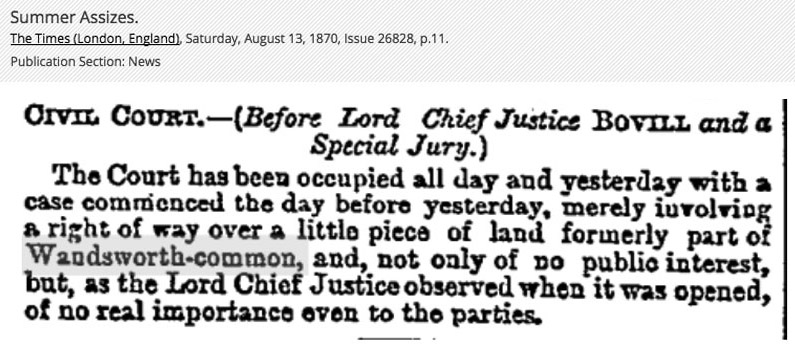
(Click on image to enlarge)
Enclosure etc in The Times
[PB: ADD TO BUCKMASTER PAGE AND/OR TO ENCLOSURE PAGE]
- /wandsworth_common/years/1863/1863_enclosure_buckmaster_letter_Times_3sep1863.jpg
- /wandsworth_common/years/1863/1863_enclosure_Times_2sep1863.jpg
- /wandsworth_common/years/1863/1863_enclosure_Times_10oct1863.jpg
-
/wandsworth_common/years/1870/1870_preservation_Times_16jul1870.jpg
-
/wandsworth_common/years/1870/1870_right_of_way_Times_13aug1870.jpg
JB refs to follow up:
- "Preservation.doc" = The_Preservation_of_WC_SouthLondonPress_20nov1886.jpg = https://www.britishnewspaperarchive.co.uk/viewer/bl/0000213/18861120/008/0003
- PRESERVATION OF WC_1886_BNA SEARCH — BATTLE WANDS.doc
- WC from The municipal parks gardens and open spaces of London — their history and associations (1905).pdf
- Shirley Passmore_Wandsworth Common History 2010.pdf
- DOWN WITH THE FENCES — S London Common — fences.pdf
- WANDSWORTH 18-180 Heritage Report Appendix 1 — Final list.pdf
- SEXBY_WANDSWORTH COMMON — SEXBY.doc
- 50.19_deep_south.pdf
- The Peerage: "Stanley Owen, first Viscount Buckmaster 1861-1934 [son of JB], lord chancellor and statesman, was born at Slapton, Cheddington, Buckinghamshire, 9 January 1861, the third of the four sons of John Charles Buckmaster, of Slapton, afterwards of Wandsworth, by his wife, Emily Anne, eldest daughter of George Goodliffe, of Trumpington, near Cambridge." Another remarkable life.
- [Source: Buckley/Buckmaster mentioned in England's Revelry: A History of Popular Sports and Pastimes, 1660-1830 By Emma Griffin.]
- And probably many more...
DICTIONARY OF NATIONAL BIOGRAPHY
No entry for JCB, but he is mentioned in his son Stanley's biography.
Buckmaster, Stanley Owen, first Viscount Buckmaster (1861 — 1934), lord chancellor, was born on 9 January 1861 at 2 New Road, off St John's Hill, Wandsworth, London, the third of four sons of John Charles Buckmaster (d. 1908), professor of chemistry, and his wife, Emily Anne (d. 1890), eldest daughter of George Goodliffe, of Trumpington, near Cambridge. John Buckmaster was a remarkable man who, beginning as an agricultural labourer at the age of ten in the village of Slapton in Buckinghamshire, became successively a joiner, a platform speaker in the campaign against the corn laws, and, after attending a teacher training college, a teacher of chemistry first at the college where he had trained and then at the Imperial College of Science and Technology.
Stanley Buckmaster was sent to Aldenham grammar school (now Aldenham School). The school was then in low water and the boys suffered hardships which Buckmaster never forgot. However, thanks to the encouragement of one outstanding teacher, Buckmaster won a junior studentship in mathematics at Christ Church, Oxford, in 1879. He led an active and sociable life at Oxford, but was disappointed by obtaining a second class in both mathematical moderations (1881) and the final honours school (1882) rather than the first class for which he had hoped and which his two elder brothers had obtained.
etc etc.
[Source: https://www.oxforddnb.com/view/10.1093/ref:odnb/9780198614128.001.0001/odnb-9780198614128-e-32159?rskey=NPDoGg&result=3 (accessed 21 May 2019).]

New Road, St John's Hill. OS Town Plan, 1868 (1:1056).
Not shown on Stanford's 1862. Is it more or less where the old pedestrianised "Station Approach" used to run? Or where the taxis used to enter?]
Notice the many substantial houses and ornamental gardens, particularly on Lavender Hill e.g. where Arding and Hobbs [bottom right quadrant at the cross roads] and the big supermarket [Lidl? top right] now stand. St John's Rd seems to be quite narrow and not straight.
(Click on image to enlarge)
- John Buckmaster (dates)
- A Village Politician (John Buckmaster's Autobiography (date)
- Chronology of enclosures and the fight against them
- LINK
- LINK