
It is worth looking at the general situation on and around the Common in 1800 [Milne's map] and compare it with a map from the 1860s [WC As It Was and As It Is map] — the time that Buckmaster was attempting to halt and reverse the losses.
[Source: Link]
[If we use this map, or one like it, we could annotate it, as I have done experimentally — e.g. some of the roads, Clapham Common etc. This might help people get their bearings.
SUMMARISE?
But look at the situation that confronted . that Buckmaster and his contemporaries were facd with
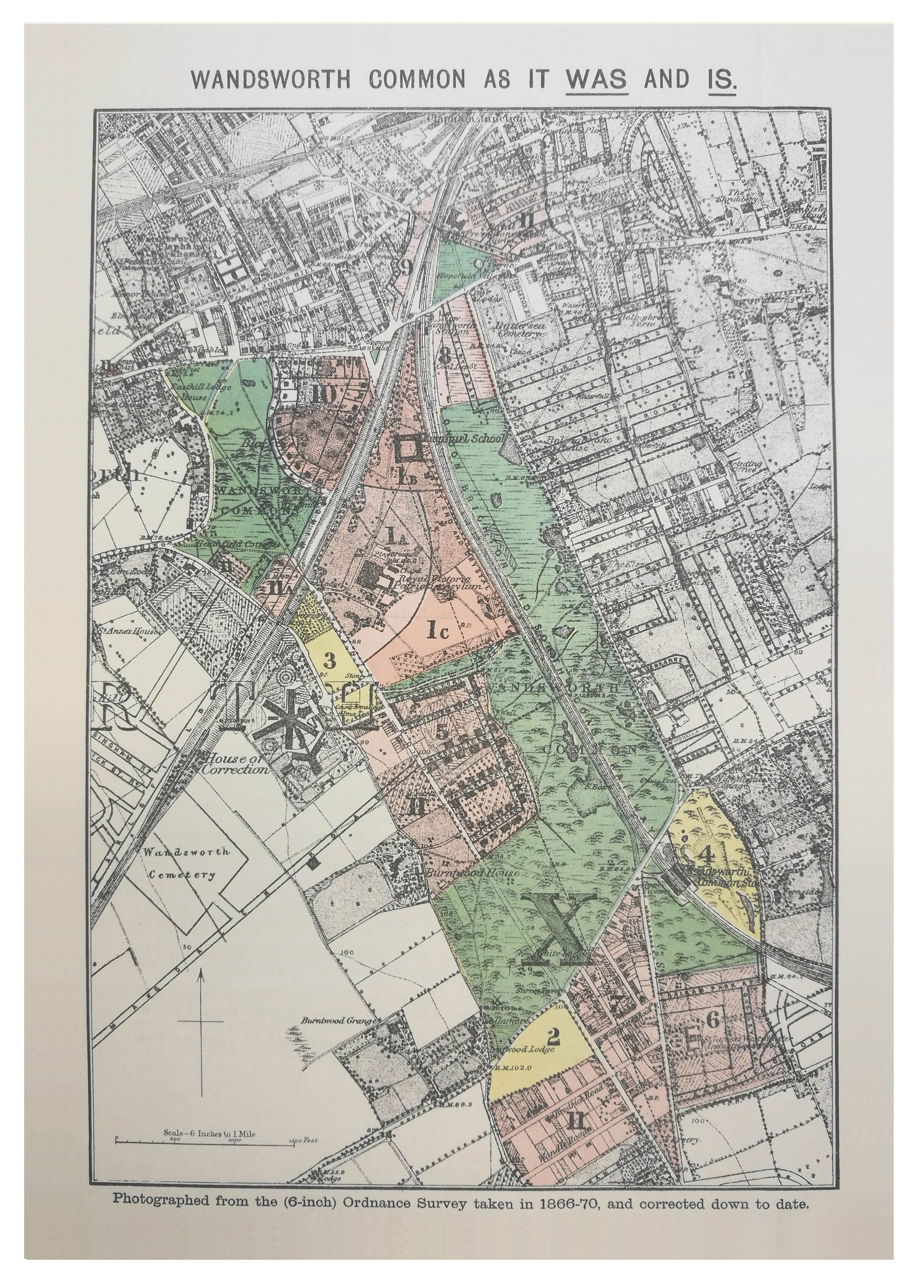
[Source: Link]
OR adapt my What A Carve Up maps
A map of — this copy has been lost, but it was re-drawn some years later to remind everyone of what had happened — knowing that memory is short.
Summarise all the losses
Buildings round the edge In the C18, Heathfield Cottages, Burntwood House, which spread between what is now Ellerton Road, across where Lyford Road now runs, as far as the track that eventually formed Trinity Road.And the Wilson House
At the end of the C18 a number of grand "villas" — sometimes in the "cottage ornee" style loved by the new Romantics — on fields adjacent to the common, onto which they often spread.
Houses on the edge that nibbled away at the edges included "the 5 houses" (along the future Bolingbroke Grove), ], Fernside to the south, and the Burntwood houses [Burntwood Grange, Lodge, House, and Collamore, at the corner of Burntwood Lane and the Scope].
And, nearby, the Surrey County Pauper Lunatic Asylum [opened 1841], and a LOT of cemeteries e.g. Lambeth, first burials 1854
Surrey House of Correction / Wandsworth Prison [1851 / https://en.wikipedia.org/wiki/HM_Prison_Wandsworth]
The prison itself was not built on Common land (or at least nt since Tudor times), but the [?] bought all the land between Alma Terrace and wat is now the railway, which was still Common.
Diced and spliced, gouged and grabbed, the Common was being taken from all sides.
But even worse were the losses to the Common itself.
Starting in the late 1830s with the arrival of the railways:
Railways — split into three parts by railway lines to London-Southampton Railway (1838-1840) and Crystal Palace (and later Brighton) in the late 1830s/1840s [dates]
And not to forget the replacement of tracks [in effect, informal desire lines] by new (dead straight) surfaced roads paid for by companies hoping to encourage traffic to pay tolls [Trinity Road, Bellevue, St James's Road/Drive]. [Earl Spencer was a [major?] shareholder in the railways and bridges.]
Enclosures for "charity" and science
[Earl Spencer was a shareholder.]
St James's Industrial School [for naughty boys 1851-2. Converted into a workhouse 1904 and infirmary, then into a hospital in 1930. Closed 1988 and replaced by houses.]
[Earl Spencer's London home was in St James's Piccadilly https://en.wikipedia.org/wiki/Spencer_House,_London]
The Craig Telescope [completed 1852/ ? acres removed from Common, restored ? / ]
Royal Masonic School for Girls [purchased 1853, "because of its wide open aspect and country air, qualities that would later be lost" — https://en.wikipedia.org/wiki/The_Royal_Masonic_School_for_Girls]
[Earl Spencer was a Mason, the Wandsworth Lodge (meeting in the Freemasons' Tavern? Arms?/now the Roundhouse) was named after him.
Royal Victoria Patriotic Asylum — enclosure of a further 60 acres for [the RVPA], initially for daughters of military men who had died in the Crimean War [1853-56]. [Foundation stone laid by Q Victoria 1857, opened 1859.]
An area of the girls' school grounds was set aside for boys in ? [and later sold to Emanuel School in 1883]
St Mary's/ Battersea Rise Cemetery [opened 1860]
St Mark's Church and school [1872-4], Battersea Rise [this is the small "iron church" that Buckmaster took Spencer to.]