
"I was unable to help these poor potato men, but it occurred to me that a letter to the newspapers might attract attention. I wrote three letters to the daily papers. Only one, the Standard, inserted the letter, but this was sufficient; other letters followed, and there was evidently a strong growing public sentiment against the further enclosure of commons near London.
"A public meeting was held in each of the parishes adjoining the common, and resolutions were passed, but still the enclosures went on."
"A public meeting was held in each of the parishes adjoining the common, and resolutions were passed, but still the enclosures went on."
[Is this John Buckmaster's first letter?]
WANDSWORTH COMMON ENCROACHMENTS
TO THE EDITOR
Sir, — Will you kindly permit me, through the medium of your valuable journal, to call the attention of the public to the shameful encroachments on their rights to Wandsworth Common, which have been going on for a long time past? The evil is rapidly increasing, and unless a vigorous stand is at once made by the owners of property in the neighbourhood, all that remains of this once beautiful common will shortly be confiscated to private and monied interests. Quite recently, indeed, from four to five acres have been enclosed in a strong fence by the Brighton Railway Company, and this convenient little piece of business has been quietly arranged between the company and the lord of the manor, who seems entirely to ignore the existence of freeholders, copyholders, and the parish authorities.
I myself am a freeholder of property adjoining the common, and as I see the open space, which is so great a boon to residents, being gradually fenced in, I cannot refrain from asking by what right or title does the lord of the manor dispose of our rights to the railway company and others? I believe I am correct in asserting that the proceeding is utterly illegal; and if anyone had the funds or the courage to try the question I believe this wholesale disposal of land might be stopped.
But surely, sir, this is a matter to be taken up by the vestry whom the ratepayers in their blissful ignorance imagine to be the protectors of the parish rights. Yet the vestry say nothing, and watch the proceedings in apathetic silence. Either their supineness is caused by a want of business or a disgraceful neglect of duty.
To conclude, I do sincerely trust that there may be a determined stand made by the freeholders and copy-holders, and that by a united action we may preserve the common from further spoliation on the part of monied or other influence.
I am, Sir, yours, &c,
M.R.C.S.
St.John's-hill, Wandsworth, July, 1862.
[Source: Link]
[Is the above the original letter? Locating it would provide a firm start date. This could possibly be it, from 1862, though from the South London Press, not the Standard. The address (St John's Hill) and sentiment are spot on, but "MRCS" not obviously so. If not "Member of the Royal College of Surgeons" perhaps something else? Or was it a deliberate deception, to imply the views of a professional man.? Newspapers frequently reprinted each other's articles and letters, and JCB sent the same letter to different papers.
Certainly the robustly class-conscious "all that remains of this once beautiful common will shortly be confiscated to private and monied interests" puts the pen in Buckmaster's hand.]
Along with letter-writing and public meetings, Buckmaster raised a petition or "memorial" among local ratepayers. This was widely reported, including (perhaps remarkably) in The Times. The memorial adopted a thoroughly obsequious manner.
"for centuries the Parishioners and their families have enjoyed undisturbed the healthy walks on Wandsworth-common, and the custom of years, right or wrong, has given them an apparent right to this enjoyment."
Your memorialists view these encroachments with deep sorrow and regret, and if permitted to go on they must at no distant period lead to the entire extinction of Wandsworth-common.
This is not Buckmaster's style, but such an entreaty to Spencer certainly wouldn't fail for lack of due deference. Notice that there is no assertion of an actual legal "right" of local people to enjoy the Common, only an appeal to a sense of timeless tradition that would be understood implicitly by someone in the position of "his Lordship":
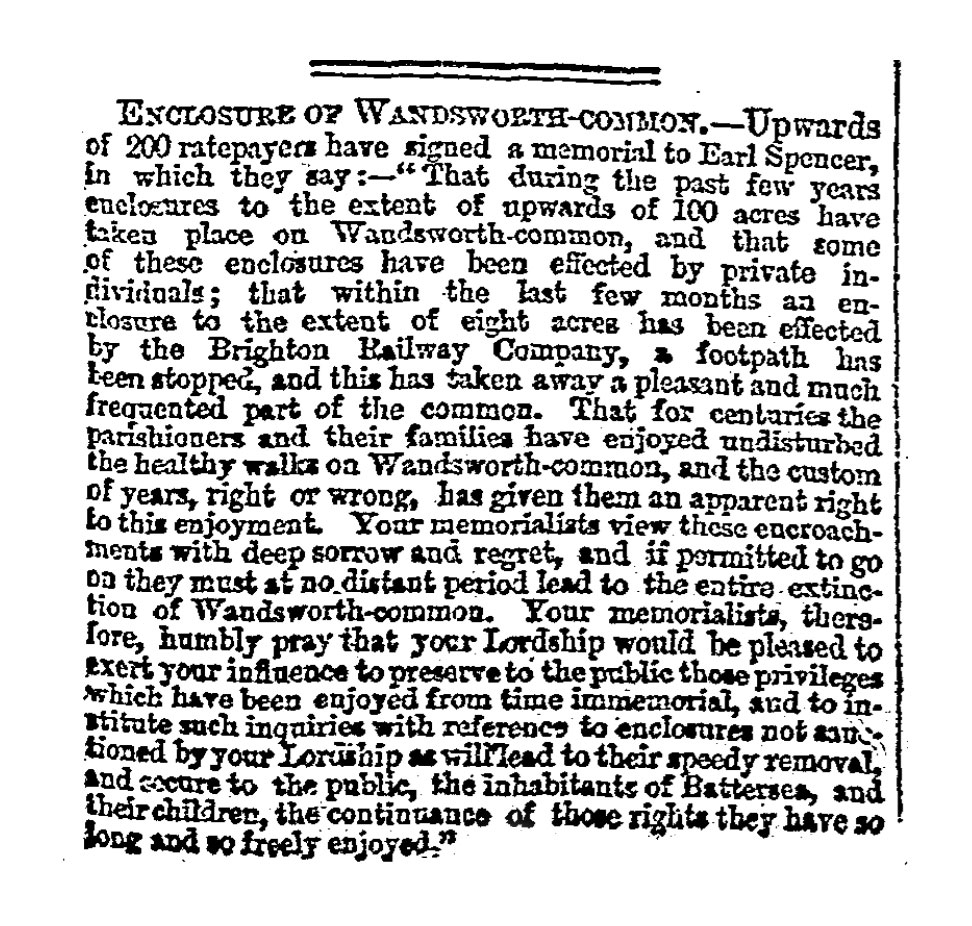
ENCLOSURE OF WANDSWORTH-COMMON.
Upwards of 200 ratepayers have signed a memorial to Earl Spencer, in which they say: "That during the past few years enclosures to the extent of upwards of 100 acres have taken place on Wandsworth-common, and that some of these enclosures have been effected by private individuals; that within the last few months an enclosure to the extent of eight acres has been effected by the Brighton Railway Company, a footpath has been stopped, and this has taken away a pleasant and much frequented part of the common.
That for centuries the Parishioners and their families have enjoyed undisturbed the healthy walks on Wandsworth-common, and the custom of years, right or wrong, has given them an apparent right to this enjoyment.
Your memorialists view these encroachments with deep sorrow and regret, and if permitted to go on they must at no distant period lead to the entire extinction of Wandsworth-common.
Your memorialists, therefore, humbly pray that your Lordship would be pleased to exert your influence to preserve to the public those privileges which have been enjoyed from time immemorial, and to institute such inquiries with reference to enclosures not sanctioned by your Lordship at will lead to their speedy removal and secure to the public, the inhabitants of Battersea, and their children, the continuance of those rights they have so long and so freely enjoyed."
[Source: Link.]
Buckmaster immediately followed up with a (much longer) letter, detailing and hammering home his arguments one by one. As was ever his habit, no reference concerning the future of Wandsworth Common anywhere in the country was ever allowed [to pass] without explicit contradiction (if he disagreed) or elaboration (if he approved). But notice also the dry humour.
[Include reference to a letter in a distant e.g. a Scottish article? Find and add.]
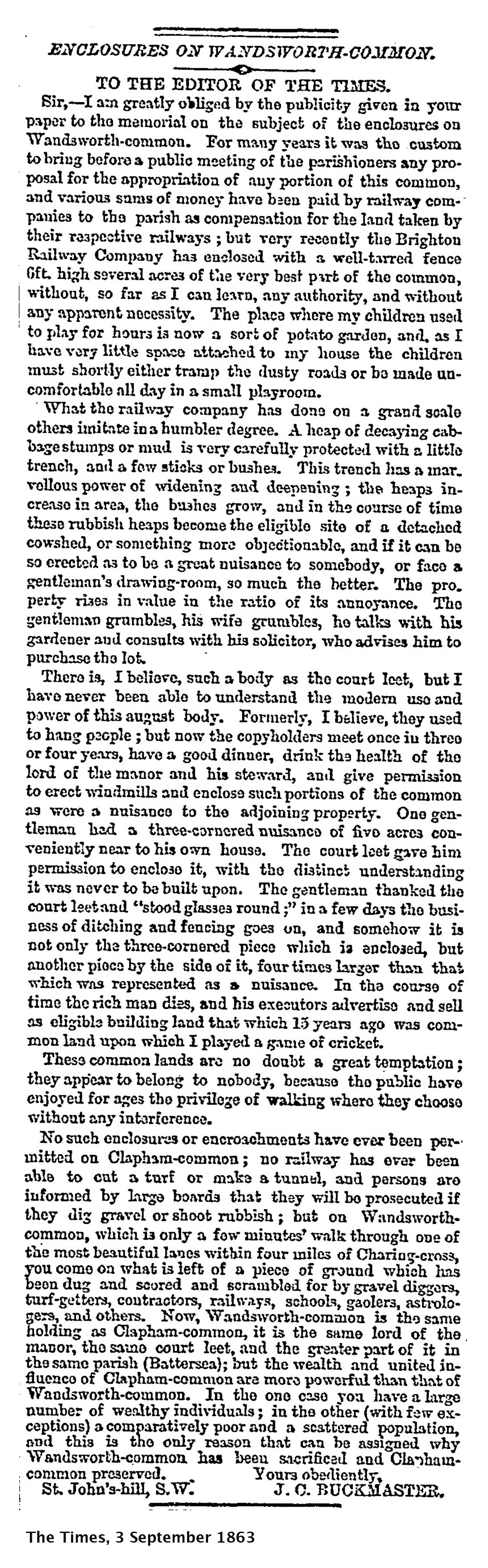
"ENCLOSURES OF WANDSWORTH-COMMON".
TO THE EDITOR OF THE TIMES.
Sir, — I am greatly obliged by the publicity given in your paper to the memorial on the subject of the enclosures on Wandsworth-common.
For many years it was the custom to bring before a public meeting of the parishioners any proposal for the appropriation of any portion of this common, and various sums of money have been paid by railway companies to the parish as compensation for the land taken by their respective railways; but very recently the Brighton Railway Company has enclosed with a well-tarred fence 6ft. high several acres of the very best part of the common, without, so far as I can learn, any authority, and without any apparent necessity.
The place where my children used to play for hours is now a sort of potato garden, and as I have very little space attached to my house the children I must shortly either tramp the dusty roads or be made uncomfortable all day in a small playroom.
What the railway company has done on a grand scale others imitate in a humbler degree. A heap of decaying cabbage stumps or mud is very carefully protected with a little trench, and a few sticks or bushes. This trench has a marvellous power of widening and deepening; the heaps increase in area, the bushes grow, and in the course of time these rubbish heaps become the eligible site of a detached cowshed, or something more objectionable, and if it can be so erected as to be a great nuisance to somebody, or face a gentleman's drawing-room, so much the better.
The property rises in value in the ratio of its annoyance. The gentleman grumbles, his wife grumbles, he talks with his gardener and consults with his solicitor, who advises him to purchase the lot.
There is, I believe, such a body as the court leet, but I have never been able to understand the modern use and power of this august body. Formerly, I believe, they used to hang people; but now the copyholders meet once in three or four years, have a good dinner, drink the health of the lord of the manor and his steward, and give permission to erect windmills and enclose such portions of the common as were a nuisance to the adjoining property.
One gentleman had a three-cornered nuisance of five acres conveniently near to his own house. The court leet gave him permission to enclose it, with the distinct understanding it was never to be built upon. The gentleman thanked the court leet and "stood glasses round;" in a few days this business of ditching and fencing goes on, and somehow it is not only the three-cornered piece which is enclosed, but another piece by the side of it, four times larger than that which was represented as a nuisance.
In the course of time the rich man dies, and his executors advertise and sell as eligible building land that which 15 years ago was common land upon which I played a game of cricket.
These common lands are no doubt a great temptation; they appear to belong to nobody, because the public have enjoyed for ages the privilege of walking where they choose without any interference.
No such enclosures or encroachments have ever been permitted on Clapham-common; no railway has ever been able to cut a turf or make a tunnel, and persons are informed by large boards that they will be prosecuted if they dig gravel or shoot rubbish; but on Wandsworth-common, which is only a few minutes' walk through one of the most beautiful lanes within four miles of Charing-cross, you come on what is left of a piece of ground which has been dug and scored and scrambled for by gravel diggers, turf-getters, contractors, railways, schools, gaolers, astrologers, and others.
Now, Wandsworth-common is the same holding as Clapham-common, it is the same lord of the manor, the same court leet, and the greater part of it in the same parish (Battersea); but the wealth and united influence of Clapham-common are more powerful than that of Wandsworth-common.
In the one case you have a large number of wealthy individuals; in the other (with few exceptions) a comparatively poor and a scattered population, and this is the only reason that can be assigned why Wandsworth-common has been sacrificed and Clapham-common preserved.
Yours obediently, J.C. BUCKMASTER
St John's-hill S.W.
[Source: Link]
Buckmaster's spirited comparison of Wandsworth and Clapham Commons recurs in his and other authors throughout this period. Although both are gravelly hilltop heaths under the control of same lord of the manor inEarl Spencer, "In the one case you have a large number of wealthy individuals; in the other (with few exceptions) a comparatively poor and a scattered population, and this is the only reason that can be assigned why Wandsworth-common has been sacrificed and Clapham-common preserved."
"No enclosures or encroachments have ever been permitted on Clapham-common; no railway has ever been able to cut a turf or make a tunnel, and persons are informed by large boards that they will be prosecuted if they dig gravel or shoot rubbish; but on Wandsworth-common, which is only a few minutes' walk through one of the most beautiful lanes within four miles of Charing-cross [i.e. Nightingale Lane], you come on what is left of a piece of ground which has been dug and scored and scrambled for by gravel diggers, turf-getters, contractors, railways, schools, gaolers, astrologers, and others."
The reference to "astrologers" is probably [a joke/pun], conflating gypsy fortune tellers (such as the famous Charlotte Cooper, well-known for plying her trade on Wandsworth Common), and the Rev. Craig's giant telescope. The "Observatory" had only recently been dismantled, but the enclosure created for it (near what is now Lyford Road) was still shown on contemporary maps (for example, the OS map of 1868-69 and even the Stanford and Wyld maps from 1872).
On September 8th The Times reported that Earl Spencer had agreed to meet a deputation in his awesomely splendid house on the edge of Green Park. Presumably [Battersea and Wandsworth hoi polloi — though] all of them big fish in their small pond — hoped their appeal would make Spencer see the light / effect some change of heart.
A month to the day later, they duly appeared, and the [event/gathering/] was once again noticed by The Times:
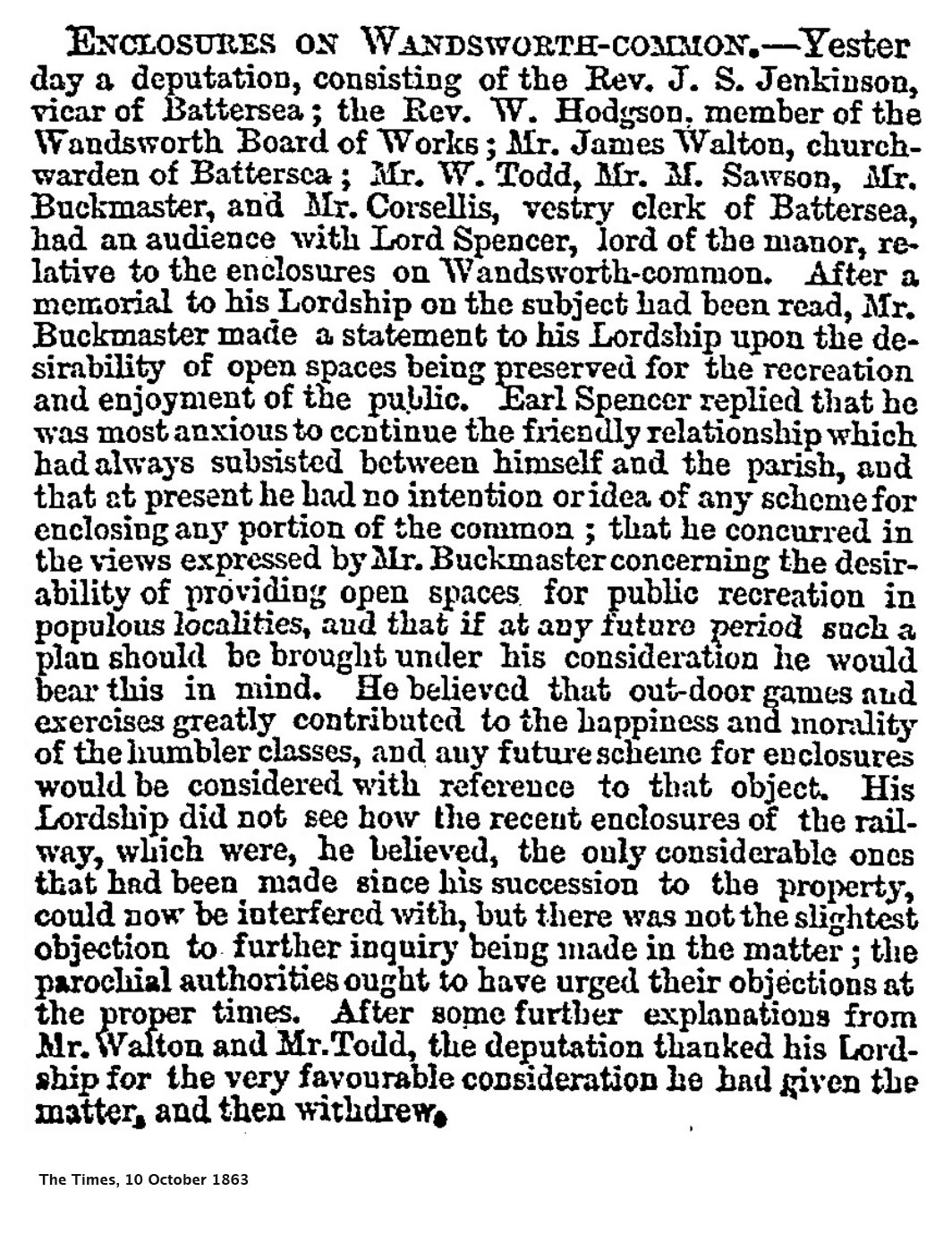
ENCLOSURES ON WANDSWORTH-COMMON.
On Friday, a deputation, consisting of the Rev. J. S. Jenkinson, vicar of Battersea; the Rev. W. Hodgson, member of the Wandsworth Board of Works; Mr. James Walton, Churchwarden Battersea; Mr. W. Todd, Mr. M. Sawson, Mr. Buckmaster, and Mr Corsellis, vestry clerk of Battersea, had an audience with Lord Spencer, lord of the manor, relative to the enclosures on Wandsworth-common.
After a memorial to his Lordship on the subject had been read, Mr. Buckmaster made a statement to his Lordship upon the desirability of open spaces being preserved for the recreation and enjoyment of the public.
Earl Spencer replied that he was most anxious to continue the friendly relationship which had always subsisted between himself and the parish, and that at present he had no intention or idea of any scheme for enclosing any portion of the common; that he concurred in the views expressed by Mr. Buckmaster concerning the desirability of providing open spaces for public recreation in populous localities, and that at any future period such plan should be brought under his consideration he would bear this in mind.
He believed that outdoor games and exercises greatly contributed to the happiness and morality of the humbler classes, and any future scheme for enclosures would be considered with reference to that object.
His Lordship did not see how the recent enclosures of the railway, which were, he believed, the only considerable ones that had been made since his succession to the property, could now be interfered with, but there was not the slightest objection to further inquiry being made in the matter; the parochial authorities ought to have urged their objections the proper times.
After some further explanations from Mr. Walton and Mr. Todd, the deputation thanked his Lordship for the very favourable consideration he had given the matter, and then withdrew.
[Source: Link]
Buckmaster's account of the meeting (in his autobiography) is rather different. He describes his fellow "memorialists" as obsequious and struck dumb in the august presence. Buckmaster was his usual self. When they leave, they are furious with him.
After some difficulty we obtained an interview with the lord of the manor, and after discussing the matter in the presence of his agents and lawyers he asked, "Do you question my right to dispose of the common?"
All the other members of the deputation were dumb.
I waited to hear what they would say, but as no one spoke I replied, "I am sorry to say, my lord, that we do question your right."
He turned on his heel, his lawyers followed, and we were shown the door by his footman.
"No sooner were we outside than the other members of the deputation turned on me and said I had greatly offended his lordship and destroyed all hopes of a settlement, and yet the question of right was the great question."
[PB: It is possible that JCB's comments are about another meeting, perhaps later in the 1860s. However, I have found no evidence of other meetings. Follow up/carry on looking.]
Buckmaster also writes about a tetchy exchange of letters between JCB and Spencer that JCB forwarded to The Times, causing a furious response from Spencer. [I have looked for this in the Times, but so far without success.]
I wrote a respectful letter to the lord of the manor, pointing out the importance of what was left of the common for health and recreation, and reminded him that these privileges had been enjoyed undisputed, in the language of lawyers, from the time "whereof the memory of man faileth not." This brought back a rough letter about agitation and rights of property.
I sent my letter with his lordship's reply to the Times, which brought a very angry letter back saying the letter was not intended for publication; to which I replied that it was not marked private, and I felt the subject was of too much public importance to be dealt with privately.
Significantly, Buckmaster is careful not to blame Spencer himself:
I had reason to believe that his lordship had been kept in ignorance of the facts by his agents and lawyers, who had represented me as a demagogue and attributing to me language which I should never dream of using; but give a lie a few hours' start and it is impossible to overtake it.
[A "noble Champ de Mars for our volunteer army" indeed! It woud be interesting to write something on WC and the Army/war — the "Sham Fights" during the Napoleonic Wars", the young [militia/ reservists] shooting a pet dog, John Burns's set to with a jingo when watching (with approval) the Coldstream Guards during the Boer War, Stanley Owen Buckmaster's observation about the thousands of men parading on the Common early in WWI, the 3rd General London Hospital, Big Bertha and Zeppelins, the use of the RVPB in WWII, gun emplacements and balloons? The ambulances in the Bellevue Garage etc etc.]
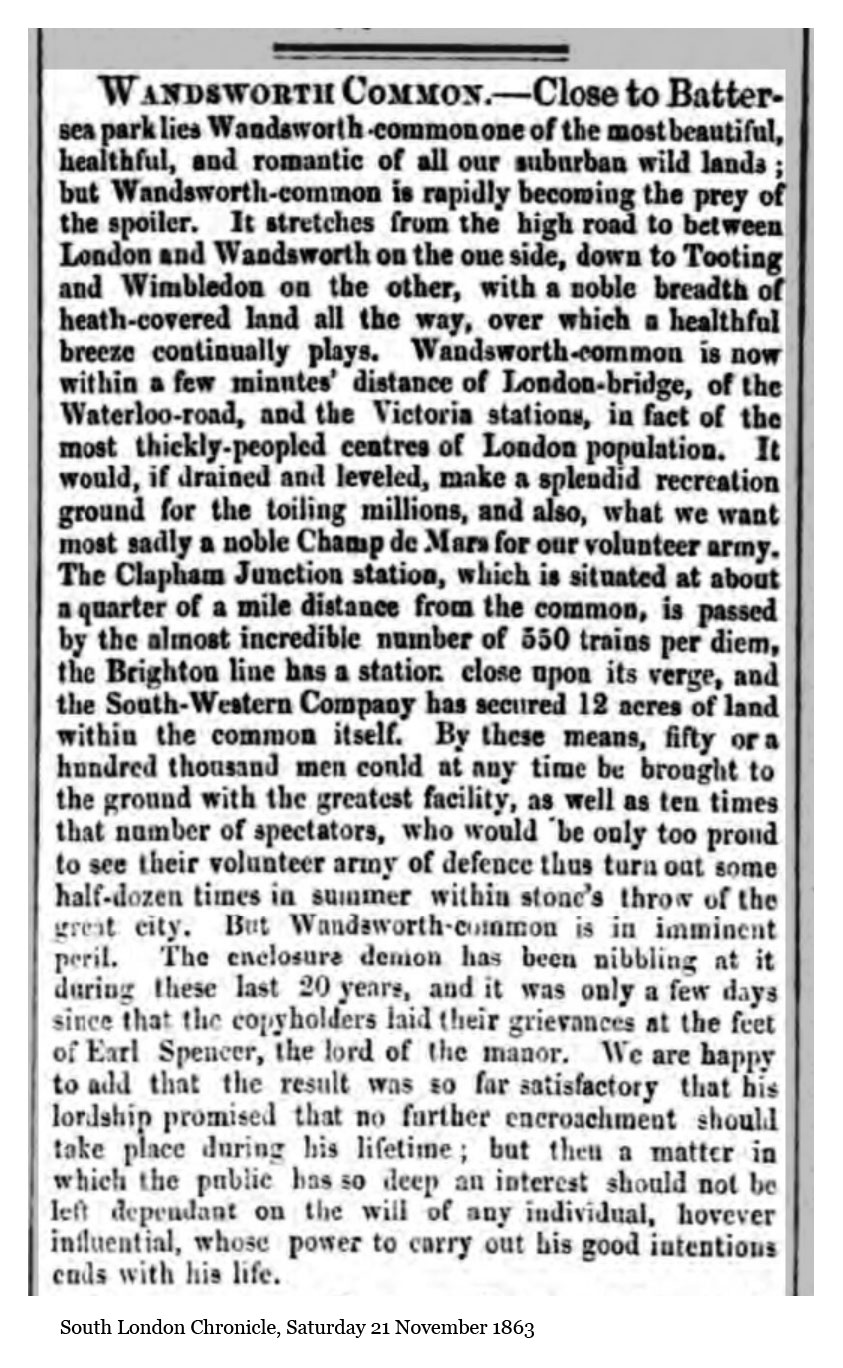
Wandsworth Common.
Close to Battersea park lies Wandsworth-common, one of the most beautiful, healthful, and romantic of all our suburban wild lands; but Wandsworth-common is rapidly becoming the prey of the spoiler. It stretches from the high road to between London and Wandsworth on the one side, down to Tooting and Wimbledon on the other, with a noble breadth of heath-covered land all the way, over which a healthful breeze continually plays.
Wandsworth-common is now within a few minutes' distance of London-bridge, of the Waterloo-road, and the Victoria stations, in fact of the most thickly-peopled centres of London population. It would, if drained and leveled, make a splendid recreation ground for the toiling millions, and also, what we want most sadly a noble Champ de Mars for our volunteer army.
The Junction station, which is situated at about a quarter of a mile distance from the common, is passed by the almost incredible number of 550 trains per diem, the Brighton Line has a station close upon its verge, and the South-Western Company has secured 12 acres of land within the common itself. By these means, fifty or a hundred thousand men could at any time be brought to the ground with the greatest facility, as well as ten times that number of spectators, who would be only too proud to see their volunteer army of defence thus turn out some half-dozen times in summer within a stone's throw of the great city.
But Wandsworth-common is in imminent peril. The enclosure demon has been nibbling it during these last 20 years, and it was only a few days since that the copyholders laid their grievances at the feet of Earl Spencer, the lord of the manor.
We are happy to add that the result was so far satisfactory that his lordship promised that no further encroachment should take place during his lifetime; but then a matter in which the public has so deep an interest should not be left dependent on the will of any individual, however influential, whose power to carry out his good intentions ends with his life.
[BNA: LINK.]
Notice in particular the comment that it the future of the Common "should not be left dependent on the will of any individual, however influential, whose power to carry out his good intentions ends with his life." This vulnerability would become the central concern of Buckmaster's strategy in the next few years.
In the meanwhile, Buckmaster continued to agitate locally, for example taking advantage of the grievance felt by local cricketers that they might lose the field they had created — an area "threatened with enclosure...It was now intended to dispose, on building leases, of the portion of the common where, at a considerable expense to the parishioners, a cricket ground had been levelled and maintained. There was no other spot in the neighbourhood available for cricket."
This pitch was in the area between Trinity Road and Heathfield Cottages, hence not far from the County Arms where they dined:

THE ENCLOSURE QUESTION
The annual cricket match of the tradesmen of Wandsworth took place on Tuesday, on the cricket ground, Wandsworth-common, after which dinner was provided at Mr. Finch's, the County Arms, when there was a large attendance of the inhabitants, it having been announced that on this occasion would be taken into consideration what steps should be adopted to prevent the threatened enclosure of the cricketing-ground. The chair was taken by Mr. Smith, and the vice-chair by Mr. Frost.
Mr. McKellar read a memorial proposed to be presented to Earl Spencer; who is the lord of the manor, deprecating any further encroachment on the common, and particularly on the cricket-ground.
Mr. Frost, after alluding to the interests in the out-door games of the people manifested by her Majesty and the late illustrious Prince Consort, and referring to Lord Russell's observations on the opening of Baxter-park, Dundee; on the advantages of out-door recreation, complained that the ground on Wandsworth-common was being gradually appropriated to the use of proprietary bodies. Four acres had been attached to the station of the Crystal-palace line, and the Patriotic Fund school had acquired a large portion, and had stopped up a footpath, compelling passengers to go a considerable distance round.
However, the inhabitants would cheerfully put up with this last mentioned encroachment if it stood alone, for they were glad of anything that could promote so laudable an object. But it was now intended to dispose, on building leases, of the portion of the common where, at a considerable expense to the parishioners, a cricket ground had been levelled and maintained. There was no other spot in the neighbourhood available for cricket.
The memorial was adopted, a committee appointed and a vote of thanks accorded to Mr. Buckmaster who had obtained more than 300 signatures to it.
[Source: LINK.]
class="note">[PB: I assumed this was the Wandsworth Lodge McKellar, but the dates don't work well — HM died that year (or was it the year before?), and the Lodge was up for sale. I recall finding another McKellar family locally — St Anne's Hill? Check.]
[PB: Interesting — the protection of WC arising out of sport.
This relatively informal pitch continued in use for many years — much to to the annoyance of some local people, such as Mrs Nixon, who around 1880 lived in the nearest house in Heathfield Cottages and was tired of retrieving cricket balls batted over her wall. She soon moved, but later a wire-mesh fence was erected, and residents of the Cottages were given one shilling a year as compensation.
The 1881 Census shows Frances Nixon as a 45-year old widow of independent means, living with 3 daughters (20, 19, 16) and a widower brother (39). She was still there in 1883, mis-spelt as Mrs Nickson. But she'd gone by 1891.
