... not simple vandalism ... politically motivated, part of great popular local movement against the imminent destruction of the Common.
[The struggles over "Plough Green" are the most violent in the history of Wandsworth Common [most fought over — most attended — 4000/5000 — frequent — long-lasting].
Sort out the names and relationships. There seem to be a "John" Costeker and a "Charles" Costeker. there are references to a son, who may have written to the local press. There appears to be a Woollen Merchant Costeker and also an "attorney".
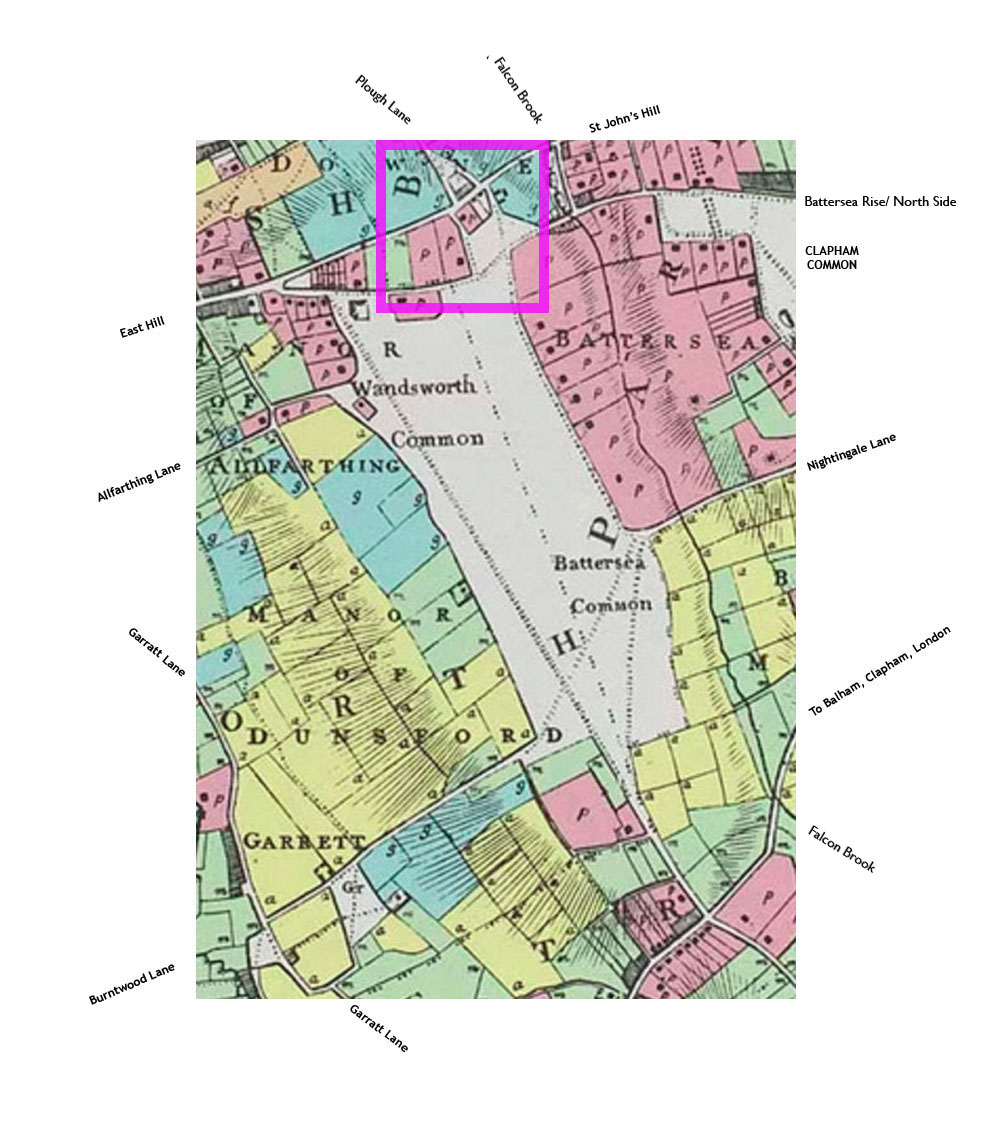
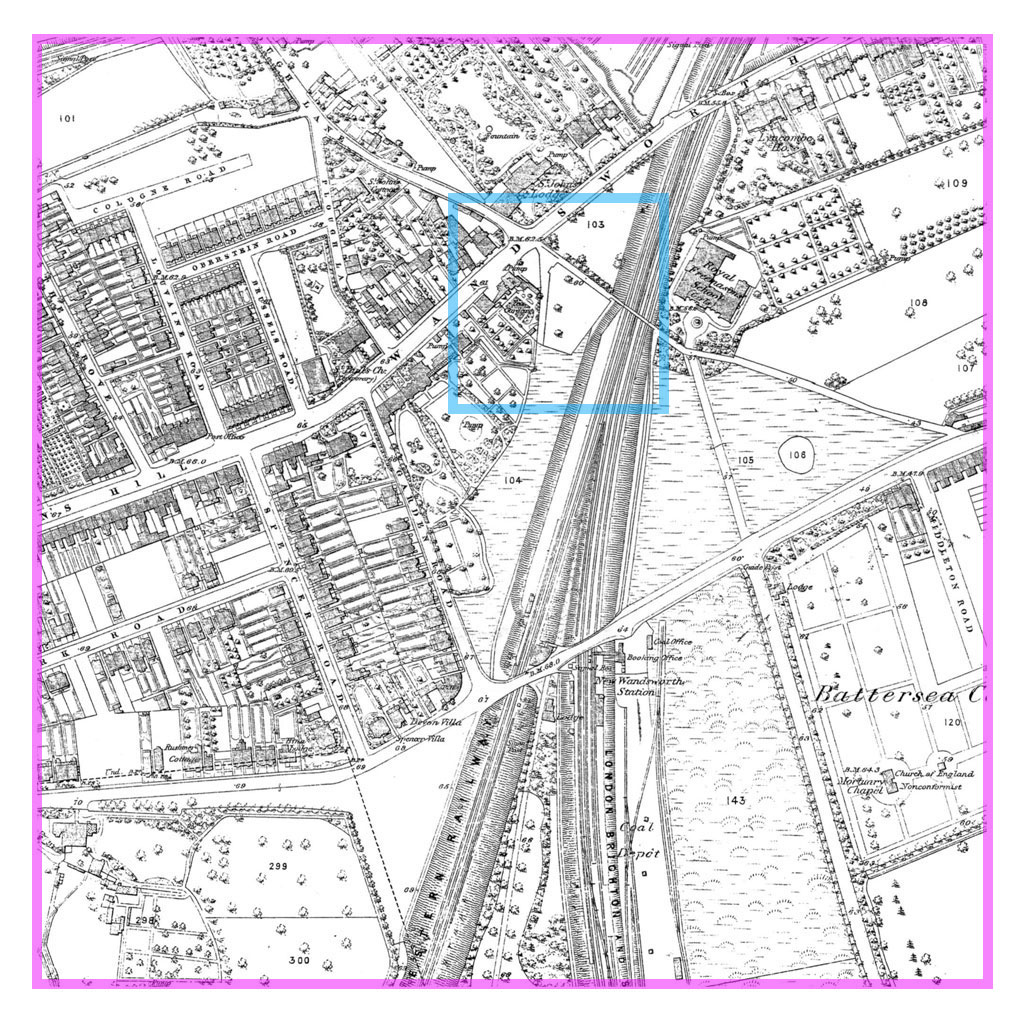
"Plough Green" appears to be an area cut into fragments by the new railway lines, creating an "orphaned" section to the north-east (which soon became someone's garden, and was later built on). A further section became the site in 185? of the Royal Freemasons School for Girls [exact name?] In the late 1860s, John Costeker attempted to take the last remaining fragment, used as a footpath ...]
John Costeker, a Woollen Merchant [?] born in Southwark, was living in a large house on St John's Hill [between today's Strathblaine Road and Strath Terrace]. Its garden was separated from dangerous gravel workings and the railway line by a strip of Common behind the Plough pub. This strip was widely used as a pathway to and from the main part of the Common and the rest of Battersea.
It was also alleged that "the part in question had come to be frequented by idlers and prostitutes, and at length the nuisance became so intolerable that he consented to take it on lease, and enclosed it."
[This led to much local merriment — the idea that Costeker was solely motivated by the desire to protect local people.]Costeker had leased [?] the area from Earl Spencer some years previously, but appears to have done little with it. But [around 1868/ only 18 months earlier?] he fenced it off and planted a "kitchen garden", or perhaps an orchard. Local people took this very badly, and there had already been countless attempts to break down his gate and fences (including a number by Costeker's own butcher, a Mr Clark).
[The dispute between Costeker and Clark went on and on. It ended in [1871?] when a higher court...]
A letter in support of Mr Clark, who was fined for defending the Common, and strong (and superbly sarcastic) criticism of the magistrate for his "valuable addition to our law on the subject"...
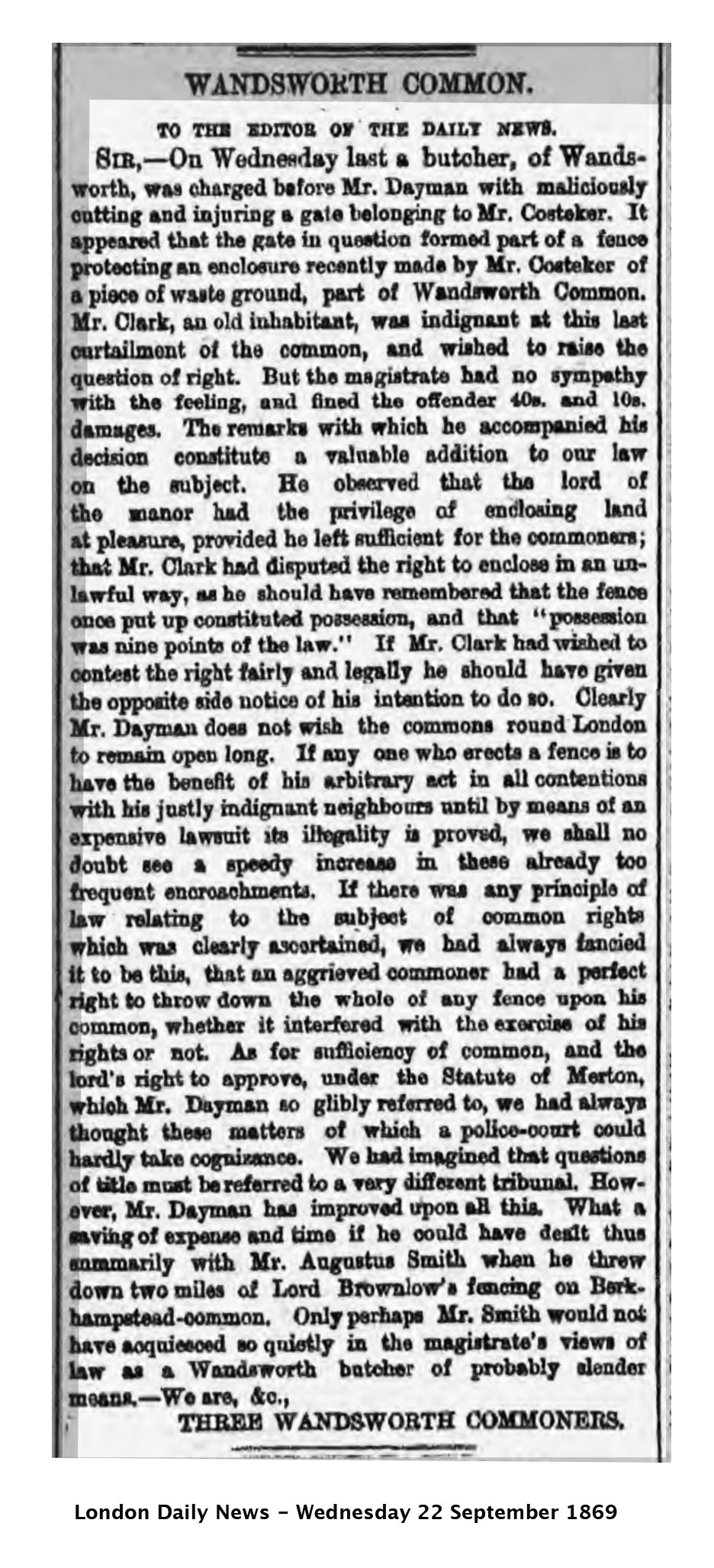
WANDSWORTH COMMON.
TO THE EDITOR OF THE DAILY NEWS.
On Wednesday last a butcher, of Wandsworth, was charged before Mr. Dayman with maliciously cutting and injuring a gate belonging to Mr. Costeker. It appeared that the gate in question formed part of a fence protecting an enclosure recently made by Mr. Costeker of a piece of waste ground, part of Wandsworth Common.
Mr. Clark, an old inhabitant, was indignant at this last curtailment of the common, and wished to raise the question of right. But the magistrate had no sympathy with the feeling, and fined the offender 40s. and lOs. damages.
The remarks with which he accompanied his decision constitute a valuable addition to our law on the subject. He observed that the lord of the manor had the privilege of enclosing land at pleasure, provided he left sufficient for the commoners; that Mr. Clark had disputed the right to enclose in an unlawful way, as he should have remembered that the fence once put up constituted possession, and that "possession was nine points of the law."
If Mr. Clark had wished to contest the right fairly and legally he should have given the opposite side notice of his intention to do so. Clearly Mr. Dayman does not wish the commons round London to remain open long.
If any one who erects a fence is to have the benefit of his arbitrary act in all contentions with his justly indignant neighbours until by means of an expensive lawsuit its illegality is proved, we shall no doubt see a speedy increase in these already too frequent encroachments. If there was any principle of law relating to the subject of common rights which was clearly ascertained, we had always fancied it to be this, that an aggrieved commoner had a perfect right to throw down the whole of any fence upon his common, whether it interfered with the exercise of his rights or not.
As for sufficiency of common, and the lord's right to approve, under the Statute of Merton, which Mr. Dayman so glibly referred to, we had always thought these matters of which a police-court could hardly take cognizance.
We had imagined that questions of title must be referred to a very different tribunal. However, Mr. Dayman has improved on all this. What a saving of expense and time it he could have dealt thus summarily with Mr. Augustus Smith when he threw down two miles of Lord Brownlow's fencing on Berkhampstead-common. Only perhaps Mr. Smith would not have acquiesced so quietly in the magistrate's views of law as a Wandsworth butcher of probably slender means.
We are, &c.,
THREE WANDSWORTH COMMONERS.
[Source: Link]
[Explain or add a link to an explanation of the C13 Statute of Merton, which underpins not just this case but the whole attack on all Commons at this time.]
[Follow-up letter: 29 September 1869, below.]
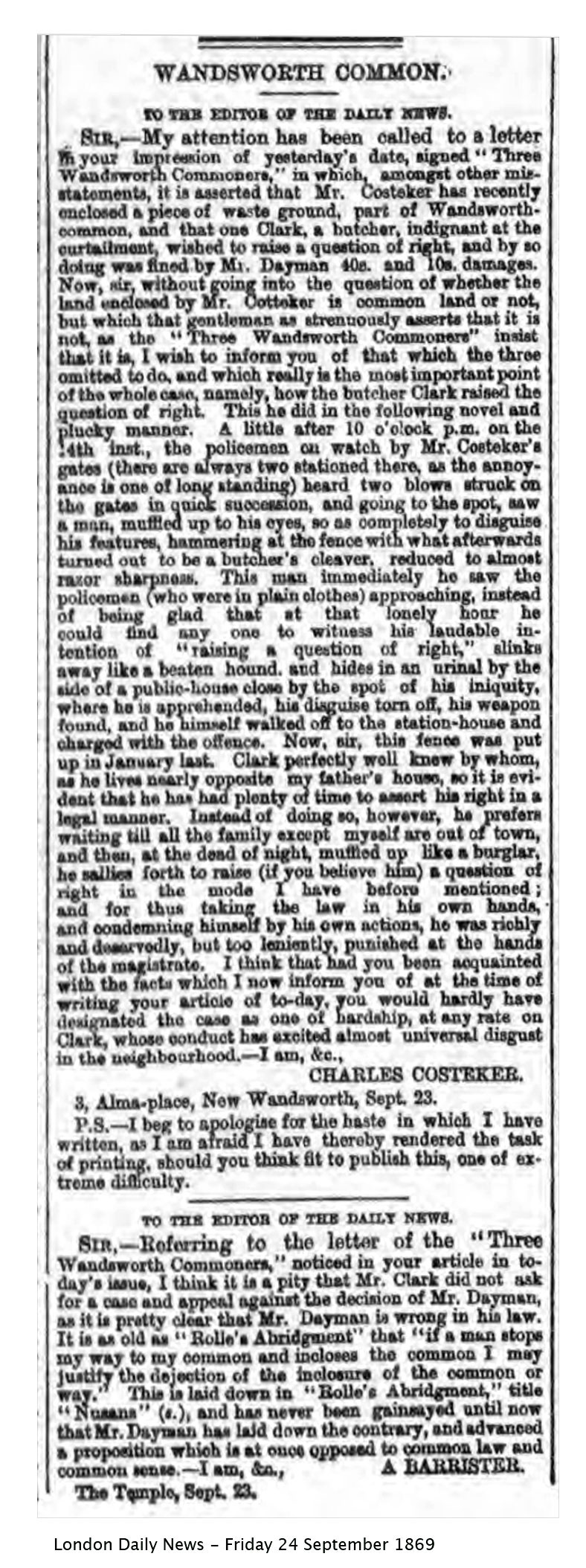
London Daily News — Friday 24 September 1869
WANDSWORTH COMMON., TiSO 1 EDITOR 0F THE DAMY NZWO. SIR,-My attention has been called to a letter .ayour Impression'of yesterdsys date, signed0 au hres Waudsworph Commoiore " in whioh amongst other iis- statements, it is asserted that Mr. bostteker has recently enclosedea piece of waste ground, part kof Wandeworth- common, and that one Clark, a butcher, indignant at the ourtalmsent, wished to raise a question of right, end by so doing wast fined-by Mr. Dayman 40a. and lOs. damages. No sI witheut going into the question of whether the la ?? byu T. Cotteler is common land or not, but which that gtleman at strenuously asserts that it is not, as the "T hree Wandsworth Comnr"iss .that it is, I wish to, inform you of Ihat which the three omitted to do, and which really is the most important point oftne wole cae, namely,howthelbuteer Clarkuraied the questionof right. This he did in the following noveland ?? manner. A. little' after 10 o'clock p.m. on the 14th inst., the policemen on watch by Mr. Costeker's gates (ther e awy two stationed there, as the annoy- aend is one of lon st o dcn) heard two blows struck on the gates in eo suocession, and going to the spoet saw a mniin, mutleup to his eyes, so as competely to disguise. hi featlures, N ;8hammeringat theencaewit what afterwads tured out to he a butcher's cleaver, reduced to almost rao shrness. This man immediately he saw the policeme (who were inplanoclothes) appreaching, instead of being glad that at that lonely hoer he could fidany one to witness his- laudable in- tention of "raising a question of right," sinks away like abeaten hound. and hides in an urinal by the. sideoof apublio-house close bythe spot of his 'Iniquity, where he is apprehend guse off, his weapon found, and he himself t station-houe and charged with the offence. Now, air, this fenoee was put up in.January last. Clark perfectly well knew bi! whom, as he lives nearly opposite my lather's house, so it is evi. dent that he has ha plentyoftime to ?? right ina5 legal, manner. Isistead of doing so, however, he prefers waiting till all the family except myself are out of town, and than, at the dead of night, muffled up like a burglar, he sallies forth to raise (if you believe him) a question of right in the mode I have bsfore mentioned; and for thus taking the law in his own hands, and condemning himself by his own actions, he was richly 4usd desevedly, but too leniently, punished at the hands of the magistrate. I think tat n you been acquainted withthefee' wich no inormyouof at the time of CHARLES COSTEKER 3, Alma-place, New Wandsworth, Sept. 23. written, as I acm afraid I have thereby rendered the task of p i shuld you think fit to publish this, oen of ax. for a eae and appeal against the decision of Mr. Da~'man, as it is pretty clear that Mr. IDayman is wrong in his law.. It is as old as"1 Bolls's Abridgment" that "if a men stops1 my way to my common and incloses the common I may7 jusif' he ejcton f ?? common or The TqMInples Sept. 23.
In the same issue "A Barrister" wrote ...
oen of ax. for a eae and appeal against the decision of Mr. Da~'man, as it is pretty clear that Mr. IDayman is wrong in his law.. It is as old as"1 Bolls's Abridgment" that "if a men stops1 my way to my common and incloses the common I may7 jusif' he ejcton f ?? common or The TqMInples Sept. 23.

[NEEDS EDIT]
Wandsworth Morality.
It might be considered severe were we to assert that public and private morality is exceptionally low in the neighbourhood of Wandsworth. And we make no such assertion; but we are sure that the public will agree with us that it would not be singular should this impression be forced on them by facts constantly being brought under notice. Wandsworth Common appears to be the great source of demoralization, and those apt to jump at conclusions might easily convince themselves that the source is very potent and the effects most deplorable.
For example. At the Board of Works' meeting on Wednesday attention was drawn to a triangular piece at the top end of the Common which had been enclosed, and the surveyor was asked when, by whom, and under what plea this outrage was committed? The officer could only answer that the land belonged to the churchwardens, but he could not say how they became possessed of it.
[Where was this triangle that "belonged to the churchwardens"?What did they do/want to do with it? Was this the triangle at the top of East Hill, next to Mount Nod, between North Side and St John's Hill on which the Wandsworth Board of Works built their offices in 188?]
Here we have as No. 1, the churchwardens, of all people, under suspicion of brigandage, of appropriating public property to their private uses. The next point arising was a rumour that the Battersea Vestry had "appropriated" gravel from the Common, in gross violation of an agreement entered into with other vestries, thus saving £1,000 a year.
So No. 2 shows the pleasing spectacle of a vestry, which ought to have some little care for public rights, coolly taking advantage of its position to, well, "convey, the wise it call" — what it had expressly stipulated not to lay hands on.
[The gravel issue comes up elsewhere — Battersea continuing to extract gravel even after an agreement has been reached with Wandsworth not to do so. Find.]
From the vestry to a man who has taken a prominent part in public affairs is an easy stage, and, as No. 3 case, the name Mr. Costeker next crops up. This time it is a police-case. Mr. Costeker has, it is alleged, enclosed a piece of waste ground, part of Wandsworth Common, and there are those in the parish who believe he has done this, and has no more right do this than he would have to stop a traveller the high-road and demand his money or his life.
Among others who entertain this opinion is Mr. Clark, butcher, an old inhabitant (whom Charles Costeker, while ready to "Mr." his namesake, petulantly calls "one Clark"), who recently went and tried to break down the fence.
Costeker at once had him before Mr. Dayman, for maliciously cutting and injuring a gate belonging to him, and, though assured that the act was only done to try a right, our local Midas fined the offender 40s., and 10s. for damages.
From the remarks accompanying the decision, one of two conclusions seems inevitable — either the magistrate did not know what he was talking about, or there was strong bias in the case.
The decision and the remarks have alike aroused public indignation. This has been expressed in the newspapers, and Mr. Costeker, or his son, has written a fiery letter which has not improved matters. In the course of it he grows sensational and angry in one; says of Clark that "at the dead of night, muffled up like a burglar, he sallies forth to raise (if you believe him) a question of right."
[His son? Can we find this letter?]
There is nothing like carrying things with a high hand, and there is something amusing in Charles Costeker's affecting to believe that Clark was not influenced by the motive he assigned, though he obviously went to work in the manner described, so to save himself from falling victim to the public interests.
At all events, here we have three cases of alleged appropriations of parts of that tempting prize, the Wandsworth Common, and seeing who the parties concerned are, we ask again whether those apt to jump at conclusions would not be almost justified in concluding that the public and private morality about Wandsworth is at an uncommonly low ebb?
One thing is certain, Wandsworth owes it to itself to try the question of Common rights, while it has Common left to try it over, or a character to be affected by the decision. If the battle is to be fought, it should be fought at once, as that of Edmonton Common is about to be fought by its spirited Local Board.
[BNA: South London Press — Saturday 25 September 1869 .]
[CAN THE LETTERS FROM THE COSTEKERS BE FOUND? WHAT ARE THE FAMILY RELATIONSHIPS — is the lawyer — Charles Costeker — John Costeker's brother? son?]
[NEEDS EDIT]
[Refers to letter 22 September 1869, above]
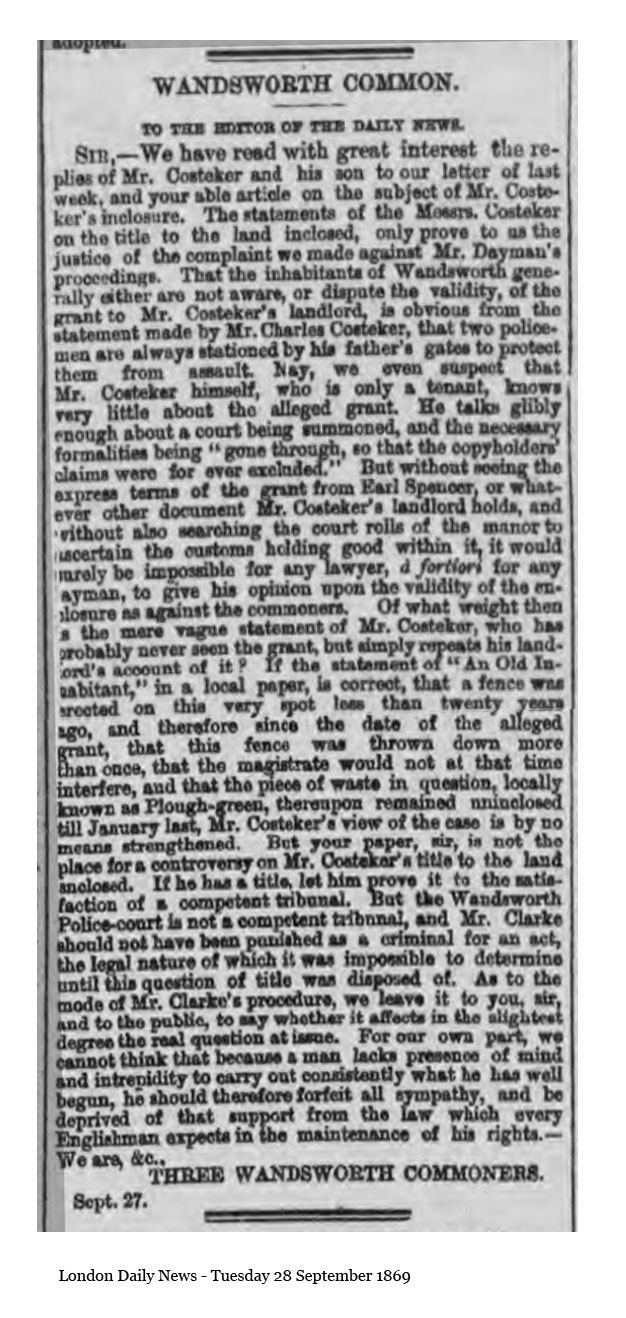
WANDSWORTH COMMON
TO THE EDITOR OF THE DAILY NEWS
Sir, We have read with great interest the replies of Mr. Costeker and his son to our letter of last week, and your able article on the subject of Mr. Costeker's inclosure. The statements of the Messrs. Costeker on the title to the land inclosed only prove to us the justice of the complaint we made against Mr. Dayman's proceedings.
That the inhabitats of Wandsworth generally either are not aware, or dispute the validity, of the grant to Mr. Costeker's landlord, is obvious from the statement made Mr. Charles Costeker that two policemen are always stationed by his father's gates to protect them from assault.
[Two policemen! Who was Costeker's lamdlord? Did all this kerfuffle cause Costeker to move away?]
Nay, we even suspect that Mr. Costeker himself, who is only a tenant, knows very little about the alleged grant. He talks glibly enough about a court being summoned, and the necessary formalities being "gone through", so that the copyholders' claims were for ever excluded. But without seeing the express terms of the grant from Earl Spencer, or whatever other document M Costeker's landlord holds, and without also searching the court rolls of the manor to ascertain the customs holding good within it, it would surely be impossible for any lawyer, a fortiori for any layman, to give his opinion upon the validity of the enclosure as amainst the commoners.
Of what weight then is the mere vague statement of Mr. Costeker, who has probably never seen the grant, but simply repeats his landlord's account of it?
If the statement of "An Old Inhabitant," in a local paper, is correct, that a fence was erected on this very spot less than twenty years ago, and therefore since the date of the alleged grant, that this fence was thrown down more than once, that the magistrate would not at that time interfere, and that the piece of waste in question, locally known as Plough Green, thereupon remained unenclosed till January last, Mr. Costeker's view of the case is by no means strengthened.
["January last", i.e. January 1868. Can we find the letter from "AN Old Inhabitant"?]
But your paper, sir, is not the place for a controversy on Mr. Costeker's title to the land enclosed. If he has a title, let him prove it to the satisfaction of a competent tribunal. But the Wandsworth Police-court is not a competent tribunal, and Mr. Clarke should not have been punished as a criminal for an act, the legal nature of which it was impossible to determine until this question of title was disposed of.
As to the mode of Mr Clarke's procedure, we leave it to you, sir and to the public, to say whether it affects in the slightest degree the real question at issue. For our own part, we cannot think that because a man lacks presence of mind and intrepidity to carry out consistently what he has well begun, he should therefore forfeit all sympathy, and be deprived of that support from the law which very Englishman expects in the maintenance of his rights.
We are, &c.,
THREE WANDSWORTH COMMONERS
Sept. 27.
Costeker [v Clark?]
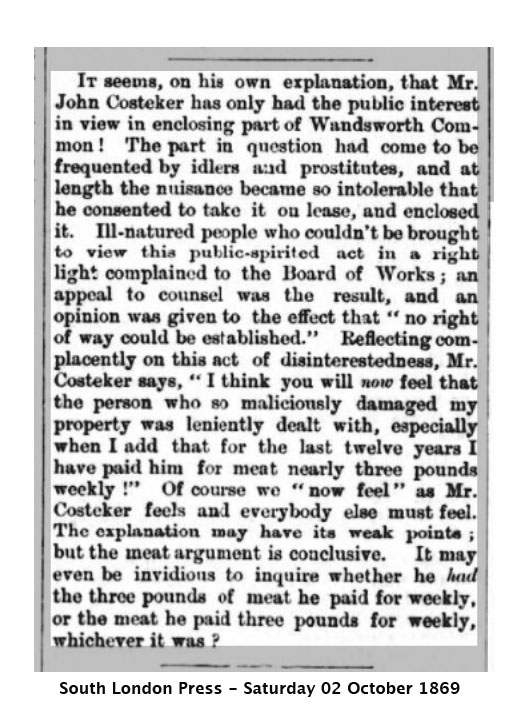
It seems, on his own explanation, that Mr. John Costeker has only had the public interest in view in enclosing part of Wandsworth Common! The part in question had come to be frequented by idlers and prostitutes, and at length the nuisance became so intolerable that he consented to take it on lease, and enclosed it.
Ill-natured people who couldn't be brought to view this public-spirited act in a right light complained to the Board of Works; an appeal to counsel was the result, and an opinion was given to the effect that no right of way could be established.
Reflecting complacently on this act of disinterestedness, Mr. Costeker says, "I think you will now feel that the person who so maliciously damaged my property was leniently dealt with, especially when I add that for the last twelve years I have paid him for meat nearly three pounds weekly!"
Of course we "now feel" as Mr. Costeker feels and everybody else must feel. The explanation may have its weak points; but the meat argument is conclusive. It may even be invidious to inquire whether he had the three pounds of meat he paid for weekly, or the meat he paid three pounds for weekly, whichever it was?
[Source: Link]
[Source: Link]
[Source: Link]
A conclusion, in which nothing is concluded, has been arrived by one of Our magistrates. The lord of the manor of Wandsworth (as it was first stated, though afterwards turned out to be only a resident) had erected fence inclosing part of the common; another inhabitant pulled down this fence; and the former summoned the latter to the police court. The offender was fined 40s., and had to pay 10s, for the damage, the magistrate remarking that the lord of a manor had right to inclose much of common as he chose, provided leave enough for the commoners."
Such a magisterial dictum as this shows in what unsatisfactory state the law. Why this decides nothing Enough for the commoners 1 But the commoners want it all; they wish to be left free and open to themselves and their children, and this is what all London wishes, and all London concerned in the matter. And if the right, and the lord of manor has a right to put up a fence, or allow another person to do so, and leave what the lord of the manor considers enough for the commoners," it is a matter which conrerns the inhabitants of every town on the outskirts of which there may be that precarious boon — a common.
[Source: Chelsea News and General Advertiser]
[During the hearing against Samuel Sullings]
Mr. Charles Costeker, solicitor, conducted the case. He said the complainant was lessee of a piece of ground running by the side of the railway, and facing the Wandsworth-road. It was enclosed by him in December, 1868, and since then put into cultivation. Persons had the liberty to wander over it for a number of years, and erroneously supposed that they had a right of way across it.
In September last Mr. Clark was found injuring the fence by hacking the gates at night, muffled up, which would be in the recollection of the magistrate, who fined him forty shillings in addition to the damage of ten shillings. Since then he had trespassed upon the land, and the complainant commenced an action in the Court of Queen's Bench, in which the question of the right of way was raised. Certain pleas were entered, but the defendant in the case suffered judgment to go by default with costs.
Costeker/"Costaker"? v Clarke case ridiculed by judge
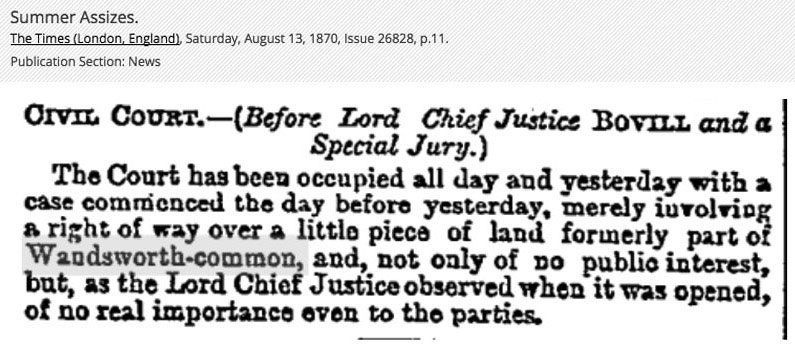
Costeker/Costaker [sp?] v Clarke case comes to court again

COSTAKER V. CLARKE — WANDSWORTH COMMON
This was action of trespass, and involved a question whether a piece of land to have formerly been portion of Wandsworth common was public or of the plaintiff. The action was tried at Guildford, before Lord Chief Justice Bovill, and resulted in verdict for the plaintiff.
It appeared that the strip of land was formerly a waste, and being sandy soil — as, indeed, all Wandsworth-common is — some parties, for speculative purposes, digged pits in it, raised and sold sand, and thus became dealers in an article which cost them nothing but the labour in excavating, and by which they amassed fortunes.
A railway was in course of time run across the common, and bordered close on the skirts of the piece of land in question. The construction of the railway narrowed the pathway accommodation for foot passengers, causing them to verge somewhat closely on the open sandpits, and exposing "her Majesty's lieges" to danger of life and limb. The Accidental Assurance Company was not in existence at the time.
The plaintiff, who is an attorney, and who has a house and garden on the confines of the plot of ground, set up a wooden fence between the gravel-pit and footpath, and while he saved the public from the danger of falling into them, managed to enclose them and the strip of land.
The defendant, who is a butcher, questioned and disputed the plaintiff's right to enclose the piece of land, and acting in co-operation with neighbours determined to try the right, "and to preserve the common to the goose." A phalanx of them, in that determination, made a raid upon the fence, and asserted, by coup de main, a "right of common."
The plaintiff instituted proceedings against the defendant, and adduced evidence that he had years possession of the land, which gave him a title in law.
For the defence it was submitted that the plaintiff, under a pretext for the public safety, first enclosed the gravel pits, and subsequently added the piece of land his garden ground.
The learned Judge summed up the evidence, and the jury returned verdict for the plaintiff the point of law that the 20 years' possession gave him a legal title.
Mr. Montagu Chamber, Q.C., now moved to set the verdict aside on the ground of misdirection by the learned judge, and also that the verdict was against the weight of evidence.
The Court refused the rule on the first point, and intimated that they would speak to Lord Chief Justice Bovill respecting the question of weight of evidence.
[BNA: Morning Advertiser ]
[So what was decided?!]
For Costeker's role in bringing Battersea Grammar School/St Walter St John's? to [name?], the villa almost opposite him, and his conflict with James Lord? see e.g Survey of London 49.4._schools_chapter.pdf and 50.16_st_john_s_hill.pdf.
Check Keith Bailey on Lord
Addresses in Metallurgicon, 1867:
[Here cross Spencer Road.2
6 Crump, Mr. Edward
5 Gibson, 0., Corndealer
4 Pask, Mr. Samuel John
3 Kains-Jackson, H., Esq.,
Eh 1 2 Houlton, J., Plumber, &c.
1 Smith, John, Tailor
Ashton, Rev. Robert
[Here cross Garden Road.]
Smith, William Compton, Esq.,
Ivy Lodge
Costeker, John, Esq.
Vacant, Walnut Tree Cottage
Kendall, Mrs. Jane, "The Plough "
The Royal Freemasons' School for Female Children
NB
Both Costeker and Da Silva were members of the Society of Arts (1865_04_21_johnson_da_silva_rsa.pdf)
Cooke, Rev. John Hunt, Elm-grove, Southsea. Costeker, John, St. John's-hill, Wandsworth, S.W. Da Silva, Johnson, Burntwood,Wandsworth-common
DOWN WITH THE FENCES — S LONDON COMMONS.pdf