Last modified: 24 October 2026 · Build 1
Home›People›Henry and James Groves›Obituary by James Groves (1913)
Source: J[ames] G[roves], “Henry Groves (1855–1912)”, The Journal of Botany, British and Foreign, vol. 51 (March 1913), pp. 73–79, with portrait. Written at the request of the editor, James Britten.
Wandsworth Common. In the early 1870s, James writes, “Wandsworth Common was a particularly happy hunting ground for us, in the days before it had been pared down and tidied up so as to conform to municipal ideas of beauty” (page 74, below). Barnes Common, where Henry found Rosa hibernica in 1875, and Thames Ditton, where the brothers visited Hewett Cottrell Watson, appear too.
HENRY GROVES.
(1855–1912.)
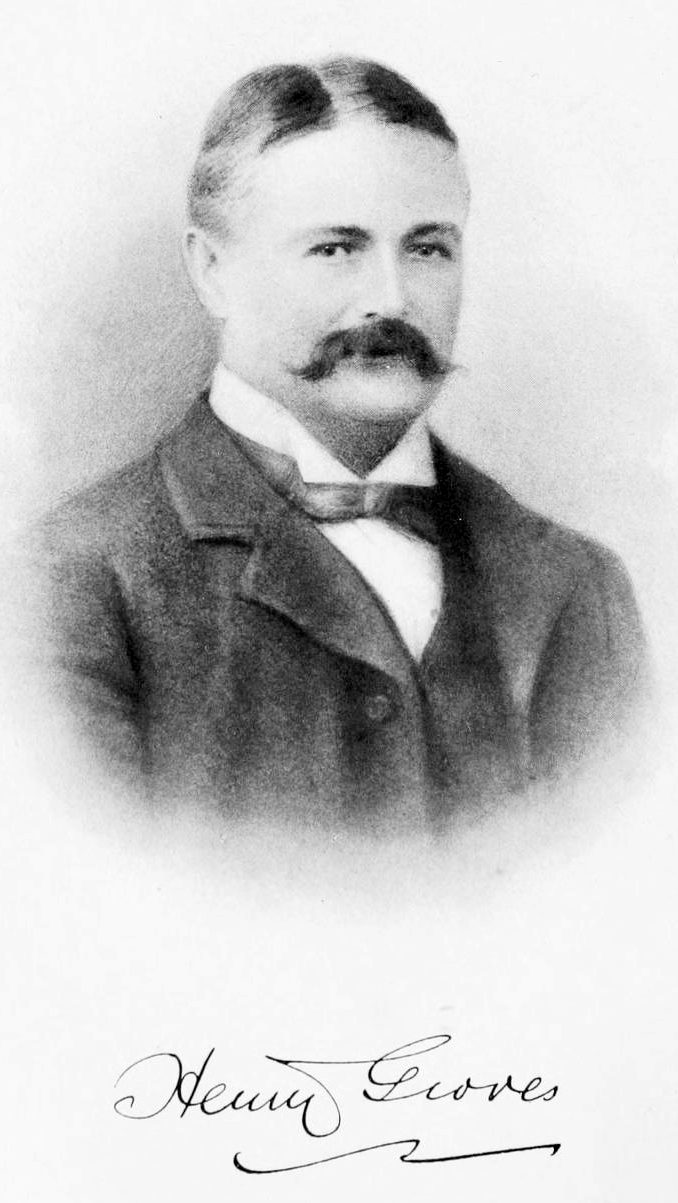
(with portrait.)
[page 73]
At Mr. Britten’s request I have undertaken to write a short memoir of my late brother, feeling that I am in a better position to do so than anyone else could be, having been associated with him in all his botanical work; but for that very reason, coupled with our close relationship, it is impossible for me to write of him as impartially as perhaps a biographer ought.
My brother was born in London on October 15th, 1855. Our father’s family came from Gloucestershire, and our mother’s—her maiden name was Stewart—from Scotland. Early in 1863, when my brother was seven years old, we removed to Godalming, in Surrey, and for about six years he attended Godalming Grammar School.
The Principal of the school, Mr. Peter Churton, who is happily still with us, though a good schoolmaster, had nothing of the dominie about him, being both in and out of school a friend rather than a master to his pupils. He was a good general naturalist, and used to take those of the elder boys who showed any interest in such things for frequent natural history rambles over the beautiful and diversified Lower Greensand and Chalk country with which Godalming is surrounded. He generously provided presses and drying and mounting paper to those who wished to preserve specimens of the plants collected, as well as other natural history apparatus. On several occasions he took my brother and one or two of the other boys away with him on summer holidays, visiting Hayling Island, the Isle of Wight, South Devon, and Cornwall. These excursions gave my brother an opportunity of seeing a great many fresh plants, besides widening his general outlook. He was, I think, Mr. Churton’s favourite pupil, and I attribute his rather exceptional powers of observation, and his keen desire to get at the real meaning of any fresh facts or phenomena which presented themselves, to his early training in practical natural history; and the development of his character was, I feel sure, largely due to Mr. Churton’s example and teaching.
In 1869 our father died, and our mother was left with three children and very slender means. It was necessary for my brother to begin to earn something, and when we had removed to London, he went, at the age of fourteen, to the office of a stockbroker friend of our parents, where he remained for about ten years.
In the very early seventies we made the acquaintance of the family of the late John Edward Sowerby, the botanical draughtsman, who possessed a number of botanical books. I remember we used to borrow the English Botany (ed. 2) a volume at a time, and make drawings and tracings of the plants which we did not know. The Sowerbys also gave us several books, among them [page 74] Hooker and Arnott, and Babington’s Manual. Up to that time I think we had only Withering by which to try and identify plants. We soon began to make excursions in search of specimens to the London commons and other places near at hand. Wandsworth Common was a particularly happy hunting ground for us, in the days before it had been pared down and tidied up so as to conform to municipal ideas of beauty. At that time we were omnivorous collectors, especially delighting in water creatures and keeping several freshwater aquaria.
1874 was an important year with us. Up to that time we knew scarcely any other naturalists, but during the year we made the acquaintance, personally or by correspondence, of quite a number, some of them men of considerable standing. At the commencement of the year we both joined the South London Microscopical and Natural History Club, then a very flourishing association, and my brother soon became acquainted with Dr. Braithwaite, Professor Charles Stewart, and Mr. (now Dr.) Daydon Jackson. Through the medium of the exchange column of Science Gossip we got into correspondence with a number of British botanists, among them Mr. T. B. Blow, my brother’s acquaintance with whom ripened into a lifelong friendship. At that time Mr. Blow was one of the most ardent of field botanists, and we were carried away by his enthusiasm to study many critical plants of which we had previously fought shy. To Mr. Blow we were also indebted for the personal acquaintance of one whom we always felt proud to have known, Hewett Cottrell Watson. In October, 1874, in company with Mr. Watson and Mr. Blow, we went for a short excursion in the neighbourhood of Thames Ditton, when Mr. Watson showed us several interesting plants. He invited us to call on him whenever we were in the neighbourhood, and a number of our Saturday afternoon rambles terminated at Thames Ditton. He always made us very welcome, and we owed much to his help and encouragement. I think one reason why he rather took to us was that we were not afraid to disagree with him, and he dearly loved an argument. In 1874, also, we first visited the Botanical Department of the British Museum, and made the acquaintance of Mr. (now Dr.) Carruthers, the late Henry Trimen, and our good friend Mr. Britten.
An early correspondent who helped us greatly was the late Andrew Brotherston, of Kelso, to whom we were indebted for specimens of a great many critical plants. We also learnt a great deal from the late Frederick Morgan Webb, an excellent critical botanist who was for some time living close at hand.
In 1875, thanks to the help and encouragement of our friend Mr. Bagnall, we commenced the study of the Roses, and my brother’s discovery of Rosa hibernica on Barnes Common brought us the acquaintance of another great botanist, John Gilbert Baker. We also got into correspondence with Professor Crépin and M. Déséglise.
In 1875–6 we became acquainted with a large number of fresh plants. In company with Mr. Blow my brother had many walks [page 75] in Hertfordshire and the adjoining counties, collecting many of the rarer eastern county plants. One day I remember they set out for Hitchin with the fixed intention of finding Phleum phalaroides, although it had not previously been recorded on that side of the county, and strangely enough before evening they had found the grass in great abundance on the borders of Hertfordshire and Bedfordshire, it being a new record for the latter county.
Our summer holidays from 1873 to 1879 were mostly spent at our uncle’s near Southampton. This gave us the opportunity of exploring the New Forest and a great portion of the south of Hampshire, with occasional visits to the Isle of Wight. We turned up a number of plants not previously recorded for vice-county 11, and collected many notes for Townsend’s Flora of the county, then in course of preparation. Our Hants botanising brought us another lasting friendship, that of the best all-round naturalist we have ever known, Mr. Ernest D. Marquand.
Up to 1877 we were quite as keen hunters of the land and freshwater mollusca as of plants. My brother was particularly quick at finding those tiny creatures the Vertigos, and our discovery of V. Moulinsiana as a British species brought him the personal acquaintance of Dr. Gwyn Jeffreys. My brother assisted Mr. Rimmer in the preparation of his Land and Freshwater Shells of the British Isles.
About 1877 we began to study the Characeæ. Mr. Hiern first suggested the group to us as a profitable field for work, but it was Professor Babington who supplied the principal incentive by kindly presenting us with several important papers on Characeæ, as well as the first two of Braun’s Exsiccatæ. We also received much assistance from our esteemed friend Professor Otto Nordstedt. Our first note on these plants appeared in this Journal in 1878, when we recorded Chara connivens as a British plant. We collected Characeæ assiduously, and borrowed a large number of specimens for examination from friends and correspondents.
In 1879, owing to the death of his principal, my brother left the stockbroking business, and in the interval between this and his employment at Queen Anne’s Bounty Office, he spent a good deal of time at the British Museum, making extracts of all he could find relating to the Characeæ, our object being in the first place to produce an account of the British species.
In 1880, when my brother was twenty-four, we published our little “Review of the British Characeæ,” which came out in three instalments in the pages of this Journal. Had we waited a few years longer we should no doubt have avoided some mistakes, but as the greater part of the work and all the drawings were my brother’s, I may perhaps be pardoned for saying that on the whole the “Review” was a fairly satisfactory piece of work, and I think did something to stimulate the study of the group in this country. From time to time for many years we published supplementary notes giving extensions of distribution, &c., and describing the several fresh species added to the flora, my brother supplying [page 76] the illustrations of the latter. In 1880 Henry revisited Cornwall, meeting the two veterans John Ralfs and William Curnow.
In 1881 we launched out in another direction by describing Spartina Townsendi and Rosa tomentosa var. Woodsiana. I well remember the late Rev. W. W. Newbould shivering at our audacity, evidently thinking it scarcely decent for young men to describe a new British plant without some first rate botanist like the late William Borrer having viewed it in situ to see that it was all right!
In 1882 my brother was placed on the regular staff of Queen Anne’s Bounty Office, having for about three years been employed as a supernumerary in the reorganization of the Muniment Department, where his love of order and a certain fondness for antiquarian research made the work interesting. In later years he was employed in other departments, and at his death was one of the seniors in the Office.
In 1883 he made his first acquaintance with mountain plants. We had a glorious fortnight together on the Breadalbane Hills, staying at the sheep farm at the foot of Ben Laoigh. He paid many subsequent visits to Scotland, mostly to the Breadalbanes and Cairngorms, in the latter case staying at Rothiemurchus with our friend the Rev. D. McDougall. He also on several occasions visited the Welsh mountains.
In 1884 he became Secretary of the South London Microscopical and Natural History Club, and retained that office until the Club was dissolved in 1897.
For some years we had been collecting Characeæ extensively with a view to issuing fasciculi of the British species, and in 1892 we brought out the first of these, making up fifty sets of thirty numbers. My brother contributed the larger proportion of the specimens. He was a careful and indefatigable collector, particularly of the water plants, and paid many visits to the Fen country, the Norfolk Broads, and other districts, in search of them.
Our mother, though not a botanist, took the keenest interest in our pursuits, and, as well as our artist sister, helped us greatly in laying out and drying specimens. When there was a big haul of Characeæ and hundreds of specimens to be floated out in a limited time, pans and dishes pervaded the house, and all hands turned to the work.
In 1892 we both visited Ireland and enjoyed a positive feast of Characeæ, first in Wicklow under the guidance of Mr. R. M. Barrington, then on the fine Shannon lakes with the late Mr. H. C. Levinge, afterwards in Galway, and finally at Killarney. The sight of Chara tomentosa and Nitella gracilis growing in quantity, and the finding of N. tenuissima (new to Ireland) in two provinces, were the great botanical delights of this holiday.
My brother became a Fellow of the Linnean Society in 1892, and served on the Council from 1899 to 1902, and again in 1911 to the time of his death. His broad knowledge of financial matters and his general level-headedness rendered him a useful councillor. In this connexion I may quote from a letter written [page 77] to me after his death by Dr. Scott, the former President:—“I had a great regard for your brother, whose vigorous mind and strong straightforward character made him a most valuable colleague and friend. No one was of more service to the Linnean Society.”
In 1896 Henry married Miss Bolton, and they had one daughter, now aged fifteen.
In 1900 we brought out our second fasciculus of Characeæ, to which our friend Canon Bullock-Webster contributed a large number of specimens.
In 1904 the ninth edition of Babington’s Manual was published. Several years before, out of regard for the late Professor, and rather than that such an invaluable book should go out of print, we reluctantly undertook the task of editing it, with the limitations explained in the preface. We should gladly have left the work in other hands, as we felt that for some time we had been getting out of touch with British botany generally, besides having too little leisure to do the work as it ought to have been done. However, as no one else seemed to be forthcoming, we did the best we could with it.
In my brother’s later years other interests to a great extent crowded out botany, and the limited portion of his leisure left for it was devoted almost entirely to the study of the Characeæ, especially those of extra-European countries. He prepared many hundreds of slides of these plants for microscopic examination, which represented no small amount of labour, considering the draggled apologies for specimens of which so much of the available material consists. He also made micro-photographs of the membranes of the oospores of a large number of species.
In 1907 he became a Trustee of the South London Botanical Institute. Though he could not quite share Mr. Hume’s optimistic views as to its regenerative mission, he had great hopes for the future usefulness of the Institute.
In 1909 he visited the South West of France, and, in company with Canon Webster, explored some of the lakes in the Landes, collecting a large series of specimens of Characeæ. This was the only occasion he botanized abroad, his other visits to the Continent being confined to the towns.
In 1910 Henry went to Brussels for the International Botanical Congress, acting as one of the delegates of the Linnean Society. He attended the section which dealt with nomenclature, the problems of which had a particular interest for him. He always advocated uniformity of practice, and was in favour of changes where they tended toward ultimate stability, having scant patience with those who opposed them merely on the ground of inconvenience to the existing generation. In this, as in larger matters, he was thoroughly public-spirited and had no sympathy with opportunists, or with those who set their own interests before the good of the community.
In 1911 we contributed an account of the Characeæ to Professor Urban’s Symbolæ Antillanæ. This was our most [page 78] ambitious undertaking as regards foreign Characeæ, and we hoped to have followed it up with similar papers on the species of other parts of the world.
On the 2nd November, 1912, having just completed his fifty-seventh year, my brother died, after a long and wearisome illness borne with characteristic courage and patience. He was of medium height and strongly built, and until recent years had particularly good health. Our portrait is from a group taken by the late Mr. J. Guardia, and enlarged and adapted for publication by our friend Miss Charlton.
At school Henry was fond of athletics, but, like many widows’ sons, as very young men we took life rather seriously and spared little time for amusements. Later on my brother took to lawn tennis, which, as well as Badminton, he played up to the commencement of his last illness. He was always fond of rowing, and it was partly owing to this that we were attracted to the study of aquatic plants.
In his earlier manhood my brother was a keen field botanist, and knew a great many critical species. Of late years he used to say he had forgotten all the British plants, but with a few minutes’ examination of a doubtful specimen his knowledge revived, and his judgment was, I think, particularly sound. With the ticketing of varieties which has so great an attraction for some botanists he had no sympathy. If he knew a species and the directions in which it varied he was quite satisfied. On the other hand, he was much interested in discovering the causes which had brought about any form or state, and was quick in detecting abnormality in specimens sent for determination. As regards the work done by our botanical “firm,” he was always the predominant partner.
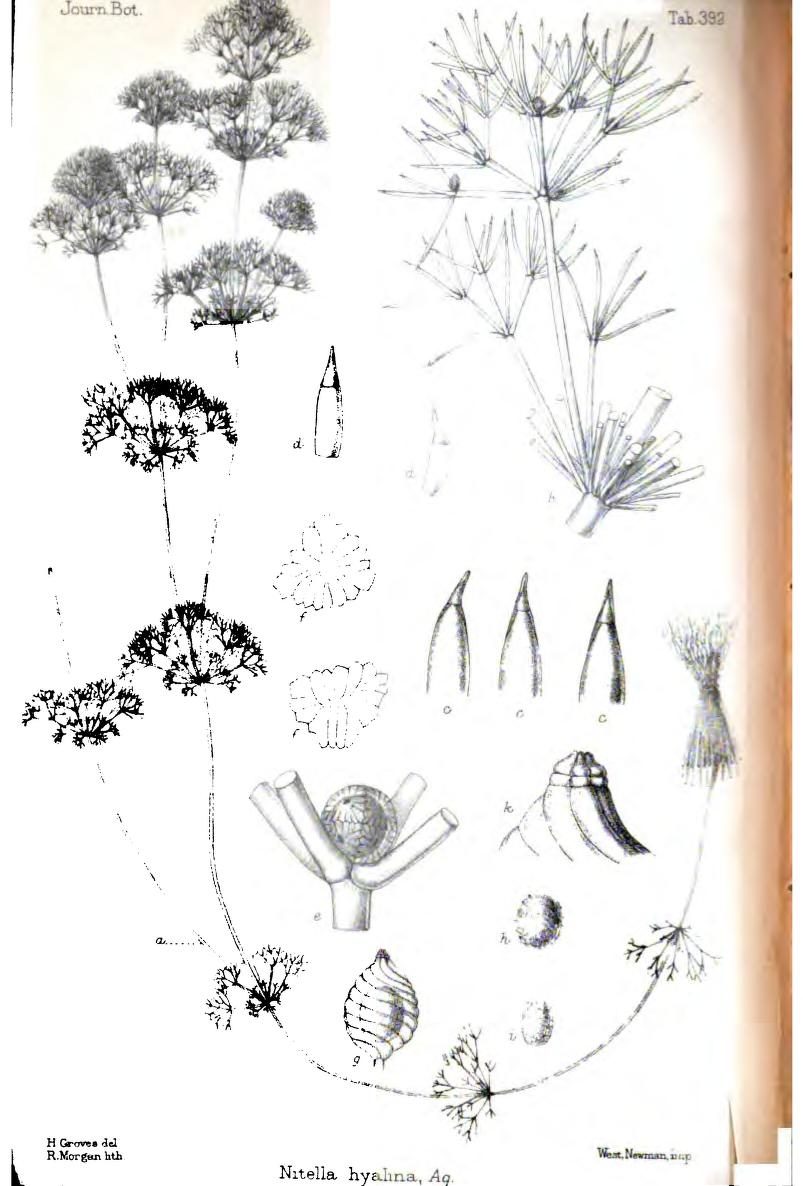
Though my brother did not produce a large number of finished drawings he was an excellent draughtsman, and was, I think, particularly successful in “erecting” a dried specimen into the semblance of life. His plates of Nitella Nordstedtiana and N. hyalina in this Journal, and that of N. dictyosperma in the Journal of the Linnean Society, are among the best representations of plants of this genus which have been produced. The only non-botanical drawings of his which have been published were the beautiful plate of Vertigo Moulinsiana in the Transactions of the Hertfordshire Natural History Society, and the representations of the genus Vertigo in Rimmer’s book.
Though by no means lacking in a sense of the beautiful, all forms of beauty did not appeal to him. He always put truth first, and a romantic poem or an imaginative painting had no charm for him. He was not a great reader, especially latterly, but had a particularly retentive memory for what he had read.
In later life especially, my brother was essentially a man of affairs, one whom it seemed natural to put on committees, to appoint as a trustee, and for his relatives and friends to turn to as a general counsellor. His knowledge of finance and property, his shrewd common sense and insight into human nature, his cool judgment and his ready sympathy eminently fitted him to [page 79] give advice in almost any difficulty, and he spared neither time nor trouble when his help was needed.
My brother always took a keen interest in politics. In his young days he was a Liberal, and I remember at our Church Debating Society we were, in point of numbers, always on the losing side, sometimes I think forming a compact minority of two! About 1886, when the Liberal Party split up, he went with the moderate section, and in later years must be classed as a Conservative. Though in a marked degree he “loved his fellow men,” he had little sympathy with the ideals of modern democracy, which to his robust common sense mind appeared crude and unpractical; while a Socialist was to him either a fanatic, a visionary, or one who coveted his neighbour’s goods. My brother used thoroughly to enjoy a parliamentary election. All his fighting instincts came out on such occasions, and he was an invaluable helper on polling days, his genial, persuasive manner and quick grasp of the personality of the man he had to do with standing him in good stead in bringing up the unwilling voter. He was not a fluent speaker, but was particularly quick in seeing a fallacy in an argument, and was never carried away by the glamour of oratory.
Though he was always a member of the Church of England, his religious views were extremely broad. He had a great affection for Westminster Abbey, and for a great many years acted as steward for some of the services there.
Of his more intimate personal qualities I cannot speak here; suffice it to say that even I, who knew him so well, was surprised to discover after his death what a large number of people there were, in many different stations in life, who regarded him with evident affection as well as esteem, showing how widely and profoundly he is missed.
J. G.
Do you know more about Henry or James Groves, or where the family lived in London? Please let me know.