Last modified: 24 October 2026 · Build 1
Home›People›Henry and James Groves›Notes on British Characeae, 1895–1898
Source: H. & J. Groves, F.L.S., “Notes on British Characeæ, 1895–1898”, The Journal of Botany, British and Foreign, vol. 36 (November 1898), pp. 409–413, with plates 391 and 392.
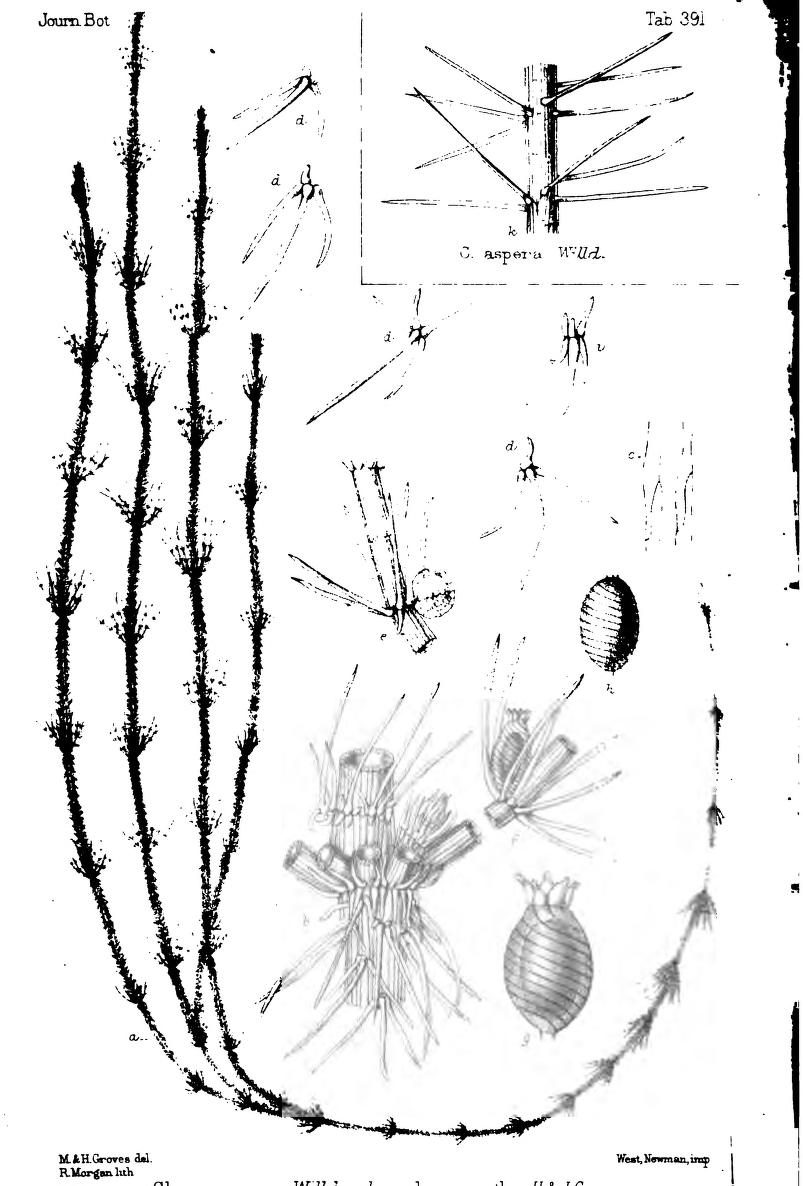
One of the brothers’ regular reports on the stoneworts, printed here for its two plates and as an example of their work. There is nothing about Wandsworth in it: the records come from Norfolk, Suffolk, Cornwall, the Hebrides and above all Ireland, sent in by a network of correspondents. The nearest place to us is Frensham, in Surrey (plate 391, figure k). Botanical recording areas are given as vice-counties (“Norfolk W.”, “Mid Ebudes” and so on); the name after each record is the finder’s.
[page 409]
NOTES ON BRITISH CHARACEÆ, 1895–1898.
By H. & J. Groves, F.L.S.
(Plates 391, 392.)
In the present instalment of “Notes” we have the pleasure of describing the most interesting addition to our Chara-flora for many years past, Nitella hyalina, which has recently been discovered in Cornwall by our friend the Rev. G. R. Bullock Webster, who has done such good work among the Characeæ in the eastern counties. There are also some important extensions of distribution to record, notably Chara connivens from Ireland, and C. canescens from Suffolk and Wexford. As in former years, Mr. R. Lloyd Praeger has furnished us with a very large amount of material, enabling us to fill up many blanks in the Irish counties. Mr. S. M. Macvicar’s gatherings in Coll and Tiree have added considerably to our previously scanty records for Mid Ebudes. We are much indebted to the gentlemen already named, and to our other correspondents, who have furnished us with the very numerous specimens, from which the following records are gleaned:—
Chara fragilis, Desv.—Norfolk W., 1897, G. R. Bullock Webster; Ayrshire, 1896, A. Somerville; Cantire, 1897, C. E. Salmon; Cork S., 1896, R. A. Phillips; Kildare, Meath, and Louth, 1896, R. Ll. Praeger, Roscommon, 1896, D. McArdle & R. Ll. Praeger.
Var. barbata.—Devon N., 1895, W. P. Hiern; Lincoln S., 1895, Mason & Peacock; Clare, 1896, N. Colgan; Mayo E., 1895, E. S. Marshall.
Var. capillacea.—Cambs, 1896, G. R. Bullock Webster; Louth, 1896, R. Ll. Praeger.
Var. Hedwigii.—Aberdeen N., 1883, J. W. H. Trail, comm. A. Bennett.
Var. delicatula.—Lincs. N., 1894, Mason & Peacock; Westerness, 1895, S. M. Macvicar; Cantire, 1897, C. E. Salmon: South Ebudes, Islay, 1898, T. F. Gilmour, comm. A. Somerville; Mid Ebudes, 1896, S. M. Macvicar; Meath (1896) and Roscommon (1897), R. Ll. Praeger; Tyrone, 1896, Mrs. Leebody, comm. R. Ll. Praeger.
C. connivens, Braun.—Suffolk E., near Benacre Broad, 1897, G. R. Bullock Webster; Wexford, lagoon north of Wexford Harbour, 1896, E. S. Marshall. A very interesting addition to the Irish flora.
C. aspera, Willd.—Norfolk W., Fowlmere, Croxton Heath, 1897, G. R. Bullock Webster; Lincs. N., Althorpe, 1894, “Fowler,” comm. E. A. Woodruffe Peacock; Mid Ebudes, Coll and Tiree, 1896, S. M. Macvicar.
Var. subinermis.—Mid Ebudes, Coll, 1896, S. M. Macvicar; Cork S., Tralispeen Bog, near L. Hine, 1896, R. A. Phillips & J. G.; Wexford, lagoon north of Wexford Harbour, 1896, E. S. Marshall.
Having received from time to time a large number of specimens of C. aspera from Ireland, and a few from England, in which the [page 410] spine-cells are more or less fasciculate, instead of solitary, or occasionally geminate, as in the normal forms, we have come to the conclusion that the forms with fasciculate spine-cells may with advantage be grouped together under a new subspecies, as follows:—
Subspecies desmacantha, nobis.—Stem usually considerably thicker than in the type; cortex very imperfectly triplostichous, the secondary cells joining obliquely; cortical nodes more numerous, 14–18 to an internode of the stem; spine-cells usually in groups of 3–5. Tab. 391.
We have been unable to find among the many varietal and specific names which have been given to forms of C. aspera one applicable to our subspecies. In addition to the character afforded by the fascicled spine-cells, there seems to be a marked difference in the number of the cortical nodes, the type of C. aspera having usually 10–12 to an internode, while the present plant has usually 14–18. It should be explained that in arriving at these figures we have added the number of cortical nodes in an ascending series to that in the descending series most nearly opposite to it. Among the aspera forms which we have recently examined, we find specimens referable to this subspecies from Cornwall W., Hayle Kembra, J. G.; Norfolk E., Lopham Fen, and Norfolk W., Langmere, G. R. Bullock Webster; Cambridge, Burwell Fen, A. Bennett; Anglesey, J. E. Griffith; and Yorks S.E., Bromfleet, T. Birks, jun.; and from Ireland, where it seems to be the prevalent form, from the following counties:—Queen’s Co., Kildare, Dublin (the form we referred to var. capillata), Meath, Galway E., Tipperary N., King’s Co., Westmeath, Mayo E., Sligo, Roscommon, and Down. We also have specimens from several localities in the S. of Sweden, Nordstedt & Wahlstedt; and from Bavaria, Leonhardi, Braun R. & S. Exsicc. No. 116, var. curta. No doubt the examination of a larger number of specimens will show a much more extended distribution.
C. polyacantha, Braun, R. & S.—Norfolk W., Garboldisham, 1897, G. R. Bullock Webster; Meath, Oldcastle, 1896, R. Ll. Praeger.
C. contraria, Kuetz.—Suffolk E., near Southwold, 1896, E. S. & C. E. Salmon; Mid Ebudes, Tiree, 1896, S. M. Macvicar; Meath, Oldcastle, 1896, R. Ll. Praeger; King’s Co., Edenderry, 1896, R. Ll. Praeger; Roscommon, R. Suck, 1896, D. McArdle & R. Ll. Praeger; Cavan, L. Sheelin, 1896, R. Ll. Praeger; Donegal, near Mulroy Mouth, 1898, H. C. Hart.
Var. hispidula.—Westmeath, L. Owel, 1895, H. C. Levinge.
C. hispida, L.—Norfolk W., 1897, G. R. Bullock Webster; Lincoln N., 1894, Mason & Peacock; Cantire (I. of Gigha), 1898, A. Somerville; Mid Ebudes (Coll and Tiree), 1896–7, S. M. Macvicar; Orkney, 1898, A. Somerville; Tipperary S. (1897) and Meath (1896), R. Ll. Praeger; Donegal, 1898, H. C. Hart.
Var. rudis.—Tipperary S., Clonmel, 1897, R. Ll. Praeger; Queen’s Co., Portarlington, 1896, R. Ll. Praeger; Meath, Oldcastle, 1896, R. Ll. Praeger; Kildare, Kilcock and Maynooth, 1896, R. Ll. [page 411] Praeger; Clare, Aranmore, 1891, S. A. Stewart (recorded by us in Journ. Bot. 1895, p. 291, by an error, as W. Galway); King’s Co., Edenderry, 1896, R. Ll. Praeger; Mayo E., S.E. corner of L. Mask, 1895, E. S. Marshall; Sligo, Rosse’s Point, 1897, R. Ll. Praeger; Cavan, L. Sheelin, 1896, R. Ll. Praeger.
C. vulgaris, L.—Monmouth, 1892, W. Whitwell; Argyll (Lismore), 1898, S. M. Macvicar; Mid Ebudes (Coll and Tiree), 1896–7, S. M. Macvicar; Tipperary S., 1897, R. Ll. Praeger; Wexford, 1896, E. S. Marshall; King’s Co. (1896), Leitrim (1897), Roscommon (1897), and Cavan (1896), R. Ll. Praeger; Donegal, 1898, H. C. Hart.
Var. longibracteata.—Hants N., 1895, C. E. Salmon; Norfolk W., 1897, G. R. Bullock Webster; Argyll (Lismore), 1898, S. M. Macvicar; Queen’s Co. (1897), Kildare (1896), and Meath (1896), R. Ll. Praeger; Clare, 1895, N. Colgan; Westmeath, 1895, E. S. Marshall.
Var. papillata.—Mid Ebudes, Tiree, 1896, S. M. Macvicar.
C. canescens, Loisel.—Suffolk E., near Southwold, 1896, E. S. & C. E. Salmon; Wexford, large lagoon N. of Wexford Harbour, 1896, E. S. Marshall. Both of these records represent important extensions in the distribution in this country of this species, which had hitherto only been found in W. Cornwall, Dorset, and N. Kerry.
Tolypella glomerata, Leonh.—Wexford, large lagoon N. of Wexford Harbour, 1896, E. S. Marshall; Galway E. and Tipperary N., L. Derg, 1896, N. Colgan.
T. prolifera, Leonh.—Berks, R. Isis near Oxford, 1896, G. C. Druce; Oxford, Kidlington, 1896, G. R. Bullock Webster; Norfolk E., near Gillingham Marsh, Beccles, 1897, G. R. Bullock Webster; Norfolk W., Little Ouse, near Brandon Creek and St. John’s, Southery Drain, &c., 1897, G. R. Bullock Webster.
Nitella hyalina, Agardh, Systema Algarum (1824), p. 126 (ex parte). Kuetzing, Phyc. Germ. (1845) p. 256; Sp. Alg. (1849) p. 516; Tab. Phyc. vii. (1857) p. 14, tab. 35, fig. 2. Braun, Schweiz. Char. (1847) p. 10; Monatsb. Akad. Berl. 1867 (1868), p. 817; Fragm. Monog. Char. (1882) p. 78. Rabenh. Deutsch. Krypt. Flor. (1847) p. 196. Wallm. Act. Acad. Stockh. 1852 (1854) p. 244. Nordstedt, Bot. Notiser, 1863, p. 39. Leonhardi, Oesterr. Arml. Gewächse (1864), p. 55. Wahlst. Mon. Sver. & Norg. Char. (1875) p. 20. Sydow, Europ. Char. (1882) p. 31, Migula in Rabenh. Krypt.-fl. ed. ii. vol. v. part 3 (1890) p. 190. fig. 55–57; Syn. Char. Europ. (1898) p. 49, fig. 43–45.
Chara hyalina, DC. Flore Française (1815), vol. vi. p. 247 (ex parte). Braun, Ann. Sci. Nat. 1834, p. 351; Regensb. Bot. Zeit. 1835, i. p. 54.
C. condensata and C. interrupta, Rupr. Symb. ad Hist. Pl. Ross. 1845, p. 78 (fide Braun).
Exsiccata:—Braun, R. & S. Char. Europ. 21, 31, 107. Nordst. & Wahlst. Skand. Char. 18. Rabenh. Alg. Sachs. 419. Desmaz. [page 412] Pl. Crypt. Fr. ii. 324. Lloyd, Alg. Ouest Fr. 401. Wartm. & Schenk, Schweiz. Krypt. 250. Jack, Lein. & Stizenb. Krypt. Bad. 205.
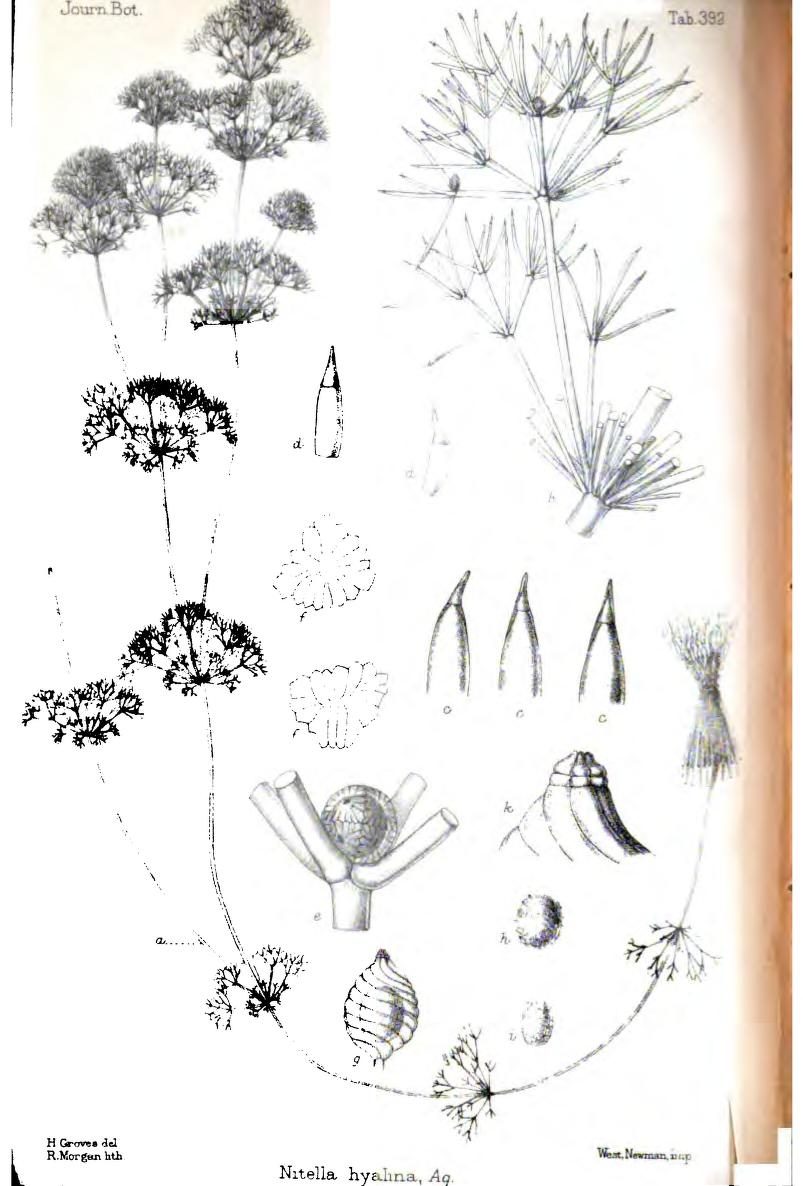
A rather small plant. Stem about ·30–·48 mm. thick. Internodes 2–4 times the length of the branchlets. Whorls of usually 8 primary branchlets with about double that number of smaller secondary branchlets in two series, the one above and the other below the primary branchlets. Primary branchlets 2–3 times divided, the primary rays ½–⅗ the total length of the branchlets. Rays at the first forking 7–10 (of which 1–3 are usually simple); at the second forking 4–7, of which 0–2 are again divided into 4–5 quaternary rays. Ultimate rays 2-celled, apical cell ·09–·14 mm. long, ·03–·045 broad at the base. Secondary branchlets usually one above and one below each primary branchlet, those of the lower series usually once or twice divided into 4–6 rays, those of the upper usually once divided into 5 rays, or simple. Fruits solitary, occurring on the primary branchlets at the second and third and more rarely at the first forkings, sometimes on the secondary branchlets also, ·5–·62 mm. long, ·33–·41 thick, showing 9–10 striæ; coronula ·075 mm. broad, ·045 high; oospore (unripe) brown, decidedly flattened, about ·28 mm. long, ·26 thick in the broader diameter, ·18 in the narrower. Antheridia occurring at all the forkings, though less commonly at the first, ·35–·42 in diameter. Monœcious.
An extremely beautiful plant, at once distinguished from all the other British species by the presence of the secondary branchlets, being the only European representative of Braun’s section Diarthrodactylæ, heterophyllæ. The English plant is a large lax form, which would be included in Braun’s var. maxima, though more slender than the Bayonne plant. The species is world-wide in its distribution, occurring almost throughout Europe, in Asia, Africa (N. and S.), N. America, and Australasia. It was discovered in Britain in August of the present year by the Rev. G. R. Bullock Webster, growing in some quantity on thick mud in 4–5 feet of water, in The Loe, a lake separated from the sea by a narrow sand-bar, near Helston, West Cornwall. Tab. 392.
N. tenuissima, Kuetz.—Norfolk E., Lopham Great Fen, 1897, G. R. Bullock Webster. This is a very satisfactory record, Lopham being in the same group of fens as Roydon Fen, and we think there is little doubt that Borrer’s specimen labelled Roydon Fen, Cambs, was really collected in East Norfolk.
N. mucronata, Kuetz.—Norfolk W., Little Ouse, near St. John’s, 1897, and Cambs, Roswell Clay-pits, Ely, 1895, G. R. Bullock Webster; Beds, R. Ivel, near Sandy, 1891, J. Saunders.
N. translucens, Agardh.—Bucks, Burnham Beeches, 1897, G. C. Druce; Mid Ebudes, Loch-na-Gile, Tiree, 1896, S. M. Macvicar; Cork S., Shepperton Lakes, 1896, J. G.
N. flexilis, Agardh.—Hants S., Darkwater, near Exbury, 1895, J. G.; Bucks, Brickhill, 1897, G. C. Druce; Salop, Longmynd, 1897, W. Hunt Painter.
[page 413] N. opaca, Agardh.—Worcester, 1897, R. F. Towndrow; Lincoln N., 1895, Mason & Peacock; Mid Ebudes (Tiree), 1896, S. M. Macvicar; Carlow (1897) and King’s Co. (1896), R. Ll. Praeger; Westmeath, 1895, H. C. Levinge; Mayo E., 1895, E. S. Marshall; Galway E., 1896, D. McArdle & R. Ll. Praeger; Roscommon (1897) and Cavan (1896), R. Ll. Praeger.
Explanation of Plate 391.—a. Chara aspera, Willd., subsp. desmacantha, H. & J. Groves, from Brittas Lake, Westmeath: plant natural size. b. Portion of stem with node × 15. c. Cortex showing oblique joinings of secondary cells × 60. d. Clusters of spine-cells × 15. e. Node of branchlet with antheridium × 15. f. Ditto, with fruit × 15. g. Fruit × 30. h. Oospore × 30. i. Group of spine-cells on specimen from Money Lake, Downpatrick × 15. k. Portion of stem of C. aspera type, from Frensham, Surrey, × 15.
Explanation of Plate 392.—a. Nitella hyalina, Agardh, from The Loe, West Cornwall; plant natural size. b. Portion of whorl showing a primary and upper and lower secondary branchlets × 7½. c. Apices of terminal rays × 60. d. Young ditto × 60. e. Node of branchlet with antheridium × 30. f. Plates of antheridium × 60. g. Fruit × 30. h. Unripe oospore, broadest view × 30. i. Ditto, narrowest view × 30. k. Apex of fruit, showing coronula × 140.
Do you know more about Henry or James Groves, or where the family lived in London? Please let me know.