The petition presented to Parliament by the Conservators of Wandsworth Common against the transfer of the Common from their control to that of the Metropolitan Board does not seem to allege any very adequate reason against the change. The Conservators merely contend that the Common is better administered and maintained by them than it would be the Metropolitan Board, and they request that, if they are deprived of the control of the Common, they shall be represented upon some specially constituted body. The members for the constituencies in which the Common is situated are all in favour of the transfer.
[BNA: Link.]
London Daily News — Friday 25 February 1887
(Click on image to enlarge)
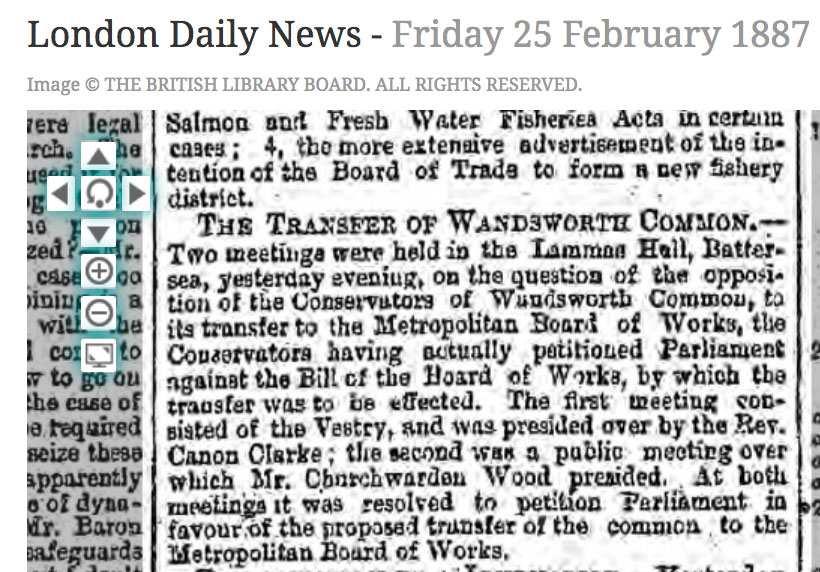
THE TRANSFER OF WANDSWORTH COMMON.
Two meetings were held in the Lammas Hall, Battersea, yesterday evening, on the question of the oppositiom of the Conservators of Wandsworth Common, to its transfer to the Metropolitan Board of Works, the Conservators having actually petitioned Parliament against the Bill of the Board of Works, by which the transfer was to be effected.
The first meeting consisted of the Vestry, and was presided over by the Rev. Canon Clarke; the second was a public meeting over which Mr. Churchwarden Wood presided. At both meetings it was resolved to petition Parliament in favour of the proposed transfer of the common to the Metropolitan Board of Works.
[BNA: Link.]
South London Press — Saturday 26 February 1887
(Click on image to enlarge)
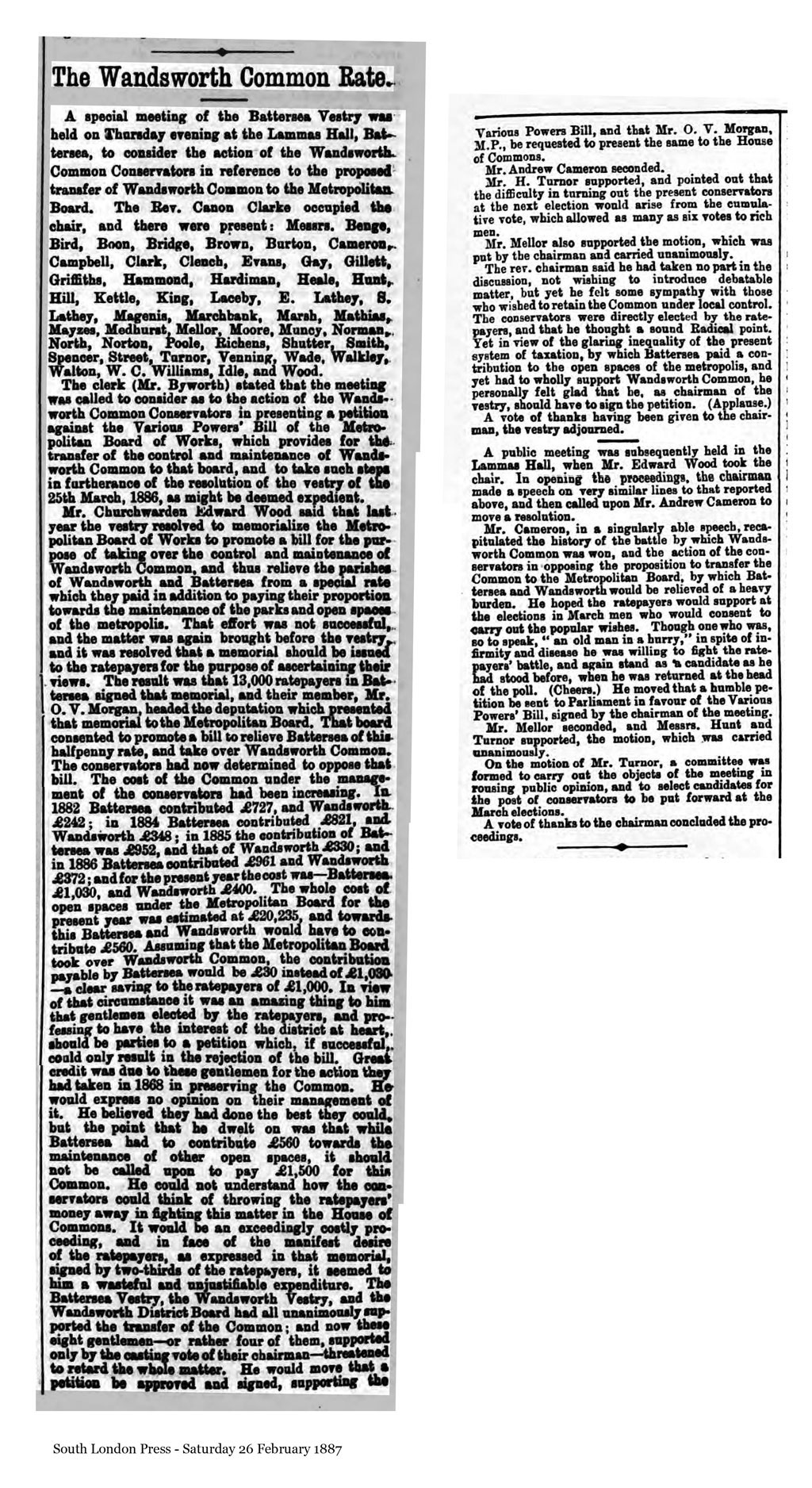
The Wandsworth Common Rate. A special meeting the Battersea Vestry was held on Xbnnday evening at the Lammas Hall, Battersea, to consider the action the Wandsworth. Common Conservators reference to the proposed transfer Wandsworth Common to the Metropolitan. Board. The Rev. Canon Clarke occupied the chair, and there were present: Messrs. Benge, Bird, Boon, Bridge, Brown, Barton, Cameron,. Campbell, Clark, Clench, Evans, Gay, Gillett, Griffiths, Hammond, Hardiman, Heale, Hunt, Hill, Kettle, King, Laceby, E. Lathey, 8. Lathey, Magenis, Marchbank, Marsh, Mathias, Mayaes, Medburst, Mellor, Moore, Muncy, Norman, North, Norton, Poole, Bichens, Shutter, Smith, Spencer, Street, Turner, Venning, Wade, Walkley, Walton, W. C. Williams, Idle, and Wood.
The clerk (Mr. Byworth) stated that the meeting was called to consider as to the action of the Wandsworth Common Conservators in presenting petition against the Various Powers' Bill of the Metropolitan Board of Works, which provides for the transfer the control and maintenance of Wandsworth Common to that board, and to take anoh steps in furtherance the resolution of the vestry of the 25th March, 1886, might be deemed expedient.
Mr. Churchwarden Edward Wood said that last year the vestry resolved to memorialise the Metropolitan Board of Works to promote a bill for the purpose of taking over the control and maintenance of Wandsworth Common, and thus relieve the parishes of Wandsworth and Battersea from a special rate which they paid in addition to paying their proportion towards the maintenance the parks and open of the metropolis.
That effort was not successful, and the matter was again brought before the vestry, and it was resolved that memorial should issued to the ratepayers for the purpose of ascertaining them 1 views. The result was that 13,000 ratepayers Battersea signed that memorial, and their member, [Ur. 1 O.??] V. Morgan, headed the deputation which presented that memorial to the Metropolitan Board. That board consented to promote bill to relieve Battersea of this halfpenny rate, and take over Wandsworth Common. The conservators had now determined to oppose that bill.
The cost of the Common under the management of the conservators had been increasing, in 1882 Battersea contributed X 727, and Wandsworth. £2i2: in 1884 Battersea contributed £B2l, ana. Wandsworth .£348, in 1885 the was .£952. and that of Wandsworth £330; and in 1886 Battersea contributed f £372 J andfor the presentyearthe £1 030 and Wandsworth £400. The whole Con roenspscea under the Metropolitan Board for the oresent year was estimated at £20,235, and towards lb?. Battersea and Wandsworth would have contribute £s6ftT Assuming that the Metropolitan Board %not over Wandsworth Common, the contribution navable by Battersea wonld £3O instead of £1,090. | saving to the ratepayers of £1,000. In view of that circumstance it was amazing tiling to him that gentleman elected by the ratepayers, and professing to have the interest the district at heart, should be parties to a petition which, if successful, could only result in the rejection of the bill.
Great credit was due to these gentlemen for the action they had taken in 1868 in preserving the Common. He would express opinion on their management of it. He believed they had done the best they could, but the point that dwelt on was that while Battersea had contribute £560 towards the maintenance of other open spaces, it should not be called upon to pay £1,500 for this Common. He could not understand how the conservators could think of throwing the ratepayers' money away in fighting this matter in the House of Commons. It would be exceedingly costly proceeding, and in face of manifest desire of the ratepayers, expressed in that memorial, signed by two-thirds of the ratepayers, it seemed to him wasteful and unjustifiable expenditure.
The Battersea Vestry, the Wandsworth Vestry, and the Wandsworth District Board had all unanimously supported the transfer of the Common; and now these eight gentlemen%or rather four of them, jupporteo, only by the casting rote their chairman%threatenea i to retard the whole matter. would move Mat petition approved Mid signed, supporting Various Powers Bill, and that Mr. O. V. Morgan. M.P-i be requested to present the same to the House of Commons.
Mr. Andrew Cameron seconded.
Mr H. Tumor supported, and pointed out that the difficulty in tnming out the present conservators at the next election would arise from the cumulative vote, which allowed as many as six votes
Mr. Mellor also supported the motion, which was nut the chairman and carried unanimonaly.
The rev. chairman said he had taken no part in the discussion, not wishing to introduce debatable matter but yet felt some sympathy with those who wished to retain the Common under local control. The conservators were directly elected the ratepayers, and that he thought sound Radical point. Yet in view of the glaring inequality of the present system of taxation, by which Battersea paid a contribution to the open spaces of the metropolis, and yet had to wholly support Wandsworth Common, personally felt glad that he, as chairman the vestry, should have sign the petition. (Applause.) A vote of thanks having been given to the chairman, the vestry adjourned.
__________
A public meeting was subsequently held in the Lammas Hall, when Mr. Edward Wood took the chair. In opening the proceedings, the chairman made a speech very similar lines to that reported above, and then called upon Mr. Andrew Cameron to move resolution.,
Mr. Cameron, in a singularly able speech, recapitulated the history of the battle by Wandsworth Common was won, and thcactionof the conservators in opposing the propjmtion to transfer toe Common to the Metropolitan Board, by which Bat tersea and Wandsworth would be relieved of heavy burden. He hoped the ratepayers would support at the elections in March men who would conseut to party out the popular wishes. Though one waa, so to speak, old man in hurry, l firmity and disease was willing to fight the ratepayers' battle, and again stand as as he had stood before, when was returned at the head of the poU. (Cheers.) He moved that a humble petition to Parliament in favour the Various Powers' Bill, signed by the chairman of the masting
Mr. Mellor seconded, and Messrs. Hunt ana supported, the motion, which was 'carried unanimously
On the motion of Mr. Tarnor, committee was formed to carry ont the objects the 4!"* rousing public opinion, and to candidates for the post of conservators to put forward at the March elections.
A vote of thanks to the chairman concluded the proceedings.
[BNA: Link.]
London Daily News — Tuesday 01 March 1887
Brief mention in the day's list
Queen's Bench Division
Lord Chief Justice's Court
Wandsworth Common Conservators v Official Trustees of Patriotic Fund and another
[BNA: Link.]
[NOTE]
The People — Sunday 06 March 1887
(Click on image to enlarge)
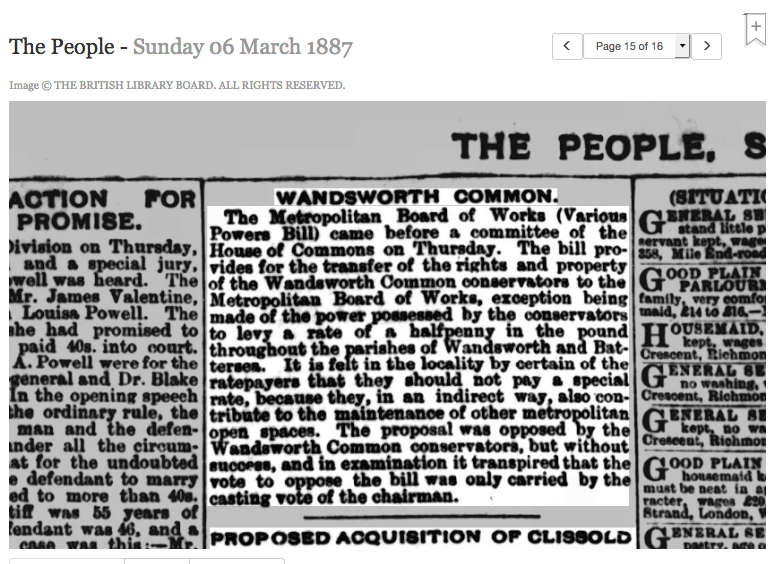
. . . WANDSWORTH COMMON. The Metropolitan Board of Works (Various Powers Bill) came before a committee of the House of Commons on Thursday. The bill provides for the transfer of the rights and property of the Wandsworth Common conservators to the Metropolitan Board of Works, exception being made of the power possessed by the conservators to levy a rate of a halfpenny in the pound throughout the parishes of Wandsworth and Battersea.
It is felt in the locality by certain of the ratepayers that they should not pay a special rate, because they, in an indirect way, also contribute to the maintenance of other metropolitan open spaces.
The proposal was opposed by the Wandsworth Common conservators, but without success, and in examination it transpired that the vote to oppose the bill was only carried by the casting vote of the chairman.
[BNA: Link.]
[PB: Who was the Chairman? Presumably Ransome had been replaced by Reginald Bray?]
London Daily News — Tuesday 15 March 1887
(Click on image to enlarge)
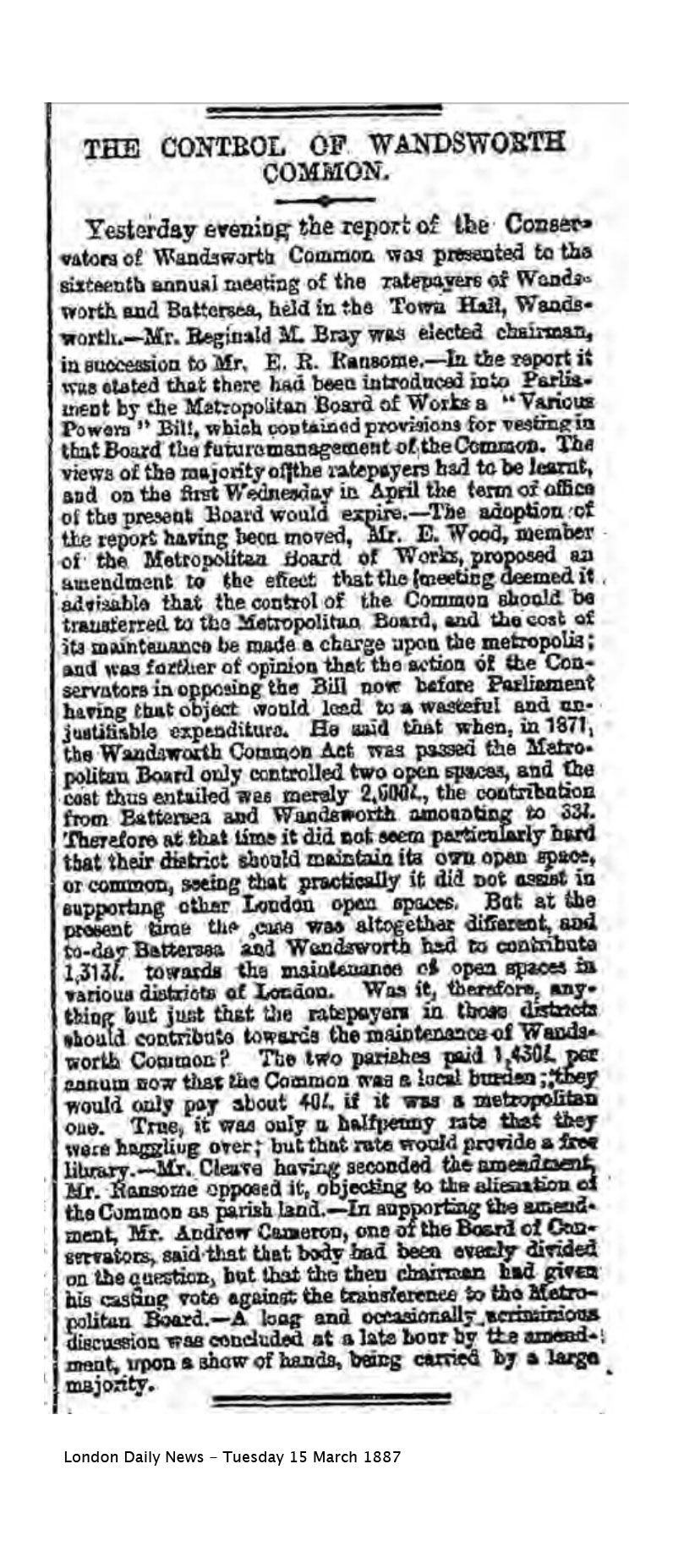
THE CONTROL OF WANDSWORTH COMMON
Yesterday evening the report of the Conservators of Wandsworth Common was presented to the sixteenth annual meeting of the ratepayers of Wandsworth and Battersea, held in the Town Hall, Wandsworth. Mr. Reginald M. Bray was elected chairman, in succession to Mr. E. R. Ransome.
In the report it was stated that there had been introduced into Parliament by the Metropolitan Board of Works a "Various Powers" Bill, which contained provisions for vesting the future management of the Common. The views of the majority of the ratepayers had to be learnt, and on the first Wednesday in April the term of office of the present Board would expire.
The adoption of the report having been moved, Mr. E. Wood, member of the Metropolitan Board of Works, proposed an amendment to the effect that the meeting deemed it advisable that the control of the Common should be transferred to the Metropolitan Board, and the cost of its maintenance be made a charge upon the metropolis; and was farther of opinion that the action of the Conservators in opposing the Bill now before Parliament having that object would lead to a wasteful and unjustifiable expenditure./p>
He said that when, in 1871, the Wandsworth Common Act was passed the Metropolitan Board only controlled two open spaces, and the cost thus entailed was merely £2,600 [?], the contribution from Battersea and Wandsworth amounting to £33. Therefore at that time it did not seem particularly hard that their district should maintain its own open space, or common, seeing that practically it did not assist in supporting other London open spaces. But at the present time the case was altogether different, and today Battersea and Wandsworth had to contribute £1,313 towards the maintenance at open spaces in various districts of London.
Was it, therefore, anything but just that the ratepayers in those distrcts should contribute towards the maintenance of Wandsworth Common? The two parishes paid £1,430 per annum now that the Common was a local burden, they would only pay about £40, if it was a metropolitan one. True, it was only a halfpenny rate that they were haggling over; but that rate would provide a free library.
Mr. Cleave having seconded the amendment, Mr. Ransome opposed it, objecting to the alienation of the Common as parish land./p>
In supporting the amendment, Mr. Andrew Cameron, one of the Board of Conservators, said that that body had been evenly divided on the question, but that the then chairman had given his casting vote agaist the transference to the Metropolitan Board.
A long and occasionally acrimonious discussion was concluded at a late hour by the amendment, upon a show of hands, being carried by a large majority.
[BNA: Link]
[PB: "A long and occasionally acrimonious discussion was concluded at a late hour by the amendment, upon a show of hands, being carried by a large majority." Really? The People report says it was only by the casting vote of the Chairman — who had recently replaced Ransome. Follow up.]
[BNA: Search: "Reginald Bray"]
London Daily News — Tuesday 15 March 1887
At a meeting of the ratepayers of Battersea and Wandsworth, held to receive the report of the Conservators of Wandsworth Common, an amendment to the act that it was desirable that the control of that open space should be transferred to the Metropolitan Board of Works was carried by a large majority.
[Source: London Daily News — Tuesday 15 March 1887.]
London Daily News — Tuesday 22 March 1887
WANDSWORTH COMMON
Mr. KIMBER asked the Secretary of State for War whether, prior to granting a lease of land attached to the Patriotic Asylum for Girls on Wandsworth Common, held in charitable trust, the Royal Commissioners of the Patriotic Fund sought and obtained the consent of the Charity Commissioners?
Mr. STANHOPE — I am advised that the Commissioners of the Patriotic Fund were not required by law to obtain the consent of the Charity Commissioners to the grant to them of a lease of land for twenty-one years.
[Source: Link.]
London Daily News — 28 March 1887
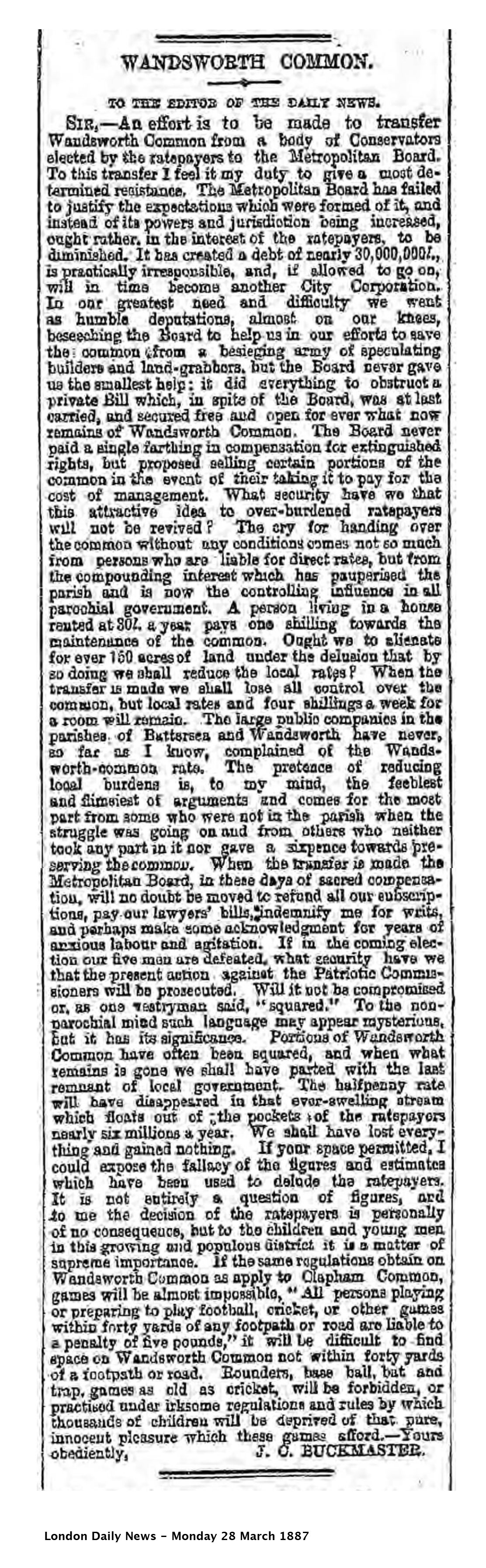
Buckmaster fulminates against the transfer of the Common from the existing body of elected Conservators to the Metropolitan Board of Works.
(Click on image to enlarge)
WANDSWORTH COMMON.
TO THE EDITOR OF THE DAILY NEWS
An effort is to be made to transfer Wandsworth Common from a body of Conservators elected by the ratepayers to the Metropolitan Board. To this transfer I feel it my duty to give a most determined resistance. The Metropolitan Board has failed to justify the expectations which were formed of it, and instead of its powers and jurisdiction being increased, ought rather, in the interest of the ratepayers, to be diminished. It has created a debt of nearly £30,000,000, is practically irresponsible, and, if allowed to go on, will in time become another City Corporation.
[PB: "if allowed to go on, will in time become another City Corporation" — meaning? A dictatorship?]
In our greatest need and difficulty we went as humble deputations, almost on our knees, beseeching the Board to help us in our efforts to save the common from a besieging army of speculating builders and land-grabbers, but the Board never gave us the smallest help: it did everything to obstruct a private Bill which, in spite of the Board, was at last carried, and secured free and open for ever what now remains of Wandsworth Common.
The Board never paid a single farthing in compensation for extinguished these rights, but proposed selling certain portions of the common in the event of their taking it to pay for the cost of management.
What security have we that in this attractive idea to over-burdened ratepayers will not be revived ?
The cry for handing over the common without any conditions comes not so much from persons who are liable for direct rates, but from the compounding interest which has pauperised the parish and is now the controlling influence in all parochial government. A person living in a house rented at £30 a year pays one shilling towards the maintenance of the common.
Ought we to alienate for ever 150 acres of land under the delusion that by so doing we shall reduce the local rate? When the transfer is made we shall lose all control over the common, but local rates and four shillings a week for a room will remain.
The large public companies in the parishes of Battersea and Wandsworth have never, so far as I know, complained of the Wandsworth-common rate. The pretence of reducing local burdens is, to my mind, the feeblest and flimsiest of arguments and comes for the most part from some who were not in the parish when the struggle was going on and from others who neither took any part in it nor gave a sixpence towards preserving the common.
When the transfer is made the Metropolitan Board, in these days of sacred compensation, will no doubt be moved to refund all our subscriptions, pay our lawyers' bills, indemnify me for writs, and perhaps make some acknowledgment for years of anxious labour and agitation. If in the coming elections our five men are defeated, what security have we that the present action against the Patriotic Commissioners will be prosecuted. Will it not be compromised or, as one vestryman said, "squared."
To the non-parochial mind such language may appear mysterious. But it has its significance. Portions of Wandsworth Common have often been squared, and when what remains is gone we shall have parted with the last remnant of local government. The halfpenny rate will have disappeared in that ever-swelling stream which floats out of the pockets of the ratepayers nearly six millions a year.
We shall have lost everything and gained nothing. If your space permitted, I could expose the fallacy of the figures and estimates which have been used to delude the ratepayers.It is not entirely a question of figures, and to me the decision of the ratepayers is personally of no consequence, but to the children and young men in this growing amd populous district it is a matter of supreme importance.
If the same regulations obtain on Wandsworth Common as apply to Clapham Common, games will be almost impossible, "All persons playing or preparing to play football, cricket, or other games within forty yards of any footpath or road are liable to a penalty of five pounds," it will be difficult to find space on Wandsworth Common not within forty yards of a footpath or road. Rounders, base ball, bat and trap, games as old as cricket, will be forbidden, or practised under irksome regulations and rules by which thousands of children will be deprived of that pure, innocent pleasure which these games afford.
Yours obediently,
J.C. BUCKMASTER
[BNA: London Daily News, 28 March 1887 ]
2 April 1887
The Custody of Wandsworth Common.
The result of the election of conservators of Wandsworth Common was not made known until very late hour last night. Mr. Bray, Q.C., waa the returning officer. The counting took place at Bolingbroke Hall. The "independent" candidates, Messrs. Etheridge and Mitchell, were stated to have received very few votes. Messrs. Cameron, Turner, Bell, Hamilton, and Howick were (up to the time our latest inquiry) confident of success. These gentlemen are in favour of the transfer of the custody of the Common to the Metropolitan Board.
[BNA: Link]
St James's Gazette — Monday 11 April 1887
Also checkMYSTERIOUS DEATH ON WANDSWORTH COMMON. The police have issued the description of the body of a woman which was found in the waters of a pond on Wandsworth Common last evening, and which is now lying at the Battersea mortuary awaiting an inquest and identification. The deceased was aged sixty-five years. She had large scar on cheek and right side of forehead ; and had on a black dress, bonnet, and shawl.
[BNA: Link]
[BNA: Link]
[BNA: Link]
The Sportsman — Saturday 16 April 1887
REINDEER HARRIERS — This promising club, whose muster-roll now shows a total of ninety-five members, have now changed their head-quarters to the Freemasons' Hotel. Battersea Rise, Wandsworth Common, and the following are the handicaps decided during the summer evenings: — April 27, 120 Yards Handicap; June 1, 880 Yards Handicap; July 6, One Mile and Photo; August 3. One Mile Walk; Seplember 7, 300 Yards Handicap. The races will decided the vicinity of their head-quarters, which are about two 10100103' walk from Clapham Junction. Three prizes will be given for each race, and entries for the sprint should sent the hon. sec. on or before Wednesday next, April 20. All officers are requested to attend the committee meeting at the Freemasons' Hotel on the same date, at 8 p.m.
[BNA: Reindeer Harriers]
Several interesting-looking articles e.g. BNA: Link
Hackney and Kingsland Gazette — Wednesday 04 May 1887
(Click on image to enlarge)
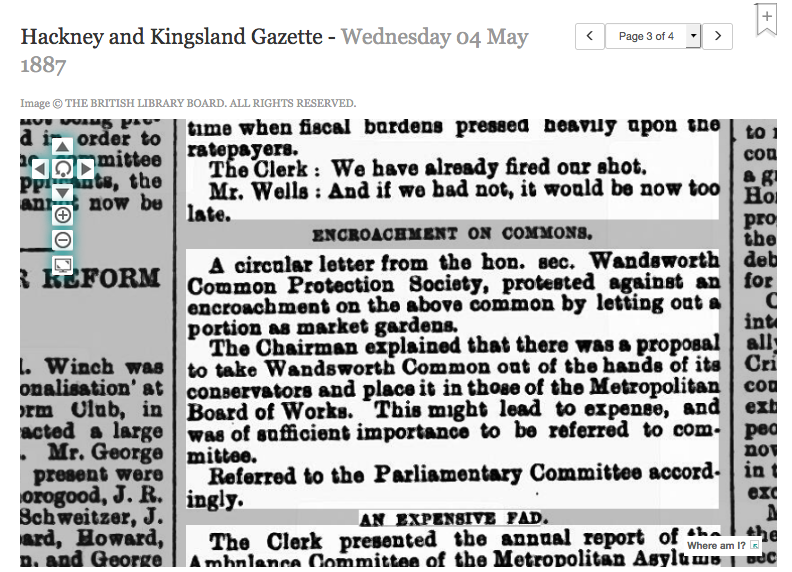
A circular letter from the hon. sec. Wandsworth Common Protection Society, protested against encroachment on the above common by letting ont a portion as market gardens. The Chairman explained that there was proposal to take Wandsworth Common out of the hands of its conservators and place it in those of the Metropolitan Board of Works. This might lead to expense, and was of sufficient importance to be referred to committee.
Referred to the Parliamentary Committee accordingly.
[BNA: Link]
South London Press — - Saturday 20 August 1887
WANDSWORTH. A DOG FIGHT BATTERSEA.
Gcorjo Whitehead, labourer, was charge'l, before Mr, Bennett, with cruelty to a dog, urging it on to fight. Sergeant Rowan deposed that on Sunday afternoon was in ork-road, Battersea, when be received information which induced him to go to Linda-street, where ho saw crowd of persons. He get through the crowd, but was prevented. saw two dogs fighting in the middle of the road. The prisoner was stooping, keeping back the crowd which bad formed in a ring, and urging his dog attack the other. The dogs fought for two miuntcs after he arrived. The prisoner picked up his dog and carried it into house, leaving the other prostrate. Witness went into the house, and saw the dog in the back yard unable to move, snU'ering from seven bites abont its head and body. The other dog was taken away. The prisoner said he parted the dogs. Thomas Clavis, a French polisher, stated that he heard the prisoner say, Let him go; he will kill the other." did not attempt to separate the dogs. Inspector Ford, who took the charge at the station, gave a description of the dog. Ho said it was in distressed condition. was bitten upon the head, bleeding from the ear, and could not walk. Mr. Bennett fined the prisoner £3, and in default ordered him to be imprisoned for one mouth. , STEALING FROM AN EMPLOYER. John Goldsmith (17) was charged with stealing sovereign, the property of his employer, Walter George Woolley, a draper, of High-street, Morton. The prosecutor said tho prisoner had been in his employ week. On Friday witness’s wife gave tho prisoner a sovereign fetch some things, but never went the shops, and did not return. He saw him in custody on Monday night. The prisoner said lost tho sovereign and looked for it. did not home, was afraid of being thrashed his father. Mr. Bennett referred to the prisoner's clothes, which, said, appeared to bo quite new. Sergeant Young said the trousers and vest were new. The prisoner accounted for the possession of the clothes by stating that he worked for an ice cream seller, who gave them to him. Mr. Bennett said be did not believe tho prisoner, and committed him for one month.
ASSAULTING A WIFE AT BATTERSEA. William Mahoney, a porter, was charged, before Mr. Bennett, with eenonsly assaulting his wife, Matilda Mahoney, who lived in Stewurt’s-road, Battersea. The magistrate was informed that the wife was injured and unable appear. Ann Boot, the wife of a carman, said that that morning she heard noise and ran down stairs, and saw the prisoner beating his wife about the head. Witness said, What the matter?'s He replied that wanted to see his child. Ho stepped back and kicked violently the back. Witness fetched a doctor. The prisoner's wife was lying on the bed nuable to move. The Prisoner; Did yon s-ee Kick wife Witness : I did. Police-constable Smith was called to the house, and saw the wife sitting on the bed. There was blood on the tioor, her clothes were saturated. The prisoner alleged that his wife was living with a dustman, and said he wanted to see his child, lie was within the law. He did not kick bis wife. Mr. Bennett remanded the prisoner, and refused an application for bail.
[BNA: Link.]
South London Press — Saturday, 3 September 1887
I've given this story its own page here
In 1887, after sixteen years in the care of a small group of Conservators (five elected locally, and three others), control of Wandsworth Common was handed over (briefly) to the Metropolitan Board of Works — a remote body with much wider (and often conflicting) responsibilities. This transfer may have been against the wishes of many in the area, who cried out against the change. Here is one among many letters and articles on the subject from the time . . .
South London Press — Saturday 3 September 1887
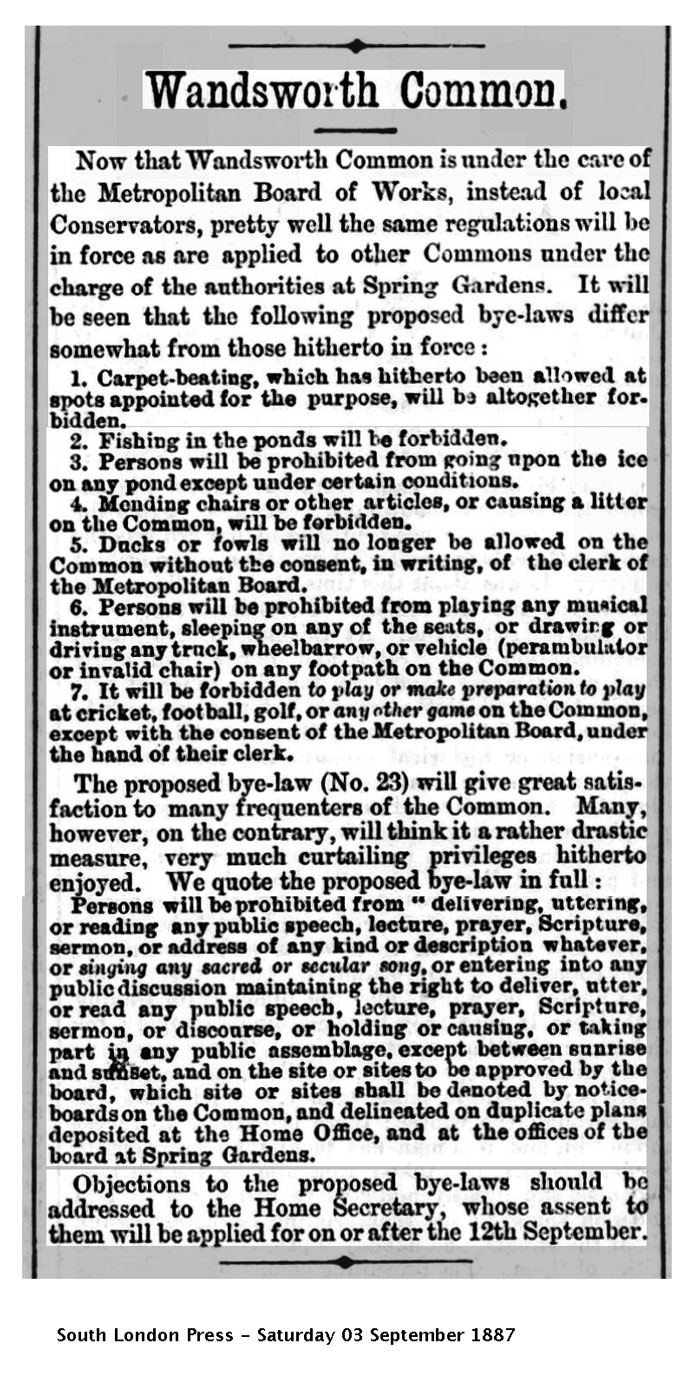
New management of the Common threatens carpet-beating, fishing, sport, ice-skating, ducks, music, and free speech . . .
(Click on image to enlarge)
Wandsworth Common.
Now that Wandsworth Common is under the care of the Metropolitan Board of Works, instead of local Conservators, pretty well the same regulations will be in force as are applied to other Commons under the charge of the authorities at Spring Gardens.
It will seen that the following proposed bye-laws differ somewhat from those hitherto in force:
1. Carpet-beating, which has hitherto been allowed at spots appointed for the purpose, will be altogether forbidden.
2. Fishing in the ponds will forbidden.
3. Persons will prohibited from going upon the ice on any pond except under certain conditions.
4. Mending chairs or other articles, or causing litter the Common, will be forbidden.
5. Ducks or fowls will longer be allowed on the Common without the consent, in writing, of the clerk of the Metropolitan Board.
6. Persons will be prohibited from playing any musical instrument, sleeping on any the seats, or drawirg or driving any truck, wheelbarrow, or vehicle (perambulator or invalid chair) on any footpath on the Common.
7. It will forbidden to or make preparation to play at cricket, football, golf, or any other game on the Common, except with the consent of the Metropolitan Board, under the band of their clerk.
The proposed bye-law (No. 23) will give great satisfaction to many frequenters of the Common. Many, however, on the contrary, will think it a rather drastic measure, very much curtailing privileges hitherto enjoyed.
We quote the proposed bye-law in full:
Persons will prohibited from delivering, uttering, or reading any public speech, lecture, prayer, Scripture, sermon, or address of any kind or description whatever, or singing any sacred or secular song, or entering into any public discussion maintaining the right to deliver, utter, or read any public speech, lecture, prayer, Scripture, sermon, or discourse, or holding or causing, or taking part in any public assemblage, except between sunrise and sunset, and on the site or sites to approved by the board, which site or sites shall be denoted by noticeboards on the Common, and delineated on duplicate plans deposited the Home Office, and at the offices the board Spring Gardens.
Objections to the proposed bye-laws should addressed to the Home Secretary, whose assent to them will he applied for on or after the 12th September.
[HoWC: Source.]
[BNA: Source.]
South London Press — Saturday 01 October 1887
(Click on image to enlarge)
[TEXT?]
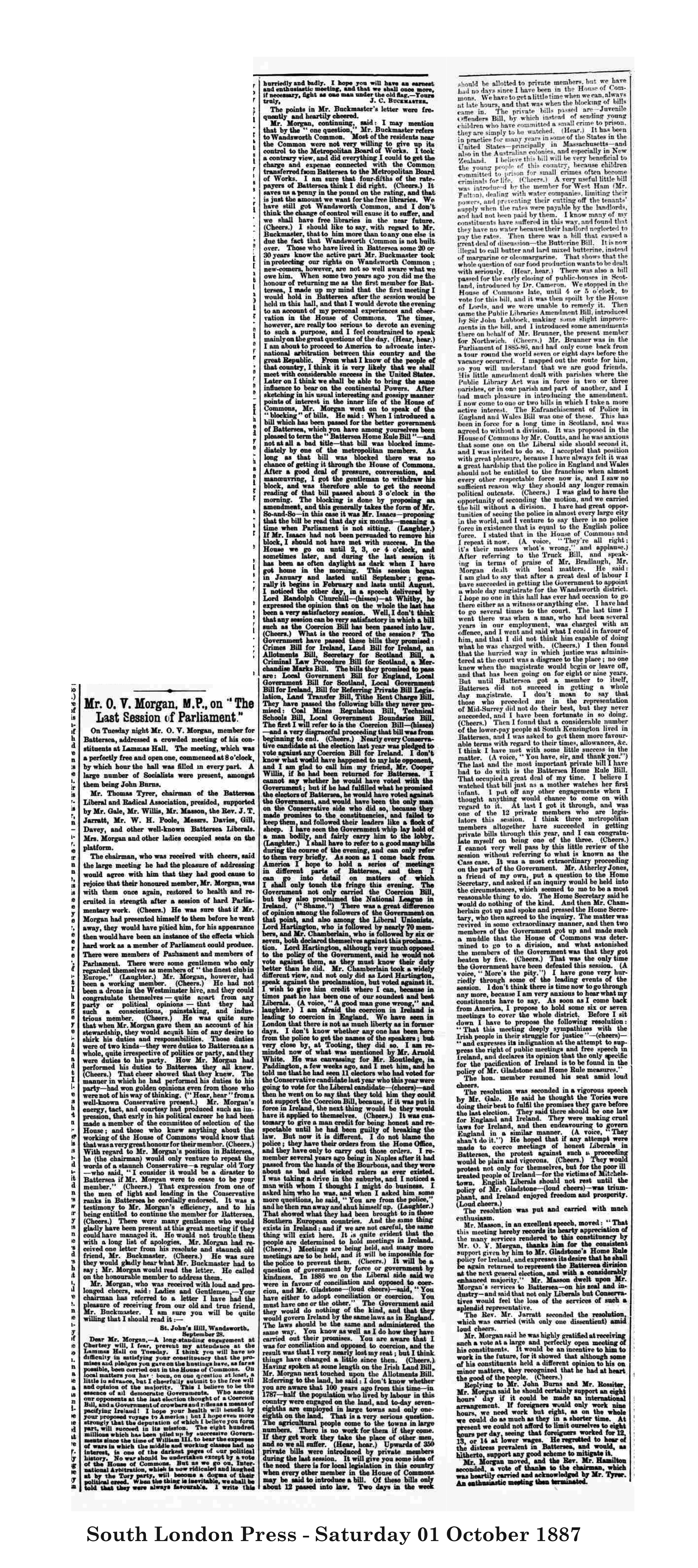
Mr. 0. V. Morgan, M.P., on The Last Session of Parliament."
On Tuesday night Mr. O. V. Morgan, member for Battersea, addressed a crowded meeting of his constituents at Lammas Hall. The meeting, which was a perfectly free and open one, commenced at 8 o'clock, by which hour the hall was filled in every part. A large number of Socialists were present, amongst them being John Burns. Mr. Thomas Tyrer, chairman of the Battersea Liberal and Radical Association, presided, supported by Mr. Gale, Mr. Willis, Mr. Masson, the Rev. J. T. Jarratt, Mr. W. H. Poole, Messrs. Davies, Gill, Davey, and other well-known Battersea Liberals. Mrs. Morgan and other ladies occupied seats on the platform.
The chairman, who was received with cheers, said the large meeting he had the pleasure of addressing would agree with him that they had good cause to rejoice that their honoured member, Mr. Morgan, was with them once again, restored to health and recruited in strength after session of hard Parliamentary work. (Cheers.) He was sure that if Mr. Morgan had presented himself to them before he went away, they would have pitied him, for his appearance then would have been an instance of the effects which hard work as member of Parliament could produce. There were members of Parliament and members of Parliament. There were some gentlemen who only regarded themselves members of the finest club in Europe." (Laughter.) Mr. Morgan, however, had been a working member. (Cheers.) He had not been drone in the Westminster hive, and they could congratulate themselves quite apart from any party or political opinions that hod such a conscientious, painstaking, and industrious member. (Cheers.) He was quite sure that when Mr. Morgan gave them account of his stewardship, they would acquit him of any desire to shirk his duties and responsibilities. Those duties were of two kinds — they were duties to Battersea as a whole, quite irrespective of politics or party, and they were duties to his party. How Mr. Morgan had performed his duties to Battersea they all knew. (Cheers.) That cheer showed that they knew. The manner in which he had performed his duties to his party — had won golden opinions even from those who were not of his way of thinking. ("Hear, hear" from a well-known Conservative present.) Mr. Morgan's energy, tact, and courtesy had produced such an impression, that early in his political career he had been made member of the committee of selection of the House; and those who knew anything about the working of the House of Commons would know that tliat was a very great honour for their member. (Cheers.)
With regard to Mr. Morgan's position in Battersea, he (the chairman) would only venture to repeat the words of staunch Conservative — a regular old Tory — who said, "I consider it would a disaster to Battersea if Mr. Morgan were to cease to be your member." (Cheers.) That expression from one of the men of light and leading in the Conservative ranks in Battersea he cordially endorsed. It was testimony to Mr. Morgan's efficiency, and to his being entitled to continue the member for Battersea. (Cheers.)
There were many gentlemen who would gladly have been present at this great meeting if they could have managed it. Ho would not trouble them with a long list of apologies.
Mr. Morgan had received one letter from his resolute and staunch old friend, Mr. Buckmaster. (Cheers.) He was sure they would gladly hear what Mr. Buckmaster had to say; Mr. Morgan would read the letter. He called on the honourable member to address them.
Mr. Morgan, who was received with loud and prolonged dicers, said; Ladies and Gentlemen, — Your chairman referred to a letter I have had the pleasure of receiving from our old and true friend, Mr. Buckmaster.
I am sure you will be quite willing that I should read it:
St. John's Hill. Wandsworth. September 28.
Dear Mr. Morgan, — A long-standing engagement at will, I fear, prevent my attendance at the Lammas Tuesday. I think you will have no difficulty satisfying your constituency that the promises and pledges you gave on the hustings have, as far as possible, been carried out in the House of Commons.
On local matters you have been, on one question at least, a little in advance, but I cheerfully submit to the free will and opinion of the majority. This I believe to be the essence of all democratic Governments.
Who among our opponents at the last election thought of a Coercion Bill, and a Government of crowbars and rifles as means of pacifying Ireland!
I hope your health will benefit from your proposed voyage to America; but I hope even more strongly that the deputation of which I believe you form part, will succeed in its mission. The eight hundred millions which has been piled by successive Governments since the time of William III. to bear the expenses of wars in which the middle and working classes had no interest, in one of the darkest pages of our political history.
No war should be undertaken except by a vote in the House of Commons. But as we go on, International Arbitration, which is now ridiculed and laughed at by the Tory party, will become a dogma of their political creed. When the thing is inevitable, we shall be told that they were always favourable.
I write this hurriedly and badly. I hope you will have an earnest and enthusiastic meeting, and that shall once more, if necessary, fight as one man under the old flag.
Yours truly, J. C. BUCKMASTER.
The points in Mr. Buckmaster's letter were frequently and heartily cheered.
Mr. Morgan, continuing, said: I may mention that by the one question," Mr. Buckmaster refers to Wandsworth Common.
Most of the residents near the Common were not very willing to give its control to the Metropolitan Board of Works. I took contrary view, and did everything I could to get the charge and expense connected with the Common transferred from Battersea to the Metropolitan Board of Works. I am sure that four-fifths of the ratepayers of Battersea think I did right. (Cheers.) It saves a penny in the pound on the rating, and that is just the amount want for the free libraries. We have still got Wandsworth Common, and I don't think the change of control will cause it to suffer, and we shall have free libraries in the near future. (Cheers.)
I should like to say, with regard to Mr. Buckmaster, that him more than to any one else is due the fact that Wandsworth Common is not built over. Those who have lived in Battersea some 20 or years know the active part Mr. Buckmaster took in protecting our rights on Wandsworth Common; new-comers, however, are not so well aware what owe him.
When some two years ago you did the honour of returning me the first member for Battersea, I made up my mind that the first meeting I would hold in Battersea after the session would held in this hall, and that I would devote the evening to an account of my personal experiences and observation in the House of Commons. The times, however, are really too serious to devote an evening to such a purpose, and I feel constrained to speak mainly on the great questions of the day. (Hear, hear.) I am about to proceed to America to advocate international arbitration between this country and the great Republic. From what I know of the people of that country, I think it is very likely that we sliall meet with considerable success in the United States. Later on I think we shall be able bring the same influence to bear on the continental Powers. After sketching in bis usual interesting and gossipy manner points of interest in the inner life of the House of Commons, Mr. Morgan wont on to speak of the blocking bills. He said: When I introduced bill which has been passed for the better government of Battersea, which you have among yourselves been pleased to term the Battersea Home Rule Bill and not at all a had title — that bill was blocked immediately by one of the metropolitan members. As long as that bill was blocked there was no cliance of getting it through the House of Commons. After good deal of pressure, conversation, and manoeuvring, I got the gentleman to withdrew his block, and was therefore able to get the second reading of that bill passed about 3 o'clock in the morning. The blocking is done proposing amendment, and this generally takes the form of Mr. So-and-So — in this case it was Mr. Isaacs — proposing that the bill be read that day six months — meaning time when Parliament is not sitting. (Laughter.) If Mr. Isaacs hod not been persuaded to remove his block, I should not have met with success. In the Hoase we on until 2,3, or o'clock, and sometimes later, and during the last session it has been as often daylight as dark when I have got home in the morning. This session began in January and lasted until September; generally it begins in February and lasts until August. I noticed the other day, speech delivered Lord Randolph Churchill — (hisses) — at Whitby, expressed the opinion that on the whole the last has been very satisfactory session. Well, I don't think that any session can be very satisfactory in which bill snch as the Coercion Bill has been passed into law. (Cheers.) What is the record of the session? Government have passed these bills they promised: Crimes Bill for Ireland, Land Bill for Ireland, an Allotments Bill, Secretary for Scotland Bill, a Criminal Law Procedure Bill for Scotland, Merchandise Marks Bill. The bills they promised to poss are: Local Government Bill for England, Local Government Bill for Scotland, Local Government Bill for Ireland, Bill for Referring Private Bill Legislation, Land Transfer Bill, Tithe Rent Charge Bill. They have passed the following bills they never promised: Coal Mines Regulation Bill, Technical Schools Bill Local Government Boundaries Bill. The first I will refer to is the Coercion Bill — (hisses) — and a very disgraceful proceeding that bill was from beginning to end. (Cheers.) Nearly every Conservative candidate at the election last year was pledged to vote against any Coercion Bill for Ireland. I don't know what would have happened late opponent, and I am glad call him my friend, Mr. Cooper Willis, if he had been returned for Battersea. I cannot say whether he would have voted with the Government; but if he had fulfilled what he promised the electors of Battersea, he would have voted against the Government, and would have been the only man on the Conservative side who did so, because they made promises the constituencies, and failed keep them, and followed their leaders like flock sheep. I liave seen the Government whip lay hold of man bodily, and fairly carry him to the lobby. (Laughter.)
I shall have to refer to good many bills during the coarse of the evening, and can onlv refer to them very briefly. As soon I come back from America I hope to hold a series of meetings in different parts of Battersea, and then I can go into detail on matters of which I shall only touch the fringe this evening. The Government not only carried the Coercion Bill, but they also proclaimed the National League in Ireland. ("Shame.") There was a great difference of opinion among the followers of the Government on that point, and also among the Liberal Unionists. Lord Hartmgton, who is followed by nearly 70 members, and Mr. Chamberlain, who is followed six or seven, both declared themselves against this proclamation. Lord Hartington, although very much opposed to the policy of the Government, said be would not vote against them, as they must know their duty better than he did. Mr. Chamberlain took a widely different view, and not only did os Lord Hartington, speak against the proclamation, but voted against it. I wish to give him credit where I can, because in times post lias been one of our soundest and best Liberals. (A voice, good man pone wrong," and laughter.) I am afraid the coercion in Ireland is leading to coercion in England. Wo have seen in London that there is not as much liberty as in former days. I don't know whether any one has been here from the police to get the names the speakers; but very close by, at Tooting, they did so. I reminded now of what was mentioned by Mr. Arnold White. He was canvassing for Mr. Boutledge, in Paddington, a few weeks ago, and I met him, and bo told me that he hod seen 11 electors who liad voted for the Conservative candidate last year who this year were going to vote for the Liberal candidate — (cheers) — and then he went on to say that they told him they could not support the Coercion Bill, because, if it was put in force in Ireland, the next thing would bo they would have it applied to themselves. (Cheers.) It was customary to give man credit for being honest and respectable until lie had been guilty of breaking the law. But now it is different. I not blame the police; they have their orders from the Home Office, and they have only to carry out those orders. remember severe! years ago being in Naples after it had passed from the hands of the Bourbons, and they were about as had and wicked rulers as ever existed. I was taking a drive in the suburbs, and noticed man with whom I thought I might do business. I asked him who he was. and when I asked him some more questions, he said, You are from the police," and he then ran away and shut himself up. (Laughter.) That showed what they had been brought those Southern European countries. And the same thing exists in Ireland and if are not careful, the same thing will exist here. It quite evident that the people are determined to bold meetings in Ireland. (Cheers.) Meetings arc being held, and many more meetings are to lie held, and it will lie impossible for the pohee to prevent them. (Cheers.) It will be question of government force or government by kindness. In 188(i we on the Liberal side said were in favour of conciliation and opposed coercion, and Mr. Gladstone — (loud cheers) — said, You have either to adopt conciliation or coercion. You must have one or the other." The Government said they would nothing of the kind, and that they would govern Ireland the same laws in England. The laws should lie the same and administered the game way. You know as well as Ido how they have carried out their promises. You are aware that I was for conciliation and opposed to coercion, and the result was that I very nearly lost seat; but I think things have changed little since then. (Cheers.). Having spoken at some length on the Irish Land Bill* Mr. Morgan next touched upon the Allotments Bill. Referring the land, he said: I don't know whether 3*ou arc aware that 100 years ago from this time — in 1787 — half the population who lived labour in this country were engaged on the land, and to-day seveneighths ore employed in large towns and only oneeighth on the land. That is very serious question. The agricultural people come to the towns in large numbers. There is no work for them if they come. If they gel work they take the place of other men, and we all suffer. (Hear, hoar.) Upwards of private bills were introdneed private members during the last session. It will give you some idea of the need there is for local legislation in this country when every other member in the House of Commons may be said to introduce bill. Of these bills about 12 passed into law. Two days in the week
'>e allotted to private members, but ire have ill since I have been in the House of Commons. We have to pet little time when can. always at late hours, and that wa� when the blocking of bills came in. The private bills passed are r Juvenilc Offenders Bill, which instead of sending young children who have committed a small crime to prison, they are simply to watched. Hear.) has bo n in practice for many years in some of the States the United States-pnncipally in Massachusetts — and also in the Australian colonies, and especially in hew Zealand I believe this bill will lie very beneficial to the vouiig people of this country, because children cuminitted to prison for small crimes often become criminals for life. (Cheers.) A very useful little bill was introduced by the member for West Ham (Mr. Pulton), dealing with water companies, limiting their powers, and preventing their cutting off the tenants' supply 'when the rates were payable the landlords, and had not been paid them. I know many of my constitncnts have suffered in this way. and found that they have no water because their landlord neglected to pay the rates. Then there was a hill that caused a great deal of discussion — the Hntterinc Bill. It is now illegal call batter and lard mixed butterine. instead of margarine or oleomargarine. That shows that the whole question of our food production wants to dealt with seriously. (Hear, hear.) There was also a bill passed for the early closing of public-houses Scotland, introdneed Mr. Cameron. We stopped in the House of Commons late, until i or 5 o'clock, to vote for this bill, and it was then spoilt the House of Lords, and were unable to remedy it. Then came the Public Libraries Amendment Bill, introduced Sir John Lubbock, making some slight improvements the bill, anil I introduced some amendments there behalf of Mr. Brunner, the present member for Northwich. (Cheers.) -Mr, Brunner was in the Parliament of ISBS-Wl. ami had only come hack from tour round the world seven or eight days before the vacancy occurred. mapped out the rontc for him, you will understand that are good friends. His little amendment dealt with parishes where the Public Library Act was in force in two or three parishes, or in one parish and part of another, and I had much pleasure in introducing the amendment. now come to one or two hills which I take a more active intcrc.-t. The Knfranchiscment of Police in England and Wales Bill was one of these. This Ims (Mien in force for a long time in Scotland, and was agreed to without division. It was proposed in the House of Commons Mr. Coutts, and he was anxious that some one on the Liberal side should second it, and was invited to so. accepted that position with great pleasure, because I have always felt it was great hardship that the police in England and Wales should not lie entitled to the franchise when almost cverv other respectable force now is, and I saw no sufficient reason why they should any longer remain political outcasts. (Cheers.) I was glad to have the opportunity of seconding the motion, the hill without division. I have had great opportunities of seeing the police in almost every large city ji the world, and I venture to say there is no police force in existence that is equal to the English police force. I stated that in the House of Commons and f repeat it now. (A voice, They're all rigid: it's their masters whot's wrong," and applause.) After referring to the Truck Bill, and speaking terms praise Mr. Mr. Morgan dealt with local matters. He said: t glad to say that after great deal of labour I have succeeded in getting the Government to appoint whole day magistrate for the Wandsworth district. hope no one in this hall lias ever had occasion to there citherns witness or anything else. I have hod to several times to the court. The last time I went there was when man, who had been several years in employment, was cliargcd with offence, and went and said what I could in favour of him, that I did not think him capable of doing what he was charged with. (Cheers.) I then found that the hurried way in which justice was administered at the court was disgrace to the place; one know when the magistrate would begin or leave off, and that lias been going on for eight or nine years. But until Battersea got member to itself, Battersea did not succeed in getting a whole day magistrate. I don't moan to say that those who preceded in the representation of Mid-Surrey did not their best, but they never succeeded, and I have been fortunate in doing. (Cheers.) Then I fonnd that considerable number of the lower-pay people at Soutli Kensington livcil in .Battersea, ami was asked to get them more favourable terms with regard to their times, allowances, Ac. think I have met with some little success in the matter. (A voice, You have, sir, and thank you.' ) The last and the most important private hill I have had to with is the Battersea Home Kuio Bill. That occupied great deal of ray time. I believe I watched that bill just as a mother watches her first infant. I put off any other engagements when I thought anything would chance to come on with regard to it. At last I got it through, nnd was one of the 12 private members who arc legislators tills session. I think three metropolitan members altogether have succeeded in getting private bills through this year, nnd I can congratulate myself on being ono of the three. (Cheers.) I cannot very well pass this little review of the acssion without referring what is known the Cass case. It was most extraordinary proceeding on the part of the Government. Mr. Atherley Jones, friend of my own, put a question to the Homo Secretary, and asked if inquiry would held into the circumstances, which seemed to mo to bo a most reasonable tiling to do. The Home Secretary said lie would nothing of the kind. And then Mr. Cham, bcrloin got up spoke and pressed the Home Secretary, who then agreed to the inquiry. The matter was revived in sonic extraordinary manner, then two members of the Government got up nml made such muddle that the House of Commons was determined to go division, nnd what astonished the members of the Government was that they got beaten five. (Cheers.) That was the only time the Government have been defeated this session. (A voice, More the pity. ') I have gone very hurriedly through some of the leading events of the Mission. Idon't think there is time now to through any more, because I am very anxious hear what constituents have to say. soon I come hack from America. I propose to hold some six or seven mootings to cover the whole district. Before I sit down I have to propose the following resolution: That this meeting deeply sympathizes with the Irish people in their struggle for justice " — (cheers) — * expresses its indignation at the attempt to suppress the right of public meetings free speech in Ireland, and declares its opinion that the only specific for the pacification of Ireland is to be found the policy of Mr. Gladstone and Homo Rule measures." The hon. member resumed his seat amid loud cheers. . . . . . the resolution was seconded in a vigorous speech by Mr. Gale, Ho said thought the Tories were doing their best to fulfil promises they gave before the last election. They said there should be one law for England Ireland. They were making cruel taws for Ireland, nnd then endeavouring to govern England in similar manner. (A voice. "They shan't do it.'') Ho hoped that if any attempt were made to coerce meetings of honest Liberals in Battersea, the protest against such a proceeding would In' plain and vigorous. (Cheers.) They would protest not only for themselves, but for the poor ill treated people of Ireland — for the victims of Mitchelstown English Liberals should not rest until the policy of Mr. Gladstone — (loud chcers)-was triumphant, and Ireland enjoyed freedom and prosperity. (Loud cheers.) . . . .. . The resolution was put and earned with enthusiasm. Mr. Masson, in an excellent speech, moved: That tins meeting hereby records its hearty appreciation the many senrices rendered to this constituency Mr. O. V. Morgan, thanks him for the consistent support given him to Mr. Gladstone Home Rule policy for Ireland, and expresses its desire that be shall again returned represent the Battersea the next general election, and with considerably eenhanced majority." Mr. Masson dwelt upon Mr. Morgan's services Battersea — on his seal and industry — and said that not only Liberals but Conservatives would feel the loss of the services of such splendid representative. the Rev. Mr. Jarratt seconded the resolution, which was carried (with only one dissentient) amid loud cheers. Mr. Morgan taiil was highly gratified rrcriring such a rote at large and perfectly open meeting of his constituents. It would be an inrentire to him to work the future, for it showed that although some of his constituents held different opinion to his on minor matters, they recognised that he had at heart the good of the people. (Cheers.) Replying to Mr. John Burns and Mr. Kossiter, Mr. Morgan said he should certainly support an eight hours' day if it could be made international arrangement. If foreigner* would only work nine hours, we need work but eight, on the whole we could do as much as they in a shorter time. At present we could not afford to limit ourselves eight hours per day. seeing that foreigners worked for 12, IS, or 14 at lower wages. He regretted to hear of the distress prevalent in Battersea, and would, hitherto, support any good scheme mitigats it. Mr. Morgan moved, and the Rer. Mr. Hamilton seconded, vote of thanks to tbs chairman, which was heartily carried and acknowledged Mr. Typer. enthusiastic meeting then terminated. The Reform of Friendly Societies. A public meeting was held the Liberal and Radical Club, Glouccster-road. Camberwell, Wednesday evening, to consider the Laxity of the law relating to friendly societies, and to a?k the Government for a Royal Commission to inquire into the operations of the present system, with a view to an amendment of the Friendly Societies Act. 1875, and also to enlarge and define the powers and duties of the Chief Registrar — in fact, to make his office a reality instead of a sham, as at present. Mr. iiliam Cnbben took the chair, and was supported by several well-known members of friendly societies and of the associations for their reform. Resolutions were unanimously passed pledging the meeting use its utmost endeavours to carry out the object of the meeting. The Proposed Park for Lambeth. Under the auspices of the and Wandsworth-road Tradesmen's Club, meeting was hold on Tuesday evening at the Hanover Assembly Rooms, Church-street, Clapham-road, to protest against the onormons outlay of 100.000 for the proposed public parks at Lambeth. The chair was taken Mr. John Dixon, and among those supporting him were Messrs. J. Hill, J. Bennett, Dunkin, Bumip, Woodwark, Lubbock, and Dr. Oswald. The chairman, in opening the meeting, said it was held under the auspices of a club which was established for the purpose of dealing with parochial matters apart from sect or creed. He asked the meeting to deal calmly with the question, and said he regretted that much had been said during the agitation which would have been better left unsaid. He asked them to consider whether they required more open spaces in Lambeth than they had at present. There were in Soutli London 1,125| acres of open spaces which had to maintained from the rates, and although Lambeth was 300,000 in debt, certain people wanted a park which would considerably increase that debt. Even if park were given them on the condition that it was to be maintained from the rates, he did not know if he should support the proposal even at that rate. (Cries of''Shame," and interruption.) Night after night heard complaints from those unable to pay the rates, and although people were summoned by thousands, certain people wanted to increase the rates which now pressed so heavily upon the poorer classes. He thought the price asked for The Lawn " was something enormous. Dr. Oswald (vestryman), in moving the first resolution, said he did so for two reasons, not that he was opposed to open spaces, because he thought they were very desirable, but because he did not think this proposed open space necessary, and because he thought the outlay of money was enormous. He thought when they calculated all the expenses that would be incurred in making the park, the cost would not be much less than . £100,000. He should be sorry to see the land go, but had consideration for the poor ratepayers, and for that reason, as ratepayer, he should vote against the park, and as representative of the ratepayers he would vote against it, believing that so doing he would represent the opinion of the majority. (Interruption.) He moved — " That this meeting is of opinion that the purchase of The Lawn,' South Lambeth, and Raleigh House, Brixton, at the proposed enormous outlay, is unnecessary and unjust, and earnestly hopes that the Lambeth Vestry will not consent to any such expenditure out of the rates, as such schemes would prove serious decrease in the rateable income of the parish, considering that an extensive ratepaying property will be destroyed to form the socalled open spaces." Mr. Hooper, on rising to second the resolution, was greeted with loud laughter and some cheering. In tracing the history of the movement, his arguments were continually received with laughter and interruptions. He said thought that in the history this parish there never had been such piece of jobbery. The owner did not care for the public — (interruption) — and he believed he would take almost any amount for the land. Mr. J. S. Garratt asked the chairman whether he would allow amendment. The Chairman: As ratepayer, ion can vole against the resolution. Mr. Garratt; If it is a public meeting, you must hear both sides of the question. I demand the right to move amendment. (Interruption.) The Chairman: This is a meeting of the ratepayers, called together by the Waudsworth-road Ratepayers' Club — (interruption) — to protest against the proposed expenditure the rates of the parish. Therefore, you will not be allowed to move amendment. Mr. Garratt; Well, I shall demand it. Mr. Bennett, in supporting the resolution, criticised the action of Mr. Cobeldick with regard to his statements as to the extent of the land, and, amid considerable interruption, stated that Mr. MTntosh was primed " by Mr. Cobeldick to measure the ground, and for so doing had " gone down one " in the eyes of the vestry. (Uproar.) A gentleman asked the representatives of the press to especially note that Mr. Bennett had said the surveyor of the vestry had been "primed." (Loud cheers.) Mr. Bennett explained that Mr. MTntosh was never ordered to measure the ground, did not go to the ground, and said that Mr. Cobeldick had said that there were many acres. He called that " priming." (A voice, " Then Mr. Driver was ' primed.' ") The chairman was about to put the resolution, but Mr. Garratt demanded that his amendment should be put. There was some confusion, during which Mr. Moore addressed the meeting at considerable length, and towards the close hod to sit down owing to the opposition he met with through his personalities. The chairman said Mr. Garratt might address the meeting, but not move an amendment. Mr. Garratt, who was received with enthusiastic cheering, addressed the meeting. He answered the arguments that had been advanced by the several speakers, and said that Mr. Cobcldick had been offered . £45,000 down for the land. He believed if they had the park, the rates would be lessened, because the rateable value of the houses in the vicinity of the park would be increased, and the rates would be decreased, while if the land was built npon poor people would come into the parish and increase the rates. Mr. Kingsbury made a forcible speech on behalf of the park. The chairman then put the resolution, for which there appeared to be 13 hands held up, and on the contrary being pat, a large number hands were held up, amid cheering. Mr. Garratt: Will you give ns your opinion on the voting, Mr. Chairman? The Chairman: You have got it. Cheering for the chairman concluded the proceedings.
[BNA: Link]
[BNA: London Daily News, 7 October 1887 Common Rights at Burnham Beeches.]
Sporting Life — Saturday 26 November 1887
AA Kanthack played rugby-football (in the scrum) for Barts Hospital in 1887. Although he is shown here in a match versus Queen's [?] at Eltham, it seems probable he also played on Wandsworth Common, since Barts, along with several other London medical schools, often did. (If I carry on searching, I might find confirmation.)
Did his experiences here cause him to refer to the healthfunless of WC in his article on bacteria in London in 19??

AA Kanthack playing for Barts Hospital in 1887
(Click on image to enlarge)
Upper Tooting v. Charing Cross Hospital . . . at Wandsworth . . .
Mostyn Park v. Clapham Rovers . . . At Wandsworth Common. Dress at Surrey Hotel. . . .
St. Bartholomew's v. Queen's. — To-day (Saturday) at Eltham. The following will represent the Hospital: M. Cutliffe (back), T. M. Draper, F.S. Dalton, and A. R. Badger, P. C. Ward and J. C. Shaw (half-backs), A. O. Hubbard (captain),
A. A. Kanthack , S. H. Drysdale, B.C. Oldham, C.H. Bennett, B. A. Walter, F. W. Rock, S. Morrison, and E. A. Sheep-Bonner.North Kent v. Middlesex Hospital . . . at Eltham . . .
https://britishnewspaperarchive.co.uk/viewer/bl/0000893/18871126/059/0003
1886 | 1888