[The Times: Search: "Wandsworth Common"].
[BNA: Buckmaster Battersea 1861]
[BNA: Buckmaster Wandsworth 1861]
[London Evening Standard: Buckmaster Wandsworth 1861]
[The Times: Search: "Wandsworth Common"].
[BNA: Buckmaster Battersea 1886]
[BNA: Buckmaster Wandsworth 1886]
[London Evening Standard: Buckmaster Wandsworth 1886]
THE CHAMPION ALL-ENGLAND FOX TERRIER RABBIT COURSING MEETING
. . . COURSING MEETING. The third meeting of the season will held to-morrow (Wednesday. Mmolt 17) in ioigo meadow near the Surrey Tavern, Wandsworth Common. . . . The field is very easy of access, being only three minutes walk from Wandsworth Common Station . . .
[BNA: Link.]
[I have collected several articles — see folder "WC SPORT — RABBIT COURSING WITH FOX TERRIERS 1886" or similar. I recall the Spencer cricket pitch is mentioned as the site.]
WANDSWORTH COMMON.
The General Purposes Committee having considered a letter from the clerk to the Metropolitan Board of Works, in reply to the letter from the board in favour of the control and management of Wandsworth Common being in future undertaken by the Metropolitan Board, stating that such board, whilst itself not prepared to make application to Parliament to vest in it the future control and management of the common, would, in the event of the district board promoting a bill in Parliament for that purpose in a satisfactory form, refrain from offering any opposition to such bill, recommended that the clerk be instructed to forward a copy of such letter to the Battersea and Wandsworth Vestries, and to state that the board do not see their way to carry out the suggestion of the Metropolitan Board of Works to promote a bill in Parliament.
Mr. Morton said he hoped the matter would be referred to the General Purposes Committee, so that an application might be made to the Home Secretary, or some steps taken to bring this matter to successful issue. It was no use sending the matter to vestries who had no power to spend money. The Metropolitan Board of Works had made the trumpery exenso that theyconld not spend money in promoting bill because Wandsworth had opposed them in the matter 10 years ago. Such feeling as that should not enter into the operations of a public board. (Hear.) Had the Metropolitan Board the desire to help in the matter, they would have included the subject of Wandsworth Common in the "Omnibus Bill."
Mr. Gilks said it was considered that as Battersea and Wandsworth were the districts affected, and had to pay for Wandsworth Common, if the matter was referred to those vestries, they would work in the matter and bring some pressure bear on the Metropolitan Board. The subject was referred to committee to work in combined action with the vestries.
South London Press — Saturday 15 May 1886
WANDSWORTH COMMON
. . . they would have included the subject of Wandsworth Common in the "Omnibus Bill." Mr. Gilks said it was considered that as Battersea and Wandsworth were the districts affected, and had to pay for Wandsworth Common, if the matter was . . .
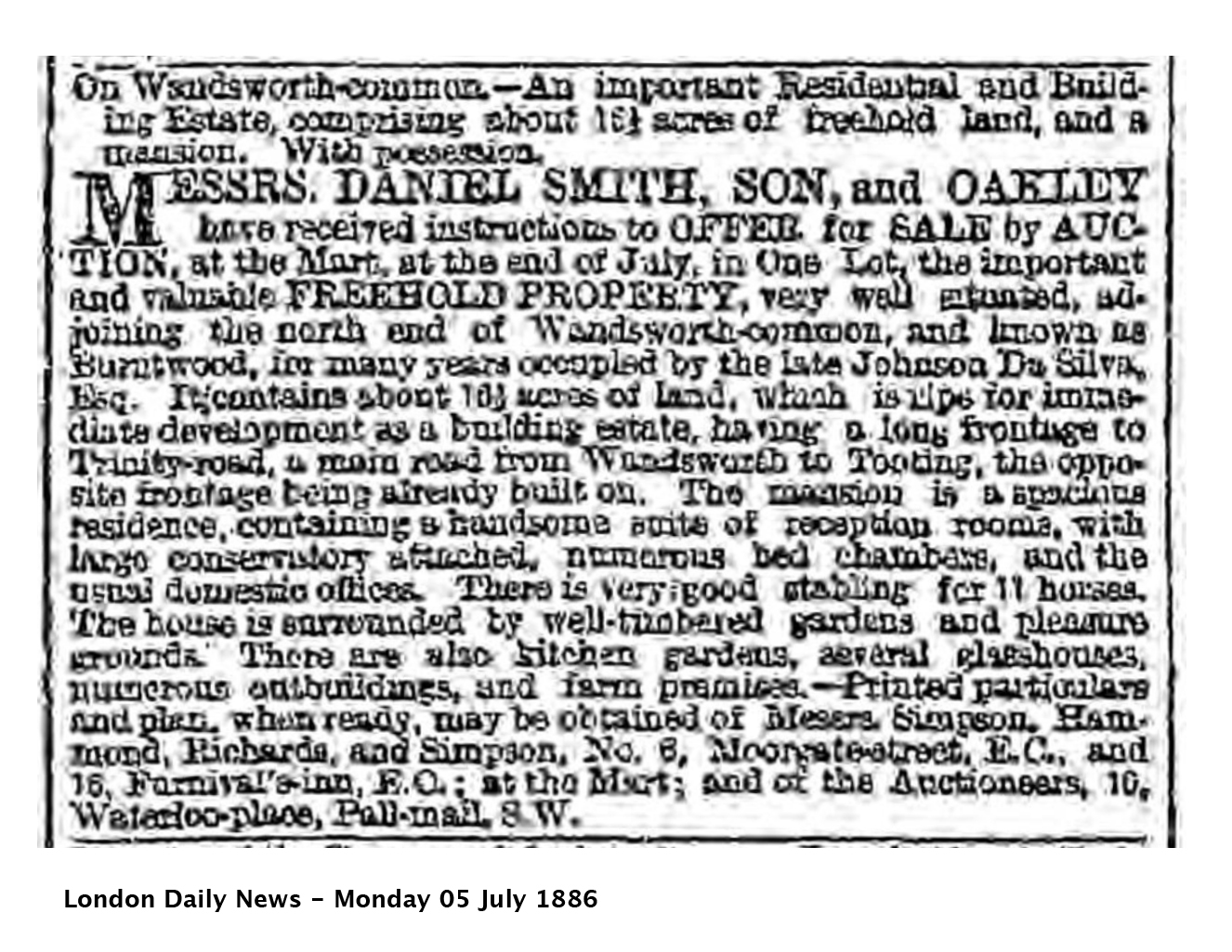
Burntwood House for sale at auction. Johnson Da Silva's name mentioned.
On Wandsworth-common — An important Residential and Building Estate, comprising about 16 1/2 acres of freehold land, and a mansion. With possession.
MESSRS DANIEL SMITH, SON, and OAKLEY have raceived instructions to OFFER for SALE by AUCTION, at the Mart, at the end of July, in One Lot the important _ n and valuable FREEHOLD PROPERTY, very well situated, adjoining the north end of Wandsworth-common, and known as Burntwood, for many years occupied by the late Johnson Da Silva,Esq.
It contains about 16 1/2 acres of land, which is ripe far immediate development as a building estate, having a long frontage to Trinity-road, a main road from Wandsworth to Tooting, the opposite frontage being already built on. The mansion is a spacious residence, containing a handsome suite of reception rooms, with large conservatory attached, numerous bed chambers, and the usual domestic offices. There is very good stabling for 11 horses.
The house is surrounded by well-timbered gardens and pleasure grounds. There are also kitchen gardens, several glasshouses, and numerous outbuildings, and farm premises.
Printed particulars and plan, when ready, may be obtained of Messrs Simpson, Hammond, Richards, and Simpson, No. 6 [8?], Moorgate-street, EC, and 16 Furnival's-inn, EC; at the Mart; and of the Auctioneers. 10, Waterloo-place, Pall-mall, S.W.
[BNA: Link]
NEEDS EDIT
London Daily News — Saturday 16 October 1886
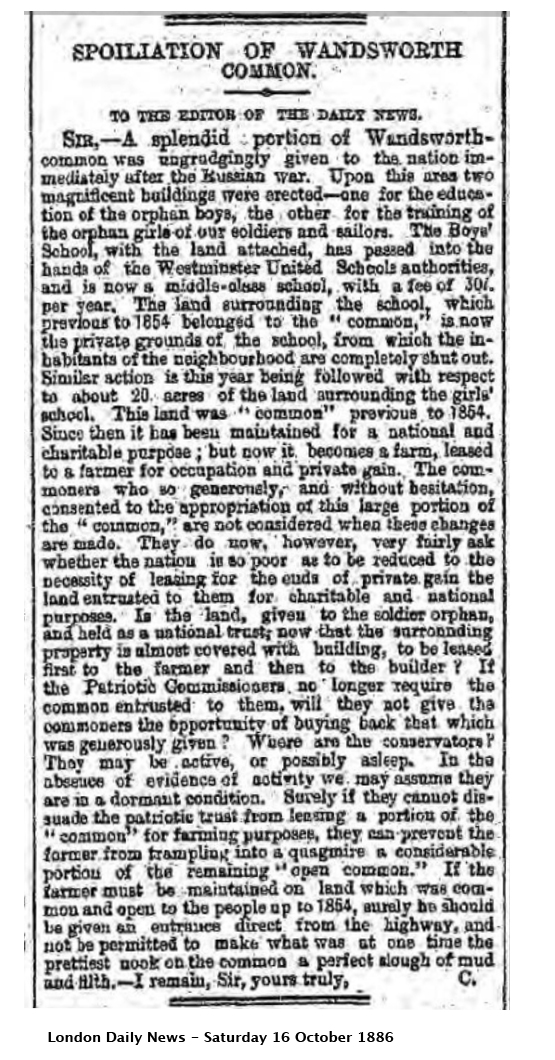
SPOILIATION OF WANDSWORTH COMMON
TO THE EDITOR OF THE DAILY NEWS
Sir,-A splendid portion of Wandsworth-common was ungrudginlgy given to the nation immediately after theh Russian war. Upon this area two mnagnifcent buildings were erected — one for the education of the orphan boys, the other. ?? ?? of the o bani Birb of our soldiers and sailors.
The Boys' School, with the land attached, has passed into the hands of he Westminster United School authorities, and is now a middle-class school with ?? 30 per 7ear. The land surrounding the school; which previous to 1854 helonged to the "common" is now the private grounds of the school, from which the inhabitants of the neighbourhood are completely shut out. Similar action is this year being ?? with respect to about 2D.. acres t of the land surrounding the girls' school, This land — wzs — oMmoa" previous to7 4.
Since then it has been maintained for a national and charitable purposes; but now it. becomes alarm, leased to a farmer for occupation and private gain. Ihecor- monera who so generously;' and without hesitation, consented to t.e appropriaton of this large portion of the "common," are not considered when these changes are made. They do now,, however, very fairly ask whether the nation is so poor as to be reduced to the necessity of leasing for the ends of private gain the land entrusted to them for charitable and national purposes. fa the lad, given to the soldier orphan,;n=held as a national trust now 'that the surondn5 .perty is almost covered with building, to he the to the farmer and then to the builder ? If the Patriotic Commissioners, no longer require the common entrusted to them will they not give the commoners the opportnnitv of buying back that which was generously given ?
Where are the Conservators? They may be active, or possibly asleep. In the absence of evidence of activity We may assume they are in a dormant condition. Surely if they cmnaot dissuade the patriotic trust from leasing a portion of the "common" for farming purposes, they can prevent the former from trampling into a quagmire a considerable portion of the remaining "open common." If the farmer must be maintained on land which was common and open to the people up to 1854, surely be should he give an entrance direct from the highway, and not be permitted to make what was at one time the prettiest nook of the common a perfect slough of mud and filth.
I remain, Sir, yours truly,
C
[BNA: Link.]
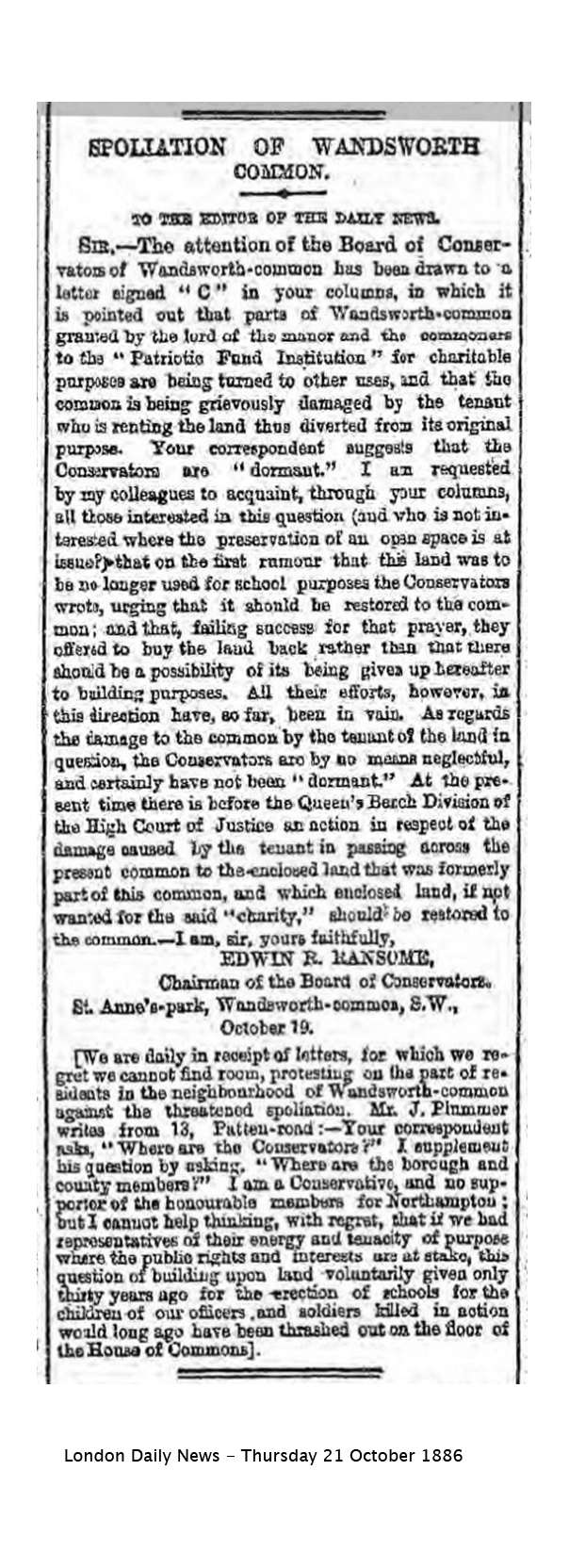
SPOLIATION OF WANDSWORTH COMMON.
TO THE EDITOR OF THE DAILY NEWS
Sir,--The attention of the Board of Conservators of Wandsworth-common has been drawn to a the letter signed "C" in your columns, in which it is pointed out that parts of Wandsworth-common granted by the lord of the manor and the commoners to the "Patriotic Fund Institution" for charitable purposes are being turned to other uses, and that the common is being grievously damaged by the tenant who is renting the land thus diverted from its original purpose.
Your correspondent suggests that the Conservators are "dormant." I am requested by my colleagues to acquaint, through your columns, all those interested in this question (and who is not interested where the preservation of an open space is at issue) that on the first rumour that this land was to be no longer used for school purposes the Conservators to wrote, urging that it should be restored to the common; and that, failing success for that prayer, they offered to buy the land back rather than that there should be a possibility of its being given up hereafter to building purposes. All their efforts, however, in this direction have, so far, been in vain. As regards the damage to the common by the tenant of the land in tic question, the Conservators are by no means neglectful, and certainly have not been "dormant."
At the present time there is before the Queen's Bench Division of M the High Court of Justice an action in respect of the re( damage caused by the tenant in passing across the Ox present common to the unenclosed land that was formerly 21 part of this common, and which enclosed land, if not wanted for the said "charity," should be restored to the common.
I am, sir, yours faithfully,
EDWIN B. RANSOME, as Chairman of the Board of Conservator, St. Anne's-park, Wandsworth common, S.W., October 19.
The editor attached a comment [rebuke?]:
We are daily in receipt of letters, for which we regret we cannot find room, protesting on the part of residents in the neighbourhood of Wandsworth-common against the threatened spoliation. Mr. J. Plummer writes from 13, Patten-road: Your correspondent in asks, "Where are the Conservators?" I supplement this question by asking, "Where are the borough and county members?" I am a Conservative and no supporter of the honourable members for Northampton; but I cannot help thinking, with regret, that if we had representatives of their energy and tenacity of purpose where the public rights and interests are at stake, this question of building upon land voluntarily given only thirty years ago for the erection of schools for the children of our officers and soldiers killed in action would long ago have been thrashed out on the floor of the House of Commons.
[Source: Link]
[PB: "the honourable members for Northampton"?]
A remarkably poetic evocation of Wandsworth Common and the current conflict

[NEEDS EDIT]
WANDSWORTH COMMON
Wandsworth Common is probably at its best in the later spring months, and it is most popular amongst the people who frequent it during the long summer days when even the sick and feeble may sit in the shade of the big trees and lounge upon the turf with impunity.
At this mid-October season, however, especially since the rains have turned the brown made by the dog-day suns into the greenest of grass, it still proclaims an abundance of charms, albeit some of them may suggest decay and induce a gentle melancholy rather than the bounding delight which a fresh May morning should bpring to all healthy persons.
Let the season be what it may, indeed, this fine open space tells its own mission of healthful service to the people, and invites every one interested in its preservation, and other places of like character, to be strong and resolute in resisting every attempt at spoliation.
You may reach Wandsworth Common by railway, but to fully appreciate the boon it must be, you should cross Westminster Bridge, and journey to it by the Albert Embankment and along the Wandsworth-road. The locality thus traversed teems with evidences of industrial labour. The shops, eating-houses, and tramcars are patronised mostly by the working classes of a substantial type, and the vast works along the riverside are the sources of their income. For these densely habited thousands, the nearest open air spaces are Battersea Park and Wandsworth Common.
On your way to the last-named you find that the air gets perceptibly clearer when once you are upon Lavender-hill. The shops, breweries, and manufactories are now succeeded by terraces of small villas set back from the pavement; old creeper-fronted houses peep between the trees of their enclosed grounds; the roar of London has become e subdued hum, and you are at a respectable height above the valley of Father Thames. You descend as well as climb Lavender-hill but immediately on reaching the dip commence the ascent of St. John's-hill. By- -and-bye you turn off to the left, and a short connecting link of byeway introduces you to Wandsworth Common.
The first glimpse of the greenery of the ground, and the foliage of the trees which are so liberally distributed, bids you imagine that you are almost in the country. Nor is this impression erroneous. Close by, looking over the oak palings, you may see quite a large field with cattle grazing, and as honest a rick as the remotest village could produce. Here, too, you are at the commencement of that chain of prized open spaces which only terminates with glorious Richmond Park.
No doubt the owners of the private grounds, which appear on either hand, can here pluck their flowers without smearing the hand with London smut. Half over the lanes and roadways hang the branches of immemorial elms. There is a fine row of chestnuts on the Common itself, with birches, poplars, limes, and sycamores; and in the corner yonder, to which much public attention has recently been called, a couple of real full-grown willows stand, as if to weep over the spoliation going on under their shadow. In all directions young trees, protected by railings, flourish up and down the Common with full promise of future beauty.
Though it is the 22nd of October there are men, women, and children tempted by the sunshine resting on the seats or strolling or playing on the sward amidst the dark masses of gorse, which truly is only out of bloom when kissing is out of fashion.
You must push up past the great school buildings with their ample enclosures of private ground, and cross the wooden bridge over the London, Brighton, and South Coast line to find the corner of which readers of the Daily News will have learned much within the past few days.
One of the correspondents who have very properly sounded an alarm correctly described this part as one of then prettiest coorners of the Common. The spoliation requires no magnifying glass to discover it. All along by the spick and span new houses of the estate laid out in that quarter runs a rough muddy road, and this, just past the willows, branches off into two up-ploughed, quagmiry cartroads, worse than many a colonial bush track. One of these cuts right through the gorse.
These rude reminders of the heavy traffic of roads of contract manure carted to the farm (which has passed from the Patriotic Commissioners to a private tenant) wvould be an eyesore under any circumstances, but they are doubly ugly as being the encroachments upon the space which should be devoted to public uses.
The history of the appropriation of land to various purposes on Wandsworth Common has a been recently told in all its details in these columns, amid the indignation felt in the surrounding district at the new effort at spoliation has been expressed by numerous correspondents. A visit to the Common may lead some to the conclusion that it is after all but a small area to make so much noise about, but it is precisely in this manner in the past that acre after acre has been filched from the people wherever open spaces were to be found.
Just in this manner Wandsworth Common, years ago, was shorn of its just proportions, and reduced to what it now is. The inhabitants know that the danger is imminent, and they should, combining for one common interest, never allow this matter to rest unil the rough places are made plain. Before the passing of the Wandsworth Common Act the land grabbers neever ceased their operations, and the history of all public spaces proves that a threatened yard of land should be as jealously guarded as thousands of acres.
In his letter, published on Thursday in this Journal, Mr. Ransome, chairman of the Wandsworth Common Conservators, stated that at the present time an action is pending in the High Court of Justice "in respect of the damage caused by the tenant in passing across the present Common to the enclosed land that was formerly part of the Common." The queston is one of right of way, and its bearings were truthfully c explained in the letter of "C." on the 19th inst. The Queen's Bench Division, therefore, will have to decide it, and it is to be hoped that the settlement of the matter will not be unduly postponed by the law's delay.
Three months ago. Mr. 0. V. Morgan, MP., and Mr. Kimber, M.P., introduced a deputation to the Metropolitan Board of Works, praying that the Board would take steps for transferring the control and management of the Common from the present Conservators to the Metropolitan Board (who yesterday decided to promote a Bill for vesting the control and management of Wandsworth Common in themselves) and Mr. Morgan pointed out how years since, enterprising individual citizens worked incessantly to put an end to the encroachments which seemed likely soon to improve the Common off the face of the earth.
It will thus be seen that the spoliation of Wandsworth Common is not a new cry. Both Mr. Buckmaster and Mr. Thomas Clark took the risk (and cost of consequent prosecutions) of knocking down obnoxious fences. This, however, was prior to the passing of the Act, and it should be said on behalf of the Conservators that, whatever may be their present shortcomings, they have in days gone by done much for the Common. By their efforts enclosures have been thrown open and rights established; nuisances have been stopped; the trees, turf, gorse, and gravel have been protected; and by aid of voluntary contributions, footways have been made or restored, valuable trees planted, pits filled up, embankments restored, and seats erected for the public.
[BNA: LINK.]
WANDSWORTH COMMON AND PUBLIC RIGHTS.
A meeting called by the Wandsworth-common Protection Association was held last night at the Town Hail, Wandsworth; Mr. J. BarLL presidio ?? Chairman said there was no desire to discuss this question in a spirit of passion. They recognised legal rights, but wished to represent that those rights, if they existed, should be exercised in a reasonable way, with dlue ?? to the public convenience anti public rights, iand to the understanding that possibly underlay the original gift to the Commissioners of the Patriotic Fund.
-Mr. D. Johnson, honorary secretary to the Association, read letters, expressing sympathy with the objects of the meeting, which had been received from Sir H. W.. Peek, Sir J. Trevor LaVreuce, MR.. Mr. Buckmaster, Mr. J. F. Moulton, Mr. 0. V. Morgan, MP., Mr. J. Williat, M.P., and Mr. Conybeare, MP.
- Mr. Steel proposed a resolution setting forth the regret of the meeting that the Patriotic School authorities and their tenant should have established an extensive vehicular traffic across a portion of the common, whereby most serious damage had been done to the turf, gorse and footpath, contrary to the spirit and intention of the Wandsworth Common Act of 1871, which provided that it should be the duty of the Conservators "to keep the common for ever open, unenclosed, and unbuilt on, for purposes of health and unrestricted exercise amide recreation".
-Mr., Cuwvham seconded the resolution, taking occasion to acknowledge the services which had been rendered to this movement by the Daily ??
Chairman, in answer to questions, said the Conservators did not think it desirable to take any part in a public meeting, but were prepared to act for the interest of the public as they might be advised, anti they bad applied for an injunction against the tenant with respect to the vehicular traffic. The map on the wall wais the property of the Conservators, and was lent by theme for this meeting. He disclaimed any rivalry between the present meeting and the one to be held at Bolingbroke Hall on Thursday.
-The Chairman then, at the request of the meeting, explained the map, which showed in a very striking manner the extensive encroachments made on the common since 1847 [?], besides indicating the nature of the present contention.
-Mr. S. Bowes wished to move as an amendment that, the matter being before a court of law, it was not competent to the meeting to pass the resolution Chairman' declined to accept this as au amendment, and the resolution was passed, Mr. Bowes being the only ?? following resolution was unanimously passed: "1 That, as the schools and grounds as first established were intended to afford visible onei permanent memorial of the national generosity, this meeting desires to record its emphatic protest against the action of the Royal Commissioners in leasing more than a third of the land to a market gardener, and respectfully urges that steps should be taken to extinguish the lease granted, with a view to restoring the hand to the use of the school, or its annexation to the Common."
-A memorial to the Royal Commissioners embodying, the above resolutions was also carried.
[BNA: Link]
WE reported on Tuesday a ?? influential fleeting which had been called by the Waudsworth Common Protection Association to protest against spoliation oitA e Common wliioa is likely to result from the action of the Trustees of the Patriotic Schools. To-night another local body will hold a meeting at Bolingbroke Hall, near Clapham Junction, with a similar object. The attempt which is thus being made to prevent the perversion of a public trust deserves the sympathy of the whole of London. Wandsworth and Battersea are doing a public service in thus persistently directing attention to the subject.
The story has been told again and again, but the case is one which needs painful iteration. There appears to be no appeal except to public opinion, and public opinion can only be influenced by persistent agitation. Wandsworth Common is one of the most useful breathing grounds in southern London. It is being gradually surrounded by the town as the brick and mortar deluge flows outwards over the meadows. Thirty years ago it was far away inl the outskirts, a fine breezy, open space of turf and gorse. The gorse is still there, the turf is as green as ever; but the dimensions of the Common are sadly curtailed.
Just after the Crimean war sixty acres of it were put into the ?? of the Royal Commissioners of the Patriotic Fund for the building of schools for the orphan boys and girls of our sailors and soldiers. The schools were built with plenty of airing ground around them, as the nation intended. In 1682, Low- ever, one of the schools was sold by the trustees, aud with it twelve acres of land were alienated for ever. Now they have taken the further step of letting nineiteon acres for a market garden. In getting access to this garden the lessee has taken his carts across the Common, and the question of his right to do this is to be tried before a court of law.
The further question, whether the Royal Commissioners of the Patriotic Fund have a right to do as they choose with the whole of the land, cannot be thus put to the test. It is quite possible that they might prove to be within their legal right ii they sold it for building purposes, though, if that should prove to be the case, it would be the duty of Parliament to reconsider the terms of the gift. But the appeal;ihich the people of Wandsworth are manking to the Commissioners can at least bej us- tified on moral grounds. There can be no doubt for what purpose the lind was put into their hands, and they can huve no moral right to use it for any other purpose. It was given for schools for the orplhans; and if it is not needed for that purpose it should be handed back to ?? public.
The Patriotic Fund is not an impoverished institution, It has a large capital atnd a considerable yearly incomne. There is no necessity for any attempt to increase its revenue by turninig its land into building land; nor do the Commissioners at presont show signs of a disposition so to use it.
But the fear is naturally and justly entertained at Wandsworth that the letting these acres for marlet gardens is the first stop. It is an act of alienation. It is setting up a hind of private ownership. It is practically asserting thast the laud belongs to the Commmission, not merely for the one purpose for which it was given, but for purposes of revenue mtmdl profit. If for market gardens, why not for houses and streets? is the question people ask; and there is no answer.
We contend that the moral right of the Commissioners to the ground is limited to the uses for which it was given, and that to niche use of it for other purposes, especially for other purposes which are not public purposes, is an entire misuse of the trust which the nation has put into their hands.
[BNA: Link]
[Source: BNA: London Daily News: 1880-1889]
A meeting called by the Wandsworth-common Protection Association was held at the Wandsworth Town Hall, when resolutions were passed protesting against the encroachments by vehicular traffic, and against the letting for market gardens of a portion of the common ground possessed by the Royal Commissioners of the Patriotic Fund.
[BNA: Link]
WANDSWORTH COMMON
WE reported on Tuesday a very influential meeting which had been called by the Wandsworth Common Protection Association to protest against the spoliation of the Common which is likely to result from the action of the Trustees of the Patriotic Schools. To-night another local body will hold a meeting at Bolingbroke Hall, near Clapham Junction, with a similar object. The attempt which is thus being made to prevent the perversion of a public trust deserves the sympathy of the whole of London. Wandsworth and Battersea are doing a public service in thus persistently directing attention to the subject.
The story has been told again and again, but the case is one which needs painful iteration. There appears to be no appeal except to public opinion, and public opinion can only be influenced by persistent agitation. Wandsworth Common is one of the most useful breathing grounds in southern London. It is being gradually surrounded by the town as the brick and mortar deluge flows outwards over the meadows.
Thirty years ago it was far away in the outskirts, a fine breezy, open space of turf and gorse. The gorse is still there, the turf is as green as ever; but the dimensions of the Common are sadly curtailed. Just after the Crimean war sixty acres of it were put into the hands of the Royal Commissioners of the Patriotic Fund for the building of schools for the orphan boys and girls of our sailors and soldiers. The schools were built with plenty of airing ground around them, as the nation intended.
In 1882, however, one of the schools was sold by the trustees, and with it twelve acres of land were alienated for ever. Now they have taken the further step of letting nineteen acres for a market garden. In getting access to this garden the lessee has taken his carts across the Common, and the question of his right to do this is to be tried before a court of law.
The further question, whether the Royal Commissioners of the Patriotic Fund have a right to do as they choose with the whole of the land, cannot be thus put to the test. It is quite possible that they might prove to be within their legal right if they sold it for building purposes, though, if that should prove to be the case, it would be the duty of Parliament to reconsider the terms of the gift. But the appeal which the people of Wandsworth are making to the Commissioners can at least be justified on moral grounds. There can be no doubt for what purpose the land was put into their hands, and they can have no moral right to use it for any other purpose. It was given for schools for the orphans; and if it is not needed for that purpose it should be handed back to the public.
The Patriotic Fund is not an impoverished institution. It has a large capital and a considerable yearly income. There is no necessity for any attempt to increase its revenue by turning its land into building land; nor do the Commissioners at present show signs of a disposition so to use it. But the fear is naturally and justly entertained at Wandsworth that the letting these acres for market gardens is the first step. It is an act of alienation. It is setting up a kind of private ownership. It is practically asserting thast the land belongs to the Commission, not merely for the one purpose for which it was given, but for purposes of revenue and profit.
If for market gardens, why not for houses and streets? is the question people ask; and there is no answer. We contend that the moral right of the Commissioners to the ground is limited to the uses for which it was given, and that to make use of it for other purposes, especially for other purposes which are not public purposes, is an entire misuse of the trust which the nation has put into their hands.
[BNA: Link]
THE Patriotic Fund AND WANDSWORTH COMMON.
A public meeting called by the Wandsworth District Local Government Association was held last night in Bolingbroke-hall, Clapham Junction, to protest against the action of the Royal Commissioners of the Patriotic Fund respecting the land under their control on Wandsworth common. Mr. E. Wood presided, and there was a large attendance, among those present being Mr. Bonsor, M.P., Mr. Gilliat, MP., Mr. J.C. Buckmaster, Mr. Dickinson, and Dr. Jefferson.
The Chair, in opening the proceedings, explained that the object of the meeting was to prevent the permanent alienation of any portion of the land which was at the present time in the possession of the Royal Commissioners of the Patriotic Fund from the purposes for which it was intended to be applied when it was handed over to them, or, if alienated, to ask that it should be restored to the common of which it originally formed a part.
After the Crimean War a fund was opened for the purpose of providing pensions, and of furnishing home accommodation for the orphans of the soldiers and sailors who had sacrificed their lives in the country's service, and whose children had been left destitute. The appeal made to the nation met with a generous response, upwards of a million of money having been subscribed. Out of that large sum two buildings now standing on Wandsworth-common, which at one time were set apart as schools, were erected, one for boys and the other for girls, the children of soldiers and sailors who were killed during the Crimean War.
No one would for a moment begrudge the giving up of the land occupied by the schools so long as it was used for the purpose of providing for these children, but what the parishioners felt was that as soon as the time arrived when the land was no longer required for the purposes of the schools, it should be restored to the Commission.
In 1881, in consequence of the diminution in the funds, the Commissioners applied to Parliament to procure the passing of a Bill authorizing them to dispose of the boys school. The Bill was passed, and while the parishioners felt that that was a departure from the understanding by which the Commissioners obtained the land, they had some satisfaction In knowing that it was still used for educational purposes. But with regard to the land which was the subject of discussion, they feared that it would be diverted to infinitely worse purposes unless energetic action were taken by the parishioners of Wandsworth and Battersea.
Less than a year ago nearly 20 acres of the land was let on lease for agricultural purposes, and those who had noticed the extent of building operations in London would understand that the letting of land for agricultural purposes was generally the preliminary to its forming a building estate. This they wished to prevent. They had lost too much of the common already. Gradually one piece and another had been filched from it until it was reduced to its present proportions. He would not enter into the legal question; probably the Commissioners had legal sanction for disposing of the land, but there could be no moral justification for their action. The land was handed over to them for a specific purpose, and when it was no longer required for that purpose it was only reasonable and fair that they should surrender it to the people who originally had possession of it, They could not afford to lose these breathing places,and he hoped that their energetic protests would cause the Commissioners to reconsider their action. (Cheers.)
Mr. Dickinson then read a memorial, which it was proposed should be sent to the Commissioners, setting forth that in the year 1854 a Royal Commission was issued empowering the raising of a Patriotic Fund for orphans and widows of soldiers who might fall in the Crimean war, that the Commissioners thus constituted obtained possession of about 60 acres of Wandsworth-common, and erected thereon a school or asylum for the daughters of soldiers and sailors, of which the foundation stone was laid by Her Majesty on the 11th day of July, 1857; that subsequently a school for the sons of soldiers and sailors was also erected on a portion of the said land; that this latter school, with 12 acres of the land formerly part of Wandsworth-common, was sold by the Commissioners in 1882, under the authority of 44 and 45 Vict.,chap. 46, and the land was thus diverted from the purposes for which possession of it was obtained, that during the past 12 months no less than 19 acres of the remaining land, formerly part of Wandsworth-common, had been separated by a fence from the buildings of the asylum for girls, and was not now used for the purposes of the asylum, but for the carrying on of a trade or business; and that such a diversion of the land from the purposes for which it was alienated from the common was inconsistent with the objects for which the land was granted, and was altogether unworthy of so distinguished and wealthy a body, and might eventually lead to the permanent misappropriation of this open space.
A resolution moved by Mr. J.C. BUCKMA5TER and supported by Mr. GILLIAT, M.P., and Mr. BONSOR, J.P., to the effect that the memorial be signed by the chairman on behalf of the meeting, was passed unanimously.
Dr. JEFFERSON moved that copies of the memorial be forwarded to the Royal Commissioners of the Patriotic Fund and to each individual member.
This was seconded and agreed to, after which the proceedings terminated.
[Source: Link.]
WANDSWORTH COMMON
A large and enthusiastic meeting of the inhabitants and ratepayers of Battersea and Wandsworth was held last night Jil d Bolingbroke Hall, Battersea, to discuss the question of the restoration to the public of the part of Wsndsworth Common no longer required by the Royal Commissioners of the Patriotic Fund for the purposes of their school. The chair was taken by Mr. Edward Wood,:e churchwardea of Battersea. On the motion of Pro. e fessor Buckimaster, seconded by Mr. J. S. Gilliat,, M.P., and supported by Mr. Bonsor, A.P., a memorial — to the Royal Commissioners of the 'Patriotic Fund was l unanimously adopted. The memorial set forth that in 3. the year 1 854 the Queen issued a Royal Commission 1 empowering the raising of a "Patriotic Fund" for Orphans and Widows of Soldiers and Sailors who might Ir fall in the Crimean War. The Commissioners thus )r constituted obtained possession of about sixty acres of ie Wandsworth Commonu, in the mauors of Beattersen and Wandsworth, aud erected thereon a school or 'y asylum for the daughters of soldiers and sailors. a Subsequently a school for the sons of soldiers and sailors was also erected on a portion of the said land. n This latter school, vnth twelve acres of the land le formerly part of Wandsworth Common, was sold by te the Commissioners in 1832 under the authority of 44 — and 45 Vict., c. 46, end the land was thus diverted 7e from the purposes for whiob possession of it was ob- in tamled. ]During the past twelve months no less then ), nineteen and aL half acres of the remaining laud, for- if marly part of Wandsworth Common, have been Bepa- A t rate4 by a fence from the buildings of the Asylum for 4, Girls, and is not now used for the purpeses of the ig asylum, but for the carrying on of a trade or business. ir In the opinion of the menmorialists such a diversion of '5 the land from the purposes for which it was alienated a, from the common is iniconsistent with the objects for d. which the land was granted, and is altogether unworthy le of so distinguished and wealthy a body, and may even tually lead to the permanent misappropriation of this 1y open space."
[BNA: Link]

Preservation_of_WC_SouthLondonPress_20nov1886.jpg
[NEEDS A PROPER EDIT]
The Preservation of Wandsworth Common.
A public meeting, convened Wandsworth Common Protection Association, was held on Monday evening at the Wandsworth Town Hall, under the presidency of Mr. Bell, "to protest against the grievous damage now being done by vehicular traffic to the turf, gorse, and footpath of the Common to the rear of the Girls' Patriotic School; to memorialize the Royal Commissioners relative thereto, and to take such other action as might desirable."
The chairman, in opening the proceedings, insisted on the importance of the question which had brought them together being thoroughly and impartially considered and trusted that whatever resolutions were passed would be carried unanimously. After referring to the manner in which the funds had been subscribed after the Crimean war to enable the Commissioners of the Patriotic Fund to acquire the land and to establish the schools as a memorial, it was only fair that if the Commissioners had taken over more land from the Common than they now required, that portion which was not needed should be returned to the ratepayers.
Letters expressing regret their inability to be present and sympathy with the objects of the meeting were then read from Mr. Kimber, M.P., Mr. Gilliatt, M.P., Mr. Conybeare, M/P., Sir Trevor Lawrence, M.P., Mr. O.V. Morgan. M.P., Lord Brabazon, Sir H. Peek, who forwarded £10O, and Mr. Buckmaster, who said that if the ratepayers did not take care, the land now used as a garden would soon be covered with houses.
Mr. Steel then moved the following resolution: "That inasmuch the Wandsworth Common Act 1871 provides that it shall the duly of the Conservators to keep the Common tor ever open and unenclosed and unbuilt on, for purposes of health and unrestricted exercise and recreation, this meeting desires to record its deepest regret that the Patriotic School authorities and their tenant ' d established extensive vehicular traffic across portion of the Common, whereby most serious damage has been done to the turf, gorse and footpath, contrary to the spirit and intention of the Act.
Mr. Cowbam seconded the resolution, which was carried unanimously.
Mr. Black then moved, and Mr. Mace seconded, the following resolution: That, without offering any opinion the legal aspect of the action now pending between the Conservators of Wandsworth Common and the official trustees of the Patriotic Fund and their tenant, this meeting desires to record its opinion that if the Patriotic School authorities had provided, at a comparatively trifling cost, a suitable entrance from the Trinity-road for their tenant, the action in question would have been quite unnecessary.
A lengthy discussion ensued, Mr. Barnes and several other speakers objecting strongly to the terms of the resolution, as admitting the right of the Patriotic School Commissioners to utilise the 20 acres of ground which they had leased to gardener, any manner they thought fit, instead of using lt tor the school, the purpose tor which it nnally granted It the principle were to be aumit. that land could Led in Stable to the school, it might all let a building land It was at last suggested that the resolution ehooid withdrawn, bat the mover onder declining to accede to this proposition, expressing at the same time their opinion the defeat of the resolution would really be strengthening their case, the chairman pat the to the meeting as to whether the resolution should put, and it was negatived by a large majority.
Mr. Ennis then moved the following resolution, which was carried: "That as the schools and grounds, as first established, were intended to afford visible permanent memorial of the national generosity this meeting desires to record its emphatic protest against the action of the Commissioners leasing more than a third of the land to market gardener, and respectfully urges that steps should be taken to extinguish the lease granted, with view to restoring the land to the use of the school, or its annexation to the Common. p (;
A memorial to the Commissioners of the Patriots Fund embodying the substance of the foregoing resolutions was also agreed to, and the proceedings, which had been most enthusiastic throughout brought to close with the customory vote of thanks to the chairman.
[Thursday . . . ]
A largely attended public meeting was held on Thursday evening at the Bolingbroke Hall, Battersea Rise, under the auspices of the Wandsworth District Local Government Association, for the purpose of taking into consideration the alienation by the Royal Patriotic Commissioners of 20 acres of land, originally part of Wandsworth Common, from the purposes for which it was given them.
In the absence Sir John B. Heron Maxwell, president of the association, Mr. Edward Wood took the chair, supported by many of the leading ratepayers the district. There were also present Mr. Bonsor M.P.. Mr. J. S. Gilliat, M.P., Canon Erskine Clarke, Messrs. Beddoes Mnspratt and Drs. Jefferson and Oram. Letters of regret for inability to attend were read from Mr. O.. Morgan, M.P.and Mr. Robert Hunter, who both expressed themselves in sympathy with the meeting.
The chairman said that he felt that the question which they hod met together to consider was very important one for the district of Wandsworth. The object of the meeting was to prevent the permanent alienation of any portion of that land the present time vested in the Commissioners of the Patriotic Fund from the purposes to which it was intended to applied when handed to them; or it alienated from that purpose, it should be restored to the Common, of which it originally formed a part. (Hear.); in consequence of the large number of soldiers and sailors who had lost their lives, the country, founded, c died the for the pnrpose of providing for the widows and orphans.
The nation made a generous response to that appeal, and upwards of million of money was subscribed, and the two buildings on Wandsworth Common wore built, one for boys and the other for girls. A portion of the Common was appropriated for these two schools. one for moment begrudged the giving up of that land so long it was used to provide home for the children loft destitute by those who perished in their country service (hear) hut what they felt was that so soon as the time arrived when the land longer required for that purpose it ought to restored the Common. Cheers
In 1881, in consequence of diminution in the funds of the Trust, the Commissioners applied to Parliament, and procured the passing of Bill by which they were authorized to dispose of the land that to that time had been occupied by the hovs and this was done m pursuance ot the Act obtained. The ratepayers felt that that was a departure from the understanding on which the possession ot the land was obtained; still they had the satisfaction of knowing that it was bought and still used for educationary purposes with regard to the land which was the subject of discussion, they feared that it would diverted to infinitely worse purposes than the land already sold by the Commissioners, unless energetic action was token by the residents.
About year ago, or perhaps somewhat less, this portion e r ly 20 let by the Commissioners on lease for agricultural purposes, and those who had noticed the extension of building operations in London would understand that this was generally the preliminary stop to an estate. was for the purpose of preventing that that action had been initiated by the association, the expectation that association might spring to prevent any farther alienation of the Common.
There were some old verses which said:
It is a crime in man or woman
To steal a goose from off Common;
But surely he is without excuse
Who steals the Common from a goose.He did not they were the geese, but they diminished open spaces and increased the density of the population, the more would the death-rate increase. As regarded the legal aspects of the case, he believed that the Commissioners were acting within their powers, but there was no moral justification for the course they had pursued. (Cheers.)
The hon. secretary, Mr.W. H. Dickenson, then read the following memorial:
The Memorial of Ratepayers of Battersea and Wandsworth, and othe residing at or near irainlocoHh Public Meeting assembled Hail, Battersea, the 18th day of November, 1886, Sir B.BeronJfjxn-eU Bart,J.P., President oj the Wandsworth District Local Government Association t the chair:
Showeth.-That year 18M her Majesty issued Royal Commission empowering raismg Patriotic Fund" for Orphans and Widows boltuers and Sailors who might fall in Crimean war:
2. That the Commissioners constituted obtained possession of about acres the Manors of Battersea and amt erected tbereon a School or Asylnm lor the Daughters of Soldiers and Sailors, of which the foundation-stone was laid Majesty on the 11th day of July. 1857 Q.
3. That subsequently School for the Sons of Soldiers and Sailors was also erected on a portion of the said 1 this said land;
4. That this latter school, with 12 acres of the land formerly part of Wandsworth Common, was sold by the Commissioners in 1882 under authority of 44 and 45 Vic., c. 46, and the land was thus diverted from the purposes for which possession of it was obtained;
5.That during the past 12 months no less than 19 1/2 acres of the remaining land, formerly part of Wandsworth Common, have been separated by a fence from the buildings of the Asylum for Girls, and, as your memorialists understand, is not now used for the purposes of the asylum, but for the carrying on of a trade or business.
That in the opinion of your memorialists, such a diversion of the land from the purposes for which it was alienated from the Common, is inconsistent with too objects for which the granted, and is altogether unworthy of so distinguished and may eventually lead to the permanent misappropriation Your memorrialists therefore pray that y wm pleased to take such steps ns may be " \ l restore this portion of Wandsworth Common to public use and enjoyment.
Mr. J. C. Buckmaster proposed the first resolution: That the memorial now read be adopted, and that the chairman be requested to sign it on behalf of the meeting. In the course of an able address, Mr. Buckmaster said that the Patriotic Schools had not been very successful. At first the amount of land which could have been given to each the girls was three acres. (Laughter, and voice, "Where was the cow?") The cow was the Common. (Renewed laughter.)
The speaker proceeded to quote repeated instances of encroachments on the Common from the time of the Garratt Parliament in 1760. Between 1730 and 1810, 173 acres of the Common were appropriated, and encroachments had since been made both by public companies and private individuals urged them now to make hold stand against further surrender of the rights handed down to them for their own and their children's use.
Mr. J. S. Gilliat, M.P.. had pleasure ra seconding the resolution. He recollected the time when both Wandsworth and Clapham Commons were beautiful spots. Now all that was changed, and was heartily with them in desiring to join in the memorial which might arrest the progress of the destruction now taking place,
Mr. Cosmo Bonsor, member for that division of Surrey, supported the resolution. He was engaged in fighting similar battle to theirs respect to some others of the Surrey Commons. (Cheers ) He sorrv Mr. O. V. Morgan was unable to present (cheers) for this was not a party ' (hear) but a question which concerned every inhabitant. He considered they had a most substantial grievance against the Patriotic Commissioners and he could not understand how any men bearing the name of patriotic could act in such an nnPatnoUc manner. This was a matter that should be brought before Parliament (liear) and felt sure that the members of the House ot Commons would man to preserve any open space for the inhabitants of the metropolis. (Cheers.)
The resolution was carried unanimously.
Dr. Jefferson proposed that the secretary forward the memorial to the Commissioners and to each individual member of the Metropolitan Board.
Dr. Oram, as a conservator of the Common, seconded the resolution, and was supported Mr Fithian, secretary of the Commons Preservation Society.
The resolution was unanimously passed.
It was intimated by the chairman that the lease granted by the Commissioners to Mr. George Neale was tor 21 years at -Sl5O per annum, with the option ot a. further term of 21 years, if the land was not required for patriotic purposes. One of the covenants of the lease provides that the Commissioners shall not pay any compensation at the expiration of terms for buildings or improreraents.
An enthusiastic meeting closed with the usual vote of thanks
[BNA: LINK
Provisions are to be inserted in the Metropolitan Board of Works Various Powers Bill for next Session transferring to that body all the powers at present exercised the Conservators of Wandsworth Common, provision being also made for winding the affairs of the Conservators, and discharging them from any further liabilities in respect of that common.
[Source: Link.]
Letter from John Buckmaster
[NEEDS PROPER EDIT]
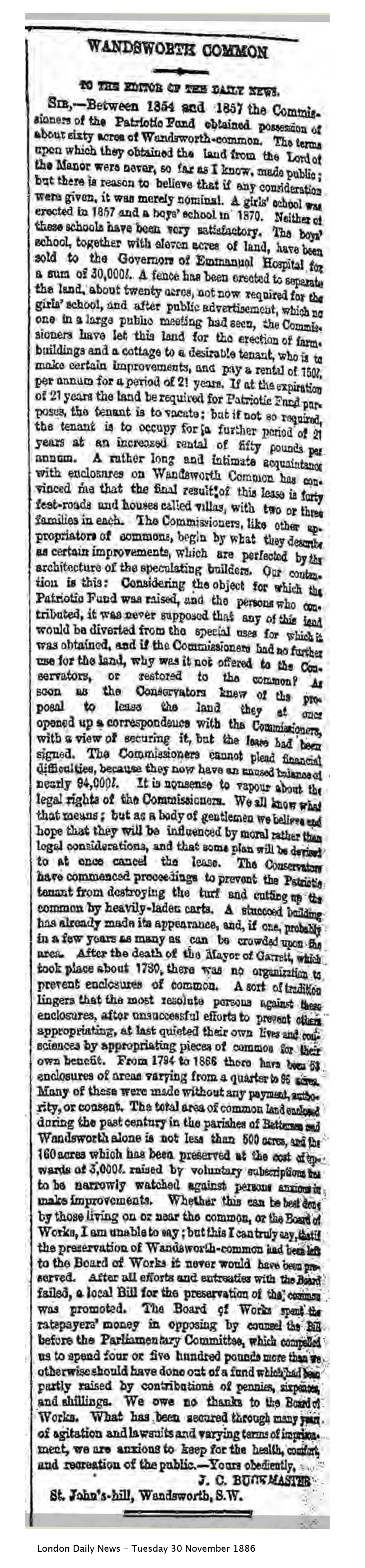
WANDSWORTH COMMON
TO THE EDITOR OF THE DAILY NEWS
SIR, — Between 1854 and 1857 the Commissioner of the Patriotic Fund obtained possession of about sixty acres at Wandsworth-common. The terms upon which they obtained the land from the Lord of the Manor were never, so far as I know, made public; but there is reason to believe that if any consideration were given, it was merely nominal.
A girls' school was erected in 1857 and a boys' school in 1870. Neither of these schools have been very satisfactory. The boys school, together with eleven acres of land, have been sold to the Governors of Emmanuel Hospital [sic] to a sum of £30,000. A fence has been erected to separate the land, about twenty acres, not now required for the girls' school, and after public advertisement, which no one in a large public meeting had seen, the Commissioners have let this land for the erection of farm buildings and a cottage to a desirable tenant, who is to make certain improvements, and pay a rental of £150 per annum for a period of 21 years. If at the expiration of 21 years the land be required for Patriotic Fund purposes, the tenant is to vacate; but if not so required, the tenant is to occupy for a further period of 21 years at an increased rental of fifty pounds per annum.
A rather long and intimate acquaintance with enclosures on Wandsworth Common has convinced me that the final result of this lease is forty feet roads and houses called villas, with two or three families in each. The Commissioners, like other appropriators of commons, begin by what they describe as certain improvements, which are perfected by the architecture of the speculating builders.
Our contention is this: Considering the object for which the Patriotic Fund was raised, and the persons who contributed, it was never supposed that any of this land would be diverted from the special uses for which it was obtained, and it the Commissioners had no further uses for the land, why was it not offered to the Conservators, or restored to the common?
As soon as the Conservators knew of the proposal to lease the land they at once opened up a correspondence with the Commissioners, with a view of securing it, but the lease had been signed.
The Commissioners cannot plead financial difficulties, because they now have an unused balance of nearly £94,000. It is nonsense to vapour about the legal rights of the Commissioners. We all know what that means; but as a body of gentlemen we believe and hope that they will be influenced by moral rather than legal considerations, and that some plan will be devised to at once cancel the lease. The Conservators have commenced proceedings to prevent the Patriotic tenant from destroying the turf and cutting up the common by heavily-laden carts. A stuccoed building has already made its appearance, and, if one, probably in a few years as many as can be crowded upon the area.
["A stuccoed building has already made its appearance" — Neal's Farm/Lodge (or some predecessor_?]
After the death of the Mayor of Garrett took place about 1780, there was no organisation to prevent enclosures of common. A sort of tradition lingers that the most resolute persons against these enclosures, after unsuccessful efforts to prevent others appropriating, at last quieted their own lives and consciences by appropriating pieces of common for their own benefit.
From 1794 to 1866 there have been 53 enclosures of areas varying from a quarter to 56 acres. Many of these were made without any payment, authority, or consent.
The total area of common land enclosed during the past century in the parishes of Battersea and Wandsworth alone is not less than 500 acres, and the 160 acres which has been preserved at the cost of upwards of £3,000 raised by voluntary subscription has to be narrowly watched against persons anxious to make improvements.
Whether this can be best done by those living on or near the common, or the Board of Works, I am unable to say; but this I can truly say, that if the preservation of Wandsworth-common had been left to the Board of Works it never would have been preserved. After all efforts and entreaties with the Board failed, a local Bill for the preservation of the common was promoted.
The Board of Works spent the ratepayers' money in opposing by counsel the Bill before the Parliamentary Committee, which caused us to spend four or five hundred pounds more than we otherwise should have done out of a fund which had been partly raised by contributions of pennies, sixpences and shillings. We owe no thanks to the Board of Works. What has been secured through many years of agitation and lawsuits and varying terms of imprisonment, we are anxious to keep for the health, comfort, and recreation of the public.
Yours obediently, J.C. BUCKMASTER, St. John's-hill, Wandsworth, S.W.
[BNA: Link]
Editorial comment about John Buckmaster's letter (above)
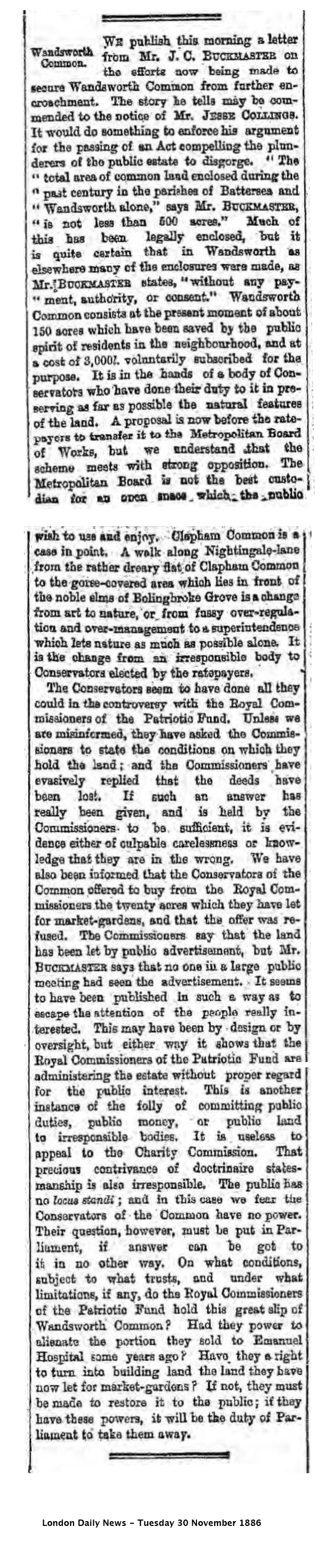
[NEEDS AN EDIT].
Wandsworth Common
We publish this morning a letter from Mr. J.C.BUCKMASTER on the efforts now being made to secure Wandsworth Common from further encroachment. The story tells may be commended to the notice of Mr. JESSE COLLINGS. It would do something to enforce his argument for the passing of an act compelling the plunderers of the public estate to disgorge.
"The total area of common land in closed during the past century in the parishes of Battersea and Wandsworth alone," says Mr Buckmaster, is not less than 500 acres. Much of this has been legally enclosed, but it is quite certain that in Wandsworth as elsewhere many of the enclosures were made, as Mr Buckmaster states, without any payment, authority, or consent. Wandsworth Common consists at the present moment of about 150 acres which have been saved by the public spirit of residence in the neighbourhood, and at a cost of £3000 voluntarily subscribed for the purpose. It is in the hands of a body of Conservators who have done their duty to it in preserving as far as possible the natural features of the land.
The proposal is now before the ratepayers to transfer it to the Metropolitan Board of Works, but we understand that the scheme meets with strong opposition. The Metropolitan board is not the best custodian for an open space which the public wish to use and enjoy.
Clapham Common is a case in point. A walk along Nightingale Lane from the rather dreary flat of Clapham Common to the ghost covered area which lies in front of the noble elms of Bolingbrook Grove is a change from art to nature, or from fussy over regulation and over management to a superintendence which lets nature as much as possible alone. It is the change from from an irresponsible body to Conservators elected by the ratepayers.
The Conservatives seem to have done all they could in the controversy with the Royal Commissioners of the Patriotic Fund. Unless we are misinformed, they have asked the Commissioners to state that conditions On which they hold the land; and the Commissioners have evasively replied that the deeds have been lost. If such an answer has really been given, and is held by the Commissioners to be sufficient, it is evidence either of culpable carelessness or knowledge that they are in the wrong.
We have also been informed that the Conservatives of the common offered to buy from the Royal Commission is the 20 acres which they have let the market gardens, and that the offer was refused. The Commissioners say that the land has been let by public advertisement, but Mr Buckmaster says that no one in a large public meeting had on which they hold the land; and the Commissioners have evasively replied that the deeds have been lost. If such an answer has really been given, and he is held by the Commissioners to be sufficient, it is evidence either of culpable carelessness or knowledge that they are in the wrong.
We have also been informed that the Conservators of the common offered to buy from the Royal Commission is the 20 acres which they have let the market gardens, and that the offer was refused. The Commissioners say that the land has been left by public advertisement, but Mr Buckmaster says that no one in a large public meeting had seen the advertisement. It seems to have been published in such a way as to escape the attention of the people really interested. This may have been by design or by oversight, but either way it shows that the Royal Commissioners of the Patriotic Fund are administering the estate without proper regard for the public interest.
This is another instance of the folly of committing public duties, public money, or public land to irresponsible bodies. It is useless to appeal to the charity Commission. That precious contrivance of doctrinaire statesmanship is also irresponsible. The public has no locus standby; and in this case we fear the Conservatives of the common have no power.
The question, however, must be put in Parliament, if answer can be got to it in no other way. On what conditions, subject to what trusts, and under what limitations, if any, do the Royal Commissioners of the Patriotic Fund hold the great hold this great slip of Wandsworth Common? Had the power to alienate the portion they sold to a manual hospital some years ago? Have they are right to turn into building land the land they have now let for market gardens? If not they must be made to restore it to the public; if they have these powers, it will be the duty of Parliament to take them away.
[FINISH OFF . . . ]
[BNA: Link]
[Google Search: Jesse Collings (1831-1920), Mayor of Birmingham, Education and Land reformer . . . Find out more about why he's mentioned here.]
VANDALISM AT WANDSWORTH COMMON. THE inhabitants of Battersea and Wandsworth have a very clear grievance against the Royal Commissioners of the Patriotic Fund; and they are taking vigorous action, by public meeting and otherwise, to get that grievance removed. The first Report of the Royal Commissioners of the Patriotic Fund, issued in 1858, contained the announcement that the lord of the manor and commoners of the parishes of Battersea and Wandsworth had generously allowed some fifty-five acres of the common (the value of which at that time was Cioo,ooo) to be transferred to the Royal Commissioners of the Patriotic Fund, for the purpose of a site for two schools for the maintenance and education of the orphan children of our soldiers and sailors who sacrifice their lives in the defence of their country, What has
[BNA: Link.]