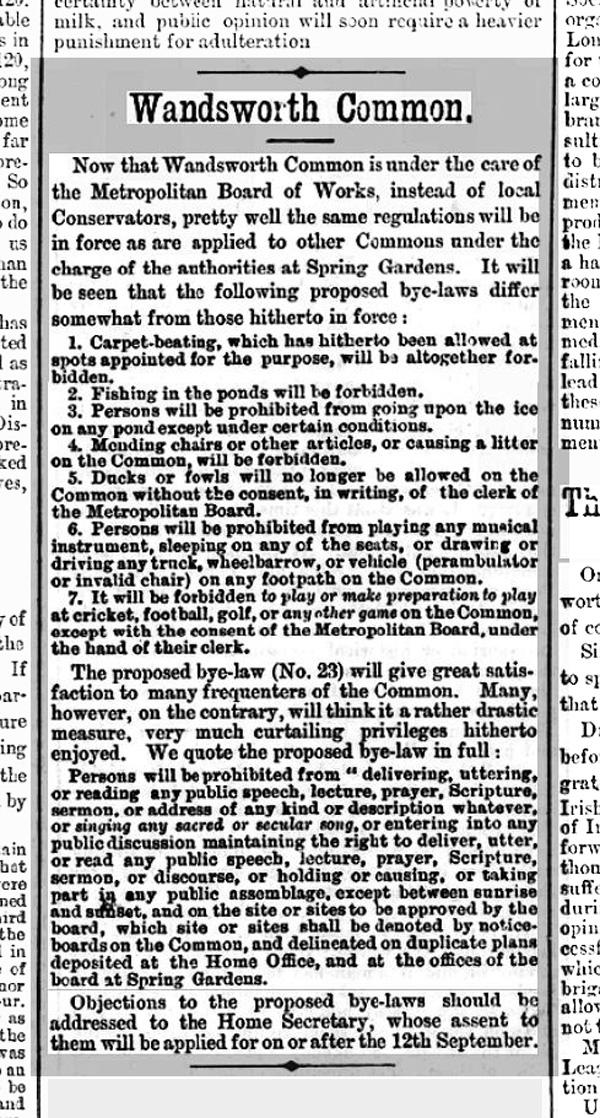
This transfer may have been against the wishes of many in the area, who cried out against the change. Here is one among many letters and articles on the subject from the time...
Wandsworth Common. Now that Wandsworth Common is under the care of the Metropolitan Board of Works, instead of local Conservators, pretty well the same regulations will be in force as are applied to other Commons under the charge of the authorities at Spring Gardens.*
It will seen that the following proposed bye-laws differ somewhat from those hitherto in force:
1. Carpet-beating, which has hitherto been allowed at spots appointed for the purpose, will be altogether forbidden.
2. Fishing in the ponds will forbidden.
3. Persons will prohibited from going upon the ice on any pond except under certain conditions.
4. Mending chairs or other articles, or causing litter the Common, will be forbidden.
5. Ducks or fowls will longer be allowed on the Common without the consent, in writing, of the clerk of the Metropolitan Board.
6. Persons will be prohibited from playing any musical instrument, sleeping on any the seats, or drawirg or driving any truck, wheelbarrow, or vehicle (perambulator or invalid chair) on any footpath on the Common.
7. It will forbidden to or make preparation to play at cricket, football, golf, or any other game on the Common, except with the consent of the Metropolitan Board, under the band of their clerk.
The proposed bye-law (No. 23) will give great satisfaction to many frequenters of the Common. Many, however, on the contrary, will think it a rather drastic measure, very much curtailing privileges hitherto enjoyed.
We quote the proposed bye-law in full:
"Persons will be prohibited from delivering, uttering, or reading any public speech, lecture, prayer, Scripture, sermon, or address of any kind or description whatever, or singing any sacred or secular song, or entering into any public discussion maintaining the right to deliver, utter, or read any public speech, lecture, prayer, Scripture, sermon, or discourse, or holding or causing, or taking part in any public assemblage, except between sunrise and sunset, and on the site or sites to approved by the board, which site or sites shall be denoted by noticeboards on tbe Common, and delineated on duplicate plans deposited at the Home Office, and at the offices of the board Spring Gardens."
Objections to the proposed bye-laws should addressed to the Home Secretary, whose assent to them will he applied for on or after the 12th September.
[HoWC:Source.]
[BNA:Source.]
[* Spring Gardens — headquarters of the Metropolitan Board of Works, near Trafalgar Square. The 1871 Wandsworth Common Act gave control of the Common to locally-elected Conservators, but this was transferred to the MBW in 1887 after a bitter "rate-payers' revolt". Within a few years, control was passed to the new London County Council.]
