[The Times: Search: "Wandsworth Common"].
[BNA: Buckmaster Battersea 1880]
[BNA: Buckmaster Wandsworth 1880]
[London Evening Standard: Buckmaster Wandsworth 1880]
[James Du Buisson's will]
South London Will. - The will Mr. James Du Buisson, late of Laurence Pountney-lane, merchant and underwriter, and of Wandsworth, who died November 16, was proved on the 8th ult. Mr. Thomas Buissou, the son, and Mr. Henry Douglas, the executors, the personal estat3 being sworn under . £140,000. The te.-talor bequeaths to his executor, Mr. Douglas,; to his nephew, Mr. Henry Tucke, . £,>oo; to each of his nephews and nieces, the children of Mr. William Kiickcr, £150; to divided amongst his servants the discretion of his executors, £150; to his wife. Mrs. Elizabeth Maty, £1,000 and all his household furniture, plate, and effects, £500 per annum for life, in addition to her marriage settlement. Portions of £20,000 are provided for each of his younger sons, and £15,000 for each of his daughters, the residue of his real personal estate gives to his said son Thomas. - City Press.
[BNA: Link]
Death and funeral of Robert Neal: "one of the largest employers, if not the largest, in the county of Surrey."
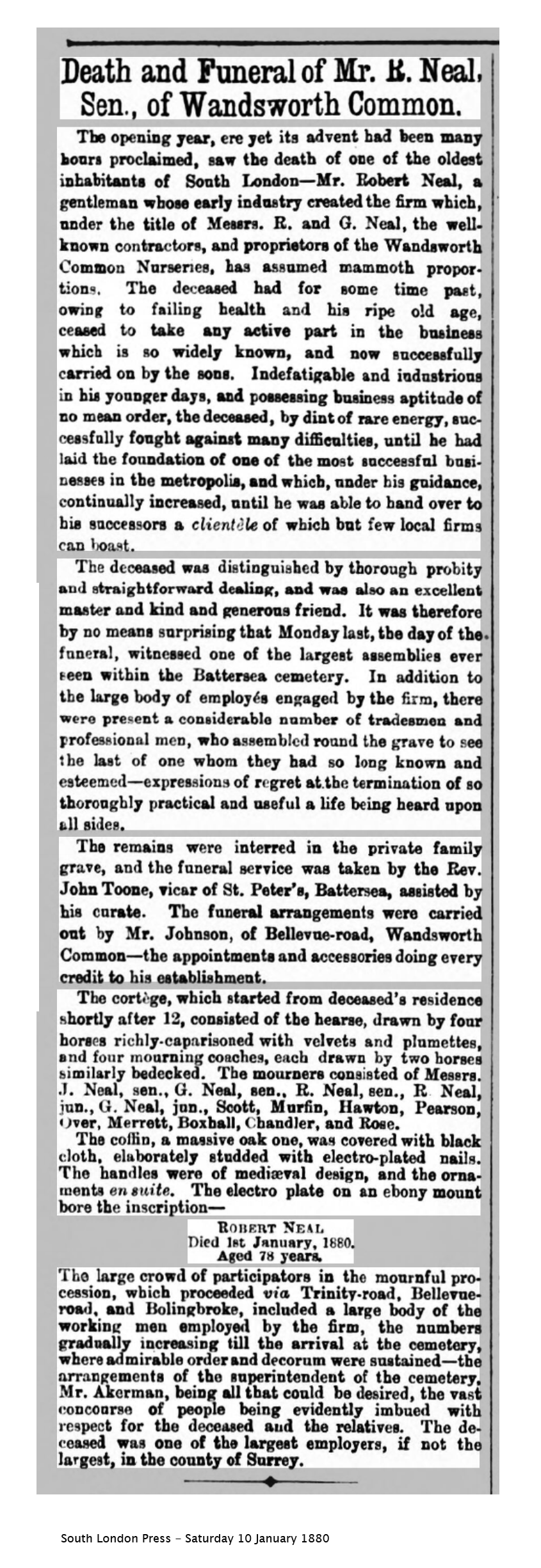
Death and Funeral of Mr. R. Neal, Sen., of Wandsworth Common.
The opening year, ere yet its advent had been many hours proclaimed, saw the death of one of the oldest inhabitants of South London - Mr. Robert Neal, a gentleman whose early industry created the firm which, under the title of Messrs. B. and G. Neal, the well-known contractors, and proprietors of the Wandsworth Common Nurseries, has assumed mammoth proportions. The deceased had for some time past, owing to failing health and his ripe old age, ceased to take any active part in the business which is so widely known, and now successfully carried on by the sons.
Indefatigable and industrious in his younger days, and possessing business aptitude of no mean order, the deceased, by dint of rare energy, successfully fought against many difficulties, until he had laid the foundation of one of the most successful businesses in the metropolis, and which, under his guidance, continually increased, until he was able to hand over to his successors a clientele of which but few local firms can boast. The deceased was distinguished by thorough probity and straightforward dealing, and was also an excellent master and kind and generous friend.
It was therefore by no means surprising that Monday last, the day of the funeral, witnessed one of the largest assemblies ever seen within the Battersea cemetery. In addition to the large body of employees engaged by the firm, there were present a considerable number of tradesmen and professional men, who assembled round the grave to see the last of one whom they had so long known and esteemed - expressions of regret the termination of so thoroughly practical and useful life being heard upon all sides.
The remains were interred in the private family grave, and the funeral service was taken by the Rev. John Toone, vicar of St. Peter's, Battersea, assisted by his curate. The funeral arrangements were carried out by Mr. Johnson, Bellevue-road, Wandsworth Common - the appointments and accessories doing every credit to his establishment. The cortege, which started from deceased's residence shortly after 12, consisted of the hearse, drawn by four horses richly-caparisoned with velvets and plumettes, and four mourning coaches, each drawn by two horses similarly bedecked.
The mourners consisted of Messrs. J. Neal, sen., G. Neal, sen., R. Neal, sen., R. Neal, jun., G. Neal, jun., Scott, Murfin, Hawton, Pearson, Over, Merrett, Boxhall, Chandler, and Rose.
The coffin, a massive oak one, was covered with black cloth, elaborately studded with electro-plated nails. The handles were of mediaeval design, and the ornaments en suite. The electro plate on an ebony mount bore the inscription —
ROBERT NEAL
Died 1st January, 1880
Aged 78 years.The large crowd participators in the mournful procession, which proceeded via Trinity-road, Bellevue-road, and Bolingbroke, included large body of the working men employed by the firm, the numbers gradually increasing till the arrival at the cemetery, where admirable order and decorum were sustained - the arrangements of the superintendent of the cemetery, Mr. Akerman, being all that could be desired, the vast concourse of people being evidently imbued with respect for the deceased and the relatives. The deceased was one of the largest employers, if not the largest, in the county of Surrey.
[BNA: Link.]
[BNA: Link.]
[Assuming GN was coming from his home, presumably that was on or near Trinity Road. "Neal's Farm"? The procession would not have come the fastest way - along Windmill Road. It must have turned left down Bellevue, then left into Bolingbroke etc.]
The Hardy's house near the southern edge of Wandsworth Common, was close to the highest point around our area. c.116 feet above sea level, plus the height of the house . . .
The Hardy's' house at Upper Tooting stood in a rather elevated position, and when the air was clear they could see a long way from the top windows.
The following note on London at dawn occurs on May 19 [1880], a night on which he could not sleep, partly on account of an eerie feeling which sometimes haunted him, a horror at lying down in close proximity to "a monster whose body had four million heads and eight million eyes":
In upper back bedroom at daybreak: just past three. A golden light behind the horizon; within it are the Four Millions. The roofs are damp gray: the streets are still filled with night as with a dark stagnant flood whose surface brims to the tops of the houses. Above the air is light. A fire or two glares within the mass. Behind are the Highgate Hills. On the Crystal Palace hills in the other direction a lamp is still burning up in the daylight. The lamps are also still flickering in the street, and one policeman walks down it as if it were noon.
Life, p. 139
Notes
Note how far he could see
The Hardy's house near the southern edge of Wandsworth Common, was close to the highest point around our area. c.116 feet above sea level, plus the height of the house . . .
London's population grew from 1 million to 4.5 million by the time this was written
Follow up Raymond William's comment?
Raymond Williams:
Hardy saw London as 'a monster whose body had four million heads and eight million eyes', and he wrote this memorable description of a crowd, at the Lord Mayor's Show of 1879:
As the crowd grows denser it loses its character of an aggregate of countless units, and becomes an organic whole, a molluscous black creature having nothing in common with humanity, that takes the shape of the streets along which it has lain itself, and throws out horrid excrescences and limbs into neighbouring alleys; a creature whose voice exudes from its scaly coat and who has an eye in every pore of its body. The balconies, stands and railway-bridge are occupied by small detached shapes of the same tissue, but of gentler motion, as if they were the spawn of the monster in their midst.
The distance of the observer, now no longer in the streets but physically or spiritually above them, is a new element, but the evident fear of crowds, with the persistence of an imagery of the inhuman and the monstrous, connects with and continues that response to the mob

[This relatively informal pitch continued in use for many years - much to to the annoyance of some local people, such as Mrs Nixon, who around 1880 lived in the nearest house in Heathfield Cottages and was tired of retrieving cricket balls batted over her wall. She soon moved, but later a wire-mesh fence was erected, and residents of the Cottages were given one shilling a year in compensation.
The 1881 Census shows Frances Nixon as a 45-year-old widow of independent means, living with 3 daughters (20, 19, 16) and a widower brother (39). She was still there in 1883, mis-spelt as Mrs Nickson. But she'd gone by 1891.
This is also the ground on which the Wandsworth tradesmen played prior to the 1863 meeting with John Buckmaster at the County Arms to plot a defence of the Common.
See 1827 for mention of the "Wandsworth New Ground", where the MCC presumably played.]

A new cemetery for Wandsworth rejected
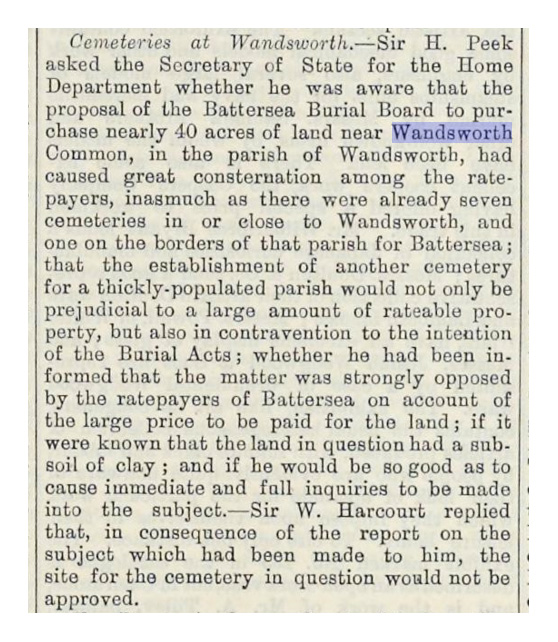
DISAPPROVAL OF A CEMETERY SITE WANDSWORTH.
Sir HENRY PEEK asked the Home Secretary whether he was aware that the proposal of the Battersea Burial Board to purchase nearly forty acres of land near Wandsworth-common, had caused great consternation among the ratepayers, inasmuch there were already seven cemeteries in or close to Wandsworth, and one on the borders of that parish for Battersea; and that the establishment of another cemetery for a thickly populated parish would not only be prejudicial to large amount of rateable property, but also in contravention of the intention of the Burial Acts; whether he had been informed that the matter was strongly opposed the ratepayers of Battersea on account of the large price to be paid for the land; and whether he would cause inquiries to be made the subject.
Sir W. HARCOURT - I have already caused inquiry to be made in this matter. The Inspector of Burial Grounds has made report to me, the conclusion of which is that he considers it his duty to recommend that the approval of the Secretary of State should not given to the establishment of cemetery on the proposed site, and may say that the site will not be approved.
[Source: Link]
Where would this cemetery have been? Another never-built structure? Or is it in fact the enlarged Magdalen Road Cemetery?
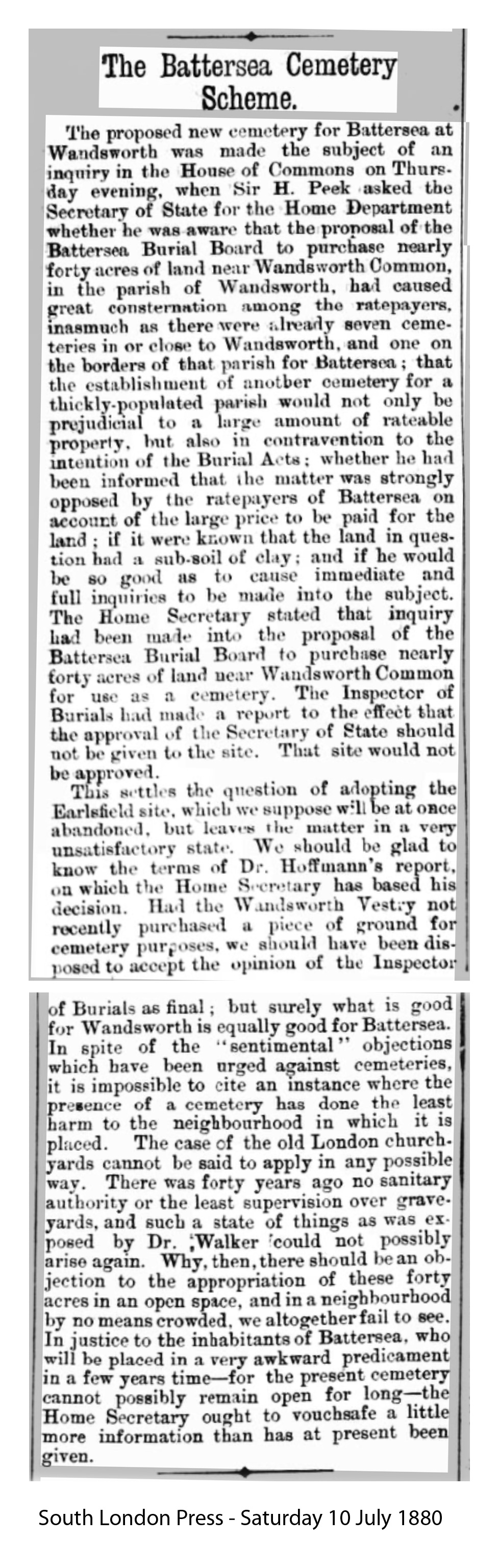
The Battersea Cemetery Scheme.
The proposed new cemetery for Battersea and Wandsworth was made the subject of an inquiry in the House of Commons on Thursday evening, when Sir H. Peek asked the Secretary of State for the Home Department whether he was aware that the proposal of the Battersea Burial Board to purchase nearly forty acres of land near Wandsworth Common, in the parish of Wandsworth, had caused great consternation among the ratepayers, inasmuch as there were already seven cemeteries in or close to Wandsworth. and one on the borders of that parish for Battersea; that the establishment of another cemetery for a thickly-populated parish would not only be prejudicial to a large amount of rateable properly, but also in contravention to the intention of the Burial Acts; whether he had been informed that the matter was strongly opposed by the ratepayers of Battersea on account of the large price to be paid for the land; if it were known that the land in question had a sub-soil of clay; and if he would be so good as to cause immediate and full inquiries to be made into the subject.
The Home Secretary stated that inquiry had been made into the proposal of the Battersea Burial Board to purchase nearly forty acres of land near Wandsworth Common for use as a cemetery. The Inspector of Burials had made a report to the effect that the approval of the Secretary of State should not be given to the site. That site would not be approved.
This settles the question of adopting the Earlsfield site, which we suppose will be at once abandoned, but leaves the matter in a very unsatisfactory state. We should be glad to know the terms of Dr. Hoffmann's report, on which the Home Secretary has based his decision. Had the Wandsworth Vestry not recently purchased a piece of ground for cemetery purposes, we should have been disposed to accept the opinion of the Inspector of Burials as final; but surely what is good for Wandsworth is equally good for Battersea. In spite of the "sentimental " objections which have been urged against cemeteries, it is impossible to cite an instance where the presence of a cemetery has done the least harm to the neighbourhood in which it is placed.
The case of the old London church-yards cannot be said to apply in any possible way. There was forty years ago no sanitary authority or the least supervision over grave-yards, and such a state of things as was exposed by Dr. Walker could not possibly arise again. Why, then, there should be an objection to the appropriation of these forty acres in an open space, and in a neighbourhood by no means crowded, we altogether fail to see.
In justice to the inhabitants of Battersea, who will be placed in a very awkward predicament in a few years time — for the present cemetery cannot possibly remain open for long — the Home Secretary ought to vouchsafe a little more information than has at present been given.
[BNA: Link]
[Brief mentions of Wall and Conder]
We are glad to observe that Mr. and Mrs. Heron Wall, of Halbrake Collegiate School, New Wandsworth, have, in addition to the Rev. Evan Daniel (whose election we noticed last week!, been appointed members of the Royal College Preceptors. This is gratifying tribute to the scholastic attainments of both Mr. and Mrs. Wall, who have extended the popularity attained by Halbrake House School during the tenure of the late principal, the Rev. Dr. Conder.
[BNA: Link]
[WC used as a warning of the harm done to Commons when railways are pushed through.]
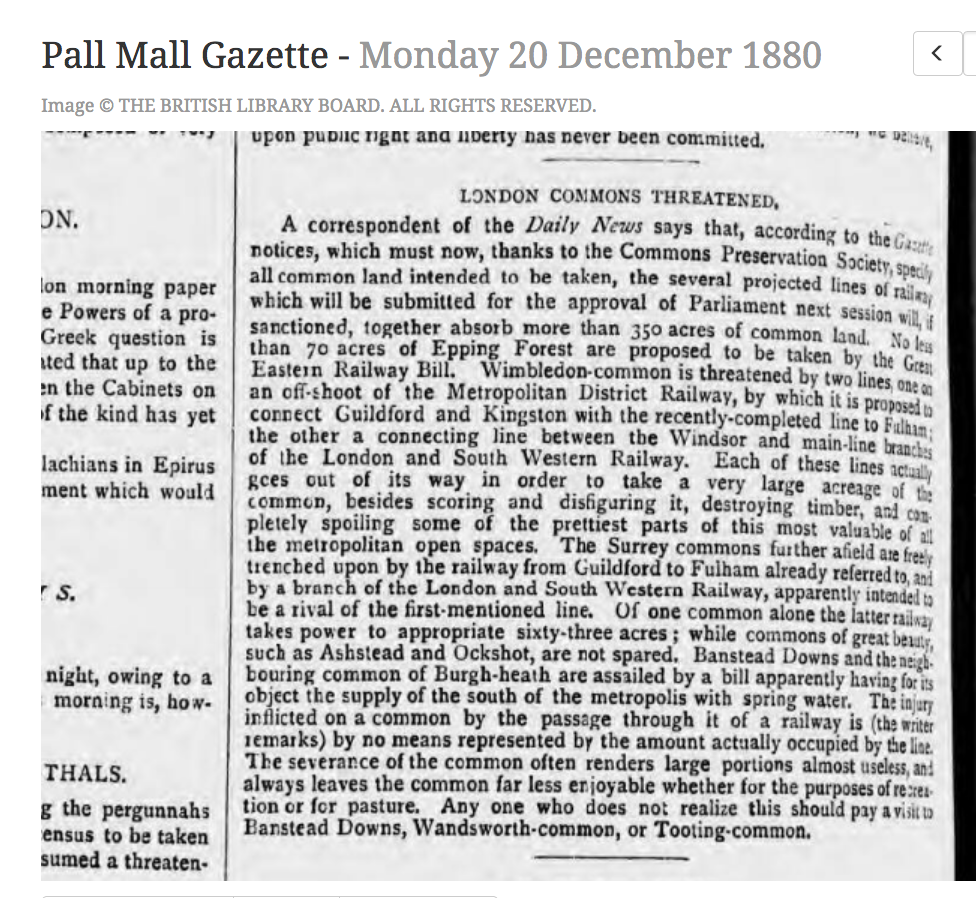
LONDON COMMONS THREATENED.
A correspondent of the Daily News says that, according to the Gm notices, which must now, thanks to the Commons Preservation SocietyS all common land intended to be taken, the several projected lines oral which will be submitted for the approval of Parliament next session wi, sanctioned, together absorb more than 350 acres of common lan.n o le than 70 acres of Epping Forest are proposed to be taken by the Giti Eastern Railway Bill.
Wimbledon-common is threatened by two lines, oneoj an off-shoot of the Metropolitan District Railway, by which it is propnsed connect Guildford and Kingston with the recently-completed line to Farhn,. the other a connecting line between the Windsor and main-line branch of the London and South Western Railway.
Each of these lines actua!y gces out of its way in order to take a very large acreage of tl common, besides scoring and disfiguring it, destroying timber, and din pletely spoiling some of the prettiest parts of this most valuable of a.l the metropolitan open spaces. The Surrey commons further afield arte fret-, trenched upon by the railway from Guildford to Fulham already referred to, ant by a branch of the London and South Western Railway, apparently intended to be a rival of the first-mentioned line. Of one common alone the latter raii; takes power to appropriate sixty-three acres; while commons of great beauty such as Ashstead and Ockshot, are not spared. Banstead Downs and the neighbouring common of Burgh-heath are assailed by a bill apparently having for its object the supply of the south of the metropolis with spring water,
The injury inflicted on a common by the passage through it of a railway is (the writer remarks) by no means represented by the amount actually occupied by the line, The severance of the common often renders large portions almost useless, and always leaves the common far less enjoyable whether for the purposes of recreation or for pasture. Any one who does not realize this should pay a visit to Banstead Downs, Wandsworth-common, or Tooting-common.