[The Times: Search: "Wandsworth Common"].
[BNA: Buckmaster Battersea 1879]
[BNA: Buckmaster Wandsworth 1879]
[London Evening Standard: Buckmaster Wandsworth 1879]
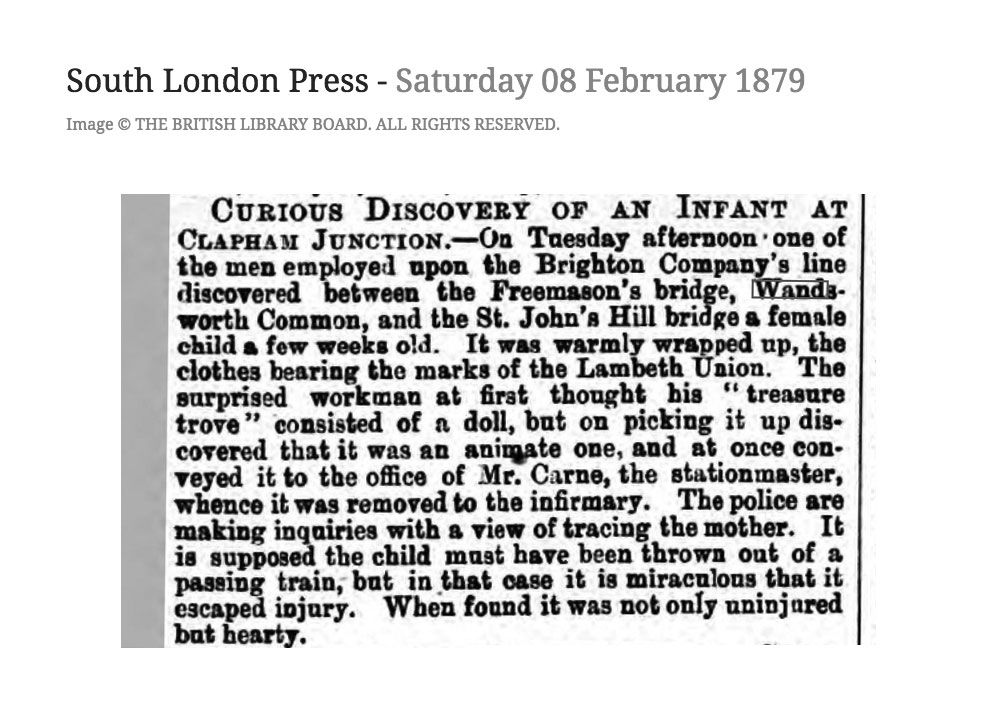
Curious Discovery of an Infant at Clapham Junction.
Curious Discovery of an Infant at Clapham Junction.
On Tuesday afternoon one of the men employed upon the Brighton Company line discovered between the Freemason's bridge, Wandsworth Common, and the St. John's Hill bridge a female child a few weeks old. It was warmly wrapped up, the clothes bearing the marks of the Lambeth Union. The surprised workman first thought his "treasure trove" consisted of a doll, but on picking it up discovered that it was an animate one, and at once conveyed it to the office of Mr. Came, the stationmaster, whence it was removed to the infirmary. The police are making inquiries with a view of tracing the mother. It is supposed the child must have been thrown out of a passing train, but in that case it is miraculous that it escaped injury. When found it was not only uninjured but hearty.
[NEEDS EDIT . . . ]
Tramway for New Wandsworth [By One Who Can't Keep a Cabriolet.]
Among the schemes which have been sneered at as utopian is that for extending the advantages of tramways to New Wandsworth and Old Wandsworth, Now, I prepared to admit that the advent of a tramcar in Old Wandsworth would be almost sufficient to cause mild revolution in that benighted neighbourhood - I mean in respect to communication with others; but I fail to see what possible injury conld be done to property in this district if trams should at any time run along St. John's Hill as far as the top of East Hill.
The argument that New Wandsworth and its immediate vicinity would lose its suburban character if tramway intrudes into it is at the best a very partial and selfish one. There is scarcely railway in the metropolis against which a similar objection might not have been raised, and yet few are prepared to contend that the suburbs of the metropolis have been injured by the network of railways which connect them with the City and with one another.
Of course carriage people naturally regard tramways with very little favour, as they are independent of the means of transit thus provided, and would like the roads kept perfectly even for driving along. A few monopolizing tradesmen may also be a little adverse to a tramway from the fear that their trade may be interfered with.
But the interests of these two classes ought not to be studied to the disadvantage of the hundreds or perhaps thousands who are daily experiencing the inconvenience resulting from the want of more direct and more means of communication with various parts of the metropolis than is now afforded.
But it may be urged Is there not railway station at Wandsworth I grant it, and unique it is both architecturally and in regard to accommodation; but a suburban railway station is often a snare and delusion. In fine weather and with plenty of time it does not much matter (when reaching that station to find the booking-office closed and a train due in about one hour or so. A walk from Wandsworth to Clapham Junction under such circumstances perhaps more conducive to health than otherwise; but there are times when the wind, the rain, and the snow seem to have it all their own way, and then it that unlucky would-be passengers by the South-Western Railway from Wandsworth have been heard to say some very hard things against railway directors in general, and those of the South-Western Company in particular.
There is, I believe, a good service of trains to the City; but the chances are that passenger will see a dozen of them pass Wandsworth with the utmost contempt; and when at last a train does stop, the guards and driver seem equally hurt at the indignity thus cast upon them. A good tramway service connecting Clapham Junction with Wandsworth Old Town - say, from the Ealcon, along St. John's Hill to East [ Price Twopence. Hill, would, I feel sure, be boon to those compelled 1848011 or another to live in the neighboorhood of New or Old Wandsworth. As for the presumed 0, 7 to property, what there along St. John's Hul that conld possibly bo affected by a tramway rnnnmg along thpt road Surely neither the long line dismal walls which screen gentlemen's residences from the vulgar gaze, the Wandsworth and Clapham Union Workhouse, the Fishmongers' Almshouses, nor the motley array of shops And yet a large portion of the road is abntted upon by property of this kind, I can only think of one class of persons from whom opposition would come - those who desire to keep the locality select - or, in other words, to prevent its becoming more accessible to the general public.
Now, personally I think that there are advantages connected with snch a common as that Wandsworth which onght to be freely placed at the disposal of the public - advantages of which they certainly cannot fnlly avail themselves whilst the district remains so devoid of adequate travelling accommodation, There are other reasons which might urged in favour of a tramway along St. John's Hill (of course I am presuming that one of the schemes before Parliament will be sanctioned), but I will conclude by merely pointing out that ever since can recollect the district - a very few years - what were fields are now covered with large numbers of houses evidently intended for the middle class, and that New Wandsworth, and perhaps even Old Wandswortb, shows signs of development totally inconsistent with the travelling accommodation at present afforded this district. I may add that there is a rumour that the South-Western Railway Company have a scheme in contemplation by which a few additional trains per day will run from Wandsworth station to Waterloo; but this scheme will not come into operation for some 20 years hence, I should suggest that people should rather put their faith in the Tramway Companies.
While on the subject, though, I should like to relieve myself of a few growls which have been accumulating in my mind for some time past anent these same tramways.
I want to know why all the cars on the southern lines have no arrangement whereby the seats on the ontside can be kept diy. the north of London, each seat, means of a spring, rises up and fits under a ledge directly the passenger gets up, so that the cushion is always dry. On the south, the cushions are fastened to the seats, and have not even the small advantage of those on omnibuses, which are moveable and can be reversed. The consequence is that in wet weather, supposing yon are forced outside, you must either run the risk of catching rheumatism if yon sit down, of being thrown off and breaking your neck if you stand nj).
Again, why should the poor outside passengers be denied all means of communicating with the conductor when they want to stop? Surely some kind of bell is not an absolute impossibility. It is even' worse with those outside when the conductor happens to be collecting fares on the roof. It isn't to be expected a lady can climb up the steps on purpose to tell the conductor she wants to alight. Another grievance - why cannot a light brass rail divide the seats in the inside? At present the ordeal one has to go through of having 18 pairs of eyes glaring upon you as intruder while you look from one side to the other for a seat is something fearful.
The omnibus passenger is the very essence selfishness, but the tramway passenger is the quintessence. Lastly, why are all tramway drivers and conductors afflicted with blindness and deafness? Are these qualifications insisted upon by the Companies 1, almost would seem be the case, for occasionally you may wave your umbrella until you are taken for madman, may shriek nntil you are blue in the face, may indulge in race for a hundred yards after the car, but all in vain. The condnctor I the driver are supremely unconscious of your existence and the result is language such our army used in Flanders. I sincerely trnst the directors, the shareholders, and the head officials - secretary, manager, engineer, &c. - will use their own cars as much possible, instead of riding their and then we may get little improvement.
[Source: Link]
Wimbledon and Wandsworth Commons
[ . . . ]
The accounts in connection with the preservation of Wandsworth Common have also been presented at
March [??] meeting of the Conservators - Mr. Du Buisson in the chair - held a few days ago. The balance sheet showed that with the balance from last year (£30 4s. 4d.) the total receipts had been £855 16s. 10d.
Of this sum £429 had been compulsorily devoted to expenses beyond the control of the Conservators - such as the annuity secured in return for the rights of the lord of the manor, sinking fund, audit, taxes, &c.
The remainder, with a small deduction for working expenses, was expended upon the maintenance of order upon the Common, draining, planting, &c., leaving a balance of £96 7s. 3d. to carry forward.
[PB: i.e. a half! And presumably in previous years there had been even less money to spend on the Common - see below.]
The receipts included sum of collected by Dr. Mann, of Bolingbroke Grove, and specially applied under the provisions of the Act for planting trees in the neighbourhood.
An analysis of the past expenditure indicated that since the passing of the Act the following sums had been laid out in the improvement the Common - viz.,
1872, £287;
1873, £235;
1874, £132;
1875, £179;
1876, £195;
1877, £312;
1878, £249.
Mr. Hatch, a ratepayer, suggested the desirability of improving the banks of the sheets of water contiguous to the Brighton Company's line; and Mr. Whiteley drew attention to the question of allowing bathing in certain of the ponds upon the Common.
[PB: the " the sheets of water " must be a reference to "the lake"]
In answer to these gentlemen, and also to Mr. Moore, who suggested certain improvements connection with the paths, the chairman stated that the plan upon which the Conservators had hitherto acted had been to consider that moneys raised from the rates should be expended for the improvement of Common a whole, and that improvements in particular spots, such as those suggested, should be provided for subscriptions raised in the locality to be benefited. Such subscriptions the Conservators would be at all times ready to receive.
[PB: i.e. charity, donations]
The remarks and suggestions which had fallen from the ratepayers present should, however, meet with due consideration during the coming year.
[Source: Link.]
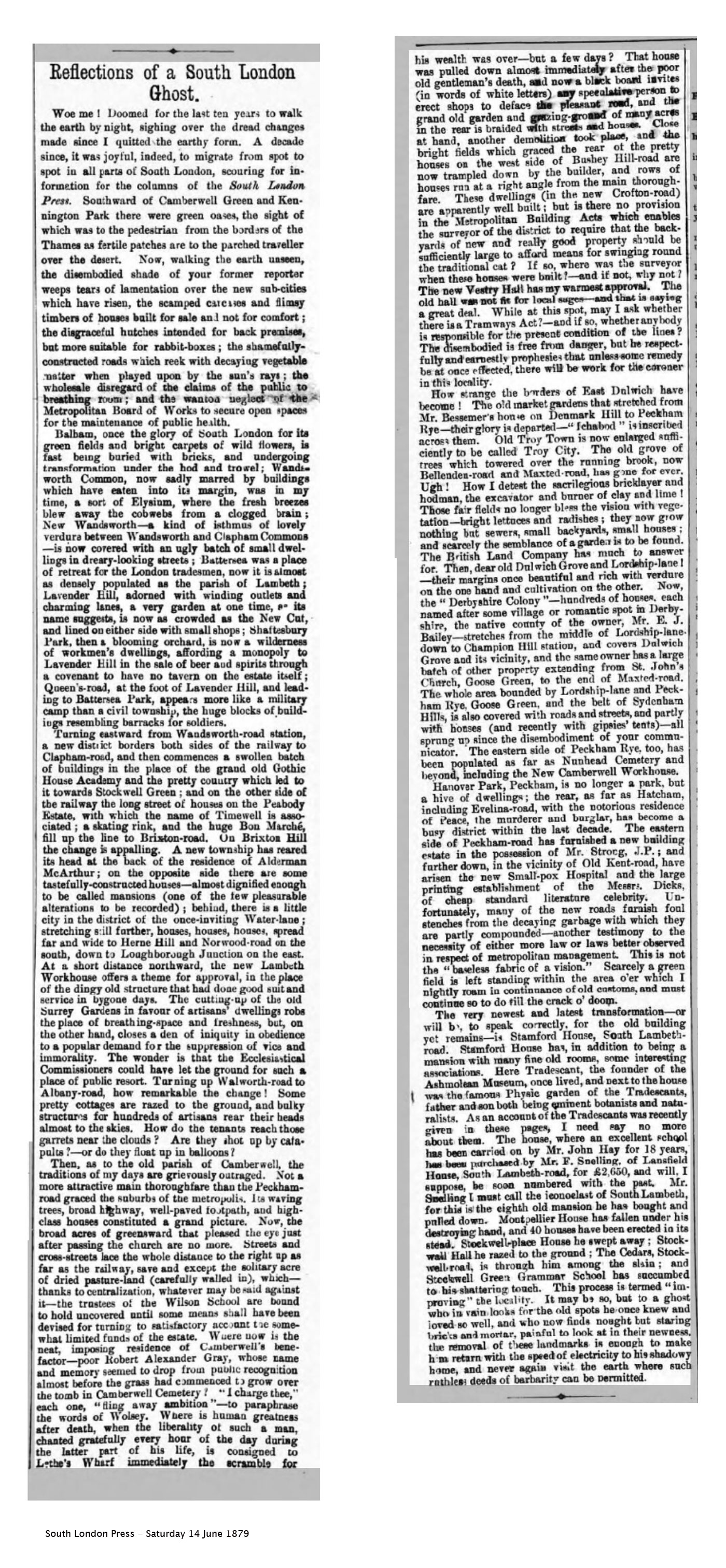
Reflections of a South London Ghost.
Woe me! Doomed for the last ten years to walk the earth by night, sighing over the dread changes made since I quitted the earthy form. A decade since, it was joyful, indeed, to migrate from spot to spot in all parts of South Loudon, scouring for information for the columns of the South London Press. Southward of Camberwell Green and Kennington Park there were green oases, the sight of which was to the pedestrian from the borders of the Thames fertile patches are to the parched traveller over the desert.
Now, walking the earth unseen, the disembodied shade of your former reporter weeps tears of lamentation over the new sub-cities which have risen, the scamped cat cues and flimsy timbers of houses built for sale and not for comfort; the disgraceful hutches intended for back premises, but more suitable for rabbit-boxes; the shamefully constructed roads which reek with decaying vegetable matter when played upon the sun's rays; the wholesale disregard of the claims of the public to breathing room; and the neglect of the Metropolitan Board of Works to secure open spaces for the maintenance of public health.
"Wandsworth Common, now sadly marred by buildings which have eaten into its margin, was in my time, a sort of Elysium, where the fresh breezes blew away the cobwebs from a clogged brain"
Balham, once the glory of South London for its green fields and bright carpets of wild flowers, fast being buried with bricks, and undergoing transformation under the hoe and trowel; Wandsworth Common, now sadly marred by buildings which have eaten into its margin, was in my time, a sort of Elysium, where the fresh breezes blew away the cobwebs from a clogged brain; New Wandsworth - a kind of isthmus of lovely verdure between Wandsworth and Clapham Commons - is now covered with an ugly batch of small dwellings in dreary-looking streets; Battersea was a place of retreat for the London tradesmen, now it is almost as densely populated as the parish of Lambeth; Lavender Hill, adorned with winding outlets and charming lanes, a very garden at one time, so its name suggests, is now as crowded as the New Cut, and lined on either side with small shops; Shaftesbury Park, then a blooming orchard, is now a wilderness of workmen's dwellings, affording a monopoly to Lavender Hill in the sale of beer and spirits through a covenant to have no tavern on the estate itself; Queen's-road, at the foot of Lavender Hill, and leading to Battersea Park, appears more like a military camp than a civil township, the huge blocks of buildings resembling barracks for soldiers.
Turning eastward from Wandsworth-road station, a new district borders both sides of the railway to Clapham-road, and then commences a swollen batch of buildings in the place of the grand old Gothic House Academy and the pretty country which led to it towards Stockwell Green; and on the other side of the railway the long street of houses on the Peabody Estate, with which the name of Timewell is associated a skating rink, and the huge Bon Marche, fill up the line to Brixton-road. Up Brixton Hill the change is appalling. A new township has reared its head at the back of the residence of Alderman McArthur; on the opposite side there are some tastefully-constructed houses - almost dignified enough to be called mansions (one of the few pleasurable alterations to be recorded); behind, there is a little city in the district of the once-inviting Water-lane; stretching still farther, houses, houses, houses, spread far and wide to Herne Hill and Norwood-road the south, down to Loughborough Junction on the east.
At short distance northward, the new Lambeth Workhouse offers a theme for approval, in the place of the the dingy old structure that had done good suit and service in bygone days. The cutting-up of the old Surrey Gardens in favour of artisans' dwellings robs the place of breathing-space and freshness, but, on the other hand, closes a den of iniquity in obedience to a popular demand for the suppression of vice and immorality. The wonder is that the Ecclesiastical Commissioners could have let the ground for such a place of public resort.
Turning up Walworth-road to Albany-road, how remarkable the change! Some pretty cottages are razed to the ground, and bulky structures for hundreds of artisans rear their heads almost to the skies. How do the tenants reach those garrets near the clouds? Are they shot up catapults? - or they float up in balloons.
Then, as to the old parish of Camberwell, the traditions of my days are grievously outraged. Not a more attractive main thoroughfare than the Peckham-road graced the suburbs of the metropolis. Its waving trees, broad highway, well-paved footpath, and high-class houses constituted a grand picture. Now, the broad acres of greensward that pleased the eye just after passing the church are no more. Streets and cross-streets lace the whole distance to the right up far as the railway, save and except the solitary acre of dried pasture-land (carefully walled in), which thanks to centralization, whatever may be said against it - the trustees of the Wilson School are bound to hold uncovered until some means shall have been devised for turning to satisfactory account toe somewhat limited funds of the estate.
Where now is the neat, imposing residence Camberwell's benefactor - poor Robert Alexander Gray, whose name and memory seemed to drop from public recognition almost before the grass had commenced to grow over the tomb in Camberwell Cemetery! "I charge thee," each one, "fling away ambition" - to paraphrase the words of Wolsey. Where is human greatness after death, when the liberality of such a man, chanted gratefully every hour of the day during the latter part of his life, is consigned to Lethe's Wharf immediately the scramble for his wealth was over but a few days? That house was pulled down almost immediately after the poor old gentleman's death, and now a black board invites (in words of white letters) any speculative person to erect shops to deface the pleasant road, and the grand old garden and grazing ground of many acres in the rear is braided with streets and houses.
Close at hand, another demolition took place, bright fields which graced the rear of the houses on the west side of Bushey Hill-road are now trampled down by the builder, and rows of houses run at a right angle from the main thoroughfare These dwellings (in the new Crofton-road) are apparently well built; but there no provision in the Metropolitan Building Acts which enables the surveyor of the district to require that the backyards of new and really good property should be sufficiently large to afford means for swinging round the traditional cat? If so, where was the surveyor when these houses were built? and if not, why not?
The new Vestry Hall has my warmest approval. The old hall was not fit for local sages - and that is saying a great deal.
While at this spot, may I ask whether there is a Tramways Act? - and if so, whether anybody is responsible for the present condition of the lines? The disembodied is free from danger, but he respectfully and earnestly prophesies that unless some remedy be at once effected, there will be work for the coroner in this locality.
How strange the borders of East Dulwich have become! The old market gardens that stretched from Mr. Bessemer's house on Denmark Hill to Peckham Rye - their glory is departed - inscribed across them. Old Troy Town now enlarged sufficiently be called Troy City. The old grove of trees which towered over the running brook, now Bellenden-road and Maxted road, has gone for ever. Ugh! How I detest the sacrilegious bricklayer and hodman, the excavator and burner of clay and lime. Those fair fields no longer the vision with vegetation bright lettuces and radishes; they now grow nothing but sewers, small backyards, small houses; and scarcely the semblance of a garden to be found. The British Land Company has much to answer for.
Then, dear old Dulwich Grove and Lordship-lane! - their margins once beautiful and rich with verdure on the one hand and cultivation on the other. Now, the "Derbyshire Colony" - hundreds of houses each named after some village or romantic spot in Derbyshire, the native county of the owner, Mr, E. J. Bailey - stretches from the middle of Lordship-lane down to Champion Hill station, and covers Dulwich Grove and its vicinity, and the same owner has a large batch of other property extending from St. John Church, Goose Green, to the end of Maxted-road. The whole area bounded Lordship-lane and Peckham Rye, Goose Green, and the belt of Sydenham Hills, is also covered with roads and streets, and partly with houses (and recently with gipsies' tents) all sprung up since the disembodiment of your communicator. The eastern side of Peckham Rye, too, has been populated far and beyond, including the New Camberwell Workhouse.
Hanover Park, Beckham, is no longer park, but hive of dwellings; the rear, as far as Hatcham, including Evelina-road, with the notorious residence of Peace, the murderer and burglar, has become a busy district within the last decade. The eastern side of Peckham-road has furnished a new building estate in the possession of Mr. Strong [?], J.P.; and further down, the vicinity of Old Kent-road, have arisen the new Small-pox Hospital and the large printing establishment the Messrs, Dicks, of cheap standard literature celebrity.
Unfortunately, many of the new roads furnish foul stenches from the decaying garbage with which they are partly compounded - another testimony to the necessity of either more law or laws better observed in respect of metropolitan management. This is not the "baseless fabric of vision". Scarcely a green field is left standing within the area o'er which I nightly roam in continuance of old customs, and must continue so to do till the crack o' doom.
The very newest and latest transformation - or will be, to speak correctly, for the old building yet remains is Stamford House, South Lambeth-road. Stamford House has, i addition to being a mansion with many fine old rooms, some interesting associations. Here Tradescant, the founder of the Ashmolean Museum, once lived, and next to the house was the famous Physic garden of the Tradescants, father and son both being eminent botanists and naturalists. As an account of the Tradescants was recently given these pages, I need say no more about them. The house, where excellent school has been carried on by Mr. John Hay for 18 years, has been purchased by Mr. E. Snelling. of Lansfield House, South Lambeth-road, for £2,650, and will, I suppose, be soon numbered with the past.
Mr. Swelling I must call the iconoclast of South Lambeth, for this is the eighth old mansion he has bought and pulled down. Montpellier House has fallen under his destroying hand, and 40 houses have been erected in its stead. Stockwell-place House swept away; Stockwell Hall he razed to the ground; The Cedars, Stockwell-road, is through him among the slain; and Stockwell Green Grammar School has succumbed to his shattering touch.
This process termed "improving" the locality. It may be so, but to a ghost who vain looks for the old spots he once knew and loved so well, and who now finds nought but staring bricks and mortar, painful to look at in their newness, the removal of these landmarks is enough to make me return with the speed of electricity to his shadowy home, and never again visit the earth where such ruthless deeds of barbarity can be committed.
[BNA: Link.]
Notice how easily AA Corsellis rejects the objections of the inhabitants of Wiseton Road, and insists that a trellis is all that is needed.

Your Committee have also to report that they have had under consideration an application from Mr. Charles Newbury, of Hill-street, Walworth, for sanction to the establishment anew of the business of a Slaughterer of Cattle, at premises situate in Wiseton-road, Wandsworth-common.
The Slaughterhouse premises are attached to a new house and shop in Belle Vue-road, but they abut upon and are entered from Wiseton-road, the houses in which are residential.
Your Committee have had before them a Memorial from some of the inhabitants of Wiseton-road, protesting against the establishment of a Slaughterhouse within a few yards of their residences.
Your Committee have viewed the premises, and find them to be well adapted to the business proposed to be carried on; and as they are enclosed by a wall, your Committee consider that the objections of the Memorialists will be sufficiently met by placing a trellis-work screen on the top of the wall. It will also be necessary to make an alteration as regards the poundage, and your Committee recommend:
That the application be granted, on condition that, prior to granting the formal sanction of the Board under Seal, the poundage be altered in accordance with the Board's conditions as to new Slaughterhouses; that a trellis-work screen, of a height of at least three feet, be constructed and placed on the top of the whole of the boundary-wall in Wiseton-road; and that the premises be altered and maintained, in all respects, in accordance with the conditions and Bye-laws of the Board.
[PB: I'm pretty sure it was subsequently rejected [by the MBW? LCC?] an the abattoir never built there - find notes.]
Halbrake School. New Wandsworth.
ANNUAL ATHLETIC SPORTS.
On Friday the annual sports held connection with these schools took place in the presence of a very large and fashionable company. The items the card commenced at half-past 2, the following being a full return:
Throwing the Cricket Ball (Boys under 13).-J. Gumming, JC Birch
Throwing the Cricket Ball (Open). - F. Gilbert, 80 yards, 1 H.Saunders, 2.
Long Jump. - H. Saunders, 1; Ade. 2. 80 Yards Race (Boys under 10). - Pllkm, 1; U. Bell, 2. The 300 Yards Races were won respectively by A, Crombie, C. Waterer, and H. D'Ade. High Jump. - C. Storey 1, distancing four competitors. High Jump (Boys under 13). - W. Mossop., Quarter-mile aces. - W. and F. Gilbert took first Jump. - This was one the most interesting and sharply-contested events of the day, C. Storey defeating F. Gilbert fine leap of 7ft, Hurdle Kaccs (Junior and Senior). - W. Peirce and F. Gilberf,winners; H. a good second. Old Boys' Race. - H. Mossop. Visitors' Race. - M. Wilson. Half-mile Handicap. - E. Wilson. Sack Race (Open). - C. Mossop. Three-Legged Race. - C. Storey and J. Watcrer. Swimming Race for prize presented by the Head Master, and previously competed for. - H. D'Ado, 1; E. Creasy a good second. "Fives" Prize. - C. Storey, 1; K. Creasy, 2. The tug of war created considerable excitement amongst the boys of the school, the competitors being also heartily cheered by the lookers-on, and was won by C Colvill'a team, consisting of L. Saunders, J. Gumming, J. Mempress, A. Wall, W. Peirce, J. George, and C. Colvill.
The ladies' cups, presented by ladies interested m the school to the winners of the greatest number of marks, and consisting of two handsomely-chased silver and gold goblets, were won by H. D'Ade (senior) and W. Mossop (junior).
After the consolation race, won by C. R. Wall, the head master, Mr. Heron Wall, introduced the vicar of St. Saviour's, Battersea, the Rev. S. G. Scott, and in doing so dwelt upon the excellent example set them by Mr. Scott, whom he had known in his school days, and who had achieved honours at his university both in work and sport, being winner of the mile race at the inter-university sports. (Cheers.)
Mr. Wall also alluded to the success of 18 boys the recent public examination, showing that they also knew how to work first and play afterwards, as all true boys should. (Applause.) He would not longer detain them from receiving their well-earned guerdons, which his friend Mr. Scott was waiting to distribute.
The Rev. S. G. Scott, in reply, said that had witnessed with much pleasure the day's contests, and exhorted the competitors not to forget or lay aside those qualities of self-restraint or self-discipline which they had accustomed themselves to during the period of training. It was perseverance in these qualities in the daily lives which would make them good and worthy men. (Applause.) The worthy vicar concluded by asking Mrs. Wall's aid in distributing the prizes.
The proceedings, which were of a thoroughly successful and enjoyable nature, concluded with vote of thanks to the Rev. S. G. Scott, and hearty cheers to Mr., Mrs., and Miss Wall. It should, however, be said that the beat thanks of the school and committee arc due to Mr. J. Mossop, jun., whose indefatigable efforts in the executive department greatly contributed to the pleasures of the day.
[BNA: Link]
Halbrake House Collegiate School, Wandsworth Common.
SPEECH DAY.
The reputation attained by this school under the Rev. Dr. Conder is evidently worthily maintained by the present head master, Mr. C. H. Wall, who yearly succeeds in assembling the elite of the neighbourhood to take part in the proceedings attending the speech day and recital. Friday was no exception to the rule, and, under the presidency of the Rev. J. Mills Ellison, vicar of St. John's and St. Paul's churches, numerous and select party had responded to the invitations sent out. The schoolroom had been very prettily decorated with flags and evergreens, whilst the bijou theatre was fitted up with especial regard to Thespian requirements. The proceedings of this long-looked forward to opened with a brief speech by Mr. Wall, wh) said that lie was pleased to tell them in regard to the examination, that every boy who had failed last year had passed this, and out of 22 sent up for 'Varsity examinations, 18 had passed, and none of them had failed in French, Geography, or Scripture. (Hear, hear.)
The Rev. W. J. Mills Ellison said looked upon it as a privilege conferred upon him to be asked to preside. He was quite sure the result of the examinations outside the school showed that the great work of education was being carried on at Halbrake House a thoroughly satisfactory way. (Cheers.) Not only was it evident the ordinary instruction was sound but that the higher part, which aimed at the formation of character, was duly considered. The school motto was, he observed, By Truth and Work," and was glad to see truth and work allied; good honest truthful work was what they all wanted to see, for he (the speaker) thought much of the future of England depended upon the education and training the rising generation were receiving. (Hear, hear.) He observed there was nothing one-sided in Mr. all curriculum. and his assistants endeavoured to make the very best of the individual attributes the boys possessed. He was pleased to note so many boys having passed their examinations successfully and taken prizes, and he believed the teaching of Halbrake College School was calculated to promote sound education in all who were privileged to be Mr. Wall's pupils. (Applause.)
Mr. Wall thanked Mr. Ellison for the kind manner in which he had spoken him. He hoped he deserved The rev. chairman then proceeded to distribute the prizes, of which, and the honours obtained, append full list.
Scholarships. H. T. Carty and J. Stonning. Examination Prizes Creasy. Gilbert. Ade, Storey. Waterer, Morgan. Sanders (Ma.), Sutherland (Ja.). niHUiice,Mossop (Ma.). Pease. Stenning.Oliver (Mu.), Stamper (Ma.) and Berry (M;u). Upper School. Form Prizes%Lee. D'Ade, Sanders (Ma.). Oliver (Ma.), Berry (Mi.). Camming (Ma,), Smith (Ma.), Nicholson (Mi.), Evill, Sykes, and Bell (Ma.) Lower School. Form Prizes%Tiarks ). Frith, and Bennett. Special Prizes and Certificates. Mathematics %deration. Latin%Cooke %.). V,' v -9,% and CumingmVMi.) English Lit* rature%\Vall (Ma.) - Kng'i.sli Grammar%Oliver (Mi.) and Kelly (Mi.) Genii an-Mossop (Ma.) and Cleave. Scripture%Wall (M'.), Stamper (Mi), Wvoter. Messop (Mi.), and Mudie. Music% Cromhie. Holiday- Task%Millar. Drawing- Nicholson (Ma.) Writing%Abbott and Pemberton, General Improvement-Kelly (Ma Evening Work-Grant and Cox. Good Conduct Methold. Perseverance%Wyche (Ma;. The following is the list of honours gained during 1877-70: H S. Dove%" Associate in Arts." Oxford Examinations, Seniors Juno. 1577: A. Millur%Competitive Civil Service Examinations. Juniors. 1877; M. Wilson%o.xf"i Examinations, Juniore. June 1877; H. J. L. %Cambridge Examinations. Seniors, December, 1877; Passed Honours. Bracketed seventh French: M. Parton%Cambridge Higher Examinations, June. 1878. First Class Honours. Distinguished Divinity and English Literature; Gr. Campbell%Army Examinations, October, 1878.
The following junior boys obtained certificates (College of Preceptors, June, 1878): C. Waterer, H. T. Cnrtv. E, Creasy. C. Mndie. H, '-annders, E. Wilson. R.Creasy, E. Dwelly, C. R. W 11. H. H. DAde, S. Perks, F. J. Gilbert, It. Jirebner, and W J. Mimprlss. E. Creasy%" Associate in Arts," Oxford Examinations, Seniors, 1879; H. T. Carty%Oxford Examinations, Juniors, 1879. The following Junior Boys obtained certificates (College of Preceptors, June, 1870); F. J. Gilbert. H. H. S. D'Ade. J. Waterer. L. Colvill, C. P. Storey. C. Waterer, G. Morgan. G. Lanuton, 1,. Sanders. S. F. Sutherland, H. Fitzm.iurice. H. T.angton. O. Mossop, J. R. Pease. J. Stennimr, J. K. Oliver, W.Stamper,and A.G. Berry. Halbrake Scholarships.%H. T. Carty anil J. Stcnning. The following old boys have also distinguished themselves: W. E. Long, at Magdalen College, Oxford; W. Lord, Seventh in the Indian Civil Service Examination; Creasy, Scholarship at Malvern College. The following the programme of speeches, &c., which were gone through manner highly creditable to the pupils: Pianoforte solo Ado about Nothing (Shakespeare.) C. E. Dogberry Verges Conrad Rorachio First Watchman.. Second Watchman Sexton . . . M. Wilson. . . . C. Coivill. . . . A. Scratton. . . . . C. Small. C. E. Wyche. ~.. W. Hall.,W. Stamper. Sweet and Low." J George S. Oliver, C. Mosson. C. Birch. W. W. Hinde. and ' C. H. White. Charade e.n act ids%" Facu.ite." Year 1871. /SccJie-Room In Miss Timmers' House. Miss Timmers If. H. S. D'Ade. Blanche f vcr % Josdphinc Mdde. la Grande Maison G. Morgan. A. Crombie. Francoise H. V. Sutherland. Solo Violin Mr. Hall. . . . . . . (J. George, C. Mosson, Quartette% % God is a Spirit . W Hlnde, C.H. White Selections erou I.'Avare. (Mali ere.) Harpngon (Miser) C. R. Wall Mai i. re Jacoues . . . . (Cook-coachman) . . . . %. Morgan Val6re (disguised Steward).. K. Cooke Cloante (son to Harpagon) . . . . C. La Fldche (Valet to Cleante) A. Wall La Merluche) I J'- candors Brindavoine (Servants to Harpagon) L. Hawtayne Dame Claude ' Hall, ~,, (G. W. Teal, A. Violin and Piano% Men Harlecii % Crombic. Whitebait Greenwich. Scene%Room in Buzzard's House. John Sir.all G.N. Taylor M. Durant Mr. %% Monier-wmiams h.h: s D-Ade The selection from Moliere's L'Avare was worthy of especial mention, as was also the charade 'Facilite. The plays were capitally mounted, and the dresses rich and appropriate. The applause which greeted the performers was certainly well merited, and the manner in which the various characters were portrayed m the Moliere selection would have done credit to far older and more experienced actors. general, the performances were bo even excellent it would bo, perlmps, invidious to particularize, but the Harpagon of C. R. Wall and the Maitre Jacques of G. Morgan were ex-06 I'Hall 1 'Hall and Mr. Cecil Clark lent material and valuable aid-the former with the violin, and the latter the piano. The laughable old farce Whitebait at Greenwich" brought an enjoyable recital to close, and Mr. Wall is certainly to be congratulated upon maintaining the reputation of Halbrake House.
[BNA: Link]