[BNA Search: "Wandsworth Common"]
[South London Press: "Wandsworth Common"]
[The Times: Search: "Wandsworth Common"].
[BNA: Buckmaster Battersea 1865]
[BNA: Buckmaster Wandsworth 1865]
[London Evening Standard: Buckmaster Wandsworth 1865]
["What the Lord giveth, the next Lord can take away . . . " ho ho!]
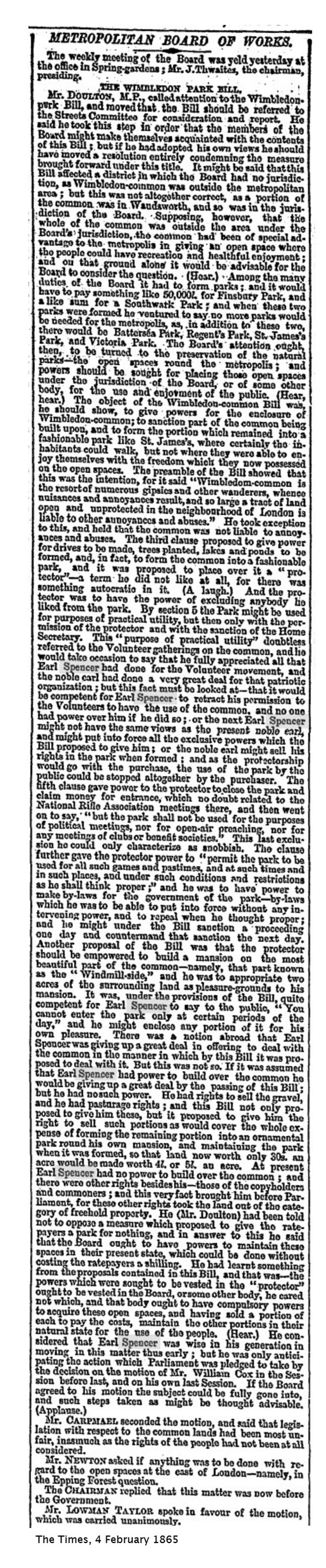
METROPOLITAN BOARD OF WORKS
The weekly meeting of the Board was held yesterday at the office In Spring-gardens; Mr.J.Thwaites, the chairman, presiding. harmn
THE WIMBLEDON PARK BILL,
Mr. DOULTON, MP. called attention to the Wimbledon-park Bill, and moved that the Bill should be referred to the Streets Committee for consideration and report. He said he took this step in order that the members of the Board might make themselves acquainted with the contents of this Bill; but if he had adopted his own views he should have moved a resolution entirely condemning the measure brought forward under this title.
It might be said that this Bill affected a district in which the Board had no jurisdiction, as Wimbledon-common was outside the metropolitan area; but this was not altogether correct, as a portion of the common was in Wandsworth, and so was in the jurisdiction of the Board. Supposing, however, that the whole of the common was outside the area under the Board's jurisdiction, the common had been of special advantage to the metropolis in giving an open space where the people could have recreation and healthful enjoyment; and on that ground alone it would be advisable for the Board to consider the question. (Hear.)
Among the many duties of the Board it had to form parks; and it would have to pay something like £50,000 for Finsbury Park, and a like sum for a Southwark Park; and when these two parks were formed he ventured to say no more parks would be needed for the metropolis, as, in addition to these two, there would be Battersea Park, Regent's Park, St James's Park, and Victoria Park. The Board's attention ought, then, to be turned to the preservation of the natural parks — the open spaces round the metropolis; and powers should be sought for placing those open spaces under the jurisdiction of the Board, or of some other body, for the use and enjoyment of the public. (Hear, hear.)
The object of the Wimbledon-common bill was, he should show, to give powers for the enclosure of Wimbledon-common; to sanction part of the common being built upon, and to form the portion which remained into a fashionable park like St. James's, where certainly the inhabitants could walk, but not where they were able to enjoy themselves with the freedom which they now possessed on the open spaces. The preamble of the Bill showed that this was the intention, for it said Wimbledon-common is the resort of numerous gipsies and other wanderers, whence nuisances and annoyances result, and so large a tract of land open and unprotected in the neighbourhood of London is liable to other annoyances and abuses.
He took exception to this and held that the common was not liable the annoyances and abuses.
The third clause proposed to give power for drives to be made, trees planted, lakes and ponds to he formed, and, in fact, to form the common into a fashionable park, and it was proposed to place over it a "protector" — a term he did not like at all, for there was something autocratic in it. (A laugh.) And the protector was to have the power of excluding anybody he liked from the park.
By section 5 the Park might be used for purposes of practical utility, but then only with the permission of the protector and with the sanction of the Home Secretary.
This "purpose of practical utility" doubtless referred to the Volunteer gatherings on the common, and lio would take occasion to say that he fuly appreciated all that Earl Spencer had done for the Volunteer movement, and the noble earl had done a very great deal for that patriotic organization but this fact must be looked at — that it would be competent for Earl Spencer to retract his permission to the Volunteers to have the use of the common, and no one had power over him if he did so; or the next Earl Spencer might not have the same views as the present noble earl, and might put into force all the exclusive powers which the Bill proposed to give him; or the noble earl might sell his rights in the park when formed; and as the protectorship would go with the purchase, the use of the park by the public could be stopped altogether by the purchaser.
The fifth clause gave power to the protector to close the park and claim money for entrance, which no doubt related to the National Rifle Association meetings there, and thon went onuto say, "but the park shall nonbe used for the parposes of political t settin s, nor for open-ai preaching, nor for anymeetis of t l u oro bnefit societaies. This I st exclusion hocould only characterize as snobbish. Thaeclause m further gave the protector power to "permit the park to be used for all such games end` pastimes and at such times and in such places, and under such conditions And restrictions as he slial think proper; " andl he was to have power to make by-laws for the government of the park-by-laws which he was to be able to put into foree without any intervening power, and to repeal when her thught prearv; tnd he mnight under the Bill sanctio t a pproceeinone day and countermaad that sanction the next day.
Another proposal of the Bill was that the protector should be empowered to build a mansion on the most beautiful part of the common — namely, that part known as the "Windmill-side, " and he was to appropriate two acres of the surrounding land as pleasure-grounds to his mansion. It was, under the provisions of the Bill, puto competent for Earl Spencer to iay to the public, Ihu cannot enter the pari only at certain perods of the day, " and he might enclose any portion of it for his own pleasure.
There was a notion abroad that Earl Spencer was giving up a great deal in offering to deal with the common in the manner in which by this Bill it was proposed to deal with it. But this was not so.- If it was assumed that Earl Spencer had power to build over the common he would be giving up a great deal by the passing of this Bill; but he had no such rights Hobadri-tstopelthogrvel, and he had pasturage rights; and thist Bill not only proposed to give him these, bue t it proposed to give biin the right to sell such portions as would cover the whole expense of forming the remaining portion into an ornamental park round his own mansion, and maintaining the park when it was formed, so that land now worth only ito. an acre would be radeworth4 a . or 51. an acre. At present Earl Spencer had no power to build over the commons; and there were other rights besides his-those of the copyholder and commoners; and this very fact brought him before Parliament, for these other rights took the land out of the category of freehold property. He (Mr. Doulton) had been told not to oppose a measure which proposed to give the ratepayers a park for nothing, and in answer to this he said that the Board ought to have powers to maintain these spaces in their present state, which could be done without costing the ratepayers a shilling.
He had learnt something front ise proposals contained in this Bill, and that was-the powers which were sought to be vested in the "protector" ought to be vested in the Board, or some other body, he cared not which, and that body ought to have compulsory powers to acquire these open spaces, and having sold a portion of each to pay the costs, maintain the other portions in their natural state for the use of the people. (Hear.)
He considered that Earl Spencer was wise in his generation in moving in this matter thus early; but he was only anticipating the action which Parliament was pledged to take by the decision on the motion of Mr. William Cox in the Session before last, and on his own last Session. If the Board aggreed to his motion the subject could be fuilly gone into, and such steps taken as might be thought advisable.
"the motion of Mr. William Cox in the Session before last, and on his own last Session"? So Spencer was getting his retaliation in early — to form a park under his own control before the whole was taken away from him? Interesting.
Mr. CARMICHAEL seconded the motion, and said that legislation with respect to the common lands had been most unfair, inasmuch as the rights of the people had not been at all considered.
Mr. NEWTON asked if anything was to be done with regard to the open spaces at the east of London — namely, in the Epping rorest question.
The CHAIRMAN replied that this matter was now before the Government.
Mr. LOWMAN TAYLOR spoke in favour of the motion, which was carried unanimously.
[Times?: Link.]
[Frederick Doulton MP (1824-1872), son of John Doulton (founder of Royal Doulton), Liberal politician, member of MBW, MP for Lambeth 1862-1868, involved in Roupell scandal c.1869 — which presumably caused him not to be credited for roles in campaigns to protect Wimbledon and Wandsworth etc Commons?
Wikipedia: Frederick Doulton.
Add DoNB entry.]
Extraordinary letter

WIMBLEDON-COMMON.
TO THE EDITOR OF THE TIMES
Sir, I venture to address some remarks to you on the subject of Lord Spencer's Wimbledon-common Bill.
As professionally concerned for his Lordship I receive frequent communications respeing it, and from these I find that very great misconception prevails not only as to the motives which led to the introduction of the measure, but also as to certain of its provisions. The published correspondence has probably been of service in lessening this mis-conception, but it is not likely to be generally read, and I and therefore seek the publicity, afforded by The Times to place the matter concisely before the public.
It appears to me that, in order to arrive at a fair estimate of Lord Spencer's proposal, the main consideration is the exact legal position which his lordship as lord of the manor of Wimbledon now holds in relation to the common.
On this point I am able to say that Lord Spencer is as absolutely owner of the common as he is of any other part of his property, subject only to the existing rights of the commoners. These rights are confined to pasturage; they are practically of little value, and those who possess them are few in number. By common law the lord might enclose for his own benefit all the common, except so much as would suffice to satisfy these rights, and by a special custom of the manor even this residue could be enclosed. Neither the residents in the neighbourhood nor the public at large have any legal interest in the property, nor is there any statutory provision to hinder an enclosure .under either the common law right or the special custom. The restricton against the endosure of open spaces near large towns contained in the General Enclosure Acts applies only to enclosures proposed to be carried out under those Acts.
If my view on these points be correct - and I may add that it is supported by the opinions of eminent counsel who have advised Lord Spencer specially in the matter-it follows that Wimbledon-common in the hands of an owner looking to his pecuniary interest rather than the public welfare might, and probably would, be built over and enclosed. A belief in the reality of this danger and a conviction of the necessity for better regulations were the main considerations which led Lord Spencer to bring forward his proposal.
He desired to secure for ever as an open space some 700 acres of very valuable landin the immeediate neighbourhood of London, of the enjoyment of which the public might otherwise be at any moment deprived. With this object he resolved to forego whatever prospective gain he might have derived by the exercise of his power to enclose for his own benefit, retaining only the actual profit he had always made by selling gravel and turf, together with two acres of the common adjoining the windmill, which had many years since been erected on land taken from the common and belonged to his Lordship. He was also willing to undertake the management and to become trustee for the public, placing himself in all material matters under the control of a Government official. He proposed to drain and otherwise improve the common, hut not so as to alter its character; to surround it with an appropriate fence, and to compensate the commoners rights. The expense was to be met by sale of outlying portions of common, so much only being sold as might actually be required. The current expenses were to be pronided by letting the nasturare.
These were the main features of Lord Spencer's scheme as originally brought forward. He has since in the interest of the public proposed an important modification-namely, the association with himself in the trust of two persons to be selected by the Crown and the Enclosure Comissioners, to whom the management of the gravel and turf might be left.
With this modification the proposal remains as originally made.
Three objections are urged against it. They apply to the fence, the extinction of common rights, and the sale of land to meet expenses. His Lordship has been greatly pressed by some of the local residents to withdraw these parts of the scheme, and it has been suggested that the original outlay might be met by subscriptions, and the current expenses by a local rate. With every desire to avoid any needless curtailment of the common, and to meet the wishes of the residents as far as possible, his Lordship felt that he ought not to withhold from the consideration of Parliament such important features of the scheme. Ele sees that a local rate, if it could be obtained (which is doubtful) might involve the question of local management, and his object has not been to benefit the locality alone but the public at large.
I cannot, in the compass of a letter, explain all the reasons which have led Lord Spencer to regard as essential the three points in question. I may, however, mention that without the fence and extinction of the common rights, the pasturage would not be available to provide the funds for management, and the scheme would no longer pay its own way.
A fence also is desirable for the effectual supervision of the common, and to prevent the possibility of future encroachments; moreover, it would eave the cost of the fence annually erected by the National Rifle Association.
Unless the common rights were extinguished the common could not be completely dedicated to the public, and although the sale of the outlying lands may to some extent affect the adjoining residences, their owners will greatly gain by the measure as a whole.
In order to lessen this objection, his Lordship, hearing that large sums would be contributed by the residents to preserve the lands from sale, has offered to introduce a clause giving the contributors a right of pre-emption.
In conclusion I will only add that Lord Spencer has no personal object whatever in promoting the Bill. So far as his private interests are concerned he must inevitably lose by the scheme, since it involves the relinquishment of a valuable property, and it is therefore on public grounds alone that he would regret the loss of the measure.
The second reading is fixed for Tuesday next, but it is likely to be postponed to enable Mr. Doulton's Select Committee to consider the general principles of the scheme.
I am, Sir, your obedient servant.
W. S. FORSTER
[Source: Link.]
Shirley Passmore mentions Forster, doesn't she?
[Probably better to move the debate report to a separate page. Have I done this already?]
Commons And Open Spaces
Volume 177: debated on Tuesday 21 February 1865
Feb 21 1865
Select Committee
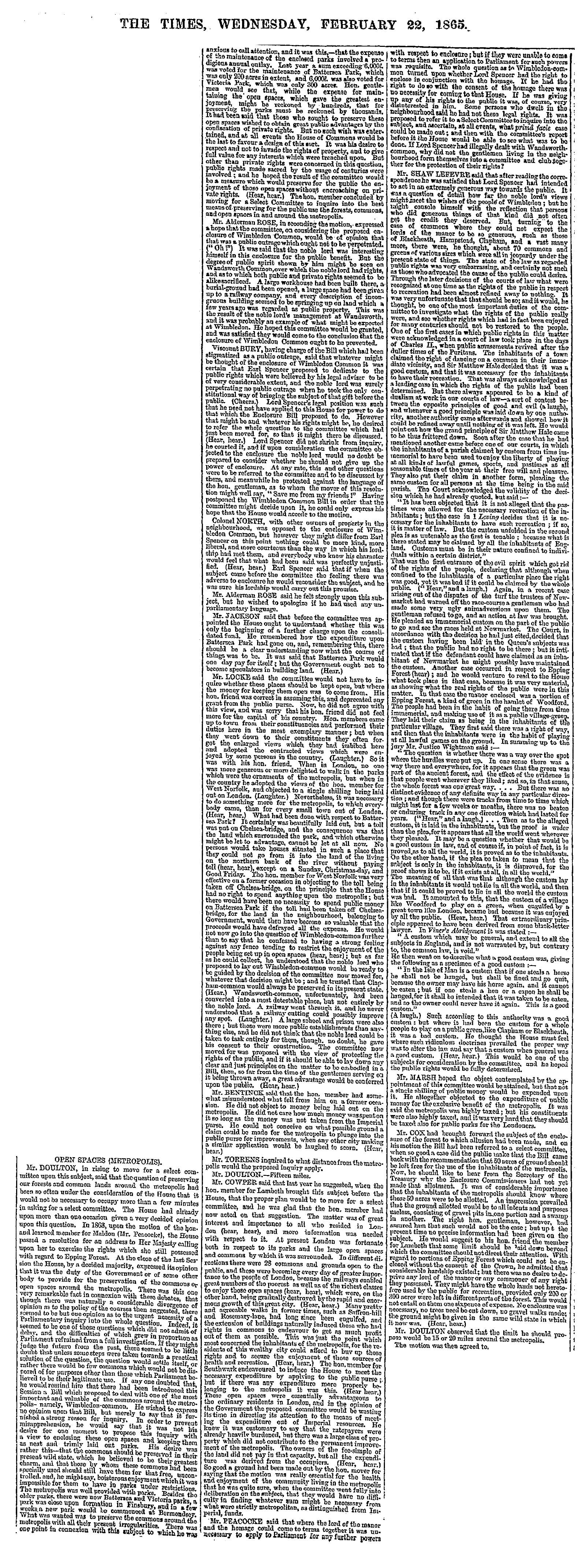
MR. DOULTON, in rising to move for a Select Committee to inquire into the best means of preserving for the public use the Forests, Commons, and Open Spaces in and around the metropolis, said, that the question of preserving for public use our forests and common lands around the metropolis had been so often under the consideration of the House that it would not be necessary for him to occupy more than a few minutes in asking for a Select Committee. The House had already upon more than one occasion given a very decided opinion upon this question. In 1863, upon the Motion of the hon. Member for Maldon (Mr. Peacocke), the House passed a Resolution for an Address to Her Majesty calling upon her to exercise the rights which she still possessed with regard to Epping Forest. At the close of the last Session the House, by a decided majority, expressed its opinion that it was the duty of the Government or of some other body to provide for the preservation of the commons
[503]
or open spaces around the metropolis. There was this one very remarkable fact in connection with these debates, that though there was naturally a considerable divergence of opinion as to the policy of the course then suggested, there seemed to be but one opinion as to the urgent necessity of a Parliamentary inquiry into the whole question. Indeed, it seemed to be one of those questions which did not admit of delay, and the difficulties of which grew in proportion as Parliament refrained from a full investigation: — indeed, if they might judge the future from the past, there seemed to be little doubt that unless Parliament adopted some course calculated to lead to a practical solution of the question, the question would settle itself, or rather there would be few commons and open spaces near the metropolis which would not be disposed of for purposes other than those which Parliament believed to be their legitimate use. If any hon. Member doubted the necessity of inquiry, he would remind him that there had been introduced this Session a Bill which proposed to deal with one of the most important and valuable of the commons around the metropolis — he alluded to Wimbledon Common. He wished to express no opinion upon that Bill, but merely to say that it furnished a strong reason for inquiry. In proposing the appointment of this Committee he was but following out the opinions and wishes the House had already expressed. In order to prevent misapprehension, he would say that it was not his desire for one moment to propose this inquiry with a view to enclosing these open spaces and commons and keeping them as neat and trimly laid out parks. His desire was rather this — that the commons should be preserved in their present wild state, which he believed to be their greatest charm, and that those by whom these commons had been specially used should still have them for that free, uncontrolled, and, he might say, boisterous enjoyment which it was impossible for them to have in parks under restrictions. The metropolis was well provided with parks. Besides the older parks, there were now Battersea and Victoria Parks, a park was now in the course of formation in Finsbury, and in a few weeks a new park would be commenced at Bermondsey. What was wanted was to preserve the commons around the metropolis with all their present irregularities.
There was one point in connection with this subject
[504]
to which he was anxious to call attention, and it was this — that the expense of the maintenance of the enclosed parks involved a prodigious annual outlay of public money. Last year a sum exceeding £6,000 was voted for the maintenance of Battersea Park, which was only 200 acres in extent, and £6,000 was also voted for Victoria Park, which was only 300 acres. Hon. Gentlemen would see that, while the expense for maintaining the open spaces, which gave the greatest enjoyment, might be reckoned by hundreds, that for preserving the parks must be reckoned by thousands. It had been said that those who sought to preserve these open spaces wished to obtain great public advantages by the confiscation of private rights. But no such wish was entertained, and at all events the House of Commons would be the last to favour a design of this sort. He wished to say in the strongest manner that it was his desire to respect and not to invade the rights of property, and to give full value for any interests which were trenched upon. But other than private rights were concerned in this question, public rights made sacred by the usage of centuries were involved; and he hoped the result of the Committee would be some suggestion or measure which would on the one hand preserve for the public the enjoyment of those open spaces, and on the other to reserve without encroachment all private rights. The hon. Member then moved that a Select Committee be appointed.
MR. ALDERMAN ROSE
said, he rose to second the Motion. The question was one connected with a movement now going on the importance of which was scarcely recognized by the public at large or the House. It was intended to postpone the Bill for the enclosure of Wimbledon Common for a month to await the result of this Committee, and if the Committee were appointed he hoped they would get such information as would prevent so great a public outrage as the enclosure of that common being perpetrated. It was said that the noble Lord who was interested in the Bill (Earl Spencer), was only influenced by a desire to do a public benefit; but Members of the House had an opportunity of judging for themselves of the public spirit of the operation. If they would take a ride from Battersea Park to Wands worth Common they would see how the latter place was being appropriated by the noble Lord. He did not hesitate to say that in the appropriation of Wands worth Common
[505]
there was not a public right which had not been sacrificed, and contrary as he thought, to law. The only roadway from north to south was so narrow that foot-passengers were in danger of being run over; a workhouse and a burial ground had been planted on the common, and a large space of ground was occupied by a railway company, and apparently for no earthly purpose. In addition, all kinds of incongruous buildings — four-roomed, six-roomed, or indeed any kind were springing up; and all this upon land which a few years ago was public property. This was how the noble Lord showed his public spirit; and what was done on Wands worth Common he now wished to extend to Wimbledon. He wished that before the Bill was passed for this enclosure, the Committee now proposed would have reported on the whole subject.
Moved, That a Select Committee be appointed "to inquire into the best means of preserving for the public use the Forests, Commons, and Open Spaces in and around the Metropolis." — ( Mr. Doulton.)
VISCOUNT BURY
said, that being one of the Members who had charge of the Bill which had been stigmatized by the last speaker as a public outrage, he could not remain silent. He desired to say that whatever might be thought of the enclosure of Wimbledon Common it was certain that Earl Spencer proposed to dedicate to the public, rights which were believed by his legal adviser to he of very considerable extent; and the noble Lord was surely perpetrating no public outrage when he took the only constitutional way of bringing the subject of that gift before the public. Lord Spencer's legal position was such that he need not have applied to this House for power to do that which the Enclosure Bill proposed to do. However that might be, and whatever his rights might be, his Lordship was quite willing — nay, desired — that the whole question should be referred to the Committee which had just been moved for, so that it might there be discussed. Lord Spencer did not shrink from inquiry — he courted it; and if upon consideration the Committee objected to the enclosure the noble Lord would no doubt be prepared to consider whether he should not give up the power of enclosure. At any rate, this and other questions were to be referred to the Committee and to be discussed by them, and meanwhile he protested against the language of the hon. Gentleman, as to whom the Mover of this Resolution might well
[506]
say, "Save me from my friends!" Having postponed the Wimbledon Common Bill in order that the Committee might decide upon it, he could only express his hope that the House would accede to the Motion.
COLONEL NORTH
said, he did not know anything about Wands worth Common, but could not for a moment agree to what had been said by the hon. Member for Southampton (Mr. Alderman Rose) as to Wimbledon. It was hardly necessary to defend Earl Spencer's character, for everyone who knew him would feel that what had been said of him by the hon. Member was perfectly unjust. He had himself property at Putney, and with other owners of property was opposed to the enclosure of Wimbledon Common; but, however they might differ from Lord Spencer as to the mode of carrying out his views, no one could have acted more candidly, fairly, and liberally. He (Colonel North) was against the enclosure of the common, but then that was only his individual opinion. The public had for years enjoyed Wimbledon Common in all its natural wildness, and he thought it should be continued in that state rather than be converted into an ornamental park. Earl Spencer said, that if when the subject came before the Committee the feeling there was adverse to enclosure he would reconsider the subject; and he was sure his Lordship would carry out this promise.
MR. ALDERMAN ROSE
said, that if he had expressed his opinions in other than the ordinary terms allowed in debate he would readily apologize. He felt strongly on the subject, and if he had used unparliamentary terms he would willingly withdraw them.
MR. JACKSON
said, that before the Committee was appointed the House ought clearly to understand whether this was only the beginning of a further charge upon the Consolidated Fund. They all remembered how that Fund had become chargeable in connection with matters of science and art. No less a sum than £60,000 had been spent out of the Imperial exchequer for Battersea Park; and though it was said that the park would pay itself by the sale of surplus property, he hoped the House would never sanction the Government becoming speculators in building land. He trusted it would be clearly understood that whatever was done by the Committee or upon their Report, there would be no demand for money from the Consolidated Fund.
Column 507is located here
MR. LOCKE
said, he would support this Motion as he had supported a similar one last year, which was carried by a large majority, but it being late in the Session there was no time to appoint a Committee. The duties of the Committee now to be appointed would therefore be simplified inasmuch as they would not have to inquire whether these spaces should be kept open, but where the money for keeping them open was to come from. His hon. Friend was correct in assuming this, and deprecated any grant from the public purse for the purpose. Now, he did not agree with this view, and was sorry that his hon. Friend did not feel more for the capital of his country. Hon. Members came up to town from their constituencies and performed their duties here in the most exemplary manner; but when they went down to their constituents they often forgot the enlarged views which they had imbibed here, and adopted the contracted views which were enjoyed by some persons in the country. So it was with his hon. Friend. His hon. Friend represented a constituency far away from the metropolis. No man was more constant in gracing the House with his presence, and when in London no one was more generous or more delighted to enjoy the parks which were the ornaments of the metropolis; but when in the country he forgot his duty to the capital of his country, and he adopted the views of the hon. Member for West Norfolk (Mr. Bentinck), and objected to a single shilling of Imperial money being laid out on London. Nevertheless, it was necessary to do something more for the metropolis, to which everybody came, than for every small town out of London. What had been done with respect to Battersea Park? It certainly was beautifully laid out, but a toll was put on Chelsea Bridge, and the consequence was that the land which surrounded the park, and which otherwise might be let to advantage, could not be let at all now. No persons would take houses situated in such a place that they could not go from it into the land of the living on the northern bank of the river without paying toll, except on a Sunday, Christmas Day, and Good Friday.
The hon. Member for West Norfolk was very effective on a former occasion in objecting to the toll being taken off Chelsea Bridge, on the principle that the House had no right to spend anything upon the metropolis; but there would have been no necessity to spend public money on Battersea
[508
Park if the toll had been taken off Chelsea Bridge, for the land in the neighbourhood, belonging to Government, would then have become so valuable that the proceeds would have defrayed all the expense. He would not now go into the question of Wimbledon Common further than to say that he confessed to having a strong feeling against any fence tending to restrict the enjoyment of the people being set up in open spaces; but, as far as he could collect, he understood that the noble Lord who proposed to lay out Wimbledon Common would be ready to be guided by the decision of the Committee now moved for, whatever that decision might be. He trusted that Clapham Common would always be preserved in its present state. Wands worth Common, unfortunately, had been converted into a most detestable place, but not entirely by the noble Lord. A railway went through it, and he never understood that a railway cutting could possibly improve any spot. A large school and prison were also there; but those were more public establishments than anything else, and he did not think that the noble Lord could be taken to task entirely for them, though, no doubt, he gave his consent to their construction. The Committee now moved for was proposed with the view of protecting the rights of the public against invasion, and if it should be able to lay down any clear and just principles with regard to these common lands to be embodied in a Bill, then, so far from the time of the Gentlemen serving on it being thrown away, a great advantage would be conferred upon the public.
MR. BENTINCK
said, he did not object to any amount of money being spent on the decoration of the metropolis, but he contended that it ought not to come out of the Imperial purse. He was at a loss to conceive on what possible ground of fairness and equity a claim could be made by the metropolis upon the public purse for its improvement and adornment, when if any other city in the country made a similar claim it would be hooted and scorned. He hoped that as long as the House of Commons exercised a control over that purse it would oppose itself to these rapacious proceedings.
MR. TORRENS
inquired to what distance from the metropolis would the proposed inquiry apply.
MR. DOULTON
Fifteen miles.
MR. COWPER
said, that last year, when the hon. Member for Lambeth (Mr.
[509]
Doulton) brought this subject before the House, he suggested that he should move for a Select Committee, and he was glad he had acted upon that suggestion. The subject was one of great interest and importance to all residing in London, but a great deal of information respecting it was required before it could be ripe for legislation, and he believed that the details which the Committee would receive would be valuable. At present London was peculiarly fortunate, both as to the parks which were chiefly in the centre of it, and as to the large open spaces which surrounded it on all sides. There were within the limits of the metropolis no less than twenty-eight commons and greens open freely to the public. These were becoming every day of greater importance to the people, because the railways enabled great numbers of the poorest as well as the richer classes to enjoy them; while, on the other hand, the rapid and enormous growth of the City had a constant tendency to destroy them. Saffron Hill, Rosemary Lane, Mayfair, and other places whose pleasant names recalled the memory of agreeable walks, had long since been engulphed, and the progress of building naturally presented a temptation to convert the rights in commons into money. He thought that the private rights over such places were worth being bought by a wealthy city like this, and preserved to the people. He agreed that what were wanted in the suburbs of London were not so much ornamental parks as open spaces in their natural beauty and native wildness; but he must turn a deaf ear to the persuasions of the hon. and learned Member for Southwark (Mr. Locke), who seemed to think that the expenditure required for preserving and maintaining those places should come out of the national purse. It seemed to him that the expenditure required for the preservation of these suburban places of recreation, was peculiarly local and municipal, and had nothing Imperial in its character — they were for the advantage of the residents of the metropolis; and it was the opinion of the Government that if this Committee were granted, and they wished it to be so understood, it would be a waste of time for them to turn their attention to the question of meeting the expenditure out of Imperial funds. He knew it was the custom to say that the ratepayers of the metropolis were already too heavily burdened, but there were resources still undeveloped; for instance, one large
[510]
class of property did not contribute directly to permanent improvements of the metropolis — the owners of the fee simple of land did not pay in that capacity, all the expenditure being drawn from the occupiers. He thought his hon. Friend had made out good ground for his Motion. The preservation of these open spaces was important to the health and enjoyment of those who lived in the metropolis; and he thought that consideration might be usefully given by the Committee to questions of fact and law, and application of metropolitan funds, which might prepare the way for future action.
MR. PEACOCKE
said, that where the lord of the manor and the homage could come to terms together, it was unnecessary to apply to Parliament for any further powers with respect to enclosure; but if they were unable to come to terms, then an application to Parliament for such powers was requisite. The whole question as to Wimbledon Common turned upon whether Lord Spencer had the right to enclose in conjunction with the homage. If he had the right to do so, with the consent of the homage, there was no necessity for coming to that House. If, on the other hand, the right was disputed, it was only natural that he should endeavour to obtain the sanction of the Legislature for his proposal. If he was giving up any of his rights to the public, it was, of course, very disinterested in him. Some persons who dwelt in the neighbourhood said he had not these legal rights. It was proposed to refer it to a Select Committee to inquire into the subject, and ascertain, at all events, what prima facie case could be made out; and then, with the Committee's Report before it, the House would be able to see what was to be done. If Lord Spencer had illegally dealt with Wandsworth Common, why did not the gentlemen living in the neighbourhood form themselves into a committee and club together for the protection of their rights?
MR. SHAW LEFEVRE
said, that no doubt the last speaker was right in saying that if the public had no legal right to be upon, or to use the commons, the lord of the manor could at any time, with the consent of the commoners, enclose a common. But if, on the contrary, the public had any rights over the common, the lord could not enclose without an Act of Parliament. The question of Wimbledon Common was one of detail, and it would, no doubt, be brought before the Committee. After reading the correspondence, he was
[511]
satisfied that Lord Spencer had intended to act in an extremely generous spirit towards the public. It was a question how far the noble Lord's views might meet the wishes of the people of Wimbledon; and if he was dissatisfied with the reception it had met with, he might console himself with the reflection that persons who did generous things of that kind did not always get the credit they deserved, because, while he was giving up what might be of great prospective value to him, they were only receiving that which they had always enjoyed. But, he would address himself to the case of commons, where, perhaps, they could not expect the lords of the manor to be so generous, such as those of Blackheath, Hampstead, Clapham, and many others, and he believed there were about seventy commons and greens of various sizes within fifteen miles of London, which were all in jeopardy under the present state of things. The state of the law as regarded public rights was very embarrassing and unsatisfactory, and certainly not such as those who advocated the cause of the public could desire. Through the later decisions of the Courts of Law, what were recognized at one time as the rights and customs of the public in respect to recreation had been almost refined away to nothing It was very unfortunate that that should be so; and it would, he thought, be one of the most important duties of the Committee to investigate what the rights of the public really were, and see whether rights which had in fact been enjoyed for many centuries could not be restored to the people. He would, first of all, call the attention of the House to one of the first cases in which public rights in this matter were acknowledged in a court of law. It occurred in the days of Charles I., when public amusements revived after the duller times of the Puritans. The inhabitants of a town claimed the right of dancing on a common in their immediate vicinity, and Sir Matthew Hale decided that it was a good custom, and that it was necessary for the inhabitants to have their recreation. — (Abbott v. Weekly, I Levinz's Reports, 176.) That was always regarded as a leading case in which the rights of the public had been properly determined.-But there always appeared to be a kind of dualism at work in our courts of law — a contest between the opposite principles of good and evil — and whenever a good principle was laid down by one Judge, another
[512
Judge came afterwards and, while acknowledging the previous decision, showed how it could be refined away until nothing of it was left. He would point out how the grand principle of Sir Matthew Hale came to be frittered away. Soon after the case that he had mentioned had been decided, another came before one of our courts, in which the inhabitants of a parish claimed by custom from time immemorial to enjoy the liberty of playing at all kinds of lawful games, sports, and pastimes, at all seasonable times of the year, at their free will and pleasure. They also put their claim in another form, pleading the same custom for all persons at the time being in the said parish. The court acknowledged the validity of the decision which he had already quoted, but said -
"It has been objected that it it is not alleged that the pastimes were allowed for the necessary recreation of the inhabitants; but the case in I Levinz decides that it is necessary for the inhabitants to have such recreation; if so, it is matter of law. But the custom unfolded in the second plea is as untenable as the first is tenable; because what is there stated may be claimed by all the inhabitants of England. Customs must be in their nature confined to individuals within a certain district." — (Fitch v. Rawlings, 2 H. Bl. 393."
That was the first entrance of the evil spirit which got rid of the rights of the people, declaring that although when confined to the inhabitants of a particular place the right was good, yet it was had if it could be claimed by the whole public. Again, in a recent case, arising out of the disputes of the turf, the trustees of the Jockey Club, who were lords of the manor of Newmarket Heath had warned off the race-course a gentleman who had made some very ugly animadversions upon them. The gentleman refused to go; they turned him off; and the case was brought before a court of law. He pleaded an immemorial custom on the part of the public to go and see the races held at Newmarket. The court, in accordance with the decision he had just cited, decided that the custom having been laid in all the Queen's subjects was bad; that the public had no right to be there; but it intimated that if the defendant could have claimed as an inhabitant of Newmarket, he might possibly have maintained the custom. Another case occurred in respect to Epping Forest, and he would venture to read to the House what took place in that case, because it was very material, as showing to what the rights of the public, acknowledged in the previous cases, had
[513]
been at last reduced in this matter. In that case the manor enclosed was a portion of Epping Forest, and formed a kind of public green in the hamlet of Woodford. The people had been in the habit of going there from time immemorial, and making use of it for purposes of recreation. It was enclosed by the lord of the manor, and the inhabitants objected to the enclosure. They laid their claim as being in the inhabitants of the particular village. They first said there was a right of way, and then that the inhabitants were in the habit of playing at all lawful games on the round. In summing up to the jury Mr. justice Wightman said -
""The question is, whether there was a way over the spot where the hurdles were put up. In one sense there was a way there and everywhere, for it appears that the green was part of the ancient forest, and the effect of the evidence is that people went wherever they liked; and so, in that sense, the whole forest was one great way. . . But there was no distinct evidence of any definite way in any particular direction; and though there were tracks from time to time which might last for a few weeks or months, there was no beaten or enduring track in any one direction which had lasted for years. . . Then as to the alleged custom, it is laid in the inhabitants, but the proof is wider than the plea, for it appears that all the world went wherever they pleased. It may be a question whether that would be a good custom in law, and of course if, in point of fact, it is proved as to all the world, it is proved as to the inhabitants. On the other hand, if the plea be taken to mean that the subject is only in the inhabitants, it is disproved, for the proof shows it to be, if it exists at all, in all the world." — (See Schwinge v. Dowell, 2 Foster and Finlason's Report, p. 845.)"
The meaning of this was that although the custom lay in the inhabitants it would not lie in all the world, and then that if it could be proved to lie in all the world the custom was bad. It amounted to this, that the custom of a village like Woodford to play on a green, when engulfed by a great town like London, became bad, because it was enjoyed by all the public, Now that was, in his opinion, a most monstrous conclusion. It might be law, but certainly was opposed to common sense and to practice. This doctrine of general custom appeared to have been derived from some black-letter lawyer. In Viner's Abridgment it was stated -
""A custom which may be general, and extend to all the subjects in England, and is not warranted by, but contrary to the common law, is void.""
He then went on to describe what a good custom was, giving the following as a specimen of a good custom: -
[514]
""In the Isle of Man is a custom that if one steals a horse he shall not be hanged, but shall be fined and go quit, because the owner may have his horse again, and it cannot be eaten; but if one steals a hen or a capon, he shall be hanged, for it shall be intended that it was taken to be eaten, and so the owner could never have it again. This is a good custom.""
Such according to this authority was a good custom; but where it had been the custom for a whole people to play on a open common, like Clapham or Blackheath, it was a had custom. He thought the House must feel where such ridiculous doctrines prevailed the proper way was to alter the law and say that a custom should not be had because it was a general custom. It might perhaps be said, why not buy up the interests of the lords of the manor? That only raised the same question in another form, because, if the public had no rights whatever over the commons, then the compensation would have to be given for all these commons assessed as building land, worth from £400 to £600 an acre; and it would be impossible to find the money for it. But if, on the other hand, the public had rights of recreation, then a comparatively very small sum would purchase the manorial rights of pasturage, and digging sand and gravel. At any rate, he hoped that the rights of the public would be fully discussed in the Committee, and that if necessary the law would be altered in the sense he had referred to.
MR. MARSH
hoped the object contemplated by the appointment of this Committee would be attained, but that not a single shilling of public money would be expended upon it. He altogether objected to the expenditure of public money for the exclusive benefit of the metropolis. It was said the metropolis was highly taxed; but his constituents were taxed quite as heavily as the inhabitants of the metropolis, and he thought it would be very unfair that they should be further taxed for the embellishment or recreation of the Londoners.
MR. COX
said, that in 1862 the lords of the manor of Chigwell, Essex, had come to Parliament to obtain permission to enclose the portion of Epping Forest lying in that manor, but on his (Mr. Cox's) Motion the Bill was referred to a Select Committee, when so good a case did the public make that the Bill came back with the recommendation that fifty acres of ground should be left free for the use of the inhabitants of the metropolis. That recommendation was adopted by the House; but the allotment had not yet been made. Now, he
[515
should like to hear from the Secretary of the Treasury why the Inclosure Commissioners had not yet made that allotment. It was of considerable importance that the inhabitants of the metropolis should know where those fifty acres were to be allotted. An impression prevailed that the ground allotted would be to all intents and purposes useless, consisting of gravel pits in one portion and a swamp in another. The right hon. Gentleman (Mr. Peel), however, had assured him that such would not be the case; but, up to the present time, no precise information had been given on the subject. He would suggest to his hon. Friend the Member for Lambeth not now to fix any limit beyond which the Committee should not direct their attention. As he (Mr. Cox) conceived that point would be the first to be considered and settled by the Committee with regard to portions of Epping Forest which could not be enclosed without the consent of the Crown, he admitted that considerable hardship existed; but there was no desire to deprive any lord of the manor or any commoner of any right they possessed. They might have the whole lands not heretofore used by the public for recreation, provided only the 200 or 300 acres which had been so used were left in different parts of the Forest. This would not entail on them one sixpence of expense. No enclosure was necessary, no trees need be cut down, no gravel walks made; the ground might be given in the same wild state in which it now was.
MR. DOULTON
observed, that the limit he should propose would be fifteen or twenty miles around the metropolis.
Motion agreed to; — Select Committee appointed.
And, on March 3, Select Committee nominated as follows: -
Mr. DOULTON, Mr. COWPER, Viscount BURT, Sir HENRY WILLOUGHBY, Mr. LOCKE KING, Mr. DR CANE, Mr. HENRY BAILLIE, Sir JOHN SHELLEY, Mr. JOHN TOLLEMACHE, Mr. KINNAIRD, Mr. BEN-TINCK, Mr. PEACOCKE, Mr. HANBURY, Mr. VANCE, Mr. LOCKE, Mr. LYALL, Mr. BUXTON, Mr. TOREENS, Mr. SHAW LEFEVRE, Mr. Alderman ROSE, and Mr. Cox: — Power to send for persons, papers, and records; Five to be the quorum.
[Hansard: Open Spaces — 21st February / Link]
How the debate was reported — rather interesting. Notice e.g. the attack on Alderman [William] Rose. Rose is said to be living in Upper Tooting. He is James Anderson Rose's brother.
[Text? Is it the same as Hansard's? I used Gale to access.]
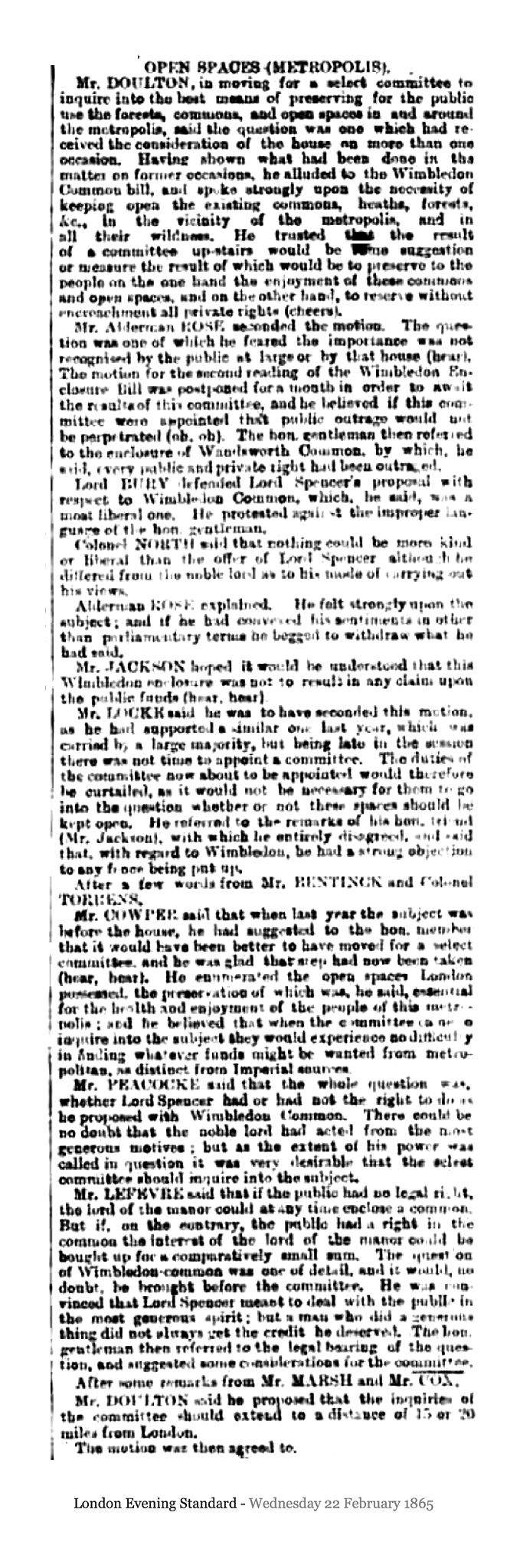
OPEN SPACES — (METROPOLIS)
Mr. DOULTON, in moving for select committee to inquire into the best means of preserving for the public use the forests, commons, and open spaces and around the metropolis, said the question was one which had received the consideration of the house on more than one occasion. Having shown what had been done in the matter former occasions, he alluded the Wimbledon Common bill, and spoke strougly upon the necessity of keeping open the existing commons, heaths, forests, &c. In the vicinity of the metropolis, and in all their wildness.
He trusted the result of committee upstairs would be Wme suggestion or measure the result of which would preserve to the people the one hand the enjoyment of these commons and open spaces, and on the other hand, to reserve without encroachment all private rights (cheers).
Mr. Alderman ROSE seconded the motion. The question was one of which feared the importance was not recognised by the public largo by that house (hear). The motion for the second reading of the Wimbledon Enclosure Bill was postponed fora month in order await the results of this committee, believed if this committee were appointed that public outrage would perpetrated (oh, oh). The hon. gentleman then referred to the enclosure of Wandsworth Common, by which, said, every public and private right had been outraged.
Lord BURY defended Lord Spencer's proposal with respect Wimbledon Common, which, said, was most liberal one. He protested against the improper language of the hon. gentleman.
Colonel NORTH said that nothing could be more kind or liberal than the offer of Lord Spencer although he differed from noble lord as to his mode of carrying out his views.
Alderman ROSE explained. felt strongly upon the subject; and if he had conveyed Ms sentiments in other than parliamentary terms he begged to withdraw what had said.
Mr. JACKSON hoped it would be understood that this Wimbledon enclosure was not result any claim upon the public funds (hear, hear).
Mr. LOCKE said he was to have seconded this motion, as he had supported a similar one last year, which was carried by a large majority, but being late in the session there was not time to appoint a committee. The duties of the committee now about to be appointed would therefore be curtailed, as it would not be necessary for them go into the question whether or not these spaces should kept open. He referred to the remarks of his hon. friend (Mr. Jackson), with which entirely disagreed, and that, with regard to Wimbledon, he had a strong objection to any fence being put up.
After few words from Mr. and Colonel TORRENS.
Mr. COWPER said that when last year the subject was before the house, he had suggested to the hon. member that it would have been better to have moved for a select committee, and was glad that step had now been taken (hear, hear). He enumerated the open spaces London possessed, the preservation of which was, he said, essential for the health and enjoyment of the people of this metropolis; and he believed that when the committee came to inquire into the subject they would experience no difficulty in finding whatever funds might be wanted from metropolitan, as distinct from Imperial sources.
Mr. PEACOCKE said that the whole question was, whether Lord Spencer had or had not the right to do as he proposed with Wimbledon Common. There could be no doubt that the noble lord had acted from the most generous motives; but as the extent his power was called in question it was very desirable that the select committee should inquire into the subject.
Mr. LEFEVRE said that if the public had no legal right, the lord of the manor could at any time enclose the common. But if, on the contrary, the public had a right in the common the interest the lord of the manor could bought for a comparatively small sum. The question of Wimbledon-common was one of detail, and it would, no doubt, be brought before the committee. He was convinced that Lord Spencer meant to deal with the public in the most generous spirit; but a man who did a generous thing did not always get the credit he deserved. The hon. gentleman then referred the legal bearing of the question, and suggested some considerations for the committee.
After some remarks from Mr. MARSH and Mr. COX, Mr. DOULTON said he proposed that the inquiries the committee should extend to distance of 15 miles from London. The motion was then agreed to.
[BNA: Link]
[IS THIS A DUPLICATE?]
OPEN SPACES (METROPOLIS)
Mr. DOULTON, in moving for a select committee to inquire into the beat means of preserving for the public use the forests, commons, and open spaces and around the metropolis, said the question was one which had received the consideration of the house on more than one occasion. Having shown what had been done in the matter former occasions, he alluded the Wimbledon Common bill, and spoke strougly upon the necessity of keeping open the existing commons, heaths, forests, &c. In the vicinity of the metropolis, and in all their wildness. He trusted the result of committee up-stairs would be Wme suggestion or measure the result of which would preserve to the people the one hand the enjoyment of these commons and open spaces, and on the other hand, to reserve without encroachment all private rights (cheers).
Mr. Alderman ROSE seconded the motion. The question was one of which feared the impor tance was not recognised by the public largo by that house (hear). The motion for the second reading of the Wimbledon Enclosure Bill was postponed fora month in order await the results of this committee, believed if this committee were appointed tha t public outrage would perpetrated (ob, oh). The hon. gentleman then referred to the enclosure f Wandsworth Common, by which, said, every public and private right had been outraged.
Izord BURY defended Lord Spencer's proposal with respect to Wimbledon Common, which, said, was most liberal one. He protested against the improiier laugu"e of the hon. gentleman.
Colonel NORTH said that nothing could be more kind liberal than the offer of for Spencer although ho differed from noble lord as to his mode currying out his views. Alderman ROSE explained. felt strongly upon the subject; and if he had conveyed Ms sentiments in other than parliamentary terms he begged to withdraw what had said.
Mr. JACKSON hoped it would lie understood hat this Wimbledon enclosure was not result any claim upon the public funds (bear. hear).
Mr. LOCKE said he was have seconded this motion, he had supported a similar one lu.st year, which whs carried large majority, but being late the session there was not time to appoint a committee. the duties of the committee now about appoints! would therefore curtailed, as would not necessary for them go into the question whether or not these spaces should kept open. referred the remarks of his bon. tri (.Mr. Jackson), with which entirely disagreed, and that, with regard to Wimbledon, had a strong objection to any fi nc being put up. After few words from Mr. and Colonel TORRENS.
Mr. COWPER said that when last year the subject was before the house, he had suggested hoo. member that would have been better have moved for select committee, and was glad that step had now been taken (hear, hear). He enumerated the open spaces London possessed, the preservation of which was, said, essential for the health and enjoy men t of the people of this tm tr -; ai d lie believed th:i when the committee ne inquire into the subject they would experience noditticul finding whatever funds might wanted from metiopolltao, as distinct from sources.
Mr. PEACOCKE said that the whole question was, whether Lord Spencer had had not the right a-t he proi osed with Wimbledon Common. There could be doubt that the noble lord had acted from the n.o-c generous motives; but as the extent his power was called in question it was very desirable that the selcot committee should inquire into the subject.
Mr. LEFEVRE said that if the public had legal Jit, the lord of the manor could at.ruy time enclose common. But if, the contrary, the public had right in the common the interest the lord of ihe manor could bought for comparatively small sum. The quest of Wimbledon-common was one detail, and it. would, doubt, brought before the committee. He w;t convinced that Lora Spencer meant to deal with the public the most generous spirit; but man who did generous thing did not always get the credit deserved. The bon. gentleman then referred the legal bearing of the question, and suggested some considerations for the commit ee. After some remarks from Mr. MARSH and Mr. f'OX, Mr. DOULTON said he proposed that the inquiries the committee should extend to distance of 15 miles from Loudon. Ttie motion was then agreed to.
[BNA: Link]
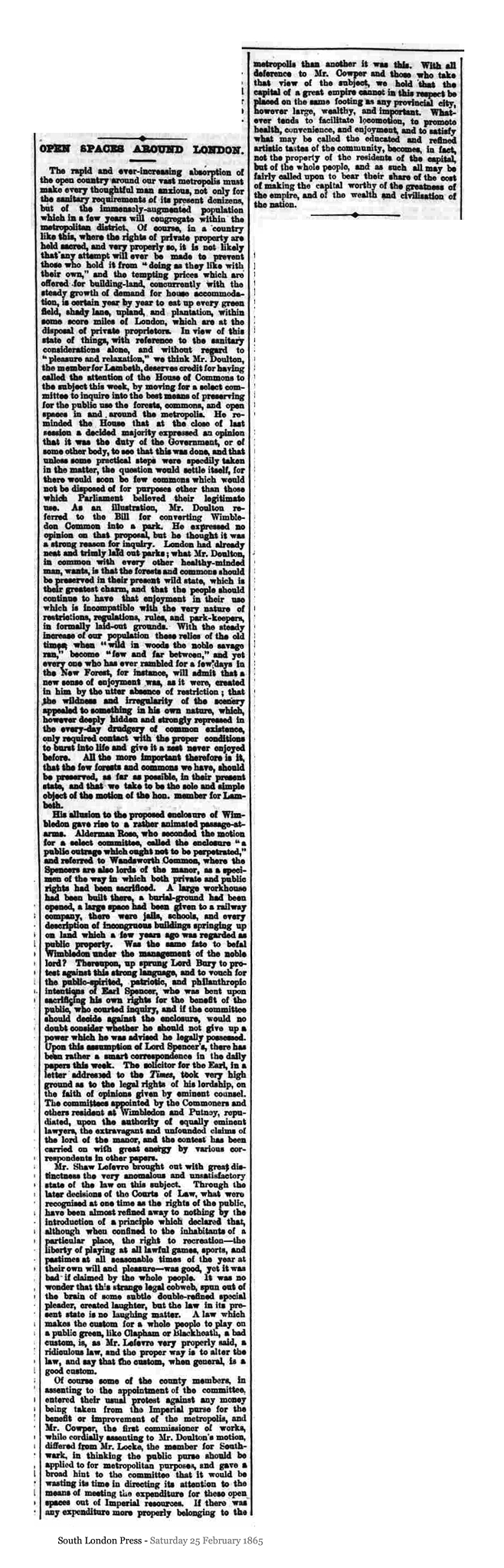
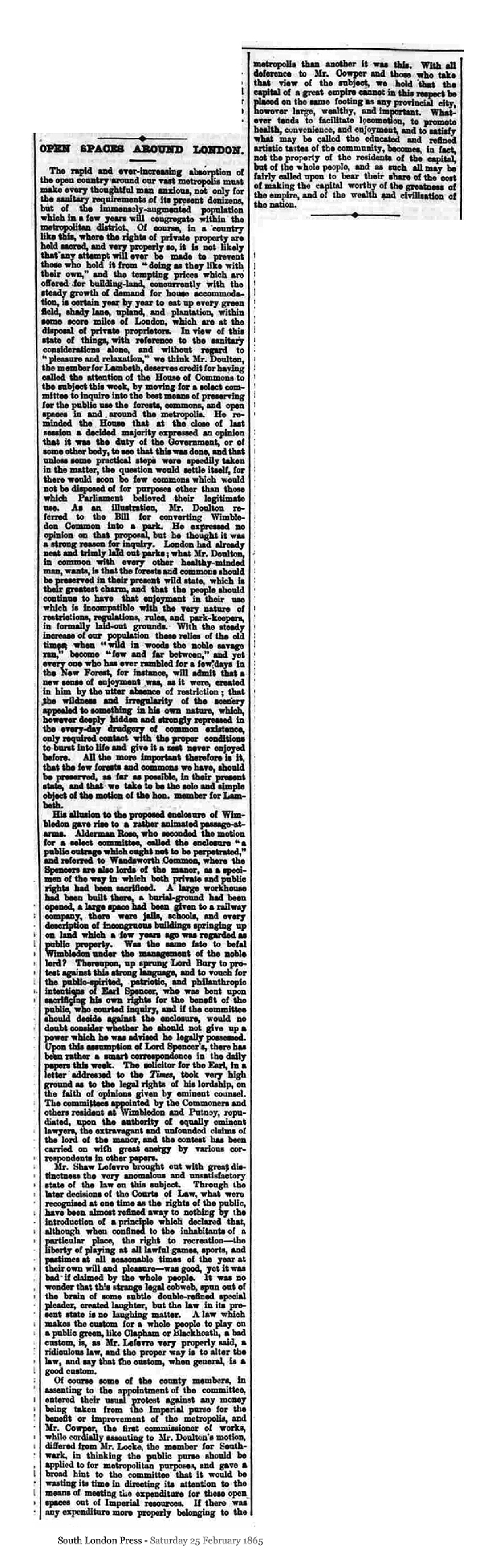
OPEN SPACES ABOUND LONDON.
The rapid and ever-increasing absorption of the open country around our vast metropolis must make every thoughtful man anxious, not only for the sanitary requirements of its present denizens, but of the immensely-augmented population which in few years will congregate within the metropolitan district.
Of course, in a country like this, where the rights of private property are held sacred, and very properly so, it is not likely that'any attempt will ever made to prevent those who hold it from doing as they like with their own," and the tempting prices which are offered for building-land, concurrently with the steady growth of demand for house accommodation, is certain year by year to eat up every green field, shady lane, upland, and plantation, within some score miles of London, which are at the disposal of private proprietors.
In view of this state of things, with reference to the sanitary considerations alone, and without regard to pleasure and relaxation," think Mr. Doulton, the member for Lambeth, deserves credit for having called the attention of the House of Commons to the subject this week, moving for a select committee to inquire into the best means of preserving for public use the forests, commons, and open spaces in and . around the metropolis.
He reminded the House that at the close of last session decided majority expressed opinion that it was the duty of the Government, or of some other body, to see that this was done, and that unless some practical steps were speedily taken in the matter, the question would settle itself, for there would soon be few commons which would not be disposed of for purposes other than those which Parliament believed their legitimate use.
As an illustration, Mr. Doulton referred to the Bill for converting Wimbledon Common into park. He expressed no opinion on that proposal, but he thought it was a strong reason for inquiry. London had already neat and trimly laid parks; what Mr. Donlton, in common with every other healthy-minded man, wants, is that the forests and commons should be preserved their present wild state, which is theur greatest charm, and that the people should continue to have that enjoyment in their uso which is incompatible with the very nature of restrietions, regulations, rules, and park-keepers, in formally laid-ont grounds.
With the steady increase of our population these relies of the old times; when "wild in woods the noble savage ran," become "few and far between," and yet every one who has ever rambled for a few'days in the New Forest, for instance, will admit that new sense of enjoyment was, as it were, created in him by the utter absence of restriction; that the wildness and irregularity of the scenery appealed to something in his own nature, which, however deeply hidden and strongly repressed in the every-day drudgery of common existence, only required contact with the proper conditions to burst into life and give it zest never enjoyed before.
All the more important therefore is it, that the few forests and commons we have, should be preserved, as far as possible, in their present state, and that we take to the sole and simple object of the motion of the hon. member for Lambeth. Withallusion to the proposed enclosure of Wimbledon gave rise a rather animated passage-atarma.
Alderman Rose, who seconded the motion for select committee, called the enclosure "a public outrage which ought not to be perpetrated," and referred to Wandsworth Common, where the Spencers are also lords of the manor, as specimen of the way in which both private and public rights had been sacrificed.
A largo workhouse had boon built there, a burial-ground had been opened, a large space had been given to a railway company, there were jails, schools, and every description of incongruous buildings springing up on land which few years ago was regarded aa pnblio property.
Was the same fate to befal Wimbledon under the management of the noble lord?
Thereupon, up sprang Lord Bury to protest against this strong language, and to vouch for the pnblic-spirited, patriotic, and philanthropic intentions of Earl Spencer, who was bent upon sacrificing his own rights for the benefit of the public, who courted inquiry, and if committee should decide against the enclosure, would no doubt consider whether be should not give up a power which ho was advised he legally possessed. Upon this assumption of Lord Spencer's, there has betel rather smart correspondence in the daily papers this week.
The solicitor for the Earl, in letter addressed to the Times, took very high ground as to the legal rights of his lordship, on the faith opinions given by eminent counsel. The committees appointed by the Commoners and others resident at Wimbledon and Putney, repudiated, upon the authority of equally eminent lawyers, the extravagant and unfounded claims the lord of the manor, and the contest has been carried on with great energy by various correspondents in other papers.
Mr. Shaw Lefevre brought out with great distinctness the very anomalous and unsatisfactory state of the law this subject. Through the later decisions the Courts of Law, what wore recognised at one time as the rights of the public, have been almost refined away to nothing by the introduction of principle which declared that, although when confined to the inhabitants of particular place, the right to recreation — the liberty of playing all lawful games, sports, and pastimes at all seasonable times of the year at their own will and pleasure — was good, yet it was bad' if claimed by the whole people.
It was no wonder that this strange legal cobweb, spun out of the brain of some subtle double-refined special pleader, created laughter, but the law in its present state is no laughing matter.
A law which makes the custom for a whole people to play on public green, like Clapham or blackhoath, a had custom, is, as Mr. Lefevre very properly said, a ridiculous law, and the proper way is to alter the law, and say that the custom, when general, is a good custom.
Of course some of the county members, in assenting to the appointment of the committee, entered their usual protest against any money being taken from the Imperial purse for the benefit or improvement of the metropolis, and Mr. Cowper, the first commissioner of works, while cordially assenting to Mr. Doulton's motion, differed from Mr. Locke, the member for Southwark, in thinking the public purse should bo applied to for metropolitan purposes, and gave broad hint to the committee that it would be wasting its time in directing its attention to the means meeting the expenditure for these open spaces out of Imperial resources. If there was any expenditure more properly belonging to the
[BNA: Link]
[IS THIS THE SAME AS ANOTHER SLP CUTTING? IF SO, USE THE BETTER.]
>]
COMMONS AROUND THE METROPOLIS Mr. Doulton, in moving for select committee to inquire into the best means of preserving for the paolic the forests, commons, and open spaces in and around the metropolis, said the question was one which had received the approval of the House on more than one occasion.
In 1863, the House passed resolution for an address to Her Majesty calling upon her not to exercise any rights which Her Majesty had with respect to Epping Forest
At the close of the last session the House, by a considerable majority, expressed an opinion that it was the duty the Government to provide for the preservation the commons and open spaces in and around the metropolis. Although there was strong diversity of opinion as to the policy of the motion, there was but one opinion that ft was urgently necessary to have Parliamentary inquiry into the Whole question. The question was one which did not admit delay, for if something was not done at once towards us settlement the question would settle itself, and the few open spaces that remained would be applied to other purposes than what believed to m their legitimate use.
The fact that Bill was introduced in the present session for dealing with one most valuable common, namely, Wimbledon Common, showed the necessity that for a Parliamentary inquiry. proposing committee was only following up the wish which the House had already expressed. The object of the inquiry was not with the view of enclosing those open spaces, and keeping them trimly laid out; his desire rather was that those commons and open spaces should be preserved in their present wildness and irregularity, which believed to be their greatest charm; and that those by whom the commons had bean used should have free, uncontrolled, and, he might say, boisterous enjoyment, which they could not have in the parks, which were necessarily under restriction.
The metropolis was at present well supplied with parks; but what was wanted was to preserve the open spaces in their {assent irregularity. The parks necessitated large annual expenditure. found sum of £6,000 for Battersea Park, and a like sum for Victoria Park. The hon. member repudiated the idea that his object was to secure gnat public advantage by the confiscation of private rights. All he desired, while respecting those rights, was to secure public rights; because there was such thing as the confiscation of public rights which had been made sacred by the usages of centuries. His desire in moving for the committee was to have the subject considered in all its varieties, with the result, hoped, of some practical suggestion which would admit of preserving the commons and open spaces freely to the people hitherto, and, on the other hand, not encroaching in any way upon private rights.
Mr. Alderman Hose seconded the motion. He said a motion had been pot upon the paper that the Enclosure Bill for Wimbledon Common should be postponed for month, to await the consideration of this committee. He believed, if that committee were appointed, they would give such information that such public outrage as believed the enclosure to be would not be perpetrated. (Cries of "Oh, and Hear, bear.") It was said that the noble lord who was interested in carrying out that Bill was acting for the public benefit Hon. members of the House had an opportunity of judging for themselves of the public spirit of the operation by riding from Battersea Park across Wandsworth Park.
The proof of the noble lord's public spirit was shown the enclosure that was going on of Wandsworth Common the present time, which believed was owned by the noble lord. There was not public right which had not been sacrificed, or private right which had not been outraged, contrary to all law. The noble lord wanted to extend the same private management to Wimbledon Common.
The operation of all Enclosure Acts was give private advantages. Lord Barr, M the person the Bill -which the hon. member had stigmatised a public outrage, protested against such improper language being applied in that House to what the noble lord, Earl Spencer, belie red be great boon offered to the public. He courted open and fair inquiry, and, the meloeure was objected the committee, no doubt the noble lord would be prepared to oonsi THE SOUTH dor whether he should not rive the power of enclosure, (Hoar, hear.)
Colonel North said it was not necessary to defend the character of Earl Spencer. Every one who knew him would know also that what had been said of him by the hon. member for Southampton was altogether unworthy. (Colonel North) had property at Putney, and, though he differed from Ban Spencer to the policy of enclosing Wimbledon Common, must bear testimony to the fact that nothing could be more liberal and courteous than the offer the noble lord had made. Ha could not allow the hon. member for Southampton to speak of Lord Spencer in the way had done without rtoing to say that such opinion did not exist In the neighbourhood of Putney.
Mr. Alderman Bose said that he felt strongly on the subject, and he had spoken strongly; but; If had convoyed his feelings in other than parliamentary terms, hoped the House would allow him to withdraw those terms.
Mr. Jackson hoped that the Wimbledon Common Enclosure Bill was not the beginning of cell upon the Consolidated Fond.
Mr. Locke deprecated the objection of the hon. member who had just spoken then, and of the hon. member for West Norfolk (Mr. Bentlnok) on previous occasions, to any imperial expenditure for the improvement of the metropolis, fie (Mr. Looks) thought it was necessary to do more for the metropolis of a country to which every one went than for any provincial town. With regard to the Wimbledon Bill, bis strong feeling was against any fence being pat up in any open place, as it entirely destroyed the enjoyment that people had from roving about unrestrictedly. The committee, took it, was for the purpose of protecting the rights of the public against any innovation. If they could lay down any clear and just principle with regard to these common lands and embody it in Bill, they would confer great benefit on the public.
Mr. Bentinck said that, had been referred to, would reiterate his objections to any money being taken from the imperial purse for the purpose of metropolitan improvements. After few words from Mr. Torrens, Mr. Cowper Raid that be was glad the hon. member for Lambeth had moved for select committee. The matter was one of great interest and importance to all who resided in Ixmdon, but great deal more information was required before the subject would be ripe for legislation. He believed the details which might be obtained by committee would be of great ralne.
London was peculiarly fortunate at present, both in the parks, which were in its centre, and the belt of open places and commons which surrounded it on all sides. There were twentyeight commons and greens encircling the metropolis which at present were open to the public. These became every day of greater importance to the inhabitants, because railways enabled the poorest as well as the richest to enjoy such open places; while, on the other hand, the enormous growth of London tended rapidly to engulf those commons. They saw how London former times had ongnlphed open spaces by taking within its embrace such maces as Saffron-hill, Boeemary-lane, and Mayfair.
The increase of building naturally tempted lords of manors and commons to combine, and get profit out of their rights, and thus to destroy the commons. He thought that wealthy city like London could well afford to buy up such rights and keep the commons in their state of native wildness. He must turn deaf ear to the pleadings of the hon. member for Southwark, who had endeavoured to induce the House to concur in'this szpenditnre out of the public purse. If ever there was expenditure wnieh more particularly belonged to the metropolitan funds, it was the preservation of those open spaces. There was nothing imperial in the question, and if the committee was granted it must be on the understanding that they would only waste their time if they turned their attention to meeting that expenditure out of the public revenue. Their object would be to find how the funds of the metropolis could be employed.
The ratepayers were already heavily taxed, but would suggest that the owners of the fee-simple of the land did not at present contribute anything to the permanent improvement of the metropolis. All the expenditure was derived from the occupiers. He, however, felt sure that the metropolis would be willing in many ways to find more money for the preservation of the surrounding open spaces. Ur. Pmooolm wished inform the House of the actual state in which the Enclosure Act stood. If the landlord and the homage agreed, it was unnecessary to oome to that House; hut if, on the other hand, opposition was made, they were obliged to apply to Parliament
The whole question of Wimbledon rested upon this: has Lord Speneer the consent of the homagers or not? If had not, would find it necessary to apply to the House; if had, he made most munificent proposition to enclose the Common. (Hear, hear.) The people in that neighbourhood disputed his power. If had a legal right to do it, no one could complain; if had not that legal right, the people had the usual remedy in their own hands. The same remarks would, thought, apply to Epping Forest, to which had been continually asked why Parliament did not afford help.
Mr. S. Lefevre thought Lord Spencer had intended to act in an extremely-generons manner towards the public, and might console himself with the reflection that those who did this did not often get tiie credit they deserved. He was anxious to deal with those commons where they could not expect the lord of the manor toi be so generous as the noble lord had been — such as Blackheath, Hampstead, Clapham, and a variety of others. The state of the law regarded public rights was in menacing position, and not such one as those who took the part of the public would like to see it in.
The courts of law recognised the rights of the public to places of recreation if they had not gradually been given away to almost all in the world. They had, in point of fact, enjoyed those rights from the time of the second Charies, when, might be supposed, the people turned to amusements after the strictness of the Puritans. In one case the inhabitants claimed a right to the common; and Sir Matthew Hale, in giving his decision, said, "This is good custom, and it is necessary for the inhabitants to have their recreation and this had become one of the leading cases on which the rights of the public were determined. In the courts of law, however, sort of duellism [sic?] between good and evil prevailed. Amongst other oases was one arising out of a dispute on the turf, in which the trustees of Newmarket Heath wanted off the course there gentleman who had made ugly observations against them in the newspapers. He pleaded immemorial usage; but, on the other side, it was pleaded that general custom was bad, and therefore had no right to be there; although had he claimed as inhabitant of Newmarket, he might have had such right.
In the case of Woodford Green, in Epping Forest, Mr. Justice Wightman, in summing to the jury, had in fact pointed out that the claims of the inhabitants of particular village to play on the green had been abandoned, because, through being near a place like London, the green had become enjoyed by all the world. This might be law, but it did seem to him to be opposed to all common-sense and feeling. (Hear, hear.) The law had, indeed, come to such ridiculous point that the only thing to do was to alter it and say that customs which were general were good customs, and that it was a good custom to play on a village green. (Hear, hear.)
Mr. Marsh hoped justice would be done, but protested against the expenditure of a shilling of the public money for this purpose. There might some excuse for applying the national revenue to the preservation of public buildings, because the public might there; but when people came up to town they did not go to see rural places, which were entirely for the use of the metropolis. Hr. Cos would bring the House down to what had taken place within the last two or three years.'
The lord of the manor asked the House in 1862 to pass BID the people to enclose it, and to deprive the public of the right the/ had heretofore enjoyed. On his notion, the matter was referred to select committee, the result being that fifty acres were allotted to the free use of the inhabitants of the metropolis; but the Enclosure Commissioners had not yet stated where that ground was to be, should be glad to receive some information on the subject.
With regard to Epping Forest, the inhabitants of the metropolis had no desire to deprive the lord of the manor of any right he might possess. All they required was that the two or three hundred acres they had hitherto had for their enjoyment might be left in the same wild state now, and that the trees might not be out down, nor gravel walks made to despoil the forest of the charms it had for pio-nks. The motion was then agreed to/
[BNA: Link]
OPEN SPACES ABOUND LONDON.
The rapid and ever-increasing absorption of the open country around our vast metropolis must make every thoughtful man anxious, not only for the sanitary requirements of its present denizens, but of the immensely-augmented population which in few years will congregate within the metropolitan district.
Of course, in a country like this, where the rights of private property are held sacred, and very properly so, it is not likely that'any attempt will ever made to prevent those who hold it from doing as they like with their own," and the tempting prices which are offered for building-land, concurrently with the steady growth of demand for house accommodation, is certain year by year to eat up every green field, shady lane, upland, and plantation, within some score miles of London, which are at the disposal of private proprietors.
In view of this state of things, with reference to the sanitary considerations alone, and without regard to pleasure and relaxation," think Mr. Doulton, the member for Lambeth, deserves credit for having called the attention of the House of Commons to the subject this week, moving for a select committee to inquire into the best means of preserving for public use the forests, commons, and open spaces in and . around the metropolis. He reminded the House that at the close of last session decided majority expressed opinion that it was the duty of the Government, or of some other body, to see that this was done, and that unless some practical steps were speedily taken in the matter, the question would settle itself, for there would soon be few commons which would not be disposed of for purposes other than those which Parliament believed their legitimate use.
As an illustration, Mr. Doulton referred to the Bill for converting Wimbledon Common into park. He expressed no opinion on that proposal, but he thought it was a strong reason for inquiry. London had already neat and trimly laid parks; what Mr. Doulton, in common with every other healthy-minded man, wants, is that the forests and commons should be preserved their present wild state, which is theur greatest charm, and that the people should continue to have that enjoyment in their uso which is incompatible with the very nature of restrietions, regulations, rules, and park-keepers, in formally laid-ont grounds.
With the steady increase of our population these relies of the old times; when "wild in woods the noble savage ran," become "few and far between," and yet every one who has ever rambled for a few days in the New Forest, for instance, will admit that new sense of enjoyment was, as it were, created in him by the utter absence of restriction; that the wildness and irregularity of the scenery appealed to something in his own nature, which, however deeply hidden and strongly repressed in the every-day drudgery of common existence, only required contact with the proper conditions to burst into life and give it a zest never enjoyed before.
All the more important therefore is it, that the few forests and commons we have, should be preserved, as far as possible, in their present state, and that we take to the sole and simple object of the motion of the hon. member for Lambeth.
His allusion to the proposed enclosure of Wimbledon gave rise a rather animated passage-at-arms.
Alderman Rose, who seconded the motion for select committee, called the enclosure "a public outrage which ought not to be perpetrated," and referred to Wandsworth Common, where the Spencers are also lords of the manor, as specimen of the way in which both private and public rights had been sacrificed. A large workhouse had boon built there, a burial-ground had been opened, a large space had been given to a railway company, there were jails, schools, and every description of incongruous buildings springing up on land which few years ago was regarded aa public property.
Was the same fate to befal Wimbledon under the management of the noble lord? Thereupon, up sprang Lord Bury to protest against this strong language, and to vouch for the pnblic-spirited, patriotic, and philanthropic intentimis of Earl Spencer, who was bent upon sacrificing his own rights for the benefit of the public, who courted inquiry, and if committee should deeido against the enclosure, would no doubt consider whether be should not give up a power which ho was advised he legally possessed. Upon this assumption of Lord Spencer's, there has betel rather smart correspondence in the daily papers this week.
The solicitor for the Earl, in letter addressed to the Times, took very high ground as to the legal rights of his lordship, on the faith opinions given by eminent counsel. The committees appointed by the Commoners and others resident at Wimbledon and Putney, repudiated, upon the authority of equally eminent lawyers, the extravagant and unfounded claims the lord of the manor, and the contest has been carried on with great energy by various correspondents in other papers.
Mr. Shaw Lefevre brought out with great distinctness the very anomalous and unsatisfactory state of the law this subject. Through the later decisions the Courts of Law, what wore recognised at one time as the rights of the public, have been almost refined away to nothing by the introduction of principle which declared that, although when confined to the inhabitants of particular place, the right to recreation — the liberty of playing all lawful games, sports, and pastimes at all seasonable times of the year at their own will and pleasure — was good, yet it was bad' if claimed by the whole people.
It was no wonder that this strange legal cobweb, spun out of the brain of some subtle double-refined special pleader, created laughter, but the law in its present state is no laughing matter. A law which makes the custom for a whole people to play on public green, like Clapham or blackhoath, a had custom, is, as Mr. Lefevre very properly said, a ridiculous law, and the proper way is to alter the law, and say that the custom, when general, is a good custom.
Of course some of the county members, in assenting to the appointment of the committee, entered their usual protest against any money being taken from the Imperial purse for the benefit or improvement of the metropolis, and Mr. Cowper, the first commissioner of works, while cordially assenting to Mr. Doulton's motion, differed from Mr. Locke, the member for Southwark, in thinking the public purse should bo applied to for metropolitan purposes, and gave broad hint to the committee that it would be wasting its time in directing its attention to the means meeting the expenditure for these open spaces out of Imperial resources.
If there was any expenditure more properly belonging to the metropolis than another it was this.
With all deference to Mr. Cowper and those who take that view of the subject, we hold that the capital of great empire cannot in this respect be placed the same footing any provincial city, however large, wealthy, and important. Whatever tends to facilitate locomotion, to promote health, convenience, and enjoyment, and to satisfy what may called the educated and refined artistic tastes of the community, becomes, in fact, not the property of the residents of the capital, hut of the whole people, and as such all may fairly called upon to bear their share of the cost of making the capital worthy the greatness of the empire, and of the wealth and civilisation of the nation.
[BNA: Link]
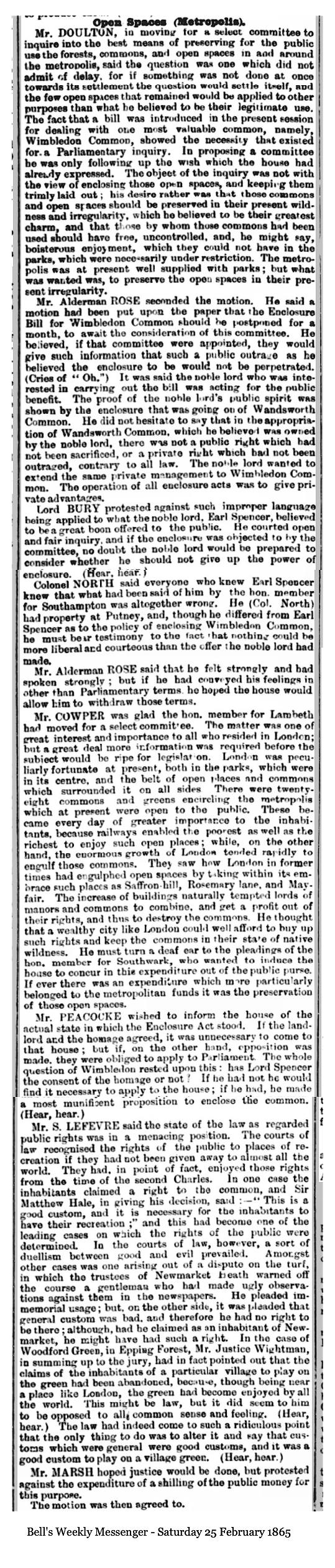
Open Spaces (Metropolis).
Mr. DOULTON, in moving for select committee to inquire into tbe best means of preserving for the public use tbe forests, commons, and open spaces in around tbe metropolis, said the question was one which did not admit of delay, for if something was not done at once towvds its tettfoment tbe question would settle itself, and the few open spaces that remained would bo applied to other purposes than what believed their legitimate use. Tbe fact that bill was introduced in the present session for dealing with oi.e valuable common, namely, Wimbledon Common, showed tbe necessity that existed for. a Parliamentary inquiry. In proposing a committee he was only following the wish which the bouse had expressed. The object of the inquiry was not with the view of enclosing those ope-n spaces, and keepii g them trimly laid out; his desire rather was that iboso commons and open sf aces should be preserved in their present wildness and irregularity, which ho believed their greatest charm, and that those whom those commons had been used should have free, uncontrolled, aod, might say, boisterous enjoyment, which they could not have the parks, which were noco-sarily under restriction. Tbe metropolis was present well supplied with parks; hut what was wanted was, to preserve tbe opo:i spaces iu their prosent irregularity.
Mr. Alderman ROSE seconded the motion. said motion bad been put the paper that the Enclosure Bill for Wimbledon Common should for a month, await the consideration of this committee. bo.ieved, if that committee wore appointed, they would give such information that such a public outrage he believed the enclosure would not be perpetrated. (Cries Oh.") It was said the notde lord who was interested in carry ing out the bill was acting for the public benefit. The proof the noble lord's public spirit was shown by the enclosure that waa going on of Wandsworth Common. did not hesitate to that in appropriation of Wandsworth Common, which believed owned the noblo lord, there was not a public right which had not been sacrificed, or private right which had not been outraged, contrary all law. the no'-fo lord warned to extend the same private management Wimbledon Common. the operation of all enclosure acts was to give private advantages.
Lord BURY protested such improper language being applied what tbe noble lord. Earl Spencer, believed great boon offered to the pmblto. courted open and fair inquiry, and if the enclosure was objected to by the committee, doubt noble lord would bo prepared to consider whether should not give the power of enclosure. (Hear, hear.)
Colonel NORTH said evoryono who know Earl Spencer knew that what had been said of him by the hon. member for Southampton was altogether wrong. (Col. North) had property Putney, and, though he differed from Earl Spencer as to the policy of enriching Wimbledon Common, he mu-t heir testimony to the tact that nothing oould more liberalacd courteous than tbo effor noble lord had made.
Mr. Alderman ROSE said that he frit strongly and had spoken strongly ; but if hail cnnv. yed his feelings other than Parliamentary terms ho hoped the house would allow him to withdraw those terms.
Mr. COWPER was glad the hon. member for Lambeth had moved for a select commit'ee. The matter was one of great interest and importance to all who resided in but a great deal more information w .a required before the subiect would bo for on. London was peculiarly fortunate present, both in the parks, which were in its centre, and the belt of open places and commons which surrounded it all sides There were twentyeight commons greons encircling the nvtrop*bg which at present were open to the public. These became every day of greater to inhabitints, because railways enabled tie poorest as well as the richest to enjoy such open places; while, the other hand, the enormous growth of London tended rapidly to engulf those commons. Thej saw how London in former times had engulphed open spaces by taking within its embrace such places as Saffron hill, Rosemary lane, and Mayfair. The increase of buildings naturally tempted lords of manors and commons to combine, and get a profit out of their rights, and thus destroy the commons. He thought that a wealthy city like London could well afford to buy such rights and keep the commons their state of native wildness. He must turn a deaf car to pleadings of the hon. member for Southwark, who wanted to induce the house to concur in this expenditure out of tbe public purse. If ever there was an expenditure which more particularly belonged to the metropolitan funds it was the preservation of those spaces.
Mr. PEACOCKE wished to inform tbe house of the actual state in which the Enclosure Act stood. If the landlord tbo homage agreed, it was unnecessary to come to that house; but if, on tbo other bind, rppo-itioD was made, they were obliged to apply to parliament The whole question of Wimbledon rested upon this : has Lord Spencer the consent of homage or notlf had not he would find it necessary to apply to the house ; if had, ho made a most munifioent proposition to enclose the common. (Hear, hear.)
Mr. S. LEFEVRE said the state of the law as regarded public rights was in menacing jiosition. The courts of law recognised the rights of the public to places of recreation they had not been given away almost all the world. They had, in point of fact, enjoyed those rights from the time of the second Charles. ono esse the inhabitants claimed a right tbo common, and Sir Matthew Hale, in giving his decision, said ; -* This is a good custom, and it is necessary for the inhabitants to have their recteation ;'' and this had become one the loading cases on w.lich the rights of public were dotormiootl the courts of law, bow. ver, a sort of duellistn between good and evil prevailed. Amongst other cases was one arising out diputo on the turf, in which tbo trustees of Newmarket Heath warned off the course a gentleman who had made ugly observations against them the newspapers. He pleaded immemorial usage; but. on tbe other side, it was pleaded that general custom was bad. and therefore had right to there; although, had bo claimed inhabitant of Nowmarket, he might have had such aright. In the case of Woodford Green, iu Forest, Mr. Justice Wightman, in summing up the jury, had in fact pointed out that the claims of the inhabitants of a particular village play ou the green had boon abandoned, boc..u-e, though being near place like London, the green had become enjoyed all the world. This might bo law, but it did stem to him to opposed to all| common sense and fooling. (Hoar, bear.) Tbe law had indeed come such ridiculous point that tbe only thing to was to alter it and say that customs which were general were good customs, and it was good custom to play village green. (Hear, hoar.)
Mr. MARSH hoped justice would be done, but protested against the expenditure of shilling of the public money for this purpose.
The motion was then agreed to.
[BNA: Link]
House of Commons, Tuesday
Mr Doulton moved for select committee to inquire into the best means of preserving for the public use the forests, commons, and open spaces in and around the metropolis. The question was one which would admit of no delay. He aid not wish to have the commons converted into enclosed and neatly-trimmed parks. That would involve great expense. He desired to respect private rights, but he also wished public rights should considered, and he believed the committee he saked for would be able to propose a comprehensive plan of dealing with the question.
Mr Rose seconded the motion. He denounced the conduct of Earl Spencer in seeking to enclose Wimbledon Common. It was said the noble earl was only actuated by desire for the public good, but his motives might be judged what he had done to Wandsworth Common. He (Mr Rose) did not hesitate to say that in the approportion of that common every public right had been sacrificed.
Lord Bury defended Earl Spencer, and said he be lieved his lordship could have done all he proposed to do for Wimbledon Common without coming to Parliament. His lordship was, however, desirous that the Wimbledon Common Bill should be referred to the select committee now moved for. C
Colonel North, thongh opposed to the enclosure of Wimbledon Common, believed that Earl Spencer in proposing it was actuated the host motives.
Mr Jackson hoped it would be understood that no call would be made on the public funds in connection with the proceedings of this committee.
Mr Locke thought the might fairly ask for public funds to preserve the open spaces near London.
After few remarks from Mr Bentinck and Mr Torrens, Mr Cowper approved of the appointment of the committee. He did not not think it would much for wealthy city like London buy up the open spaces near the metropolis, would be to expect the Imperial Government provide the necessary suns.
Mr Peacoke defended Earl Spencer.
Mr Lefevre reviewed the legislation in respect to common rights, and hoped the committee would look closely into the matter.
Mr Marsh should object to one shilling of the public money being spent on these commons.
Mr Cox supported the motion for a committee.
After a few words from Mr Doulton the appointment of committee was agreed to.
[BNA: Link]
[What was Marsh's argument — that lords have absolute rights and should have complete freedom to flog everything off? Or that no public money needs to be spent — that the land should be appropriated for local use?]
[Rose mocked by a newspaper in his constituency.]
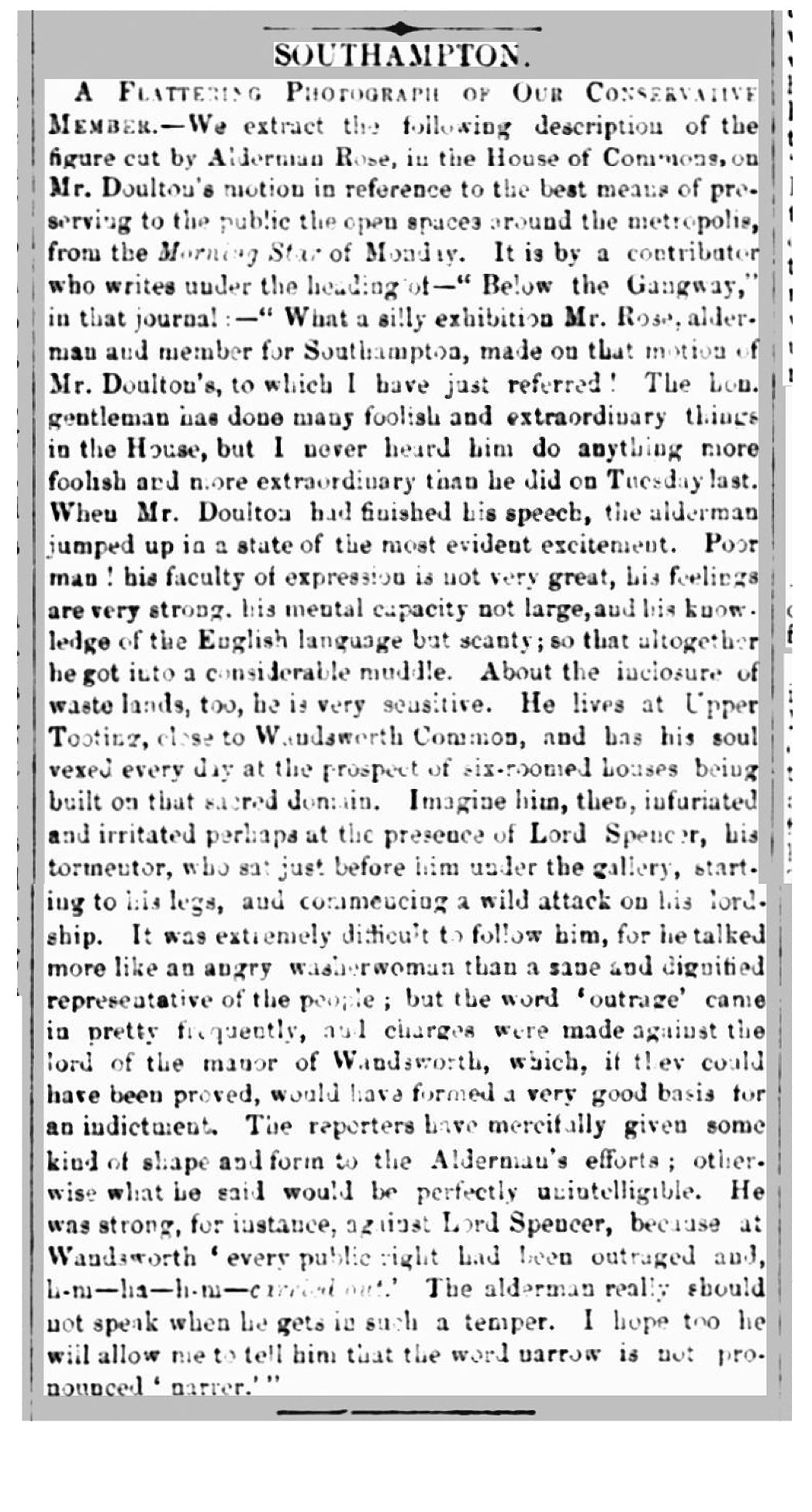
SOUTHAMPTON
A FLATTERING PHOTOGRAPH OF OUR CONSERVATIVE MEMBER
We extract the following description of the figure cut by Alderman Rose, in the House of Cormmons, on Mr. Doulton's motion in reference to the best means of preserving to the public the open spaces around the metropolis, from the Morning Star of Monday.
It is by a contrihntor who writes under the — of — "Below the Gang Way," in that journal!: "What a silly exhibition Mr. Rose, alderman and member for Southampton, made on that motion if Mr. Doulton's, to which I have just referred! The hon. gentleman has done many foolish and extraordinary things in the House, but I never heard him do anything more foolish and more extraordinary than he did on Tuesday last. When Mr. Doulton had finished his speech, the alderman jumped up in a state of the most evident excitement.
Poor man! his faculty of expression is not very great, his feelings are very strong. his mental capacity not large,aud his knowledge of the English language but scanty; so that altogeher he got into a considerable muddle.
About the inclosure of waste lands, too, he is very sensitive. He lives at Upper Tooling, close to Wandsworth Common, and has his soul vexed every day at the prospect of six-roomed houses being built on that sacred domain.
Imagine him, then, infuriated and irritated perhaps at the presence of Lord Spencer, his tormentor, sat just before him under the gallery, starting to his legsand commencing a wild attack on his lordship.
It was extremely difficult to follow him, for he talked more like an angry washerwoman than a sane and dignified representative of the people; but the word 'outrage' came in pretty frequently, and charges were made against the lord of the manor of Wandsworth, which, it they could have been proved, would have formed a very good basis for an indictment.
The reporters have mercifully given some kind of shape and form to the Alderman's efforts; otherwise what he said would be perfectly unintelligible.
He was strong, for instance, against Lord Spencer, because at Wandsworth 'every public right had been outraged and, h-m — ha — h-m — carried out.
The alderman really should not speak when he gets in such a temper. I hope too he will allow me to tell him that the word narrow is not pronounced 'narrer'."
[BNA: Link]
[This article was referred to, with choice extracts, in the South London Chronicle 4 March 1865: Link]
The subject of "open spaces" for recreation is attracting considerable attention, apropos of Mr. Doulton's select committee on the subject, and Lord Spencer's bill to inclose one part of Wimbledon Common and build upon another. The feeling in favour such open spaces is all but universal, but unhappily no one sees his way clear effect the object. It is rather curious, and by no means encouraging, that Hampstead Heath and Blackheath are both in danger from the action which may be taken by the same gentleman, and that Wimbledon Common and Wandsworth Common, also, are both, to a very dangerous extent, under the control of the same nobleman. If there be no other means of preserving these places (to Bay nothing of others) to the public, why not compensate the opyholders and rate the whole of the metropolis to pay the cost?
[This short piece was widely reproduced. More examples here.]
The subject of "open spaces" for recreation is attracting considerable attention, apropos of Mr. niton's select committee on the subject, and Lord Spencer's bill to inclose one part of Wimbledon Com- 1 mon and build upon another. The feeling in favour such open spaces is all but universal, but unhappily no one sees his way clear effect the object. It is rather curious, and by no means encouraging, that Hampstead Heath and Blackheath are both in danger from the action which may be taken by the same gentleman, and that Wimbledon Common and Wandsworth Common, also, are both, to a very dangerous extent, under the control of the same nobleman. If there be no other means of preserving these places (to Bay nothing of others) to the public, why not compensate the opyholders and rate the whole of the metropolis to pay the cost?
[BNA: Link]
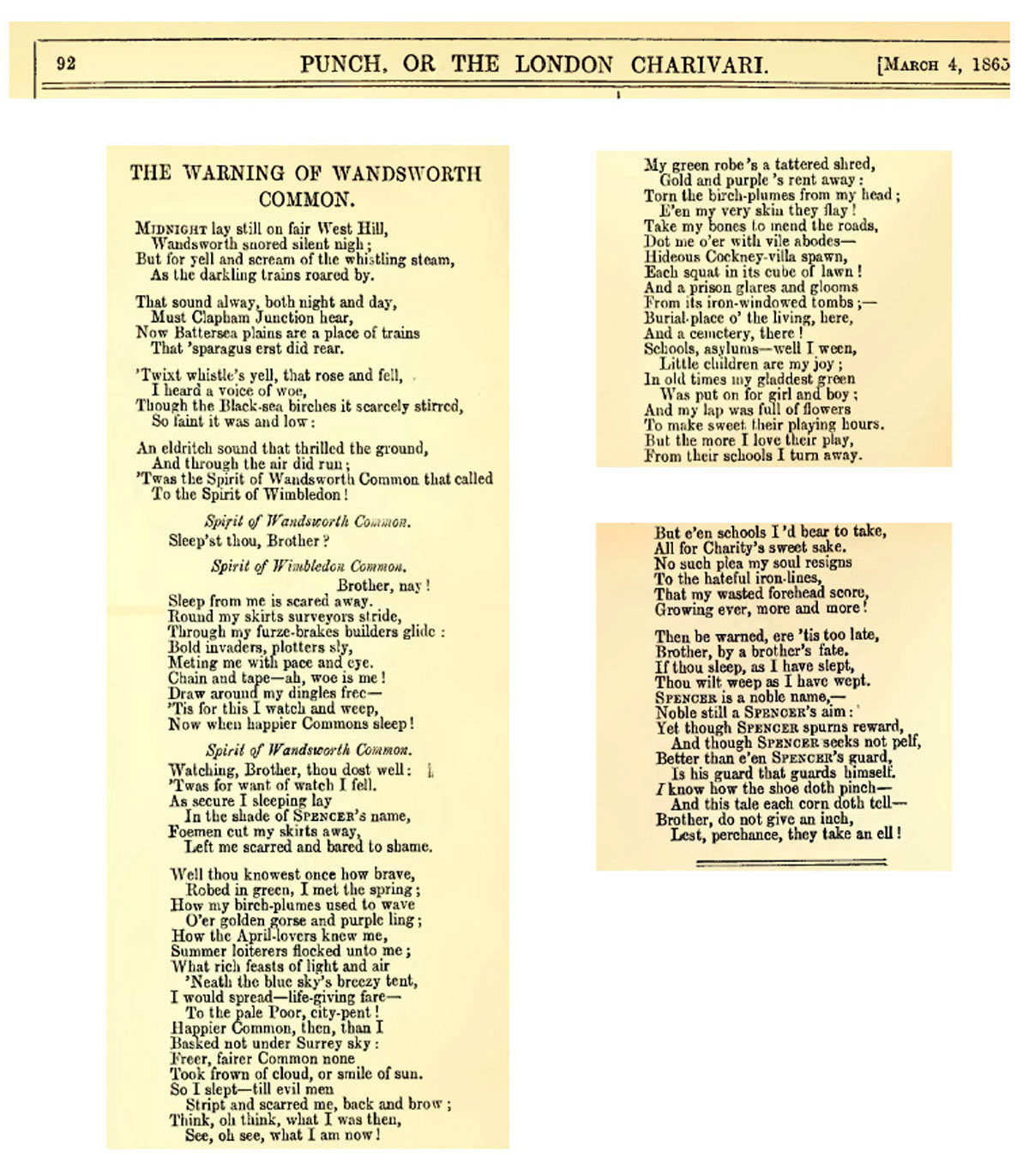
THE WARNING OF WANDSWORTH COMMON
MIDNIGHT lay still on fair West Hill,
Wandsworth snored silent nigh;
But for yell and scream of the whistling steam,
As the darkling trains roared by.
That sound alway, both night and day,
Must Clapham Junction hear,
Now Battersea Plains are a place of trains
That 'sparagus erst did rear.
'Twixt whistle's yell, that rose and fell,
I heard a voice of woe,
Through the Black-sea birches it scarcely stirred,
So faint it was and low:
An eldritch sound that thrilled the ground,
And through the air did run;
'Twas the Spirit of Wandsworth Common that called
To the Spirit of Wimbledon!
Spirit of Wandsworth Common.
Sleep'st thou, Brother?
Spirit of Wimbledon Common.
Brother, nay!
Sleep from me is scared away.
Round my skirts surveyors stride,
Through my furze-brakes builders glide:
Bold invaders, plotters sly,
Meting me with pace and eye.
Chain and tape – ah, woe is me!
Draw around my dingles free –
'Tis for this I watch and weep,
Now when happier Commons sleep!
Spirit of Wandsworth Common.
Watching, Brother, thou dost well:
'Twas for want of watch I fell.
As secure I sleeping lay
In the shade of SPENCER's name,
Foemen cut my skirts away,
Left me scarred and bared to shame.
Well thou knowest once how brave,
Robed in green, I met the spring;
How my birch-plumes used to wave
O'er golden gorse and purple ling;
How the April-lovers knew me,
Summer loiterers flocked unto me;
What rich feasts of light and air
'Neath the blue sky's breezy tent,
I would spread – life-giving fare –
To the pale Poor, city-pent!
Happier Common, then, than I
Basked not under Surrey sky:
Freer, fairer Common none
Took frown of cloud, or smile of sun.
So I slept – till evil men
Stript and scarred me, back and brow;
Think, oh think, what I was then,
See, oh see, what I am now!
My green robe's a tattered shred,
Gold and purple's rent away:
Torn the birch-plumes from my head;
E'en my very skin they flay!
Take my bones to mend the roads,
Dot me o'er with vile abodes –
Hideous Cockney-villa spawn,
Each squat in its cube of lawn!
And a prison glares and glooms
From its iron-windowed tombs; –
Burial-place o' the living, here,
And a cemetery, there!
Schools, asylums – well I ween,
Little children are my joy;
In old times my gladdest green
Was put on for girl and boy;
And my lap was full of flowers
To make sweet their playin' hours.
But the more I love their play,
From their schools I turn away.
But e'en schools I'd bear to take,
All for Charity's sweet sake.
No such plea my soul resigns
To the hateful iron-lines,
That my wasted forehead score,
Growing ever, more and more!
Then be warned, ere 'tis too late,
Brother, by a brother's fate.
If thou sleep, as I have slept,
Thou wilt weep as I have wept.
SPENCER is a noble name, –
Noble still a SPENCER's aim:
Yet though SPENCER spurns reward,
And though SPENCER seeks not pelf,
Better than e'en SPENCER's guard,
Is his guard that guards himself.
I know how the shoe doth pinch -
And this tale each corn doth tell –
Brother, do not give an inch,
Lest, perchance, they take an ell!
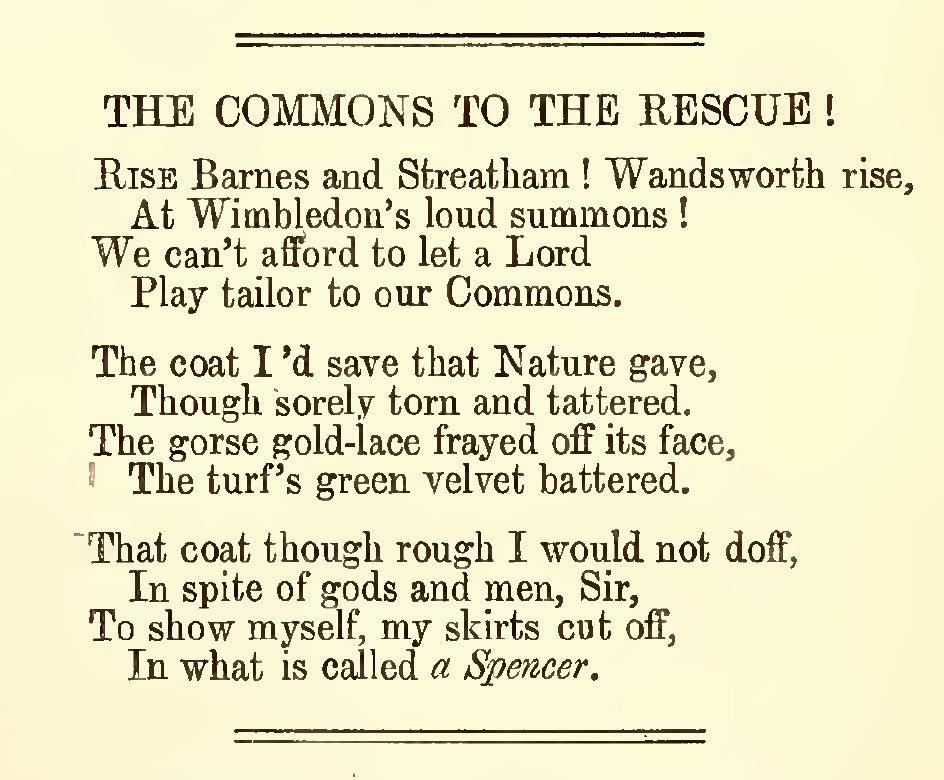
PB: July 2020: I don't know how I missed this poem before, but it was printed a week after after the "The Warning of Wandsworth Common", Punch, March 4 1865.
— the places named (Barnes, Streatham, Wandsworth, Wimbledon) are all SW London commons under threat at this time (1865)
— notice the cloth and imagery — Lord plays tailor — coat — gorse as gold lace — turf as velvet — skirt
— notice the implied contrasts — Lords/Commons — Nature (no matter that it has been damaged)/Artifice
— AND — and this is really delightful — notice the MULTIPLE puns and allusions in the poem
— the poem was (almost certainly) written for Punch by Tom Taylor — ho ho
— to tailor is to cut, of course
— "a Spencer" was defined as clothing whose tails or skirts had been cut off:
The spencer, dating from the 1790s, was originally a woolen outer tail-coat with the tails omitted. It was worn as a short waist-length, double-breasted, man's jacket . . . It was also soon adopted as a popular women's fashion on both sides of the Atlantic during the 1790-1820 Regency style period. The spencer was worn as a cardigan, or as a short, fitted jacket cut to just above waist level, or, in Empire style, to the bust line, and tailored on identical lines to the dress. The use of the term spencer continued well into the 19th century to mean more generally any type of short jacket or coat.
[Wikipedia: Spencer (clothing).]
It was named "spencer" after George, the 2nd Earl (born Wimbledon Park), "who is reported to have had a tail-coat adapted after its tails were burned by coals from a fire".
[Wikipedia: George Spencer.]
Science-Gossip also discourses upon Wimbledon, and designates the tendency to diminution of common-area as "Short-Commons." "For us," writes the editor, "the vision of Wimbledon Common surrounded by miles of monotonous palisades, and laid out in trim parallelograms of level grass, intersected by the cleanest of gravel walks, is enough, be it only a vision, to arouse us from exploring the 'Origin of Species' to protest against the 'Origin of Parks' and the absorption of 'the last of commons.'
Not 'the last of the commons,' and not closed to the public' are the pleas put against us. Are not Wandsworth Common and the Black Sea left? Is there not a common at Barnes, or Esher, or Weybridge? And if Hainault is gone, and Epping is going, is not the New Forest left? We are not politicians, so perhaps all this is it should be. It may right enough to give to. 'Labour' its Saturday half-holiday, that it may go out of town and enjoy itself, and hold converse with Nature face to face, and at the same time drive Nature far out of town, that half-day is too short to reach her domains
[BNA: Link]
[A whole page of adverts/references to George Todd's properties throughout south London, including Wandsworth Common, and elsewhere. Worth looking at more closely.]
[BNA: Link]
[Also BNA: West Middlesex Advertiser and Family Journal — Saturday 1 April 1865 . Pdf: here.]
CLIPPINGS OF THE MONTH. (From the Spectator for January.)
The feeling of the parishes adjoining to Wimbledon Common is pronouncing itself strongly against Earl Spencer's Bill. At a privately called, but numerously attended, meeting of freeholders and others residing in the vicinity, held at Wimbledon House (H. W. Peek, Esq.) on Saturday last, and comprising almost all those gentlemen whose property might derive enchanced value from the formation of the proposed park, almost the only supporter of the inclosure and of the proposed Spencerian czarship was a Mr. Paine, who declared the noble Earl "too great a man" to be opposed.
On the other hand, it was pointed out that the Bill, whilst conferring almost every conceivable power on Lord Spencer, imposed no kind of obligations upon him, in fact, made him " protector" without so much as binding him to protect; that the proposed diversions of roads seemed to have been planned for the sole benefit of the noble Earl's future mansion, and to the utmost inconvenience of the public, 44.. c., ac.
Admiral Sullivan urged that the portions of Putney Heath which are set apart for sale by the plan are really the most frequented parts of the whole Common, and from an experience of several years at the Roehampton end stood up in the most unexpected way for the morality of the gipsies and tramps, the need for whose removal is put forward as the main argument for the Bill.
According to his testimony, the only moral nuisance on the Common is one indirectly of Lord Spencer's own making, and proceeds from some wretched women of the lowest class, who are attracted by the diggers in the lord of the manor's gravel pits (the full enjoyment of which he proposes to retain in the Bill) — a set of men whose conjugal infidelities almost provoked lynching at the hands of the gipsy wives on one occasion.
Our article of last week, it seems, has to be corrected on one point. According to Mr. Paine, the extinction of Wandsworth Common is solely owing to the late, and not to the present Earl, who has made no further grants out of the waste. Let it therefore be understood that the Spencers only eat up Commons at the rate of one per Earl.
The opening of a subscription was announced towards defraying the cost of a vigorous opposition should the Bill be persevered in.
[BNA: Link]
">Our article of last week . . . According to Mr. Paine"?]
CARRY ON FROM HERE: BNA: Link]
e.g. Globe — Friday 7 April 1865
>>https://www.britishnewspaperarchive.co.uk/viewer/bl/0001652/18650407/019/0002<<
London Evening Standard — Friday 7 April 1865
>>https://www.britishnewspaperarchive.co.uk/viewer/bl/0000183/18650407/026/0005<<
WANDSWORTH COMMON ENCLOSURES
[VERY IMPORTANT — FINISH EDIT.]

WANDSWORTH COMMON ENCLOSURES
The committee appointed to inquire into the best means of preserving for the public use the forests, commons and open spaces around the metropolis, met again yesterday, Mr. LOCKE in the chair. Nearly all the members of the committee wine present . . .
[PB: I have made a short section on Wimbledon Common invisible.]
Previous to taking evidence respecting Wandsworth-common, The Hon. Charles Gore, one of her Majesty's Commissioners of Woods, was examined with respect to the crown rights over Wimbledon-common.
He said his attention had been drawn to the subject in consequence of the introduction of Earl Spencer's Enclosure Bill. The crown claimed rights in respect of property at Mortlake. It was a part of the private property of George the Third transferred to the Commissioners of Woods in 1820, and afterwards re-granted to the crown. It was situated in East Sheen, and was called March-gate-farm. The rights of the crown had not been settled. He believed that Earl Spencer denied the existence of rights of common. The crown claimed in respect of enclosed land at Mortlake.
The parliamentary survey of 1649 contained various findings with respect to the rights of the lord and the tenants over the commons, and among the customs of the manor were the following: "Every cottager that is a copyholder of the said manor may keepe on the commons within the sayd manor twentie-five sheepe two cows one mare and a coult, and is to have once in every yeare allowed him one carte load of croppe wood from of the pollards of the sald commons and he that hathe fifteen acres or the greate [part?] of fifteen acres of copic [?] hould land in is to have the like libertie of commonery and fireboots [?]."
He could not tell off-hand what the crown might claim by virtue of that provision.
If the crown claimed compensation for common rights, it was in the case of enclosure. The land of the crown was generally let on lease, and the lessee might or might not exercise these common rights. He believed the crown to possess the rights which he had described.
Mr Rose, solicitor, was called and examined by Mr. Alderman Rose [PB: a relative? Presumably this was his brother William? William lived at "Bifrons", Upper Tooting. Where did James Anderson Rose live. Together? No — he lived next door to Fernside] with respect to the state of Wandsworth-common.
He said — I am the owner of property on the east side of Wandsworth-common, and have been so for the last 13 years. At that time there were no enclosures except one piece of land in front of Mr. Wilson's house . The first enclosure made was by the parish of St. James, Piccadilly, for a workhouse or for parochial schools.
[PB: Mr Wilson, who owned Price's Candle Works, lived in a large house with grounds and the Black Sea that made way for the future Spencer Park]. This was St James's Industrial School for Boys, built [date?] .Earl Spencer lived in the parish of St James, Piccadilly.]
The next was by a railroad running right through the common.
[PB: This was the ? line to Portsmouth etc. There was no station at "Earslfield" until [date?]]
The next was for railroad purposes, for excavations to make the embankments up to the Crystal Palace There were 13 acres excavated to a considerable depth and left in that condition.
[PB: So, well before the trainline was laid, earth had to be found to raise the Crystal Palace railway? I've seen a reference in the Daily News in 1864 ? that trains were running regularly fr the the 4+ miles between Wandswrth Common and Crystal Palace. ]
The next enclosure, was for the Patriotic School. Then pieces of land were enclosed by Mr. McKellar.
[PB: Work started on the RVPA in 1855?. McKellar lived in Wandsworth Lodge [roughly where ? is today]. His "triangle" was all the land between (the future) Trinity Road, St James's Drive, and Bellevue.]
Were these enclosures made under the Enclosure Act? — No. I am not aware by what authority they have been made. The general opinion is that they have been made by no lawful authority whatever. At the time I went there there were public footpaths over the whole of Wandsworth-common. The whole of them have been stopped up, except one which crosses in the centre, in a straight line. The enclosures have been made up to the carriage road in some instances without leaving any footpaths.
[PB: The road which crosses "in a straight line" is presumably the future Trinity Road rather than the old track that meandered either side of the Wandsworth-Battersea parish boundary. The roads built without footpaths probably include Bolingbroke Grove.]
With regard to the drainage, in what state was the common when you went to live there ? — It was kept in good order thirteen years ago by the inhabitants, who held a lease. They excavated gravel at certain points in such a manner as to convert the spaces into ornamental waters.
In what state is the common now? — It is a morass now. A great portion of it is under water all the winter, and was so up to the 20th March. A portion of it is now under water. In summer time the water soaks in, but it leaves the common in a bad condition.
I consider Wandsworth-common is an unhealthy place, on account of the want of drainage. In olden times the excavations were made so as to preserve the beauty of the common and its use to the enjoyment of the public; but during the last five years the gravel has baee excavated in extraordinary quantities so that the common is not usable by the commoners. It is full of pits and water; and some time ago the dead body of a man was taken out of one of these pits.
[PB: The dangers of drowning in these pits — deliberately by suicide or by accident in the night — was widely discussed.]
In the whole area of Wandsworth-common is there sufficient space for a cricket-ground? — There is only a small space near Wandsworth town, the enclosures have been made contrary to the wishes of persons living there or having property in the neighbourhood, with the exception perhaps of Mr. M'Kella [McKellar].
[PB: Almost certainly the gorse-free area near Heathfield Cottages? The demand for cricket pitches was socially vital throughout the century e.g. cricketers at a meeting at the County Arms in [date?] were furious that they faced losing the pitch they had created — i.e. presumably flattened and mowed. What does the comment about McKeller mean? That he alone wanted enclosures?]
The interests of the public have been totally sacrificed by the making of these enclosures. The inhabitants believe they have been made illegally, and contrary to all rights and justice. Wandsworth-common was held on a lease by a certain number of the inhabitants of the district, in the same way that Clapham is now held, and it was kept in order by a public subscription. They had an open space for the public use and enjoyment. I believe that a deputation waited on Earl Spencer to ask him to grant a new lease, on condition that they would preserve the park for public use and enjoyment.
[PB: I've not seen another reference to this "lease". What did it mean? ]
And what was the answer? — He refused. There was a common keeper, but there is none at present. There was an avenue of trees a mile long, planted by the inhabitants of the district. The ground has been dug right up to the trees, one-half of which are wholly destroyed, and the other half are in such a bad condition that they might as well be taken away. The last enclosure was made right up to these trees.
[PB: "common keeper" — I recall a common keeper in a novel where two sailors go shooting on Wimbledon Common early in the century and fight with a keeper. Find the reference.]
[PB: Was this "avenue of trees a mile long" by the side of Bolingbroke Grove? (Or Trinity Road?) I think I recall the destruction of these trees [chestnuts?] was a complaint.]
Earl Spencer is the lord of the manor of Clapham. There has been no enclosure there. I believe a new lease was granted 30 years ego of that portion of Clapham-common which Earl Spencer is lord of the manor. Clapham-common is preserved to the use of the public at a very small expense. It is of the greatest service to the public. There is a large open space for cricketing, and a large portion covered with gorse.
What is the difference between Clapham-common and Wandsworth-common? — Around Clapham-common there are numerous mansions, inhabited by the rich, the rental exceeding £50,000 a year, and any enclosure would be resisted by them. Wandsworth-common is a poor district, the residents around are few in number, and could not raise the money, or have not the courage to contend against the lord of the manor, he having unlimited resources and a definite object, and they having no definite object and small resources.
I am not aware of any nuisances on Wandsworth-common except those committed with the sanction of the lord of manor or his agents. I do not consider the gypsies a nuisance. I have never lost anything by them. But there are people who come on Wandsworth-common who are objectionable. They come from the gaol at the expiration of their sentences, and congregate in considerable numbers. They are sometimes interfered with by the police; but I not aware that they are interfered with by the lord of the manor. The gaol is situate at the edge the common.
By Mr. Lefevre — Before those enclosures took place the common was much used in summer time. The population of Wandsworth is about 10,000. The extent of open area is not more than one-half what it was originally. I am not aware of any common rights. The copyholders are few in number, and are entirely under the influence of the lord of the manor. The lease to which I allude expired five or six years ago.
[PB: The extent of the Common may have been around 400 acres, but by this time it was down to about 150 acres. Some (small) areas were later restored to the Common.]
By the Chairman — Tooting is at one end of the common. Many houses are in the course of erection in the neighbourhood. Some time ago I applied on behalf of myself and three other persons to be allowed to enclose a space opposite to our houses, solely to to prevent any one else from doing so. The application was made to Earl Spencer's agents. That was in 1860. In November of that year an answer was received from them, stating that Earl Spencer was not very desirous of parting with any of the common at Wandsworth, so much having previously been enclosed, but stating that if we were in a position to make an offer it might facilitate matters. I did not make an offer, and there the matter dropped.
By Mr. Cowper — I presume the railway enclosure took place under the railway act. The enclosure made by the parish of St. James took place under no act of parliament. They obtained the property at a very low price, because there was no title. The price was about 30s per acre. I presume the amount was paid to the lord of the manor. Mr. M'Kellar enclosed in conjunction with the lord of the manor. The lord sold him the property for so much money, and he put up the fences. I believe that there is no title to these enclosures. The fences are run up very rapidly, and the only way to interfere is to knock them down; but it would be rather awkward to do so in the case of a railway company. I have never communicated with the lord of the manor. No, because our belief is that it would be entirely useless. That is the general opinion.
By Mr Tollemache — Why did you not try your right by pulling down the fences in the case of the lord of the manor? Because that would be a preliminary to a long litigation. My neighbours would not find money for that purpose and It would have been useless to commence pulling down the fences.
I hope the legislature will deal with the matter and not lead us into conflict with Earl Spencer. If I had sufficient money I would contest the matter with him to the end, but there is no worse form of carrying on litigation than by a committee of inhabitants. Earl Spencer would have every advantage in such a case, and might sacrifice all public rights.
[Interesting that he objects to "carrying on litigation . . . by a committee of inhabitants" — which of course will eventually happen.]
By Mr. Peacocke — Has there been any act relative to these enclosures except the railway acts? — None whatever.
By Mr. Baillie — When I went to Wandsworth the common was unenclosed.
["Mr Baillie" — who he?]
By the Chairman — The enclosures would never have been made but for the expense of litigation being so enormous
The committee then adjourned until after the holidays.
[BNA: Link]
THE ENCLOSURE OF COMMON.
It is difficult to understand on what grounds the House of Commons proceeded on Thursday night, when they allowed Lord Spencer's scheme for the alteration of Wimbledon Common to be read second time, even with the proviso that it is to be sent to select committee. The committee "open spaces," moved for by Mr. Doulton, and of which Mr. Locke is chairman, evidently had, in anticipation of the discussion of the Bill, after taking full evidence on the subject, reported very decidedly against the scheme.
They objected to fencing in the Common, and extinguishing common rights. They thought it was neither necessary nor desirable to sell any of the land, and thus struck at the root of many of these schemes, when they recommended the immediate repeal of the "Statute of Merton," which enables a lord of the manor to enclose, without the concurrence of the Commoners or the sanction of Parliament.
Yet, in the face this report, Lord Bury, who has been Lord Spencer's advocate in the Committee, urged, in presence of his ''noble friend," who was sitting under the gallery, the second reading of the Bill, and the House of Commons deliberately set aside the recommendation given to it by a committee of its own appointment — a most unusual, and must say contemptuous course, for the adoption of which can find no justification, in the advocacy of the measure itself.
Lord Spencer, and his advocates and his abettors, loudly profess their desire to benefit the public that and that alone, they declare is the sole object of the Bill; but the public might surely claim to too what is good for them as well Lord Spencer, and if he really wishes them so well, and desires earnestly to promote their comfort and jtcnotion might pay some respect their rejgo ns trances, and let the people happy in their own way. They say that Wimbledon Common is T well as it is — that it is breezy, wild, free, and healthy, and all they desire is that it may be left alone.
If Lord Spencer really desires to benefit them, there is one thing he can do: let him give up to the public any rights may possess, suppose to possess, oyer the Common, and thus secure to the people without litigation the light to roam freely oyer it for all time come. It is very suspicious when noble lords press "favours" upon people in this Srtinacious style, and notwithstanding Lord Spencer's earnest assurances that will comply with the two recommendations of the committee, and neither fence the Common nor sell any the land if the inhabitants will raise a rate drain it efficiently, hope that the select committee, which the Bill is to be referred, will give it its quietus and rid na for oyer of this very questionable "public boon."
The evidence given before the committee to Wandsworth Common the very day on which the Bill was read a second time, ought to be sufficient to ensure its ultimate rejection.
Lord Spencer is the lord of the manor of Wandsworth, as well as Wimbledon Common, and how have his powers been exercised there? Thirteen years ago was as open and free to Ike public Wimbledon now is. There were public footpaths over the whole the Common. The whole of them have been stopped up, except one which crosses the centre in a straight line, and the nnmerona enclosures have been made up to the carriage-road, in some instances without leaving any footpaths.
The whole of these enclosures have been made contrary to the wishes of persons living there or having property in the neighbourhood. No one can tell under what authority they bare been made, but the Commoners are few in number, the district is poor, and not able to enter into litigation with the lord of the manor, who, having all his way, has shown at Wandsworth what he would like to do at Wimbledon, under the pretext of conferring great boon on the public. We hope that if his lordship is so ill-advised as to persist pushing forward his Bill, that will sustain humiliating defeat by its rejection, either by the Private Bill Committee or the House of Commons.'''''
[Upkeep of the as-yet unamed Bellevue Road]
That the clerk request Mr. J. B. Smith, and the Rev. J. S. Jenkinson, to transfer to the Board the sum of £573 Is. 3d., three per cent, consols held by them in trust for the parish of Battersea, for the purpose of keeping in repair the road from Burntwood-lane to Nightingale-lane, Wandsworth Common, per agreement between the above parish and Messrs. Bush and Perkins in the year 1827. At the conclusion of the reading of this report, Mr. Juer proposed that cheques to the amount of £5,118 os. 3d. be signed.
[BNA: Link]
Blenheim Club — The members of this club commenced their season on Saturday last bv playing a match among themselves on Wandsworth Common. Sides were chosen by the captain and secretary. There was some spirited play on both sides, the principal scorers for the captain being Mr Luff 14, Mr Jonas 21, and the captain (Mr Cox) 17. For the secretary Mr Boswell scored 22 and the secretary which was the leger. The members then dined together at the Railway Tavern, Wandsworth, and the president presented, on behalf of the members, a handsome dressingcase to their secretary. Mr Harland, to whose labours alone the club owed its present position.
BNA: Link
It has become almost an historical fact that the Derby day is a fine day, and this morning proving no exception to the rule, thousands started for the Epsom Downs in all sorts of vehicles, while the railways provided ample accomodation for such as chose to avail themselves of that means of conveyance. A telegram received at mid-day informs us that the course was already densely packed, and that a most brilliant "Derby" is anticipated His Royal Highness the Prince of Wales is on the course.
The Prince with his suite left Marlborough House about half-past eleven o'clock to go down by road. The route was over Chelsea new bridge, and through the second lodge into Battersea Park, along the inside of the Park, and by Falcon-lane to Wandsworth-road, then across Wandsworth Common, and by Five House-lane, to the Epsom road, and along that to Merton.
The horses of the royal carriage were changed at the "Five Bells." Thence the Prince proceeded through Morden and Ewell to Epsom Town, passing through the High-street to Woodcote Park, and out at the lodge on the downs, then along the outside of the paddock, and by the road to the back of the Grand Stand. The route taken by the royal cortege was kept by mounted con- stables of the T division of metropolitan police, who, with the force on Epsom Downs, were under Mr. Superintendent Brett.
The Prince of Wales will return to town in the evening by the main road and Clapham-common.
It would be easy to add to these simple facts a great deal above the "incidents of rail and road," to describe in humorous language the comical variety of vehicles that swarm along the dusty road, the crush at the stations, the beautiful dresses of the ladies, the imbecilities of young gentlemen out for the day, and so forth; only we do not choose to make a hash of last year's incidents, and call it a new dish. To-morrow we have something to say of what really did happen this year.
[BNA: Link
THE ROAD
The road to-day presented as animated aa appearance at naual, and eaily M the bulk the pleaauie aaekeri were la>t year they were earlier tin,, main road to Clapliam waa crowded ai early eight o'clock, and at Kennington Gate aiiortly af that lime the carriage were so numerous that it waa only after oonaidcraWe delay that they got through, and be early atari did not conduce Ttry quick arrival the Downs.
Hansom cabs were the predominant eehb.ee; on former Derby days they have usually carried two only inside, but utterly regardless announcement on the plate this year the majority Tarried three, and various ingenious contrivances wore adopted accomplish this object. In aome Hansoms the "third party" occupied a chair aad faced his oompamonsln the seat, but the "prevailing fashion" seemed to be for one person sit hamper, "F. and M," indicative of the good contents, generally prominent.
Although the made the beet of the road, their drivers apparently having adopt tbt motto, oabbie# in, where,''Ac., they had not the whole of it. The inevitable costermonger cert was there; the four in hands were there j omnibuses, and daa carriage with po tilion, who looked uncomfortable end unused their situation, were there and so the company the road, that is the company going to the Derby, was made up. Every class vehicle represented, even the knackers cart, the three occupants of which, however, probably went down with eye business . If there was much aes on road, there was also much amusement and delight the foot-ways.
The road between Clapham and Tooting be the place, of all other, where ladies school, or perhaps should esy, "college foe young ladie " abound; and although, matter of course, young ladies always look well, still they seem to look hotter on the great the than st say other time, when, with faces lighted up by the nnirostion youth, they look out those going the Derby, sod criticise the animals — bipeds by the way, as well quadrupeds, in snob manner young ladtee only can.
Not only did the school do honour the oeo ion to-day, but moat of the garden were occupied fashionable company, and in some temporary tier of seats were arranged. . . . . "Is the Prince of Wales coming was the interrogatory put to those who were likely to know, aad those who were not; aad when did come, having started from Marlborough House and made the Ei sons road the lane below Wandsworth Common, few obeerved|hiro, though wherever he was observed there ready cheer.
The weather being ae fine be wished, of course the footway were lined with people, "Scott, the Champion Bill-poster," and ths Crystal Palace Company, seemed vie with each other in the prominence of their advertisements; on the house sides, on the scaffolding where houses are to be, their advertisements were strikingly obvious, and looking at the toll-ticket on the return journey, who are fortunate enough to lave retained it will generally cry out, instead of number, that which is far more cleat and diitinet than the ticket, " Scott, the Champion Bill
Certainly, the Society for the Prevention Cruelty to Animals must have gone to the Derby early or many would not have reached the Elephant and Castle. It was bad enough to see wagonette, drawn by one horee, with 13permon it; but the setue of kindness was outraged th exhibition one patient donkey drawing Id ofwell, his impatient brothers, behind him. themsny who started, however, not few reemed to think it was well enjoy themselves the rosd, and lave the trouble of going the whole diitanoe; and publics" near the starting point as the Borough pleasuie vans and carte were be aeon empty, the recent occupants being deeply engaged in the mystery pipes aed and some cases indulging in an amateur musical entertainment, in which "Slap bang, her# are agaia, waa the favourite melody.
And, spooking of melody, the niggers were great this year, but did not stem to make first-rate harvest, forth tramps were few, the rail having removed that oertainly industrious class, wlo must have been the true lover spirt, who used to walk and from Epsom each year. Punch, too, little at discount, and although plkd hi stick vigorously, and although Toby sat patiently- eerablo, blinking at the spectators, the audience seemed an uaptonteble one. "The Road," indeed, waa woU pleased with itself, the good-humoured oliaff that waa plentifully Indulged seemed to shorten the journey, which from Wandsworth onward was slow and dusty enough.
[Other articles follow covering travel by railway from Waterloo and Victoria.]
[BNA: Link]
Also Express (London) — Wednesday 31 May 1865
(report of a fire in a horse-drawn carriaGE ON WC:
" . . . of a pleasure van catching fire. It appears that large pleasure ran, filled with persons of both sexes, was crossing Wandsworth Common on the way to Epsom, when was discovered to be on fire through some of the smokers having dropped their lighted tobacco . . . ")
[BNA: Link]
Many more reports, probably mainly republication.
[BNA Search: Link]
COMMONS AND OPEN SPACES AROUND PECKHAM
A large and enthusiastic meeting of owners of property, inhabitants, and parsons claiming eomroon rights, told the King's Arms, Packhamrya, Wodnatoay evening last, seven o'clock, to u consider bast means to be adopted to prevent erection of buildings in tha open spaces Pockham-rye, Goose-green, and Nunhead-grean, and to maintain rights hitherto enjoyed." Tto large room wta inconveniently filled, and many ware unable to gain admission.
The chair was taken B. Gray, Esq., and additional interest waa imparted to proceedings by tha presence of Aldermen Lawrence, Eeq., and F. Doulton, Esq., the members for Lambeth. We also observed among the gentlemen present: Messrs. J. Richardson (C.C.), J. Scott, 8. Straker (C.C.), T. Norton, J. Stony, J. Taylor, Bov. P. W. Elliott, T. Drake, A. Brett, W. Nortbcott (O.O.), J. Godder, J. Wool ton, J. Thompson, J. Douglas, G. Wright, W. Sehoilrid, W. Adams. J. Finley (0.0.), F. W. Danny, J. W. Gall, B. Cranford, G. Howard, C. Howard, J. Shields, D. Rogers, Peachey, Davies, F. J. Potter, C. Boris, Lupton, Littai, Coombs, Hawes, Trimmer, As. Letters of apology for absence from the meeting were read from P. J. Locks King, Esq., M.P., C. Buxton, Esq., M.P., and Messrs. Broderick, Peek, and T. Hughes, the three latter gentlemen being candidates for the new Parliament.
The latter gentleman's letter said: "I should have been present with much pleasure, but that I have engagement which I cannot now put off. Should you hold any further meetings I hops yon will give the chance of attending, as I quite agree that the subject is one the first Importance to the borough."
The chairman, on rising to address the meeting, was warmly greeted with applause. He observed it was quits unnecessary for him to sttpte the object for which they were met that evening; hot his being sleeted to the chair was compliment which duly appreciated, which most have arisen from the connection which had had with the Common since 1819, since the time wheu attempt had been made to deprive the inhabitants the use of the common. was the only survivor who then look iutereetin protecting the common. They had then very severe fight, but they achieved the victory. The speaker narrated at some length the efforts that were then made to frustrate the attempt in the House of Commons, and the ultimate success which attended their efforts. He thought there was something monstrous in the attempt to deprive the inhabitants of the use of the common. (Hear, hear.)
The resolution be had to submit to them was to the following effect: "Inasmuch Mr. Graham, the solicitor ior tire lord of the manor of Camberwell Frierne, and Camberwell Buckingham, stated in his evidence before the committee of the House of Commons on'Open Spaces around the Metropolis,' that there were no common rights, and that the lord of euob manors possess the freehold thereof, end can now build thereon whenever he shall think fit, it is resolved by the inhabitants of Peckham-rye and its neigbbourhood, and the parties eatitled to its oommon rights, that they will use every means to resist any msasuraon the part of such lord of the manor to infringe npon the rights and privileges enjoyed from time immemorial." Ha considered that the resolution quite met their views in regard to the course the ought to taka (Hear, hear.) It was their bounden duty to try to iaerasso the comforts of the working maa. In conclusion, sincerely trusted that those parties who were trying to deprive them of their privileges would meet with signal defeat.
Mr. Thomas Drake rose to second the resolution. He remarked that Mr. Graham had bean examined before committee of the House of Commons and himself likewise: but that hie evidence was directly the reverse of Mr. Graham's. (tbs speaker) maintained that they hod right; and had been able bytlwaidofwddeadato trace book far as 1710. (Chssra.) Hs bad spent weak in trying to find old grant if than was one in existence; but had bean unsuccessful.
Mr. Graham had maintained that they had no existing righto of common, end that common had not been used for pasturage, do. The foot was that Urey saw two or three hundred sheep, and hones as well, use it day by day. He maintained that the main point to be considered was that the inhabitants should not sllow the lord of the manor to stool march upon them and override their privileges and righto. (Cheers.) It res tod with themselves to whether they were determined to maintain thair righto, notwithstanding the threat of the lord of the manor. (Applause.) The raeolution was carried without dissentient.
Mr. wished to ask from what the threat anas? The chairman said it merely arose from what had taken place befera the committee of the House of Commons.
Mr. Goddsa was anxious to know if there had been communication from any one on behalf of the lord of the manor with regard to these righto. Theohairman replied that Mr. Graham, the solicitor to the lord of the manor; had appeared before the committee of the House, and taking action then they were stealing march on the committee.
Mr. Trimmer said that Mr. Graham appeared as the representative of the lord of the manor, and claimed the common their freehold, bat apprebtoidad they would have no difficulty in resisting that claim. He believed there were plenty in that room who were prepared to come forward and assist that committee with evidence to before the committee of (bo House of Commons. They simply wanted to assert their righto in opposition to the lord of the manor. This was all they asked of them that evening as regarded Mr. Graham, who saw it was now or never.
Mr. Gall would like to know whether there any other eridence besidee that given by Mr. Graham before the committee of the of Commons. Had Mr. Graham stated that they had rights over Peekham-rye which they Intended to enforce? Mr. Trimmer replied that be simply appeared the representative of the lord of the manor, and stated his case.
Mr. Gall wm M to what Mr. Graham had %tatad generally, hot had stated specifically Peekham-rye Common?| Mr. Drake remarked, in answer to Mr. Gall, that It had been stated that the lord of the manor considered himself In position to build upon Peokbamrye Common. The hon. secretary (Ur. Straker) said that Mr. Doulton would communicate to them his views upon the subject He had been of great value to the cause,,and to him they felt much indebted.
Mr. Boulton had attended their committee meetings daring the winter, and had afforded them every infnrm.tim.
Mr. Doulton, M.P., was loudly cheered on rising to address the meeting. remarked that having interested himself on the question for the last two or three years, it was with very great pleasure that be attended the meeting that night, that the inhabitants should preserve those spaces for the recreation and enjoyment of the public. If he understood the object of that meeting it was that they were prepared to maintain those just and legal rights which they held in reference to this question. (Hear, hear.)
If there had been one regret felt the committee of the House, it was that the Inhabitants of those districts in which these commons were placed had not exercised the same energy and determination that had been shown in and other districts. There was extraordinary diversity of opinion with regard to those who claimed to have rights over these commons. He did not suppose it would right him to state what had taken place before committee of the House of Commons. He was quite sure that they had Men %afficfaot of ttao eridenoe the committee hod hod to dad with in the daily pres . Thera had bean three kinds of a ridesoe aahmitted: those who oonteaded for manorial rishta, tboaa who ware opposed to it, and the legal of those who profaaaed to hare atndied the subject. Bat there wee no legal opinion apon which they could rely in relationship to this subject.
Mr. Graham had contended that the lord of the manor had the right to do pleased with the common; then there was the evidence of those who believed that they had copyhold rights, which were of considerable woe; and then there was the opinion of lawyers, who gave their opinions in accordance with those who paid them. (Laughter.) That wee the kind of evidedce they had had to deal with, and they would see that it was of little value. It was absurd conclusion for agents to arrive at that the lord of the manor had a right to deal with these commons as pleased. They were compelled to get the sanction of Parliament. (A voice: "No, no.'') general rule parliamentary sanction mast be given to these enclosures. A men could not deal with common could with his own property. There wen exceptions in detail.
The exception which, no doubt, had just occurred to his friend was
Wandsworth common , one of the finest commons around London. No one attempted to deny that there were great difficulties connected with this question. He believed it was possible for them to enact parliamentary Act which would really preserve to the public the right of these commons. The question was, how wen they going to deal with it? He had no objection to tell them what would propose. would suggest that no common should be enclosed without the sanction of some such body as the Metropolitan Board of Works.
A great difficulty in dealing with this question was the one of money. He would give to those who were invested with the power of disposing of this land, that in cases where there was surplus of land, that they should have the power to sell, where it would not deteriorate the character of the commons. He believed that if this plan were adopted they would be able to preserve the improvements of the commons around London without the infliction of any burden upon the ratepayers.
In the case of Wimbledon Common there was at least some 40 or 50 acres that might be sold without deteriorating the character of the common. He believed there was not one in that room but would look with regret upon any encroachments being made in the commons. No matter what body were invested with the power sell, would wish to clog it with superior power.
As one of the members of Her Majesty's Government was upon the committee of the House, had every confidence that they would introduce Bill on this subject; and believed that another session would not pass without seeing satisfactory settlement of the question. (Applause.) If they did hot faring in Bill on the subject, then should feel compelled to do so. (Loud cheers.) It would be presumptuous in him to say what intended to do next session, with the approaching dissolution at hand%(laughter); but whether in the House or not, was convinced that the result of their legislation would be to preserve the commons to the free use of the inhabitants; and his hands would be strengthened by any decided action which they might take on this subject (Loud applause.)
A Voice: "Perhaps Mr. Lawrence Will favour with his opinion?" The chairman wished to remind the meeting that there was danse in existence, preventing the enclosure of the common; therefore they stood in better position than others did. He contended that there was spirit enough in that neighbourhood frustrate any attempt that might made to deprive them of the use of the common. (Hear, hoar.) He hdd no selfish motive himself on this question; but be should always strive to preserve those rights which considered inaUenable. (Cheers.)
Mr. Denny was rather sorry that the evidence of Mr. Graham, given before the committee of the House of Commons, had not been given to the meeting, because word wrongly stated might place them in very unenviable position with regard to Mr. Graham. He thought that the proper course of the committee would be to obtain, from those who had long been resident in the neighbourhood, evidence to show that they had right to exercise powers over the common.
A Voice: "Mr. Drake has explained it." Mr. Drake remarked that had already said that had spent the whole of week in searching for old grants or grant, but had been unsuccessful; but from old deed of 1720 he had found they had right to the common internuni.
Mr. Denny did not wish to throw any doubt on the subject Their worthy member (Mr. Doulton) had stated to them his opinions on this matter, ana hoped that the meeting would strengthen his hands by unanimous resolution the subject. Thera was one farther point which wished to mention, and that was that the Metropolitan Board of Works, who were spending their rates in removing houses, and making purchases, should be invested with power to pare base the rights of these open spaces; and it was intended to seek these powers he thought that vestries should be urged to get powers to secure these rights. (Hear, hear.) Mr. Straker remarked that they hod the evidence of the gentlemen who were in the committee-room of the House of Commons. As far the right of the commons from custom was concerned, they had the right of one family who had had it handed down for 400 years. (Cheers.)
Mr. Alderman Lawrence, M.P., on rising to address the meeting, was loudly applauded. He expressed the gnat pleasure felt in responding to the invitation to be present felt that it was matter in which the public were concerned, and was delighted to have the opportunity of offering his sympathy in the object which had brought them together.
The resolution he had to propose was: "That this meeting having beard with sunrise that the common rights of Feckham-rya, Goose Green, and Nunhead Green, are threatened to be encroached upon, to the utter annihilation of the above open spaces, this meeting most strongly protests against such an invasion, not only on behalf of the inhabitants of the neighbourhood, but equally on the part of the southern district of the metropolis; and this meeting hereby pledges itself to support the Peekham-rye Improvement Committee by subscriptions, and further urgently requests them to continue their measures in defence of the rights and privileges long enjoyed by the public large.'' He believed that both Parliament and the people were alive to this matter, and did not think that any former period the subject had been so well discussed as it was likely to be in the present and future Parliament (Hear, hear.) He thought that it was owing, in great measure, to the strong resolution passed by the House of Commons to the desirability of keeping open these spaces that was raising the ire of legal gentlemen. (Laughter.)
His friend, Mr. Doulton, was able to tell them more on this subject. The other day they had heard that the solicitor to the Commissioners of Woods and Forests had set the House of Commons de- fiance. He had allowed to take place in Crown lands, without being able to resist them, forgetting that the rights of the Crown were the rights of the people. (Cheers.) They had heard a great deal about manorial rights, bat these was one right above all%the right of the people. (Loud cheers.) By meetings of that description they would beable to back up the House of Commons, ana believed that such an impreasion would made upon the House and the country that the preservation these spaces would be made one of the means available for the health and enjoyment of the people laron (Cheers.)
Mr. John Richardson (member of the Court of Common Council) said bad much pleasure, inhabitant, and one who took deep interest in the conserving of the open space of Peokham-rye, second the resolution so ably propoaed by his mend, Ur. Alderman wrenoe, UP. Ho did ao. tar rmolution implied two objects most omurs%isl fsslinge, vis.: thotitedroeetsd tbs ---t-- — — fsTOursd brother end sister, the and daegfaters toil, who tame from all ernm? that satshty London to breathe the parodr heaven, and bask in God's gloriona (Cheers.) He did so, for it showed the Englishman, and that it carried oat the adage that God u helps those who help themssHm- and in meeting that night, they mot to pntem against any encroachment upon those righto ami privileges long enjoyed by not only the tents, bat the teeming thousands of . they not oven then an example of the advaaiman the oommon provided, whilst hundreds wen eowr lag the pore air of heaven in the cool summer's m The lord of the manor, ho know, was in aosdtf oasb, bttt hoped would not find remedy fm bisdodett in the desecration of so favoured spetm Peckham-rye, and thus deprive the thoosanih gained their daily bread by the sweat of their brow from the enjoyment of one of the greatest boom any snbcrb of London afforded. (Applaesal Amt thodaim of the lord of the manor, hedidnetbSew eould overttoow pestarage rights of 460 yes , though he knew it was the duty all menloMk after their own, trusted the men of Peshhamiesw would not be faithless to their character, end one of the greatest boons now poesesssd them poss iutUesely from their grasp. (Loud eheMa liked the niolntion because it spoke tinuing the laboure of body of geotlomen, eemeU sing the Peokham-rye Improvement CommiSn who bed boon moat watchful and pweistrot in defence of those righte they and their ehildrmUhe did hope their childrens ohildrea %would toonjoy. (Applause.) Toe, could pay moot oeneit tribute to the ooasistent and indefatigable labours ole committee who might be properly termed the wahh> don of their interests. Whilst they were enjoying toe advantages the oommon provided, these gsefle. men wen eagerly pursuing their duty in inqnlriro and rooting oat evidenoe to rebut any eUlm upon that rights and privileges by the lord of the soil Let thorn, than, said the speaker, show manly front, subscribing liberally to the Peokham-rye Defame Fond, for It wee not by speeches and show of heads that viotorie# wars gained, but by a mote mode, placing good sum in the hands the committee, who were still anxious in the future in the pest, to watoh and guard over the moat valued "o The resolution was put. end carried neanhnnmh %Mid great cheering. n Mr. Straker said that it afforded him great ateasMe in propoaing vote of thanks to Mr. Doulton %H Mr. Lawrence for attending there that ovanfog, He was satisfied, therefore, that they would to them nnaaimeus vote of thanks for thotr Bceenm on that oeoasion.
Mr. Denny had pleasure In eeoonding it The vote wee pat, end carried with aoobmeUen. Both the bon. gentlemen acknowledged the eetk fa suitable language.
Mr. Trimmer had to propone rote of than In the chairman. When they remembered that be always his services, and when they -mitosll the number of years that had resided fa that locality, was sure that they would all join hsartAy in the rote. (Cheers.) The Rev. F. W. Elliott said nee with gieflt ptoasore to second the rote of thanks. need add nothing mote to Mr. Trimmer had said. one looked at the manner which London extending, from year to year%east, west, north, etfl south%and saw that many buildings were rising up, even round Feokbam-iye, they most conclude that there must be little principle, and great deal of covetousness, in the heart of that man who Would try to wiest from the poor that which was eo a privilege. (Load cheers.) He would them to piotoro to themselves that evening mta appearance of Peckham-rye; bat what would they if it was boilt upon, and there was no tiarlrissS |daoe where they could get fresh air from? great pleasure in seconding the vote of thanks, mU hoped that their ehainaan would long be spared to carry oat the good work which had been basea. (Cheers.) The motion was carried unanimously, HM% cheers being called for, and given far the chairman. The mM felt the oouplhne%t the vote of thehki wMeh hed been peaeed to Mb. hod for 60 veere of his life been resident of thet vicinity. would remind then thet it wee ontr by Arm manifestation that they could secure the great object they had in view. quite agreed with hie rev. friend that they should take ovary means to loeioaee the happiness and comforts theee who wore daily employed. But they could notUm; without money. (Laughter.) Their worthy friends, the lawyers, could do nothing without money, sometimes their remuneration exceeded their serrioss. (Renewed laughter.) When made that remark it must be understood eT%mpii-.. g the present eoaspmiy. would be loth to lose the estimation which he was held by them, but kaew they wsss fond of making money. thought it was high tune that there was reform in the House of Commons, and be considered that the of the department of the Commissioners of Woods and Forests should be — andUsaidirttac should go into retirement with him. %
After several donations had been given fay gentlemen in the room, amounting to %o2. the meeting dispersed.
[BNA: Link]
The case of the Commissioners of Land Tax for Wandsworth ?? Lord Col- chester and others, also before the Court of Exchequer, raised the question whether the Royal Victoria Patriotic Asylum on Wandsworth Common, built and endowed by the Commissioners of the Royal Patriotic Fund for the education of three hundred daughters of non-commissioned officers, soldiers, sailors, and marines was liable to assessment for the land-tax. The Solicitor-General (with whom was Mr. Prideaux) contended that the asylum was an " hospital" within the exemption in the Land-tax Act of 38 Geo. III. c. 5, and, secondly, that if it did not fall within that express exemption it came within the implied exemption of land held immediately under the crown by Royal commission, and occupied and used entirely for public purposes.
In the course of his argument, the court observed that it was very important to know whether the different hospitals in London were charged with the land-tax (the learned counsel said he believed they were all exempted), and it was agreed that the case should be postponed in order that both parties might agree to a statement of facts upon that point. Mr. Lush, O.C., and Mr. Philbrick were counsel on the other side.
[BNA: Link]
A letter was read from Mr. Buckmaster, relative to the stopping of the footpath from New Wandsworth to Bolingbroke-grove. He said that should feel much obliged if the Board of Works would assist him in maintaining the right to the people which had belonged to them 29 years ago, and if they knew any member of the Wandsworth committee who would favour the matter to forward him their names.
In answer to question from the chairman, the clerk said that this path had been enclosed five or six years.
[Beating the bounds! I vaguely recall there's an account in the WH. Find.]
Mr. Sarson said that though that the company had enclosed it many years; but understood that the real facts of the case were these: That on beating the bounds on one occasion, Mr. Buckmaster, no doubt influenced by the best motives, broke down the fence, which the railway company resisted, because they considered that danger would ensue from the cattle thus released straying over their lines. He certainly considered that if gentleman, upon public grounds, had actuated solely feeling that there had been grave public wrong, thought that it would be to the dignity of that Board to support him; but if went out of his way to do something, although it might affect the public interest, certainly ought to bear the whole responsibility.
Mr. Buckmaster had laid himself open to both civil and criminal proceedings, and thought that he ought not to be allowed to come as it were with side-wind and get the support of the Board.
Mr. Todd wanted to know whether this path was a public path, because if it was the parish ought not to have allowed it to have been blocked up. The chairman said that it was merely made for the convenience of the members that Board on their way to the Board-room. quite understood the matter it had been explained, and be considered that they could take no action in it. This was agreed to.
Mr. Anderson Rose, relative to the rights of the Board over Wandsworth Common.
[Meaning? There is no additional info]
[BNA: Link]
BIRMINGHAM NATURAL HISTORY SOCIETY
The usual weekly meeting of this society was hield, Tuesday morning, at the Midland Institute ; the President in t)ie chair. A short account of the inhabitants, mineral an.l vegetable, of pond on Wandsworth Common, by Mr. Simpson, a corresponding number the society, was ifcad, ami called for some remarks the anacharis ali>astrum, the American pond-weed, which at present threatens so much damage to our pools and water-courses.
An account of the excursion to Sutton, June 10, was also read, and reference luade to the disappearance of the osmunda regalis, floowering fern, from the Park. It is much to be regretted that collectors of will be content with taking small portions of the plants, which they may require, but must thoroughly root ,n every particle they can find, and thus destroy the habitat the species. "This fern,nee found in abundance near Birmingham, is now becoming every yea? more and more rare in this locality. Daring the evening a large number of specimens of insects, plants, iVc., were exhibited.
WANTED, a respectable young Man, as BILLIARD-MARKER and WAITER-liberal wages. Apply Mr. Robertson's, Freemasons' Hotel, Wandsworth Common, near the new station. WANTED, a MAN-COOK and CUTTER, for West-end Dining-rooms — must be very active and 1 with . . .
[BNA: Link]
THE LEEDS BANKRUPTCY AFFAIRS AND THE REV. G. R. HARDING
Last evening a public meeting was held in the Assembly Rooms, at the Spread Eagle Hotel, Wandsworth, eonv. n- d by certain gentlemen, for the purpose of considering the report of the committee of the House of Commons on the Leeds Bankruptcy 0 ur , so far aa it aff.ots the li v. G. K. il.rd.ng, the vicar of the parish, and adopting such r.s >lv tions with leferenoe thereto as may b_ deemed expedient. The following gentlemen signed the notice convening the meeting: % C. Corthorn, St. Anne's-hill; Alex. Sim, Wandsworth common; Robert Wilson, Wandsworth- common; George F. Wilson, East-hill, Wandsworth; Samuel M. Hubert, St. Anne's-hill; L. Orombie, St. Anne's-hill; Sim nei Overhall, St. Anne's bill; Lemuel Goddard, St. Anne's-hill; George L.wferd.St. Anne's-hill; Edward I). Brown, East-hill; Ambrose Mooro, St. Anne's House; Samuel Hindley, St. Anne's-hill: Oh tries Hay- don, sen., High-street; EL ft, Mopsey, _58, High-street; T. S. Watsoe, Wandsworth-common; Samuel B. Bevington, 3, Lake-terrace, Wandsworth-common; Charles Denny, East-hill.
Mr. C.r thorn, having been called to the chair, said that the meeting had been called for the purpose of considering that portion of the report of the House of Commons with regard to the Leeds Bankruptcy affair, so far as it affected the ftev.
Mr. Harding, the vicar of St. Anne's, Wandsworth
That report was as follows: % " Your committee have given the more prominent facts or statements bearing on this matter. For minute details they refer to the evidence of the parties concerned. The statement of Mr. Harding is irreconcileable with that of Mr. Betbell and Mr. We'o'\ Mr. Harding's statement, if true, discloses a corrupt bargain between the three parties; if false, it is a gross attempt at extortion. One or other of these conclusions would be established by a judicial investigation of the facts of the ease, but as each of them involves tke liability to a charge of a highly-penal character, your committee, not having the opportunity of examining witnesses upon oath, or of bringing the persons inculpated to a formal trial, purposely abstain frem expressing any opinion as to whioh of the two views above-mentioned ought to be adopted. They consider it their duty to observe .hit the indisputable facts aro suoh as to render it essential to the publio Interest that the case should be as soon as possible made the subject of legal investigation," The Chairman pointed out that the report c.st very serious imputations on the vicar ot the p .ris h, and thought that he ought to abstain from further appearing in the pulpit until the present charges were cleared up, Mr. Alexander Sim, having referred at some length to the report, moved the first resolution, as follows:% " That this meeting, having taken into itsmo-tgerious consi lera tion the sai.l report and the evidence en which it is founded, especially the admissions made by the Bey. G. R, Harding, the vicar of this parish, before the said oommittee, and having in view the highest interests of this parish, trust, that, in accordance with the suggestion of the committee, and also in fulfilment of the assurance given by the Attorney General, in his place in the House of Commons, on the 3d of July last, the government will prosecute suoh investigation." The speaker urged that the government should do that wbich the report, as read, recommended should be adopted, and that pending suoh inquiry and, if possible, the clearance of the parties implicated, the vicar ought to abstain from ministering in the church (cheer.).
Mr. Ambrose Moore, in seconding the resolution, commented on the fact that the bishop of the diocese could not interfere until the Attorney General had carried ont the crimkial proceedings recommended by the oommittee. He feared that the rev. gentleman wonld not do that whicb would put an end to the scandal in the parish, as he had openly declared that he would not be " turned out " of the parish. Many of the parishioners had felt themselves obliged to take the painful course of leaving the churoh when the vicar appeared to minister (hear, hear).
Mr. George Bill thought the course being adopted was an?? mode of proceeding, and be thought pressure should be brought to b.ar to indues the bishop to interfere. The Chairman said they had taken counsel's opinion, and found the bishop could not interfere, but that they had better press on Sir George Grey the necessity of carrying out the recommendations of the oommittee of the House of Commons.
Mr. Michael approved of the resolution, whicb was put and carried with only fire dissentient) .
Mr. Wilson then moved, and Mr. Herbert seconded, the following resolution: % " That, until such legal inquiry into the truth of the charges alleged against Mr. Harding shall have taken place, this meeting feels bound publicly to express its opinion that, in deference to the religious fetding of the congregation, he should refrain from conducting the ministration of the church in this parish." In reply to a rjuestion by Mr. Ward as to the legal right of Mr. Harding t _ the living, to which the llev.
Mr. Holmes asserted his claim, The Chairman said the meeting had to deal with the vicar defacio,_ whoever might be vicar de-jure (hear, hear). The resolution was then put, and carried, with two dissentients.
Mr. Samuel Overall m.ved, and Mr. Lemuel Goddard seconded % " That copies of the resolutions should b_ forwarded to the Secretary of State for the Home Department, to his Grace the Archbishop of Canterbury, to the lord bishop of the diocese, and to the Rev. Mr. Harding." The resolution was put, and carried, with two dissentients.
The Chairman said that was all the business of the meeting, but he had received a letter, addressed to him as chairman, from the vicar, which he proposed to read, if the meeting thought proper (read, read). The letter was theu read as follows .
"The Vicarage, Wandsworth, August 22, l SG. . " TO THE CUAIBMAN, "Sir. % As vioar of St. Anne's,?? .4.,?? who properly appreciates an Englishman's privilege of unfettered speech, I cannot at all object to my parishioners, or any section of them, meeting to discuss my public character with reference to matters which have obtained a public notoriety; but as no sul%cient opiortunity has yet been afforded to me to explain my conduct lv the transactions which occupied the attention of the late parliamentary committee, and as any ex parte statements or proceeding at this juncture may be calculated soiiously to ail'eot or prejudice me, I think it right to protest against the introduction of my name at the meeting over which you aro called upon to preside, and I appeal to you, as a lover of fair play, not to sanction a course which upon reflection your judgment cannot approve, Yon will forgive me for adding that I shall hold you responsible for anything said in the oourse of this night s proceedings affecting me.
At the same time, I beg to add that upon a future occasion it will afford me much pleasure to meet my parishioners and explain to them the circumstances which led to my interference in the matter referred to, and the motives and considerations whioh guided my conduct throughout,-
Yours very obediently, " G. R. Habdikg, Vicar of St. Anne's, Wandsworth."
Mr. Stevens urged that the meeting should adjourn for a week, to give the vicar some opportunity of explaining.
Mr. Blackmore seconded the proposition, but it was rejected on a division; and a vote of thanks to the chairman closed the business of a crowded and influential meeting.
[BNA: Link]
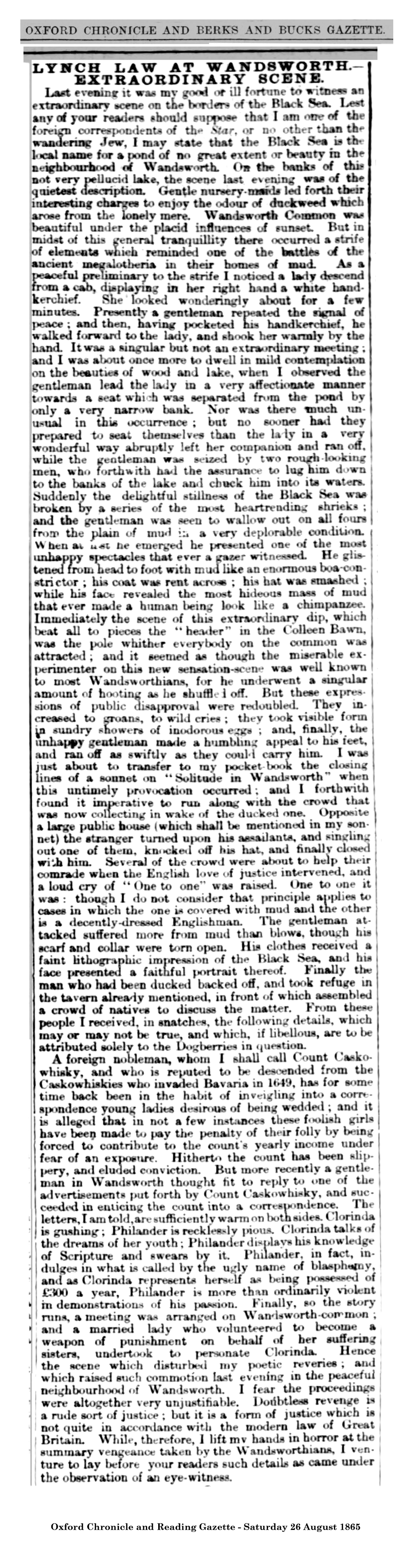
Several other articles:LYNCH LAW AT WANDSWORTH.- EXTRAORDINARY SCENE.
Last evening it was my good or ill fortune to witness an extraordinary on the the borders of the Black Sea. Lest any readers should suppose that I one of the foreign correspondents of the Star, or no other than the wandering Jew, I may state that the Black Sea is the local name for a pond of no great extent or beauty in the neighbourhood of Wandsworth. On the bank this not very pellucid lake, the scene last evening was of the quietest description. Gentle nursery-maids led forth their interesting charges to enjoy the odour of duckweed which arose from the lonely mere. Wandsworth Common was beautiful under the placid influences sunset.
But in midst this general tranquillity there occurred a strife of elements which reminded one of the battles the ancient megalotheria in their homes ai mud. a peaceful preliminary the strife I noticed a lady descend from a cab, displaying in her right ind a white handkerchief. She looked wonderingly about for a few minutes. Presently a gentleman repeated the signal peace; and then, having pocketed his handkerchief, walked forward the lady, and shook her warmly the hand. It was a singular but not extraordinary meeting; and I was about once more to dwell in mild contemplation on the beauties of wood and lake, when I observed the gentleman lead the lady in very affectionate manner towards a seat whi was from the pond by only a very narrow bank.
Nor was there much unusual in this occurrence; but no sooner had they prepared to seat themselves than the lady in a very wonderful way abruptly left her companion and ran off, while the gentleman seized by two rough looking men, who forthwith had the assurance lug him d-wn the banks the lake ami chock him into its waters.
Suddenly the delightful stillness of the Black Sea was broken a series of the most heartrending shriek and the was seen wallow out on all fours from the plain of mu l a vary deplorable condition. ben av emerged presented one the must unhappy spectacles that ever a gazer witnessed. He glistened from head to foot with mud like enormous boa-constrictor; his coat was rent across; his bat was smashed; while his face revealed the most hideous mass mud that ever made a human being look like a chimpanzee.
Immediately the scene of this extraordinary dip, which beat all to pieces the header" in the Colleen Bawn. was the pole whither everybody on the common was attracted; and it seemed as though the miserable experimenter this new sensation-seen' was well known most Wandsworthiana, for underwent a singular amount of hooting as he shuffled off. But these expressions of public disapproval were redoubled. They increased to groans, wild cries; they took visible form j sundry showers of inodorous eggs; and, finally, the j unhappy gentleman made humbling appeal to his feet, and ran off swiftly as they could carry him.
I was j just about to transfer ray pocket book the closing — lines of a sonnet "Solitude in Wandsworth" when this untimely provocation occurred; and I forthwith i found it imperative run along with the crowd that was now collecting in wake the ducked one.
Opposite is a large public bouse (which shall mentioned in sonnet) [i.e. The masons] the stranger turned upon assailants, and singling out one of them, knocked off his hat, and finally closed with him. of the crowd were alsmt to help their comrade when the English love justice intervened, and a loud cry of "One to one" was raised. TTne to one it was; though I not consider that principle applies cases in which the one is covered with mud and the other | a decently-dressed Englishman. The gentleman attacked suffered more from mud than blows, though his 1 scarf and collar were tom open. His clothe received a j faint lithographic impression of the Black Sea, and his face presented faithful portrait thereof.
Finally live man who had been ducked backed off. and took refuge the tavern already mentioned, in front which assembled a crowd of native to discuss the matter. From these people I received, in snatch, the following details, which may may not be true, and which, if libellou, are attributed solely the Dogberries in quetion-
A foreign nobleman, whom I shall call Count Caskowhisky, and who is reputed to descended from the Caskowhiskies who invaded Bavaria in ha for some time back been in the habit of inveigling into a corrtspondence young ladies desirxaw of being wedded; and it is allege! that in not a few these foolish girl have been made pay the penalty of their folly being forced to contribute the count's yearly income under fear of exposure. Hitherto the count ha been slippery, and eluded conviction. But more recently gentleman in Wandsworth thought fit to reply to one the advertisement put forth by Count Caskowhisky, and succeeded in enticing the count into correspondence.
The letters, lam told,are sufficiently warm both side . Clorinda is gushing'; Philander is recklessly jnou . Clorinda talk of the dreams her youth; Philander displays his knowledge Scripture and swears it. Philander, in fact, indulges in what is called by the ugly name of blasphemy, and Clorinda represent herself being of £100 a year, Philander is more than ordinarily violent demonstratious his passion.
Finally, the story runs, a meeting was arranged Wandsworth-common; and a married lady who volunteered become a weapon of punishment on behalf il her suffering sisters, undert s k to personate Clonnda. Hence the scene which disturbed my poetic reverie; and which raised such commotion last evening in the peaceful neighbourhood of Wandsworth. I fear the proceedings were altogether very unjustifiable.
Revenge is a rude sort of justice; but it is a form justice which is not quite in accordance with the modem law of Great Britain. While, therefore, 1 lift v hands in horror the summary vengeance taken by the I venture to lay before your readers such details came under the observation of eye-witness.
[BNA: Link]
e.g. Particularly popular in Scotland?LYNCH LAW AT WANDSWORTH EXTRAORDINARY
YART BOWL A correspondent of the Star, writing on Friday, says: — brat evening it was my good or ill fortune to witness an extraordinary scene on the borders of a pond of no great extent or beauty in the neighbourhood of Wandsworth. On the banks of this not very pellucid lake, the scene last evening was of the quietest description. Gentle nursery-maids led forth their interesting charges to enj..iy the odour of duckweed which arose from the lonely mere. Wandsworth Common was beautiful under the placid influence of sunset.
But in the midst of this general tranquillity there occurred a strife of elements which reminded one of the battles of the ancient megalotheria in their homes of mud. As a peaceful preliminary to the strife I noticed a lady descend from a cab displaying in her right hand a white handkerchief. She looked wonderingly about for a few minutes. Presently a gentleman repeated the signal of peace; and then, having pocketed his handkerchief, be walked forward to the lady and shook her warmly by the band.
It was a singular but not an extraordinary meeting; and I wax about once more to dwell in mild contemplation on the beauties of wood and lake, when 1 observed the gentleman lead the lady Ma very affectionate manner towards seat which was separated from the pond by only a very Harrow bank. Nor was there much unusual in this occurrence; but no sooner had they prepared to seat themselves than the lady in a very wonderful way abruptly left her companion and ran off, while the gentleman was seized by two rough-looking men, who forthwith had the assurance to lug him down to the banks of the lake and chuck him into its waters.
Suddenly the delightful stillness of the pond was broken by a aeries of the toast heartrending shrieks; and the gentleman was seen to wallow out on all fours from the plain of mud in a very deplorable condition. When at last he emerged he presented one of the moat unhappy spectacles that ever a game whammed. He listened from bead to foot withiandlihe ba Victor; his coat was rent wren; his bet was entombed; while his face revealed the /wag hideous nen of 'nod that ever mate lumen he kick a the Mls Minh hest pines the 'Mier' he was the psis whither the emmon was; and it esemed the miserable se this Dew error wJ ale Melba as aL gm 'gumless pails They lamed to poem to wed nine; they Me in sen un happ dry y a @hewers Mimes Me bet, nes meg as thmid emery him. Mt attain a tavern, in front of which s_a natives
to disco= the matter. From these people I received, in snatches, the following details.
A foreign nobleman has for some time back been in the habit of inveigling /into a correspondence with young belies desirous of 'being wedded; and it is alleged that in not a few instances these foolish girls have been made to pay the penalty of their folly by being forced to contribute to the count's yearly incr.me under fear of an exposure. Hitherto the count has been slippery, and eluded conviction. But more recently a gentleman in Wandsworth thought lit to reply to one of the advertisements put forth, and succeeded in enticing the count into a correspondence. A meeting was arranged on Wandsworth Common, awl a married lady who volunteered to become a weapon of punishment on behalf of her suffering sisters. undertook to personate elorinda. Hence the scene which rained such commotion last evening in the peaceful neighbourhood of Wandsworth.'
[BNA: Link]
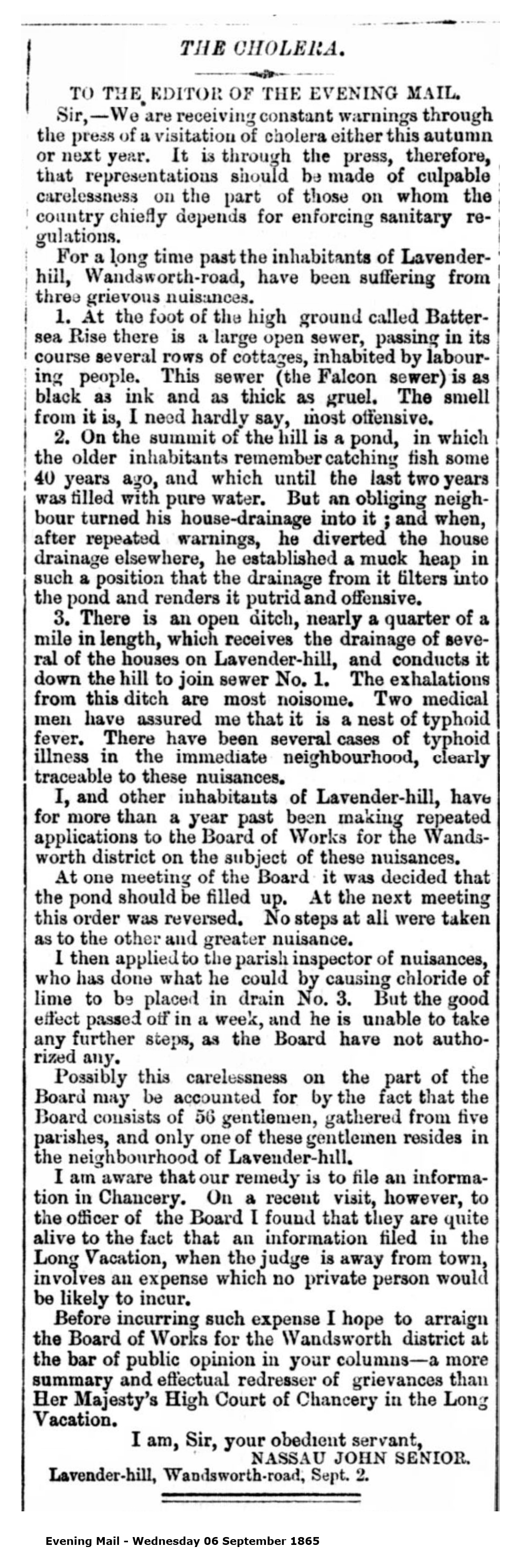
THE CHOLERA
TO THE EDITOR OF THE EVENING MAIL.
Sir, — We are receiving constant warnings through the press of a visitation of cholera either this autumn or next year. It is through the press, therefore, that representations should be made of culpable carelessness on the part of those on whom the country chiefly depends for enforcing sanitary regvulations. For a long time past the inhabitants of Lavender-hill, Wandsworth-road, have been suffering from three grievous nuisances.
1. At the foot of the high ground called Battersea Rise there is a large open sewer, passing in its course several rows of cottages, inhabited by labouring people. This sewer (the Falcon sewer) is as black as ink and as thick as gruel. The smell from it is, I need hardly say, is most offensive.
2. On the summit of the hill is a pond, in which the older inhabitants remember catching fish some 40 years ago, and which until the last two years was filled with pure water. But an obliging neighbour turned his house-drainage into it and when, after repeated warnings, he diverted the house drainage elsewhere, he established a muck heap in such a position that the drainage from it filters into the pond and renders it putrid and offensive.
3. There is an open ditch, nearly a quarter of a mile in length, which receives the drainage of several of the houses on Lavender-hill, and conducts it down the hill to join sewer No. 1. The exhalations from this ditch are most noisome. Two medical men have assured me that it is a nest of typhoid fever. There have been several cases of typhoid illness in the immediate neighbourhood, clearly traceable to these nuisances.
I, and other inhabitants of Lavender-hill, have for more than a year past been making repeated applications to the Board of Works for the Wandsworth district on the subject of these nuisances.
At one meeting of the Board it was decided that the pond should be filled up. At the next meeting this order was reversed. No steps at all were taken as to the other and greater nuisance. I then applied to the parish inspector of nuisances, who has done what he could by causing chloride of lime to be placed. in drain No. 3. But the good effect passed off in a week, and he is unable to take any further steps, as the Board have not authorized any.
Possibly this carelessness on the part of the Board may be accounted for by the fact that the Board consists of 56 gentlemen, gathered from five parishes, and only one of these gentlemen resides in the neighbourhood of Lavender-hill.
I am aware that our remedy is to file an information in Chancery. On a recent visit, however, to the officer of the Board I found that they are quite alive to the fact that an information filed in the Long Vacation, when the judge is away from town, involves an expense which no private person would be likely to incur.
Before incurring such expense I hope to arraign the Board of Works for the Wandsworth district at the bar of public opinion in your columns — a more summary and effectual redresser of grievances than Her Majesty's High Court of Chancery in the Long Vacation.
I am, Sir, your obedient servant,
NASSAU JOHN SENIOR. Lavender-hill, Wandsworth-road, Sept. 2.
[BNA: Link]
[This letter may have been written by Jane Senior, as her biographer Sybil Oldfield and Jeanie Rathbone believe. Did anything happen?]
ELOPEMENT WITH A GROOM
At the Wandsworth court yesterday -eo* st,.ed> years, Of short stature; iiaid of very boyish appearance, was ,baced in the dack before Mr. -GAAM charged withtihe a duetIon of a young lady, aud also with robbery.,Mbprer. Hane olOictotr; of Wandsworth appeared for the prisoner.,InsVectci Loelace, v iisioii, stitel t&at at 4 c,'clock on ues ay afternoc atwo gentlemene oane to the police-statios ad informedi hira thatthey bad reason to behevethedaug.Vter o one of them, the Rev. Mr. Crosse, of Ockham, Surre, was living with a young man semewiere in the neigbourhoodac& Wandsworth and.ha.d considerable property belonging to her father izk her possession. Witness went'to lo. 1; St.- Ann's.plsce, Love-lanet and he there found in an upper rcom the prisoner with ile youig ladyr Heasked the prisoner whether he had the property in the roborZ anl Ltaee obelieved the yoang lady handed him,, whimh her father, who had accompanied him, at ance ideutifled. Witness found apoet the prisoner a,,arse contamins 11. 2'., and in the boxhe fou)t 41. in gold. le also found in the room a4liastityof clothing, dresses, bonnets, and feuale wearing appareL lHe then tookthee,D. risoner into custodiy. — ',The Itev. Robert Croise, rector of Ockham, said his Oaaugtei's natte was Alice Caroline, and the was 20 years of ajeiu lune lest. 1he hadieen living with himauntilthe *snght, or, striv tpcakin ;, the morning of the 26th ult. He nissed her frorr the house. He knew the prisoner. RelLad been groom and.general servant in his house. Ho had sent 'him away On the Thursday previously. Witness recognizedl the box antd sxticles as belonging to his daughter. To the,est of his belief- -sotbing was said in the room about the bd.uction. ie spoke to his lauglter about the elothing.,Mr. INGHAM inqiuired- whether any property was found tut what was expreasly.purohased for his dau-hter.,The wtness said that sonteof the articles were not pur. chatshedr for his5 daughter. Some of tliem belonged to her Another.,-Mr. IXGrAVr said he woouid pass oi frora that part of the case, WSlt was not necessary to go into the question of rob-,The wlitneas was then questioned with reFerenee to pro. G (rty veSted is his daughter. Ho said that on her coming,'lot ifurter rspects oln thte denat,eOth ofhr mouther anzd Mr, IieGoU inqyuirmd whether he ctoul swear tbat tbe drisoder was aware of that,*The -vitniess said he had no proof of the fact, but ha had teasn6 to believe that he was aware of it, because his daughter was in the habit of speaking about her prospects.,By-M.r Haynes.-His daughter hbd not stated her reason -for lIaving. He discharged the prisoner because it had * een copnrte4. that she haa bean seen in the stable with hinT. Releftt'ehouse on the 24th nlt., and tooklodginga just outside witness' property. Ho could not say at what tinie his daughter left, but it must hxvo hees before half-past 3 o7cleck in the rnorning. He discovered her missing at 7 o'clock.,In answver to further questions, the wituess said he ceiild -rt say wahether the young lady left by herself, but he had Tensota believe that she didnot. Re conl rnot see thatshe could get out of anupperwindow withoutassistance. Be found.the window of her bedroom open, and the cord of the curtain torn dowvn. The window is about 14 feet higb, and looks-out on to the Iawn. He only saw the case of his danghter's unibrclla, that had been dropped on the lawn ulnderneath the window. The ground waS too bard to leave foatmarks. He did not see anu marks of a ladeor nor any. thing fixed. to the window.,r.-. Havues sugested that she could easily have jumped from the rIndow.,Witness.-ils daughter wras slender andaactive. It was milusual for the windowto be open. Heoerrfoaunditopen before. It war so wide open tbat be Saw in a moment what bad taken place. It was an iron casement windoyr, and opened like a door. The outer Idomrs were not unloaked.,the housemaidn first discovered his daughter gone on enter. Iu= her bedroomn.,MArt Hn&yes.-T.th eoing away ws sVi volntay on, the Tart of your daugh-Iter?,Witesvi,-I don't knoW at ptesent.,Mr. Imasrar.-Was anything said in the prisoner's pro. sence about taking her away?,* Witness.-i did not speak to hir. I havc spoken to 'my daughlter on the sul'ject. I have reason toberieve that she -was in the babit of burning paper at the winwaw as a signal fortheprisonerto come to her. I tound.ashesof burnt pacer in the window.,Inspector Lovelace was reealled, a-ad he sSia tiat he took the prisoner intocustody simply for the A obbery, and that ;,e rcoverdsftion tookplace with reference to the yonughad'fs expectaions. Vitness'believed bereceived the boxof jewels jima the daugliter.,Hrsit Jane Wietns, the wife of a labotuer, of , St. Ann's.> Eplace,,saM that an last Satardsy week the p is- r car e tc. haer house with his wife, as she thought. theylbothispolve,ebouttselolagngs She askedlthem whethertheyTwererma-,ain4 wife, satheylookedso4y6ttg,andweirenorelik)bot'her anadsister. Ileseli~, " Oh, ee, we are man amcl wife." They t,Ok thO lodgings for- weK; hntthey remainedbeyosld that iitme. -Witness coulnhsee that she swas a perfect dTand,thobetroom togetlher Thel ay made the agreemeit and paid witness t'he rent.,Mr.T JoahnHam eltn, of Fyne-court, Somerset, said that 'ie was surmmoned by hFie brother. Witnms carefuIlys-ex amnieth window and found traes of soineperson getting eut. and the ivy was pulled down.,The Rev. Mr. Crosse saidulie noticed that the iiy wasrtezr nnderneath tle wmndow, uownwards. It was imposs-ble to put a feot on the ivy, as it was not strong aenoigh to hear the weight of a person. The ivy was torn only just at the atoP.,Mr. Hamilton, in continuation of his evidence,. saidIhe 'rxamiaed the ground nnr7erneath the window. At rIght an gles of the honuse was alowv brick aill, and by standing saponit a persox could.be assisted out of the window. He exammed the top of the wall, and he observed traces df heavwyslices or'boots havingrisbbed away the brickworl, and esldentl'thesebhaa been proaduced by somne person ulho liad stood on the wall,,Mr. IDs.A l having expressed a deseie to examline the young lady, Inspector Lovelace broughtlier upstairs into the court and placed ber ia the witness-hbax. She iSnR slight, lady-nikeyeungwonian,having irlis'h appeainee, and was,et-y snmply dressed in a small black straw hat, black silk cane, and a spotted mslin dress. She dll not exhibit any oympAdu ofnrv-latrronsness. Onlbring sworn,absetstated thit jsbe hadheen livin- with lier fathier until Tecently.,Mr. A. Taylor (tbe Chief Clerll.-Now- explain how yen caine t4 leave your falthe's bouse.,t> Smith. Hewasnearly tworears in y fatme s service.,giiunlt Ohcitmu,s,-a littlehbCefore, perhaps.teCnUlQR,Mr.. 155ORAa.-gOw did the iatinssp' osinsiene?,Wititcss.-By riding with bitn. I wrant oit riding, and he accomnanied me aSR nr,Isr. X2cGfl&.-Wh -smade the frst advomlee Witsese. -I den't know eraotly.,slr. GtUM.-You can tell me tlwt.,Witnsess (sinilins ).-..I think w e wnere sboutt eellla. M,r. Iirur.uer-Did you ever go into tho etabhe s,gee the hories cleanea,d.etElt,*1 . tSI GHc a_ . . . -WhO first proposed that you should leave Wituees.-I think I propnsed tha. There had been a ,re:rt row, and I was anlmappy; Rand I wisbied to leave. ¶ihcrowaaagreat roDwwhen itwasfoundout-about 3 week beefore I went away-.,Mr. Iira3s,ts.-?qow. tell me all ab ont it.,Witue s.-Iarrin,,edi6-. Rewassentawayat aminute's ~eolice. 1 sAW him en the pasage wshen he vwas leaviur, and P[ merely told l im. to comhe the niglit after to my bedroom 'window. Iusedtolightpaperinithewindow.,31r. 1NGUAly^.-What happened ontho night in question? 'W'itess.-Ye.s, directly after pa wpa vest to bed.,The Utev. Mr. Crocee (excplining).-4 wvent to bed about WittesL-T lit paper in tbe'window, and he canae -p rntside, I think he was in the lane. I told him I should go away. I put my things out of the window, and then Igot uut myself. I scrambled ouit someholw, as I had no assistF ne. I think hb helped me alittle when I gotnearlvdown. I think r was slipping down, 'and be held me. blothing u irtber took place, you know, exrcept that we walked toe ter t6 the station. I did not know where I was going, ntIthbuiht I was going to London. I iroposed walking to Wevbriage station. It is s distance of about five miles and a hslf along the road. We.walked there togbther. We took a mail tr to: London, and I paid the fare. I don't knowrwho uald for It, as on-r imonea Vwas put together. 1 3ranl abeelt 21., and he hbad 51. 2s.. — The mnoney was put to-. Leiher -AtWeylridge. I took tlrt money.I,Mr. INGHAe,.-Yoa took his money, in fact?,'WitnleSS.-.YeS (L,o1rgiter.) We Went tO 'Waterloo Station.'thence to a cof'eehlou.e in the city, wtere we had smnie co ee. We wert to Doctor's-commons for a licence of narriage. He applied for it. We could not have it with. oct myraither'sconeent e I dI not hear'what was said, as I w,s nntpsesent. mRe tolda m6 tA afLrwards. We came itr'.ght. to Wandsworth. I proposed Wandsworth, as I thought it would be more convenient. I had ofton been through Wandsworth. We took loddeugeat Mrs. Wiggins's fromin osin a card in her wiiidow. I kiow what fortune I am entitledlto; Iinevertalkedimeich about it. Since I base,srirat Wandsworth ase IRn sadssol aipt i ndo the, unenee,BeFore I1lef home I terIdbim Ishoujli 'hare sanmetbing, not the exact sun. 'I will Swear clid not tell.him the exact,.erm. To the bea of my belief I did ne * mention an.y sum, in particular. I rthought I shouldI have smtIgo h death .ofimvImother. I never mentioned 'that in nhia prorence. I toldl htineishould nthve anthlting on my fistther's,eleth.Tlitwaseoew hlvolecnrDr- n4~tthinkjgpoke .of thatbheforel lefthborne. -1havea d-utaotit i,ILsve apoken abouat mV prosPect, boorltbet hbomei. Itih,Thie 11er. Mer. Crms~e..-j leave evidncoc to hrorv'that 'the V.-iway tickets. w-erepaid for. by.the prisone'r,sIr. Hi :e,v~ rnunnr handedl to hM,The .ftev. AMr. Crosse.-Thab Ire erpenihs ue,to ~Lie monod' out, ajed renraried that lire bad vet tte, letoo,W'itaese.-I. hdl he-aid thirit there wvas a. Proloability of my 'Living nionoy- aLtmy fathtar's death';- bre T-c~ ~s ot If I niatrried George. Irmight hive Said. I abbuhl.lkot have,havea. esttf. bfy fat-bos'ris"in goodclircunestancs.1 'Re keeprs two; hioresqsandacaMige Isuppoeserryfathier ist irichi =a.not very ricTr. E'dh't kneu hterte~i soner knwbat myfather had.- I eapps6oire thoregltity fathier in ~good circumstances.'; I never talked to himi abouti 3nt- sister..,-Bv r fe. 114ss.-It wrs iiv~ Ownl actasd deed,tha.t of Iav-ing- moe f~'9 r'a house: 0th priomr doe~s not detain,ouig~outofWimddr.Whether George was there or not, s4ould, home g~oli. I don't 3ne'w whetlier I shou1cld jvt jeft that ivenitiegif lie .hasl-noth beeethere. .IL ead rileu.de,ame iriuh o -ea~e tehe aries o~estenit asI I hould ieiv Wt2f, eorr~ ;hd ded. fter 12w'~aoutof the,me actogaway. whbnligout ofto thowinaon; heasked-ine if I hiad not better stay. I said Iwottlclrat'her not., Ee,akedl a policeman abiout Dootora'.eonmonB. I 417d -not know muc'h about, It. I proposed asking a policeman, and we got the informatioa frors one. The prisaoer went isside, and Iwaited outside,.,Thia bets Uteeidne hhE!.iurdwe thrthere was any bail for the prisonut.,ldr. Haynes said he lid not new, as'-tile priseier wasa, stranger. He 'wag not' likely to run away after the MR.ntstrati bail l*ouglet out the fact that t'heyonla, wais liktly to have 4 large fortune. yugld,Didir eantakn aaywithou theftehkolde,Mr~ ayne o~s~edthat the. proeridntaehe,noL InumenH. a~Ii a qe tio flw htera.p. Wasslta haer go hdeidelehere.Teqeto a,jid tbe fare, and esol.lk to hea h vdnee,Mr.llanisthoghtthe'word, "fraudulent" mnsaat to impl tht sme mprpermeans had beenaused to entice.,Mr.lic~ni~ sidke didl xot think it yroper tolet the prione goat arg 'wthot affiies hal.He, should reman hunto se 'wat frthe eviencewas ffered. Hze, I hoive, tougt terewasnot muh& chnefins rauning',Theo Young lady, was askedl 'uetion byr the magistrate at thle suggestien of her father. SheSdened that the prisoner ever toldl her that she 'wouila die if she remained at her fatheres house.,Iu answer to further questions she aid. thet prisoner was going-to wor-k for his brother, a farmer. lI!othinig wast said about-that until they came to Wandsworth. They talkedl,shocut how they shou d live in the winter, san hie said thaLt,he could 'work for 'his brother. She proposed that they should buy abausiess with the mousy she 'would.have, lHe ask-ea her not to touich the muoney.,rgr. -I2onAN -then cossentecl to accept two sureties InL,1004. each for the prisoner's appearanc.,The young ladv retired 'with her friends andl the prisoner was remove(i to the cella. — The bail, -two tradesmenL of, Wandsworth, were, however, soon forthcoming, and he -was ledaaw.w ly ythem in a half-fainting condition. q,Mn ITaynes madle anapplica6tion for the etoration of the money belonging to the priioser, laut -,The XAGsrTnAT refused to make any order at present.,It-was stated that the banns of mnarriage between the prisoner and his late young mistress had keen published in Wandsworth Church.
[Source: Link.]
[Short version still running a fortnight later.
An odd case is reported. A man who calls himself by some foreign title has been in the habit of advertising for a wife, and having procured interviews with certain foolish young women, has so far succeeded in compromising their characters that they have gladly paid a kind of black mail to secure his silence. This has been discovered by some indignant brothers and other relations, who last week entrapped the pseudo count to Wandsworth Common, where he was ducked in a most unsavoury pond and afterwards hunted out of the neighbourhood. The police appear to have looked with tolerance, if not with complacency.
Saturday, September 3, 2011
September 14, 1865 --- A Romance in Real Life
A police escort is needed to lead the bride and groom through happy, cheering crowds outside All Saints, Wandsworth. The bride is 20-year old Alice Crosse, only child of a wealthy, widowed, rector from Ockham. The groom is just that, the family groom, 18-year old George Smith.
Their romantic elopement, with Alice's midnight clamber down the ivied wall of her father's rectory and their pursuit by hired detectives, had been closely followed across England. Rev. Crosse had forbidden Alice's fancy for George without success and so the groom was sacked in August. Two nights later, they ran off to London. Turned away at the Registry Office as Alice was under age to marry without parental consent, they went to Wandsworth where George had family. The trail was not hard to follow.
George was charged with abduction and robbery. Rev. Crosse claimed the young man "systematically worked upon [Alice's] feelings to dislike her home." He accused him of lusting more for Alice's inheritance, £2600, hers at age 21. The crowded Police Court fell silent when Alice took the stand. Without nervousness, she declared her love for George. Asked who made the first advance, she answered, "We were about equal"; about the elopement, "I proposed it"; about the flight to London, "I arranged it." Reversing the robbery charge, she boasted of taking George's money to pay for the train. As for her father at home, Alice insisted, "Whether George was there or not, I should have gone."
The case was remanded for a week and George given bail, the young lovers managed to convince Rev. Crosse to drop the charges. Nor would he stand in the way of their marriage, once satisfied that — in his words — "Alice returned home as intact as on the day she left." The father of the bride opts not to attend the wedding, however. At their modest reception, George and Alice appear at the window to acknowledge the crowd outside. In the words of The Times: "A public scandal, which has greatly shocked well-regulated minds in the genteel classes of society, but which, after brilliant sequel, will doubtless be the theme of admiring and envious comment in many a Servant's Hall."
Their married life was short as Alice died in 1871.
Posted by Tom Hughes at 2:46 PM
https://victoriancalendar.blogspot.com/2011/09/
Hey, we have that lovely poem (written in cockney) about this!
Where is it? HERE!
https://www.historyofwandsworthcommon.org/chronicles/09/09-as-posted-sep-2021.html[WC in poetry]

THE BRIDE AND HER GROOM.
By Policemah X.
0 pleasant is a parson's life —
Beneath no cares to writhe.
To spend your trooly rooral days
Midst smiling rustics blythe;
And drive your Poney carridge hout
Collectin of your Tythe.
But hevry rose has got a thorne,
Vich him that smells it feels;
Though at a distance hit alone
Its pooty looks reweals —
And even Parsons has sum cares
Beyond their daily meals.
Sometimes his curates goes estray,
Or Bishops thwarts his course;
Sometimes hit Is a unpayed Tythe,
Sometimes a limpin orse;
Sometimes it is his childering dear —
So 'twas with Mister +!
Vich + by name he was, but not
I hopes by nature so;
Miss Alice was his daughter fair,
And she had chose a Bo
(The brightest eyes that shoots fourth darts
Will sometimes hame them low).
Equestering exercise she took
Whenever she'd a mind,
George Smith the groomb (haged 18 years),
He should have rode behind —
But hoft he cum up side by side,
Miss Alice was so kind!
And to the stables she would go
Her darling nags to view
(Vich whilst she kissed their noses warm —
As most young ladies do —
Preaps, by haccident, she mite
Have fondled George's too.)
Vich wen her father came to find
This orrifying fac,
I ope he neither swor nor cust
(No parson so should ack),
But he gave Miss A. a scolding sharp,
And Mister George the sack.
Ho, fancy those young loviers then,
Ow sad their fate did loomb —
Pore Alice she was sent up-stairs,
And ad to keep er roomb;
And pityus was the diction hof
That pore young Boy the Groomb.
But love at locksmiths laughs, they say
And so (it wosn't right)
Sly Alice, wen 'twas dark, displayed
A burnin paper light,
Attractin George, to whom she vowed,
"We'll fly this very night."
Then she goes and packs her cloze
(Vich sum was her mamma's),
And down the ivied wall she climbs,
Dispizin locks and bars,
And to the Rail five miles they walks
By lite of moon and stars.
Vich Alice then esumed kermand
(Has females loves to do),
And took his capital away
(Vich were just £5 2s. 0d.),
And bought two tickets for herself
And George to Waterloo.
Ven Doctors-commons waked that morn,
The coves in aprins white
Observed (vich was to them a sweet
And soul inspirin sight)
Our lnnicents a wanderin round
In anxshus puzzled plight.
Beneath the Arch those veskits vite,
They led the infants in,
But R! too soon they turned them out,
Whilst lookers-on did grin —
Without her Pa they couldn't get
A Lisins to begin!
Their true love's course untimely checked!
By hobstacles like these,
Towards Wandsworth Common off they set,
And sat beneath the trees,
And sor the windmill turnin round,
And herd the cacklin geese.
Vich rooral sounds inspirin hope,
They joins eaoh other's hands,
And off they goes, and tells the Clerk
To publish of their bans,
And takes a lodgin in Love-lane
In a terras called St. Hans.
But soon to that abode of Bliss
Inspector Lovelace came
(It's hodd that such a man as im
Should ay a hammerous name),
And on a vile phelonions charge
He stopped their little game.
Pore George he took afore the Beak,
Where Mister + erose,
And swore he steeled his daughter's heart,
And likewise stole her cloze
(Vich she it was as rifled him,
As well my reader noze).
Brave Alice boldly pled his caws,
And did herself avow
That she it was that pland their flite,
Becos " there was a Row."
And that it was a equall flame
She redly did allow.
But all er smilin blushin looks
They wos of no aveil
To save her George from being soon
Remanded to the jail,
Until so be as he might find
Two good substanshal bale.
They bore him faintin from her sight,
And hall is ope he found
In thinking with wot faithful love
His Alice did abound-
That Hangel in a hat and cape
And spotted muslin gownd!
But, hout on fickle woman's love!
A week had scarcely past
Hare Alice broke the vows she swore
From life to death she uld last,
And flung away the faithful heart
That clung to hers so fast.
She told him be might "Go away"
She'd never see im more" —
Inspector Lovelace, standing by,
It pleased his very core,
And off to Ockham Mister +
His perjured daughter bore!
On Vensday last when George came up
His Alice was not there!
To him, the Beak who set im free
Spake nothing but Despare —
His fond young hopes he thought wos wrecked
Upon a quicksand fair.
But O, faint-harted George mistook!
(Like many a other man).
Ven Alice bade him "* Go away"
Twas all a artful plann
By soothing Pa, to keep him safe
From Lor's tremenjus ban!
No sooner was the case dismissed,
Than Alice, quite elate,
Declared that now, till 21,
She patiently would wait,
And then to George she would return,
And be his married mate!
O sore it grieved the Parson's heart
Such desperate words to hear,
But hacting like a man of sense
He faced his fate severe.
(That he would have to yield at last
He saw wos very clear.)
A wilfull man," said Mister + ,
"We know must hav is way. —
Hay foresheory, so will girls:
No longer He say nay —
That she may not her choice repent
I earnestly do prey!"
So Friday last, in Wandsworth Church,
There was a wedding gay,
And George and Alice one were made
By Mr. Gower that day.
The belles ring out! the people shout!
True love has got its way!
R, wonderful is woman's ways
To pleasure or to vex!
No wonder that they even did
A Solemnun perplex.
O Soosan! lovelier than all
The loveliest hof thy Sex,
Be true to me, as I to thee,
Thy changeless
PLEASEMAN X.
Sept. 16.
[BNA: Link]
[ADD IMAGE OF ARTICLE]
Westminster Review/cite> — 1865
WC in WESTMINSTER REVIEW/cite> — VOL LXXXIV, JULY & OCTOBER 1865
Westminster Review/cite> — July-October 1865
[Wikipedia: Link.]
The Westminster Review — Page 219 [PB: I can't find this source again! Where is it? It's a superb account. I wonder who wrote it? George Eliot was in practice the main editor rather earlier, 1852-1854]
1865
According to the evidence of Mr. Rose, who has some property adjoining Wandsworth Common, that common has been undergoing a rapid degradation for several . . .
Art. VII. — Commons Round London.
1. Reports of the Select Committee of the House of Commons on Cultivation and Improvement of Waste Lands. 1797 and 1798.
2. Report of the Select Committee of the House of Commons on the means of Facilitating the Inclosure and Improvement of Waste Lands. 1800.
3. Reports of the Select Committee of the House of Commons on Open Spaces (Metropolis)- 1865.
The growth of that incoherent aggregation of villages which we call London is daily bringing up fresh problems for solution. It would be difficult under any circumstances to compress a nation within the limits of a city without causing much inconvenience. But the difficulty is increased tenfold by the incapacity of our municipal institutions to conform to circumstances.
London is compelled to expand, not like a vertebrate animal, by a uniform development of all its parts, but like a creature of the lowest order of existence, by throwing out a series of imperfectly organized growths. It is, perhaps, needless to remark that this irrational state of things is not a legitimate consequence of any principle of self-government. It is not that the sphere of government is too narrow, but that it is divided and parcelled out amongst too many, and too feeble authorities.
In any country where the adaptation of institutions to circumstances is not tempered by a superstitious regard for vested rights and ancient corporations, the city which is a unit by its geography is also allowed to be a unit for administrative purposes, and certainly without any evil consequence to its independence. In fact, the impotence of our local centres of authority compels the constant interference of the national authority in matters which are properly of merely local interest.
To settle such purely municipal questions as the main drainage and the Thames embankment, Parliament had to create a new authority, and afterwards could not refrain from meddling — not always successfully — with its action. The evils which result from the curiously complicated system of jurisdictions under which we live, have been often enough illustrated, and are indeed obvious to the eyes and noses of us all.
London is allowed to develop according to its own sweet will, without any attempt at providing against the dangers of the future. Railways have been permitted to cut their way through populous districts, and to force back the displaced inhabitants into streets already overflowing; and no care has been taken to render the transition to the new state of things as easy as possible. There has indeed been, of late, a revolt against the tyranny of railway companies, but the want of any central will or intellect must always give advantage to the assaults of interested persons upon interests which there is no one to look after.
The state of the commons round London is an illustration of this very obvious truth.
By a piece of good fortune there are still a number of unenclosed pieces of wild land within the Metropolitan District. Fragments, as it were, of moor and heath lie at our very doors, and a few years ago they still remained in a position of apparent security. The transformation which London is undergoing, no less than Paris, though after a different fashion, is bringing many of them into jeopardy.
It is curious to remark the various gradations by which London fades into the country, or as we should more accurately say, by which the country is gradually swallowed up in London.
The main army is preceded by an advance of villas, thrown out like skirmishers. They begin by seizing a few picked positions, but are to be found, as their numbers increase, wandering off into the fields, where they can only be approached along muddy and unlighted lanes.
Then come the more solid ranks of the semidetached, forming in continuous lines along the high roads and in the neighbourhood of railway stations.
They are followed by rows of shops, generally headed by an enterprising gin-palace, which bind together the more irregular forces and complete the army of occupation.
We find some morning that a town has grown up which has a physiognomy peculiar to these suburban districts. For it is evidently no articulate whole, but a mere fragment, which will soon be assimilated by the advancing mass behind.
The houses, too, have that cramped and mean appearance which speaks of pressure in the dingy crowds of London. They bear the stamp of their origin, and show in contrast with the remaining fragments of picturesque old country houses as a Cockney would show amongst the gathering of a Highland clan.
Of course these houses, and streets, and towns have a tendency to congregate round the commons. The pieces of wild land are gradually surrounded with a girdle of town houses, which seem to look down upon them with a show of town-bred arrogance. The common becomes an island in the dingy ocean of coal-smoke, and, unfortunately is too often in danger of being entirely engulphed by the rising tide of bricks and mortar.
It has seldom or never happened, indeed, that a common has been swallowed up wholesale, for reasons which we shall presently have occasion to notice. Small outlying fragments, however, are frittered away; squatters effect settlements upon them; and the enemy succeeds in establishing a lodgment.
Meanwhile, nuisances of various kinds grow up: the drainage is left to take care of itself; the surface is degraded in a variety of ways; heaps of rubbish are shot upon it; gravel-pits are dug without the smallest regard to its beauty or convenience; and as the police are not responsible for preserving order and decency upon it, it becomes in some cases a resort of had characters.
By these means the common, which was formerly an ornament to the neighbourhood, and which a little foresight might have converted into a permanent reservoir of fresh air and country beauty, degenerates into a nuisance. The immediate interest of a whole army of spoilers is allowed to prevail over the interests of the population at large, which are watched by no intelligent guardian; and before public attention has been aroused the evil may be consummated. Even if the common still remains unenclosed, it may have. been so damaged that its enclosure is no longer regarded as an evil.
There are, however, symptoms that Londoners are beginning to awake to their danger. The case of Wimbledon Common last year drew attention to some of the more important considerations involved. Wimbledon is, without doubt, one of the most beautiful of our commons. The furze-covered slopes of the hill fronting Combe Wood, with their miniature glens and broken undulations of ground, have a peculiar attraction. They are in pleasant contrast to the more formal graces of the neighbouring Richmond Park. Fortunately, too, they had stronger claims upon public interest than any derivable from mere beauty of landscape. Artists might admire them; but artists have as yet established no locus standi to resist the encroachments of builders or of railways upon their favourite haunts.
Luckily the preservation of Wimbledon Common is almost indispensable for the interests of the volunteers. There is no body which is pinched more to the quick than the volunteers by the growing pressure of population; although in this they are only most conspicuous representatives of all those to whom air and exercise are becoming daily more valuable and more difficult to obtain. The difficulty of obtaining anything like satisfactory rifle ranges is so great, and the distances which have to be travelled in order to obtain them increase so fast, as to be a severe discouragement upon the practice of shooting.
But it is also becoming difficult to obtain a fair space for drilling. A few companies may contrive to make some sort of shift in the backyards and sheds to which London volunteers are ordinarily doomed. But there is no place within a moderate distance of London where more than a battalion or two can be manoeuvred with anything like the facilities obtainable at Wimbledon. Hence any blow aimed at the common would instantaneously cripple the London volunteers.
With the common would perish the only space where field-days can be held on a satisfactory scale, and the only space where the National Rifle Association could hold its meetings. Its enclosure would have the same effect upon them as the closing of their last breathing-holes would have upon fish in a frozen pond.
There was, therefore, no common round London whoso integrity would be guarded with more eager jealousy; and the inhabitants of the neighbourhood are of that class who are able to make their voices heard in Parliament, and, if necessary, to provide means for a legal contest.
The proposal made by Lord Spencer in the last session was therefore received with great interest, as it was avowedly, and no doubt sincerely, intended to reconcile the interests of the commoners and the lord of the manor. Wimbledon consists of about 1000 acres: of these it was proposed to sell 300, or so much of them as should be sufficient to compensate all the persons concerned, and pay the necessary expenses. The remainder of the common was to be surrounded with a fence, to be drained and reduced to the likeness of a park; a house was to be built in the centre, to be occupied by the "Protector," the name under which Lord Spencer and succeeding lords of the manor were to be the supreme rulers of this little domain.
Lord Spencer, in making this proposal, undoubtedly conceived himself to be making a generous offer; but the value of his concession of course depended upon the nature of the rights which he abandoned. If it had been in his power to sell the whole, or nearly the whole common, for building land, then he would have deserved due gratitude for the generosity which secured so large a fraction for public purposes. If, on the other hand, he had no legal power to sacrifice a single acre to the builder, it was plain enough that the last state of the common, as contemplated in his scheme, was worse than the first.
Now, as the commoners took the narrower view of the lord's rights, whilst i.< -: Spencer approximated more nearly to the broader, it is not surprising that they received his offer with small show of gratitude. He was, in their opinion, only granting to them a part of what was theirs already; they decidedly objected to selling any part of the common; they objected also to the proposed enclosure; they very much preferred the present wild growth of fern and gorse to the new park, with its central "protectoral" residence. They maintained that the really necessary drainage might be accomplished at a very trifling expense, which could be raised without a sale of any part of the land; and, on the whole they very decidedly requested to be let alone, except so far as measures for the preservation of the common were necessary.
The committee of the House of Commons, to which the question was referred, so far adopted their views as to declare that no inclosure was desirable; and the proposal for any permanent settlement of the matter dropped through, leaving the common, for the present, in the same state ns before. The committee. however, took evidence as to the state of many of the other commons round London, and proposed a general plan for securing them in their present integrity.
The various complaints which were made illustrate forcibly the complication of evils which commons in these days are heirs to. Some are threatened with instant annihilation; others are gradually perishing by an insidious process of consumption; and most of them are suffering from diseases which arc rapidly spoiling their remaining charms.
We may give an instance or two of the various fates with which they are threatened. It is unnecessary to go over again the story of Hampstead Heath, which has long been the object of assault, and which has been so far preserved (possibly at some expense to private interests) by the vigilance of Parliament; on the death of the present lord of the manor, his successor will probably claim a right to cut up the whole of it into building plots.
Sir Thomas Wilson stated very frankly before the Committee that he should simply consider how he could best improve Hampstead Heath for his own advantage. He considered himself to have been already seriously aggrieved; the public had, in his view, no rights whatever upon the heath; and he would enter into no arrangement with regard to it. He had once intended to lay out Hampstead Heath as a recreation-ground for his own houses. Now, he said, he might, if he chose, "turn it into an Agar Town" — Agar Town being a place where cottages have been built on short leases for poor people.
We express no opinion upon the grievance to which Sir Thomas Wilson conceives himself to have been subjected; but it is pretty clear that if he can establish his view of the legal rights of the question, the public hold upon one of the most delightful of London recreation grounds is, to say the least, precarious. In fact, it is only reasonable to presume that lords of manors will, as a rule, take the most extended view of their rights, and will endeavour to enforce them by all means in their power. On the assumption, however, 'that they may find their view of the matter to be erroneous, it does not at all follow that commons will escape unscathed.
Commons have strong attractions for various other classes of depredators. One example will show the nature of the most flagrant evils. According to the evidence of Mr. Rose, who has some property adjoining Wandsworth Common, that common has been undergoing a rapid degradation for several years past.
Thirteen years ago [i.e. c.1852] it was kept in a satisfactory state, under an arrangement similar to one still in force and still producing satisfactory results at Clapham. A certain number of the inhabitants had a lease from Lord Spencer, the lord of the manor, and kept the common in order for public use and recreation. They dug gravel at certain points, so as to make ornamental pieces of Water in the places from which it was excavated, and to allow the water from the common to drain off satisfactorily. It was then, as Clapham still is, a beautiful oasis of country scenery in the outskirts of the metropolitan wilderness.
For some reason or other the lease was terminated. The common was neglected: gravel was dug at random, without any regard to its beauty or convenience; and a series of inclosures gradually came cranking in and cut "monstrous cantles" out. The irresistible powers who have been cutting and slashing the map of London according to their will, were not long in claiming their share of the spoils.
Two or three railway companies in succession fell upon the devoted common, the danger of whose position may be inferred from the immediate vicinity of that mysterious station, Clapham Junction, whence, to the bewildered mind of the passengers, every railway in England seems to radiate. A space of open land was too tempting not to invite attack. The South-Western Railway seized a fragment; the Crystal Palace Railway appropriated 29 acres; and the London, Brighton, and South Coast 7 acres.
Besides encroachments pure and simple, the inclosures made under Lord Spencer's authority appear to have amounted to 140 acres; of which, whatever consolation the public may derive from that fact, the greater part have been granted to charitable institutions.
If our pockets are picked, it is of course gratifying to know that the money has been put into a missionary-box; and we may take some comfort in the thought that we are being ousted from our scanty supplies of green grass and fresh air by the boys of the Patriotic School.
The mere diminution in area of the common is by no means the only evil. The remnant which is left to us is deteriorated. Railways and other intruders, like the Harpies, spoil the fragments of the feast which they do not touch. Thus all the public footpaths across the common, with one exception, have been stopped up. The space formerly used as a cricket-ground has become useless, and in Mr. Rose's language:
"Wandsworth Common is a morass now; it has been excavated to such an extent that the whole of the space from Nightingale-lane up the centre of the common is under water all the winter; it was under water up to the 20th of March, when I was there, and is now (April, '64) to a considerable extent; and although in the summer the water soaks away, it leaves the common in a very had state, so that it cannot be used for any purpose."
As an illustration of the results of excavating gravel in a reckless way, Mr. Rose mentions that he, with two of his neighbours, took the dead body of a man out of one of the pits, which had been placed (as traps are set for elephants in Africa) in the direction of a public path, the water being at such a level that he could not reach up to the bank.
Lord Spencer's agent, who appeared before the committee, did not dispute the existence of these grievances but the responsibility of Lord Spencer. He mentioned an additional evil, which results from the inability of the police to exercise authority upon the common, except in the case of an actual breach of the peace. He stated that there were loose women living upon the common who had no other home, and who insulted and annoyed people as they went about.
The encroachments by which the common has been mangled appear in some cases to have been made without any sort of claim; but the commoners are disloyal enough to their feudal superior to doubt the legality even of those sanctioned by his authority. They venture to say that they consider these inclosures to be disastrous to the neighbourhood altogether, and have "a strong sense that they are done illegally, and contrary to law and justice." These misguided men will be finding fault with the British Constitution next.
They entertain, however, a strong opinion that it is impossible for a poor man, or even for a rich man, having a right, successfully to contest an inclosure; and as Wandsworth is a poor parish the various inclosures have been allowed to pass without protest.
It might be hoped that the abuses of which Wandsworth is a most flagrant case would be avoided in cases where the Crown is lord of the manor; it might be anticipated that its powers would be used to secure a more satisfactory state of things. If a lord of the manor prefers his own interests to the interests of the public, the public cannot be surprised. But the interests of the Crown are presumed to be those of the public.
Blackheath, which is in this position, should therefore be a model common, especially as"it is one of the rare breathing spaces upon which the crowded population of the East end congregates with most eagerness. It is stated that as many as 80,000 people have gone to Blackheath upon Easter Monday and Tuesday. Now the heath is stated to have very much deteriorated during the last few years. The principal causes of this are the absence of all control, and the gradual breaking up of the surface by digging for gravel. Booths and photographic vans, and other habitations of our nomad population form temporary settlements, which tend to disfigure the beauty of the heath.
The Hon. C. Gore was examined upon this point, and stated that the Crown received 56/- a year from the gravel, besides II. from a photographer, 4s. 6d a-year from the Blackheath Improvement Association for certain posts and rails, and 11. a-year for a tool-shed belonging to the man who digs grave). Part of this princely revenue is raised to prevent any one from encroaching on the Crown rights; the 561. is raised at an expense, as we have seen, of serious injury to the Heath.
Mr. Gore was asked whether it was not his duty, as trustee for the Crown, to see that whilst the revenue was raised the comforts of the people were not interfered with. He answers, "I do not see what right I have to forego the public revenue that is derived from Crown lands for any local purpose, however beneficial the purpose in itself may be." This enlightened policy, by which the nation at large realizes 561. annually at the expense of a permanent injury to a London common, is carried out on a nobler scale in the case of Epping.
A committee of the House of Commons, in 1863, stated that there were two courses which might be followed with regard to the forestall rights: the first was to discontinue the sale of those rights, and to maintain them vigilantly without regard to cost, in order to prevent future inclosures, and preserve the forest in its wild state; the other was to obtain the sanction of Parliament for the inclosure of the forest by sale of rights, and otherwise "to secure an adequate portion for purposes of health and recreation." The committee recommended this last plan, as, in their view, the use of such rights to prevent inclosure was of questionable justice. The House of Commons, however, passed a resolution recommending that no sales of forestal rights should be made to facilitate inclosures within fifteen miles of the metropolis.
The result of this resolution was singular. The Commissioners of Woods and Forests discontinued the sale of rights; but, after taking a legal opinion, they decided that it would not pay to take legal steps against encroachments already made. The pecuniary value of the rights preserved would be more than swallowed up by the law expenses; and as they look at the question as simply a matter of pounds, shillings, and pence (and, we may add, very few pounds and shillings), they declined to take any steps against encroachments.
The result of the House of Commons' resolution thus appears to be, not that no further encroachments are made, but that we receive nothing for them; the rights are appropriated instead of bought. Now Epping is a beautiful open tract of country within a few miles of the most crowded part of London.
These will be sufficient examples of the chief dangers by which commons in the neighbourhood of London are surrounded, and of the spirit in which they are generally met. It is scarcely necessary to dwell upon the importance of preserving these open spaces, nor to point out that those in the metropolitan district have especial claims upon us. The destruction, indeed, of commons in the country districts is one which it is not possible to contemplate with entire equanimity, attracted as we may be by the promise of increased production.
We are all treading too closely upon each other's toes in this little island of ours, not to grudge the closing of any interstice which yet remains unfilled. When men inhabited little oases of cultivated land in the midst of a wilderness, the sight of uninclosed land was a vexation of spirit. The case is now reversed — we value a bit of unbroken ground as our ancestors valued a garden. In the words of Mr. Mill, in one of those eloquent passages which stand out from the philosophic calm of his ordinary writing: —
"There is not much satisfaction in contemplating the world with nothing left to the spontaneous activity of nature; with every rood of land brought into cultivation which is capable of growing food for human beings; every flowery waste or natural park ploughed up, all quadrupeds or birds which are not domesticated for man's use exterminated as his rivals for food, and scarcely a place left where a wild shrub or flower could grow without being eradicated as a weed in the name of improved agriculture."
It is not impossible, indeed, that in the power of that name injury may be done, not only in a sentimental, but in a very prosaic point of view. The improvement of agriculture is not always synonymous with the improvement of those who live by agriculture; and there is reason to suppose that in the war against the waste lands a larger part of the spoil has somehow fallen to the share of the rich men among the conquerors than of their poorer allies — a result not quite without analogy in other cases. Professor Fawcett, in his lectures on the "Economic Position of the British Labourer," speaks of some of the unfortunate results that have ensued to particular classes, from a process intended to increase the general wealth of the nation:
"The commons," he says, "are now being rapidly swept away. Cottagers have now no means of keeping a cow, a pig, or poultry; the village games are gone; every acre of ground is carefully fenced; the beaten path of the frequented highway cannot be left without committing the crime and incurring the penalties of trespass, and I have been too often gained to find that the turnpike road is now the only recreation ground for village children."
Mr. Fawcett shows some reason for doubting whether in point of fact the destruction of commons has increased the material wealth of the country. But the effects upon the poorer classes have generally been of unmixed evil. Some nadequate compensation was generally awarded, which was spent by those who received in The next generation had simply descended a step in the scale; they were in the position of their predecessors, minim these common rights, which had formed an inalienable piece of property; the labourers, as he remarks, had formerly the special advantage in the right to keep cows or poultry, that they could enjoy luxuries which daily wages never placed within their reach. "Every one," he says, "who knows the working classes will tell you how much their children suffer when they are unable to obtain milk, as some additional nourishment to their scanty food."
It may therefore be maintained that the inclosure of waste lands beyond a certain limit has been far from an unmixed advantage; even if the productive powers of the country have been increased, the benefits have been by no means equally distributed. The increase of agricultural power per e would of course be a clear gain; the man who makes two blades grow where one grew before, is, we know, a benefactor to his country, unless, indeed, he accomplishes the proverbial feat at his neighbour's expense. But it is important to remark, first, that this argument, whatever its worth, has no application to the metropolitan commons; and secondly, that it was the sole ground of the legislation by which inclosure elsewhere was made practicable.
The first Inclosure Acts were founded on reports made by select committees of the House of Commons in the years 1795, 1797, and 1800. Anxiety was felt at that time on account of the scarcity of corn. The sums paid for corn imported in three years had amounted to over 7,000,0002., and according to the political economy of the day, the last committee pointed out that this turned the balance of trade against this country, besides producing various other evils. They calculated that a cultivation of 148,000 acres additional would be sufficient to raise as much corn as had been imported on an average of the last twenty years.
On the other hand, they estimated that there were in England and Wales nearly eight million, and in Scotland over fourteen million acres of waste and uninclosed lands. After allowing for land which was either unimprovable or only partly improvable, they calculated the value of the annual produce which might be raised from these lands at 20,000,0002. yearly.
They reported in 1795 that there was reason to believe that the waste lands might not only be speedily brought into cultivation, but might even be improved so as to increase the stock of provisions within the next two years, and "more particularly to furnish a very large additional supply of potatoes." They further argued that inclosure would be favourable to an increased growth of men as well as of corn and potatoes.
The purpose, then, of the first inclosure Acts was purely agricultural; it was to meet a great strain upon the resources of the country during the early period of the French war by increasing the area of cultivable land. It was intended to raise larger supplies of food, and was passed in the interests of the country at large, not of private owners. As the national wealth would receive an infinitesimal improvement by ploughing up Wimbledon Common or covering Hampstead Heath with villas, it is plain that the precedent has no application. If, that is, the interference of Parliament is necessary in order to facilitate the inclosure of the metropolitan commons, no sort of claim can be founded upon these inclosure Acts for legislative assistance.
The measure was not designed merely with a view to help private persons to an easy mode of dividing property amongst themselves, but distinctly and principally because the inclosure was proved to be of the highest importance to the national welfare. The legal obstacles which impeded a division of common lands amongst persons interested might, for anything that appears, have been left untouched, if the national welfare had not been concerned; and mighf have been scrupulously maintained, if the national welfare had, as now, been concerned on the other side.
It is necessary to observe what were the difficulties which had made the inclosure of com^ mons almost impracticable. The statute most commonly referred to as justifying the principle of inclosure is the 20 Henry III., c. 4, commonly called the Statute of Merton. This ancient and all but extinct statute provides that "because many great men of England have complained that they cannot make their profit of the residue of their manors, as of wastes, woods, and pastures," the lords may, as it is technically called, "approve," or inclose the waste, after leaving sufficient pasture to satisfy the rights of the commoners.
This statute had, however, become practically obsolete. The lords had, it may be presumed, taken advantage of the statute by enclosing the "residue," which was not required to satisfy the claims of the commoners. It was rare to find any common sufficiently extensive to leave a surplus of any importance. Moreover, it was difficult for the lord to prove (and the burden of proof rested with him) that he had left a sufficiency of pasture; finally, where there were rights of"turhary" or "estovers," — that is, of cutting turf or wood — the lord could not approve any part of the waste. As the commoners grew rich, it became more difficult for the lord to come to terms with them, the rights of rich men having a decided tendency to gain consistency.
Commons could only bo inclosed by the unanimous consent of all persons concerned. And thus for a long time previous to the inclosure Acts of this century, inclosures had only been practically effected by means of private legislation. This process, however, was so expensive and troublesome, that the number of Acts was beginning to decrease; and as, for the reasons we have noticed, it was thought of great importance to the public interest that the process of inclosure should be accelerated, the necessary machinery was provided by the different inclosure Acts.
The Inclosure Commissioners are applied to in the first instance by the persons interested. If the proposed inclosure appears to be advantageous in an agricultural point of view, and is supported by two-thirds of the interests concerned, it is then reported to Parliament and is generally passed as a matter of routine. The Act, however, recognises to a certain extent the existence of other than purely agricultural interests. The General Inclosures Act of 1845 provides that the Commissioners may insist upon an allotment for purposes of recreation and exercise, the extent of which is to be regulated in proportion to the population of the parish; the greatest quantity which can be thus alloted is ten acres.
It is also provided that no inclosure shall take place under the Act within fifteen miles of the metropolis, or within certain distances of towns of a specified magnitude, without the previous sanction of Parliament in each particular case. Thus the inclos^e qf commons round London can only take prece by some of the insidious processes which we have noticed; it is scarcely possible that the lord should obtain the consent of every individual commoner, but many of the rights may gradually be extinguished by neglect, as the gradual progress of the metropolis deprives the pasture of its value — encroachments may be made which no one is willing to dispute, and afterwards justified under the obsolete authority of the Statute of Merton, and gradually the public may be ousted from the common before it knows that any assault has been made.
The question is thus raised, whether the public at large, or even the people of London, have any claim to be considered; or whether the commons are mere pieces of private property, which may be inclosed and built over whenever a few persons have contrived to settle their conflicting claims. It appears, at first sight, evident that Parliament has, in fact, recognised the principle that the neighbourhood has some kind of right to the commons.
The refusal to facilitate inclosures within fifteen miles of London, and the order to set apart a space — though, in the case of large towns, a very inadequate space — to be used as a village green, no doubt proceeded on the assumption that the public had some rights of a more or less shadowy nature. It was not assumed that they had no irtore business to meddle with the question than with the sale of an ordinary freehold.
Although the interests of the people at large are not very apt to deaden the lively affection which Parliament bears to lords of manors and landholders generally, they have in this instance been taken into account. No facilities have been given for inclosure, except on the distinct ground that national interests required it. And there is evidently no shadow of a claim for such facilities except where the same ground 'can be proved to exist "Nothing can be clearer," says Mr. Joshua Williams, "both upon principle and by the usage of Parliament than this, that the interest of the public at large is a sufficient ground for denying to any person the assistance of a private Act."
If the difficulties which have hitherto prevented the enclosure of commons were still sufficient to guard them near London, we might be content with this moderate concession. But it is plain that something more is wanted. Mere inaction ia equivalent to permitting their destruction.
Has then the public any legal right, not merely to refuse facilities for inclosure, but to insist upon the present open spaces being preserved? As we acquire a right of way along a path, may we not acquire by immemorial usage a right of straying over a common? Or, as a village is allowed the enjoyment of the green on which cricket' and other games have been played, may not Wimbledon and Clapham be considered as village greens for the metropolis? They are certainly not too large in proportion.
Here, however, the lawyers are shocked by the mention of such vague considerations as the public interest. They think that London is too big a place to have any rights, and that a right of exercise and recreation is too vague to be a right at all. It is true that Parliament has insisted upon village greens being set apart; but in so doing, it is argued, they recognised no rights; they were merely making a bargain; they were selling the facilities of inclosure for the permanent dedication of a fraction of the ground to the public."We," they said in effect,"will help you to share your property, but you must give us a slice of it by way of fee."
Persons coming to Parliament for assistance in enclosing commons were in the same position as railways asking for a compulsory Act for the sale of property, and any conditions which seemed good to Parliament might be imposed upon them. By this view, the right of the public, or of any part of it, to be heard in the question, is altogether put out of question. It is thus maintained that the public have no rights in commons. There may indeed be valid customs in particular places for the inhabitants of a town to enjoy recreation in certain lands.
It has been held that a custom for all the inhabitants of a village to dance at all times of the year on a certain close was good. And it has been held that a custom for the freemen and citizens of a town to enter a close for the purpose of horse-racing on a particular day of the year is a good custom. But a general custom for all the Queen's subjects to attend a horse race at a particular place is considered to he bad, because the rights possessed by the Queen's subjects generally are part of the general law of the land, and not the custom of a particular place.
This distinction, by which the inhabitants of a village may obtain a right to play cricket or even to recreate themselves generally on their green, and the inhabitants of London can obtain no right to enjoy the little spaces of open ground left to them, however constantly they may have resorted to those spaces, seems rather unintelligible to the non-legal mind. The committee of last session remark forcibly that these opinions, even if judicially binding, seem to rest upon no very intelligible principle. "They are," they say,"at a loss to conceive why, upon general principles, a right of enjoyment which may be acquired by the inhabitants of a small hamlet should be denied to the inhabitants of the metropolis, or even to the general public."
That such doctrines should 'commend themselves to the minds of lawyers, is indeed intelligible enough. The public is not likely to meet with such favour at their hands as are the lords of manors. A concrete person enjoying a clearly defined right is likely to have it all his own way in the courts, as against an abstraction called "the good of the public."
But the more we examine into the origin of the right, the more prohable it becomes that the lords have gained more than is equitably due to them. It is, in fact, merely an illustration of the process by which landed proprietors have gradually gained an absolute right, whilst throwing gradually aside all the duties to which their rights were formerly correlative.
The nature of the change is explained in Mr. Maine's "Ancient Law." In discussing the question of the origin of primogeniture, Mr. Maine finds a key to the solution of the problem in a peculiarity of Hindoo institutions. In India, he says, the possessions of a parent are divisible at his death in equal shares among his children; but, "whatever public offiet or political power devolves at the decease of the last mcumbent, the succession is nearly urnTersally according to the rules of primogeniture. . . All offices in India tend to become hereditary, and, when their nature permits it, to vest in the eldest member of the oldest stock."
Comparing this with the feudal organization, Mr. Maine points out that "the lord with his vassals, during the ninth and tenth centuries, might be considered as a patriarchal household, recruited, not as in the primitive times, by adoption, but by infeudation." When, in later times, "courts and lawyers were called in to interpret and define" the state of things of whiqh this was the germ, they applied to it the refined principles of Roman jurisprudence.
Here a change took place like that which has come to pass in later times in India, when the English conquerors, assuming the state of things with which they were conversant in England to be part of the eternal order of nature, proceeded to identify native tenures with their own — a process which, we need not say, some times involved gross injustice. In a patriarchally governed society, says Mr. Maine, "the eldest son may succeed to the government of the agnatic group and to the absolute disposal of his property. But he is not a true proprietor. He has correlative duties not involved in the conception of proprietorship, but quite undefined and quite incapable of definition."
The later Roman jurisprudence could not recognise these liabilities: "it considered the uncontrolled power over property as equivalent to ownership;" and thus, "the contact of the refined and harharous nation had inevitably for its effect the conversion of the eldest son into legal proprietor of the inheritance." And Mr. Maine proceeds to point out that the revolution thus effected was identical with that which has occurred in quite recent times in the Highlands of Scotland.
"When called in to determine the legal powers of the chieftain over the domains which gave sustenance to the clan, Scottish jurisprudence had long since passed the point at which it could take notice of the vague limitations in completeness of dominion imposed by the claims of the clansmen, and it was inevitable therefore that it should convert the patrimony of many into the estate of one."
The effect of this change in the Highlands is sufficiently well known. Those who were formerly possessed of,a share in the patrimony have become encumbrances on the estate; and the representative of the chieftain of the clan has been able to improve his feudal inferiors off the face of Scotland. We need not inquire what may be the economical results of this change; but it certainly adds force to the argument that the possession of landed property should be held certain duties.
The landholding class have neither toiled nor spun, but by the unobserved progress of affairs they have gradually become absolute proprietors without any responsibility, instead of leaders of a confederacy. It has thus become a legal doctrine that the lord has the right to everything upwards and downwards, except that which is carved out of his rights for some one else. The lords are absolute owners of the soil, it is said, subject only to the rights, whatever they may be, of the commoners.
So long, however, as the rights of the commoners survive, the lord is unable to take practical advantage of his theory by enclosing; but he is now endeavouring to take another stop in advance. He has become a proprietor with certain claims upon his estate, instead of a political head with responsibilities corresponding to his privileges.
The consequence is, that whenever the claimants drop off it is so much clear gain to him. If a common right is extinguished by disuse, the lord remains as a kind of universal heir. The public has been put entirely on one side. The lord remains immovable and eternal. A centralized government tends to become steadily stronger, because whenever a local institution loses its vitality, the central power is always at hand, ready to assume its privileges and to discharge its duties. The lord of the manor gradually becomes invested in the same way with additional rights.
As London gradually extends its huge ramifications round the commons, the common rights become comparatively valueless. When a piece of land becomes open to the incursions of the British public at large, it naturally becomes impossible to turn out cows upon it to much effect. The grass is trampled down; gates across the public roads have to be removed to accommodate traffic, and cows take advantage of the case. In the case of Wimbledon, parts of the common have become dangerous from the erection of butts; and, in short, as the common takes on more of the character of a playground, it becomes less available for agricultural purposes. The consequence is, that there is a danger of the rights gradually dropping.
When a man turns out his children upon the common instead of turning out his cows, the law does not admit that he is keeping up his claim. The persons who have in fact supplanted the commoners and have been allowed to exercise their rights, are the general public; the commoners have tacitly permitted them to take such advantage of the unenclosed state of the ground as to render it impossible to turn it to account in the ancient way. In the case of a few acres surrounded by a village, this would amount to a dedication to the public, and would be sufficient to secure the ground as an open space for ever.
In the case of a common surrounded by the huge population of London, it is assumed that the public which has practically superseded the commoners is too vague a body to enjoy any rights, or to have anything dedicated to it; and consequently the whole benefit accrues to the lord of the manor. His estate is converted from a valueless bit of waste land into building ground of enormous value by the near approach of London; the same circumstance gradually pushes off his land all those inconvenient'people whose claims were formerly sufficient to keep it open, and the whole of the benefit is supposed to go to him.
Thus, to take one example, Mr. Thompson bought the common of Tooting, in 1861, for £3000 [CHECK]. He immediately set to work and made out, to his own satisfaction, that the common rights which existed were imaginary; he maintains that there is only one man besides himself who has any right at all — a matter upon which the inhabitants take a very different view. In 1865 he values.the common at 80,000 £, and takes much credit to himself for proposing to leave part of it open.
Mr. Thompson may be justified in his opinion, although the commoners have hitherto refused to consent to the compromise which he has proposed. Indeed, it may be said in general that the opinions of lords of manors on one side and inhabitants on the other, as to their rights, always diverge in a manner which proves the unsettled state of the law upon the subject.
The case seems to be that the rights of commoners have of late years been suffered gradually to evaporate, but have not so completely dispersed into thin air that their actual non-existence can be affirmed. Where the case has been tried, it has generally appeared that the lords of the manor have viewed their own rights in a large and generous spirit which has led them to neglect entirely those of their neighbours. And it is to be hoped that in the legal decisions which must be given before long upon some of these cases, where rival interests are coming into conflict, the lawyers will incline to a broader view of the matter than that which we have indicated.
This is surely a case which eminently confirms the truth of Mr. Mill's saying: "To me it seems almost an axiom that property in land should be interpreted strictly, and that the balance, in all cases of doubt, should incline against the proprietor."
The landed proprietor, as a rule, has nothing to do but to sit still and allow the general increase of population to raise his rents; in this case, the increase of population simultaneously clears off every one who has an interest in the land, except the lord of the manor, who receives the benefit both of the rise in the value of the land and of the extinction of all other shares in the property. He would lose nothing if the public at large were considered to be the heirs of the commoners, except that there would be a smaller chance of enclosing the common; but as this was impracticable in most cases so long us the common-rights were kept up, the value thus lost is really very small.
The practical steps which were proposed by the committee of last session, and which are embodied in a bill brought in by Mr. Cowper are simple, and need not offend the most sensitive stickler for vested interests. The first point is to map out accurately the limits of the existing commons. A board — either already existing, or newly constituted — is to be appointed to act as trustees for the preservation of commons. They are to inquire into the circumstances of the particular commons, to authorize drainage works and schemes for raising the necessary funds, to have a locus standi against all railway bills and similar measures, and to be authorized to accept grants of the rights of lords of manors and others.
In this way it is hoped that, at any rate, the commons may not be frittered away without notice by the insidious means we have noticed. An accurate statement will be made of their present limits; the attacks of railways and the whole breed of depredators will be warded off, and the rights will be so ascertained as to facilitate permanent arrangements between the persons interested.
We are glad, also, to hear that one lord at least, Mr. Alcock, has generously promised to grant to the board, if appointed, his rights over Banstead Downs, a beautiful tract of fourteen hundred acres in the neighbourhood of Epsom. It is hardly to be expected that this action will be followed in a similar spirit by many of the lords; it is probable that there must be litigation in many cases before matters are brought to a satisfactory conclusion; but, at any rate, it is highly important that something should be done at the earliest possible period.
The commons are daily in greater danger from numerous enemies; the rights of commoners are gradually disappearing, and the rapacity of the various classes who would supersede them, is constantly receiving fresh stimulants. The injury already done to some of our beautiful commons is irreparable, and, without energetic action, others may share their fate. All classes are interested, both in preserving them for health and pleasure, but especially the poorest classes.
We hope to see what remains of them placed beyond the reach of their enemies, if only as an affirmation of the principle that landowners are not to be allowed to extend their rights indefinitely, without any regard to the interests of the public.
[Wikipedia: The Westminster Review.]

[PB: I've since seen other references to the shooting of a Bittern — which is obviously more likely.]