[BNA Search: "Wandsworth Common"]
[The Times: Search: "Wandsworth Common"].
[BNA: Buckmaster Battersea 1850]
[BNA: Buckmaster Wandsworth 1850]
[London Evening Standard: Buckmaster Wandsworth 1850]
[The Times: Search: "Wandsworth Common"].
CARRY ON SEARCH: BNA_BUCKMASTER WANDSWORTH_LONDON_EVENING_STANDARD_1850-1879
[London Evening Standard: Buckmaster Wandsworth 1850]
[PalI MalI Gazette: "Wandsworth Common" 1850]
[London Daily News: "Wandsworth Common" 1850]
TO ADD:
[South London Chronicle: "Wandsworth Common" 1850]
[Daily Telegraph: "Wandsworth Common" 1850]
[ClerkenwelI News: "Wandsworth Common" 1850]
[London Daily News: "Wandsworth Common" 1850]
[Globe: "Wandsworth Common" 1850]
OTHERS? NORWOOD ?
The New Prison on Wandsworth Common
Notice the word "on" WC.
THE NEW PRISON ON WANDSWORTH-COMMON.
The report stated that the part for tbe habitation of male prisoners was nearly completed, and the foundations completed for the females. The sum of 37,000.. had been already paid to the builders. There was only 5861. in the han Is of the committee, and a further sum of 10 000.. was required that quarter. It was the intention of the committee to have a resident surgeon, and a house was being erected for his accommodation. A bond for 10,000.. having been executed, Mr. Johnson moved that Sir Benjamin Brodie be on the new prison committee; that gentleman would be of great use to them as he was connected with tbe building of the modeI prison committee. The motion was seconded and unanimously carried. The county treasurer presented his report of the receipts and expenditure of the past quarter. The receipts were 22,110.. 6s. Id., including a loan of 500. . from the treasurer; and the expenditure 11,296.. Is. probable balance for the ensuing quarter 10,814.. ss. ld.
[Source: Link]
Notice next item on the page is about danger to life expected from huge "mob" — 11,0000 — gathering outside the gates of another prison — presumably Horsemonger Lane [?] t witness an execution. Barricades would have to be erected, which were costly. Was moving prisons out of the centre of London e.g. to remote Wandsworth Common — related to such danger?
[Source: Link.]
Bell's Weekly Messenger — Saturday 05 January 1850
https://www.britishnewspaperarchive.co.uk/viewer/bl/0001286/18500105/064/0007
Morning Advertiser — Monday 07 January 1850
Jesse Smith and Geohos Warwick (or Epsom). — These men run their 200 yards for lOf. to-day, Wandsworth Common
https://www.britishnewspaperarchive.co.uk/viewer/bl/0001427/18500107/058/0004
_____________________
The Era — Sunday 27 January 1850
https://www.britishnewspaperarchive.co.uk/viewer/bl/0000053/18500127/011/0005
_____________________
eeFiring of the Furze on Wandsworth, Tooting, and Streatham Commons.
On Sunday evening sen'nigbt the furze was set on fire at the north-west corner of Wandsworth common, which consumed some 150 square yards before the fI ames were extinguished. It was presumed at the time that the occurrence was a purely accidentaI one, and no further notice was taken by the authorities who lease the common.
On Monday night, however, an alarm was raised that another fire had broken out near the same spot. A large body of the V division were soon in attendance, and being plentifully supplied with poles by the residents of the surrounding mansions, succeeded in a short time in subduing this fire, but scarcely had their labours ceased than, at a quarter of a mile off, another fire was seen raging. Here the police, and many labouring men, greatly to their credit, went and extinguished this and severaI distinct but contiguous fires; their labours had not concluded tilI r.car nine o'clock, when the hemisphere became again brilliantly illuminated, and it was soon ascertained that another conflagration had broken out almost close to the Clapham-common station. This fire proved more difficult in respect to its extinguishment than any of the others and severaI of the police got their hands severely scorched and blistered, and their clothes damaged.
It was now . imagined that this spirit of incendiarism had ceased, at , least for the night, when between ten and eleven o'clock, simultaneous conflagrations broke out at Tooting and Streatham Commons, and although large body of the i division rendered their assistance, the quantity of furze ' destroyed on both these Commons was immense. It may i almost needless to say that the numerous highly respectable families resident on the verges of these Commons, have been, and continue to be, in a most sm state of alarm. Various causes are assigned for this unusual, but $ most outrageous, kind of proceeding, which it would not be prudent at the present time to further divulge, but there is little doubt that the matter, ere long, wilI be the subject of 1 1 magisteriaI inquiry.
[Source: LINK ]
"Clapham-common station" was at this time on Wandsworth Common, where Battersea Rise become North Side.
Numerous similar reports
https://www.britishnewspaperarchive.co.uk/search/results/1850-01-01/1850-12-31?BasicSearch=%22wandsworth%20common%22&PhraseSearch=wandsworth%20common&RetrieveCountryCounts=False&SortOrder=dayearly
Pedestrianism
Jones and Smith. — The*lx walking match, for lO aide, between J. Jones of London nd J. Smith VauxbalI former giving the latter half minute start), came off on Tuesday last, on Wandsworth Common, and not at Bedlington Corner, announced, ceoaequeuce of the police not allowing the match to come off there, to the great disappointment vast non-her of persona who had assets led. The men then agreed proceed to Wandsworth Common, distance cf six mtlea, where they came t scratch. signaI being given away went Smith, and covered about 130 yards given lime, and Id very good style. Jones then went to work, and at began to gain ground; 2to 1 being now offered on him. caught Smith when three miles and half had been covered, and after walking logether short distance abreast, Smith went in advance, and was proclaimed the wiener by 100 Tme slmia S2sec. Smith, very alisht made youth, struggled along n.oat gamely, although bis chance completely gone after be was caught, it evident Jonea had the turn of speed and considerable strength with it. stakea wilI banded over to Jones to-morrow (Monday) night, Temperance's. Long-acre.
[Source: Link]
SeveraI furze firing reports
FIRING OF FURZE ON WANDSWORTH COMMON.-Thomm Candar, aged 17, and John Baker, aged 15, the sons of foremen on the works at the New Prison, were brought up from Horsemonger-lane Gaol, to which prison they had been committed on Monday last, on a charge of setting fire to the furze on Wandsworth Common. The prisoners' friend had applied to baiI them, but were refused, the offence charged against them being felony and transportable.
On Mr. Beadon takin his seat, Mr. W. Nottidge, a county magistrate, and Mr. Wilson, two of the lessees of the commmon, intimated their desire of withdrawing from the prosecution, They supposed that the prisoners were connected wvith others who had eaused a number of incendiary fires on the previous Monday night, but they had since ascertained it was not so, that the boys' parents were respectable, end they were inclined to think it only a boyish freak.
Mr. Beadon said he had certainly intended to have committed the prisoners for trial, presumng it would be shown they were connected with other fires. He was glad to dand it weas not so; and they were indebted to those gentlemen for not pressing the case. After some further remarks, the magistrate ?? the parents must enter into suretie.^ on behalf of the boys to keep the peace for twelve months.
[Source: Link]
Lots more pedestrianism stories.
The Era — Sunday 25 August 1850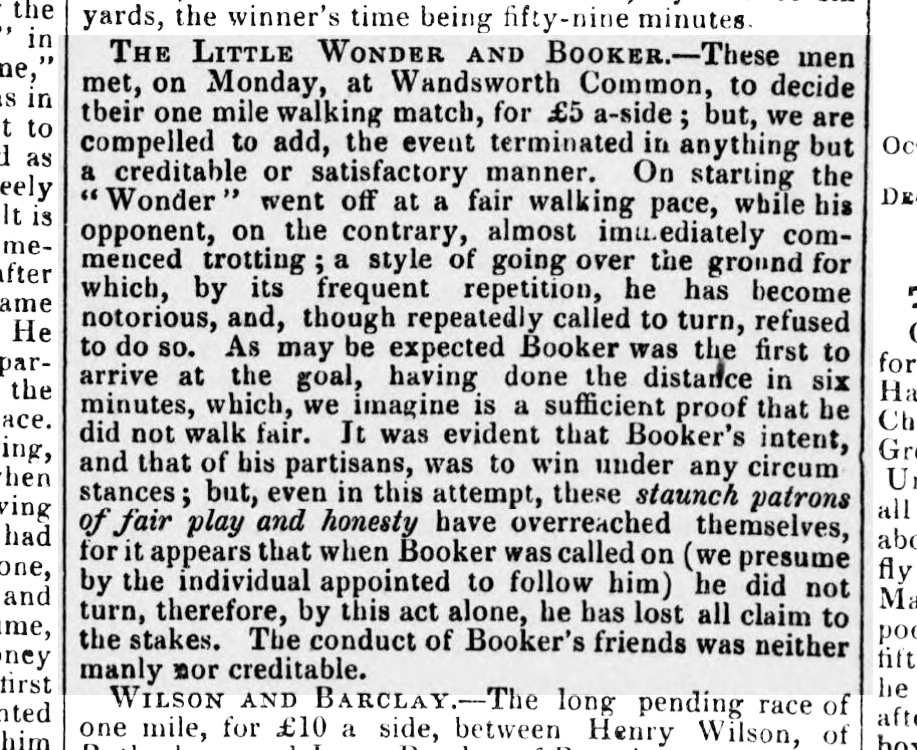
THE LITTLE WONDER AND BOOKER
These men met, on Monday, at Wandsworth Common, to decide their one mile walking match, for £5 a-side; but, we are compelled to add, the event terminated in anything but a creditable or satisfactory manner.
On starting the "Wonder" went off at a fair walking pace, while his opponent, on the contrary, almost imstediately commenced trotting; a style of going over the ground for which, by its frequent repetition, he has become notorious, and, though repeatedly called to turn, refused to do so.
As may be expected Booker was the first to arrive at the goal, having done the distance in six minutes, which, we imagine is a sufficient proof that he did not walk fair.
It was evident that Booker's intent, and that of his partisans, was to win under any circumstances; but, even in this attempt, these staunch patrons of fair play and honesty have overreached themselves, or it appears that when Booker was called on (we presume by the individual appointed to follow him) he did not turn, therefore, by this act alone, he has lost all claim to the stakes. The conduct of Booker's friends was neither manly nor creditable.
https://www.britishnewspaperarchive.co.uk/viewer/bl/0000053/18500825/010/0006
1850-08-25-little-wonder-and-booker-walking-race-TheEra-25aug1850.jpg
Building of the prison continues.
Theft of bricks.
WANDSWORTH.
The court was densely crowded, owing to its being known that three persons were to be examined on charge of stealing a very large quantity of bricks, the property of Messrs. Locke and Neesham, the contractors for building the new county gaoI on Wandsworth-common. That the case may be properly understood, it may be necessary to state that the contractors had agreed with Mr. RandalI Wood, Waterside, Wandsworth, to hire the greater portion of his wharf for the unloading of barges containing bricks, stone, tile, cement, iron, and whatever was required for the new prison; and Mr. Bngbee, of Rochester-row, Westminster, subcontracted carry alI bricks and other materials from the barges at the river side, to the new prison, having employed in this service a great quantity of carts and horses.
For some time it had been suspected that description of bricks were being used in the erection of some small houses in Battersea that were superior to what would have been used by the parties if they paid a fair price for them, and the matter was entrusted to Sergeant Daley, V, and police-constable Walker, 98 V, who succeeded in apprehending the three prisoners in the course of Tuesday. Mr. having taken his seat at 10 o'clock, William O&ldard, aged about 50, a carter, in the employ of Mr. Bugbee, contractor, was charged with stealing cart-load of bricks from the wharf of Messrs. Locke and Xeesham, the said bricks being consigned that firm, and Mr. Win. Robert Coomber, of 2, Battersea bridge-road, builder, was charged with receiving quantity of bricks, well-knowing them to be stolen. Police constable Walker, V, stated that in consequence of information he received he was in Battersea-square at about half past six o'clock on Tuesday morning, and at this time perceived one of Mr. Bughee's carts laden with bricks going towards Battersea-bridge; he watched it to the back Church street, into a piece of vacant ground, in the rear of the garden of the Europa public-house. Goddard was driving the cart, and he then shot out his load. He followed the empty cart back to Messrs. Locke and Neesbam's wharf, at the waterside, and on inquiring of Mr. RandalI Wood, found he had no contract Battersea, and what bricks went from them were supposed go to the new prison. Witness then went to the station and gave information of what he had seen, and subsequently, in company with Sergeant Daley, went to the spot where the bricks were shot. He there saw bricklayer, named Leggatt, and his labourer. He was heightening a walI enclosing the gardens of the Europa Tavern, and using the bricks. Leggatt said he had been employed by the prisoner Coomber. Witness then told Leggatt he must not touch any more of the bricks, as they were the property of Messrs. Locke and Neesham. Ho then remained watching the bricks untiI Goddard was brought there in custody of Sergeant Daley. The witness afterwards went in search of the prisoner Goomber, who he found was not at home, and he watched for him tilI past 10 at night, when he returned home. Witness addressed him, saying, "Do you know any thing of the bricks which are at the back of Enropa-place ?" and he said, " Yes, I have purchased 1,000, and am to pay 265. for them. 1 have purchased a great many thousands of him, and have paid 21. and 51. at a time.'' Witness asked him who "he" was, and Coomber said he was agent at Bugbee's wharf, at Wandsworth. Witness said that party had no right to selI any bricks, as they were the property of Locke and Neesbam the contractors. Coomber then said, " 1 shalI be able to show you that some othei parties have purchased of the same man." Witness now told him that he should charge him with receiving the bricks, welI knowing them to have been stolen, and took him into custody. Sergeant Daley, 33 V, stated, that having gone to the wharf, he there saw Goddard reloading his cart, and said to him when he came out of it, "What have you done with those bricks you took to Battersea," and be said, "I've not taken any at all." He put the question again, and he distinctly said No." Witness then took him to the place at Battersea described by Walker, and he identified him, and again Goddard denied having been there. He then charged him with stealing bricks belonging to Mr. Bugbee, and he made no reply. Charles Ondley proved the removaI of the bricks from the wharf by Goddard on Tuesday. Mr. Thomas Sewell, the foreman at the New Prison, said Goddard did not bring any bricks to the prison on Tuesday morning. The prisoner Goddard declined asking a question or saying anything. Mr. Beadon now cautioned the prisoner Coomber as to any statement he might make. Coomber went into a detaiI of his transactions, in which, according to his own showing, he had bought large quantities of bricks of a man who called himself Brown, and said he was agent to Mr. Bngbee, but could not write his name, and he had made out the receipts, Brown putting only cross his mark. He said he could produce those receipts, and observed that be had paid a f-ar price. Unfortunately for the prisoner a pocket-book was produced, and examined by Mr. Beadon, which proved to contain the identicaI receipts, and which clearly showed that not more than half the price had been paid for stock bricks. Mr. James Bugbee said he had contracied for carting the bricks to the new prison. Goddard had been in his father's and his services for 17 years. He had no authority to shoot them at Battersea, or draw bricks for any persons but him. The mode of transacting business in the manner described by the prisoner Coomber, was not that practised a respectable builder, and was one calculated to do witness, who was most extensively engaged in contracting, and others of his class, immense injury by seducing the men the) employed from the paths of honesty. Coomber here observed it had been carried on to awfuI extent. Mr. SewelI said the best stock bricks, the same quality as Coomber had admitted had giveu 265. a thousand for, cost their firm at first hand 345. Mr. Collett wished to make a statement with respect to the bricks at Battersea, as he had employed Coomber. Mr. Beadon faid he would decline the present inquiry hearing any statement. The prisoners were then remanded for week. Jo/m Savage, carter to Mr. Bug bee, was next charged with stealing a load of bricks intrusted to him to deliver at the new prison. The circumstances were similar to those in Goddard's case. This prisoner, who said nothing, was also remanded for a week. was expected that by to-morrow fth* B day) severaI other parlies would be in custody.
[Source: Link]
A sparrow shoot at the Plough on Garrett Lane.
I assume, though I have no evidence yet, that sparrow (and pigeon) shoots also took place on Wandsworth Common.

[PB: EXTRAORDINARY STORY — INTRO MISSING — FULL OF SALACIOUS DETAIL, BUT HARD TO WORK OUT WHAT WAS GOING ON — AND THE STORY IS NOT CONCLUDED!]
Indecent liberties
[missing section?
. . . after the occurrence. I did not telI Mrs. Collett, as she was in too much trouble about her husband's bankruptcy. She allowed him to sleep in the house. By
The JUDGE — Not with the servants? — (Laughter.)
Witness — No. George Strudwick examined, said — I shalI be twenty-two on the 1st of next January. I have known Ann Sherlock seven or eight years. I am a carpenter, and was employed by Mrs. Collett. I slept with Ann Sherlock once — (Laughter) — that was the occassion referred to when I was discovered in bed. Alice Morgan slept with us in the same bed. — (Continued laughter). I have since seen her with prostitutes; she smoked, and I have seen her drink. She was a person of immodest conduct. I never had connexion with her on any other occasion. I know a men named Woodhouse. I have heard her challenge him to sleep ith her.
Cross-examined — I don't know what has become of Alice Morgan. My father was a master carpenter, at Barnes, I was never apprenticed to the business. I cleaned boots and the knives, papered a room, and have goes of mends, when the man-servant. was away: I declare I was not engaged as shoeblack. After I left Mr. Collett I went to a gentleman named Gayton, at Priestbridge, and looked after his horse and shay." I have since been occasionally employed as a butcher at Barnes. I then went to t, situation at Walhatngreen, to look after a horse and shay, and drive the lady out. — (Laughter.) The lady's name was Lawton. I next got employment as a gardener to a surgeon. — (Laughter.) I have had a drop of drink with the defendant. I went to a "free and easy society" with him on Wednesday night last. A woman took the chair. — (Laughter.) The defendant and I smoke and drank like the rest.
The JUDGE — How came you to go to the bedroom?
Witness — They had both challenged me that I might, sleep with them, and they came to my bed room when I was undressing, and asked me to go into their room. They waited untiI I was undressed, and I then laud, " Go on, then, and PlI follow you: as I mean to sleep with you tonight." — (Laughter.) They went out, and I proceeded,to their bed-room.
The JUDGE — Did you have connexion with them both?
Witness — Not with Sherlock.
The JUDGE — Did Sherlock invite you to go to bed with her ?
Witness — Yes, and I might have had connexion with her if we had not been disturbed in the morning. — (Laughter.)
The JUDGE — Is she a good looking girl ?
Witness — Yes. Alice Morgan is 28 years old.
Edward Woodis examined — I am a friend of the last wimeis. He told me of his conneiion with Alice Horgan. Ann Sherlock also told me of their sleeping together, and said I might sleep with her if I liked. This was in March 1848. I became acquainted with the plaintiff through living in the same neighbourhood. I was charged before a magistrate for taking walnuts from a tree, but was dismissed. I am a carpenter, and earn 4s. a day. By the JUDGE — I declined to avaiI myself of Ann Sherlock's offer.
Wm. Smith, a plumber, residing at Mortlake, said, I know Ann Sherlock and a woman who went by the name of Edwards. She lived at Priest-bridge. Ann Sherlock lived as servant there. I went to the house, and slept with Mrs. Edwards. I went to another bed-room in the morning and found the defendant sleeping with Sherlock. I am also acquainted with the defendant. I was not at the Hen and Chickens, as it is called. on Wednesday evening. I do not consider the plaintiff a modest woman. I and a person named Challoner met her and another girI on Wandsworth-common. They accompanied to a public-house, where they drank freely, and Sherlock allowed us both to take indecent liberties with her.
Cross-examined — I saw the plaintiff for the first time at the BulI at Mortlake. Mr. Challoner is a gentleman residing at Richmond. I won't swear that I told the defendant of the occurrence at the public-house. I am 27 years old. William Bowen Challoner, also a young deposed to his going to the public-house in company with the last
Witness. 'After the plaintiff had sworn the child to the defendant, I said to her, "I thought you were too artful, Nance, to have a child." She said, "It is a pity you were not the father of the child, as you have just had 5001. a year left you." This was at the police-office; I nursed the child for a few minutes and then left. — (Laughter.) I have seen her frequently in the company of bad girls and gentlemen at a public-house at Putney.
Cross-examined — I have not quite £500 a year. I have known the defendant three or four years; he was in the same rowing club with me. He is quite a lad now. Frederick Chapman said — I know Mr. Edwards, but Mrs. Edwards is not his wife; she was his kept-woman. I also had a kept-woman at the same house at Priestbridge, where Sherlock wai servant. I am a solicitor. Mrs. Edwards was a woman of the town; her reaI name was Ashwen. Henry Brown — I live at Mortlake and knew the plaintiff. I once made an arrangement to take her to Cremorne, and then to sleep with her at Mrs. Edwards's. She did riot go with me, as Mrs. Edwards was at home, and she could not get out. She was an immodest girl. I have seen her frequently in the company of girls of the town. One of her companions is now in the penitentiary.
Cross-examined — I went to schooI with the defendant and know him well. I went last Wednesday to the club in the Strand where a lady takes the chair. I don't know that it is called the Cock and Hen Club." Cbarles Phillip, brother of the first
Witness. said he remembered two years ago Anne Sherlock telling him (she had been behind the scenes at the London Theatre, and had enjoyed a good lark. I always considered her to be a girl of very had character. This closed the defendant's case. Mr. sergeant ALLEN was then about to address the jury in reply, when The Learned JUDGE said, as he had to attend Chambers, he would be compelled to adjourn the case untiI Monday.
The Foreman intimated that the jury were quite unanimous as to their verdict. The Learned JUDGE. — I do not see how the plaintiff can hope to go on against the mass of evidence which has been given. It the defendant's case had rested entirely on the evidence of one or two witnesses, there, perhaps, might have been some doubt on the subject; but when so many persons, several of whom seem to be worthy of credence, corroborate the statements of each other, I think the Learned CounseI may see the propriety of stopping at this stage of the case but he is at libetty to adopt what course he likes.
Mr. Sergeant ALLEN — Then I will consent to the verdict bring given at once.
The jury engaged in consideration for about ten minutes, but were interrupted by Mr. Sergeant ALLEN, who said as they appeared still to entertain some doubt on the case, he would claim his right to reply. The case was then adjourned until Monday.
[Source: Link]