The History of Wandsworth Common
Wandsworth Common
IN THE NEWS
1849
[The Times: Search: "Wandsworth Common"].
[BNA: Buckmaster Battersea 1849]
[BNA: Wandsworth Common 1849]
[London Evening Standard: Buckmaster Wandsworth 1849]
1849-01-06-Cholera-IllustratedLondonNews.png
Illustrated London News — Saturday 06 January 1849
Outbreak of Cholera at an Infant Orphan Asylum.— During Tuesday and Wednesday, the members of the boards of guardians of the various metropolitan parishes and unions who farm out their pauper children at Mr. Drouet's Infant Poor Establishment at Tooting, were considerably alarmed at the receipt of information that cholera of a most fatal character had broken out amongst the children.
Mr. Drouet has under his care from 1400 to 1500 children of both sexes farmed out to him, under the sanction of the Poor-Law Commissioners, from various metropolitan parishes and unions, for whom each parish pays 3s. 6d. per head per week. The children exliibited their usual healthy appearance up to Friday (last week), when, in some of the wards, several children were attacked with severe diarrhoea, and in two or three instances the cases assumed the form of Asiatic cholera, and were treated accordingly; but, in some few of the cases death ensued in the short space of £hree hours. Every hour brought new patients, and undoubted evidence manifesting itself that the epidemic was extending its baneful influence to others,
Dr. Addison, of Guy's Hospital, was sent for, to consult with the resident medical oflicers. Up to that time fifty-seven cases and twelve deaths had occurred. Officers from the various parishes were summoned to Tooting, and the establishment was examined, when it was found that the drains of the buildings emptied themselves into extensive ditch abutting on the ground, and which it was believed might have a prejudicial effect.
The united opinion of all the medical gentlemen assembled concurred in stating the disease to have arisen from atmospheric poison, and not from the food the patients had taken.
Information of the occurrence has been forwarded to the Poor-law Board, Somerset-house, as also to Mr. Carter, the Coroner for Surrey, but it is not known whether any official inquiry will be instituted.
[BNA: Link.]
Bell's Life in London and Sporting Chronicle — Sunday 07 January 1849
[1849-01-07-cholera-tooting-BellsLife.jpg]
OUTBREAK OF CHOLERA AT THB PAUPER ASYLUM, LOWER TOOTING.
>A painfal sensation was created on Wednesday by the annou ek will that the cholera tad broken out io the juvenile pauper estab jecided | of Mr Drouett, Lower Tooting. In this establishment from highly; 1, 400 children are received from various unfons in and around would where they are clothed, fed, and educated at cuatract prices pecta- 46 6d to 48 9d @ week each, and heretofore the most gratifying views. have been made of the health of these chiliren, often—out of t ticular number more than three or four being in the it t there at a time, and those afflicted only with the diseases incidental toc ther as the mortality being far below that even in private, iron, This is the more remarkable when the localities and classes fro > have the children came, often the lowest and most depraved in the orders polis, are considered. remises are large and airy, and sur with extensive play-grounds, gardens, and meadows; and, to di | some to Mr Drouett, a more kind-hearted or man could 1 d dis. selected for the charge entrusted tohim. The establish ceived carried on under the sanction of the Poor-law Commission erally is constantly visited by the guardians of 'the different unions fro opean children are eent. e have repeatedly visited the institution ov
Infant Poor Establishment, Tooting culation of cholera under treatment. in both Number of Deaths. est was Total cases which have occurred since Friday. 'Ss were "* The first symptoms of the cholera appeared is a gir! on Friday n 371, 435, being the only cave which occurred then. The weather was foggy, da £4, 657, cold, and had been 60 throaghout the afternocen. On Saturday mor creased Game species of weather continued, with cold in the extreme. Six m occurred during Saturdey. A few cases only occurred on Susu nce our occurred during the day. Ou Tuesday and Wednesday t:.e numbers Monday morning brought with it tweive cases at daylight, aod ss m that the to increase, the latter day producing the greatest number of cases, ts accu- the number of cases which have occurred since midnight t; and thirteen, The strong and healthy, as the delicate, have te ered for criminately attacked, the fatality being as reat among the healthy lay, and sudden as among the delicate and previous! f diseased. "The draiwmage of the has been under the manage value of sanitary commission, which commission had the drainege cicar 'ands to want of drainage, as that is exceilent both from the werds and in the it improved a short time since; the disease therefore cannot be attr neighbourb influence alone being the only probabie | ng after (Signed) "Wa. Joseen Kire, surgeot ending engthen With respect to the drainage of the house and grounds, . 898 3, testimony to the fact that all within the power of Mr Drouett bas lolstein complished; but not so immediately beyond his grounds is week control, where, as we have often ststed, the drainage is not onl. fect, but an open sewer, emitting the most noxious effluvia, is over two miles of country to the river Wandle, and this immedi front of the Surrey Lunatic Asylum, close to which is an open : pm to receive the horrible deposits for the purpose of sor inthe neighbourhood. The same open drain passes thro bh the of Somers Town and Garrard, and such is the stat atmosphere, that mere casual passengers in the summer are oft ened y the atrocious character of the exhalations—and thi English wealthy parishes of Tooting, Streatham, and Wandsworth, wi en, the jurisdiction of the Commissioners of Sewers, and with the coy 2 bond- of sundry '' charitable and bumane'' committees, to whose a mised a ctober. the facc has been forcibly drawn. Perhaps these committees, 5 the evil of which we have so frequently warned them has come 1849. own doors, will bestir themselves, and, by obtaining prope the door is locked.'' drains, prevent its recurrence. When the steed is stolen th t Lhave Gibbs When death and desolation are produced | J tothe inattention, then the twaddlers about public health begin t By this themselves. The truth is, the Board of Health isa mere no shipped and there are so many im iments to beneficial operations t termi- existence of such a board is a deception. Persons who seek er next, are bandied from one body to another, and thus nothing i pro- Sometimes it is they are waiting for the levels to be completed | by my paid surveyors of the Crown; and then those supposed to be res n bond- deny that responsibility, and shuffle out of a duty the necessity | g that I torming which is but too obvious, and the inattention to which | the Ist duced the conse uences we have described, and which we over a hargip, re again proclaime: d as inevitable. Mr ite, in addition to his official report, states, that in almo MAR. instance, instead of the usual premonitory symptoms, the first in of attack has been the sudden bulking up or vomiting, and imm after the symptoms of confirmed cholera ensue. The indication, some case, of approaching death is a plaintive cry on the part of the c ealised water, after which being administered the patient apparently | intelli- into a sound sleep, a sleep from which he or she (as the case 1 never awakes. Finding the tendency to vomiting the first symy every case, Mr Kite felt it desirable that the matter vomited sh — subjected to analysation, and fur that purpose some was despat London, for the inspection of Professor Taylor, the eminent c lecturer of Guy's Hospital, who in the course of the day forward port to Tooting, in which he says :—'' I have no hesitation in ex; my firm belief that the symptoms are not due to any poison ts the food. They can only be regarded as cases of epidemic chol mali, ant form. I should recommend the use of animal food dai 25:50 gruel and liquid food, and isolation of the attacked.'' div Deputations from several unions have visited the establishmen and hints and suggestions have been given for improving the d clothing of the children, as well as increasing the warmth of the tories, all of which were promptly attended to, although the ni ll very price given for each child could scarcely such an extra June- Great credit is given to Mr Drouett for his anxious efforts to sub visitation to which his inmates have been subjected. ter 30 On Friday r Grainger, one of the medica! inspectors of the ( nglian Board of Health, as also Mr Hall, the Poor-law inspector for t ast tropolitan district, visited the establishment. We regret to stat th and gentlemen found that the disease and mortality were on the in eastern Up to five o'clock on Friday afternoon there had been 189 cases, York- cess of 71 over the return on Thursday. The number of cases 1, and occurred duriog Friday was 26, and the number of deaths 39, | yn and 114 cases under medical treatment, some of which are ina fair nches- recovery. Mr Kite states the symptoms in all the new cases to msoli- cisely similar to those which exhibited themselves in those whic last nigut are of a character, and will go far to st the hope of better times.
Evening Mail — Wednesday 31 January 1849
THE BILLS OF MORTALITY
The returns of the Registrar-General for the week ending January 27, show the total number of births to 1.57(J, and the deaths 1, 208, the latter being increase of 39 on the weekly average of five months.
This result is more favourable than that obtained in the two previous weeks, when the deaths were respectively 1, 448 and 1, 345.
The return shows that the deaths from zymotic diseases were 329, being 108 above the average; from dropsy, cancer, and other diseases of uncertain or variable seat, 61, being the usual average; from tubercular diseases, 175, being below the average; from diseases of the brain, spinal marrow, nerves, and senses, 150, being 9 above the average; from diseases of the heart and blood vessels, 22, being 18 below the average; from diseases of the lungs of the other organs of respiration, 245, being 2 above the average; from diseases of the stomach, liver, and other organs digestion, 58, being below the average; from diseases of the kidneys, &c. 14, being 1 below the average; from childbirth, diseases of the uterus, 13, being 4 above the average; from rheumatism, diseases of the bones, joints, &c., 10, being 3 below the average; premature birth and debility, 16, being 7 below the average atrophy, 20, being 5 above the average age, 45, being 28 below the average; sadden, 8. being 6 below the average; violence, privation, cold, and intemperance, being 14 below the average; smallpox, 16, being 5 below the average; measles. 18, being below the average; scarlatina, 76, being 44 above the average; hooping-cough, 55, being 13 above the average; diarrhoea, i 7, being 5 above the average; dysentery, 5, being 3 above the average.
The number of deaths from cholera is stated; and of these 14 occurred in the district of Wandsworth and Clapham, of them being the institution at Tooting. The total number of deaths in this house, or among children who have been removed from it, registered in four weeks, amounts to 188, of which 158 were returned as caused cholera. The' rest are ascribed to dysentery, mesenteric diseases, &c.
During the week 66 people have died from typhus, being above the average; from bronchitis, 104, being above the average; from. pneumonia, 95, being below the aveiage; from asthma, 26, being 12 below the The . Registrar-General adverts to fact, that the deaths from diseases affecting the respiratory organs were 246, almost the same as the average, having declined from 325 and 800, the numbers of the two former weeks, while the mean daily temperature ranged from 24�6 on the 2d day of the month to 49�6 the 25th.
In the last week a boy was registered in the Kent-road sub-district, who died of natural causes accelerated exposure to cold, " and at Clapham, woman of 18, who died of peritonitis, brought on by exposure to cold and damp, " after seven days' illness. Inquests were held in both case. A woman and her child died in Leather-market, Bermondsey, diarrhoea from want of sufficient nourishment, " as certified by medical certificates. The former was seven months advanced in pregnancy. It does not appear that an inquest was held in either of these cases. The medical man adds, that the house was mos. offensive condition from want of drainage.
The following is detailed statement of the fatal cases cholera, all certified medical attendants except two Kensington, Town. — ln the workhouse, P.. 23, typhoid fever, oouseeuttve on choleraat .Teunirg's-buddinga, widow of a labourer, 39, "cholera hours);" buildings, daughter labourer, 5, cholera (46 hours); same buildings, gardener labourer, 84, "cholera (13 boon)."
[BNA: Link]
Nottinghamshire Guardian — Friday 17 April 1868
PARTNERSHIPS DISSOLVED
— Edward Thomsett and Oswald Parsons, Sussex-road, Brixton, bricklayers. —
https://www.britishnewspaperarchive.co.uk/viewer/bl/0000176/18680417/012/0002
Morning Advertiser — Monday 7 May 1849
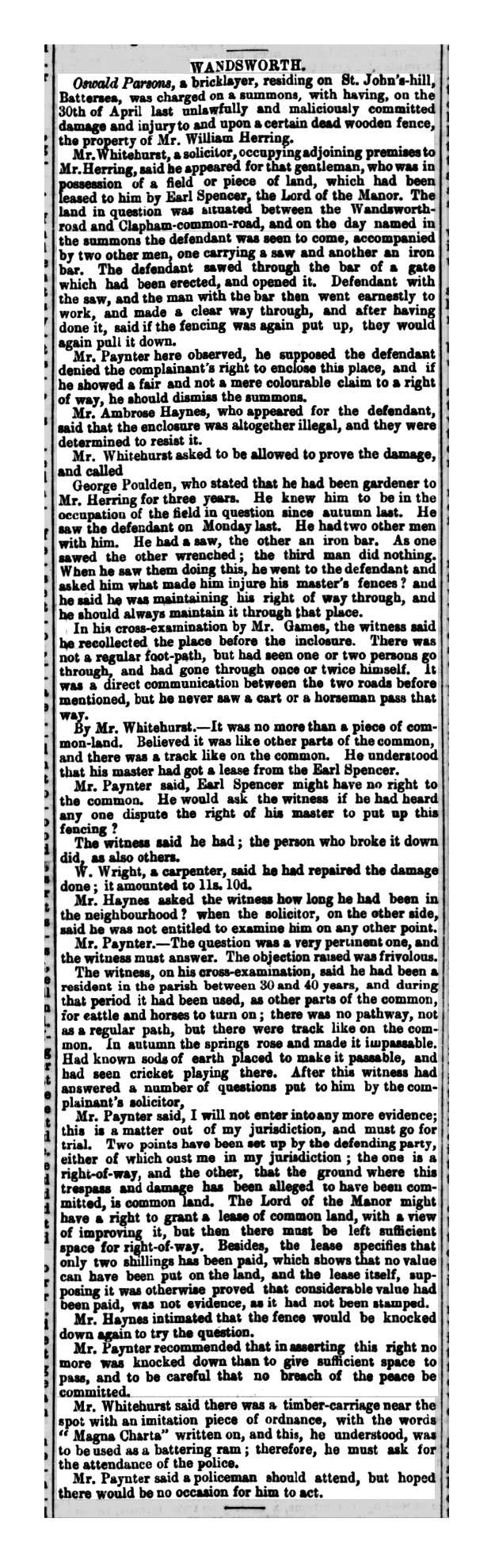
The bricklayer Oswald Parsons in court — the first named Wandsworth Common fence-breaker. He is charged with having "unlawfully and maliciously committed damage and injury to and upon a certain dead wooden fence, the property of Mr. William Herring." Herring lived in [Ivy House, on the corner of St John's Hill and today's Vardens Road.]
WANDSWORTH.
Oswald Parsons, a bricklayer, residing on St. John's-hill, Battersea, was charged on a summons, with having, on the 30th of April last unlawfully and maliciously committed damage and injury to and upon a certain dead wooden fence, the property of Mr. William Herring.
Mr. Whitehurst, solicitor, occupying adjoining premises to Mr. Herring, said be appeared for that gentleman, who was in possession of a field or piece of land, which had been leased to him by Earl Spencer, the Lord of the Manor. The land in question was situated between the Wandsworth-road and Clapham-common-road, and on the day named in the summons the defendant was seen to come, accompanied by two other men, one carrying a new and another an iron bar. The defendant sawed through the bar of a gate which had been erected, and opened it. Defendant with the saw, and the man with the bar then went earnestly to work, and made a clear way through, and after having done it, said if the fencing was again put up, they would again pull it down.
Mr. Paynter here observed, he supposed the defendant denied the complainant's right to enclose this place, and if he showed a fair and not a mere colourable claim to a right of way, he should dismiss the summons.
Mr. Ambrose Haynes, who appeared for the defendant, said that the enclosure was altogether illegal, and they were determined to resist it.
Mr. Whitehurst asked to be allowed to prove the damage, and called George Youlden, who stated that he had been gardener to Mr. Herring for three years. He knew him to be in the occupation of the field in question since autumn last. He saw the defendant on Monday last. He had two other men with him. He had a saw, the other an iron bar. As one sawed the other wrenched; the third man did nothing. When he saw them doing this, he went to the defendant and asked what made him injure his master's fences? and he said he was maintaining his right of way through, and he should always maintain it through that place.
In his cross-examination by Mr. Games, the witness said he recollected the place before the inclosure. There was not a regular foot-path, but had seen one or two persons go through, and had gone through once or twice himself. It was a direct communication between the two roads before mentioned, but he never saw a cart or a horseman pass that way.
Mr. Whitehurst — It was no more than a piece of common-land. Believed it was like other parts of the common, and there was a track like on the common. He understood that his master had got a lease from the Earl Spencer.
Mr. Paynter said, Earl Spencer might have no right to the common. He would ask the witness if he had heard any one dispute the right of his master to put up this fencing?
The witness said he had; the person who broke it down did as also others.
W. Wright, a carpenter, said he had repaired the damage done; it amounted to 11s.10d.
Mr. Haynes asked the witness how long he had been in the neighbourhood? when the solicitor, on the other aide, said he was not entitled to examine him on any other point.
Mr. Paynter — The question was a very pertinent one, and the witness must answer. The objection raised was frivolous.
The witness, on his cross-examination, said he had been a resident in the parish between 30 and 40 years, and during that period it had been used, as other parts of the common, for cattle and horses to turn on; there was no pathway, not as a regular path, but there were tracks like on the common. In autumn the springs rose and made it impassable. fled known sods of earth placed to make it impassable, and had seen cricket playing there. After this witness had answered a number of questions put to him by the complainant's solicitor.
Mr. Paynter said, I will not enter into any more evidence; this is a matter out of my jurisdiction, and must go for trial. Two points have been set up by the defending party, either of which oust me in my jurisdiction; the one is a, 1 right-of-way, and the other, that the ground where this; traipse. and damage has been alleged to have been committed, is common land. The Lord of the Manor might have a right to grant a lease of common land, with a view; of improving it, but then there mast be left sufficient, space for right-of-way. Besides, the lease specifies that only two shillings has been paid, which shows that no value, can have been put on the land, and the lease itself, sup-; posing it was otherwise proved that considerable value had been paid, was not evidence, as it had not been stamped.
Mr. Haynes intimated that the fence would be knocked down again to try the question.
Mr. Paynter recommended that in asserting this right no more was knocked down than to give sufficient space to, pass, and to be careful that no breach of the peace be; committed.
Mr. Whitehurst said there was a timber-carriage near the, spot with an imitation piece of ordnance, with the words " Magna Charts" written on, and this, he understood, was, to be used as a battering ram; therefore, he must ask for; the attendance of the police.
Mr. Paynter said a policeman should attend, but hoped 1 there would he no occasion for him to act.
[PB: Oswald Parsons is named as "Oswald Painter" in Mark Gorman's, Saving the People's Forest, p120. Mr Paynter is the magistrate, not the defendant. A simple slip.]
[PB: I think he [or possibly a relative, since often referred to as "C." or "Charles" Parsons, and never as a bricklayer] was also involved in fence breaking near Garratt Lane:]
This story is very interesting. I learned about it in reverse date order — I was trying to find out more about Oswald Parsons when I read of a "C. Parsons, fence breaker on Garratt Lane, who I thought might be him. (I'm still not sure.)
The last report (the first I read) was Morning Advertiser — Saturday 17 November 1849
But as I dug and delved I realised the story as described on 17 November was very much more complicated, and interesting.[Was it cholera?]
So read the articles in reverse order, finish with this, the earliest:
Morning Advertiser — Friday 12 October 1849
WANDSWORTH
A large number of working men and their wives presented, themselves before the sitting magistrate, to complain jointly, of the corpse of a woman lying in one of row of five houses in Garrat-lane, Wandsworth, from which was impossible to remove her for burial, in consequence of barricade with, spikes being erected in front of these houses, which not only prevented access to or egress from them without incurring great danger, together with the risk of a prosecution for trespass.
Mr. Broughton sat for Mr. Paynter. It appeared that for many years a tramway existed, which went from Wandsworth to Merstham, a celebrated depository of fullers-earth, which some years since was in great request, particularly in Wandsworth, where a great number of silk and cotton printing mills abounded. This trade spreading further north, by the introduction of steam machinery, the tram-way, or "Surrey Iron Railway, " as it was termed, fell into disuse, and remained so for years, until the existing proprietor obtained an Act to dissolve the company and sell the land, without reference to any rights of way, outgoings. Sec., giving, however, the occupiers of the adjacent soil the right of pre-emption in purchasing. Much of the old line of railway ran parallel to Garret-lane, and on the left hand side, proceeding from Wandsworth to Tooting and Merton many houses had been built, the tenants of which assumed right of way over the neglected tramway, which was not discountenanced by the representatives of the Company, and hence became implied right.
When the sale of the line was announced few ot the owners of the adjoining property attended, fancying their right of way secure; and not doing so, became the victims of more far-seeing men than themselves, who demanded a high premium for small portions of land, which, purchased in the bulk, had occasioned them a very trifling outlay. Amongst the parties who had neglected purchasing the vacant space of ground intervening between his house and the roadway, was Mr. Johnson, the owner of the five houses alluded to, and declining also to submit to the terms imposed by the purchasers, the letter inclosed the vacant space of ground to within a yard of the houses, with close paling, from five to six feet high, and in addition stopped up the footpath, which never was a portion of the Surrey Iron Railway.
Mr. Scully, a grocer, whose premises adjoined these houses, had to secure a right of way to his shop, purchasing the ground in front, and left communication of about 13 inches in width between the houses and his shop, and this was the only outlet the tenants had had for the last six months, when he was induced, partly by threats, to close that passage, and the people inhabiting the houses literally became prisoners since Monday last, and the Magistrates at this Court had no intimation of the fact until Wednesday, when Mr. Gardinar, the undertaker to the Wandsworth and Clapham Union, applied to Mr. Beadon to know how he was to bury corpse that was lying in one of these houses. Tbe magistrate being only partially acquainted with the circumstances, and informed that the owner of the land had agreed to temporarily remove sufficient of the fencing allow of the coffin passing, upon being paid compensation fee, said thought that the best course to adopt, and so the matter dropped until to-day, when, as have stated, all the tenants came before Mr. Broughton, by whom, with much pains, the foregoing facts were ascertained.
Mr. Broughton expressed a decided opinion that the tenants had no right to be imprisoned in their houses, whatever dispute might arise between their landlord and the owner of the intervening ground, and they were justified in breaking down the fence that prevented their ingress or egress. It was a very strange business for hardworking people being shut in this manner, and he wished to know who the party was who had imprisoned the tenants. The tenants replied, Mr. Bright, a plumber and glazier, in Wandsworth, who was also registrar of births and deaths, &c., and inspector of nuisances. (Laughter.)
A poor woman said she had three children then ill at home. She had climbed over the fence to come there with great difficulty, and she wanted a doctor to see them, but how could he get there? There was no way backwards, for those premises were Mr. Bright's, and if they trespassed, they were threatened with instant imprisonment. In fact, the well in the row of premises being poisoned with dead kittens and rats, they were compelled to drag every drop of water over the palings.
Mr. Broughton said, before went any farther into this affair, should wish Mr. Bright to present. Mr. Bright was accordingly sent for, and on his arrival, the worthy magistrate said a very serious complamt had been made against him, and detailed the nature of it (>
Mr. Bright entered into a long statement respecting his purchase of the land, and the refusal of Mr. Johnson to repurchase. He then proceeded to state, that he had done only what was justified in, and thrust the odium Mr. Scully, who had only closed np 13 inches. He considered that if that aperture had been left open, there would have been plenty of room for a coffin to pass. He was not bound to accommodate Mr. Johnson's tenants, and he could have gone two feet nearer the house. He had threatened to build a wall. He knew that the tenants were paying no rent to Mr. Johnson, who wanted to obtain the land for nothing.
The tenants said this was untrue, and produced their rent books.
Mr. Broughton said, it was very hard that the tenants should be sacrificed either by their landlord or Mr. Bright. They had taken their houses with a presumed right of way, and he had no hesitation in saying they were entitled to it. It was cruel thing that a woman could not get a doctor to her sick children, and if attempting to take them to him, an accident should happen that resulted in death, a coroner's jury would make it a very serious case for Mr. Bright, he repeated, he had no right to put such a fence, and when spoke of putting up a wall, he had better once erect a museum for the skeletons of the women and children that would die for want of nourishment and air.
After some further remarks, the worthy magistrate told the tenants the remedy was in their own hands.
[BNA: Link.]
Also
Globe — Friday 12 October 1849
WANDSWORTH.
Imprisonment of the Tt- I Five Houses —A large number of working I men and their wives presented themselves before the magistrate, to complain, first of the corpse of a woman lying in ouo of row of five houses Garrat-lane, Wandsworth, which it was impossible to remove for I buri.il reason of barricade with spikes beioi: erected iu front of those houses, which not only pre'. j vented the egress of the dead body, but the ingress egress of those inhabiting the houses without incurring great danger, together with a prosecution for trespass. A disused tramway — over which for several years the inhabitants of these houses were permitted to pass—runs in front between them and the high road. This ground occupied by the tramway was purchased t'Ome time since by persons who refused recognise this implied right of way, and demanded high premium for the portions of land abutting the houses, and the people inhabiting the houses literally became prisoners.
Mr. Broughton said that the tenants had taken their houses with presumed right of way, and he had hesitation in saying they were entitled to it. was cruel thing that woman could not get a doctor to her sick children, and if attempting take them to him accident should happen that resulted in death, a coroner's jury would make it a very serious case.
After some further remarks, the worthy magistrate told the tenants the remedy was in their own hands.
[BNA: Link.]
Morning Chronicle — Tuesday 23 October 1849
WANDSWORTH
William Peatt, a carpenter, Charlotte Thrush, Charles Parsons, a labourer employed at Mssrs. Easton and Amos's paper mills, William White, a shoemaker, and _______ Fortin, all tenants of five houses situate opposite to the Old Sergeant Tavern, Garrat-lane, Wandsworth, and belonging to a Mr. Johnson, a coal and corn merchant at Chelsea, were summoned by Mr. Paynter, at the instance of Mr. Robert Bright, a plumber and glazier, registrar of births, deaths, &c., and inspector of nuisances, at Wandsworth, for wilfully and maliciously damaging a wooden fence, to the amount of £5., his property.
Mr. Batt, of the firm of Messrs. Luttley and Batt, appeared on the part of Mr. Bright; and Mr. Augustus Newton, the barrister, was engaged by the defendants.
It will be recollected that on the 12th instant an application was made at this court, to Mr. Broughton, who sat for Mr. Paynter, by a number of the inhabitants (some of whom were the present defendants), relative to the fact of the body of a woman lying dead in one of the above-mentioned houses, which could not be removed for the purpose of burial, in consequence of a high and impassable fence being erected, not only in front of, but absolutely inclosing these houses, and preventing all ingress and egress to the tenants. Many inconveniences resulting from this extraordinary proceeding were mentioned by the complaining parties, more particularly the fact of a woman having three children dangerously ill, and being unable, by reason of the above-mentioned obstruction, to obtain the attendance of a doctor.
The reply of Mr. Bright, the party then complained of, was, that he had purchased a certain portion of land intervening between those houses and the main thoroughfare of Garrat-lane, which now formed part of an iron tramway extending from Wandsworth to Mitcham. He had offered the frontage to M1r. Johnson, the owner of these houses, who had refused to purchase; and he (Mr. Bright) had only carried out his own right in enclosing the tenants' houses.
To this explanation Mr. Broughton said, the law would never permit a dead body to be kept shut up in a house to the danger of all the living inhabitants; nor was it to be supposed that the living tenants were to be imprisoned because there was a dispute between their landlord and the owner of an adjoining piece of ground. It was quite clear that when they took the houses, they took them with an implied right of way, and it was equally certain they were entitled to that privilege, the remedy for the recovery of which was in their own hands.
It was for the subsequent proceedings on this application, namely, the making of a clear right of way to such house, that the present summonses were obtained.
Mr. Batt proceeded at great length to show the right and title of the late Tramway Company to sell all their land, without reference to any right of way to a few adjoining lands, and that his client buying under that power which had been given the company by the Legislature, he submitted that both a trespass and wilful damage had been committed by the defendants in breaking down the fencing his client had erected, and he should consequently press for their punishment and if they were unable to pay the fines they must suffer tie penalty, for matters of such a character must be set at rest.
A long and uninteresting discussion, except to the parties interested, was then 'one into, without any witnesses being called prio or coa. M r. Newton objected to the magisterial jurisdiction, oel the ground of a fair and reasonable right of way being set up, which ousted him; and the magistrate said it was questionable if the proprietary of the railway had not assumed powers they had no right to, but the complainant himself, when he applied for the summonses, had deceived him, for lie said his land abutted on the houses, when the fact was it was several feet from them, and it was evident neither he nor any other man could take away the pathway leading to and from inhabited houses, and shut up or imprison any man. After many more remarks equally favourable to the defendants, the magistrate alluded to the enormous expense that would devolve on either party in trying this question, and suggested that the parties most interested should come to some amicable understanding, which was so far effected that there is now no fear of a renewal of imprisonment taking place, so far as the tenants are concerned.
[BNA: Link.]
>>https://en.wikipedia.org/wiki/Surrey_Iron_Railway<<
Closed 1846
Sold off
How much did Sophia Sheppard/Magdalen College own? Marc S. wrote something about this, didn't he?
Old Sergeant Pub
104 Garratt Lane
SW18 4DJ
[Almost opposte the end of Allfarthing Lane. The Wendlesworth Estate? was built on the site c.? See e.g.
[BNA: Link.]
]
[BNA: Link.]
[BNA: Link.]
>>
Bright
Morning Advertiser — Thursday 04 January 1849
Bright as overseer/inspector of nuisances
[BNA: Link.]
See
Morning Advertiser — Saturday 27 October 1849
WANDSWORTH
Mr. W. Smith, a retired tradesman, late of North-street, Wandsworth, and now of West-hill Villas, Battersea; Mr. Charles Bowles, a surveyor; W. White, shoemaker; and C. Parsons, the two latter inmates of the row of houses in Garrat-lane, concerning the right of way to which there has been so much dispute, were summoned before Mr. Paynter, for wilfully and maliciously pulling down and destroying 15 rails, of the value of 20s.
Mr. Batt, solicitor, observed that he had again to appear for Mr. Robert Bright, who is a plumber and glazier, and owner of a row of small houses in Garrat-lane, adjoining what was formerly the Surrey Iron Railway, of which he now possessed a portion that he fenced it in, and it was for the malicious destruction of this fencing that he prosecuted the defendants now present.
The magistrate would recollect that his client possessed part of the same strip land which ran in front of five houses belonging to Mr. Johnson; that that fencing was pulled down by a party of whom White and Parsons were members, and that they were summoned no later than Monday last for removing this fencing. The worthy magistrate adjourned his decision for a fortnight, at the same time suggesting an amicable arrangement between Mr. Bright and Mr. Johnson, which was come to the | same afternoon, by the latter becoming the purchaser of the land over which there had been a disputed right of way.
It was supposed that the matter would have rested here, but not so, for on the very same afternoon Mr. Smith and Mr. Bowles, who were not tenants, and consequently had no interest at stake, went with the other defendants, and polled down a panelled fencing, separating Mr. Bright's house from Mr. Johnson's, and fifteen pales which were erected at the extreme boundary of Mr. Bright's land, running parallel to the roadway. He was prepared to show, that Mr. Smith set the example, by pulling down the first pale, which he carried into White's house, and that the others were conveyed there, but some of them were brought out again and thrown on the ground. His client did not proceed so much for the value, but if this spirit of mischief was not checked, it might lead to a very serious breach of the peace. Mr. Smith did all he could to provoke his client to breach of the peace, and should not be surprised if the proceedings terminated at last at the Old Bailey.
Mr. Paynter here observed, that on a former occasion he expressed himself of opinion, that there was right of way to the houses, but that fhat was only a private and not a public right., .
Benjamin Whitty was then sworn, and th»t he was employed by Mr. Bright. On the mat. saw all the defendants break down the boundary fencing, and some panelling paling next to the complainant's houses, which prevented any one crossing there from Johnson's side. White took all the paling into his house, but brought eight pieces out afterwards. The paling that had been erected opposite Johnson's houses had been cleared away, and was in a cart ready to be drawn off. White was inclined to upset the cart, but witness told him he would go too far, and he desisted. Had had no order from his master to take down the paling which crossed the pathway. There had been a free right of way before. Mr. Bright was present part of the time. Mr. Smith and the others hooted him down the lane as far they could see him. Smith held a paper to his face. There was a great riot, and all the neighbourhood was out.
Another witness named Bennett corroborated the preceding evidence, and added that the pales might be worth 6d. a piece.
Mr. Bright was then sworn, and after detailing the facts already mentioned by his solicitor, added that he had been grossly insulted, that he heard Smith say, in allusion to the palings, must have them down." Smith asked him to look at the remarks about him in Mr. Newton's brief, and put the paper in his face.
In his cross-examination by Mr, Smith, the witness said he did not know what width of ground he purchased the railway. He had sold the same way to Mr. Johnson as be had bought. He did not guarantee any number of feet. Did not know that he had inclosed 12 feet of parish ground that never belonged to, or was used by the railway. He conveyed what he had from the railway to Mr. Johnson, and did not ask the defendant to tell Johnson, when he wished to purchase some time since, that he. Smith, had bought it so as to enhance the price. Witness could not undertake to convey to Mr. Johnson a certain width. Did not know it was worth £50 more if the width was gua ranteed. It might be feet, as it now was. Witness claimed the ground from his houses to the roadway.
Mr. Smith said the railway was only 18 feet wide. The other land belonged to the parish, and was public property. He had the parish with him, and the minister and the local magistrates; and he would go that afternoon and knock down the remaining palings.
Mr. Paynter here emphatically observed, that if the defendant made such threats in his presence, he would commit him to prison for contempt of Court, or he would bind him down in such heavy sureties, that would experience difficulty in procuring them. It was not to bo borne, that he should be told in his own Court by a defendant, that he would go from that Court in defiance of him, and create breach of the peace. It was an attempt at annihilating his jurisdiction, and he could not but say it was the most disgraceful conduct be had ever witnessed.
Mr. Smith expressed his regret at being so led away by his feelings to have used expressions that had pained the magistrate, and trusted his apology would be accepted.
After some further remarks from the Bench, the defendant White said Mr. Johnson authorised him to pull down the panelling fence, and the pales he never interfered with, except to take care of them, as be was told to do by Mr. Johnson.
Mr. Bowles said he was sent for Mr. Johnson, whose surveyor he was, to give his opinion on the paling across the pathway, and in consequence of what said Johnson authorised him and the tenants to pull it down, saying he would bear him and them harmless. He had not attended the Court that day, although he had given his word he would do so. He wished distinctly to say that he never insulted Mr. Bright, nor had any idea of doing so.
Mr. Paynter now made some remarks the whole case, observing first that he had hoped that Monday would have set this matter finally at rest, and that it might do so he adjourned the case a fortnight, but White and Parsons, while the matter was in abeyance, proceeded to raise the disturbances for which they were liable to proceedings in the Court of Queen's Bench.
The magistrate continued, that the question of right of way did aot authorise them to destroy property, and the damage must be made good. The defendant's (Smith) conduct he considered very violent, and Bowles, from his peculiar position, knew that he had not the claim, even of a tenant, and as Mr. Bright had expressed himself in bodily fear from both him and Mr. Smith, he should require them to enter into their own recognizance of 502. each; for Mr. Bright must be protected.
He did not wish to convict the defendants of a malicious trespass, having very little doubt they had a private right of way to their houses, though there was no proof of right to cross Bright's houses. The other question of the land admitted of doubt.
The Magistrate concluded his observations by adjourning the case for a fortnight.
[BNA: Link.]
Morning Advertiser — Monday 29 October 1849
Wandsworth — Mr. Bowes requests to state that he was not required to enter into his own recognizance of £50, on Friday last, to keep the peace towards Mr. Bright; application to that effect was made, but the magistrate refused to accede to it.
[BNA: Link.]
Other mentions of Charles Parsons, Garratt Lane:
Morning Post — Thursday 18 December 1845
CP accuses carrier of stealing money from laundry box
[BNA: Link.]
I have found no further references to the story in the Morning Advertiser in 1850 or 1851
Also 1849-11-17-parsons-fencebreaker-MorningAdvertiser.jpg]
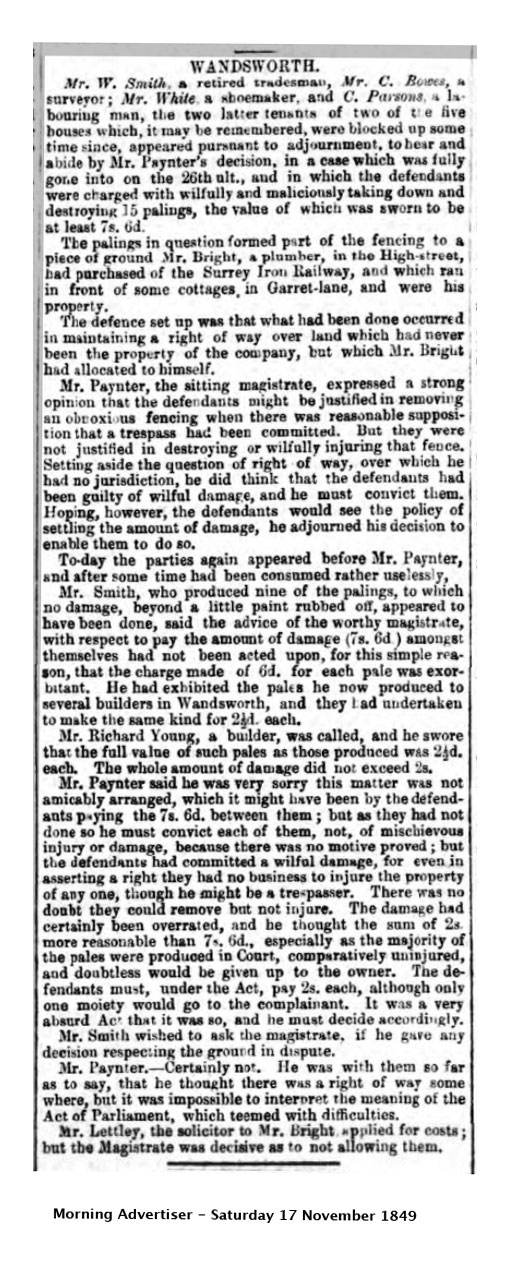
"C." Parsons, and others, fence-breaking on Garratt Lane, 17 November 1849. Is this Oswald? Or a relation? Where exactly was this? The Tithe map might have an answer.
WANDSWORTH
Mr. W. Smith, retired tradesman, Mr. C. Bowes, surveyor; Mr. White, a sboemaker. and C. Parsons, a labouring man, the two latter tenants of two of the five houses which, it may be remembered, were blocked up some time since, appeared pursuant to adjournment, to hear and abide by Mr. Paynter's decision, in a case which was fully gone into on the 26th ult., and in which the defendants were charged with wilfully and maliciously taking down and destroying 15 palings, the value of which was sworn to be at least 7s. 6d.
[Check newspapers covering 26 October 1849.]
The palings in question formed part of the fencing to a piece of ground Mr. Bright, a plumber, in the High-street, had purchased of the Surrey Iron Railway, and which ran in front of some cottages, in Garret-lane, and were his property.
The defence set was that what had been done occurred in maintaining a right of way over land which had never been the property of the company, but which Mr. Bright had allocated to himself.
Mr. Paynter, the sitting magistrate, expressed a strong opinion that the defendants might be justified in removing the obnoxious fencing when there was reasonable supposition that a trespass had been committed. But they were not justified in destroying or injuring that fence.
Setting aside the question of right of way, over which he had no jurisdiction, he did think that the defendants had been guilty of wilful damage, and he must convict them. Hoping, however, the defendants would see the policy of settling the amount of damage, he adjourned his decision to enable them to do so.
Today the parties again appeared before Mr. Paynter, and after some time had been consumed rather uselessly, Mr. Smith, who produced nine of the palings, to which no damage, beyond a little paint rubbed off, appeared to have been done, said the advice of the worthy magistrate, with respect to pay the amount of damage (7s. 6d ) amongst themselves had not been acted upon, for this simple reason, that the charge made of 6d. for each pale was exorbitant. now He had exhibited the pales he now produced to several builders in Wandsworth, and they had undertaken to make the same kind for 2 1/2d each.
Mr. Richard Young, a builder, was called, and he swore that the full value of such pales as those produced was 2 1/2deach. The whole amount of damage did not exceed 2s,
Mr. Paynter said he was sorry this matter was not amicably arranged, which it might have been by the defendants paying the 7s. 6d. between them; but as they had not done so he must convict each of them, not, of mischievous, injury or damage, because there was no motive proved; but the defendants committed a wilful damage, for even in asserting a right they had no business to injure the property of any one, though be might be a trepasser, There was no doubt they could remove but not injure.
The damage had certainly been overrated, and be thought the sum of 2s.more reasonable than 7s. 6d., especially as the majority of the pales were produced in Court, comparatively uninjured, and doubtless would be given up to the owner. The defendants must, under the Act, pay 2s. each, although only one moiety would go to the complainant. It was a very absurd Act that it was so, and he must decide accordingly.
Mr. Smith wished to ask the magistrate, if he gave any decision respecting the ground in dispute.
Mr. Paynter — Certainly not. He was with them so far as to say, that he thought there was a right of way somewhere, but it was impossible to interpret the meaning of the Act of Parliament, which teemed with difficulties.
Mr Lttley, the solicitor to Mr. Bright applied for costs; but the Magistrate was decisive as to not allowing them.
The News (London) — Sunday 18 July 1830
[BNA: Link.]
Public Ledger and Daily Advertiser — Monday 26 July 1830
Insolvent Debtors' Court
"Oswald Parsons, Late of Battersea-rise, Surrey, bricklayer"
[BNA: Link.]
Then no mentions until 1843:
Bell's New Weekly Messenger — Sunday 13 August 1843
"INSOLVENT DEBTORS' PETITIONS Saturday, the 5th day of August, 1843. ORDERS have been made, vesting in the Provisional Assignee the Estates and Effects of the following Persons; (On their own Petitions.) . . . Oswald Parsons, Battersea rise, Battersea, Surrey, journeyman bricklayer"
[BNA: Link.]
Several similar announcements
No mentions until 1859
Morning Advertiser — Saturday 12 November 1859
COURT OF BANKRUPCY . . .
RB OSWALD PARSONS. SUBSEQUENTLY ACQUIRED PROPERTY, Mr applied under insolvency of the year 18i3 to enforce the warrant of attorney, riven by the insolvent at the time of his adjudication, on the ground that be was of ability to pay his debts. The application waa made on an affidavit setting forth the property the insolvent now possessed.
The Court granted rule nisi.
[BNA: Link.]
Morning Advertiser — Thursday 08 December 1849
IN RE OSWALD PARSONS. In this case a rule had been obtained enforce the warrant of attorney, given at the time of the insolvent's adjudication in 1853. His debts were then only 132l, and it was alleged that he had become possessed of some houses at Wandsworth, under his father's will.
The insolvent showed that his income was only £88-a-year, that he had a large family, and was a cripple in one of his hands.
The learned Commissioner said the object of the legislature was to apportion for old creditors any surplus that man might have after supporting his family, and he could not discover any surplus the case, the rule would discharged.
Mr. Reed was for the creditors applying, and Mr. Sargood for the insolvent.
[BNA: Link.]
I assume this means he was no longer bankrupt?
(Click on image to enlarge)
[BNA: Link]
Morning Herald — Monday 25 June 1849
St Peter's Hospital, The Fishmongers' Company
(Click on image to enlarge)
THE FISHMONGERS' COMPANY
On Saturday the ceremony of laying the foundation-stone of the new St. Peter's Hospital, at East Hill, Wandsworth (the ancient foundation being about to be removed from Newington Butts), took place with the customary solemnities. The prime warden of this wealthy civic company, accompanied by wardens and court of assistants, and a numerous body of the livery, proceeded from London Bridge in the state barge for the new pier at Wandsworth, and the usual ceremony was gone through, the party embarking shortly after one o'clock and returning to London Bridge soon after five o'clock; the band of the Roya Artillery having been engaged to attend the whole of the day. On the return of the prime warden, Mr. William Flaxman Vowler, and the company to Fishmongers' Hall, a grand banquet was given in celebration of the event. The general loyal toasts, and those of an individual interest, were given and responded to; after which, about eleven o'clock, the assembly separated after a most agreeable day.
[BNA: Link]
Neal
(Click on image to enlarge)
Sun (London) — Thursday 30 August 1849
The great Battersea-Wandsworth Dam / Albion Terrace cholera
The report of the Registrar-General on the state of the health of London during the week states that 7, 470 lives have been destroyed in London alone from cholera since the commencement of the epidemic, and the Registrar very justly adds, that while the present epidemic has excited some talk and terror, the efforts which have hitherto been employed to combat it look feeble and insignificant when contrasted with the vast means and agency which are brought to bear by the nation in other fields for the protection of life and property.
We have Sanitary Commissioners and Commissioners of Sewers, each with a well-paid staff of officials at their command, and when we endeavour to ascertain what they have done to arrest the progress of cholera by removing its causes, we find that with the exception of the adoption of that very questionable measure, the flushing of the sewers, by which their filthy and putrid contents have bee disturbed and diffused, and the Thames polluted and rendered a medium for the propagation of contagion, as any one who travels on it may satisfy himself, by the evidence of his own nostrils, these two Boards of Commissioners have done nothing. The Commissioners of Sewers have indeed stated their readiness to receive any plans which may be sent in for the effectual drainage of London, but they are too much occupied with the squabbles of Mr. CHADWICK and Mr. LESLIE to do more than " receive" plans which appear to be treated by them somewhat after the fashion in which petitions are treated by Parliament.
Among the various plans which have been thus ordered to be laid on the table, two have more especially excited the attention of engineers, scientific men, and the public, viz., that of Mr. W. YATES FREEBODY and that of Mr. RICHARD DOVER.
Mr. FREEBODY, in his letter to the Commissioners, thus proceeds to state the objects which he proposes to effect. He says " The first plan is to obtain an efficient supply of water sufficient to cleanse at any given time all the sewers under your control, and constantly afterwards to flow in sufficient volume to prevent accumulations therein of noisome materials or other obstructions. "
The other design is to flush that part of the channel of the River Thames between Battersea and Greenwich, so as to obviate along its course the deposit of offensive matter — a measure, I presume, necessary to be adopted, in the event of your arriving at the determination that the River Thames is still the best practicable out-fall for the drainage of so vast a system as the one now under your care and control."
Having explained the method which he proposes to adopt for the purpose of obtaining an efficient supply of water, Mr. FREEBODY proceeds as follows: " Should you, after mature consideration, elect to continue the drainage of the metropolitan sewers to the valley of the Thames, I have next to direct your attention to the second proposal I desire to bring under your notice, viz., to flush that part of the channel of the River Themes between Battersea and Greenwich. I purpose to effect this by placing across the river, at a point between Battersea and Wandsworth, a solid dam of masonry, pierced by seven locks. The lock-gates may, very generally, be kept open, and the tidal and downfall currents allowed to pass unobstructed; but in process of time, or more especially in dry seasons, the river throughout its populous vicinity from Battersea to Greenwich may, from its continuing to be the out-fall of above 140 sewers, have a considerable quantity of soft foetid matter deposited in its course that would need removal; and, at present, there is no agency under your control that will effectively perform that duty. To inquire your power to erect such a work is unimportant hero; the sewers, as at present constituted, have a tendency to pollute the river, and to cause obstructions in its channel that may become insalubrious. I will, therefore, assume that the required authority to ameliorate the conditions of those evils will be intrusted to your Commission when found requisite. "
Were these locks constructed, their action when employed would be as follewl: During the flow of the tid: the gates would all remain open until high water, and the tidal water would, as usual, run up to Teddington Lock, with the varied heights due to ordinary causes. From the time of high water the gates (except for passing vessels) would remain closed for about four hours of the six and a half hours (which is about the duration) of an ordinary ebb tide. By this means the channel of the river, for a length of twelve miles five furlongs, would become one vast lock-pool, of an average width of 154 yards, and assuming a medium tidal lift of only 6 feet over t.:is entire distanc:., it would give 185, 081, 520 cubic feet of water, to be passed along the river from Battersea to Greenwich, and probably below, in a given time, and with a controllable velocity.
The water so conserved would by this means be brought into use at a period when most needed for purposes of salubrity, viz., during the two hours preceding the time of low water, and any inconvenience caused thereby to navigation could not exceed what is now often experienced in redly seasons (when the whole valley of the river between Oxford and Teddington is flooded) the sluice area so governing the rate of current as never to permit it to exceed the velocity generally cells, quent on ordinary freshes. "in order to preserve the sides of the river from deposits of filthy material, principally those sites varied almost diurnally, between high and low water marks, many of the minor sewer out-falls should be united into one common channel, and conducted downwards to a convenient discharge point, by drains of the usual construction, or by cast-iron tubes. It is also very important that greater care should be taken with that part of the various out-fall sewers necessarily left open on the site nearest to low-water marks. These outlets should all be properly graduated and proportioned, so as to avoid deposit near that spot, and to retain the full benefit of the relative gravity due to the force of flush obtainable, the desideratum being to carry the sewer contents as far into mid-stream as possible.
There is one great and to our minds insuperable objection to this plan, it still makes the Thames the receptacle for all the filthy and corrupted sewage of the metropolis, thus turning it into a purveyor of infection to all who live upon its banks.
The plan of Mr. DOVER, as explained in his recently published pamphlet, * and in his letter to the Commissioners of Sewers, is not open to this objection, and while it maintains the Thames in a state of comparative purity, it turns the sewage to profitable account, at by isliismppllaenanindtchheeappamprpoicdeests.tooariet:athunds which sioa has already been made: "It is practicable for the Thames to carry with it health instead of sickness!andindoingso to combine vviCa vast national pecuniary gains repeal of t h e sewer . rates!! This is by intercepting the sewage at the exit * " The Public Health, with National Pecuniary Gain, verses Pestilential Disease and Increased Taxation." of each sewer, and, with anti-contagious and innoxious de. putrefying chemical agents, fixing and precipitating the ammoniacal and other valuable properties therein, and then converting the residuum into a cheap portable guana or manure, of extremely fertilizing powers, for agricultural and horticultural purposes, when spread upon or drilled into the ground. It was also represented that my system of operation does not require the lowest of any of the present levels [at low water mark] to be raised; on the contrary, it will be more advantageous to me to have the wells ten or even twenty feet below the lowest of the present levels of sewers in London. "It is proved beyond all doubt that a disinfecting agent is known, by which sewage can be converted into guano, to 'be employed for the production of food, ' and that by the aid of this agent all sewage can be rendered a source of profit to the Government, the manufacturers of gnaws, the farmers, the agricultural population, and, in tact, to the whole community. Also that the sewage of London (and every other city and town) can be converted into guana, with sanitary as well as pecuniary advantage. A very large revenue and gain can accrue to the Government, and this city in particular, and to the community in general, by the conversion of the sewage of this vast metropolis into guano; and the millions sterling per annum of value [in sewage] now wasted so uselessly down the Thames, it has been proved practically need be wasted no longer. " The agent will de-putri-y the sewage, or any matters commonly passing through the sewers, emitting putrid or rotten smell or scent, by fixing and precipitating the valuable fertilizing properties, whereby they era preserved and rendered available for agriculture or horticulture when spread upon or drilled into the ground. By itself, the residuum, or solid of the sewage, will net pay; whereas, by being disinfected and converted into guano, it can produce a very large revenue to the Government, besides a very large profit to the manufacturers, and be sold to the agricultural community at little more than half the price of the Peruvian." But this is not all the advantage which Mr. Dovaie proposes to accomplish " After the sewage is disinfected, and the solid precipitated, the supernatant water' is available and of value for sundry purposes [bleaching, washing, and purifying floors and rooms in houses, or linen and clothes, used in cases of typhus or other fevers, or where cholera is, or may have been raging; also for washing slaughterhouses, &c.]" Nay, this supernatant water becomes a most powerful agent for the cleansing and disinfecting of sewers during the remainder of its course, for on being returned into the sewer it deprives completely the contents of the sewer of smell, de putrefying them in fact, and rendering them innocuous. Mr. DOVER thus continues: " The works requisite for taking up and disinfecting the sewage are neither complex nor large, and can be established at the exit of each sewer into the Thames, or in any other part of London more-convenient! The sewage to be pumped up by steam-power into tanks or vats averaging from one to three thousand gallons each, and disinfecting progressively whilst filling, as the agent fixes and precipitates all the matters that will putrefy (and valuable therefore as fertilizers), leaving the supernatant water clear, and free from offensive smell. By the time the tank is full, its contents will be ready for filtering a rEgyptien. The residuum is then removed for draining upon the premises [if there is sufficient space], or run into barges for transport to other premises, up or down the river. Thus all the offensive and putrid or putrefying matters now running disadvantageously and wastefully, out of London into the Thames, auld be made available fur agricultural and horticultural purposes, and to national profit." We were present a few days ago at some experiments which were performed for the purpose of testing the merits of Mr. DOVER'S plan, and the result of those experiments was most satisfactory. A bucket full of sewage was taken from the mouth of one of the common sewers as it was emptying itself into the Thames at low water. The effluvia proceeding from this was, as may be imagined, most offensive. The sewage having been placed in a glass receptacle, had poured into it the disinfecting agent; in the space of a few minutes the process of de-putrefaction had taken place the guana had been precipitated and the supernatant fluid was perfectly clear and quite free from any disagreeable smell. It exhaled a slightly acid odour, arising from the fact of its retaining a sufficient portion of the disinfecting agent in solution to enable it in its turn to act to a certain extent as a deodoriser and deputrefier. The proposal of Mr. DOVER appears to us worthy of every attention; it is cheap, simple, efficacious, and will preserve the Thames from pollution.
But these plans only go to remedy one portion, and that the smallest, of the evil under which we are labouring. What is to be done in cases where there are no sewers? Neither of these plans would be of any avail in such cases as the following, which we quote from the Registrar-General's report ea--
" On the 9th August a stockbroker died at No. 12, Albion-terrace, Wandsworth-road; a widow lady and an old domestic servant at No. 6; in the five preceding days in the same terrace the daughter of a grocer, a child of five years of ago, had died at No. 1; the widow of a coach proprietor and a commercial clerk, at No. 2; a gentleman's widow at No. 3; a surgeon's daughter at No. 4; a spinster of 41 at No. 5; the wife of a Dissenting minister, his mother, a widow lady, and a servant at No. 6; a young woman of 21 at No. 10; a gentleman at No. 12, where the stockbroker died; a commercial clerk and a young woman of 19 at No. 13, where a young woman also died on Jaly 28th; a gentleman's wife at No. 14, who had seen her daughter die there the day before. The nineteen persons died of cholera, many of the inhabitants of the terrace were dispersed; and the deaths of several have been registered elsewhere. 6 lt appears, ' says the registrar, Mr. Frost, that at No. 13, inhabited by Mr. Biddle, where the first death occurred, and where two deaths were afterwards registered, the refuse of the house had been allowed to accumulate in one of the vaults (which is a very large one) for about two years, and when removed last week the stench was almost intolerable, there being about two feet of wet soil filled with maggots. The drains had also burst, overflowed into the tank, and impregnated the water with which the houses were supplied. On the back ground, in the distance, was an open ditch, into which nearly the whole of the soil of Clapham runs.' "
We cordially concur in the eloquent denunciations of the Registrar-General against the murderous carelessness with which the contents of Mr. BIDDLE'S cellars were suffered to accumulate; but how can it be expected that private individuals will go to the expense of erecting sewers and drains, when the Government of the country sets them the example of leaving the refuse and drainage water of one of the largest public establishments in the neighbourhood of the metropolis to accumulate in cesspools, forming centres for the diffusion of poisonous miasma, becoming, in short, hotbeds for cholera.? Our readers will scarcely believe that Woolwich, with its enormous Government establishments, and its densely crowded population, is the greater portion of it undrained to this very hour, and that for the draining of the small portion of it, in which sewers have been recently built, the public is indebted not to the Government, not to the exertions of the inhabitants of Woolwich themselves, ', tit to the North Kent Railway Company, at whose expense the sewers have been erected, and More especially to Mr. M'GBroo , the excellent and able Chairman the company, who has added to the many obligations which he has conferred on the public by his incest'; stile and praiseworthy exertions in this matter of the Woolwich drainage. The company, in carrying un the works of their line in the neighbourhood of Woolwich, found that they were constantly breaking into the cesspools, in which the filth of Woolwich was collected, and the overflow from which at one time appeared likely to drown their works in a sea of corruption. Mr. M'Gnrcos, with his wonted energy and decision, immediately undertook the substitution of a proper system of drainage, and the people of Woolwich are indebted for the removal of these reservoirs of pestilence, not to the Government, not to the Sanitary Commissioners, not to the Sewers Commissioners, but to the extension of the railway system. It is one, and that not the least of the advantages of the extension of railways, that they are invariably accompanied by the introduction of an efficient system of drainage; and the public will find that, probably after all, the only really effective sanitary board is a board of railway directors. And this case proves how much better it is to trust to private enterprise for the accomplishment of great useful public works, than to that most inefficient, most expensive, and most obstructive of all contrivances a public board of paid missioners.
[BNA: Link.]
[BNA: Link]
Excellent material on Snow / Albion Terrace etc
[Source: Link]
Globe — Tuesday 09 October 1849
WANDSWORTH
/. Lawrence, G. Cartwright, J. Fry, W. Fry, W. Alfrey, M.Paviti, J. CaUigan, and /. White, who had been remanded on bail from the previous Monday, surrendered themselves to answer obarge of committing a series of unprovoked assaults upon five labourers, employed at the new prison in course of erection on Wandsworth-common. The examination of the numerous witnesses lasted upwards of two hours, but the facts may be thus briefly narrated Saturday night, the 30th ult., five labouring men, named Leak, Mills, Harrison, Hart, and Butler, had left the Ham inn, and were proceeding quietly home, when passing the Grapes public-house, North-street, five of the prisoners rushed against them, at the same time making use of an insulting expression. The labourers took no notice of the prisoners, but when they had reached the corner of the road leading to Battersea, Mills was struck iu the back of the neck; he struck his assailant, and this was the signal for a general attack, and the labourers were shockingly beaten; Leak being knocked down, had his right arm broken by a kick from Lawrence, and this coward and his companions would have continued their brutality to the injured man, but for the interposition of Mr. Kobt. Coleman, jun., a member of the Society of Friends, who resides at Bridgefield-house, and who, on hearing cries of murder, ran out of his house with a bludgeon and put stop to the outrage. At this time, although many minutes had elapsed, and crowd had collected, there was no appearance of police, and these fellows (who are all known as loose characters) succeeded in getting away, but were afterwards (with the exception of who surrendered) apprehended through the activity of Sergeant Daley, 33 V, very efficient officer. It was proved Mr. Coleman und Mr. Cox, had risen from his bed in consequence of the noise, that ail the prisoners, with the exception White, were concerned in assaulting the labourers; and that Lawrence, Alfrey, and Cartwright were the most violent, und they described the condition of the men as most pitiable they were almost smothered in blood one had his head cut open with stone, another's eyes were closed with blows, and Butler lias been so injured by kick on the knee that white swelling has arisen that may result in most serious consequences. Mr. Haynes cross-examined all the witnesses for the prosecution with considerable tact, but their evidence the whole was unbroken. then stated in his defence, that his instructions were that the labourers were the first aggressors applying abusive language, and by Mills striking Lawrence, that then general fight ensued. Mr. Beadon said there was no evidence to affect White, and he could be discharged; he would, however, remain outside, to called, if requisite. A woman named Susan pukham, who called herself widow, was then sworn for the defence, and she stated that she was going the Bell when she met Lawrence, W. Fry, Calligan, and the lad White they afterwards accompanied her through the town, when left them go Battersea; her return she saw row near Mr. Coleman's house, and seeing White, sbe told him to go one way and sbe would go another, and get the police to quell it; the labourers were in tbeir shirt sleeves, and beating the prisoners. While was now called in, and amongst other contradictions he gave to the witness's statement was, that she had never oeen oat of tbeir company, and that she never told him to call the police. Mr. Beadon now summed up the evidence, and stated that whatever doubt had existed in his mind previously as to the real character of this case, was now set rest the woman Oakham's statement, who was prisoners' witness. He did not blame the solicitor for prisoners in calling her, because he had done only his strict duty obeying his instructions but if prisoners chose to call such witnesses they must abide the consequence and they would some of them have probably fated better had they placed tbeir case unreservedly in Mr. Haynes's bands. Lawrence's conduct being far the worst, having broken man s arm, be should fine him 31. and 5s costs, or in default two months' imprisonment; Cartwright and Alfrey would each pay 40a and coats, be committed for one month; and J. Fry, W. Fry, Pavitt, and Calligan would severally pay 2s and 5s costs, or in default would be imprisoned for a month each. Not any of the penalties were paid, and the prisoners were locked up.
[BNA: Link.]
See also:
Morning AdvertiserTuesday 02 October 1849
[BNA: Link.]
Globe — Tuesday 09 October 1849
[BNA: Link.]
Morning Advertiser — Saturday 17 November 1849
[This is NOT Mr Oswald Parsons, the Plough Green fence-breaker — who's referred to 20 years later, when WC is being discussed.]
(Click on image to enlarge)
WANDSWORTH.
3mitii a retired crinicsenrin, Air. C. 'Lou surveyor; hfr. Wilde a Anemaker. and PmioNs. I bournig man, the two latter tensnts of t it of t. e five houses which, it may he renumbered, were Mocked up aome time since, appeared pursuant to adjournmeut. 'often' and !abide by Mr. Paynter's decision, in a case which wes fully . Rohe into on the 26th ult., and in which the defendants were charged with wilfully and maiciously taking down and destroying 15 palings, the value of which was sworn to be at least 7s 6d.
. hd The paling. in question formed psrt of the fencing to piece of ground Mr. Bright, plumber, in the High treet, had purchased the Surrey Iron Railway, and which rah in front of some cottages, in Garret-lane, and were h
The defence set up wart that what had been done occurred in maintaining right of way over land which lhot never been the property of the company, but which .Mr. Bright had allocated to himself.
Mr. Paynter, the sitting 'magistrate, expressed strong opinion that the defendants might he justified in retouvul au obroxi hut fencing when there was reasonable supposition that a trespass had been committed. Unt they were not justified in destroying or wilfully injuring that (fence. Setting mid. the question of right of way. over which he had no jurisdiction, he did think that the defendants had been guilty of wilful damage, and he man convict them. Hoping, however, the defendants would see the policy of settling the amount of damage, he adjourned his decision to enable them to do so.
To-day the parties again appeared before Mr. Paynter, and after some time had been consansed rather uselessly.
Mr. Smith, who produced nine of the palings, to which no damage, beyond a little paint rubbed out, appeared to have been done, said the advice of the worthy magistrate, with respect to pay the amount of damage tie. Gd ) amongst themselves had not been acted it for this simple reason, that the charge made of tid. kn ugh pale was exg, totant. Ile had exhibited the paha he now produced to several builders in Wandsworth, and they I ad undertaken to make the same kind for 2i1. each. lit.
Mr Richard Young, a builder, was called, and he swore that the full value of such palings as those produced was 2Id. each. The whole amount of damage did not exceed t:a.
Mr. Paynter said he was very sorry this matter was not amicably arranged, which it might have been by the defendants paying the 7s. 6d. between them; but m they had not done so he must convict each of them, not, of mischievous injury or damage, bemuse there was no motive proved; but the defendants had committed a wilful damage, for even in asserting a right they had no business to injure the property of anyone, though he might be a tre-paaxer. There was no doubt they could remove but not injure. The damage had certainly boen overrated, and he thought the sum of .2, 1 more reasonable than 7, 6d., especially as the majority of the pales were produced in Court, cooperatively uninjured, and doubtless would be given up to the owner. Tim defendants must, under the Aet, pay 2s. each, although only one moiety would go to the complainant. It w is a very absurd At- that it was so, aad he 'num decide acceolit, gly.
Mr. Smith wished to task the magistrate. 1: he 14, ve decision respecting the grout d in dispute. Mr. Paynter — Certainly oto. Ile was swill them P at; to my, that he thought there was a right of mune where, h. it was impossible to interpret the meaning ot the Act of Parliament, which teemed with difficulties.
Mr. Lettley, the solicitor to Mr. Bright .poited for costs; but the Magistrate was decisive as to not allowing them.
[BNA: Morning Advertiser — Saturday 17 November 1849 .]
The Times, 21 November 1848.
"Fatal occurrence on the South-Western Railway"
(Click on image to enlarge)
A rather gruesome train accident at the old WC station was widely reported e.g. here]
Fatal Occurrence on the South Western Railway.
Yesterday morning, about half past ??.o'clck, Mr. Donald M'Arthur, aged 45, baker at Wimbledon, died that place from the effect of injuries received from being run over by a train at the Wandsworth-common station of the South Western Railway on the day of the thanksgiving. It appears that on Thursday evening last the deceased, who had spent the day in town, left Waterloo-station the 7 o'clock down train for Wimbledon. On the train reaching Wandsworth-common station, which is in a deep cutting, the deceased, and a gentleman named Buckley, took advantage of the temporary stoppage of the train to alight. Mr. Buckley first returned to the carriage, and the train had been set in motion, when he observed the deceased, who was a very portly man, endeavouring to step on the footboard, and, to enable him to do so, Mr. Buckley held out his hand, which the deceased grasped, and held so firmly that, not having effected his footing, he dragged Mr. Buckley out of the carriage, that gentleman literally rolled over the deceased to the platform, at the surae time releasing himself from the deceased, who fell between the carriage and platform, the carriage passed over the body and so injured the spine as to produce instant paralysis, which continued until death. Some portion of the carriage, probably the iron step, caught the unfortunate roan's head, both sides of which were all but scalped, the skin and hair barely being retained on the skull. The deceased was carried into the station, and in short time Mr. Howell, seu., a surgeon at Wandsworth, attended and dressed the deceased's wounds. He was then conveyed fly to Wimbledon and was seen the same night by Dr. Fennell, who continued to attend deceased until his death, which Dr. Fennel believes to have arisen from the injury done to the spine, lie has left a widow, but no family. Information has been sent to Mr. W. Carter, the coroner for blast Surrey, but the day of the inquest has not yet been fixed.
[BNA: Link.]
Also:
Sun (London) — Wednesday 21 November 1849
[BNA: Link.]
Evening Mail — Wednesday 21 November 1849
[BNA: Link.]
W Wilson registers a beetle trap — BNA: Link]


