Added
IN PROGRESS — NOT FOR PUBLICATION
— Wollastons other than Henrietta.
Notes on the Wollaston family
— Wollaston in Burke's Genealogical and Heraldic History, 1847 (pdf)
— Gideon Mantell, "Short Sketch of the Geology of Surrey", in Brayley [title?], 1840 (pdf) — numerous references to Wandsworth Common
[The Wollastons came to live in Clapham c.1799, because of the Napoleonic War]
"George Hyde Wollaston, a merchant and banker formerly based in Genoa. He and his wife resided at No. 83 until their return to Italy in 1802, though they came back to Clapham Common shortly afterwards, to live at Beechwood. [Survey of London: Battersea, 2013, pp15-16?]
c.1804 — 40, the Wollastons lived at Beechwood, which was nearby
George Hyde, of Clapham-common, b. 10 July, 1765, m. 23 Oct. 1796, Mary-Ann, dau. of William Luard, Esq. of Dorset-street, and by her (who d. in 1817) had issue,
George Luard, b. in 1797, and d. in 1801.
William Luard, b. in 1799, and d. in 1821.
Frederic Luard, b. in 1802, m. 17 March, 1834, Diana-Harriet, dau. of John Sperling, Esq. of Dynes Hall.
Alexander Luard, b. 14 June, 1804.
Edward Luard, b. 18 Dec. 1814.
Mary Ann, d. in 1826.
[and simply tacked on at the end...]
Henrietta [another source gives "Henrietta Wollaston, born 20 Mar 1807; died 1873"]
Charlotte
Sophia.
Henrietta's uncle (father's brother) was the eminent (and very rich) scientist William Hyde Wollaston, b. 6 Aug. 1766, M.D. F.R.S., d. 22 Dec. 1828.
Another close relation [brother to George ] was Francis John Hyde Wollaston FRS (13 April 1762, London — 12 October 1823), natural philosopher and Jacksonian Professor at the University of Cambridge.
He was the son of Francis Wollaston (1731 — 1815) and Althea Hyde, and brother to William Hyde Wollaston (1766-1828).[Wikipedia: Francis Wollaston (philosopher)]
Wollaston, George Hyde (1761 — 1841, Chairman of Thames Tunnel Co.
Merchant, Banker, Antiquarian, and Chairman of Marc Isambard Brunel's Thames Tunnel Company. NB Brunel's sawmills were by the Thames on the Battersea-Wandsworth border.

George Hyde Wollaston of Clapham Common, was born on the 10th July 1765. George succeeded M Aubert, a friend of the Luards, as a merchant and banker in Genoa. He imported and exported mainly between England and Italy though he bought and sold elsewhere as well. After marrying Mary Ann Luard (born in of Dorset Street, and died 1817) on the 23rd October 1796, he returned to England and did not go back to Genoa till 1802 during the peace of Amiens when his firm went into voluntary liquidation and was wound up. Prior to this he inherited the estate of his uncle, General West Hyde.
It seems likely that he joined the firm of Messrs. Aubert and Lombard in London. In 1819 he became the accountant to the Gas Company which occupied one day a week. Because of his business connections, he knew several languages and was well educated. He wrote two long and most interesting letters of his journey to Paris and Genoa in 1802, comparing the state of France before the French Revolution when he previously knew it with its state in 1802.
He also wrote a very carefully compiled little book called "Clapham and its environs" which was published in 1827 without the author's name [HWW].
In the 1820s the docks of London were expanding, and the building of St Katherine's Docks made new river crossings a necessity. Sir Marc Isambard Brunel put forward a scheme in 1823-24 for a tunnel under the Thames to meet that need. A Company — The Thames Tunnel Company, was formed to promote and finance this venture. George Hyde Wollaston was the chairman of the company. The work started in 1825, with Brunel's nineteen year old son, Isambard Kingdom Brunel, as resident engineer. Financial and engineering problems caused the work to be abandoned for five years, no doubt causing the chairman of the company some distress. George's brother Dr. William Hyde Wollaston (1766-1828), chemist and physicist, had shares in the Thames Tunnel Company.
Government aid came to the rescue and the tunnel was completed in 1843. By this time George had died (1841) and Marc Brunel an invalid. The tunnel is still in use as part of the London Underground system.
George Hyde Wollaston, author of Clapham and its Environs, the first account of Clapham by a Clapham historian
The Clapham Society Local History Series — 1, Eric Smith and the Historians of Clapham, by Peter Jefferson Smith
...The first account of Clapham by a Clapham historian appeared in 1827, as a part of Batten's street guide. Written anonymously, it was by George Hyde Wollaston, who lived on West Side; neither a clergyman nor an academic, he was a City businessman; but he evidently either had the leisure and taste to do a lot of original research, or he had access to the work of someone else who did. (2) Anyway, he put together a historical and topographical account which was a major step forward. Inevitably he used Lysons and much of Manning and Bray (though with less antiquarian detail), but he made important additions.
We find for the first time the history of the springs and ponds on the Common, including Henton Brown's creation of the Mount Pond; on William Hewer, he was able to quote Evelyn's diary (though not Pepys, since that was still to be deciphered and published). He followed Lysons in giving biographies of some of the Rectors, but without the Lysons' prejudices and anecdotes.
He was the first to use the parish records, many of them rescued from destruction by John Venn (Lysons tells us that), and from those records he got a detailed description of the parish boundaries, and summaries of what he called parochial occurrences from the seventeenth century to his own times. There is a wealth of financial and social information there, though one has to question his balance when he finally devoted several pages to the grisly murder in 1823 of a lady living on South Side. A touch of sensationalism there.
I have dealt with Lysons, Manning and Bray and Wollaston at length because they are the foundation for all that followed. Wollaston in particular has been much used later, but perhaps because his work appeared in the back of a street guide, without the acknowledgment it deserves.
Wollaston, George Hyde, A Topographical and Historical Description of Clapham, Surrey (In Batten, D, A Key and Companion to the Plan of Clapham, 1827, reprinted 1841). ["Clapham, with its common and environs : containing an historical and topographical description of the parish and manor, principally extracted from parochial documents, with a catalogue of indigenous plants growing in the neighbourhood, list of population, rates, and other parochial occurrences, from 1603 to 1827, and a list of the inhabitants, corrected to 1841"]Download here (pdf).
CLAPHAM COMMON/WOLLASTON NOTES
Extracts from SURVEY OF LONDON, BATTERSEA 50.17 Between the Commons_1
Henrietta Wollaston lived with her brother? parents? at 83 Clapham Common West Side, then at nearby Beechwood.
81 — 84 Clapham Common West Side (with Beechwood and Maisonette, demolished
This is the only group of late-Georgian houses to have survived on the west side of the common, and as such is an important reminder of the area's heyday as a high-class suburb. All four were built in the 1790s on land belonging to the family of Thomas Bond (d.1776), the Lambeth timber merchant who had built himself a large residence here around 1766....
... Though style and planning vary between the four surviving houses, it is evident that they were built as a speculative group (Ills 17.8 — 10). All are faced in the same pale golden-brown stock brick, with minimal dressings, and all have prominent double-height bows or bays at the rear, to afford views over the long gardens. Also, shared pedimented coach-houses and stable-blocks were built spanning the boundary walls between Beechwood and No. 81, and between Nos 82 and 83, the latter surviving. No. 84, being the fifth house in the sequence, missed out, and so had its own neoclassical stable-block built at the end of the rear garden (which also survives), with a driveway ranged along the side of the plot....
... No. 83 was the first to be completed, in 1793 — 4, while Burton was still actively involved, and must have been the 'neat modern built House and Offices' at Clapham Common 'now finishing' that he advertised in the press in March 1793. By April 1794 it was in the occupation of James Jopp, a Lombard Street merchant with connections to the Jamaica trade through a related company there (Bagle & Jopp). Jopp remained until 1796 or 1798, and was followed, from c.1799, by George Hyde Wollaston, a merchant and banker formerly based in Genoa. He and his wife resided at No. 83 until their return to Italy in 1802, though they came back to Clapham Common shortly afterwards, to live at Beechwood.29
... Other residents include: Beechwood, G. H. Wollaston (c.1804 — 40); Field Marshal Sir George Pollock (1854 — 72), hero of the Khyber Pass and relief of Jalalabad;
... Beechwood was demolished c.1899 for new housing in and around Culmstock Road; Maisonette was purchased in 1858 by Henry Sykes Thornton of Battersea Rise House, with which it was demolished in 1908. Encroaching lower middle-class development robbed the surviving large houses of their allure, and after 1900 most succumbed to institutional use; doctors' surgeries were popular in the early 1900s. In 1907 No. 83 became Carlyle College, a private preparatory music school for girls (also later at Glenelg, see below), and was subsequently converted to flats....
... But since the mid 1990s the area has experienced an influx of wealth and renewed interest in such properties as single-family residences, and Nos 81 — 83 have been restored with some sensitivity. The re-conversion at No. 83, the biggest of the sites, was carried out in 2009 — 11 by the classical experts Robert Adam Architects for the multi-millionaire businessman and philanthropist Michael Hintze, and includes a new garage at the front of the house (in a style intended to complement the original stable blocks) and an indoor swimming-pool and gymnasium block in the rear grounds.31
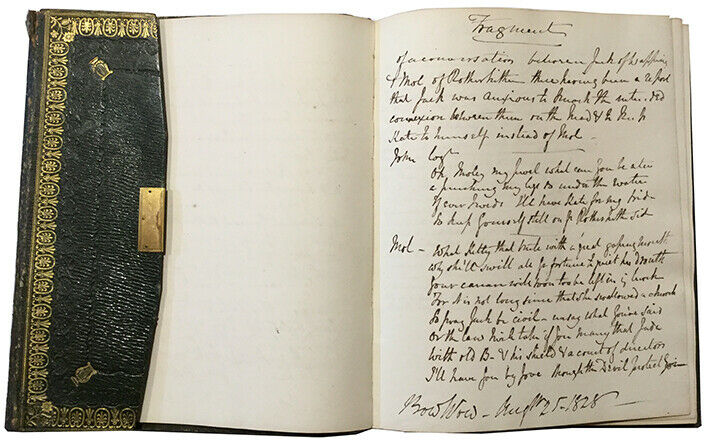
1825: George Hyde Wollaston. Family commonplace book. Clapham. 1825.
PB: I wonder if there would have been anything illuminating in this?
— Ebay: George Hyde Wollaston Family Commonplace Book 1825, £295.
(Click on image to enlarge)
Note: Nautilus — a "living fossil" — a relative of the squid and the octopus that has persisted almost unchanged for the last 200 million years — [Wikipedia: Nautilus.]

Plate 1: "No. 36. XANTHIDIUM in flint: from Clapham common; highly magnified; the original is scarcely visible to the naked eye. Many beautiful and highly-interesting specimens of fossil infusoria, and minute polyparia, from the flints of Clapham and Wandsworth commons, have been collected by Mrs. Potts, and Miss Graham, of Clapham Common."
(Click on image to enlarge)
Francis Wollaston, Henrietta Wollaston's grandfather?
[PB: Take care — there's a grandfather [the astronomer?] and a great-grandfather [the philosopher?] with the name Francis Wollaston. Also, numerous other Wollastons with the same forenames. Sorting out our Henrietta's family will be a challenge. ]
Wikipedia: Francis Wollaston (Astronomer).
Francis Wollaston (astronomer)
Francis Wollaston (23 November 1731, London — 31 October 1815), British astronomer and Church of England priest. He was elected a Fellow of the Royal Society in 1769.
Born 23 November 1731, London
Died 31 October 1815 (aged 83)
Nationality British
Family
He married Althea Hyde, daughter of John Hyde, in 1758 and they had several [!] children:
Mary Hyde Wollaston (1760 — 1843), married, in 1803, William Panchen, vicar of St Mary and St Benedict, Huntingdon
Althea Hyde Wollaston (1760 — 1785), married Thomas Heberden (1754 — 1843), Canon of Exeter cathedral
Francis John Hyde Wollaston (1762 — 1823)
Charlotte Hyde Wollaston (1763 — 1835)
Katherine Hyde Wollaston (1764 — 1844), conchologist [follow up! I notice there's a reference to her will in the NA — "Will of Katharine Hyde otherwise Katherine Wollaston, Spinster of Eltham, Kent " here.]
George Hyde Wollaston (1765 — 1841)
[Science Museum, London: George Hyde Wollaston]
— Charles Hyde Wollaston (1772 — 1850)
— Louisa Hyde Wollaston (1771 — 1772)
— Frederick Hyde Wollaston (1770 — 1839? went to America in 1796)
— Anna Hyde Wollaston (1769 — 1828), unmarried
Henrietta Hyde Wollaston (1767 — 1840), noted conchologist [I assume this is "our" Henrietta Wollaston's aunt]
— William Hyde Wollaston (1766 — 1828), physiologist, chemist, physicist etc
— Henry Hyde Wollaston (1774), died in infancy
— Amelia Hyde Wollaston (1775 — 1860)
— Henry Septimus Hyde Wollaston (1776 — 1867), married Maria Anna Blanckenhagen, the daughter of a well-known merchant family originating from the Baltic.
— Sophia Hyde Wollaston (1777 — 1810), unmarried
— Louisa Decima Hyde Wollaston (1778 — 1854), married James Leonard Jackson, a priest from Dorsetshire
— unknown child
— unknown child