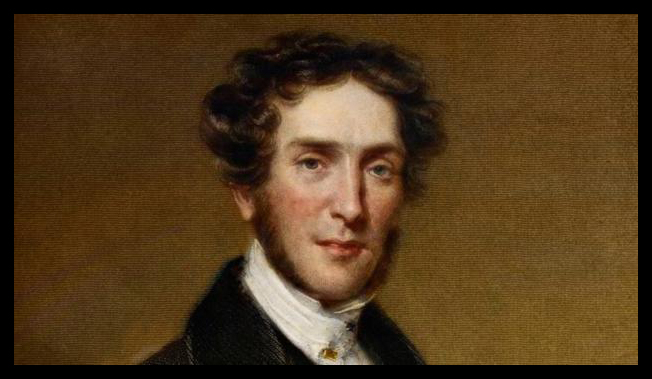
— Proceedings of the Royal Society of Medicine: Biography of Gideon Mantell (pdf)
— Gideon Mantell, A Sketch of the Geology of the County of Surrey (date), (pdf)
— Wikipedia: Gideon Mantell.
— Google Search: Gideon Mantell.
— Guardian: Gideon Mantell: forgotten man who discovered the dinosaurs - "A new play recalls the battle in the scientific establishment that denied a cobbler's son credit for a major discovery" (2019).]
— Wollastons other than Henrietta.
— Prehistoric World comic strip [5pp]
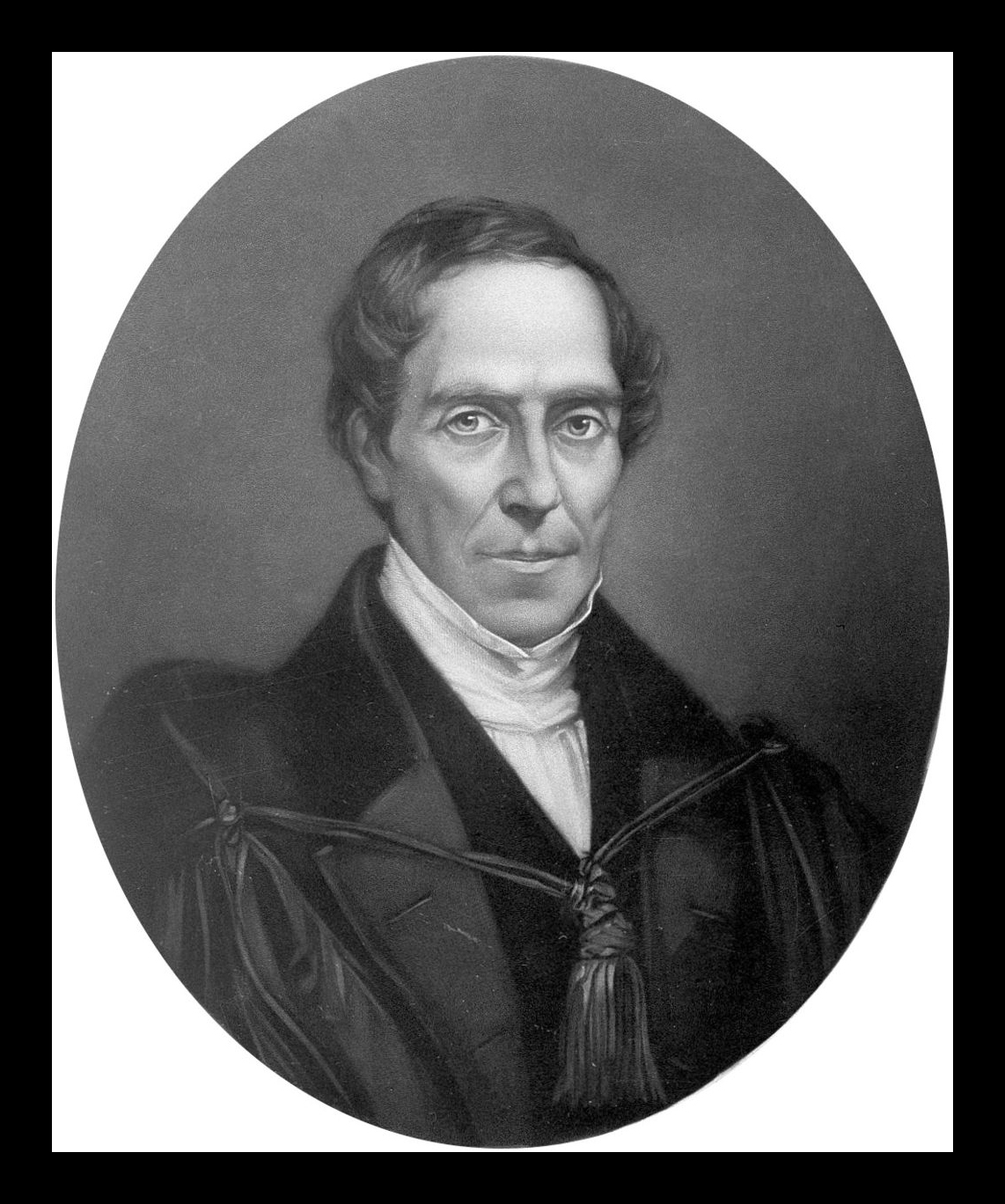
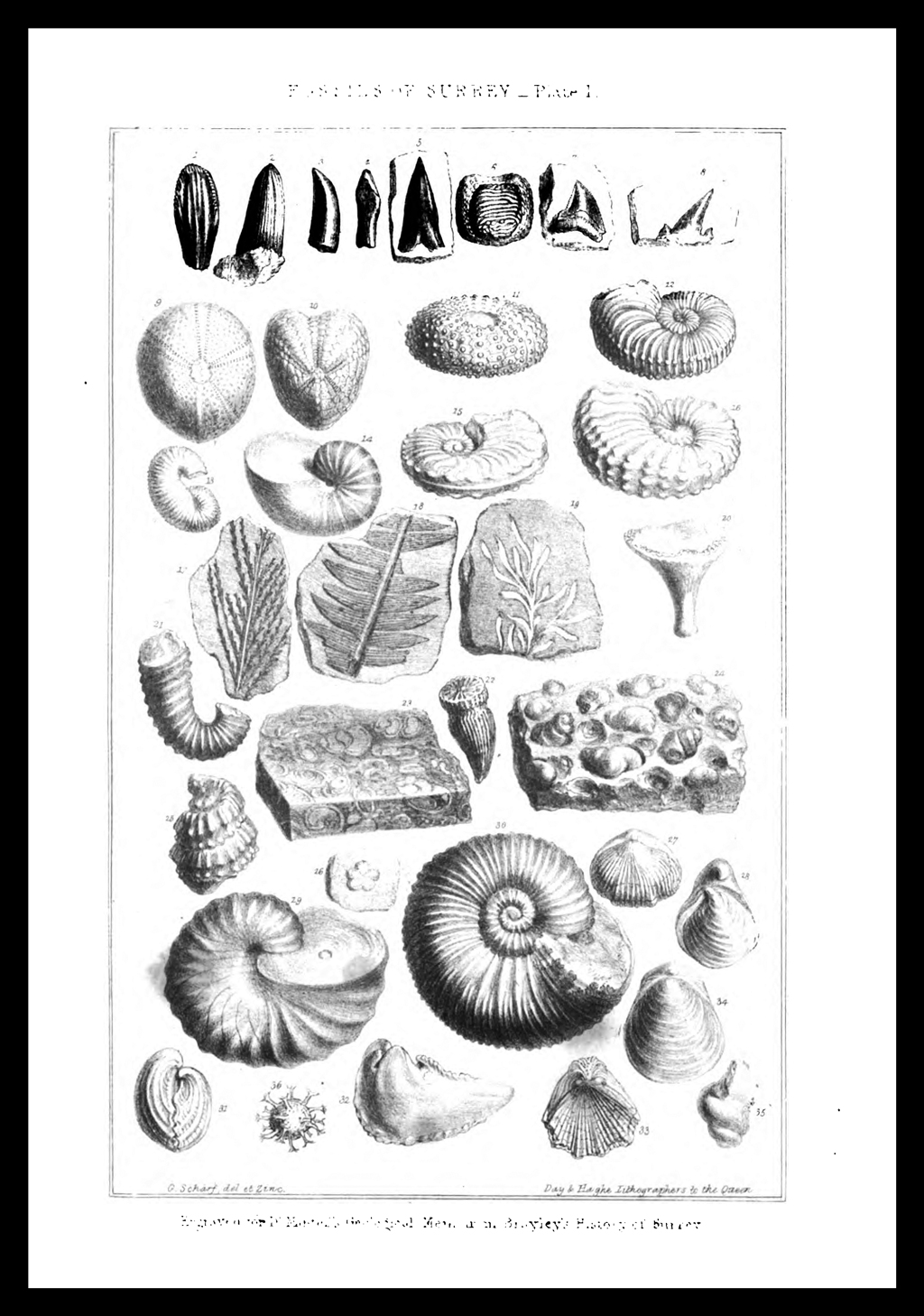
PB: I'm sure I've written detailed notes on Miss Wollaston - find them. Names of the other two women collectors that Mantell refers to?
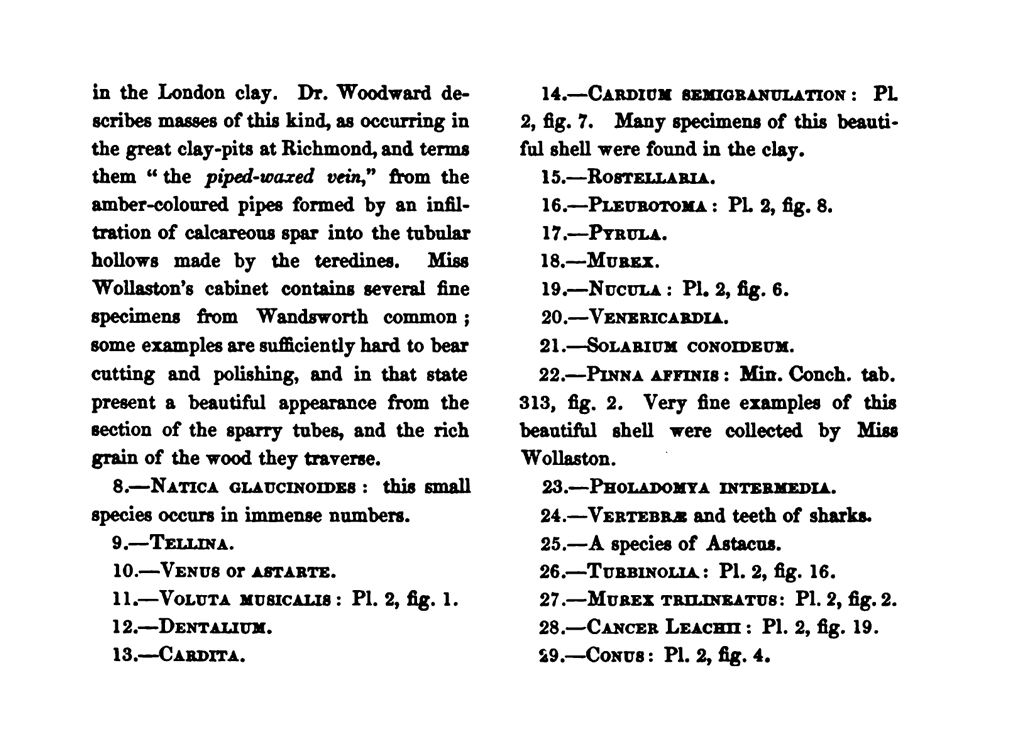
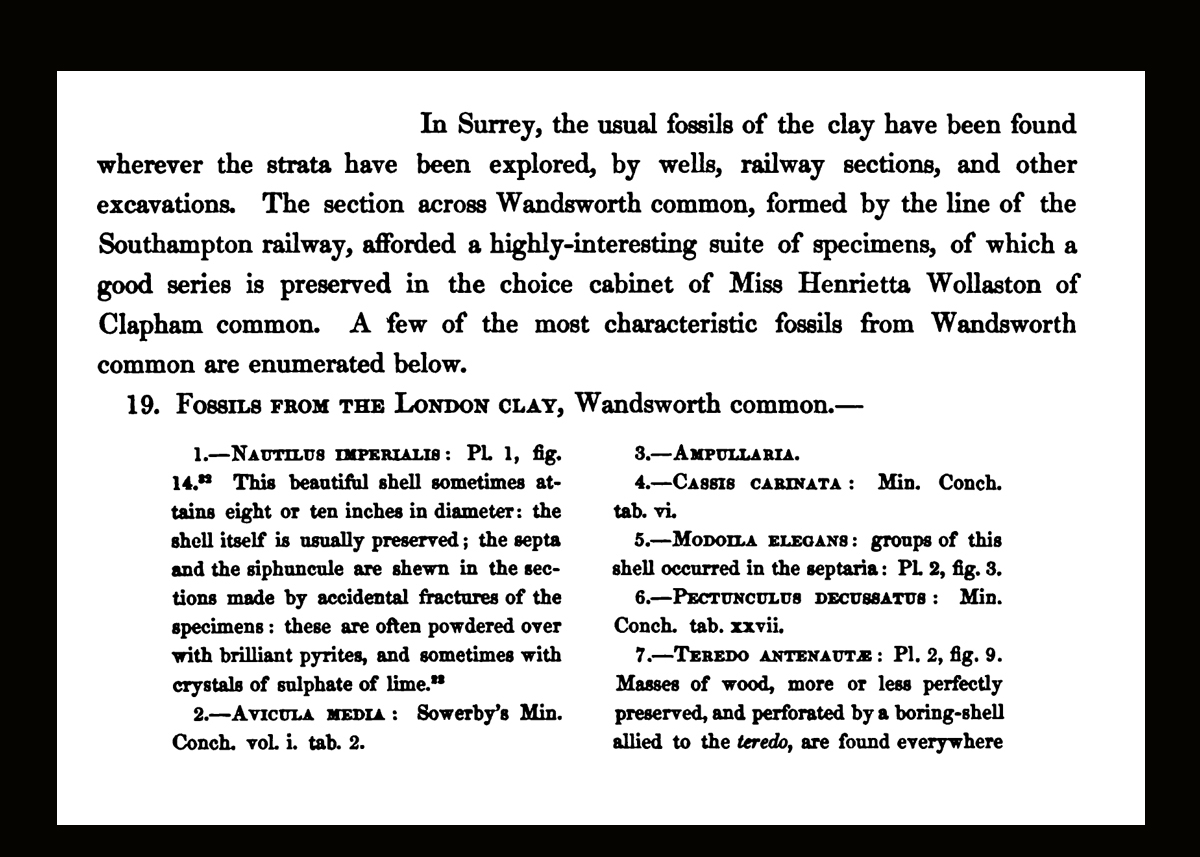
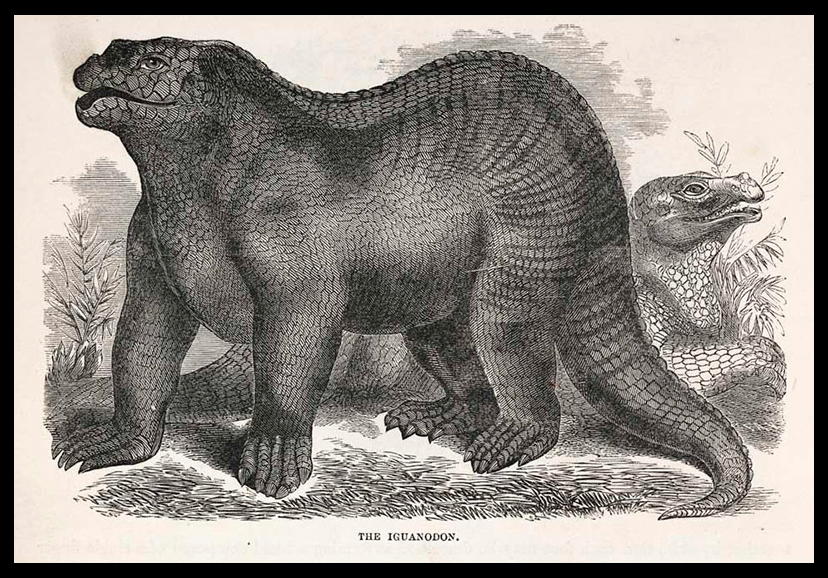
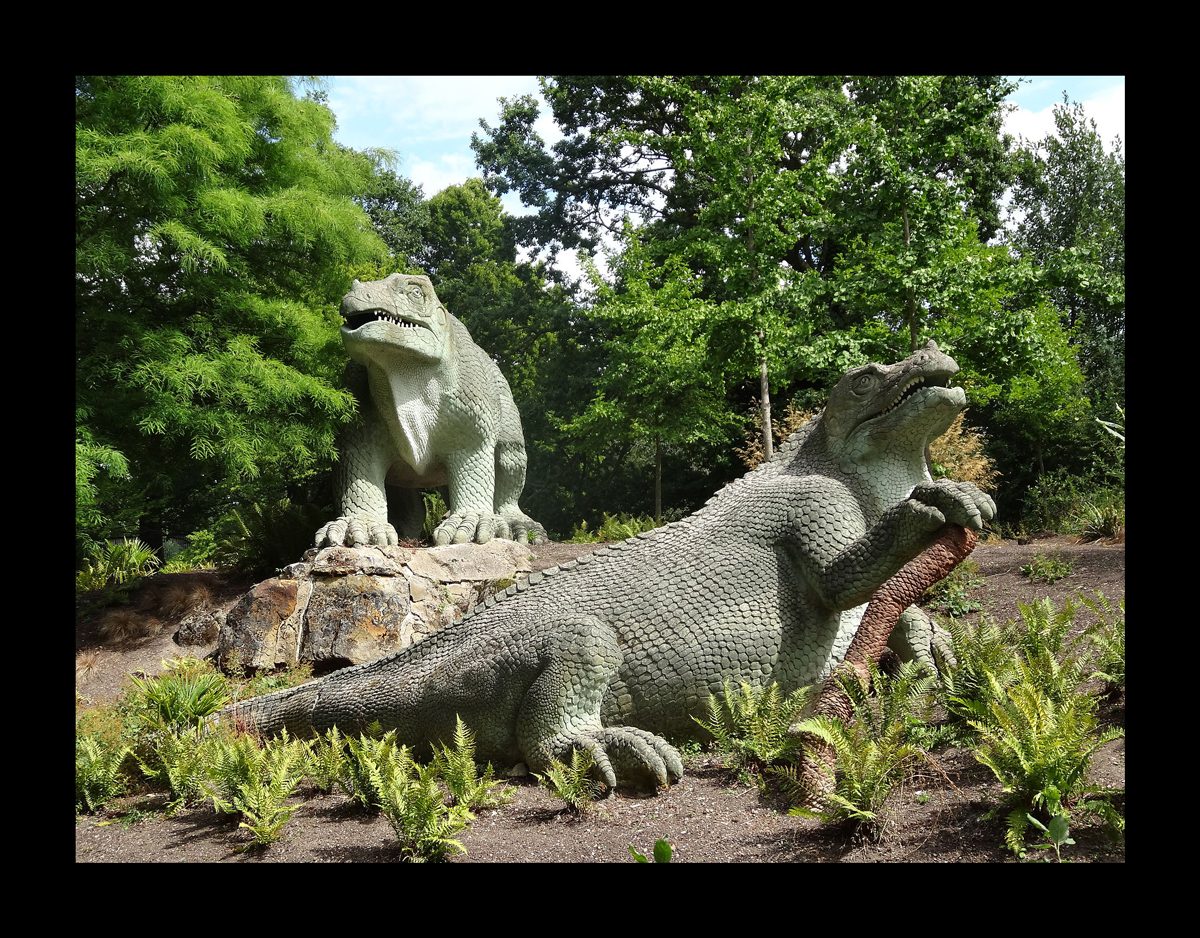
Curiously, Richard Owen's imaginative reconstruction of Mantell's dinosaurs, placed on an island in the lake at Sydenham's Crystal Palace, became a draw for visitors - who used the new railway from [Victoria?] London through Wandsworth Common to reach Sydenham.
Brayley/Mantell Surrey was funded by subscription
Several Wandsworth and Clapham residents subscribed
including G.H. Wollaston Esq., and a number of women
https://iiif.wellcomecollection.org/pdf/b29350463_0001
See pp.20 onwards...
[https://www.gutenberg.org/files/62871/62871-h/62871-h.htm]]
https://ia600500.us.archive.org/10/items/ThoughtsOnAPebble1842/mantell-g-thoughts-1842-RTL000446.pdf
Fascinating.
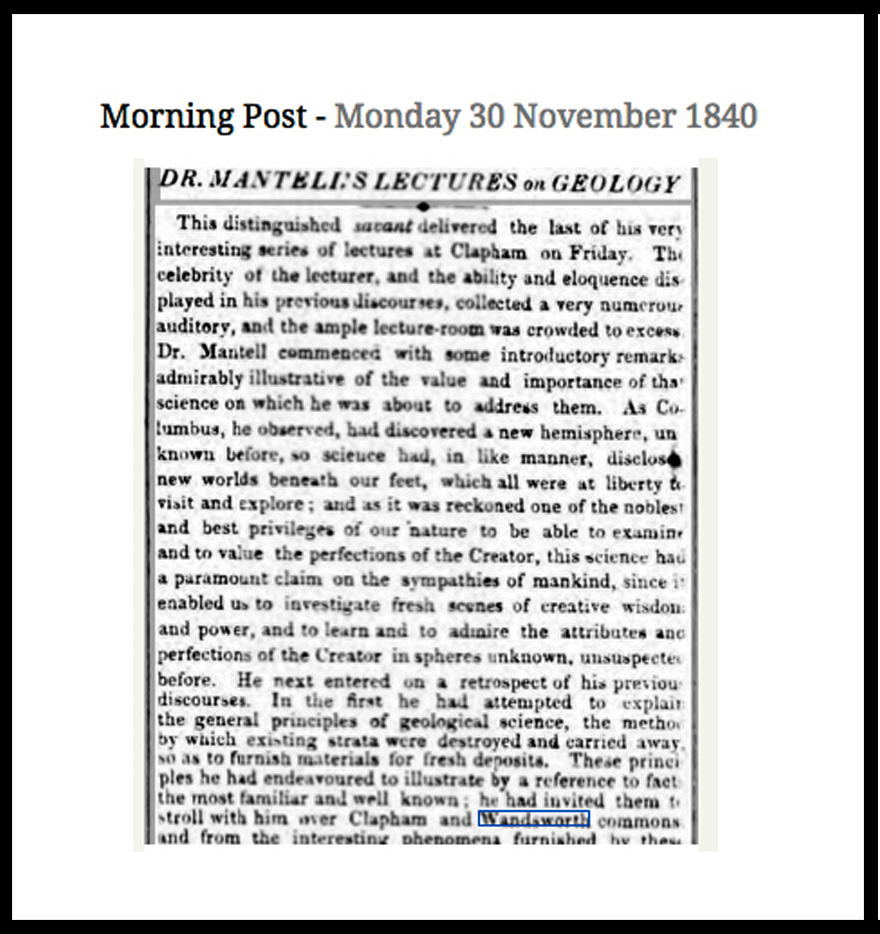
DR. MANTELL'S LECTURES on GEOLOGY
This distinguished savant delivered the last of his very interesting series of lectures at Clapham on Friday. The celebrity of the lecturer, and the ability and eloquence displayed in his previous discourses, collected a very numcrouf auditory, and the ample lecture-room was crowded to excess Dr. Mantell commenced with some introductory remark.admirably illustrative of the value and importance of that science on which he was about to address them.
As Columbus, he observed, had discovered a new hemisphere, unknown before, so science had, in like manner, disclosed new worlds beneath our feet, which all were at liberty to visit and explore; and as it was reckoned one of the noblest and best privileges of our 'nature to be able to examine and to value the perfections of the Creator, this science has a paramount claim on the sympathies of mankind, since it enabled us to investigate fresh scenes of creative wisdom and power, and to learn and to admire the attributes and perfections of the Creator in spheres unknown, unsuspected before.
He next entered on a retrospect of his previous discourses.
In the first he had attempted to explain the general principles of geological science, the method by which existing strata were destroyed and carried away, so as to furnish materials for fresh deposits. These principles he had endeavoured to illustrate by a reference to fact the most familiar and well known; he had invited them to stroll with him over Clapham and Wandsworth commons and from the interesting phenomena furnished by these well known localities he had taught them many of the wonders of geology, and much of the history of the ancient earth and its inhabitants. In the gravel they had discovered the teeth and bones of the elephant and the rhinoceros, creatures of tropical growth and origin, and in the clays they had found the usual exuvia; of a marine deposit, the weeds, sponges, shells, and fish, which could only have existed in the depths of a profound ocean.
[Can we find a more detailed report of this first lecture, on Wandsworth and Clapham Commons? Did he literally stroll with local people over the commons, or is this a figure of speech? The first report is in the Morning Post 2 November 1840 [copy below]. It discusses walks "in idea" over Clapham Common but not over Wandsworth Common.]
In his second discourse he had treated of the nervous system, both as regarded the human and the animal races, particularly with reference to the connection of the subject with that of geology, and his remarks had extended from man himself°anc the colossal animals of primeval times, from the mammoth and mastodons of the ancient earth, down to the animal | invisible to the unassisted eye, who lived in the earliest j periods, as they existed now, since their fossil remains an I found embedded in the strata of primeval date.
After these prefatory remarks, which were enlivened b\ illustrations of the most lively and instructive nature, Dr I Mantell observed that on the present occasion he should direct his views somewhat farther, and, instead of confining his observations to the vicinity of Clapham, he should request his audience to accompany him on an imaginary tour from Londou to Brighton, in the course of which he should I direct their particular attention to the weald of Sussex, j that peculiar and interesting locality which he had explored with so much attention as to establish the fact of its being an estuary deposit, the mouth of some Ganges or Mississippi of the ancient earth, the very spot at which its , mighty waters were discharged and mingled with those ot ! the then existing sea. Dr. Mantell next proceeded to give a brief but instructive history of his researches and disco' venes in this interesting regiou.
Adverting to the map ' of the district he showed thatthe tertiary deposits prevailed in the valley of the Thames and the immediate vicinity of ' Loudon. On arriving in the vicinity of Sutton the tertian deposits are succeeded by the chalk which rises into the lofty hills termed the North Downs, and which shortly after passing Reigate are followed by strata of blue marl and green sand. These are followed by beds of sand stone which constitute the valleys of the weald, and are terminated »y beds of green sand and blue marl, which are succeeded by a parallel range of chalk hills, called the South Downs, the whole of the space intervening between the to ?? d * OUth ?? ot " chalk beiu S as the Weald. These wealden deposits, consisting of sandstone Ti' marble, &c were conceived, prior to their investigation by ' Dr. Mantell, to appertain to the green sand, the lowest nu mbei of the chalk formation. But as the chalk and green sand are marine deposits, and their imbedded fossils also of marine origin, Dr Mantell speedily discovered that the strata of the weald were of different origin, the fossils which thev contained being none of them marine, but wholly of fluviatile or fresh water character.
Further investigations convinced him that the strata in question must have been deposited at the very Delta, the spot where the river discharged itself into the sea, and thus the estuary character __r 1 k B a W ! a * den de POsits was fully and satisfactorily established.
Dr. Mantell next proceeded to describe the various organic remains which he had discovered in this interesting formation. He ghowed that the plants were entirely of tropic growth and character, and instead of resembling the oak, the ash, or the elm, were analogous to the fern, the palm, tiie cane, and the bamboo. Adverting next to the animal remains, he showed that the teeth and bones were those of reptiles of enormous size and structure and related the means by which he had removed the doubt.-01 the illustrious Cuvier on this point, and satisfied both scientific observers and the general public as well of the novel and interesting fact that the earth, during a considerable part of its history, was tenanted by reptiles of colossal character and magnitude
He theI proceeded to describe the chief characters of the iguanodon and the hylseosaurus, which he had first discovered, and thi ' plesiosaurs and megalosaurus, which, found in other formations, had also been recognised in this. The pterodactyles, winged creatures of the reptile class, were the chic. inhabitants of the air, and the entire creation, animal ami vegetable, teemed with more than tropic.il richness and prolusion, and presented characters strangely different from those exhibited at the present hour. These are the chief outlises of a discourse to which our limited space prevents us from doing more than imperfect justice The details into which Dr. Mantell was led were in the highest degree interesting and instructive. The mention of the animal races introduced some important remarks on their nature and habits, and the various orders of the herbivora, carnivora, and rodentia were graphically and spiritedly described.
The mention of the chalk furnished occasion for the display of some exquisite specimens of fish which he had discovered and extricated from their chalky beds The description of the weald, and its singular and striking history was alike fruitful in eloquent and valuable information the description of its plants introduced a valuable disquisition on vegetable physiology and structure, and that of its colossal reptiles was alike fertile in information on the subject of animal structures and existence.
The lecture was illustrated by a beautiful suite of drawings and diagrams, was interrupted with frequent marks of sympathy and approbation, and was honoured at its close with the loudest and most general expression of approval and delight.
[BNA: Link.]
Morning Post - Monday 02 November 1840
GEOLOGY
Dr. Mantell, the celebrated writer and lecturer on this science, delivered an elementary discourse " On the Intercs and Importance of Geological Researches," at Clapham, on Friday last. The proceeds of the lecture were destined to aid the funds of the Claphara Parochial School in connec tion with the Established Church. The benevolent natur t . of the object, together with the deserved celebrity of the lecturer, attracted a numerous auditory, and nearly 600 persons, comprising most ofthe respectable families of the vicinity, were assembled in the lecture-room. In commencing his discourse Dr. Mantell alluded to the circumstance of his having been in the habit of lecturing while residing at Brighton, trtid observed, that having no,, disposed of his collection to the trustees of the British Mu- seum, he was deprived the advantages which its possession conferred, and should be unable to place before his auditor* those singular and interesting memorials of the past history of our globe which he had been so fortunate as to collect, md which were now deposited in the national collection Adverting to his present place of residence, he remarked thai Clapham was classic ground to science, that the distinguished Cavendish had once resided in the place, and that Or. Lis'er, the celebrated writer on organic remains, wa> mried in the parish church. Addressing himsel; to the immediate topic of his discourse, he remarked that it was the privilege and the glory of scienci to invest objects the most common and familiar with interest and importance unfdt, unsuspected before. The fall of an *j pie had led a Newton to form a new theory of motion and lie laws which regulate the universe, and the situation of a pebble might lead us to discover the nature and formation of the whole earth.
Digressing, for a moment, with a view to remove those apprehensions which timid mind.*, sometimes needlessly entertain that the pursuit of geological studies might weaken their belief in matters of higher importance, he remarked that, without dwelling at nnneces sary length on objections so utterly unfounded, he wouh. remind his hearers that geology was taught and enforced, both in this country and on the Continent, by professors o divinity and instructors of youth; and while Dr. Bucklami I md Professor Sedgwick had for years taught the accord _cc of the science with the revelations of hulv writ, a dis- J tenting brother, the Rev. Dr. Pye Smith, in a" recent publication, the tendency and merit ot* which could not be too highly extolled, hud shown the harmony of geology with Scripture, and the un ounded nature of any alarms on thi subject. One instance he would select of the union of tht most profound scientific attainments with religious faith and practice of the highest excellence. His late regretted friend Dr. Turner was eminent for his scientific acquirement.-., ami was for several years secretary to the Geological Society, yet he was no less distinguished tor religious anil moral worth, and, when prematurely cut off in the prime of existence, his dying moments were sweetened by the best consolation- of religion. After Sums farther vindication of the sei. net- as a pursuit, which r. c immended itseif not only for its econo- mical advantages a:id t< r the benefits which it was calculate.! to confer on society, but as affording a course of study calculate.!, perhaps, be.ond all others to improve our mora! and intellectual nature,
Dr. Mantell appropriately observed that he should study to render the present introductory discourse as plain and simple as possible, with the view to interest those who had not paid that attention to it before which its importance deserved, and to lead the youthful portion of his auditors in particular to studies of so beneficial and improving a nature. He should ask his friends to take a stroll with him in idea over Clapham-common, and to investigate the phenomena of nature displayed in that familar scene.
He then entered on a popular, but at the same time a perfectly accurate, description of the geological character of the district, depicting its various strata as the indurated clay slime, and mud, dep< sited by the waters of a sea which once spread over the whole of this part of England, and which though of modern date in the geological series, carried the mind back to a period of incalculable antiquity According to the history of Herculaneum and Pompeii he forcibly" urged that as the discovery of these buried cities left no doubt of their existence and of that of their inhabitants so when we in like manner inspected the buried dwelling- places of the creatures which on:e inhabited the earth we read their history as plainly and found as perfect records oi their existence as was afforded by the theatres baths streets, and mansions of Pompeii, or written on the papyri of Herculaneum.
Dr. Mantell proceeded to describe the various interesting fossils discovered in Clapham and its neighbourhood; and the nautilus with its beautiful structure and singular faculty of' navigation, the various conditions and characters of other shells, the teeth and bones of fishes, with relics of colossal mammalia, of elephants and mastodons and hipp potami, and the like, were by turns the theme of instruction and engaging comment, leading back the mind to a t period wntn the beautiful village of Clapham was the bed of a profound sei, and thence to a more modern era when it had emerged from the deep and become dry land, but under conditions totally different from those of existing nature at the present day, when its vegetation consisted of groves of tro pical trees and spicy plants, and its animal inhabitants sur-passed in size and structure the elephantine and other races which now inhabit the torrid zone.
The most striking phenomena of geology; the various properties of water its destructive and its conservative agency, its power to 'destroy and wear away the solid strata of the earth and again to restore these anew by the cementing power of the lime which it holds in solution; the existence of infusoria and animalcule invisible to the unassisted eve both in a recent and fossil condition, and the important share which their mineralised skeletons have iv buildin- up the solid strata of the earth; the various processes of mineral, isation _ exemplified both in animal and vegetable sub stances; the conversion of wood into jet and coal • the vegetable origin of amber, copal, and even the diamond itself; the formation of breccia and conglomerate ?? om lation ot iron; these, with other themes of like interest ing natur, were by turns the subject of instructive comment and animated ??; and a forcible and eloquent appeal on the advantages of scientific inquiry and research formed the appropriate conclusion to a discourse which ex- cited the most lively interest, was heard to its close wiih profound attention and terminated amid the unanimous and repeated approbation of a delighted audience It is gratifying to state that Dr. Mantell has acceded to the request ot the committee, and will shortly lecture a»ain when his subject will be one closely allied to his own pro- fession—the nervous system.
>>https://www.britishnewspaperarchive.co.uk/viewer/bl/0000174/18401102/032/0006<<
The Royal College of Surgeons of England Library homepage
Plarr’s Lives of the Fellows
Mantell, Gideon Algernon (1790 - 1852)
Identifier: RCS: E000531
Full Name: Mantell, Gideon Algernon
Date of Birth: 3 February 1790
Place of Birth: London, UK
Date of Death: 11 November 1852
Place of Death: London, UK
Occupation: General surgeon
Geologist
Titles/Qualifications: MRCS, April 19th, 1811
FRCS, Dec 11th, 1843, one of the original 300 Fellows
FRS, 1825
Hon. LLD. Yale, 1834.
Details: Born on Feb 3rd, 1790, the third son of Thomas Mantell, and Sarah Austin of Peckham. His father, who traced his descent from Walter Mantell in 1540, was a cordwainer living in St Mary’s Lane, now called Station Street, Lewes. He is still remembered as the builder of the first Wesleyan Chapel in the town.
Gideon Mantell was educated at an Academy in Lewes founded by John Button, and afterwards at a school in Wiltshire, his uncle being the Baptist minister at Westbury and Swindon. He was apprenticed to James Moore, a surgeon in Lewes, and then proceeded to St Bartholomew’s Hospital, taking with him a collection of fossils from the chalk which had already attracted his attention and interest. He returned to Lewes as soon as he had qualified, and entered into partnership with his former master, James Moore, and lived in Castle Place; he became Medical Officer of several parishes in the neighbourhood of Lewes and was appointed Surgeon to the Royal Ordnance Hospital at Ringmer.
Encouraged by James Parkinson, a surgeon living at Hoxton who had published in 1804 Organic Remains of a Former World, he began to study geology seriously, and in 1815 published at Lewes an octavo volume, A Sketch of the Geological Structure of the South-Eastern Part of Sussex. In 1822 The Fossils of the South Downs appeared, with 42 plates engraved by Mrs Mantell and with the King as patron. In 1825 he contributed a valuable paper to the Royal Society on the Iguanodon, and with this fossil his name is now inseparably connected. In November, 1825, he was elected FRS. His next book, also illustrated, is known as The Fossils of Tilgate Forest, though it was published under the title Illustrations of the Geology of Sussex in 1827.
Mantell in the meantime continued his medical work, took an active part in securing a free pardon for Hannah Russell in the Burwash case, and published in 1827 Observations on the Medical Evidence Necessary to Prove the Presence of Arsenic in the Human Body.
In 1831 he became acquainted with Benjamin Silliman (1779-1866), Professor at Yale University and founder in 1818 of the American Journal of Science; the acquaintance ripened into a lifelong friendship and was the means of the honorary LLD being conferred upon him by the University of Yale in 1834.
In 1833 he published The Geology of the South-East of England, with a dedication to the King, and in the same year he moved to 20 Steyne, Brighton, partly to reduce the labour of an extensive country practice, and partly on account of his health, which had given cause for anxiety. The move proved unsatisfactory from a professional point of view, and Mantell had serious thoughts first of emigrating to America, and later of buying a practice in London.
He published in 1837 Thoughts on a Pebble, dedicated to his younger son, Reginald Neville Mantell; the book became very popular as a gift book, and there was a seventh edition in 1846. In September, 1837, he bought a practice at Clapham Common and sold a Geological Museum which he had collected with much pains. It was bought by the British Museum for £4000.
The Wonders of Geology appeared in 1838 and soon established itself as a popular favourite. The eighth edition was published in England twelve years after his death; an edition appeared in America in 1839, and Dr Burchard, of Bonn, translated it into German. He also wrote the sketch of the “Geology of Surrey” which was published in Brayley’s Topographical History of Surrey in 1840.
The following year, 1841, found him busy as a Member of the Councils of the Linnean and of the Geological Societies, and as Secretary of the Geological Section of the Royal Society. He was also one of the promoters of the Clapham Athenæum, which was established in 1841. With all these distractions it is clear that he did not neglect his medical practice, for his friends and patients at Clapham Common presented him with a purse of one hundred guineas as a birthday gift on Feb 3rd, 1844. He moved from his house in the Crescent, Clapham Common, in the autumn of 1844, to 19 Chester Square, SW. In this year he published The Medals of Creation, or First Lessons in Geology and in the Study of Organic Remains (2 vols, 8vo, illustrated, London, 1844). The Thoughts on Animalcules, or a Glimpse of the Invisible World revealed by the Microscope, with 12 coloured plates and 7 woodcuts, was issued in 1846, and in the same year A Day’s Ramble in and about the Ancient Town of Lewes, a small octavo with a frontispiece and vignette.
The Geological Excursions round the Isle of Wight and along the Adjacent Coast of Dorsetshire: illustrative of the most Interesting Geological Phenomena and Organic Remains appeared first in 1847. A second edition with a supplementary chapter was published in 1850, and a third edition under the superintendence of Rupert Jones, FRS, was issued posthumously in 1854.
Mantell was granted a pension of £100 a year from the Civil List in 1852. He died at his house, 19 Chester Square, on Nov 11th, 1852, and was buried in Norwood Cemetery. The memorial tablet in St Mary’s Church, Lewes, gives the year of his death incorrectly as 1853.
Mantell married in May, 1816 - by special licence, for she was under age - Mary Ann, daughter of George Edward Woodhouse, of Maida Hill, London, W. She was educated to become a sufficiently good artist to illustrate some of her husband’s books and papers. She outlived him, but there is no mention of her at the time of his death, though she appears to have been living at Cambridge. A half-length portrait of her from a painting is in the possession of W M Woodhouse, Esq. There were two sons and two daughters of the marriage. Walter, the elder son, was appointed in 1848 “Commissioner for the allotment and purchase of lands in the middle island of New Zealand”. He died without issue. Reginald, the second son, was a pupil of Isambard K Brunel. He was engaged in railway construction in England and the United States. He died of cholera, unmarried, at Allahabad in 1857; and was superintending the building of a bridge over the Jumna when the Mutiny broke out. The elder daughter married John Parker, publisher to the University of Cambridge; the younger daughter died unmarried.
Mantell was one of the many members of the medical profession who have made for themselves imperishable names in various branches of science entirely alien to their practice. He was amongst the pioneers in the study of fossils at a time when such study was considered impious. Ill health and a marked tendency to hypochondriasis must have made him “gey ill to live with” and accounted for the unnecessary acrimony which marks some of his discussions.
A careful post-mortem examination was made of his body. The results are described in the Medico-Chirurgical Transactions for 1854, xxxvii, 167-170, with plates iv, and v. His spinal column is preserved in the College Museum (No. 4808/i) as an example of extreme lateral curvature which is remarkable from the fact that it does not appear to have been very noticeable during life. There is also a plaster cast of the spine in the College Museum (Special Pathology Part xxviii) with the number 4808/2.
A kitcat portrait of Mantell is in the possession of W M Woodhouse, Esq, also a half-length portrait dated 1837 by J Masquerier, engraved by Samuel Stepney. Further portraits are one in a LLD gown from an engraving by W T Davey, and a small wax medallion executed in 1841 for presentation to Professor Silliman; but this was not considered good enough for the purpose. A fine engraving by W T Davey from a drawing by Senties is in the College Collection.
Related Record: Author: Royal College of Surgeons of England
Sources: Gideon Algernon Mantell, by Sidney Spokes, 8vo, London, 1927, with genealogical table and portraits. Brit. Med. Jour., 1929, ii, 969, 1094 and 1178
Rights: Copyright (c) The Royal College of Surgeons of England
Publication Date: created: 7 August 2008
Collection: Plarr's Lives of the Fellows
Obituary
>>https://livesonline.rcseng.ac.uk/client/en_GB/lives/search/detailnonmodal/ent:$002f$002fSD_ASSET$002f0$002fSD_ASSET:372715/one?qu="rcs%3A+E000531"&rt=false%7C%7C%7CIDENTIFIER%7C%7C%7CResource+Identifier<<
It is very likely that Henrietta Wollaston and colleagues, and Gideon Mantell, saw their pursuits as elucidating the power of the Almighty, in particular by demonstrating the existence of a catastrophic flood (perhaps identified with Noah's) that once covered the entire landscape — hence the superabundance of marine and riverine sediments at every depth across our area, and the immense power that raised them to great heights.
As Mantell puts it in his introduction to his best-selling introduction to geology, Thoughts on a Pebble; or a First Lesson in Geology (1842):
[And here an aesthetic / intellectual justification for knowledge...'
Here we must bring our “Thoughts on a Pebble” to a close; but advert - not without and ingto the elevating gratification which investigations of this nature afford, and the beneficial influence which they the mind and character. In circumstances where the uninstructed and uninquiring eye can perceive neither novelty nor beauty, the mind imbued with a taste for natural science, finds an inexhaustible source of pleasure and instruction and new and stupendous proofs of the power and goodness of the Eternal!
Every rock in the desert, every boulder on the plain, every pebble by the brook-side, every grain of sand on the sea-shore, is fraught with lessons of wisdom to him whose heart is fitted to receive and comprehend their sublime import. Amidst the turmoil of the world, and the dreary intercourse of common life, we possess in these pursuits a never-failing source of delight, of which nothing can deprive us — an oasis in the desert, to which we can escape, and find a home “wherever the intellect can pierce, and the spirit can breathe the air.”* (pp.36-38)
*Exodus xv. 23.
Elsewhere:
[This next bit is very interesting...similar in feel to the end of Darwin's Origin... it's as if he/they are trying to find a rationale - benign reason - a longterm plan - a rational justification - for chaos - geological violence - suffering - etc etc.]
To discover order and intelligence, in scenes of apparent wildness and confusion, is the pleasing task of the geological inquirer; who recognises, in the changes which are continually taking place on the surface of the globe, a series of necessary operations, by which the harmony, beauty, and integrity of the Universe are maintained and perpetuated; and which must be regarded, not as symptoms of frailty or decay, but as wise provisions of the Supreme Cause, to ensure that circle of changes, so essential to animal and vegetable existence.
Immense power raising and lowering land and sea:
... we must bear in mind, that had the chalk remained at the bottom of the deep sea in which it was originally deposited, it could not have been exposed to destructive operations. It is therefore manifest, that at some very remote period of the earth’s history, the bed of the chalk ocean was broken up, and that great portions of it were elevated, and formed the boundary of the existing mass of water. In like manner the beach on this hill has been raised to its present situation, several hundred feet above the level of the sea-shore!
>Every part of the earth’s surface presents incontrovertible proof that the elevation of the bottom of the deep in some places, and the subsidence of the dry land in others, have been always, and are still, going on; and that, in truth, the mutability of the surface of the earth, is the effect of one of those laws which the Author of the Universe has impressed on matter, and thus rendered it capable of eternal renovation: (pp17-18)
gideon-mantell-thoughts-on-a-pebble-1842.pdf