Last modified: 10 November 2026 · Build 9
Home›People›Thomas Hardy›Did Wandsworth Common shape him?
The facts of the Hardys’ life on Trinity Road (1878–1881) are on the main page, Thomas Hardy on Trinity Road. This page collects the arguments, from the best-attested to the most speculative. Passages in my own voice are marked with a red rule. Points still to check are marked [?].
1. Hardy’s own verdict · 2. Direct borrowings · 3. A heath in London · 4. Kate Webster and Tess · 5. Graham Swift · 6. Mark Ford · 7. Huxley · 8. Other possibilities · Sources
Hardy’s own account says that he moved near London because “the practical side of his vocation of novelist demanded” it, and that he “afterwards questioned” the wisdom of the decision, “considering the nature of his writing” (Early Life, p. 156).
When they left in 1881 they decided to live in the country and come to London only for part of each year,
“both for reasons of health and for mental inspiration, Hardy finding, or thinking he found, that residence in or near a city tended to force mechanical and ordinary productions from his pen, concerning ordinary society-life and habits.”
Early Life, p. 193.
That fits A Laodicean, the novel written and dictated on Trinity Road. It is a story of telegrams, railway tunnels, faked photographs and fashionable society, and is usually counted among his weakest. On Hardy’s own reckoning, then, the suburb’s influence was largely a bad one, and it sent him back to Dorset and the great novels of the next fifteen years.
I have tended to argue the case this way round: Hardy moved to Wandsworth Common at least partly because it reminded him of his beloved gorse heath. In early 1878 he was deep in The Return of the Native, the novel of Egdon Heath, which was already appearing month by month in Belgravia. Here, five miles from Westminster, was a wild, wet, gorse-covered common where he could be a rising London literary lion and still be in daily touch with heathland.
(An earlier, more playful version of my argument went further, and had Wandsworth Common as the inspiration for Egdon itself. The dates make that hard to sustain for the opening of the novel: see the evidence below.)
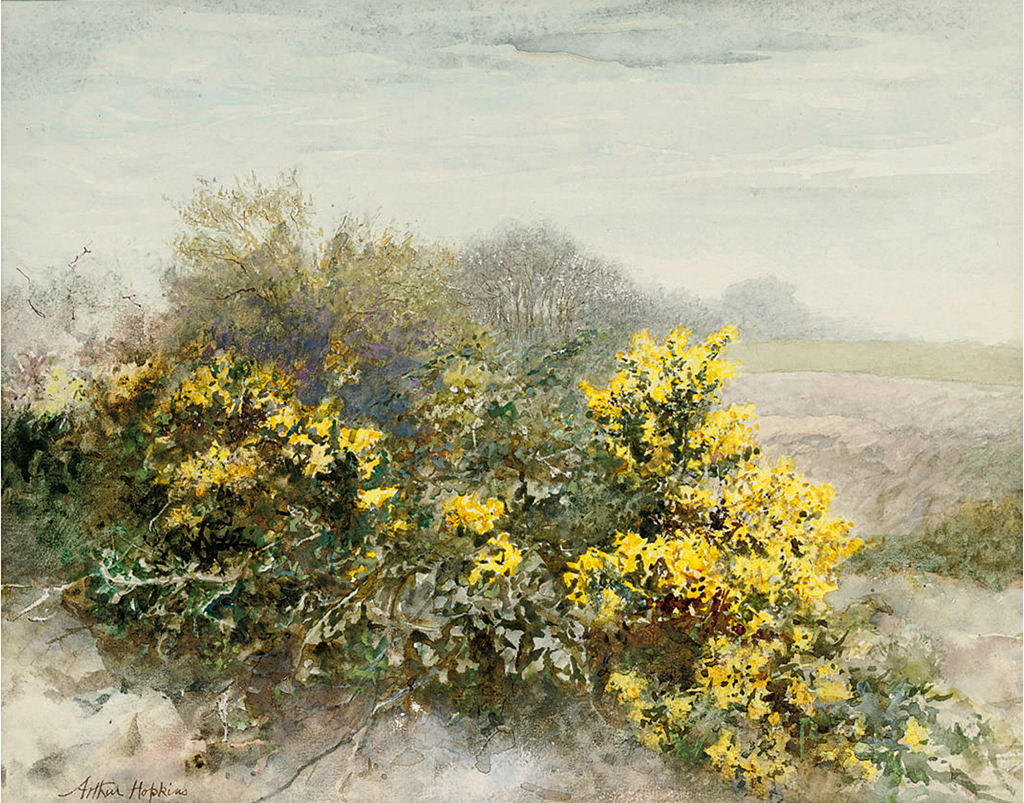
What the Common was like. In her talk for the Friends of Wandsworth Common (2026), Roz Page quoted Hardy as describing the Common in his time as bare, muddy and sloppy after even a little rain, undrained and almost without trees. A photograph from the period shows it covered in gorse, which was known locally as furze. That is very nearly heathland. [Find the source of Hardy’s description: a letter? Claire Tomalin’s Thomas Hardy: The Time-Torn Man (2006)?] Roz Page also quotes Hardy calling Tooting Common, by the Macmillans’ house, “then charming and countrified”. [Source?]
Roz Page, “Thomas Hardy”, Friends of Wandsworth Common Heritage Talk.
I once argued that it was not the Dorset heathlands of his childhood that inspired Thomas Hardy’s awesome Egdon Heath in The Return of the Native (and in The Mayor of Casterbridge and elsewhere), but Wandsworth Common. Hardy lived for three years only a hundred yards or so from the Common, in a house built on land filched from the Common only a few years earlier.
Initially I wrote this as a joke, but . . .
The Common at this time (1878–1881) was nothing like today’s mainly manicured parkland opposite Bellevue or near Spencer Park, or the football pitches on the Battersea side of the railway line. Nor was it like the heavily wooded and tangled “Scope” to the west of Trinity Road.
When I was a child in the 1950s, this area (which we called “Bushy Common”, not the newfangled “The Scope”) was indeed wild and covered in gorse, with very few trees. It was also very wet, and covered in what we called “tussock grass” (in fact purple moor-grass, Molinia, of which there is now very little left). When the Common was wet, as this area nearly always was, we crossed it by jumping from tussock to tussock.
An area beside Burntwood Lane made all-season football pitches, because it was covered in slag or clinker (we were told it came from Battersea Power Station). Heaven help your knees and elbows if you fell on it, so we never practised sliding tackles there. I don’t know exactly when this area was replanted with silver birches (or did they seed themselves?), but if you dig an inch or two you can still find the layer of black slag. [My neighbour Pam [?] at no. 4 Loxley tells me the area was used to store rubbish during the “Winter of Discontent” of 1978–79, so it was probably quite a health hazard. Was it fenced off while nature got going?]
Certainly his description of Egdon Heath fits it exactly . . .
[To do: summarise and quote Edward Thomas and others on the glories of the Common’s gorse in flower; its ponds, lakes and scattered gravel pits; its wildness.]
Who knows, it’s even possible (though not at all likely) that Evelyn Waugh made the same connection. In Decline and Fall (1928) he places Paul Pennyfeather’s prison on Egdon Heath. [Wandsworth Prison . . .]
See also Wikipedia: Egdon Heath.
The full argument is now on its own page: Thomas Hardy and an execution at Wandsworth Prison. The notes below are kept for reference.
I have started to collect material on the possibility that Hardy was influenced by the execution of Kate Webster at Wandsworth Prison on 29 July 1879, sixteen months after he came to live on Trinity Road.
She was the only woman ever to be executed there, and the case was widely reported at the time. Did it perhaps influence Tess of the d’Urbervilles (1891)? Were there crowds at the prison gates, as there were when I was a child?
At the end of Tess of the d’Urbervilles, Angel Clare and Tess’s sister ’Liza-Lu climb the West Hill above Wintoncester (Winchester) and look back at the gaol where Tess is to be hanged:
“Against these far stretches of country rose, in front of the other city edifices, a large red-brick building, with level gray roofs, and rows of short barred windows bespeaking captivity, the whole contrasting greatly by its formalism with the quaint irregularities of the Gothic erections. . . . From the middle of the building an ugly flat-topped octagonal tower ascended against the east horizon, and viewed from this spot, on its shady side and against the light, it seemed the one blot on the city’s beauty. Yet it was with this blot, and not with the beauty, that the two gazers were concerned.
“Upon the cornice of the tower a tall staff was fixed. Their eyes were riveted on it. A few minutes after the hour had struck something moved slowly up the staff, and extended itself upon the breeze. It was a black flag.
“‘Justice’ was done, and the President of the Immortals, in Æschylean phrase, had ended his sport with Tess.”
Tess of the d’Urbervilles (1891), Phase the Seventh, chapter LIX. “The President of the Immortals” is Hardy’s rendering of Aeschylus’s phrase for Zeus in Prometheus Bound, makárôn prýtanis, “presiding chief of the blessed ones”.
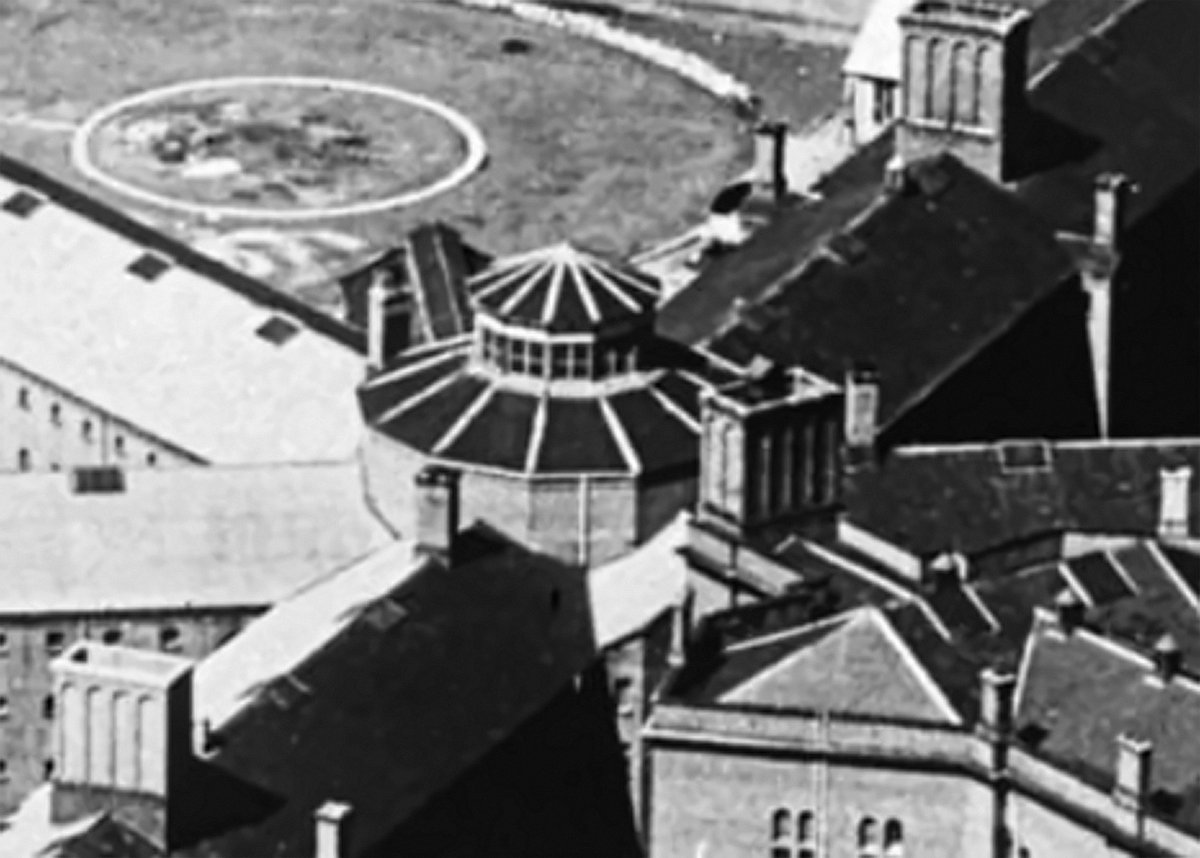
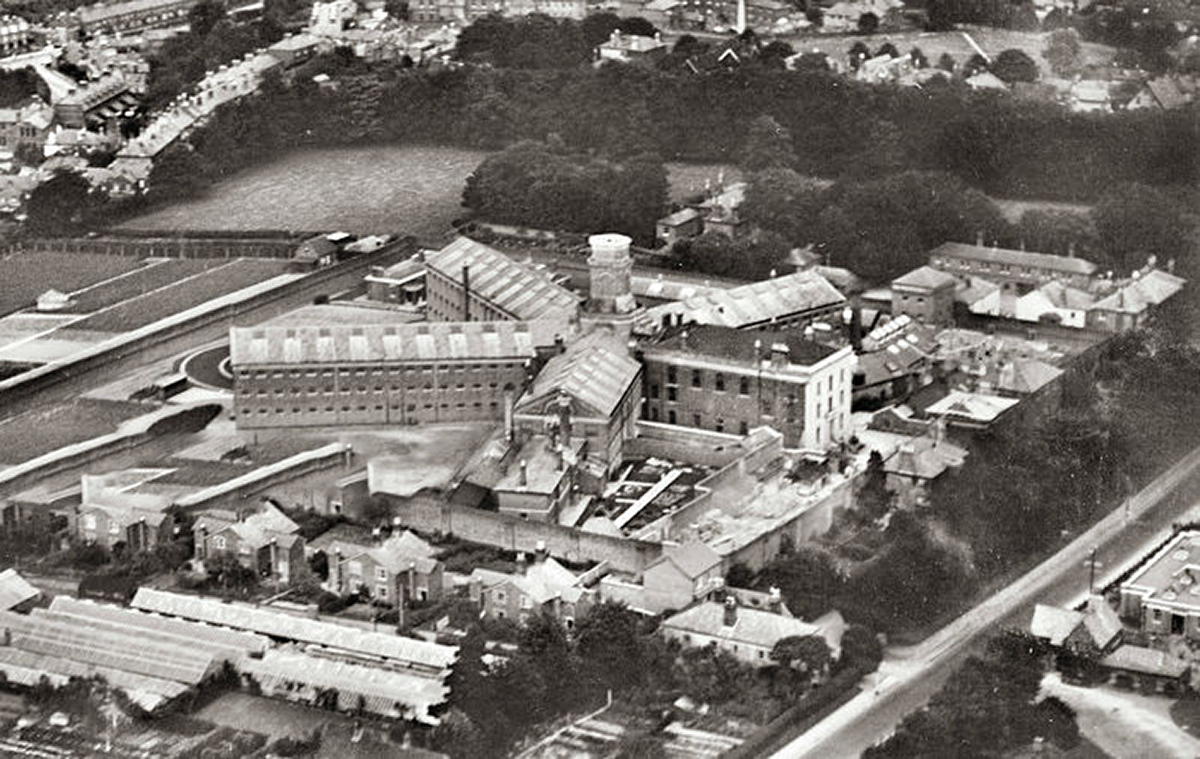
Winchester Prison (built 1846–49, architect Charles Pearce) and Wandsworth (opened in November 1851 as the Surrey House of Correction) were close contemporaries, both built to the new radial plan, with wings of cells spreading from a central many-sided hub. They differ in one telling detail. Winchester’s hub carries a tall, flat-topped tower, “prominent on the Winchester skyline”, exactly Hardy’s “ugly flat-topped octagonal tower”. Wandsworth’s octagonal central hall, designed by D. R. Hill, has a pointed lantern roof instead. A central hall, where the wings meet, is not the same thing as a central tower rising above the building, and Hardy is precise: his tower is flat-topped, with a cornice and a flagstaff fixed to it. So Hardy described Winchester as it was; but in 1879 he lived about a mile from its close cousin. (Dorchester, the gaol Hardy knew best, was rebuilt in 1884–85 with radial wings and a central hub, but whether that hub was octagonal has not been established.)
In August 1856 the sixteen-year-old Hardy watched the public hanging of Martha Brown outside Dorchester gaol, a sight he never forgot. In 1868 the Capital Punishment Amendment Act ended public executions: from then on hangings took place inside the prison walls, and the crowd outside saw only the signal, the black flag raised over the gaol and the tolling of the prison bell.
That is exactly what Angel and ’Liza-Lu see from the hill above Wintoncester. Tess’s death is the new, private kind of execution, known only by the flag. It is just what the crowd in Heathfield Avenue saw at Kate Webster’s hanging in 1879. The Dorchester hanging of 1856 is usually named as Hardy’s source for Tess, but the closing scene of the novel belongs to the post-1868 world of the black flag. For two of its executions, in 1878 and 1879, Hardy was living about three-quarters of a mile away.
[Check: was any woman hanged inside Winchester gaol between 1868 and 1891, when Tess appeared? If not, Tess’s hanging there is an imagined first, and the real-life model for a woman’s private execution, announced by a black flag, would be nearer home, at Wandsworth.]
Wandsworth’s first executions. When Horsemonger Lane Gaol closed in 1878, Surrey’s executions moved to Wandsworth, with the gallows brought from Horsemonger Lane and set up in a shed near the end of A Wing. The first man hanged there was Thomas Smithers, aged 31, on 8 October 1878, for the murder of his girlfriend Amy Judge at Battersea that July. Kate Webster was the second, on 29 July 1879, and the only woman ever hanged at Wandsworth. William Marwood hanged both. Both executions fell in the Hardys’ time on Trinity Road. [Was a black flag reported for Smithers too?]
Allan Brodie, Jane Croom and James O. Davies, English Prisons: An Architectural History (English Heritage, 2002), fig. 4.25 (Wandsworth). Capital Punishment UK: Wandsworth Prison; Winchester Prison; Wikipedia: HM Prison Winchester.
The black flag at Wandsworth, 29 July 1879. When Kate Webster was hanged, the Globe reported that “as the clock struck the hour for the execution about a foot of the black flag appeared above the parapet of the tower”, and that a crowd of about 400, mostly young girls, cheered as it went up. That is just the scene Hardy wrote twelve years later: the clock striking, the black flag rising above the cornice of the prison tower. It happened about a mile from the Hardys’ house, sixteen months after they moved in. [PB: The flag probably could not have been seen from the house, but Hardy could have been in the crowd in Heathfield Avenue. And in any case he would have known that a black flag would be flown.] The custom of the black flag ended in 1902.
Full transcription: “The Richmond Murder: Execution of Catherine Webster”, The Globe, 29 July 1879. Kate Webster’s confession, as published in the Daily Telegraph, 31 July 1879: the Governor’s letter and an outline.
Chronicles: July 2021 (Kate Webster executed); September 2025 (Wandsworth Prison). [Check URL.]
The novelist Graham Swift, for many years a neighbour of the Common in Jessica Road, wrote about Wandsworth in “Local History and an Interview: Wandsworth, 1851–2005”, in Making an Elephant: Writing from Within (2009), pp. 349–358. The essay is mostly about the County Arms, the prison, the Patriotic Asylum, the Wandle and his own novels. Hardy comes in at three points. The essay is in copyright, so it is summarised here, not quoted.
How close is this to my Egdon theory? Closer in spirit than in substance. Swift treats the Wandsworth Common/Egdon pairing as a curiosity, given the dates. His own suggestion is that the Common may have fed the later Wessex books. He also has Hardy “turning forty” on arrival (he was 37), and The Woodlanders (1887) was written in Dorset.
The essay: PDF (for my reference; not for publication).
Mark Ford’s Thomas Hardy: Half a Londoner (Harvard University Press, 2016) argues that the Wessex label has hidden how much London mattered to Hardy’s career and writing. He lived at more than thirty London addresses over the years, and from 1881 spent most seasons in town until the First World War. The title comes from Hardy’s description of himself in a letter to Edmund Gosse. The reviewers single out Ford’s attention to the city/country divide in Hardy’s work, and to his writing about crowds.
[Read Ford’s chapter on the Tooting years and summarise it here.]
Reviews: Dinah Birch, Guardian; Melissa Shields Jenkins, English Literature in Transition 61.2 (2018), pp. 262–265; Tim Armstrong, Victorian Studies 60.4 (2018), pp. 675–677; A. Banerjee on the Victorian Web.
Hardy met Thomas Henry Huxley at the Macmillans’ house, Knapdale. A couple of years before the Hardys arrived, Macmillan had published Huxley’s Physiography: An Introduction to the Study of Nature (1877). It explains the forces of nature through one familiar place, the Thames basin, as Hardy’s Wessex explains the human condition through one region.
[PB: I don’t know whether Hardy read it, let alone was influenced by it, but it seems to me to resonate with his outlook.]
Chronicles, August 2025, part two. [Check URL.]