[BNA Search: "Wandsworth Common"]
[South London Press: "Wandsworth Common"]
[The Times: Search: "Wandsworth Common"].
[BNA: Buckmaster Battersea 1868]
[BNA: Buckmaster Wandsworth 1868]
[London Evening Standard: Buckmaster Wandsworth 1868]
Attempts by local people to preserve the Common against further encroachment began in earnest in 1868 when appeals were made to the Metropolitan Board of Works to take over responsibility, following the Metropolitan Commons Act of 1866, but this was initially unsuccessful.[A]
Public meetings on the Common (including one allegedly 5000-strong in January 1868) had passed resolutions to tear down Todd's fences.[A]
In the months following fund-raising efforts and lobbying of support accelerated. And so did the wanton destruction of property. [A]
BEVINGTON. — Decamber 30, at Lake-terrace, Wandsworth-common, the wife of Mr. S. B. Bevington, of a daughter.
[Source: Link]
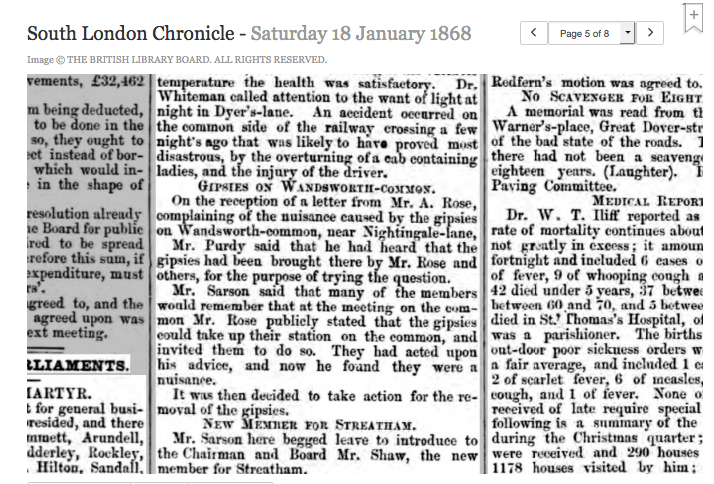
Gipsies on Wandsworth-common.
On the reception of letter from Mr. A. Rose, complaining of the nuisance caused by the gipsies Wandsworth-common, near Nightingale-lane, Mr. Purdy said that he had heard that the gipsies had been brought there by Mr. Rose and others, for the purpose of trying the question.
Mr. Sarson said that many of the members would remember that at the meeting on the common Mr. Rose publicly stated that the gipsies could take up their station on the common, and invited them to do so. They had acted upon his advice, and now he found they were a nuisance.
It was then decided to take action for the removal of the gipsies.
[BNA: Link
MURDER AND SUSPECTED SUICIDE AT THE "BLACK SEA" WANDSWORTH COMMON
On Saturday afternoon Mr. W. Carter, the coroner, proceeded with an inquiry, in the Board-room of the Wandsworth Union, Battersea Rise, respecting the death of a female child about five months old, who was found in pond called the Black Sea at Wandsworth-common.
Evidence having been adduced respecting the finding of the child, and tending to the suspicion that its unfortunate mother had committed suicide, the jury returned the following vordict: That the deceased child was wilfully murdered by being thrown into a pond called the Black Sea, but they (the jury) further say by what person or persons the evidence before them fails to prove.
[BNA: Link]
[BNA: Link
[BNA: Link
Plough, 89 St Johns Hill, Clapham, London, SW11 1SY
Plough, 89 St Johns Hill at the corner of Strath Terrace, SW11- circa 1920 and shows the Victorian building, with landlord GT Belshaw.
Usually listed at Ye Plough Hotel, at Wandsworth Road in 1851 census. Ye Old Plough Inn, on St. John's Hill, which was built a.d. 1701, and was pulled down in 1874, the present "Plough" being erected upon the site.
In front of the old inn grew an oak tree, beneath its shade travellers used to sit and enjoy their refreshments. There is some grounds for the belief that the notorious Dick Turpin once stayed at this house for some time, when he was nightly visiting the Garrett Lane district, the lane was then a lonely Surrey high road, leading to Tooting and Merton, where many of the gentry resided whom Turpin used to intercept on their way home, and demand his toll. Tradition says that he was often in hiding at the " Plough," when he was hard pressed by the men of law (1913).
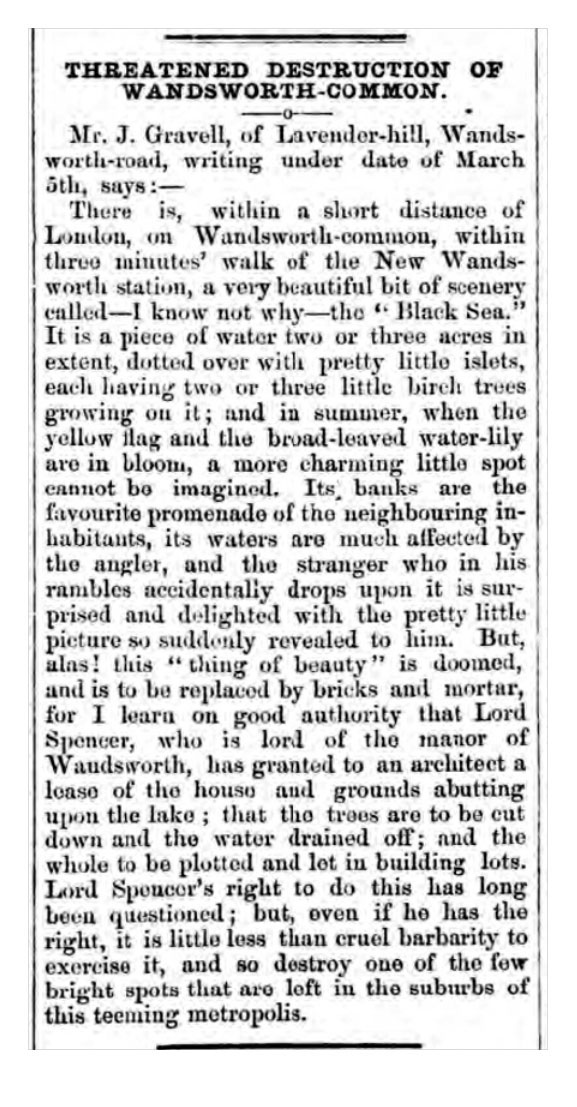
"A very beautiful bit of scenery called . . . the 'Black Sea' . . . is doomed."
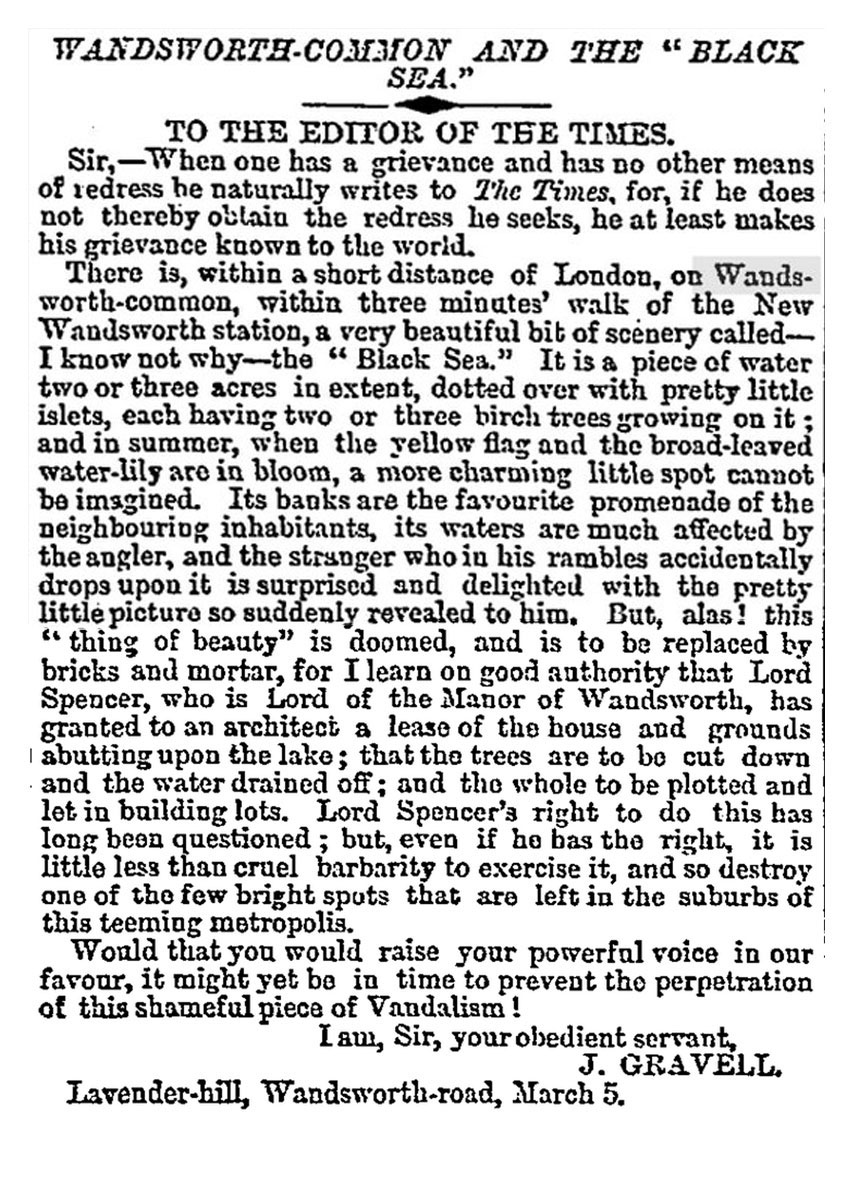
WANDSWORTH-COMMON AND THE "BLACK SEA"
TO THE EDITOR OF THE TIMES.
Sir When one has a grievance and has no other means of redress he naturally writes to The Times, for, if he does not thereby obtain the redress he seeks, he at least makes his grievance known to the world.
There is, within a short distance of London, on Wandsworth-common, within three minutes' walk of the New Wandsworth station, a very beautiful bit of scenery called — I know not why — the "Black Sea." It is a piece of water two or three acres in extent, dotted over with pretty little islets, each having two or three birch trees growing on it; and in summer, when the yellow flag and the broad-leaved water-lily are in bloom, a more charming little spot cannot be imagined. Its banks are the favourite promenade of the neighbouring inhabitants, its waters are much affected by the angler, and the stranger who in his rambles accidentally drops upon it is surprised and delighted with the pretty little picture so suddenly revealed to him.
But, alas! this "thing of beauty" is doomed, and is to be replaced by bricks and mortar, for I learn on good authority that Lord Spencer, who is Lord of the Manor of Wandsworth, has granted to an architect [PB: who was this?] a lease of the house and grounds abutting upon the lake; that the trees are to be cut down and the water drained off; and the whole to be plotted and let in building lots.
Lord Spencer's right to do this has long been questioned; but, even if he has the right, it is little less than cruel barbarity to exercise it, and so destroy one of the few bright spots that are left in the suburbs of this teeming metropolis.
Would that you would raise your powerful voice in our favour, it might yet be in time to prevent the perpetration of this shameful piece of vandalism!
I am sir, your obedient servant
J. GRAVELL
Lavender-hill, Wandsworth-road, March 5.
[Source: The Times Wandsworth-Common and the "Black Sea"]
Within three minutes walk of the New Wandsworth Station there is a very beautiful bit of scenery called the "Black Sea." It is a piece of water about three acres in extent, dotted over with pretty little islets, each having two or three birch trees growing upon it, and in summer, when the yellow flag and the broadleaved water-lily are in bloom, a more charming spot cannot be imagined. Its banks are the favourite promenade of the neighbouring inhabitants, and its waters much resorted to by the angler.
According to a correspondent in yesterday's Times, this thing of beauty is doomed by Lord Spencer to be replaced by bricks and mortar. As lord of the manor of Wandsworth, he is said to have granted a lease to architect of the house and grounds abutting upon the lake, the trees are to be cut down, the water to be drained off, and the whole to be plotted and let off in building lots.
This seems to be revival of the mania on the part of the noble earl, which called forth such strenuous resistance from the inhabitants in the neighbourhood of Wimbledon Common, to its enclosure. Lord Spencer's right to deal with the Black Sea as his private property, has long been questioned, and the Wandsworth Board of Works would confer great boon on the inhabitants of the district if they were to take vigorous measures to prevent the plan from being carried out.
[BNA: Link.]
South London Chronicle — Saturday 11 April 1868
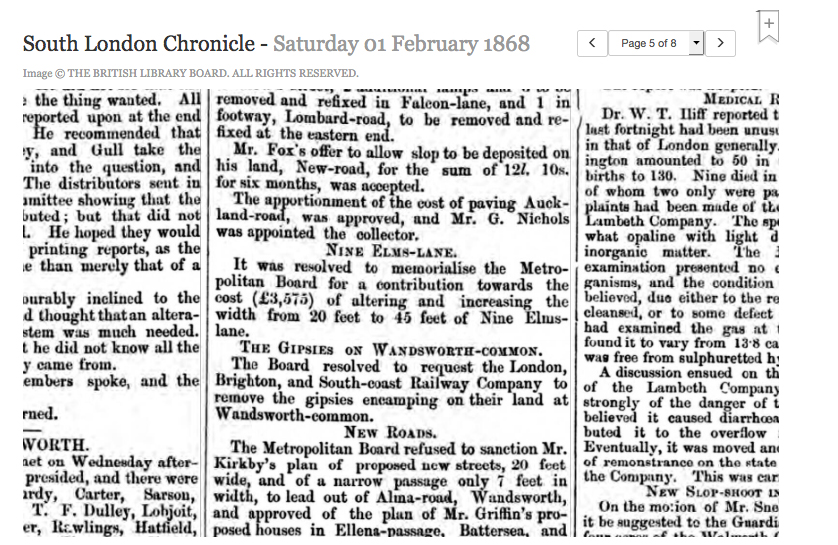
Gipsies on Wandsworth-commqn. On the reception of letter from Mr. A. Rose, complaining of the nuisance caused by the gipsies Wandsworth-common, near Nightingale-lane, Mr. Purdy said that he had heard that the gipsies had been brought there by Mr. Rose and others, for the purpose of trying the question.
Mr. Sarson said that many of the members would remember that at the meeting on the common Mr. Rose publicly stated that the gipsies could take up their station on the common, and invited them to do so. They had acted upon his advice, and now he found they were a nuisance.
It was then decided to take action for the removal of the gipsies.
[BNA: Link]
[Source?]
CAMPAIGNERS FOR THE COMMON
[May 1868]
In May, 1868, the Vicar, the Rev. T. S. Jenkinson, invited a few gentlemen to meet at his house to consider if anything could be done to stop the continual encroachments on the Common.
A road was made by the side of the South Western Railway from the railway bridge, opposite the Freemasons Arms, past the old pumping mill to the bridge on Trinity road, another road, being a continuation of Spencer-road was made to form a building frontage to the Spencer Park Estate.
There was also an enclosure of a long strip of green sward on the side of the main road, which now forms the north frontage of the Spencer Park Estate.
A committee was appointed, and frequent meetings were held, which at last resulted in a memorial to Earl Spencer, which was signed by upwards of 200 ratepayers of New Wandsworth.
All these efforts were useless
At last the indignation and enthusiasm of the neighbourhood were fully aroused, and the way prepared for further action.
Application was made to the District Board of Works to take charge of the Common, and prevent further encroachments.
The entire interest of the lord of the manor in Peckham Bye, Goose Green, and Nunhead Green, has been purchased by the Camberwell Vestry for the sum of £1,000. The sale was made on the condition that the Rye and the two Greens should be legally dedicated as recreation grounds, to be kept open and unenclosed for ever, for the benefit of the parishioners, and effectually secured to their use.
Had the vestry not accepted the offer, ten vestrymen and residents were prepared to put down £100 apiece to secure the Rye for the public. A space of 40 acres has thus been obtained at a nominal cost, the place saved from the chance of such deplorable spoliation as has been practised on Wandsworth and other suburban Commons, and an example set — both by the lord of the manor and by the vestry — of public spirit and energy that it were well should be copied by others.
[BNA: Link.]
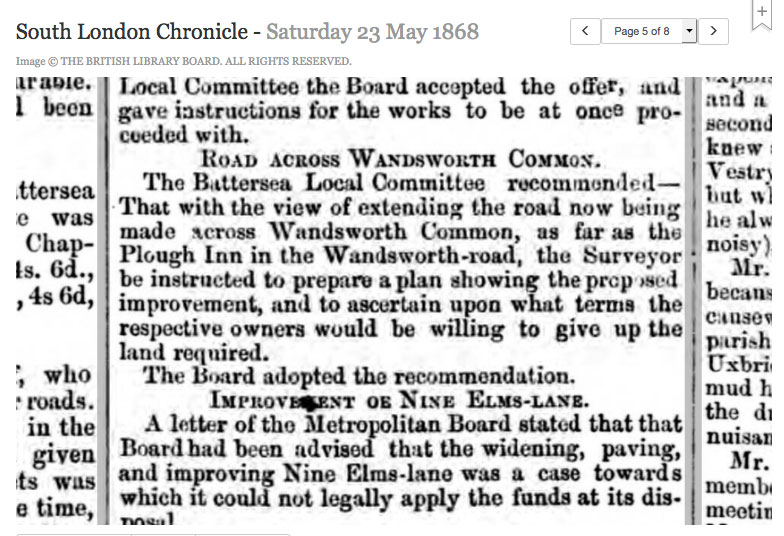
OUR PAROCHIAL PARLIAMENTS
Road across Wandsworth Common. Tho Battersea Local Committee recommended: That with the view of extending the road now being made across Wandsworth Common, far as Plough Inn in the Wandsworth-road, tho Surveyor be instructed to prepare a plan showing the prop improvement, and to ascertain upon what terms the respective owners would be willing to give up the land required.
[BNA Link.]
[PB: Buckmaster called the "Emperor of Battersea"! Buckmaster proposes Costeker.]
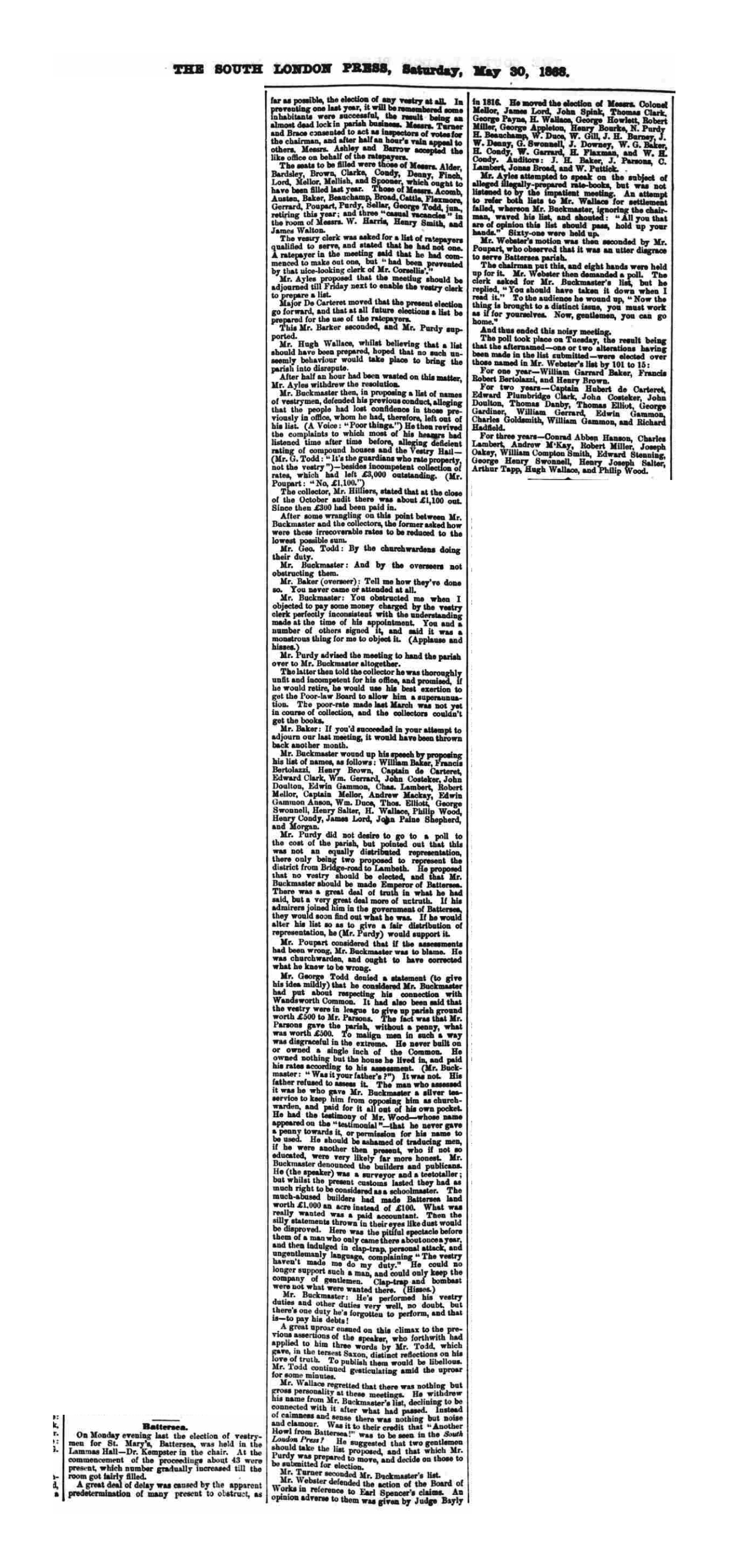
Battersea.
On Monday evening last the election of vestrymen for St. Mary's, Battersea, was held at the Lammas Hall — Dr. Kempster in the chair. At the commencement of the proceedings about 43 were present, which number gradually increased till the room got fairly filled.
A great deal of delay was caused by the apparent predetermination of many present to obstruct, as far possible, the election of any vestry all. In preventing one last year, it will be remembered some inhabitants were successful, the result being almost dead lock parish business. Messrs. Turner and Brace to act as inspectors of votes lor the chairman, and after half an hour's vain appeal to others. Messrs. Ashley and Barrow accepted the like office behalf of the ratepayers.
The seats to be filled were those of Messrs. Aider Bardsley, Brown, Clarke, Condy, Denny, Finch, Lord, Mellor, Hellish, and Spooner, which ought to have been filled last year. Those Messrs. Acomb. Austen, Baker, Beauchamp Broad, Cattle, FlexmorS Gerrard, Poupart, Purdy, bellar, George Todd, retiring this year; and three "casual vacancies in the form of Messrs. Harris, Henry Smith, and James Walton.
The vestry clerk was asked for a list ratepayers qualified to serve, and stated that he had not one. A ratepayer in the meeting said that he had commenced to make out one, but " had been prevented by that nice-looking clerk of Mr. Corsellis'."
Mr. Ayles proposed that the meeting should be adjourned till Friday next to enable the vestry clerk to prepare list.
Major Carteret moved that the present election forward, and that at all future elections list be prepared for the use the ratepayers. This Mr. Barker seconded, and Mr. Purdy supported.
Mr. Hugh Wallace, whilst believing that a list should have been prepared, hoped that such unseemly behaviour would take place to bring the parish into disrepute. After half hour had been wasted on this matter Mr. Ayles withdrew the resolution.
Mr. Buckmaster then, in proposing a list of names of vestrymen, defended his previous conduct, alleging that tho people had lost confidence in those previously office, whom he had, therefore, left out of his list. (A Voice: "Poor things.")
He then revived the complaints to which most of his heaegrs had listened time after time before, alleging deficient rating of compound houses and the Vestry Hall (Mr. G. Todd: "It's the guardians who rate property, not the vestry") — besides incompetent collection of rates, which had left £3,000 outstanding. (Mr. Poupart: "No, £l,loo.'')
The collector, Mr. Hilliers, stated that the close of the October audit there was about £l,l00 out Since then £300 had been paid in.
After some wrangling on this point between Mr. Buckmaster and the collectors, the former asked how were these irrecoverable rates to be reduced to the lowest possible sum.
Mr. Geo. Todd: the churchwardens doing their duty.
Mr. Buckmaster: And by the overseers not obstructing them. Mr. Baker (overseer): Tell me how they've done so. You never came or attended at all. Mr. Buckmaster: You obstructed me when I objected to pay some money charged by the vestry clerk perfectly inconsistent with the understanding made at the time of his appointment. Yon and a number of others signed it, and said it was a monstrous thing for me to object it. (Applause and hisses.)
Mr. Purdy advised the meeting to hand the parish over to Mr. Buckmaster altogether. The latter then told the collector he was thoroughly unlit and incompetent for his oflice, and promiesdl, if he would retire, he would use his best exertion to get the Poor-law Board to allow him a superaunnatiou. The poor-rate made last March was not yet in course of collection, and the collectors couldn't get the books.
Mr. Baker: If you'd succeeded in your attempt to adjourn our last meeting, it would have been thrown back another month.
Mr. Buckmaster wound his speech by proposing his list of names, follows: William Baker, Francis Bertolazzi [Bertolacci]. Henry Brown, Captain Carteret, Edward Clark, Win. Gerrard, John Costeker, John Doulton, Edwin Gammon, Chas. Lambert, Robert Mellor, Captain Mellor, Andrew Mackay, Edwin Gammon Anson, Wm. Duce, Thos. Elliott, George Swonnell, Henry Salter, H. Wallace, Philip Wood, Henry Condy, James Lord, Paine Shepherd, and Morgan.
Mr. Purdy did not desire to go to poll to the cost of the parish, but pointed out that this was not equally distributed representation, there only being two proposed to represent the district from Bridge-road to Lambeth. He proposed that no vestry should be elected, and that Mr. Buckmaster should be made Emperor of Battersea. There was a great deal of truth in what he had said, but a very great deal more of untruth. If his admirers joined him in the government of Battersea, they would soon find out what was. If would alter his list so as to give fair distribution representation, be (Mr. Purdy) would support it.
Mr. Poupart considered that if the assessments had been wrong, Mr. Buckmaster was to blame. He was churchwarden, and ought to have corrected what he knew to be wrong.
Mr. George Todd denied statement (to give his idea mildly) that he considered Mr. Buckmaster had put about respecting his connection with Wandsworth Common. It had also been said that the vestry were in league to give up parish ground worth £500 to Mr. Parsons. The fact was that Mr. Parsons gave the parish, without a penny, what was worth £500. malign men in such way was disgraceful in the extreme. He never built on or owned a single inch of the Common. He owned but the house he lived in, and paid his rates according to his assessment. (Mr. Buckmaster: "Was it your father's?") It was not. His father refused to assess it. The man who assessed it was he who gave Mr. Buckmaster a silver teaservice to keep him from opposing him churchwarden, and paid for it all out of his own pocket. He had the testimony of Mr. Wood — whose name appeared on the "testimonial" — that he never gave a penny towards it, or permission for his name to to used. He should be ashamed of traducing men, were another then present, who if not so educated, were very likely far more honest.
Mr. Buckmaster denounced the builders and publicans. He (the speaker) was surveyor and a teetotaller; but whilst the present customs lasted they had much right to be considered as a schoolmaster. The much-abused builders had made Battersea land worth £100O an acre instead of £100. What was really wanted was a paid accountant. Then the silly statements thrown in their eyes like dust would be disproved. Here was the pitiful spectacle before them man who only came there about once a year, and then indulged in clap-trap, personal attack, and ungentlemanly language, complaining The vestry haven't made me do my duty." He could longer support such a man, and could only keep the company of gentlemen. Clap-trap and bombast were not what were wanted there. (Hisses.)
Mr. Buckmaster: He's performed his vestry duties and other duties very well, no doubt, but there's one duty he's forgotten to perform, and that is — to pay his debts!
A great uproar ensued on this climax to the previous assertions of the speaker, who forthwith had applied to him three words by Mr. Todd, which gave, in the tersest Saxon, distinct reflections on his lUU . To print them would be libellous. Mr. continued gesticulating amid the uproar for some minutes. regretted that there was nothing but gross personality at these meetings. He withdrew his name from Mr. Buckmaster's list, declining to be after had p — of calmness and sense there was nothing but noise H^wff OU ' to their credit that "-Another Howl from Battersea!" was to be seen in the South / ?e suggested that two gentlemen should take the list proposed, and that which Mr. Purdy was prepared move, and decide those to submitted for election. . uded Hr. Buckmaster's list.
Mr Webster defended the action the Board of Works in reference Earl Spencer's claims. opinion adverse to them was given Judge Bayly ia 1816. He moved the election of Messrs. Colonel Meuor, James Lord, John Spink, Thomas Clark, George Payne, H. Wallace, George Hewlett, Robert Hiller, George Appleton, Henry Bourke, N. Purdy H. Beauchamp, Duoe, W. Gill, J. H. Burney, J. W. Denny, G. Swonnell, Downey, W. G. Baker, H. Condy, W. Garrard, H. Flaxman, and W, H. Goody. Auditors: J. H. Baker, J. Parsons, C. Lambert, Jonas Broad, and W. Puttick.
Ur. Avles attempted to speak on the subject of alleged illegally-prepared rate-books, but was not listened to by the impatient meeting. An attempt to refer both lists to Mr. Wallace for settiement failed, whereon Mr. Bnckmaster, ignoring the chairman, waved his list, and shouted; All you that are of opinion this list should pass, hold up your hands." Sixty-one were held up.
Mr. Webster's motion was then seconded by Mr. Poupart, who observed that it was utter disgrace to serve Battersea parish. The chairman put this, and eight bands were held up for it. Mr. Webster then demanded poll. The clerk asked for Mr. Buckmaster's list, but replied, "You should have taken it down when I read it." To the audience he wound up, Now the thing is brought to a distinct issue, yon must work as it for yourselves. Now, gentlemen, you can go home."
And thus ended this noisy meeting.
The poll took place on Tuesday, the result being that the afternamed — one or two alterations having been made in the list submitted — were elected over those named in Mr. Webster's list by 101 to 15:
For one year — William Garrard Baker, Francis Robert Bertolazzi [usually Bertolacci], and Henry Brown.
For two years — Captain Hubert de Carteret, Edward Flumbridge Clark, John Costeker, John Dou ton, Thomas Danby, Thomas Elliot, George Gardiner, William Gerrard, Edwin Gammon, Charles Goldsmith, William Gammon, and Richard Hadfleld.
For three years — Contmd Abben Hanson, Charles Andrew Kay, Hobert Miller, Joseph Oakey, William Compton Smith, Edward Stenninff, George Henry Swonnell, Henry Joseph Salter, Arthur Tapp, Hugh Wallace, and Philip Wood.
[BNA Link.]
[This may be identical with the article above — but may have somes sections missing from there — CHECK.
. . . as far possible, the election of any vestry all. In preventing one last year, it will be remembered some inhabitants were successful, the result being almost dead lock parish business. Messrs. Tuner and Brace to act as inspectors of votes lor the chairman, and after half an hour’s vain appeal to others. Messrs. Ashley and Barrow accepted the like office behalf of the ratepayers. The seats to be filled were those of Messrs. Aider Bardsley, Brown, Clarke, Condy, Denny, Finch! Lord, Mellor, Hellish, and Spooner, which ought to have been filled last year. Those Messrs. Acomb. Austen, Baker, Beauchamp Broad, Cattle, FlexmorS Gerrard, Poupart, Pnrdy, bellar, George Todd, retiring this year; and three “casual vacancies in the room of Messrs. Harris, Henry Smith, and James Walton.
The vesiry clerk was asked for a list ratepayers quaiilied to serve, and stated that he had not one. A ratepayer in the meeting said that he had commenced to make out one, but “ had been prevented by that uice-looking clerk of Mr. Corsellis’." Mr. Ayles proposed that the meeting should be adjourned till Friday next to enable the vestry clerk to prepare list. Major Carteret moved that the present election forward, and that at all future elections list be prepared for the use the ratepayers. This Mr. Barker seconded, and Mr. Purdy supported.
Mr. Hugh Wallace, whilst believing that a list should have been prepared, hoped that such unseemly behaviour would take place to bring the parish into disrepute. After half hour had been wasted on this matter Mr. Ayles withdrew the resolution.
Mr. Buckmaster then, in proposing a list of names of vestrymen, defended his previous conduct, alleging that tho people had lost confidence in those previously office, whom he had, therefore, left out of his list. (A Voice: “Poor things.”) He then revived the complaints to which most of his heaegrs had listened time after time before, alleging deficient rating of compound houses and the Vestry Hall (Mr. G. Todd: “ It’s the guardians who rate property, not the vestry ") — besides incompetent collection of rates, which had left £3,000 outstanding. (Mr. Poupart: “No, £1,100’’)
The collector, Mr. Hilliers, stated that the close of the October audit there was about £1,100 out Since then £300 had been paid in. After some wrangling on this point between Mr. Buckmaster and the collectors, the former asked how were these irrecoverable rates to be reduced to the lowest possible sum.
Mr. Geo. Todd: the churchwardens doing their duty.
Mr. Buckmaster; And by the overseers not obstructing them.
Mr. Baker (overseer): Tell me how they’ve done so. You never came or attended at all.
Mr. Buckmaster: You obstructed me when I objected to pay some money charged by the vestry clerk perfectly inconsistent with the understanding made at the time of his appointment. Yon and a number of others signed it, and said it was a monstrous thing for me to object it. (Applause and hisses.)
Mr. Purdy advised the meeting to hand the parish over to Mr. Buckmaster altogether. The latter then told the collector he was thoroughly unlit and incompetent for his oflice, and promiesdl, if he would retire, he would use his best exertion to get the Poor-law Board to allow him a superaunnatiou. The poor-rate made last March was not yet in course of collection, and the collectors couldn’t get the books.
Mr. Baker; If you'd succeeded in your attempt to adjourn our last meeting, it would have been thrown back another month.
Mr. Buckmsster wound his speech by proposing his list of names, follows: William Baker, Francis Bertolazzi. Henry Brown, Captain Carteret, Edward Clark, Win. Gerrard, John Costeker, John Doulton, Edwin Gammon, Chas. Lambert, Robert Mellor, Captain Mellor, Andrew Mackay, Edwin Gammon Anson, Wm. Duce, Thos. Elliott, George Swonnell, Henry Salter, H. Wallace, Philip Wood, Henry Condy, James Lord, Paine Shepherd, and Morgan.
Mr. Purdy did not desire to go to poll to the cost of the parish, but pointed out that this was not equally distribnted representation, there only being two proposed to represent the district from Bridge-road to Lambeth. He proposed that no vestry should be elected, and that Mr. Buckmaster should be made Emperor of Battersea. There was a great deal of truth in what he had said, but a very great deal more of untruth. If his admirers joined him in the government of Battersea, they would soon find out what was. If would alter his list so as to give fair distribution representation, be (Mr. Purdy) would support it.
Mr. Poupart considered that if the assessments bad been wrong, Mr. Buckmaster was to blame. He was churchwarden, and ought to have corrected what he knew to be wrong.
Mr. George Todd denied statement (to give his idea mildly) that he considered Mr. Buckmaster had put about respecting his connection with Wandsworth Common. It had also been said that the vestry were in league to give up parish ground worth £500 to Mr. Parsons. The fact was that Mr. Parsons gave the parish, without a penny, what was worth £500. malign men in such way was disgraceful in the extreme. He never built on or owned a single inch of the Common. He owned but the house he lived in, and paid his rates according to his assessment. (Mr. Buckmaster: Was it your father's?") It was not His father refused to assess it. The man who assessed it was he who gave Mr. Buckraaster a silver teaservice to keep him from opposing him churchwarden, and paid for it all out of his own pocket. He had the testimony of Mr. Wood—whose name appeared on the “testimonial”—that he never gave a penny towards it, or permission for his name to to used. He should be ashamed of traducing men, were another then present, who if not so educated, were very likely far more honest.
Mr. Buckmaster denounced the builders and publicans. He (the speaker) was surveyor and a teetotaller; bat whilst the present customs lasted they had much right to be considered as a schoolmaster. The much-abused builders had made Battersea land worth £1,000 an acre instead of £l00. What was really wanted was a paid accountant. Then the silly statements thrown in their eyes like dust would be disproved. Here was the pitiful spectacle before them man who only came there aboutouceayear, and then indulged in clap-trap, personal attack, and ungenUemanly language, complaining The vestry haven't made me do my duty.” He could longer support such a man, and could only keep the company of gentlemen. Clap-trap and bombast were not what were wanted there. (Hisses.)
Mr. Buckmaster: He’s performed his vestry duties and other duties very well, no doubt but there's one duty he’s forgotten to perform, and that is—to pay his debts! A great uproar ensued on this climax to the previous assertions of the speaker, who forthwith had applied to him three words by Mr. Todd, which gave, m the tersest Saxon, distinct reflections on his lUU . To P them would be libellous.
Mr. continued gesticulating amid the uproar for some minutes. regretted that there was nothing but gross personality at these meetings. He withdrew his name from Mr. Buckmaster’s list, declining to be after had p — of calmness and sense there was nothing but noise H^wff™ OU ' to their credit that ‘-Another Howl from Battersea!” was to be seen in the South / ?e suggested that two gentlemen should take the list proposed, and that which Mr. 1 urdy was prepared move, and decide those to submitted for election. . uded Hr. Buckmaster’s list. Webster defended the action the Board of Works in reference Earl Spencer’s claims. opinion adverse to them was given Judge Bayly
[BNA: Link.]
New Road, St John's Hill — John Buckmaster's home at this time:
[17th of June, 1868]
This was supplemented by an appeal to the Metropolitan Board of Works, and at a meeting held on the 17th of June, 1868, Mr. Meaden presented a memorial from the Wandsworth Board of Works, praying the Metropolitan Board to enforce the provisions of the Commons Act of 1866, so as to save what remained of the Common from further encroachments. This was referred to the Works Committee.
A deputation attended of inhabitants of Wandsworth and Battersea, introduced by Mr. Meaden, who presented the following memorial:
The memorial of us the undersigned inhabitants of the parishes of Wandsworth and Battersea, showeth -
1. That the whole of Wandsworth and Battersea Commons are within your jurisdiction.
2. That these Commons formerly consisted of about 300 acres, but, in consequence of many enclosures and encroachments, the open spaces now remaining, do not, we believe, consist of more than 150 acres.
3. That from time immemorial these Commons have been entirely open for the public use and recreation, and were formerly noted for their great natural beauty and fertility, and are, not-withstanding their present neglected state, still greatly resorted to by the inhabitants of the metropolis, the access by rail being remarkably easy, and the fares low.
4. That the continual encroachments on these Commons, the excavation of gravel pits which are left in a dangerous state to the public and serve as resorts for dissolute characters — the deposit of rubbish, and other nuisances of a like nature, have given rise to a wide-spread feeling of regret and dissatisfaction, which has resulted in an application to the Board of Works for the Wandsworth District to enforce the Commons Preservation Act of 1866.
5. The necessity of maintaining the Commons and open spaces around London, in consequence of the rapid increase of the population, has been recognised both by your honourable Board and the Legislature, and we would respectfully urge that the preservation, unenclosed, of Wandsworth and Battersea Commons has become a matter of great importance to the inhabitants of the metropolis.
Your memorialists therefore hope that, in consideration of the public importance of the subject, your honorable Board will be pleased to direct immediate steps to be taken to put the Commons Preservation Act of 1866 in operation, to secure and maintain, unenclosed, for the benefit of the public, in perpetuity, the existing Commons of Wandsworth and Battersea.
J. S. Jenkinson, Vicar of Battersea.
E. R. Ransome, Rushmere Cottage, Wandsworth Common
H. Brown, Cornwall Villa, Wandsworth common;
J. D. Keighley, Ashdown, Wandsworth common;
Charles Gray, Chestnut Villa, Wandsworth common;
William Carter, Althorp House, Wandsworth common;
George Alder, Battersea Rise;
G. H. Page, Spencer road;
C. M. Hanson, Spencer road;
Hubert de Carteret, Spencer road;
Paul Oppitz, Vardens road;
G. H. Swounell, Wandsworth common;
John Costeker, St. John's hill;
Wm. Compton Smith, Ivy Lodge, St. John's hill;
Alexander Webster, 25, Oberstein road;
H. W. M. Wilson, Spencer road;
James Mudie, Park road, New Wandsworth;
Francis R. Bertollacci [Bertolacci], Park road, New Wandsworth;
John Archbutt, Wandsworth common;
Andrew McKay, Park road, New Wandsworth;
Ambrose P. Boyson, Wandsworth common;
T. S. Watson, The Gables, Wandsworth common.;
James Du Buisson, Wandsworth common;
Edward Coventry, Wandsworth common.
Mr. Lord and Mr. Buckmaster addressed the Board on the subject, asking them to interfere for prevention of further encroachment without delay, pointing out the gradual increase of enclosure and buildings.
[Shortly after November 1868, the defenders of the Common finally despaired of the MBoW, who they realised were contemplating selling off parts of the Common.]
Moreover, Earl Spencer's agent with the connivance of the district surveyor, enclosed a long strip of common to add to the north side of the said estate, cutting the main road down to a mere 40ft road, instead of its being a good wide road as it had been from time immemorial.
A petition signed by more than 200 ratepayers of New Wandsworth was sent to Earl Spencer, protesting against, these encroachments, but a deaf ear was turned to us.
[I have moved a section to 1870 that started: "
1870. — March 14th. — A large and influential meeting was held at the Lammas Hall, Battersea, convened by Mr. J. C. Buckmaster, churchwarden of the parish of St. Mary's, Battersea, at the request of seven influential parishioners, including the vicar and the late Tom Taylor. The hall was filled by eight o'clock, amongst those . . . "
"
Wandsworth Common.
A deputation atten ie t, and presented a memorial from the inhabitants of Battersea and Wandsworth, praying B *rd take steps to prevent Wand*worth-coram The Chtirina i sai l that ino-e than a year ago Board was '-y Earl Sp with the reply that nothing emil lone while the legal settlement , the question w. sin aheyaice. promised to what coul it the ditau Board, and sag- I gested the preparation of a plan of the common, Eventually a oinmittee was formod to pi<>} are plan, with the view of moving the Board.
The Footpath of Wandsworth Common. In accordance with the recommendation of the Battersea Local Committee, it was resolved that the evidence handed in by Mr. Buckmaster, on the subject of the footpath on Wandsworth-common, leading from the old Clapham-common station to Bolingbroke-grove, be printed and circulated among the members of the Board.
[BNA: Link]
[PB: "from the old Clapham-common station to Bolingbroke-grove"? I can understand old Clapham Common, but where would the footpath have gone since isn't there a railway line in between?]
FOOTPATHS AND ROADS — BOLINGBROKE GROVE EXTENDED TO PLOUGH
WANDSWORTH COMMON
A memorial to the Central Board of Works was read, which had been pre by the clerk. It set forth that application been made by the board to Earl Spencer tual casement over the Common, and t hat ied that his answer could not be ven till the litigation as to his rights over Wimbledon Common was settled. This was 18 months ago, and no decision was yet come to. The board were now desirous that the Commo which has been 80 materially reduced in size, shou id rved in its natural state, wer being given be med requisite— draining or planting being not inte rfered with, but rights of pasturage and gravel-digging being pur- rights of turbary The follo evidence, relative to an alleged was oe Station to rors,» 3 of ostler at the Plo Recollects Mr. using the footpath 30 Wilson repairing more than 20 years pamed Waller g trenc on either of the f th in winter to keep it and ever any one say it was not a f Kendall, now living at the P) h, recol- lects the f 80 years Has frequently walked and recollectsits gravelled lo before the Board of Wor! ks gravelled t Never footpath; always believed any one say it was nota it to be proper f John now the unl recollects the foot- Southampton way was path before trenched in winter to carry 0 ff recollects its being the water, and afterwards gravelled. Believes it was first gravelled by the living in Boling broke Grove. Joseph A bley, now in the union, 63 years of age, has been across footpath ever since he was a boy ; alwa considered it a proper regular f No one ever said to hin like any o foot the foot Was & was not a foo’ convenience to men working on the Common, and also for Jose of age, now in the recollects the f ever since he was a walked acroas it hundreds of times a man named Waller trenches and making the a little ter ; Tecollects its gravelled b Mr. Wilson. Never heard any one was not a footpath ; always believed it to be a f Fricker, of Merton Road, Wandsworth, came into the of Battersea in 1827, Wasa eara,and was in the habit of using the for dail some times three or four times a day. Footpath Recollects its being gravelled on two or three oc- casions. The men once asked him for beer when they it. The last time he believes it was were widened by order of the District when they met in the Bolingbroke Grove. Never heard of any one say it was not a footpath. b the railway. Has Was surprised when of times. Never ieved walked across it tho he was a Some one broke the railway ntle- fence down w came out. A m and man from the railway compan. called on others to make in about f th. He told him the number at years he had used He said be would call again, but has never seen or heard any- t of him since. Believes the fence has been broken down since the tleman called. William Thornton, builder, St. Hill, recollests the foo when he wasa boy. play at cricket near to it, now more than 35 years Recollects its raised to it in winte r,and recollects Mr. ilson having it gravelled. Always believ ed it to be a proper bh. Was 8 when somebody told hi the of Works did not believe it was a f h, as he uired. a 78 one ever always used it when occasion req stopped him or interfered with him, or told him he was a trespasser John Ke P lough-lane, recollects the footpath 2 at least. at Was once in the babit of using for 30 years he worked at Balham, and recollects the it daily when The f n Railway being was then at into good order, and was in the habit of wa it the rail often met Mr. Fricker, Wa Never heard till it waa not a footpath; always ever believed it to be and no one interfered with bis using it. The memorial was and the chairman re- quested to present and support it B
[BNA: Link.]
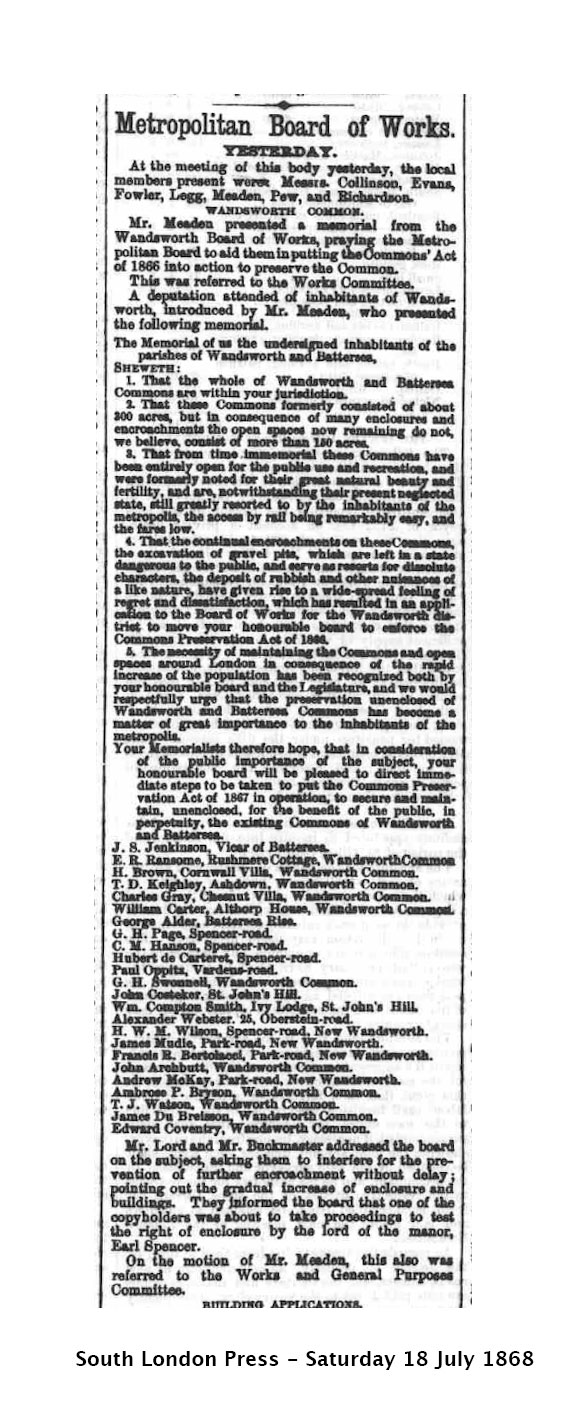
South London Press — Saturday 18 July 1868
Metropolitan Board of Works
Yesterday
At the meeting of this body yesterday [17th of July, 1868], the local members present were Messrs Collinson, Evans, Fowler, Legg, Meaden, Pew, and Richardson.
Wandsworth Common
Mr. Meaden presented a memorial from the Wandsworth Board of Works, praying the Metropolitan Board to aid them in putting the Commons Act of 1866 to preserve the Common.
This was referred to the Works Committee.
A deputation attended of inhabitants of Wandsworth, introduced by Mr. Meaden, who presented the following memorial.
The memorial of us the undersigned inhabitants of the parishes of Wandsworth and Battersea,
SHEWETH:
1. That the whole of Wandsworth and Battersea Commons are within your jurisdiction.
2. That these Commons formerly consisted of about 300 acres, but in consequence of many enclosures and encroachments, the open spaces now remaining do not, we believe, consist of more than 150 acres.
3. That from time immemorial these Commons have been entirely open for the public use and recreation, and were formerly noted for their great natural beauty and fertility, and are, not-withstanding their present neglected state, still greatly resorted to by the inhabitants of the metropolis, the access by rail being remarkably easy, and the fares low.
4. That the continual encroachments on these Commons, the excavation of gravel pits, which are left in a dangerous state to the public and serve as resorts for dissolute characters — the deposit of rubbish, and other nuisances of a like nature, have given rise to a wide-spread feeling of regret and dissatisfaction, which has resulted in an application to the Board of Works for the Wandsworth District to enforce the Commons Preservation Act of 1866.
5. The necessity of maintaining the Commons and open spaces around London, in consequence of the rapid increase of the population, has been recognised both by your honourable Board and the Legislature, and we would respectfully urge that the preservation, unenclosed, of Wandsworth and Battersea Commons has become a matter of great importance to the inhabitants of the metropolis.
Your Memorialists therefore hope that, in consideration of the public importance of the subject, your honourable board will be pleased to direct immediate steps to be taken to put the Commons Preservation Act of 1867 [PB surely 1866?] in operation, to secure and maintain, unenclosed, for the benefit of the public, in perpetuity, the existing Commons of Wandsworth and Battersea.
J. S. Jenkinson, Vicar of Battersea.
E. R. Ransome, Rushmere Cottage, Wandsworth Common
H. Brown, Cornwall Villa, Wandsworth Common;
J. D. Keighley, Ashdown, Wandsworth Common;
Charles Gray, Chestnut Villa, Wandsworth Common;
William Carter, Althorp House, Wandsworth Common;
George Alder, Battersea Rise;
G. H. Page, Spencer road;
C. M. Hanson, Spencer road;
Hubert de Carteret, Spencer road;
Paul Oppitz, Vardens road;
G. H. Swonnell [Swannell?], Wandsworth Common;
John Costeker, St. John's hill;
Wm. Compton Smith, Ivy Lodge, St. John's hill;
Alexander Webster, 25, Oberstein road;
H. W. M. Wilson, Spencer road;
James Mudie, Park road [= Elsynge Rd], New Wandsworth;
Francis R. Bertolacci [many diff. spellings recorded], Park road [= Elsynge Rd], New Wandsworth;
John Archbutt, Wandsworth Common;
Andrew McKay, Park road [= Elsynge Rd], New Wandsworth;
Ambrose P. Bryson, Wandsworth Common;
T. S. Watson, The Gables, Wandsworth Common.;
James Du Breisson [Du Buisson], Wandsworth Common;
Edward Coventry, Wandsworth Common.
Mr. Lord and Mr. Buckmaster addressed the Board on the subject, asking them to interfere for the prevention of further encroachment without delay; pointing out the gradual increase of enclosure and buildings.
They informed the Board that one of the copyholders [PB: Peek? Digby?] was about to take proceedings to test the right of enclosure by the lord of the manor, Earl Spencer.
n the motion of Mr Meaden, this also was referred to the Works and General Purposes Committee.
[PB: This is reproduced, with only minor differences, in HOW THE BATTLE FOR WANDSWORTH COMMON WAS FOUGHT AND WON, late 1880s]
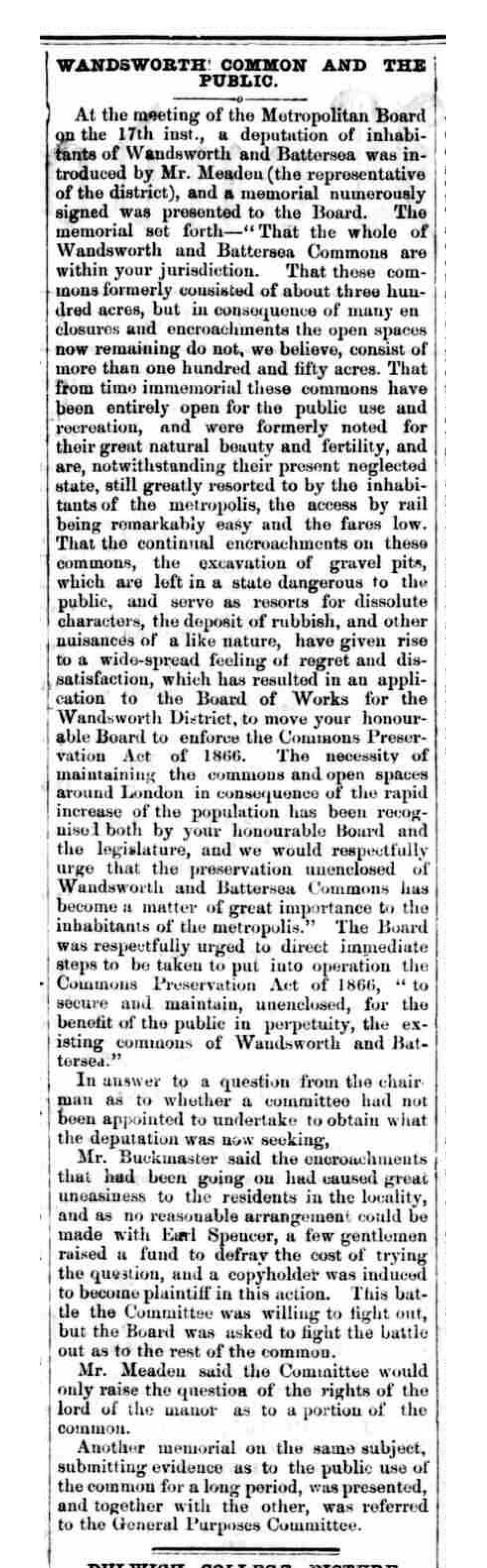
WANDSWORTH COMMON AND THE PUBLIC.
At the meeting of the Metropolitan Board the 17th inst., a deputation of inhabitants of Wandsworth and Battersea was introduced Mr. Meaden (the representative of the district), and memorial numerously signed was presented to the Board. The memorial set forth — "That the whole of Wandsworth and Battersea Commons are within your jurisdiction. That those commons formerly consisted of about three hundred acres, but in consequence of many enclosures and encroachments the open spaces now remaining do not, believe, consist of more than one hundred and fifty acres. That from time immemorial these commons have been entirely open for the public use and recreation, and wore formerly noted for their great natural beauty and fertility, and are, notwithstanding their present noglected state, still greatly resorted to by the inhabitants of the metropolis, the access by rail being remarkably easy and the fares low. That the continual encroachments on these commons, the excavation of gravel pits, which are left in a state dangerous to the public, and serve resorts for dissolute characters, the deposit of rubbish, and other nuisances a like nature, have given rise to a widespread feeling of regret and dissatisfaction, which has resultod an application to the Board of Works for the Wandsworth District, to move your honourable Board to enforce the Commons Preservation Act of 1866. The necessity of maintaining the commons and open spaces around London in consequence the rapid increase of the population has been recognise both by your honourable Board and the legislature, aud we would respectfully urge that the preservation unenclosed of Wandsworth and Battersea Commons has become a matter of great importance to the inhabitants of the metropolis." The Board was respectfully urged to direct immediate steps to taken to put into operation the Commons Preservation Act of 1866, "to secure and maintain, unenclosed, for benefit of the public in perpetuity, the existing commons of Wandsworth and Battersea."
In answer to a question from the chairman to whether a committee had not been appointed undertake to obtain that the deputation was now seeking, Mr. Buckmaster said the encroachments that had been going had caused great uneasiness to the residents in the locality, aud no reasonable arrangement could be made with Earl Spencer, few gentlemen raised fund to defray the cost trying the question, aud a copyholder was induced to become plaintiff in this action. This battle the Committee was willing to light out, but the Board was asked to light the battle out to the rest of the common.
Mr. Meaden said the Committee would only raise the question of rights of the lord of the manor as to a portion of the common.
Another memorial the same subject, submitting evidence to the public use the common for a long period, was presented, and together with the other, was referred to the General Purposes Committee.
Mr. MEADEN introduced a deputation from the inhabitants of the parishes of Wandsworth and Battersea.
The deputation presented the following memorial: "That the whole of Wandsworth and Battersea are within the jurisdiction of the Board; that their commons formerly consisted about 300 acres, but in consquence of many enlosures and encroachments the open spaces now remaining . . .
[CARRY ON EDITING]
|ieu space 4 not, wo believe, exusist of more than Ic'*acr->9; -t from time immemorial these comn hart been entirely open for public use an and were formerly noted for their g eat natural and fertility, anil arc, notwithstanding s'ate, still grcv.ly resorted to n.n rhabitants the metropolis, the access t*y ra s.* remarkably easy and the fares low. Tint the .trr. continual encroachments on theso commot.a; the rations of gravel-pits, which are left a ute d vngerous the public and serve res --( f.>r characters; the de(M>Bit — rub'rsb nr.<. nuisances like nature, have given ri--etor. spnvid of regrot and dissatisfaction, h.-ck has resulted an application to the Hoar-lot -ci r Wandsworth district to move your rd enforce the Common- Preservation Act, 1866. The necessity maintuiidng the cviamona and open spaces around London, in qnenco of tee rapid inercise the p -pnlat tieen recognised both jour ur-iolo H.arw a- d the legislators; and would nspccifnliy urge that the presorvstion, nncncloiud, of and Batter*! commons — been a nuatisr gr-at imp -rtance inhabiiuuls of th 7 metrepolis."
The deputation was hoard in support the rccmori.d, |>oii.ting out that the common was a.* butlf and cnclo-*! right build w-udd fought out, and they wishei the Hoan.l ic iut- rforo for the rem lining }v-r ions of the cjcjmens. The matter .vn** referred to the Work? ae* Ofr,-. rul Committee.
SEWER VENTILATORS
Mr. J. W. BAZALGETTE, the Chief Engineer, brought up a report, recommending the use of charcoal boxes in all the ventilators of sewers. Agreed to.
[BNA: Link]
[BNA SEARCH: CARRY ON FROM HERE . . . .]
Long detailed report of Conservative Party meeting in Battersea — Brodrick and Peek — attacks on Goldsmid
[BNA: Link]
Mr. Brodrick's ancestors had conducted themse to the satisfaction the county all the ti the more responsibility and inducement rested po their successor to do his duty. (Cheers.) -I her been two charges brought against the Conser as a party-the one that they were a corrupt lot, and the other that they were extravagant. Thetroppo nents had talked about the corruption of the conservatives; the fact was there had bocu three men at Bristol accommodated with boar lodging in gaol for malpractice ou I* ' .
Conservatives there — perhaps attributable to bad example set them, for there been _ very curious scenes at Bristol — (a laugh) sides. (Applause.) Perhaps they had been influenced by the general atmosphere of the (laughter) — but their opponent had ?J , — the electors that there was borough called Beigaw, iu Mid-Surrey, where three years ago there be a member returned for the borough. no Conservative candidate, the LiberaU all their own way; and what was the result — place was disfranchised, and nearly 300 elector personally disfranchised. So that it two people found themselves in trouble amongst servatives, he must put against that the fact t hundreds hnd assisted in corruption in connection with the Liberals.
The next objection respecting the Conservatives being such extravagant set, easily disposed of. The statement had been repeated frequently daring the past few da) s. the statement to be false-as a man o business he could easily see that; but in order tto l , might not have taken on the subjeet employed an accountant — ("Name *) Mr. S to ascertain Irora the blue books the relative rates of expenditure during several years. Mr. Morgan's statement, ou printed form, handed about the room.] Last year, " March, the gross expenditure — including for the cost of the Abyssinian war, which they would grant was an exceptional £71,8G2,UU0.
In 186 Uh e expe uditnre was < UUU, 1802, f72,21)0,000; in 1863 0,400,000, giving an average, duriug the three years while air. Gladstone was Chancellor the Exchequer, £71,880,000, against a less sum last year under the Government, even with the cost the Abysstu a war added. Mr. Peek also referred to the same present table showing that there had been a reduction o income-tax during the present Adtmmstra in. (Cheers).
It had been objected to him that his claims were local; true, that was the very first thing for which he was brought forward to "got battle for Mid-Surrey, where be had resided for 20 years. contended that one of the representatives, at least, ought be local min. it was that ground fought the battle three years ago, and that gronua he fought now. (Applause.)
There were many great questions which would seriously affect them one of which was that of equalization of the poor rate. ("Hear, hear." and cheers.) He thought the area should be enlarged far practicable, without waste or improvident expense, even to the extent of a national rate. He would have every parish contribute a fair proportion towards the maintenance of the common poor, and not let the latter bear the whole burden. (Applause.)
On the subject of preserving open spaces, he avowed himself in favour of maintaining large commons intact, eettecially in densely-crowded districts such Wandsworth and Battersea. He had become copyholder in Battersea, for the purpose of fortifying his position while fighting the battle of the commons in Chancery.
He was sure that if they were represented by strangers, justice would not done to them in that respect. Some people had no care for politics, and chose concentrate their attention upon volunteering, cricketing, boating, Ac., tb whom he jocosely appealed, saying that he was connected with the volunteer corps, a cricket club, and a regatta committee — (cheers) — on which account hoped they would give their votes, if they had no taste for politics. (Applause.) In reply to a question put respecting Mr. Coleridge's bill for giving equal privileges to students of universities, . . . , Mr. Brodrick said that he had been member of Oxford University for 20 years, and was favour of opening universities to all students as far their privileges for study, and for acquiring titles, passing degrees, Ac., were concerned; but he should decidedly oppose Mr. Coleridge's bill in that particular which provided that Dissenters as well as Churchmen should have a voice in the disposal of the funds. When endowment had been made in the interest of the Church of England, it was wrong allow Dissenters make use of that endowment, just it would bo wrong to privilege a member of the Church of England to interfere with endowment granted a Wesleyan, Methodist, or Baptist College.
As far as was personally concerned, he would be ashamed to ask for share in the endowment of institution, not being a member of the connexion. (Cheers.) Whether obtained votes or not, would not a party anything which he considered to injustice. (Loud applause.) Colonel Bercsford referred to two fellowships which had been endowed in favour of bis family, aud asked whether any other persons would be encouraged to make endowments, if tho law ouce admitted the right to interfere with them.
Dr. Brown reviewed the conduct of the present ministry at some length, after which he moved the following resolution: "That this meeting having heard the views of the Hon. W. Brodrick and Mr. H' W. I'cek, and approving their political principles, is'of opinion that they are well fitted to represent Mid-Surrev in Parliament." (Loud cheers and a Mr.'Dagnell seconded the resolution, after which Mr'. Bucktou moved an amendment, the spirit of which was a direct negative to the original motion.
Mr. Kiraber made an excellent speech, contending that whichever party obtained power, justice would done to Ireland. He argued that the interference with the Irish Church, without prior examination of her ailments, was like a surgeon doctoring patient without first ascertaining the nature the disease. . . . Xhe amendment, being put to the meeting, was supported by about one-fourth of the meeting, and an overwhelming majority in favour of the original resolution. . . , The result was received with loud cheers, and shouts of "Hurrah." .
Mr. Brodrick returned thanks for the enthusiastic manner in which resolution had been received, remarking that his opponents had miscalculated their strength in that room. A vote of thanks to the chairman, and loud shouts ~r..Hurrah." andcheers forthe candidates, concluded the business of the meling.
Meeting at Redhill On Tuesday last the Conservative candidates, the Hon. Mr. Brodrick and Mr. H. W. Peek, addressed ft meeting at the Public Hall, Hedhill, which was well attended. The Hon. Mr. lirodrick stated his views upon the great political questions of the day.
Mr. H. W. Peek followed, but it was clearlv evident their views were not accordance with the majority of those present, several questions put which were not satisfactorily auswered. resolution was then proposed and seconded that the Hon. Mr. Brodrick and Henry William Peek were fitaud proper persons represent Mid-Surrey in Parliament. amendment was then proposed and seconded that no candidates were fit and proper persons to represent Mid-Surrey who would not vote for Mr. Gladstone and the Liberal party, which was carried majority of quite 3 to 1.
The gentlemen the platform immediately left, without even passing vote thanks to the chairman. Three cheers were then given for Mr. Gladstone, and the company dispersed.
[BNA: Link]
[ John Conder elected member of the Council of the College of Preceptors.]
[BNA: Link]
[ . . . ]
Mr. Lord then addressed the meeting, advocating equalisation of poor-rates, and alteration of the system of collecting them on the principle of securing the income-tax which would enable them to reach a large amount of property which at present was ignored. He condemned the pending Act of Parliament which was said to allow vagrants to tramp from one end of the countiy to another the expense of the ratepayers. On the question of open spaces, he contended that the commons should not be interfered with — not single acre should be touched in the vicinity of London. He had opposed the lord of the manor tonching yard ot Wandsworth Commons for building purposes. alluded to Mr. Gladstone having stated some years ago that the Maynooth grant could not be tolerated, as it would a thorn in the side of this country, and yet five years afterwards he brought in bill for increasing that grant from .£5,000 to about .£30,000. It might be asked whether man should not have the right to change his opinions, to which (the candidate) would reply in the affirmative; but, no added, when a public man had published one opinion, and afterwards changed his notion, it was dne from him to make a public recantation and state his reasons for the same. Ho was astonished that they should have to defend the Protestant Chnrch in the!9th century, and reminded them that it was doe to the interference of the Papacy which sought to be supreme. alluded to statement made by Mr. Spurgeon that the Irish Chnrch must'be abolished, and justice done, cost what it might If they were to act the principle of confiscating property which had been endowed and left for a particular purpose, they might consider all property henceforth He considered that as the length of time which property had been retained teudeo to strengthen its title, it was a great argument in support of the retention of the Church in Ireland by people to whom it had descended. If they were once admit the principle in this case, there would be no protection for the savings of the working classes deposited in the savings banks. He remarked that people who emigrated from Ireland to America almost invariably sent home money throueh the Protestant clergymen, not daring to trust it with the Catholic priest. He also pointed oat that Roman Catholics had admitted two millions of their emigrants to have abandoned the Roman Catholic faith after they had gone abroad, which could be attribnted only to their having been freed from the domination of the priest. The bon. gentleman concluded appealing to his Conservative friends to fight fairly and manfully, uprightly, and free from all ground of complaint. (Applause.) After aeverai questions had been answered by the candidates Captain Wells moved, and Mr. Kent seconded motion of confidence in Messrs. Hardman and Lord, which was supported by Mr. Mason, and carried with only one dissentient vote.
Hardman and Lord at Clapham.
On Tuesday night crowded meeting held at the Clapham Hall, Old Town, Clapham, to afford the electors of the district opportunity of hearing an exposition of the political opinions of Messrs. Hardman and Lord, the Conservative candidates for East Surrey. Mr. Freeman presided. Mr. Hardman, in addressing the meeting, said that all the difficulties existing between England and America had been cleared away by the Conservative Government. regarded taxation, he said that proper distinction was not made between realized property and precarious incomes. He advocated the equalization of poor-rates all over the country, and thought that invested capital should pay these rates. Financial boards should under the jurisdiction of the ratepayers. He then alluded to the condition of the criminal population. the Irish Church, he said he would oppose Mr. Gladstones policy regarding that Establishment. A common form of faith formed the great link binding England and Ireland. He contrasted what characterized as the vulgar and profane chaff of the Mr. Gladstone of the present with the utterances of Mr. Gladstone of the past. The Roman Catholics of Ireland never demanded the disestablishment of the Irish Church, the alleged grievance had uo bearing whatever on Feminism. He then discussed the sources whence the support of the Irish Church was derived, and said that the £l00,000 contributed yearly for tie nuunteeanee, the eum of was sabeeribed by Proteatenta. He enamoratad the am of money which bed been granted for Roman Catholic purposes, and concluded by asserting that the great to be tried whether England should have Protestantism or Popery. Mr. Lord said that the Tinting poor-law was open to many objections. He that invested capital should bo taxed. The vagrancy law was also capable of improvement. He urged that open spaces in and round the metropolis should be preserved. Referring the Irish Church, said that the first great contest of the session would arise on that subject. then referred to Mr. Gladstone's changes opinion. The great aim of Romanism was to bring England again under its yoke. The disestablishment of the Irish Church would be followed the disestablishment of the Church in England. He quoted from Sir Boundell Palmer's address, in which that learned gentleman had designated diaendowment ae "mere confiscation," and concluded by urging the necessity of returning Con stitutioonl candidates the ensuing election. vole of confidence in the candidates having been proposed and carried, the proceedings terminated. Mid-Surrey Election. Heasra. CMdsaM, M.P., mml Balteraea. On Wednesday evening, Hr. Julian GoldamW, H.P. for Honiton, and Mr. Charles Roberta, candidates for the Liberal representation of Mid-Surrey, addressed crowded meeting in the Lammas Hall, Battersea. Hr. Newmanh fchairman) opened the meeting by announcing that her Majesty's writs were already out, and the election would take place Terr shortly, when had no doubt abont the result. After making some complimentary remarks concerning the junior candidate, bo called upon Mr. Roberts, who declared that be and his colleague had had several popular and enthusiastic meetings since they last assembled in that ball. pronounced the people as Liberal to the backbone, the constituency having been almost unanimous the two dozen meetings they had held. He charged the Conservative candidates with being so poverty-stricken (electorally speaking) that they had been obliged to deal in personal allusions, and to impute improper motives to those supposed to be in the employment their opponents. No, no," and applause.) He was astonished that Mr. Peek (one of the Conservative candidates) had been obliged to puff off his own charities at time when was contesting for seat in Parliament, which was an unfit time to violate the Scriptural advice, Let not thy left hand know what thy right hand doctb." If Mr. Peek were so generous that could not restrain his charity a time like the present, it was to be hoped that the Legislature would prohibit that form of electoral corruption when an opportunity occurred. He (the speaker) and bis colleague had received no less than score of applications for subscriptions on the ground that Mr. Peek had given bv fifties and hundreds. He characterized this as bribery; for what, he would like to know, was the difference between buying by paying single sums to stogie individuals, and giving amongst 100 men, as Mr. Peek had been doing for the past few months? He alluded the illustrations of Bible, sword, and crown, used by the Tory party in the city, remarking that the Bible was represented closed book. He objected to the Bible being brought into political questions all, but as his opponents had chosen to adopt that course, chose to make the comparison to show that the Conservatives held closed Bible and the Liberals an open one. (Cheers.) He hated robbery for bumt-offering, than which nothing less was being carried cu in Ireland, where the poor were taxed to support the church of the rich — ("No, no," and counter cries) — and wealth was so much in the ascendancy that poverty was trampled on — the landlord class ruled the tenant class, established by law. Ha claimed for Parliament the right to undo what it had done, and therefore the privilege of taking away that which it had given. He reminded the meeting that our institutious had always been strengthened instead of weakened by the removal of any form of injustice. He declared the foreign policy of the Conservatives to be sympathy with close dynasties abroad; sympathy with the Confederates in the American war — ( Gladstone did that ") — sympathy with the opponents of Italy; and the reason they were now so quiet was that they could find no mischief to do, and therefore preferred to do nothing rather than to do good. Ho remarked that nearly 1,000 clergymen had come forward to say that the cause of their Church was not strengthened by being united with injustice, amongst whom were Dean Alford, Dean Stanley, and others. He concluded by alluding the Reform Bill and the prophecies abont the danger attending it, saying believed it would have Men far more dangerous to have left the working classes isolated. (Applause.)
Mr. Goldsmid then delivered address, in which he entered into a process of reasoning to show the distinction between Liberal and Conservative, and then avowed that a Liberal was proud of his name, while the others were ashamed of theirs. He then entered into review of the different phases under which Tories had ranked themselves, commencing as protectionists, and then assuming gradationaTly those of Tory, Conservative, Libwal- Oonservatlve, Aa, and be would not be surprised at their finding something fresh by which to flatter the people. He alluded to a letter which had received from a Conservative clergyman in Mid-Surrey, the most scurrilous letter which he had ever received in his life. (" Oh, oh," dissension and oproar, cries of "Name,name.") He had no objection to name the gentleman — Rev. Mr. Fenwick, of Thames Ditton. He had also been denounced by the Rev. Mr. Hongh(hisses — from the pulpit, that rev. gentleman having denounced him personally by name, and told the Mid-Surrey electors not to vote for Mr. Goldsmid. ("Shame.") He believed the result would be to ensure for himself still more support and secure him at the head of the poll. (Applause.)
He then reviewed the progress of the Reform Bill in its various stages, claiming the abolition of all the objectionable features by the Liberal party, except one — the only one which the Conservatives had succeeded in passing, which was the most objectionable one of all — household suffrage. He then criticised and related the history of the Irish Church, declaring that it was established 300 years ago at the point of the sword, and had been maintained in the same manner to the present day, there being army of 30,000 men to enforce the iron rule. Mr. Goldsmid then condemned the appointment of Lord Mayo to the governorship of India, one of the worst had ever known; and allnded to several other gentlemen who had been sent to foreign lucrative offiors. (A Voice: " Yon would like to go.") Be assured them thst be would rather not go himself. Be then urged the necessity of the adoption of the ballot, and the return of himself along with Mr. Kobarts, to enable them to assist in supporting Mr. Gladstone. (Loud cheers.) The question whether the candidates would vote for the disestablishment of the English Church was answered Mr. Goldsmid, saying, "I not going to vote for it; and by Mr. Roberts, I will vote for the disestablishment of the English Church(cheers and dissension) — when it becomes unpopular and hateful to the English people the Church in Ireland had become to the Irish. (Enthusiastic applause.) Mr. moved vote of confidence in the candidates, and Mr. Dear working roan) seconded the same, and Mr. J. C. Buckmaster supported it in humorous manner. The motion was carried with only three dissentient votes.
[BNA: Link]