Amelia Alfrey
(Alfery, Alfrid, Alfred etc)
[NB: This story, from 1844, is remarkably like Amelia McDougal [or M'Dougal] Pringle's of a few years later. January 1846. Any connection?]
Also included here:
Curiously, both stories were reported in the Northern Star. [Was this newspaper particularly interested? Were they noticed elsewhere?]
NB ALFREY = ALFERY = ALFRID
Northern Star and Leeds General Advertiser — Saturday 3 August 1844
ATTEMPTED MURDER AND SUICIDE On Monday evening, about five o'clock, a woman, about twenty-six years of age, named Amelia Alfrid, left her home at the water side, Wandsworth, with her two children, a girl and boy, aged respectively six and four years, and proceeded on to Wandsworth-common. She wandered about for nearly an hour, and then approached a large and deep pond, called the "Black Sea." It would appear that, whilst standing on the margin of this pond she tied the two children to her waist, and then precipitated herself into the water; the bank was shelving, and the water was rather shallow at that point; but so determined was the wretched woman upon making away with herself and her offspring, that she afterwards threw herself on her back, so that the water covered both the children and herself.
At this critical period Wm. Alfrid, the brother of the unfortunate woman, a lad of not more than fourteen years of age, ran up to the spot, jumped into the water, and tried to rescue the children. Finding that he could not release them, he held their heels above water and halloed for assistance. Assistance arriving, the woman and her children were taken out of the water, the latter uninjured, but the former in a somewhat precarious state. She was conveyed to the Union Infirmary, where means were adopted for her recovery.
There is little doubt but that the woman is Insane, and that that insanity has been brought on by ill-usage and distress. She had lived for years at Wandsworth, her native place, with a journeyman carpenter and cabinet-maker, by whom she had her children. This man, in November last, was charged at the Wandsworth police-court with stealing a silver watch, which had by accident been left in a drawer of a cheffonier he had to repair, and was committed for trial.
[Wikipedia: Chiffonier - alternative spelling for Cheffonier - a small sideboard, chest of drawers, with a door in front, typically rosewood with brass fittings.]
The woman Alfrid, who was then supposed to be his wife, proved her great attachment for the fellow; for she never ceased petitioning persons to speak for him on the day of trial. The prosecutrix even recommended the prisoner to mercy on her account, and he consequently hadi but a slight sentence passed upon him.
Since his release he had deserted her. This cruel conduct was not without its effect upon the poor creature, who became insane, and was passed by the magistrate at Wandsworth Police Court as a lunatic, to the Surrey County Lunatic Asylum, at Garrett, where she remained a short time, but was eventually discharged as cured.
Yesterday the superintendent of the V division made Mr. Clive, the sitting magistrate, acquainted with the particulars; and it is understood that so soon as the wretched woman is capable of being removed, she will be brought to court to undergo examination upon a charge of attempting to murder her children.
[BNA: Link.]
Morning Advertiser — Wednesday 7 August 1844
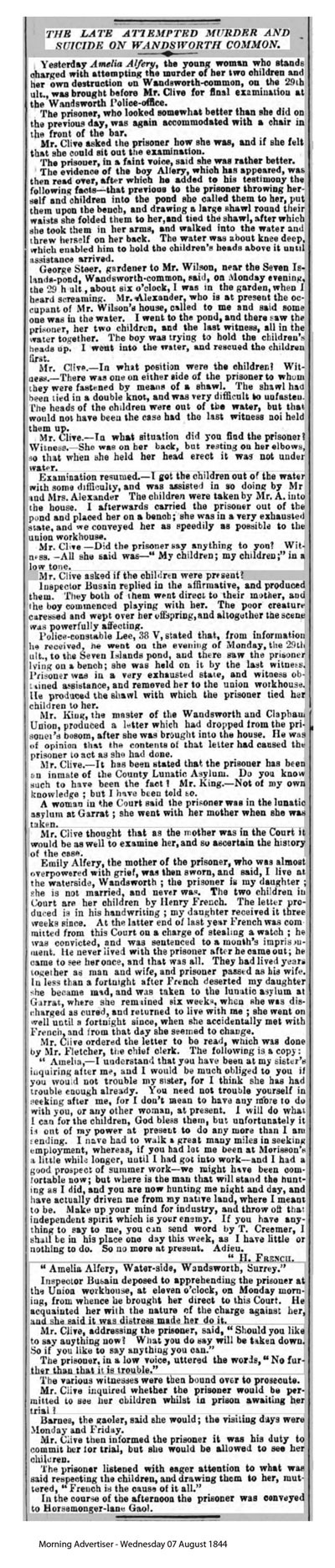
THE LATE ATTEMPTED MURDER AND SUICIDE ON WANDSWORTH COMMON
Yesterday Amelia Alfery, the young woman who stands charged with attempting the murder of her two children and her own destruction on Wandsworth-common, on the ult., was brought before Mr. Clive for final examination at the Wandsworth Police-office. The prisoner, who looked somewhat better than she did on the previous day, was again accommodated with a chair in the front of the bar.
Mr. Clive asked the prisoner how she was, and if she felt that she could sit out the examination. The prisoner, in faint voice, said she was rather better. The evidence of the boy Alfery, which has appeared, was then read over, after which he added his testimony the following facts$that previous to the prisoner throwing herself and children into the pond she called them her, put them upon the bench, and drawing large shawl round their waists she folded them to her, and tied the shawl, after which she took them her arms, and walked into the water and threw herself on her back. The water was about knee deep, which enabled him to hold the children's heads above it until assistance arrived.
George Steer, gardener to Mr. Wilson, near the Seven Islands-pond, Wandsworth-common, said, on Monday evening, the h ult, about six o'clock, I was in the garden, when I heard screaming.
Mr. Alexander, who is at present the occupant of Mr. Wilson's house, called to me and said some one was in the water. I went to the pond, and there saw the prisoner, her two children, and the last witness, all in the water together. The boy was trying to hold the children's heads up. I went into the water, and rescued the children first.
Mr. Clive.$ln what position were the children? WitQe gjj.$There was one either side of the prisoner to whom they were fastened means of a shawl. The shawl had been tied in double knot, and was very difficult to uufasteu. The heads of the children were out of the water, but that would not have been the case had the last witness noi held them up.
Mr. Clive. $In what situation did you find the prisoner? Witness.$She was on her back, but resting ou her elbows, that wheu she held her head erect it was not under water. Examination resumed.$l got the children out of the water with some difficulty, and was assisted in so doing by Mr and Mrs. Alexander The children were taken by Mr. A. into the house. I afterwards carried the prisoner out of the pond and placed her on bench; she was in a very exhausted state, and we conveyed her as speedily as possible to the union workhouse.
Mr. Clive: "Did the prisoner say anything to yon? Witness. — All she said was$" My children; my children;" in a low tone.
Mr. Clive asked if the children were present? Inspector Husain replied in the affirmative, and produced them. They both of them went direct to their mother, and ihe boy commenced playing with her. The poor creature caressed and wept over her offspring, and altogether the scene was powerfully affecting. Police-constable Lee, 38 V, stated that, from information he received, went on the evening of Monday, the 29th alt., to the Seven Islands pond, and there saw the prisoner Iving on bench; she was held ou it by the last witness. Prisoner was in very exhausted stale, and witness obtained assistance, and removed her the union workhouse. produced the shawl with which the prisoner tied her children to her.
Mr. King, the master of the Wandsworth and Claphaui Union, produced letter which had dropped from the prisonei's bosom, after she was brought into the house. was of opinion that the contents of that letter had caused the prisoner to act she had done.
Mr. Clive. It has been stated that the prisoner has been inmate of the County Lunatic Asylum. Do you know such to have been the fact iI Mr. King.$Not of own knowledge; but I have been told so. A woman the Court said the prisoner was in the lunatic asylum Garrat; she went with her mother when she was taken.
Mr. Clive thought that as the mother was in the Court it would be as well to examine her, and so ascertain the history of the case. Emily Alfery, the mother of the prisoner, who was almost overpowered with grief, was then sworn, and said, I live at the waterside, Wandsworth; the prisoner is my daughter; she is not married, and never was. The two children in Court are her children by Henry French. The letter produced is in his handwriting; daughter received it three weeks since. At the latter end of last year French was com raiited from this Court a charge of stealing watch; he was convicted, and was sentenced to a month's imprismment. He never lived with the prisoner after he came out; he came to see her once, and that was all. They had lived years together as man and wife, and prisoner passed as his wife. In less than a fortnight after French deserted my daughter she became mad, and was taken to the lunatic asylum Garrat, where she remained six weeks, when she was discharged as cured, and returned to live with me; she went on well until a fortnight since, when she accidentally met with French, and from that day she seemed to change.
Mr. Clive ordered the letter to be read, which was done Mr. Fletcher, the chief clerk. The following is copy:
"Amelia, I understand that you have been at my sister's inquiring after me, and I would be much obliged to you if you would not trouble my sister, for I think she has had trouble enough already. You need not trouble yourself in seeking after me, for I don't mean have any more to with you, or any other woman, at present. will what iI can for the children, God bless them, but unfortunately it is out of ray power at present to any more than I am sending. iI nave had to walk a great many miles in seeking employment, whereas, if you had lot me been Morisson's a little while longer, until I had got into work$and iI had a good prospect of summer work$we might have been comfortable now; but where is the man that will stand the hunting as I did, and you are now hunting me night and day, and have actually driven me from native land, where I meant to be. Make up your mind for industry, and throw oft that independent spirit which is your enemy. If you have anything to say to me, you can send word by T. Creemer, I shall be in his place one day this week, as I have little or uothiog to do. So more at present. Adieu. H. French. Amelia Alfery, Water-side, Wandsworth, Surrey."
Inspector Husain deposed to apprehending the prisoner at the Union workhouse, eleven o'clock, Monday morning, from whence he brought her direct to this Court. He acquainted her with the nature cf the charge against her, and she said it was distress made her do it.
Mr. Clive, addressing the prisoner, said, Should you like to say auything now? What you do say will be taken down. So if you like to say anything you can." The prisoner, in a low voice, uttered the words, No further than that it is trouble." The various witnesses were then bound over to prosecute.
Mr. Clive inquired whether the prisoner would be permitted to see her children whilst in prison awaiting her trial ? Barnes, the gaoler, said she would; the visiting days were Monday and Friday.
Mr. Clive then informed the prisoner it was his duty to commit her for trial, but she would be allowed to see her children. The prisoner listened with eager attention to what was said respecting the children, and drawing them her, muttered, French is the cause it all." In the course of the afternoon the prisoner was conveyed to Horsemonger-lane Gaol.
[Source: BNA: Link.]
[Date?]
Proceedings of the Old Bailey — London's Central Criminal Court, 1674-1913
[Old Bailey: Link.]
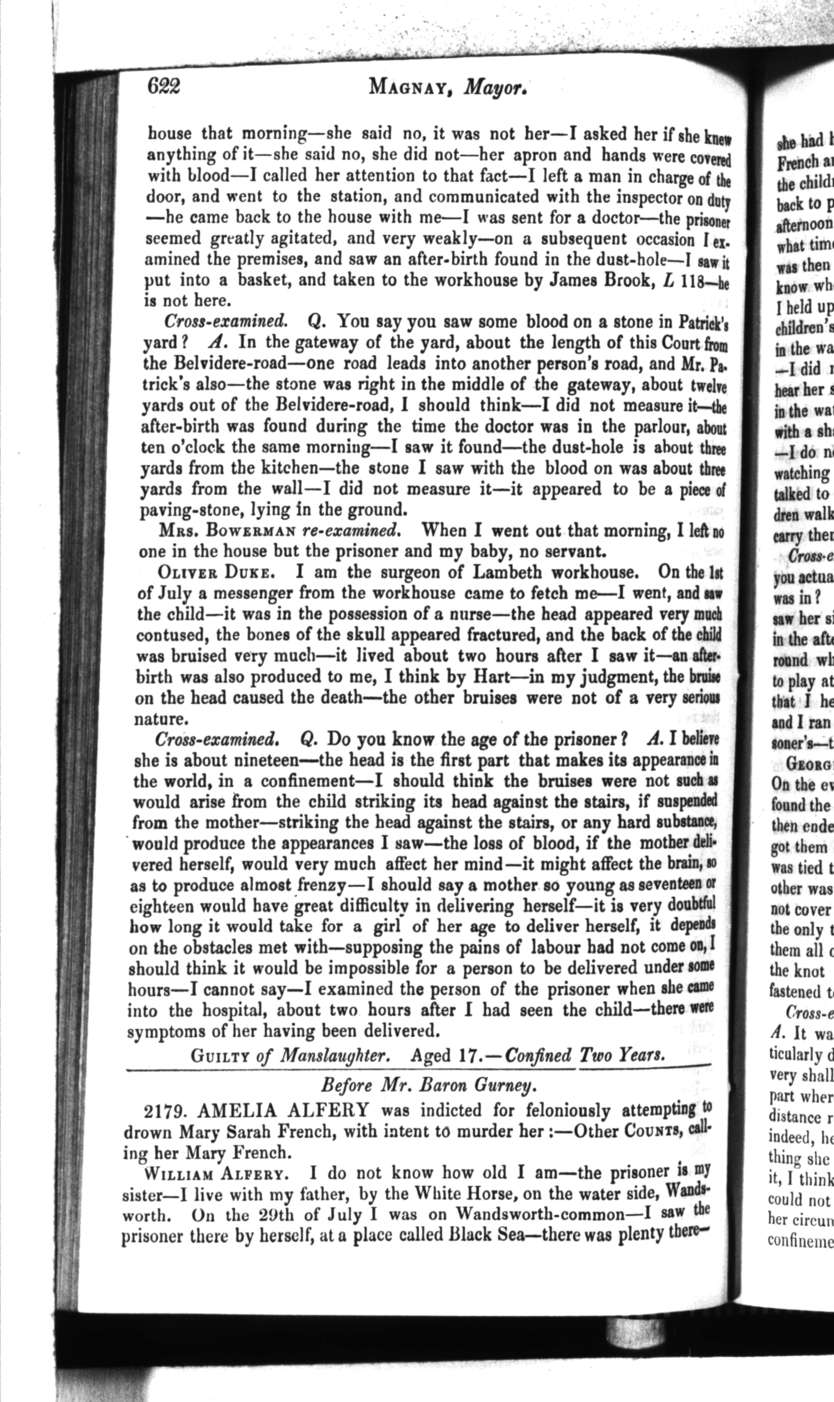
(Click on image to enlarge)
'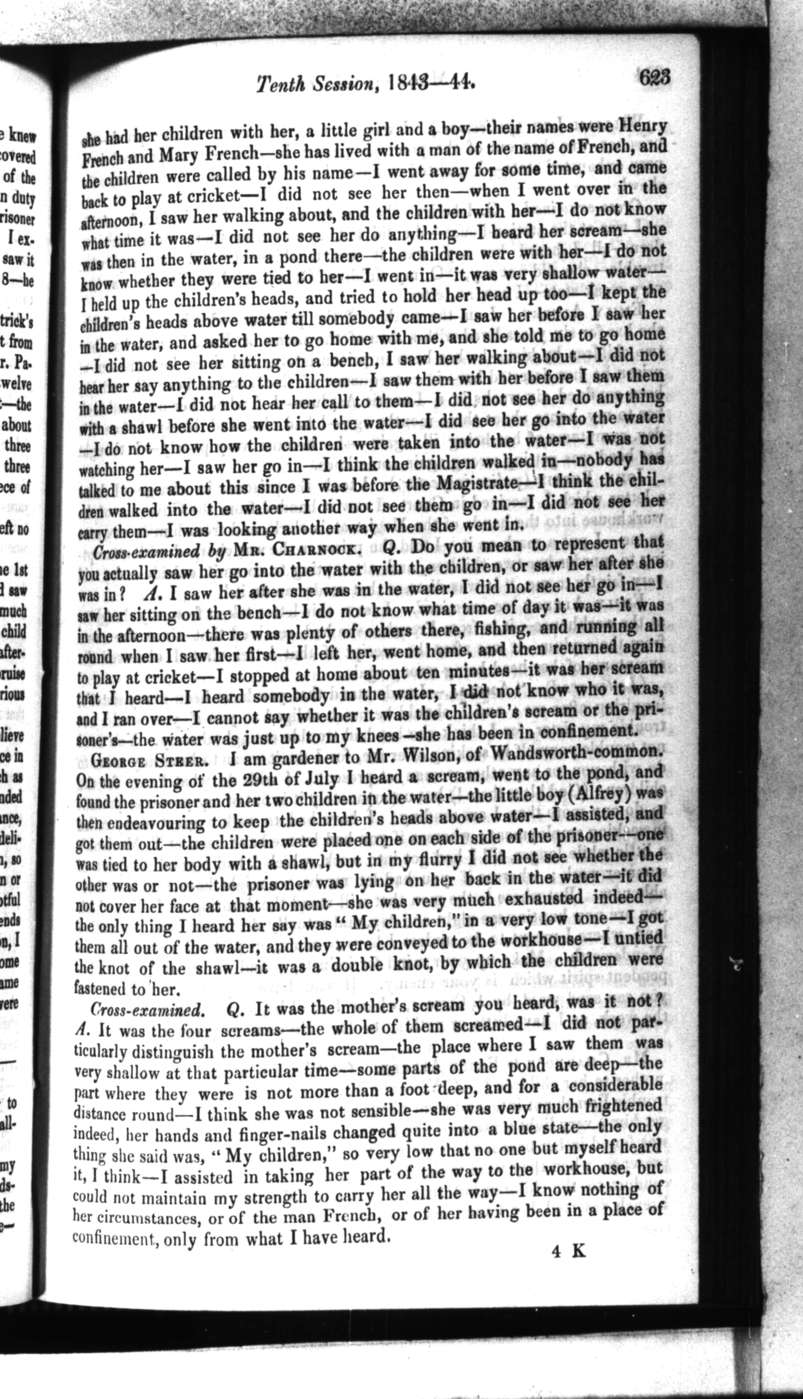
(Click on image to enlarge)
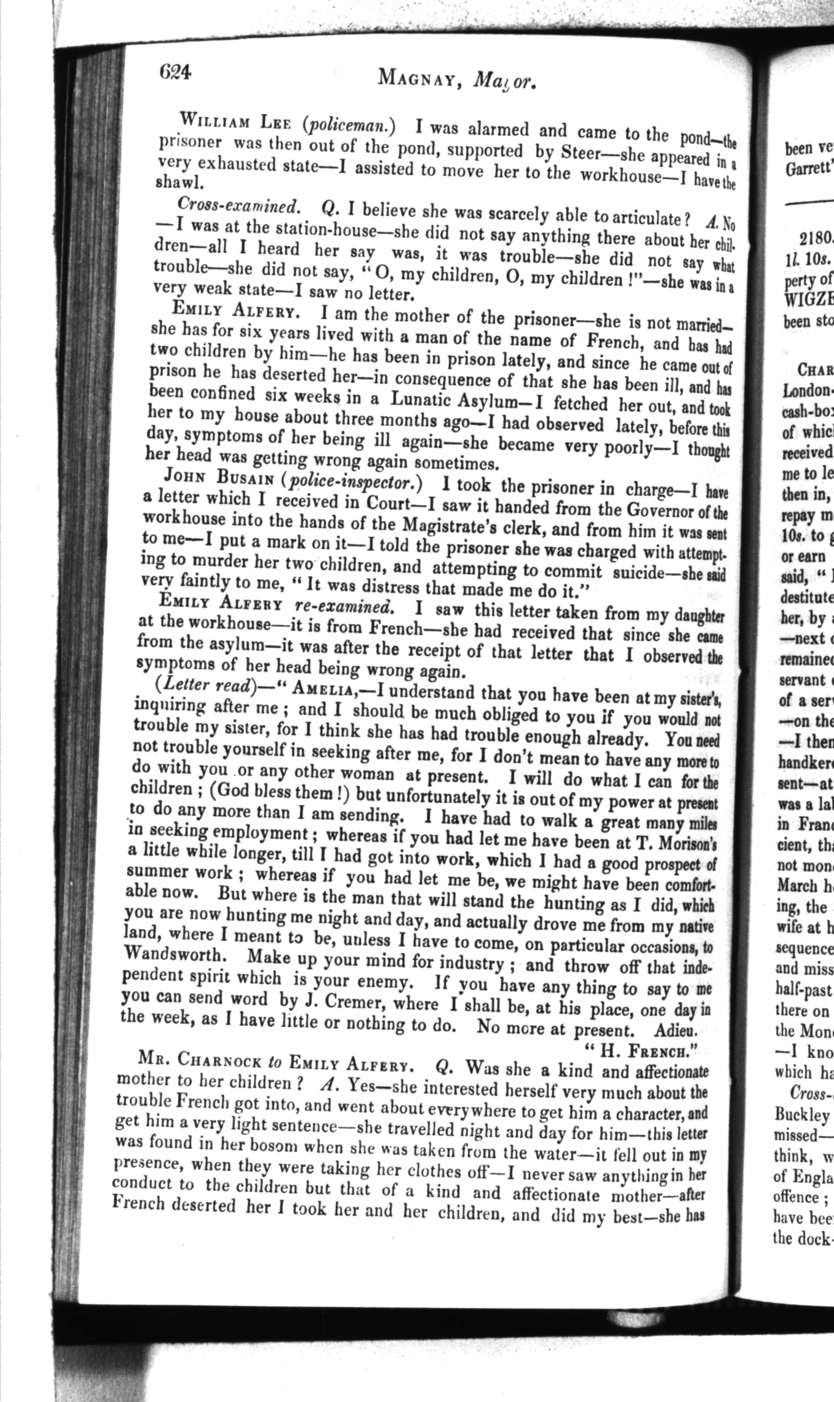
(Click on image to enlarge)
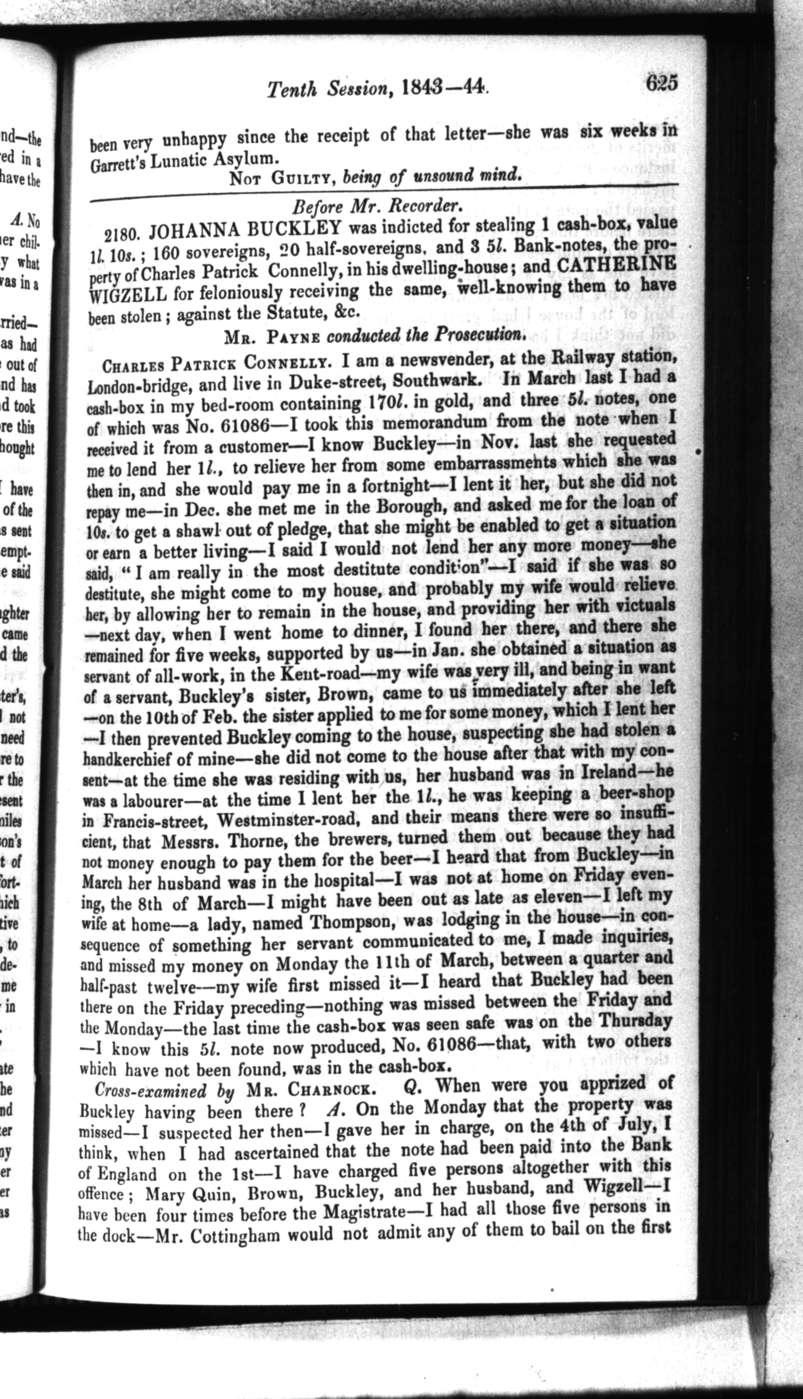
(Click on image to enlarge)
London Evening Standard — Saturday 24 August 1844
Amelia Alfrey, 26, was indicted for feloniously assaulting Mary Anne French, and casting her into the water with intent to drown and murder her.
Mr. Charnock defended the prisoner. William Alfrey, a little boy, deposed that the prisoner was his sister, and he lived with her by the water side at Wandsworth. On the 29th July he was on Wandsworth Common, and saw the prisoner there, accompanied by her two children, a little girl and boy. Their names were Henry French and Mary Anne French.
The prisoner lived with a man named French, and the children went by his name. Shortly afterwards he heard the prisoner scream, and on going to her he found her in a pond with her children. It was very shallow water, ancl he ran in and held up the children's heads, and also tried to hold up the prisoner's head. A little time before this occurred he had seen the prisoner walking about, and she told him to go home. He did not see the prisoner carry the children into the water, but he thought they walked in.
Cross-examined. — There were plenty of people about at the time. The prisoner was in the water. The water was not deeper than just above the knee. George Steer deposed that on the evening in question he heard a scream, and went to the pond, and found the prisoner and her two children in the water. Witness assisted to get them out, and ascertained that one of the children was tied to the prisoner's body with a shawl, but he could not state whether the other was attached to her. The prisoner was lying npon her back in the water, and appeared in an exhausted state, and all she said was "My children, my children!" in a low tone. The prisoner and her children were then taken to the workhouse.
By Mr. Charnock. — In witness's opinion the mother and her two children all screamed together. The pond was not at this time very deep. The prisoner appeared very much exhausted, and her hands had changed colour. Witness had heard that the prisoner was once confined in a lunatic asylum. William Lee, a police-constable, said that he found the prisoner in the state described by the last witness, and assisted to convey her to the workhouse. He produced the shawl taken from the prisoner.
By Mr. Charnock. — He heard the prisoner say it was trouble that had made her do it. Emily Alfrcy, the prisoner's mother, deposed she was not married to the father of the children in question, but they had cohabited together for six years. He had latterly deserted her, and she had in consequence become very ill, and was confined in a lunatic asylum for six weeks; and when she was discharged she went to live at witness's house. Before the lst of July witness had observed symptoms in the prisoner's conduct of her mind becoming bad again.
John Busain, an inspector of police, proved that he received the prisoner in charge, and told her that she was accused of attempting to murder her children, and to commit suicide; and she replied in a taint tone, " It is distress that drove me to do it." The witness then produced a letter found upon the prisoner when she was taken to the workhouse.
The mother was recalled, and she stated that the letter in question was written by the man French, and in it he expressed his intention to abandon her. (The letter was read.) The witness said that after the prisoner received this letter she observed the symptoms in the prisoner's conduct that she referred to. In cross-examination, the mother said that French had been charged with some offence, and the prisoner had exerted herself very much to obtain a lenient sentence for him. She appeared very fond of her children.
Mr. Charnock, in his address to the jury, said it was impossible for an advocate to have to do so upon a more distressing case than the present. He then proceeded to comment upon the facts, and said it was evident that the cruel manner in which the unhappy prisoner had been deserted and abandoned by the man for whom she evidently felt an ardent affection had unsettled her mind, and that, in a paroxysm of frenzy, she committed the act imputed to her.
Mr. Baron Gurney, in summing up, remarked upon the distressing nature of the case, and said there did net appear to be the slightest ground for believing that the prisoner entertained any malice towards her children; but if the jury thought that she went into the water with the intention of destroying them and herself, she would in law be guilty of the offence imputed to her. If they thought the tacts proved it would then be a question whether at the time the act was committed the prisoner was in such a state of mind as to be accountable for her actions.
The jury, after a very short deliberation, Acquitted the prisoner on the ground of insanity, and she was ordered to be detained during her Majesty's pleasure. The first witness, the prisoner's brother, was then recalled by Mr. Baron Gurney, who told him that the courage he had shown and the manner in which he acted at the time did him great credit, but he regretted to see by the depositions that he had not to-day stated all he knew.
[BNA: Link.]
THE GLOBE, SATURDAY, AUGUST 24, 1844
[Source: Link.]
Morning Post, 24 August 1844
[Source: Link.]
Sun, 24 August 1844
[BNA: Link]
[BNA: Link]
Also:
[BNA: Link]
[BNA: Link]
[BNA: Link]
Bell's New Weekly Messenger
[BNA: Link]
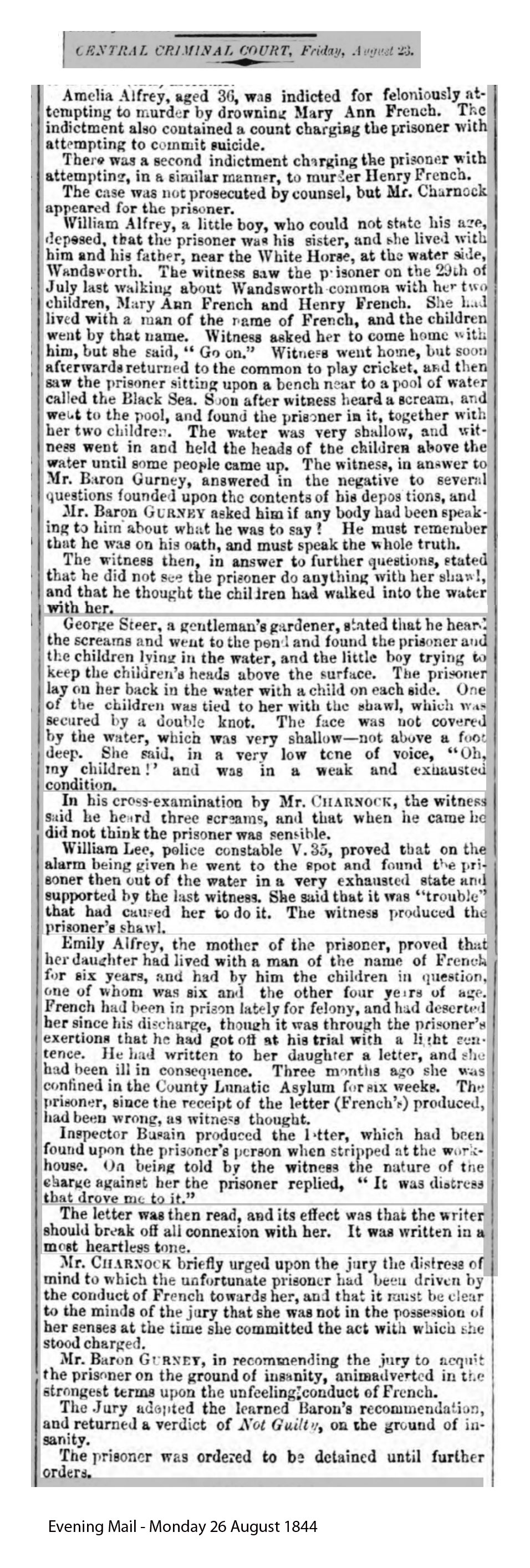
Evening Mail, Monday 26 August 1844
(Click on image to enlarge)
''Amelia Alfrey, aged 36, was indicted for feloniously attempting murder drowning Mary Ann French. The indictment also contained a count charging the prisoner with attempting to commit suicide. There was a second indictment charging the prisoner with attempting, in similar manner, to murder Henry French. The case was not prosecuted counsel, but Mr. Churnock appeared for the prisoner.
William Alfrey, a little boy, who could not state his age, deposed that the prisoner was his sister, and she lived with him and his father, near the White Horse, at the water side, Wandsworth. The witness saw the prisoner on the 29th of July last walking about Wandsworth common with her two children, Mary Ann French and Henry French. She had lived with a man of the name of French, and the children went by that name. Witness asked her to come home with him, but she said, on." Witness went home, but soon afterwards returned to the common to play cricket, and then saw the prisoner sitting upon a bench near to a pool of water called the Black Sea. jon after witness heard a scream, and weofc to the pool, and found the prisoner in it, together with her two children. The water was very shallow, and witness went in and held the heads of the children above the water until some people came up.
The witness, in answer to Mr. Baron Gurney, answered in the negative to several questions founded upon the contents of his depos tions, and Mr. Baron Gurney asked him if any body had been speaking him about what he was to say ? He must remember that he was on his oath, and must speak the whole truth. The witness then, in answer to further questions, stated that he did not see the prisoner do anything with her shawl, and that he thought the chillren had walked into the water with her.
George Steer, a gentleman's gardener, stated that he heard the screams and went to the pend and found the prisoner and the children lying in the water, and the little boy trying keep the children's heads above the surface. The prisoner lay her back in the water with child on each side. One of the children was tied to her with the shawl, which was secured double knot. The face was not covered by the water, which was very shallow$not above foot deep. She said, in very low tene of voice, "Oh, my children! 'and was in weak and exhausted condition.
In his cross-examination Mr. Charnock, the witness said he ard three screams, and that when he came he did not think the prisoner was sensible. William Lee, police constable V.35, proved that on the alarm being given he went to the spot and found v 'e prisoner then out of the water in a very exhausted state ami supported the last witness. She said that it was "trouble" that had caused her to do it. The witness produced the prisoner's shawl.
Emily Alfrey, the mother of the prisoner, proved her daughter had lived with a man of the name of French for six years, and had by him the children in question, one of whom was six and the other four yeira of French had been in prison lately for felony, and had deserted her since his discharge, though it was through the prisoner's exertions that he had got oil his trial with a li.tht sentence. had written to her daughter letter, and she had been ill in consequence.
Three months ago she was confined in the County Lunatic Asylum for six weeks. The prisoner, since the receipt of the letter (French's) produced, had been wrong, as witness thought. Inspector Busain produced the Idler, which had been found upon the prisoner's person when stripped at the workhouse. being told by the witness the nature of the charge against her the prisoner replied, It was distress that drove me to it." The letter was then read, and its effect was that the writer should break off all connexion with her. It was written in most heartless tone.
Mr. Charnock briefly urged upon the jury the distress of mind to which the unfortunate prisoner had been driven the conduct of French towards her, and that it must be clear to the minds of the jury that she was not in the possession of her senses at the time she committed the act with which she stood charged.
Mr. Baron Gurnet, in recommending the jury to acquit the prisoner on the ground of insanity, animadverted in the strongest terms upon the unfeelingiconduct of French. The Jury adopted the learned Baron's recommendation, and returned a verdict of jVot Guilty, on the ground of insanity. The prisoner was ordered to be detained until further orders.
https://www.britishnewspaperarchive.co.uk/viewer/bl/0001316/18440826/017/0003
In 1851 an Emily "Alfred", Charwoman aged 60 [i.e. born c.179], was living with her daughter Amelia "Alfred", 28 [i.e. born c.1823], charwoman, in Sp[encer's Cpurt Wandworth St Ann's. Neither birthplace known.
NB some newspaper reports named her "Alfred".
https://www.ancestry.co.uk/interactive/8860/SRYHO107_1578_1578-0023?pid=964303&backurl=https://search.ancestry.co.uk/cgi-bin/sse.dll?indiv%3D1%26dbid%3D8860%26h%3D964303%26tid%3D%26pid%3D%26usePUB%3Dtrue%26_phsrc%3DPMG989%26_phstart%3DsuccessSource&treeid=&personid=&hintid=&usePUB=true&_phsrc=PMG989&_phstart=successSource&usePUBJs=true&_ga=2.240284931.1653635360.1575143184-285859747.1504633615&_gac=1.187336538.1574961231.CjwKCAiA_f3uBRAmEiwAzPuaM78dyRhOkj8coPJjtanmiz-XTN7qIeSbprK5RfrWHiC3UMyIfVgbTRoCm7kQAvD_BwE
1841 Census: Richard, Emily and their son William Alfred were living on "Thames bank". AA's brother was "Richard" and Thames bank fits the location but at 10 in 1841 whe would appear to be too old. Notice, incidentally, how many "Fishermen" there are nearby on the census pages.
[Ancestry: Link.]
Amelia Alfrey died Wandsworth aged 44 in 1865 (i.e. born c.1821 — too young to be our AA, but possibly a relation?
[Ancestry: Link.]
Amelia Alfrey, born c.1865, daughter of Richard Alfery, born Wandsworth c.1831. A relation?
[Ancestry: Link.]
Morning Advertiser — Wednesday 7 August 1844

(Click on image to enlarge)
THE LATE ATTEMPTED MURDER AND SUICIDE ON WANDSWORTH COMMON.
(Click on image to enlarge)
''[BNA: Link.]
Morning Chronicle, 31 July 1844:
[BNA: Link.]
Morning Post, 31 July 1844:
[BNA: Link.]
London Evening Standard, 31 July 1844
[BNA: Link.]
Evening Mail, 31 July 1844
[BNA: Link.]
Sun (London), 31 July 1844
[BNA: Link.]
etc etc
London Evening Standard — Tuesday 6 August 1844
[BNA: Link.]
etc etc
Illustrated London News, 10 August 1844
[BNA: Link.]
etc etc
Notes & queries
- Mr Wilson's house is not named, and the pond is called the "Seven Islands Pond". For a while I wondered whether the name "The Black Sea" was only adopted after the Crimean War (a more obvious choice after the RVPA was built a short way away on the other side of the railway line). However, the answer is yes, since it is called the Black Sea in Saunders's News-Letter, below.
- Horsemonger-lane Gaol, on Borough High Street, would have been a grim place to send Amelia to. See Link. Once Surrey's largest prison and its principal place of execution, it was built 1791-1799, and demolished 1878. In 1849, Dickens protested against public hangings here. The site is now a public park, Newington Gardens.
- Punch: The Great Moral Lesson at Horsemonger Lane Gaol, Nov. 13 1849 (poem partly written in London vernacular).
Saunders's News-Letter [Ireland] — Friday 2 August 1844
ATTEMPTED MURDER AND SUICIDE. Note she is called Amelia

(Click on image to enlarge)
'ATTEMPTED MURDER AND SUICIDE
On Monday evening a woman living at Wandsworth attempted the murder of her two children and her own destruction.
The circumstances connected with this dreadful affray are these:
On Monday evening, about five o'clock. a woman twenty-six years of age, named Amelia Alfred, left $nr bums waterside, Wandsworth, with her two children, a girl and boy, aged respectively ais and four yaara, and proceeded to Wandsworth Common. Sbe about for nearly an bow. and then approached a terga and pond called the Black Sea Jr would appear that while steading oo the margin the pond, she bar two children to bar waist, and then precipitated Into water; the bank was shelving, nod the water was rather shallow that point; bat so determined Was wretched woman upon making sway with haraelf nod bee offspring, that she afterwards threw herself her back, an that water covered both the children and hernaif. this period William Alfred. the brother of the woman, lad not more than years of ago, ran np to the spot, jumped Into the water, triad to reams tea that could not release them, bald their beads above water and halloaad for aaciatannr.
Mr. and bit lady worn walking their lawn, adjoining the poad, and bearing tha laysa ncraoma. Mr. Alexander instantly anrmlafd that some ana the water, and taking big gardaoder with him gnn to pond. lad waa still keeping Iha childrewss head above water, appsased ready drop aghanetlon. gardener Jumped Into the water and with his knife tbs and released ablldren. Police Constable Lee. 38 V. who was on duty the common, assisted getting the woman ont of the pond, having previously sent to the Uoioa to request tea master and matron to bare a warm bath and o'her appliances In raad ineaa thechildren, who. through the nondnet the lad Alfred, ware not seriously injured, were kindly taken charge of Mrs. Alexander, and onvsyed that lady to bee rsaidence.
The woman Alfred when token nut the water was to all appearance dead. She wns coavaysd quickly as possible, however, the Wands worlb Union, where Mr. King, the mister, and wife, matron, ware prepared to receive bar. The means $aed restoring parsons from drowning were and before tea arrival of the medical oflfoer. Doctor Coo$ar, aba atbibilrd symptoms of reviving animation. Every attention has been since paid to too wretched woman, bat ia MHI an estrcmely precarious cocditioa. There la little doubt that lb# woman Is Insane, and that Invanity baa been brought on usage and distress. baa lived for years Wnadsawth, her native place, with Henry French, Journeyman carpenter and cobinet maker, whom tea had her children. This toan. November leer, was cs atg#d at Wandsworth JMlna Court with stealing silver watch, which bod! _ accident been left io drawer of a chlfl$alrr hr; Mdto end was committed trial. the wotnan, i "fTfs, b s$ $uppoMd to bla wife, never pvrsoos speak for him on I dny trial. The proserusri$ evco recommended prlS?s js s, rr J.$s vccoaat, and had $Mffbt aantaacajtaased upon him. At the eipiratkio bialmprlaomeot French returned to the woman Alfred, waa Using with ber mother, washerwoman, Waterside, Wandsworth, bat he had sooner recruited 'bla Wrvngtk than deserted her and bla children. This w$$ ant without its effect. poorevaagpra becaei. n.aJ, was passed magistrate the Lunatic Asylum at Garrett, where she remained a short time, and was discharged as cured. From that time up to Monday she lived at home with her mother, and it was generally noticed that she appeared very much dejected.
Whilst the woman was being stripped at the Union, a letter from her bosom. It was a wretched scrawl from her paramour, French, and the substance was that he never intended to live with her or any woman again, and she must work and do her best for herself and children, as she could expect nothing from him.
Yesterday the superintendent of the V division made Mr. Clive, the sitting magistrate at Wandsworth Police Court, acquainted with the particulars, and it is understood that so soon as the woman is capable of removal she will be brought to this court to undergo examination upon a charge of attempting to murder her children.
[Source: BNA Link.]
Bell's Weekly Messenger — Saturday 3 August 1844
ATTEMPTED MURDER AND SUICIDE

(Click on image to enlarge)
[NEEDS COMPLETION & EDIT]
ATTEMPTED MURDER AND SUICIDE
On Monday evening great excitement prevailed in the parishes of Wandsworth and Battersea, in consquence of the woman having attempted the murder of her two children, and her own destruction.
The circumstances connected with this dreadful affair are these:
On On Monday evening about five o'clock, a woman named named Amelia Alfred, left ater side, Wandsworth, with her two children, a girl and boy, aged respectively six and four years...
Vrel Wandsworth-common. She nearly an hour, and then approached hed the Black Sea." Here she her waist, ami precipitated herself Hisllott was and the water was uimn . iI determined was the wretched die away with herself and her offspring, both, er back, that the water children and herself. At this critical the brother of the unfortunate water, and tried to rescue not release them, heldw halloed for assistance.
Mr. ere walking in their lawn, which hearing the boy's screams Mr. . . one was in the water, and the pond. Tte lad heads above water, but into, haiiBtion. The gardener nd released the children, and con the common, assisted in The children, whe mjured, were charge Mrs. when taken out of the She was conveyed to the the master and the matron from droumf means used in restoring $riical otfio re "dopted, and before the arrival the poor creature animation. that the woman insane, and that M for 'h-usage and distress. i 'mienn$i. her native place, cabinet-maker in November wort Police-court with chiffo accident, been left Alfri? t, ir and ttas committed was then supposed fellow, for to speak for him on the Ten recommended him to he, consequently, had but expiration of his her; she was then but at the waterhis, her and her children...
[BNA Link.]
Sun (London) — Saturday 27 April 1844
[I INCLUDE THIS ITEM, ALTHOUGH NOT DIRECTLY WC-RELATED, TO SHOW SOMETHING OF CONTEMPORARY ATTITUDES ALSO REFLECTED IN THE AMELIA ALFERY/ALFRED STORY BELOW]>

(Click on image to enlarge)
''We quote the following paragraph from the Times of this morning:
Mr. Sheriff MUSGROVE attended at Newgate yesterday to perform the painful duty of fixing a day for the execution of MARY FURLEY, under sentence of death for the murder of her infant child, and he has appointed Monday, the 6th of May, at eight o'clock A.M. He afterwards visited the unhappy woman, in company with the Rev. JOHN DAVIS, Ordinary, and Mr. COPE, the Governor. The prisoner received the announcement in the greatest agony of mind, and in a few minutes became almost insensible from grief. She has conducted herself with great propriety in the prison, and exhibits every sign of real penitence."
Our first impression on reading the above announcement was that of astonishment, our second, that of unmitigated disgust. We could scarcely believe it possible that, in the nineteenth ceatury, which prides itself, and not unjustly, on its humane endeavours to diminish the severity of our criminal code, and to do away with capital punishment, except in aggravated cases of atrocity, a pooT wretch$and she a woman, too!$could be forcibly hurried out of existence on a public scaffold, for no more deadly crime against society than that of having attempted to commit suicide with her infant in her arms, under the pressure of intolerable agony and destitution, which had driven her to the very verge of insanity.
GOD forbid that we should seek to extenuate the crime of murder; it is one of the blackest in the long calendar .of guilt; but here there was no . cool, wanton, deliberate attempt at murder, prompted by a heartless and malignant nature; the act sprung out of the very intensity of maternal affection; the poor creature, MARY FURLEY, had just lost her sole remaining chance of providing a day's meal for herself and starving child; after having, with incredible difficulty, scraped together a few paltry shillings by making shirts at three halfpence each, and small dress caps, she was robbed of every farthing she possessed; and, under the overwhelming agony of mind produced by the sudden discovery of this loss; feeling that nothing was left her but death by a lingering process of starvation, or a resort to a union workhouse, of which she had already had a most painful and humiliating experience the wretched mother, we say, under the overwhelming influence of one of those paroxysms of lsewilderment which are so apt to beset people in her situation, when the mind has wholly lost its balance, and madness flashes across the brain, resolved at once to put an end to her griefs by suicide, and involve her child in the same fate, knowing well what would be its condition, should it be left on earth, when the only friend and protector it had was gone.
It was not a callous nature, but an exquisitely sensitive one, that was exhibited in this phrenzied determination$it was not that the feelings of the mother lay dormant, but that they were too painfully awakened, in the heart of MARY FURLEY; had she been a merely selfish parent she would have acted otherwise, and hurried herself only out of life, while she left her child behind, to take its chance in the great struggle of existence.
At the trial which took place before Mr. Justice MAULE, there was no positive proof that she had flung herself and infant into the water; she herself observed in her defence, " I fell off the plank into the wharf;" and the only evidence that vas adduced in contradiction of this assertion, was a remark which she had been heard to make a few days hefore, _ to the effect that she and her. child would tcneet a watery grave. If ever there was a case that demanded the lenient consideration of the authorities, this is that one. Legally speaking, the sentence passed on her may have been a just one; but, morally speaking, it is a tnost merciless and unrighteous one; and pity, benevolence humanity$equity$every feeling, in short, of our common nature, alike shrinks with horror from the idea of its being carried into execution.
Are there no degrees in such criminality as that of which MARY FURLEY has been found — guilty ? Is the starved, hopeless, heart-broken, half frenzied mother, who, if she really did endeavour to dtrodid so out of the agony i of her mater na l l ov e, very yy ex c es s her owna: and offspring, to. meet with the same punishment as that awarded to such heartless, deliberate murderers as GREENACRE and COURVOISIER, who set about their work with, the cool, pitiless malignity of fiends ? Even now, though the day of execution is fixed, we can scarcely believe that the sentence will be carried into execution; for though in the eye of the law, the sacrifice of MARY FURLEY may be just and orthodox, in the eye of humanity it cannot fail to be looked on its a murder.
[BNA: Link]
For more info see
[Old Bailey: Link.]
[Victorian Calendar: "To the relief of almost everyone, 40-year old Mary Furley will not hang. The miserable woman had tried to drown herself and her child in Regent's Canal. A passing boatman - hearing a woman's moans - rescued Mary but the little boy was never seen again. At her trial, Mary Furley's story became clear. Abandoned by her husband, she had been sent to the Bethnal Green workhouse. While there, her child had gotten lice in his hair, A drunken barber employed to shave the lad cut him badly. Mary fled the workhouse and sought work as a needlewoman. Her first meager earnings had been promptly stolen. Faced with a return to the workhouse, she said "I preferred death for myself and my child."
Her pathetic tale notwithstanding, Mary Furley was sentenced to die for infanticide. Sent to hang at Newgate, she was advised to "turn your mind to your spiritual affairs." The Times was merely the most prominent voice urging mercy: "No, the rich, the respectable, the comfortable members of society cannot imagine, cannot picture to themselves, a condition so deplorably miserable as to prompt a woman to infanticide. Let them be thankful that they cannot; but let them show their humility and their gratitude by judging lightly of a fellow creature.'
On 26 April, Mary was informed that all pleas for mercy had been considered and rejected; her execution would take place on 8 May. She collapsed in her cell, "insensible with grief." The very next day, however, she was told Her Majesty "had been pleased" to respite her sentence.
Punch called it "capriciously wicked" and attacked the Government: "In the name of outraged humanity, in the name of a most miserable woman, scourged to agony and madness by the cruelty of unmerited ill-fortune, we ask [the Home Secretary] wherefore this atrocity was committed? Did he not know the wretchedness, more complete in its horror than any labored tale of fiction, that step by step had scourged the woman from the workhouse to the river's brink?"
Mary Furley was ordered [to be?] transported to Australia for a period of seven years. The Examiner asks: "If such be the Royal clemency, what is the rigor?" " Link.]
Follow up...
SEARCH : "Mary Furley transported to australia 1844"
https://www.google.com/search?client=opera&q=Mary+Furley+transported+to+australia+1844&sourceid=opera&ie=UTF-8&oe=UTF-8
Old Bailey: https://www.oldbaileyonline.org/record/t18440408-1279
From
Carolyn A. Conley, Debauched, Desperate, Deranged: Women Who Killed, London 1674-1913
ents
ExpandFront Matter
Introduction
1 1674–1753: Strumpets and Wenches
2 1754–1833: Passion and the Frailty of Human Nature
Collapse3 1834–1873: Becoming Women and Ogresses
Neonaticide
Unwed Mothers
Child Neglect
Child Abuse
Maternal Insanity
Other People’s Children
Husbands and Lovers
Murderesses
Conclusion
4 1874–1913: Incapable of Forming a Sound Judgement
Conclusion
ExpandEnd Matter
Ch.3 1834–1873: Becoming Women and Ogresses Get access Arrow
Abstract
In the Victorian period, the urge to match women accused of homicide to stereotypes grew stronger. This was a challenge, since at the same time the number of women tried for killing their own children was skyrocketing. Motherhood was the essential aspect of womanhood, yet the expectations seemed to be driving women to madness. The New Poor Law meant that deaths of children from neglect were being punished more severely while the injustice of the bastardy clause led to greater sympathy for unwed mothers who appeared in court. There was a huge increase in insanity verdicts. Women who killed someone other than their own child were often viewed through a prism created by fictional models as the press attempted to force the woman into an existing model.
https://academic.oup.com/book/32006/chapter-abstract/267777971?redirectedFrom=fulltext
Chapter Seven: Suicidal Women: Fact Or Fiction?
Barbara T. Gates, Alumni Distinguished Professor of English, University of Delaware
https://victorianweb.org/books/suicide/07.html
Was Suicide a Female Malady?
[NB LOTS OF GOOD PAINTINGS IN ORIGINAL ARTICLE]
Women were fictionalized and mythologized much as were monsters in Victorian England. They too were made into "others" — weaker vessels or demons, angels in the house or fallen angels (see such fine recent studies as Auerbach, 1982; and Mitchell, 1981) — and suicide was displaced to them much as it was to demonic alter egos. For the most part, fictions about women and suicide became more prevalent and seemed more credible than did facts. The facts themselves were clear: throughout the nineteenth century women consistently had a suicide rate lower than that of men; see especially J. N. Radcliffe, p. 465.
Consistent too were the means of suicide. In most cases, women chose poison or drowning over bloodier deaths by gun or knife, a pattern that continues today. These facts were well-established even before mid-century and were well-confirmed after 1858, when William Farr improved record-keeping for cause of death. Lower incidence among women proved, however, easier to determine than to accept. Despite all evidence to the contrary, most Victorians believed what they wished to believe about the frequency of female suicide.
In the main they did so because they wanted and expected suicide, like madness, to be a "female malady." (See Showalter, 1985.) Since women were statistically over-represented among the mentally ill — primarily because in Victorian England they were more often confined to "homes" for the insane and were more easily countable than were men — they were generally thought to be more vulnerable to madness.
The reasoning for linking women and suicide went something like this: more women are confined for insanity than men and suicide is a result of insanity; therefore more women should commit suicide than men (see Lewes, 52-78). Or else it went like this: woman is a lesser man, a weaker being, both physically and mentally. Resisting suicide takes willpower and courage; therefore women should fall victim to suicidal impulses far more readily than should men. Unless the weaker sex were to be credited with unwanted strength, the fact that women killed themselves less frequently than men required considerable explaining. Such was the price of retaining the displacement of self-destruction to women in a patriarchal society that was dedicated to championing male mental and physical superiority and to rationalizing sexual differences. [125/126]
The Discrepancy between Statistics and Expectations
Throughout the century, men's explanations for the discrepancy between statistics and expectations centered on what was presumed to be the female disposition. In 1857, writing for the Westminster Review, George Henry Lewes attributed the cause for the lower suicide rate among women to women's "greater timidity" and to "their greater power of passive endurance, both of bodily and mental pain" (71). Lewes was echoed in 1880 by a writer for Blackwood's who asserted that women were "habitually better behaved and quieter; they have more obedience, more resignation, and a stronger directing sentiment of duty.... They possess precisely dispositions of temperament and teaching which best withhold from voluntary death" (727).
Female analysts of suicide rates were less likely to make naive pronouncements about female character, but they too felt called upon to explain away the statistics. After observing that "nearly three men commit suicide to one woman," Harriet Martineau concluded that "as there is no such disproportion in the subjects of what we may call natural insanity, we may attribute the majority of male suicides to the habit of men to incur the artificial insanity caused by intemperance" (511). For women's timidity, she simply substituted men's weakness toward another Victorian bête noir, the demon bottle.
At century's end, men like S.A.K. Strahan and Havelock Ellis made less generous conjectures about the female temperament and suicide than had Lewes. Strahan believed that women were weaker contenders in the struggle for existence and therefore less prone to its after-effects — like suicide. For him, their lower suicide rate depended upon woman's "lack of courage and her natural repugnance to personal violence and disfigurement" (179). Female ignobility, not nobility, marked his suppositions. Ellis's similar judgments hinged less on the rate than on the means of suicide. Referring to what he called the "passive" methods of suicide (drowning, for example), Ellis found women temperamentally irresolute in opting for means that required both less preparation and less gore. More violent forms of suicide offended "against women's sense of propriety and their intense horror of making a mess" and reflected their fear of public scrutiny after they were dead. "If it were possible to find an easy method of suicide by which the body could be entirely disposed of," said Ellis, "there would probably be a considerable increase of suicides among women" (335).
Inherent in these observations is an absurd prejudice in favor of bloodier suicides as being braver and therefore more manly. Ellis makes means of suicide so much a point of honor that he begins to glorify self-destruction and loses sight of his real argument about suicide as a "morbid psychic phenomenon." Inherent here too is a more insidious prejudice [126/127] against women and women's bodies, a male supposition that women must wish to dwindle away to nothing. This is a confirmation of the Victorian ideal of the female self that dissolves into others, much as does Dickens's Esther Summerson in Bleak House. Frances Power Cobbe metaphorically described this ideal as exhibited in marriage. It is as though a male tarantula devours a female spider and incorporates the female wholesale into his own being (789). When the female atomizes into the male, there is simply no longer any "other" to contend with. Cobbe's description can also serve to characterize a state of death-in-life, where there is still a remaining female body, but only a living corpse. In this state, the female's logical end becomes suicide. She is like a child or a mistress who exists but must not be seen, and eventually relinquishes her existence as a confirmation of the way in which she is perceived (for a recent examination of such diminishment see Bassein, ch. 1). The Indian institution of suttee, so fascinating to Victorians, well exemplifies this perception of women. The Englishman Ellis certainly posits something similar in his fanciful alternative to accepting the reality of suicide statistics: rates of self-destruction would be much higher for females if women's bodies could disappear along with their sense of self.
The conjectures of Ellis, the famed pioneer sexologist, help confirm the fact that men displace self-loss in sex to women and therefore displace death to them as well. But Ellis did not really deny the statistics; he only wanted them to be otherwise. It took J. W. Horsley, a prison chaplain in the last quarter of the century, to argue resolutely that suicide was predominantly a female crime. Drawing upon his own experience at Clerkenwell Prison dealing with women rescued from suicide attempts and brought to him for "reform," Horsley became convinced that women had a greater propensity to suicide. They were simply less successful in its execution. He contradicted himself, however, when he suggested how easily such intrinsic female suicide might be prevented: "Hysterical girls make demonstrations on the Embankment, and a pail of water over their finery would often be more efficacious a deterrent or cure than the notoriety they gain (or perhaps seek) by apprehension" (256). Horsley's lack of compassion could hardly have been instrumental in "reforming" Clerkenwell's inmates. He himself asserted that hardly five days at the prison went by without sight of a repeated suicide attempt by a woman. With his own callous attitudes, Horsley seemed determined to help substantiate his belief that suicide was beyond a doubt "a specifically female crime" (241).
Male Displacement of Self-Destruction to Women
Ellis and Horsley show the lengths to which intelligent Victorian men could go to continue displacing self-destruction to women. Taken along with theories of passive endurance, their assumptions lead to the [127/128] heart of a puzzling contradiction. Was women's comparative immunity to the suicidal impulse the result of will-lessness or of willpower? Were women really too weak to commit suicide, or were they morally stronger than men and therefore more courageous in resisting it? If they were simply weak, they better fit Victorian expectations of them. As John Stuart Mill pointed out, women were inculcated to believe "that their ideal of character is the very opposite of that of men, not self-will, and government by self-control, but submission and yielding to the control of others" (27). Such people, sentiment ran, would hardly be bent toward self-destruction, for they lacked the fortitude to kill themselves, much as Ellis and Horsley posited. On the other hand, should they run counter to both statistics and expectation, their inherent weakness was at fault. In either of these cases, they proved baser, lesser beings.
But what if they were in fact stronger than men in withstanding suicide? This alternative was by far the more troubling one for Victorians — so troubling that more fallacious reasoning was concocted to explain it away. Argument was diverted from the courage not to die and from the female sense of duty to those "self-willed" women who opted for death. Late in the century, Ellis tried unsuccessfully to prove that the growing number of women whose working lives most resembled men's were more prone to suicide, but he had to admit that women's tendency to suicide versus men's was continually decreasing. Others had been even less generous to women. The famous case of Mary Brough, who slit the throats of her six children and then unsuccessfully tried to kill herself in the same way, raised enormous hostility — more because of Brough's "long-indulged self-will" than because of the child murders. Brough was reported to have been an unfaithful wife who became deranged as a result of her immoral life; her insanity was consequently "self-created" (Winslow, 623). To most Victorians, self-will, Carlyle's first line of defense against suicide, was unnatural in woman — an indication that something was radically wrong. Charles Kingsley, for example, disliked Tennyson's Princess Ida because of her "self-willed and proud longing to unsex herself." She had substituted "her own self-will" for "the womanhood which God [had] given her." As a result she was "all but a vengeful fury, with all of the peculiar faults of a woman and none of the peculiar excellences of man" (250).
Women with willpower struck a different chord with women writers. When Anna Jameson wrote about Cleopatra in her book on Shakespeare's heroines, her imagination thrilled to the "idea of this frail, timid, wayward woman dying with heroism from the mere force of passion and Will" (276). Women also looked askance at the timidity that allowed other women simply to dwindle away to death. In Shirley, , [128/129] Charlotte Brontë's Mary Cave dies by starvation for love and significance rather as the anorectic Nightingale nearly did. Her death may be a suppressed rebellion, but it is clearly cautionary. In this sort of rebellion, the woman dies in order to become noticed or missed. In Shirley, young Caroline Helstone, the love-starved niece, must learn to read Mary Cave's lesson and live. Brontë's own sympathy lay more with Frances Henri in The Professor, who scorned voluntary death in the hope that she would "have the courage to live out every throe of anguish fate assigned me" (226). Later in the century, Victoria Crosse (Vivian Corey) took on Grant Allen's The Woman Who Did (1895) in her The Woman Who Didn't (1895). Allen had described a broken, fallen heroine who initiates suicide by taking prussic acid and then arranges herself on a bed with white roses at her breast. Crosse's heroine, Euridyce, lives on and employs willpower to endure a loveless marriage and defy premature death.
Victorian Images of Women, Female Willfulness, and Suicide
Despite the insights of such women writers, the image of woman as the strong-willed, "vengeful fury" better approaches the dominant Victorian view of female willfulness and suicide because it begins to make myth of willful womanhood (See Auerbach, ch. 1). A decade and a half after Kingsley wrote about Ida, a male writer for the Westminster Review (1865) sketched in the image of the fury. She was the new woman abroad, one who possessed "not only the velvet, but the claws of the tiger." She was "no longer the Angel, but the Devil in the House." With her in mind, this writer reframed an old proverb to read, " man proposes, woman disposes" (Wise, 568) This sentiment was virtually paraphrased by the painter Edward Burne-jones, who said of woman: "Once she gets the upper hand and flaunts, she's the devil — there's no other word for it, she's the devil... as soon as you've taken pity on her she's no longer to be pitied. You're the one to be pitied then (11). And so she-wolves grew in place of pet dogs. Monstrous women represented female energy bristling with will, whereas male monsters like Hyde depicted masculine energy dispossessed of will. Even when they disposed of themselves, such women were insidiously dangerous because they then threatened the very being of males who were their counterparts in willpower. Ever "vengeful," these monstrous women suggested that willpower was a way into, not out of, self-destruction. They began to displace displacement and needed to be mythologized endlessly in efforts to distance them. Fear of Mary Brough's sexuality and of her anger caused her rebirth in the press and in the popular mind as an utterly appalling miscreation. Fear of Bertha Rochester's female loss of control caused the fictional Rochester in Jane Eyre to lock her up like an animal, to dehumanize her into the ultimate monster she became until she set fire to her cage-like [129/130] home, destroying both herself and, for a time, the will of Rochester in the bargain. A broken man, the once potent Rochester could only be restored by the intuition and ministration of Jane.
Cesare Lombroso, Evolutionary Regression, and Suicidal Women
Making monsters of women was not only the pastime of the press or of novelists during the nineteenth century. Criminologists like Cesare Lombroso, an Italian who was widely admired in England, included women in their theories of evolutionary regression or atavism. For Lombroso, criminals became a manifestation of such atavism; they were less evolved beings, closer to other primates than were most people. And because women were already lesser beings than men, female criminals were the most atavistic of all. In The Female Offender (1893), Lombroso discussed woman's hysteria, hand and facial anomalies, lunacy, tattoos, and of course suicides. To his mind, female offenders were appallingly dangerous because in them piety and maternalism were missing. In their place were "strong passions and intensely erotic tendencies, much muscular strength and a superior intelligence for the conception and execution of evil." To Lombroso "it was clear that the innocuous semi-criminal present in the normal woman," had in these women been "transformed into a born criminal more terrible than any man." His "criminal woman is consequently a monster" (150-152). Lombroso also believed that women were less impelled to suicide than were men because they felt pain less. When thwarted in love, however, their monstrously passionate natures leapt to the fore, so that far more than men, women in love turned into self-destructives.
Lombroso reached an English soil well prepared for his coming. Nevertheless liberals like Mill and feminists like Cobbe had earlier raised voices of protest against such dehumanizing of women. In On the Subjection of Women (1869), Mill questioned the right of men "to worship their own will as such a grand thing that it is actually the law for another rational being" (77). Absolute domestic tyrants were for him "absolute monsters"; lesser tyrants, more the rule in Victorian England, were "savages," "little higher than brutes" (64-65). Mill thus found more primitiveness in men than in women. So did Cobbe, who also thought that to treat woman, who "has affections, a moral nature, a religious sentiment, an immortal soul...as a mere animal link in the chain of life" was itself "monstrous" (Cobbe, 9) These two earlier writers helped stand the myth of atavistic womanhood on its head. Later, Oscar Wilde would further invert and deflate it. In The Importance of Being Earnest (1895), Jack says of Lady Bracknell, "she is a monster, without being a myth, which is rather unfair. " (Wilde, 50).
Lovelorn Suicidal Women
But it was not necessary to treat women as fiends in order to distance them from men. Other myths about their nature would serve equally [130/131] well, especially when it came to suicide. When suicidal women were not feared as willful Medusas, they were usually disdained or pitied as the yearning lovelorn. They displayed that second-class will so often projected upon them. If men had been their main reason to exist, one important supposition went, losing them meant indifference to life. Of all the constructs about women and self-destruction, this one had the deepest hold on the Victorian imagination for the longest time. A catalogue listing all works of art on this subject would have to run on for pages. Domestic melodrama snatched dozens of jilted women from the jaws of suicide, while broadsheet after broadsheet sensationalized their plight. Ophelias and Crazy Janes, madwomen frenzied for want of their lovers (see Showalter, intro. and ch. 3), haunted the pages of Christmas books and annuals. In Forget-Me-Not: A Christmas and New Year's Present for 1827, the orphaned Ida is abandoned by her higher-born beloved, Osmond, in favor of a wealthier bride. Poor Ida gazes on Osmond's nuptial pride and turns her "lone footsteps to the shore." "A plunge was heard — a dying groan — / A bubble in the moonbeam shone; / A light form rose, then sunk again, / And Ida slept beneath the main" (Shoberl, 204-206) The strength of Ida's stereotype would be confirmed by Victorian coroner's juries like Margaret Moyes's, that would ask: "Was this dead woman crossed in love?"
Ida and her jilted sisters — both real and imagined — were often sympathetic figures, victims of men who were superior to them in status, power, or physical strength, and the source of sympathy for them very often Jay in male perceptions of female honor. Many believed with De Quincey that "there is no man who in his heart would not reverence a woman that chose to die rather than to be dishonoured" (VIII, 399). But deserted women who committed suicide did so not only out of bereavement, Many were seduced as well as abandoned. They killed themselves rather than face the shame of "falling," for fallen women immediately gained new willpower in Victorian eyes. Sinful creatures now considered responsible for their own destinies, they became blameable for their wrong choices (see Mitchell, p. x). If they lived on, as most did both in Victorian literature and in actuality, they might either become prostitutes or else atone for their sin through good works, through death-in-life, or through some untimely demise. Ruined Hetty Sorrel in George Eliot's popular Adam Bede (1859), for instance, became an infanticide. After killing her illegitimate offspring, she was punished for her fall by a sentence of hanging — later commuted to transportation but followed by an early death. More common than infanticide for the women who fell was a further fall into prostitution. In Household Words (1853) Dickens tells of "case number fifty-four" at the Home for Homeless Women who "had stayed out late one night, in company with a 'commissioner' [131/132] whom she had known abroad, was afraid or ashamed to go home, and so went wrong" (1911; p. 408). The Home itself was an attempt to counter such prostitution. Established in the late 1840s by a group of women, it set out to find work for young women who had "already lost their character and lapsed into guilt" or to lend an opportunity to "fly" from the "crime" of prostitution (395). In literature more than in life, losing character did mean losing life. William Acton's classic study of prostitution pointed out that prostitutes did not have a high rate of suicide (Acton, 38). In popular poetry like William Bell Scott's "Rosabell," however, when the woman "goes wrong," she before long develops the scornful laugh of the street-walker. People like Scott's narrator can then only moan: "Descent is easy: stage to stage / Facile, they say, and swift, alas" (I, 151). The usual end of such an archetypal fall was self-destruction. Scott's poem concludes with a fatal prophecy for such women: "And every lamp on every street / Shall light their wet feet down to death."
Fallen women were considered deadly to more than just themselves. Scott's Rosabell was led astray not only by her male lover but by the already hardened Joan. Unfallen Victorian women, like those who established the Home for Homeless Women, had to be careful to avoid the taint of the fallen. In discussing the importance of Ladies Committees to female penitentiaries, John Armstrong saw both pros and cons for their existence. Ladies could show requisite pity for their sisters, but it might not be "advisable for pure minded women to put themselves in the way of such a knowledge of evil as must be learned in dealing with the fallen members of their sex." (Armstrong, 375-376) Moreover, the taint from an actual fall could cling to middle-class or even upper-class women for the rest of their lives, another stigma widely illustrated in Victorian literature. In Arthur Wing Pinero's The Second Mrs. Tanqueray (1893), Paula, the cynical second wife of Aubrey Tanqueray, is much beloved by her husband but resented by his daughter, Ellean. By an odd quirk of fate, the daughter falls in love with a former lover of the second Mrs. Tanqueray. To save Ellean from that lover, Paula tells Aubrey of her own affair but then refuses to save herself. She had once revealed to Aubrey that she would have killed herself had they ever parted, but now commits suicide rather than live with his and Ellean's knowledge of her past. Similarly in Dickens's Bleak House (1852-53), after her illegitimate liaison is discovered, Lady Dedlock wanders on to self-induced death by exposure, a fitting metaphor for the revelation of her fall.
Paula Tanqueray and Honoria Dedlock die willingly but only after attempts to live down a deeply internalized sense of descent. Other women in Victorian literature choose death-in-life after a self-perceived fall. They live disheartened, suicidal lives that confirm what they feel [132/133] friends or society must think of them. Marian Erle in Aurora Leigh (1856) becomes a living dead person twice in Barrett Browning's poem. First she flees home to avoid falling victim to a neighboring squire, running until she drops, and then she feels "dead and safe" (Browning, p. 112) Years later she is more severely victimized. Drugged and raped, not "seduced" says she, but "simply murdered" (223), she becomes pregnant but indifferent to her own life. "I'm dead," she admits. "And if to save the child from death as well / The mother in me has survived the rest / Why that's God's miracle you must not tax, — / I'm not less dead for that" (224). Marian is only restored by the ministrations of another woman, Aurora Leigh. Less revivable is Dahlia Fleming in George Meredith's Rhoda Fleming (1865), one of the most profound Victorian studies of living death after sexual fall. Dahlia and Rhoda are the two flowerlike daughters of a dead, garden-loving mother. Beautiful, natural, and naive, Dahlia goes to the city, is seduced by Edward Blancove, the worldling son of a banker, and when he deserts her, she evades her family. She is about to marry a ruffian when she is discovered by Rhoda's suitor. Morally strong but blindly unaware of the dangers of supposedly correct behavior, Rhoda is willing to see Dahlia married off after her fall because it will make her respectable again. Only very slowly does Rhoda realize that acts like marrying off are what constitute immorality. Meanwhile, Dahlia dies to life as had Marian Earle. Unable really to accept anything but Edward, she maddens, unsuccessfully attempts suicide, and then succumbs to tedium vitae. Eventually Edward decides he will indeed have her, but by then she has deadened to him as well.
Central to Meredith's portrayal of Dahlia is others' misapprehension of her deathlike indifference. It begins while Edward is still present, on the night when be will leave her. Dahlia, again like Marian Erle, directly states that she is dead, but Edward counters her statement with baby talk. Meredith brilliantly reads both sides of the gulf between his characters. Edward thinks of Dahlia as a child, a will-less, lesser being, and so feeds her child's talk. But Dahlia is love-starved, not weak, and resents this gibberish "as not the food she for a moment requires" (Meredith, vol. 5, p. 98) It sickens her and in turn disgusts Edward, who is about to go out to his club for dinner. Intuiting Dahlia's feelings, Edward glances at the real plate of food that Dahlia is about to have and muses to himself that the "potatoes looked as if they had committed suicide in their own stream" (WGM, 100). First realizing, then denying, the growing compassion he suddenly feels for Dahlia, he rationalizes that no person of character could knowingly sit down to a meal like Dahlia's, and he abruptly leaves. Much like Edward, Rhoda too lives on the opposite side of the abyss from Dahlia, who after Edward's abandonment becomes like one [133/134] of the damned. This new Dahlia, who does "not wish to live but cannot die" (WGM, 381), puzzles Rhoda, who "had imagined agony, tears, despair, but not the spectral change, the burnt out look" (WGM, 38o). The sisterly gulf is finally bridged, but like Hetty Sorrel, Dahlia lives for only a few years and then only as a kind of nurse to Rhoda's children. Her heart in "ashes" except regarding her nieces and nephews, Dahlia dies uttering the words, "Help poor girls" (WGM, 499). These final words of the book, an 1886 revision of the 1865 text, leave Meredith's reader recalling Dahlia's will to die more than Rhoda's new fecundity and corrected moral vision. In 1865, the story had ended with Edward's wondering whether Dahlia's ultimate independence from him meant that she was a greater or lesser being than before — with his trying, as it were, to fit her into a new mythology. Dahlia's last words refocussed the novel as a plea to alleviate women's pain.
Found Drowned
Earlier in Rhoda Fleming, Meredith had Dahlia imagine "that perchance if she refrained from striving against the current, and if she suffered [134/135] her body to be borne along, God would be more merciful" (WGM, 382). What Dahlia envisioned here is another female-associated type of death, dissolution into a body of water. Suicide by drowning, a common route for those women who did take their own lives, was the way most visual artists and many writers of the Victorian era imagined female suicide. It was as though women drowned in their own tears, or returned to the water of the womb, or, as Freud believed, were delivered of a child (see Strachey, XVIII, 162 n) when they made their final retreat into water. Fallen women thus drowned in grief or in conjunction with childbearing, both of which were associated with their state and with female fluids in general. In Victorian literature, many fallen women openly acknowledged this affinity with water. Fronting the river, Martha Endell in David Copperfield exclaims, "I know it's like me! . . . I know I belong to it. I know that it's the natural company of such as I am!" (1981; p. 581) Martha's creator, Charles Dickens, certainly seems to agree. Nancy in his Oliver Twist also feels destined to drown. "How many times," she ponders, "do you read of such as I who spring into the tide. . . , It may be years hence, or it may be only months, but I shall come to that at last" (1966; p. 354) And in "Wapping Workhouse" from The Uncommercial Traveller, Dickens's narrator, looking down into dirty water from a swing bridge, hears of women "always a headerin' down here" (1911; p. 22), down to the water.
If Dickens presented a phalanx of fallen women moving toward the Thames, Thomas Hood preferred to focus on only one. In his enormously popular and influential "Bridge of Sighs" (1844), Hood, who had been moved by Mary Furley's suicide attempt and trial for infanticide, determined to write about "Waterloo and its suicides" (Hood, 392) Hood's poem opens by presenting
One more Unfortunate,
Weary of breath,
Rashly importunate,
Gone to her death.
Basically, the poem is an impassioned plea for charity toward this homeless, "lost" woman, and predictably, men like Horsley found it too soft. For Horsley "it tinged suicide with a halo of romance, and afforded a justification of cowardice and crime to the unreasoning and hysterical" (Horsley, 509) Nevertheless its strong sentiment deeply stirred most Victorian consciences. Hood's unfortunate is described with great tenderness. As she is brought up dead from the water, the poet sings her a merciful kind of dirge:
Touch her not scornfully;
Think of her mournfully,
Gently and humanly;
Not of the stains of her
All that remains of her
Now is pure womanly.
(SP, 15-20)
[135/136] Once she is plucked from the river, Hood sees her as washed clean of her sins, in effect baptized by the Thames. Yet kindly as Hood is toward his "unfortunate," one can hardly miss an underlying message that the only good prostitute is a dead prostitute:
Make no deep scrutiny
Into her mutiny
Rash and undutiful:
Past all dishonour
Death has left on her
Only the beautiful.
(SP, 2 1-26)
This poor woman has been willful, but has been punished and bathed into attractiveness by the river-left clean, limp, will-less, but dead.
Ophelia Like the famous Victorian painting of Ophelia (1851-52) by John Everett Millais, Hood's poem on his unfortunate's death has a quietude and beauty that belies its subject. And like many Victorians, both Hood and Millais had Shakespeare's flower bedecked corpse in mind when they thought of the suicides of jilted, fallen, or mad women. Recall Wilde's Lord Henry teasing Dorian Gray by suggesting that his Hetty might be floating in a mill-pond with water-lilies all around her. Such Ophelias became a phenomenon in Victorian England.
Elaine Showalter has uncovered the fact that asylum superintendents with cameras actually dressed up inmates in Ophelia-like costumes in order to get "authentic" photos of the phenomenon. Then art, trying to imitate life, which was really imitating art, sent stage actresses to the asylums to study the crazy Ophelias there. Showalter believes that "the figure of Ophelia eventually set the style for female insanity" (92).
[PB: Showalter, Elaine. The Female Malady. New York: Pantheon Books, 1985. I wonder what she says? Obviously Diamond — I can't believe there were any other "asylum superintendents with cameras".
]Certainly Hood was fascinated by the image when he selected "Drown'd! drown'd" from Hamlet as the epigraph for "The Bridge of Sighs." Hood's epigraph in turn was chosen by Abraham Solomon as the title for a painting that he exhibited at the Royal Academy in 1860. Solomon's representation, now extant only in a lithographic reproduction, features yet another woman pulled out of the water from beneath Waterloo Bridge. A waterman with grappling hook stands nearby, and a woman folds the dead girl in her arms. Other lookers-on in this visual narrative remain more indifferent, and Solomon seems to be relaying the same overt message as Hood: "Londoners, learn to show more compassion!"
Interestingly, a reviewer for The Athenaeum (12 May 1860) directly compared Solomon with Hood and found Solomon lacking because his drowned female was not beautiful like Hood's:
What respect does not Hood pay to the beauty of the fallen! how singularly felicitous are the epithets throughout! how he dwells upon the natural incidents [137/138] of the suicide, forming a background, as it were, full of living nature, to his picture in words! We may be sure that had the brush been the exponent of Hood's wise-heartedness, he would never have neglected to show, with all possible fidelity, the awful stillness of the dawn looking down upon the climax of guilt, confident as he must have been that by painting Nature alone could he do her justice.
The contrast between loveliness in death and guilt in life, between willlessness and willingness, was what the Victorians wanted to see in art about suicidal women. It amounted to a kind of necrophilia.
Found Drowned
George Frederic Watts, Found Drowned (ca. 1848-50). Reproduced by permission of the Trustees of the Watts Gallery, Compton. Click upon images for larger pictures, which take longer to download.
In the visual arts, the Thames and its bridges came to represent the end of the line for such desperate women. For two decades after the publication of Hood's poem, artists like Solomon rendered women as dead or about to die on the banks or bridges of London's central river. Gustav Doré's The Bridge of Sighs, with its darkened arc of abriage, forlorn fernale figure, and hulking church dome, epitomizes these works. From 1848 to 1850, George Frederic Watts worked on Found Drowned, a portrait of a woman washed up by the tides under Waterloo Bridge, her body laid out in the form of a cross. Then came Phiz's illustration for David Copperfield (1849-50) entitled "The River." It [138/139] shows Martha Endell staring out into her kindred river, one toe already in the water, with a ruined vessel jutting out behind her and St. Paul's dome in the background. And the third and last painting of Augustus Egg's series Past and Present (1858) would depict the adulterous wife wrapped in a shawl, with the thin, small legs of her illegitimate child protruding out from under it. She stares at the moon from underneath the Adelphi Arches near Waterloo Bridge. If the tide is out for the moment, it will not be for long; the woman's beloved moon will see to that. Meanwhile she awaits death by resting under a poster bearing the word "VICTIMS."
Delaroche's Christian Martyr Egg's Outcast
Left: Augustus Leopold Egg, Past and Present No. 3: Despair (1858). Tate Gallery, London.
Right: Paul de La Roche, The Christian Martyr (1855). Delaware Art Museum, Wilmington, Delaware. Click upon images for larger pictures, which take longer to download.
In each of these pictures, arches or arcs frame the women. Even Phiz's etching, which is free of bridges, has an arched sky at its upper edge. The same is true of Paul Delaroche's The Christian Martyr, an 1855 French painting of a drowned woman floating with a life-ring drifting beside her, placed on the canvas like a halo above her head. Above her, too, the heavens are opening. This popular painting passed into British hands in 1866 and was hailed as the French Ophelia. Ophelia, of course, was also framed with an arched upper edge, suggesting that arcs were a convention for rendering drowned, female suicides in the visual arts. [139/140]
The River
Hablot K. Browne, The River, illustration for Charles Dickens's David Copperfield (1849-50).
They might have been chosen as reminiscent of religious altar paintings, by association purifying weaker vessels, much as did Hood's poem. Certainly Delaroche's work demands such an interpretation. Or they might have functioned as subtle reminders of eggs or of the womb, enclosing women in symbols of their beginnings, their power, or their fall. They also serve to distance the viewer from the suicides, replicating proscenium-arched stage sets and reinforcing the drama of suicide. Whatever their other functions, they certainly helped draw attention to women, water, and death. <.p>
Airborne Women
A second image that saw a series of visual representations during the Victorian period was that of women plunging through the air from a height. The woodcuts of deaths from the Monument — with Margaret Moyes dropping like a lead weight or with her counterpart in the 1841 [140/141] [141/142] suicide flying with arms outstretched, skirts billowing, and collar uplifted like wings — became prototypes for a number of graphics, mostly associated with popular literature.
reynolds Cruikshank selby
Left: The Leap from the Window, illustration for G. W. M. Reynolds's Mysteries of the Courts of London, Bew Series. 2 (1849-56): 25. Middle: George Cruikshank, The Drunkard's Children, "The Poor Girl Homeless, Friendless, Deserted, Destitute, and Gin-Mad Commits Self-Murder" (1848). Victoria and Albert Museum, London. Right: Cover illustration for Charles Selby's London by Night, Dick's Standard Plays, no. 721 (1886).
Reynolds's Mysteries of London (1844-46) was illustrated with a young woman fleeing from the embraces of a royal "personage" and leaping into space. Her arms fan out in a ballet-like gesture of entreaty, and her skirts fly like a parachute. In 1848, George Cruikshank etched a now famous flying woman for his series The Drunkard's Children and entitled it "The Poor Girl Homeless, Friendless, Deserted, Destitute, and Gin-Mad, Commits Self-Murder." His scene combines pathos with brilliance and bridge arcs with flying. Cruikshank's young woman's body bends upward at the middle, virtually reversing the arch of the bridge in its unwillingness to die. As she falls, the Drunkard's Daughter covers her eyes, and her hat trails her skirt and hair, which almost touch one another as she arches her back. Two onlookers, a horrified man and impassive woman, peer over the edge of the bridge.
Boucicault
Eliza's attempted suicide, illustration for Dion Boucicault's After Dark; A Tale of London Life (1868).
This powerful rendering yielded a host of imitations, particularly as illustrations for melodramas (see Meisel, 140). Act 1, Scene 6 of After Dark (1868) was provided with a woodcut reminiscent of Cruikshank, Egg, and Doré, all three. In it young Eliza drops from Blackfriars Bridge and flies like a witch across the moon, but with hands held up to the sides of her head in despair. The perspective from under the arching bridge is like Egg's in Past and Present, no. 3, but here a St. Paul's prominent on the horizon and a gibbet-like bridge-support looming up on the right both cry out in condemnation of the girl's rash action. Closer to Cruikshank was an 1886 cover illustration for Charles Selby's melodrama, London by Night (1844), a production that actually tried to incorporate a scene dramatizing Crulkshank's Drunkard's Daughter. The illustration repeats Cruikshank's scene but with only one onlooker and a nearly vertical woman. Here once again the arms are outstretched in flight, but this young person is trailed by a cape and looks rather like an angelic superwoman.
All these images of airborne women bear a message different from the Victorian Ophelias. These women are not deadened or will-less. Their soaring is — for a moment — an act of autonomy or self-assertion. Symbolically, flying signifies raising oneself, both in terms of status and in terms of morality. In her plunge, Reynolds's heroine is trying to escape compromise. The others, shown flying rather than failing, are choosing the course of their own descent. They are kindred to Lady Cecilia Harborough in Reynolds's Mysteries, who, thinking of the Monument, had theorized that "from the river I might be rescued; but no human power can snatch me from death during a fall from that dizzy height" (II, 69). If these figures confirm "fallen" woman's status, they also [142/143] convey determination. And probably because of their imminent deaths, Victorians made momentary heroines rather than monsters of these women. They were not associated with witches, those legendary fliers who are always considered willful and dangerous. Witch fights represent magical powers, and judges in 'witchcraft trials presupposed the reality of their flying (see Duerr, 1985). But in Victorian flights like Eliza's from Blackfriars, men look on in horror rather than anger, hailing rather than impaling the young Eliza. In the case of these doomed Victorian fliers, sentiment won out over fear.
Repeated representations of women and water and women and flight confirmed the statistical knowledge of female means of suicide. Ellis points out that women chose falls from heights twice as often as did men (334). Yet the profusion of images also helped perpetuate the inaccurate myth of frequency of female suicide (people found drowned were not in fact counted as suicides. See Jopling, 39), another myth that women writers strove to counter. In literature by women of all classes, female characters most often lived on past suicidal urges and pointless atonements. Charlotte Brontë certainly took Elizabeth Gaskell to task for killing off her heroine in Ruth (1853). After a long and heroic struggle to respectability and self-reliance, Ruth dies of a fever contracted while nursing her one-time seducer back to health. To Gaskell, Brontë vehemently protested what seemed a needless sacrifice. "Why Should she die? . . . And yet you must follow the impulse of your own inspiration. If that commands the slaying of the victim, no bystander has a right to put his hand to stay the sacrificial knife, but I hold you a stern priestess in these matters" (Shorter, II, 264) Brontë's own protagonists live on, sometimes against great odds like those faced by Lucy Snowe in Villette. So does Lady Blessington's Clara Mordaunt in The Governess (1839). After her father's suicide, Clara survives, but with "a dark cloud" over her past and a "shadow" over her future (Blessington, 60). And so do George Eliot's fearful, weak Hetty and gentle, Zionist Mirah.
These well-known characters had powerful counterparts in lesser-known works of fiction about working women. Nelly, in Sarah Whitehead's two-volume novel, Nelly Armstrong (1853), works as a maid in Edinburgh, becomes pregnant, loses her job and then her baby, despairs, but refuses to kill herself because she hopes for a heavenly reunion with the child. Another Nelly, the sister of Lucy Dean in Eliza Meteyard's "Lucy Dean; the Noble Needlewoman" (1850) (Meteyard, 312-395) has an illegitimate child and is deeply distressed but goes off to Australia instead of off of a bridge.
Unmanly Male Sucides
When not busy saving their heroines, women writers also denied myths about female suicides by turning the tables and depicting male suicides — including male self-sacrifices and men made miserable by liaison or love. Charlotte Brontë refused to banish Jane Eyre to exhaustion [143/144] and death as a missionary in India, but Brontë's St. John Rivers meets such an end. So does Mary Augusta Ward's Robert Elsmere, who consumes his existence in self-sacrifice for others in the novel named after him (1888).
Frances Trollope, in Jessie Phillips: A Tale of the Present Day (1843), destroys the male as well as the female in an illegitimate partnership. Young Jessie, a beautiful seamstress, is seduced and abandoned by wealthy Frederic Dalton. Dalton leaves her to a fate that includes childbirth, a workhouse, a coma, and a trial for an infanticide committed by Dalton. Worn out, Jessie eventually dies a natural death, [144/145/146] but Dalton commits suicide by throwing himself into a raging stream; Trollope uses water to punish her villain, not to bear off her heroine. With a different intent, Elizabeth Gaskell sends one of her male characters to the Thames to drown. This poor man, a sailor in "The Manchester Marriage" (1858), returns to England after a long absence. Presuming him dead, his wife has remarried. Unbeknownst to the wife, a nursemaid has allowed the long-lost man into the house to see his child, born while he was away. He prays next to the child's bed and afterwards flings himself into the Thames in a gesture of grief and self-sacrifice over the wife's new happiness. Although his wife never learns of all this, the second husband does and becomes a more thoughtful man as a result. Here Gaskell leaves the woman entirely free of the taint of suicide, which is used both as a symbol of male grief and as an admonishment urging male growth.
How unmanly such male suicides for love must have seemed to some Victorians becomes clear when one recalls Gilbert and Sullivan's Mikado (1885). There masculine suicidal lovelornness is spoofed in "Titwillow," sung by Ko-Ko, the Lord High Executioner of Titipu. Ko-Ko first hears the sound "titwillow" burst from a sad, suicidal "Dickybird" whose "willow, titwillow" echoes from his "suicide's grave" under a "billowy wave." Ko-Ko then croons his own "Titwillow" to the elderly Katisha:
Now I feel just as sure as I'm sure that my name
Isn't Willow, titwillow, titwillow,
That 'twas blighted affection that made him exclaim,
"Oh, willow, titwillow, titwillow!"
And if you remain callous and obdurate, I
Shall perish as he did, and you will know why,
Though I probably shall not exclaim as I die,
"Oh, Willow, titwillow, titwillow!"(Gilbert and Sullivan, 356)
If women writers showed less robust humor than Gilbert and Sullivan toward men dying for love, it may have been because they had in mind the fates of women trying to cope after male self-murders. Most men did not die lovelorn, but as we know, more men were pronounced felo-de-se than were women. The consequences were often both bitter loneliness and utter destitution for female survivors, even if confiscation did not occur. Early in the century, Harriet Cope's four-part poem, Suicide (1815) (Cope, 1815), looked into three instances of women suffering after suicides — Chatterton's bereft mother; a young wife who in her shame and grief over her husband's suicide begins to ignore her child; and a young unmarried woman whose father forbids her marriage, whose [146/147] lover then kills himself, and who considers suicide herself but has a vision of God warning her against self-murder.
Imagined scenarios like Cope's dealt mainly with bereavement, but economic deprivation equally stunned the actual survivors of suicides. An 1825 family letter, written by a woman in London to a step-son in America from whom she had not heard for twenty-two years, tells a tale worthy of Brontë or Dickens. Ten years earlier, Ann Jewett's husband had become a debtor. He was taken off to Fleet Prison and from there on to Bedlam, where he ended his own life in despair. Left destitute, Ann had lived on minimal parochial aid and on the few shillings she could get by plying her [147/148] needle. At fifty-nine, however, she wrote to her step-son saying that she was still grateful to have learned sewing years before in convent school, but that her eyes were now failing her as was her subsistence. The letter is not a plea for financial help from a long-lost son nor a statement fraught with self-pity, but rather a moving assessment of the way things were, coupled with a contrasting look at the past. Ann ached for her old father who "brought her up with greatest tenderness," and wondered what he would feet if he should "rise from his grave" to see her at age fifty-nine. (For access to Ann Jewett's letter I am grateful to my friend Sarah Van Camp, a descendent of the Jewett family).
Ann Jewett's letter brings us back to the painful reality behind the statistics of suicide, much as the deaths or suicide attempts of real women can bring us back to the reality behind the myths. Beliefs about women and suicide were ingrained in women as well as men — so ingrained that some women opted to live them out. Mary Wollstonecraft had once, when deserted by a lover, filled her pockets with lead and tried to drown herself. Nina Auerbach sees George Eliot's Mill on the Floss as a mythic expression of Eliot's obsession with Wollstonecraft's attempt to live and die the myth of abandonment (Auerbach, 94). And for most of her married life Thackeray's wife Isabella lived hidden away, almost like a madwoman in the attic — much to Charlotte Brontë's embarrassment when she found out about Isabella only after dedicating Jane Eyre to her greatly admired Thackeray.
Isabella made repeated attempts on her own life, all graphically described in Thackeray's letters to his mother. On an 1840 steamship voyage to Ireland, says Thackeray, "the poor thing flung herself into the water (from the water-closet) & was twenty minutes floating in the sea, before the ship's boat even saw her. O my God what a dream it is! I hardly believe it now I write. She was found floating on her back, paddling with her hands, and had never sunk at all" (I, 483) Having failed as the distracted, drowned Ophelia, the next night Isabella again tried to die. Thackeray says he then tied "a riband round her waist, & to my waist, and this always woke me if she moved" (I, 483). The novelist's descriptions move one to compassion for him, poor "Titmarsh," who asked himself "O Titmarsh Titmarsh why did you marry?" (I, 473) But they move one to even greater concern over the miserable Isabella, a confused Victorian woman, but hardly a heroine from Hamlet.
Wollstonecraft outlived the myth of suicide-by-drowning only to die later in childbirth; while poor Isabella Thackeray subsisted in various private asylums only to outlive Thackeray by thirty years. The novelist lamented in 1848 that the institutionalized "poor little wife of mine . . . does not care for anything but her dinner and her glass of porter (440). Isabella indeed became a timid, childlike ghost of a person, an enduring [148/149] but will-less Bertha Mason.
On the other hand, Elizabeth Siddal, who suffered the ignominies of chill and cramp when posing in a bathtub for Millais's Ophelia and who came to represent the enduring image of Ophelia-madness after mid-century, succeeded in killing herself. Known to us almost exclusively through others' eyes, Siddal is a difficult person to grasp. A milliner discovered by the Pre-Raphaelite brothers and frequently used as a model by Rossetti, Siddal is the woman whose eyes Christina Rossetti saw looking out from so many a Rossetti canvas. On canvas, Siddal became part of the Rossetti myth, the saintly angelic woman or, after her marriage to Rossetti, the silent mysterious icon. In both cases, she was envisioned by her paramour as "other," a figment of his Victorian woman-worship, rather than a living partner. This artistic mythologizing seems to have entered the very lives of Siddal and Rossetti, but Siddal had difficulty living out a romanticized ideal with a man who was so often unfaithful, moody, and inattentive. Throughout their long engagement, Siddal gained Rossetti's attention through illness and talk of impending death. She wanted to appear mortal, not merely to be immortalized in paint. After the Rossettis' marriage, Siddal's illnesses continued, as did veiled suicide threats. In Brighton with her sister Lyddy, trying to recover her health, Siddal wrote to Rossetti that "I should like to have my water-colours sent down if possible, as I am quite destitute of all means of keeping myself alive. I have kept myself alive hitherto by going out to sea in the smallest boat I can find (qtd. in Doughty, 269).
All this suicidal misery was compounded when Siddal gave birth to a stillborn daughter. For months afterwards she would sit by the fire, rocking and staring at the empty cradle. Georgina Burne-Jones believed that Siddal "looked like Gabriel's Opbelia when she cried with a kind of soft wildness" (in Rosetti, I, 177) by the childless cradle. So often represented as Ophelia, Siddal seems finally to have become obsessed with Ophelia's lot, to have decided to live — and die — a fiction. Like her husband, she both painted and wrote poetry, the latter haunted by images of watery death. In her "A Year and a Day," the poem's persona reviews a dreamlike life and imagines a scene that all but recreates Millais's painting in words:
Dim phantoms of an unknown ill
Float through my tiring brain:
The unformed visions of my life
Pass by in ghostly train;
Some pause to touch me on the cheek,
Some scatter tears like rain.
[149/150] The river ever running down
Between its grassy bed,
The voices of a thousand birds
That clang above my head,
Shall bring to me a sadder dream
When this sad dream is dead.
[see Donaldson, 126-133]
All dreams ended for Siddal on 10 February 1862, when, retreating to her room after a dinner out with Swinburne and Rossetti, she emptied a laudanum phial. After a few hours of labored breathing, Elizabeth Siddal Rossetti relinquished dead dreams and entered the ranks of the dead.
Co
Contents
List of Illustrations
Preface
Introduction
Abbreviations
I. Verdicts
II. Willing to Be
III. Cases and Classes: Sensational Suicides and Their Interpreters
IV. Bad and Far Better Things
V. Other Times, Other Cultures, Other Selves
VI. Monsters of Self-Destruction
Varney the Vampire, or The Feast of Blood (1847)
John Merrick, the Elephant Man
Nell, Quilp, and Accidental Suicides in Dickens's The Old Curiosity Shop
Joseph Sheridan Le Fanu
Robert Louis Stevenson's The Strange Case of Dr. Jekyll and Mr. Hyde
The Divided Self and Self-Destruction in Tennyson's Idylls of the King
Oscar Wilde's Picture of Dorian Gray
VII. Suicidal Women: Fact or Fiction?
VIII. Century's End: "The Coming Universal Wish Not to Live"
Credits
Chapter 1 of the author's Victorian Suicide: Mad Crimes and Sad Histories, which Princeton University Press published in 1988. It has been included in the Victorian Web with the kind permission of the author, who of course retains copyright.
This web version is a project supported by the University Scholars Programme of the National University of Singapore. Adrian Kang, April Julia Ang, Alvin Wee, Derrick Wong and Sabrina Lim, undergraduates in the University Scholars Programme at the National University of Singapore, working under the direction of George P. Landow, who added links to materials in VW.
Notes
1. See such fine recent studies as Nina Auerbach's Woman and the Demon (Cambridge: Harvard University Press, 1982), and Sally Mitchell's The Fallen Angel (Bowling Green: Bowling Green University Popular Press, 1981).
Directions
Numbers in brackets indicate page breaks in the print edition and thus allow users of VW to cite or locate the original page numbers.
Where possible, bibliographical information appears in the form of in-text citations, which refer to the bibliography at the end of each document.
Superscript numbers link only to documents containing substantial bibliographical information; the numbers do not form a complete sequence.
Non-bibliographic notes appears as text links.
Notes
Bibliography
Auerbach, Nina. Woman and the Demon, Cambridge: Harvard University Press, 1982.
Mitchell's Sally. The Fallen Angel, Bowling Green: Bowling Green University Popular Press, 1981.
Radcliffe, J. N.. "On the Prevalence of Suicide in England," Transactions oftbe National Association for the Promotion of Social Science. London, 1862.
Showalter, Elaine. The Female Malady. New York: Pantheon Books, 1985.
Lewes, George Henry "Suicide in Life and Literature," Westminster Review. July 1857.
Martineau, Harriet. "Self-Murder," Once A Week 17 December 1859.
Strahan, S. A. K.. Suicide and Insanity: A Physiological and Sociological Study. London: Swan Sonnenschein, 1893.
Ellis, Havelock. Man and Woman. London: Walter Scott, Ltd., 1894.
Cobbe, Frances Power. "Criminals, Idiots, Women, and Minors," Fraser's Magazine December 1868.
Bassein, Beth Ann. Women and Death. Westport, Conn.: Greenwood Press, 1984.
Horsley, J. W.. Jottings from Jail. London: T. Fisher Unwin, 1887.
Mill, John Stuart. On the Suhjection of Women. London: Longmans, Green, Reader, and Dyer, 1869.
Winslow, Forbes. "Recent Trials in Lunacy," Journal of Psychological Medicine and Mental Pathology 7. 1854.
Kingsley, Charles. "Tennyson," Fraser's Magazine September 1850.
Jameson, Anna. Characteristics of Women. London: George Bell and Sons, 1889.
Brontë, Charlotte. The Professor. London: J. W. Dent, 1969.
Wise, John R. de C. "Belles Lettres," Westminster Review 84, 1865.
Burne-Jones, Edward. Burne-Jones Talking, ed. Mary Lago Columbia: University of Missouri Press, 1981.
Lombroso, Cesare. The Female Offender, intro. W. Douglas Morris, New York: Appleton, 1895.
Cobbe, Frances Power. "The Final Cause of Women," in Woman's Work and Woman's Culture, ed. Josephine E. Butler London: Macmillan, 1869.
Wilde, Oscar. The First Collected Edition of the Works of Oscar Wilde, ed. Robert Ross, 15 vols. 1908-22; London: Methuen, 1969. The Importance of Being Earnest
Shoberl, Frederic ,ed. "The Suicide," in Forget-Me-Not, London: R. Ackermann, 1827.
DeQuincey, Thomas. "On Suicide," Collected Works, 14 vols., ed. David Masson. Edinburgh: Black, 1890.
Dickens, Charles. Miscellaneous Papers. London: Chapman and Hall, 1911.
Acton, William. Prostitution Considered in Its Moral, Social and Sanitary Aspects. 1870; London: Frank Cass and Co., 1972.
Scott, William Bell. "Rosabell," in Autobiographical Notes of the Life of William Bell Scott, ed. W. Minto, 2 Vols. New York: Harper, 1892.
Armstrong, John. "Female Penitentiaries," Quarterly Review 83, 1848.
Blessington, Lady. The Governess, Philadelphia: Lea and Blanchard, 1839.
Browning, Elizabeth Barrett. Aurora Leigh, ed. Gardner B. Taplin 1864; Chicago: Academy Chicago Limited, 1979. Subsequent references appear in the text by page number.
Duerr, Hans Peter. Dreamtime New York: Basil Blackwell's, 1985.
Meredith, George. The Works of George Meredith, 29 Vols. New York: Scribner's, 1910, vol. 5. Subsequent references are to volume five and appear in the text.
Cope, Harriet. Suicide, London: Bryer, 1815.
Dickens, Charles. David Copperfield, London: Oxford University Press, 1981.
Dickens, Charles. Oliver Twist, London: Oxford University Press, 1966.
Dickens, Charles. "Wapping Workhouse," in The Uncommercial Traveller, London: Chapman and Hall, 1911.
Donaldson, Sandra M.. " 'Ophelia' in Elizabeth Siddal Rossetti's Poem 'A Year and a Day'," Journal of Pre-Raphaelite Studies 2 November 1981.
Doughty, Oswald. A Victorian Romantic: Dante Gabriel Rossetti London: Oxford University Press, 1960.
Gilbert and Sullivan, The Complete Plays of, New York: Garden City, 1938.
Hood, Thomas. Selected Poems of Thomas Hood, ed. John Clubbe. Cambridge: Harvard University Press, 1970, p. 392. Subsequent references are by line number and are incorporated into the text.
Horsley, J. W.. "Suicide," Fortnightly Review 35. 1881.
Jopling, R. Thompson. "Statistics of Suicide," Assurance Magazine 2, 1851.
Meisel's, Martin. Realizations: Narrative, Pictorial, and Theatrical Arts in Nineteenth-Century England, Princeton: Princeton University Press, 1983.
Meteyard, Eliza. "Lucy Dean: the Noble Needlewoman," Eliza Cook's Journal 16 March-April 1850.
Reynolds, G.W.M.. The Mysteries of London, London: John Dicks, 1846.
Rossetti, W.M.. Dante Gabriel Rossetti: Family Letters and a Memoir, 2 vols., ed. London, 1895.
Shorter, Clement, ed. The Brontë: Life and Letters, ed., 19 vols.. New York: Scribners, 1908.
Thackeray, William Makepeace. Letters and Private Papers of William Makepeace Thackeray, 1817-1840, ed. Gordon N. Ray, 4 vols.. Cambridge: Harvard University Press, 1945.
Strachey, James, ed. The Standard Edition of the Complete Psychological Works, et al., 24 vols.. London: Hogarth Press, 1953-74.
Periodicals
Blackwood's June 1880