Added
IN PROGRESS — NOT FOR PUBLICATION
Wandsworth Common
IN THE NEWS
1844
Amelia Alfrey (also recorded as "Alfery" and "Alfred"
Sun (London) - Saturday 27 April 1844
[I INCLUDE THIS ITEM, ALTHOUGH NOT DIRECTLY WC-RELATED, TO SHOW SOMETHING OF CONTEMPORARY ATTITUDES ALSO REFLECTED IN THE AMELIA ALFERY/ALFRED STORY BELOW]

(Click on image to enlarge)
We quote the following paragraph from the Times of this morning:$" Mr. Sheriff MUSGROVE attended at Newgate yesterday to perform the painful duty of fixing a day for the execution of MARY FURLEY, under sentence of death for the murder of her infant child, and he has appointed Monday, the 6th of May, at eight o'clock A.M. He afterwards visited the unhappy woman, in company with the Rev. JOHN DAVIS, Ordinary, and Mr. COPE, the Governor. The prisoner received the announcement in the greatest agony of mind, and in a few minutes became almost insensible from grief. She has conducted herself with great propriety in the prison, and exhibits every sign of real penitence." Our first impression on reading the above announcement was that of astonishment, our second, that of unmitigated disgust. We could scarcely believe it possible that, in the nineteenth ceatury, which prides itself, and not unjustly, on its humane endeavours to diminish the severity of our criminal code, and to do away with capital punishment, except in aggravated cases of atrocity, a pooT wretch$and she a woman, too !$could be forcibly hurried out of existence on a public scaffold, for no more deadly crime against society than that of having attempted to commit suicide with her infant in her arms, under the pressure of intolerable agony and destitution, which had driven her to the very verge of insanity. GOD forbid that we should seek to extenuate the crime of murder; it is one of the blackest in the long calendar .of guilt ; but here there was no . cool, wanton, deliberate attempt at murder, prompted by a heartless and malignant nature; the act sprung out of the very intensity of maternal affection ; the poor creature, MARY FURLEY, had just lost her sole remaining chance of providing a day's meal for herself and starving child ; after having, with incredible difficulty, scraped together a few paltry shillings by making shirts at three halfpence each, and small dress caps, she was robbed of every farthing she possessed; and, under the overwhelming agony of mind produced by the sudden discovery of this loss ; feeling that nothing was left her but death by a lingering process of starvation, or a resort to a union workhouse, of which she had already had a most painful and humiliating experience$the wretched mother, we say, under the overwhelming influence of one of those paroxysms of lsewilderment which are so apt to beset people in her situation, when the mind has wholly lost its balance, and madness flashes across the brain, resolved at once to put an end to her griefs by suicide, and involve her child in the same fate, knowing well what would be its condition, should it be left on earth, when the only friend and protector it had was gone. It was not a callous nature, but an exquisitely sensitive one, that was exhibited in this phrenzied determination$it was not that the feelings of the mother lay dormant, but that they were too painfully awakened, in the heart of MARY FURLEY; had she been a merely selfish parent she would have acted otherwise, and hurried herself only out of life, while she left her child behind, to take its chance in the great struggle of existence. At the trial which took place before Mr. Justice MAULE, there was no positive proof that she had flung herself and infant into the water; she herself observed in her defence, " I fell off the plank into the wharf;" and the only evidence that vas adduced in contradiction of this assertion, was a remark which she had been heard to make a few days hefore,_ to the effect that she and her. child would tcneet a watery grave. If ever there was a case that demanded the lenient consideration of the authorities, this is that one. Legally speaking, the sentence passed on her may have been a just one ; but, morally speaking, it is a tnost merciless and unrighteous one ; and pity , benevolence humanity$equity$every feeling, in short, of our common nature, alike shrinks with horror from the idea of its being carried into execution. Are there no degrees in such criminality as that of which MARY FURLEY has been found - guilty ? Is the starved, hopeless, heart-broken, half frenzied mother, who, if she really did endeavour to dtrodid so out of the agony i of her mater na l l ov e, very yy ex c es s her owna : and offspring, to. meet with the same punishment as that awarded to such heartless, deliberate murderers as GREENACRE and COURVOISIER, who set about their work with, the cool, pitiless malignity of fiends ? Even now, though the day of execution is fixed, we can scarcely believe that the sentence will be carried into execution ; for though in the eye of the law, the sacrifice of MARY FURLEY may be just and orthodox, in the eye of humanity it cannot fail to be looked on its a murder.
LINK
Sun (London) - Wednesday 12 June 1844
Transportation for stealing a horse from Wandsworth Common

(Click on image to enlarge)
CENTRAL CRIMINAL COURT. OLD COURT.
The RECORDER sat in this Court the whole of the day, and disposed of a great many cases of felony; but the following are the only ones deserving publicity : John Biggins, 25, was charged with stealing a mare, Value 201., the property of George Rough.
It appeared that the prosecutor lives at Wandsworth, and the mare in question was stolen from the common near his residence on the night of the 14th May. On the 17th the prisoner appeared with the mare at Shaftesbury, upwards of a hundred miles from the place whence the mare had been stolen, and he there bargained with a man, named Wright, for the disposal of the mare, and eventually he agreed to take another horse, a saddle and bridle, and two sovereigns for her; but Wright, as the prisoner was an entire stranger to him, refused to complete the bargain until he introduced him to some person who knew him. Upon this the prisoner took Wright to a person who said he knew him, but by a cliff, rent name to that he had previously given, and the prisoner was then given into custody. After being in gaol several days, and no person coming forward to identify the animal, he was set at liberty, but on the same day the prosecutor arrived at Shaftesbury and identified the mare, and the prisoner was pursued and taken into custody. The prisoner, in his defence, said he bought the mare for nine sovereigns at a fair in the neighbourhood of Shaftesbury, but he called no witnesses in support of his statement. The jury returned a verdict of Guilty, and the prisoner was sentenced to be transported for ten years.
LINK
https://www.britishnewspaperarchive.co.uk/search/results/1844-01-01/1844-12-31?basicsearch=amelia%20alfred%20suicide%20murder%20wandsworth%20common&somesearch=amelia%20alfred%20suicide%20murder%20wandsworth%20common&exactsearch=false&retrievecountrycounts=false&sortorder=dayearly&page=17
Morning Chronicle, 31 July 1844:
https://www.britishnewspaperarchive.co.uk/viewer/bl/0000082/18440731/014/0005
Morning Post, 31 July 1844:
https://www.britishnewspaperarchive.co.uk/viewer/bl/0000174/18440731/033/0007
London Evening Standard, 31 July 1844
https://www.britishnewspaperarchive.co.uk/viewer/bl/0000183/18440731/004/0001
Evening Mail, 31 July 1844
https://www.britishnewspaperarchive.co.uk/viewer/bl/0001316/18440731/044/0007
Sun (London), 31 July 1844
https://www.britishnewspaperarchive.co.uk/viewer/bl/0002194/18440731/087/0005
etc etc
London Evening Standard - Tuesday 06 August 1844
https://www.britishnewspaperarchive.co.uk/viewer/bl/0000183/18440806/025/0003
etc etc
Illustrated London News, 10 August 1844
https://www.britishnewspaperarchive.co.uk/viewer/bl/0001578/18440810/019/0003
etc etc
Proceedings of the Old Bailey - London's Central Criminal Court, 1674-1913
London Evening Standard - Saturday 24 August 1844
Amelia Alfrey, 26, was indicted for feloniously assaulting Mary Anne French, and casting her into the water with in- tent to drown and murder her. Mr. Charnock defended the prisoner. William Alfrey, a little boy, deposed that the prisoner was his sister, and he lived with her by the water side at Wandsworth. On the 29th July he was on Wandsworth Common, and saw the prisoner there, accompanied by her two children, a little girl and boy. Their names were Henry French and Mary Anne French. The prisoner lived with a man named French, and the children went by his name. Shortly afterwards he heard the prisoner scream, and on going to her he found her in a pond with her chil- dren. It was very shallow water, ancl he ran in and held up the children's heads, and also tried to hold up the pri- soner's head. A little time before this occurred he had seen the prisoner walking about, and she told him to go home. He did not see the prisoner carry the children into the water, but he thought they walked in. Cross-examined. - There were plenty of people about at the time. The prisoner was in the water. The water was not deeper than just above the knee. George Steer deposed that on the evening in question he heard a scream, and went to the pond, and found the pri- soner and her two children in the water. Witness assisted to get them out, and ascertained that one of the children was tied to the prisoner's body with a shawl, but he could not state whether the other was attached to her. The prisoner was lying npon her back in the water, and appeared in an exhausted state, and all she said was "My children, my children !" in a low tone. The prisoner and her chil- dren were then taken to the workhouse. By Mr. Charnock. - ln witness's opinion tbe mother and her two children all screamed together. The pond was not at this time very deep. The prisoner appeared very much exhausted, and lier hands had changed colour. Witness had heard that the prisoner was once confined in a lunatic asylum. William Lee, a police-constable, said that he found the prisoner in the state described by the last witness, and as- sisted to convey her to the workhouse. He produced the shawl taken from the prisoner. By Mr. Charnock. - He heard the prisoner say it was trouble that had made her do it. Emily Alfrcy, the prisoner's mother, deposed she was not married to the father of the children in question, but they had cohabited together for six years. He had latterly deserted her, and she had in consequence become very ill, and was confined in a lunatic asylum for six weeks ; and when she was discharged she went to live at witness's house. Before the lst of July witness had observed symptoms in the prisoner's conduct of her mind becoming bad again. John Busain, an inspector of police, proved that he re- ceived the prisoner in charge, and told her tbat she was ac- cused of attempting to murder her children, and to commit suicide ; and she replied in a taint tone, " It is distress that drove me to do it." The witness then produced a letter found upon the prisoner when she was taken to the workhouse. The mother was recalled, and she stated that the letter in question was written by the man French, and in it he expressed his intention to abandon her. (The letter was read.) The witness said that after the prisoner received this letter she observed the symptoms in the prisoner's conduct that she referred to. In cross-examination, the mother said that French had been charged with some offence, and the prisoner had ex- erted herself very much to obtain a lenient sentence for him. She appeared very fond of her children. Mr. Charnock, in his address to the jury, said it was im- possible for an advocate to have to do so upon a more dis- tressing case than the present. He then proceeded to comment upon the facts, and said it was evident that the cruel manner in which tlie unhappy prisoner had been de- serted and abandoned by the man for whom she evidently felt an ardent affection had unsettled her mind, and that, in a paroxysm of frenzy, she committed the act imputed to her. Mr. Baron Gurney, in summing up, remarked upon the distressing nature of the case, and said there did net ap- pear to be the slightest ground for believing that the prisoner entertained any malice towards her children ; but if the jury thought that she went into the water with the intention of destroying them and herself, she would in law be guilty of the offence imputed to her. If they thought the tacts proved it would then be a question whether at the time the act was committed the prisoner was in such a state of mind as to be accountable for her actions. The jury, after a very short deliberation, Acquitted the prisoner on the ground of insanity, and she was ordered to be detained during her Majesty's pleasure. The first witness, the prisoner's brother, was then recalled by Mr. Baron Gurney, who told him that the courage he had shown and the manner in which he acted at the time did him great credit, but he regretted to see by the depositions that he had not to-day stated all he knew.
https://www.britishnewspaperarchive.co.uk/viewer/bl/0000183/18440824/030/0004
THE GLOBE, SATURDAY, AUGUST 24, 1844
https://www.britishnewspaperarchive.co.uk/viewer/bl/0001652/18440824/038/0004
Morning Post, 24 August 1844
https://www.britishnewspaperarchive.co.uk/viewer/bl/0000174/18440824/023/0004
Sun, 24 August 1844
https://www.britishnewspaperarchive.co.uk/viewer/bl/0002194/18440824/035/0004
Also: https://www.britishnewspaperarchive.co.uk/viewer/bl/0002194/18440824/173/0012
Also:
https://www.britishnewspaperarchive.co.uk/viewer/bl/0002194/18440824/035/0004
https://www.britishnewspaperarchive.co.uk/viewer/bl/0002194/18440824/105/0008
https://www.britishnewspaperarchive.co.uk/viewer/bl/0002194/18440824/173/0012
Bell's New Weekly Messenger
https://www.britishnewspaperarchive.co.uk/viewer/bl/0001319/18440825/033/0005
Evening Mail, Monday 26 August 1844
(Click on image to enlarge)
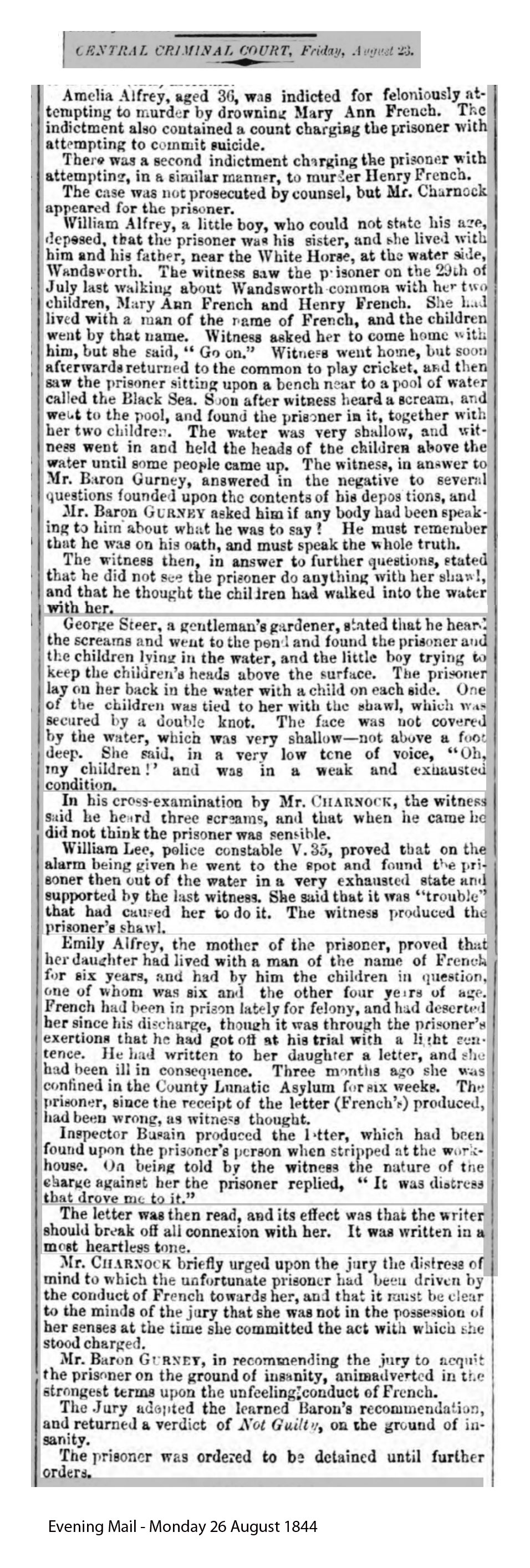
Amelia Alfrey, aged 36, was indicted for feloniously attempting murder drowning Mary Ann French. The indictment also contained a count charging the prisoner with attempting to commit suicide. There was a second indictment charging the prisoner with attempting, in similar manner, to murder Henry French. The case was not prosecuted counsel, but Mr. Churnock appeared for the prisoner.
William Alfrey, a little boy, who could not state his age, deposed, tbat the prisoner was his sister, and she lived with him and his father, near the White Horse, at the water side, Wandsworth. The witness saw the prisoner on the 29th of July last walking about Wandsworth comraoH with her two children, Mary Ann French and Henry French. She had lived with a man of the name of French, and the children went by that name. Witness asked her to come home with him, but she said, on." Witness went home, but soon afterwards returned to the common to play cricket, and then saw the prisoner sitting upon a bench near to a pool of water called the Black Sea. jon after witness heard a scream, and weofc to the pool, and found the prisoner in it, together with her two children. The water was very shallow, and witness went in and held the heads of the children above the water until some people came up.
The witness, in answer to .Mr. Baron Gurney, answered in the negative to several questions founded upon the contents of his depos tions, and Mr. Baron Gurney asked him if any body had been speaking him about what he was to say ? He must remember that he was on his oath, and must speak the whole truth. The witness then, in answer to further questions, stated that he did not see the prisoner do anything with her shawl, and that he thought the chillren had walked into the water with her.
George Steer, a gentleman's gardener, stated that he heard the screams and went to the pend and found the prisoner and the children lying in the water, and the little boy trying keep the children's heads above the surface. The prisoner lay her back in the water with child on each side. One of the children was tied to her with the shawl, which was secured double knot. The face was not covered by the water, which was very shallow$not above foot deep. She said, in very low tene of voice, "Oh, my children! ' and was in weak and exhausted condition.
In his cross-examination Mr. Charnock, the witness said he ard three screams, and that when he came he did not think the prisoner was sensible. William Lee, police constable V.35, proved that on the alarm being given he went to the spot and found v 'e prisoner then out of the water in a very exhausted state ami supported the last witness. She said that it was "trouble" that had caused her to do it. The witness produced the prisoner's shawl.
Emily Alfrey, the mother of the prisoner, proved her daughter had lived with a man of the name of French for six years, and had by him the children in question, one of whom was six and the other four yeira of French had been in prison lately for felony, and had deserted her since his discharge, though it was through the prisoner's exertions that he had got oil his trial with a li.tht sentence. had written to her daughter letter, and she had been ill in consequence.
Three months ago she was confined in the County Lunatic Asylum for six weeks. The prisoner, since the receipt of the letter (French's) produced, had been wrong, as witness thought. Inspector Busain produced the Idler, which had been found upon the prisoner's person when stripped at the workhouse. being told by the witness the nature of the charge against her the prisoner replied, It was distress that drove me to it." The letter was then read, and its effect was that the writer should break off all connexion with her. It was written in most heartless tone.
Mr. Charnock briefly urged upon the jury the distress of mind to which the unfortunate prisoner had been driven the conduct of French towards her, and that it must be clear to the minds of the jury that she was not in the possession of her senses at the time she committed the act with which she stood charged. Mr. Baron Gurnet, in recommending the jury to acquit the prisoner on the ground of insanity, animadverted in the strongest terms upon the unfeelingiconduct of French. The Jury adopted the learned Baron's recommendation, and returned a verdict of jVot Guilty, on the ground of insanity. The prisoner was ordered to be detained until further orders.
https://www.britishnewspaperarchive.co.uk/viewer/bl/0001316/18440826/017/0003
In 1851 an Emily "Alfred", Charwoman aged 60 [i.e. born c.179], was living with her daughter Amelia "Alfred", 28 [i.e. born c.1823], charwoman, in Sp[encer's Cpurt Wandworth St Ann's. Neither birthplace known.
NB some newspaper reports named her "Alfred".
https://www.ancestry.co.uk/interactive/8860/SRYHO107_1578_1578-0023?pid=964303&backurl=https://search.ancestry.co.uk/cgi-bin/sse.dll?indiv%3D1%26dbid%3D8860%26h%3D964303%26tid%3D%26pid%3D%26usePUB%3Dtrue%26_phsrc%3DPMG989%26_phstart%3DsuccessSource&treeid=&personid=&hintid=&usePUB=true&_phsrc=PMG989&_phstart=successSource&usePUBJs=true&_ga=2.240284931.1653635360.1575143184-285859747.1504633615&_gac=1.187336538.1574961231.CjwKCAiA_f3uBRAmEiwAzPuaM78dyRhOkj8coPJjtanmiz-XTN7qIeSbprK5RfrWHiC3UMyIfVgbTRoCm7kQAvD_BwE
1841 Census: Richard, Emily and their son William Alfred were living on "Thames bank". AA's brother was "Richard" and Thames bank fits the location but at 10 in 1841 whe would appear to be too old. Notice, incidentally, how many "Fishermen" there are nearby on the census pages.
https://www.ancestry.co.uk/interactive/8978/SRYHO107_1069_1071-0050?pid=10313298&backurl=https://search.ancestry.co.uk/cgi-bin/sse.dll?indiv%3D1%26dbid%3D8978%26h%3D10313298%26tid%3D%26pid%3D%26usePUB%3Dtrue%26_phsrc%3DPMG990%26_phstart%3DsuccessSource&treeid=&personid=&hintid=&usePUB=true&_phsrc=PMG990&_phstart=successSource&usePUBJs=true&_ga=2.38501155.1653635360.1575143184-285859747.1504633615&_gac=1.80793189.1574961231.CjwKCAiA_f3uBRAmEiwAzPuaM78dyRhOkj8coPJjtanmiz-XTN7qIeSbprK5RfrWHiC3UMyIfVgbTRoCm7kQAvD_BwE
Amelia Alfrey died Wandsworth aged 44 in 1865 (i.e. born c.1821 - too young to be our AA, but possibly a relation?
https://search.ancestry.co.uk/cgi-bin/sse.dll?indiv=1&dbid=1559&h=8657057&tid=&pid=&usePUB=true&_phsrc=PMG987&_phstart=successSource
Amelia Alfrey, born c.1865, daughter of Richard Alfery, born Wandsworth c.1831. A relation?
https://www.ancestry.co.uk/family-tree/person/tree/25960031/person/12092803298/facts
Morning Advertiser - Wednesday 07 August 1844
THE LATE ATTEMPTED MURDER AND SUICIDE ON WANDSWORTH COMMON.
(Click on image to enlarge)
Morning Advertiser - Wednesday 07 August 1844
THE LATE ATTEMPTED MURDER AND SUICIDE ON WANDSWORTH COMMON
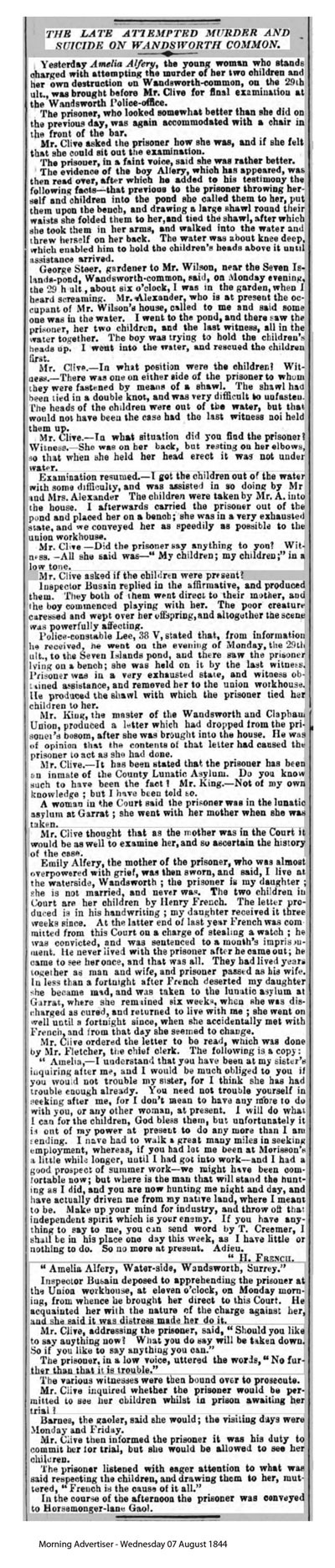
Yesterday Amelia Alfery, the young woman who stands charged with attempting the murder of her two children and her own destruction on Wandsworth-common, on the ult., was brought before Mr. Clive for final examination at the Wandsworth Police-office. The prisoner, who looked somewhat better than she did on the previous day, was again accommodated with a chair in the front of the bar. Mr. Clive asked the prisoner how she was, and if she felt that she could sit out the examination. The prisoner, in faint voice, said she was rather better. The evidence of the boy Alfery, which has appeared, was then read over, after which he added his testimony the following facts$that previous to the prisoner throwing herself and children into the pond she called them her, put them upon the bench, and drawing large shawl round their waists she folded them to her,and tied the shawl, after which she took them her arms, and walked into the water and threw herself on her back. The water was about knee deep, which enabled him to hold the children's heads above it until assistance arrived.
George Steer, gardener to Mr. Wilson, near the Seven Islands-pond, Wandsworth-common, said, on Monday evening, the h ult, about six o'clock, I was in the garden, when I heard screaming. Mr. Alexander, who is at present the occupant of Mr. Wilson's house, called to me and said some one was in the water. I went to the pond, and there saw the prisoner, her two children, and the last witness, all in the water together. The boy was trying to hold the children's heads up. I went into the water, and rescued the children first. Mr. Clive.$ln what position were the children? Wit- Qe gjj.$There was one either side of the prisoner to whom they were fastened means of a shawl. The shawl had been tied in double knot, and was very difficult to uufasteu. The heads of the children were out of the water, but that would not have been the case had the last witness noi held them up. Mr. Clive. $In what situation did you find the prisoner? Witness.$She was on her back, but resting ou her elbows, that wheu she held her head erect it was not under water. Examination resumed.$l got the children out of the water with some difficulty, and was assisted in so doing by Mr and Mrs. Alexander The children were taken by Mr. A. into the house. I afterwards carried the prisoner out of the pond and placed her on bench; she was in a very exhausted state, and we conveyed her as speedily as possible to the union workhouse. Mr. Clive $Did the prisoner say anything to yon? Witness. -All she said was$" My children; my children;" in a low tone. Mr. Clive asked if the children were present? Inspector Husain replied in the affirmative, and produced them. They both of them went direct to their mother, and ihe boy commenced playing with her. The poor creature caressed and wept over her offspring, and altogether the scene was powerfully affecting. Police-constable Lee, 38 V, stated that, from information he received, went on the evening of Monday, the 29th alt., to the Seven Islands pond, aud there saw the prisoner Iving on bench; she was held ou it by the last witness. Prisoner was in very exhausted stale, and witness obtained assistance, and removed her the union workhouse. produced the shawl with which the prisoner tied her children to her. Mr. King, the master of the Wandsworth and Claphaui Union, produced letter which had dropped from the prisonei's bosom, after she was brought into the house. was of opinion that the contents of that letter had caused the prisoner to act she had done. Mr. Clive. $It has been stated that the prisoner has been inmate of the County Lunatic Asylum. Do you know such to have been the fact 1 Mr. King.$Not of own knowledge ; but I have been told so. A woman the Court said the prisoner was in the lunatic asylum Garrat; she went with her mother when she was taken. Mr. Clive thought that as the mother was in the Court it would be as well to examine her, and so ascertain the history of the case. Emily Alfery, the mother of the prisoner, who was almost overpowered with grief, was then sworn, and said, I live at the waterside, Wandsworth ; the prisoner is my daughter ; she is not married, and never was. The two children in Court are her children by Henry French. The letter produced is in his handwriting ; daughter received it three weeks since. At the latter end of last year French was com raiited from this Court a charge of stealing watch ; he was convicted, and was sentenced to a month's imprismment. He never lived with the prisoner after he came out; he came to see her once, and that was all. They bad lived years together as man and wife, and prisoner passed as his wife. In less than a fortnight after French deserted my daughter she became mad, and was taken to the lunatic asylum Garrat, where she remained six weeks, when she was discharged as cured, and returned to live with me ; she went on well until a fortnight since, when she accidentally met with French, and from that day she seemed to change. Mr. Ciive ordered the letter to be read, which was done Mr. Fletcher, the chief clerk. The following is copy: Amelia, $I understand that you have been at my sister's inquiring after me, and I would be much obliged to you if you would not trouble my sister, for I think she has had trouble enough already. You need not trouble yourself in seeking after me, for I don't mean have any more to with you, or any other woman, at present. will what 1 can for the children, God bless them, but unfortunately it is out of ray power at present to any more than I am sending. 1 nave had to walk great many miles in seeking employment, whereas, if you had lot me been Morisson's a little while longer, until I had got into work$and 1 had a good prospect of summer work$we might have been comfortable now; but where is the man that will stand the hunting as I did, and you are now hunting me night and day, and have actually driven me from native land, where I meant to be. Make up your mind for industry, and throw oft that independent spirit which is your enemy. If you have anything to say to me, you can send word by T. Creemer, I shall be in his place one day this week, as I have little or uothiog to do. So more at present. Adieu. H. French. Amelia Alfery, Water-side, Wandsworth, Surrey." Inspector Husain deposed to apprehending the prisoner at the Union workhouse, eleven o'clock, Monday morning, from whence he brought her direct to this Court. He acquainted her with the nature cf the charge against her, and she said it was distress made her do it. Mr. Clive, addressing the prisoner, said, Should you like to say auything now? What you do say will be taken down. So if you like to say anything you can." The prisoner, in a low voice, uttered the words, No further than that it is trouble." The various witnesses were then bound over to prosecute. Mr. Clive inquired whether the prisoner would be permitted to see her children whilst in prison awaiting her trial ? Barnes, the gaoler, said she would; the visiting days were Monday and Friday. Mr. Cii?e then informed the prisoner it was his duty to commit her lor trial, but she would be allowed to see her children. The prisoner listened with eager attention to what was said respecting the children, and drawing them her, muttered, French is the cause it all." In the course of the afternoon the prisoner was conveyed to Horsemonger-lane Gaol.
[Source: BNA: LINK.]
- Mr Wilson's house is not named, and the pond is called the "Seven Islands Pond". For a while I wondered whether the name "The Black Sea" was ony adopted after the Crimean War (a more obvious choice after the RVPA was built a short way away on the other side of the railway line). However, the answer is yes, since it is called the Black Sea in Saunders's News-Letter, below.
- Horsemonger-lane Gaol, on Borough High Street, would have been a grim place to send Amelia to. See LINK. Once Surrey's largest prison and its principal place of execution, it was built 1791-1799, and demolished 1878. In 1849, Dickens protested against public hangings here. The site is now a public park, Newington Gardens.
- Punch: The Great Moral Lesson at Horsemonger Lane Gaol, Nov. 13 1849 (poem partly written in London vernacular).
Notes & queries
Saunders's News-Letter [Ireland] - Friday 02 August 1844
ATTEMPTED MURDER AND SUICIDE. Note she is called Amelia

(Click on image to enlarge)
ATTEMPTED MURDER AND SUICIDE
On Monday evening a woman living at Wandsworth attempted the murder of her two children and her own destruction.
The circumstances connected with this dreadful affray are these:
On Monday evening, about five o'clock. a woman twenty-six years of age, named Amelia Alfred, left $nr bum* waterside, Wandsworth, with her two abUdrva. girl and boy. aged respectively ais and four yaara, and proceeded to Wandsworth Common. Sbe about for nearly an bow. and then approached a terga and pond called the Black Sea Jr would appear that while steading oo the margin the pond, she bar two children to bar waist, and then precipitated Into water; the bank was shelving, nod the water was rather shallow that point; bat so determined Was wretched woman upon making sway with haraelf nod bee offspring, that she afterward* threw herself her back, an that water covered both the children and hernaif. this period William Alfred. the brother of the woman, lad not more than years of ago, ran np to tba spot, jumped Into tba water, triad to reams tea that could not release them, bald their beads above water and halloaad for aaciatannr. Mr. and bit lady worn walking tbeir lawn, adjoining tba poad, and bearing tha lay*a ncraoma. Mr. Alexander instantly anrmlafd that some ana the water, and taking big gardaoder with him gnn to pond. lad waa still keeping Iha childrew** head above water, app*a*ed ready drop aghanetlon. gardener Jumped Into the water and with bis knife tbs and released ablldren. Police Constable Lee. 38 V. who was on duty the common, assisted getting the woman ont of the pond, having previously sent to the Uoioa to request tea master and matron to bare a warm bath and o'her appliances In raadineaa. Tba children, who. through the nondnet the lad Alfred, ware not seriously Injured, were kindly taken charge of Mra. Alexander, and onvsyed that lady to bee rsaidence. The woman Alfred when token nut the water was to all appearance dead. She wns coavaysd quickly as possible, however, the Wands worlb Union, where Mr. King, the mister, and wife, matron, ware prepared to receive bar. The means $aed restoring parsons from drowning were and before tea arrival of the medical oflfoer. Doctor Coo$ar, aba atbibilrd symptom* of reviving animation. Every attention has been since paid to too wretched woman, bat ia MHI an estrcmely precarious cocditioa. There la little doubt that lb# woman Is Insane, and that Invanity baa been brought on usage and distress. baa lived for years Wnadsawth, her native place, with Henry French, Journeyman carpenter and i tobinet maker, whom tea had her children. This toan. November leer, was c* atg#d at Wandsworth JMlna Court with stealing silver watch, which bod ! _ accident been left io drawer of a chlfl$alrr hr ; Mdto end was committed trial. Tba wotnan, i "fTf* ,b *$ $uppoMd to bla wife, never pvrsoo* speak for him on I dny trial. The pro*eru*ri$ evco recommended prl- S?* j* * ,rr J.$* vccoaat, and bad $Mffbt aantaacajtaased upon him. At the eipiratkio bialmprlaomeot French returned to tbe woman Alfred, waa Using with ber mother, washerwoman, Waterside, Wandsworth, bat he had sooner recruited ' bla Wrvngtk than deserted her and bla children. This w$$ ant without Its effect. poorevaagpra becaei. n.aJ, was passed magistrate the
Lunatic Asylum at Garrett, where she remained a short time, and was discharged as cured. Fro that time up to Monday she lived at home with her mother, and it was generally noticed that she appeared very much dejected.
Whilst the woman was being stripped at the Union, a letter from her bosom. It was a wretched scrawl from her paramour, French, and the substance was that he never intended to live with her or any woman again, and she must work and do her best for herself and children, as she could expect nothing from him.
Yesterday the superintendent of the V division made Mr, Clive, the sitting magistrate at Wandsworth Police Court, acquainted with the particulars, and it is understood that so soon as the woman is capable of removal she will be brought to this court to undergo examination upon a charge of attempting to murder her children.[Source: BNA LINK.]
Bell's Weekly Messenger - Saturday 03 August 1844
ATTEMPTED MURDER AND SUICIDE

(Click on image to enlarge)
[NEEDS COMPLETION & EDIT]
ATTEMPTED MURDER AND SUICIDE
On Monday evening great excitement prevailed in the parishes of Wandsworth and Battersea, in consquence of the woman having attempted the murder of her two children, and her own destruction.
The circumstances connected with this dreadful affair are these:
On On Monday evening about five o'clock, a woman named named Amelia Alfred, left ater side, Wandsworth, with her two children, a girland boy, aged respectively six and four years...
Vrel Wandsworth-common. She nearly an hour, and then approached hed the Black Sea." Here she her waist, ami precipitated herself Hisllott was and the water was uimn . 1 determined was the wretched die away with herself and her offspring, both ,er back, that the water children and herself. At this critical the brother of the unfortunate water, and tried to rescue not release them, heldw halloed for assistance. Mr. ere walking in their lawn, which hearing the boy's screams Mr. . . one was in the water, and the pond. Tte lad heads above water, but into , haiiBtion. The gardener nd released the children, and con the common, assisted in The children, whe mjured, were charge Mrs. when taken out of the She was conveyed to the the master and the matron from droumf means used in restoring $riical otfio re "dopted, and before the arrival the poor creature animation. that the woman insane, and that M for 'h-usage and distress. i 'mienn$i. her native place, cabinet-maker in November wort Police-court with chiffo accident, been left Alfri? t, ir and ttas committed was then supposed fellow, for to speak for him on the Ten recommended him to he, consequently, had but expiration of his her; she was then but at the waterhis , her and her children...
[Source: BNA LINK.]