p. 38The creation of any Victorian suburb involved the provision of a wide variety of services, by both private and public enterprise. This chapter examines briefly some major elements (local government; transport; schools; churches; shops and public houses, and entertainment), as a background to the analysis of the building process. Some aspects have been studied more than others. Local government at the London-wide and local levels is thoroughly examined by Owen and Roebuck.1 Transport, and railways in particular, has generated a vast literature, although we have already noted in Chap. 1 that little of it is concerned with their physical and social consequences. Schools – especially the work of the School Board for London from 1870 – and the rash of new churches and chapels erected after 1850 have received little notice from local historians, and the same is true of retailing, the drink trade and the various forms of entertainment which were provided in Battersea, ranging from the tropical gardens in Battersea Park to music halls and the Shakespeare Theatre.
Local Government
Until 1855, apart from some limited county involvement and the local application of national legislation, notably the Poor Law, the Vestry dealt with matters such as paving and lighting. Drainage was the prerogative of the Kent & Surrey Commissioners of Sewers, a Tudor creation essentially concerned with the maintenance of natural and man-made watercourses.2 Battersea was outside the scope of the London Building Acts until 1845 and the Vestry had no concern with housing quality. Equally, the small population before 1850 meant that no Commissions or Trusts for paving, lighting or policing had been found necessary. A turnpike road (Lavender Hill-St. Johns Hill) reflected long-distance transport requirements, and probably deterred development along this corridor prior to the abolition of tolls in 1865.3 From 1829, law enforcement was by the new Metropolitan Police.
The onset of major building activity locally coincided with the creation of the Metropolitan Building Office (MBO) in 1845, whose District Surveyors were responsible for the enforcement of standards. Their records form an invaluable basis for any study of the progress and timing of building.4 The MBO and the Commissioners of Sewers were absorbed in 1856 by the Metropolitan Board of Works, a new non-elective London-wide body.5 Its principal task was to provide London with an adequate main drainage and sewerage system, which it did over the next fifteen years through its engineer Joseph Bazalgette,6 an essential framework into which the drains of thousands of new dwellings and streets could debouch. The MBW freed the local Thames bridges from toll in 1879-80, thereby helping to fuel the building boom of 1878-82, by reducing the cost of travel outside the area. The Board and its successor the LCC assumed the management of Clapham and Wandsworth Commons and later of Battersea Park.
District Boards of Works were also created in 1856. The Wandsworth Board covered Battersea, Clapham, Putney, Streatham, Tooting and Wandsworth, 11,500 acres, whose population in 1855 was only c.65,000. Its main functions related to lighting and paving new and existing roads, public health and consideration of plans for new buildings. The DBW had Local
p. 39Committees in each parish, along with a medical officer who reported on the health of the local community. A key player from his appointment as Clerk to the Board in 1856 until he retired in 1885 was Arthur Alexander Corsellis, a local solicitor.7 He also acted for the Wandsworth Guardians, and was well-placed to take up estate development in the late-1880s and 1890s.
The DBW was a generally conservative body, its membership drawn from a wide spectrum of local tradesmen, including builders, the clergy and professions and minor gentry. It made great difficulties for the new tramway companies after 1875, extorting considerable highway improvements from them.8 Although the two-tier structure of Boards of Works was essentially bureaucratic rather than democratic, they managed the huge upsurge in new road and house building after 1856 reasonably well. By 1889, when the MBW gave way to the London County Council, a fully-elected body, the population of the Wandsworth DBW area had grown to c.300,000, a figure exceeded outside London by relatively few major towns, most of which enjoyed County Borough status.
Battersea regained its independence in 1889 as a Metropolitan Vestry.9 This was a radical and progressive body, a tradition inherited by the Metropolitan Borough after 1900, whose anti-royalist stance caused a furore in the Edwardian period.10. By then, Battersea had a splendid Town Hall costing £30,000 (1892, architect E.W. Mountford),11 and a Central Library (1889). Their location in Lavender Hill confirmed the shift of the commercial centre of gravity from the old village to Clapham Junction, which began in the 1870s and was complete by 1900. The Vestry had built a public baths, wash-house and mortuary complex on Latchmere allotments in 1887, followed by Nine Elms Baths in 1899. Municipal housing began modestly with a few houses by the Town Hall in the 1890s, and rapidly expanded with the Latchmere Estate in 1903-4. These were unusual on being on virgin ground, rather than slum clearance schemes.12 Public conveniences, or “chalets”, appeared at Clapham Junction and outside Battersea Park during the nineties. The Borough continued to espouse municipal socialism, building its own electricity generating station in Lombard Road by direct labour.13 Battersea Polytechnic was opened in 1894 (architect E.W. Mountford14).
Battersea was generally well-served by its local government. The Building Acts and the MBW’s main drainage ensured a reasonably high standard of working-class housing. Overcrowding in some areas did create slums, but most of the area in 1914 consisted of well-paved and lit streets with houses or maisonettes occupied by single families. In terms of civic amenities, Battersea stands comparison with many a provincial city.
Local Government at Work 1850-1900
The minute books of the Boards provide detail week by week of applications for new roads, drains and houses and the response of the Superintending Architect of the M.B.W. who agreed to or amended them. The adoption of what had been private estate roads during the construction phase and the provision of street lights often caused debate between the DBW and builders and developers, as did the tendency of the latter to circumvent the width stipulations. In one notable instance a builder laid out a street 20 feet wide instead of the regulation 40ft., because the field on the other side of the boundary had an unharvested crop.15
p. 40In 1879, there were questions about why the parish was watering and repairing Altenburg Gardens, a private road belonging to a vestrymen, Mr. Hiscox, who also owned one of the sites which was being considered for the planned Vestry/public hall.16 He was not the only member with such vested interests. The Vestry election of May 1872 saw Messrs. Appleton, Edwin Lathey, C.W. Todd, George Chadwin and Knipler elected, all involved in estate development, surveying or building.17 Alfred Heaver, a major developer after 1875, served a term on the DBW after 1880.
Private developers were not the only ones involved. In May 1863, the Office of Works, which had created Battersea Park and the surrounding roads wrote regarding Victoria and Park Roads (Chelsea Bridge Road and Prince of Wales Drive). The Treasury paid £1,272 for their adoption, including the Circus and Octagon, a grand piece of town planning for this area.18 In September 1860, Mr. Hunt wrote to the DBW asking that Parkside Street be lighted, as he had already erected nearly fifty houses there. The matter was referred to the Battersea Committee.19 In 1891, when the Vestry was paving St. John’s Hill and Battersea Rise, it was agreed that footpath flagging should be charged to frontagers, including St. Mark’s church.20
The transition from farmland to suburb produced some unpleasant health problems. The as-yet open sewer in Falcon Lane was said in September 1865 to be ‘blue and inky, gurgling through refuse and garbage... the effluvia arising... disgusting in the extreme’.21 Bazalgette’s main drainage solved this problem, and Battersea’s ancient watercourses disappeared below ground. By October 1865, 19,220 feet of sewers had been laid in the parish, although they only drained 530 houses at first.22 In the days before the automatic linking of new houses with the sewer system, previously-built houses had to be specially connected. In April 1865 Mr. Holland, owner of 37 houses in Hope Street, mostly built between 1857 and 1860, applied for early construction of a sewer, and also for repair of the road and footways.23
The slow progress in health is highlighted by the local Medical Officer’s report for 1868-9, which records 1975 births and 964 deaths, of which 631 were children under ten. In October 1868, the Board took legal proceedings against William Snelling, who kept 32 pigs in Latchmere Grove, a street noted for this activity and hemmed in since 1863 by railways.24 The battle was not new, and continued for years. In January 1859, the Clapham Gazette had reported fever in York Road, Sleaford Street, George Street and Latchmere, attributable to the large number of pigs kept there. In 1872, the pigkeepers went to the Home Office saying that only 49 pigs were kept in poor conditions, but revealing no less than 232 piggeries. The D.B.W. was worried about smallpox and found 2,948 pigs, although the true number may have been three times that.25 In August 1874, Battersea had the worst incidence of scarlet fever and diarrhoea deaths in London, while later that year, a highly contagious disease broke out in local piggeries.26
The various organs of government did not always agree. In December 1874 Battersea Vestry opposed an attempt by the M.B.W. to compulsorily purchase 18 acres at Latchmere for gas storage, saying that it was an open space providing useful allotments.27 By 1886, however, the Latchmere Allotments Committee was saying that the most profitable use would be for artisan dwellings, and recommending a layout providing 476 plots with a ground rental of
p. 41£1,925 p.a. at 5/- per foot frontage. Of the proceeds, £500 were to go on technical scholarships and the balance on a free library and reading rooms. Although this accurately foreshadowed the ultimate use of Latchmere, the scheme was premature. Only the M.B.W. had powers to erect dwellings at this time, as the Local Government Board pointed out to the Vestry in November 1886.28
Battersea Vestry adopted the Public Libraries Acts in 1887, providing reading rooms in Battersea Park Road and Latchmere Road. The first lending library was in the Lammas Hall (October 1888), followed by the Central Library and Lurline Gardens in 1890. The book stock was 28,000 volumes in 1891, issues were c.250,000 p.a. and the cost £4,500.
London street-names often changed, mainly to avoid confusing duplication. In December 1883, the MBW ordered the renaming of the politically maladroit Zulu Crescent on Alfred Heaver’s Falcon Park estate to neutral Rowena Crescent. In 1887, the residents of Bullen Road objected to its being renamed Dives Road (after the previous owner), and the DBW and MBW agreed to change it to Ilminster Gardens.
Street traders were a perennial problem and the DBW employed a Street Keeper to regulate them. In October 1887, he seized a barrow, board and onions outside the “Princes Head” belonging to Richard Gould of Knowsley Road, and also a barrow and oil cloth in Totteridge Road. Trouble was not confined to the pavements, as the Board received a memorial from 33 residents of Falcon Road in November 1887 objecting to the nuisance caused by organ grinding, swings and shooting galleries at Hallett’s timber yard. This was followed by a letter from Battersea Tradesmen’s Club demanding an end to the same nuisance.
Public Transport
Whatever the relationship between public transport and the timing and pattern of suburban growth (see discussions by Kellett, White and Jackson29), its development had a very significant impact on the landscape of Battersea after 1840. The minimal short stage and omnibus services of the 1820s and 1830s did not affect the essentially local orientation of employment. Those who lived in villas and mansions around the Commons could afford their own transport.
Battersea was well served by railways and trams, but studies of their socio-economic and physical impact are few,30 and services and traffic, both passenger and freight, have received scant attention.
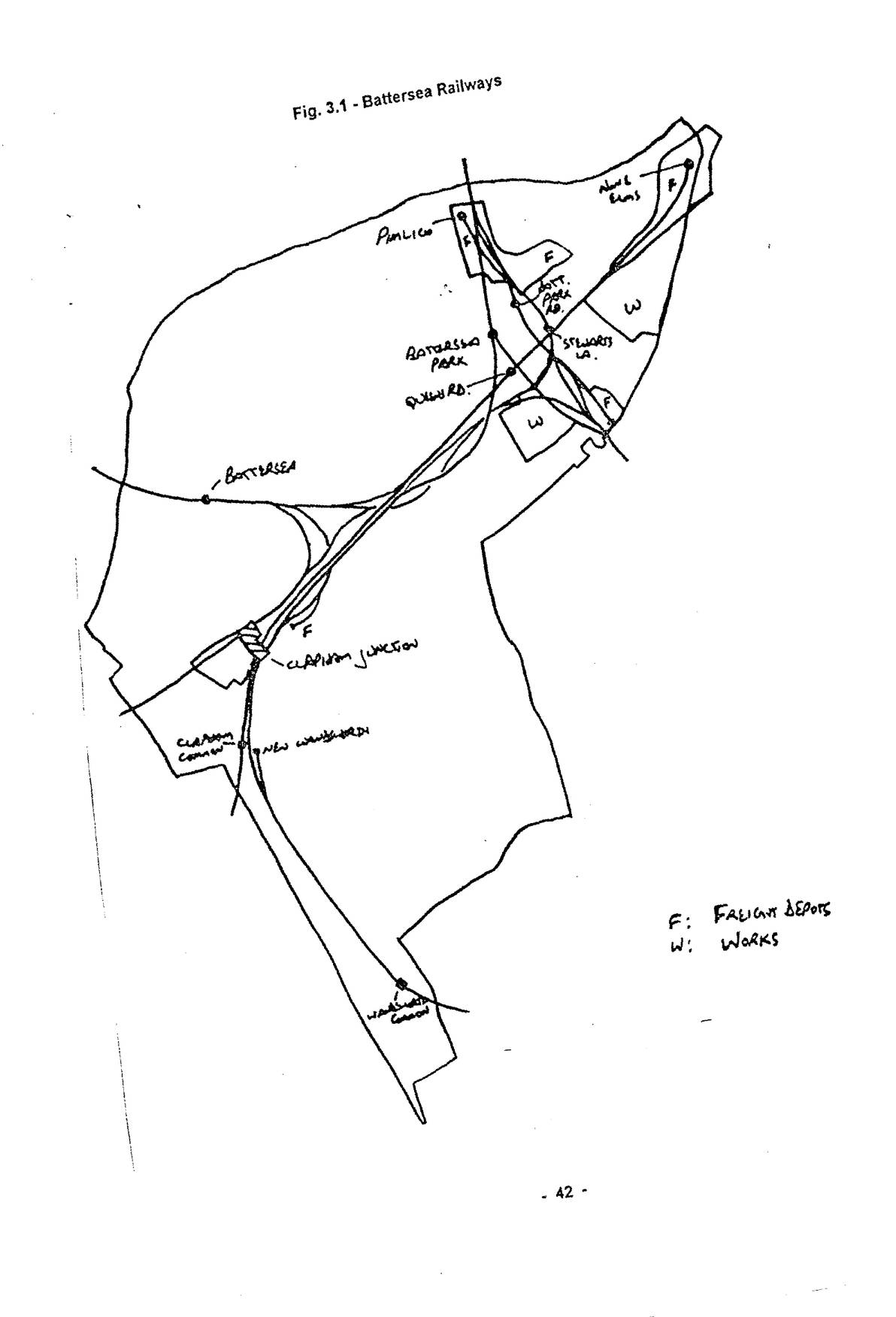
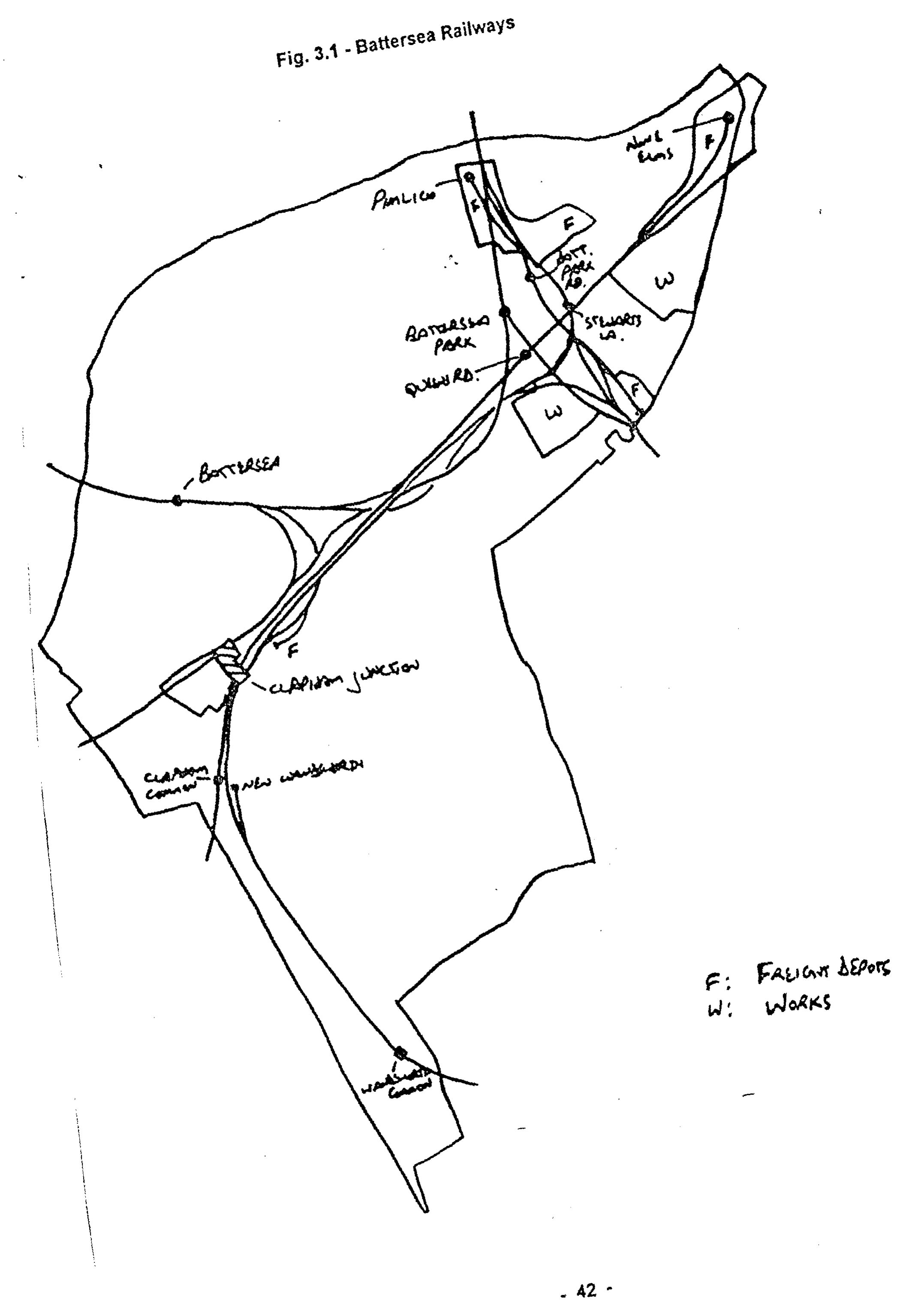
Railways (Fig. 3.1)
The London & Southampton Railway opened in stages from May 1838. In Battersea bridges were provided only for the few pre-existing roads, which affected the pattern of development after 1850. There was a station at Battersea Rise; called “Wandsworth”, and later “Clapham Common”, it set a precedent whereby railways tended largely to ignore the existence of Battersea. This difficult site was probably chosen because St. John’s Hill was still a turnpike.
Services began with six down and five up trains (four each way on Sundays). Third-class passengers were not carried. Fares from Wandsworth to Nine Elms were 1/6 first- and 1/- second-class for three miles.31 The Southampton was not a suburban railway but a trunk line.
Open zoomable view
p. 43The average journey in late 1839 was 21 miles. Like its contemporaries the Great Western and the London & Birmingham, it was not interested in what little suburban traffic might be on offer.32 The high fares were reduced in January 1839, allegedly to attract business, rather than because of public complaints. Nine Elms was typical of the peripheral termini of early main-line railways in London. When the line was extended to Waterloo Bridge in 1848,33 Nine Elms then became the principal goods depot. The locomotive works and largest engine shed had been here since 1843.34
In July 1846, the Richmond Railway opened from a junction with the LSR at Falcon Lane through Wandsworth and Putney to Richmond, clearly intended as a suburban line. Two additional tracks were provided to Nine Elms and Waterloo, but no interchange station at the junction.35 Only six dwellings were affected in Battersea, the rest being gardens, meadows or market garden ground.36
Apart from its physical presence, and employment at Nine Elms, railways had had little impact on Battersea by 1850. In 1851, 64 railwaymen lived there, 56 at Nine Elms. The largest group were a dozen engine drivers, the rest ranged from Richard Eaton, locomotive superintendent to porters and labourers.
The first Railway Mania collapsed in the late-1840s, and the next line did not open until 1856. The West End of London & Crystal Palace Railway connected the rebuilt Great Exhibition at Penge with the West End. It reached a temporary terminus at Battersea Rise on 1 December 1856.37 It was extended to “Pimlico” station, in Battersea next to the new Park and Chelsea Bridge in March 1858, finally reaching Victoria on 1 October 1860.38 Although adjacent to the LSWR for almost one mile, no immediate steps were taken to provide a station, nor were the lines physically connected.
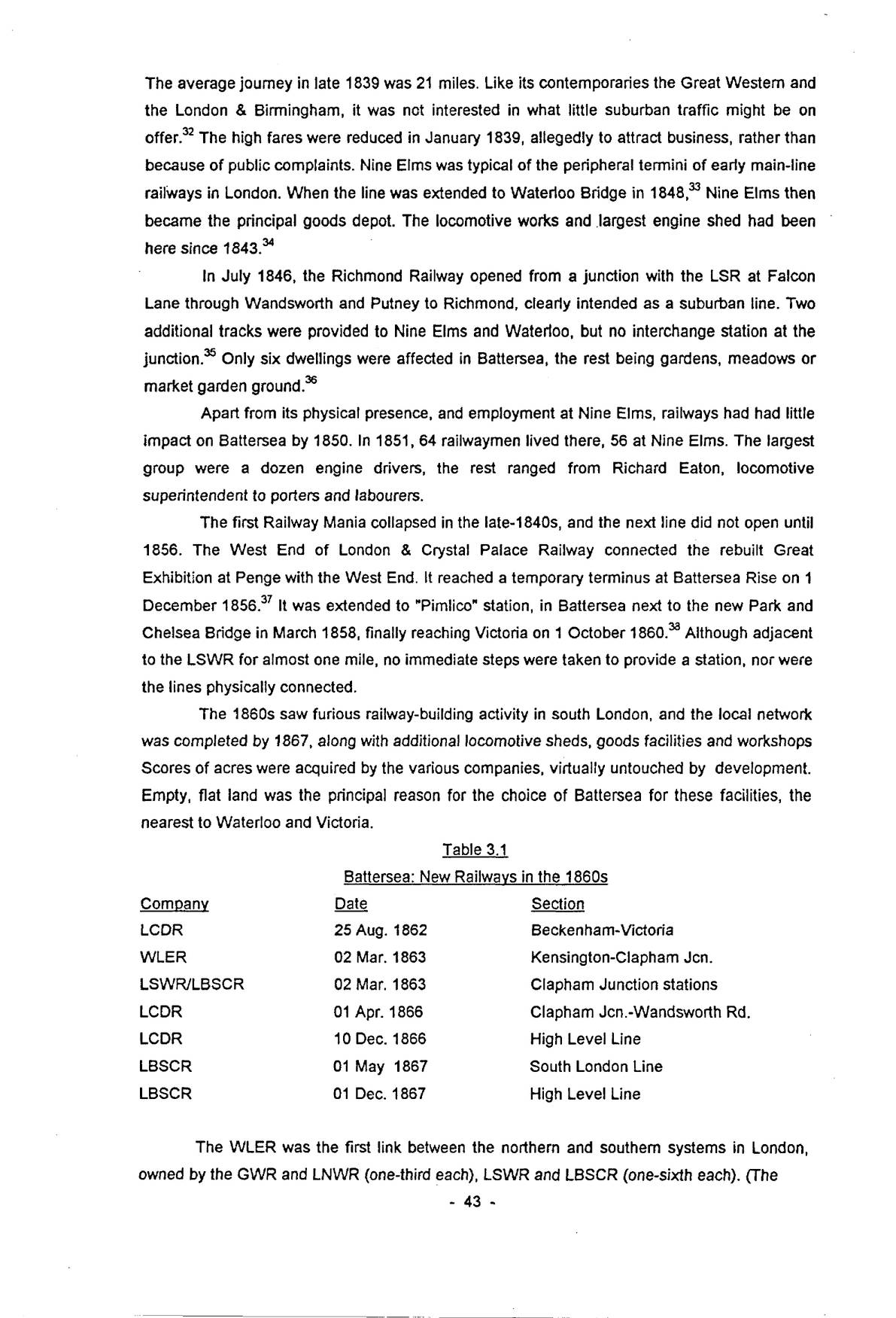
The 1860s saw furious railway-building activity in south London, and the local network was completed by 1867, along with additional locomotive sheds, goods facilities and workshops Scores of acres were acquired by the various companies, virtually untouched by development. Empty, flat land was the principal reason for the choice of Battersea for these facilities, the nearest to Waterloo and Victoria.
| Company | Date | Section |
|---|---|---|
| LCDR | 25 Aug. 1862 | Beckenham-Victoria |
| WLER | 02 Mar. 1863 | Kensington-Clapham Jcn. |
| LSWR/LBSCR | 02 Mar. 1863 | Clapham Junction stations |
| LCDR | 01 Apr. 1866 | Clapham Jcn.-Wandsworth Rd. |
| LCDR | 10 Dec. 1866 | High Level Line |
| LBSCR | 01 May 1867 | South London Line |
| LBSCR | 01 Dec. 1867 | High Level Line |
The WLER was the first link between the northern and southern systems in London, owned by the GWR and LNWR (one-third each), LSWR and LBSCR (one-sixth each). (The
p. 44GWR had obtained powers for a similar route in 1845.) The WLER ended with four spurs, one to each side of Clapham Junction, to Waterloo and to Victoria (LCDR). There was a wide range of passenger and freight traffic.39 The spurs to Victoria and Clapham Junction (LBSCR) had mixed standard/broad gauge tracks for the GWR. Clapham Junction station was partly built in 1860,40 and was always an interchange station, rather than a true junction. It retained separate LSWR and LBSCR buildings and staffs until 1923. The companies enlarged and rebuilt the station several times. It reached its final form in 1910.41 The high-level viaducts were built to obviate the gradients from low-lying north Battersea up to Grosvenor Bridge, which presented problems to the locomotives of the day.42
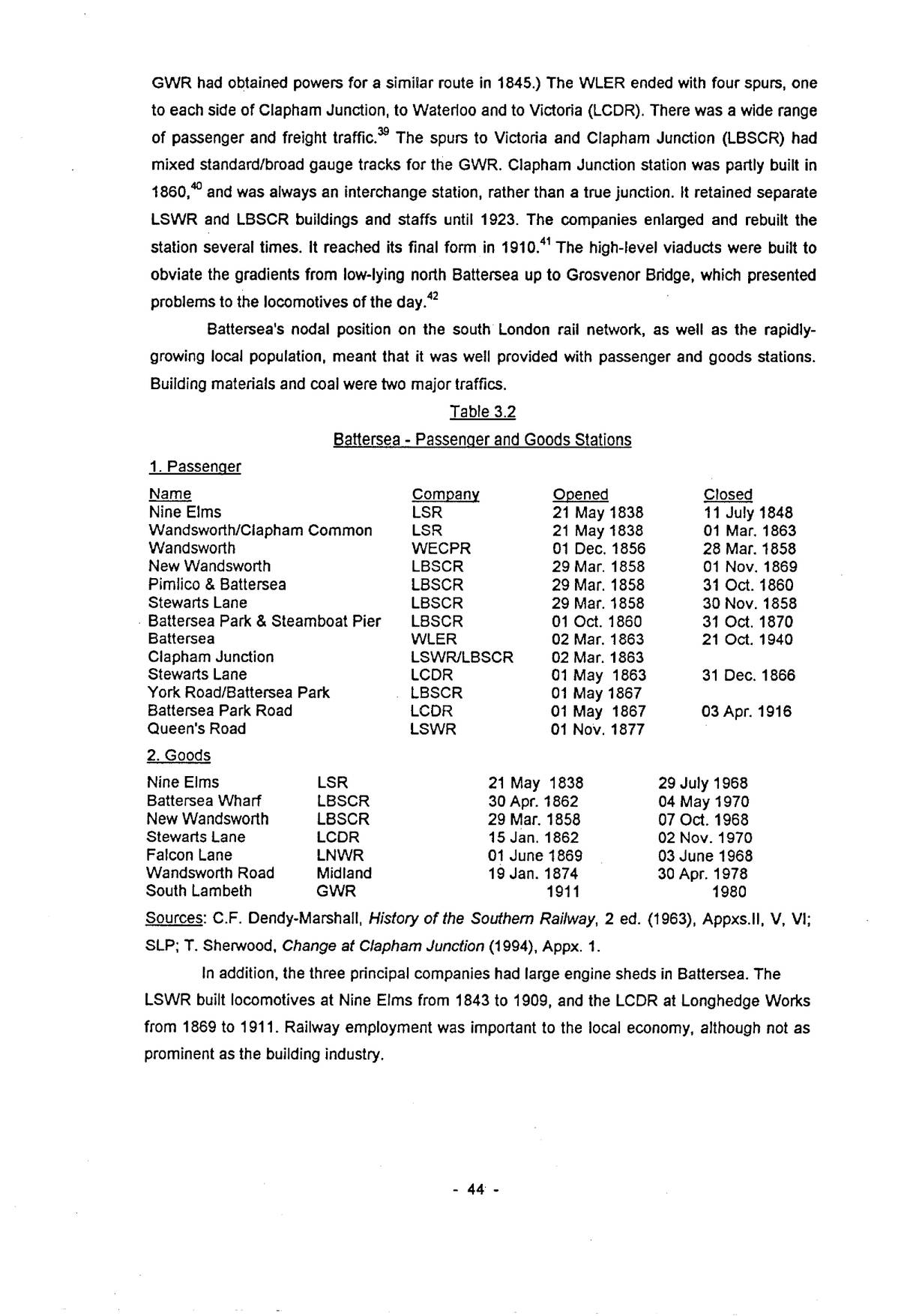
Battersea’s nodal position on the south London rail network, as well as the rapidly-growing local population, meant that it was well provided with passenger and goods stations. Building materials and coal were two major traffics.
| 1. Passenger | |||
|---|---|---|---|
| Name | Company | Opened | Closed |
| Nine Elms | LSR | 21 May 1838 | 11 July 1848 |
| Wandsworth/Clapham Common | LSR | 21 May 1838 | 01 Mar. 1863 |
| Wandsworth | WECPR | 01 Dec. 1856 | 28 Mar. 1858 |
| New Wandsworth | LBSCR | 29 Mar. 1858 | 01 Nov. 1869 |
| Pimlico & Battersea | LBSCR | 29 Mar. 1858 | 31 Oct. 1860 |
| Stewarts Lane | LBSCR | 29 Mar. 1858 | 30 Nov. 1858 |
| Battersea Park & Steamboat Pier | LBSCR | 01 Oct. 1860 | 31 Oct. 1870 |
| Battersea | WLER | 02 Mar. 1863 | 21 Oct. 1940 |
| Clapham Junction | LSWR/LBSCR | 02 Mar. 1863 | |
| Stewarts Lane | LCDR | 01 May 1863 | 31 Dec. 1866 |
| York Road/Battersea Park | LBSCR | 01 May 1867 | |
| Battersea Park Road | LCDR | 01 May 1867 | 03 Apr. 1916 |
| Queen’s Road | LSWR | 01 Nov. 1877 | |
| 2. Goods | |||
| Nine Elms | LSR | 21 May 1838 | 29 July 1968 |
| Battersea Wharf | LBSCR | 30 Apr. 1862 | 04 May 1970 |
| New Wandsworth | LBSCR | 29 Mar. 1858 | 07 Oct. 1968 |
| Stewarts Lane | LCDR | 15 Jan. 1862 | 02 Nov. 1970 |
| Falcon Lane | LNWR | 01 June 1869 | 03 June 1968 |
| Wandsworth Road | Midland | 19 Jan. 1874 | 30 Apr. 1978 |
| South Lambeth | GWR | 1911 | 1980 |
Sources: C.F. Dendy-Marshall, History of the Southern Railway, 2 ed. (1963), Appxs.II, V, VI; SLP; T. Sherwood, Change at Clapham Junction (1994), Appx. 1.
In addition, the three principal companies had large engine sheds in Battersea. The LSWR built locomotives at Nine Elms from 1843 to 1909, and the LCDR at Longhedge Works from 1869 to 1911. Railway employment was important to the local economy, although not as prominent as the building industry.
| Occupation | 1851 | 1861 | 1871 | 1881 | 1891 |
|---|---|---|---|---|---|
| Traincrew | 13 | 70 | 326 | 675 | 818 |
| Terminals | 5 | 30 | 205 | 440 | 595 |
| Track, &c. | 5 | 35 | 59 | 118 | 132 |
| Signalling | 2 | 18 | 67 | 166 | 175 |
| Eng. Shed | 1 | 10 | 74 | 147 | 244 |
| Works | 4 | 7 | 79 | 140 | 338 |
| Shed/Wks. | 4 | 21 | 142 | 208 | 414 |
| Clerk | 3 | 10 | 43 | 144 | 146 |
| Labourer | 13 | 145* | 76 | 76 | 107 |
| Other | 15 | 21 | 71 | 197 | 161 |
| Total | 65 | 367 | 1142 | 2311 | 3130 |
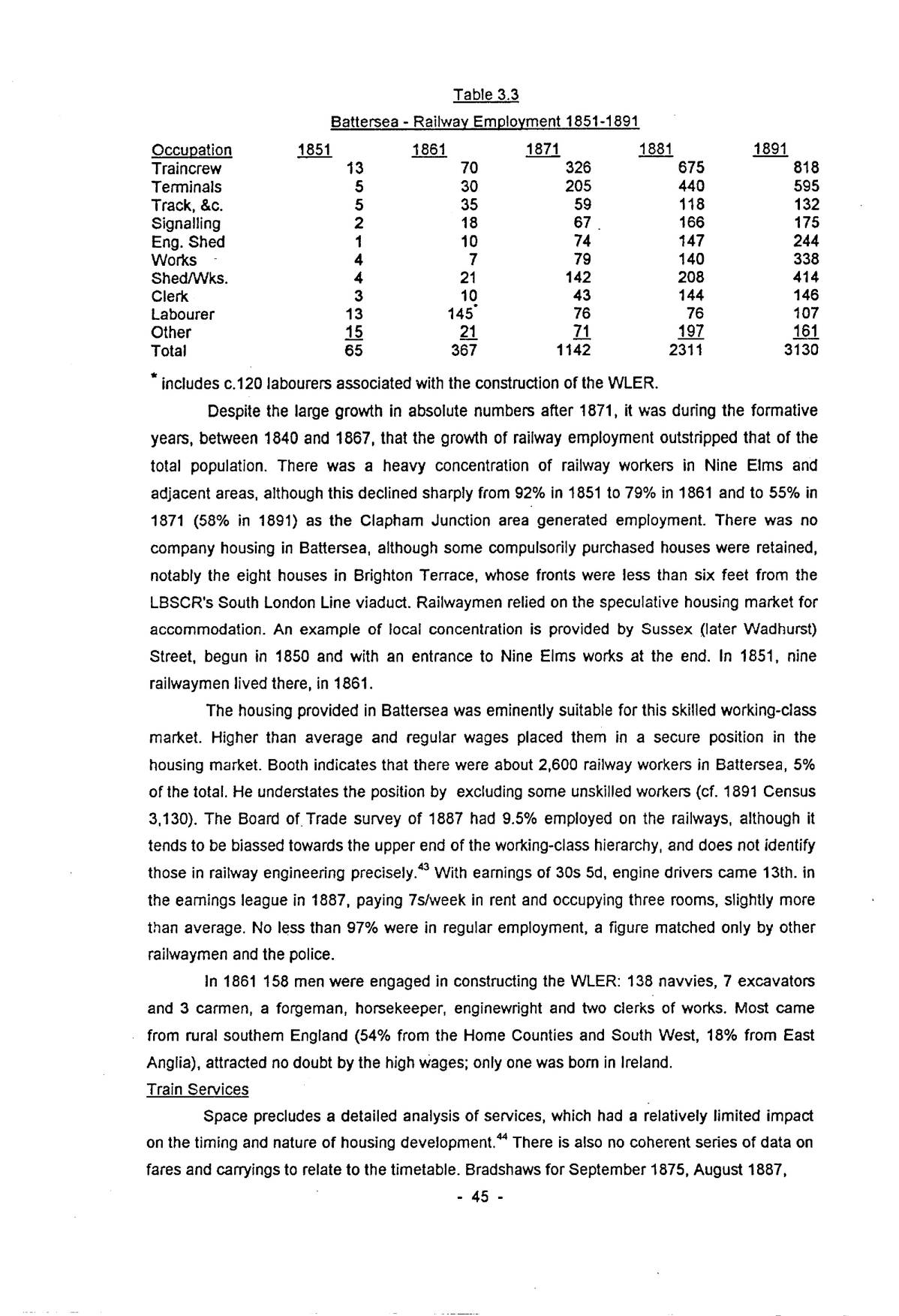
* includes c.120 labourers associated with the construction of the WLER.
Despite the large growth in absolute numbers after 1871, it was during the formative years, between 1840 and 1867, that the growth of railway employment outstripped that of the total population. There was a heavy concentration of railway workers in Nine Elms and adjacent areas, although this declined sharply from 92% in 1851 to 79% in 1861 and to 55% in 1871 (58% in 1891) as the Clapham Junction area generated employment. There was no company housing in Battersea, although some compulsorily purchased houses were retained, notably the eight houses in Brighton Terrace, whose fronts were less than six feet from the LBSCR’s South London Line viaduct. Railwaymen relied on the speculative housing market for accommodation. An example of local concentration is provided by Sussex (later Wadhurst) Street, begun in 1850 and with an entrance to Nine Elms works at the end. In 1851, nine railwaymen lived there, in 1861.
The housing provided in Battersea was eminently suitable for this skilled working-class market. Higher than average and regular wages placed them in a secure position in the housing market. Booth indicates that there were about 2,600 railway workers in Battersea, 5% of the total. He understates the position by excluding some unskilled workers (cf. 1891 Census 3,130). The Board of Trade survey of 1887 had 9.5% employed on the railways, although it tends to be biassed towards the upper end of the working-class hierarchy, and does not identify those in railway engineering precisely.43 With earnings of 30s 5d, engine drivers came 13th. in the earnings league in 1887, paying 7s/week in rent and occupying three rooms, slightly more than average. No less than 97% were in regular employment, a figure matched only by other railwaymen and the police.
In 1861 158 men were engaged in constructing the WLER: 138 navvies, 7 excavators and 3 carmen, a forgeman, horsekeeper, enginewright and two clerks of works. Most came from rural southern England (54% from the Home Counties and South West, 18% from East Anglia), attracted no doubt by the high wages; only one was born in Ireland.
Train Services
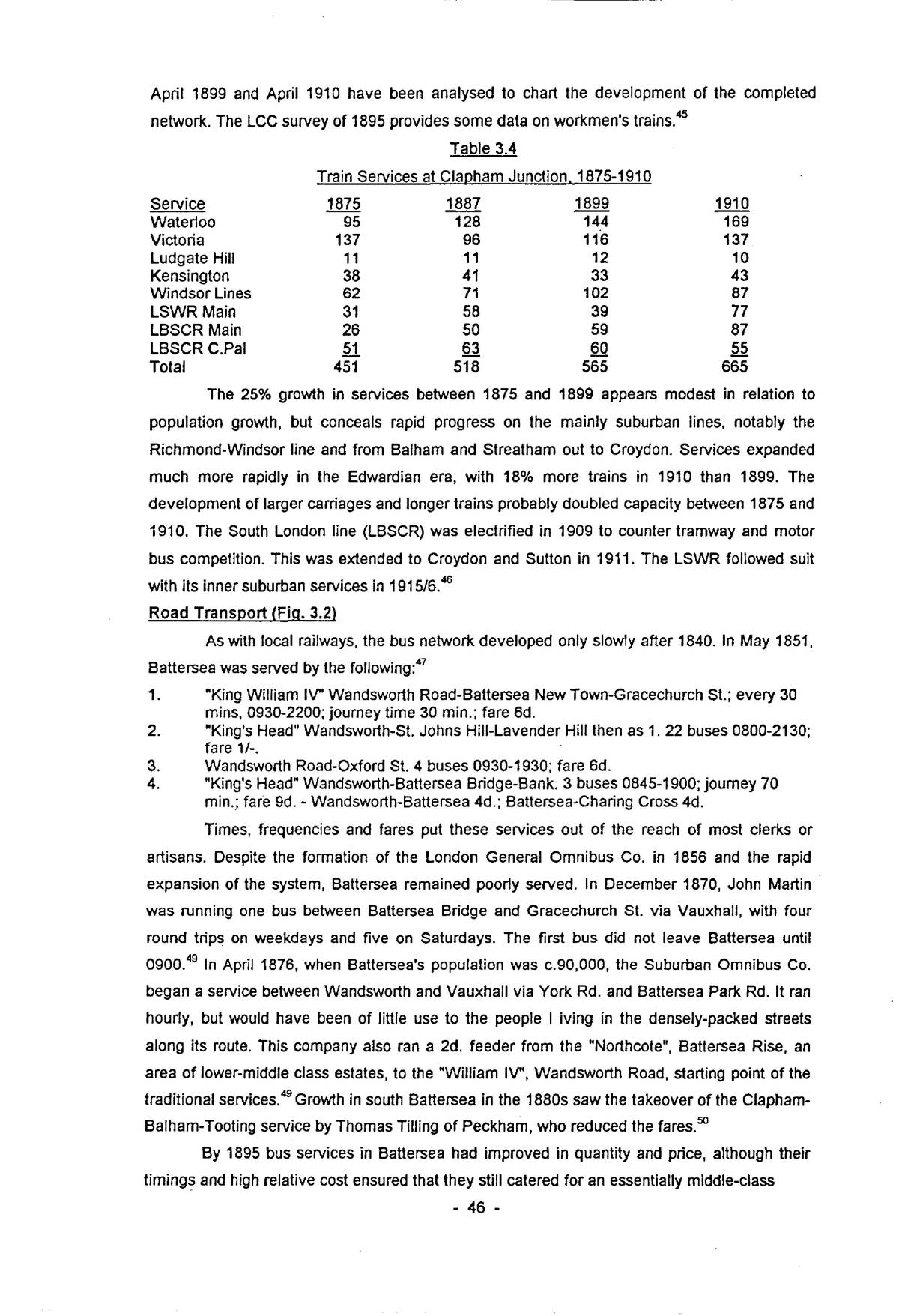
Space precludes a detailed analysis of services, which had a relatively limited impact on the timing and nature of housing development.44 There is also no coherent series of data on fares and carryings to relate to the timetable. Bradshaws for September 1875, August 1887,
p. 46April 1899 and April 1910 have been analysed to chart the development of the completed network. The LCC survey of 1895 provides some data on workmen’s trains.45
| Service | 1875 | 1887 | 1899 | 1910 |
|---|---|---|---|---|
| Waterloo | 95 | 128 | 144 | 169 |
| Victoria | 137 | 96 | 116 | 137 |
| Ludgate Hill | 11 | 11 | 12 | 10 |
| Kensington | 38 | 41 | 33 | 43 |
| Windsor Lines | 62 | 71 | 102 | 87 |
| LSWR Main | 31 | 58 | 39 | 77 |
| LBSCR Main | 26 | 50 | 59 | 87 |
| LBSCR C.Pal | 51 | 63 | 60 | 55 |
| Total | 451 | 518 | 565 | 665 |
The 25% growth in services between 1875 and 1899 appears modest in relation to population growth, but conceals rapid progress on the mainly suburban lines, notably the Richmond-Windsor line and from Balham and Streatham out to Croydon. Services expanded much more rapidly in the Edwardian era, with 18% more trains in 1910 than 1899. The development of larger carriages and longer trains probably doubled capacity between 1875 and 1910. The South London line (LBSCR) was electrified in 1909 to counter tramway and motor bus competition. This was extended to Croydon and Sutton in 1911. The LSWR followed suit with its inner suburban services in 1915/6.46
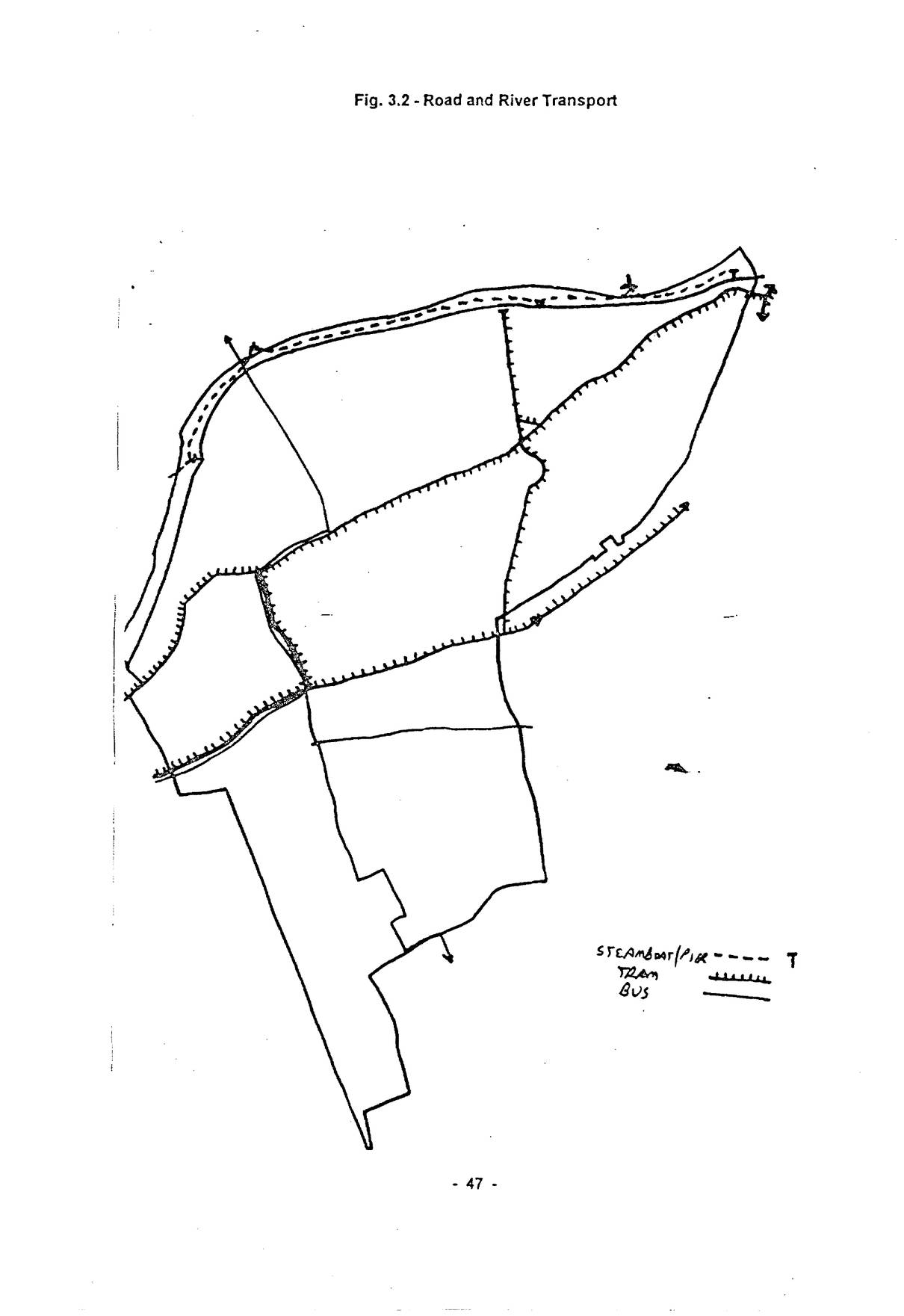
Road Transport (Fig. 3.2)
As with local railways, the bus network developed only slowly after 1840. In May 1851, Battersea was served by the following:47
1. “King William IV” Wandsworth Road-Battersea New Town-Gracechurch St.; every 30 mins, 0930-2200; journey time 30 min.; fare 6d.
2. “King’s Head” Wandsworth-St. Johns Hill-Lavender Hill then as 1. 22 buses 0800-2130; fare 1/-.
3. Wandsworth Road-Oxford St. 4 buses 0930-1930; fare 6d.
4. “King’s Head” Wandsworth-Battersea Bridge-Bank. 3 buses 0845-1900; journey 70 min.; fare 9d. – Wandsworth-Battersea 4d.; Battersea-Charing Cross 4d.
Times, frequencies and fares put these services out of the reach of most clerks or artisans. Despite the formation of the London General Omnibus Co. in 1856 and the rapid expansion of the system, Battersea remained poorly served. In December 1870, John Martin was running one bus between Battersea Bridge and Gracechurch St. via Vauxhall, with four round trips on weekdays and five on Saturdays. The first bus did not leave Battersea until 0900.49 In April 1876, when Battersea’s population was c.90,000, the Suburban Omnibus Co. began a service between Wandsworth and Vauxhall via York Rd. and Battersea Park Rd. It ran hourly, but would have been of little use to the people living in the densely-packed streets along its route. This company also ran a 2d. feeder from the “Northcote”, Battersea Rise, an area of lower-middle class estates, to the “William IV”, Wandsworth Road, starting point of the traditional services.49 Growth in south Battersea in the 1880s saw the takeover of the Clapham-Balham-Tooting service by Thomas Tilling of Peckham, who reduced the fares.50
By 1895 bus services in Battersea had improved in quantity and price, although their timings and high relative cost ensured that they still catered for an essentially middle-class
Open zoomable view
p. 48market:
(20) “Northcote”-Battersea Bridge-Knightsbridge LGOC ; every 10-12 mins.0730-2224; journey 39 mins.; 26 seats; 4.6mph.
(120) Bedford Rd. Clapham-Rise-Wandsworth-Putney Tilling 0.88d/ml; every 20 mins. 0930-2100; journey 50 mins.; 28 seats; 5.4mph.; Clapham-Falcon 2d., Leathwaite Rd-Clapham Jcn. 1d.
(122) Clapham Jcn.-Balham Stn. Tilling 1.14d/ml.; every 15 mins 0800-1230/1330-2205; journey 15 mins.; 12 seats; 7mph.
Assuming a twelve minute frequency on service 20, the total number of seats/day in each direction was: (20) 1950; (120) 900; (122) 650. This is tiny in relation to a population of 160,000. Local transport was dominated by trams and trains. The concentration of buses in central and south Battersea reflects their higher status and the failure of trams to penetrate south of Lavender Hill.
After a false start in 1861, the tramway age in south London began in earnest in 1870, and by 1890 a network radiating from the bridges had been created by several private companies.51 The South London Tramways Co. (SLT) sought approval for a line from Vauxhall to Lavender Hill in 1877-8,52 but the DBW objected. The SLT obtained an Act in 1879, with £70,000 capital and powers to construct lines from Vauxhall to Lavender Hill and from Plough Lane to Nine Elms, the latter was not permitted to cross the LSWR lines.53 The DBW obtained clauses for its “protection”, including paving the whole roadway at passing places, and conveying excavated material free to its yard. The 1880 SLT Act authorised lines from the “Falcon” to the “Princes Head”, and from Plough Lane to Wandsworth.54
Work did not start until August 1880. The contractor was Turner of Chelsea, supervised by four DBW clerks. Public service began on 1 January 1881, between the “Princes Head” and the “Royal Rifleman”, extended from 12 March to give a “Falcon”-Nine Elms service, 2.75 miles of mainly single track with passing places. The first trams were twenty-eight forty-seat double-deck cars, about 50% larger than contemporary buses. They were pulled by a stud of 108 horses, and housed in a depot in Queens Road.55 As the network grew, additional depots were provided at Clapham Junction station, Gonsalva Road, and Jews Row, Wandsworth. The following services were offered in 1882:56
1. “Falcon”-Nine Elms ev. 10 mins. 0745-2210 (2355 Sats.). c.6 mph; jny. 20 mins.
2. “Princes Head”-Chelsea Steamboat Pier ev. 10 mins. 0755-2145 (2335 Sats.)
A five-minute headway was provided along Battersea Park Road (c.6,700 seats each way), far better than the parallel railway, although the starting times were akin to those of the buses. Workmen’s tickets were apparently available in 1882. Ordinary fares were 1d.-2d., about 1d/ml.
The “Upper Road” opened in June 1882, from East Hill, Wandsworth to Westbury St., Clapham, extended to Vauxhall in 1883. The York Road-Wandsworth section also opened in 1883, along with extensions to Westminster Bridge and the Hop Exchange, Borough, which gave access to the City. The piecemeal opening led to poor financial results. Passing places were criticised as being poorly sited and insufficient, and nine more were added in 1886-7. By the 1890s, the whole of Falcon Lane was double track. In 1895 the horse tram network was at its peak, soon to be taken over by the L.C.C. and electrified:
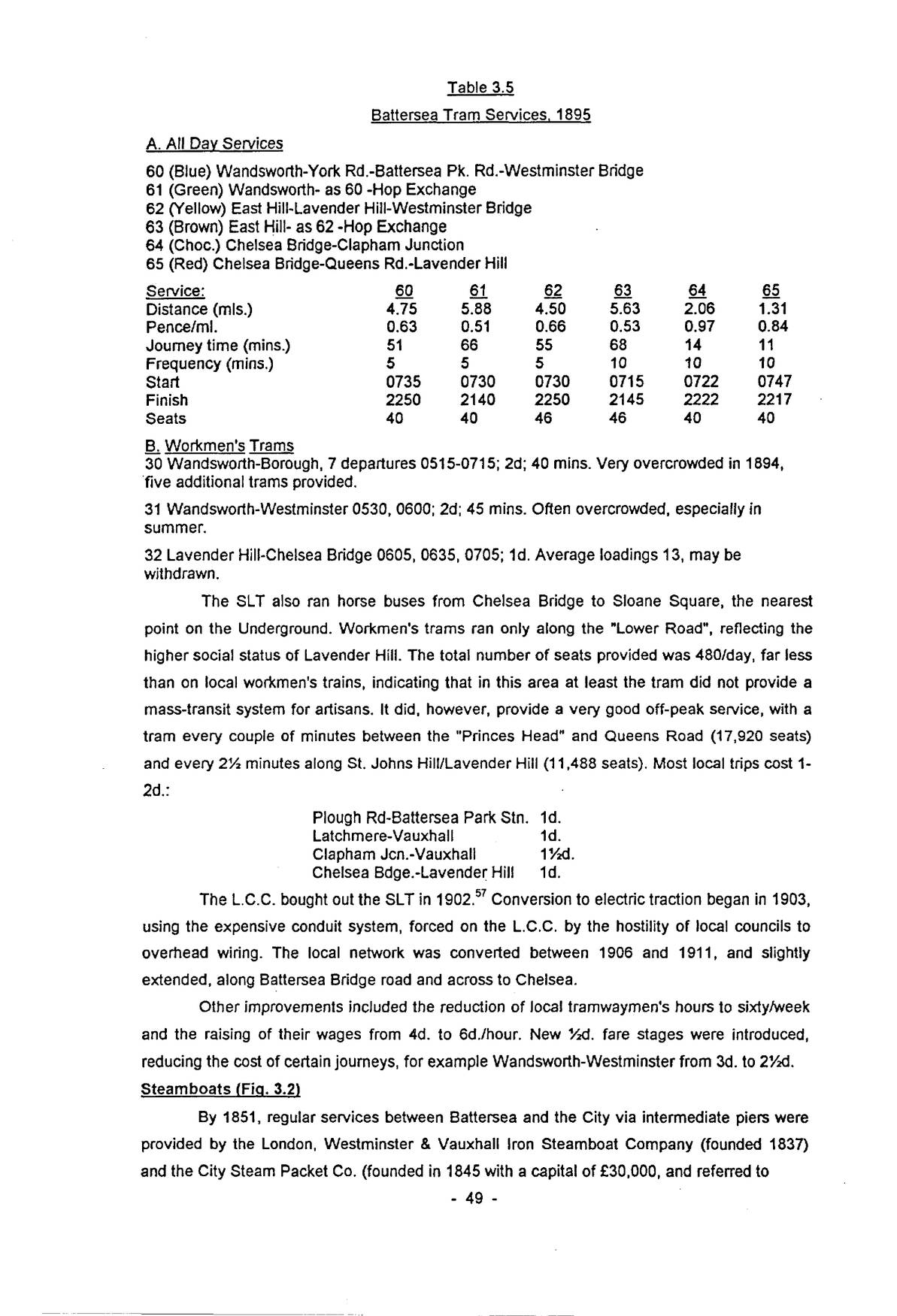
| A. All Day Services | ||||||
|---|---|---|---|---|---|---|
| 60 (Blue) Wandsworth-York Rd.-Battersea Pk. Rd.-Westminster Bridge | ||||||
| 61 (Green) Wandsworth- as 60 -Hop Exchange | ||||||
| 62 (Yellow) East Hill-Lavender Hill-Westminster Bridge | ||||||
| 63 (Brown) East Hill- as 62 -Hop Exchange | ||||||
| 64 (Choc.) Chelsea Bridge-Clapham Junction | ||||||
| 65 (Red) Chelsea Bridge-Queens Rd.-Lavender Hill | ||||||
| Service: | 60 | 61 | 62 | 63 | 64 | 65 |
| Distance (mls.) | 4.75 | 5.88 | 4.50 | 5.63 | 2.06 | 1.31 |
| Pence/ml. | 0.63 | 0.51 | 0.66 | 0.53 | 0.97 | 0.84 |
| Journey time (mins.) | 51 | 66 | 55 | 68 | 14 | 11 |
| Frequency (mins.) | 5 | 5 | 5 | 10 | 10 | 10 |
| Start | 0735 | 0730 | 0730 | 0715 | 0722 | 0747 |
| Finish | 2250 | 2140 | 2250 | 2145 | 2222 | 2217 |
| Seats | 40 | 40 | 46 | 46 | 40 | 40 |
| B. Workmen’s Trams | ||||||
| 30 Wandsworth-Borough, 7 departures 0515-0715; 2d; 40 mins. Very overcrowded in 1894, five additional trams provided. | ||||||
| 31 Wandsworth-Westminster 0530, 0600; 2d; 45 mins. Often overcrowded, especially in summer. | ||||||
| 32 Lavender Hill-Chelsea Bridge 0605, 0635, 0705; 1d. Average loadings 13, may be withdrawn. |
The SLT also ran horse buses from Chelsea Bridge to Sloane Square, the nearest point on the Underground. Workmen’s trams ran only along the “Lower Road”, reflecting the higher social status of Lavender Hill. The total number of seats provided was 480/day, far less than on local workmen’s trains, indicating that in this area at least the tram did not provide a mass-transit system for artisans. It did, however, provide a very good off-peak service, with a tram every couple of minutes between the “Princes Head” and Queens Road (17,920 seats) and every 2½ minutes along St. Johns Hill/Lavender Hill (11,488 seats). Most local trips cost 1-2d.:
| Plough Rd-Battersea Park Stn. | 1d. |
| Latchmere-Vauxhall | 1d. |
| Clapham Jcn.-Vauxhall | 1½d. |
| Chelsea Bdge.-Lavender Hill | 1d. |
The L.C.C. bought out the SLT in 1902.57 Conversion to electric traction began in 1903, using the expensive conduit system, forced on the L.C.C. by the hostility of local councils to overhead wiring. The local network was converted between 1906 and 1911, and slightly extended, along Battersea Bridge road and across to Chelsea.
Other improvements included the reduction of local tramwaymen’s hours to sixty/week and the raising of their wages from 4d. to 6d./hour. New ½d. fare stages were introduced, reducing the cost of certain journeys, for example Wandsworth-Westminster from 3d. to 2½d.
Steamboats (Fig. 3.2)
By 1851, regular services between Battersea and the City via intermediate piers were provided by the London, Westminster & Vauxhall Iron Steamboat Company (founded 1837) and the City Steam Packet Co. (founded in 1845 with a capital of £30,000, and referred to
p. 50generally as the Citizen Steamboat Co.).58 A ten-minute service was offered for 3d., far more frequent than bus and train and about one-third the price. Battersea had piers at Nine Elms (embarking point for rail passengers until 1848), the “Red House”, the “British Flag” and the “Old Swan next to Battersea church. Citizen had a boatyard close to Battersea Bridge from the late 1840s, where its fleet of vessels was maintained and in some cases built, for example the replacements for Citizen A-F,& J during the 1860s.59 In 1862 the London Steamboat Co. was registered with a capital of £100,000 to take over the Iron and City SB Cos.60
After 1880 railway and tram competition seems to have told, and also the freeing of the toll bridges in 1878-80. The London SB Co. went into liquidation in 1884. In 1887 regular services between Battersea and Woolwich ceased and thirty vessels were laid-up.61 By 1890 services were virtually restricted to the summer pleasure business.
A LCC committee recommended the provision of a service and free the piers from tolls.62 The radical Council favoured this direct solution (cf. its tramway policy) and sought powers in 1901. An Act was finally obtained in August 1904, when the extension of trams along the Embankment was imminent, and electrification was sowing some of the seeds which caused the steamboat service to fail after a few years. Thirty vessels were built, an operations began in June 1905. Battersea to London was 2-3d. single and 3-5d. return, undercutting rail, bus and tram. A workmen’s boat ran from Hammersmith at 0500, calling at all piers; the regular fifteen-minute service ran from 0700 until 1915. Some express boats called only at Westminster, Nine Elms and Battersea between London Bridge and Putney. There was a loss of £30,000 in 1905 and the service became a political issue between the Progressives and the Municipal Reformers. It was suspended in winter 1906-7, and ceased after September 1907. Despite carrying 3.2 million passengers in 1906 and 2.3m in 1907, the service lost nearly £74,000 in three years. It was the final attempt to provide a full service on the Thames.63
Retailing
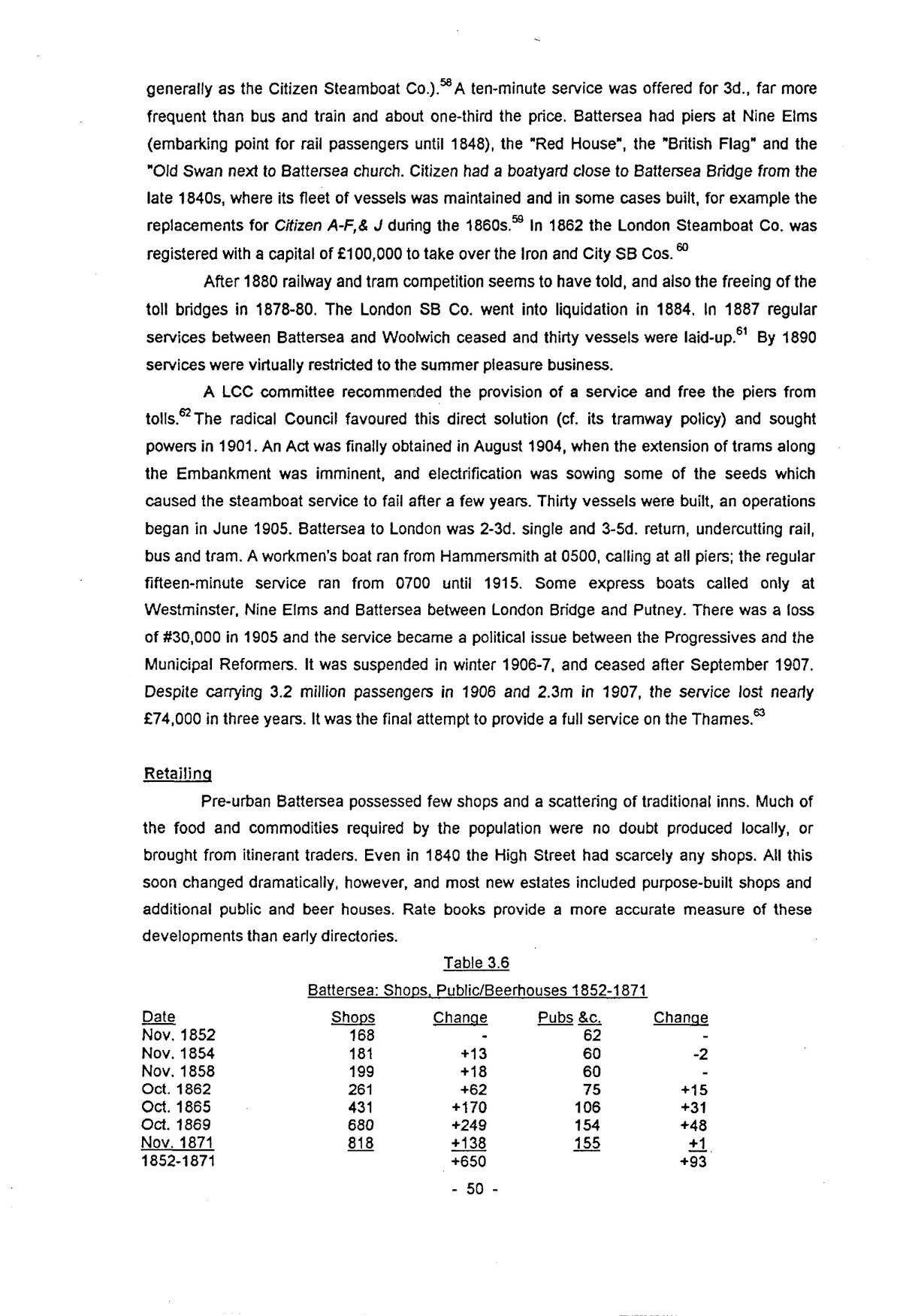
Pre-urban Battersea possessed few shops and a scattering of traditional inns. Much of the food and commodities required by the population were no doubt produced locally, or brought from itinerant traders. Even in 1840 the High Street had scarcely any shops. All this soon changed dramatically, however, and most new estates included purpose-built shops and additional public and beer houses. Rate books provide a more accurate measure of these developments than early directories.
| Date | Shops | Change | Pubs &c. | Change |
|---|---|---|---|---|
| Nov. 1852 | 168 | – | 62 | – |
| Nov. 1854 | 181 | +13 | 60 | -2 |
| Nov. 1858 | 199 | +18 | 60 | – |
| Oct. 1862 | 261 | +62 | 75 | +15 |
| Oct. 1865 | 431 | +170 | 106 | +31 |
| Oct. 1869 | 680 | +249 | 154 | +48 |
| Nov. 1871 | 818 | +138 | 155 | +1 |
| 1852-1871 | +650 | +93 |
p. 51Between 1851 and 1871, the population increased from 10,560 to 54,016 (412%), almost matched by shop provision (+387%), the ratio of inhabitants to outlets rising slightly from 62.9 to 66.0. It is the late-1860s which saw large-scale shop building, almost doubling between 1865 and 1871. The characteristic parades of shops lining some, but not all, of the main roads in Battersea began to appear. Battersea Park Road and York Road were the first of these, followed after 1870 by Lavender Hill, Falcon Road, St. John’s Road and Northcote Road, the last with a street market, decisively moving the commercial centre of gravity to the south of Clapham Junction. There were, of course, large numbers of corner shops on most estates, along with new public houses, beerhouses and off licences. The rate of growth of the latter was much less spectacular, however: 150% 1852-1871. The threshold rose from 170 persons/establishment to 348 in this period. How much this was due to the temperance movement and the restriction placed on such outlets by some estate developers and magistrates is not clear, neither is their usage quantifiable.
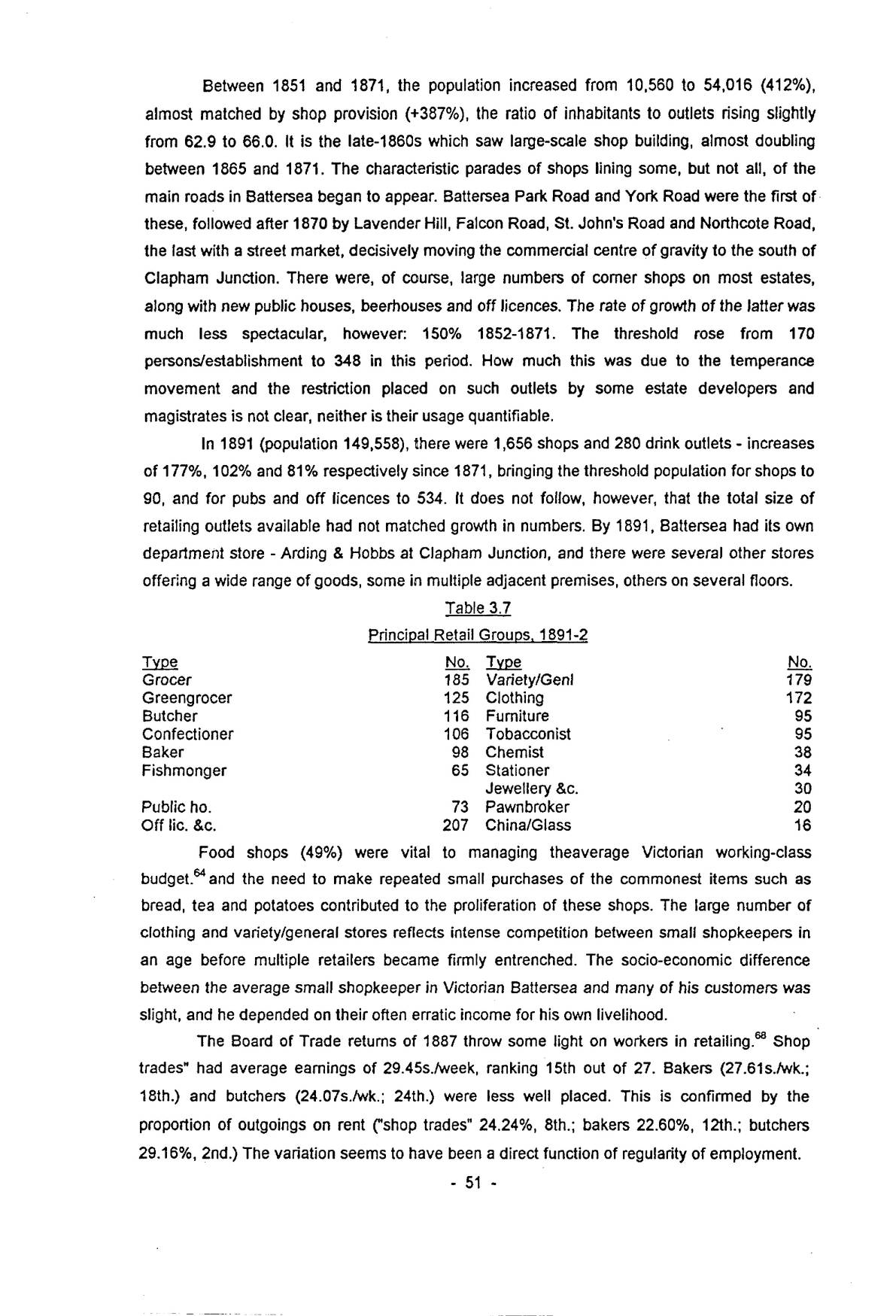
In 1891 (population 149,558), there were 1,656 shops and 280 drink outlets – increases of 177%, 102% and 81% respectively since 1871, bringing the threshold population for shops to 90, and for pubs and off licences to 534. It does not follow, however, that the total size of retailing outlets available had not matched growth in numbers. By 1891, Battersea had its own department store – Arding & Hobbs at Clapham Junction, and there were several other stores offering a wide range of goods, some in multiple adjacent premises, others on several floors.
| Type | No. | Type | No. |
|---|---|---|---|
| Grocer | 185 | Variety/Genl | 179 |
| Greengrocer | 125 | Clothing | 172 |
| Butcher | 116 | Furniture | 95 |
| Confectioner | 106 | Tobacconist | 95 |
| Baker | 98 | Chemist | 38 |
| Fishmonger | 65 | Stationer | 34 |
| Jewellery &c. | 30 | ||
| Public ho. | 73 | Pawnbroker | 20 |
| Off lic. &c. | 207 | China/Glass | 16 |
Food shops (49%) were vital to managing the average Victorian working-class budget.64 and the need to make repeated small purchases of the commonest items such as bread, tea and potatoes contributed to the proliferation of these shops. The large number of clothing and variety/general stores reflects intense competition between small shopkeepers in an age before multiple retailers became firmly entrenched. The socio-economic difference between the average small shopkeeper in Victorian Battersea and many of his customers was slight, and he depended on their often erratic income for his own livelihood.
The Board of Trade returns of 1887 throw some light on workers in retailing.68 Shop trades” had average earnings of 29.45s./week, ranking 15th out of 27. Bakers (27.61s./wk.; 18th.) and butchers (24.07s./wk.; 24th.) were less well placed. This is confirmed by the proportion of outgoings on rent (“shop trades” 24.24%, 8th.; bakers 22.60%, 12th.; butchers 29.16%, 2nd.) The variation seems to have been a direct function of regularity of employment.
p. 52While 78.5% of shopmen were regularly-employed (9th.), for bakers this fell to 71.0% (11th.) and for butchers to 67.7% (17th.) In Battersea the so-called “labour aristocracy” was found in industry, rather than distribution.
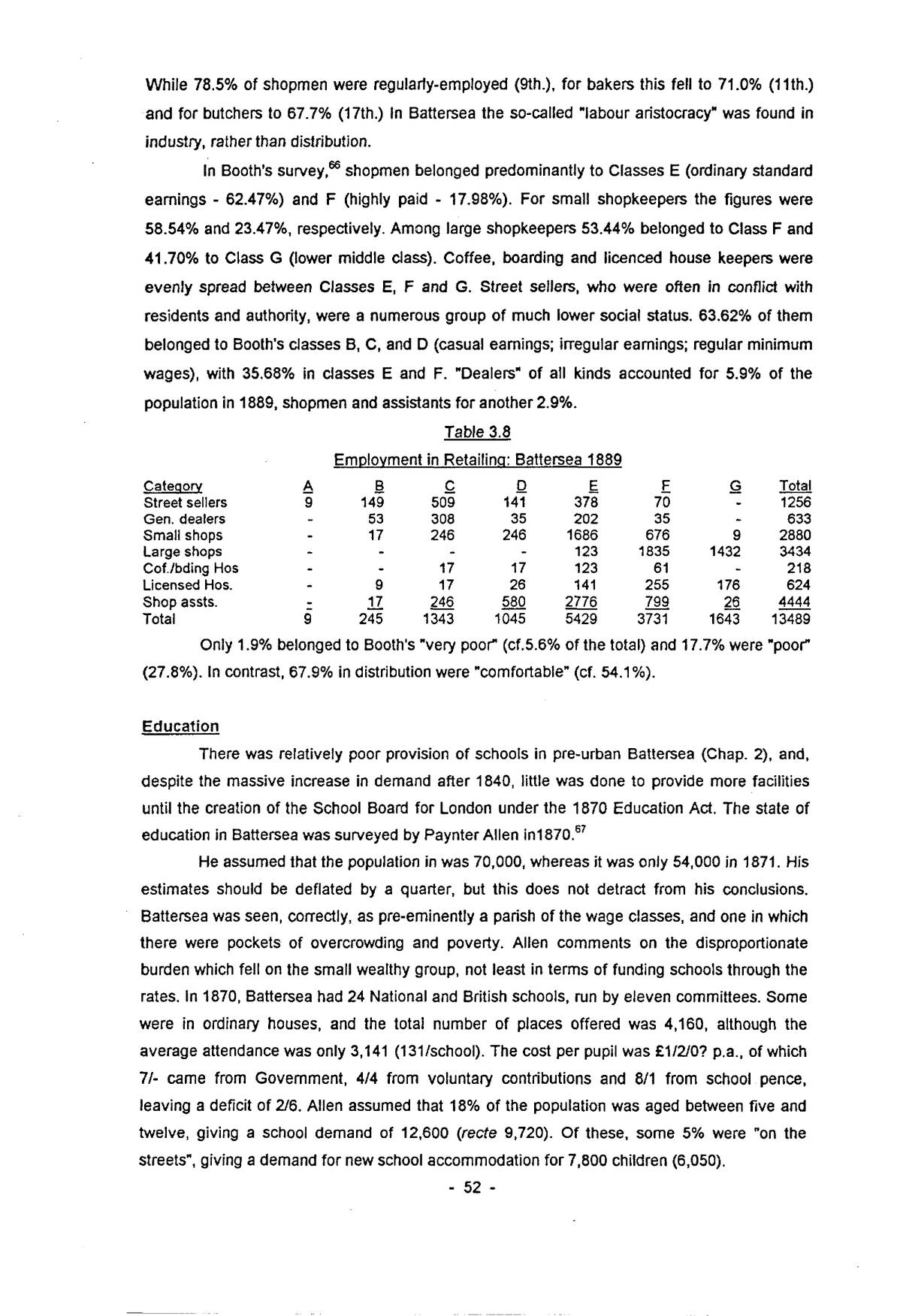
In Booth’s survey,66 shopmen belonged predominantly to Classes E (ordinary standard earnings – 62.47%) and F (highly paid – 17.98%). For small shopkeepers the figures were 58.54% and 23.47%, respectively. Among large shopkeepers 53.44% belonged to Class F and 41.70% to Class G (lower middle class). Coffee, boarding and licenced house keepers were evenly spread between Classes E, F and G. Street sellers, who were often in conflict with residents and authority, were a numerous group of much lower social status. 63.62% of them belonged to Booth’s classes B, C, and D (casual earnings; irregular earnings; regular minimum wages), with 35.68% in classes E and F. “Dealers” of all kinds accounted for 5.9% of the population in 1889, shopmen and assistants for another 2.9%.
| Category | A | B | C | D | E | F | G | Total |
|---|---|---|---|---|---|---|---|---|
| Street sellers | 9 | 149 | 509 | 141 | 378 | 70 | – | 1256 |
| Gen. dealers | – | 53 | 308 | 35 | 202 | 35 | – | 633 |
| Small shops | – | 17 | 246 | 246 | 1686 | 676 | 9 | 2880 |
| Large shops | – | – | – | – | 123 | 1835 | 1432 | 3434 |
| Cof./bding Hos | – | – | 17 | 17 | 123 | 61 | – | 218 |
| Licensed Hos. | – | 9 | 17 | 26 | 141 | 255 | 176 | 624 |
| Shop assts. | – | 17 | 246 | 580 | 2776 | 799 | 26 | 4444 |
| Total | 9 | 245 | 1343 | 1045 | 5429 | 3731 | 1643 | 13489 |
Only 1.9% belonged to Booth’s “very poor” (cf.5.6% of the total) and 17.7% were “poor” (27.8%). In contrast, 67.9% in distribution were “comfortable” (cf. 54.1%).
Education
There was relatively poor provision of schools in pre-urban Battersea (Chap. 2), and, despite the massive increase in demand after 1840, little was done to provide more facilities until the creation of the School Board for London under the 1870 Education Act. The state of education in Battersea was surveyed by Paynter Allen in 1870.67
He assumed that the population in was 70,000, whereas it was only 54,000 in 1871. His estimates should be deflated by a quarter, but this does not detract from his conclusions. Battersea was seen, correctly, as pre-eminently a parish of the wage classes, and one in which there were pockets of overcrowding and poverty. Allen comments on the disproportionate burden which fell on the small wealthy group, not least in terms of funding schools through the rates. In 1870, Battersea had 24 National and British schools, run by eleven committees. Some were in ordinary houses, and the total number of places offered was 4,160, although the average attendance was only 3,141 (131/school). The cost per pupil was £1/2/0? p.a., of which 7/- came from Government, 4/4 from voluntary contributions and 8/1 from school pence, leaving a deficit of 2/6. Allen assumed that 18% of the population was aged between five and twelve, giving a school demand of 12,600 (recte 9,720). Of these, some 5% were “on the streets”, giving a demand for new school accommodation for 7,800 children (6,050).
p. 53Private schools were much more numerous than denominational ones. Allen found 101 of them, four were brand new with no pupils, and seven had recently closed, ‘without being noticed locally’.68 Setting up such an establishment required ‘neither capital, experience, professional ability, nor special aptitude of any sort.... A card placed on Saturday will raise the nucleus of a school by Monday’. Many appear to have been child-minding facilities, occupying only one room, the mistresses alternating “teaching” with mangling and shopkeeping. Allen considered that as few as twelve were really schools, although twice that number claimed to be “select”. Attendance was irregular, averaging 1,833 (1,064 girls and 769 boys), 19/school. Charges ranged from 2d.-1/- per week, mostly 3-6d. Average weekly income was 5-6/-, less than half what a washerwoman could expect to earn.69
A further 700 children attended Industrial Schools, and 200 were educated outside Battersea. The total number at school in 1870 was therefore about 5,900, of which 500 were older than twelve and 590 under five. Using the corrected population data, this gives a balance of 3,820 with no school places, about 40%. During the 1870s, a further 9,500 children of school age were added to the local population, followed by 7,700 more in the 1880s. The arrival of the School Board was none too soon for Battersea.
Allen sampled 200 households to ascertain earnings levels. He found 1,228 people (average 6.14, very close to the 1871 Census), with 546 children aged 3-14, of which 285 were not at school (52%). Average earnings were just £1/week, with severe unemployment during the winter, made worse by the collapse of the building boom in 1869-70. Many households were headed by women, chiefly in laundry work, and Allen made the advanced suggestion that provision of nursery schools would release them to work more, and protect the children.70
The new School Board wasted no time in identifying the size of the problem and commencing a building programme which lasted thirty years, providing Victorian Battersea with its most characteristic buildings, whose great bulk – three-storied blocks with large windows in a generally “Queen Anne” style – towered above the small houses even more than local churches and chapels.71 By 1900, the Board had provided 25,054 school places, compared with a church school provision of only 4,683, hardly changed since 1870. 84% of local children received their primary education in a recently-built school. The costs given below are for the initial contracts, including ancillary works such as playgrounds and schoolkeepers’ houses. Extensions and alterations, which often transformed the size and capacity of the school, are excluded, as is the cost of land purchase included except where indicated. Table 3.12 shows the number of children at each school in 1904, when they had reached their maximum size, as well as the number of pupils on the rolls in 1882.72 Two schools were built after 1900 in areas which still had room for new houses – Wix’s Lane 1901/2; Broomwood Road 1905-9.
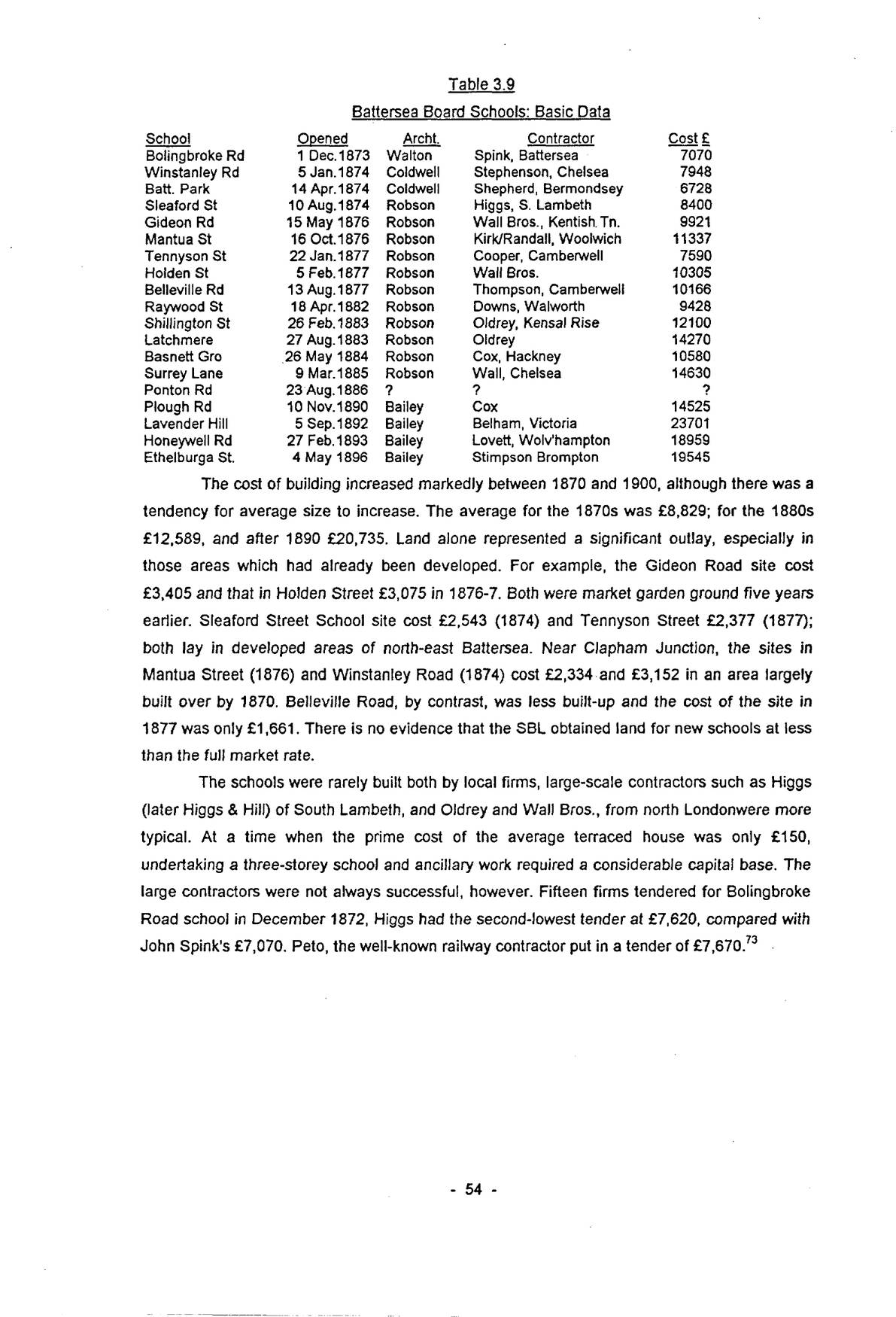
| School | Opened | Archt. | Contractor | Cost £ |
|---|---|---|---|---|
| Bolingbroke Rd | 1 Dec.1873 | Walton | Spink, Battersea | 7070 |
| Winstanley Rd | 5 Jan.1874 | Coldwell | Stephenson, Chelsea | 7948 |
| Batt. Park | 14 Apr.1874 | Coldwell | Shepherd, Bermondsey | 6728 |
| Sleaford St | 10 Aug.1874 | Robson | Higgs, S. Lambeth | 8400 |
| Gideon Rd | 15 May 1876 | Robson | Wall Bros., Kentish Tn. | 9921 |
| Mantua St | 16 Oct.1876 | Robson | Kirk/Randall, Woolwich | 11337 |
| Tennyson St | 22 Jan.1877 | Robson | Cooper, Camberwell | 7590 |
| Holden St | 5 Feb.1877 | Robson | Wall Bros. | 10305 |
| Belleville Rd | 13 Aug.1877 | Robson | Thompson, Camberwell | 10166 |
| Raywood St | 18 Apr.1882 | Robson | Downs, Walworth | 9428 |
| Shillington St | 26 Feb.1883 | Robson | Oldrey, Kensal Rise | 12100 |
| Latchmere | 27 Aug.1883 | Robson | Oldrey | 14270 |
| Basnett Gro | 26 May 1884 | Robson | Cox, Hackney | 10580 |
| Surrey Lane | 9 Mar.1885 | Robson | Wall, Chelsea | 14630 |
| Ponton Rd | 23 Aug.1886 | ? | ? | ? |
| Plough Rd | 10 Nov.1890 | Bailey | Cox | 14525 |
| Lavender Hill | 5 Sep.1892 | Bailey | Belham, Victoria | 23701 |
| Honeywell Rd | 27 Feb.1893 | Bailey | Lovett, Wolv’hampton | 18959 |
| Ethelburga St. | 4 May 1896 | Bailey | Stimpson Brompton | 19545 |
The cost of building increased markedly between 1870 and 1900, although there was a tendency for average size to increase. The average for the 1870s was £8,829; for the 1880s £12,589, and after 1890 £20,735. Land alone represented a significant outlay, especially in those areas which had already been developed. For example, the Gideon Road site cost £3,405 and that in Holden Street £3,075 in 1876-7. Both were market garden ground five years earlier. Sleaford Street School site cost £2,543 (1874) and Tennyson Street £2,377 (1877); both lay in developed areas of north-east Battersea. Near Clapham Junction, the sites in Mantua Street (1876) and Winstanley Road (1874) cost £2,334 and £3,152 in an area largely built over by 1870. Belleville Road, by contrast, was less built-up and the cost of the site in 1877 was only £1,661. There is no evidence that the SBL obtained land for new schools at less than the full market rate.
The schools were rarely built both by local firms, large-scale contractors such as Higgs (later Higgs & Hill) of South Lambeth, and Oldrey and Wall Bros., from north London were more typical. At a time when the prime cost of the average terraced house was only £150, undertaking a three-storey school and ancillary work required a considerable capital base. The large contractors were not always successful, however. Fifteen firms tendered for Bolingbroke Road school in December 1872, Higgs had the second-lowest tender at £7,620, compared with John Spink’s £7,070. Peto, the well-known railway contractor put in a tender of £7,670.73
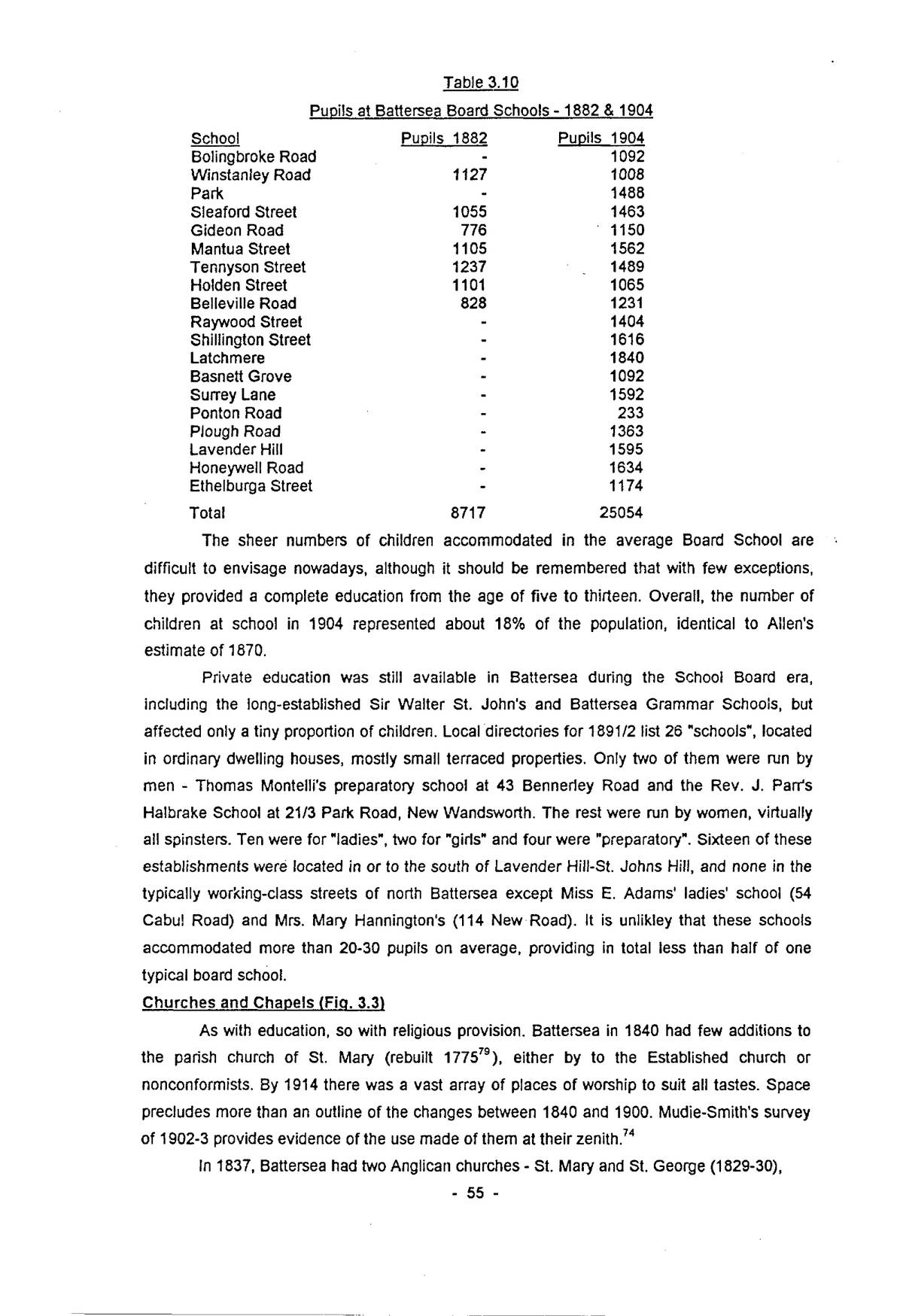
| School | Pupils 1882 | Pupils 1904 |
|---|---|---|
| Bolingbroke Road | – | 1092 |
| Winstanley Road | 1127 | 1008 |
| Park | – | 1488 |
| Sleaford Street | 1055 | 1463 |
| Gideon Road | 776 | 1150 |
| Mantua Street | 1105 | 1562 |
| Tennyson Street | 1237 | 1489 |
| Holden Street | 1101 | 1065 |
| Belleville Road | 828 | 1231 |
| Raywood Street | – | 1404 |
| Shillington Street | – | 1616 |
| Latchmere | – | 1840 |
| Basnett Grove | – | 1092 |
| Surrey Lane | – | 1592 |
| Ponton Road | – | 233 |
| Plough Road | – | 1363 |
| Lavender Hill | – | 1595 |
| Honeywell Road | – | 1634 |
| Ethelburga Street | – | 1174 |
| Total | 8717 | 25054 |
The sheer numbers of children accommodated in the average Board School are difficult to envisage nowadays, although it should be remembered that with few exceptions, they provided a complete education from the age of five to thirteen. Overall, the number of children at school in 1904 represented about 18% of the population, identical to Allen’s estimate of 1870.
Private education was still available in Battersea during the School Board era, including the long-established Sir Walter St. John’s and Battersea Grammar Schools, but affected only a tiny proportion of children. Local directories for 1891/2 list 26 “schools”, located in ordinary dwelling houses, mostly small terraced properties. Only two of them were run by men – Thomas Montelli’s preparatory school at 43 Bennerley Road and the Rev. J. Parr’s Halbrake School at 21/3 Park Road, New Wandsworth. The rest were run by women, virtually all spinsters. Ten were for “ladies”, two for “girls” and four were “preparatory”. Sixteen of these establishments were located in or to the south of Lavender Hill-St. Johns Hill, and none in the typically working-class streets of north Battersea except Miss E. Adams’ ladies’ school (54 Cabul Road) and Mrs. Mary Hannington’s (114 New Road). It is unlikely that these schools accommodated more than 20-30 pupils on average, providing in total less than half of one typical board school.
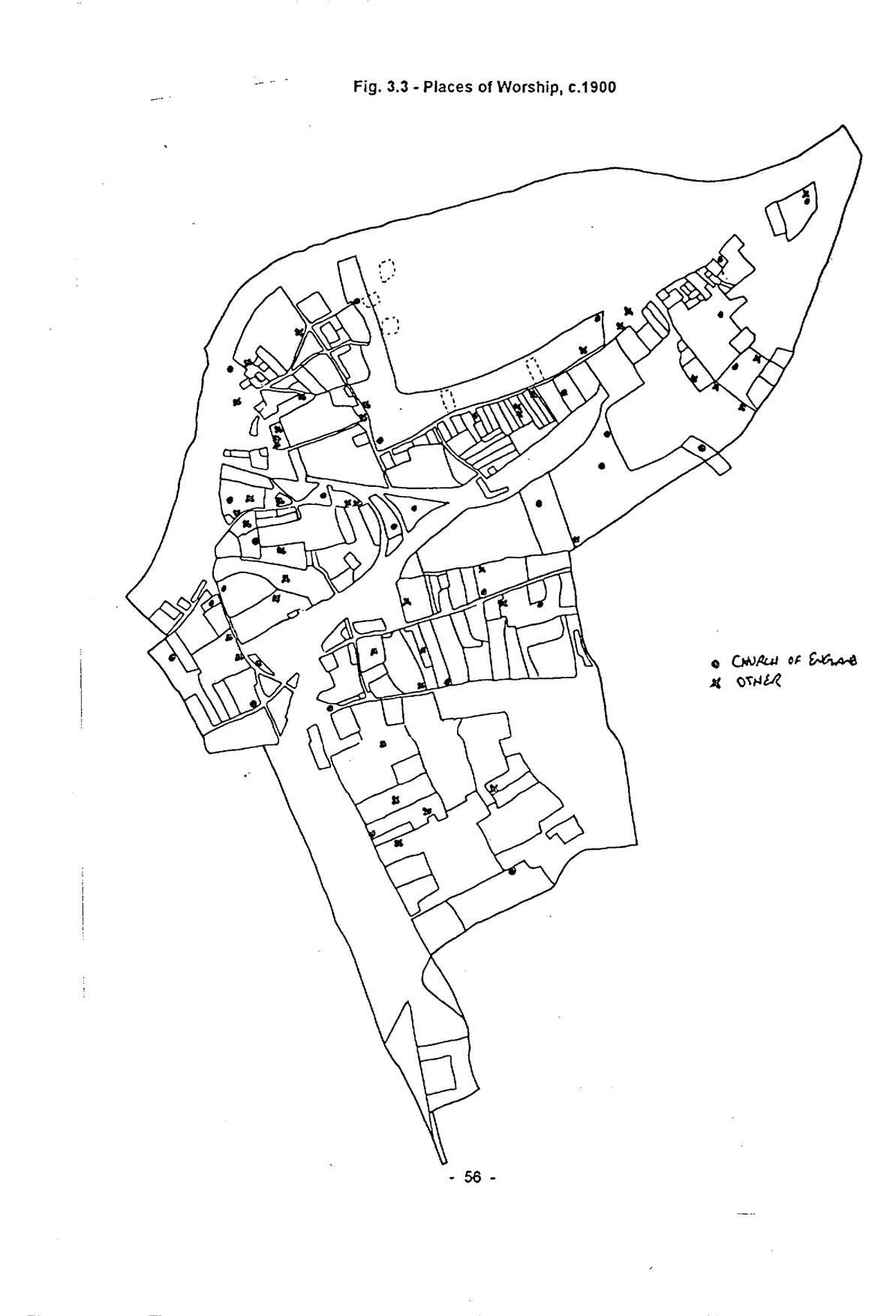
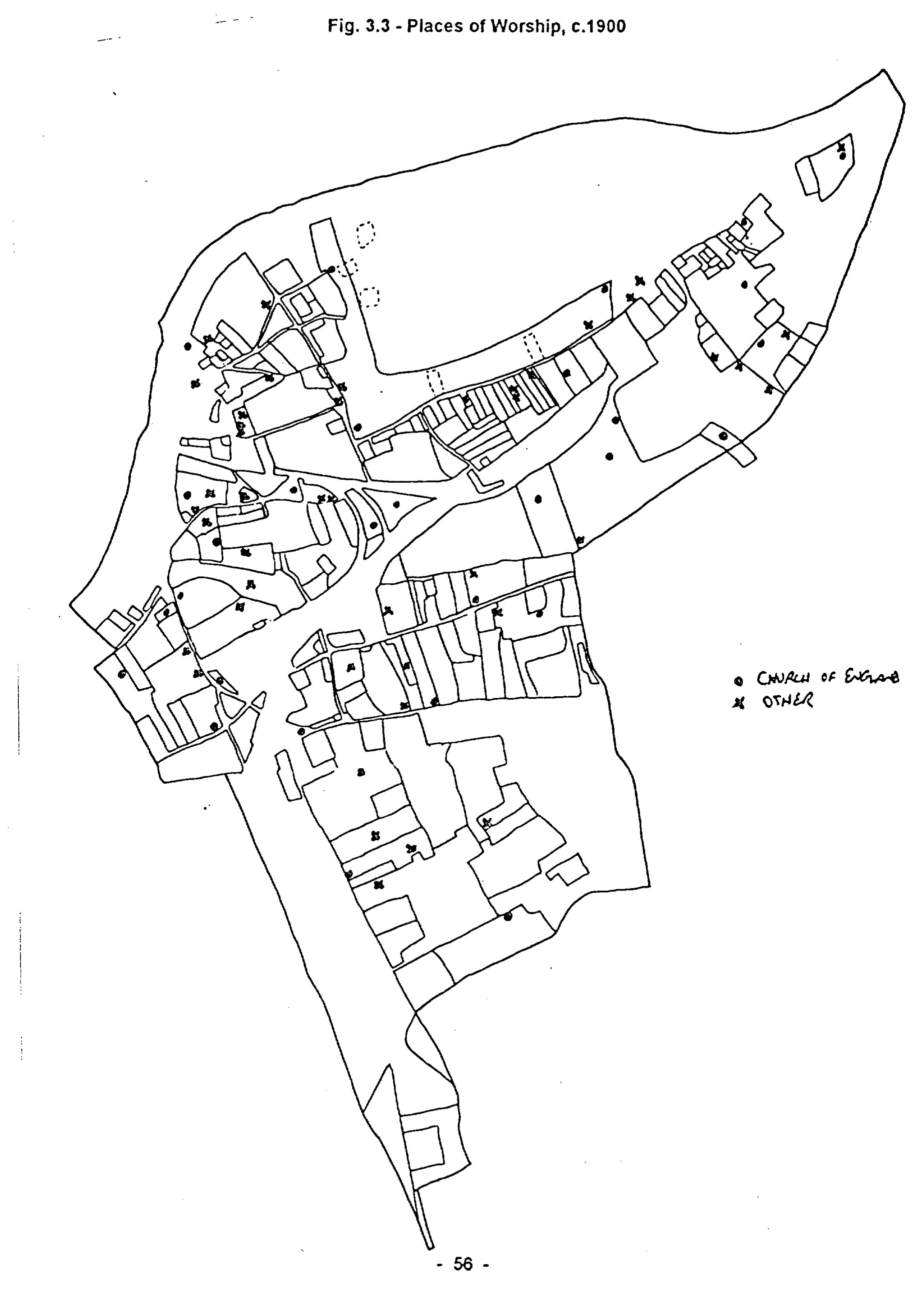
Churches and Chapels (Fig. 3.3)
As with education, so with religious provision. Battersea in 1840 had few additions to the parish church of St. Mary (rebuilt 177579), either by to the Established church or nonconformists. By 1914 there was a vast array of places of worship to suit all tastes. Space precludes more than an outline of the changes between 1840 and 1900. Mudie-Smith’s survey of 1902-3 provides evidence of the use made of them at their zenith.74
In 1837, Battersea had two Anglican churches – St. Mary and St. George (1829-30),
Open zoomable view
p. 57and the Baptist chapel in York Road (1770, founded 1736). By 1901, there were 25 Anglican churches and missions and 44 nonconformist places of worship. Attendance at these in 1902-3 was 7,116 and 8,824 respectively (deflated to allow for those attending more than once75), averages of 285 and 201 persons/establishment. This represents one-tenth of the population (4.23% Anglican; 5.25% other) and explodes the myth of Victorian religious observance in this suburb at least. The proportions of men, women and children under fifteen were: Anglican 22.2%; 42.8% and 34.9%; and Nonconformist 29.1%; 37.4% and 33.5%. Children were unlikely to have been present voluntarily, and the proportion of church attendees was 7.8% of men and 11.9% of women.
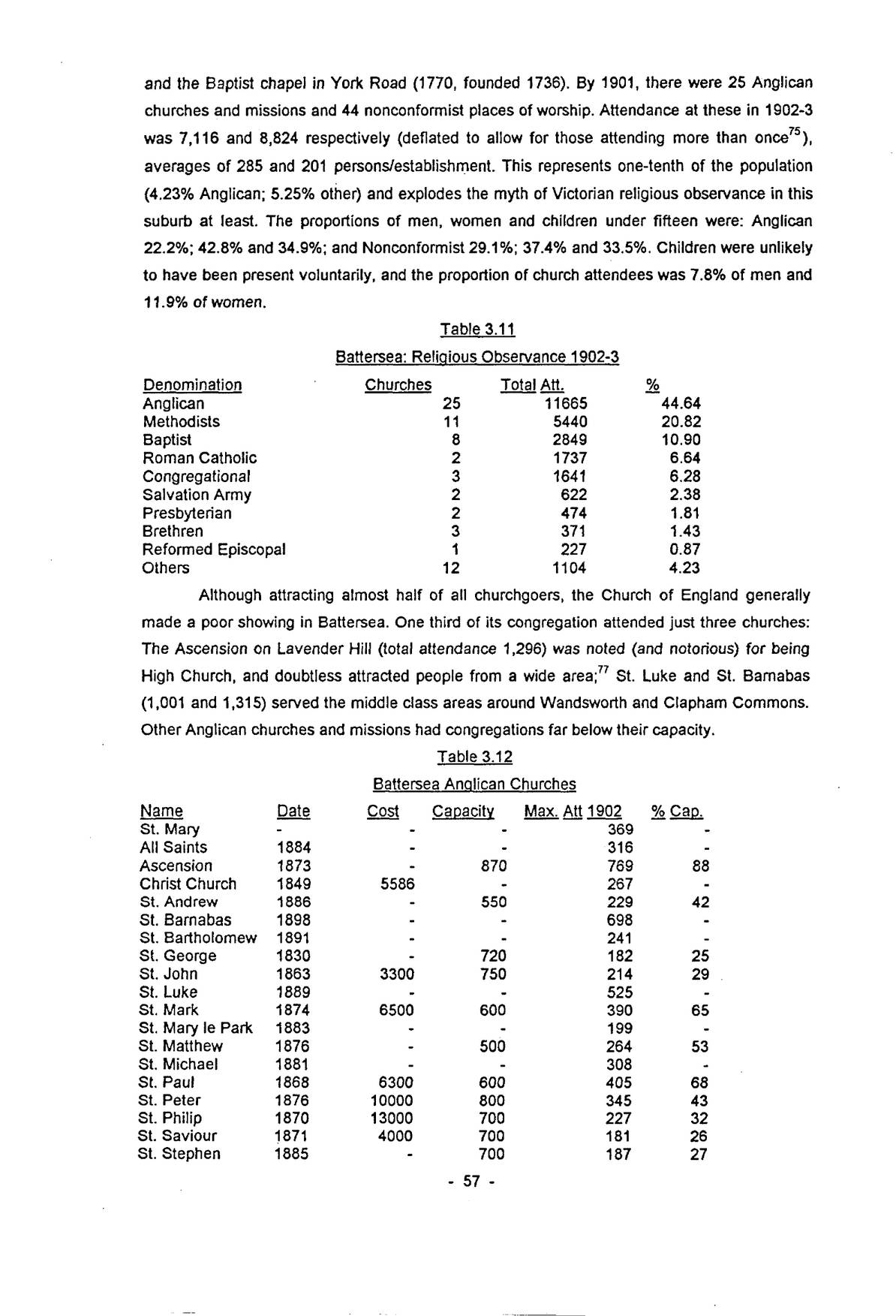
| Denomination | Churches | Total Att. | % |
|---|---|---|---|
| Anglican | 25 | 11665 | 44.64 |
| Methodists | 11 | 5440 | 20.82 |
| Baptist | 8 | 2849 | 10.90 |
| Roman Catholic | 2 | 1737 | 6.64 |
| Congregational | 3 | 1641 | 6.28 |
| Salvation Army | 2 | 622 | 2.38 |
| Presbyterian | 2 | 474 | 1.81 |
| Brethren | 3 | 371 | 1.43 |
| Reformed Episcopal | 1 | 227 | 0.87 |
| Others | 12 | 1104 | 4.23 |
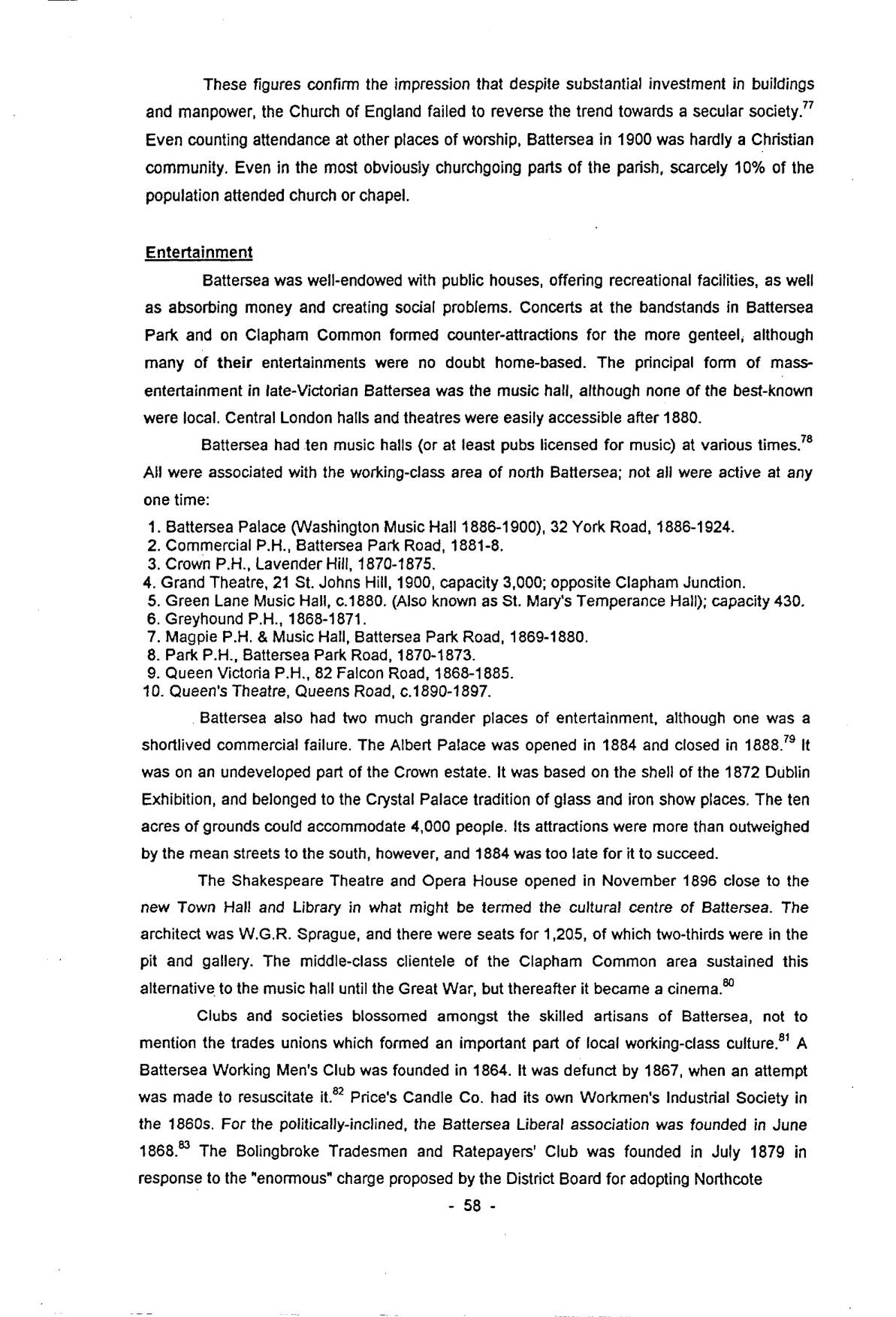
Although attracting almost half of all churchgoers, the Church of England generally made a poor showing in Battersea. One third of its congregation attended just three churches: The Ascension on Lavender Hill (total attendance 1,296) was noted (and notorious) for being High Church, and doubtless attracted people from a wide area;77 St. Luke and St. Barnabas (1,001 and 1,315) served the middle class areas around Wandsworth and Clapham Commons. Other Anglican churches and missions had congregations far below their capacity.
| Name | Date | Cost | Capacity | Max. Att 1902 | % Cap. |
|---|---|---|---|---|---|
| St. Mary | – | – | – | 369 | – |
| All Saints | 1884 | – | – | 316 | – |
| Ascension | 1873 | – | 870 | 769 | 88 |
| Christ Church | 1849 | 5586 | – | 267 | – |
| St. Andrew | 1886 | – | 550 | 229 | 42 |
| St. Barnabas | 1898 | – | – | 698 | – |
| St. Bartholomew | 1891 | – | – | 241 | – |
| St. George | 1830 | – | 720 | 182 | 25 |
| St. John | 1863 | 3300 | 750 | 214 | 29 |
| St. Luke | 1889 | – | – | 525 | – |
| St. Mark | 1874 | 6500 | 600 | 390 | 65 |
| St. Mary le Park | 1883 | – | – | 199 | – |
| St. Matthew | 1876 | – | 500 | 264 | 53 |
| St. Michael | 1881 | – | – | 308 | – |
| St. Paul | 1868 | 6300 | 600 | 405 | 68 |
| St. Peter | 1876 | 10000 | 800 | 345 | 43 |
| St. Philip | 1870 | 13000 | 700 | 227 | 32 |
| St. Saviour | 1871 | 4000 | 700 | 181 | 26 |
| St. Stephen | 1885 | – | 700 | 187 | 27 |
p. 58These figures confirm the impression that despite substantial investment in buildings and manpower, the Church of England failed to reverse the trend towards a secular society.77 Even counting attendance at other places of worship, Battersea in 1900 was hardly a Christian community. Even in the most obviously churchgoing parts of the parish, scarcely 10% of the population attended church or chapel.
Entertainment
Battersea was well-endowed with public houses, offering recreational facilities, as well as absorbing money and creating social problems. Concerts at the bandstands in Battersea Park and on Clapham Common formed counter-attractions for the more genteel, although many of their entertainments were no doubt home-based. The principal form of mass-entertainment in late-Victorian Battersea was the music hall, although none of the best-known were local. Central London halls and theatres were easily accessible after 1880.
Battersea had ten music halls (or at least pubs licensed for music) at various times.78 All were associated with the working-class area of north Battersea; not all were active at any one time:
1. Battersea Palace (Washington Music Hall 1886-1900), 32 York Road, 1886-1924.
2. Commercial P.H., Battersea Park Road, 1881-8.
3. Crown P.H., Lavender Hill, 1870-1875.
4. Grand Theatre, 21 St. Johns Hill, 1900, capacity 3,000; opposite Clapham Junction.
5. Green Lane Music Hall, c.1880. (Also known as St. Mary’s Temperance Hall); capacity 430.
6. Greyhound P.H., 1868-1871.
7. Magpie P.H. & Music Hall, Battersea Park Road, 1869-1880.
8. Park P.H., Battersea Park Road, 1870-1873.
9. Queen Victoria P.H., 82 Falcon Road, 1868-1885.
10. Queen’s Theatre, Queens Road, c.1890-1897.
Battersea also had two much grander places of entertainment, although one was a shortlived commercial failure. The Albert Palace was opened in 1884 and closed in 1888.79 It was on an undeveloped part of the Crown estate. It was based on the shell of the 1872 Dublin Exhibition, and belonged to the Crystal Palace tradition of glass and iron show places. The ten acres of grounds could accommodate 4,000 people. Its attractions were more than outweighed by the mean streets to the south, however, and 1884 was too late for it to succeed.
The Shakespeare Theatre and Opera House opened in November 1896 close to the new Town Hall and Library in what might be termed the cultural centre of Battersea. The architect was W.G.R. Sprague, and there were seats for 1,205, of which two-thirds were in the pit and gallery. The middle-class clientele of the Clapham Common area sustained this alternative to the music hall until the Great War, but thereafter it became a cinema.80
Clubs and societies blossomed amongst the skilled artisans of Battersea, not to mention the trades unions which formed an important part of local working-class culture.81 A Battersea Working Men’s Club was founded in 1864. It was defunct by 1867, when an attempt was made to resuscitate it.82 Price’s Candle Co. had its own Workmen’s Industrial Society in the 1860s. For the politically-inclined, the Battersea Liberal association was founded in June 1868.83 The Bolingbroke Tradesmen and Ratepayers’ Club was founded in July 1879 in response to the “enormous” charge proposed by the District Board for adopting Northcote
p. 59Road.84 It met first at the Invitation Tavern, moving to the Railway Tavern in late-1887. It met fortnightly, and the subscription was 5/- p.a. Despite politics being strictly excluded, the Club was active in the nomination and election of vestrymen, guardians and other local representatives, including the free library movement and the Wandsworth Common Conservators. The inaugural meeting was attended by Alfred Heaver, at that time just beginning his career as a major developer. Other social and sporting groups included the “Good Intent” Buffalo Lodge, which met at the Prince’s Head, and the United Railway Cricket Club.85 The Battersea Tradesmen’s Club met at the Royal Arms in Battersea Park Road. Its president in 1889, Mr. Bloor, was a butcher and vestryman. His predecessor Coulson Laceby had been a driver on the underground railway, but later owned a chain of four pubs.86 The aims and objectives seem to have been very similar to the Bolingbroke Club’s.