Build 6 — 31 July 2026
Grove House - House No. 2 of the Five Houses
Name: Grove House — House No. 2
Date Built: 1777–78
Date Demolished: Sold to developer H. N. Corsellis and demolished in 1889
Land purchased from: Earl Spencer
Builder/Developer: Philip Norris
Architect: John Scott
Location: The house was located between Belleville Road and Kelmscott Road, surprisingly close to Bolingbroke House (House No. 1 in the lane).
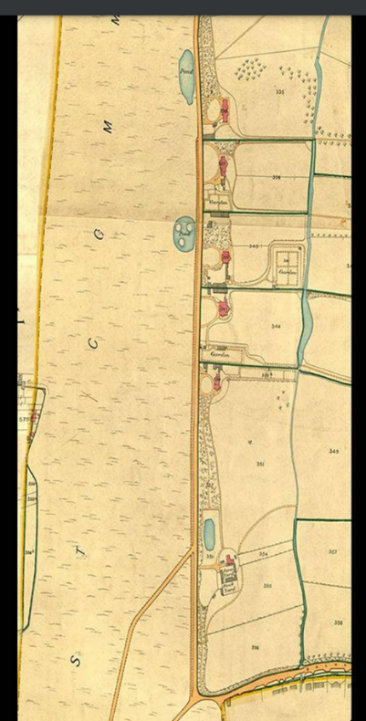
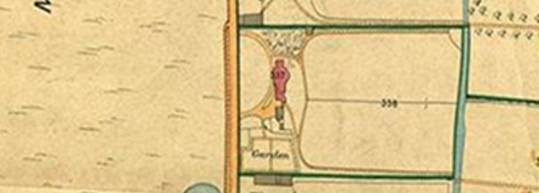
Grove House had a similar long, rectangular footprint to Bolingbroke House, comprising wings either side of a central core. It had a carriage drive and stables. The house was smaller than Bolingbroke House and its estate considerably so, according to the tithe map of 1838/40.
[To be added]

| Years | Occupants | Details |
|---|---|---|
| 1778 | John Scott | First lessee |
| 1789–1804 | Edward Fawkes | |
| 1804–1806 | Henry Barchard | Wine merchant |
| 1807–1837 | Alexander Champion | Prominent whaler, merchant and director of the Bank of England |
| 1870–1889 | Charlotte Ellen Blackmore | |
| 1889 | Nicholas Corsellis | Solicitor and property developer |
| 1889 | HOUSE DEMOLISHED | For development |
Grove House (or confusingly sometimes The Grove), Bolingbroke Grove, was built as part of the same speculative project by Robert Dent, 1777–78, and was designed by John Scott, a surveyor and associate of the Norris family. It was unfinished in 1778 when Scott became the first lessee (Lambeth Archive LA, I/10732, 10736). It was probably, but not definitely, built by Philip Norris.
In addition to owning the freehold to Bolingbroke House, William Willis purchased the freehold to Grove House, and this was occupied for some time by Edward Fawkes.
Fawkes was succeeded for a short period by Henry Barchard, a wine merchant, before the lease on the house was taken by Alexander Champion. He was obviously a rich man because his daughter and co-heiress, Harriet, was described as bringing a 'considerable fortune' to her husband, the antiquary Thomas Streatfield.
[PB: I've written about the Champions in September 2022's Chronicles. There may be something to add here. Also, the possible connection with Price's candle works, because they used whale oil.]
Alexander's wife, Ann, continued living there after his death in 1808 with her two daughters Maria and Elizabeth. Ann died in April 1837. The two daughters were left the leasehold of the house and stayed there for the rest of their lives, Elizabeth being the last to die in 1870, having subsequently bought the freehold from Willis's successor.
Thereafter Grove House descended through his family to Charlotte Ellen Blackmore, later wife of the Rev John Pincher Faunthorpe, principal of Whitelands College, Chelsea. It was their family home c.1870–1889, when they sold to developer H. N. Corsellis.
The house was demolished in 1889 and the western ends of Kelmscott and Bramfield Roads were built over the site.
In 1889 Henry Nicholas Corsellis, the Wandsworth solicitor and developer, bought Grove House, the last of the Five Houses in private use. Corsellis took possession of a rectangular plot, sandwiched between the streets of the Conservative Land Society's estate, formerly Bolingbroke House, and the Chatham Road development of house number three, Bolingbroke Grove House. His surveyor and builder, William Stanbury, followed their lead and laid out two more east–west streets, with return frontages to Webb's Road and Bolingbroke Grove, both of which were widened at this point.
[PB: The Corsellis family - very significant locally. First, the lawyer father (A.A. - Arthur Alexander - who John Buckmaster absolutely LOATHED because of his roles in local vestries and the Wandsworth Board of Works), then the son Nicholas. Nicholas is responsible for acquiring several estates e.g. Bramblebury on West Side and "developing" them. He's buried in Magdalen Road Cemetery. I'll talk to Keith Bailey. Definitely worth a box feature. ]
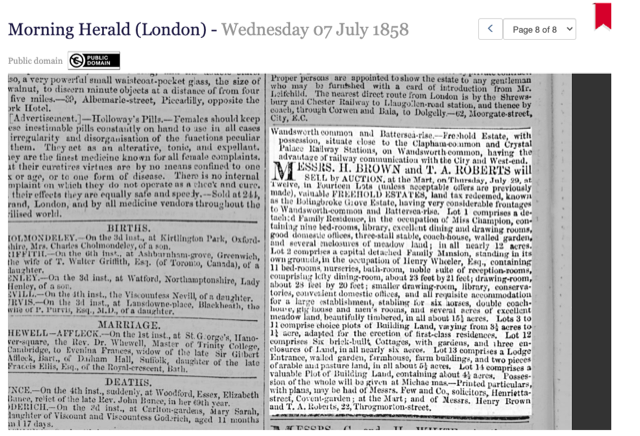
The advert below shows that in 1858 the house and freehold estate was put up for sale by auction.
Wandsworth Common and Battersea-rise
Freehold Estate, with possession, situate close to the Clapham-common and Crystal Palace Railway Stations, on Wandsworth-common, having the advantage of railway communication with the City and West-end.
MESSRS. H. BROWN and T. A. ROBERTS will SELL by AUCTION, at the Mart, on Thursday, July 29, at Twelve, in Fourteen Lots (unless acceptable offers are previously made), valuable FREEHOLD ESTATES, land tax redeemed, known as the Bolingbroke Grove Estate, having very considerable frontages to Wandsworth-common and Battersea-rise.
Lot 1 comprises a detached Family Residence, in the occupation of Miss Champion, containing nine bedrooms, library, excellent dining and drawing rooms, good domestic offices, three-stall stable, coach-house, walled gardens and several enclosures of meadow land; in all nearly 12 acres.
Lot 2 comprises a capital detached Family Mansion, standing in its own grounds, in the occupation of Henry Wheeler, Esq., containing 11 bed-rooms, nurseries, bath-room, noble suite of reception-rooms, comprising lofty dining-room, about 23 feet by 21 feet; drawing-room, about 23 feet by 20 feet; smaller drawing-room, library, conservatories, convenient domestic offices, and all requisite accommodation for a large establishment, stabling for six horses, double coach-house, gighouse and men's rooms, and several acres of excellent meadow land, beautifully timbered, in all about 15½ acres.
Lots 3 to 11 comprise choice plots of Building Land, varying from 3 to 1½ acres, adapted for the erection of first-class residences.
Lot 12 comprises six brick-built Cottages, with gardens, and three enclosures of Land, in all nearly six acres.
Lot 13 comprises a Lodge Entrance, walled garden, farmhouse, farm buildings, and two pieces of arable and pasture land, in all about 5½ acres.
Lot 14 comprises a valuable Plot of Building Land, containing about 4½ acres. Possession of the whole will be given at Michaelmas.
Maria Champion was baptised on 7 March 1778, London (father Alexander, mother Ann). She died Wandsworth 1852, Quarter 2, aged 75. Elizabeth Champion was baptised 5 March 1780, London; died 1870 Wandsworth, Quarter 2, aged 90. The cousin Charlotte Ellen Blackmore, living with her relatives in 1851 and 1861, married John Pincher Faunthorpe on 25 August 1870 in South Milton, Devon.
Maria Champion (aged approx. 60), of independent means, was living in the house with her sister, Elizabeth, of a similar age. They had six servants living in: James Toyer (30), William Reaves (45), Edward Russell (15), Jane Spinks (40), Jane Street (20) and Maria Wallis (15). All ages are rounded to the nearest five years on the 1841 census.
The house was still occupied by Elizabeth Champion (71, unmarried, fundholder) and her sister Maria (73, unmarried), together with two great-nephews, Albert C. Petty (5) and William H. Petty (3), and a cousin, Ellen C. Blackmore (14). They had two visitors staying and seven live-in servants: Eliza Routledge (44), cook; Eliza Street (34), ladies' maid; Frances Street (32), upper housemaid; Charlotte Browne (31), under housemaid; William Reaves (64), coachman; James Nayland (37), footman; and William Anscombe (18), farm lad.
Elizabeth Champion (81, fundholder) was still resident, with her cousin Charlotte E. Blackmore (24), and two boarders: Clare Streatfield, widow (67), and John F. Streatfield (32), MRCS Eng, Surgeon. There were seven live-in servants: Elizabeth Routledge (53), Frances J. Street (42), Jane Anscomb (23), William Reaves (73), Charles Worthington (26), Lawrence Castle (26), and Joseph Sharp (41), garden servant.
In residence were John P. Faunthorpe, head of household (31, married, MA of London, clergyman, vice-principal of St John's College, Battersea), with his wife Charlotte Ellen (34), and four live-in servants: Lydia Shapland (58), housekeeper; Jane Anscomb (32), parlourmaid; Emily Stanford (23), housemaid; and Mary Ann Murphy (17), kitchen maid. Over the stables lived Ebenezer Ford (44), coachman, born Cheddington, Sussex, with his wife Mary (53), born Wiveliscombe, Somerset, and their two sons William (17), born Bermondsey, and Richard (13), born Peckham Rye.
John P. Faunthorpe was head (41, clergyman) with his wife Charlotte (44) and children John Champion (9), Bertram Platt (8), Muriel (3) and Clement Lingard (1), all born in Battersea. Their live-in servants were Jane Anscomb (43), nurse; Ann Page (13), under nurse; and Ann Hughes (29), housemaid.
The Faunthorpe family had moved to Bromley, and Grove House was demolished about 1890 after being purchased by a developer. Approval was granted in March 1890 for the development of the Rev John Faunthorpe Estate.
Of the children of John and Charlotte Faunthorpe: John Champion was a Colonel, and in 1924 was retired from the Indian Civil Service. He was born in 1871 Wandsworth, died 1 December 1929 Lucknow, Bengal, aged 58. Bertram Platt was baptised 28 December 1872 at Holy Trinity, Upper Tooting; in 1939 he was a retired schoolmaster in Fleet, Hampshire. Muriel was born in 1877 Wandsworth, died Bromley 1901. Clement Lingard was baptised 7 June 1889 in Battersea (implying the family were still at The Grove at that date); in World War I he was a Second Lieutenant in the 1st Royal West Kent Regiment; he died in Malvern in 1964.
John Pincher Faunthorpe died in Bromley in 1924. Charlotte, his wife, died on 28 October 1900. One of their servants, Jane Anscomb, was with them from 1861 to 1901. She never married. She was born in West Hoathly, Sussex, and baptised 13 May 1838 to James and Ann of East Grinstead. Her father was a labourer. She died after 1901.
[SCV: WE SHOULD MOVE THE SECTION ON KEY INDIVIDUALS TO BEFORE THE SERVANTS.
PB: DONE.]
SCV DON’T LIKE THE HEADING - "Bios of key individuals " - PERHAPS WE COULD CHANGE IT.]
The Survey of London states that Edward Fawkes lived at Grove House from about 1789 until about 1804 and was the son of a prominent Guildford mercer. He was born on 30 November 1760 in Surrey to Edward and Mary Fawkes. He married Sarah Shaw Tritton (1765–1818) on 10 December 1783 at the Quaker Meeting House in Wandsworth. They had four children, including Edward, the eldest, born 1786 in Battersea.
From the land tax records he was at first an occupier (William Dent, owner) and later owner of property on "The Common", Battersea, between the Willises and the house of Matthew Chalie, from 1789 until 1804. His wife died in 1818 and was buried in Wandsworth, aged 53. His Will was proved on 28 January 1829, stating that he was late of York Place, Portman Square, now of Waddon, Surrey, Esquire.
Henry lived at Grove House for only about two years, after the Fawkes family had vacated it and preceding Alexander Champion, who moved there in 1807. He was born in 1781 in Hatton Garden, London, baptised at St Andrew, Holborn on 19 January 1781. He married Anna Maria Fawkes, eldest child of Edward and Sarah, the previous occupants of Grove House. They married at St Margaret's, Westminster on 19 February 1805, during the period that Henry lived at Grove House.
[PB: It would be good to establish his relationship with George Fergusson Wilson's wife, born Barchard. The Wilsons owned Price's Candle Works, and lived in what some call Black Sea House, on the site of Spencer Park. ]
Henry and Anna Maria had three daughters. Anna Maria presumably died between 1812 and 1818, when Henry remarried. His second wife was Elizabeth Daniel (possibly née Walker) and they married on 28 May 1818 at All Saints, Wandsworth. He is described as a wine merchant. Henry died in 1868 in Wandsworth, aged 87.
Alexander Champion (junior) (11 November 1751 – 6 April 1809) was a London-based merchant and active as a whaler in the late 18th century. His father was especially significant in the history of whaling in the United Kingdom. The Champion family was from Berkshire and moved to London in the early 18th century. Champion appeared regularly before the Committee of the Privy Council for Trade and Plantations as spokesman for the Southern Fishery. One of the Galapagos Islands is named after him.
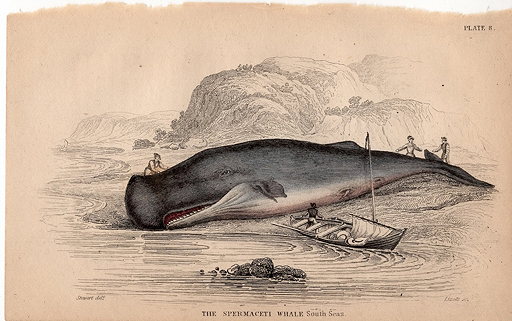
[PB: Must add a map, engraving or similar!]
Alexander Champion was heavily involved with his partners in whaling and is credited as "the founder of British whaling" about 1775. An embargo had been placed on whale oil exports from New England in 1775 as a result of the American Revolutionary War. Samuel Enderby was Alexander's business partner, and he elected to pursue the whaling trade in the South Atlantic. When James Cook returned to Britain from his voyage into the South Atlantic in 1775, during which he crossed the Antarctic Circle for the first time, he reported that the seas were full of whales and seals.
Samuel Enderby founded the Samuel Enderby & Sons company the following year, when he and his business partners Alexander Champion and John St. Barbe assembled a fleet of twelve whaling vessels on the Greenwich Peninsula. Alexander Champion was a London alderman, one of the directors of the Bank of England, and of the London Dock Company. He died on 6 April 1809 at his house in Battersea, after two days' illness, having been taken ill at the Bank on the 4th. He was buried in Bromley, Kent.
Alexander Champion died in his house, Grove House, in 1809, but his daughter Elizabeth (born in 1780) did not die until 1870.
Miss Elizabeth Champion's Will — Illustrated London News, Saturday 10 September 1870:

The late Miss Elizabeth Champion, of Wandsworth-common, whose will has just been proved under £120,000, left legacies to several charitable institutions, including the Society for Promoting Christian Knowledge, Society for the Spread of the Gospel, Church Building Society, National Education Society, National Benevolent Institution, Governesses' Benevolent Institution, Metropolitan Convalescent Institution, Bethlem, London, and St. George's Hospitals, each £100; and the Church Missionary Society, St. Ann's Schools, Asylum for the Indigent Blind, Asylum for Deaf and Dumb, Battersea National Schools, and Surrey Society for the Employment of Discharged Prisoners, £50 each.
[PB: There's a monument to her in St Mary's Church, I think, and a plaque commemorating her generosity in establoishing a school in Battersea. Good to add.]
In 1871 Ebenezer Ford was living with his wife and two sons over the stables of Grove House, he being the family coachman. In 1881 they were at Worcester Park House stables, where Ebenezer was the coachman — he went with the Wheeler family when they left Bolingbroke House in about 1873–77. In 1901 the two of them were living at 8 Idminton Square, Malden, Surrey, and he was a retired coachman living on his own means. The previous coachman at The Grove, William Reeves (or Reaves), was with the Champion family in 1841, 1851 and 1861. He was born in Chute, Wiltshire in 1788. He died in 1866, buried St Mary's Battersea, aged 81, on 30 May 1866, abode High Street, Battersea.
The cook at Grove House in 1851 was Elizabeth Jane Routledge/Ruttiledge, who was single and born in 1808 in Stow Bardolph, near King's Lynn in Norfolk. She remained there until after 1861 and then lived in Wandsworth, working in the paper mill, dying in 1884 aged 76. She never married.
In 1851 Eliza Street was a ladies' maid to Maria Champion. She was born on 3 July 1816 and baptised on 28 July 1816 at St Mary, Hanwell, Middlesex, to parents Thomas Street, a gardener, and his wife Ann. Eliza married David Wicks, a bachelor, on 4 September 1852 at St Mary's, Battersea. He was a gardener. By 1861 David and Eliza had moved to Reigate, where he worked as a gardener to a solicitor and his family. In 1871 the couple were living at the Gardener's Cottage at Byland House, Bathwick, where he was head gardener to Henry Byron. In 1881 the family was living in Islington and David was working as a jobbing gardener. David died in 1885 and Eliza in either 1881 or 1898 in Islington.
Eliza's sister, Frances Jane Street, was the upper housemaid at Grove House in 1851 and 1861. She was born on 16 June 1818 in Richmond, Surrey. Frances married Thomas Carter Lack on 28 February 1865 at Christ Church, Battersea. By 1881 he had retired; Thomas died between 1881 and 1891. In 1891 and 1901 Frances was living in Michels Almshouses, Richmond, and died there in 1903. They had no children.
In 1851 Grove House had a footman called James Wayland. He was single, aged 37, born in Richmond, Surrey, baptised on 11 June 1813 at St Mary Magdalen to parents Joseph, a coachman, and Sarah. He died in 1857 and was buried in Richmond, St Mary Magdalen, on 19 December 1857 aged 44. In his Will he bequeathed various modest assets to some of his seven siblings and his mother Sarah. His signature on the Will is an X — despite holding a respectable position, he could not read or write.
[PB: Not necessarily - he may have been able to read.]
William Anscomb was a farm lad at Grove House on the 1851 census, aged 18, born in East Grinstead, Sussex. His sister Jane, born 1838, became a servant at Grove House and was resident there on the 1861, 1871 and 1881 censuses, staying with the family until at least 1901. William himself was destined for a different career: in 1861 he was living in Thurlaston, Leicestershire, as a schoolmaster at a national school. He married Elizabeth Clover on 19 May 1861 in the City of London, and on subsequent census returns described his occupation as Professor of Music and then Music Teacher. One of William and Elizabeth's sons had the unusual middle name of Champion — perhaps a clue to how William came to be educated and elevated. William died in 1915 in Hackney but has living descendants.
Charles Worthington was a servant at Grove House in 1861. He was born in Slipton, Northamptonshire, baptised on 13 January 1835 to Jarvis, the parish clerk, and his wife Elizabeth. He died on 22 January 1864 at Grove House and was buried on 25 January 1864 at St Mary's Battersea, aged only 29, of Rheumatic Fever. The informant of the death was Joseph Sharp, a live-in garden servant at Grove House in 1861 and still in 1864.
Another male domestic servant at Grove House in 1861 was Lawrence Castle. He was born in East Hendred, Berkshire. He married Mary Ann Chandler in 1870 and by 1891 was a widower living in Faversham, Kent and working as a landscape gardener. He probably died in 1896 in Lambeth, aged 55.
In 1871 Lydia Shapland (58, single, from Twitchen, Devon) was the housekeeper at Grove House. She was born in 1813 and baptised on 20 May 1813 in North Molton, Devon. She died on 25 December 1898 and was buried at North Molton, aged 86. She left £32 2s 11d in her Will to her sister Sarah Ann. As she was the cook at Burrington vicarage in 1861, it is likely that she knew her future mistress Charlotte Faunthorpe (née Blackmore), who married at Burrington in 1870 and probably took her to Battersea.
When Grove House was built in 1777 the landscape was rural and open, having been agricultural — arable, pasture and meadow — as shown by the Rocque Map of 1761. Within this verdant green environment the Five Houses were created, foreshadowing Victorian ribbon development in the mid to late 19th century.
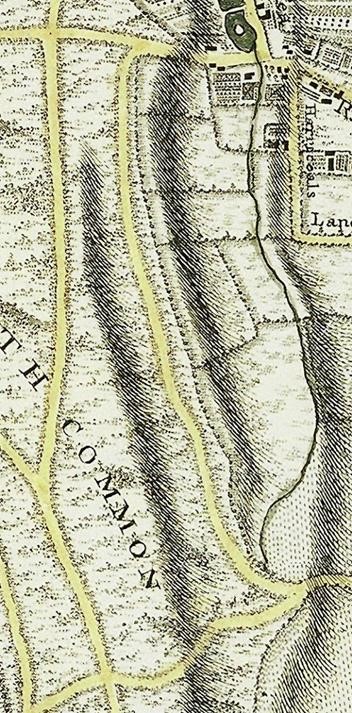
The Corris Map of 1787 shows the house sitting in a rectangular plot fronting Wandsworth Common on its west side — a tree-lined lane divided the house from what we can assume was rough ground, characterised by poor, damp land with gravel pits. The house's grounds lay principally to the east down to the Falcon Brook. It also shows an additional smaller building alongside the main house, which we can assume were stables and/or a carriage house.
Grove House was unique in showing a rectangular shape at the Falcon Brook end of the plot. This may depict alternative planting, perhaps a structure, or could be the start of a large pond from streaming water from the brook. By the 1840 tithe map, this shape had gone.
The 'Explanation' of the 'Plan of Battersea Surry' shows the blue line and shading depicting the property owned privately, the red line showing land owned by Earl Spencer, and the green line depicting the edge of Wandsworth Common.
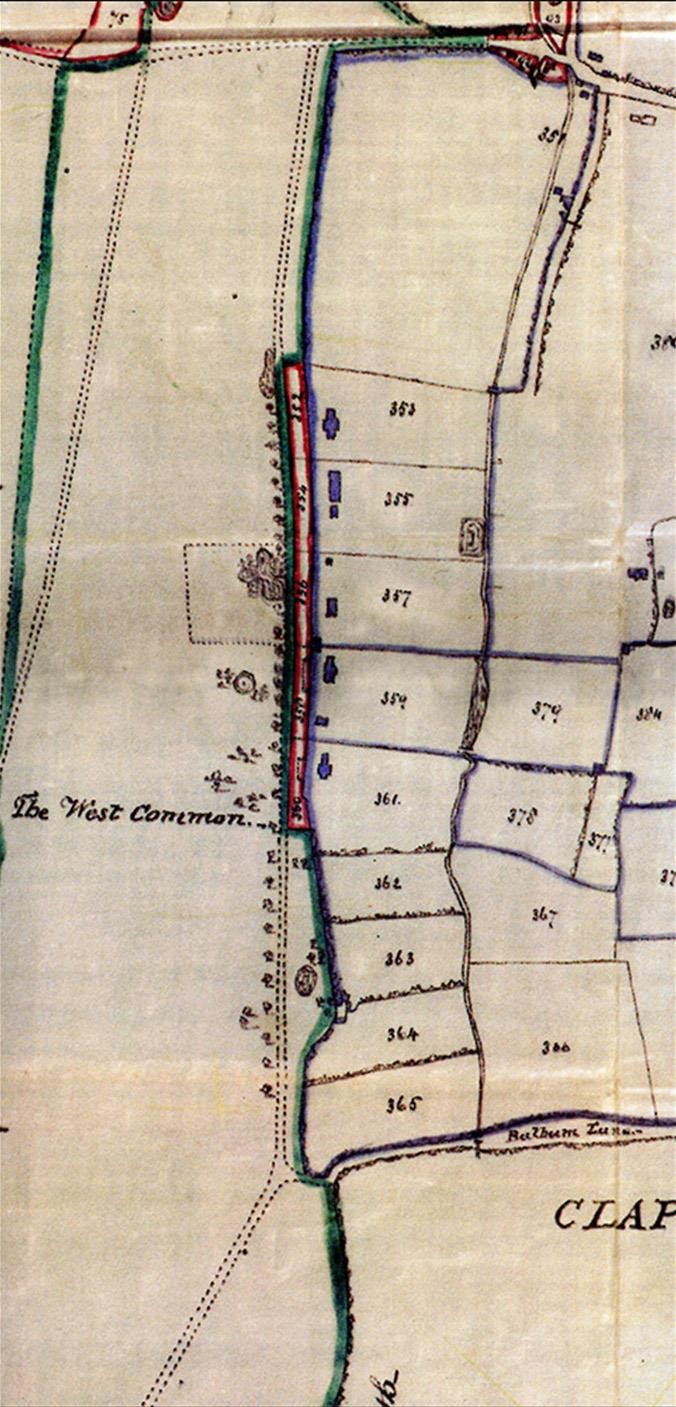
In 1797 the land on the Clapham Common side of the Falcon Brook was sold to the owners of three of the Five Houses but not to Grove House or The Elms, making these two estates significantly smaller than the other three.
The 1800 Milne map shows its land marked as 'P' meaning 'Paddocks and Little Parks'. This suggests that the grounds of this house will have had a large proportion of rough grass for grazing alongside more formal planting of trees and shrubs. It is interesting to note that at this stage the Common was known as 'Battersea Common.'
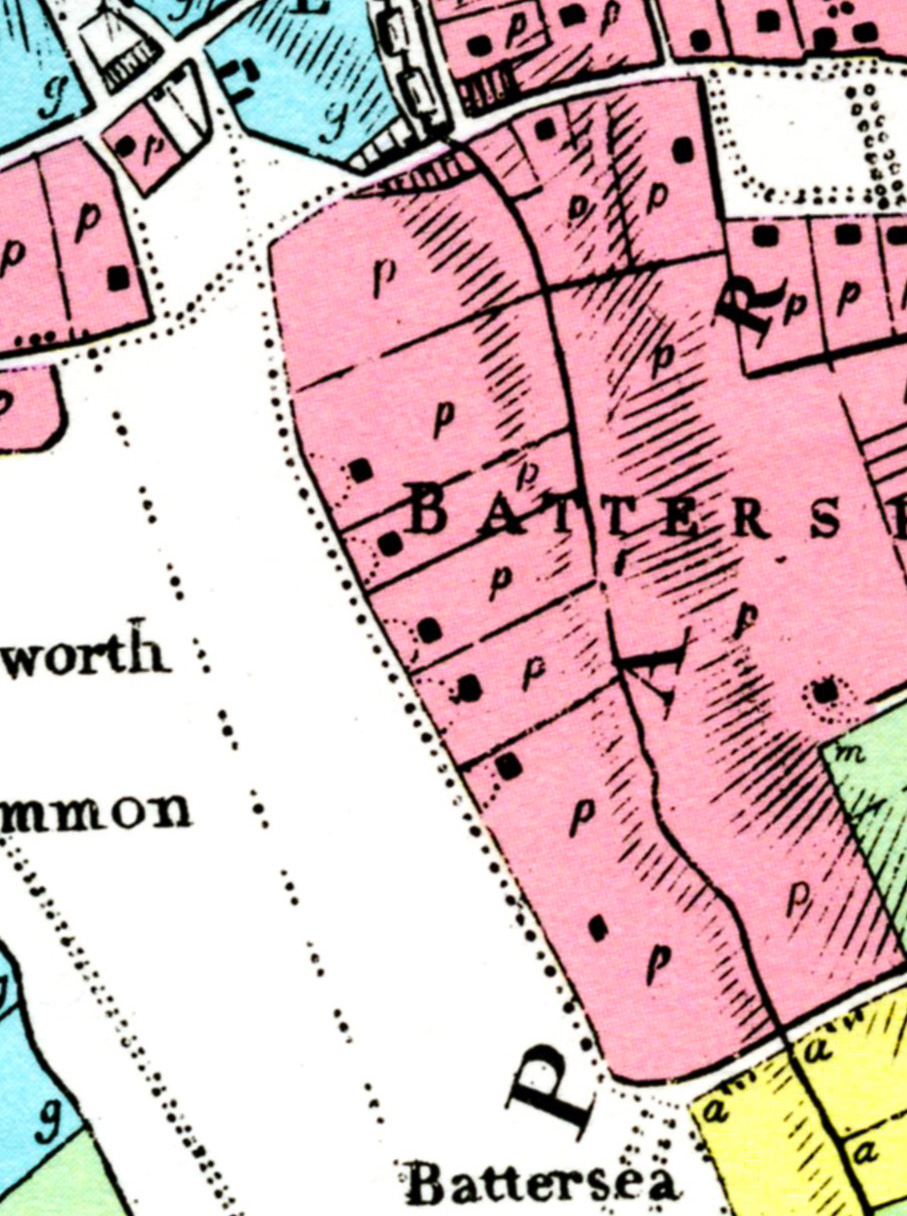
The Tithe Map of 1840 is a gem of extra information. We can see the creation of tracks around the house for carriage and pedestrian access. Carriages could conveniently go from house to stables. The property had a circular sweeping drive between the lane and house, forming a semicircular area — the contemporary style of Humphrey Repton was to create 'artificial' circular shrub or flower beds, with walks and tracks of gravel. Unlike most of the other houses, there are no trees bordering the lane by the Common, lending a more open aspect to the west. The gardens appear similarly arranged to those of The Elms, with the perhaps walled garden lying south of the house to take advantage of the sun. In summary, the outbuildings of this house appear at this time to be smaller in number and scale than the other four houses.
The Common is depicted as rough ground compared to Grove House.
The apportionment book supporting the tithe map shows Grove House as follows.
Description: Upper Bramlands*. (A = Acre = 160 Perches; P = Perch; R = Rod.)
| Section | Land use | Acre | Rod | Perch |
|---|---|---|---|---|
| 337 | Meadow/Pleasure Ground | 2 | 3 | 26 |
| 338 | Meadow | 4 | 1 | 3 |
| Total | 6 | 4 | 29 |
*We have been unable to clarify exactly what Upper Bramlands means. There was an area north of Battersea Rise described as Upper Bramlands, and the name may refer to an individual. 'Bram' has been known to mean brambles or gorse, so perhaps — as we know gorse was prevalent in the area — it genuinely referred to a type of vegetation. Why this description was given for both Grove House and Bolingbroke House remains unclear.
From the evidence of maps and sales advertisements, we can only guess at the range of plants Grove House may have enjoyed. Here is a generic list of plants we know were available at the time and could have been planted within the estate. It is worth noting that there was a large plant nursery just on the other side of the Common at the time.
| Category | Plants |
|---|---|
| Tender plants | aspidistra, pelargonium, carnation, hyacinth, mimulus, fuschia |
| Perennials and bulbs | tulip, anenome, lupin, gaillardia, gardenia |
| Shrubs | magnolia, azalea, daphne, rhododendron, rose, hydrangea, berberis, aucuba, holly, laurel, privet, box, conifer |
| Trees | white or black poplar*, elm*, plane*, ash, chestnut*, lime*, oak*, sycamore, purple beech, cherry, almond birch, lilac, robinia, laburnum |
* These are particularly likely trees, and it is worth noting that these trees all flourish on the Common today, suggesting favourable conditions.
An additional point of interest from other property sales advertisements is the suggestion of a 'green lane' running from Battersea Rise (where Webbs Road is now) parallel to the frontage of The Five Houses. We know that 'Australia Lodge', complete with gates, stood on current Battersea Rise and believe it protected the lane and its access to the houses. There must have been either bridges or fording points to cross the Falcon Brook.
By the 1860s Grove House was for sale. The Morning Herald of 7 July 1858 describes the land and outbuildings as:
'good domestic offices, three-stall stable, coach-house, walled gardens and several enclosures of meadow land; in all nearly 12 acres.'
These details largely support maps of the early to mid-19th century mentioned here.
The 1862 Stanford map shows the detailed layout and position of the Five Houses, and is interesting in its depiction of several landmarks that still exist today: just beyond the London, Brighton and South Coast Railway running parallel to Bolingbroke Grove lie the Royal Patriotic School (now Building), the Surrey County Prison (now Wandsworth Prison), a large plant nursery (now Capital Gardens/Neals Nurseries), and the County Arms (name unchanged). The area was becoming more developed.
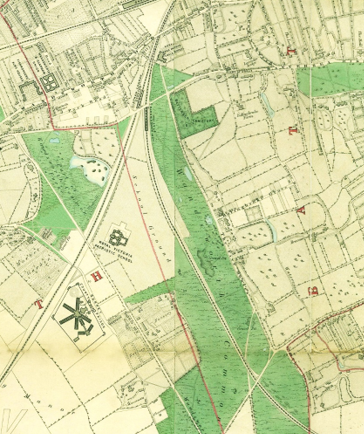
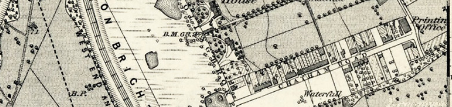
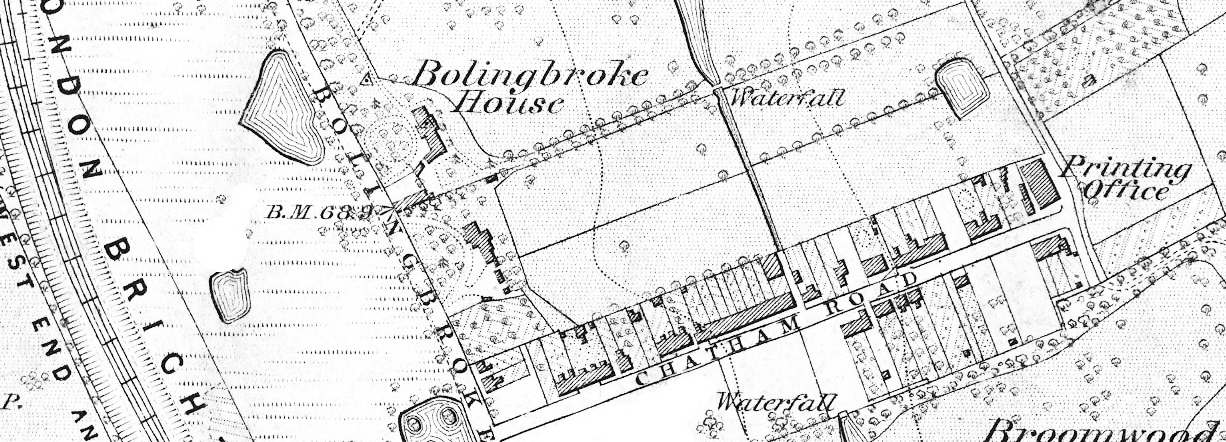
The 1868 OS map shows an increased-sized pond almost opposite this house and more trees formally planted along the Common edge. Worth noting are references to 'waterfall' in three nearby places, explaining the damming method of creating long thin lakes from the Falcon Brook, again reminiscent of the Capability Brown method. It shows a more symmetrical and formal drive up to what we assume is a coach house to the south of the house.
The house would have had privacy from its neighbours on either side as indicated by lines of trees along those boundaries. We see that Bolingbroke Grove House had gone (since 1864) and so to the southern side Grove House overlooked the newly emerging Bolingbroke Estate with smaller terraced, semi-detached and detached properties.
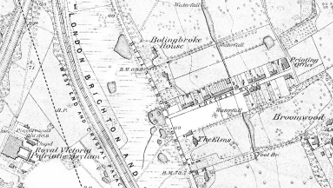
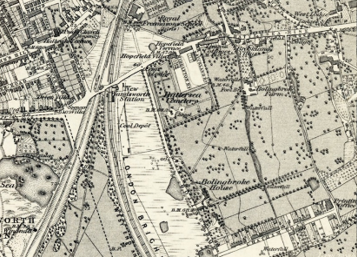
The 1865–73 OS map also exhibits large changes to the immediate environs of the house. Not only had the train line appeared, but Battersea Cemetery became a prominent landmark with New Wandsworth Station and a coal depot alongside. By this time the area would seem much more connected to the wider city. The start of a busier commuting world was well under way.
The census records show during the mid-19th century the following staff descriptions: coachman, farm lad, footman (1851); garden servant (1861); coachman in stable (1871). For the scale of property, we can assume maintenance of the extensive grounds was carried out by labour living both in and outside the house.
In summary, Grove House gardens seem not dissimilar to the other four houses. It enjoyed the rural nature like the others until ribbon development from 1877 and the emergence of retail shops and pubs, schools, prison and cemetery transformed the area into a busier suburb of the expanding city of London.