[BNA Search: "Wandsworth Common"]
[The Times: Search: "Wandsworth Common"].
[BNA: Buckmaster Battersea 1875]
[BNA: Buckmaster Wandsworth 1875]
[London Evening Standard: Buckmaster Wandsworth 1875]
South London Places and People [Br Ors Bram'. XIII.--IN THE MAYORALTY OF GARRATT. There are comparatively few people who remember that there was once a - Mayor of Garrett. I may go further and say that not many people--unless we reckon the actual inhabitants of that particular district of South London—know precisely where Garrett really is, or could direct a stranger (off-hand) what direction to take in order to reach it. Yet Garrett has, so to speak, a history, though not exactly an antiquity, of its own ; and is interesting enough to merit the honour of an excursion as a village of some note. The happy-go-lucky petleFtrian between Wandsworth and Tooting, who finds himself some mile and a half from the former, in the long thoroughfare still called Garratt-lane, is quite close to the village itself, almost without knowing it. But he has had a pleasant walk if he has chosen such a day as Thursday last, when the sun is bright, the air clear, cold, and dry, the ground firm, and the sky with the first intimation of spring in its golden glow. In spite of a queer series of half-rural cottages and rather squalid shops which form a part of the irregular highway known as Southstreet,forming, as it were, the first half. mile of Garratt.lane, there are glimpses of the country, and glint* of the river Wandle, which meanders sometimes quite close to the road, and then again diverges to a quarter of a mile, but still follows about the same course as that by which we are proceeding. One quaint, old, one-storeyed mansion, with Fable ends, and standing in its own grounds, is perhaps old enough to have been on the spot when Foote wrote his once celebrated "Comedy of the Mayor of Garrett " and another old-fashioned buikling was probably at one time a goodly inn, though it is now only a el a nmeiser which are to be fous cirtively short intervals all the way. we have Ises to au with the high row' ' with tie iillage itself ; and here, bernd • the meaner shops, with their stock in trade of dapping, sweetstuff, and old clothes, and Past the blank wall by the gasworks, we come to Allfarthing-lane, to open fields, stretching towards Wandsworth Common, to a nearer glimpse of the Wandk, to the mission-room of St. Anne's Church, and so, beneath the railway, to a good broad road, by which we reach the very centre of Garrett itself. And having reached it, what then? Well, not very much, truly. A few comparatively modern country cottages, of a very commouplam deficri 'on, and, twenty - five or thirty ruipau! 'Novels, lgfve ap. : parent4Y keen tu ahinre a ceetury, and are in such nTV $, ritinoof copdu —especitilly those of number are comapeed Of wood and er—that it would really be a good day's work for some local board t? e r::: the order to have them sway. ancient tenements are by what appears to be a piece of covanioft garden ground; and at the end of the village * itretelt of meadow-land, with the river beyond, bordered by a row of really fine trees: In which of the decaying cottages the Mayors of Garrett were su pp osed to have held their state, no local history exists to tell; but in the centre of the village, the one important house is a plain unpretentious inn, of red brick, and bearin ,, the good old sign of "The Leather Bottle." Now, as this quiet hostelry is certainly a good deal more than a hundred years old—as the late proprietor, Mr. Fenton, was born within its walls, and, as it had been in the possession of his family for nearly eighty years, we would imagine that here, if anywhere, the traditions of the Mayoralty would be preserved. This fancy is strengthened by the appearance of the snug bar—by the fact that in the tap-room is a veritable leather bottle, which, with one of the oddest old clocks in all Surrey, forms the chief attraction of the apitrtmept: Such expectations be diaappuinted, however; and beyond a few vagne notions that there such a persoa ae the Mayor of Oarratt, sad that the first individual elected to office was one Jeffrey (afterwards 'ffir Jeffrey) Dunstan, a deformed or d fellow, who was considered to be ha .witted, we shall obtain little clue to the leg i that s the object of our journey. here are records, however, which go beyond even the Fame to Foute's Comedy in explaining the origin and maintenance of the Mayoralty ; and though moot of us have regar4e4 the play as the chief authority for the local historian, we may discover even from a preface, subsequently published with the drama itself in later editions, that Foote founded it on au actual custom, and that even _ _ . if Sir Jacob Jollup, Jerry Sneak, Lieutenant Bruin, Snuffle, and Sturgeon, were not copied from the life, the Mob, and fleeltap, the leader and orator of Garratt, were real enough. It is said, indeed, that the character of Major Sturgeon (usually played by Foote himself) was taken from that of a retired fishmonger named Lamb, residing at Acton, who .bad been appointed to a commission in the , as alio to another in the Middlesex militia, whose amiable officers the major describes as "quiet and peaceable as lambs." But the Oarratt elections, with all their pothouse humour and riotous absurdity, began some time before Foote wrote of them—and began, too, in a protest against those encroachments which have been but too successful in many places where the people have lacked the determined public spirit to protect their common lands. The inhabitants of Garrett had such a piece of common, their rights in which were ignored by certain high-handed gentry, who attempted to appropriate a portion of the 'village green but however humble the rude forefathers of the hamlet may have been, they had advanced so far in civilization as to meet together in a dub, and made use of this organization to elect s president, and ultimately to take successful action against the usurpers. It is not easy to fix the exact date of this triumphant assertion of rights and privileges; but as it occurred at the time of a general election, a certain mock solemnity and no little practical jesting characterized the whole of the sativ e urt proceedings. The president, who was the Mayor, was to hold office during the sitting of Parliament, and was to be re-elected or to have a successor, aud afterwards two mayors or members were chosen to represent the local interests of Garrett, and all the rough excitement of a Parliamenta7 contest was carried on in the broadest spirit of turlesque. It need scarcely be said that the innkeepers of Wandsworth profited so greatly by the observance that when the general public participated in the joke, and the Garrett elections began to draw thousands of spectators to enjoy the fun, it was kept up with considerable ardour; in fact, the licensed victuallers subseribed to pay the election expenses, and all kinds of queer humorous fellows were put forward as candidates. Curiously enough, though 110 little information can now be obtaiued at the Leather Bottle on the subject of these elections. in one of three exmedingly lever and mirth-moving engravings in " lione's Every Day Book," the Keno of the 4;arratt election is represented in front of this very inn ; while the other two are taken from the front of the Spread Eagle and the Raw, awl at the entrance of Garratt-laue. It would appear that there was a kind of wasque ads procession, and the principal features in w hich were on wheels drawn by horses, and containing absurdly-dressed eharacters t _one of which, according to Bone was "Lady make." An old lady of li'audswohli, speaking to lions about this figure, bays—" I remember her very and so I ought, for I had a good hand in the dressing of her. I helped to put together many a good pound of wool to make her hair up. I suppose it was more than throe feet high at least ; and as for her mlays, I also helped to make them down in Ander- wee Own. TlE:are neither than gc waling- without the pot well coventil bed' ed outside 4 1 te a stomacher. As lie sat in the boat, she was one of the .drollest creatures for size and dress ever seen." The common way opposite the Loather Bottle, and in the engraving one of the candidates is seen addressing his constituents from a phaeton drawn by six borses, amidst a crew of miukpiaraders in all sorts of extravagant costumes; while in a corner of the picture, representing the front of the Spread Eagle, is the figure of the celebrated Sam House, the publican, who was such a determined Foxite in the Westminster elections, and who never wore either hat or cost. The e ng ravings are the work of Valente Green, a arwickshire man, who came to London from arwickshire in 1765, and was afterwards appointed keeper of the British Institution on firet foundation. Of humorous and extravagant addresses of the candidates, examples have been preserved in a curious collection of handbills and broadsides in tte possession of the family of Mi. ttlacknoite, of Wandsworth, who communicated film contents to the Messrs. Chambers for publication in those most interesting volumes entitled "The Book of Days. Theis enable us to go as far back as 1747,' when Squire Blowmedowu and Squire Gabbing were rivals contesting the election. The first was one John Willis, a Wandsworth waterman ,• the second, James Simmonds, the landlord of the Gubbins Head, in Blackman- street, Borough. In "A Letter from an Elector," the claims of Illowmedown are eloquently enforced, and the appeal concludes by saying "as our worthy candidate judiciously observes, if drinking largely, heading a mob majestically, huzzaing eloquently, and fetading voraciously, be merits in Any degree worthy the esteem of the good people of this land, a Garrott, I must ingenaously confess, is too mean an apartment for such a worthy; for Envy herself must confess, if the above qualifications are of any efficacy, the iniversal voice of the whole realm of Great Britain would not be equivalent to his wondrous deserts." Seven years afterwards the same candidates were in the field, when Gabbing asks, "Where was Esquire Blowmedown when the Jew Bill, Matrimony Bill, and Wheel Bill passed ?" And furtber, " Blowmedown washes his boat every Sabbath day, that he may not be induced to rise on Alouday morning before high water." Again there is an N.B. declaring that "time esquire entertains his friends at all the houses in Wandsworth on the day of election, which will be elegant and generous, without any other expense than that of every one paying for what they call for." Of course many of these handbills and addresses were written by the wits who joined in the "fun of the fair," which . maybe said to have culminated in 1761, when nine candidates were in the field, and some of the squibs and harangues were said to hare been furnished by Foote. Garrick, and Wilkes. Foote was at the election, and with his. friends occupied a room in Wandsworth, opposite the church, paying nine guineas for the accommodation. The famous comedy was the result of his visit, and the characters of the play are said to have been drawn from actual persons. "Snuffle," the sexton, was one John Gardiner, a cobbler, and the parish gravedigger. who was one of the candidates under the name of Lord Twankum. " Crispin " Heeltap was another candidate brought forward as Lord Lapstone. The other five were Kit Noisy, Esq. (one Beecham, a waterman), Lord Wede, Lord Paxford, John Crambo, and Beau Stivester. The address issued by the latter is exceedingly humorous, and concludes thus : My abilities will procure you the knowledge of your wants, if not the gratification of your desires; and those that dare advance the price of the darling essence of Sir John Barley will incur my displeasure, if not fail the weight of my reseatment. Through my purer and universal connection, your liberty and commerce shall be spread to the Antipodes, and I *ill order yet undiscovered raglans to be alarmed with your &me ; in your borough I erect a non-existent edifice for the transaction of your timber business, and in your suburbs plant an imaginary grove for your private affairs. My unknown fortune shall be ever ready for your 1113• sistauce, my useless sword drawn in your defence, and my waste blood I'll freely spill in your protection. It was in 1781, when the Garrett election was again a very remarkable one, that the notorious Sir Jeffrey Dunstan became Mayor. "Sir .Jeffrey" was a big-headed, knock-kneed dwarf, whose business it was to deal in secondhand wigs, and his habit to cry them in the streets in a whimsical manner. Ile went about without coat or hat, with his shirt open at the breast, and his stockings about his leek Sir Jeffrey was a foundling, for he had been picked up as an infant at the church door by a churchwarden of St. Dunstan-in-the-East. His two daughters—one of whom, "Lady Ann," married "Lord Thompson," a dustman of Bethnal ( heen —were fine young women, and he regarded them with remarkable affection, speaking of them as "Miss Dinah" and " beautiful Miss Nancy." The dwarf Mayor , of Garrett was a buineurist iu his way,and his election speeches were full of an inflated imitation of statesman-like harangues. These speeches and his imitations of London crier he was in the liabit'uf delivering at public-houses in Whitechapel, for the amusement of the company, and so gained consitlerable popularity, his effigy appearing on numerous tradesmen a tokens and on t4vern b irJ eff rey died from the effects of a drinking bout in 1797, and the Garratt elections may b.! said to have died with him, for his saccessor, who gained the election witinrt him in 17teti, was Sir Harry pitartlale, a deformed muffin man, and dealer in tin ware; who, however, had nut many qualifications for the Aim, and died before his year of Mayoralty had terminated. Probably by that time public taste, even at Garrett, bad revolted from the low debauchery and riot of the elections. The original joke ba . it grown stale ; the humour of the thing failed. Wits and dramatists no longer aided the ea!Wilde., and the publicans declined to linker& any more money. Thirty-four the rat son 1826) in attempt as Wily. the abairdif, but it fail , a on subject of the ayors of rrett, the Leather Bottle itsel has dried up. >>https://www.britishnewspaperarchive.co.uk/viewer/bl/0000213/18750206/006/0002
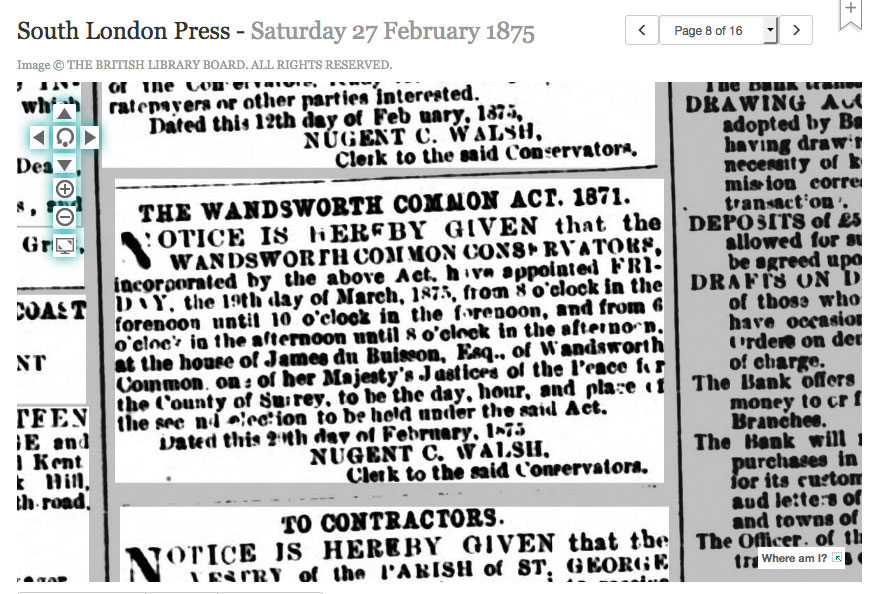
WANDSWORTH COMMON ACT 1871
NOTICE IS HEREBY GIVEN that the WANDSWORTH ni (mu ON CV RV ATOM+, iscorooreied by the above h appealed FM-1/ 'Y. the 19th day of March. 1075. horn s o'clock In the forenoon until 10 o'clock in the and &eine, In the afternoon until ti o'clock in the eft et no..n. at the how of James du Buisson, Esq.. of Wandsworth Common of her Majesty's Justices of the Peace hr the County of Surrey to be the day. hour, and ple .:e t the see n.I PI ea! ton to be held tinder the Act. inited this t-ttli der of February. NJ GRNT C. WALSH. Clerk to the said Conservators.
[BNA: Link]
South London Press - Saturday 06 March 1875
WANDSWORTH COMMON ACT, 1871.
NOTICE IS HEREBY GIVEN that the L' WANDSWORTH COMMON CONSERVATORS, incorporated by the above Act. I)4Y, the 19th day of March, 1878, from 8 o'clock in the k e ys appointed FRI- forenoon until 10 o'clock in the forenoon, and from 6 o'clock in the afternoon until 8 o'clock in the afternoon, at the house of James du Buisson, Esq., of Wandsworth Common one of her Majesty's Justices of the Peace for the County of Surrey, to be the day, hour, and place of sec tri to be held under mid Act. Dated this 2.lth day of February. 1"7 5
NUGENT C. WALSH. Clerk to the Conservators.
[BNA: Link]
(Click on image to enlarge)
South London Press - Saturday 13 March 1875
[NB: Part-cleaned up. A very important report, well worth studying closely.]
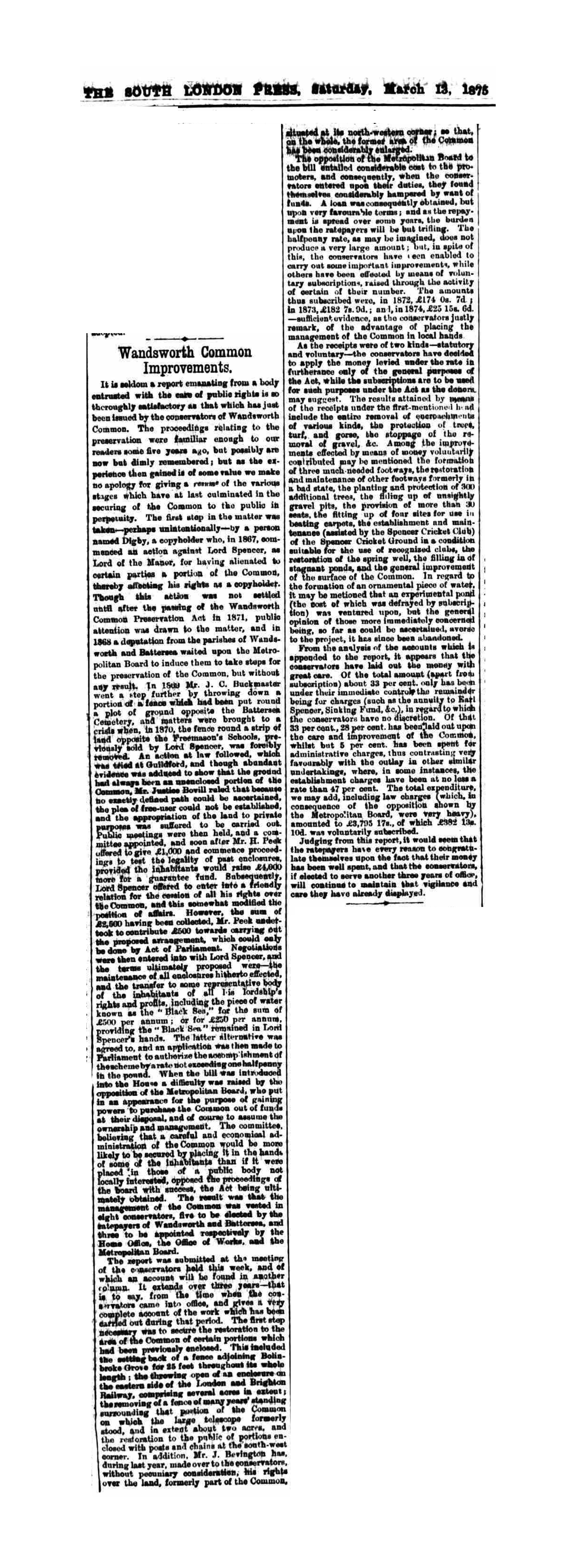
Wandsworth Common Improvements.
It is seldom a report emanating from a body entrusted with the care of public rights is so theroughly satisfactory as that which has just been issued by the conservators of Wendsworth Common. The praceedings relating to the preservation were familiar enough to our readers some five years ago, but possibly are now bat dimly remembered; but as the experience then gained is of some value we make no apology for giving a of the various stages which have at last culminated in the securing of the Common to the public in perpetuity.
The first step in the matter was taken - perhaps unintentionally - by a person named Digby, a copyholder who, in 1887 [PB:1867], commenced an action against Lord Spencer, as Lord of the Manor, for having alienated to certain parties a portion of the Common, thereby attracting his rights as a copyholder. Though this action was not settled until after the passing of the Wandsworth Common Preservation in 1871, public' attention was drawn to the matter, and in 1868 a deputation from the parishes of Wandsworth and Battersea waited upon the Metropolitan Board to induce them to take steps for the preservation of the Common, but without goy moult.
In Mr. J.C. Buckmaster went a step further by throwing down a portion of a fence which had been put round a plot of ground opposite the Battersea Cemetery, and matters were brought to a crisis when, in 1870, the fence round a strip of and opposite the Freemason's Schools, previously sold by Lord Spencer, was forcibly removed. An action at law followed, which was tried at Guildford, and though abundant evidence was adduced to show that the ground had always been an unenclosed portion of the Common, Mr. Justin Bovill ruled that because no exactly defined path could be ascertained, the plea of free-user could not be established, and the appropriation of the land to private purposes was suffered to be carried out.
Public meetings were then held, and a committee appointed, and soon after Mr. H. Peek offered to give £1,000 and commence proceedings to test the legality of past enclosures, provided the inhabitants would raise £4,000 more for a guarantee fund. Subsequently, Lord Spencer offered to enter into a friendly relation for the cession of all his rights over the Common, and this somewhat modified the position of affairs. However, the sum of £2,600 having been collected, Mr. Peek to contribute £500 towards carrying the proposed arrangement, which could be done by Act of Parliament.
Negotiations were then entered into with Lord Spencer, and the terms ultimately proposed were - the maintenance of all enclosures hitherto effected, and the transfer to some representetive body of the inhabitants of all lie lordship's rights and profits, including the piece of water known as the "Black Sea," for the sum of £500 per annum; or for £250 per annum, providing the "Black Sea" remained in Lord Spencer's hands. Thd latter alternative was agreed to, and an application was then made to Parliament to authorize the accomplishment of the scheme by a rate not exceeding one halfpenny in the pound.
When the bill was introduced into the House a difficulty was raised by the opposition of the Metropolitan Beard, who put in an appearance for the purpose of gaining powers to purchase the Common out of funds at their disposal, and of course to assume the ownership and management. The committee, believing that a careful and economical administration of the Common would be more likely to be secured by placing it in the hands of some of the inhabitants than if it were placed in those of a public body not locally interested, opposed the proceedings of the board with success, the Act being ultimately obtained.
The result that the management of the Common was vested in eight conservators, to be elected by the ratepayers of Wandsworth and Batteries. and three to be appointed respectively by the Home Office, the Office of Works, and the Metropolitan Board.
The report was submitted at ths meeting of the conservators held this week, and el which an account will be found in another g platen. It extends over three years - thst is to say, from the time when the conegrvators came ints office, and gives a vet, complete amount of the work which has out daring that period.
The first step necessary was to secure the restoration to the Common of certain portions which bed been previously enclosed. This included the setting back of a fence adjoining Bolingbroke Grove for 25 feet throughout its whole length; the throwing open of an enclosure on the eastern side of the London and Brighton Railway, comprising several acres in extent; the removing of a fence of many years standing surrounding that potion of the Common on which the large telescope formerly stood, and in extent about two acres, and the restoration to the public of portions enclosed with posts and chains at the south-west corner.
In addition, Mr. J. Bevington has, during last year, made over to the conservators, without pecuniary consideration, his rights over the land, formerly part of the Common, situated at its north-western corner; so that, on the whole, the former area of the Common has been considerably enlarged.
The opposition of the Metropolitan to the bill entailed considerable cost to the promoters and consequently, when the conservators entered upon their duties, they found themselves considerably hampered by want of funds. A loan was consequesitly obtained, but upon very favourable terms; and as the repayment is spread over years, the burden upon the ratepayers will be but trifling.
The halfpenny rate, as may be imagined, does not produce a very large amount; but, in spite of this, the conservators have been enabled to carry out some important improvements, while others have been effected by means of voluntary subscriptions, raised through the activity of certain of their number. The amounts thus subscribed were, in 1872, £174 Os. 7d. in 1873,.£182 7s. 9d.; and in 1874, £25 15s.6d. - sufficient evidence, as the conservators justly remark, of the advantage of placing the management of the Common in local hands.
As the receipts were of two kinds - statutory and voluntary - the conservators have decided to apply the money levied ender the rate in furtherance only of the general purposes of the Act, while the subscriptions are to be used for such purposes under the Act as the donors may suggest.
The results attained by means of the receipts under the thet-mentioned head, include the entire removal of encroachments of various kinds, the protection of trees, turf, and gorse, the stoppage of the removal of gravel, &c.
Among the effected by means of money voluntraily contributed may be mentioned the formation of three much-needed footways, the restoration and maintenance of other footways formerly in a bad state, the planting and protection of 300 additional trees, the filling up of unsightly gravel pits, the provision of more than 30 seats, the fitting up of four sites for use its beating carpets, the establishment and maintenance (assisted by the Spencer Cricket Club) of the Spencer Cricket Ground in a condition suitable for the use of reeognised clubs, the restoration of the spring well, the filling in of stagnant ponds, and the general improvement of the surface of the Common.
In regard to the formation of an ornamental piece of water, it may be mentioned that an experimental pond (the cost of which was defrayed by subscription) was ventured upon, but the general opinion of those more immediately concerned being, so far as could be ascertained, averse to the project, it has since been abandoned.
From the analysis of the amounts which is appended to the report, it appears that the conservators have laid out the money with great care. Of the total amount (apart from subscription) about 33 per cent. only has been under their immediate control, the remainder being for charges (such as the annuity to Spencer, Sinking Fund, &c.) in regard to which the conservators have no discretion. Of that 33 per cent., 28 per cent. has been laid out upon the care and improvement of the Common.moi, whilst but 5 per cent. has been spent for administrative charges, thus contrasting very favourably with the outlay in other undertakings, where, in some instances, the establishment charges have been at no less a rate than 47 per cent.
The total expenditure, we may add, including law charges (which, in consequence of the opposition shown by the Metropolitan Board, were very heavy), amounted to £3,795 17s., of which . £382 13sd. was voluntarily subscribed.
Judging from this report, it would seem that the ratepayers hese every reason to congratulate themselves upon the feat that their money has been well spent, and that the conservators, if elected to serve another three years of office, will continue to maintain that vigilance and care they have already displayed.
[BNA: Link.]
(Click on image to enlarge)
South London Press - Saturday 13 March 1875
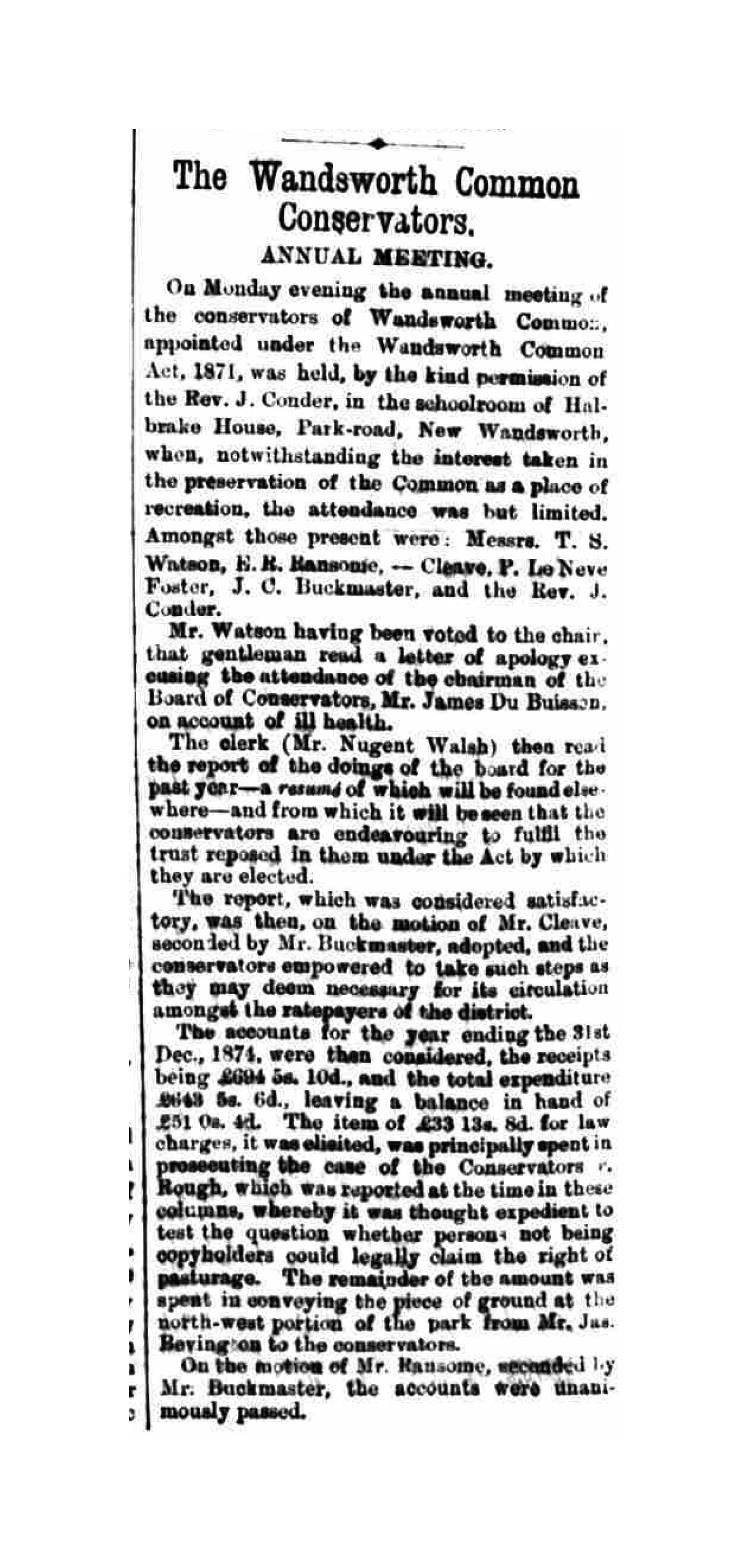
The Wandsworth Common Conservators, ANNUAL MEETING.
On Monday evening the annual meeting the conservators of Wandsworth CeitunoL, appointed under the Wandsworth Common Act., WI, was held, by the kind permission of the Rev. J. Conder, in the schoolroom of Halbrake House, Park-road, New Wandsworth, when, notwithstanding the interest taken in the preservation of the Common as a places of recreation, the attendance was but limited.
Amongst those present were: Messrs. T. S. Watson, M. Ransome, -- cleave, P. he Foider. J. C. Buckmaster, and the Rev. P. Conder. Mr. Watson having been voted to the chair, that gentleman read a letter of apology ei the attendance of the chairman of Board of Conservators, Mr. James Du Buisson, on account of ill health.
The clerk (Mr. Nugent Walsh) thee real the report of the doings of the board for the past year - a of whieh will be foiled elsewhere - and from which it boons that the conservators are endeavouring to fulfil the trust reposed in them under the by which they are elected. The report, which was considered satisfactory, was then, on the motion of Mr. Cleave, I3C 0 u led by Mr. I in outer, adopted. sad the conservators empowered to take such steps es they may deem necessary kr its circulation amongst the ratepayers of the district. The amounts for the year ending the Ist Dec., 1471, were then considered, the receipts being .01.604:mi. 10d., and the total expenditure ba. tld., leaving a balance in bawl of 2:11 tts. td. Thu item of .03 13s. Bd. for law charges, it was elicited, was principally spent in proesenting the case of the Conservators Hough, which wav reported at the time in these ooktune, whereby it was thought expedient to test the queetion whether persons not being copyholders could legallly claim the right of pasturage. The remainder of the amount was spent in conveying the of ground at tie north-west portion of tre im i g uirk front Ms. lievintrom to the cotiservatora.
On the motion of Mr Ransome, seconded by Mr. Buckmaster, the accounts were unanimously passed.
[BNA: Link.]
TITLE - DATE
Hansard: questions in the House about the sale of land by St James's Industrial School formerly part of the Common for building.
HANSARD 1803 2005 1870s 1875 August 1875 6 August 1875 $ Commons Sitting METROPOLIS WANDSWORTH COMMON QUESTION. HC Deb 06 August 1875 vol 226 c616 616
MR. GORST
asked the President of the Local Government Board, Whether his attention has been called to an advertisement in "The Times," from the Guardians of the Westminster Union, proposing to let for building purposes certain lands formerly part of Wandsworth Common; whether the consent of the homage to the alienation of this part of the Common was not obtained for the special purpose of providing a site for a school for the poor children of Saint James Westminster; and, whether the Guardians of the Westminster Union can convert land thus acquired for a charitable object to the purpose of a building speculation?
MR. SCLATER-BOOTH,
in reply, said, that it was only after a long correspondence with the Local Government Board that the Guardians of the Westminster Union had received sanction to lease for building purposes a portion of the ground which they possessed which was formerly part of Wandsworth Common. He had been informed by his hon. Friend, and by a Memorial sent to him, that the consent of the homage to the alienation of this part of the Common was obtained for the purpose of providing a site for a School for the poor children of St. James, Westminster; but there was no restriction in the document under which the property was conveyed to the Guardians. He had no knowledge of any right belonging to the Conservators which could not have been properly conveyed; but, if there were such rights, it must be presumed that the parties entitled to them would have their legal remedy.
[Source: LINK NB The "homage" was the collected copyholders at a court leet.]
[NOTE]
London Evening Standard - Saturday 07 August 1875
BUILDING ON WANDSWORTH COMMON.
Mr. GORST asked the President of the Local Government Beard whether his attention had been called to an advertisement in the Times from the guardians of the Westminster Union, proposing to let for building purposes certain lands formerly part of Wandsworth-common; whether the consent of the homage to the alienation of this part of the common was not obtained for the special purpose of providing a site for a school for the poor children of St. James's, Westminster; and whether the guardians of the Westminster Union can convert land thus acquired for a charitable object to the purpose of a building speculation.
Mr S. BOOTH said that the guardians of the Westminster Union, with the sanction of the Metropolitan Board, did propose to let for building purposes certain lands forming part of Wandsworth-common. lie did not know that there were any existing rights which would interfere with this being done, but if there were no doubt the parties interested would assert them. The matter, however, would be further inquired into.
[BNA: Link]
[Gorst of Gorst Road?]
South London Press - Saturday 18 September 1875
[NB Kalulu is leaving the school . . . also a WILSON]
(Click on image to enlarge)
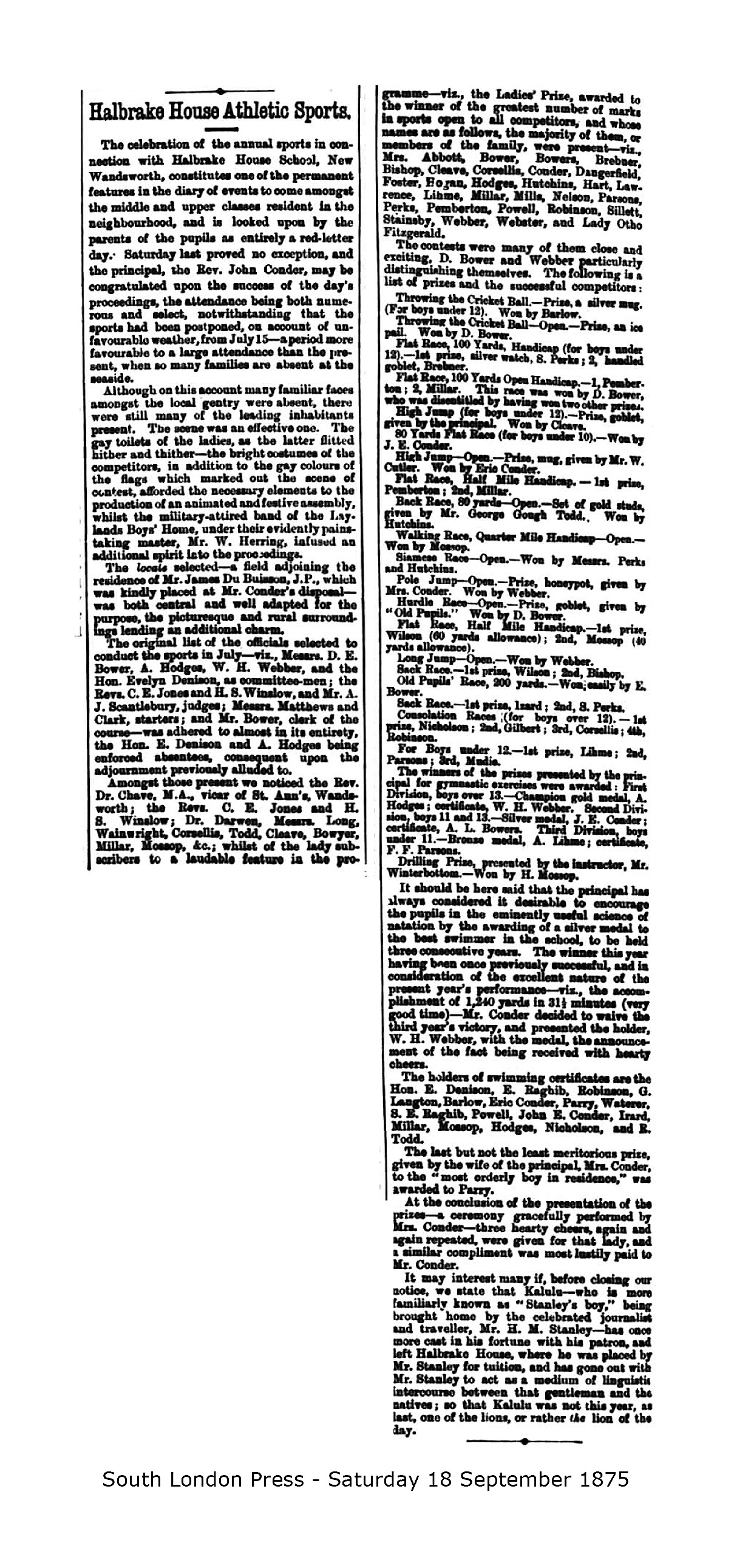
Halbrake House Athletic Sports.
The celebration of the annual sports in connection with Halbrake House Schopl, New Wandsworth, constitutes one of the permanent features in the diary of events to come amongst the middle and upper classes resident in the neighbourhood, and is looked upon by the parents of the pupils as entirely a red-letter day.
Saturday last proved no exception, and the principal, the Rev. John Condor, may be congratulated upon the success of the day's proceedings, the attendance being both numerous and select, notwithstanding that the sports had been postponed, on account of unfavourable weather, from July 15 - a period more favourable to a large attendance than the present, when so many families are absent at the seaside. Although on this account many familiar faces amongst the local gentry were absent, there were still many of the leading inhabitants present. The scene was an effective one. The ray toilets of the ladies, as the latter flitted hither and thither — the bright costumes of the competitors, in addition to the gay colours of the flags which marked out the scene of contest, afforded the necessary elements to the production of an animated and festive assembly, whilst the military-attired band of the Laylands Boys' Houle, under their evidently painstaking master, Mr. W. Herring, infused an additional spirit into the proceedings.
The locale selected — a field adjoining the residence of Mr. James Du Buisson, J.P., which was kindly placed at Mr. Conder's disposalwas both central and well adapted for the purpose, the picturesque and rural surroundings lending an additional charm.
The original list of the officials selected to conduct the sports in July — viz., Messrs. D. E. Bower, A. Hodges, W. 11. Webber, and the Hon. Evelyn Denison, as committee-men ; the Revs. C. E. Jones and U.S. Winslow, and Mr. A. J. Seeatlebtu7, judges; Messrs. Matthews and Clark, starters; and Mr. Bower, clerk of the course — was adhered to almost in its entirety, the Hon. E. Denison and A. Hodges being enforced absentees, consequent upon the adjournment previously alluded to. Amongst those present we noticed the Rev. Dr. Chave. M.A., vicar of fit. Ann's, Wandsworth; the Revs. C. E. Jones and H. B. Winslow; Dr. Darwen, Messrs. Long, Wainwright, Corsellis, Todd, Cleave, Bowyer, Millar, Memoir, &c.; whilst of the lady subscribers to a laudable feature in the programme — viz., the Ladies' Prize, awarded to the winner of the greatest number of marks in sports open to all competitors, and whose names are as follows, the majority of them, or members of the family, were present — viz., Mrs. Abbott, Bower, Bowers, Brebner, Bishop, Cleave, Corsellis, Conder, Dangerfield, Foster, E �salt, Hodges, Hutchins, Hart, Law. rent*, Lihme, Millar, Mills, Nelson, Parsons, Perks, Pemberton, Powell, Robinson. Sillett, Staineby, Webber, Webster, and Lady Otho Fitzgerald. The contests were many of them close and exciting, D. Bower and Webber particularly distinguishing themselves.
The following is a list of prizes and the successful competitors:
Throwing the Cricket Ball. — Prize, a silver mug. (Far boys under 12). by Barlow. Throwing the Cricket Ball — Open. — Prize, an ice pail. Won by D. Bone r . Flat Race, 100 Yards, Handicap (for boys under 12). — Ist prize, silver watch, S. Perks ; 2, handled goblet, Brebner. Flat Race, 100 Yards Open Handicap.-I,Pember. ton; 2, Mills,. This race was won by D. Bower, was disentitled by having won two other prize& High Jump (for boys under 1 2). — Prize, goblet, given by the principal. Won by Cleave. 80 Yards Flat Race (for boys under 1 0). — Wonby J. E. Conder. High Jump — Open. — Prize, mug, given by Mr. W. Cutler. Won by Eric Conder. Flat Race, Half Mile Handicap. Ist prize, Pemberton; 2nd, Mills,. Back Race, 80 yards — Open. — Set of gold studs, given by Mr. George Gough Todd.. Won by Hutchins. Walking Race, Quarter Mile Handicap — Open. — Won by Mostop. Siamese Race — Open. — Won by Messrs. Perks and Hutchins. Pole Jtimp — Opsn. — Prize, boneypot, given by Mrs. Conder. Won by Webber. Hurdle Race — Open. — Priae, goblet, given by "Old Pupils." Won by D. Bower. Flat Rene, Halt Mile Handicap. — lat prize, Wilson (60 yards allowance) ; 2nd, hionisop (16 yards allowance). Long Jump — Open. — Won by Webber. Sack Race.-15& prize, Wilson; 2nd, Bishop. Old Pupils' Race, 200 yards. — Won, easily by li. Bower. Sack Race.--1j hard; 2nd, S. Perks. Consolation Races .(for boys over 12). prize, Nicholson; 2nd, Gilbert; 3rd, Consuls; 4, Robinson. For Boys under 12. — let prize, Lihme ; 2nd, Parsons; 3rd, Mudie. The winners of the prizes presented by the principal for gymnastic exercises were awarded: First Division, boys over 13. — Champion gold medal, A. Hodges; certificate, W. H. Webber. Second DiTi boys 11 and 13. — Silver medal, J. E. Conder ; certificate, A. L. Bowers. Third Division, boys under 11. — Bronze medal, A. Libmc ; certificate, F.).'. Parsons. Drilling Prize, presented by the instructor, Mr. Winterbottom. — Won by H. Mossop.
It should be here said that the principal has ilways considered it desirable to encourage the pupils in the eminently useful science of natation by the awarding of a silver medal to the best swimmer in the school, to be held three consecutive years. The winner this year having been once previously successful, and in consideration of the excellent nature of the present year's performance — viz., the accomplishment of 1,240 yards in minutes (very good time)-Mr. Conder decided to waive the third year's victory, and presented the holder, W. 11. Webber, with the medal, the announcement of the fact being received with hearty cheers. The holders of 'swimming certificates are the Hon. E. Denison, E. Raghib, Robinson, G. Langton, Barlow, Eric Conder, Parry, Waterer. S. E. Raghib, Powell, John E. Condor, 'rut Millar, Ifossop, Hodges, Nicholson, and R. Todd. The last but not the least meritorious prize. given by the wife of the principal, Mrs. Conder, to the "most orderly boy in residence," awarded to Parry.
At the conclusion of the presentation of the prizes — a ceremony gracefully performed by Mrs. Conder — three hearty cheers, again and again repeated, were given for that lady, and a similar compliment was most lustily paid to Mr. Conder.
It may interest many if, before closing our notice, we state that Kalulu — who is more familiarly known as "Stanley's boy," being brought home by the celebrated journalist and traveller, Mr. H. D. Stanley — has once more cast in his fortune with his patron, and left Halbrake House, where he was placed by Mr. Stanley for tuition, and has gone out with Mr. Stanley to act as a medium of linguistic intercourse between that gentleman and the natives; so that Kalulu was not this year, as last, one of the lions, or rather the lion of the day.
[BNA: Link]
South London Press - Saturday 6 November 1875
Henry Peek claims if it hadn't been for people such is himself, there would have been no Wandsworth Common (Cheers).
[BNA: Link.]
South London Press - Saturday 20 November 1875
(Click on image to enlarge)
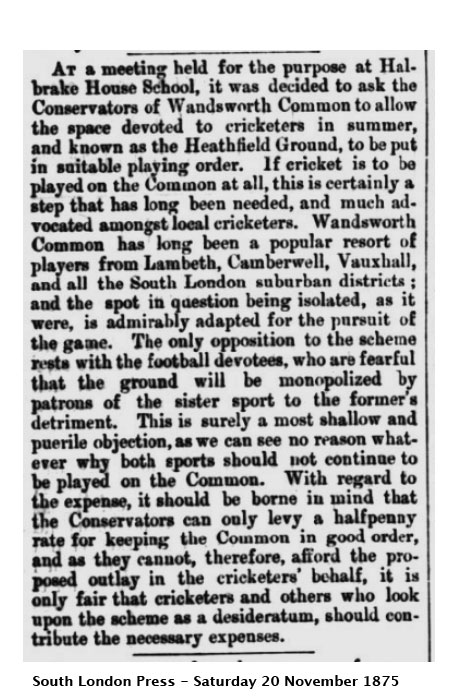
AT a meeting held for the purpose at Halbrake House School, it was decided to ask the Conservators of Wandsworth Common to allow the space devoted to cricketers in summer, and known as the Heathfield Ground, to be put in suitable playing order. If cricket is to be played on the common at all, this is certainly a step that has long been needed, and much advocated amongst local cricketers.
Wandsworth Common has long been a popular resort of players from Lambeth, Camberwell, Vauxhall, and all the South London suburban districts; and the spot in question being isolated, as it were, is admirably adapted for the pursuit of the game.
The only opposition to the scheme rests with the football devotees, who are fearful that the ground will be monopolized by patrons of the sister sport to the former's detriment. This is surely a most shallow and puerile objection, as we can see no reason whatever why both sports should not continue to be played on the Common.
With regard to the expense, it should be borne in mind that the Conservators can only levy a halfpenny rate for keeping the Common in good order, and as they cannot, therefore, afford the proposed outlay in the cricketers' behalf, it is only fair that cricketers and others who look upon the scheme as a desideratum, should contribute the necessary expenses.
[BNA: Link.]
South London Press - Saturday 04 December 1875
As announced in our last, the members of the local committee of the Charity Organization Society and their secretary, Mr. Frank J. Knight, have been indefatigable in administering to the wants of the sufferers by the late floods. Aided by a very timely donation of £llO, sent by the Clapham branch of the society, the Battersea Committee have been enabled to expend £l70 in Nine Elms, and £100 in the vicinity of Battersea Bridge, in addition to retaining a reserve fund to meet cases of illness arising from the same source. In addition to the work done by the Charity Organization Society, Dr. Thompson, the vicar of St. John's, New Wandsworth, and the Rev. Dr. Conder, of Halbrake House, have exerted themselves laudably in obtaining subscriptions, and also by a vocal and musical entertainment, in aiding the cause.
[BNA: Link]
1874 | 1876