[BNA Search: "Wandsworth Common"]
[South London Press: "Wandsworth Common"]
[The Times: Search: "Wandsworth Common"].
[BNA: Buckmaster Battersea 1872]
[BNA: Buckmaster Wandsworth 1872]
[London Evening Standard: Buckmaster Wandsworth 1872]
The Wandsworth Common Act, 1871
The Wandsworth Common Act, 1871. Wandsworth Common Conservators, JL incorporated by the above Act, are prepared to receive TENDERS from persons who may be willing to LEND at interest, for the purposes of the said Act, on security of the yearly amount . . .
Published: Saturday 9 March 1872
Newspaper: Surrey Comet
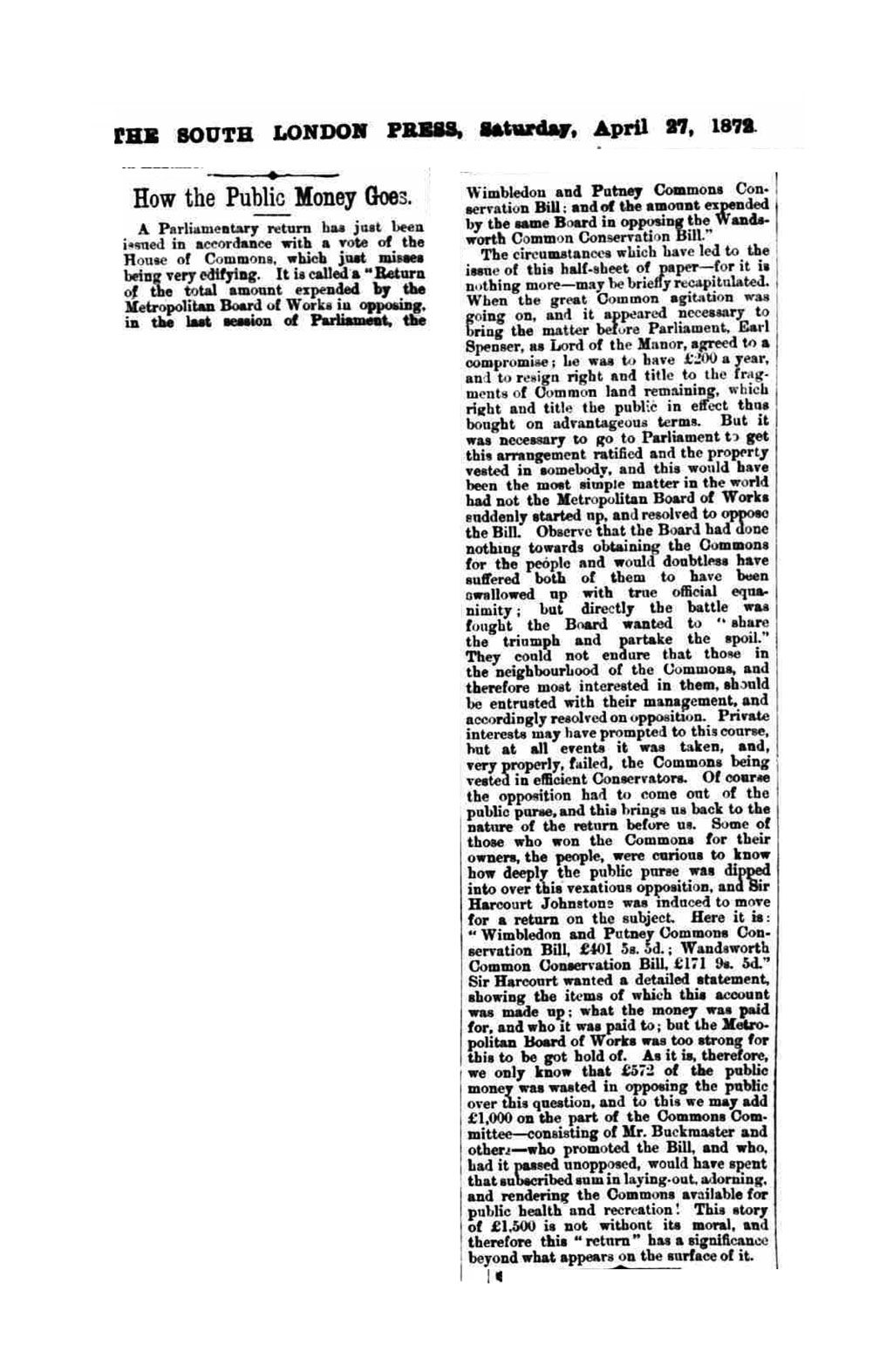
How the Public Money Goes.
Parliamentary return has just been issued in accordance with a vote of the House of Commons, which just misses being very edifying. It is called a "Return of the total amount expended by the Metropolitan Board of Works in opposing, in the last session of Parliament, the Wimbledon and Putney Commons Conservation Bill; and of the amount expended by the same Board in opposing the Wandsworth Common Conservation Bill."
The circumstances which have led to the issue of this half-sheet of paper — for it is nothing more — may be briefly recapitulated. When the great Common agitation was going on, and it appeared necessary to bring the matter before Parliament, Earl Spenser [sic], as Lord of the Manor, agreed to a compromise; he was to have £200 a year, awl to resign right and title to the fragments of Common land remaining, which right and title the public in effect thus bought on advantageous terms. But it was necessary to go to Parliament get this arrangement ratified and the property vested in somebody, and this would have been the most simple matter in the world had not the Metropolitan Board of Works suddenly started up, and resolved to oppose the Bill. Observe that the Board hadrisa: nothing towards obtaining the Commons for the people and would doubtless have suffered both of them to have been swallowed up with true official equanimity; but directly the battle was fought the Board wanted to "share the triumph and partake the spoil." They could not endure that those in the neighbourhood of the Commons, and therefore most interested in them, should be entrusted with their management, and accordingly resolved on opposition. Private interests may have prompted to this course, but at all events it was taken, and, very properly, failed, the Commons being vested in efficient Conservators.
Of course the opposition had to come out of the public purse, and this brings us back to the nature of the return before us. Some of those who won the Commons for their owners, the people, were curious to know how deeply the public purse was dipped into over this vexatious opposition, and Sir Harcourt Johnstone was induced to move for a return on the subject.
Here it is: "Wimbledon and Putney Commons Conservation Bill, £401.5s. 5d.; Wandsworth Common Conservation Bill. £171 9s. 5d." Sir Harcourt wanted a detailed statement, showing the items of which this account was made up; what the money was paid for, and who it was paid to; but the Metropolitan Board of Works was too strong for this to be got hold of.
As it is, therefore, we only know that £572 of the public money was wasted in opposing the public over this question, and to this we may add £l,000 on the part of the Commons Committee — consisting of Mr. Buckmaster and others — who promoted the Bill, and who, had it passed unopposed, would have spent that subscribed sum in laying-out, adorning, and rendering the Commons available for public health and recreation.
This story of £1,500 is not without its moral, and therefore this "return" has a significance beyond what appears on the surface of it.$$
[BNA: Link]
[Conder . . . Wandsworth Common etc]
The Battersea BanquetA complimentary supper was given on Tuesday to the members for Mid-Surrey by the Battersea Constitutional Society, at the Freemasons' Hotel, Lower Wandsworth. Mr. W. Baker occupied the chair, and there were present: Mr. George Cubitt, M.P., the Rev..!. Hall, the Rev. J. Conder C. Marriott, J. C. Fawnthorps, Hr. P. Casenove, and Mesas. Evan Hare, Coady, Hesterton, H wrap, Hardeastle, Stalker, ko., s. The large room was densely packed, so much so, indeed -, that had not the landlord had the to vsight to select waiters of slim not to ay at'Anuated lima, it would have been a physical impossibility for them to have got from one end of the room to the other. As it was, the guests had to eat with their noses almost in their plates, in order to allow anything like a free passage behind their backs, and as for elbows, some of the visitors must have carried away anything but pleasing recollections ot their neighbours' delicate attentions. The usual loyal toasts having been proposed, chairman gave "The Army and Reserve Forces," which was responded to by Mr. Hardcastle, after which, Mr. P. Casenove gave "The Bishop and the Clergy of the Diocese," adding to the toast by way of rider, "sad those who preach the Bible or do not exclude it from their schools.' regret better
The Rev. J. Hall, vier of St. Philip's, Queen's-road. Battersea. responded. alluding to his having but recently come into the district, the rev. gentleman went on to speak of the efforte which had been made by his brother clergymen in Battersea on behalf of religion, and paid high compliment to the Bishop of Winchester, whose exertions to promote the spirituel interests of his dioris untiring. There was perfect harmony between the diocesan and the clergy of his diocese, and he (Mr. Hall) could only say that if the same spirit existed throughout the Church. there would be no longer any foundation for the cry that the Church was in danger. Mr. Cleave, in proposing the toast of "The lessee of Lords and Commons," said that the Hones of Lords was a Conservative house, and that was the reason why a certain section of the Radicals wished to to the root of it. (Hear, hear.) When a Liberal came into the House of Lords he found the atmosphere so Conservative, that if he did his duty be was bound to adopt a Conservative policy. He hoped that if a general election ensued the House of Commons would have a Conservative majority, so that both Houses could work together in unison. (Hear, hear.) Mr. Cubitt, M.P. for West Surrey, acknow=too toast, and in doing so expressed his n at being present to welcome the members of the mid-division of the *minty. The Conservative party would bring forward measures for the public geed. and he confident they would receive the sagge l whisk Englishmen were ready to ( iv e them. rather than to that Radicalism which was mapant the land — whether it was of that which was so prominent now amongst Om pus. sent metropolitan members or in that form which was the more subtle and the us. With respect to the I d arthey had a most dillault task be pa' form, but they had ever shown a wise dime. tion, and when the real opinion of the people was in favour of an object and had been decidedly ezpressed, they did not display a useless resistance, but did the best they could to remedy any had measure. With regard to the House of Commons, the minority had a most arduous task. They had to fight against perhaps the most unscrupulous Minister, (hear, hear) — that had ever held the reins of power, backed by a large majority. The pre. sent Prime Minister was ready to upset the Constitution, to venture upon any change. 810 make any rash promises if it seemed pantile to him to obtain the smallest share of papier applause, and the Conservative minority was in the great difficulty that if they did not elle a sufficient and persistent resistance to mew, if not all the measures proposed by the preeeelli Government, they might be roused of Mt suMciently standing to their guns the enemy properly; while, on the dhee l l2t the Government said if too much ingilikaa was shown that the minority was feiflties. But the course which the Conservative party had adopted had met with the support and sympathy of the people at large, as evidenced by the result of elections since 1868. (Cheers.) Although he had to return thanks for the House of Commons, he could not help saying that he hoped it would not have a long ens. tence, for be felt assured that it was not in accordance with the popular feeling of the country. He was sure the present House would not last long, and therefore it behoved the Conservative party to watch earnestly the sign* of the times. and to be gespared for the coming struggle, so that ight &Wen still further successes, and a which should be a more loyal. Imaa tional, and a more efficient body Om that which was now sitting at Westminster. (Loud cheers.) The chairman then proposed "The Health of Mr. H. W. Peek and Sir R. Baggallay." For more than thirty years he had been actively engaged in every election, and at the end of — each return, he had almost despaired of seeing the Conservative cause triumph, when a champion arose in the person of Mr. H. W. Peek, who stemmed the torrent and turned its current. Since that time Conservatism had been advancing in that division of the county until it had reached its present position. Mr. Peek had rendered such service to the Conservative cause, that instead of the invitation coming from the little Battersea people, it ought to have come from Carlton Hour itself — (hear, hear) — and indeed of being a local matter, it should have a national one. With regard to Sir R. Baggalley, he could only say that he wee eminently qualitled for the pi:xenon he held. To him, Mr. J. Watney was largely indebted for his return, and he (the chairman) hoped that he, with Mr. Peek, would long run together in do ible harness. (Cheers.) Mr. Peek. M.P., said he came there, as he thought, to attend a smell supper, and he found the largest room in Bettersea crammed. and n th m wh el e rocat t nas w o it oa li m beea n s us t e i t c hi b t, thrti t a hofot re e:: b i n a ou:e was ordp Lords, v t had the th haP oug vew h ab: he nt w in a f: l ed n ia o e w li i! tinees eeptiz u ermesenb l u er owntu lt hisan wo: u eelin l al d, at the absence of Lord Middletoi t member as when he was more intimately ma . neoted with them. Unfortunately, he had been a member for Mid Surrey, Conservatives had been in the shl le. t voice "Not for long.") With that rema r k he quite agreed, for it would not be for I Their policy had been that of oppoction measures which he was bound to char.:let ' as incontinently bad. First of all, the force of the House of Commons was dire ts . to the disestablishment of the Irish Ch ar d, which he thought was a most miechievous easesnre. Next y ear they had the landlords et Ireland and the educational question. It ASS said of the Conservative parr WNW kook care of themselves; but. ealgiti If he did not believe the Conserve. Yes palsy to be the best, he would never hre a Conservative. The Land Bill he 10 upon as unjust, but as to the educational surf& had reeeivedthe support of theOppoetion, without which so comprehensive a would never have been passed, for there many who were for, taking a much narrovicr view of the subject than ought to be taken. What were they about this year? They bed only had one large measure, and that was the Ballot. He believed he had been in division but one, when he accidctrally shut out, anst it. He objected to it $4 WO, because he believed that cases of improper in. finance being exercised were extremely The way in which the Ballot Bill had been brought forward showed what the so-called Liberal principles really were. It was provided that If a man accidentally showed his ballot paper he was to be subject to two years' hard labour, so fond were they of their own crochets. Then, as if the country were not weighted heavily enough by taxation, they proposed to the ratepayers with the whole expenses of the elections, which he maintained was a most absurd and preposterous proposition, showing to what lengths Liberals would go if they were only allowed rope enough. He hoped, however, for better days. It had been said tt the Conserve tires had no policy, but he maintained that they had a most distinct policy — that of letting well alone. His feelings were Conservative, and as long as he took any 'part in publit business he hoped they would remain Those feelings would always be safe in bit keeping, as would also the local interests if the electors.
A member of Parliament hal a public duty to perform which he owed to tb, nation at large, as well as a peculiar duty which he owed to his constituents, and he hat been glad to help forward many matters which would be of advantage to the whole con munity, and he was glad to know that tie epees they saw before them (Wandsworth Common) was now secured for ever In the benefit of the inhabitants of the neighbourhood.
They had tried much to impress the approaches to Battersea by removing the tolls the bridges, but as individual actiee had failed, they hoped to be able to succeed le association. In conclusion, he said it had frwquently been remarked that when a mon. tueney consisted chiefly of working men a Liberal would be returned, but that such use not the cave had been clearly proved by the result of the Oldham election that .liy. (Cheers.) Sir R. Baggallay, M.P., said that, althoeeh he had not a personal acquaintance with the electors, from the fact of his having bevel re. turned without opposition, he sure would all join with him in wishing emcee, to the Conservative cause. (Cheers.) The Conservatives were a body of men who were n., rer ashamed of their principles. They as time rolled on that changes must be to adapt their institutions to the every4sy of life, but first of all the Conserv,. ties dashed to be satisfied that the change required, whilst the LiberaL something was wrong, got rid of it without considering whether the change was for tie better. In such eases the great advanler 01 the House of Lords was made manifest, for it put a check upon the too rapid progrewi public opinion, and prevented changes ban made without due consideration. With l'efoll to the future, he would ask every gentleme assembled there to bear in mind the poeea. tons subject of the present time. Who tell what might be the result of the next tee weeks, or even of the nest few days? It vat only in consequence of the systematic bloater on the part of the Government that" stood at the present moment in so tory a position with regard to America. if there were to be an ebullition of feeling er the other side of the Atlantic jest now we might be involved in war. It was s matic blunder which put AdleTie in theft tion &lomat to say, "We will have new ai l more to do with the treaty, and our MOM the Atlantic." or "We will do zs ~0 will drive you to make war upo n QS! '4 had been brought into that poi** the blundering of the present tion. As soon as this difficulty wee it could not be many weeks, 7 not many days, before the questioe was cided — then t. conduct of the Ministry be investigated, and he could not but tkuit would be condemned. There they hes; a strong on the part of the Uhl"' Government t i t d ro m lo all they could to majority in the Reuse of Commons. esdP er .. was a large m.i=of membeze of that fir who knew for that as soon as a goer' election they would their therefore they were fighting for their pail: lives, and it was more than probable their; would stand by the Government in or other. But there were many of Liberal side who would not be led brow feeling, and he did not look upon it as bible that there would be an adverse vottlif," the Alabama claims and the Treaty d assysmthuset either a u. posi whic titt "u the la t dissolve. If the struggle was about place it was their duty to fporiaofiegahtilingnerttheyebaar,lltev, and ouid dit place with the registrations of this called upon them, therefore, to wry steps at once for placing all their Conservative friends upon the register:, Mr. Grantham then proposed "Success to the Battersea Constitutional Association".
[BNA: Link]
[Halbrake School Athletic Sports — Conder — Le Neve Foster — courtesy De Buisson — was Kalulu there then? MARSTON was.]
Halbrake School Athletic Sports.
This meeting, which is now one of the great annual fetes ot the lweli y. came off with great e . lat on Monday. The sports.AA usual, took place in fiehl near St. Anne's Church, New Wandsworth, whioh is kindly lent for these occasions by J. Du Buisson. Esq. fiel lis charmingly situated, and well adapted for the purpose. The heavy showers in the morning had improved the ground, and the grass was perfectly dry to, the time the sports began. There was very large awl fashionable attendance of visitors, amongst whom were several of the following ladies. subscribers to the ladies' prize: Lady Mbo Fitzgerald. Mesdames Attack, Abbott. Ayers. Brown. Bower, Bell, Conder, Cleave. Corwin', Foster, Gilbert. Halcomb. Hardy, Hutchins, Hodges. Jones, Lord, Lawrence, Martin, Marshall, Mazwell. Mossop, Meredith, MARSTON, Maynard, Morley, Nickinson. Nicholson. Powell, Perks, Ragbib, Salter, Saunders. Smith, Sanders, Sheriff, H. Todd, G. Todd, Webster, Walling, Webber, Yonng, awl the Misses Young, Long, Anwyl, Frayling, and Sutherland.
The management was admirable, reflected great lit en those appointed to carry out the arrangements. The Rev. John Conder, the principal of Halbrake School. acted president of the sports, and the following were the other Committee -H. P o W. Smith, A. Dallas, A. P. MARSTON. t .1; ilbe rt. an I Paton Sutherland, sec. Jadires — Messrs. Harvey. I F. Wiz, T. Hyde. awl C. A. Gilbert. Starters — Mes-r.. A. Allen and J. 14 Griffiths. Clerk of the Course — Mr. H. LE NEVE FOSTER. _ _ . 11 e pleased to see that the bye. almost without an exception, wore sensibly clothes. 41 in plain white flannel. as young athletes should be. the distinguishing marks being coloured rosettes. The nen were very good, and the jumping capital. The pole jumping created quite an enthusiasm, owing to the in limitable pluck of Webber, the second competitor.
The sack races, as usual, formed an attractive and amusing feature. In the one to- boys under 12 years, a little fellow. Eric Conder, was leading by about four yards, and was looked upon as a certain winner. but when within three paces of the winning-post, he fell, so lost the race. The sack race for boys over 12 was also a very smart one. George Todd proving the victor by about four yards. Annexed is a list of the sports and the winner:
PRIZE LIST
Throwing Cricket boys 121. — Webster yard+. 1 foot. presented hy Tbrovrtne minket --4111bert (wl yards. 2 feet). Telescope.
100 Yards flat Raw (boys miler 12 I — Webster, Knblet . roans. knife.
Putting the Weight (open.) — &mar trt, Hchea I Gls.. stag. Raw .11, yaids. open.) — D. E. Power WK. boys wader Abbot te'escops; E _ Hid+ .1 mop t open I — H. I' T. 41 Pizoie. prostate Iby Mr. Hy& twee (quarter of a mile s — H. P. Told. Goblet. itsee.-0. W. Smith. nem; G. To td. mug (quarter of A mle, opou). — Attoek Iliacoit owe. Julep. antherlaskl (sines foot op* iseb), Webber . . CLirce jut. Hurdle Ram toren). -Sn'herland. damjar (old pupils gift.) Radm.-43. Todd awl li Toll. inkt, n4 and knit.; ti Smith and A Marton. iuktitand and knife
FLit Race (half a mile, — H. r. Tod.l. goblet; Sutherland. _ I*l Pupils Race hundred yard.) — H. Fo-der. Jam Mr (prevent paella gift., Visitors Race oinarter td a Sack Rae* (under 12). — R Sitin.lero. Flask
Sick Race 'open) — Todd. Watch-Woo& too Race (under — llaleonib, awl Whom. -
Consolation Race (open, . demi. and lell. Prizes given I, Messrs. thiady. Griffith.. Lloyd. stri martin. In rays v. and ii. the prizes were err by the *loser to the nest in order, no boy heist Ode to take more than three prizes.
The ladies' prize, a splendid claret jug with salver. was swards.] to Sutherland, for greatest number of marks in sports to all.
GYMNASTIC PRIZES
prima by the Principal ly held at the 0ch0, 4 — lst Division . er medal. It Bsun4er,.. 2u.1 a (boys between II and medal. I; drd Division bey under 111 --bronze medal, Eric Condrr.
DRILLING PRIZES.
Sutherlan& pri,e prtisentol by Mr WinterbotlOng t lawreive and Arthur prima by the Principal champion medal, presented by ths pal. W After the sports, the pieta. which were very beautiful and much admired. were listributed Mrs. Comb?, with a few kind wor.ls to each of the recipients: and the reeendings were hy hearty rounds of Eng schoolboy cheering. We must not omit the performance of a very excellent band, whose programme of music added to the enjoyment of all present.
[BNA: Link]