The History of Wandsworth Common
Wandsworth Common
IN THE NEWS
1861
[BNA Search: "Wandsworth Common"]
[South London Press: "Wandsworth Common"]
[The Times: Search: "Wandsworth Common"].
[BNA: Buckmaster Battersea 1861]
[BNA: Buckmaster Wandsworth 1861]
[London Evening Standard: Buckmaster Wandsworth 1861]
Volunteer Service Gazette and Military Dispatch — Saturday 5 January 1861
Major Marcus Beresford indignantly denied that any member of the 7th Surrey Eifles was concerned in the outrage of wantonly shooting a dog on Wandsworth common.
[BNA: Link]
Sun (London) — Friday 15 February 1861
WANDSWORTH. — A young man named Wm. Norwood, was placed in the dock before Mr. Ingham, charged with stealing a pony belonging to Richard Fletcher, a chimney sweeper, of Wandsworth. It appeared in evidence that the prosecutor had permission to turn his pony into Mount-road Burial Ground, at East Hill, Wandsworth, and it was seen safe about 10 o'clock on Monday morning last. At half-past 12 o'clock the prisoner was seen riding the pony along the Wandsworth-road tcwards Clapham, and it then had its tail plaited as straw f it and were a new for sale. halter round Shortly i t s be fo neck,before apparently 1 o'clock the prisoner presented himself at the shop of James Dunn, a greengrocer, in Union-street, Clapham, and asked him if he wanted to buy a pony. He said, " I have a nice sound one here I'll sell cheap." He was asked what he called cheap, and he said a £5 note. Dunn took the pony on trial upon,an agreement that he should pay £4 for it. A deposit was paid, and Dunn kept possession of the pony until applied to by the police. The prisoner was taken into custody, and he told the constable that a gentleman found the pony in his garden, and he asked him to turn it on to the common, and he did so. However, at the station he told the reserve constable that on the Monday morning he met a gipsy on Wandsworth-common, and he asked him (the prisoner) to " chop" his horse for a pony. He went into the burial ground with the gipsy, and assisted in catching the pony. They made the chop, and he took the pony to Union-street, and sold it for four sovereigns. It was stated that there was a former conviction against the prisoner, and that there were other charges. Mr. Ingham remanded him for a week.
[BNA: Link]
East London Observer — Saturday 2 March 1861
MRS. STUTFIELD'S SCHOOL. On Wednesday evening the 20th inst. Mr. H. Hodgson, (formerly Manager of the "Craig Telescope" Wandsworth Common) delivered tie.: fifth of a coarse of six lectures on " Popular Astronomy " to the senior classes in this establishment. The subject of the lecture was "The Moon," and it was illustrated a large number of interesting diagrams and photographs illustrative of lunar scenery.
The lecturer who is possessed of clear and fluent delivery, handled his subject masterly manner, and at the same time succeeded in making himself perfectly intelligible to the youngest of his audience. In fact, judging from this specimen his ability, should say that Mr. Hodgson bids fair to become very popular lecturer. The last lecture in the present series, "The Fixed Stars," will delivered on Wednesday evening March 20th, at 7.30 p. m.
[BNA: Link]
Army and Navy Gazette — Saturday 30 March 1861
1st (South London) Surkey Rifles. — On Saturday this corps assembled in the Oval, Kennington, and marched to Clapham Common ; skirmishers were then thrown out in the face of enemy supposed to advancing on the suburbs from Wandsworth Common.
[BNA: Link]
Morning Post — Thursday 27 June 1861
MAJOR. — On the 23d inst., at Burntwood Grange, Wandsworth-common, Mrs. Charles M. Major, of a son.
[BNA: Link]
Morning_Advertiser_19jun1861
1861_Freemasons_Morning_Advertiser_19jun1861.png
[Hence oversized pub — there were stations opposite!]
MESSES. DEBENHAM and TEWSON are instructed to Sell, at the Mart, on Friday, June 28, at 12, in four lots, valuable FREEHOLD PROPERTIES, comprising noble and extensive building (In a forward state of completion), intended be called the Freemasons Hotel, occupying most commanding and conspicuous position, facing Wandsworth-common, directly opposite the Clapham common statlon on the South-Western Ballway, and the new Wandsworth Station on the Crystal Palace and West-end Line.
The premises possess frontage of 95 ft., and from their advantageous position, moat ensure large and lucrative trade; also. Two valuable Ground-r. ate of 6L 6s. a-year each, amply secured upon pair of newly-erected residences adjacent to the above; and Two Plots of Building Land, having frontages of 71 ft. and 61 tt. respectively, pleasantly situated on a gravelly soil, overlooking Wandsworth-common, and offering very desirable site for the erection of villas.
Particulars of Messrs. Lyse and F erring too. Solicitors, Pan eras-Isaac and st the Fatale Offices, 80, Cheapside.
[BNA: Link]
London Daily News — Monday 1 July 1861
By Messrs. DEBENHAM and TEWSON.- Freehold property, comprising an extensive building intended to be called the "Freemasons' Hotel and Tavern," facing Wandsworth-common, also a plot of freehold building land overlooking Warndsworth-commou-sold for 1,700l.
[BNA: Link]
Evening News (Dublin) — Friday 16 August 1861
[Extensive discussion of reformatories, includes a brief reference to WC.]
It might be considered that the public would believe that deaths from hereditary disease were most unavoidable. Such an idea is a fallacy. Place the poor under the care of a sanitary officer, make them amenable to a sanitary system, and three-fourths of the deaths would be spared.
At Wandsworth Common, for instance, they had established an institution in which were placed a number of children of unhealthy parents, and during ten years only two had I taken place of one hundred fifty children, and one of those actually entered the place with the taint of tubercular disease.
[BNA: Link
Coleraine Chronicle — Saturday 28 September 1861
POUTRCSH. GRA. % ANTRIM ARMS." Tnr elose of the season in this popular watermgplarc was celebrated ball, a grand scale, o% Wednesday night last. The company was composed of the rank and fashion of the neighbourhood, and the entertainment passed off with all the eclat of County Ball Indeed during the season, the visitors at Portrush have noen enjoying a complete round %f this being the third party of the same brilliant kind which assembled for like purpose in the ' Coffee-room" of the Antrim Arms. The designation is, however, means calculated to convey an adequate conception of the immense proportions ot the apartment, which is as commodious in its dimensions, and far more tasteful in its adornments, than the public Assemhlv Rooms of most provincial towns, illed with 'the fashionably dressed assemblage of Wednesday night, it was placed m the most advantageous light, and presented a tout ensembleif rare attractiveness. The company began to arrive about nine o clock, and were well immersed in the labyrinthine evolutions of the %mazy dance" by ten. Mr Dornan string hand, from Belfast, discoursed for the brilliant throng most excellent modern music, to the inspiring strains of which the merry dancers tripped it lightly and long. Supper of the most . fcherche description was laid about one o clock. The excellence and variety of the vmnds were the theme of admiration, and testified to the taste and energy displayed in the conduct and management the hotel by Mr. Parsons The success of the ball was mainly owing to the exertions of William Chaine, Esq., and toptain Pox both of whom deserve great credit for the efforts they put forth to render it perfect. The following list contains the names, far we were able to ascertain, of most of those present on Wednesday:, T, w Sir Frederick Heygate. M.P., and Lady Heygate. Ballarena; Mr. and Mrs. Dolling and the Misses Dolling, the Manor House, Kilrea Col. Verner. Belfast; Mr. and Mrs. Stirling, Money%arrie House, Aghadowey; Mr. and Mrs Gooderidge. Gortnamoyagh; Col, Knox, Cortstcwart; TJobcrt Knox, Esq., J-P-. Rushbrook; Captain Giveen, .T.P.. and Mrs. Givecn, Berne Castle, Portstewart: C. '/Janssen, Esq., Lakevicw; Thomas and John Hutchinson, Esqrs and the Misses Hutchinson, Ballymonev % Hugh and Conollv Lecky, Esqrs., Beard.v.lle; Mr. and Mrs. Gage, Ballynacree; Captain and Mrs. Fox, and Frederick Fox, Esq., Kumwley Glebe, Co. Fermanagh; Captain H. B Hunt. Portstewart; Francis Greene, Esq, and Sub-Inspector Taylor. Antrim; Mrs. and the Misses Kennedy. Oxford Square, Londou; Capt. Smyley; Lieut. Douglass and Mr. Douglass. PoribaUintrae; Mj; and ' Crnmsie, Ballymoney; H. H. H. O Hara, Kq., High Sheriff; County Antrim; Mr and Mrs. Chaine and the Misses Chaine, Antrim; Miss — . WmiamChaine, Esq.. gj goon Guards; James Sinclair, Esq, J F-. Dro more % Mr. and Mrs. Hutchinson. Stranocnm House %
Mr. and Mrs. Bevington. Wandsworth Common. London;
Miss er PorcWer Pouare, London; George and John White, plirs, and Mrs. and the Misses hite, Whitehal? % Mm. Young, and Miss Armstrong, Gal,, . Peebles, Esq., and Miss Twigge, W.. Knox Gore, R.N., Ballycastle; W. H. Ashe, JP The Hermitage, Garyagh; James Adams Esq.. Ballydivitt; Captain and Miss Hartwell, Cushendun; Arthur O Kara, Esq., O'Harabrook; Captain R. Richardson, and W P. Richardson, Esq., J-P-* . "% sl Mrs and the Misses Beggs, Dublin; M; Carpendale, Donaghmore; Mrs. and the Misses Hezlett, Bovagh; Miss Boyle; Miss Black and Mrs. Bogan, Portrush; S. Btyan, l l' ' lirvan, Portrush; Capt. and Mrs. Weatherhead, Depot Battalion, Belfast; John Clarke, Esq., The Steeple, Antrim; Thomas Barklie, E q., and Mrs. Barklie, Mullamore; Charlea Donglas, Fin Dervock % Sub Inspector Dobhyn, Bally- Galt and Mr" Davis; JoL Rowley Miller',, and the Misses Miller Moneyraore; Lieutenant Evans, 6th Regiment; Mr., Mrs., and the Misses Sinclair, The Grove Belfest; Miss Antrim- Bartlett, Esq., 7bth Regiment; Sub Inspector Alcock, Ballymoney; Charles Williamson. Esq.,_ Derry; Captain Middleton, Yorkshire; Captain Murray, Antrim Rifles; Miss Fanny Wardlaw, Hamilton Stewart, Esq., Dungannon, etc.,&c. Strwards%Jas. Cramsie. Esq., Ballymoney; Captain Fox, H.M. Madras Army; Campbell Gaussen, Esq.; Marcus Gage, Esq., Carnckmore, County Tyrone; Captain B. Portrush; Captain Smyley, Londonderry Light In The try subjoined the programme of the N 1 cers%Valse. Ksthlesn M%v<.arneen_C.aloi.e, Triamphsl%Quadrille. Christy's Mf n .tr.l.-V. %e. Reizning Beauty Lancers, Galope, Dixie L%nd-Val%e,B.tinell%-Polk%M.z%rka.V.enne%e Quadrille. Sylphides-Valse. Ada-L^>cer% %ftalope. Rurle-que _ Valse, Sultana rille, Louise MilUr-VaUe Nellie Gray-Gaiope, Overland Mail-Polka. Rossmond- Lancer, Valse. Jullien's Last-Gaiope, Neptune-Valse. T)ancin<' was^kept up" with spirit and animation until the laggard sun of ino- nenetrated the Venetian blinds of the Cottee room and paled the brilliancy of the crystal rh-mdeliers, which for hours had showered a dazzling stream light the most joyous and festive scene Portrush has yet witnessed. Prvsbytfrtak Chcbch, Abstralia. We copy the lllowing from the %/r- %The Kev. Mr. Richey, formerly ot Lo nine, and who laboured for short time in this colony, is at present preaching m Brisbane to very crowded audiences. Mr. Richey % up . the School of Arts until the United Preshytermn Cburoh be vacated for him by the Mt Mabchtokess of Londondebry and Tenantry% The annual dinner given by the Dowager Marchioness of Londonderry to her tenanfry took place on Thursday the Town-hall. Camlough The tenantry who %s sembled in large numbers, gave her * hearty welcome. After dinner the health of the Marchioness was proposed. Her Ladyshiy re %.%.i on 'Kry.'' 5 The report, is of very satisfactory character, was men were elected to serve ' -rjjoa. OreerrJo^n'Smpbell^wliliam^.Heran!^^. Dickey, and Charles Duffin. of Belfast; amt Ut. Lynn, of Armagh.
[BNA: Link]
See also, same newspaper:
[BNA: Link]
[BNA: Link]
Morning Post — Tuesday 1 October 1861
Bevington. — On the 25th ult., at 3, Luke-terrace, Wandsworth-! common, the wife of Mr Samuel B. Bevington, of a son.
[BNA: Link]
Windsor and Eton Express — Saturday 16 November 1861
TWICKENHAM. Extraordinary Fracas a First-class Railway Careiaok. — The Smoking Question. — At the Wandsworth Police Court, on Saturday, Mr. Herbert Playford, the celebrated aquatic sportsman, residing at No. 10, The Terrace, Putney, appeared before Mr. Arnold to answer the complaint of Mr. T. Bent, behalf of the South-Western Railway Company, for unlawfully interfering with the comforts of certain passengers travelling in first-class carriage, on the 20th ult. — The defendant pleaded not guilty. — Mr. H. Q. Bohn, the well-known bookseller, of Covent-garden, residing at Twickenham, sUted that Tuesday night, the 29th ult., he was a passenger in a first-class carriage, by the 11 train from the Waterloo Station. The defendant was also passenger in the same carriage, and sat opposite to him. Soon after the train had started, the defendant pushed his foot between the door and witness's trousers, and rested it upon the cushion upon which he sat. He remonstrated with him, and he then put up the other foot, and in violent way pushed it between his legs on to the cushion. Witness then forced the defendant feet down, upon which be commenced kicking his shins, and at the same time expressed a hope that they were well bruised. The defendant hail a friend with him, and they both commenced chaffing'' him; and he complained to the guard both at the Vauxhall and Wandsworth Stations. The witness added that attributed the annoyance to his being known objector of smoking. — Mr. Robert Weir, an officer in the merchant service, residing at Battersea-rise, confirmed Mr. Bohn's evidence. The witness said he had travelled a great deal, but never saw such conduct in the presence of lady. He thought the defendant was under the influence of drink. — George Newell, the guard, said he had his attention called the matter Vauxhall, but he did not notice that the defendant was the worse for liquor. — The defendant denied putting his foot upon the seat upon which Mr. Bohn was sitting. Mr. Bohn had placed his foot between his legs, and he was unable to pilt them where he ought. In order to avoid Mr, Bohn's feet, he put his foot on the strap on the door. Without any reason, Mr. Bohn put his foot on his shins, and. for self-protection, he kicked his shins. He denied using the language imputed to him, and also that be was under the influence liquor. He called witness Mr. Charles Schotel, a member of the Stock Exchange, residing at No. 2, Lake-terrace, Wandsworth common, who was also summoned for a similar offence, and he corroborated the defendant's statement He also said that they never made any inquiries about smoking. — Mr. Arnold said he would hear Mr. Schotel's case before he gave his decision in the other. — Mr. Bohn was again examined, and he said that the only complaint he had to make against him was that he was very insulting, and assisted the other in his annoyance. -Mr. Arnold was of opinion that the summons could not be sustained, he thought the bye-laws of the company must mean an interference with physical comfort of the passengers, and not insulting language. — Mr. Weir said he had to complain of Mr. Schotel's conduct. He then stated that he had to call his attention also to the presence of a lady, and he told him that, if he got out at Wandsworth, he would give him a pounding." He alighted at Wandsworth with his friends, and the defendant also got out and insulted him in the station. — The defendant said Mr. Weir called him names in the carriage — Mr. Weir denied it to certain extent, but admitted using certain expression. Arnold told Air. Weir that, if he used such expressions in a railway carriage, he must expect to have rough language returned. He dismissed the summons. He thought the case in the other was established. The conduct of Mr. Playford was in the highest degree reprehensible, and he should fine him the full penalty of 40s. and costs.- There was third summons against Mr. Richard Ellin, Vine Lodge, Twickenham, for smoking certain tobacco in the same .carriage, but he did not attend, and it was stated that he was out of town. — Air. Arnold granted a second summons against Mr. Ellis. — Mr. Bohn said Air. Ellis would pay the 4i*s. penalty, and asked if it was necessary in that case for him (Mr. Ellis) to attend I — Mr. Arnold remarked, if that were allowed, it would be something like the representation in Punch, where the young gentleman is seen offering the 405., in a railway carriage. — Mr. Bent said great many would like to pav the 4'�s. without attending the court. — Mr. Arnold said he always insisted on having every person summoned before him.
[BNA: Link]
Morning Post — Friday 22 November 1861
THE IN-DECENT EXPOSURE ON WANDSWORTH-COMMON.
COURT OF CRIMINAL APPEAL. — Nov. 21. (Before Lord Chief Baron Pollock, Justices Wightman and Williams, Barons Martin and Channell, and Mr. Justice Keating. ) The Court sat this morning and delivered judgment in the following cases:
THE QUEEN V. ELNOTT AND MARY ANN WHITE —
The prisoners were convicted at the Surrey Sessions for an indecent exposure of their persons on Wandsworth-common. The offence was proved by one witness. The act says it must be a nuisance to the annoyance of diverse persons.
The question raised was whether it was a conviction in accordance with the provisions of the act.
Lord Chief Baron Pollock delivered the judgment of the Court. In this case the judges were divided in opinion, and on such an occurrence it was usual to reargue the case before the whole of the judges. Two of the judges were of one opinion, and the remaining three of a contrary one. The case must therefore be again argued.
He ordered that the woman should be discharged upon her own recognisances to appear when called upon.
Mr. Thompson — The woman was sent to prison at her own request. (Laughter.)
Lord Chief Baron Pollock — How could that be ?
Mr. Thompson — She had no home, and she asked to be sent to prison.
Lord Chief Baron Pollock — The prisons of the country are not refuges for the destitute. The woman must be discharged.
Judgment accordingly.
[BNA: Link]
1861-11-29-conder-MorningAdvertiser.png
Morning Advertiser — Friday 29 November 1861
WANDSWORTH. The Career of Schoolmaster. %Janus Breic-fr, tall, thin, elderly man, described himself as a schoolmaster. W';s brought before Mr. Ingham ou remand, charged with begging. The case against the prisoner was that, on Saturday evening he went to the house of Mr. Conder, the schoolmaster of the National Schools, St. Ann's hill, Wandsworth. was answered by Mrs. Conder, and he asked to see Mr. Conder, but was out. He then stated that he had called for assistance, and asked her for twopence for him obtain night's lodging. He also that had been to Mr. Wilson, another in Wandsworth, and he had given him twopence. She told him that had better call again, but persisted in stopping, produced a quantity ot papers, and put his stick down against the door to prevent her closing it. At last she gave him sixpence to get rid of him. Fryer, one of the Mendicity officers, attended, and crated that the prisoner had been known to them since year 1837, ae upon the benevolent portion of public. The prisoner said it was untrue. The officer said that the prisoner had never been convicted. In 1837 he was charged before Mr. Dyer at Marlborough street, but was discharged. The prisoner had been in the habit of writing ladies and bat now he called upon them. They had several ot his letters, one addressed to Lady Lascelles. The prisoner said he had only written to his former pupils. He had given lessons to Lord Canning, two sons of Lord John Russell, and Miss Maudeslay, when she lived in Wandsworth. He also mentioned other names, and said it was exceedingly hard that should persecuted this way. The officer said the prisoner formerly kept school in Little Russell-street, and other places. He had also been in the service of the Queen of Spain, his reverses were caused through his drunkenness. The prisoner denied it, and said he was mined through the training schools. They had swamped the profession. Mr. Ingham looked through a number papers relative to the prisoner, and told him that he did not think it necessary to indict any punishment this time, had been some days in custody. If he ever showed his face there again he should commit him for three months. The prisoner was then discharged.
[BNA: Link. Widely reproduced — possibly with additional info?]
London Evening Standard — Wednesday 4 December 1861
"Unpardonable liberty" — Daniel O'Connor, a carpenter, charged with being drunk and wantonly ringing a bell at the house of Peter Le Neve Foster, Esq., Wandsworth at 3:15am.
(Click on image to enlarge)
WANDSWORTH
AN UNPARDONABLE LIBERTY
Daniel O'Connor, a carpenter, was placed in the dock before Mr. Ingham charged with being drunk and wantonly ringing a bell at the house of Peter Le Neve Foster. Esq., Wandsworth.
Police-constable Goodbury, 189, V division, said that about two o'clock that morning he was on duty at Wandsworth-common, when be saw the prisoner and another man. The prisoner asked him the way to Tooting. and he directed him.
He went away, and about three o'clock he heard a bell ringing at the house of Mr. Foster. The persons in the house were disturbed, and had their heads out of window. They wished him to look after the man who had disturbed them. The prisoner was the only man there, and witness asked him why he had rung the bell, and he said he wished to be directed to Tooting. He was drunk.
The Prisoner, in defence, said he missed his way, not being accustomed to the road, and he pulled the bell to inquire the direction to Tooting.
Mr. Ingham — Why, what time was it?
The Constable — Quarter-past three o'clock this morning.
Prisoner — Not meeting with a constable, I thought I would go to a respectable house, and inquire the way.
Mr. Ingham — It was a very odd time to ring a bell to inquire the way.
The Constable — I directed him the way about an hour before.
Mr. Ingham — It was a most unpardonable thing to take the liberty of ringing a gentleman's bell at three o'clock in the morning. You are fined 10s. or seven days' imprisonment.
The prisoner was locked up in default.
[BNA: Link]
Peter Le Neve Foster (c.1809—1879) — mathematician, lawyer, and civil engineer — lived at the top of East Hill, at the north-west corner of the Common. He was for many years Secretary to the prestigious "Society for the Encouragement of Arts, Manufactures and Commerce" (later renamed and more usually called the Royal Society of Arts (RSA)), and also to the Mechanical Science section of the British Association (see Grace's Guide). He was a significant figure alongside Henry Cole in the organisation of the first Great Exhibition of 1851 and its successor in 1862.
He was also a pioneering photographer, with close links to Roger Fenton and Hugh Diamond. Together they formed the Photographic Society in 18??
Peter Le Neve Foster, cartes-de-visite c.1853.
(Click on image to enlarge)
Foster continued to take photographs throughout his life. In 1878, he chronicled the erection near his workplace in John Adam Street, between the Strand and the new Thames Embankment, of "Cleopatra's Needle".
(Click on image to enlarge)
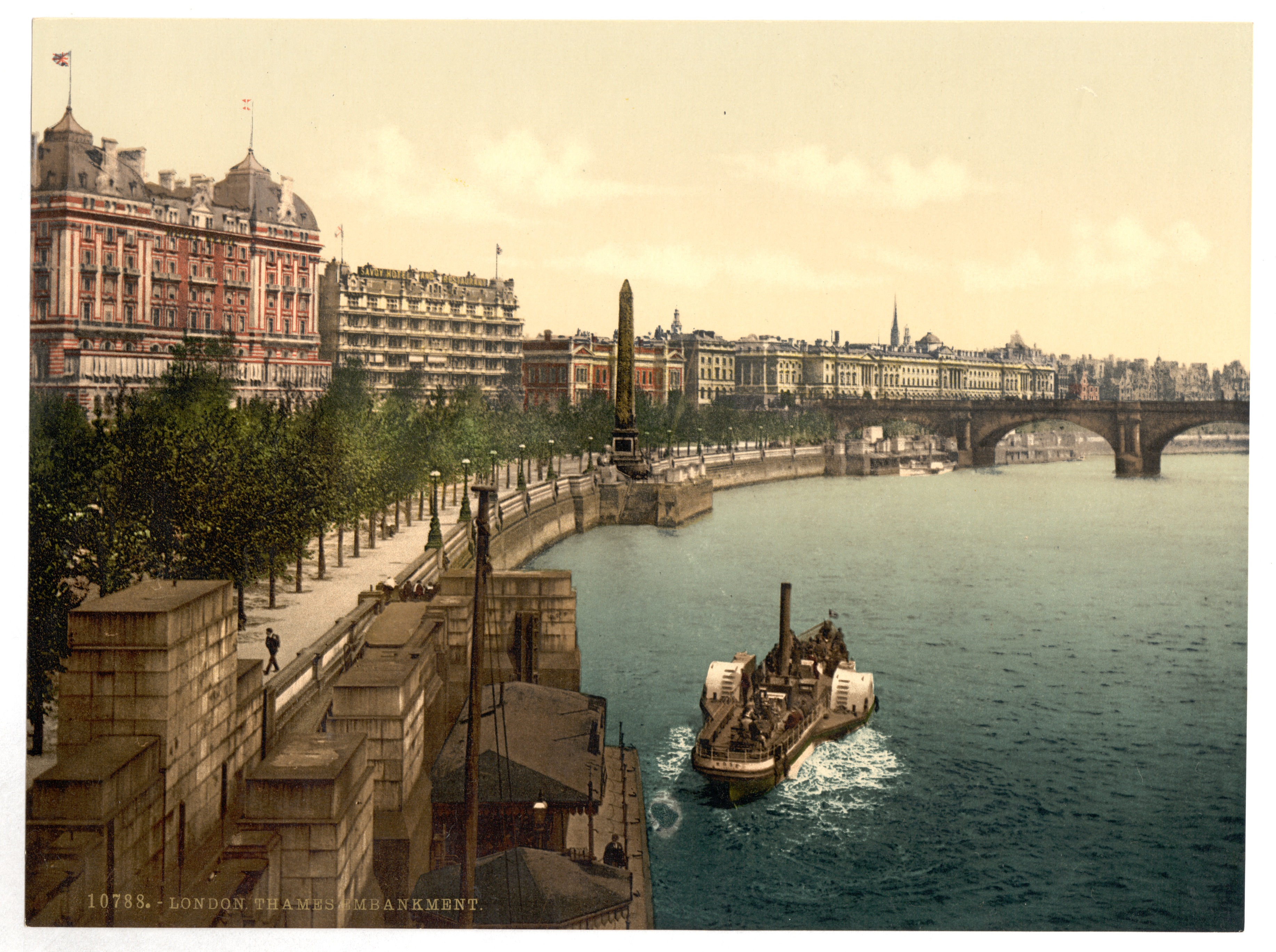
The Thames Embankment in the 1890s, with Cleopatra's Needle prominent.
Notice also the paddle steamer Rose. I have yet to find any information about this vessel, but in 1905 the LCC commissioned and ran a large number of similar river boats. It was a financial disaster, and the fleet of thirty vessels was sold off cheap in 1907. They were dispersed all over the world — including to Scotland, France, Belgium, the Netherlands, Italy, Germany, Czechoslovakia and Russia. Several ended up in Mesopotamia, for service on the Tigris and Euphrates.
These vessels had been designed by the chief mechanical engineer for the LCC, Henry Morrison Rounthwaite, who lived in Nicosia Road /the Toast Rack. Links to info about e.g. LCC Paddle Steamers and specific vessels — but not, of course, Rose, which had been built a little earlier.
I first learned of Henry Morrison Rounthwaite in Joan Davidson's study of
interwar housing for women in London . . . which discusses his daughter Bertha . . .
Henry Rounthwaite — Mechanical Engineer at the LCC 1903-1920 — is also important locally for designing e.g. storm-water pumping stations for Falconbrook and Abbey Mills.
[Photochrome Print Collection for the Falcon Brook and Abbey Mills.- Library of Congress Catalog: Thames embankment, London, England-LCCN2002696941.jpg]
(Click on image to enlarge)
I know that Foster is responsible for several very early photographs of Wandsworth Common, including one of his children boating on the Black Sea, and a view of the Royal Victoria Patriotic Asylum; but so far I've only seen a few, and there be many more. An album of his photographs is cared for by a descendant, who I have yet to make contact with. Wish me luck.
It also seems likely that the [surprisingly?] large number of Wandsworth Common residents who were members of the Society of Arts and.or the British Association in the 1860s may owe a lot to his presence in the area.
More on both topics very soon, I hope.