[The Times: Search: "Wandsworth Common"].
[BNA: Buckmaster Battersea 1853]
[BNA: Buckmaster Wandsworth 1853]
[London Evening Standard: Buckmaster Wandsworth 1853]
[PB: Can we work out which of the "5 houses" this was?]
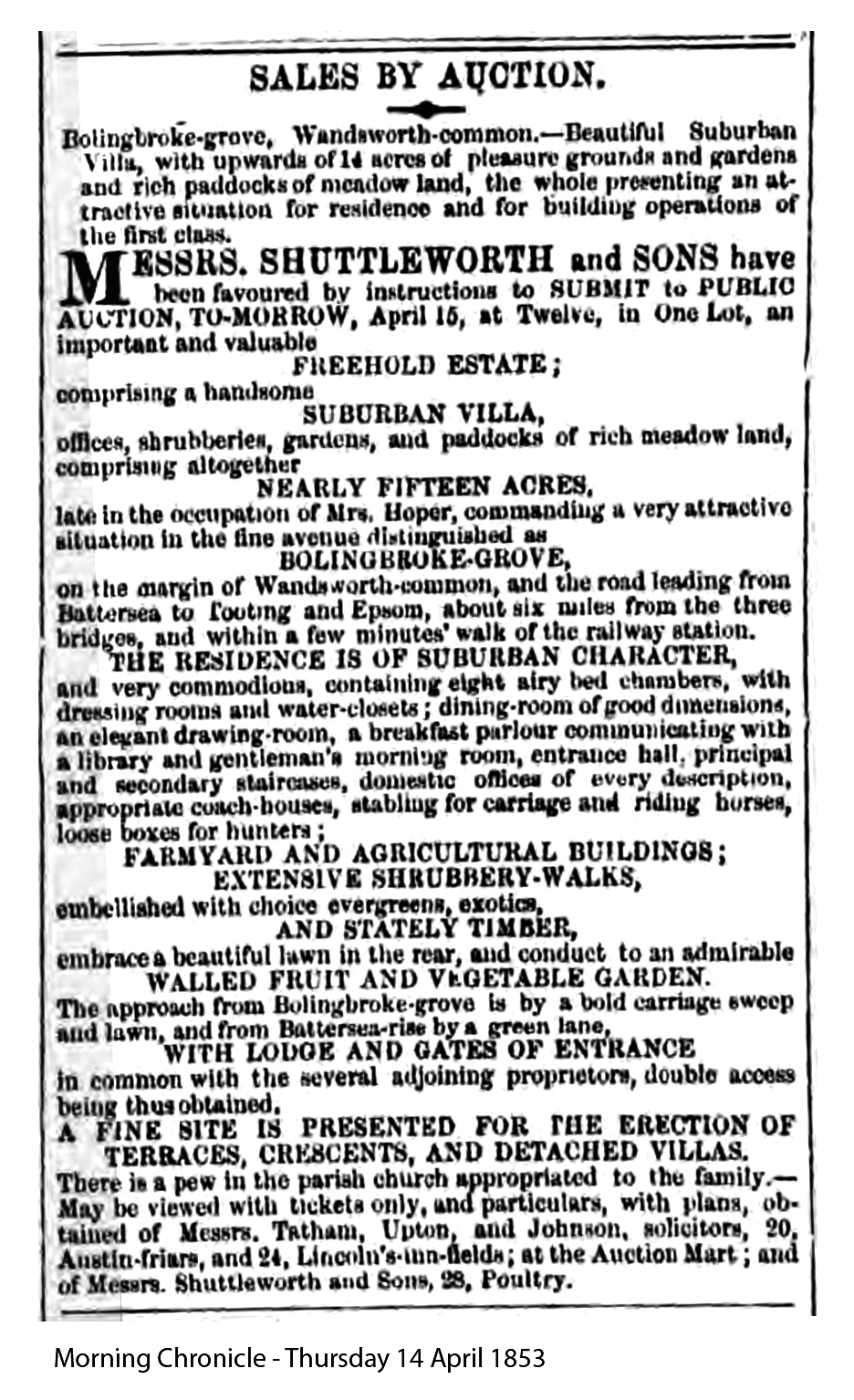
Sale by auction of a "beautiful suburban villa with upwards of 14 acres of pleasure grounds and gardens" in Bolingbroke Grove
[LOCATE ON MAP & ADD IMAGE]
SALES BY AUCTION.
Bolingbroke-grove, Wandsworth-common.- Beautiful Suburban Villa, with upwards of 14 acres of pleasure grounds and gardens and rich paddocks of meadow land, the whole presenting an attractive situation for residence arid for building operations of the first class.
MESSRS. SHUTTLEWORTH and SONS have .lV.L been favoured by instructions to SUBMIT to PUBLIC AU/'TION, TO-ISORROW, April 16, at Twelve, in One Lot, an Important and valuable
FREEHOLD ESTATE;
comprising a bandsome
SUBURBAN VILLA, offices, shrubberies, gardens, and paddocks of rich meadow land, eomprislig altogether
NEARLY FIFTEEN ACRES,
late in the occupation of Mrs. Hoper, commanding a very attractive situation ui the ?? avenue clistinguished as
BOLINGBROKE-GROVE,
on the margin of Wandsworth-common, and the road leading from Battersea to rooting and Epsom, about six miles from the three bridges, and within a few inautes' walk of the rail way station.
THE RESIDENCE IS OF SUBURBAN CHARACTER,
and very commodious, contalinlg eight alry bed ehrimbers, wlth dressieg roo"s acd water-closets; dining-room of good dnsensions, an elegant drawing-roosn, a breakfast parlour communicatiug with a library and geistlemnais's morning room, entrance hall, principal aiid secondary staireases, domestic offices of every degeription, appropriate coach-houses, stabling for earriage and riding hcrses, lease boxes for Iunters
FARMYARD AND AGRICULTURAL BUILDINGS; EXTENS1VE SHRUBBERY-WALKS,
embellished with choiea evergreens, exotics,
AND STATELY TIMBER, embracea beautiful lawi in the rear, and conduct to all admirable
WALLED FRUIT AND VEGETABLE GARDEN.
The approach from Bolingbroke-grove is by a bold carriage sweep and lawn, and from Battersea-rise by a green lane,
WITH LODGE AND GATES OF ENTRANCE in common with the several adjoining proprietors, double access being thus obtained.
A FINE SITE IS PRESENTED FOR THE ERECTION OF TERRACES, CRESCENTS, AND DETACHED VILLAS.
There is a pew in the parish church appropriated to the family.- May be viewed with tickets only, and particulars, with plans, obtained of Messrs. Tatham, Upton, and Johnson, solicitors, 20, Austin-friars, and 24, Lincoln's-inn-fields; at the Auction Mart; and of Messrs Shuttleworth and Sons, 28, Poultry.
.[Source: BNA LINK]
Kentish Mercury — Saturday 16 April 1853
Suicide of Girl through Jealousy.
On Sunday ! the body of a young woman, named Lucy Upton, the daughter of respectable paicnts residing �t Wandsworth' plain, was found by a labourer in a pond called the "Black Sea," upon Wandsworth-common, and there is no doubt but th U the deceased committed suicide while in stale of j temporary insanity, caused fit of jealousy. It appears ; that the unfortunate young girl, who is only 18 years age, had become attached to young man. the , j svi of a licensed victualler in the neighbourhood, and she had latterly seen him in company with another young woman, which roused her jealousy, and she had been heard declare that she would make hoi * in the water for him.
On Saturday night she seemed in her usual spirits, and a-out 11 o'clock her parents left her in the front parlour, in which ro >n> she slept, washing her feet, previously to her going to bed. Thev went stairs and retired rest, and, { befoit the/ did so. the deceased was heard lock her door. Nothing more was heard of her nnti! the following morning | when her was found lying in the water of the Black Sea. Wandsworth-common. Her bonnet and shawl were discovered lying the edge of the pond, and supposed that the* deceased waited until her parents were asleep, and then unlocked the door and made her way straight to the common. The water in the pond very shallow, and where the body was found lying it is only three feet. Snioci Accident.
[BNA: Link]
The Monster Telescope on Wandsworth Common — 14 May 1853
As reported in Australia:
["the only telescope ever constructed of English materials"?]
(Click on image to enlarge)
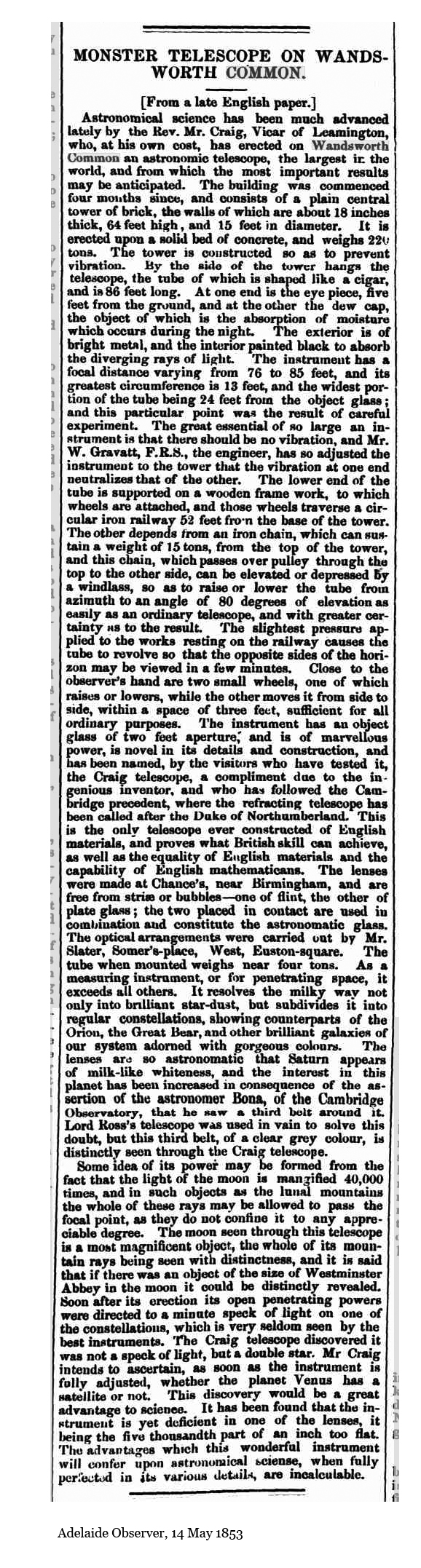
MONSTER TELESCOPE ON WANDSWORTH COMMON.
Adelaide Observer (SA : 1843 — 1904) Sat 14 May 1853 Page 8
MONSTER TELESCOPE ON WANDSWORTH COMMON.
(From a late English paper.)
Astronomical science has been much advanced lately by the Rev. Mr. Craig, Vicar of Leamington, who, at his own cost, has erected on Wandsworth Common an astronomic telescope, the largest in the world, and from which the most important results may be anticipated.
The building was commenced four months since, and consists of a plain central tower of brick, the walls of which are about 18 inches thick, 64 feet high, and 15 feet in diameter. It is erected upon a solid bed of concrete, and weighs 220 tons. The tower is constructed so as to prevent vibration. By the side of the tower hangs the telescope, the tube of which is shaped like a cigar, and is 86 feet long. At one end is the eye piece, five feet from the ground, and at the other the dew cap, the object of which is the absorption of moisture which occurs during the night. The exterior is of bright metal, and the interior painted black to absorb the diverging rays of light.
The instrument has a focal distance varying from 76 to 85 feet, and its greatest circumference is 13 feet, and the widest portion of the tube being 24 feet from the object glass; and this particular point was the result of careful experiment. The great essential of so large an instrument is that there should be no vibration, and Mr. W. Gravatt, F.R.S., the engineer, has so adjusted the instrument to the tower that the vibration at one end neutralizes that of the other. The lower end of the tube is supported on a wooden frame work, to which wheels are attached, and those wheels traverse a circular iron railway 52 feet from the base of the tower.
The other depends from an iron chain, which can sustain a weight of 15 tons, from the top of the tower, and this chain, which passes over pulley through the top to the other side, can be elevated or depressed By a windlass, so as to raise or lower the tube from azimuth to an angle of 80 degrees of elevation as easily as an ordinary telescope, and with greater certainty as to the result.
The slightest pressure applied to the works resting on the railway causes the tube to revolve so that the opposite sides of the horizon may be viewed in a few minutes. Close to the observer's hand are two small wheels, one of which raises or lowers, while the other moves it from side to side, within a space of three feet, sufficient for all ordinary purposes.
The instrument has an object glass of two feet aperture^ and is of marvellous power, is novel in its details and construction, and has been named, by the visitors who have tested it, the Craig telescope, a compliment due to the ingenious inventor, and who has followed the Cam bridge precedent, where the refracting telescope has been called after the Duke of Northumberland.
This is the only telescope ever constructed of English materials, and proves what British skill can achieve, as well as the equality of English materials and the capability of English mathematicians. The lenses were made at Chance's, near Birmingham, and are free from striaa or bubbles%one of flint, the other of plate glass; the two placed in contact are used in combination and constitute the astronomatie glass.
The optical arrangements were carried out by Mr. Slater, Somer's-place, West, Euston-square. The tube when mounted weighs near four tons. As a measuring instrument, or for penetrating space, it exceeds all others. It resolves the milky way not only into brilliant star-dust, but subdivides it into regular constellations, showing counterparts of the Orion, the Great Bear, and other brilliant galaxies of our system adorned with gorgeous colours. The lenses are so astronomatic that Saturn appears of milk-like whiteness, and the interest in this planet has been increased in consequence of the assertion of the astronomer Bona, of the Cambridge Observatory, that he saw a third belt around it.
Lord Ross's telescope was used in vain to solve this doubt, but this third belt, of a clear grey colour, is distinctly seen through the Craig telescope.
Some idea of its power may be formed from the fact that the light of the moon is magnified 40,000 times, and in such objects as the lunal mountains the whole of these rays may be allowed to pass the focal point, as they do not confine it to any appreciable degree. The moon seen through this telescope is a most magnificent object, the whole of its mountain rays being seen with distinctness, and it is said that if there was an object of the size of Westminster Abbey in the moon it could be distinctly revealed.
Soon after its erection its open penetrating powers were directed to a minute speck of light on one of the constellations, which is very seldom seen by the best instruments. The Craig telescope discovered it was not a speck of light, but a double star. Mr Craig intends to ascertain, as soon as the instrument is fully adjusted, whether the planet Venus has a satellite or not. This discovery would be a great advantage to science. It has been found that the instrument is yet deficient in one of the lenses, it being the five thousandth part of an inch too flat.
The advantages which this wonderful instrument will confer upon astronomical science, when fully perfected in its various details, are incalculable.
Norfolk Chronicle — Saturday 20 August 1853
On the 9th, at Southwark, John Charles Buckmaster, Esq., Professor of Chemistry, at Battersea college, to Emily Anne, eldest daughter of the late Mr. Goodliffe, of Cambridge.
[Source: Link]
Bell's Weekly Messenger, 3 September 1853
[COMPLETE & TRANSCRIBE]

"Burial Ground for Lambeth", Bell's Weekly Messenger, 3 September 1853
1853_burial_ground_BellsWeeklyMessenger_3sep1853.jpg
(Click on image to enlarge)
1852 | 1854