IN PROGRESS — NOT FOR PUBLICATION
Refresh this page
Index of years
1838 | 1840
Wandsworth Common
IN THE NEWS
1839
Bell's Life in London and Sporting Chronicle -Sunday 24 March 1839
Attempted duel — Alias Wilkinson, Smith and Jones
[BNA: Link.]
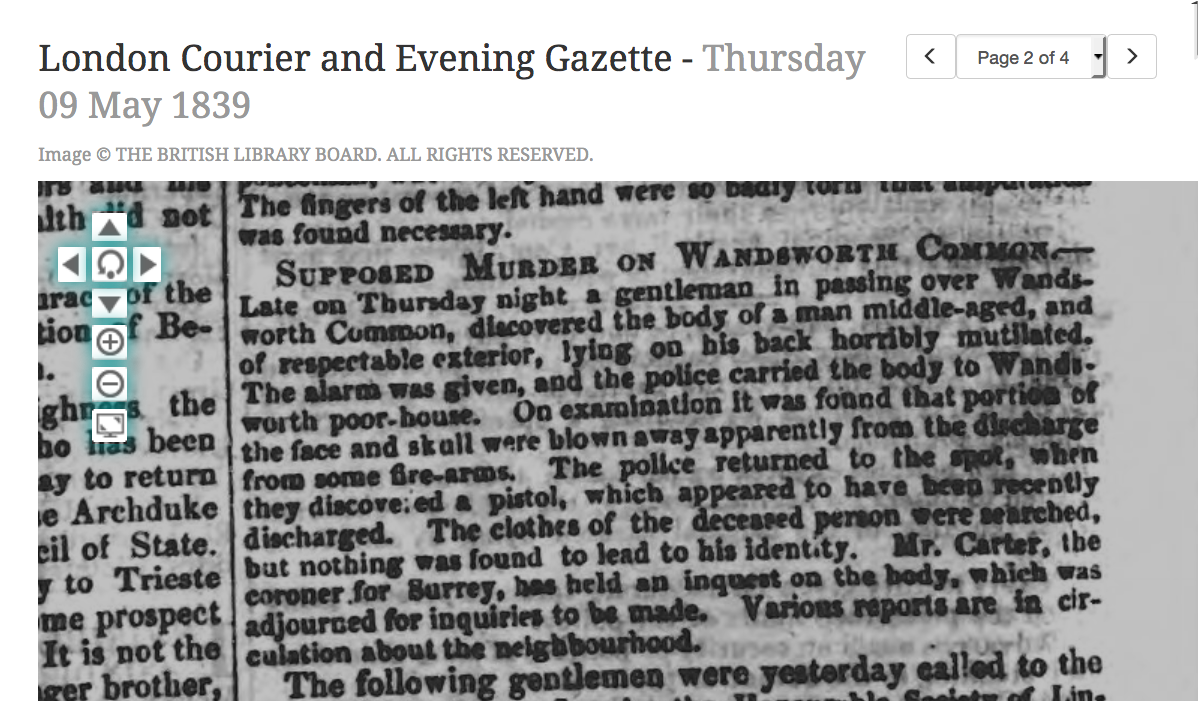
London Courier and Evening Gazette — Thursday 09 May 1839
"Supposed murder on Wandsworth Common"
(Click on image to enlarge)
MURDER London Courier and Evening Gazette — Thursday 09 May 1839[BNA: Link.]
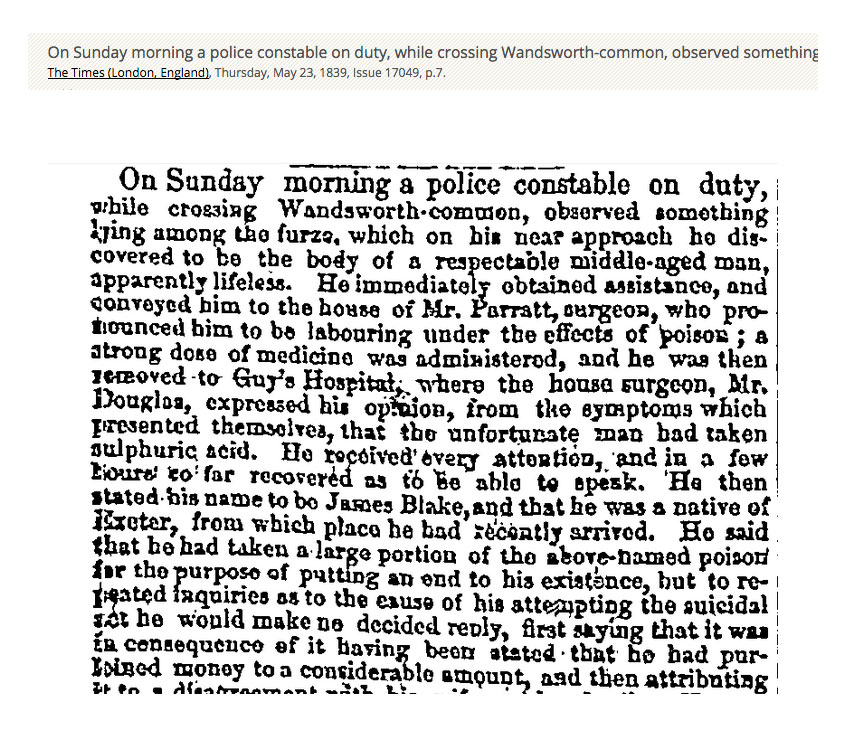
The Times, 23 May 1839
Policeman finds apparently lifeless body . . .
(Click on image to enlarge)
See also[See also BNA: Bell's Weekly Messenger — 25 May 1839]
Northern Star and Leeds General Advertiser, 9 November 1839
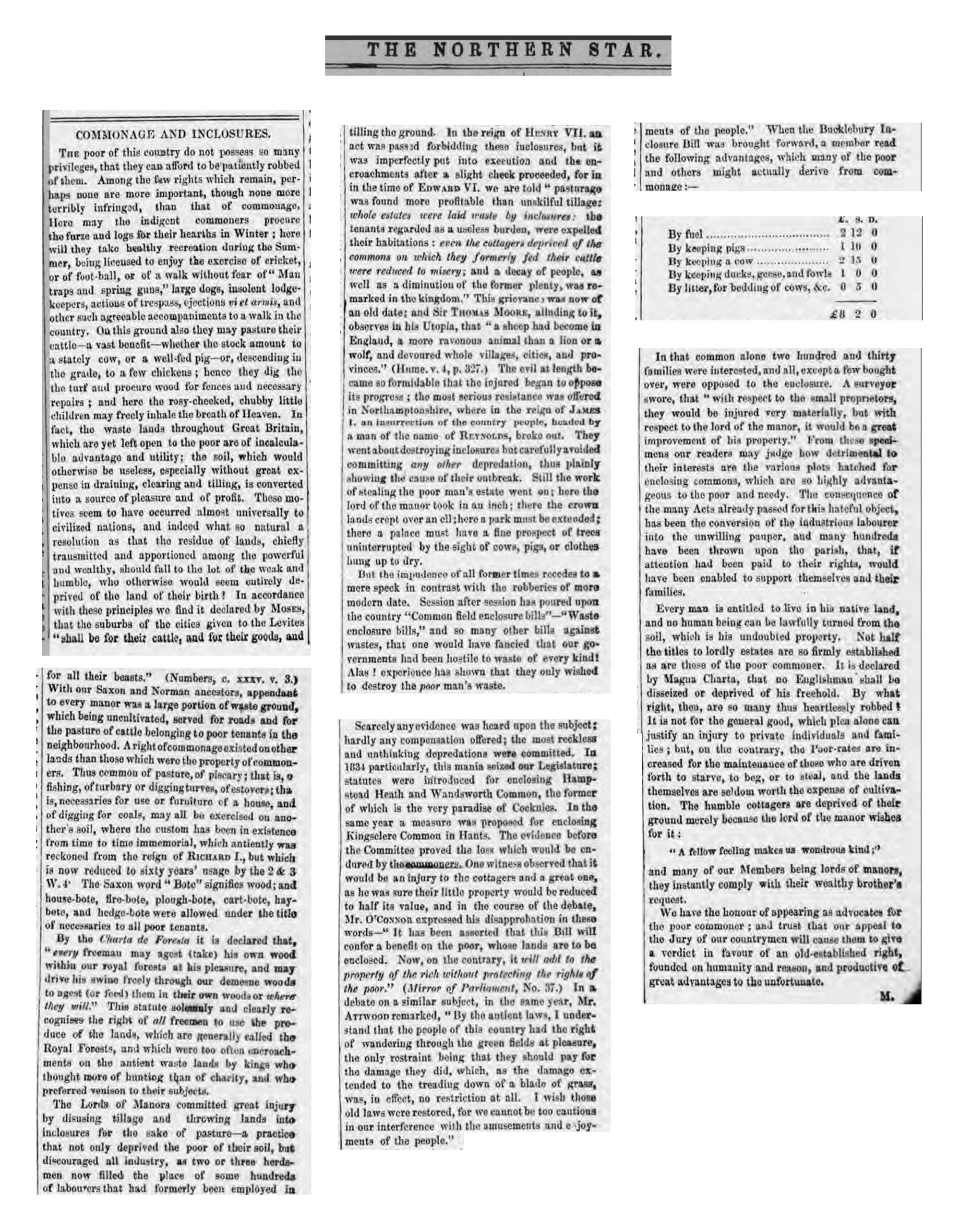
The Chartist Northern Star on the loss of the commons (including Wandsworth Common) to "inclosure" — "The poor of this country do not possess so many privileges, that they can afford to be patiently robbed of them".

(Click on image to enlarge)
BNA brief reference:
COMMONAGE AND INCLOSURES
. . . In 1834 particularly, this mania seized our Legislature; statutes were introduced for enclosing Hampstead Heath and Wandsworth Common, the former of which is the very paradise of Cocknies. In the same year a measure was proposed for enclosing Kingsclere . . .
Northern Star and Leeds General Advertiser, Saturday 09 November 1839
Entire article:
(Click on image to enlarge)
[NEEDS A PROPER EDIT]
COMMONAGE AND INCLOSURES
The poor of this country do not possess so many privileges, that they can afford to be patiently robbed of them. Among the few rights which remain, per haps none are more important, though none more terribly infringed, than that of commonage. Here may the indigent commoners procure the furze and logs for their hearths in Winter; here will they take healthy recreation during the Summer, being licensed to enjoy the exercise of cricket, or of foot-ball, or of a walk without fear of "Man traps and spring guns," large dogs, insolent lodgekeepers, actions of trespass, ejections vi et armis ["by force and arms"], and other such agreeable accompaniments to a walk in the country. On this ground also they may pasture their cattle — a vast benefit — whether the stock amount to a stately cow, or a well-fed pig or, descending in the grade, to a few chickens; hence they dig the turf and procure wood for fences and necessary repairs; and here the rosy-cheeked, chubby little children may freely inhale the breath of Heaven.
In fact, the waste lands throughout Great Britain, which are yet left open to the poor are of incalculable advantage and utility; the soil, which would otherwise be useless, especially without great expense in draining, clearing and tilling, is converted into a source of pleasure and of profit. These motives seem to have occurred almost universally to civilized nations, and indeed what so natural a., resolution as that the residue of lands, chiefly e transmitted and apportioned among this powerful and wealthy, should fall to the lot of the weak and it humble, who otherwise would seem entirely deprived of the land of their birth? In accordance with these principles we find it declared by MOSES, LO that the suburbs of the cities given to the Levites 3 "shall be for their cattle, and for their goods, and for all their beasts." (Numbers, c. xxxv. v. 3.)
With our Saxon and Norman ancestors, appendant to every manor was a large portion of waste ground, which being uncultivated, served for roads and for the pasture of cattle belonging to poor tenants in the neighbourhood. A right of commonage existed on other lands than those which were the property of commoners. Thus common of pasture, of piscary; that is, of fishing, of turbary or digging turves, of estovers; that is, necessaries for use or furniture of a house, and of digging for coals, may all be exercised on another's soil, where the custom has been in existence from time to time immemorial, which antiently was reckoned from the reign of RICHARD I., but which is now reduced to sixty years' usage by the 2 & 3 W.4. The Saxon word "Bote" signifies wood; and house-bote, fire-bote, plough-bote, cart-bote, haybote, and hedge-bote were allowed under the title of necessaries to all poor tenants.
By the Charta de Foresta it is declared that, "every freeman may agest (take) his own wood within our royal forests at his pleasure, and may drive his swine freely through our demesne woods to agest (or feed) them in their own woods or where they will." This statute solemnly and clearly recognises the right of all freemen to use the produce of the lands, which are generally celled the Royal Forests, and which were too often encroachments on the ancient waste lands by kings who thought more of hunting than of charity, and who preferred venison to their subjects.
The Lords, of Manors committed great injury by disusing tillage and throwing lands into enclosures for the sake of pasture-a practice that not only deprived the poor of their soil, but discouraged all industry, as two or three herdsmen now filled the place of some hundreds of labourers that had formerly been employed in tilling the ground.
In the reign of HENRY VII an act was passsd forbidding these inclosures, but it was imperfectly put into execution and the encroachments after a slight check proceeded, for in in the time of EDWARD VI. we are told "pasturage was found more profitable than unskilfal tillage: whole estates eere laid waste by inclosures; the tenants regarded as a useless burden, were expelled their habitations: evens the cottagers deprived of the conimons on wlhich they formerly fed their cattle veere reduced to misery; and a decay of people, as well as a diminution of the former plenty, was remarked in the kingdom."
This grievance was now of an old date; and Sir THOMAS MOORE, alluding to it, observes in his Utopia, that "a sheep had become in England, a more ravenous animal than a lion or a wolf, and devoured whole villages, cities, and provinces." (Hume. v. 4, p. 327.)
The evil at length became so formidable that the injured began to oppose its progress; the most serious resistance was offered in Northamptonshire, where in the reign of JAMES I. an insurrection of the country people, headed by a man of the name of REYNOLDS, broke out. They went about destroying inclosures but carefully avoided committing
any other depredation, thus plainly showing the cause of their outbreak. Still the work of stealing the poor man's estate went on; here the lord of the manor took in an inch; there the crown lands crept over an ell; here a park must be extended; there a palace must have a fine prospect of trees uninterrupted by the sight of cows, pigs, or clothes hung up to dry.But the impudence of all former times recedes to a mere speck in contrast with the robberies of more modern date. Session after session has poured upon the country "Common field enclosure bills", "Waste enclosure bills," and so many other bills against wastes, that one would have fancied that our governments had been hostile to waste of every kind! Alas ! experience has shown that they only wished to destroy the poor man's waste.
Scarcely any evidence was heard upon the subject; hardly any compensation offered; the most reckless and unthinking depredations were committed. In 1834 particularly, this mania seized our Legislature; statutes were introduced for enolosing Hampstead Heath and Wandsworth Common, the former of which is the very paradise of Cocknies. In the same year a measure was proposed for enclosing Kingsclere Common in Hants. The evidence before the Committee proved thee loss which would be endured by the eammouers.
One witness observed that it would be an injury to the cottagers and a great one, as lie was sure their little property would be reduced to half its value, and in the course of the debate, Mr. O'CONNOR expressed his disapprobation in these words- "It has been asserted that this Bill will confer a benefit on the poor, whose lands are to be enclosed. Now, on the contrary, it will add to the property of the rich without protecting the rights of the poor." (Mirror of Parliament, No. 37 [YEAR?])
In a debate on a similar subject, in the same year, Mr. ATTWOOD remarked, "By the antient laws, I understand that the people of this country had the right of wandering through the green fields at pleasure, the only restraint being that they should pay for the damage they did, which, as the damage extended to the treading down of a blade of grass, was, in effect, no restriction at all. I wish those old laws were restored, for we cannot be too cautious in our interference with the amusements and enjoyments of the people."
When the Bucklebury Inclosure Bill was brought forward [1834], a member read the following advantages, which many of the poor and others might actually derive from commonage:
£. s. d.
By fuel . . . . . . . . . 2/12/0
By keeping pigs . . . . . . . . . 1/10/0
By keeping a cow . . . . . . . . . 2/15/0
By keeping ducks, geese, ald fowls . . . . . . . . . 1/0/0
By litter, for bedding of cows, &c . . . . . . . . . .0/5/0
£8/2/0
In that common alone two hundred and thirty families were interested, and all, except a few bought over, were opposed to the enclosure. A surveyor swore, that "with respect to the small proprietors, they would be injured very materially, but with respect to the lord of the manor, it would be a great improvement of his property." From these specimens our readers may judge how detrimental to their interests are the various plots hatched for enclosiig commons, which are so highly advantageous to tile poor and needy. The consequence of the many Acts already passed for this hateful object, has been the conversion of the industrious labourer into the unwilling pauper, and many hundreds have been thrown upon the parish, that, if attention had been paid to their rights, would have been enabled to support themselves and their families.
Every man is entitled to live in his native land, and no human being can be lawfully turned from the soil, which is his undoubted property. Not half the titles to lordly estates are so firmly established as are those of the poor commoner. It is declared by Magna Charta, that no Englishman shall be disseized or deprived of his freehold. By what right, then, are so many thus heartlessly robbed? It is not for the general good, which plea alone can justify an injury to private individuals and families; but, on the contrary, the Poor-rates are increased for the maintenance of those who are driven forth to starve, to beg, or to steal, and the lands themselves are seldom worth the expense of cultivation. The humble cottagers are deprived of their ground merely because the lord of the manor wishes for it:
"A fellow feeling makes us wondrous kind,"
and many of our Members being lords of manors, they instantly comply with their wealthy brother's request.
We have the honour of appearing as advocates for the poor comonner; and trust that our appeal to the Jury of our countrymen will cause them to give a verdict in favour of an old-established right, founded on humanity and reason, and productive of great advantages to the unfortunate.
M.
[BNA: Northern Star and Leeds General Advertiser, Saturday 09 November 1839.]
Notes & queries
- Wikipedia: Northern Star (Chartist newspaper).
- Interestingly, the Spencer estates were principally in Northamptonshire and Warwickshire — two counties in which the fight against enclosure was perhaps fiercest [C17 and C18/19?]. Did this affect the Earls Spencer's reactions to the struggles over Wandsworth & Wimbledon Commons?
- Spencer of Althorp estate
- Bucklebury Inclosure [follow up]
- G Whittington, The Common Lands of Berkshire (JSTOR to view)
- Wikipedia: Bucklebury (v brief)
- etc
- Search: Midland Revolt [C17]
- Wikipedia: Midland Revolt
- Protest: Stories of Resistance: Steve Hindle on Enclosures and Captain Pouch
I have started writing up notes on Chartism in Wandsworth:
[HWC: Chartism in Wandsworth]