The History of Wandsworth Common
Added 2.10.2019
IN PROGRESS — NOT FOR PUBLICATION
Refresh this page
Index of years
1827 | 1829
Wandsworth Common
IN THE NEWS
1828
1828
https://www.britishnewspaperarchive.co.uk/search/results/1828-01-01/1828-12-31?basicsearch=%2benclosure%20%2b%22clapham%20common%22&freesearch=enclosure&phrasesearch=clapham%20common&exactsearch=false&county=london%2c%20england&retrievecountrycounts=false&mostspecificlocation=london%2c%20england&sortorder=dayearly
. . . A Meeting Is held at Stockwell respecting the proposed enclosure of Clapham-common. . . .
Published: Tuesday 01 January 1828
Newspaper: English Chronicle and Whitehall Evening Post
Saint James's Chronicle
. . . A meeting is held at Stockwell respecting the proposed enclosure of Clapham Common . . .
Published: Tuesday 01 January 1828
Newspaper: Saint James's Chronicle
Baldwin's London Weekly Journal
. . . A meeting is held at Stockwell respecting the proposed enclosure of Clapham Common . . .
Published: Saturday 05 January 1828
Newspaper: Baldwin's London Weekly Journal
Watchman
THE WATCHMAN. LONDON, SUNDAY, JANUARY 20, 1828
. . . a fneeting at 'Stockwell respecting the proposed enclosure Clapham common. T . . .
Published: Sunday 20 January 1828
Sun (London) — Tuesday 29 January 1828
We hear that Lord SPENCER, yielding to the wishes of the inhabitants, as expressed at their late public meeting, has abandoned the idea of applying for the enclosure of Clapham Common ; but that the project of allotting tine Common Fields at Battersea is still persisted in ; though that is warmly opposed, ou the ground that it would lead to the erection of a multitude of small cottages, and thus enhance the poor-rates.
New Times (London)
We hear that Lord SPENCER, yielding to the wishes of the inhabitants, as expressed at their late public meeting, has abandoned the idea of applying for the enclosure of Clapham Common ; but that the project of allotting tine Common Fields at Battersea is still persisted in ; though that is warmly opposed, ou the ground that it would lead to the erection of a multitude of small cottages, and thus enhance the poor-rates.
Published: Tuesday 29 January 1828
Saint James's Chronicle
. . . wishes of the inhabitants, as expressed at their late public meeting, has abandoned the idea of applying for the enclosure of Clapham Common; but that the project of allotting the Common Fields at Battersea is still persisted in; though that is as warmly . . .
Published: Tuesday 29 January 1828
London Mercury 1828
guardians of the constitution. Like oth2r watchmen they may sometimes err and give a false alarm; but the ..
. . . the wishes of the inhabitants; as expressed at their late public tneeting. has abandoned the of applying for the enclosure of Clapham Common; but that the project of allotting the Common — Fields at Battersea is still persisted in; though that is Warmly . . .
Published: Wednesday 30 January 1828
London Packet and New Lloyd's Evening Post
. . . expressed at their late public meet. ..has abandoned the idea of applying for the enclosure of Clapham Common; but that the project o . . .
Published: Wednesday 30 January 1828
High Life in London
. . . Lord Spencer, yielding to the wishes of the inhabitants, has abandoned the idea of applying for the enclosure of Clapham Common; the project of allotting the Common Fields at Battersea is still persisted in.--Letters from Madrid of the 14th . . .
Published: Sunday 03 February 1828
Atlas
GUILDHALL
. . . wishes of the inhabitants, as expressed at their late public meeting, has abandoned the idea of applying for the enclosure of Clapham Common; but that the project of allotting the Common Fields at Battersea is still persisted in; though that is warmly . . .
Published: Sunday 03 February 1828
Weekly Times (London)
MULTUM IN PARVO
. . . Lord Spencer, yielding to the wishes of the inhabitants, has abandoned the idea of applying for the enclosure of Clapham Common; the project of allotting, ' the Common Fields at Battersea is still persisted in.
Published: Sunday 03 February 1828
Newspaper: Weekly Times (London)
MULTUM IN PARVO
. . . Lord Spencer, yielding to the wishes of the inhabitants, has abandoned the idea of applying for the enclosure of Clapham Common; the project of allotting the Common Fields at Battersea is still persisted in . . . .
Published: Sunday 03 February 1828
Newspaper: Johnson's Sunday Monitor
Weekly Times (London)
LTUlil IN PARVO
. . . Lord Spencer yielding to the wishes of the inhabitants, has abandoned the idea of applying for the enclosure or Clapham Common; the project of allotting the Common Fields at Battersea is still persisted in.--Lct teas from Madrid of the 14th . . .
Published: Sunday 03 February 1828
Type: Article | Words: 549 | Page: 7 | Tags: none
Fleming's British Farmers' Chronicle
MULTUM IN PARVO
. . . Lord Spencer, yielding to the wishes of the inhabitants, has abandoned the idea of applying for the enclosure of Clapham Common; the project of allotting the Common Fields at Battersea is still persisted in. . . .
Published: Monday 04 February 1828
Type: Article | Words: 556 | Page: 3 | Tags: none
Surrey Herald and County Advertiser
GOSSIP OF THE WEEK
. . . Lord Spencer, yielding to the wishes of the inhabitants, has abandoned the idea of applying for the enclosure of Clapham Common; the project of allotting the Common Fields at Battersea is still persisted in. . . .
Published: Tuesday 05 February 1828
Morning Post
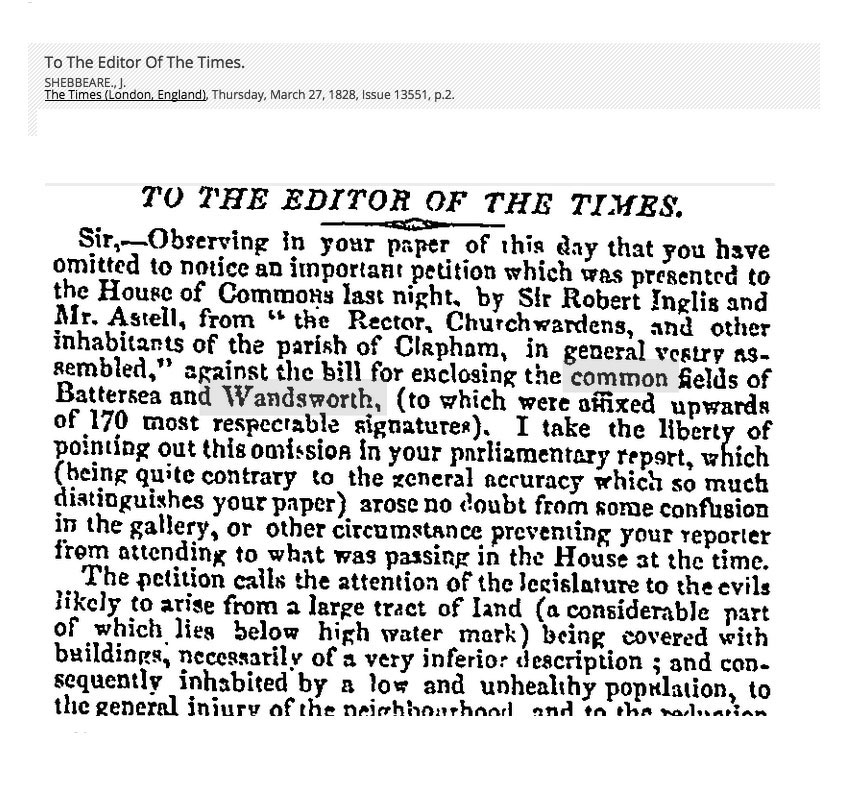
The Times, 27 March 1828
Enclosure petition . . .
[Find whole letter. And the one J Shebbeare is responding to.]
(Click on image to enlarge)
Battersea and Wandsworth Inclosure Bill, 1828
John Henry Barrow, The Mirror of Parliament 1828 vol 1
[PB: It would be good to proof & edit the following properly — I have only glanced through.]
____________________
Date?
[166]
Mr. DENISON presented a petition from certain proprietors of land, for a Bill to authorize the inclosure of particular tracts of land at Battersea and Wandsworth -Leave was given to bring in a Bill. — Bill ordered to be brought in by Mr. Denison and Mr. Charles Pallmer.
____________________
Date?
[583]
BATTERSEA AND WANDSWORTH (SURREY) INCLOSURE BILL, for inclosing, dividing, and allotting certain open and inclosed common fields in the parishes of Battersea and Wandsworth, in the county of Surrey, presented and read a first time; to be read a second time, on the motion of Mr. DENISON.
BATTERSEA and WANDSWORTH (SURREY) INCLOSURE BILL.
Mr. CHARLES BARCLAY said, he held in his hand a petition from the inhabit ants of Battersea and its vicinity, praying that the Battersea and Wandsworth Inclosure Bill might not pass into a law, and praying that they might be heard by their agents or Counsel against it. He wished to take that opportunity of giving notice, that he would take the sense of the House upon the second reading of the Bill
____________________
Date?
BATTERSEA AND WANDSWORTH INCLOSURE BELL.
Mr. CHARLES PALLMER presented a petition from the trustees of Marshall's Charity, against this Bill. They were the holders of the impropriate tithes of the fields which it was the object of this Bill to inclose; and they held them under their testator's will, for the benevolent purposes of increasing small livings and releasing persons imprisoned for debt. They feared that the effect of the inclosure would be, to convert into small tithes the fund intrusted to them, and so to divert it from its benevolent purposes. The petitioners, as well as him self (Mr. Pallmer), had too high an opinion of the charity and benevolence of the nobleman at whose instance this inclosure was made, to doubt for a moment that he would consent to such satisfactory arrangements as would prevent the petitioners from the painful duty of joining in the opposition to the second reading of his Bill, The petition was ordered to lie on the Table.
____________________
Date?
BATTERSEA AND WANDSWORTH (SURREY) INCLOSURE BILL.
SIR ROBERT INGLIS presented a petition from the Rector, Churchwardens, and Inhabitants of �m against this Bill. — Ordered to lie on the Table.
____________________
Date?
[852]
BATTERSEA AND WANDSWORTH INCLOSURE BILL.
Mr. ALDERMAN THOMPSON presented a petition, respectably signed, by the inhabitants of Putney, Putney Heath, and the neighbourhood, against the Battersea and Wandsworth Inclosure Bill.
Mr. DENISON.
It was not my intention to take up the time of the House, but I fear I must do so on the present occasion, as I understand that the Bill of which I am about to move the second reading is to be opposed.
I intend to move the second reading of the Battersea and Wandsworth Inclosure Bill.
An erroneous impression has gone forth, that the commons are to be inclosed; but if that was the case, I would not advocate the measure, because no Gentleman in this House can be more convinced than I am that it is necessary to keep those open spaces which remain near the metropolis for the health, comfort, and amusement of the people. The object of this Bill is to inclose those common fields which are now under cultivation, and not to interfere with the commons. I understand that the Bill is to be opposed, on the ground that it will enable a number of small cottages to be built in these common fields, and thus introduce a great quantity of poor inhabitants into the parishes. I trust that the House will allow the Bill to go into a Committee, as I am
[852]
instructed to say, by the promoters of the Bill, that a clause is prepared which will prevent the erection of small cottages. Another objection is from the trustees of Mr. Marshall; but that, too, I contend can be best arranged in the Committee.
I believe that two-thirds of the proprietors in value, and one-half in number, are in favour of the measure.
Having said so much to persuade the House to go into the Committee, I will now say a few words as to myself, personally — I shall go into that Committee, holding myself perfectly at liberty to take the best measures for the protection of the interests of all parties. If it should appear, on the third reading, that this Bill will interfere with the rights or privileges of that part of the county I have the honour to represent, which is contiguous to this place, the Bill will have my strenuous opposition. But, as I now think the Bill should go into a Committee, and be properly investigated, I shall move that it be now read a second time.
Mr. ALDERMAN THOMPSON.
As I have just presented a petition signed by a majority of the inhabitants in the neighbourhood of these common fields, the House will be aware that they are opposed to this measure. They consider that they will be materially injured by it, and therefore I feel it my duty to oppose the second reading.
I have always understood, that the principle on which the House acts in the case of Inclosure Bills is, that a majority of the persons interested should be desirous of the measure. But though the Honourable Gentleman has stated that two-thirds of the owners of these common fields wish to have them inclosed; yet, I believe, that of the resident owners and inhabitants of the land, a majority is decidedly against the Bill.
Another objection to the Bill rests altogether on public grounds. Every Member must be aware, that the waste land in the neighbourhood of the metropolis, has a material effect in promoting the health and recreation of the inhabitants; and I will, therefore, always oppose any measure for in closing those lands, which would have the effect of depriving the inhabitants of their accustomed air and exercise. My Honourable Friend (Mr. Denison) has stated, that it is not the intention of the persons interested in this measure to build small houses on the inclosed land, but what guarantee is there to prevent them? I object, also, that this Bill will take from the poor of that neighbourhood a considerable advantage they now possess in feeding their cattle on these grounds. For these reasons I move, as an amendment, that the Bill be read a second time this day six months.
Mr. MARRYAT.
I second the amendment, for the reasons stated by the Honourable Alderman.
LORD VISCOUNT ALTHORP.
My Honourable Friend has stated, that his objection to inclose these common fields is founded, among other reasons, on the injury that will accrue to some of the persons in the neighbourhood of these fields by their inclosure. Now, it is a principle on which this House has always acted, that persons should be allowed to do as they think fit with their own property, unless some reason be shown that the mode in which they wish to deal with it would be positively injurious to the public. In this case, the owners of the common fields are desirous to inclose them, in order to improve their cultivation; but no real injury can result to the public.
The Honourable Alderman has talked of the loss the inhabitants of the metropolis will suffer in the way of exercise and recreation. But does he not know, that if any body at present ventures to walk through these fields, over the cabbages and corn that may be growing there, he is liable to an action for trespass? The public have the right now — which they would have if this Bill were passed — only to go along the highways and paths which are left open to them. The Honourable Alderman has stated, that the great majority of the inhabitants are against the Bill. But the persons interested in these common fields are almost universally for the inclosure. The petition against it from Battersea was signed only by the proprietors of twenty-five out of nine hundred acres; and it is known that the dissentients are proprietors of only eighty acres altogether.
If ever there was a case that called on the House for its assistance, this is it. The land is so divided, that it consists, at present, of eight hundred stripes, no two of which belonging to the same proprietor are connected. The objections do not proceed from the parish of Battersea, but merely from some gentlemen who have villas and houses in the neighbourhood. To them the inclosure may be somewhat inconvenient, but it is, after all but an imaginary grievance.
As to the right of pasturage, there are considerable doubts respecting its existence; but it is intended that every person shall be fully compensated who can shew that he suffers any real loss by the Bill. What, indeed, is this right of which my Honourable Friend speaks? The power to turn out cattle after the crop is removed. This is surely not worth much to anybody. There is no question that the rights of the owners of these common fields are as complete as any ownership can be. All that the proprietors require, is the power to divide and allot this land among themselves.
Another objection is, that a number of poor houses and small tenements will be built there. I do not believe so, because that course would be as much against the interest of the owners, as that of any other persons in the parish. If by those means they increase the poor-rates, they will suffer in common with the other inhabitants. I should have no objection to the introduction of any clause which would give satisfaction as to this point, by putting a check on the building of such houses as are apprehended. For my own part, though I am not directly interested in the question, yet I am so nearly so, that I shall not vote in favour of the Bill; but I feel it my duty to make these observations, in order that the House may understand the grounds on which the Bill rests.
Mr. DANIEL WHITTLE HARVEY.
I rise to make a few remarks in support of the amendment; and in doing so, of the amendment; and in doing so, I am influenced entirely by this consideration, that when a Bill is referred for such a purpose as this to a Committee, there are always certain interests clearly defined, existing in the land to be inclosed; but, in � case, it is impossible to determine the value of any of these interests, either there or here. I agree with the Noble Lord, that individual rights may be duly estimated before a Committee; but, in this case, I deny that there are any rights which can be satisfactorily established. The clauses of the Bill would, however, more properly form the subject of the consideration of the Committee. There are objections in principle which must prevail over the Bill in this House. The objection urged by the Honourable Alderman appears to me insurmountable. It is the duty of this House to protect the inhabitants of this overgrown metropolis, in the enjoyment of the advantages they derive from the preservation of whatever open spaces remain for the circulation of free air, and for the currency of it, within five or six miles of this great city. The Noble Lord has stated, with his usual candour, and, I am sure, if he had not said he was interested in this Bill, nobody could have supposed so from the mode in which he argued it, that this Bill will give a value to the property which it does not now possess, as by means of it various and conflicting interests will be united.
Great benefits, no doubt, may arise from an adjustment of this nature, but the Noble Lord did not deny that the owners of ninety acres were opposed to the Bill. The fact is, that there is at the bottom of this Bill a plan for building a new city, or rather a new barrack of little hovels and wretched houses, which in a few years will be filled with a poor and miserable population. . . .
I am so completely convinced that this design is in contemplation, and that it will be impossible to make any adequate compensation to those who will be prejudiced by the Bill, which will only have the effect of spreading over the parish a second Mary-le-bone, or, as it was truly called, a second principality — that I trust the House will not go into a Committee upon it; convinced, as I am, that, as to the rights of parties, it is impossible they can be determined by any specific value. The Noble Lord treats the objections of the owners of villas in the neighbourhood as purely ideal. But, suppose a gentleman has given £1000 for one of those villas, or expended as much upon it: suppose he is led to purchase it solely in consideration of its distance from London; is it no prejudice to
[853]
interests, is it only an ideal grievance, to find his villa suddenly surrounded by a new mass of buildings, and himself stifled with smoke, and annoyed with every species of inconvenience? How is this gentleman to be compensated? I will ask the Noble Lord in what form of words he will propose a clause of compensation for the hundreds of individuals who have in this way sunk thousands of pounds? There is yet one more objection, to which even the Honourable Mover could not reconcile himself. "If," he said, "this Bill had contemplated Lambeth, and embraced Wandsworth, it would have become prejudicial to the public rights, and it should have had my hearty opposition." But why, I ask the Honourable Gentleman, is this Bill limited to Battersea Fields? In times gone by, Clapham and Wandsworth marched under the protection of one Bill — why are they now separated? It is, I will tell him, because there is dexterity in the managers of this scheme out of this House. They see that we should stand up against any encroachments on Clapham or Wandsworth Commons, and therefore, say they, "Let us attack these open fields; they are unprotected; for they involve only the rights of the poor." If they succeed with this Bill, Clapham and Wandsworth will soon follow in the train, and the design will be completed. In defence of the interests of the poor, and of the public health, I shall support the amendment.
Mr. FERGUSSON.
I rise to state my reasons why I differ from the Noble Lord. On one ground only do I oppose the Bill. This House, in my opinion, should resist every attempt to inclose any portion of the open space in the vicinity of the metropolis. The health of the inhabitants is not to be injured by the accession of new buildings, calculated further to obstruct the circulation of the air. Every one who has lately gone into the neighbourhood of London, must see that there is nothing like country to be found about it. It is one continued street, in every direction, for the space of ten miles. As long as there is an open space left, I will oppose its inclosure. I shall feel considerable reluctance in voting to the prejudice of the persons whose cause the Noble Lord advocates; but I have one object in view, which I cannot forego — that of preventing all the remaining open spaces from being covered with new buildings, of such a kind as the present neighbourhood of Somers Town. The Noble Lord said, the proprietors would have no interest in doing so, as the poor-rates would press as heavily on them as on the other inhabitants; but he forgot that they would make more profit by their ground rents than they would pay by the addition to in poor-rates.
Mr. PERCEVAL.
Though this Bill is so described in the votes of the House, I contend it is not a private Bill, but a Bill for the establishment of a public and general nuisance; and I hope it will be met by a public and general opposition.
Mr. BENETT.
I consider it a very extraordinary objection to this Bill, that this ground, if built upon, would tend to block up the avenues to the metropolis, and keep the air from circulating through it. I am not disposed to feel great alarm, as I know that, if this design be contemplated, it can be carried into execution without any Bill at all. If only two or three individuals were to purchase these fields, they might build upon them to-morrow, if they chose to ruin themselves with poor-rates. This land consists of grass commons, on which, it is true, the citizens may ride, who have horses; but on the arable land they must not venture, or they would be punished as trespassers. I am sorry to hear this Bill opposed on the old pretence — that of preserving the public health; for it is the most unjust opposition I ever heard in this House.
Mr. ALDERMAN WOOD.
I am not surprised at the opposition to this Bill, when I remember that two or three years ago there was just such an opposition, and a great majority against an Inclosure Bill in this very neighbourhood, at nearly the same distance, and under similar circumstances. It was then felt by every Member, that such inclosures did great injury to the public, and on that ground the House threw out the Bill. It is quite impossible that any clause to be introduced into the Committee can remove this objection.
Mr. CARTWRIGHT.
I consider that the House is using the promoters of the Bill very unjustly. Though the inclosure may be productive of some inconvenience to the public, it is too much to say, that the proprietors of the lands in question shall not have the same right to improve their property, which has been given elsewhere. Why were not the same objections applied to other inclosures, and other improvements? Why was no interference made with the improvements behind Grosvenor-place? Nothing can be more unfair than not to allow this Bill to go to a Committee.
SIR ROBERT INGLIS.
In this case the parties must show, on public grounds, that they have a right to this measure.
ut so far from this being proved, it appears, on the contrary, clearly, that the public convenience will be sacrificed by passing this Bill. This is an Inclosure Bill in which the parties do not profess to have an view to the introduction of an improved system of agriculture, nor do they assign any other sufficient ground for the interference of this House in their behalf.
When it is known that the surface of the ground is below the level of the river, it follows that the quality of the houses to be built there must be of a very inferior kind. The consequence would be, that the poor-rates would be increased, to the general inconvenience of the neighbourhood which surrounds it in every direction.
Mr. CALCRAFT.
No reason has been stated why we should not go into the Committee. I never heard more groundless objections to any measure. I also say, that the more open ground the better; and I, for one, would secure every acre for the benefit and health of the metropolis; but I would not do so at the expense of private individuals.
If gentlemen are desirous to have places for the recreation and amusement of the people, then, Sir, I say, let the public purchase the land. The people may then fairly be indulged as they are in the Regent's Park. The land once purchased, the public, through their representatives, would have a right to regulate the modes in which the purchase should be applied. But, Sir, when the land is known to be the property of individuals, and when those individuals are told, that because it is in the neighbourhood of the metropolis they shall not be allowed to improve it, I must oppose such a proposition as involving a most monstrous doctrine . . . , I, therefore, for these reasons, shall vote for the Bill going to a Committee; but, if we cannot prevent the parties from building that low description of houses which has been alluded to, I certainly shall oppose the Bill proceeding any farther, till some remedy is devised for that source of com plaint. I know, that in a conference with the parties, I laid down the necessity of their not erecting houses of a mean and paltry description; and my Noble Friend has informed us, that the parties are willing to abide by a condition of that sort, and not to allow the ground to be covered with houses which gentlemen seem to think would be filled by the lowest rank of the population. Therefore I am desirous that the Bill should go to a Committee, where only questions of this kind can be canvassed with a chance of coming to that right understanding which will lead to a fair and just feeling between the parties.
One point, Sir, seems not to have been noticed by the opponents of this measure — namely, that, out of 1000 acres, there are only 80 acres dissentient. If the measure be suffered to go before a Committee, I am sure considerable benefit will accrue to all parties, in the proper adjustment of their mutual differences.
Mr. ALDERMAN WAITHMAN.
It is, Sir, necessary, before we proceed farther, that the House should understand the nature of this land.
I have heard the Noble Lord's statement with attention — and also the statements of other Honourable Members, with a view to discover whether any other argument
[854]
could be adduced in support of this measure, or any greater objection raised against those who oppose it, than that private individuals would suffer in their property, if it were thrown out. Now, Sir, this argument does not convince me, when I look to the measure as affecting the public. The spot of land in question lies one mile from the place where we sit.
It is below the high-water mark, and is frequently in danger of being entirely overflowed. I ask, then, is such a site a place proper for building on ? On this side of it there are a great many manufactories, potteries, &c., and I do really conceive, from that circumstance, that if the land be covered with buildings, they will necessarily be of a very inferior description — to the great inconvenience of the public.
But, say those who support the Bill, almost all the owners of land agree, and why should not individuals be allowed to improve their own property? Why, Sir, it is not at all wonderful that they should agree when they are going to benefit themselves. But, I say that this ground is not, in fact, their own property — it has long been the property of parties to whom it has been let, and the public has also a property in it.
The present proceeding is like that which occurred in another place where I once resided. Under the plea of agricultural advantage, a number of common fields were inclosed — but some gentlemen took part of the lands into their parks. In this case, however, not one advantage, in an agricultural point of view, is held out, but exactly the reverse.
What purpose is this land applied to? It is laid out in fine kitchen-gardens; as fine and as productive as any other gardens round the metropolis — and from these gardens the people are supplied with a large quantity of vegetables. By this Bill, therefore, we shall not only deprive them of that recreation which I have often seen them enjoy, but we shall also deprive them of that supply of vegetables which is essential to their existence.
I state this, Sir, without any feeling of hostility towards those who advocate the Bill; but, if it be carried, the population in this part of the town will have to go four miles before they see a green field, whilst Battersea fields are within a mile of them. There they may inhale the pure air of the Thames, and indulge themselves in harmless recreation, which they cannot do if this plan be carried into effect.
LORD VISCOUNT NORMANBY.
I wish, Sir, to explain why, agreeing with some Honourable Gentlemen in the general principle of the inexpediency of inclosing common fields, I shall, nevertheless, vote for this Bill. I shall vote for it, Sir, because I understand from persons on whose authority I can rely, that the land which it is meant to inclose is, for ten months in the year under cultivation, and no person can intrude on it without committing a trespass. A great part of it, I believe, is laid out in asparagus beds. Now, Sir, as that is the case, the public cannot suffer that inconvenience by the inclosure, which has been asserted.
Mr. ALEXANDER BARING.
I do not think, Sir, that there is much validity in the objection which is founded on the probable erection of small houses. We can scarcely expect to have such great houses as are seen in Grosvenor square. Small houses will increase, on one side of London or the other: you cannot stop them. The increase of the labouring population renders it impossible.
But, Sir, this is stated to be low ground — ground below the level of the river, and liable to be flooded. If so, I say the air cannot be wholesome, and I think it will be an improvement to get rid of the wet ditches by which this land is intersected, and to prevent it from being covered with slime and mud, as it is at present. Besides, Sir, it appears that there is no intention of inclosing one acre of ground which has been open to the public. The intention is, to convert that which is now of little service to a much better purpose; and I am sure, if the Bill be agreed to, that it will be found beneficial to the public. I, therefore, shall vote for the measure.
The question was then put, "That the word 'now' stand part of the question:" — The House divided; Ayes 72, Noes 92 — Words added: main question, as amended, put, and agreed to. — Second reading put off for six months.
[Main section downloaded as "1828_BATTERSEA_AND_WANDSWORTH_INCLOSURE_BILL_from_The_Mirror_of_Parliament.pdf.]
[GOOGLE BOOK ref appears faulty: "Battersea and Wandsworth Inclosure Bill"]
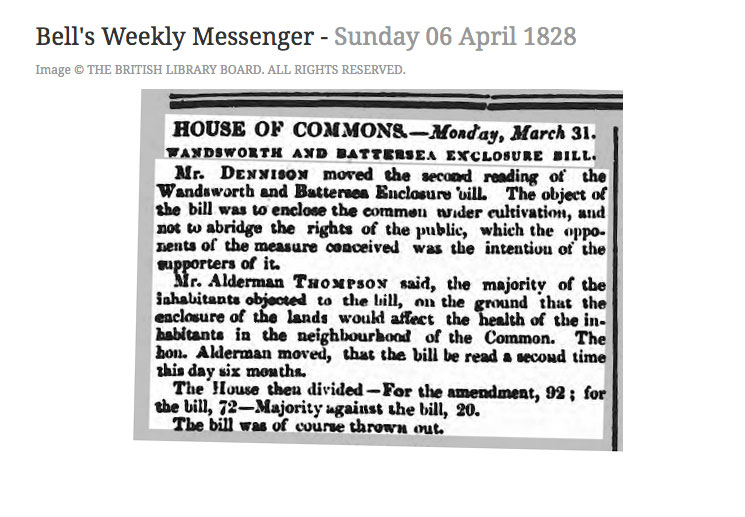
Bell's Weekly Messenger, 6 April 1828
Wandsworth and Battersea Enclosure Bill thrown out
(Click on image to enlarge)
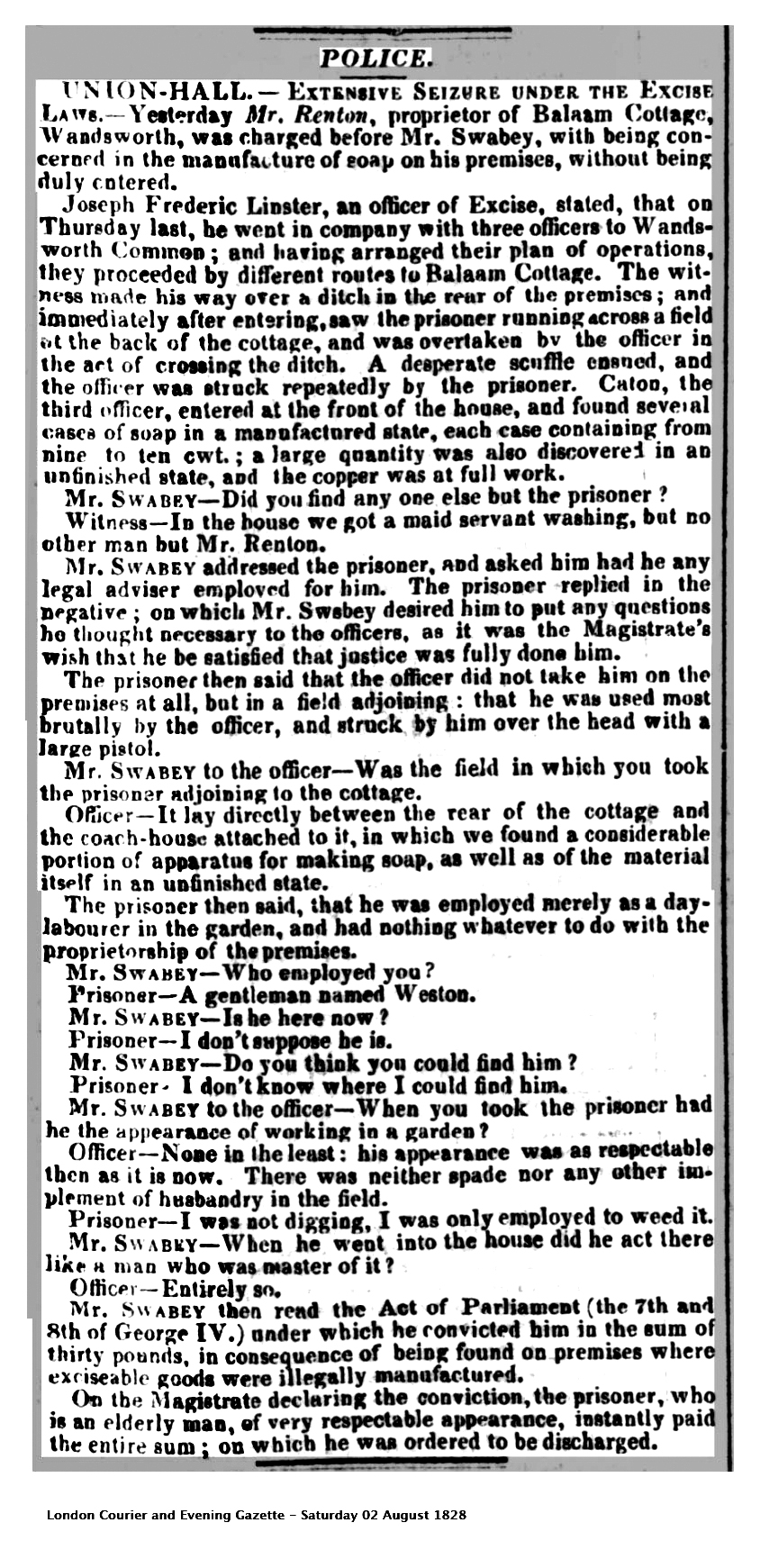
London Courier and Evening Gazette, Saturday 02 August 1828
(Click on image to enlarge)
POLICE
UNION-HALL — EXTENSIVE SEIZURE UNDER THE EXCISE LAWS
Yesterday Mr. Renton, proprietor of Balaam Cottage, Wandsworth, was charged before Mr. SWABEY, with being concerned in the manufacture of soap on his premises, without being duly entered.
Joseph Frederic Linster, an officer of Excise, stated, that on Thursday last, he went company with three officers to Wandsworth Common; and having arranged their plan of operations, they proceeded by different routes to Balaam Cottage. The witness made his way over ditch in the rear of the premises; and immediately after entering, saw the prisoner running across a field at the back of the cottage, and was overtaken by the officer in the aet of crossing the ditch.
A desperate scuffle ensued, and the officer was struck repeatedly by the prisoner.
Caton, the third officer, entered at the front of the house, and found several cases of soap in a manufactured slate, each case containing from nine to ten cwt.; large quantity was also discovered in an unfinished state, and the copper was at full work.
Mr. SWABEY — Did you find any one else but the prisoner?
Witness — In the house we got a maid servant washing, but other man but Mr. Renton.
Mr. SWABEY addressed the prisoner, and asked him had he any legal adviser employed for him. The prisoner replied in the negative; which Mr. SWABEY desired him to put any questions he thought necessary to the officers, as it was the Magistrate's wish that he be satisfied that justice was fully done to him.
The prisoner then said that the officer did not take him on the premises at all, but in a field adjoining: that he was used most brutally by the officer, and struck by him over the head with a large pistol.
Mr. SWABEY to the officer — Was the field in which you took the prisoner adjoining to the cottage?
Officer — It lay directly between the rear of the cottage and the coach-house attached if, in which we found a considerable portion of apparatus for making soap, as well as of the material itself in an unfinished state.
The prisoner then said, that he was employed merely as a day-labourer in the garden, and had nothing whatever with the proprietorship of the premises.
Mr. SWABEY — Who employed you ?
Prisoner — A gentleman named Weston.
Mr. SWABEY — Is he here now ?
Prisoner — I don't suppose he is.
Mr. SWABEY — Do you think you could find him ?
Prisoner- I don't know where I could find him.
Mr. SWABEY to the officer — When you look the prisoner had he the appearance working in garden?
Officer — None in the least: his appearance was as respectable then as it is now. There was neither spade nor any other implement of husbandry in the field.
Prisoner — I was not digging, I was only employed to weed it.
Mr. SWABEY — When he went into the house did he act there like a man who was master of it?
Officer — Entirely so.
Mr. SWABEY then read the Act Parliament (the 7th and of George IV.) under which he convicted him in the sum of thirty pounds, in consequence of being found on premises where exciseable goods were illegally manufactured.
On the Magistrate declaring the conviction, the prisoner, who is an elderly man, of very respectable appearance, instantly paid the entire sum; on which he was ordered to be discharged.
[BNA: LINK. £30 was perhaps worth £30,000 in modern money — a not inconsiderable sum for a man employed solely to weed the garden.]
Bell's Life in London and Sporting Chronicle, Sunday 26 October 1828
PEDESTRIANISM
. . . Wandsworth, at Lord's Cricket Ground, St. John's Wood. The first match was to have been played on Timrsday last, on Wandsworth Common, and the Mary-la-bonne players stumbled. consequence, at an early hour, at the houae of Mr. Gooding, at Wandsworth; . . .
Published:
Newspaper:
Bell's Life in London and Sporting Chronicle,
County: London, England
Type: Article | Words: 1253 | Page: 3, 4 | Tags: nne
MCC PLAYED ON WANDSWORTH COMMON! WHERE WAS THE CRICKET GROUND?
Bell's Life in London and Sporting Chronicle, Sunday 26 October 1828

MCC play Wandsworth home and away
(Click on image to enlarge)
Mary-le-Bonne and Wandsworth.
To-morrow, eleven players of the parish of Mary-la-bonne will, for once more this season, contend against a similar number of the gentlemen of Wandsworth, at Lord's Cricket Ground, St. John's Wood. The first match was to have been played on Thursday last, on Wandsworth Common, and the Mary-la-bonne players assembled, in consequence, at an early hour, at the houae of Mr. Gooding, at Wandsworth; but owing to the extremely unfavourable state of the weather, the match was not proceeded in. The worthy host, however, exerted himself to the utmost to make up for the disappointment, and it was ultimately agreed to play the first match tomorrow at Lord's, and the return match on Tuesday at Wandsworth. An excellent contest is anticipated.
[BNA: LINK .]
Bell's Life in London and Sporting Chronicle,
HUNTING
. . . Wallis, of the Wandsworth Players, for 20/., to played Wandsworth Common. SINGLE WICKET MATCH FOR TWENTY SOVEREIGNS. Thursday Inst, an excellei t single wicket match was played Wandsworth Common, between T. Brown, Erq. and Caldccourt (oneof the Fiayersof . . .
Published: Sunday 02 November 1828
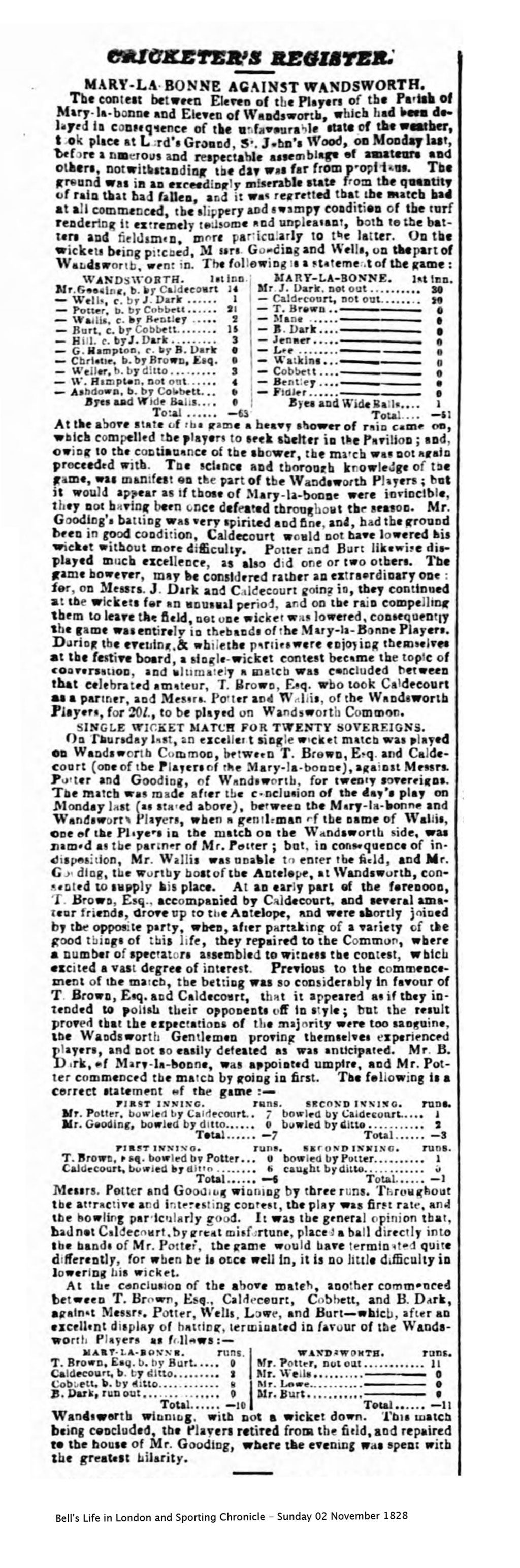
Bell's Life in London and Sporting Chronicle, Sunday 02 November 1828
MCC play Wandsworth home and away
(Click on image to enlarge)
CRICKETER'S REGISTER.
MARY-LA-BONNE [sic] AGAINST WANDSWORTH.
The contest between Eleven of the Players of the Parish of Mary-la-bonne and Eleven of Wandsworth, which had been delayed in consequence of the unfavourable state of the weather, took place at Lord's Ground, St. John's Wood, on Monday last, before a numerous and respectable assemblage of amateurs and others, notwithstanding the day was far from propitious. <.p>
The ground was in an exceedingly miserable state from the quantity of rain that had fallen, and it was regretted that the match had at all commenced, the slippery and swampy condition of the turf rendering it extremely tiresome and unpleasant, both to the batters and fieldsmen, particularly to the latter. The wickets being pitched, Messrs Gooding and Wells, on the part of Wandsworth, went in.
[NEEDS EDIT: WANDSWORTH. Ist inn. MARV-LA-BONNE, Ulr.Gffisainc, b. Caldecourt Mr. J. Dark, net 0at . . . . Wells, c. by J-Dark 1 Caldecoart, not out.. Potter, b. by 31 j — T. Brown .. — .. Wailii, c. Bentley Burt, c. Cobbett . . . 2 Mane -. Dark Hill. c. J. Dark 3 Jennet. — G. Hampton, c. by B. Dark ChrUtie, b. by Brown, Esq. | Watkina.., Weller, b. by ditto Cobbett — W. HaxnpUn, not out 4 > �T Ashdown, b. by CoUbett . . . .. — a Byes Wide 8an,..,, a | Byes and Wide Bell 1 Total .. Total
At the above state of the game a heavy shower of rain came on, which compelled the players to seek shelter in the Pavilion; and, owing to the continuance of the shower, the math was not again proceeded with. The science and thorough knowledge of the game, was manifest on the part of the Wandsworth Players; would appear as if those of Mary-la-bonne were invincible, riiey not having been once defeated throughout the season.
Mr. Gooding batting was very spirited and fine, and, had the ground been in good condition, Caldecourt would not have lowered his wicket without more difficulty. Potter and Burt likewise displayed much excellence, as also did one or two others. The game however, may be considered rather extraordinary one: for, on Messrs. J. Dirk and Caidecourt going in, they continued the wickets for an unusual period, and on the rain compelling them to leave the field, net one wicket was lowered, consequently the game was entirely in the hands of the Mary-la-bonne Players. During the evening,& while the pAfiirs were enjoying themselves the festive board, single-wicket contest became the topic of conversation, and ultimately a match was concluded between that celebrated amateur, T. Brown, Esq. who took Caldecourt a partner, and Messrs. Potter and Wallis, of the Wandsworth Players, for 20/., to played Wandsworth Common.
[Source: LINK .]
SINGLE WICKET MATCH FOR TWENTY SOVEREIGNS.
Thursday Inst, an excellent single wicket match was played Wandsworth Common, between T. Brown, Esq. and Caldecourt (one of the Players of Mary-la-bonne), against Messrs. Porter and Gooding, of Wandsworth, for twenty sovereigns.
The match was made after the conclusion of the day's play on Monday last (as stated above), between the Mary-la-bonne and Wandsworth Players, when a gentleman of the name of Wallis, one the Players in the match on the Wandsworth side, was named the partner of Mr. Potter; but, in consequence of indisposition, Mr. Wallis was unable to enter the field, and Mr. Gooding, the worthy host of the Antelope, at Wandsworth, consented to supply his place.
At an early part of the forenoon, Brown, Esq., accompanied by Caidecourt, and several amateur friends, drove up to The Antelope, and were shortly joined by the opposite party, when, after partaking of a variety of the good things of this life, they repaired to the Common, where number of spectators assembled to witness the contest, which excited a vast degree of interest.
Previous to the commencement of the match, the betting was so considerably in favour of T Brown, Esq. and Caldecourt, that it appeared as if they intended to polish their opponents off in style; the result proved that the expectations of the majority were too sanguine, the Wandsworth Gentlemen proving themselves experienced players, and not so easily defeated as was anticipated. Mr. B. Dark, Mary-la-bonne, was appointed umpire, and Mr. Potter commenced the match by going in first. The following is a correct statement of the game:
FIRST INNING.
[NEEDS EDIT: Mr. Potter, bowled Caidecourt. Mr. Gooding, bowled ditto Tetal runs. con'd ivxixo. . bowled by Caldeconrt.. . bowled ditto . "7 Total.. riasT inking. runs. second inking. runs. T. Brown, r sq. bowled Potter . . . bowled Potter 1 Caidecourt, bowled ditto caught ditto.. . . o . _ T0ta1 . . . . . . Total -1
Messrs. Potter and Gooding winning by three runs. Throughout the attractive and interesting contest, the play was first rate, and the bowling particularly good. It was the general opinion that, had not Caldecourt, by great misfortune, placed a ball directly into the hands of Mr. Potter, the game would have terminated quite differently, for when once well in, it is no little difficulty in lowering his wicket.
At the conclusion of the above match, another commenced between T. Brown, Esq., Caldecourt, Cobbett, and B. Dark, against Messrs. Potter, Wells, Lowe, and Burl — which, after an excellent display of batting, terminated in favour of the Wandsworth Players as follows:
[NEEDS EDIT: MARY-LE-BONNE WANDSWORTH. Tung. T. Brown, Esq. b. Burt 0 Mr. Potter, not out 11 Caidecourt, b. ditto | Mr. Wells Cob. ett, b. by ditto | Mr. Lowe 0 B. Dark, runout . . . 0 Mr. Burt . . .Total Total — ll
Wandsworth winning, with not a wicket down. This match being concluded, the Players retired from the field, and repaired to the house of Mr. Gooding, where the evening was spent with the greatest hilarity.
[Source: LINK .]
[PB: ANTELOPE WAS located at 34 Wandsworth High Street, near where the Town Hall stands today.]
[1826]-[1921]
LOTS of info: