IN PROGRESS — NOT FOR PUBLICATION
Refresh this page
Index of years
1823 | 1825
Wandsworth Common
IN THE NEWS
1824
Subtitle
Evening Mail — Monday 05 January 1824
Sarah Read charged with drowning her baby on Wandsworth Common.
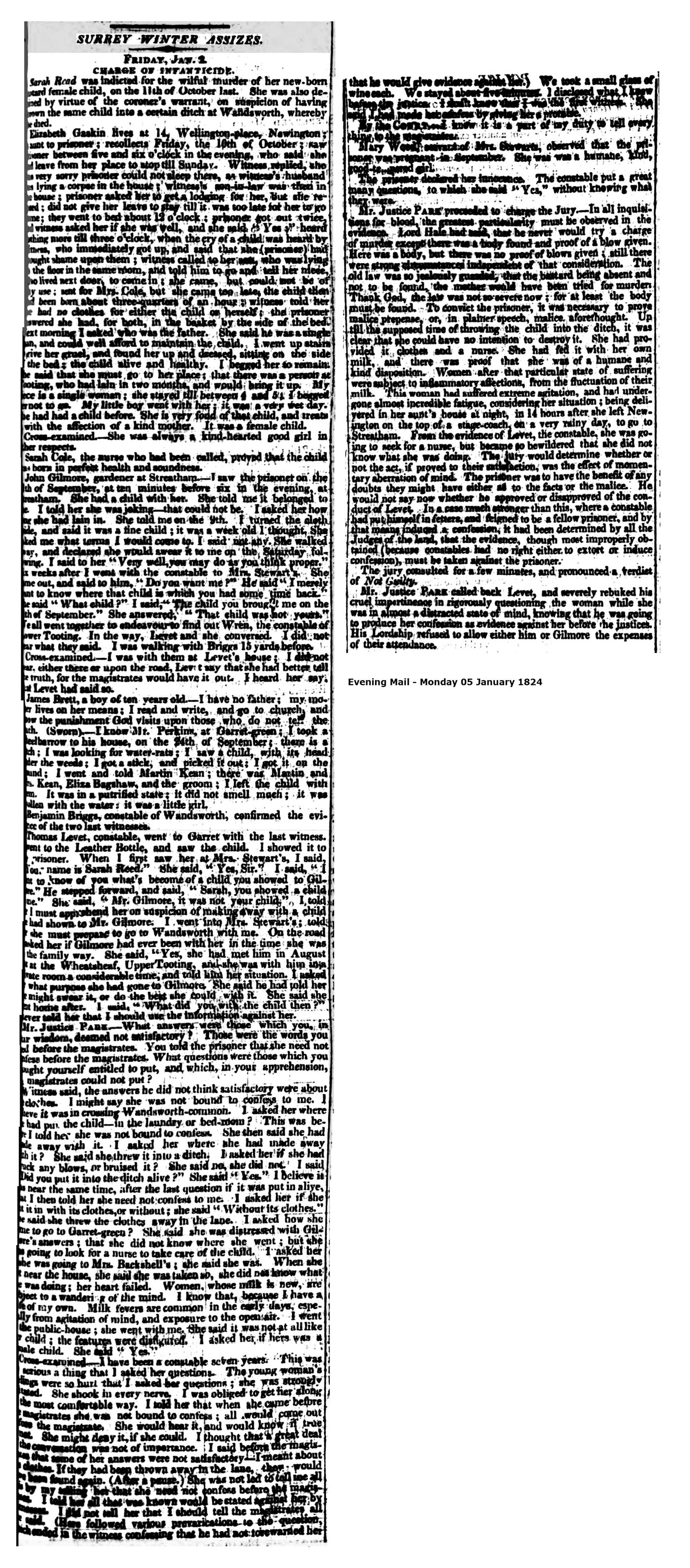
I have uploaded a larger version.
(Click on image to enlarge)
SURREY WINTER ASSIZES.
Friday Jan 2
CHARGE OF INFANTICIDESarah Read was indicted for the wilful murder of her new-born bastard female child, on the 11th of October last. She was also detained by virtue of the coroner's warrant, on suspicion of having drowned the same child into a certain ditch at Wandsworth, whereby it drowned.
Elizabeth Gaskin lives at 14, Wellington Place, Newington; aunt to prisoner; recollects Friday, the 10th October; saw prisoner between five and six o clock in the evening, who said she had leave from her place to stop till Sunday. Witness replied she was very sorry prisoner could not sleep there, as witness's husband was lying a corpse in the house; witness's son-in-law was then in the house; prisoner asked her to get a lodging for her, but she refused; did not give her leave to stay till it was too late for her to go home; they went to bed about 12 o'clock; prisoner got out twice, and witness asked her if she was well, and she said "Yes"; heard nothing more till three o'clock,when the cry of a child was heard by witness, who immediately got up, and said that she (prisoner) had brought shame upon them; witness called to her son [?], who was lying on the floor in the same room, and told him to go and tell her niece, who lived next door, to come in; she came, but could not be of any use; sent for Mrs. Cole, but she came too late, the child then had been born about three-quarters of a hour; witness told her she had no clothes for either the child or herself; the prisoner she had, for both, in the basket by the side of the bed. Next morning I asked who was the father. She said he was a single man, and could well afford to maintain the child.
[PB: Carry on editing from here.]
I went up stairs to give her gruel, and found her up and dressed, sitting the side die bed; the child alive and healthy. v ( begged her remain: t said that she must to her place; that there A person at doling, who had lain in two months, and wou)d hriog up. ice a single woman; she stayed till between and begged not to My little boy went with her; it was very Pet day. is had had a child before. She is very fond that child, and treats with the affection of a kind mother. female child.
Cross-examined — She waa always a kind-hearted good girl in her respects.
Sarah Cole, the nurse who had been called, proved that the child was born in perfect health and soundness.
John Gilmore, gardener at Streatham l taw priaanet on the ih of September, at ten minutes before six (he evening, at icstham. She hM. a child With hsr. She told belonged to told her she was joking that could hot be. asked her how the had lain in. She told me on the 9th. turned the dleth dr, and said it was a tine child; it was a week old 1 thought. She ted arhat terms I Would come to. I said' nqtahy.Sbe walked _ay, and dedarsd she would the. Saturday ful. nng. said to her Veiy weU,yoHi may doas you proper. i seeks after I went with the constable to Mrs. StewariV She nut, sod said to Um, you want me Y" said merely mt to know where that child which you had abme.time back. ir said What child said,- 44 The child yob brought me on the thsf September. She answered,' That child wasnot-yenM. esll went to endeavourto find out Wren, the constable of awer Tooting. In the way, lievet and she conversed. IdMh.nst at shat they said. Iwu walking with Briggs 15
Cross-examined. l was with them at Level s .house; dMuot v. either there or upon the rand. Lev; t say that she had better tail > muh, for the magistrates would hare it out. f heard her say; Level had said so. . .
James Brett, a boy of ten years old — l have no father; my mother lives on her means; I read and write, and go to church, and know the punishment God visits upon those who not teS the A. (Sworn). — l know Mr. Perkins, at Garret-green; I took a wheelbarrow to his house, on the 24th of September; there is a ditch; I was looking for water-rats; I saw a child, with its head under the weeds; I got a stick, and picked it out; I got it on the land; I went and told Martin Kean; there wax Martin, and Mrs Kean, Eliza Bagshaw, and the groom ; I left the child with them. It was in a putrified state; it did not smell much; it was swollen with the water; it was a little girl.
Benjamin Briggs, constable of Wandsworth, confirmed the eviice of the two last witnesses.
Thomas Levet, constable, went to Oarret with the last witness, 'on to the Leather Bottle, and saw the child. 1 showed it to Prisoner. When 1 first saw her at Mrs. Stewart s, I said, w.' name is Sarah Heed. She said, Yet, I said, to .'mow of yon what s become of child you showed to Oilrt stepped forward, and said, Sarah, you showed child ." Site'said, Mr. Gilmore, it was not your child. , I.toW I must apprehend heron suspicion making away with child had shown Mr. Gilmore. I. went into Mrs. Stewart's; told, die mutt prepare to go to Wandsworth with me. On the road sled her if Gilmore had ever been with her in the time she was the family way. She said, Yes, she had met him in August t t the Wheatsheaf, Upper Tooting, and-shewas with hi inja room considerable time, and told him hey situation. I asked *hst purpose she had gone Gilmores She said he had (ohl her miaht swear is, do the bda* she toold with ft- She said she it home after. said, did with, the child then ? , nerteld her that should user the infotmahona^nstlier. Ur. Justus Pana What were llipse Which you. in ir sriedoro, deemed not satisfactory r , Thole Were the words you si before the magistrates. You told the prisoner need not u'esr before the magistrates. What questions Were those which you light rounelf entitled to put, and which, in your apprehension, magistrates could not put ? Witness said, the answers he did notthink satisfactory were about clothes. I might say she was not bound conltryi to me. lev, it was enwaiog Wandsworth-common. 1 aiJced her where had pm die child Til the laundry bed-tOoin ? -This was be-11 add her she was not bound to confess. She then said she.had dr sway with it. , asked her where she had made away *it ? She su'd shelhrew it into ditch, tasked berif she had any blows, bruised it She said no, she did nnL I said you put it into the ditch alive Shcsaid fates. IBclieseH near the same time, after the last question if it was put m ahye, I then told her she need nol confts* to me, 1 asked her it ihe tit in with its dothea,or without; she said Without its clot rietc laid she threw the clothes away In the lane. asked how she to Uarret-greeu ? said she was distressed _widi Gils answers; tliat she did not know where she went; but she going look for a nurse take care die child. "asked her die was going to Mrs. Backshell's ; die aaid she was. When she near the house, she said she was taken so, she did nOi know what was doing her heart failed. Women, whose mTlk Is new, are to gof the mind. 1 know that, because have a, Ofiayown. MUk fevers are common in the early dayn, espedy from agitation of mind, and exposure to the opcti air. I went public-house; she wept witb.me. said it was.not allhke ; the features were disfigured. ' asked hei. tf hers was a < le child. She add tS?' i . _ .V,
Cross-examined — l have been a constable seven years.- this was so serious a thing that 1 asked her questions. The young woman feelings were so hurt that I asked her questions ; she was sttonpy fted. She shook hi crery nerve. I was obliged- together dong * moat comfortable way. I mid her that when ghe otme belpre Uautrates she was not bound to confess ; all -would owe .out the magistrate. She would heat it, imil would jff true JJt She might deny it, if she could. I thought deal wna not of importance. ; said befofo tne-magis** mie of her anawera were not about triUi heg that aha need not Wifcse befbrqjM !*_ taMWall that waa known would stated agajnai {did not mD bar that I should followed various prevarications to the question, which ended in the witness confessing that he had not forewarned her
-----
that he would give evidence against her.) We took a small glass of wine each. We stayed about five minutes. I disclosed what I knew before the justice. [I should have thought I was the first witness [?]] She said I had made her confess by giving her a promise.
By the COURT [?] I know it is a part of my duty t tell every.thing to the magistrates.
Mary Wood, servant of Mrs Stewarts, observed that theprisoner was pregnant in September. She was a humane, kind, good-tempered girl.
The prisoner declared her innocence. The constable put a great fan? aeestone to whieh sbesaid * Yca,” without knewing what they were.
Mr, Justice PARK’ proceeded to charge the Jury. — In all inquisitions for blood, the greatest particularity must be observed in the evidence. Lord Hale had said, that he never would try a charge ‘of mprder excep® there was & body fourrd and proof of 4 blow given. [Here was a body, but there was no proof of blows given ; still there were strong oiteymetances independent of ‘that consideration. The old law was so jealously guanded, — bastard being absent an mt to be fond, the mether woald have been tried for murders hank Ged, the lew was not sosevere now ; for at least the body must.be found. T'o convict the prisoner, it was necessary to prove malige prepense or, in plainer speech, malice. aforethought. Up +o 7 supposed time of throwing the child into the ditch, it was ear that she could bave no intention to dentroy it. She had pro- vided it clothes and a narse. She had fed it with her own milk, and there was proof that she was of a humane and kind disposition. Women .after that patticulet state o! suffering were subject to infammatory affections, from the fluctuation of their milk. ‘This woman had sudfered extreme agitation, and had under- gone almost incredible fatigue, considerin her situation ; being deli- yered in her aunt’s house at night, in i honrs after she left New. ton on the top of.a stage-coach, on s very rainy day, togu to Streatham. Frem the evidence of Levet, the constable, she was go- ing to seek for a nurse, but became go bewildered that she did not know what she was doing. The juty would determine whetber or not the act, if proved to thete ion, was the effect of momen- ry aberration of mind. The prisoner was to have the benefit of any doubts they might have either af to the facts or the malice. He would not asy now whether he approved or disapproved of the con- duct of Levet In ¢.case neh otronger than this, where a constable hed put himpelf in feteers, and feigned to be a fellow prisoner, and by that means jadnced & eonfession, it had been determined by all the Judges of land, that the evidence, though moet improperly ob- tained ( constables hed no right either.to extort or induce confeysion), must be taken against the prisoner. of ney jury consulted for a few minates, and pronounced a verdict _ ‘Mr. Justice Par called back Levet, and severely rebuked his cruel impertinence in rigorously questioning the woman while she was in almost a distracted state of mind, knowing that he was going to produce her confession as evidence against her before the justices. of their a Pp either him or Gilmore the expenses Evening Mail — Monday 05 January 1824
Bury and Norwich Post — Wednesday 12 May 1824
On Saturday se'nnight, Margaret, the wife of Chas. Adams, Esq, of Spencer Lodge, Wandsworth Common, and eldeset daughter of Sir I. Maclean, M.D. of Sudbury.London Courier and Evening Gazette — Friday 09 July 1824
Capital Residence, ith Acres fine Park-like Land, near to Clapham Common — To be SOLD by AUCTION, by Mr. HOGGART, at . the Mart, Friday, the inst., at I'd o%clock, unless acceptable offer is made Piivate ('-outrad, Ivlcgiuil Dcladiod V l-LA, called SPENCER LODGE delightfully situated on Wandsworth Common, within lour and hall miles of the Bridges, with extensive gardens, pleasure-grounds, lawn, shrubbery, walks, and ti%.e meadow laml, the whole outaining together about Twenty Acres. House and Otfii%es art; and substantial order, containing eight bud-rooms, two dressing-rooms, closets and water-closet, dining-parlonr 26ft by 19ft, elegant drawing-room, nit>ming-room, gentleman's-room, and offices of every description. The detached offices include coach-houses, excellent stabling, farm-yard and out-bmlding.s entirely new; dairy, laundry, and wash-house, 'fiic Purchaser may have early possession, ami accommodated with the furniture at lair valuation. viewed with tickets only, which, with particulars, may be had of Mr. Hogg-art, (tt. Old Broad-ntreet: par;n ulats at the Mart. [https://www.britishnewspaperarchive.co.uk/viewer/bl/0001476/18240709/004/0001 ]
CHECK GOOGLE SEACH "SPENCER LODGE WANDSWORTH"
https://www.google.com/search?newwindow=1&ei=43bNXNPQLqeN1fAP6Oq28AM&q=%22spencer+lodge%22+wandsworth&oq=%22spencer+lodge%22+wandsworth&gs_l=psy-ab.3 . . . 6852.12576..13170 . . . 4.0..0.361.2033.10j4j0j2 . . . . . . 0 . . . .1..gws-wiz . . . . . . .0i67j0j0i20i263j0i22i30j33i160j33i21.PxeSL3yHHEM
See account of this and nearby large houses in Survey of London: "St John's Hill Area" = 50.16_st_john_s_hill.pdf
London Courier, 1 July 1824
Spencer Lodge for rent
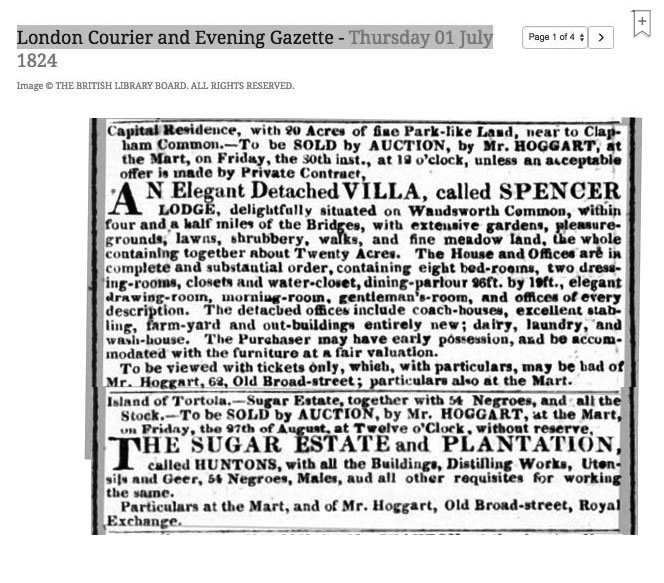
Notice the advert below it — although the slave trade was abolished in 1807, slavery as such was not abolished in the British Empire (though not India) until 1833/4.
Island of Tortola. — Sugar Estate, together with 54 Negroes, and all the Stock. To be SOLD by AUCTION, by Mr. HOGGART, at the Mart, Friday the 27th of August, Twelve o'clock, without reserve,
THE SUGAR ESTATE and PLANTATION. called HUNTONS, with all the Buildings, Distilling Works, Utensils and Geer, 54 Negroes, Males, and all other requisites for working the same.
Particulars at the Mart, and of Mr. Hoggart, Old Broad-street, Royal Exchange.
[Tortola, largest of the British Virgin Islands in the Caribbean. See e.g. Wikipedia: Tortola.]