Home › Places › Trinity Fields › A Board School on the Common?, 1883–84
Last modified: 4 October 2026 (Build 9)
In December 1883 the London School Board proposed to build a Board School on a six-acre field at Upper Tooting, near Trinity Road, that had once been part of Wandsworth Common. Within six weeks, a meeting of local inhabitants, a committee and a deputation to the Board had seen the scheme off. The field is the open space we now know as Trinity Fields. Here are the newspaper reports, in date order, transcribed in full.
Wednesday 19 December 1883 — Public meeting at St Mary Magdalen’s School, Trinity Road, Upper Tooting, chaired by Sir Henry Peek MP. Protest against the London School Board’s plan to take 1½ acres of the six-acre field for a school. A committee is formed “for preserving the land in question as an open space”.
Tuesday 29 January 1884 (probably) — A deputation, introduced by Sir Trevor Lawrence MP, meets the Works Committee of the London School Board with a memorial signed by 500 or 550 inhabitants. The Board abandons the proposal and agrees to find another site.
February 1884 — The committee reports its success at a second meeting. The same meeting adopts E. W. Fithian, secretary of the Commons Preservation Society, as its candidate for the forthcoming election of Conservators of Wandsworth Common, narrowly rejecting James Anderson Rose (21 votes to 23).
Monday 3 March 1884 — Election of Conservators. The letters column beforehand fights over Rose’s own piece of former common land in front of his house.
October 1885 — Fithian, now standing for the London School Board itself, looks back on the episode: the field “continued to be used as a place for recreation”.
[PB/Claude, 3 October 2026: Questions worth following up.
— The 1850s conveyance. The Daily News says Earl Spencer, as lord of the manor, conveyed the land “some thirty years ago” (so about 1853) on condition that it should not be built on. To whom was it conveyed, and does the deed survive?
— The size of the field. The December reports say six acres; James Woollen’s letter of March 1884 says “a fine open space of eight acres”.
— The election result. Who won in March 1884? Was Fithian or Rose elected?
— Fithian’s motives. In 1885 F. W. Lucas suggested that Fithian had opposed the school because the field lay “at the back of the road in which he lived”. Fithian called this “uncalled for, ungenerous, and untrue”. He lived at “Forest Lodge”, 56 Brodrick Road. Today no. 56 is halfway along the northern side, which backs onto the field, and the numbering has probably changed little since. So the school would have been built more or less behind his house.
— The alternative site. Where did the Board build its school instead?]
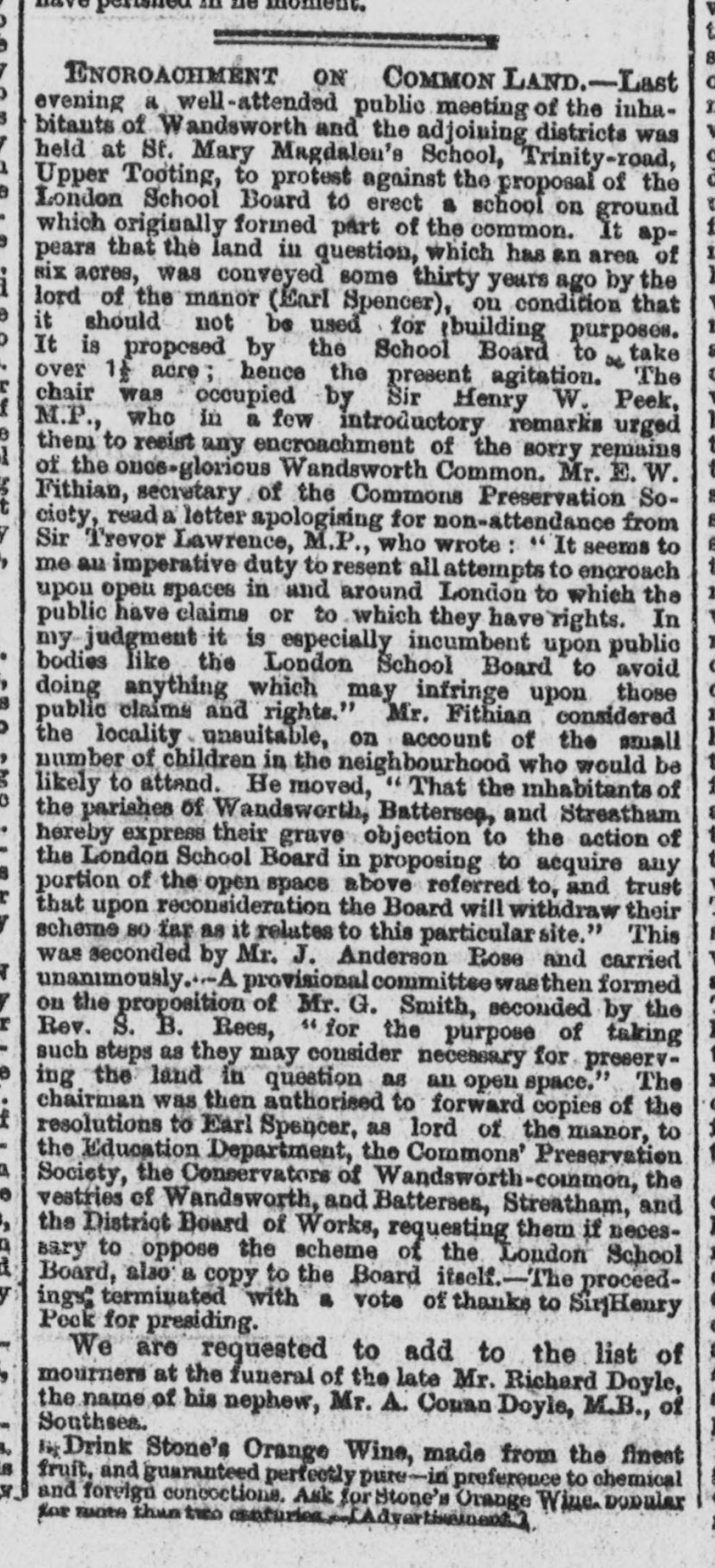
Last evening a well-attended public meeting of the inhabitants of Wandsworth and the adjoining districts was held at St. Mary Magdalen’s School, Trinity-road, Upper Tooting, to protest against the proposal of the London School Board to erect a school on ground which originally formed part of the common.
It appears that the land in question, which has an area of six acres, was conveyed some thirty years ago by the lord of the manor (Earl Spencer), on condition that it should not be used for building purposes. It is proposed by the School Board to take over 1½ acre; hence the present agitation.
The chair was occupied by Sir Henry W. Peek, M.P., who in a few introductory remarks urged them to resist any encroachment of the sorry remains of the once-glorious Wandsworth Common. Mr. E. W. Fithian, secretary of the Commons Preservation Society, read a letter apologising for non-attendance from Sir Trevor Lawrence, M.P., who wrote: “It seems to me an imperative duty to resent all attempts to encroach upon open spaces in and around London to which the public have claims or to which they have rights.
In my judgment it is especially incumbent upon public bodies like the London School Board to avoid doing anything which may infringe upon those public claims and rights.” Mr. Fithian considered the locality unsuitable, on account of the small number of children in the neighbourhood who would be likely to attend.
He moved, “That the inhabitants of the parishes of Wandsworth, Battersea, and Streatham hereby express their grave objection to the action of the London School Board in proposing to acquire any portion of the open space above referred to, and trust that upon reconsideration the Board will withdraw their scheme so far as it relates to this particular site.” This was seconded by Mr. J. Anderson Rose and carried unanimously.—A provisional committee was then formed on the proposition of Mr. G. Smith, seconded by the Rev. S. B. Rees, “for the purpose of taking such steps as they may consider necessary for preserving the land in question as an open space.” The chairman was then authorised to forward copies of the resolutions to Earl Spencer, as lord of the manor, to the Education Department, the Commons’ Preservation Society, the Conservators of Wandsworth-common, the vestries of Wandsworth, and Battersea, Streatham, and the District Board of Works, requesting them if necessary to oppose the scheme of the London School Board, also a copy to the Board itself.—The proceedings terminated with a vote of thanks to Sir Henry Peek for presiding.
[PB/Claude: “resent” in Sir Trevor Lawrence’s letter is as printed in the Daily News; the other two papers have “resist”. “Mr. G. Smith” is perhaps the “G. T. Smith” who nominated Rose as a Conservator in February 1884.]
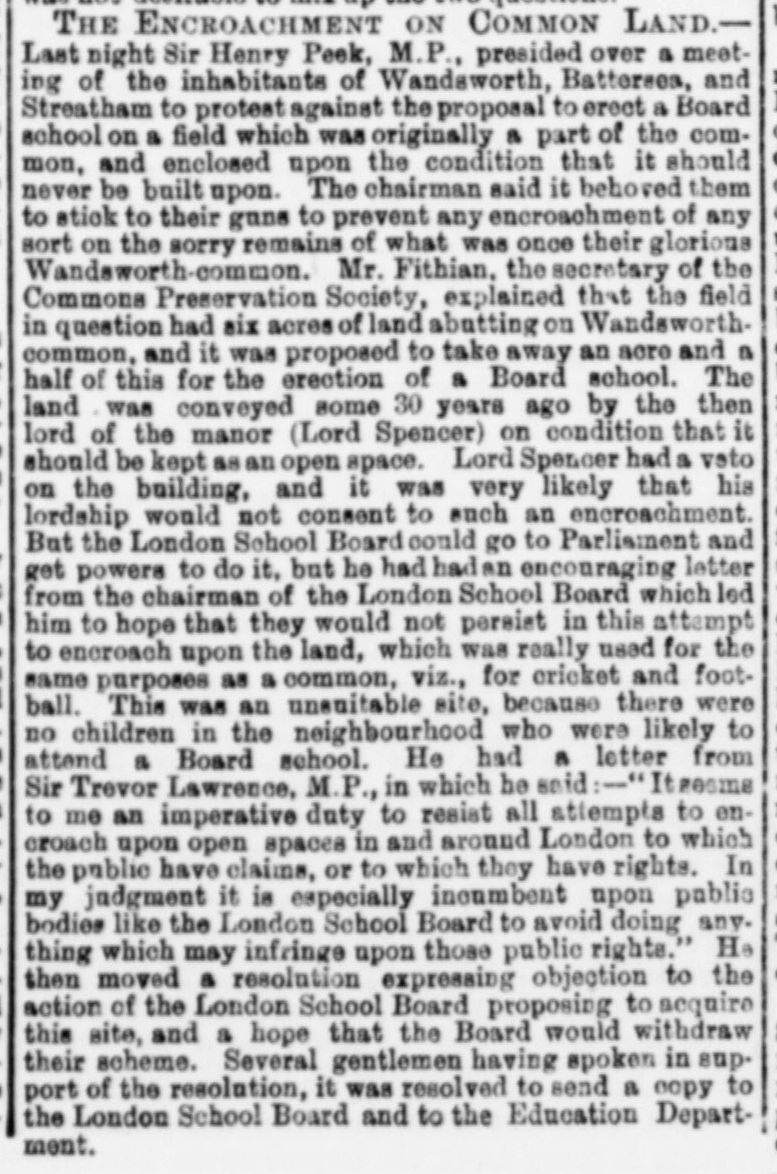
Last night Sir Henry Peek, M.P., presided over a meeting of the inhabitants of Wandsworth, Battersea, and Streatham to protest against the proposal to erect a Board school on a field which was originally a part of the common, and enclosed upon the condition that it should never be built upon.
The chairman said it behoved them to stick to their guns to prevent any encroachment of any sort on the sorry remains of what was once their glorious Wandsworth-common. Mr. Fithian, the secretary of the Commons Preservation Society, explained that the field in question had six acres of land abutting on Wandsworth-common, and it was proposed to take away an acre and a half of this for the erection of a Board school.
The land was conveyed some 30 years ago by the then lord of the manor (Lord Spencer) on condition that it should be kept as an open space. Lord Spencer had a veto on the building, and it was very likely that his lordship would not consent to such an encroachment.
But the London School Board could go to Parliament and get powers to do it, but he had had an encouraging letter from the chairman of the London School Board which led him to hope that they would not persist in this attempt to encroach upon the land, which was really used for the same purposes as a common, viz., for cricket and football.
This was an unsuitable site, because there were no children in the neighbourhood who were likely to attend a Board school. He had a letter from Sir Trevor Lawrence, M.P., in which he said:—“It seems to me an imperative duty to resist all attempts to encroach upon open spaces in and around London to which the public have claims, or to which they have rights.
In my judgment it is especially incumbent upon public bodies like the London School Board to avoid doing anything which may infringe upon those public rights.” He then moved a resolution expressing objection to the action of the London School Board proposing to acquire this site, and a hope that the Board would withdraw their scheme.
Several gentlemen having spoken in support of the resolution, it was resolved to send a copy to the London School Board and to the Education Department.
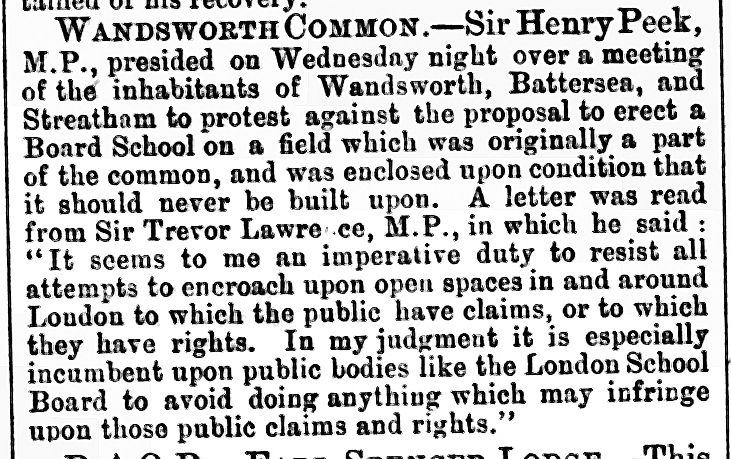
Sir Henry Peek, M.P., presided on Wednesday night over a meeting of the inhabitants of Wandsworth, Battersea, and Streatham to protest against the proposal to erect a Board School on a field which was originally a part of the common, and was enclosed upon condition that it should never be built upon.
A letter was read from Sir Trevor Lawrence, M.P., in which he said: “It seems to me an imperative duty to resist all attempts to encroach upon open spaces in and around London to which the public have claims, or to which they have rights.
In my judgment it is especially incumbent upon public bodies like the London School Board to avoid doing anything which may infringe upon those public claims and rights.”
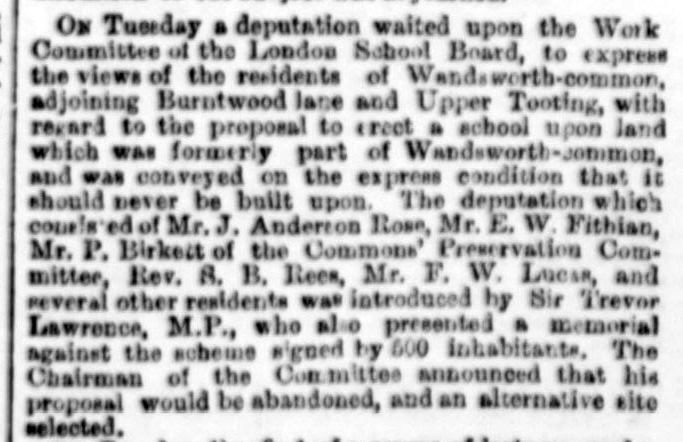
On Tuesday a deputation waited upon the Work[s] Committee of the London School Board, to express the views of the residents of Wandsworth-common, adjoining Burntwood lane and Upper Tooting, with regard to the proposal to erect a school upon land which was formerly part of Wandsworth-common, and was conveyed on the express condition that it should never be built upon.
The deputation which consisted of Mr. J. Anderson Rose, Mr. E. W. Fithian, Mr. P. Birkett of the Commons’ Preservation Committee, Rev. S. B. Rees, Mr. F. W. Lucas, and several other residents was introduced by Sir Trevor Lawrence, M.P., who also presented a memorial against the scheme signed by [500?] inhabitants. The Chairman of the Committee announced that his proposal would be abandoned, and an alternative site selected.
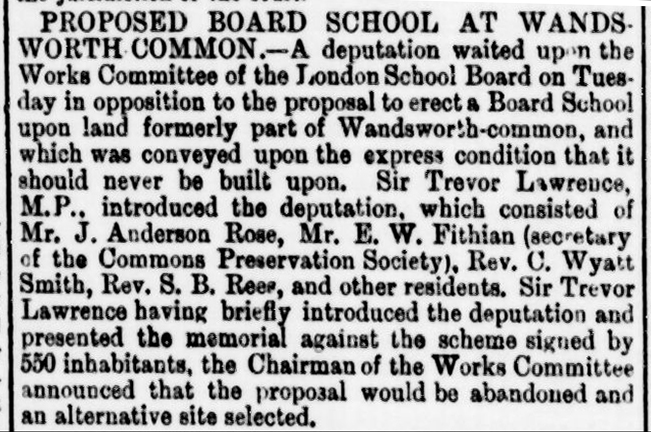
A deputation waited upon the Works Committee of the London School Board on Tuesday in opposition to the proposal to erect a Board School upon land formerly part of Wandsworth-common, and which was conveyed upon the express condition that it should never be built upon.
Sir Trevor Lawrence, M.P., introduced the deputation, which consisted of Mr. J. Anderson Rose, Mr. E. W. Fithian (secretary of the Commons Preservation Society), Rev. C. Wyatt Smith, Rev. S. B. Rees, and other residents. Sir Trevor Lawrence having briefly introduced the deputation and presented the memorial against the scheme signed by 550 inhabitants, the Chairman of the Works Committee announced that the proposal would be abandoned and an alternative site selected.
[PB/Claude: Both reports say “on Tuesday”. The 2 February paper was a Saturday, so the deputation was probably on Tuesday 29 January 1884; the Epsom paper of Tuesday 5 February seems to be repeating the same report. The number of signatures looks like 500 in one paper and 550 in the other. “Mr. P. Birkett” is presumably Percival Birkett, the solicitor closely associated with the Commons Preservation Society; this needs confirming.]
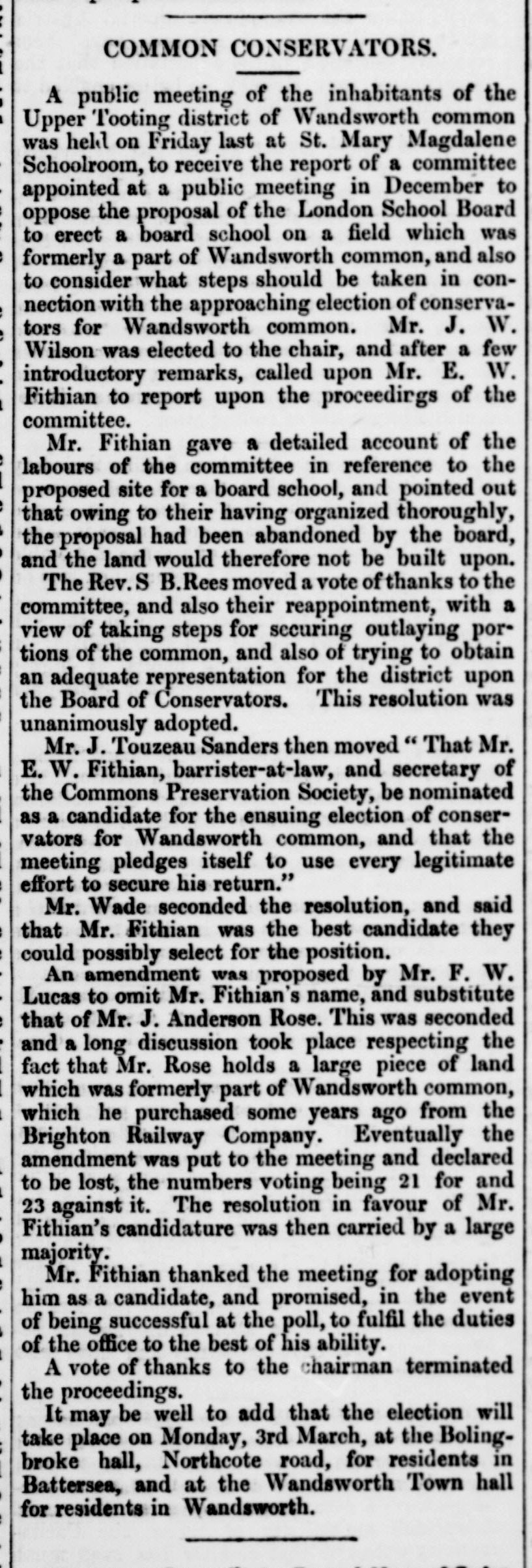
A public meeting of the inhabitants of the Upper Tooting district of Wandsworth common was held on Friday last at St. Mary Magdalene Schoolroom, to receive the report of a committee appointed at a public meeting in December to oppose the proposal of the London School Board to erect a board school on a field which was formerly a part of Wandsworth common, and also to consider what steps should be taken in connection with the approaching election of conservators for Wandsworth common.
Mr. J. W. Wilson was elected to the chair, and after a few introductory remarks, called upon Mr. E. W. Fithian to report upon the proceedings of the committee.
Mr. Fithian gave a detailed account of the labours of the committee in reference to the proposed site for a board school, and pointed out that owing to their having organized thoroughly, the proposal had been abandoned by the board, and the land would therefore not be built upon.
The Rev. S. B. Rees moved a vote of thanks to the committee, and also their reappointment, with a view of taking steps for securing outlaying portions of the common, and also of trying to obtain an adequate representation for the district upon the Board of Conservators. This resolution was unanimously adopted.
Mr. J. Touzeau Sanders then moved “That Mr. E. W. Fithian, barrister-at-law, and secretary of the Commons Preservation Society, be nominated as a candidate for the ensuing election of conservators for Wandsworth common, and that the meeting pledges itself to use every legitimate effort to secure his return.”
Mr. Wade seconded the resolution, and said that Mr. Fithian was the best candidate they could possibly select for the position.
An amendment was proposed by Mr. F. W. Lucas to omit Mr. Fithian’s name, and substitute that of Mr. J. Anderson Rose. This was seconded and a long discussion took place respecting the fact that Mr. Rose holds a large piece of land which was formerly part of Wandsworth common, which he purchased some years ago from the Brighton Railway Company.
Eventually the amendment was put to the meeting and declared to be lost, the numbers voting being 21 for and 23 against it. The resolution in favour of Mr. Fithian’s candidature was then carried by a large majority.
Mr. Fithian thanked the meeting for adopting him as a candidate, and promised, in the event of being successful at the poll, to fulfil the duties of the office to the best of his ability.
A vote of thanks to the chairman terminated the proceedings.
It may be well to add that the election will take place on Monday, 3rd March, at the Bolingbroke hall, Northcote road, for residents in Battersea, and at the Wandsworth Town hall for residents in Wandsworth.
[PB/Claude: “Friday last” in a paper of Saturday 23 February could mean the 22nd, but the official list of candidates (below) is dated the 18th and already names Fithian’s proposer and seconder, so the meeting was more probably Friday 15 February 1884. “J. Touzeau Sanders” here is “James Touzeau Saunders” in the official notice.]
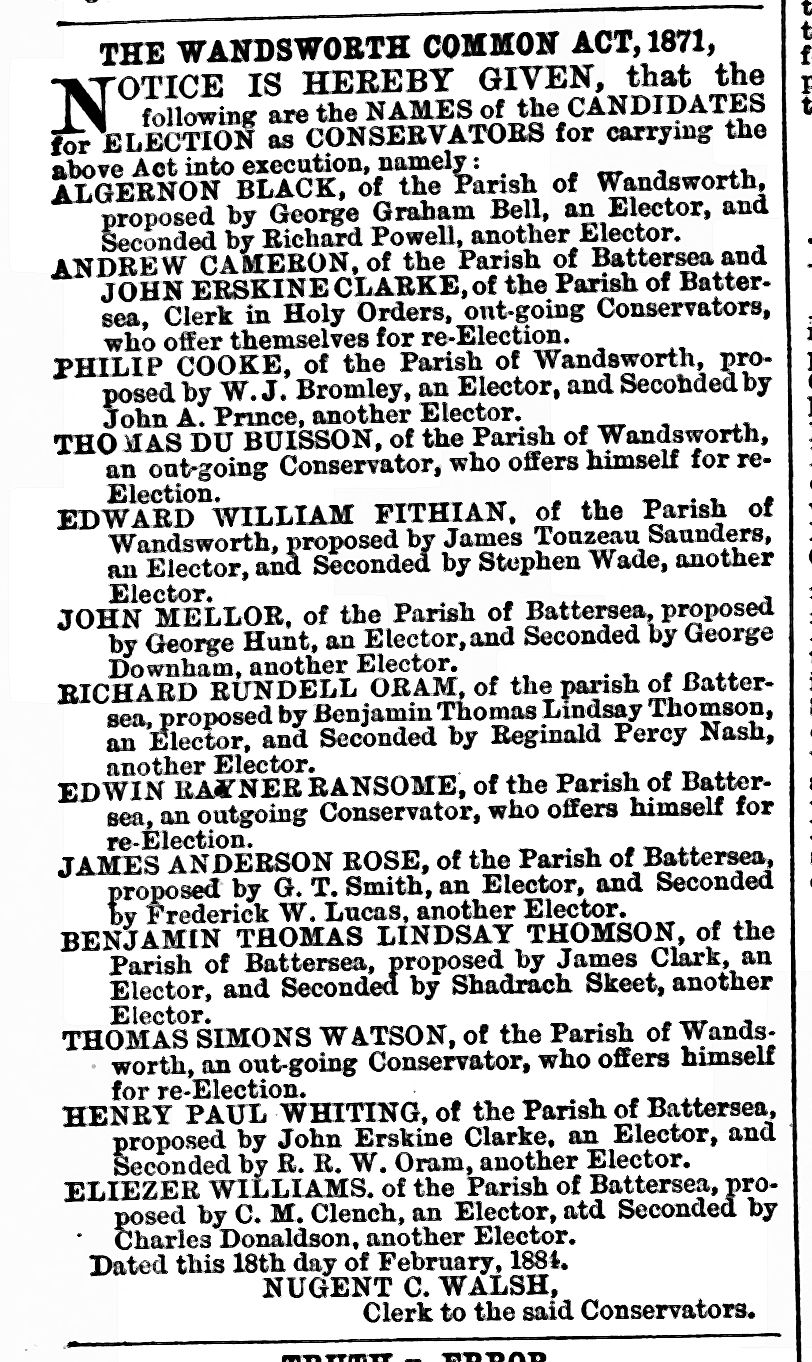
NOTICE IS HEREBY GIVEN, that the following are the NAMES of the CANDIDATES for ELECTION as CONSERVATORS for carrying the above Act into execution, namely:
ALGERNON BLACK, of the Parish of Wandsworth, proposed by George Graham Bell, an Elector, and Seconded by Richard Powell, another Elector.
ANDREW CAMERON, of the Parish of Battersea and JOHN ERSKINE CLARKE, of the Parish of Battersea, Clerk in Holy Orders, out-going Conservators, who offer themselves for re-Election.
PHILIP COOKE, of the Parish of Wandsworth, proposed by W. J. Bromley, an Elector, and Seconded by John A. Prince, another Elector.
THOMAS DU BUISSON, of the Parish of Wandsworth, an out-going Conservator, who offers himself for re-Election.
EDWARD WILLIAM FITHIAN, of the Parish of Wandsworth, proposed by James Touzeau Saunders, an Elector, and Seconded by Stephen Wade, another Elector.
JOHN MELLOR, of the Parish of Battersea, proposed by George Hunt, an Elector, and Seconded by George Downham, another Elector.
RICHARD RUNDELL ORAM, of the parish of Battersea, proposed by Benjamin Thomas Lindsay Thomson, an Elector, and Seconded by Reginald Percy Nash, another Elector.
EDWIN RAYNER RANSOME, of the Parish of Battersea, an outgoing Conservator, who offers himself for re-Election.
JAMES ANDERSON ROSE, of the Parish of Battersea, proposed by G. T. Smith, an Elector, and Seconded by Frederick W. Lucas, another Elector.
BENJAMIN THOMAS LINDSAY THOMSON, of the Parish of Battersea, proposed by James Clark, an Elector, and Seconded by Shadrach Skeet, another Elector.
THOMAS SIMONS WATSON, of the Parish of Wandsworth, an out-going Conservator, who offers himself for re-Election.
HENRY PAUL WHITING, of the Parish of Battersea, proposed by John Erskine Clarke, an Elector, and Seconded by R. R. W. Oram, another Elector.
ELIEZER WILLIAMS, of the Parish of Battersea, proposed by C. M. Clench, an Elector, and Seconded by Charles Donaldson, another Elector.
Dated this 18th day of February, 1884.
Nugent C. Walsh,
Clerk to the said Conservators.
[PB/Claude: Fourteen candidates for five places. Among them are Edwin Rayner Ransome (the lawnmower maker) and the Rev. John Erskine Clarke of Battersea, both of whom have their own pages on this site.]
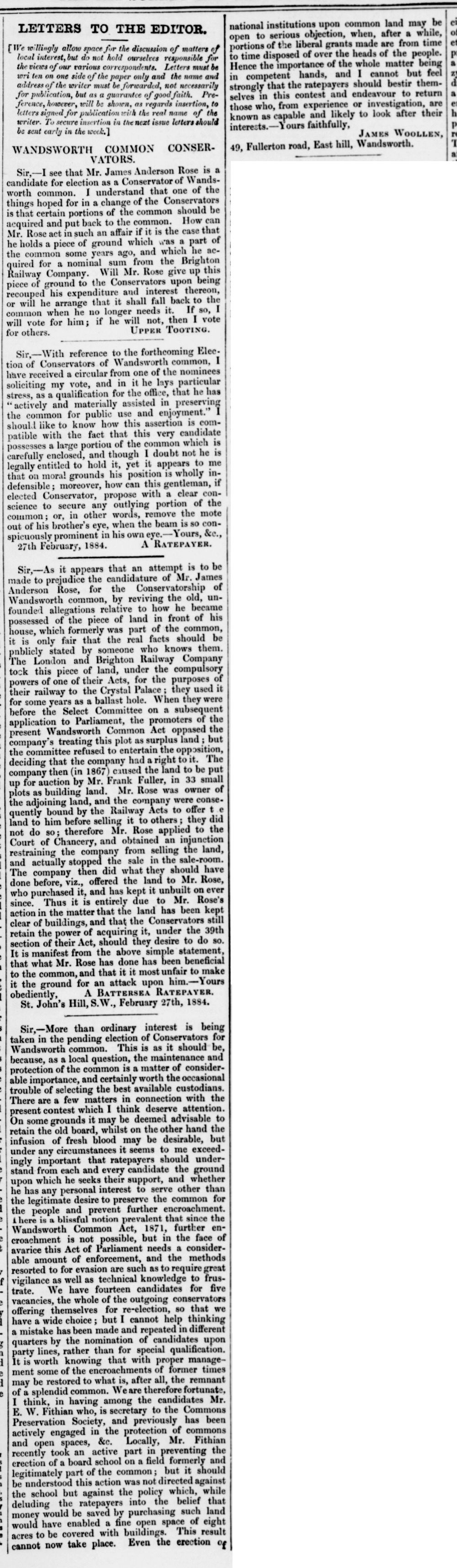
Sir,—I see that Mr. James Anderson Rose is a candidate for election as a Conservator of Wandsworth common. I understand that one of the things hoped for in a change of the Conservators is that certain portions of the common should be acquired and put back to the common.
How can Mr. Rose act in such an affair if it is the case that he holds a piece of ground which was a part of the common some years ago, and which he acquired for a nominal sum from the Brighton Railway Company. Will Mr. Rose give up this piece of ground to the Conservators upon being recouped his expenditure and interest thereon, or will he arrange that it shall fall back to the common when he no longer needs it. If so, I will vote for him; if he will not, then I vote for others.
Upper Tooting.
* * *
Sir,—With reference to the forthcoming Election of Conservators of Wandsworth common, I have received a circular from one of the nominees soliciting my vote, and in it he lays particular stress, as a qualification for the office, that he has “actively and materially assisted in preserving the common for public use and enjoyment.” I should like to know how this assertion is compatible with the fact that this very candidate possesses a large portion of the common which is carefully enclosed, and though I doubt not he is legally entitled to hold it, yet it appears to me that on moral grounds his position is wholly indefensible; moreover, how can this gentleman, if elected Conservator, propose with a clear conscience to secure any outlying portion of the common; or, in other words, remove the mote out of his brother’s eye, when the beam is so conspicuously prominent in his own eye.—Yours, &c.,
27th February, 1884. A Ratepayer.
* * *
Sir,—As it appears that an attempt is to be made to prejudice the candidature of Mr. James Anderson Rose, for the Conservatorship of Wandsworth common, by reviving the old, unfounded allegations relative to how he became possessed of the piece of land in front of his house, which formerly was part of the common, it is only fair that the real facts should be publicly stated by someone who knows them.
The London and Brighton Railway Company took this piece of land, under the compulsory powers of one of their Acts, for the purposes of their railway to the Crystal Palace; they used it for some years as a ballast hole. When they were before the Select Committee on a subsequent application to Parliament, the promoters of the present Wandsworth Common Act opposed the company’s treating this plot as surplus land; but the committee refused to entertain the opposition, deciding that the company had a right to it.
The company then (in 1867) caused the land to be put up for auction by Mr. Frank Fuller, in 33 small plots as building land. Mr. Rose was owner of the adjoining land, and the company were consequently bound by the Railway Acts to offer the land to him before selling it to others; they did not do so; therefore Mr. Rose applied to the Court of Chancery, and obtained an injunction restraining the company from selling the land, and actually stopped the sale in the sale-room.
The company then did what they should have done before, viz., offered the land to Mr. Rose, who purchased it, and has kept it unbuilt on ever since. Thus it is entirely due to Mr. Rose’s action in the matter that the land has been kept clear of buildings, and that the Conservators still retain the power of acquiring it, under the 39th section of their Act, should they desire to do so.
It is manifest from the above simple statement, that what Mr. Rose has done has been beneficial to the common, and that it it most unfair to make it the ground for an attack upon him.—Yours obediently,
A Battersea Ratepayer.
St. John’s Hill, S.W., February 27th, 1884.
* * *
Sir,—More than ordinary interest is being taken in the pending election of Conservators for Wandsworth common. This is as it should be, because, as a local question, the maintenance and protection of the common is a matter of considerable importance, and certainly worth the occasional trouble of selecting the best available custodians.
There are a few matters in connection with the present contest which I think deserve attention. On some grounds it may be deemed advisable to retain the old board, whilst on the other hand the infusion of fresh blood may be desirable, but under any circumstances it seems to me exceedingly important that ratepayers should understand from each and every candidate the ground upon which he seeks their support, and whether he has any personal interest to serve other than the legitimate desire to preserve the common for the people and prevent further encroachment.
There is a blissful notion prevalent that since the Wandsworth Common Act, 1871, further encroachment is not possible, but in the face of avarice this Act of Parliament needs a considerable amount of enforcement, and the methods resorted to for evasion are such as to require great vigilance as well as technical knowledge to frustrate.
We have fourteen candidates for five vacancies, the whole of the outgoing conservators offering themselves for re-election, so that we have a wide choice; but I cannot help thinking a mistake has been made and repeated in different quarters by the nomination of candidates upon party lines, rather than for special qualification.
It is worth knowing that with proper management some of the encroachments of former times may be restored to what is, after all, the remnant of a splendid common. We are therefore fortunate, I think, in having among the candidates Mr. E. W. Fithian who, is secretary to the Commons Preservation Society, and previously has been actively engaged in the protection of commons and open spaces, &c. Locally, Mr. Fithian recently took an active part in preventing the erection of a board school on a field formerly and legitimately part of the common; but it should be understood this action was not directed against the school but against the policy which, while deluding the ratepayers into the belief that money would be saved by purchasing such land would have enabled a fine open space of eight acres to be covered with buildings.
This result cannot now take place. Even the erection of national institutions upon common land may be open to serious objection, when, after a while, portions of the liberal grants made are from time to time disposed of over the heads of the people. Hence the importance of the whole matter being in competent hands, and I cannot but feel strongly that the ratepayers should bestir themselves in this contest and endeavour to return those who, from experience or investigation, are known as capable and likely to look after their interests.—Yours faithfully,
James Woollen,
49, Fullerton road, East hill, Wandsworth.
[PB/Claude: The land in front of Rose’s house is the “Railway Enclosure” piece, a different plot of former common from the school field. “National institutions upon common land” is presumably a dig at the Royal Victoria Patriotic Asylum and the other institutions built on the Common in the 1850s. “Woollen” reappears in 1885 as “Mr. J. T. Woollen”, seconding the resolution in support of Fithian (below). “It it most unfair” is as printed.]
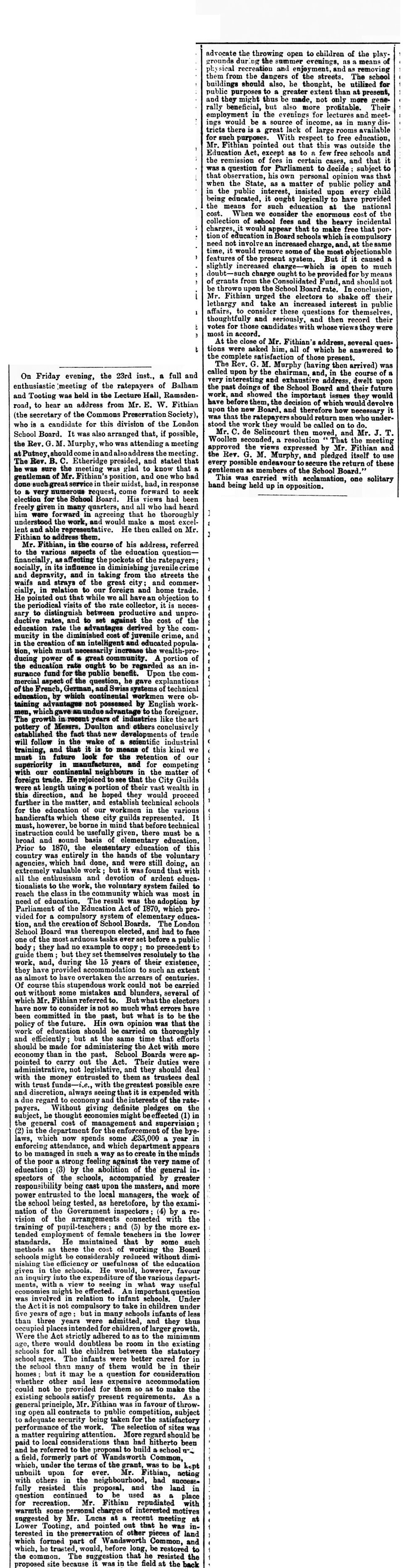
On Friday evening, the 23rd inst., a full and enthusiastic meeting of the ratepayers of Balham and Tooting was held in the Lecture Hall, Ramsden-road, to hear an address from Mr. E. W. Fithian (the secretary of the Commons Preservation Society), who is a candidate for this division of the London School Board.
It was also arranged that, if possible, the Rev. G. M. Murphy, who was attending a meeting at Putney, should come in and also address the meeting. The Rev. B. C. Etheridge presided, and stated that he was sure the meeting was glad to know that a gentleman of Mr. Fithian’s position, and one who had done such great service in their midst, had, in response to a very numerous request, come forward to seek election for the School Board.
His views had been freely given in many quarters, and all who had heard him were forward in agreeing that he thoroughly understood the work, and would make a most excellent and able representative. He then called on Mr. Fithian to address them.
Mr. Fithian, in the course of his address, referred to the various aspects of the education question—financially, as affecting the pockets of the ratepayers; socially, in its influence in diminishing juvenile crime and depravity, and in taking from the streets the waifs and strays of the great city; and commercially, in relation to our foreign and home trade.
He pointed out that while we all have an objection to the periodical visits of the rate collector, it is necessary to distinguish between productive and unproductive rates, and to set against the cost of the education rate the advantages derived by the community in the diminished cost of juvenile crime, and in the creation of an intelligent and educated population, which must necessarily increase the wealth-producing power of a great community.
A portion of the education rate ought to be regarded as an insurance fund for the public benefit. Upon the commercial aspect of the question, he gave explanations of the French, German, and Swiss systems of technical education, by which continental workmen were obtaining advantages not possessed by English workmen, which gave an undue advantage to the foreigner.
The growth in recent years of industries like the art pottery of Messrs. Doulton and others conclusively established the fact that new developments of trade will follow in the wake of a scientific industrial training, and that it is to means of this kind we must in future look for the retention of our superiority in manufactures, and for competing with our continental neighbours in the matter of foreign trade.
He rejoiced to see that the City Guilds were at length using a portion of their vast wealth in this direction, and he hoped they would proceed further in the matter, and establish technical schools for the education of our workmen in the various handicrafts which these city guilds represented.
It must, however, be borne in mind that before technical instruction could be usefully given, there must be a broad and sound basis of elementary education. Prior to 1870, the elementary education of this country was entirely in the hands of the voluntary agencies, which had done, and were still doing, an extremely valuable work; but it was found that with all the enthusiasm and devotion of ardent educationalists to the work, the voluntary system failed to reach the class in the community which was most in need of education.
The result was the adoption by Parliament of the Education Act of 1870, which provided for a compulsory system of elementary education, and the creation of School Boards. The London School Board was thereupon elected, and had to face one of the most arduous tasks ever set before a public body; they had no example to copy; no precedent to guide them; but they set themselves resolutely to the work, and, during the 15 years of their existence, they have provided accommodation to such an extent as almost to have overtaken the arrears of centuries.
Of course this stupendous work could not be carried out without some mistakes and blunders, several of which Mr. Fithian referred to. But what the electors have now to consider is not so much what errors have been committed in the past, but what is to be the policy of the future.
His own opinion was that the work of education should be carried on thoroughly and efficiently; but at the same time that efforts should be made for administering the Act with more economy than in the past. School Boards were appointed to carry out the Act.
Their duties were administrative, not legislative, and they should deal with the money entrusted to them as trustees deal with trust funds—i.e., with the greatest possible care and discretion, always seeing that it is expended with a due regard to economy and the interests of the ratepayers.
Without giving definite pledges on the subject, he thought economies might be effected (1) in the general cost of management and supervision; (2) in the department for the enforcement of the bye-laws, which now spends some £35,000 a year in enforcing attendance, and which department appears to be managed in such a way as to create in the minds of the poor a strong feeling against the very name of education; (3) by the abolition of the general inspectors of the schools, accompanied by greater responsibility being cast upon the masters, and more power entrusted to the local managers, the work of the school being tested, as heretofore, by the examination of the Government inspectors; (4) by a revision of the arrangements connected with the training of pupil-teachers; and (5) by the more extended employment of female teachers in the lower standards.
He maintained that by some such methods as these the cost of working the Board schools might be considerably reduced without diminishing the efficiency or usefulness of the education given in the schools. He would, however, favour an inquiry into the expenditure of the various departments, with a view to seeing in what way useful economies might be effected.
An important question was involved in relation to infant schools. Under the Act it is not compulsory to take in children under five years of age; but in many schools infants of less than three years were admitted, and they thus occupied places intended for children of larger growth.
Were the Act strictly adhered to as to the minimum age, there would doubtless be room in the existing schools for all the children between the statutory school ages. The infants were better cared for in the school than many of them would be in their homes; but it may be a question for consideration whether other and less expensive accommodation could not be provided for them so as to make the existing schools satisfy present requirements.
As a general principle, Mr. Fithian was in favour of throwing open all contracts to public competition, subject to adequate security being taken for the satisfactory performance of the work. The selection of sites was a matter requiring attention. More regard should be paid to local considerations than had hitherto been and he referred to the proposal to build a school on a field, formerly part of Wandsworth Common, which, under the terms of the grant, was to be kept unbuilt upon for ever.
Mr. Fithian, acting with others in the neighbourhood, had successfully resisted this proposal, and the land in question continued to be used as a place for recreation. Mr. Fithian repudiated with warmth some personal charges of interested motives suggested by Mr. Lucas at a recent meeting at Lower Tooting, and pointed out that he was interested in the preservation of other pieces of land which formed part of Wandsworth Common, and which, he trusted, would, before long, be restored to the common.
The suggestion that he resisted the proposed site because it was in the field at the back of the road in which he lived was uncalled for, ungenerous, and untrue. He would also strongly advocate the throwing open to children of the playgrounds during the summer evenings, as a means of physical recreation and enjoyment, and as removing them from the dangers of the streets.
The school buildings should also, he thought, be utilized for public purposes to a greater extent than at present, and they might thus be made, not only more generally beneficial, but also more profitable. Their employment in the evenings for lectures and meetings would be a source of income, as in many districts there is a great lack of large rooms available for such purposes.
With respect to free education, Mr. Fithian pointed out that this was outside the Education Act, except as to a few free schools and the remission of fees in certain cases, and that it was a question for Parliament to decide; subject to that observation, his own personal opinion was that when the State, as a matter of public policy and in the public interest, insisted upon every child being educated, it ought logically to have provided the means for such education at the national cost.
When we consider the enormous cost of the collection of school fees and the heavy incidental charges, it would appear that to make free that portion of education in Board schools which is compulsory need not involve an increased charge, and, at the same time, it would remove some of the most objectionable features of the present system.
But if it caused a slightly increased charge—which is open to much doubt—such charge ought to be provided for by means of grants from the Consolidated Fund, and should not be thrown upon the School Board rate. In conclusion, Mr. Fithian urged the electors to shake off their lethargy and take an increased interest in public affairs, to consider these questions for themselves, thoughtfully and seriously, and then record their votes for those candidates with whose views they were most in accord.
At the close of Mr. Fithian’s address, several questions were asked him, all of which he answered to the complete satisfaction of those present.
The Rev. G. M. Murphy (having then arrived) was called upon by the chairman, and, in the course of a very interesting and exhaustive address, dwelt upon the past doings of the School Board and their future work, and showed the important issues they would have before them, the decision of which would devolve upon the new Board, and therefore how necessary it was that the ratepayers should return men who understood the work they would be called on to do.
Mr. C. de Selincourt then moved, and Mr. J. T. Woollen seconded, a resolution “That the meeting approved the views expressed by Mr. Fithian and the Rev. G. M. Murphy, and pledged itself to use every possible endeavour to secure the return of these gentlemen as members of the School Board.”
This was carried with acclamation, one solitary hand being held up in opposition.
[PB/Claude: The passage about the Wandsworth Common field is in bold (my emphasis). The missing lines were found on the full page (below): Fithian called the suggestion that he opposed the school because the field lay “at the back of the road in which he lived” “uncalled for, ungenerous, and untrue”. That road was Brodrick Road, where the houses on one side back onto the Field. Philip has since found Fithian’s address: “Forest Lodge”, 56 Brodrick Road. Today no. 56 is about halfway along the northern side of Brodrick Road, the side whose gardens back onto Trinity Fields. The numbers may have shifted slightly since the 1880s, but along this largely unchanged Victorian road probably not by much. So Lucas had a point: the proposed school would have been built more or less at the bottom of Fithian’s garden. That doesn’t make Fithian’s campaign insincere, as he was a professional defender of commons and open spaces, but it explains why the charge stung.]
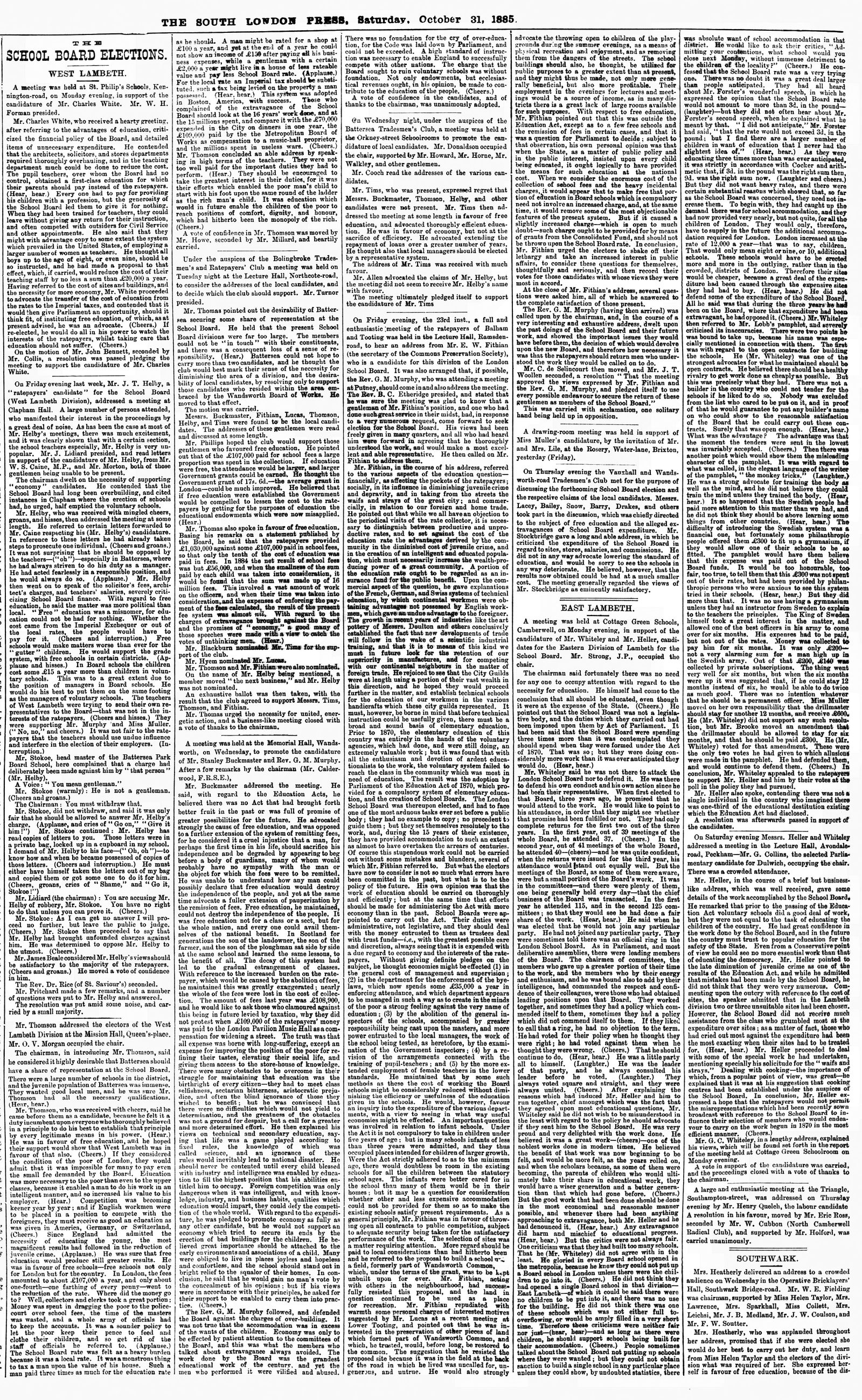
The whole page is transcribed on a separate page: The School Board Elections, 1885.
See also: Trinity Fields: all pages · Trinity Fields: A Field with No Name, 1852–1882 (the Field’s earlier history, from Graham Jackson’s A History of Trinity Fields).
Newspaper cuttings collected by Philip Boys. Transcribed October 2026. Uncertain readings are in square brackets with a question mark.