Home › Places › Trinity Fields › The School Board Elections, 1885
Last modified: 4 October 2026 (Build 4)
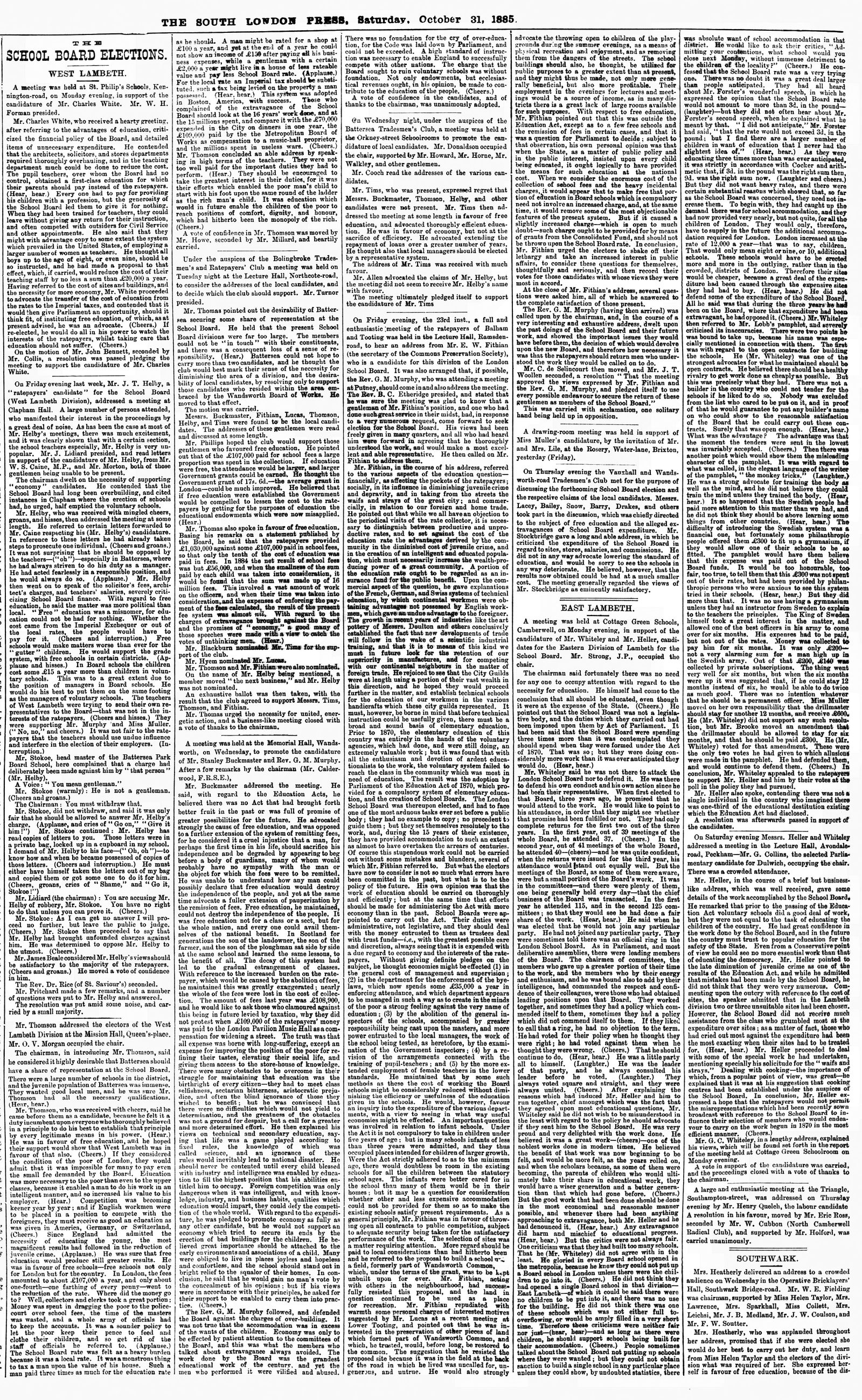
In the autumn of 1885 London elected a new School Board, the body that had been building and running the capital’s elementary “Board schools” since the Education Act of 1870. This page of the South London Press reports a week of election meetings across south London, transcribed here in full. The arguments are lively and surprisingly modern: free education, the cost of the rates, “overbuilding”, expensive sites, gymnastics from Sweden, and a stormy meeting at Clapham Hall where a headmaster called a candidate “not a gentleman”. Among the candidates are two men who had fought to save Wandsworth Common: E. W. Fithian, who defends himself over the Trinity Fields school site, and Stanley Buckmaster.
West Lambeth division (which then included Battersea, Wandsworth, Clapham, Balham and Tooting): Charles White; J. T. Helby (“ratepayers’” or economy candidate); Mr Thomson (of Battersea, for free education); the Rev. G. M. Murphy; Miss Muller; Stanley Buckmaster; E. W. Fithian (secretary of the Commons Preservation Society); F. W. Lucas; Mr Tims.
East Lambeth division: G. C. Whiteley and Mr Heller (sitting members); Henry Quelch (labour candidate).
Southwark division: Mrs Heatherly.
[PB/Claude, 3 October 2026: Some names here also appear in the Trinity Fields story. Thomson is probably the Benjamin Thomas Lindsay Thomson who stood for Conservator in 1884. F. W. Lucas, who seconded Rose against Fithian in 1884, is now Fithian’s rival for the School Board, and the “personal charges” Fithian repudiates came from him. C. de Selincourt and J. T. Woollen, who propose the resolution for Fithian, are the de Selincourts of Wandsworth Lodge and the James Woollen who wrote in Fithian’s support in March 1884. “Mr. Stanley Buckmaster” is not John Buckmaster, the hero of 1869, but his son Stanley Owen Buckmaster (1861–1934), later Lord Chancellor (confirmed by Philip). Fithian’s home, “Forest Lodge”, 56 Brodrick Road, backed onto the Trinity Fields site that Lucas raised against him. Still to find: who was elected in November 1885.]
West Lambeth · The Fithian meeting · East Lambeth · Southwark
A meeting was held at St. Philip’s Schools, Kennington-road, on Monday evening, in support of the candidature of Mr. Charles White. Mr. W. H. Forman presided.
Mr. Charles White, who received a hearty greeting, after referring to the advantages of education, criticized the financial policy of the Board, and detailed items of unnecessary expenditure. He contended that the architects, solicitors, and stores departments required thoroughly overhauling, and in the teaching department much could be done to reduce the cost.
The pupil teachers, over whom the Board had no control, obtained a first-class education for which their parents should pay instead of the ratepayers. (Hear, hear.) Every one had to pay for providing his children with a profession, but the generosity of the School Board led them to give it for nothing.
When they had been trained for teachers, they could leave without giving any return for their instruction, and often competed with outsiders for Civil Service and other appointments. He also said that they might with advantage copy to some extent the system which prevailed in the United States, of employing a larger number of women as teachers.
He thought all boys up to the age of eight, or even nine, should be so instructed, and he had made a proposal to that effect, which, if carried, would reduce the cost of their teaching staff by no less a sum than £20,000 a year.
Having referred to the cost of sites and buildings, and the necessity for more economy, Mr. White proceeded to advocate the transfer of the cost of education from the rates to the Imperial taxes, and contended that it would then give Parliament an opportunity, should it think fit, of instituting free education, of which, as at present advised, he was an advocate.
(Cheers.) If re-elected, he would do all in his power to watch the interests of the ratepayers, whilst taking care that education should not suffer. (Cheers.)
On the motion of Mr. John Bennett, seconded by Mr. Collis, a resolution was passed pledging the meeting to support the candidature of Mr. Charles White.
On Friday evening last week, Mr. J. T. Helby, a “ratepayers’ candidate” for the School Board (West Lambeth Division), addressed a meeting at Clapham Hall. A large number of persons attended, who manifested their interest in the proceedings by a great deal of noise. As has been the case at most of Mr. Helby’s meetings, there was much excitement, and it was clearly shown that with a certain section, the school teachers especially, Mr. Helby is very unpopular.
Mr. J. Lidiard presided, and read letters in support of the candidature of Mr. Helby, from Mr. W. S. Caine, M.P., and Mr. Morton, both of those gentlemen being unable to be present.
The chairman dwelt on the necessity of supporting “economy” candidates. He contended that the School Board had long been overbuilding, and cited instances in Clapham where the erection of schools had, he urged, half emptied the voluntary schools.
Mr. Helby, who was received with mingled cheers, groans, and hisses, then addressed the meeting at some length. He referred to certain letters forwarded to Mr. Caine respecting his (Mr. Helby’s) candidature. In reference to these letters he had already taken steps to prosecute one individual.
(Cheers and groans.) It was not surprising that he should be opposed by the teachers—(“oh”)—especially in Battersea, where he had always striven to do his duty as a manager. He had acted fearlessly in a responsible position, and he would always do so. (Applause.) Mr. Helby then went on to speak of the solicitor’s fees, architect’s charges, and teachers’ salaries, severely criticizing School Board finance.
With regard to free education, he said the matter was more political than local. “Free” education was a misnomer, for education could not be had for nothing. Whether the cost came from the Imperial Exchequer or out of the local rates, the people would have to pay for it.
(Cheers and interruption.) Free schools would make matters worse than ever for the “gutter” children. He would support the grade system, with free schools in certain districts. (Applause and hisses.) In Board schools the children cost some £15 a year more than children in voluntary schools.
This was to a great extent due to the position of managers in Board schools. He would do his best to put them on the same footing as the managers of voluntary schools. The teachers of West Lambeth were trying to send their own representatives to the Board—that was not in the interests of the ratepayers.
(Cheers and hisses.) They were supporting Mr. Murphy and Miss Muller. (“No, no,” and cheers.) It was not fair to the ratepayers that the teachers should use undue influence and interfere in the election of their employers. (Interruption.)
Mr. Stokoe, head master of the Battersea Park Board School, here complained that a charge had deliberately been made against him by “that person” (Mr. Helby).
A Voice: “You mean gentleman.”
Mr. Stokoe (warmly): He is not a gentleman. (Cheers and groans.)
The Chairman: You must withdraw that.
Mr. Stokoe, did not withdraw, and said it was only fair that he should be allowed to answer Mr. Helby’s charge. (Applause, and cries of “Go on,” “Give it him!”) Mr. Stokoe continued: Mr. Helby has read copies of letters to you. Those letters were in a private bag, locked up in a cupboard in my school.
I demand of Mr. Helby to his face—(“Oh, oh”)—to know how and when he became possessed of copies of those letters. (Cheers and interruption.) He must either have himself taken the letters out of my bag and copied them or got some one to do it for him. (Cheers, groans, cries of “Shame,” and “Go it, Stokoe!”)
Mr. Lidiard (the chairman): You are accusing Mr. Helby of robbery, Mr. Stokoe. You have no right to do that unless you can prove it. (Cheers.)
Mr. Stokoe: As I can get no answer I will proceed no further, but leave the public to judge. (Cheers.) Mr. Stokoe then proceeded to say that Mr. Helby had brought unfounded charges against him. He was determined to oppose Mr. Helby to the utmost. (Cheers.)
Mr. James Beale considered Mr. Helby’s views should be satisfactory to the majority of the ratepayers. (Cheers and groans.) He moved a vote of confidence in him.
The Rev. Dr. Rice (of St. Saviour’s) seconded.
Mr. Pritchard made a few remarks, and a number of questions were put to Mr. Helby and answered.
The resolution was put amid some noise, and carried by a small majority.
Mr. Thomson addressed the electors of the West Lambeth Division at the Mission Hall, Queen’s-place. Mr. O. V. Morgan occupied the chair.
The chairman, in introducing Mr. Thomson, said he considered it highly desirable that Battersea should have a share of representation at the School Board. There were a large number of schools in the district, and the juvenile population of Battersea was immense. They wanted good local men, and he was sure Mr. Thomson had all the necessary qualifications. (Hear, hear.)
Mr. Thomson, who was received with cheers, said he came before them as a candidate, because he felt it a duty incumbent upon everyone who thoroughly believed in a principle to do his best to establish that principle by every legitimate means in his power.
(Hear.) He was in favour of free education, and he hoped their support would show that West Lambeth was in favour of that also. (Cheers.) If they considered the condition of the poor of London, they would admit that it was impossible for many to pay even the small fee demanded by the Board.
Education was more necessary to the poor than even to the upper classes, because it enabled a man to do his work in an intelligent manner, and so increased his value to his employer. (Hear.) Competition was becoming keener year by year; and if English workmen were to be placed in a position to compete with the foreigners, they must receive as good an education as was given in America, Germany, or Switzerland.
(Cheers.) Since England had admitted the necessity of educating the young, the most magnificent results had followed in the reduction of juvenile crime. (Applause.) He was sure that free education would produce still greater results. He was in favour of free schools—free schools not only for London but for the country.
In London, the fees amounted to about £107,000 a year, and only about one-fourth—one farthing of every penny—went to the reduction of the rate. Where did the money go to? Well, collectors and clerks took a great portion; Money was spent in dragging the poor to the police-court over school fees, the time of the masters was wasted, and a whole army of officials had to keep the accounts.
It was a sounder policy to let the poor keep their pence to feed and clothe their children, and so get rid of the staff of officials he referred to. (Applause.) The School Board rate was felt as a heavy burden because it was a local rate.
It was a monstrous thing to tax a man upon the value of his house. Such a man paid three times as much for the education rate as he should. A man might be rated for a shop at £100 a year, and yet at the end of a year he could not show an income of £150 after paying all his business expenses, while a gentleman with a certain £2,000 a year might live in a house of less rateable value and pay less School Board rate.
(Applause.) For the local rate an Imperial tax should be substituted, such a tax being levied on the property a man possessed. (Hear, hear.) This system was adopted in Boston, America, with success. Those who complained of the extravagance of the School Board should look at the 16 years’ work done, and at the 15 millions spent, and compare it with the £70,000 expended in the City on dinners in one year, the £109,000 paid by the the Metropolitan Board of Works as compensation to a music-hall proprietor, and the millions spent in useless wars.
(Cheers.) Mr. Thomson concluded an able address by speaking in high terms of the teachers. They were not too well paid for the important duties they had to perform. (Hear.) They should be encouraged to take the greatest interest in their duties, for it was their efforts which enabled the poor man’s child to start with his foot upon the same round of the ladder as the rich man’s child.
It was education which would in future enable the children of the poor to reach positions of comfort, dignity, and honour, which had hitherto been the monopoly of the rich. (Cheers.)
A vote of confidence in Mr. Thomson was moved by Mr. Howe, seconded by Mr. Millard, and heartily carried.
Under the auspices of the Bolingbroke Tradesmen’s and Ratepayers’ Club a meeting was held on Tuesday night at the Lecture Hall, Northcote-road, to consider the addresses of the local candidates, and to decide which the club should support. Mr. Turnor presided.
Mr. Thomas pointed out the desirability of Battersea securing some share of representation at the School Board. He held that the present School Board divisions were far too large. The members could not be “in touch” with their constituents, and there was a consequent loss of a sense of responsibility.
(Hear.) Battersea could not hope to carry more than two candidates, and he thought the club would best mark their sense of the necessity for diminishing the area of a division, and the desirability of local candidates, by resolving only to support those candidates who resided within the area embraced by the Wandsworth Board of Works. He moved to that effect.
The motion was carried.
Messrs. Buckmaster, Fithian, Lucas, Thomson, Helby, and Tims were found to be the local candidates. The addresses of these gentlemen were read and discussed at some length.
Mr. Phillips hoped the club would support those gentlemen who favoured free education. He pointed out that of the £107,000 paid for school fees a large proportion was spent in the collection. If education were free, the attendance would be larger, and larger Government grants could be earned.
He thought the Government grant of 17s. 6d.—the average grant in London—could be much improved. He believed that if free education were established the Government would be compelled to lessen the cost to the ratepayers by getting for the purposes of education the educational endowments which were now misapplied. (Hear.)
Mr. Thomas also spoke in favour of free education. Basing his remarks on a statement published by the Board, he said that the ratepayers provided £1,030,000 against some £107,000 paid in school fees, so that only the tenth of the cost of education was paid in fees.
In 1884 the net result of school fees was but £56,000, and when the smallness of the sum paid by each child was taken into consideration, it would be found that the sum was made up of 16 million fees. This involved a vast amount of work on the officers, and when their time was taken into consideration, and the expenses of enforcing the payment of the fees calculated, the result of the present fee system was almost nil.
With regard to the charges of extravagance brought against the Board and the promises of “economy,” a good many of those speeches were made with a view to catch the votes of unthinking men. (Hear.)
Mr. Blackburn nominated Mr. Tims for the support of the club.
Mr. Hyem nominated Mr. Lucas.
Mr. Thomson and Mr. Fithian were also nominated.
On the name of Mr. Helby being mentioned, a member moved “the next business,” and Mr. Helby was not nominated.
An exhaustive ballot was then taken, with the result that the club agreed to support Messrs. Tims, Thomson, and Fithian.
Mr. Thomas urged the necessity for united, energetic action, and a business-like meeting closed with a vote of thanks to the chairman.
A meeting was held at the Memorial Hall, Wandsworth, on Wednesday, to promote the candidature of Mr. Stanley Buckmaster and Rev. G. M. Murphy. After a few remarks by the chairman (Mr. Calderwood, F.R.S.E.),
Mr. Buckmaster addressed the meeting. He said, with regard to the Education Acts, he believed there was no Act that had brought forth better fruit in the past or was full of promise of greater possibilities for the future. He advocated strongly the cause of free education, and was opposed to a further extension of the system of remitting fees, for he considered it a cruel injustice that a man, for perhaps the first time in his life, should sacrifice his independence and be degraded by appearing to beg before a body of guardians, many of whom would probably have no sympathy with the man or the object for which the fees were to be remitted.
He was unable to understand how any man could possibly declare that free education would destroy the independence of the people, and yet at the same time advocate a fuller extension of pauperization by the remission of fees. Free education, he maintained, could not destroy the independence of the people.
It was free education not for a class or a sect, but for the whole nation, and every one could avail themselves of the national benefit. In Scotland for generations the son of the landowner, the son of the farmer, and the son of the ploughman sat side by side at the same school and learned the same lessons, to the benefit of all.
The decay of this system had led to the gradual estrangement of classes. With reference to the increased burden on the ratepayer, which would be caused by the abolition of fees, he maintained this was greatly exaggerated; nearly the whole of the fees were lost in the cost of collection.
The amount of fees last year was £108,900, and he would like to ask those who clamoured against this being in future levied by taxation, why they did not protest when £109,000 of the ratepayers’ money was paid to the London Pavilion Music Hall as a compensation for widening a street.
The truth was that all expense was borne with long-suffering, except an expense for improving the position of the poor for refining their tastes, elevating their social life, and giving them access to the store-house of knowledge. There were many obstacles to be overcome in their struggle for maintaining that education was the birthright of every citizen—they had to meet class selfishness, sectarian bitterness, aristocratic prejudice, and often the blind ignorance of those they wished to benefit; but he was convinced that there were no difficulties which would not yield to determination, and the greatness of the obstacles was not a ground for despair, but a call for a greater and more determined effort.
He then explained his views on technical and secondary education, saying that life was a game played according to fixed rules, the knowledge of which was called science, and an ignorance of these rules would inevitably lead to national disaster. He should never be contented until every child blessed with industry and intelligence was enabled by education to fill the highest position that his abilities entitled him to occupy.
Foreign competition was only dangerous when it was intelligent, and with knowledge, industry, and business habits, qualities which education would impart, they could defy the competition of the whole world. With regard to the expenditure, he was pledged to promote economy as fully as any other candidate, but he would not support an economy which tried to secure its ends by the erection of bad buildings for the children.
He believed great importance should be attached to the early environments and associations of a child. Many were obliged to live in places joyless and hopeless and comfortless, and the school should stand out in bright relief to the squalor of their homes. In conclusion, he said that he would gain no man’s vote by the concealment of his opinions; but if his views were in accordance with their principles, he asked for their support to be enabled to carry them into practice. (Cheers.)
The Rev. G. M. Murphy followed, and defended the Board against the charges of over-building. It was not true that the accommodation was in excess of the wants of the children. Economy was only to be effected by patient attention to the committees of the Board, and this was what the members who talked about extravagance always avoided. The work done by the Board was the grandest educational work of the century, and yet the men who performed it were vilified and abused.
There was no foundation for the cry of over-education, for the Code was laid down by Parliament, and could not be exceeded. A high standard of instruction was necessary to enable England to successfully compete with other nations. The charge that the Board sought to ruin voluntary schools was without foundation. Not only endowments, but ecclesiastical revenues ought, in his opinion, be made to contribute to the education of the people. (Cheers.)
A vote of confidence in the candidates, and of thanks to the chairman, was unanimously adopted.
On Wednesday night, under the auspices of the Battersea Tradesmen’s Club, a meeting was held at the Orkney-street Schoolrooms to promote the candidature of local candidates. Mr. Donaldson occupied the chair, supported by Mr. Howard, Mr. Horne, Mr. Walkley, and other gentlemen.
Mr. Cooch read the addresses of the various candidates.
Mr. Tims, who was present, expressed regret that Messrs. Buckmaster, Thomson, Helby, and other candidates were not present. Mr. Tims then addressed the meeting at some length in favour of free education, and advocated thoroughly efficient education. He was in favour of economy, but not at the sacrifice of efficiency. He advocated extending the repayment of loans over a greater number of years. He thought also that local managers should be elected by a representative system.
The address of Mr. Tims was received with much favour.
Mr. Allen advocated the claims of Mr. Helby, but the meeting did not seem to receive Mr. Helby’s name with favour.
The meeting ultimately pledged itself to support the candidature of Mr. Tims.
On Friday evening, the 23rd inst., a full and enthusiastic meeting of the ratepayers of Balham and Tooting was held in the Lecture Hall, Ramsden-road, to hear an address from Mr. E. W. Fithian (the secretary of the Commons Preservation Society), who is a candidate for this division of the London School Board.
It was also arranged that, if possible, the Rev. G. M. Murphy, who was attending a meeting at Putney, should come in and also address the meeting. The Rev. B. C. Etheridge presided, and stated that he was sure the meeting was glad to know that a gentleman of Mr. Fithian’s position, and one who had done such great service in their midst, had, in response to a very numerous request, come forward to seek election for the School Board.
His views had been freely given in many quarters, and all who had heard him were forward in agreeing that he thoroughly understood the work, and would make a most excellent and able representative. He then called on Mr. Fithian to address them.
Mr. Fithian, in the course of his address, referred to the various aspects of the education question—financially, as affecting the pockets of the ratepayers; socially, in its influence in diminishing juvenile crime and depravity, and in taking from the streets the waifs and strays of the great city; and commercially, in relation to our foreign and home trade.
He pointed out that while we all have an objection to the periodical visits of the rate collector, it is necessary to distinguish between productive and unproductive rates, and to set against the cost of the education rate the advantages derived by the community in the diminished cost of juvenile crime, and in the creation of an intelligent and educated population, which must necessarily increase the wealth-producing power of a great community.
A portion of the education rate ought to be regarded as an insurance fund for the public benefit. Upon the commercial aspect of the question, he gave explanations of the French, German, and Swiss systems of technical education, by which continental workmen were obtaining advantages not possessed by English workmen, which gave an undue advantage to the foreigner.
The growth in recent years of industries like the art pottery of Messrs. Doulton and others conclusively established the fact that new developments of trade will follow in the wake of a scientific industrial training, and that it is to means of this kind we must in future look for the retention of our superiority in manufactures, and for competing with our continental neighbours in the matter of foreign trade.
He rejoiced to see that the City Guilds were at length using a portion of their vast wealth in this direction, and he hoped they would proceed further in the matter, and establish technical schools for the education of our workmen in the various handicrafts which these city guilds represented.
It must, however, be borne in mind that before technical instruction could be usefully given, there must be a broad and sound basis of elementary education. Prior to 1870, the elementary education of this country was entirely in the hands of the voluntary agencies, which had done, and were still doing, an extremely valuable work; but it was found that with all the enthusiasm and devotion of ardent educationalists to the work, the voluntary system failed to reach the class in the community which was most in need of education.
The result was the adoption by Parliament of the Education Act of 1870, which provided for a compulsory system of elementary education, and the creation of School Boards. The London School Board was thereupon elected, and had to face one of the most arduous tasks ever set before a public body; they had no example to copy; no precedent to guide them; but they set themselves resolutely to the work, and, during the 15 years of their existence, they have provided accommodation to such an extent as almost to have overtaken the arrears of centuries.
Of course this stupendous work could not be carried out without some mistakes and blunders, several of which Mr. Fithian referred to. But what the electors have now to consider is not so much what errors have been committed in the past, but what is to be the policy of the future.
His own opinion was that the work of education should be carried on thoroughly and efficiently; but at the same time that efforts should be made for administering the Act with more economy than in the past. School Boards were appointed to carry out the Act.
Their duties were administrative, not legislative, and they should deal with the money entrusted to them as trustees deal with trust funds—i.e., with the greatest possible care and discretion, always seeing that it is expended with a due regard to economy and the interests of the ratepayers.
Without giving definite pledges on the subject, he thought economies might be effected (1) in the general cost of management and supervision; (2) in the department for the enforcement of the bye-laws, which now spends some £35,000 a year in enforcing attendance, and which department appears to be managed in such a way as to create in the minds of the poor a strong feeling against the very name of education; (3) by the abolition of the general inspectors of the schools, accompanied by greater responsibility being cast upon the masters, and more power entrusted to the local managers, the work of the school being tested, as heretofore, by the examination of the Government inspectors; (4) by a revision of the arrangements connected with the training of pupil-teachers; and (5) by the more extended employment of female teachers in the lower standards.
He maintained that by some such methods as these the cost of working the Board schools might be considerably reduced without diminishing the efficiency or usefulness of the education given in the schools. He would, however, favour an inquiry into the expenditure of the various departments, with a view to seeing in what way useful economies might be effected.
An important question was involved in relation to infant schools. Under the Act it is not compulsory to take in children under five years of age; but in many schools infants of less than three years were admitted, and they thus occupied places intended for children of larger growth.
Were the Act strictly adhered to as to the minimum age, there would doubtless be room in the existing schools for all the children between the statutory school ages. The infants were better cared for in the school than many of them would be in their homes; but it may be a question for consideration whether other and less expensive accommodation could not be provided for them so as to make the existing schools satisfy present requirements.
As a general principle, Mr. Fithian was in favour of throwing open all contracts to public competition, subject to adequate security being taken for the satisfactory performance of the work. The selection of sites was a matter requiring attention. More regard should be paid to local considerations than had hitherto been and he referred to the proposal to build a school on a field, formerly part of Wandsworth Common, which, under the terms of the grant, was to be kept unbuilt upon for ever.
Mr. Fithian, acting with others in the neighbourhood, had successfully resisted this proposal, and the land in question continued to be used as a place for recreation. Mr. Fithian repudiated with warmth some personal charges of interested motives suggested by Mr. Lucas at a recent meeting at Lower Tooting, and pointed out that he was interested in the preservation of other pieces of land which formed part of Wandsworth Common, and which, he trusted, would, before long, be restored to the common.
The suggestion that he resisted the proposed site because it was in the field at the back of the road in which he lived was uncalled for, ungenerous, and untrue. He would also strongly advocate the throwing open to children of the playgrounds during the summer evenings, as a means of physical recreation and enjoyment, and as removing them from the dangers of the streets.
The school buildings should also, he thought, be utilized for public purposes to a greater extent than at present, and they might thus be made, not only more generally beneficial, but also more profitable. Their employment in the evenings for lectures and meetings would be a source of income, as in many districts there is a great lack of large rooms available for such purposes.
With respect to free education, Mr. Fithian pointed out that this was outside the Education Act, except as to a few free schools and the remission of fees in certain cases, and that it was a question for Parliament to decide; subject to that observation, his own personal opinion was that when the State, as a matter of public policy and in the public interest, insisted upon every child being educated, it ought logically to have provided the means for such education at the national cost.
When we consider the enormous cost of the collection of school fees and the heavy incidental charges, it would appear that to make free that portion of education in Board schools which is compulsory need not involve an increased charge, and, at the same time, it would remove some of the most objectionable features of the present system.
But if it caused a slightly increased charge—which is open to much doubt—such charge ought to be provided for by means of grants from the Consolidated Fund, and should not be thrown upon the School Board rate. In conclusion, Mr. Fithian urged the electors to shake off their lethargy and take an increased interest in public affairs, to consider these questions for themselves, thoughtfully and seriously, and then record their votes for those candidates with whose views they were most in accord.
At the close of Mr. Fithian’s address, several questions were asked him, all of which he answered to the complete satisfaction of those present.
The Rev. G. M. Murphy (having then arrived) was called upon by the chairman, and, in the course of a very interesting and exhaustive address, dwelt upon the past doings of the School Board and their future work, and showed the important issues they would have before them, the decision of which would devolve upon the new Board, and therefore how necessary it was that the ratepayers should return men who understood the work they would be called on to do.
Mr. C. de Selincourt then moved, and Mr. J. T. Woollen seconded, a resolution “That the meeting approved the views expressed by Mr. Fithian and the Rev. G. M. Murphy, and pledged itself to use every possible endeavour to secure the return of these gentlemen as members of the School Board.”
This was carried with acclamation, one solitary hand being held up in opposition.
A drawing-room meeting was held in support of Miss Muller’s candidature, by the invitation of Mr. and Mrs. Lile, at the Rosery, Water-lane, Brixton, yesterday (Friday).
On Thursday evening the Vauxhall and Wandsworth-road Tradesmen’s Club met for the purpose of discussing the forthcoming School Board election and the respective claims of the local candidates. Messrs. Lacey, Bailey, Snow, Barry, Drakes, and others took part in the discussion, which was chiefly directed to the subject of free education and the alleged extravagances of School Board expenditure.
Mr. Stockbridge gave a long and able address, in which he criticized the expenditure of the School Board in regard to sites, stores, salaries, and commissions. He did not in any way advocate lowering the standard of education, and would be sorry to see the schools in any way deteriorate.
He believed, however, that the results now obtained could be had at a much smaller cost. The meeting generally regarded the views of Mr. Stockbridge as eminently satisfactory.
A meeting was held at Cottage Green Schools, Camberwell, on Monday evening, in support of the candidature of Mr. Whiteley and Mr. Heller, candidates for the Eastern Division of Lambeth for the School Board. Mr. Strong, J.P., occupied the chair.
The chairman said fortunately there was no need for any one to occupy attention with regard to the necessity for education. He himself had come to the conclusion that all should be educated, even though it were at the expense of the State. (Cheers.) He pointed out that the School Board was not a legislative body, and the duties which they carried out had been imposed upon them by Act of Parliament.
It had been said that the School Board were spending three times more than it was contemplated they should spend when they were formed under the Act of 1870. That was so; but they were doing considerably more work than it was ever anticipated they would do. (Hear, hear.)
Mr. Whiteley said he was not there to attack the London School Board nor to defend it. He was there to defend his own conduct and his own action since he had been their representative. When first elected to that Board, three years ago, he promised that he would attend to the work.
He would like to point to his attendance, in order that they might see whether that promise had been fulfilled or not. They had only complete returns for the first two out of the three years. In the first year, out of 39 meetings of the whole Board, he attended 37.
(Cheers.) In the second year, out of 41 meetings of the whole Board, he attended 40—(cheers)—and he was quite confident, when the returns were issued for the third year, his attendance would stand out equally well. But the meetings of the Board, as some of them were aware, were but a small portion of the Board’s work.
It was in the committees—and there were plenty of them, one being generally held every day—that the chief business of the Board was transacted. In the first year he attended 115, and in the second 125 committees; so that they would see he had done a fair share of the work.
(Hear, hear.) He said when he was elected that he would not join any particular party. He had not joined any particular party. They were sometimes told there was an official ring in the London School Board. As in Parliament, and most deliberative assemblies, there were leading members of the Board.
The chairmen of committees, the members who gave up a greater portion of their time to the work, and the members who by their energy and enthusiasm, and he was bound also to add by their intelligence, had commanded the respect and confidence of their colleagues, were those who had obtained leading positions upon that Board.
They worked together, and sometimes they had a policy which commended itself to them, sometimes they had a policy which did not commend itself to them. If they liked to call that a ring, he had no objection to the term. He had voted for their policy when he thought they were right; he had voted against them when he thought they were wrong.
(Cheers.) That he should continue to do. (Hear, hear.) He was a little party all to himself. (Laughter.) He was the leader of that party, and he always consulted his leader before he voted. (Laughter.) They always voted square and straight, and they were always united.
(Cheers.) After explaining the reasons which had induced Mr. Heller and him to run together, chief amongst which was the fact that they agreed upon most educational questions, Mr. Whiteley said he did not wish to be misunderstood in the least with regard to the policy he should advocate if they sent him to the School Board.
He was very proud and very delighted with the work done. He believed it was a great work—(cheers)—one of the noblest works done in modern times. He believed the benefit of that work was now beginning to be felt, and would be more felt, as the years rolled on, and when the scholars became, as some of them were becoming, the parents of children who would ultimately take their share in educational work, they would have a wiser generation and a better generation than that which had gone before.
(Cheers.) But the good work that had been done should be done in the most economical and reasonable manner possible, and whenever there had been anything approaching to extravagance, both Mr. Heller and he had denounced it. (Hear, hear.) Any extravagance did harm and mischief to educational progress.
(Hear, hear.) But the critics were not always fair. One criticism was that they had built too many schools. That he (Mr. Whiteley) did not agree with in the least. He gloried in every Board school opened in the metropolis, because he knew they could not put up a Board school in London unless there were the children to go into it.
(Cheers.) He did not think they had opened a single Board school in that division—East Lambeth—of which it could be said there were no children to be put into it, and there was no use for the building. He did not think there was one of these schools which was not either full to overflowing, or would be amply filled in a very short time.
Therefore these criticisms were neither fair nor just—(hear, hear)—and as long as there were children, he should support schools being built for their accommodation. (Cheers.) People sometimes talked about the School Board not putting up schools where they were wanted; but they could not obtain sanction to build a single school in any particular place unless they could show, by undoubted statistics, there was absolute want of school accommodation in that district.
He would like to ask their critics, “Admitting your contentions, what school would you close next Monday, without immense detriment to the children of the locality?” (Cheers.) He confessed that the School Board rate was a very trying one. There was no doubt it was a great deal larger than people anticipated.
They had all heard about Mr. Forster’s wonderful speech, in which he expressed the opinion that the School Board rate would not amount to more than 3d. in the pound—(laughter)—but they did not often hear about Mr. Forster’s second speech, when he explained what he meant by that. “I did not anticipate,” Mr. Forster had said, “that the rate would not exceed 3d. in the pound; but I find there are a larger number of children in want of education that I never had the slightest idea of.” (Hear, hear.)
As they were educating three times more than was ever anticipated, it was strictly in accordance with Cocker and arithmetic that, if 3d. in the pound was the right sum then, 9d. was the right sum now. (Laughter and cheers.) But they did not want heavy rates, and there were certain substantial reasons which showed that, so far as the School Board was concerned, they need not increase them.
To begin with, they had caught up the demand there was for school accommodation, and they had now provided very nearly, but not quite, for all the children of London. They would only, therefore, have to supply in the future the additional accommodation required for London.
London increased at the rate of 12,000 a year—that was to say, children. That would only mean eight or nine, or 10, additional schools. These schools would have to be erected more and more in the outlying, rather than in the crowded, districts of London.
Therefore their sites would be cheaper, because a great deal of the expenditure had been caused through the expensive sites they had had to buy. (Hear, hear.) He did not defend some of the expenditure of the School Board. All he said was that during the three years he had been on the Board, where that expenditure had been extravagant, he had opposed it.
(Cheers.) Mr. Whiteley then referred to Mr. Lobb’s pamphlet, and severely criticised its inaccuracies. There were two points he was bound to take up, because his name was especially mentioned in connection with them. The first was with regard to the open contracts for building the schools.
He (Mr. Whiteley) was one of the strongest advocates for what he maintained should be open contracts. He believed there should be a healthy rivalry to get work done as cheaply as possible. But this was precisely what they had. There was not a builder in the country who could not tender for the schools if he liked to do so.
Nobody was excluded from the list who cared to be put on it, and in proof of that he would guarantee to put any builder’s name on who could show to the reasonable satisfaction of the Board that he could carry out these contracts. Surely that was open enough.
(Hear, hear.) What was the advantage? The advantage was that the moment the tenders were sent in the lowest was invariably accepted. (Cheers.) Then there was another point which would show them the misleading character of the pamphlet. It was with regard to what was called, in the elegant language of the writer of the pamphlet, “the monkey tricks.” (Laughter.)
He was a strong advocate for training the body as well as the mind, and he did not believe they could train the mind unless they trained the body. (Hear, hear.) It so happened that the Swedish people had paid more attention to this matter than we had, and he did not think they should be above learning some things from other countries.
(Hear, hear.) The difficulty of introducing the Swedish system was a financial one, but fortunately some philanthropic people offered them £300 to fit up a gymnasium, if they would allow one of their schools to be so fitted. The pamphlet would have them believe that this expense was paid out of the School Board funds.
It would be too honourable, too fair, too true, to tell them that this £300 was not spent out of their rates, but had been provided by philanthropic persons who were anxious to see this system tried in their schools. (Hear, hear.) But they did more than that.
It was no use having a gymnasium unless they had an instructor from Sweden to explain to the teachers the principles. The King of Sweden himself took a great interest in the matter, and allowed one of the best officers in his army to come over for six months.
His expenses had to be paid, but not out of the rates. Money was collected to pay him for six months. It was only £200—not a very alarming sum for a man high up in the Swedish army. Out of that £200, £140 was collected by private subscriptions.
The thing went very well for six months, but when the six months were up it was suggested that, if he could stay 12 months instead of six, he would be able to do twice as much good. There was no intention whatever that he should be a permanent officer.
Miss Muller moved on her own responsibility that the drillmaster should stay for another 12 months, and receive £600. He (Mr. Whiteley) did not support any such resolution, but Mr. Brooke moved an amendment that the drillmaster should be allowed to stay for six months, and that he should be paid £300.
He (Mr. Whiteley) voted for that amendment. These were the only two votes he had given to which allusions were made in the pamphlet. He had defended them, and would continue to defend them. (Cheers.) In conclusion, Mr. Whiteley appealed to the ratepayers to support Mr. Heller and him by their votes at the poll in the policy they had pursued.
Mr. Heller also spoke, contending there was not a single individual in the country who imagined there was one-third of the educational destitution existing which the Education Act had disclosed.
A resolution was afterwards passed in support of the candidates.
On Saturday evening Messrs. Heller and Whiteley addressed a meeting in the Lecture Hall, Avondale-road, Peckham—Mr. G. Collins, the selected Parliamentary candidate for Dulwich, occupying the chair. There was a crowded attendance.
Mr. Heller, in the course of a brief but business-like address, which was well received, gave some details of the work accomplished by the School Board. He remarked that prior to the passing of the Education Act voluntary schools did a good deal of work, but they were not equal to the task of educating the children of the country.
He had great confidence in the work done by the School Board, and in the future the country must trust to popular education for the safety of the State. Even from a Conservative point of view he could see no more essential work than that of educating the democracy.
Mr. Heller pointed to the late diminution of juvenile crime as one of the results of the Education Act, and while he admitted that mistakes had been made by the School Board, he did not think that they were very numerous. Commenting upon the outcry with reference to the cost of sites, the speaker admitted that in the Lambeth division two or three unsuitable sites had been chosen.
However, the School Board did not receive much assistance from the class who grumbled most at the expenditure over sites; as a matter of fact, those who had cried out most against the expenditure had been the most exacting when their sites had to be treated for.
(Hear, hear.) Mr. Heller proceeded to deal with some of the special work he had undertaken, mentioning specially his solicitude for the “waifs and strays.” Dealing with cooking—the importance of which, from a popular point of view, was great—he explained that it was at his suggestion that cooking centres had been established under the auspices of the School Board.
In conclusion, Mr. Heller expressed a hope that the ratepayers would not permit the misrepresentations which had been recently sown broadcast with reference to the School Board to influence their selection of members who would endeavour to carry on the work begun in 1870 in the most efficient manner. (Cheers.)
Mr. G. C. Whiteley, in a lengthy address, explained his views, which will be found set forth in the report of the meeting held at Cottage Green Schoolroom on Monday evening.
A vote in support of the candidature was carried, and the proceedings closed with a vote of thanks to the chairman.
A large and enthusiastic meeting at the Triangle, Southampton-street, was addressed on Thursday evening by Mr. Henry Quelch, the labour candidate. A resolution in his favour, moved by Mr. Eric Ross, seconded by Mr. W. Cubbon (North Camberwell Radical Club), and supported by Mr. Holford, was carried unanimously.
Mrs. Heatherly delivered an address to a crowded audience on Wednesday in the Operative Bricklayers’ Hall, Southwark Bridge-road. Mr. W. E. Fielding was chairman, supported by Miss Helen Taylor, Mrs. Lawrence, Mrs. Sparkhall, Miss Collett, Mrs. Leichsi, Mr. J. B. Medland, Mr. J. W. Coulson, and Mr. F. W. Soutter.
Mrs. Heatherly, who was applauded throughout her address, promised that if she were elected she would do her best to carry out her duty, and learn from Miss Helen Taylor and the electors of the division what was required of her. She expressed herself in favour of free education, because of the dis-
[The Southwark report continues beyond this page.]
[PB/Claude: The meeting for Fithian (highlighted) is also on the Board School page. “Mr. Forster” is W. E. Forster, author of the 1870 Education Act. “Cocker” is Edward Cocker, whose 17th-century arithmetic book made “according to Cocker” a byword for correct sums. “The the” in Mr Thomson’s speech is as printed.]
See also: Trinity Fields: all pages · A Board School on the Common? Trinity Fields, 1883–1884 · Trinity Fields: A Field with No Name, 1852–1882
Transcribed October 2026 from the copy found by Philip Boys. Uncertain readings are in square brackets with a question mark.