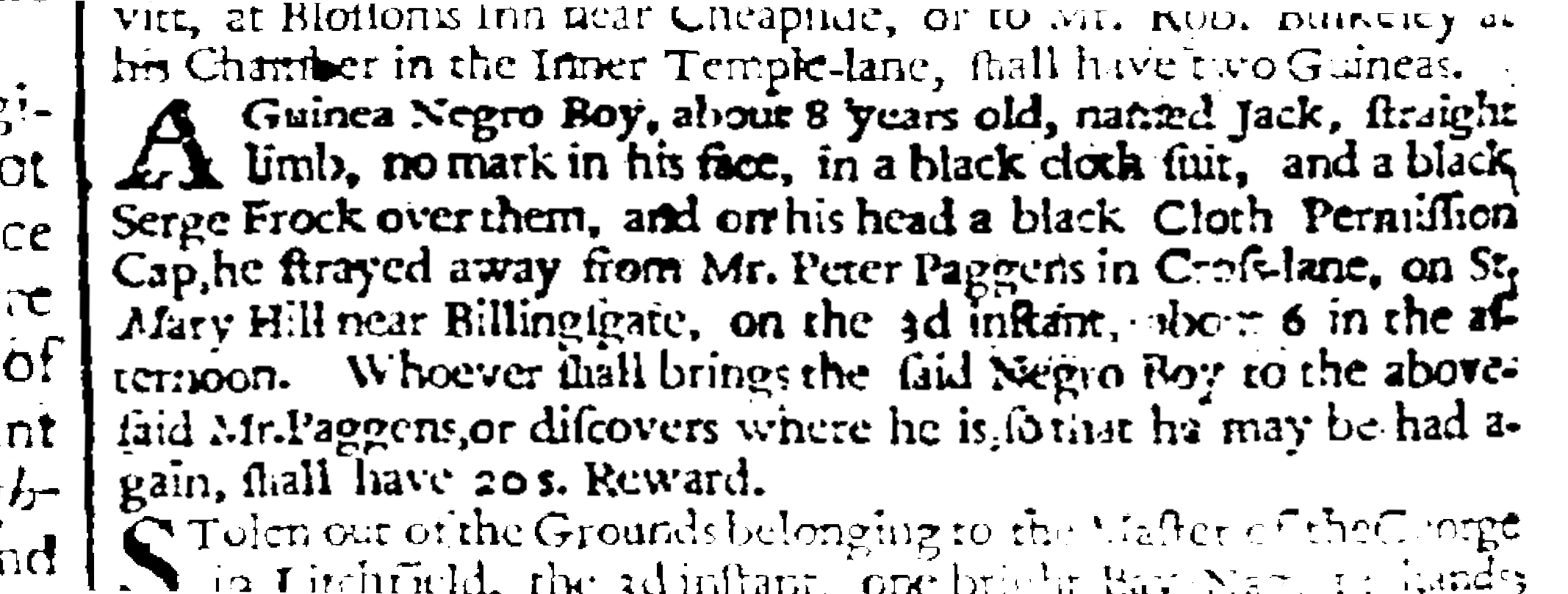
The advertisement for Jack, The London Gazette, no. 2564, 9–12 June 1690. See Jack, 1690.
Home › Peter Paggen
Last modified: 5 October 2026
— The Will of Peter Paggen, 1717 [full transcription, with the Schedule of Legacies and the probate of 1720]
— The Will of Katherine Paggen, 1724 [his widow’s will, with its schedule and the codicil naming her son-in-law Humphry Morice]
— The Will of William Paggen, Brewer, 1636 [probably his grandfather; a London brewer with land in Jülich, on the Lower Rhine, and a legacy to the Dutch Church]
— The Will of William Paggen, 1688 [his brother, a London merchant; Peter was his executor]
— Jack, ‘a Guinea Negro Boy’, 1690 [the London Gazette advertisement, with Simon P. Newman’s chapter from Freedom Seekers]
— The Manor House, East Hill, c.1670–1890 [Paggen’s house, its demolition, and Thornhill House, Putney]
— S. W. Kershaw, “The Manor House, Wandsworth” (1891) [full text, with plates]
— The Huguenot Burial Ground, Mount Nod [where Paggen and his wife are buried]
— Peter Paggen, Humphry Morice and the slave trade [notes, with a register of all their slaving voyages, 1698–1732]
— Notes on Peter Paggen from Pettigrew’s Freedom’s Debt [his career as merchant, separate trader and lobbyist]
Peter Paggen was born in about 1651: his tomb records that he died on 15 June 1720 “aged 69”. He was the son of a brewer, and his parents had been members of the Dutch Church at Austin Friars in the City of London, the church of London’s Dutch and Flemish Protestant community.4 This fits Kershaw’s suggestion of 1891 that he was descended from a “William Paggin, in the Low Countries”, and Historic England’s description of him as “a Low Country refugee”. It suggests that his family roots were Dutch or Flemish rather than French Huguenot, although he is often called a Huguenot. The will of William Paggen, a London brewer who died in 1638 and had an only son named Peter, mentions land that he owned in the Duchy of Jülich (“Gulick”) on the Lower Rhine; he was probably Peter’s grandfather (see his will). He married Katherine Davis (c.1654–1724).5
He began as a ship’s captain carrying tobacco from the Chesapeake to London and became one of the capital’s leading tobacco merchants. In 1692 the General Assembly of Maryland appointed him the colony’s agent in London. Between 1698 and 1705 he invested in at least twenty-five slaving voyages, which carried some 7,300 African captives across the Atlantic, most of them to Jamaica.1 For the full register of his voyages, and those of his son-in-law Humphry Morice, see Peter Paggen, Humphry Morice and the slave trade.
In June 1690 he was living in Cross Lane, on St Mary Hill near Billingsgate, when he advertised in the London Gazette for Jack, “a Guinea Negro Boy, about 8 years old”, who had “strayed away” from his house.
The advertisement for Jack, The London Gazette, no. 2564, 9–12 June 1690. See Jack, 1690.
By the time he made his will in October 1717, Paggen described himself as “of Wandsworth in the County of Surrey Esquire”. He lived in a copyhold house with outbuildings, gardens and orchards in Wandsworth. He also owned other houses in the town and its common fields, and held ground on lease from Lord St John, some of it in Bridge Field. His widow Katherine received £10,000 in East India and Bank of England stock. By the time she died in 1724 she held over £13,000 of stock; see her own will. A further £10,000 was put in trust for his younger daughter Sarah, and the residue was left in trust for his elder daughter Katherine, wife of William Hale. The will was proved on 15 July 1720.
His house was the Manor House, which stood just north of the road at the top of East Hill. Paggen is believed to have built it around 1670, and he certainly lived there until his death in 1720.
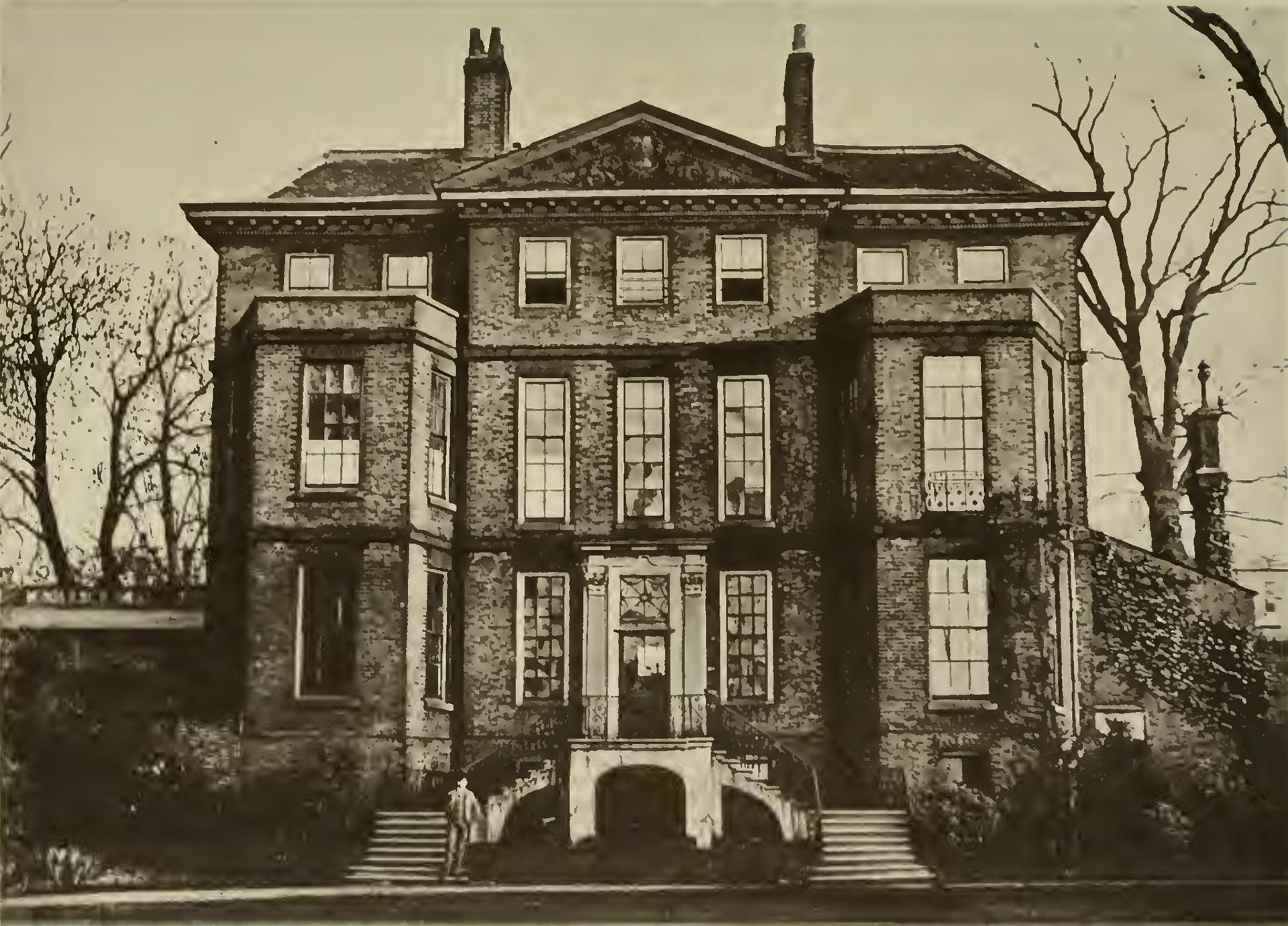
The Manor House, Wandsworth, seen from the garden. Photograph published by S. W. Kershaw.
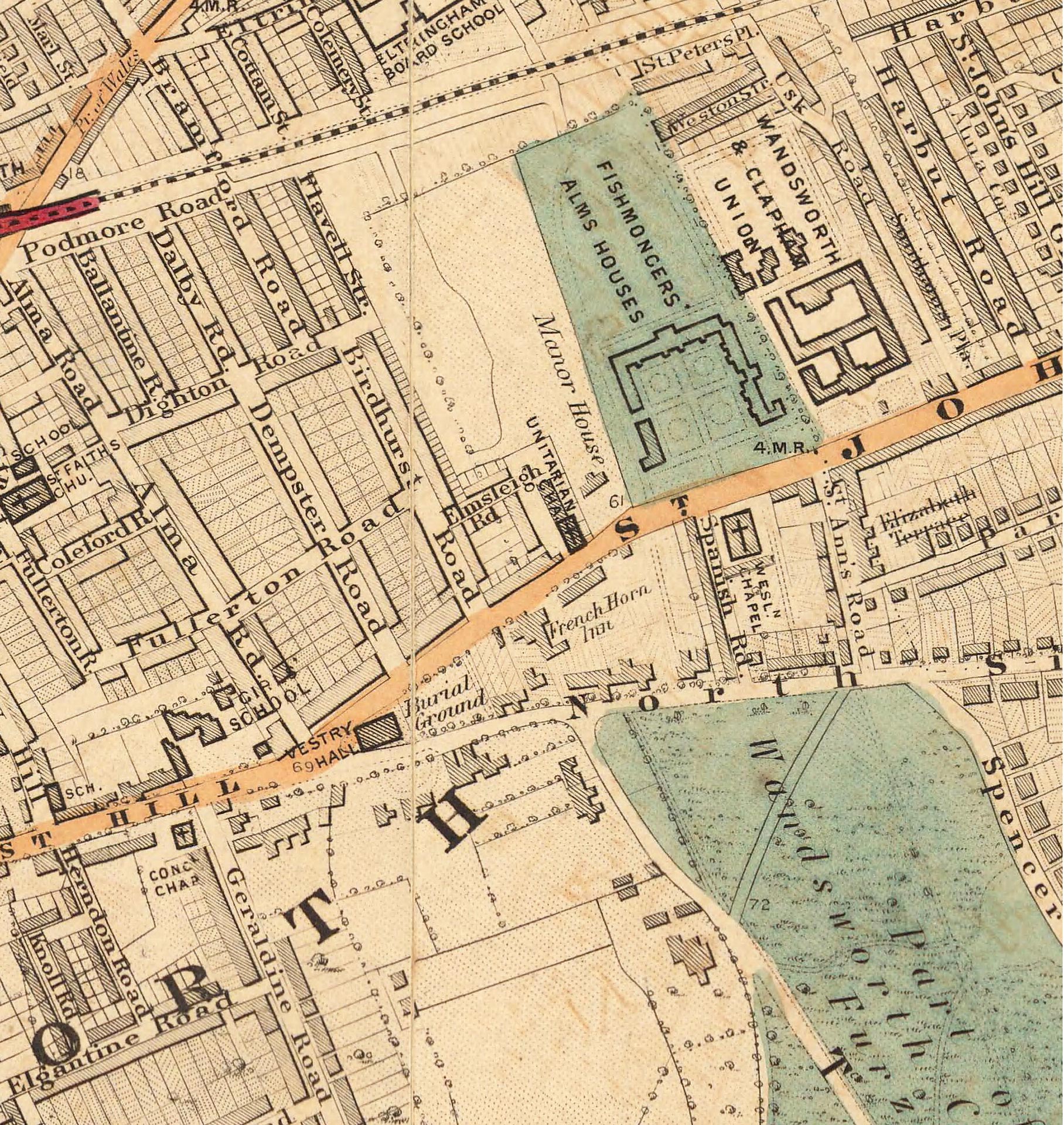
Stanford’s map of London, 1891 (detail): the Manor House, north of St John’s Hill, and the Burial Ground (Mount Nod) beside the Vestry Hall on East Hill.
For the full account, see The Manor House, East Hill.
The Manor House seems to have been built in two main phases. An overmantel fragment dated 1673, now at Thornhill House, supports the traditional date of about 1670 for the first house. Historic England describes it as “a late C17 house much remodelled c.1720”.3 The pediment, tall sash windows and doorcase in Kershaw’s photograph probably belong to this later phase.
The remodelling left a fine decorated staircase “dating from around 1720” and painted decoration. The hall ceiling, “said to be of Anne, Princess of Denmark”, bears the initials P K P, for Peter and Katherine Paggen, so it was plainly made for them. The paintings “have long been attributed” to Sir James Thornhill, painter of the Painted Hall at Greenwich. The house itself was long credited to Sir Christopher Wren, although that attribution was already doubted in 1889. Tradition also connects the woodwork with Grinling Gibbons and Caius Gabriel Cibber. Cibber died in 1700, so any work of his would belong to the first house, and Thornhill’s to the remodelling. None of these attributions has yet been confirmed from documents.
The Manor House was demolished in 1890. About that time a Kensington builder, Mr Wakefield, built Thornhill House in Deodar Road, Putney, and fitted it with panelling, the staircase, an arch perhaps from the entrance-hall screen, and the ceiling and staircase paintings from the Manor House. Thornhill House was listed Grade II in 2004.3
In 1717 his will asked for burial in the parish church of St Dunstan in the East, the City parish next to his old home near Billingsgate, but left the choice “at the discretion of my Executors”. In the event he was buried at Mount Nod, the Huguenot Burial Ground on East Hill, barely a hundred yards from the Manor House. His widow Katherine was later buried with him. Their table tomb survives and is listed Grade II. Historic England dates it to 1720 and describes it as “stone-faced. Deep moulded plinth. Panelled sides with dedications to Peter Paggen, and to ‘the widow of Peter Paggen’ died 1724. End-faces of segmental section with Baroque escutcheons. Bold cap of curvilinear section.”2
The inscriptions read:
Here lieth the body of Peter Paggen, Esq., who departed this life the 15th June, 1720, aged 69. [south side]
Here lyeth the body of Katherine Paggen, widow of Peter Paggen, Esq., deceased the 24th April, 1724, aged 69. [north side]
The tomb was one of five listed tombs at Mount Nod that were on the Heritage at Risk register. Between 2019 and 2022 the burial ground was renovated for Wandsworth Council by the not-for-profit contractor Enable, and the damaged tombs were stabilised and repaired.4 A new interpretation plaque now stands beside the Paggen tomb. It names the couple as “Peter Paggen (1651–1720)” and “Katherine Davis (1654–1724)”, reproduces the coat of arms carved on the tomb, and calls it “one of the grandest tombs in the burial ground”.5
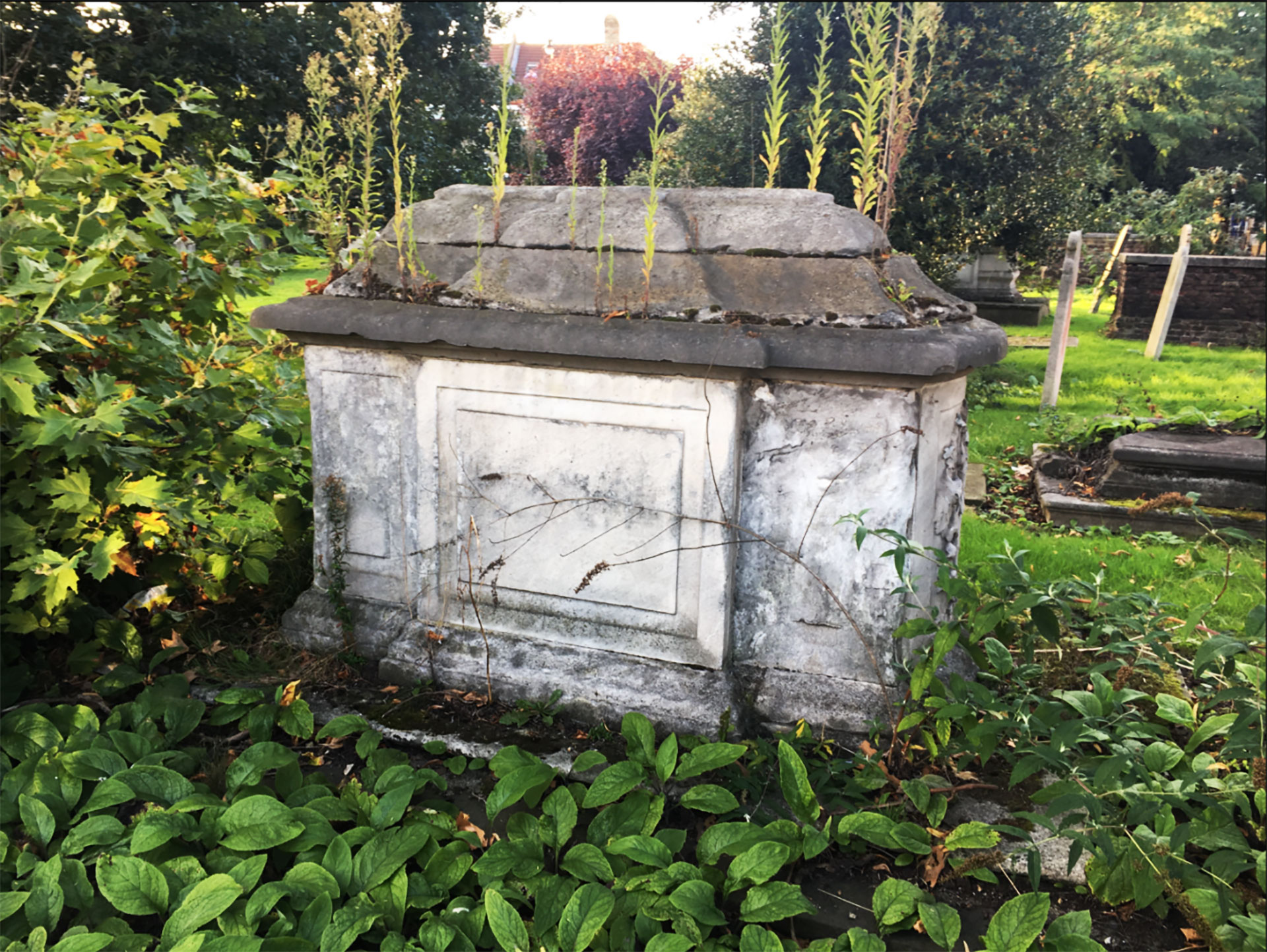
The table tomb of Peter and Katherine Paggen, Huguenot Burial Ground (Mount Nod), East Hill, Wandsworth. Before restoration. Photograph: Laura Toal for Historic England, 6 September 2017.

The Paggen tomb after the restoration of 2019–22, seen from the north. The panel carries Katherine Paggen’s inscription. Photograph: Philip Boys.

The interpretation plaque beside the tomb, installed during the renovation: “One of the grandest tombs in the burial ground, this tomb belonged to the Paggen family and features the coats of arms of both Katherine and her husband Peter (pictured above). Peter was the son of a brewer, whose parents had been members of the Dutch Church. He became a successful City of London merchant, and he and Katherine lived in Wandsworth Manor House, which stood on the summit of East Hill.” Photograph: Philip Boys.
1. S. P. Newman, Freedom Seekers: Escaping from Slavery in Restoration London (University of London Press, 2022), ch. 4, reproduced on the Jack page; W. A. Pettigrew, Freedom’s Debt (Chapel Hill, N.C., 2013), pp. 64–5, 72.
2. Historic England, list entry 1065536: Huguenot Burial Ground, Paggen table tomb.
3. Historic England, list entry 1390837: Thornhill House, including gates, gate piers and urns (listed 16 March 2004). The listing calls Paggen “a Low Country refugee”; Newman calls him a Huguenot.
4. B. Julien, “The renovation of Mount Nod burial ground, East Hill, Wandsworth”, Huguenot Society of Great Britain and Ireland, 18 October 2022.
5. Interpretation plaque beside the Paggen tomb, Huguenot Burial Ground, Huguenot Place, installed c.2022. The plaque’s dates of birth (1651, 1654) are presumably worked out from the ages on the tomb. The source for Katherine’s maiden name, Davis, is not given.
Will: The National Archives, PROB 11/575/141.