Houses: Wandsworth Lodge.
People: McKellars.
People: De Selincourts. [to follow]
The East Common was the centre of a fierce conflict in the 1860s. Mr Kellar [aka M'Kellar, McKellar], who owned land ["McKellar's triangle"] on the Common south of Bellevue Road, claimed he had to enclose it to disperse troublesome gypsies, who he accused of trashing the Common and holding a rowdy parties; but it later emerged that it was he that had supplied the travellers with the alcohol.
[PB: the story of the drunken gypsies is widely asserted but I have yet to find direct evidence.]
[PB: I once thought that Buckmaster's jeering comments [on the 1870 poster] about the Common having been filched by a "Tailor" referred to McKellar - though Henry had died 1863, and W Lodge was at that time in the hands of ? Surely not the De Selincourts (also, in a sense, "tailors", by virtue of running Swan and Edgar's)? I now think he was referring to Costeker, who was prominent in the Merchant-Taylors' Guild.]
[PB: I wonder if the McKellar family, Old Burlington Street, were Earl Spencer's tailors? How long did the McKellars have a shop there? Weren't they renamed Gibson? ]
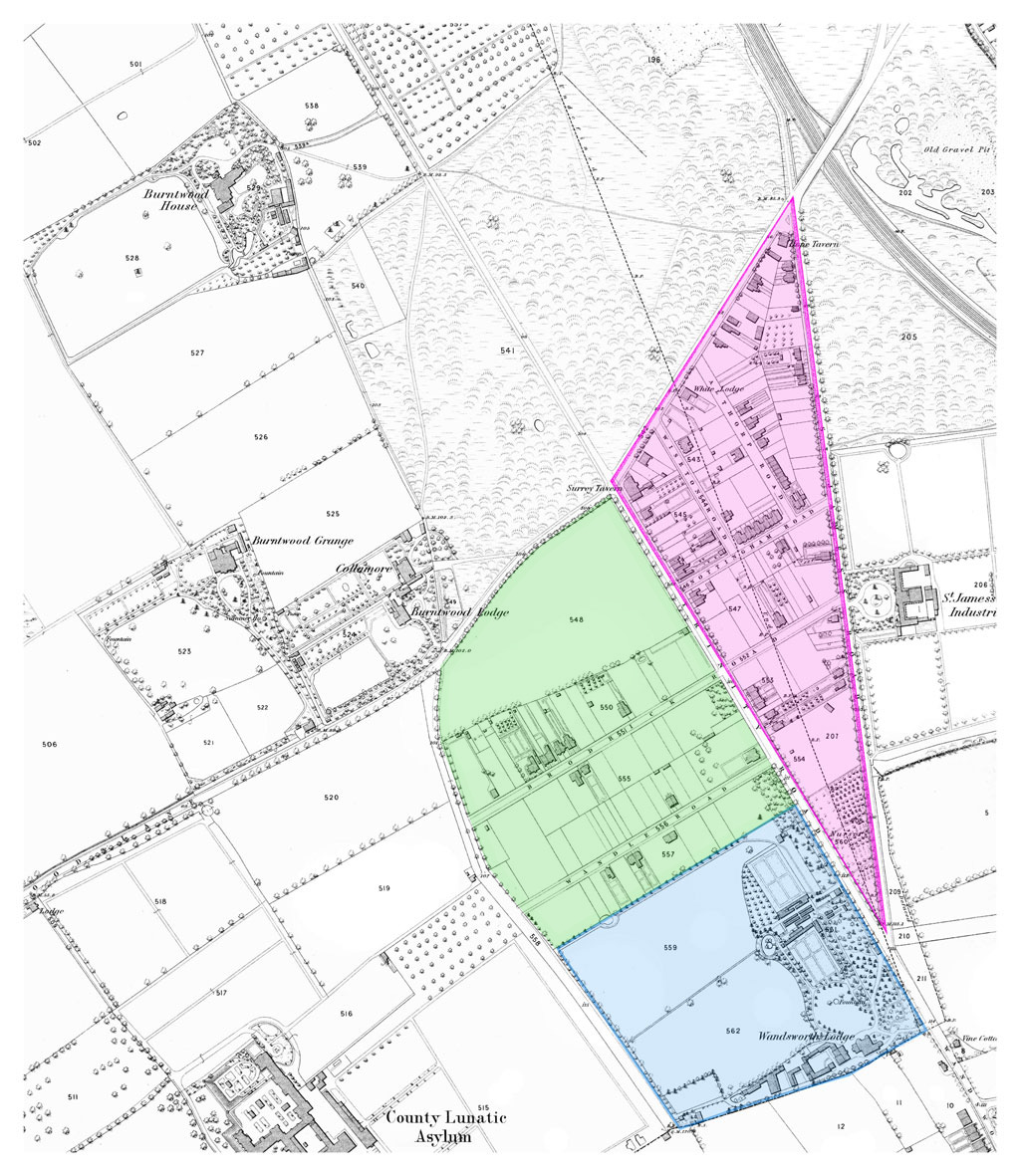
[MAP OF TRIANGLE / WANDSWORTH LODGE ETC]
The McKellar Triangle
Graham Jackson, July 2020
The McKellar Triangle is located adjacent to Wandsworth Common and is bounded by Bellevue Road, Trinity Road and St James's Drive. It is named after landowner Henry McKellar who enclosed the area between 1848 and 1853 and owned Wandsworth Lodge until his death in 1862. Although it is quite recognisable on any map of the area, it was invariably comprised of several different lots and by the advent of the Wandsworth Common Act in 1871 the whole area had been largely developed.
The Triangle is seamlessly divided between the old Battersea and Wandsworth borough boundary and at its point, on its junction between St James's Drive and Trinity Road, it roughly marks the most southerly extent of this boundary given that the old borough of Battersea has now been subsumed into the London Borough of Wandsworth.
Although open countryside before Henry McKellar's death, "The Hope" was probably one of the first buildings to be erected, situated at the point where St James's Drive meets Bellevue Road, and, more by design than accident, is located virtually adjacent to Wandsworth Common station which was not opened until 1869. In its early years it was also used as changing accommodation by Spencer cricket club and by former FA Cup Winners Clapham Rovers who both played on the Common nearby.
The building which was known as "The Surrey Tavern" but now "Brinkley's Kitchen", stands on the other point of the triangle where Trinity Road meets Bellevue Road. This was probably built about a year later than "The Hope" and opened its doors in 1865. It was intended as a Coaching Inn with upstairs accommodation and again was used as changing rooms by the Casuals Football club from its inception in 1883 until 1890 and also probably by the Heathfield cricket club during the summer months until suitable changing accommodation could be provided on what was colloquially known as Bonner's Field (now Trinity Fields) on the opposite corner with Burntwood Lane.
The upper floors to Trinity Road which sympathetically extended the frontage from five to seven windows is a modern construction, but the change in colour of the brickwork has nothing to do, it seems, with the demolition of "The Scope" almost a hundred and fifty years earlier! The adjacent new build is known as "The Bonner Building" consists of eleven apartments and is named after the publican, John Bonner, who was landlord at "The Surrey Tavern" from around 1875 until 1900.
Two other buildings are worth mentioning and are in a sense linked. St Mary Magdalene Church in Trinity Road was little more than a tin shed before the current Church was built there in 1888. It is still an impressive building, including on its western frontage with the road a double arched and gabled bellcote strangely serviced by a single bell.
Almost attached to the church was The Church Institute in Wiseton Road. Founded in 1868, it was effectively the sporting arm of the Church. One of its cricket members, was the future Test Cricketer, George Lohmann whose bowling performances were almost legendary and won prizes with the Institute side as a youth. They used to change at the Institute (now demolished) and it is thought that from time to time they also used "Bonners Field" for their cricket. The other team worth mentioning was the Rangers Football club (not the Queens Park or Glasgow versions!) who shared the Institute for changing approximately at the same time that the Casuals were using "The Surrey Tavern". A condition of changing there was that the members of the football club also had to be members of the Church Institute. One of their players, Frederick Wall, became Secretary of the Football Association, serving their organisation with distinction for almost forty years and was one of the first officials to be knighted for his services to the game in 1930.
Graham Jackson, July 2020
It is interesting that in 1863 when Wandsworth Lodge was sold by Ann McKellar - who then moved to Richmond Lodge, Streatham Hill - it says the estate was "built over". That is not quite true because the playing field was part of Henry McKellar's Wandsworth Lodge Estate and because of an 1852 covenant imposed by Earl Spencer not to build on the land when McKellar bought the land, the playing field escaped and is what it is today.
Some describe it as a miracle that it survived but survive it did with the help of the covenant.
The thing is when McKellar bought it from Earl Spencer in 1852, it effectively became his back garden - indeed if you study the maps it is quite clear that he probably bought it to keep it out of the hands of Burntwood Grange and Burntwood Lodge on the other side of Burntwood Lane although the lane itself was little more than a track in those days.
It also seems that Ann McKellar probably retained the field. Wandsworth Lodge was sold off in lots apparently, but Ann McKellar lived until 1885, two years after the Heathfield cricket club rented it in 1883. By 1888, the field was back in Spencer's hands who sold it to the council - think the London County Council- in 1890.
I am struggling with the twenty years between 1863 and 1883 as I can trace the history from the latter date. It seems that possibly the field could have been used for sport since around 1870 and that the Church Institute formed in 1868 may well have used it for sport from then. Unfortunately, just coming up against a "brick wall" on this at the present. I am well known at the Wandsworth Heritage Service and have inspected information at the London Metropolitan Archives as well!!
The above is only a general precis of what I have gleaned. I have unearthed some intriguing facts about McKellar!
A copy of the notes on the auction of Wandsworth Lodge in 1863 would be useful!
Graham Jackson, July 2020
Although in a sense McKellar and De Selincourt are incidental, it increases the narrative about the field and potentially gives more interest to any book in my view.
McKellar is, in a sense, more important because at one point he owned the field. However, the period between 1862 and 1883 is of particular interest to me from the perspective that at some stage the ground went from being effectively McKellar's back garden to a sports field.
Earl Spencer's roping off of some areas, I think, relates more to Spencer Cricket Club's history as the Spencer's Cricket Ground was more in the vicinity of the Hope Tavern. However I am open to persuasion. Incidentally at about the same time Wandsworth CC also had a ground in the vicinity of Chivalry Road / Bolingbroke Grove. The Heathfield club takes it name from the Heathfield cricket ground that was roughly in the area adjacent to Heathfield Cottages before the club set up residence at what is now Trinity Fields in 1883.
My difficulty is what actually happened to the ground as a result of the sale of the Wandsworth Lodge estate. Did it remain with Ann McKellar, Henry McKellar's wife or not until her death in 1885. If so it seems likely, upon her death, that the field either reverted to Spencer or that Samuel Wix, the benefactor of Ann McKellar's will, gave it back to Spencer as a philanthropic act whilst he was busy disposing of McKellar's interests in North Wales.
To my mind this is the only way the field got back to Spencer who then sold it to the LCC in 1890.
I enclose the Timeline of the events which have shaped its history. The 1852 covenant ensured that it was not to be earmarked for development. The field was not included in the 1871 Act. It is shown on the map as being "Open Space". A good copy of this is available in the Wandsworth Heritage Library.
[PB: "The map"?]
The Holloways lived in Burntwood Grange. Both brothers played first class cricket for Sussex, one of them died in the Great War. I think there is some sort of plaque or memorial to him in St Mary Magdalene Church opposite the field. Incidentally, I make a point of calling Trinity Fields a "field" rather than a ground because of the strict dictionary definition of what a field is - although I think early on that it was a pretty rudimentary division from part of the Common that it originally was.
I enclose the pictures I have from the Dan Leno match. You are also right about the photographer being French - originally.
When the lockdown happened, I think I was around a year away from publishing - or at least getting to that stage. Although encouraged by the Trinity Fields Trust to do so, because having had an interest principally through cricket and attending Sinjuns between 1963-70 and with such an interesting history it is just surprising that so little has ever been published about the field, which apart from the "incidentals" as you rightly call them, has an outstanding pedigree regarding sporting activities of its own. So yes, I am looking at the field from a somewhat different perspective, but my journey takes me into areas in which the Wandsworth Historical Society also has an interest. However, the lockdown has given me time to develop these ideas, so it has been a benefit, rather than sitting around and doing little. The internet has given up more secrets during this time!
I think that a meeting between us all might be useful. I am persuaded by discussions with others including the Trinity Fields Trust, that potentially there would be a commercial interest for such a book, given the use by Sir Walter St Johns School and Battersea Grammar School over the years, current users of the ground, Harlequins and London Welsh and perhaps Heathfield Bowls Club whose cricket section were one of the leading London cricket clubs until 1924.
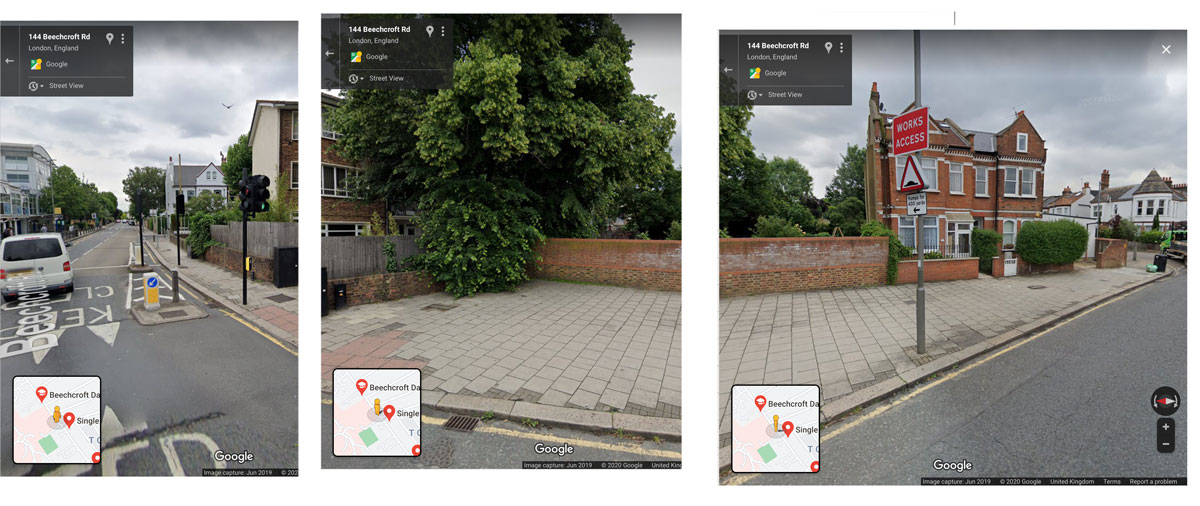
There is a curious, normally unremarkable discontinuity on Beechroft Road (formerly "Obligation Road", and variants), which probably shows the extent of the garden, just on the Wandsworth side of the boundary with Streatham. The garden and house stretched between Beechroft" and Trinity Road.
Henry McKELLAR
Birth: 10 Aug 1800
Death: 5 Oct 1862, Wandsworth Lodge, Wandsworth
Occupation: Tailor, Gibson And Co.
Spouse
Ann MOIR
Birth: 1804, Madras, India
Death: 15 May 1886, Richmond Lodge, Surrey, England
Burial: 22 May 1886, Norwood Cemetery, Norwood Road, Lambeth
Father: Unknown MOIR
Marriage: 20 Oct 1827, St. Johns, Calcutta, Bengal, India
Notes for Henry McKELLAR
Name, birth, marriage and death information from Christopher Rack.
Also
Son of Duncan McKellar of D. McKellar & Sons, Tailors of Old Burlington Street, Bond Street, London and his wife Ann Burnett.
and
National Probate Calendar
21 October 1862. The Will of Henry McKellar late of Wandsworth Lodge in the County of Surrey Esquire deceased who died 5 October 1862 at Wandsworth Lodge aforesaid was proved at the Principal Registry by the oath of Ann McKellar of Wandsworth Lodge aforesaid Widow the Relict the sole Executrix. Effects under 60 000 pounds.
London Gazette
Notice is hereby given, that the partnership subsisting between Charles Wing, of Plasgwynant, in the County of Carnarvon and of No. 22 North-bank, Regents-park, in the County of Middlesex, Esquire and Henry McKellar, of Wandsworth-lodge, in the County of Surrey, Esquire, carrying on and working certain Mines and Quarries, in the parish of Beddgelert, in the counties of Merioneth and Carnarvon, was this day dissolved by mutual consent:
As Witness the hands of the parties the 30th day of October, 1841.
Notes for Ann (Spouse 1)
Name, birth, marriage and death information from Christopher Rack.
Also
Marriage Mr. H. McKellar of the firm Gibson and Co. to Mrs Anne Gibson, widow of the late G.T. Gibson
and
National Probate Calendar
11 June 1886. The Will of Ann McKellar late of Richmond Lodge Streatham Hill in the County of Surrey Widow who died 15 May 1886 at Richmond Lodge was proved at the Principal Registry by Samuel Wix [son in law] of Broadwater Down Tunbridge Wells in the County of Sussex Esquire the sole Executor. Personal Estate 47 927 pounds 11 shillings 11 pence.
In the 1841 census Wandsworth, Surrey
Wandsworth Lodge
Henry McKeller, age 40, independent, not born in county.
Ann McKeller, age 35, not born in county.
Ann Gibson, age 15, Independent,not born in county.
In the 1861 census Wandsworth Lodge Burntwood? Common, Wandsworth, Surrey.
Head: H. McKellar, age 60, landed & house proprietor, born London.
Wife: Ann McKellar, age 56, born Calcutta.
3 servants, a cook, a housemaid and a footman. A gardener and his family are crossed out as they live in a different parish.
In the 1871 census Richmond Lodge, Streatham, Surrey. Head Ann McKellar, widow, age 67, fund holder, born Madras.
Granddaughter: Ada Hester Wix, unmarried, age 21, born Balham, Surrey.
Grandson: Ernest Newton Wix, age 19, Undergrad of Kings Coll, Cambridge, born Balham. Grandson Edwin Walter Wix, age 17, born Balham.
Granddaughter: Lilian Emily Wix, age 13, born Balham.
3 servants, a cook, a housemaid and a footman.
In the 1881 census Richmond Lodge, Main Road, Streatham, London.
Head: Ann McKellar, widow, age 78, born Madras, India.
Visitor: Jemima Wix, widow, age 61, widow, born Chapel, Leicestershire?.
4 servants a housemaid, butler, cook and coachman and the coachman's wife. [I wonder if Jemima Wix is the mother-in-law of Ann's daughter?]
Norwood Cemetery, Norwood Road, Lambeth, Surrey Burials
Ann McKellar of Richmond Lodge, Streatham Hill, buried May 22, 1886, age 85 years, ceremony performed by Arthur Woods.
[Source: ADD LINK]
1832
First shown on maps
1852 (20 September)
Henry McKellar of Wandsworth Lodge buys a "piece of land, part of Wandsworth Common" from Earl Spencer for £180, subject to the condition / covenant that the land "shall not be built upon". The land in question is enclosed, and effectively becomes a field.
1862
Henry McKellar dies and leaves his estate to his wife Ann McKellar.
1863
Wandsworth Lodge is sold by Ann McKellar but it appears that she retains the field.
1871
The field is not included in the 1871 Wandsworth Common Act.
1875
First possible use of the field for cricket
1883
First confirmed indication that the field is being used for cricket and football.
1886
Ann McKellar dies and leaves her estate including the field to her son-in-law Samuel Wix.
1888?
Samuel Wix gifts the field back to Earl Spencer (assumed)
1890 (30 December)
Earl Spencer conveys the field to the Council for Five Shillings on condition that the Council agrees to the 1852 covenants originally agreed with McKellar.
1898 (11 August)
The Council conveys the field (price unknown) to John Mills Thorne owner of the Nine Elms Brewery and Burntwood Lodge. 1852 covenants to apply.
1911 (2 June)
John Mills Thorne conveys the field to the London Welsh Athletic Club for a sum of £3,800 subject to the 1852 covenants as before.
1918 (25 March) The London Welsh Athletic Club conveys the field to Samuel Cresswell who declares the property is held for the benefit of the Sir Walter St Johns School Foundation (effectively the "Trust") for the sum of £4,643, subject to the 1852 covenants as before.
1992 (28 February) Without a school to administer, The Walter St John's Schools Trust is effectively wound up. Ownership of the field is passed with the approval of the Charity Commissioners to the "Sir Walter St. John's Educational Charity".
1996
The management and maintenance of the field is taken over by the Trinity Field Trust in 1996 by way of a lease agreement with "Sir Walter St John's Educational Charity", initially for a period of 25 years.
2017
The "Sir Walter St John's Educational Charity" extends the lease agreement with revised terms to Trinity Fields Trust for a further 50 years.
Note
Battersea Grammar School closed in 1977
Sir Walter St John's Grammar School closed in 1986
Neil Robson to Graham Jackson:
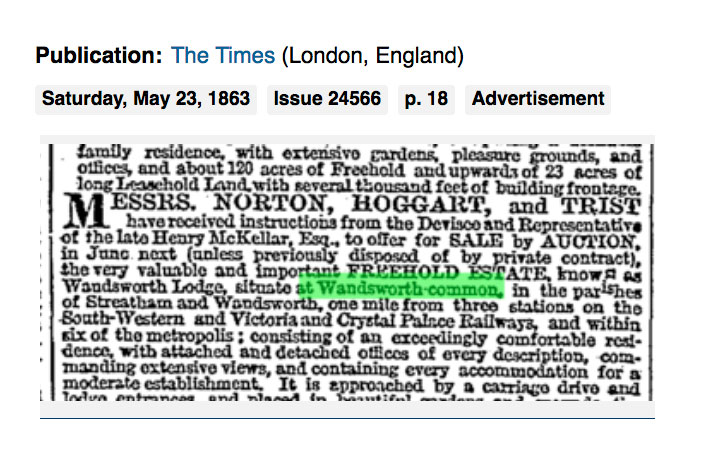
Have you explored the digital archive of The Times? There are eighteen mentions of Wandsworth Lodge in it between 1845 and 1883, though some of the are more concerned with McKellar's financial interests or later on, various advertisements by the de Selincourt family on behalf of their servants.
But, in case you've not seen it, here's an estate advert from p. 16 of the issue of the paper for 14 Feb. 1863.
[FIND AND SHOW ADVERT]
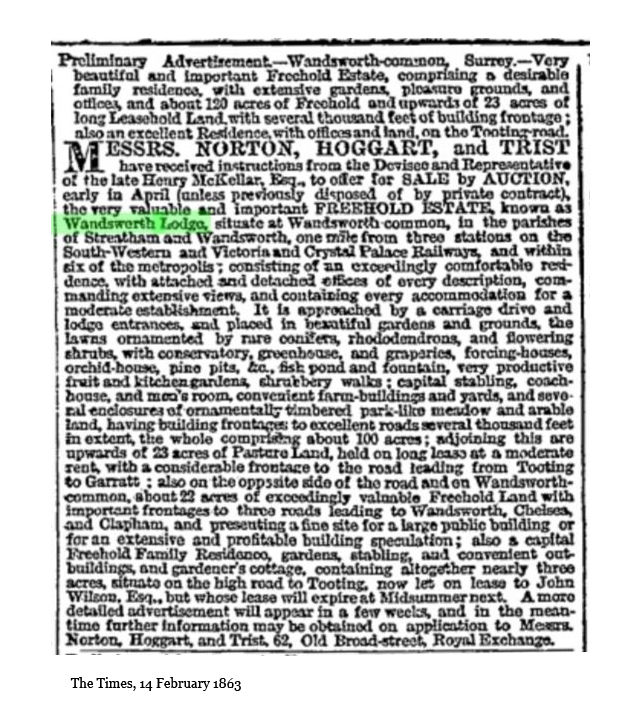
"...several thousand feet of building frontage... a fine site for a large public building or for an extensive and profitable building speculation", indeed! There are no obvious signs of the old house and grounds today, except a curious (and otherwise probably inexplicable) discontinuity on Beechcroft Road - opposite Ernest Bevin Boys school. The reason is probably that the southern edge of his garden was also the Wandsworth/Streatham parish boundary...
Graham Taylor has emailed to say "Wandsworth Lodge - there is a map in the Archives at Battersea Library dated around 1885 which shows in red the approximate area of where Wandsworth Lodge was and its division into individual properties. It was probably sold by the De Selincourt family around 1883/4 for development?"
[Find and add]
[Times: Link]
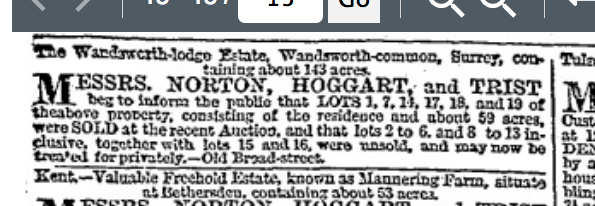
[several lots unsold! Which? Why not sold> Was one of them the future playing field? Who acquired these lots? How did Spencer acquire the playing field?]
[ADD NOTES ON MCKELLAR AS A LONDON TAILOR, HIS TIME IN INDIA, HIS MARRIAGE THERE, HIS LEGAL STRUGGLES WITH TWO PARTNERS, RETURNS AND BECOMES MANAGER AND THEN OWNER OF A WELSH COPPER MINE, LAVISH HOME IN BEDDGELERT, BECOMES LORD LIEUTENANT OF CAERNARVON]
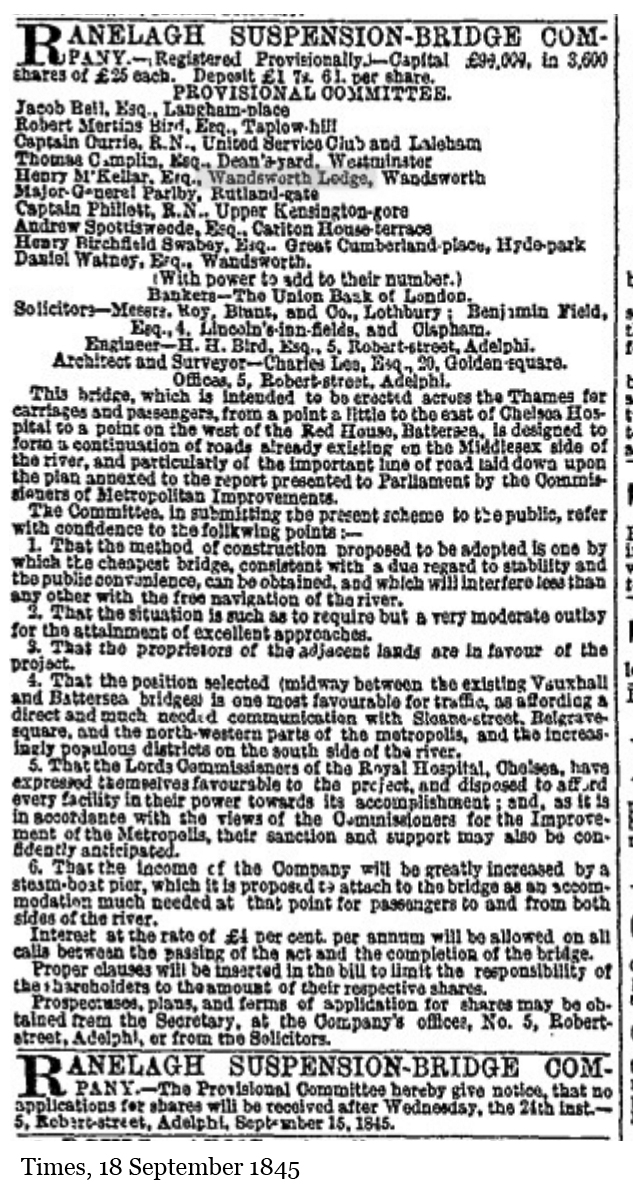
[HE (or is it his brother?) INVESTS IN "RANELAGH SUSPENSION BRIDGE" = "VICTORIA BRIDGE" (partner of ALBERT BRIDGE AT OTHER SIDE OF BATTERSEA PARK" - TOLL BRIDGE OPENED 1858 - UNPOPULAR, DEMOLISHED 1935-37 & TODAY'S CHELSEA BRIDGE BUILT IN ITS PLACE]
A complicated story (well, too complicated for me) about a partnership between McKellar and two others in India that ended badly.
India-related court case, 1853: Henry Mckellar v. John Wallace And John Spence (Privy Council).]
[Wikipedia: Chelsea Bridge.]
[Source: Link]
[Source: Link]
Henry McKellar, High Sheriff of Caernarvonshire, resided at Sygun Fawr in 1861
[Source: Link]
1840 David White Griffith raised a loan of £3,000 from Lord Redesdale on the security of the whole Sygun estate., and a further £1,000 loan from Charles Wing, joint lessee of the Sygun Copper Mine.
Henry McKellar became manager of the mine, took over this £1,000 loan advancing with it a further £250.
By 1848 D W Griffith owed McKellar £1,890.
In 1849 McKellar took over all the profits from the estate with which he paid part of the interest due to Lord Redesdale each year, adding the balance from his own pocket.
D W Griffith was loath to lose his property but in 1853 he was forced to make a deed of conveyance for the whole of the Sygun estate to Henry McKellar, subject to the existing first mortgage, for a purchase price of £2,403, the sum by which Griffith was now indebted to him.
McKellar continued to pay interest to Lord Redesdale until 1859.
In 1860 McKellar's brother redeemed the mortgage for him.
1861-2 Henry Mckellar was made High Sheriff of Caernarvonshire, and died on 5 October 1862, Leaving the estate to his wife Ann.
1886 She died and willed the estate to her son in law, Samuel Wix of Tunbridge Wells, then aged 71 years.
(C Gresham, 1978, Nanmor Deudraeth p 113-14) 1889 Mr Wix started selling off the farms separately to local buyers: 1889 Sygun Fawr & Tanllwyn to William Jones late of Buarthau Ty Hen & Cae Moch to? 1889 Hafodydd Brithion to I O I Priestley
1899 Llwyn yr Hwch to Evans, Hafod y llan
[Google Search:: "Henry McKellar Owner Copper Mine Wales"]
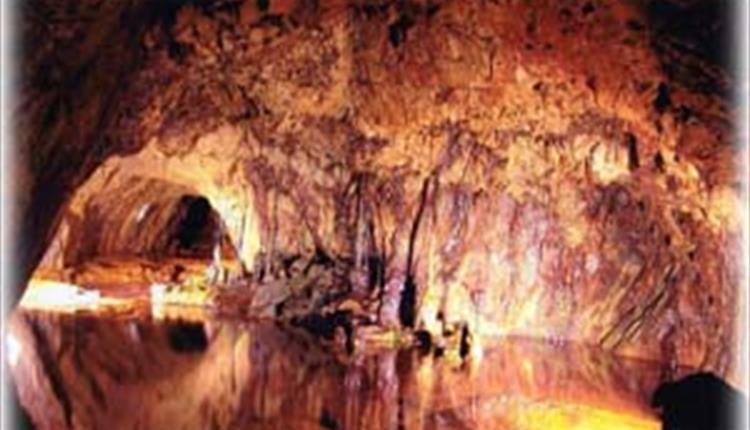
A fairly unsuccessful copper mine with an interesting history, a mine was first active here in the 1700s.
A prospectus for the Sygun Mine was issued in 1836. The mine was later purchased by one Henry McKellar in 1841, and in 1843 seventeen men are recorded working here. By 1862 the mine was no longer profitable.
In 1882 Henry Maudslay and Charles Kneebone took over the mine. Unable to make it pay, they enlisted the help of Stanley Elmore, who was registered as the owner in 1897 and built a mill for the Elmore Flotation Process. The mine still failed to make a profit and closed in 1903. In 1907 the plant and equipment was transferred to Elmore's other copper mine at Glasdir near Dolgellau (see entry under Dolgellau gold belt).
In 1958 the site was transformed into a Chinese village for the film "The Inn of the Sixth Happiness, starring Ingrid Bergman, and since 1986 the site has operated as a tourist attraction with a visitors centre (the old boilerhouse) and underground tours. Entry is via the main adit and ascends through the mine to exit via the Victoria Level.
Mineral List
_ Arsenopyrite
_ Chalcopyrite
_ Kaolinite
_ Pyrite
_ Quartz
[Source: Link]
[YouTube: Filming 'The Inn Of The Sixth Happiness', Nantmor, 1957]
[YouTube: The Inn Of The Sixth Happiness (low-res segment, 55mins)]
Sygun Copper Mine
[ShowCaves: Sygun]
2 Sygun Copper Mine.
On the A485 to the east of the village. A tour of a 19th-century copper mine. edit