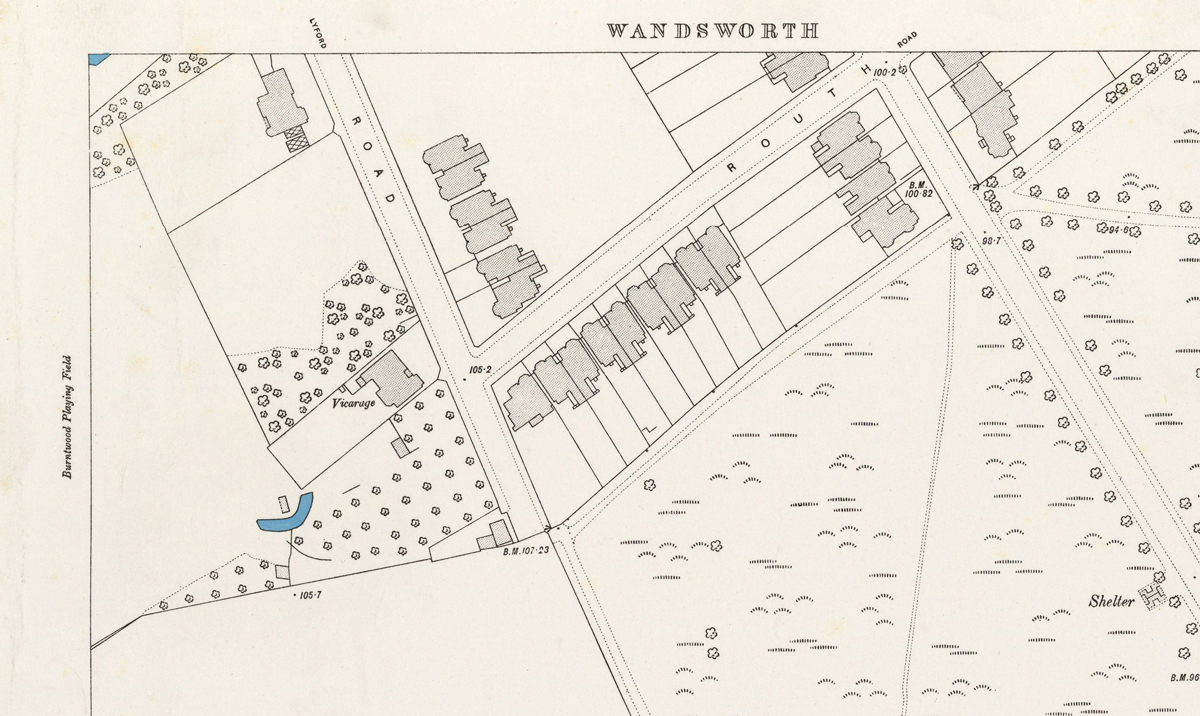
— Maps and plans showing Burntwood House
— Albinia?
— who was the other druggist — bankrupted?
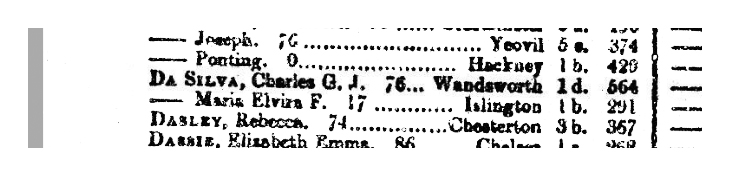
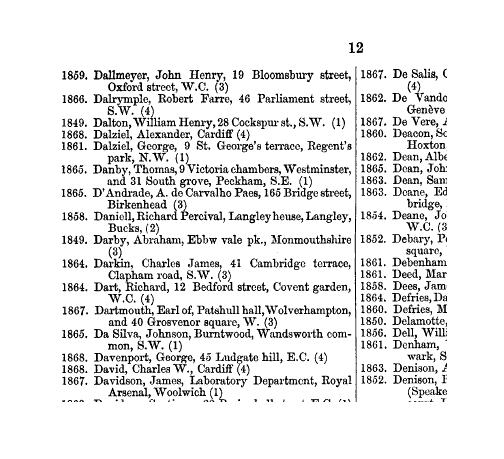
— Johnson da Silva (approx dates?)
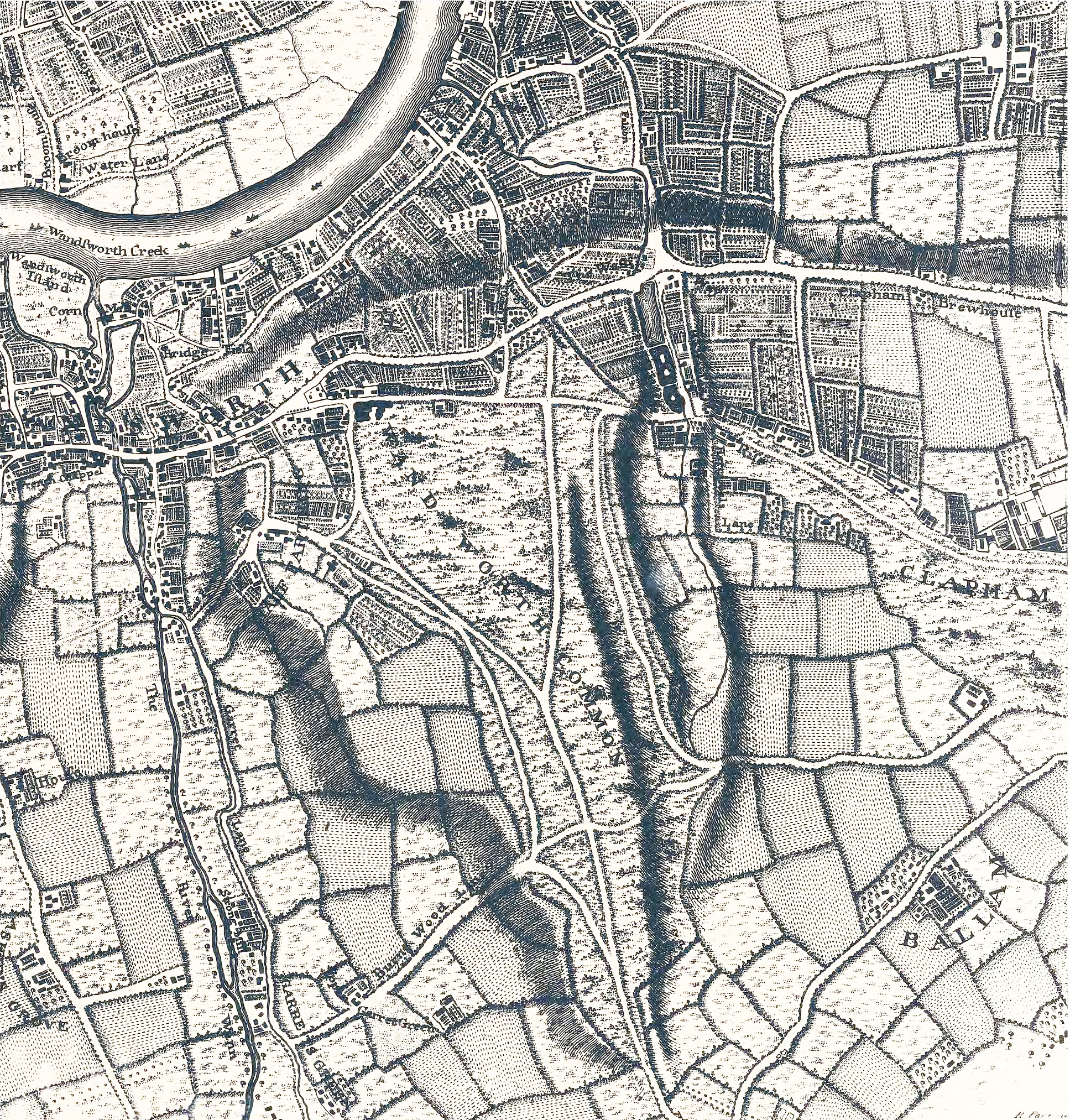
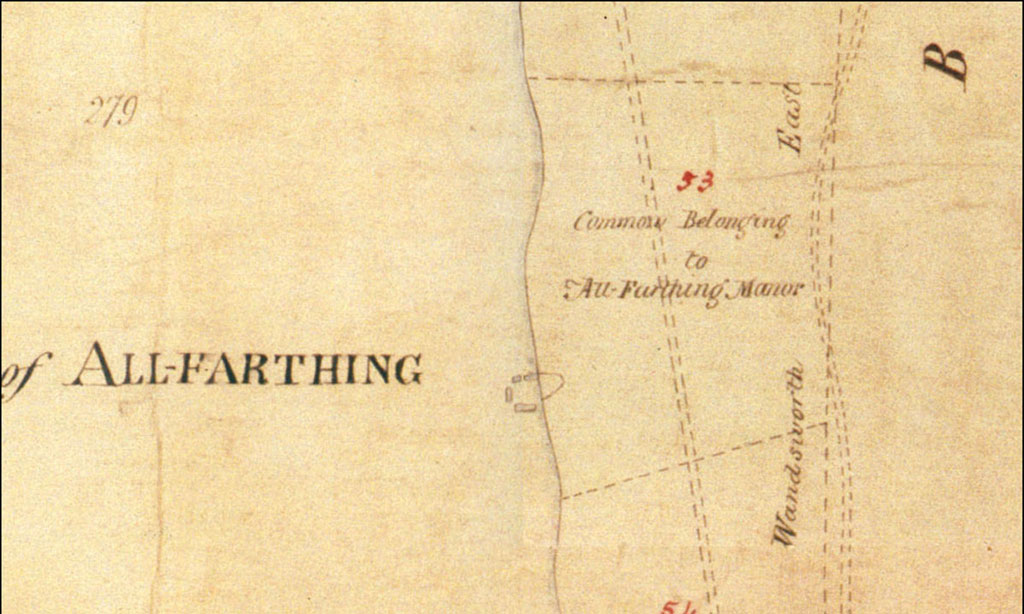

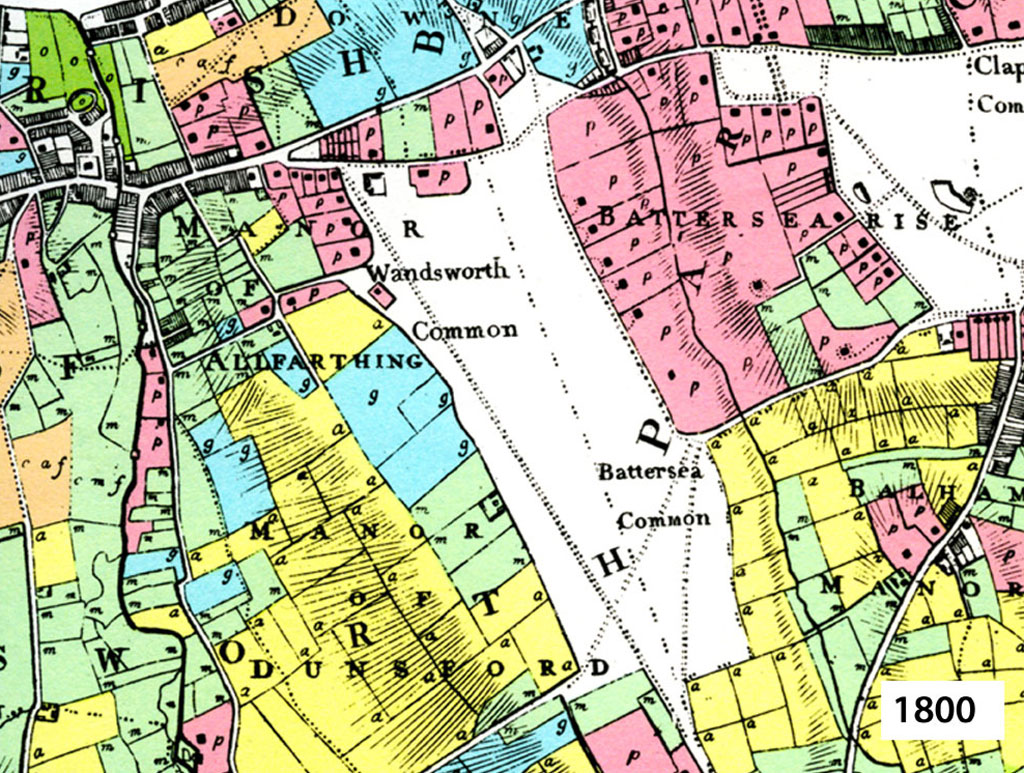
The house and garden are marked within three "meadows" ("m", green) abutting what will become Lyford Road (which closely follows the ridge between the valleys of the Falcon Brook to the east, and the River Wandle to the west). A stretch of Common lies between these fields and what will become Trinity Road.
Notice to the north, market gardens or nurseries ("g", pale blue). To the south and west, arable fields ("a", yellow).
There is nothing to interrupt the view westward across the Wandle valley to Wimbledon Park. This view often features as a selling point in adverts for the Burntwood houses.
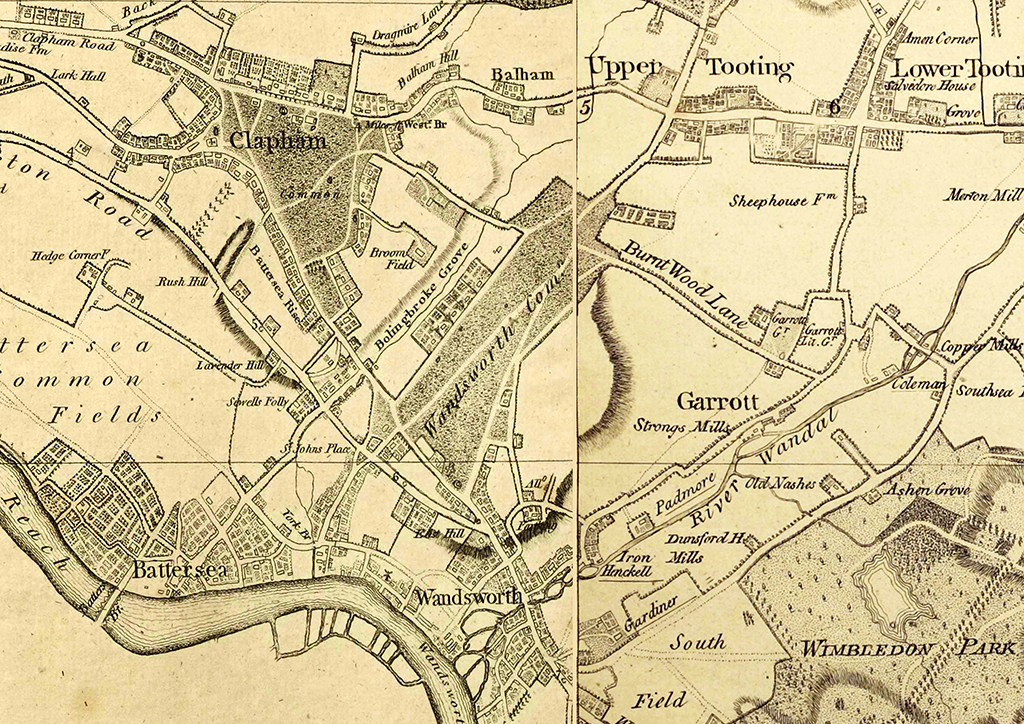
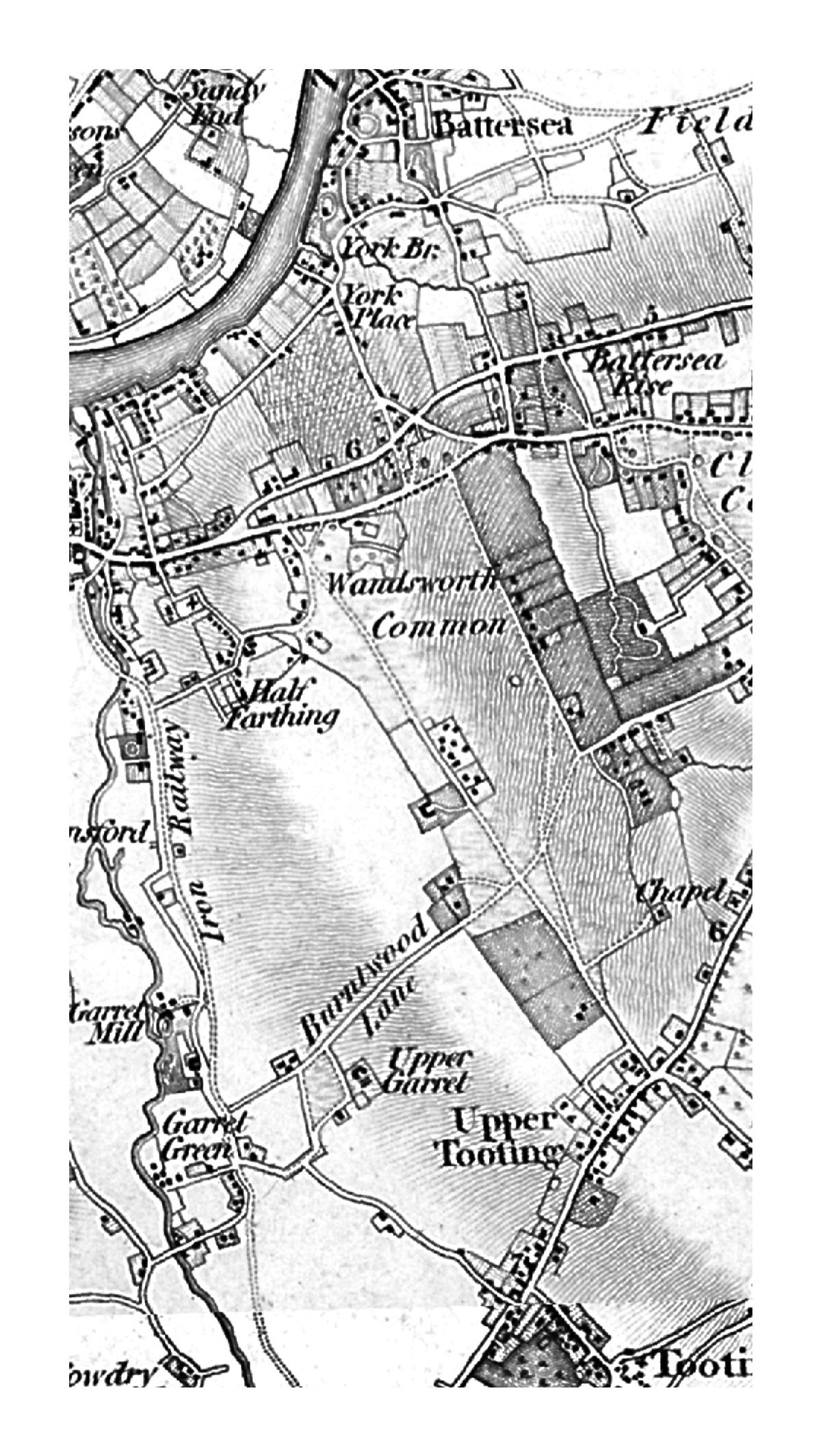
Compared to Milne, notice nearby enclosures to the north. The gardens in front of Burntnwood House have been enclosed and pushed forward as far as "Trinity Road".
On the far side of "Trinity Road" the future "Toast Rack" shows a number of buildings. Houses? Agricultural buildings?
Burntwood Cottage for sale: "A Singularly Romantic Freehold Cottage... embosomed in a plantation of forest trees and shrubs of the choicest kinds... [with] views in every direction singularly luxuriant and picturesque... in the tenure of Albinia Countess Dowager of Buckinghamshire".
I live on Loxley Road, on land that was once attached to this "cottage". But don't be misled by the term. It was probably already pretty big in 1813, and it grew to become one of the largest piles in the area. By the middle of the century it was (I believe) renamed "Burntwood House":

Burntwood Cottage, Shrubberies, Plantations, and Fifteen Acres of rich Land, Wandsworth. Peremptorily, by Mr. MUNN. at the Auction Mart, on WEDNESDAY, December 22, at Twelve, by direction of the Assignees of Messrs. Clark and Brown.
THE Singularly Romantic FREEHOLD COTTAGE RESIDENCE,
with suitable attached and detached Offices, called Burntwood Cottage, seated a desirable distance from the carriage road across Wandsworth common, leading from Tooting to Wandsworth, embosomed in a plantation of forest trees and shrubs of the choicest kinds, and fifteen acres of rich Land.
The ground commands views in every direction singularly luxuriant and picturesque, and the Land is esteemed to be of the first quality.
The Residence, Plantations, and Eleven Acres of Land are in the tenure of the Right Hon., Albinia Countess Dowager of Buckinghamshire, on Lease for an unexpired term of 20 years, determinable at the expiration of six and fourteen years of the term, at an annual rent of Two hundred and Eighty-five Pounds; the remaining four acres are in hand.
May be viewed with tickets only, which, with particulars, may be had of Mr. Munn, Walbrook, near the Royal Exchange; particulars also of G. Tahourdin, Esq. Solicitor, King's Beach-walk, Temple; of Messrs. Gaty and Haddon, Solicitors to the Commission, Angel-court, Thogmorton-street; and at the Auction Mart.
So who is Albinia Countess of Dowager of Buckinghamshire", who is selling her lease?

The 1851 Census?
BURNTWOOD COTTAGE? BURNTWOOD HOUSE? OR IS THIS THE ELMS?
[House and 12 acres for sale]
A FREEHOLD ELEGANT RESIDENCE, deemed, pleasantly cured at Wandsworth Common, Sut on a Lawn, tastefully disposed and adapted for tlui account. of a Family of the first Respectability; containing Soh-. sante Apartments on the Principal Story, with a tastefully c,.. signed Entrance by a double flight of Stone Steps to he three capital bed-chambers, with Dressing-rooms — closet on the First Floor, with S-rvinte Apartment the Basement, numerous excellent Offices of all d plentifully supplied with; Coach-Houses; five I lones, and sithtir Out-buildings; Kirm-yard, Folding-gates, with Stable, Cow-h Cattle-shei houses, Piggery, Dog-kennel, Rick-yard, Ste. Kitchen-garden, Melon-ground, Tool and Rabbiteltssed by a lofty Wall and Paling; a beautiful leisure-ground, tastefully laid out, and ornamented by a . Cold Bath, with a constant supply of fine Water:. — untaining about TWELVE ACRES, in high cond May be viewed by Tickets, and Particulars hid mises; at the Spread Eagle Wandsworth; common; Griffin, and Mr. Knight. Kiagstott; T mond; Red Lion, Hounslow; of Messrs. Green, and Crawley, Solicitors, Salisbury-square Flret-strei raw ay's; and of Mr. Robins, Warwick -street, Gul of whom Tickets for viewing may be had.
[BNA: Link]
[Albinia, Countess of Buckinghamshire's Cottage was advertised with 12 acres. This refers to 35 acres. If these are the same house, which are the new acres? The land taken from the Common between "Lyford Road" and "Trinity Road"?
I must measure up the acreage and show on a map.]
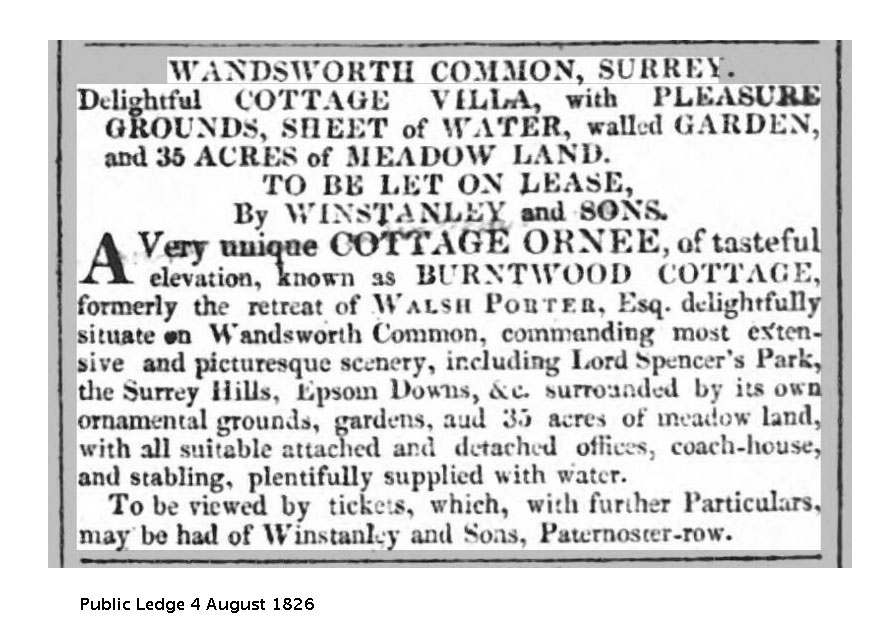
WANDSWORTH COMMON, SURREY
Delightful COTTAGE VILLA, with PLEASURE GROUNDS, SHEET of WATER, walled GARDEN, and 35 ACRES of MEADOW LAND.
TO BE LET ON LEASE
By WINSTANLEY and SONS
A Very unique COTTAGE ORNEE, of tasteful elevation, known as BURNTWOOD COTTAGE, formerly the retreat of WALSH PORTER, Esq. delightfully situated on Wandsworth Common, commanding most extensive and picturesque scenery, including Lord Spencer's Park, the Surrey Hills. Epsom Downs, etc. surrounded by its own ornamental grounds, gardens, aad acres of meadow land, with all suitable attached and detached offices, coach-house, and stabling, plentifully supplied with water.
To be viewed by tickets, which, with further Particulars, may had of Winstanley and Sons, Paternoster-row.
I suppose this is a completely trivial story, and rather off the point, but so absurd that it may be illuminating. Bears reading.
If nothing else, it shows that Revd Borradaile [vicar of All Saints?] was the owner of Burntwood Cottage at this time, and Jens Woolff, a "merchant", the tenant.
[It may be worth remarking that elsewhere on the same page, there are reports of the execution in Portugal of 12 people for rebellion against Miguel (the king?), with another 12? tpo follow soon, a catastrophic earthquake in Spain, devastating floods in Sweden, and so on. And many other...]
[BNA: Link.]
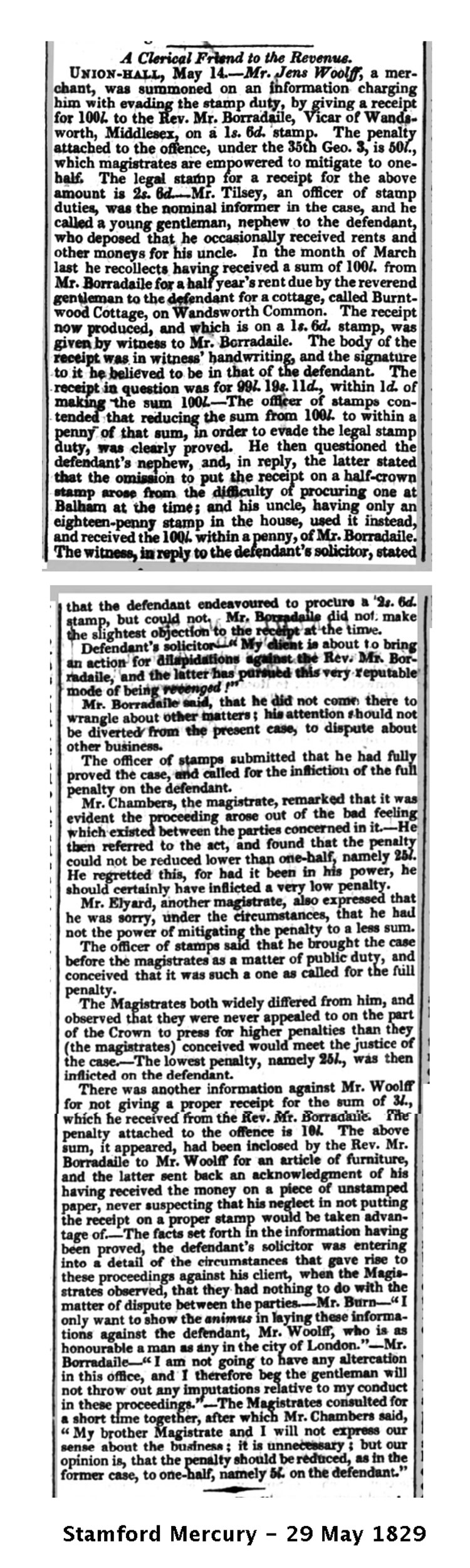
A Clerical Friend to the Revenue. UNION-HALL, May 14.
Mr. Jens Woolff, a merchant, was summoned on an Information charging him with evading the stamp duty, giving a receipt for 100/. to the Rev. Mr. Borradaile, Vicar Wandsworth, Middlesex [?], on a 1s. 3d. stamp. The penalty attached to the offence, under the 35th Geo. 3, is 60/., which magistrates are empowered to mitigate to one half. The legal stamp for a receipt for the above amount is 2i. 3d—
Mr. Tilsey, an officer of stomp duties, was the nominal informer in the case, and he called a young gentleman, nephew to the defendant, who deposed that he occasionally received rents and other moneys for his uncle* the month of March last he recollects having received a sum of 100/. from Mr. Borradaile for a half year's rent due the reverend gentleman to the defendant for a cottage, called Burntwood Cottage, on Wandsworth Common. The receipt now produced, and which is on a 1s.6d. stamp, was given by witness to Mr. Borradaile. The body of the receipt was in witness' handwriting, and the signature to believed to be in that of defendant* The receipt is question was for 19s. llci., within 14 of making -the sum 100/.— The officer of stamps contraded that reducing the sum from 100 L to within a penny of that sum, in order to evade the legal stomp duty, was clearly proved. He then questioned the defendant's nephew, and, in reply, the latter stated that the omission to put the receipt on a half-crown ' stomp arose from the difficulty of procuring one at Balhun the time; and his uncle, having only an eighteen-penny stamp in the house, used it instead, and received the 100/. within penny, of Mr. Borradaile. The witness, in reply to the defendant's solicitor, stated that the defendant endeavoured to procure 'is. 3d. stamp, but could not, Mr. Borradaile did not. make the slightest objection to the tinve. Defendant's client about to bring action for dilapidations against the Rev. Mr. Bormdaile, and the latter baspursued this very reputable mode of being rtmnged r Mr. Bonadaile said, that he did not come there to wrangle about other matters; hi# attention should not be diverted from the present case, to dispute about other business. ' . The officer of stamps submitted that he had fully proved the case, and called for the infection of the full penalty on the defendant. Mr. Chambers, the magistrate, remarked that it was evident the proceeding arose out of the bad feeling which existed between the parties concerned in it.—He then referred to the act, and found that the penalty could not be reduced lower than one-half, namely He regretted this, for had it been in his power, he should certainly have inflicted very low penalty. Mr. Elyard, another magistrate, also expressed that he was sorry, under the circumstances, that he not the power of mitigating the penalty to a less sum. The officer of stamps said that he brought the case before the magistrates as a matter of public duty, and conceived that it was such a one as called for the full penalty. The Magistrates both widely differed from him, and observed that they were never appealed to on the part of the Crown to press for higher penalties than they (the magistrates) conceived would meet the justice of the case.—The lowest penalty, namely 25/., was then inflicted on the defendant.
There was another information against Mr. Woolff for not giving a proper receipt for the sum of 31., which he received from the Rev. Mr. Borradaile. The penalty attached to the offence is 18/- The above sum, it appeared, had been inclosed by the Rev. Mr. Borradaile to Mr. Woolff for an article of furniture, and the latter sent back an acknowledgment of his having received the money on a piece of unstamped paper, never suspecting that his neglect in not putting the receipt on a proper stamp would taken advantage of—The facts set forth ui the information having been proved, the defendant's solicitor was entering into a detail of the circumstances that gave rise to these proceedings against his client, when the Magistrates observed, that they had nothing to do with the matter of dispute between the parties.
Mr. Burn—" I only want to show the animus in laying these informations against the defendant, Mr. Woolff, who is as honourable a man as any in the city of London."
Mr. Borradaile—"I am not going to have any altercation in this office, and therefore beg the gentleman will not throw out any imputations relative to conduct in these proceedings.'
The Magistrates consulted for short time together, after which Mr. Chambers said, "My brother Magistrate and I will not express our sense abont the business; it is unnecessary; but our opinion is, that the penalty should be reduced, in the former case, to one-naif, namely on the defendant."
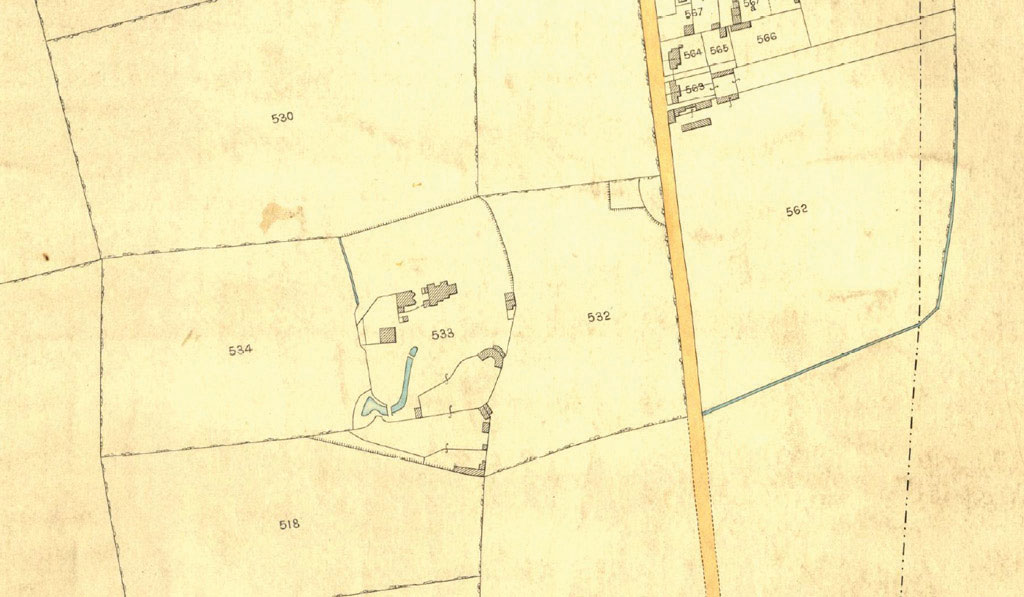
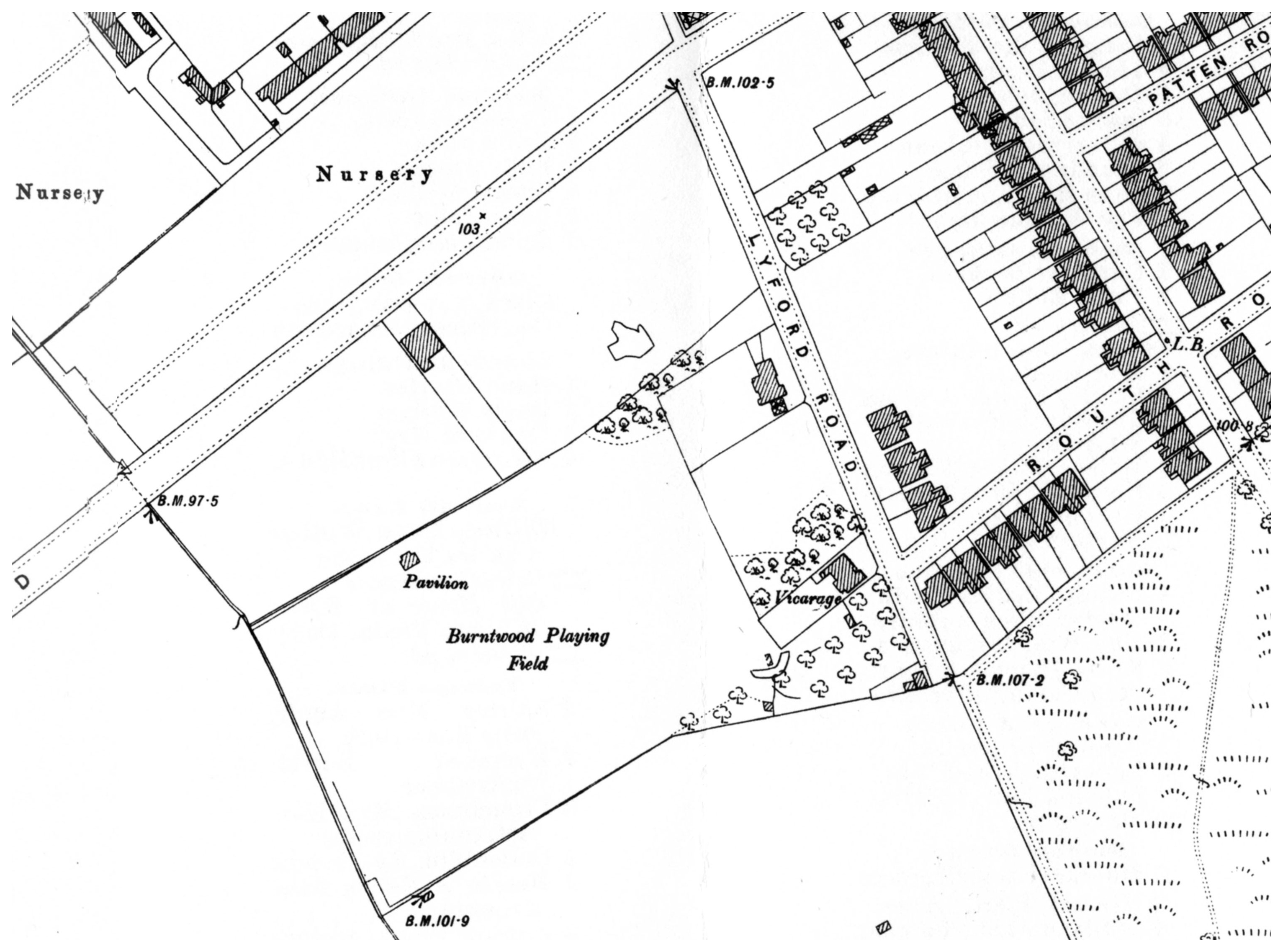
Notice a variety of buildings are spread across the plot 533 — or rather, are mainly pushed to the edges of the small walled? fenced? hedged? enclosures. These must be stables, greenhouses, gardeners' cottages and servants quarters etc. Geoffrey Bevington's photograph of the Craig Telescope shows some of these buildings. I'm pretty sure I recall a house hereabouts named something like "Observatory Cottage" in some source or other. Check.
532 = meadow, 5 acres, 533 garden, 4 acres, 534= meadow, 6 acres (16 acres 0 rods 11 poles) Mrs Faden (late), Charles Johb Cook.
518 Sophia Sheppard, ? Beeman.
530 Sophia Sheppard, ? and ? Potter.
562 Sophia Sheppard, George Rough.
Who was there for the Tithe Map, c.1841? "Mrs Faden (late)", owner ? Cook, occupant
The 1841 Census?
Morning Herald (London) - Tuesday 14 September 1841 1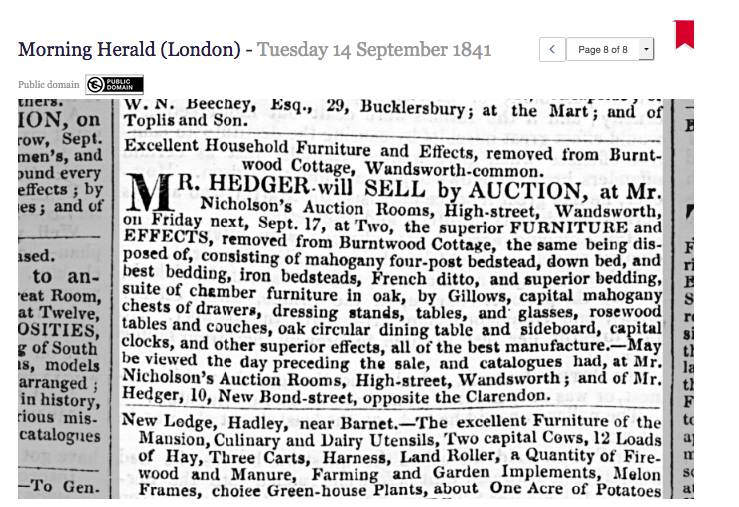
Excellent Household Furniture and Effects, removed from Burntwood Cottage, Wandsworth-common. - 111 - R. Auction SELLRooms, bzigAhUstCreeTt!OwNra,ndamtvoMrtiri: on Friday next, Sept. 17, at Two, the superior FURNITURE and EFFECTS, removed from Burntwood Cottage, the same being disposed of, consisting of mahogany four-post bedstead, down bed, and best bedding, iron bedsteads, French ditto, and superior bedding, suite of chamber furniture in oak, by Gillows, capital mahogany chests of drawers, dressing stands, tables, and glasses, rosewood tables and couches, oak circular dining table and sideboard, capital clocks, and other superior effects, all of the best manufacture.
May be viewed the day preceding the sale, and catalogues had, at Mr. Nicholson's Auction Rooms, High-street, Wandsworth; and of Mr. Hedger, lO, New Bond-street, opposite the Clarendon.
[BNA: Link.]
Marlborough-street.
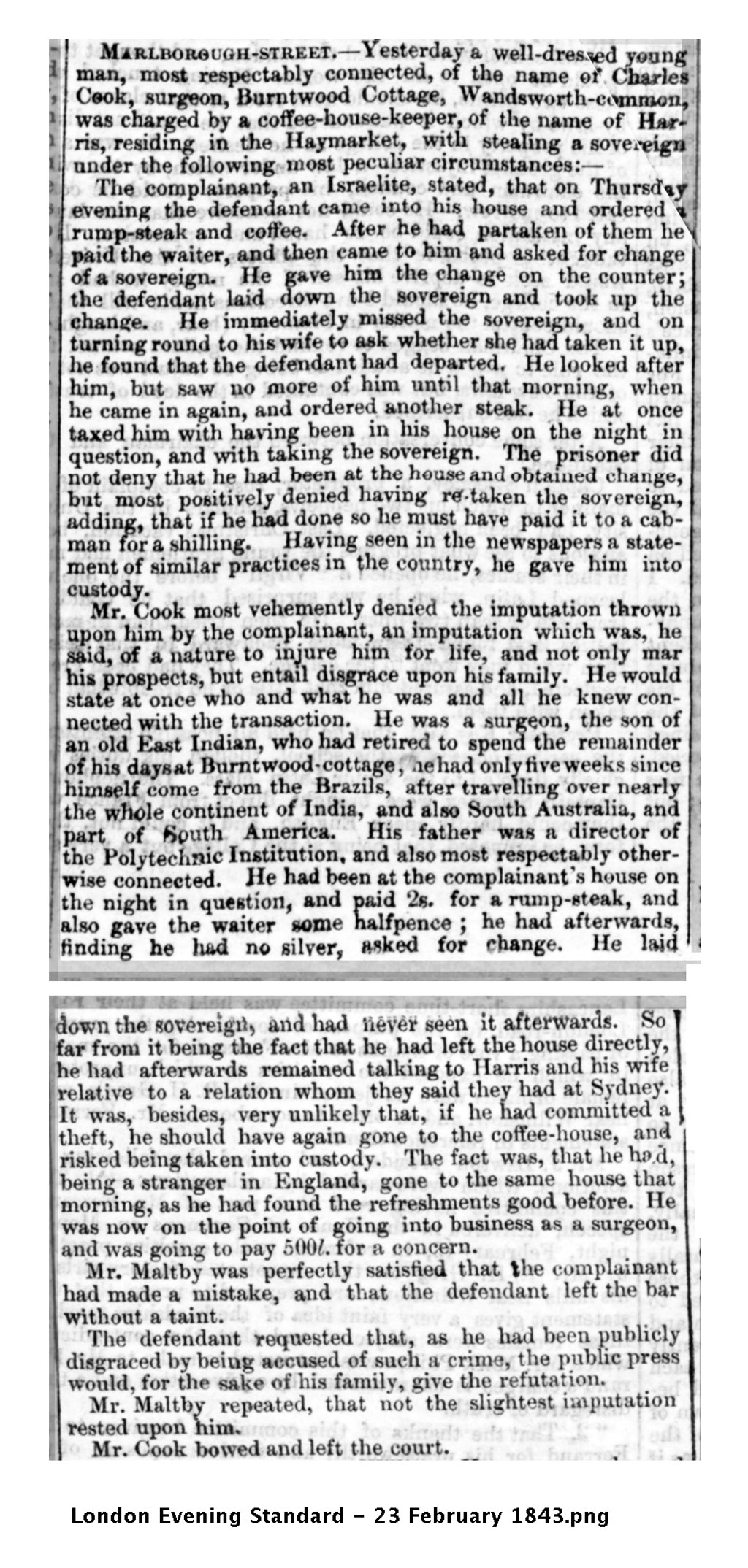
Yesterday a well-dressed young man, most respectably connected, of the name of Charles Cook, surgeon, Burntwood Cottage, Wandsworth-common, was charged by a coffee-house-keeper, of the name of ™r- ris, residing in the Haymarket, with stealing aaove,'*-- under the following most peculiar circumstances: —
The complainant, an Israelite, stated, that on Thursday evening the defendant came into his house and ordered a rump-steak and coffee. After he had partaken of them he paid the waiter, and then came to him and asked for change of a sovereign. He gave him the change on the counter; the defendant laid down the sovereign and took up the change. He immediately missed the sovereign, and on turning round to his wife to ask whether she had taken it up, he found that the defendant had departed. He looked after him, but saw no more of him until that morning, when he came in again, and ordered another steak.
He at once taxed him with having been in his house on the night in question, and with taking the sovereign. The prisoner did not deny that he had been at the house and obtained change, but most positively denied having retaken the sovereign, adding, that if he had done so he must have paid it to a cab-man for a shilling.
Having seen in the newspapers a statement of similar practices in the country, he gave him into custody.
Mr. Cook most vehemently denied the imputation thrown upon him by the complainant, an imputation which was, he said, of a nature to injure him for life, and not only mar his prospects, but entail disgrace upon his family. He would state at once who and what he was and all he knew connected with the transaction.
He was a surgeon, the son of an old East Indian, who had retired to spend the remainder of his days at Burntwood-cottage, .ie had only five weeks since himself come from the Brazils, after travelling over nearly the whole continent of India, and also South Australia, and part of South America. His father was a director of the Polytechnic Institution, and also most respectably otherwise connected.
He had been at the complainant's house on the night in question, and paid 2s. for a rump-steak, and also gave the waiter some halfpence ; he had afterwards, finding he had no silver, asked for change. He laid down the sovereign and had "never seen it afterwards. So far from it being the fact that he had left the house directly, he bad afterwards remained talking to Harris and his wife relative to a relation whom they said they had at Sydney-
It was, besides, very unlikely that, if he had committed a theft, be should have again gone to the coffee-house, and risked being taken into custody. The fact was, that he ha .1, being a stranger in England, gone to the same house, that morning, as lie had found the refreshments good before. He was now on the point of going into business as a surgeon, and was going to pay £500 for a concern.
Mr. Maltby was perfectly satisfied that the complainant had made a mistake, and that the defendant left the bar without a taint.
The defendant requested that, as he had been publicly i lk|i in i ill by being Manned of such a crime, the public press would, for the sake of his family, give the refutation. (Maltby repeated, that not the slightest imputation upon him.
Cook bowed and left the court.
[A sovereign was a gold coin with a nominal value of £1. In modern money, it was worth roughly £160.]
[An almost verbatim account.]
A GENTLEMAN ACCUSED OF THEFT.
At Marlborough-street, on Wednesday, a well-dressed young man, most respectably connected, of the name of Charles Cook, surgeon, Burntwood-cottage, Wandsworth-common was charged by a coffee-house-keeper of the name of Harris residing in the Haymarket, with stealing a sovereign under the following most peculiar circumstances :—The complainant, an Israelite, stated, that on Thursday evening the defendant came into his house and ordered a rump-steak and coffee. After he had partaken of them he paid the waiter, and then came to him and asked for change of a sovereign. He gave him the change on the counter; the defendant laid down the sovereign and took up the change. He immediately missed the sovereign, and on turning round to his wife to ask her whether she had taken it up, he found that the defendant had departed. He looked after him, but saw no more of him till that morning, when he came in again and ordered another steak. He at once taxed him with having been in his house on the night in question, and with having taking the sovereign. The prisoner did not deny that he had been at the house and obtained change, but most positively denied having re.taken the sovereign, adding that if he had done so he must have paid it to a cabman for a shilling.
Mr. Cook most vehemently denied the imputation thrown upon him by the complainant, an imputation which was, he sald, of a nature to injure him for life, and not only mar his prospects, but entail disgrace upon his family. He would state at once who and what he was, and all he knew connected with the transaction. He was a surgeon, the son of an old East-Indian, who had retired to spend the remainder of his days at Burntwood-cottage ; he had only five weeks since himself come from the Brazils, after travelling over nearly the whole continent of India, and also South Australia, and part of South America. His father was a director of the Polytechnic Institution, and also most respectably otherwise connected. He had been at the complainant's house on the night in question, and paid 2s. for a rump-steak, and also gave the waiter some halfpence; he had afterwards, finding he bad no silver, asked for change. He laid down the sovereign, and had never seen it afterwards. So far from it being the fact that he had left the house directly, he had afterwards remained talking to Harris and his wife relative to a relation whom they said they had at Sydney. It was, besides, very unlikely, that if he had committed a theft, he should have again gone to the coffee-house, and risked being taken into custody. The fact was, that he had, being a stranger in England, gone to the same house that morning, as he had found the refreshments good before. He was now on the point of going into business as a surgeon, and was going to pay 500/. for a concern. Mr. Maltby was perfectly satisfied that the complainant had made a mistake, and that the defendant left the bar without a taint. The defendant requested that, ' as he had been publicly disgraced by being accused of such a — crime, the public press would, for the sake of his family, give the refutation. Mr. Maltby would repeat, that not the slightest imputation rested upon him. Mr. Cook bowed and left the court.
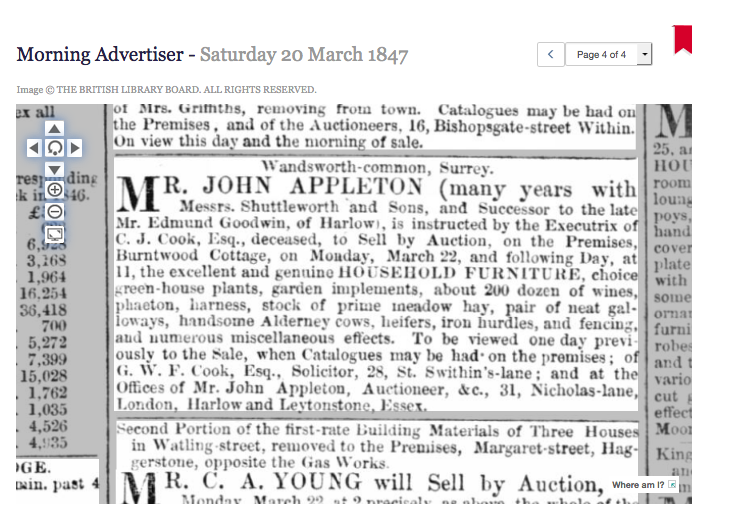
On view this day and the morning of sale. Wandsworth-common, Surrey.
MR. JOHN APPLETON (many years with Messrs. Shuttleworth and Sons, and Successor to the late Mr. Edmund Goodwin, of Harlow), is instructed by the Executrix of C.J. Cook, Esq., deceased, to Sell by Auction, on the Premises, Burntwood Cottage, on Monday, March 22, and following Day, at 11, the excellent and genuine HOUSEHOLD FURNITURE, choice green-house plants, garden implements, about 200 dozen of wines, phaeton, harness, stock of prime meadow hay, pair of neat galloways, handsome Alderney cows, heifers, iron hurdles, and fencing, and numerous miscellaneous effects.
To be viewed one day previously to the Sale, when Catalogues may be had on the premises; of G. W. F. Cook, Esq., Solicitor, 28, St. Swithin’s-lane; and at the Offices of Mr. John Appleton, Auctioneer, Ac., 31, Nicholas-Line, London, Harlow and Leytonstone, Essex.
[BNA: Link]
The 1851 Census?
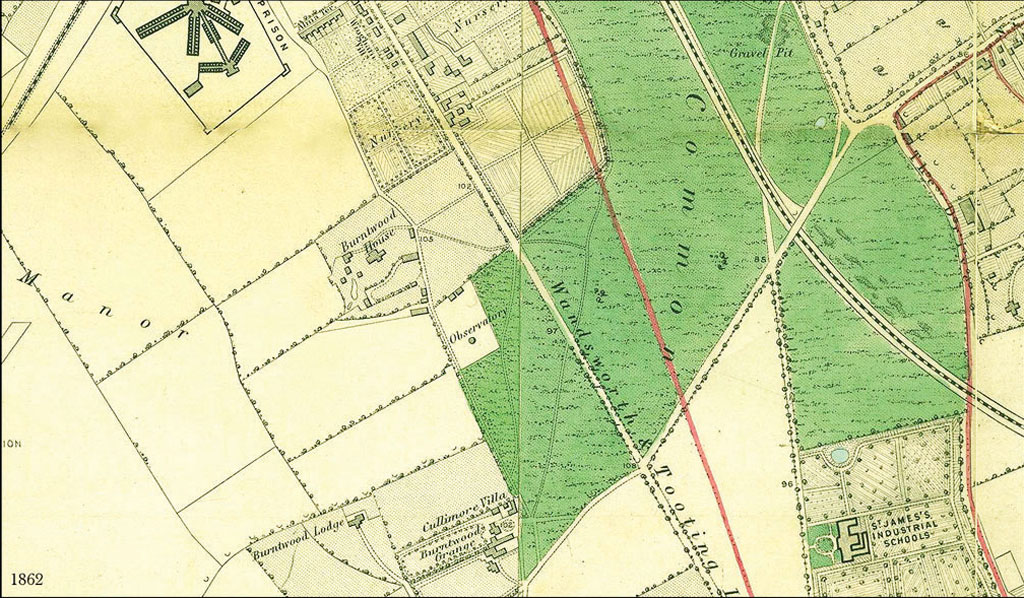
The 1861 Census?
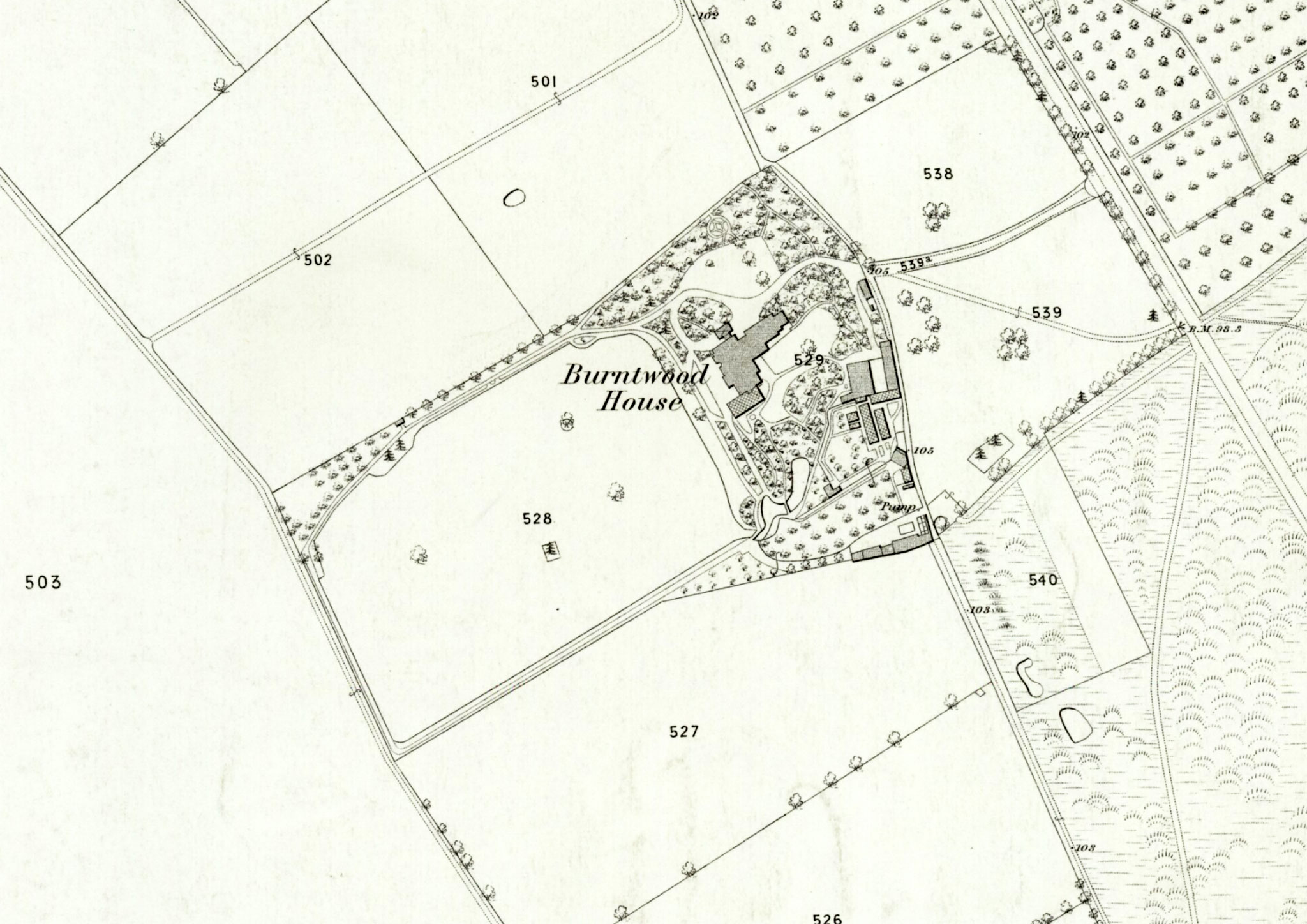
[Burntwood House section from Zoom Talk, October 2020: Link (pdf) — sort out, edit, and add to this page.]
Surely wrong address — Grisewood lived at another of the Burntwood houses, didn't he? Ask Stephen which. Burntwood Grange?
Grisewood. — On the 16th inst., at Burntwood-house, Wandsworth- common, the wife of Henry Grisewood, Esq., of a daughter.
24 April, 25 April, 16 May 1866 etc: Refs to Burntwood House in Catherine Leonard story
[BNA: 24 April 1866.]
[BNA: 16 May April 1866.]
[BNA: 19 May 1866.]
The Metallurgicon, 1867 — Johnson Da Silva.
... separately: price moderate; the owner, a gentleman, being over horsed. %Apply to Snelling, at Ledge, Burntwood House, near the County Arms, Wandsworth-common, S.W. TWO CARRIAGES for SALE, a Earpain.-A half-headed Sociable, nearly new, cost 140 guineas ...
[BNA: 24 April 1867.]
A "sociable?"
See Wikipedia: Sociable (carriage).]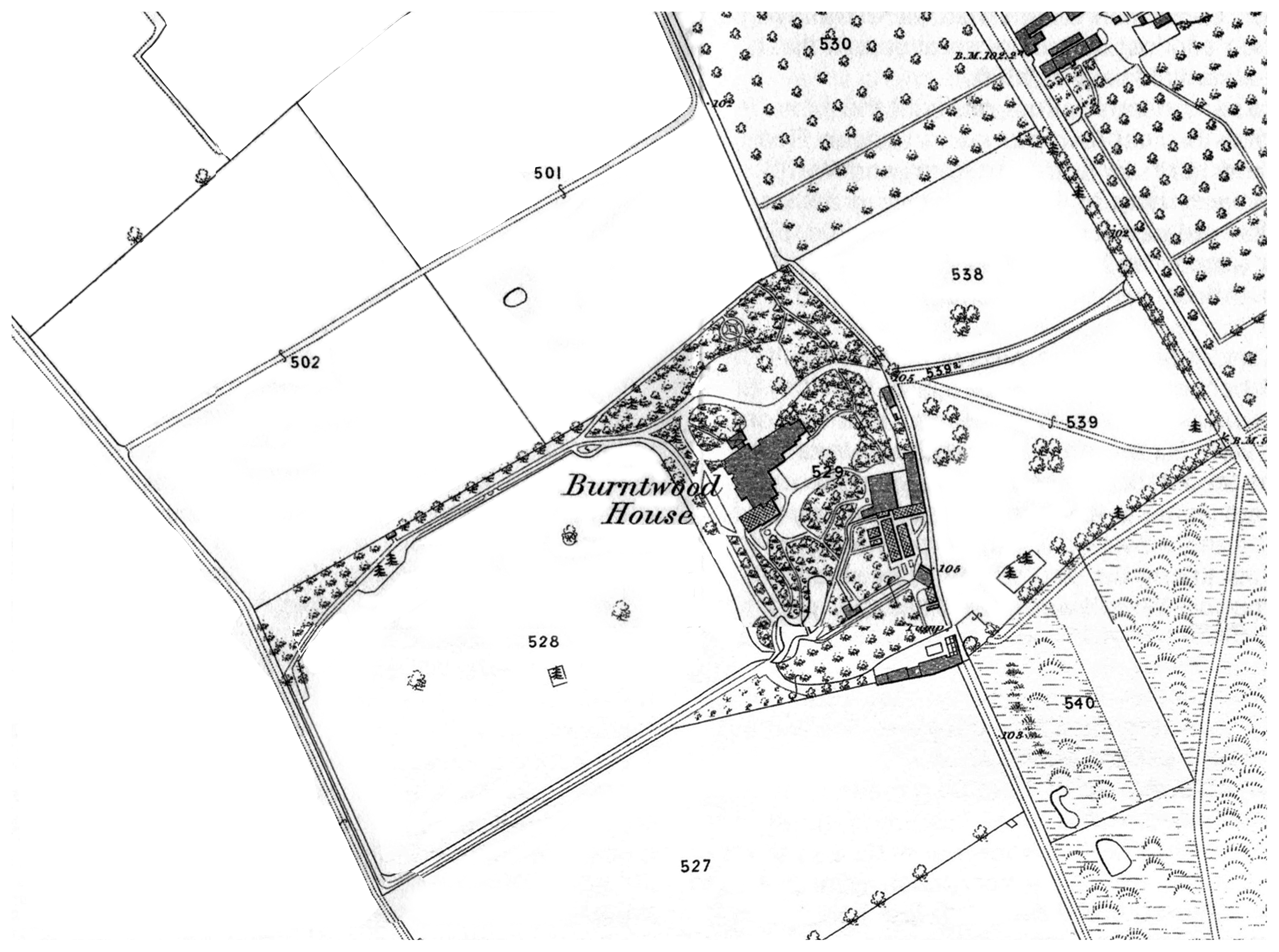
The 1871 Census?
Burntwood House: prize-winning grapes
ROYAL BOTANIC SOCIETY'S SHOW.
July 12th and 13th.
This has proved one of the best of the shows held by the Society this summer, although the weather on the first day was by no means favourable; but the absence of many of the large specimens seen at the earlier shows is compensated for by a very good exhibition of fruit, which is always an attraction at London shows, especially as there has been of late so little of it. Of table decorations, epergnes, et hoc genus oinne, there is a large display, exciting among the ladies a great amount of interest, though it may be questioned whether such objects would not be better relegated to a place by themselves, instead of forming a part of the contents of the great tent. The attendance of visitors was very good.
Among the exhibitions of stove and greenhouse plants in flower, those from Mr. Ward, gardener to F. G. Wilkins, Esq., Leyton, both of twenty iu l"2-inch pots, and of sis in pots of any size, deserve particular notice, especially the latter, although they come second to a collection from Mr. Baines, gardener to H. MichoUa, Esq. Mr. "Ward has a splendid specimen of the richly coloured Erica Parmentieriana rosea, and of Pleroma elegans one of the finest specimens we have ever seen, being covered with its large violet flowers, which render it so effective when " well done," which it seldom is. Allamanda grandiflora in the same collection is also fine; Statice profnsa, very good though beginning to pass; and Erica obbata.
Mr. Baines, however, well deserved the first position, having a magnificent Erica obbata; Anthurium Scherzerianam, very fine, with twelve spathes, and in fruit; Allamanda Aubletii; Hedaroma tulipiferum, very fine; Dipladenia amabilis, and Erica Parmentieriana rosea, splendid. Mr. Wheeler, gardener to J. Philpott, Esq., has also good specimens, as also have Messrs. Jackson & Son, of Kingston, and Mr. Kemp, gardener, Albary Park, in the class for plants in 12-inch pots.
Of fine-foliaged plants, Mr. Baines sends a magnificent pan of Sarracenia purpurea, Phcenicophorium sechellarnm, Croton pictnm large and beantifally coloured, and Theophasta imperialis. Messrs. Barley and "VVright take the remaiuing prizes.
In Orchids, of which there are but few, Messrs. "Ward, Wright, and J. Wheeler among amateurs, and Messrs. Williams, Kollisson, and Bull are the successful exhibitors.
Palms and Exotic Ferns are freely contributed, the best coming from Mr. Williams, of Holloway, Messrs. Barley, Baines, Carr, and Wright; we noticed among the Palms fine specimens of Latania borbonica, Sabal Blackburniana, &c.
Of British Ferns Messrs. Ivery, as usual, have a large assemblage.
Tricolor Pelargoniums from Messrs. Stevens, Carter & Co., E. G. Henderson, and E. & A. Smith are, as usual, excellent; and among amateurs they are well represented in collections from Messrp. Goddard, Thomas, and Welsh. Of Zonal kinds in flower, Mr. Catlin, gardener to Mrs. Lermitte, Finchley, has truly grand specimens.
New plants are shown in large groups by Mr. "Williams, Messrs. Yeitch, Mr. Bull, and Messrs. E. Ct. Henderson. Mr. W. Panl has a fine group of new Pelargoniums not for competition, also Lilium auratum beautifully flowered, as well as splendid cut blooms of Roses. Messrs. Cranston, Panl & Son, Cant, Fraser, and Kimberley, have also stands of cut blooms in tine condition; whilst among amateurs, Mr. Ingle, Mr. Farren, and Mr. Chard stand conspicuous. Mr. Hooper, of Bath, has, as usual, vei-y fine Carnations, Picotees, and Cloves, as well as fancy Pansies; and Messrs. Downie, Laird, and Laing's Phloxes and Bronze Pelargoniums deserve more than a word of praise.
In dinner-table decorations, &:c., we did not notice much above the %ordinaiy rnn, though some of the arrangements are tasteful enough. There is in general still a great tendency to overload with flowers, to Tender the arrangements too elaborate. Our leaning is towards simplicity. Miss Hassard, St. Ronans, Norwood, is first for a dinner4able decoration; Miss Harris, Clarendon Park, Salisbury, second, and she is also second for an opergne with growing plants, no first heing awarded, and first for the same with cut flowers and fruit. Miss Hassard being second in this case. For a table bouquet Miss Annie "Williams is first, Miss Harris second. Miss Buster and Miss Hassard are equal second for hand bouquets tied. Mr. Wills, Sussex Place, Brompton, is first for a bridal bouquet, Mrs. R. Tanton and Mr. J. W. Chard being second and third; Mr. Perkins, Leamington, being first, Mr. Tanton second, and,Mr. Cranston third for ball-room bouquets. In rustic standing baskets, the prettiest in our opinion comes from Mrs. Cole & Sons, and consists of Panicura variegatum, Draccena Cooperi, and blue Lobelia. Several other prizes were awarded.
First-class certificates were awarded to Mr. Parker, Tooting, for Isora amabilis; to Mr. BuU for Bignonia Koezliana, Amorphophallus spectabilis, Alocasia Marshalli, Philodeudron hybridum, Dioscoiea spectabilis, Pteris serrnlata cristata, and Goniophlebium glaucophyllum; to Messrs. E. G. Henderson & Son for Hydrangea japonica %Bpeciosa; to Mr. B, S. Williams for Rhopala granateusis; to Mr^ H. Wendland, Inspector of the Royal Gardens, Herrenhauseu, for^chmea Marife-Reginas; to Messrs. Ivery & Son for Polystichnm angulare pulchrum BellairaiEe, P. angulare Mar&halli, and P. angulare vulgare Whytei; to Messrs. Standish for Bouvardia leiantha grandiflora; and to Messrs. Rollisson for Davallia clavata. The following floral ceriificatea were given % viz., t6 Messrs. Perkins, Leamington, for Coleus Lady Leigh, and to Mr. C. Kimberley for Tricolor Pelargonium Gem of Tricolors.
FRUIT,
Of collections of fruit only two are shown; the one comes from Mr. Lynn, gardener to Lord Boston, Hedsor, the other from Mr. A. Johnson, gardener to the Marquis of Ailesbury, Savernake Forest. Both are remarkably good. That from Mr. Lynn, to which the first prize was awarded, consisted of large bunches of Black Hamburgh -Grapes, General de la Marmora, a Queen Pine, Victory of Bath Melon, splendid Grosse Mignonue Peaches, Elruge Nectarines finely <;oloured, Bigarreau Napoleon Cherries, and Sir Joaeph Paxton Strawberry, very large and tineMr. Johnson sends two good Pines, excellent Black and White Grapes, good Peaches, Nectarines, Strawberries, Cherries, and a Melon. Collections of six dishes of out-door fruit come from Mr. Lynn, Hedsor, Mr. Bones, gardener to D. Mcintosh, Esq., Havering Park, Mr, Kemp, and Mr. Pizzey, and consist of Red, White, and Black Currants, Raspberries, Gooseberries, Strawberries, Cherries, and Winter Greening Apples.
Grapes are very numerously shown, and for the most part very good. The best 12-lb. basket of Black Grapes comes from Mr. Berry, gardener to J. Da Silva, Esq., Burntwood House, Wandsworth Common; the berries beautifully coloured, and, though not large, very even in size. Mr. A. Johnson is second, and Mr. G. Osborne, Kaye's Nursery, Finchley, third, both with fine berries as regards size, colour, and bloom. Mr. Sage, gardener to Earl Brownlow, Atherstone, and Mr. Wallia, gardener to J. Dixon, Esq., Astle Park, also send fine baskets.
The best basket of White Grapes is Muscat of Alexandria well ripened, from Mr. Feist, gardener to R. Ashby, Esq., Staines. The second best, not so fully ripened, comes from ftlr. Osborne; and third, is Mr. Davies, Frieru Barnet.
In single dishes of Black Hamburgh, Mr. Douglas, gardener to F. Whitbourn, Esq., Losford Hall, takes the lead with good-sized, finelycoloured bunches. The second-prize dish, from Mr. Walker, gardener to H. J. Atkinson, Esq., Acton, consists of good, compact bunches, well coloured; Mr. Lane, gardener to J. Miles, Esq., Friern Barnet, is third, with large, fine bunches, but not well coloured. Large bunches come also from Mr. Reid, Possingworth, and Messrs. Wright, Lee.
In Black Grapes of any other kind, Madresfield Court, black as night, from Messrs. Standish, of Aacot, is first; the same firm also sends Royal Ascot. Mr. Hicks, gardener to C. Scholfield, Esq., is second with Black Prince, moderately good. Third comes from Mr. Barham, gardener to Lord Ormanthwaite, Warfield Park, with good bunches of Black Muscat of Alexandria.
In Muscats Mr, Ritchie, gardener to R. H. Prance, Esq., Frognal, Hampstead, is first with large-berried symmetrical bunches of Bowood Muscat; Mr. Barham is second with Muscat of Alexandria, fine bunches, tolerably ripe; and Mr. Kemp, gardener to the Duke of Northumberland, Albury Park, third with good, compact, but not large bunches. Very large bunches of the same kind, but not sufficiently ripe, come from Mr. A. Wright, gardener to C. H, Roberts, Esq., Regent's Park, and Mr. Davies, Friern Barnet, the three weighing 13 lbs., and Mr. Walker, Acton.
Of other white kinds, Buckland Sweetwater, finely ripened, from Mr. Cole, gardener to E. S. Budgett, Esq., Ealing Park, is first; Ascot Citronelle, a delicioasly-flavoured long-hanging Grape, from Messrs. Standish & Co., of Ascot, being second. This, though not large in berry, is one of the most delicious Grapes we have tasted. Third comes Mr. Pizzey, gardener to Sir E. Perry, Fulmer, Slough, with White Muscadine.
Of Pines there are twenty-one shown. The best Queen is one of 6 lbs., from Mr. Jaques, gardener to J. C. P. Cunliffe, Esq., Hooley House, Croydon, small -crowned and well-swelled. Second is Mr. Akehurst, gardener to J. Copestake, Esq., Highgate, with a fruit having by far too large a crown; third, Mr. J. Deaville, gardener to Lady Edwards, Wooton Hall, Ashbourne. Messrs. Godfrey, Wheeler, and Cole also send good fruit. For any other variety Mr. Bertram, gardener to R. T. Crawshay, Esq., is first with a Providence not fully ripe of 9i lbs.; second comes Mr. Ward, gardener to T. N. Miller, Esq., Bishop Stortford, with a tine Smooth Cayenne of 7 lbs.; the same kind from Mr, Rochford, market gardener, Page Green, Tottenham, is third.
Of Melons there is a fair show. The green-fleahed kinds principally shown are Queen Emma, Golden Gem, and Bailey's, but there are several hybrids; as usual. Gem is the chief scarlet-fleahed kind.
Of Peaches, splendid dishes of Royal George and Violetto Hiitive come from Mr. W. Birse, gardener to J. F. Lermitte, Esq., Finchley; of Barringtou and Grosse Mignonue from Mr. Reid, gardener to L. Huth, Esq., Possingworth; of Royal George and Violette H;itive from Mr. Bones; of Grosse Mignonue and Violette Hative from Mr. Lynn, gardener to Lord Boston, Maidenhead; and these kinds, as well as Noblesse, are well shown by other exhibitors.
Nectarines comprise fine specimens of Violette Hative, Balgowan, Elruge, Hunt's Tawny, and Newington from Messrs. Davey, Birse and Kemp.
Of Cherries, Messrs. Cole, Walker, and Godbold sent fine dishes of, Bigarreau Napoleon, Black Tartarian, and Mr. Smith the Elton.
In Strawberries, four dishes, Mr. Douglas, gardener to F. Whitbourn, Esq., has remarkably fine fruit of the Frogmore Late Pine, Lucas, Admiral Dundaa, and British Queen. Mr. Clarke, gardener to J. C. Browne, Esq., Horsham, has Empress Eugenie, very fine. Large fruit of President, Lucas, and Sir C. Napier come from Mr. Smith, gardener to the Earl of Gainsborough, Exton Park; and of Frogmore Late Pine, Sir C. Napier, and British Queen, from Mr. Pizzey.
Mr. Harvey, gardener to P. Wroughton, Esq., Worsley Park, Wantage, sends four good Pines, grown on the Hamiltonian system, being the third crop in two years and seven months. Mr. Akehurst, gardener to S. Copestake, Esq., haa three good, ripe-frnited Pines in pots; and of Vines in pots.
Mr. Wisker, gardener to J. A. Rose, Esq., Wandsworth Common, has two plants with well-ripened bunches.
Messrs. Lane have also good examples, though the bunches are not so well coloured; and from Mr. Cole, gardener to E. Budgett, Esq., Ealing Park, come two fine Vines trained with S-feet stems, and forming a circular table-head, from each of which are suspended eight good bunches. These were grown in 12-inch pots and afterwards repotted.
Of other fruit, Mr. Osman, gardener to F. R. Holland, Esq., Stanmore, has very fine Brown Turkey Figs; Mr. Harvey, Wooley Park, Wantage, two fruit of Stephanotis floribunda; Mr. Osman has also excellent French Crab Apples; and Mr. Deaville sends Bedfordshire Seedling, plump, and in fine preservation.
[Source: Link]
Link incomplete — check
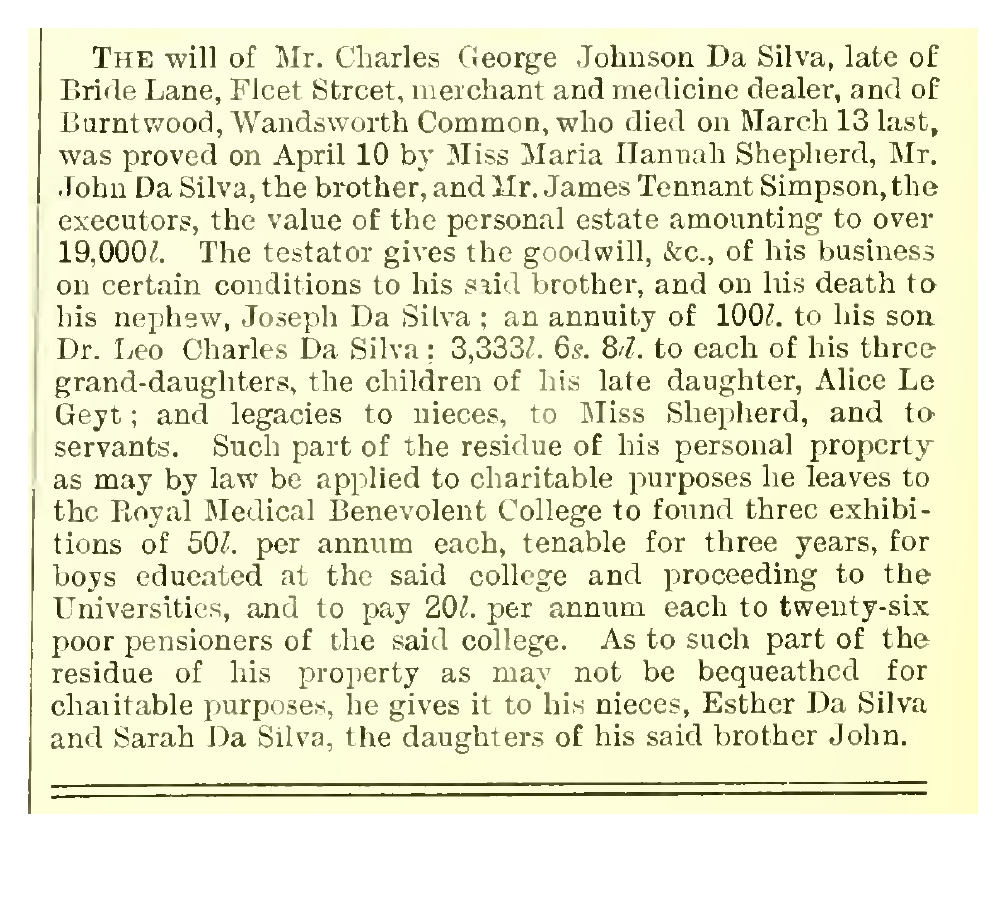
Birth of George Johnson Da Silva, c.1810?
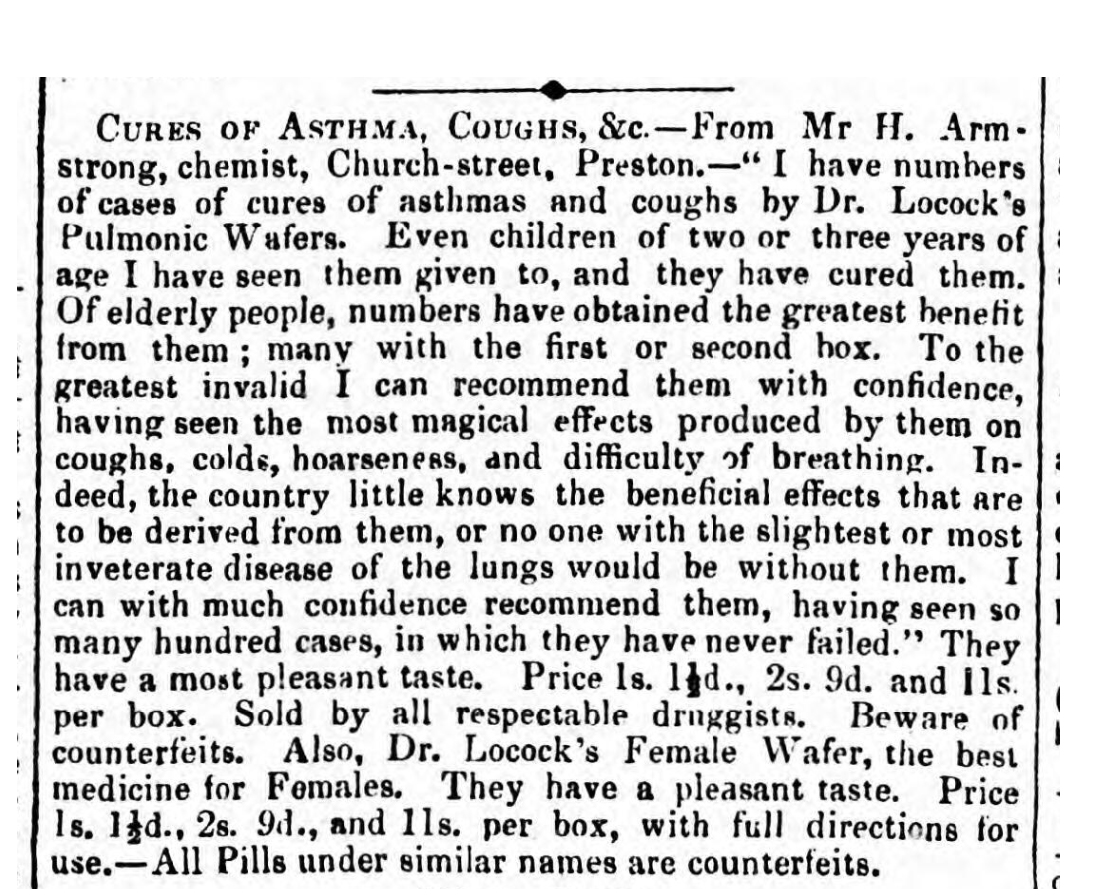
Clearly he's a pharmacist of some kind, an agent for a [quack?] remedy fo ?
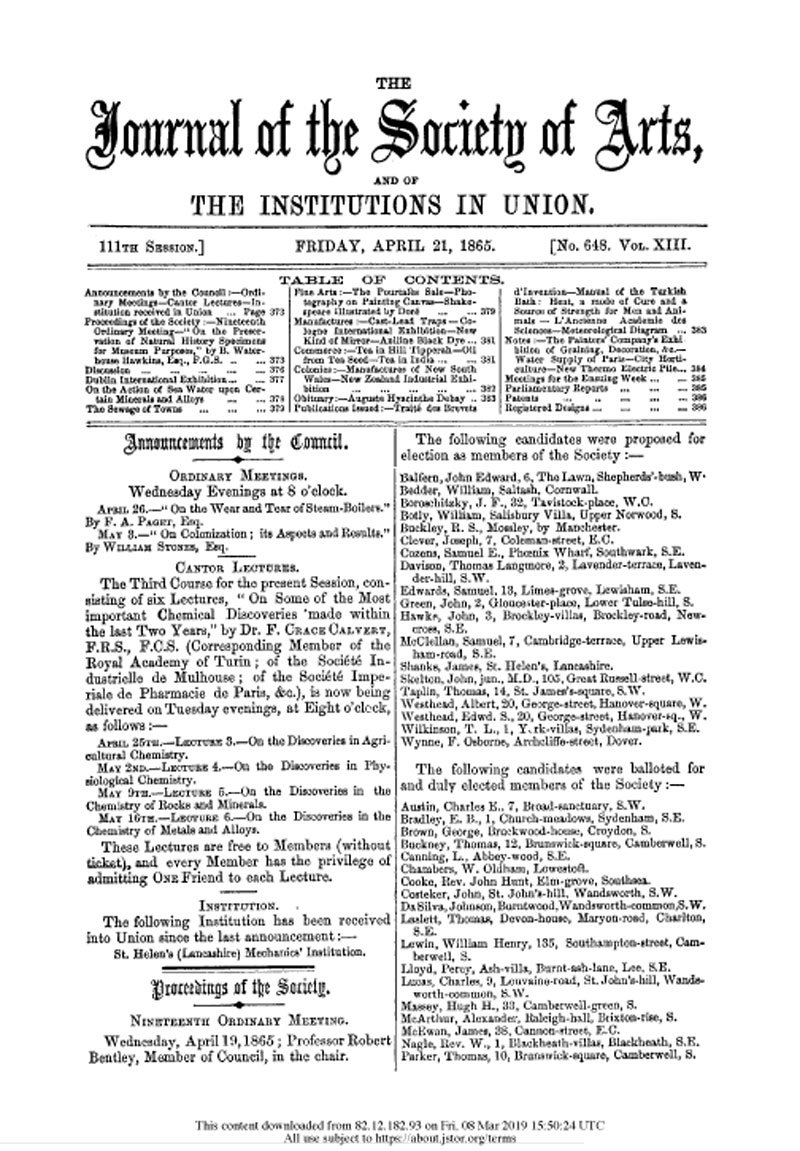
He is an active member of the Royal Society of Arts — what did that mean at that time?
In 1853 he was living in Purser's Cross, Fulham. He is prosecuted for disputing a fare [taking him and another to his office in Bride Street, Fleet Street]. He loses the case and pays promptly.
p>The 1881 Census?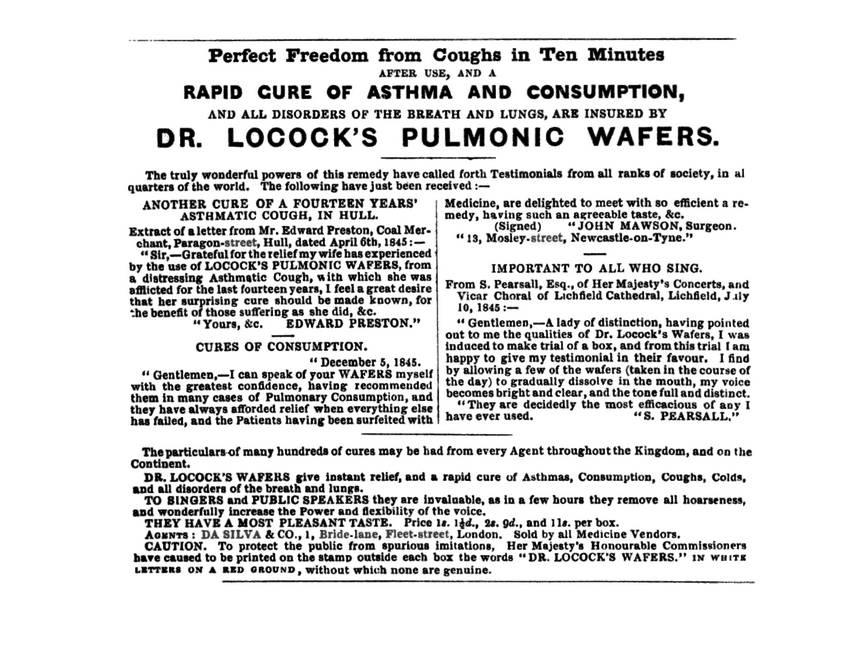
I've got an idea Johnson Da Silva went to British Association meetings, in which the latest scientific idea were discussed. See if there's any reference to him on e.g. "da silva?_british_association_meeting_24aug1866_BL_0000176_18660824_060_0011.pdf"a page from a newspaper.


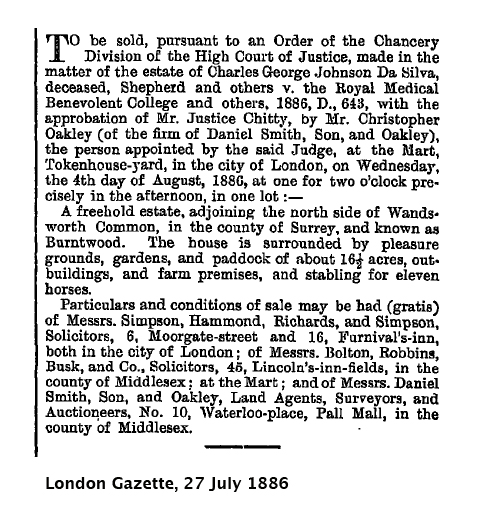
The 1891 Census?
[BNA: Link]
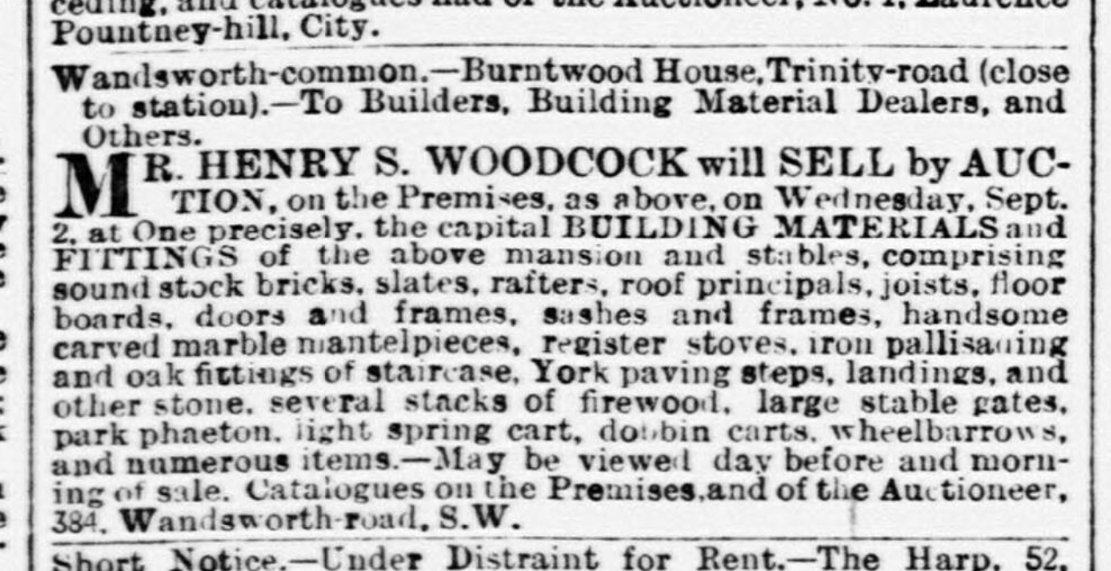
September 2 — Mr Henry L. Woodcock will sell, at Burntwood House, Wandsworth Common, building materials, &c.
WANDSWORTH COMMON
Burntwood House, Trinity Road, Wandsworth Common (close to station) — To Clear the site — To Builders, Building Material Dealers, and others.
Mr. HENRY S. WOODCOCK is instructed to BELL by AUCTION on the premises as above, on excellent BUILDING MATERIALS of the above mansion, comprising sound stock bricks, slates, roof timbers, roof principals, capital long joists, sound floor-boards, excellent land other doors and frames, sashes and frames, cupboards, York stone steps and landings, register and other stoves, capital cast-iron palisading, newels and oak rails of staircase, handsome carved marble mantelpleces, several stacks of firewood, the capital oeemork and ttings of large gates, phaeton, epring cart, four acbbin carts, wheelbarrows, p ,and numerous other ems.
View before and morning of sale. Catalogues ready, when ready, upon the site, and of the Auctioneer, 384, Wandsworth-road S.W.
[BNA: Link]
[BNA: Link]
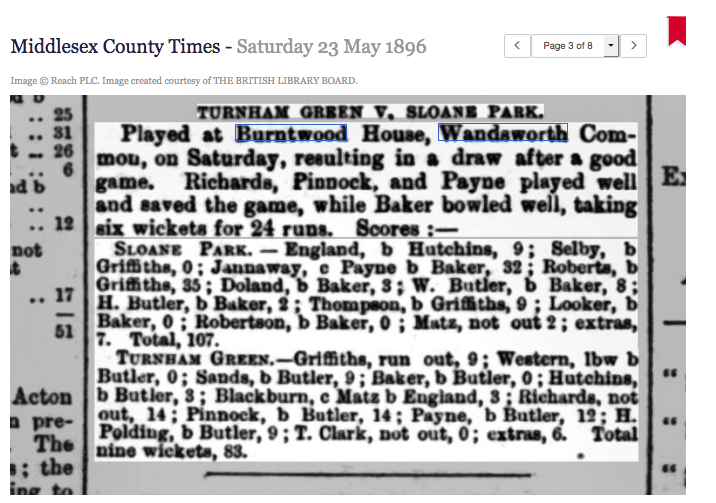
TURNHAM GREEN V. SLOANE PARK.
Played at Burntwood House, Wandsworth Common, on Saturday, resulting in a draw after a good game. Richards, Pumock, and Payne played well and eared the game, while Baker bowled well, taking six wickets for 24 runs.
Scores :
SLOANE PARK
England, b Hutchins, 9; Selby, b Griffiths, 0 Jainsway, Payne b Baker, 32 ; Roberts, b Griffiths, 33 ; Goland, b Baker, 3 ; W. Butler, b Baker, 8 ; H. Butler, b Baker, 2 ; Thompson, b Griffiths, 9 ; Looker, b Baker, 0 ; Robertson, b Baker, 0 ; lists, not oat 2 ; extras, 7. Total, 107.
TURNHAM GREEN
Griffiths, run out, 9; Western, lbw b Butler, 0; Sande, b Butler, 9 ; Baker, b Butler, 0 ; 'Lachine, b Butler, 3 ; Illeckburn, c Mats b Eugland, S ; Richards. not out, 14; Plnnock, b Butler. 1t; Payne, b Butler, 12; B. Peldiug, b Butler, 9; T. Clark, nut out, 0; esters, 6. Total nine wickets, 83.
[BNA: Link]