Last modified: 3 October 2026
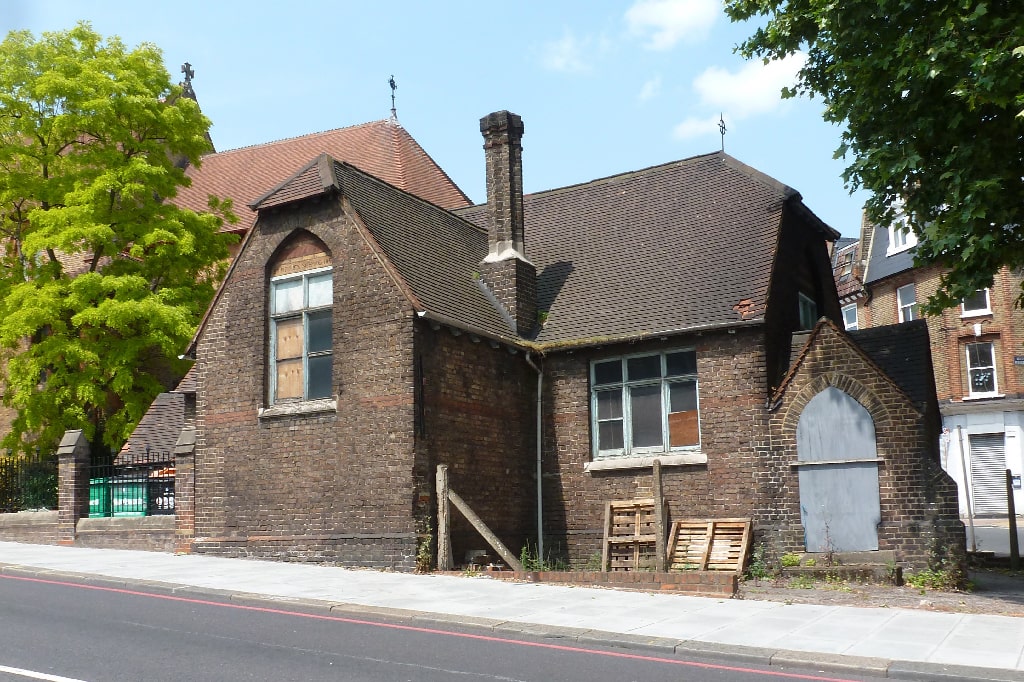
Tiny St Mark's School, Battersea Rise, was built on a corner of Wandsworth Common 1866-67.
This photograph shows the school in 2023, in a wretched state, before its splendid restoration and rebirth as the studio of Dow Jones Architects.
 S PROMISED LAST MONTH, here is my case for a Wandsworth Green Plaque to be placed on the former St Mark's Infants School, Battersea Rise. For me, and for everyone who loves Wandsworth Common, this is hallowed ground, a sacred site.

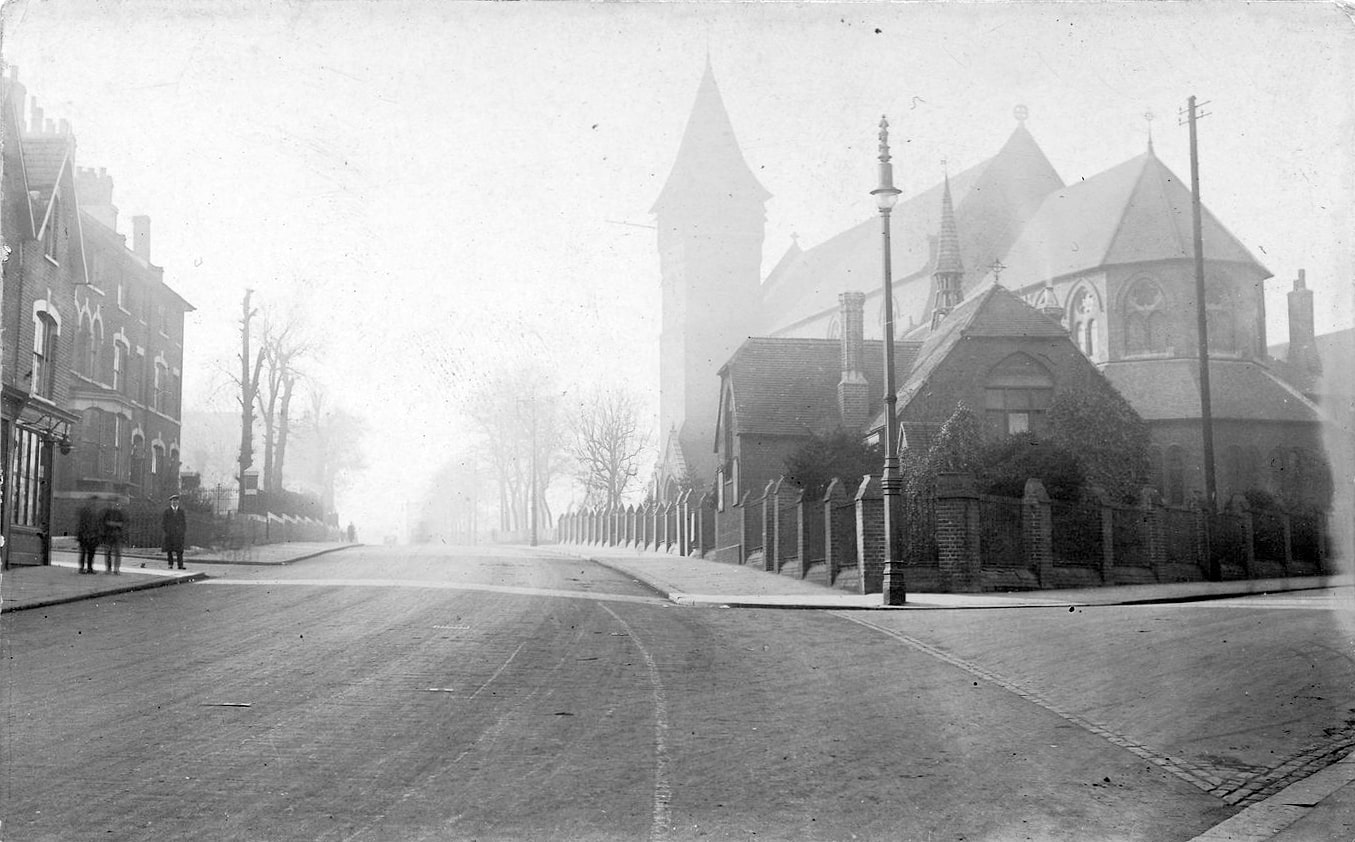
St Mark's school and church, on Battersea Rise — the church was built five years or so later.

Aerial view showing how St Mark's Infant School and Church were built on a sharp corner of Wandsworth Common, within the V-shaped "bird-beak" entrance to a drove lane between Wandsworth and Clapham Commons. This drove lane later became called Battersea Rise.
In the fight to save the Common in the 1860s and early 1870s, the Wandsworth Common Preservation Society sometimes met in the school, and in 1867 up to 5000 people gathered (loudly) on the grass nearby to protest against further enclosures of the Common
This month, I want to commemorate an event in April 1870, when Samuel Sullings (our very own martyr) was jailed for breaking down fences that blocked people's access to the Common. But for various reasons, I'm going to tell the story in the wrong order.
I'll start with his release from Wandsworth Prison in July 1870 when he was brought in a procession to this building and treated like a king, then look at why he was imprisoned in the first place, and (if there's space) the broader context of fence-breaking at this time.
Here's how John Buckmaster recollected the popular jubilation in his marvellous autobiography, A Village Politician (1897).
When his companions heard of [Samuel Sullings's] release they procured a van and decorated it with ribbons, laurels, evergreens, and flowers. An armchair was placed in the centre for the prisoner.
A band of music arrived at the prison gates, and the prisoner was received with hearty expressions of sympathy and goodwill.
The band, with van and procession, moved slowly to the scene of the late battle, for which the young man had suffered ten days' imprisonment*. The procession stopped as long as the police permitted it in front of the houses of the Common-stealers and played, almost to the bursting of their instruments, 'See the conquering hero comes,' with occasional yells of 'Who stole the Common?'
Eventually, they reached St Mark's School:
The procession moved through the parish to the schoolroom, where I presented the prisoner with a new suit of clothes and five pounds, provided by the committee. I persuaded the audience to go quietly home. I sent two men with the prisoner to his lodgings.
Some of the men had been drinking and were getting noisy and troublesome, and when they are in that state you may as well try to persuade a milestone to go home.
Buckmaster concludes this part of the story in his usual dry manner:
I did all I could, and as the young man was safe I left the others, and the next morning two or three of them were fined five shillings each."
Let's unpack these paragraphs a little.
" . . . The houses of the Common-stealers"
The "commons-stealers" were William Compton-Smith and John Costeker, two affluent chaps who lived on St John's Hill (between today's Vardens Road and Strath Terrace). Before the arrival of the railway c.1837, the area of Common behind their houses was known as Plough Green (after The Plough pub, opposite the top of Plough Lane).

The area once known as "Plough Green" is highlighted on a modern aerial photograph. P is the Plough pub, CS is the position of Compton-Smith's house, C is Costeker's. St Mark's Church and its tiny school on the extreme right, S.
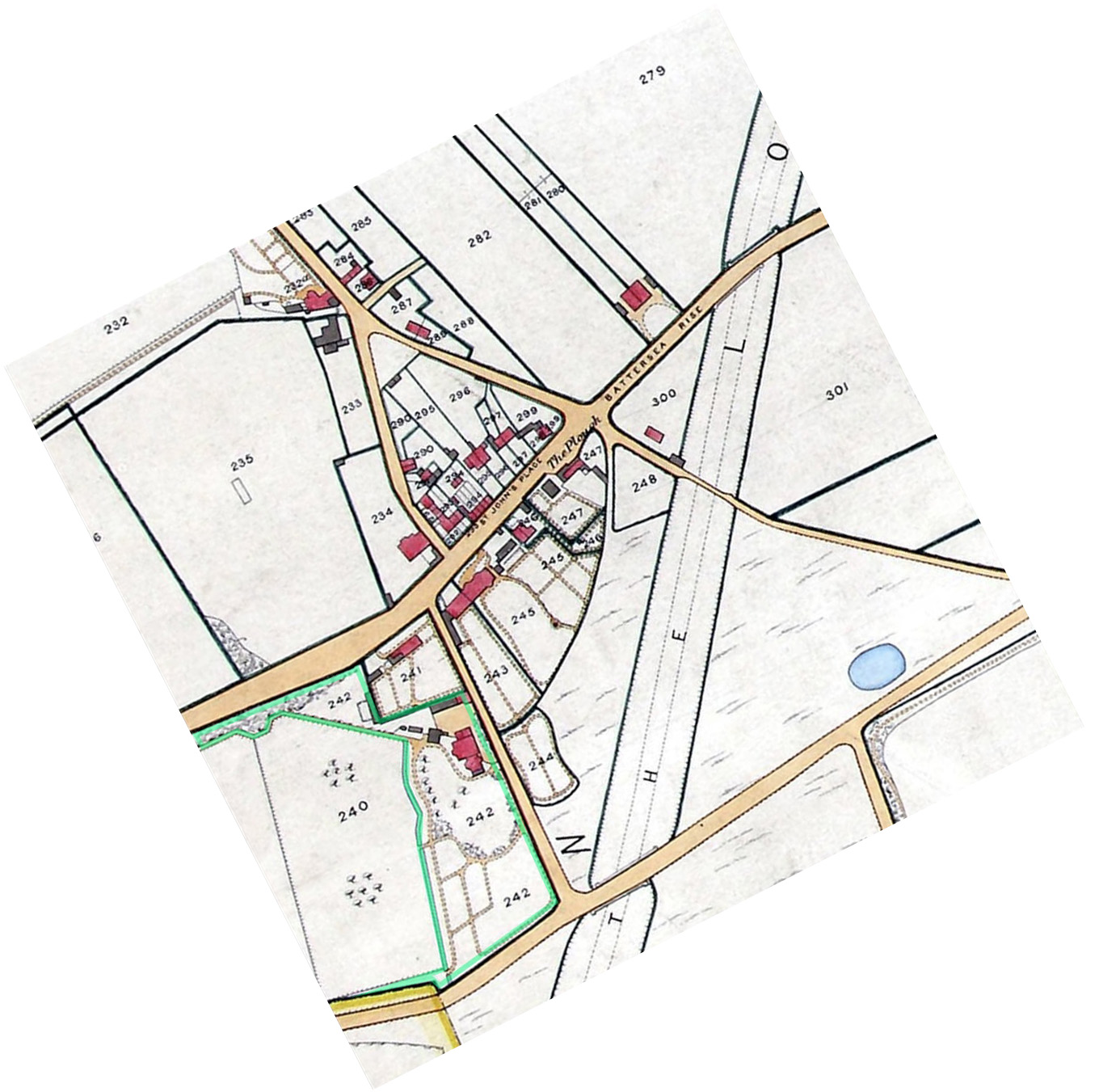
Here we see the houses on the edge of Plough Green/Wandsworth Common around 1840, before St Mark's church and school were built. The railway had been pushed through a few years earlier, curved and angled to avoid the large houses and gardens to the west. As a result, areas of the Common were cut off, making them vulnerable to enclosure.
As the wonderful Survey of London: Battersea points out, by 1870 the old houses and long gardens south-west of the Plough had become ripe for "development". William Compton Smith owned Ivy Lodge, on the corner of St John's Hill and what became Vardens Road. John Costeker's house was near the corner of what is now Strath Terrace. Both were attempting to enlarge their gardens by stopping up pathways onto the Common, and enclosing and adding common land to their properties.
And they succeeded. Within a couple of years, these detached houses and gardens were sold off, demolished, and covered in terraced housing.
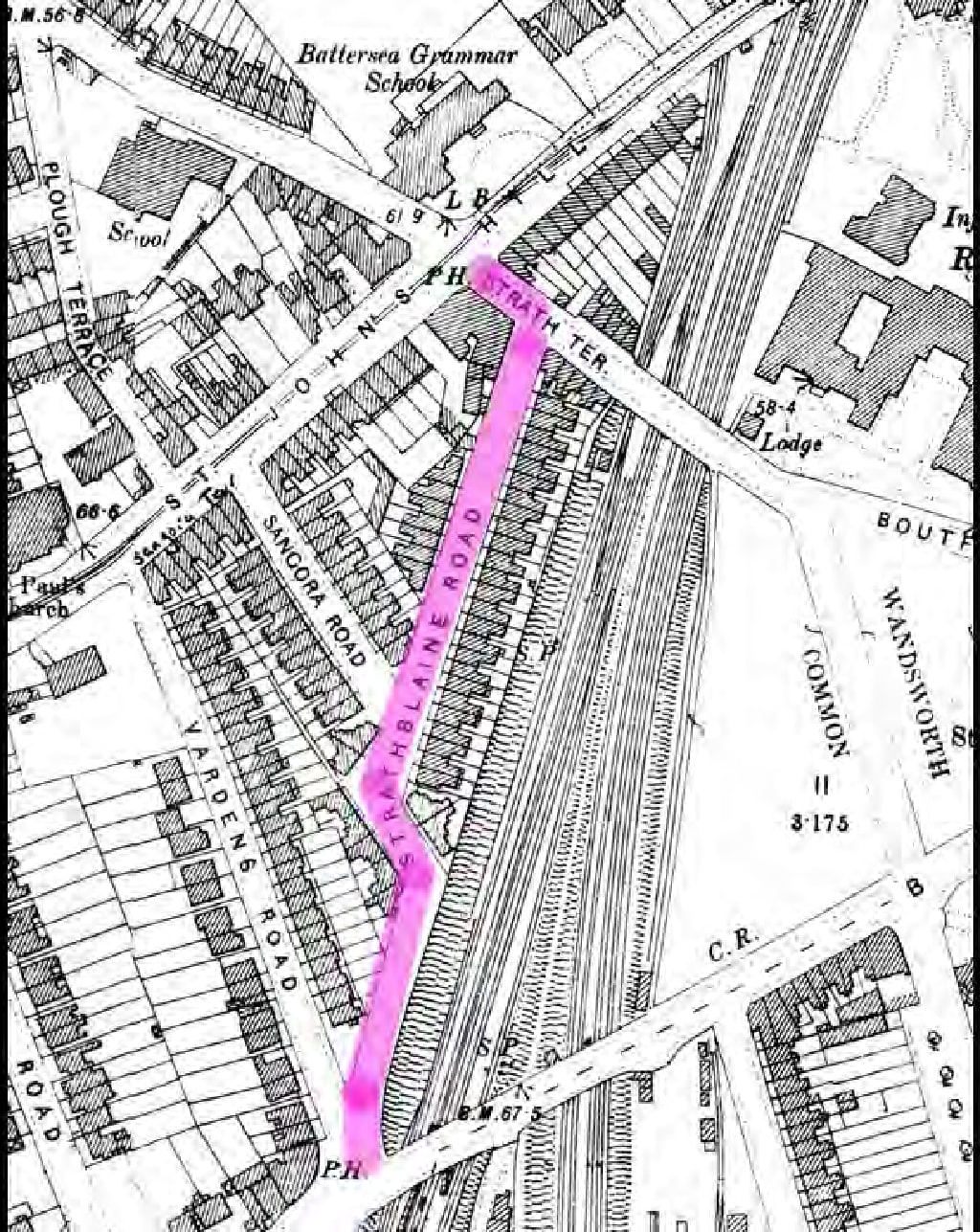
Zig-zag-roads and tightly-packed terraces (with almost no gardens) that succeeded the large houses and spacious grounds enjoyed by Compton-Smith and Costeker. Strathblaine Road, marked in pink, roughly follows the route onto the Common that Samuel Sullings and his fellow fence-breakers were endeavouring to keep open.
" . . . See the conquering hero comes"
You will notice frequent references throughout Buckmaster's account to popular music, song, and poetry of the day — which I'm delighted to be writing about because April 2025 is the start of Wandsworth's year as The Mayor of London's Borough of Culture.
"See the conquering hero comes" is a chorus from George Frederic Handel's oratorio, Judas Maccabaeus (1746), by 1870 an all-purpose patriotic hymn:
"See, the Conquering Hero Comes"
(Youths)
See, the conquering hero comes!
Sound the trumpets! Beat the drums!
Sports prepare! The laurel bring!
Songs of triumph to him sing!
(Virgins)
See the godlike youth advance!
Breathe the flutes and lead the dance!
Myrtle wreaths and roses twine
to deck the hero's brow divine!
(Israelites)
See, the conquering hero comes!
Sound the trumpets! Beat the drums!
You can hear this chorus in numerous versions that are nothing like how it must have resounded on St John's Hill and Battersea Rise in July 1870 (e.g. here and here). But this version may sound a little more like it.
Wouldn't it be fun to put together a scratch band and assemble lots of local people to play and sing it together this year!
[The song was also associated with the openings of railway stations and lines — including the first, the Liverpool & Manchester line in September 1830. Clapham Junction station opened in March 1863. I don't know whether the band played "See, the Conquering Hero Comes" on that day, but I wouldn't be a bit surprised.
By the end of the 1860s, railway workers were the largest occupational group in Battersea. They formed a number of musical ensembles, including brass bands and blackface "minstrel" groups which performed in various public gatherings, including Commons-related events (such as the monster demonstration of Friday 23 August 1867, when perhaps 5000 people gathered near the school). It would be good to know more about these groups. I'll write more about this demonstration another time.]

The earliest photograph of Clapham Junction station (c. 1875) that I know of, looking north from St John's Hill bridge. Notice there were still very few lines at this time. The "riot" that Samuel Sullings was involved in took place only a hundred yards or so from here.
John Buckmaster's home, in New Road (now Prested Road), may just be in view on the right of the photograph. It was demolished to make way for new tracks when they were added later in the century.
There's something of an irony in this. The coming of the railways fragmented and destroyed the integrity of Wandsworth Common, but it also encouraged innumerable railway workers and their families to settle in Battersea. And of course it was the cramped unhealthy terraced dwellings they were forced to inhabit that made free access to the Common all the more desperately needed.
" . . . Who stole the Common?"
A reference to a seventeenth-century protest verse that John Buckmaster often declaimed (to great public hilarity):
“The law locks up the man or woman
Who steals the goose from off the Common But leaves the greater villain loose Who steals the Common from off the goose.”

The rhyme is endlessly adaptable. Here's a version painted over a "No trespassing" sign on a fence surrounding Freeman's Wood, Lancaster (Guardian, 10 February 2016).
According to the London Daily News (15 April 1870):
Samuel Sullings, a sawyer, aged 21 years, was charged with being concerned, with other persons not in custody, in wilfully damaging a wooden fence enclosing a kitchen garden belonging to Mr. John Costeker, of St. John's-hill, Wandsworth.
The report continued:
On Wednesday last about 300 men of the roughest kind came to the place and knocked down the gates and a considerable portion of the fence. Fruit trees were damaged, and an immense amount of injury was done to the property."
A police constable said he saw Samuel Sullings:
call upon the mob to assist him to break down the gates. He threw a heavy stone at the gates, and after he got them down he jumped upon them and broke the panels. He picked up a large stick and walked across the ground. He said, 'This is our place, boys, and we'll stick to it.' "
Dr. Dayman, the magistrate, said he sympathised with the cause, but unless the law changed he was compelled to punish the prisoner regardless:
It was very desirable, no doubt, that open spaces in crowded localities should not be enclosed, but he doubted whether the public could claim to keep open Wandsworth-common without an Act of Parliament.
He fined the prisoner 40s. [i.e. £2], in addition to £15, the amount of damage, and in default ordered him to be imprisoned for six months.
[You can view the original Daily News article here; BNA Link. ]
[Numerous other accounts were published, but they're all very similar, e.g. Daily Telegraph (15 April) (headed "Riotous proceedings on Wandsworth Common", Morning Post (15 April), Sun (16 April ) ("Suburban warfare . . . Wandsworth common is still the field of battle").]
But of course £17 was far more than Samuel Sullings could pay. As an unskilled young gardener, he probably didn't earn much more than a £1 a week — so this was the equivalent of perhaps 4 months' work.
In default, then, Samuel Sullings was sent to Wandsworth Prison for six months of hard labour.

Samuel Sullings: entry in the Wandsworth Prison Registry
Number: 2167
Name: Samuel Sullings
Sex: Male
Age: 21
Height: 5 feet 5 inches
Hair & eyes: Brown — Blue
Other marks: Top left thumb [____ed?] Scar over right eye
Trade or occupation: Sawyer
Magistrate: C.O.[?] Dayman Wandsworth
When committed: 14 [April]
Offence: [illeg.] damaging a fence
Sentence: 6 months
Fine: £17
Expiration of term: 13 Oct 1870
State of instruction: Read/Write/Religion: [illeg]
Weight coming in: 10 stone
Birthplace: E [England][Let me know if you can read any more words. Ancestry: Link. ]
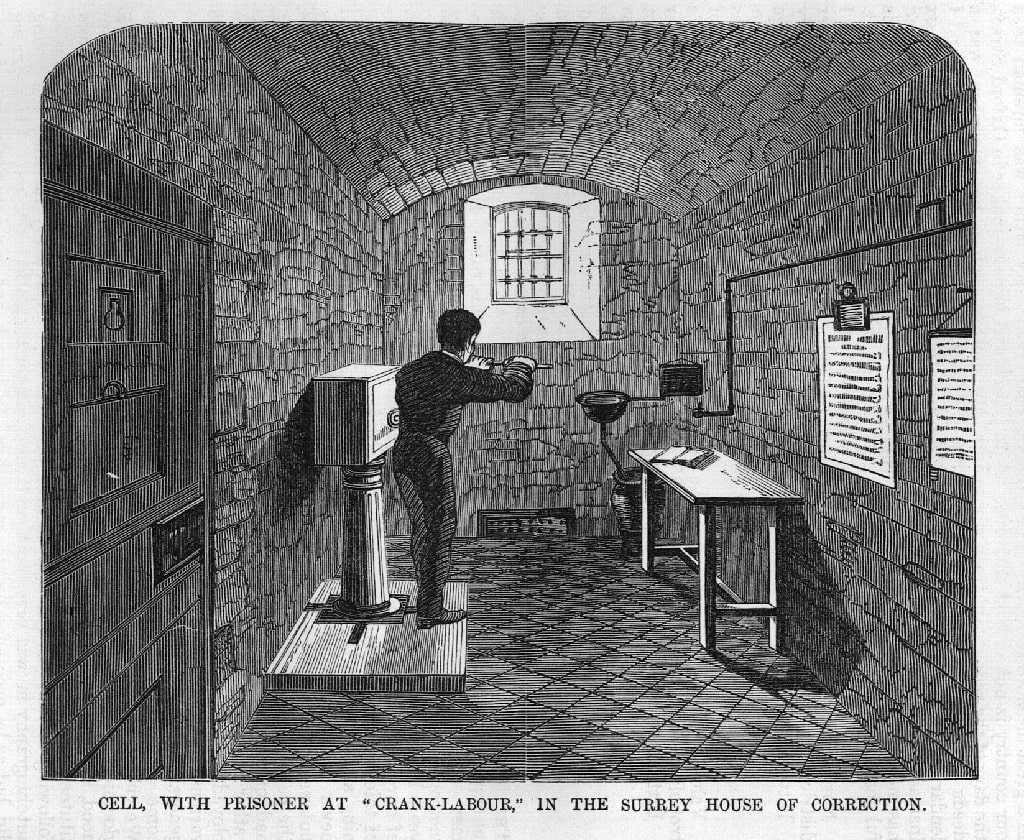
It is likely that Samuel Sullings will have spent most of his period of confinement alone in a cell, performing arduous — but useless — labour on a "crank machine" for hours at a time.
No matter how hot-headed (or indeed drunk) Samuel Sullings and his fellow fence-breakers may have been, this was not an isolated act of "mindless vandalism" but one enjoying widespread social approval. He was part of a large group — a "mob . . . 300 men of the roughest kind" — engaging in what they considered to be perfectly reasonable and legal — or at least principled — behaviour.
And it didn't come out of the blue — there was long back-story of similar actions in the area (and on commons and forests elsewhere in the country) in the last 20 or 30 years. Even the magistrate, Mr Dayman, admits the cause has its merits — "It was very desirable, no doubt, that open spaces in crowded localities should not be enclosed" — but acknowledges the confused state of the law; that "without an Act of Parliament" his hands are tied and he must punish Sullings as though it was an act of vandalism, not political principle.
Let us return to John Buckmaster's account, the most complete, vivid, and affecting we have:
A footpath which ran diagonally across a piece of the Common was stopped at both ends, and the land added to the gardens of adjoining owners. This enclosure deprived the public of a convenient footpath, and stopping it created much ill-feeling and indignation.
The enclosure was protected at both ends with a high closed fence of a most formidable character, lined inside and out with sheet-iron. The one boundary was the railway, and the other the gardens of the Common-stealers.
Men would assemble in small detachments in the evening and look at the fence. The police were on the lookout. They expected a siege some evening, and they were not disappointed.
One evening about a dozen men came out of a near public-house* and with heavy hammers and stones attacked the fence at both ends, broke it down, trampled down the fruit-trees, and went out at the other end amid the deafening cheers of a large crowd which had by this time come together.
[* probably the Plough Inn, or possibly the Surrey Hounds, on the other side of the road.]
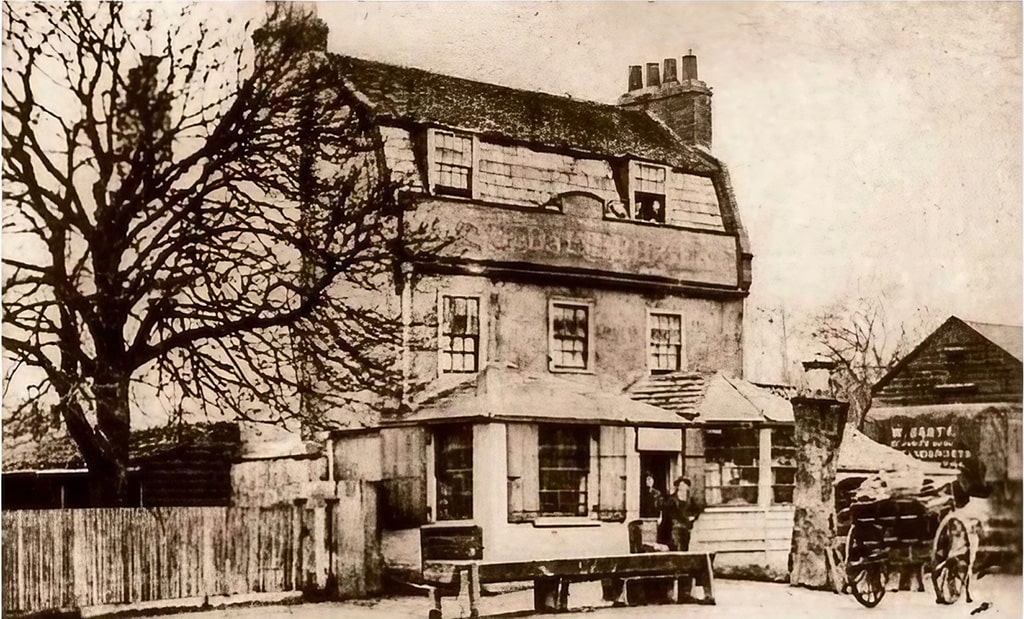
"The Plough" public house, photographed c.1875.
Among them is the unfortunate Samuel Sullings:
One stupid young fellow, who had recently come up from the country to work in the gardens, took up a large stone and deliberately knocked down some palings. His companions saw the police and called him away, but he was deaf, and the police took him into custody, and he was locked up.
I happened, fortunately for myself, to be away, but, unfortunately for the young man, the whole affair was so sudden and unexpected that no arrangements were made to defend him. The next morning he was brought before the magistrate, confessed his guilt, and expressed his sorrow. He was sentenced to a fortnight's imprisonment.
the Common-stealers pleaded damage and pressed for a heavy punishment as an example. If instead of pleading guilty he had pleaded a right, the magistrate must have dismissed the case.
Buckmaster, in characteristic fashion, swung into action, writing letters to the press to highlight the enormity of what had just happened (e.g. to the Echo, 27 April) and pulling all the levers available to him.
On my return I called on his employer, who expressed his willingness to give the man work when he came out of prison.
I at once prepared a memorial to the Home Secretary for his liberation.
I first went to the parson of our district* and asked him to sign it. Now this man, who had often expressed to me his full sympathy with our efforts, began to make all sorts of excuses. the Common-stealers formed part of his congregation. They were wealthy and subscribed liberally to his church, and unless they first signed it he could not without giving offence. This was the representative of the Church of the poor man, which ought to have protected him against the greed and avarice of the rich . . .
[* This was J.S. Jenkinson, vicar of St Mary's Battersea, appointed to the position by Earl Spencer himself. JCB (who was the Churchwarden) is often disparaging. He was much more enthusiastic about John Erskine Clarke, the vicar from c. 1872.]
I placed a table in front of a shop where hundreds of persons passed daily to the railway, and in the course of two days obtained nearly a thousand signatures.
I took the memorial at once to the House of Commons and sent for Mr. Fawcett [Henry Fawcett, the blind Liberal member for Brighton], who was out. I then sent for Sir Charles Dilke [Liberal member for Chelsea, a noted radical], who suggested I should leave it at the Home Office.
I knew what would become of it if it found its way to the Home Office. It would probably be referred to every person, from the messenger to the Assistant Secretary, who would refer it from one to the other, whose business would be to initial it, write on, "Seen — refer to Brown — look up precedents," "Refer to Asst. Sec. for instructions," "Refer to committing magistrate"; and before all was finished the young man would have done his time.
I pressed Sir Charles Dilke to take it direct to the Home Secretary, who was in the House, and explain the circumstances of the case and its urgency.
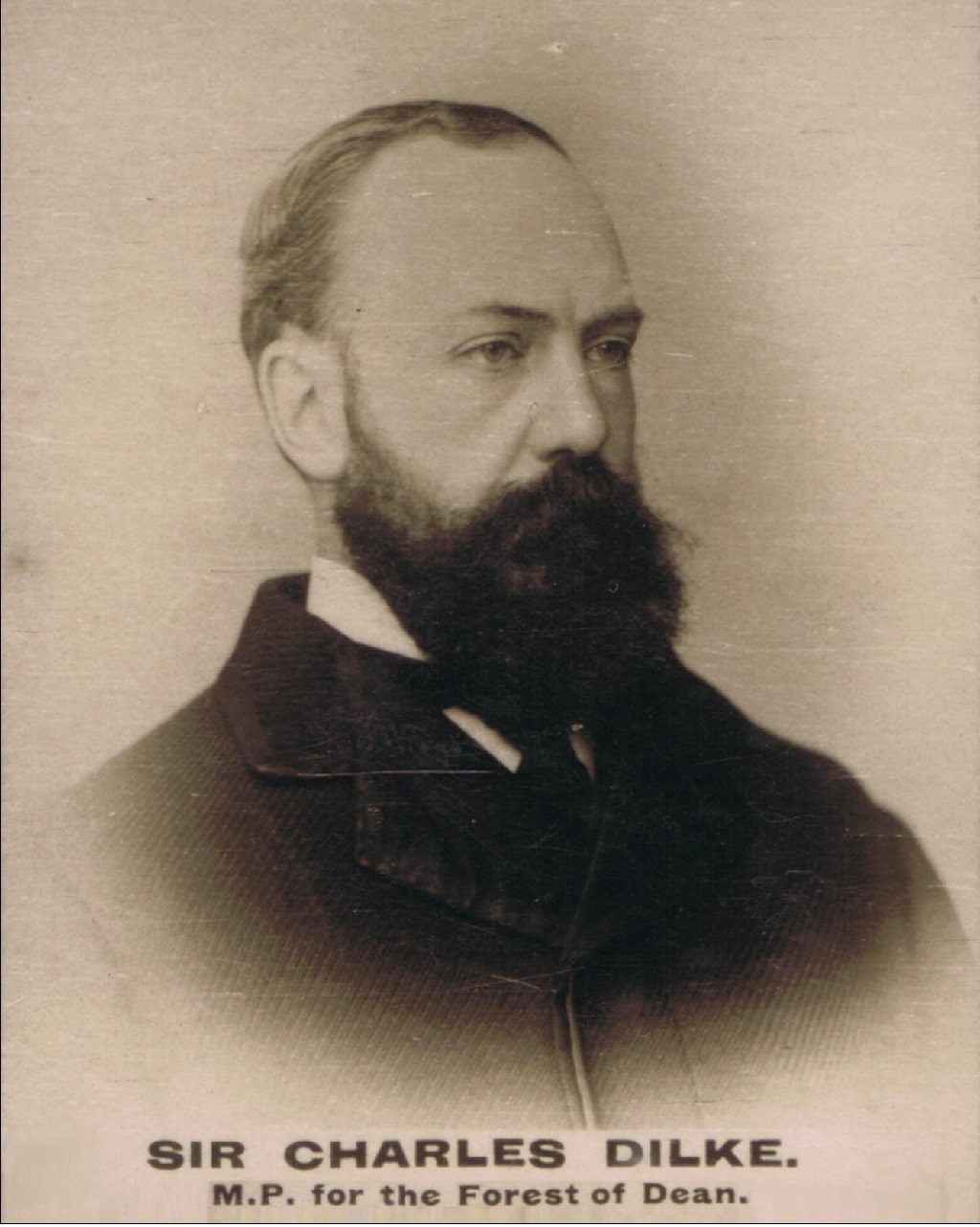
Charles Dilke, radical M.P,, friend of Wandsworth Common.
I called next day at the Office and found that the matter had been referred to the committing magistrate, who offered no objection to the prisoner's release, and I expected in a day or two the governor of the prison would receive an order accordingly.
But no order came.
I called again at the Home Office, and was informed that the papers had been forwarded to Balmoral. I waited two or three days, when I was informed there had been some mistake, and the papers would be returned to Balmoral at once.
After the young man had served his term of imprisonment all but two days, the governor received an order for his release.
[A puzzle for you: How many days did Samuel Sullings serve?
I'm quite perplexed by the dates. Samuel Sullings, not having the money to pay the fine and damages, had been sent down for six months. This means he would have been freed on 13 October. This date is confirmed by the prison register.
John Buckmaster says he tried to secure the release straight away but there were frustrating delays which meant that Sullings was in prison for 10 days. Buckmaster also states: "After the young man had served his term of imprisonment all but two days, the governor received an order for his release.
However, the celebrations at St Mark's School were on 9 July, i.e. 3 months after SS was imprisoned.
Can anybody help?]
Buckmaster's frustration with the whole rotten, creaking, crushing machinery of state is tangible. Characteristically, he grieves for Samuel Sullings's mother.
A few days after his imprisonment his poor mother came up from Suffolk in great sorrow and went direct to the police-station, where she was informed by somebody, which everybody denied, that I was the cause of her son's imprisonment.
I was deeply grieved when she came to my house, and her sorrow was the sorrow of a mother. I gave her some tea, made her comfortable, and lodged her for the night.
I sent for the treasurer of the Common Fund, and we sent her home with the assurance that her son would not suffer or lose his character.
She was much hurt when she applied at the prison to see her son. The door was slammed in her face, and she was rudely told to be off about her business.
A person in distress is more sensible of kindness than those who have never tasted the waters of deep sorrow through the errors of their children."
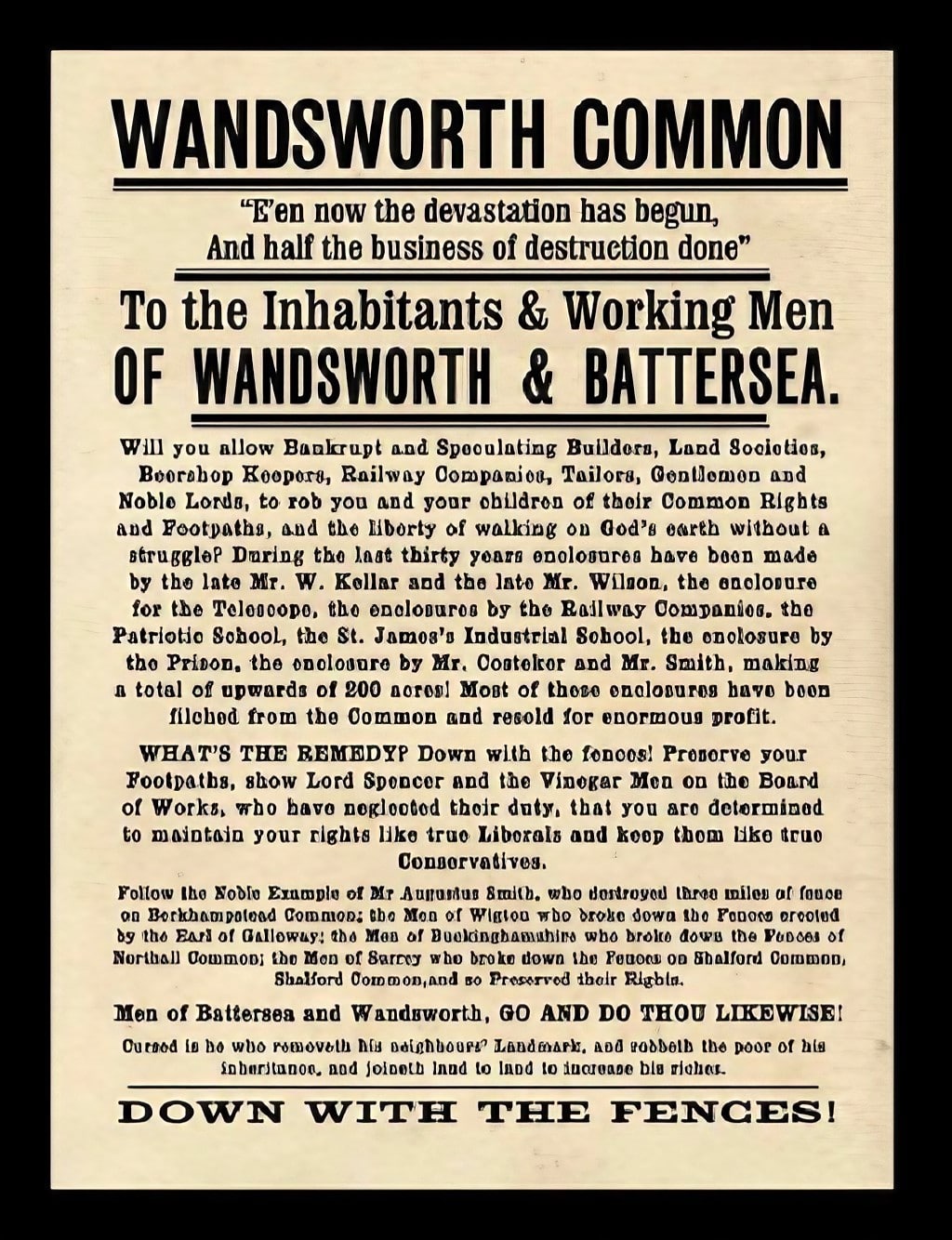
There's a lot more to be said about these events, and the many influences that brought things to such a head, but I'd better stop now. If possible, I'll follow up later this month with a look at Tom Taylor's poem "The Cry of the Commoners", published in Punch magazine ten days after Samuel Sullings was jailed, and a closer examination of this fine "Down with the Fences!" poster: (which is a history lesson in itself):
Although St Mark's Infant School is (or rather was, since it closed in the mid-1960s) built for education, as yet I haven't said anything about its century of service as such to the children of Battersea. I'm collecting stories, but in the meanwhile here is a marvellous contribution from someone who attended the infant school around 1950:
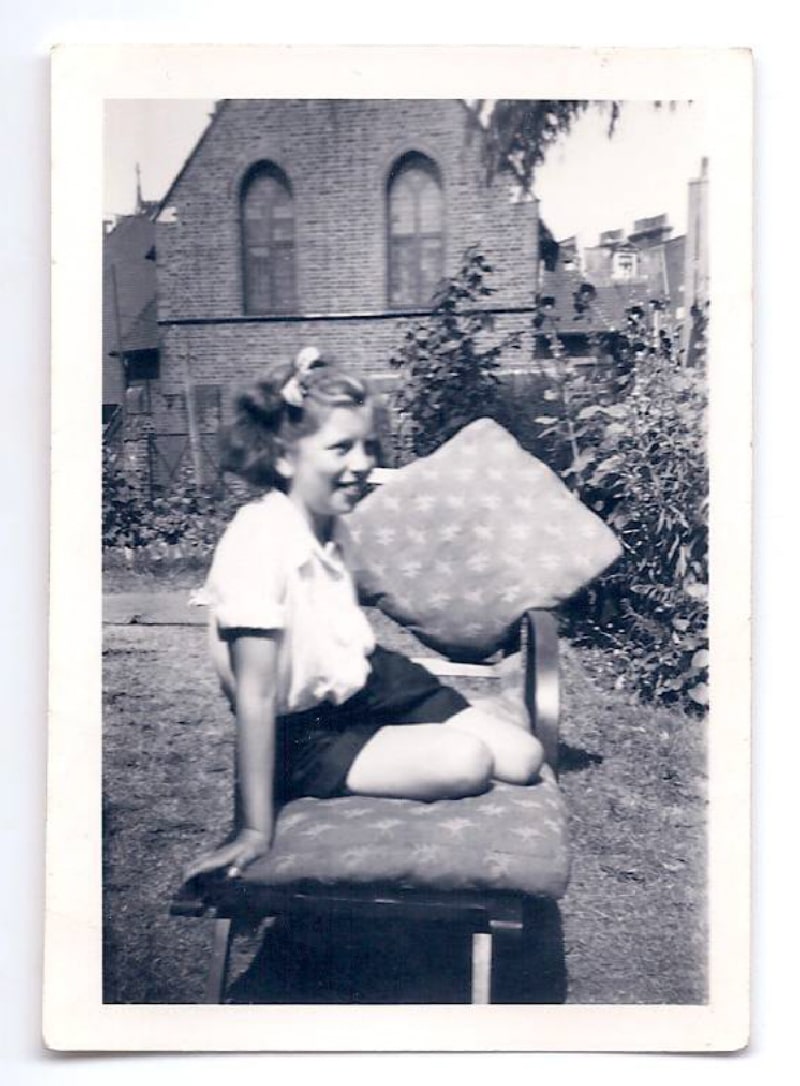
Barbara Windsor (nee Madsen) in front of her prefab home when she was about 9 years old. St Mark's Church is in the background.
In February 2025, I asked Barbara to send me recollections of her tiny infant school, which was just yards from her prefab-home (where she lived from 1946 to 1956) on what we now call St Mark's triangle. I'm so pleased I asked!
It was very convenient to start my school years a mere two-minute walk away from home and I attended St Mark's Infant School from around 1948/49 until 1950/51 prior to going to Belleville Road Primary School when I was around seven.
I have a very vivid memory of the school room, the two classes divided across the middle by, I'm pretty sure, a curtain, and a large central fire enclosed by a railed safety guard. Miss Carter was the headmistress assisted by Miss Webb. I have a vague memory of standing in front of the fire and being awarded a prize and I suppose when I get round to sorting out vast amounts of memorabilia, there might be some evidence of this somewhere!
It doesn't happen these days, but the school bell was rung in the morning, calling children to school. Boys and girls were taught together, but when it came to playtime, girls were in the tiny playground adjacent to Battersea Rise and boys were in the one alongside Comyn Road.
We were issued with cardboard pencil boxes, played with sand and had a choice of several basic musical instruments to experiment with. And of course in those days, a third of a pint of milk at playtime — I think the cod liver oil capsules came later! I can remember writing the date 1949 when I would have been five.
[For Barbara's memories of growing up in the prefabs, see the Chronicles for March 20025 Part II.
In October 2022, Barbara was interviewed at length by Ros Page as part of the Friends of Wandsworth Common "Common Lives" project. Some of what she said above is also covered, but Barbara also recollected crying on her first day at the school:
because my friend Penny Jones, who lived next door, was a year older than me so she was in the other class and so we weren't together. So I do remember, I do remember crying the first day.
Do any other readers have recollections of the school (or indeed of the prefabs)? Let me know.
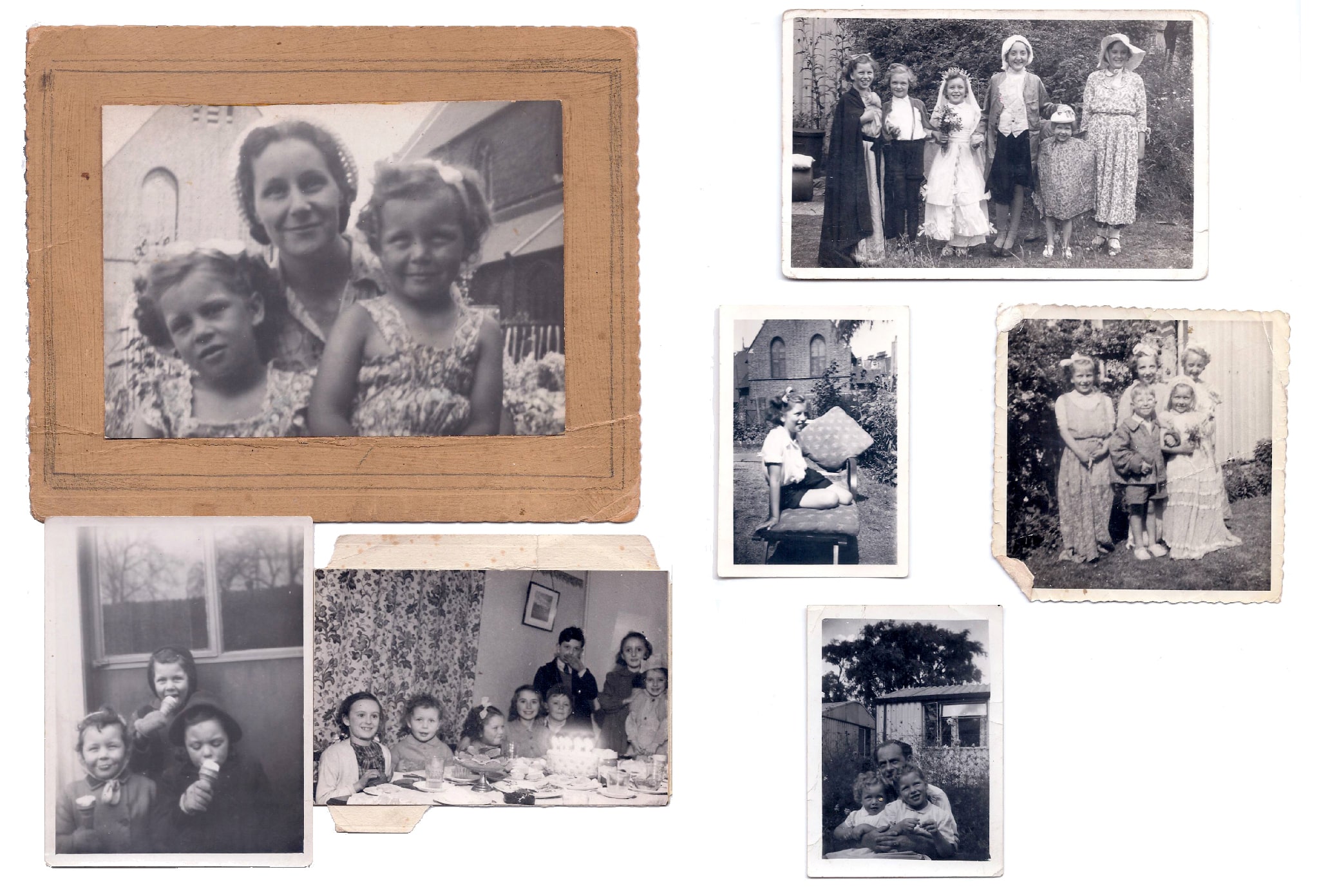
Photographs from Barbara Windsor's album.
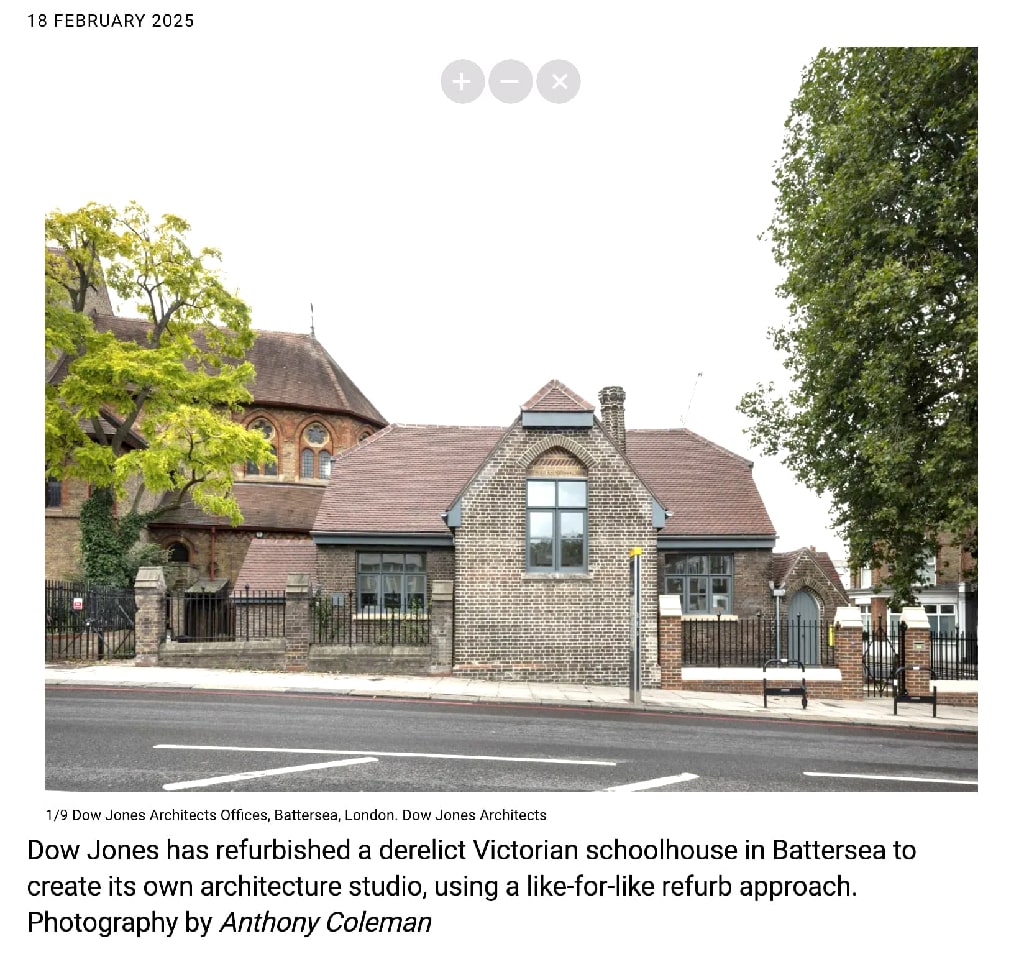
Barbara Windsor: "It's lovely to see the building looking so pristine and in use. Although (unbelievably!) I'm now 80, I still have very vivid memories of standing behind those railings on the left and my mother bringing me a breaktime snack."
[On the origins and architecture of the school, see The Survey of London: Battersea, chapter on Schools; Historic England, list entry: , St Mark's Infant School, Battersea Rise and the research report by Emily Cole (pdf).
For further info. about the recent restoration of the school, see e.g. Dow Jones Architects and Architects' Journal.]
Thank you, Barbara — it's such a pleasure corresponding with you!
[My good friend Hugh Betterton, who grew up on West Side, wrote to tell me that his mother, Bessie, whose family name was Holmes (and later Bettes), attended St Mark's infant school in 1911. You may recall from earlier Chronicles that her stepfather Albert Bettes and stepsister Florence were killed by lightning on Wandsworth Common in June 1914. Their home was at 1 Chivalry Road, but Florence was probably too young to be a pupil at the school. ]
Common Memories — Life on & around Wandsworth Common, 1930s-1980s. (Friends of Wandsworth Common, 2024)
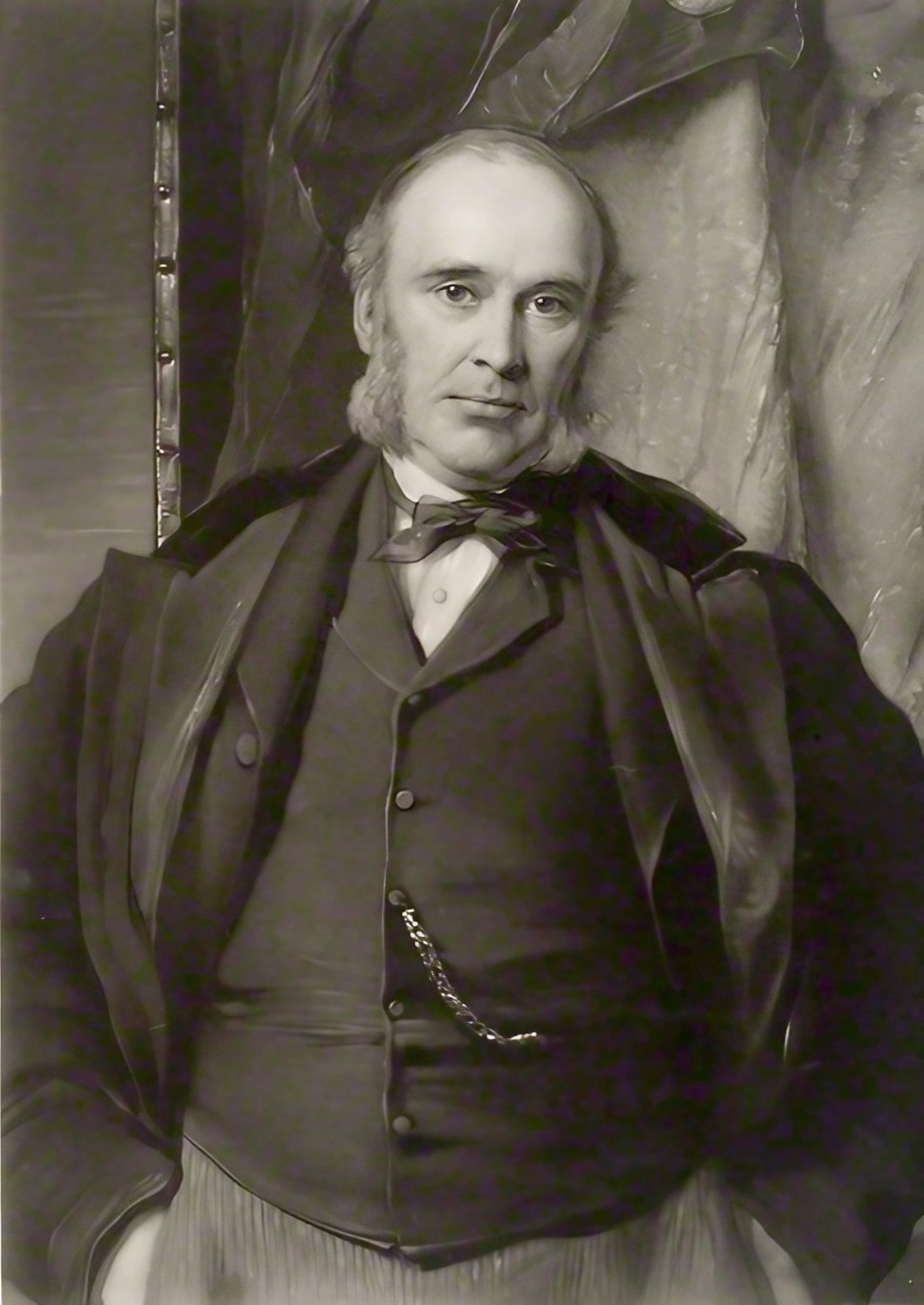
William Henry Smith (1825—1891)
News has just reached me that W.H. Smith, the bookseller and newsagent always associated with the nation's railway stations (where the company's news-stands became ubiquitous in the middle of the nineteenth century), has just been bought out and will no longer trade under this name.
The mid-Victorian owner of the company, William Henry Smith M.P., was a great friend of Wandsworth Common, lending his name in support of campaigns and petitions, and making donations to funds set up to fight legal battles to secure the Common.
For example, in July 1870, the month that Samuel Sullings was released, it was advertised that Smith would be among a host of dignitaries attending an important meeting chaired by the Lord Mayor at the Mansion House to be held on 14 July, where he would be donating £23 to the "Peek Fund" (the equivalent of about £3500 today):
for the purpose of making an appeal on behalf of a fund of £5000, to which Mr. H.W. Peek, M.P., has promised £1000 . . . for the purposes of taking proceedings against Lord Spencer, the lord of the manor, to prevent him . . . enclosing, selling and building upon Wandsworth Common."
I hope I'll have an opportunity to discuss the significance of the Peek Fund and the Mansion House meeting quite soon.
"Wimbledon: In a David vs Goliath battle, what is the price for democracy?"
I was on the point of sending out this month's Chronicles when I saw Cyril Richert's recent blog about Wimbledon Park (CPAG, 7 April 2025). It starts:
Local residents are fighting to protect Wimbledon Park from the All England Lawn Tennis Club’s expansion plans, highlighting the financial challenges of defending public spaces. A recent meeting aimed to raise funds for the upcoming Judicial Review.
How could we not be struck by similarities with the story we've just been exploring? Access to law is costly, so in 2025, as in 1870, crowd-funding is needed.

The AELTC Wimbledon Park Project – Credit: AELTC brochure
I'm sure you'll want to read it.
SO many more stories still to tell. But that's all for now, folks.
Send me an email if you enjoyed this post / want to comment on something you've seen on the site / would like to know more — or just want to be kept in touch.
If you would like to receive notifications of new Chronicles, let me know . . .
Philip Boys ("History Boys")
April 2025
— Friends of Wandsworth Common
— Wandsworth Historical Society
