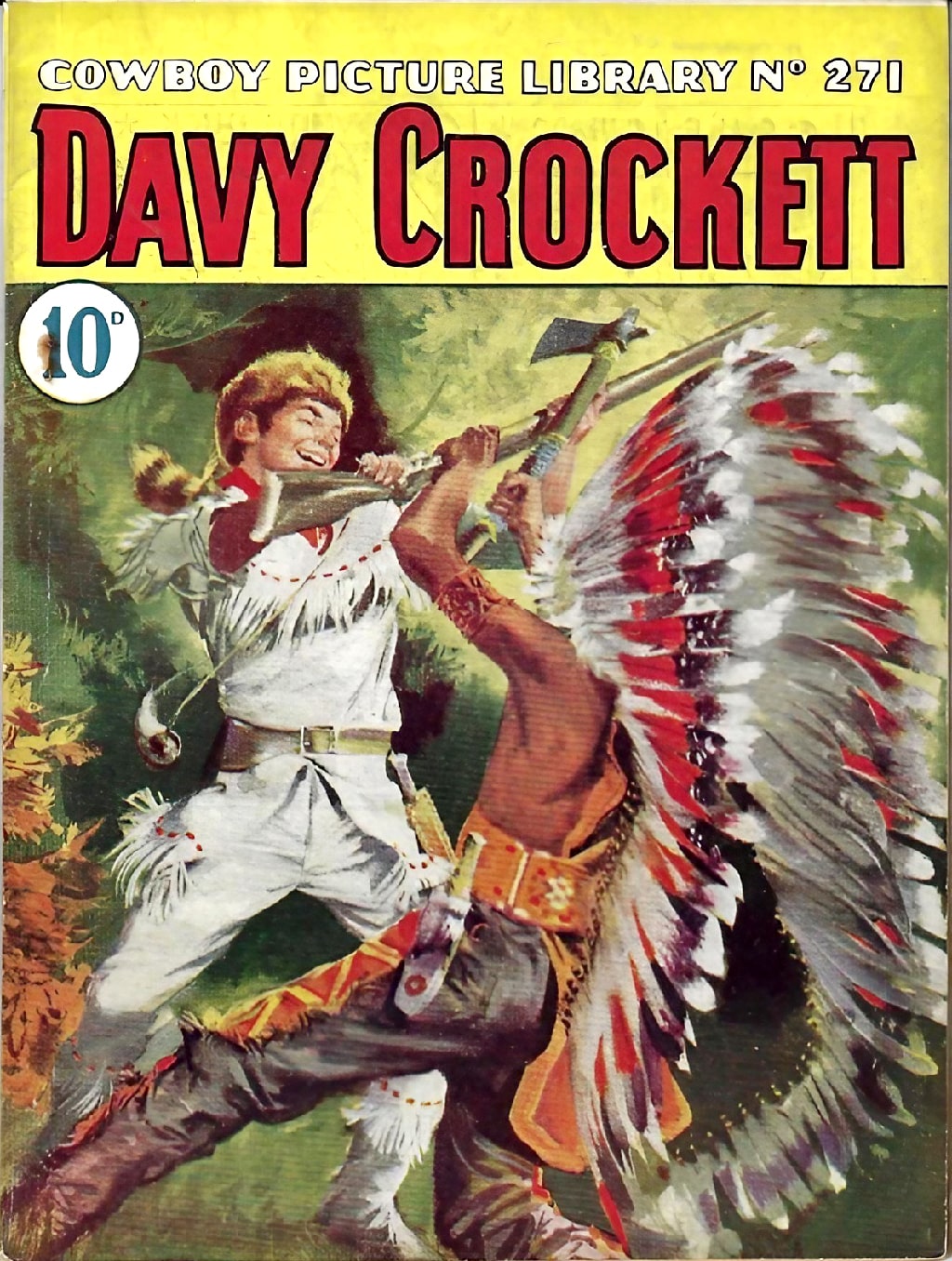
Davy Crockett, Fleetway/Cowboy Picture Library no.271 (more covers here . . . )
Last modified: 3 October 2026
h1>Part Two
Born in a tenement in Battersea
'e killed 'is Ma when 'e was only free [three]
Chopped up his Pa when 'e was only four
Now 'e's lookin' for 'is Bruvver-in-law.
Davy, Davy Crockett,
King of the Teddy boys.[As sung by me in 1956.]
Another year, another birthday . . .
You may recall that in March last year I indulged myself shamelessly by collecting posters of films shown at the Granada cinema in 1949, the year of my birth. At the end of the piece, I promised I would write something soon about "Cowboys and Indians". Well, this isn't exactly "soon", but hey.
The initial stimulus was a letter, published in that year in the South Western Star. It's from a local nature-lover J.P. Ede, who lived at 39 Broomwood Road, Here it is again, in case you need reminding:
TOMAHAWKS AND BLOOD
I was under the impression that we had seen the last of the Mohicans. But I was mistaken, for only the other day I encountered on Wandsworth Common a band of these predatory Redskins, obviously on the warpath.
Their red-brown bodies, naked save for diminutive bathing trunks, were smeared copiously with blood, and in their hands they carried weapons ranging from rifles to tomahawks.
The "braves" were local boys, their skins reddened and tanned by the holiday sun, while the besmearing blood was only the innocuous stain of the blackberry, artfully applied to chest and shoulders.
J.P. EDE, 39 Broomwood Road, Battersea.
(Ed.) Wot, no scalps?
[I transcribed a number of JPE's letters in Chronicles for March 2024.]
That was in 1949. A few years later, I might have been one of those children.
Writing about his childhood on Wandsworth Common in the 1880s, the wonderful poet Edward Thomas (born 3 March 1878) tells of child tribal warfare — on Bolingbroke Grove, nearby streets, and the Common itself. He recalls how he and his friends
modelled ourselves on Sioux, Mohicans or Hurons, crouching, pausing, trying to hush the sound of our breathing. We forgot everything in this Indian ideal.
The battles were between Board-school boys, or "Boardy Blags" (i.e. blackguards), and a neighbouring school "of the grammar-school standard".
The "Board School" must be Belleville (opened 1877), which Thomas himself attended. And the "neighbouring school of the grammar-school standard" must be Battersea Grammar School — which, by a marvellous coincidence that fits my purposes perfectly, once stood on the site of the Granada cinema. (On which, more below.)
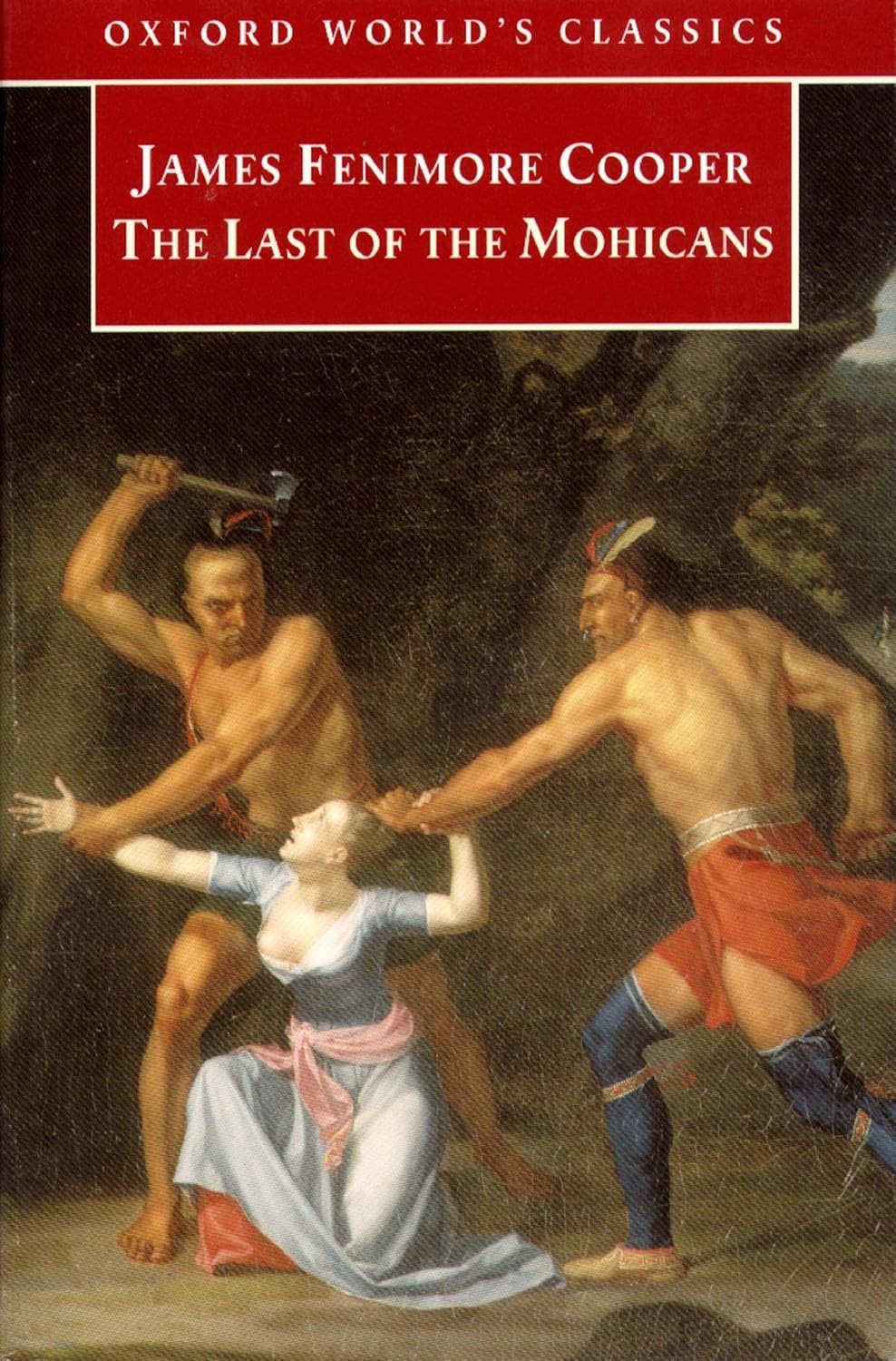
Their inspiration was not films, of course, but the wildly popular "Leatherstocking" novels of James Fenimore Cooper, such as The Last of the Mohicans — A Narrative of 1757 (1826), The Pathfinder (1840), and The Deerslayer (1841):
Edward Thomas contrasts his vivid recollection of these with other seemingly more worthy novels read in youth, such as Sir Walter Scott classics:
I remember the eager walks over Wandsworth Common to borrow volume after volume of the Waverley novels, but of Waverley, Heart of Midlothian, Peveril of the Peak and The Talisman, not a rack is left.*
[But] Of The Last of the Mohicans and The Pathfinder rather more is left. They gave me an idea of a noble savage. The Pathfinder himself towers in memory as grandly as Milton's Satan but more dimly. The name of the girl Cora has folded itself up in my mind like a gentle snake . . . .
[These "eager walks over Wandsworth Common" were to 6 Patten Road, in today's Toast rack, the home of writer James Ashcroft Noble — and his daughter Helen.]
* "Not a rack is left": an allusion to the final scene of Shakespeare's The Tempest.]
Let's look more closely at the choreography of these battles:
the Common and the streets leading up to it were the scene of our principal game. It was played chiefly on Saturday, our whole holiday. We assembled, for example, at the top of the road [i.e. Wakehurst Road] in the well-trodden garden of a doctor who had a rowdy son; each bringing a weapon or several weapons, wooden swords and pikes, or daggers, shields, pistols, bows, arrows and with horns and trumpets, and perhaps some bread and cheese and an apple or orange.
There sides were chosen. One side went out to seek a fort in someone's garden or among the gorse bushes. Ten minutes later the other set forth, often in two divisions.
Sometimes stealth was the rule of expedition, we advanced whispering and in some order. Sometimes everyone was shouting for his own plans and against another's. At other times the methods alternated, the stealth would become wearisome, we began to chatter and disagree, or the riot of anarchy would suddenly strike us as wrong, everyone said "hush", and for some minutes we modelled ourselves on Sioux, Mohicans or Hurons, crouching, pausing, trying to hush the sound of our breathing. We forgot everything in this Indian ideal.
Nevertheless the enemy had to be found. Nor were they loth. Someone was sure to show himself and wave defiance, or to leap out on us, supposing we passed by. If seen at a distance they might change the stronghold and there would be a chase. If they were content to stand a storm, the second army would gather all its numbers together and, with yells and counter-yells, batter and push them out or be battered and pushed out itself.
The struggle was one of character, not weapons. The side possessing the fiercest and most stubborn boys won. The winners would than in turn fortify themselves and sustain an attack; and so it went on, until a mealtime, or nightfall, or rain, or a serious quarrel, finished the war.
[* The "doctor who had a rowdy son" may have worked at Bolingbroke Hospital, which faced the Common at the top of Wakehurst Road.]
At long intervals fiercer battles were waged. The boys of a neighboring school of the grammar-school standard looked down upon the Board-school boys, or 'Boardy Blags' (i.e. blackguards). The Board-school boys resented this. The feud was usually hardly in so much as a smouldering condition, and so far as I know must have been all but forgotten. Then suddenly it would flame out.
A loose army of Board-school boys several score strong moved along the Grove at the edge of the Common towards the enemy's school. The army was continually being swelled from the side streets. With all the smaller or more timid boys hanging on its fringes, more angry than warlike, more curious than angry, the numbers were considerable. Stones were the long-distance weapons. But rarely, I think, did both sides muster a fairly equal army at the same time.
When they came in sight of one another they began to throw stones. They halted, odd stones were thrown here and there, the hangers-on disappeared. I doubt if both sides ever advanced and clashed in hand-to-hand conflict. Usually after some challenging shouts, some wavering and dissension, the victors knew themselves and set up a shout and moved forward confidently. The smaller army broke and fled down the streets; the larger broke and pursued. Here and there a group kept together and set upon any solitary enemy it could discover.
I, who was too small to be in the army, was content to hang on the outer outskirts, pick up the news, and occasionally insult one of the enemy if I remembered that he was one.
Numerous youth groups founded around this time, or shortly after, including Baden-Powell's Boy Scouts, were inspired by an interest in American "Indians". A leading figure was Ernest Thompson Seton, whose Woodcraft League of America was originally called Woodcraft Indians and League of Woodcraft Indians [1901]. Campfires were central to the collective experience.
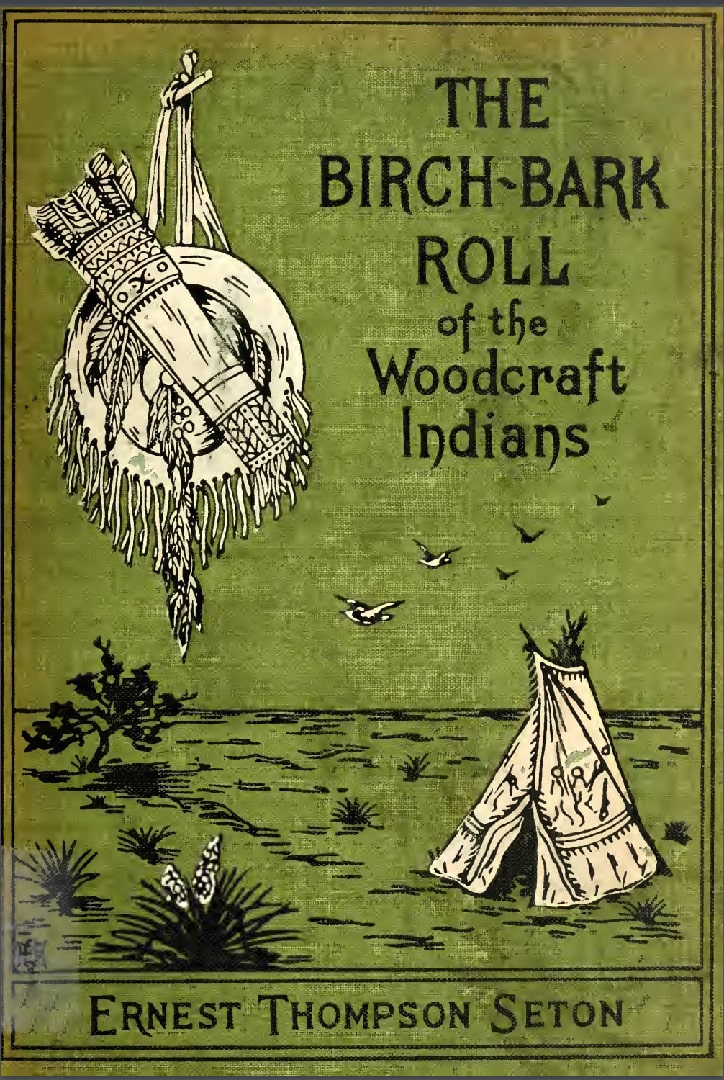
On a visit to England, Seton gave Baden-Powell a copy of his Birch Bark Roll of the Woodcraft Indians (1902).
Soon after meeting Seton, Baden-Powell decided to revise his earlier works into a more comprehensive Scouting for Boys. This was written on a Wandsworth Common, albeit the part on Wimbledon Common.
See e.g.
— Ernest Thompson Seton Institute: Biography
— Melbourne Blogger: "Ernest Seton vs Robert Baden-Powell: Woodcraft Indians".
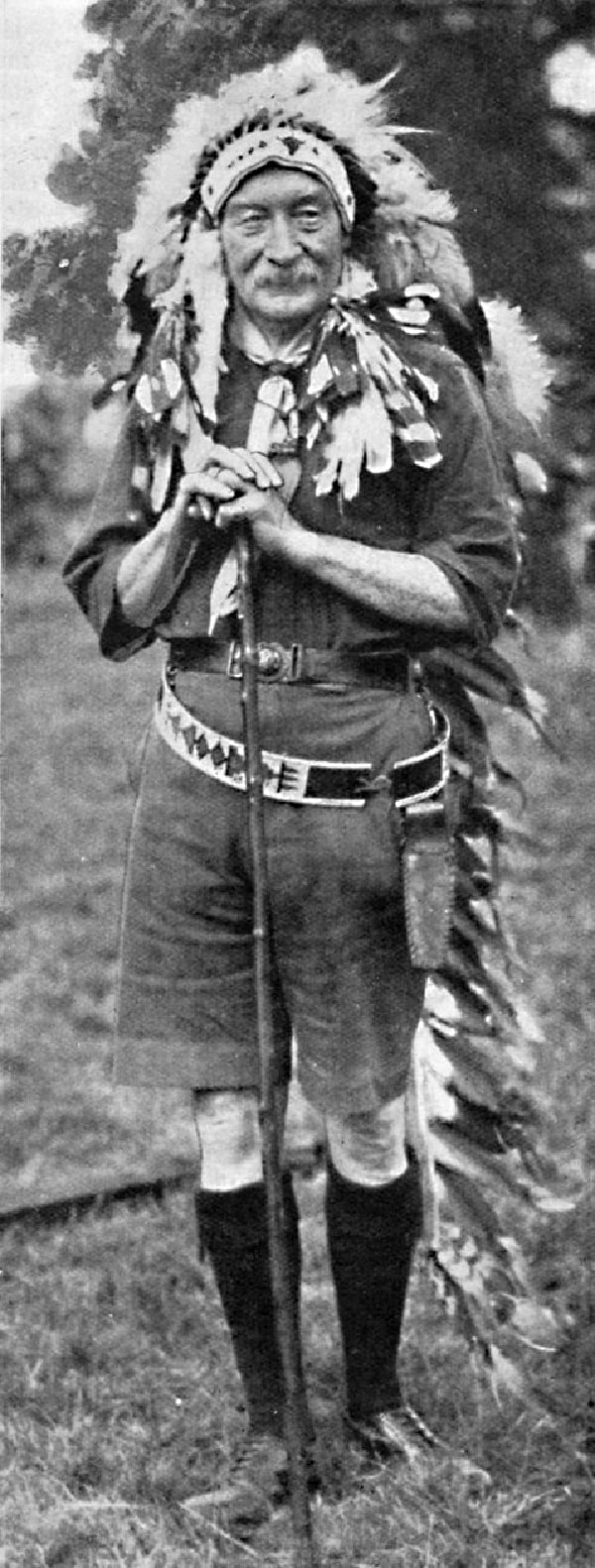
Lord Baden Powell in his Indian Chief head-dress.

Baden-Powell's Scouting for Boys was written in the Manor House next to the Windmill on Wimbledon Common. This was technically in Wandsworth, as I've written about before in relation to duelling. B-P was loaned the house as a comfortable place to write. [Now completely demolished?] There are exhibits of B-P material in the Windmill museum.
As children of the 1950s, growing up "in the shadow of" Wandsworth Prison, we often cycled or trained to Wimbledon Common to make "camps" in deep remote boggy valleys — much like Edward Thomas fifty or 60 years earlier. We loved the opportunity to get away from civilisation and to sit around the fires we made. (The principal threat to our pursuits came from Common Rangers, who perhaps significantly were mounted on horses.)
Do local children still do the same today?
Like most of my peers, I joined several youth groups. First I was a Cub, then (briefly) a Scout (at St. Paul's Church on St John's Hill, a few yards from the Granada). At other times, In I was keen on the Life Boys at the Trinity Road Chapel (but did not progress to the Boys' Brigade, which seemed too militaristic, though most of all I didn't like the funny pillbox hat). But my all-time favourite was the Woodcraft Folk, which met in a school at Figges Marsh, Mitcham. Bliss.]
Do you recognise a song with these lyrics?
Another of Edward Thomas's memories is of a song ("a kind of dirge for a North American Indian"), sung at Belleville School, which he could not identify, and neither can I. Perhaps you can?
The only one of the many songs we sang at school which I can recall was in the minor key. It was a kind of dirge for a North American Indian. I can still hum the melody, but I remember no more of the words than "Far far away in the depths of the wild wood". These were several times repeated. The rhyme to "wild wood" was I believe "childhood". I used to sing this to myself, and have periodically returned to it ever since.
[It does not appear to be The Indian's prayer or Far Away in the Depths. Both are sufficiently dirge-like, but otherwise have little in common with ET's song.]
Cora, you will remember, is the heroine of The Last of the Mohicans whose name "folded itself up" in Edward Thomas's mind "like a gentle snake".
Her connection with Wandsworth Common? Let's see.
If all you know of Cora is from the 1992 film (starring Daniel Day-Lewis as "Hawkeye"), what I'm about to say will make no sense. But this is because the film has very little in common with James Fenimore Cooper's original novel (published 1826). The book is very more complex than the super-simple boy-meets-girl romance of the film.
In the 1992 film the central romance is between feisty Cora and Hawkeye. How could it be otherwise, given it's a Hollywood blockbuster starring heart-throb Daniel Day-Lewis?
However, in the original novel, Cora's love interest is actually Uncas, a Mohican warrior.
This makes the "racial" dynamic very much more interesting. Remember, Cooper is writing only a few years before the American Civil War (1861-65).
[In the 1992 film, it is Cora's sister — the blonde, conventional Alice — who falls for Uncas. And when I say "falls for", I mean it quite literally. Both she and Uncas end up plummeting from a high cliff. In this way, they fulfil the basic rule of the Hollywood "impossible love" — white girl/"coloured" man — they can only get together in the Happy Hereafter.
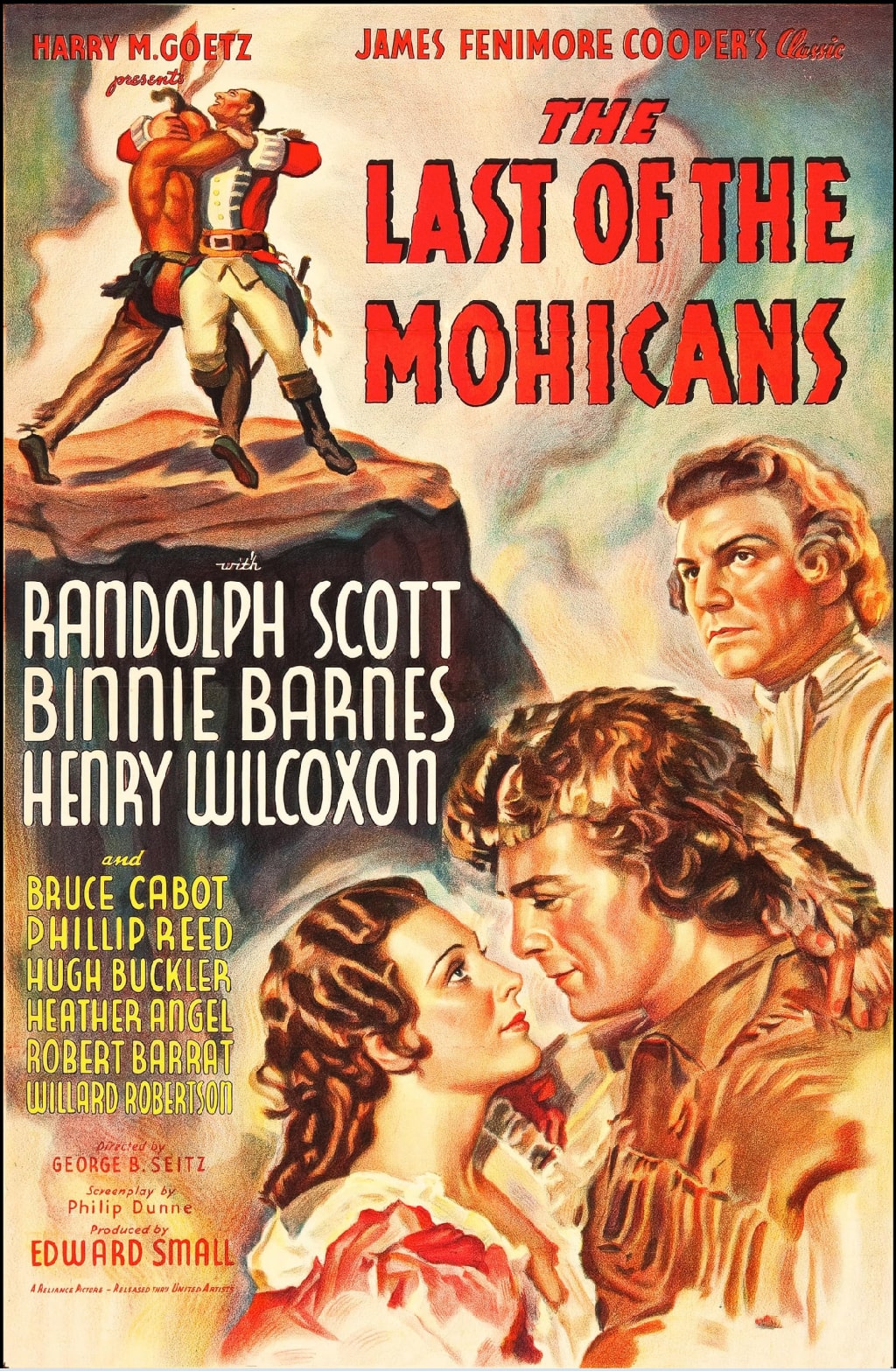
The 1936 film is slightly more faithful to the book in that it is Uncas who loves dark Cora (and vice versa), but Hawkeye loves blonde Alice.
In the novel, as it happens, Hawkeye is not in love with anyone — unless it's with the Great American Wilderness. Weird, eh?
Here's a neat summary of what a travesty this film is from Jeffrey Walker: Deconstructing an American Myth: Hollywood and The Last of the Mohicans
The Last of the Mohicans is perhaps the most filmed novel ever. Versions include Leather Stocking (1909), The Last of the Mohicans (1920 American), The Last of the Mohicans (1920 German), The Last of the Mohicans (1932), The Last of the Mohicans (1936), Last of the Redskins (1947), The Last Tomahawk (1965), Fall of the Mohicans (1965), The Last of the Mohicans (1968), The Last of the Mohicans (BBC, 1971), Last of the Mohicans (1977), The Last of the Mohicans (1992).
Complete text of The Last of the Mohicans.]
Just so you know, here is how Alice and Cora are introduced in the original novel:
Alice:
was the more juvenile in her appearance, though both were young, permitted glimpses of her dazzling complexion, fair golden hair, and bright blue eyes . . .
Cora:
The tresses of this lady were shining and black, like the plumage of the raven. Her complexion was not brown, but it rather appeared charged with the color of the rich blood, that seemed ready to burst its bounds.
And yet there was neither coarseness nor want of shadowing in a countenance that was exquisitely regular, and dignified and surpassingly beautiful. She smiled, as if in pity at her own momentary forgetfulness, discovering by the act a row of teeth that would have shamed the purest ivory . . .
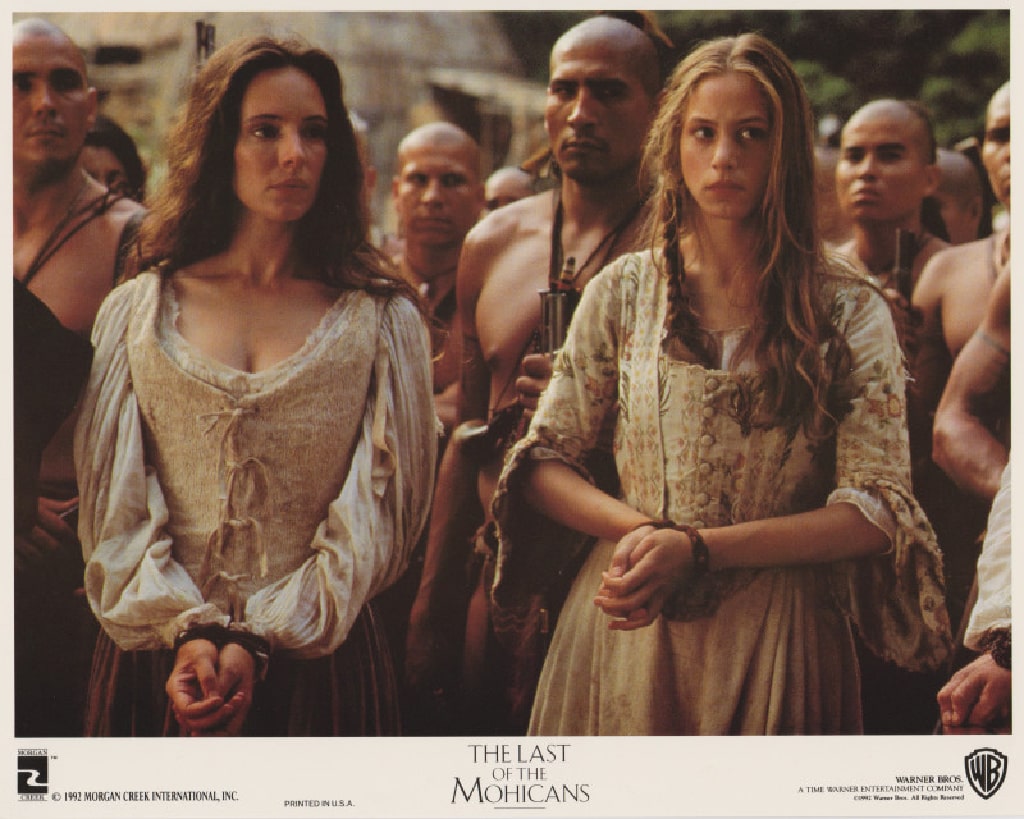
Cora (left) and Alice in the 1993 film. They are scarcely contrasted, though Alice is the fairer. (Incidentally, the novel emphasises Cora's modesty — for example, she is often described as concealing herself behind a veil. But in this film, not so much.)
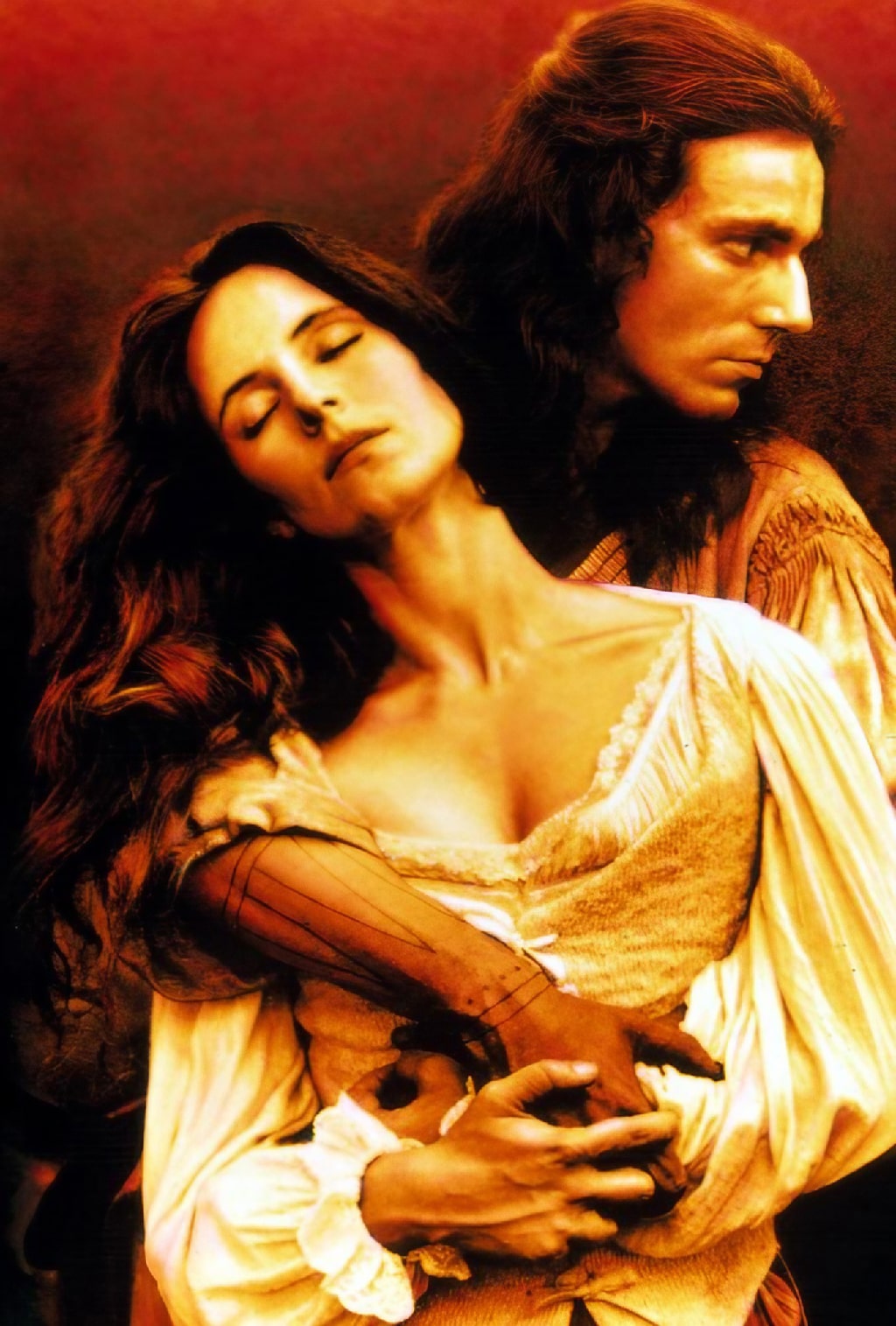
Cora (Madeleine Stowe) with Hawkeye (Daniel Day-Lewis), 1992.
Book illustrations, comics and animations are more likely to emphasise captivating Cora's dark hair and complexion:
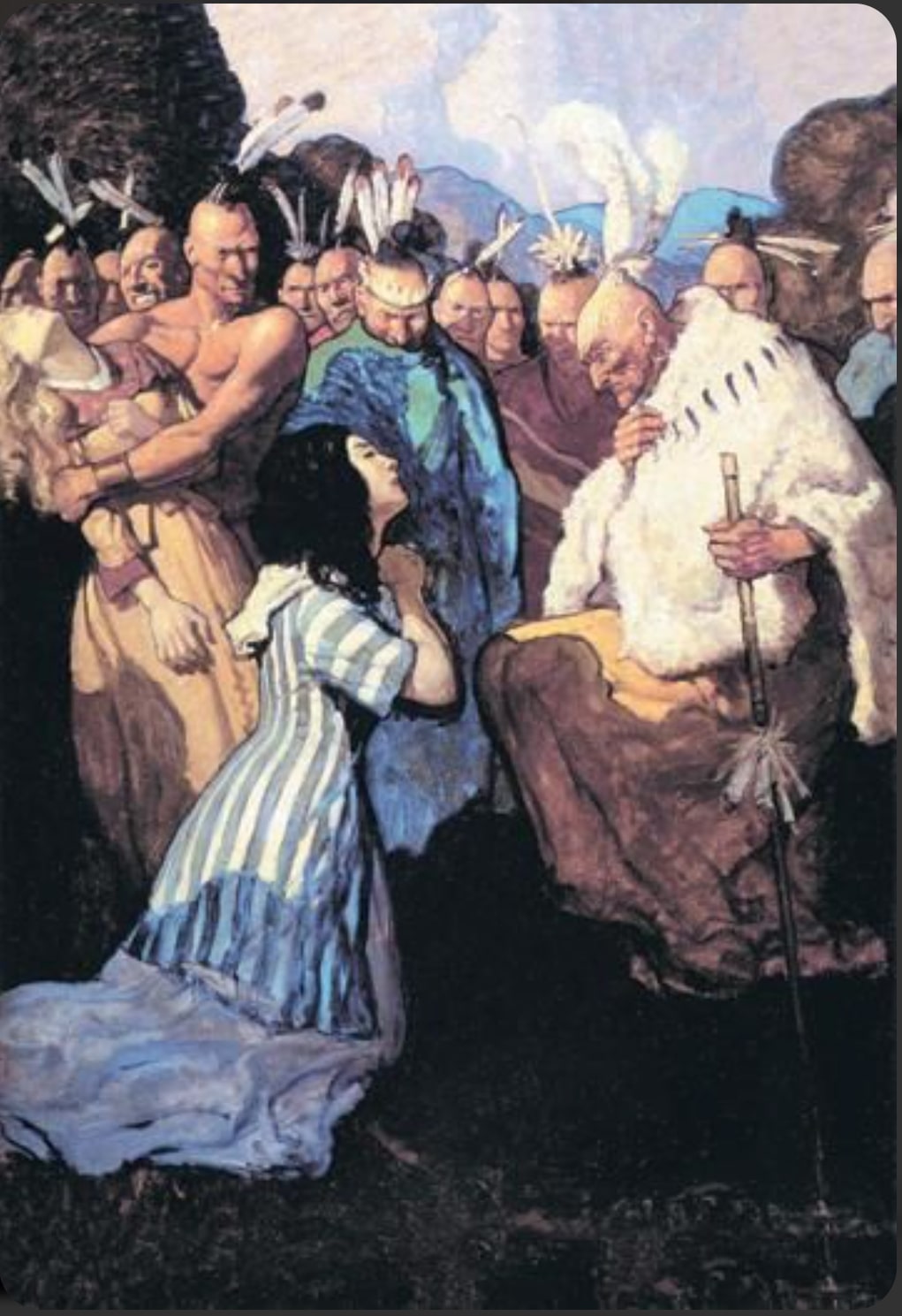
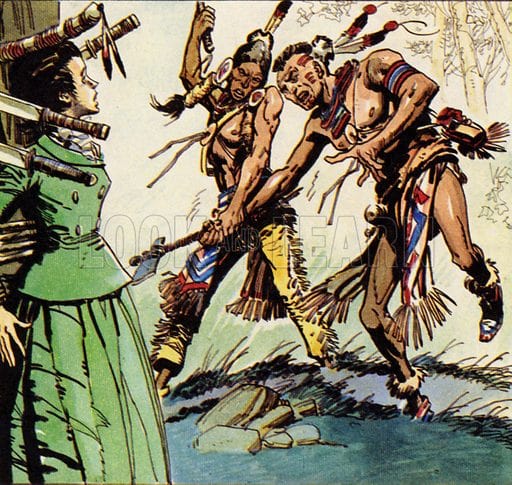
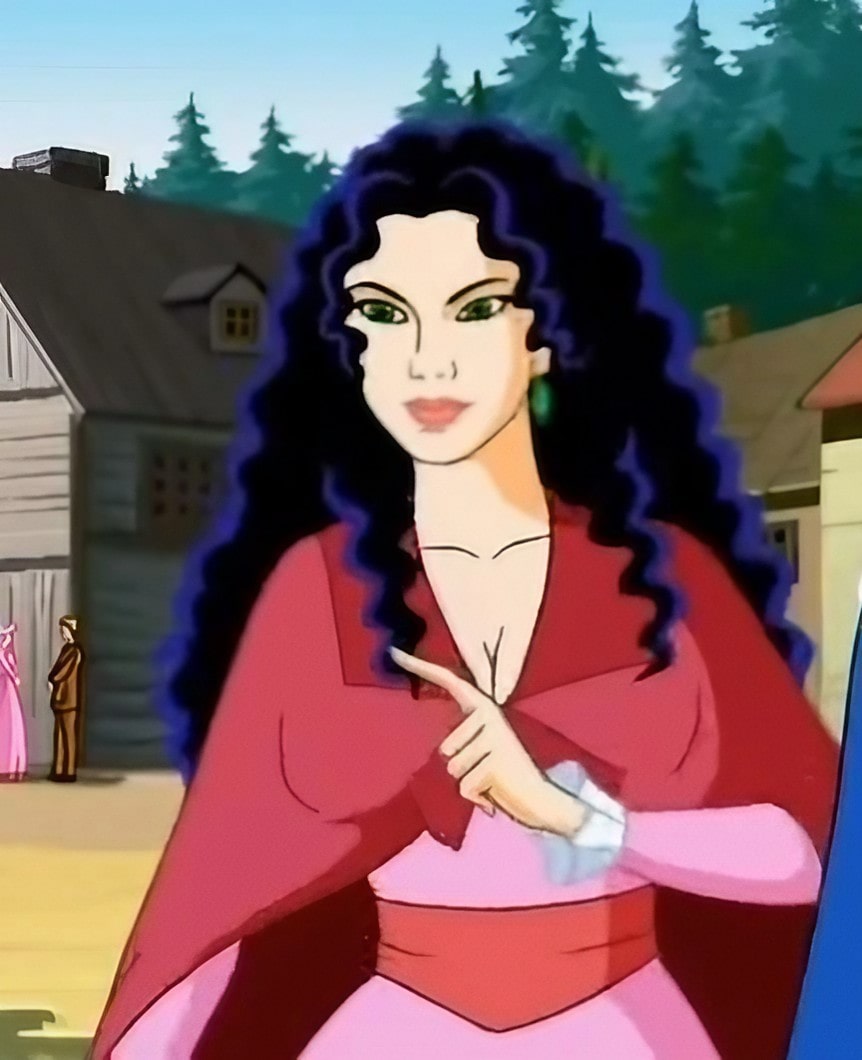
Although it's never even hinted at in the films, the circumstances of Cora's birth are central in the novel. (And hence would have been known to Edward Thomas.) In short, Cora is dark because of her part-African ancestry.
In Chapter 16 of the novel, we learn that her father, Colonel Munro, had travelled to the West Indies, where he met and married Cora's mother — who was "descended, remotely," from someone who had been enslaved:
I had seen many regions, and had shed much blood in different lands, before duty called me to the islands of the West Indies. There it was my lot to form a connection with one who in time became my wife, and the mother of Cora. She was the daughter of a gentleman of those isles, by a lady whose misfortune it was, if you will," said the old man, proudly, "to be descended, remotely, from that unfortunate class who are so basely enslaved to administer to the wants of a luxurious people.
[There is a simply enormous secondary literature on this, which I won't even try to precis here. But if you're interested, get in touch. I'd love to share the material with you.]
But why go on about this here? What's it got to do with Edward Thomas and Wandsworth Common?
Well, let's look again at Edward Thomas's line "The name of the girl Cora has folded itself up in my mind like a gentle snake . . . "
In brief, I believe Cora may have been personified for Edward Thomas in a particular girl in his class at Belleville School — Tottie Armour.
It is a remarkable feature of Thomas's Childhood memoir that he so often names names, hence we now have the wherewithal (thanks to online sources such as censuses, birth and death certificates, and newspaper archives) to find out exactly who he is talking about.
I knew boys and girls in several of streets parallel to ours or crossing it . . . With one of these friends, a girl, I went home once and in her back garden I first saw dark crimson dahlias and smelt bitter crushed stalks in plucking them . . .
Their faces are invisible to me all except one: I can say only that some were fat and the eyes narrow, and that some girls had dark hair, others fair.
The one that I can see has black curly hair, dark eyes and cherry lips; and she is smiling: her name was Tottie Armour. We picked sorrel leaves and ate them among the gorse bushes on Wandsworth Common.
I talked a little about Tottie in a talk I gave on ET a few years ago. At the time, I hadn't made the connection with Cora, so I'd like to pursue it again here.
The Armour family in the 1881 Census
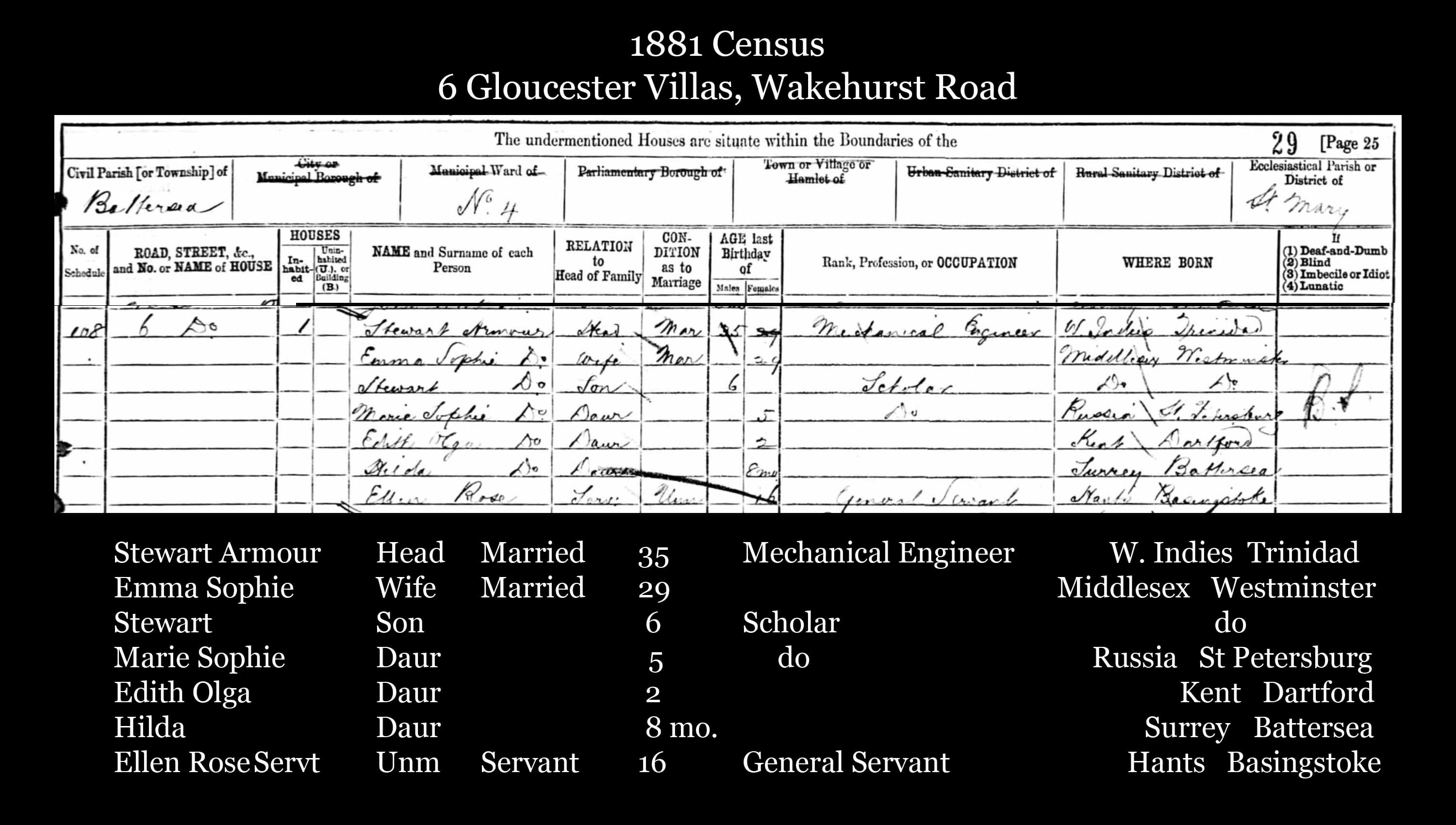
1881 Census: the Armour family, living close to the Thomases on Wakehurst Road.
I assume that "Tottie" is Edith Olga, since she was exactly the same age as Edward Thomas.
[But why "Tottie", a familiar name more usually associated with Charlotte or Dorothea? I don't know, but I have found examples of other Totties who are definitely Ediths.]
Notice that Stewart Armour, the head of the family, is described as a Mechanical Engineer. He must have previously travelled with his family for work since his daughter Marie Sophie, aged 6, was born in St Petersburg, Russia, and Edith Olga has a Russian middle name.
Tottie's father is also described as born in Trinidad. Was he, then, a person of colour? Given Edward Thomas's depiction of Tottie, this seems very possible.
So far as I know, none of Edward Thomas's biographers has investigated Edward Thomas's young girl friends such as Tottie Armour and Mabel Looms. I know a little about what happened to Edith Olga in later life, which I mentioned in the talk, but I'll leave further elaboration for another time.
My own enthusiasm for "Red Indians" was kindled less by literary stimuli than by frequent visits to "the Pictures", aka "the Flicks".
Chronicles' reader Barbara Windsor (nee Barbara Madsen) spent her earliest years in a prefab on St Mark's Triangle. She was kind enough to send me some reminiscences of her school days at the tiny school on the corner of Battersea Rise and Boutflower Road. (I'll share these next month when I discuss the cultural importance of this building, and its role in helping to save Wandsworth Common.)
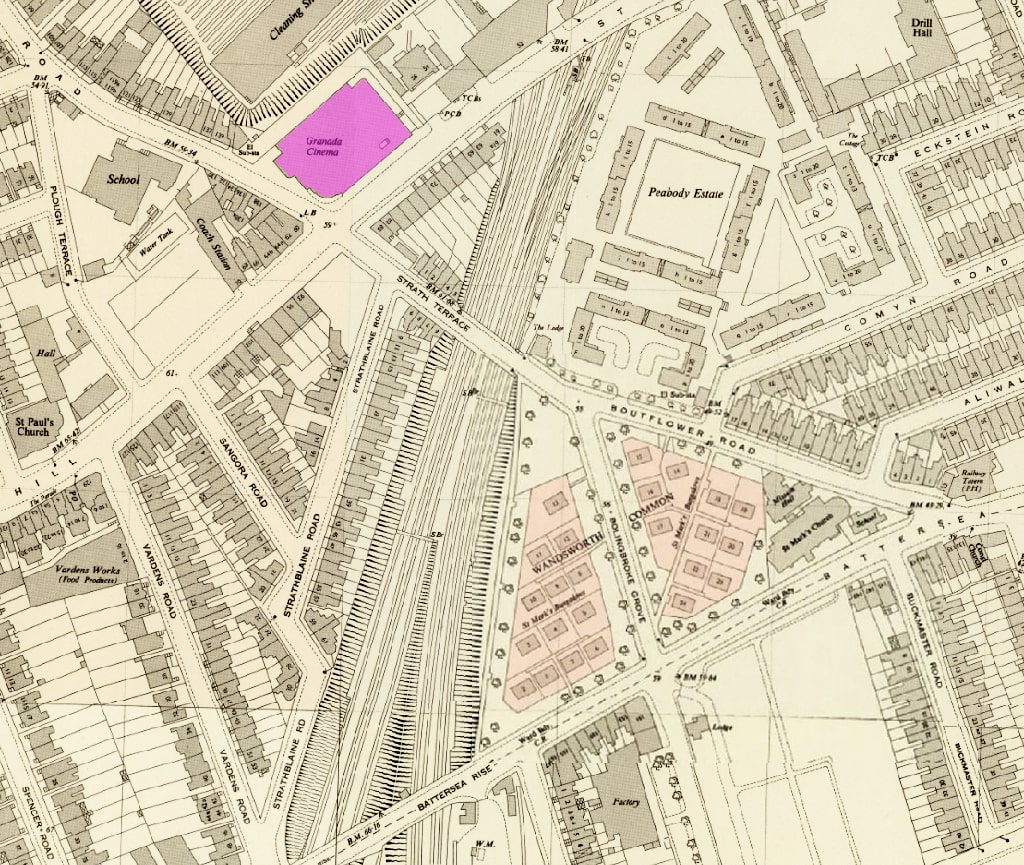
Barbara Windsor's home c.1950: Prefabs on the St Mark's Triangle, and the nearby Granada cinema.
But Barbara also mentions visits to the Granada Cinema on St John's Hill in the early 1950s:
Saturday morning pictures were a regular treat — I'm just amazed to think my sister and I were allowed to go on our own, crossing the main road at the top of Plough Road, clutching our sixpences.
I think we'd be pretty horrified to see six- and seven-year-olds out on their own now without adult accompaniment, but it was pretty much the norm then; and you just had to go the following week, as there was always a cliffhanger at the end of the film, usually with superman about to be crushed!
There was the resident organist who accompanied the children's theme song — "We're all for one and one for all, the Clapham Grenadiers".
I think there might have been a rival Saturday morning pictures at the cinema in Northcote Road — presumably long since gone, and Northcote Road now looking very much upmarket with virtually all the stalls gone.
[This was the Century cinema — see below.]
I remember being taken there with my sister when I was about seven or eight. I think the very first films we saw were 'Dumbo', a cartoon, and the main film was one with the American swimmer/actress Esther Williams — of course we could only go to those films certified as 'U' and nearly always arrived at the cinema half way through the film, staying on to see the first half, then leaving when the second half came round.
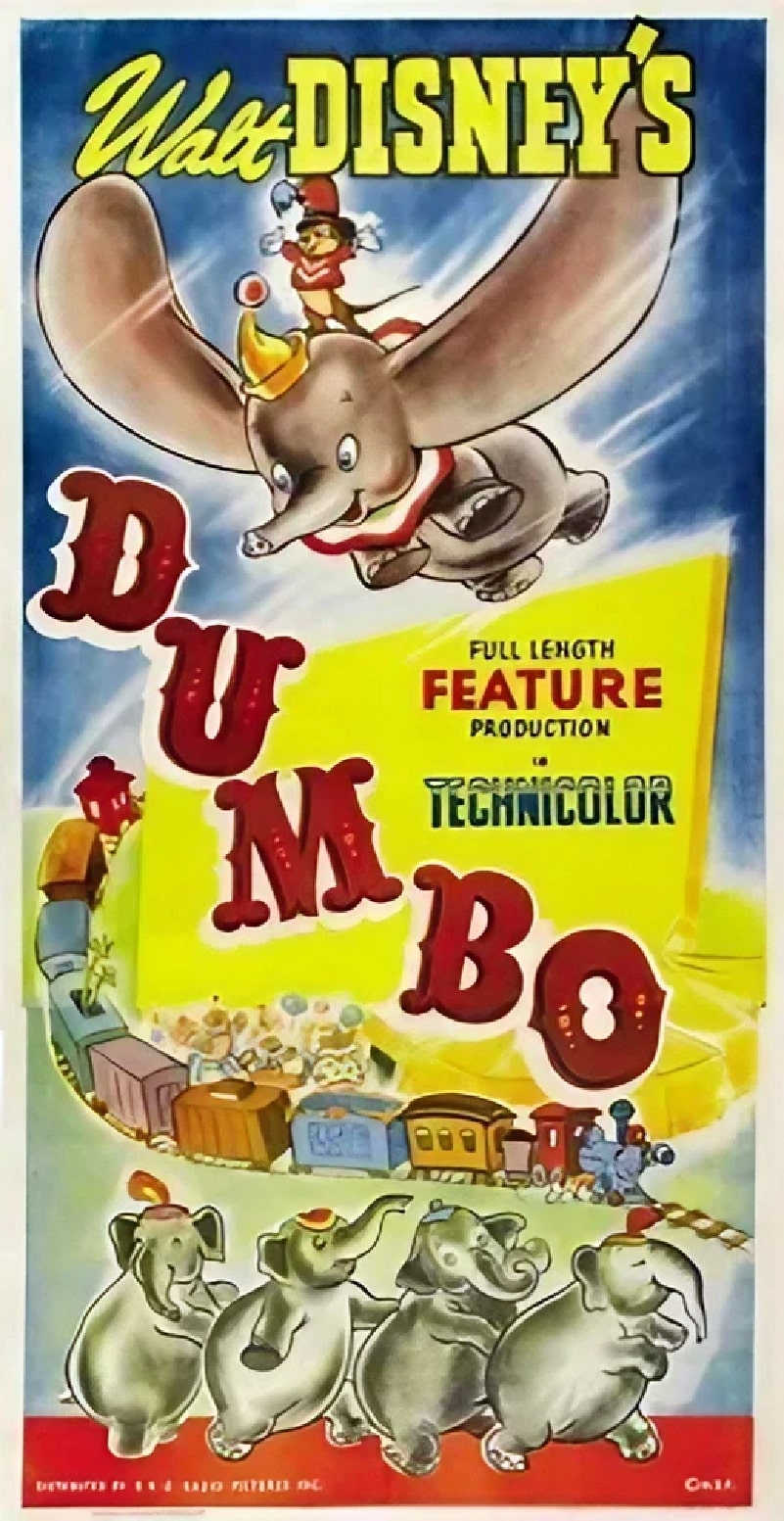
Walt Disney's gorgeous Dumbo came out in 1941, but was frequently shown again in British cinemas in following years.
How did we put up with all that smoke, everyone puffing away on their cigarettes, and no complaints! There was a choice of seats, one shilling and sixpence or one shilling and ninepence I seem to recall, with probably half price for children.
Strangely enough when I was about eighteen, I worked a holiday season in Brixham, Devon, and worked as an usherette in the tiny cinema there. I saw the film Gypsy Rose Lee countless times, and because I came from London and had been to a grammar school, I was trusted with being the ice-cream lady in the interval! My dad was a keen film buff and we regularly took the 'Picturegoer' magazine. Happy times!
[Personal correspondence, March 2025 — Thank you, Barbara!]

The Granada Clapham Junction opened in 1937, probably too late to show the then-curent version of The Last of the Mohicans. However it did screen the film on its re-release in 1946.
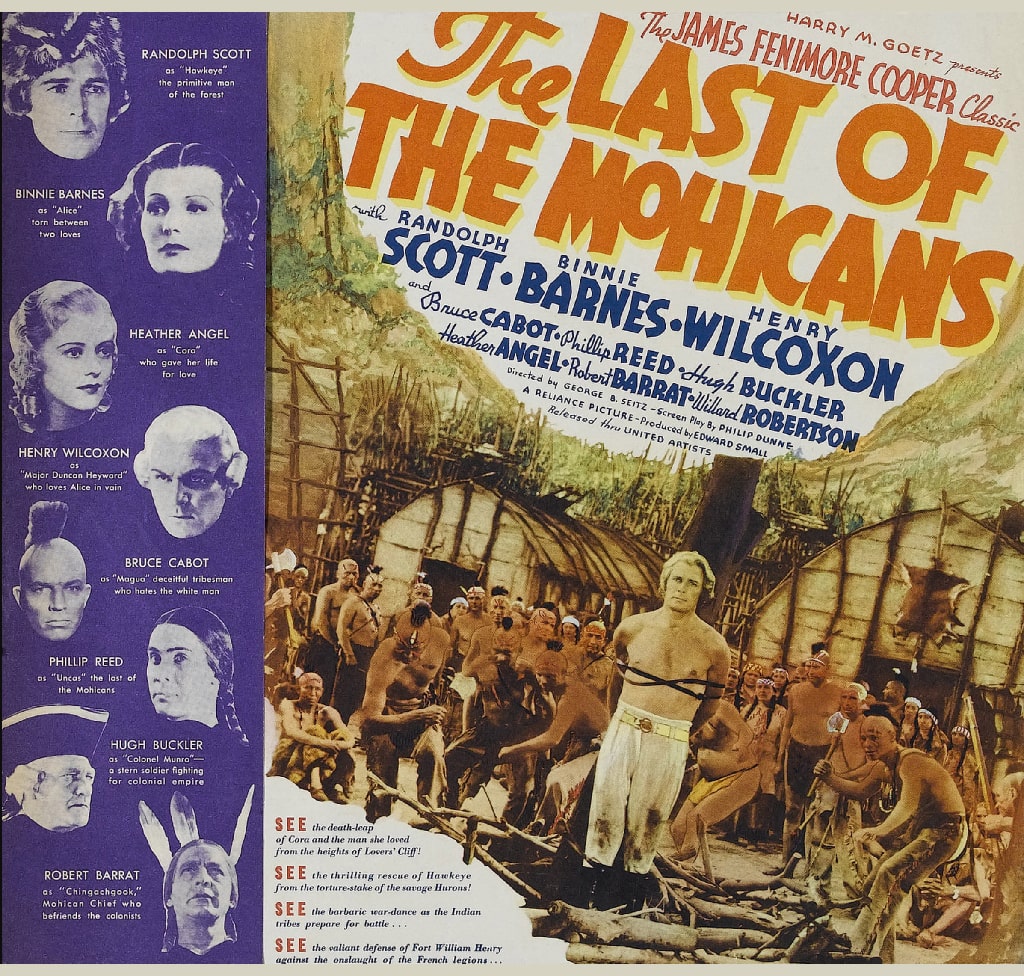
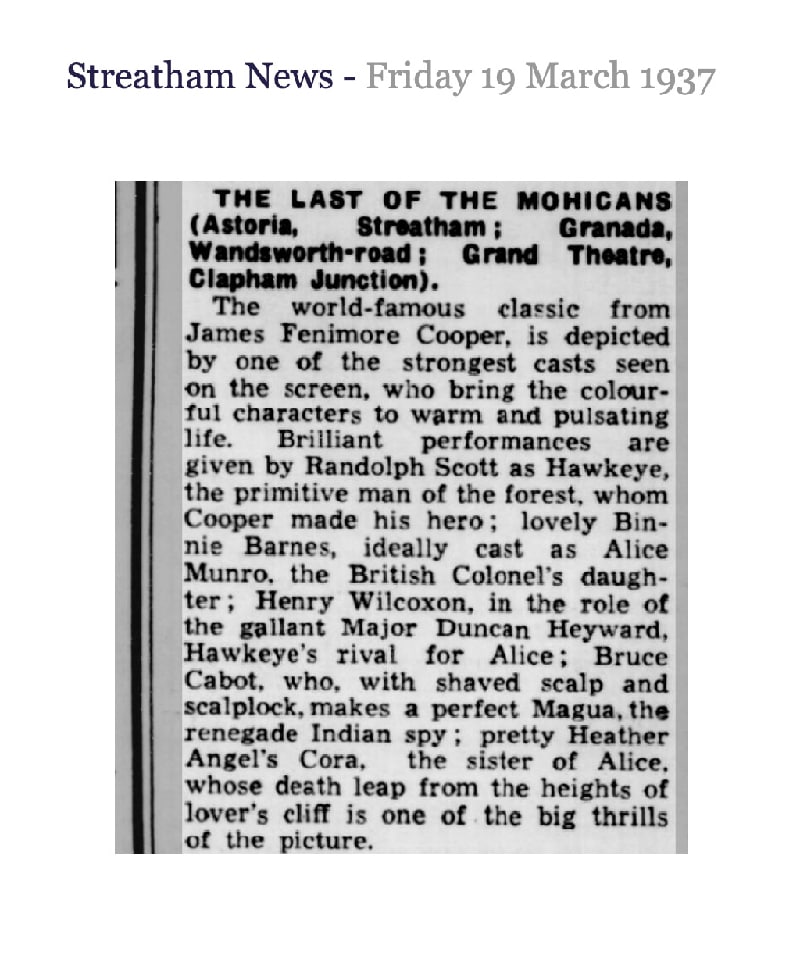
19 March 1937: The Last of the Mohicans was showing at the Granada Wandsworth Road and at the Grand Clapham Junction. (The Granada Clapham Junction was still in construction at this time.)
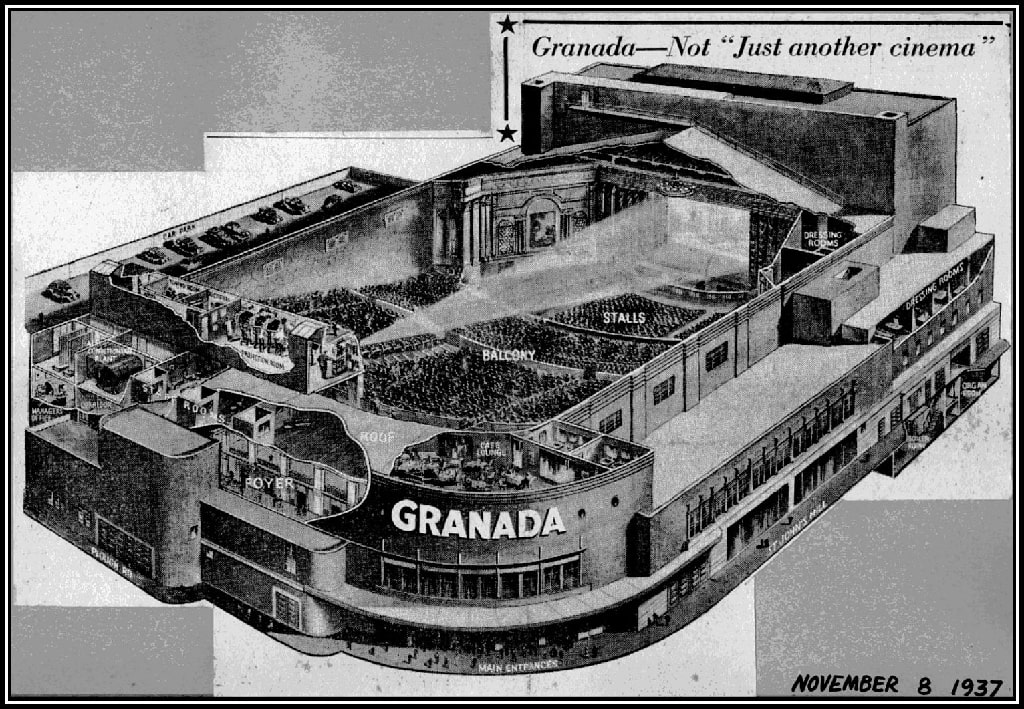
Granada — Not Just another cinema — 8 November 1937. Cutaway illustration.

The song Ghost Riders in the Sky (one of my favourites) as seen and heard at the Granada cinema, Clapham Junction in 1949.
(Click on the image to view a wonderful scene from the film.)
The cinema on Northcote Road that Barbara mentions was the Century.
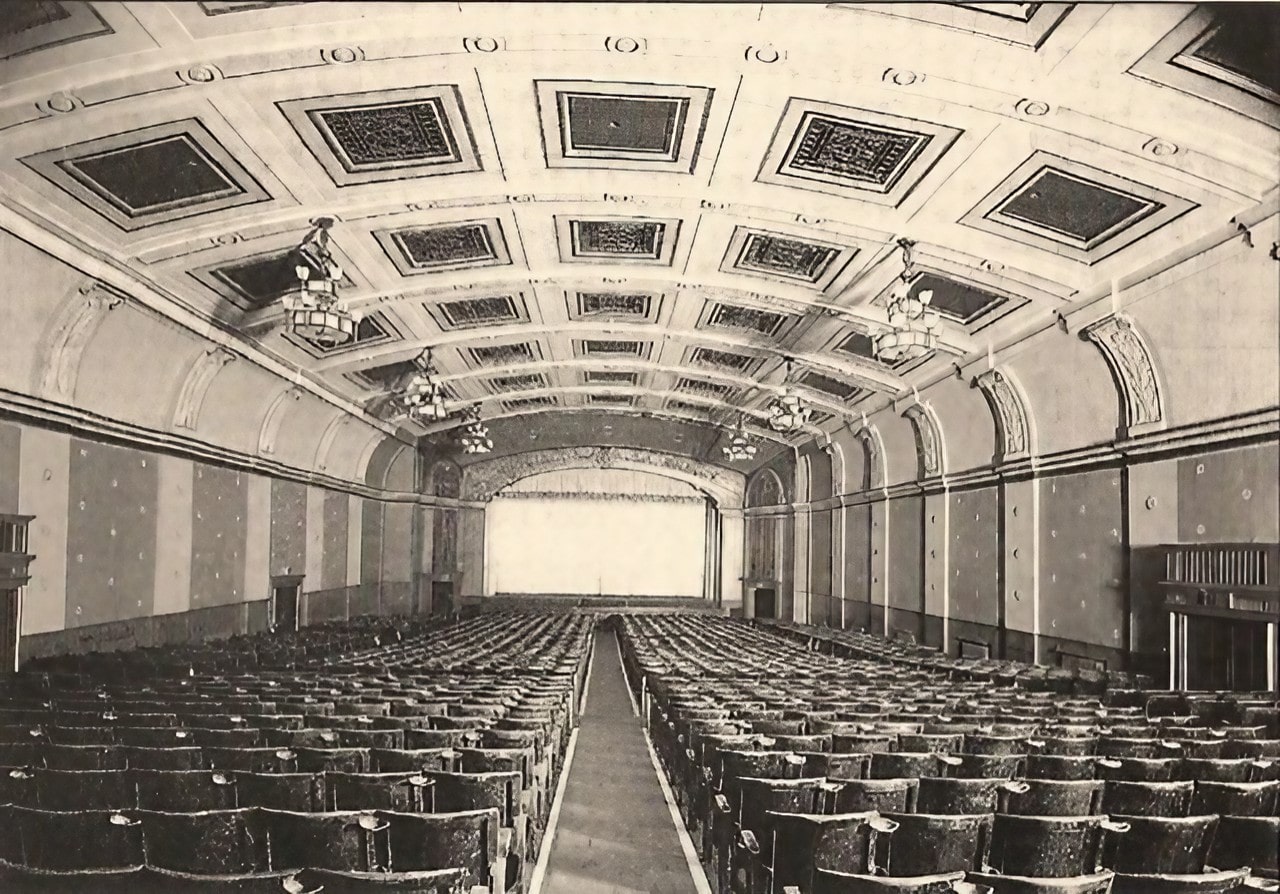
The Century Cinema, 15 Northcote Road
What's in a name?
According to Cinema Treasures.org, the Century started as the Bolingbroke Assembly Hall in 1880, before being converted into a cinema, the Bio-Pictureland Theatre, in 1907. By 1910 it was the Bio-Picture Palace with a seating capacity for 600. From 1917 until around 1923 it was re-named he Bolingbroke Picture Hall. After enlargement and radical refurbishment, it re-opened as the Globe Cinema in 1930. It was re-named the Century in 1951 (which is the name I knew it by) and closed as such in 1964.
The building was then stripped out and converted into a Tesco supermarket, later becoming a KwikSave supermarket and, in 2009, a Somerfield supermarket. By 2013, it was a Co-operative supermarket.
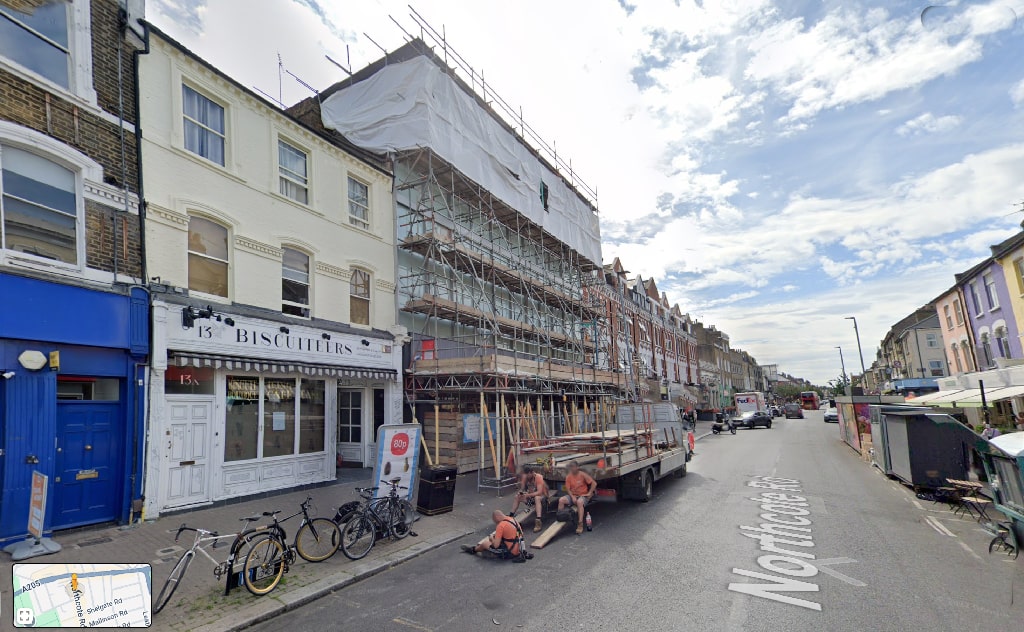
As seen in 2023: yet another future for the former Century Cinema. What is it now?
Local cinemas
(with links to the fabulous Cinema Treasures website)
Granada, Clapham Junction. (See also HoWC: Granada 1949.)
Ruby, St John's Hill
[Hugh Betterton, whose childhood was spent on West Side, wrote:
This was a tour de force! Brought back so many memories of both Saturday morning pictures, as well as other times at the Granada, the Century and The Essoldo (The Grand). The Imperial (I think) is now a hotel almost opposite the entrance to CJ station. Blimey, spoilt or what? I also went to the Gaumont in Wandsworth High Street. Those songs also brought a recall of how Granadiers were encouraged to sing on stage during intervals, as were Gaumonteers! All for 6d and 2 hours of film and fun. Think that the cinemas were heaving with kids aged 7 — 12.
Good stuff!
Hugh and I also exchanged memories of children being invited onto the stage in front of the screen. For example, I recalled my childhood pal Ronnie Thomas (who I have mentioned before) showing off his tricks with a yoyo at the Classic, Tooting Bec. And Hugh remembers spinning his hula hoop.
Thanks, Hugh!]
The earliest appears to be the Lone Ranger, which started in 1949, the year of my birth. Few people had in Britain TVs then, but over the next ten years numbers rocketed. Cowboys programmes proliferated.
Here are some of the Western-themed TV programmes I recall, all from the US (of course), and there were a lot. The year shown in brackets is when the series started, but it sometimes took a few years for episodes to be shown on British TV. Some of the series were repeated for many years after their first showing.
— Bonanza (1959)
— Champion the Wonder Horse (1955)
— Cheyenne (1955)
— Circus Boy (1956)
— The Cisco Kid (1950)
— Fury (1955)
— The Lone Ranger (1949)
— Gunsmoke (1952)
— Maverick (1957)
— The Range Rider (1951)
— Rawhide (1959)
— The Adventures of Rin-Tin-Tin (1954)
— Riverboat (1959)
— Wagon Train (1957)
[For a comprehensive (and intensely evocative) list, with links, visit Wikipedia: 1950s Western (genre) television series.]
Catchy signature tunes were vital, such as "Champion the Wonder Horse":
Like a streak of lightning flashing cross the sky
Like the swiftest arrow whizzin' from a bow
Like a mighty cannonball he seems to fly
You'll hear about him everywhere you go
The time will come when everyone will know the name of
Champion, the Wonder Horse!.[Hear Champion, the Wonder Horse here.]
Many were sung by the wonderful Frankie Laine, including Rawhide (which introduced Clint Eastwood as young, impetuous Rowdy Yates).
Keep rollin', rollin', rollin'
Though the streams are swollen
Keep them dogies rollin', Rawhide
Through rain and wind and weather
Hell-bent for leather
Wishin' my gal was by my side
All the things I'm missin'
Good vittles, love, and kissin'
Are waiting at the end of my ride
Move 'em on, head 'em up
Head 'em up, move 'em on
Move 'em on, head 'em up
Rawhide
Cut 'em out, ride 'em in
Ride 'em in, cut 'em out
Cut 'em out, ride 'em in
Rawhide
Keep movin', movin', movin'
Though they're disapprovin'
Keep them dogies movin', Rawhide
Yeah!
[Hear Rawhide here.]
But the biggest, brightest, most bodacious Western for us all was the 1956 film Davy Crockett (starring Fess Parker). It sparked an obsession throughout the country with "coonskin" (i.e. raccoon) hats with little tails behind, which looked like the family cat). You will notice that Davy looks almost identical to the 1930s version of Hawkeye, and not a bit like Daniel Day-Lewis's semi-Mohican version.
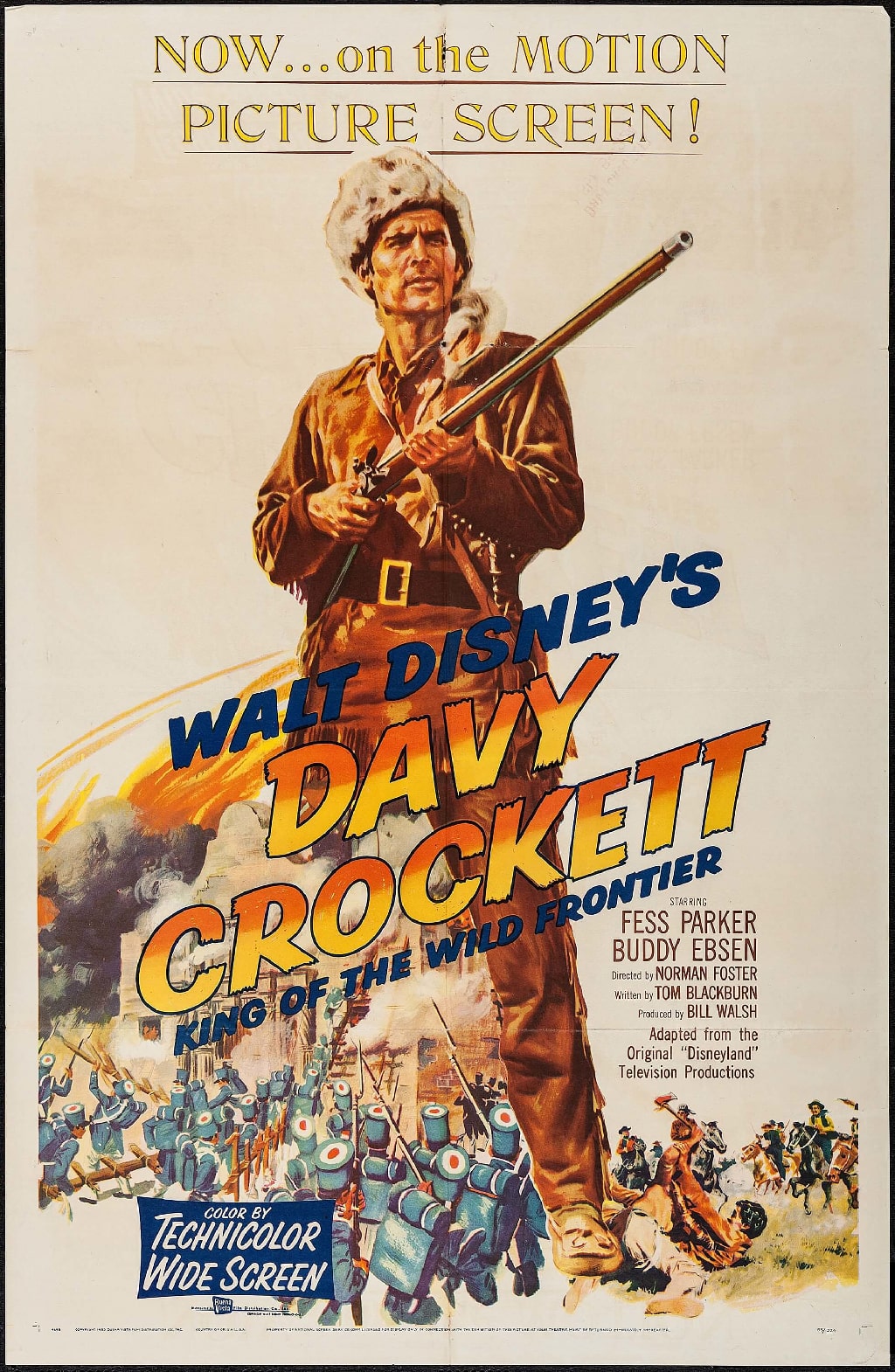
Davy Crockett: King of the Wild Frontier, 1956
. . . .and of course this song:
Born on a mountain top in Tennessee
Greenest state in the land of the free
Raised in the woods, so's he knew ev'ry tree
Killed him a b'ar when he was only three
Davy, Davy Crockett, king of the wild frontier.
Some early versions of the Ballad of Davy Crockett
— YouTube: Bill Hayes
— YouTube: Fess Parker
— YouTube: Tennessee Ernie Ford
— YouTube: The Mellomen (with lyrics)
— [Max Bygraves also recorded a version for the British market, but we won't mention that.]
See also:
— Wikipedia: The Ballad of Davy Crockett
— Wikipedia: Coonskin Cap
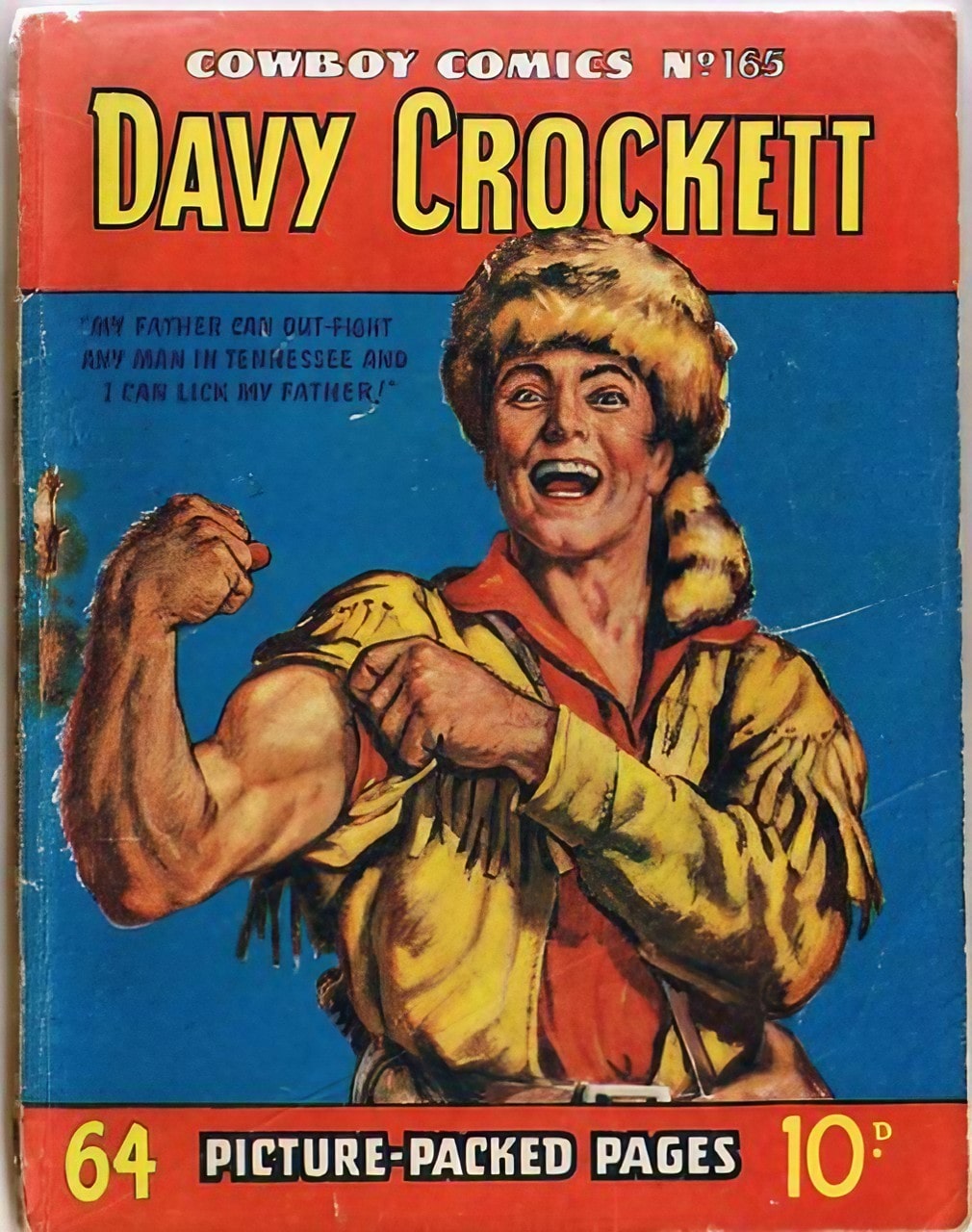
Davy Crockett, Cowboy Comics no.165.
Our chief delight in the song was in its infinite potential for parody, customisation and localisation. For our purposes, the song Davy Crockett offered endless opportunities:
Born in a tenement* in Battersea
'e killed 'is Ma when 'e was only free [three]
Chopped up 'is Pa when 'e was only four
Now 'e's lookin' for 'is Bruvver-in-Law
Davy, Davy Crockett,
King of the Teddy boys.[* Or "bungalow"]
Here's another Battersea-themed version recorded by Iona and Peter Opie in their indispensable The Lore and Language of Schoolchildren (1959):
Born on a roof top in Battersea,
Joined the Teds when he was only three,
Coshed a copper when he was only four
And now he's in Dartmoor for evermore.
Davy, Davy Crockett,
King of the Teddy boys.[Similar versions to the above reported in Great Bookham, July 1956; Swansea, September 1956; Romford, April 1957. Many more feature on pp.118—120]
Here's a nice version:
Born on a hobby horse in Garratt Green * Fed every day on Stork Margarine Killed himself a cat when he was only three That's how he got his Davy Crockett hat Baby, Baby Crockett, King of the Wild Frontier.
[* Confession: the verse the Opies report refers to Ardwick Green, and was recorded in Manchester. But I couldn't help myself.]
[On Baby Crockett as a comic character in his own right, see below.]
Before we move on, I must mention one of our old jokes:
Q. "How many ears has Davy Crockett got?"
A. "Three: A left ear . . . A right ear . . . And a wild frontier."
Here's another reference to Davy Crockett, which the Opies' volunteer researchers recorded in Tooting in October 1956, sung to the tune of "Out of Town":
Say what you will,
School dinners make you ill,
And Shepherd's Pie
Makes David Crockett cry;
All school din-dins
Come from pigs' bins
- That's no lie.[Lore and Language, p.162.]
All of these recollections can be dated very exactly. According to the Opies, David Crockett-fever had reached everywhere by the summer holidays of 1956, but that "At the end of the summer Crockett play and costume disappeared as suddenly as it arrived."
Yet the song, and its lively variants, lasted much longer. And here I am, recollecting it all again 70 years later.
Do you remember any of these songs, rhymes and jokes? Did you have different versions of your own?
[Stephen Midlane also remembers the long-running Baby Crockett comic strip. This started in The Beezer only months after the film was first shown in 1956, then ran in various comics and annuals until 2002 (Wikipedia: Baby Crockett.]
Here's Baby Crockett's song, as recollected by Stephen:
Born in a bungalow and not yet three,
The wildest babe in the whole country,
The terror of his ma and his pa is he,
And his grandpa feels safer up a tree.
Baby, baby Crockett, king of the family.
Thanks, Stephen!]
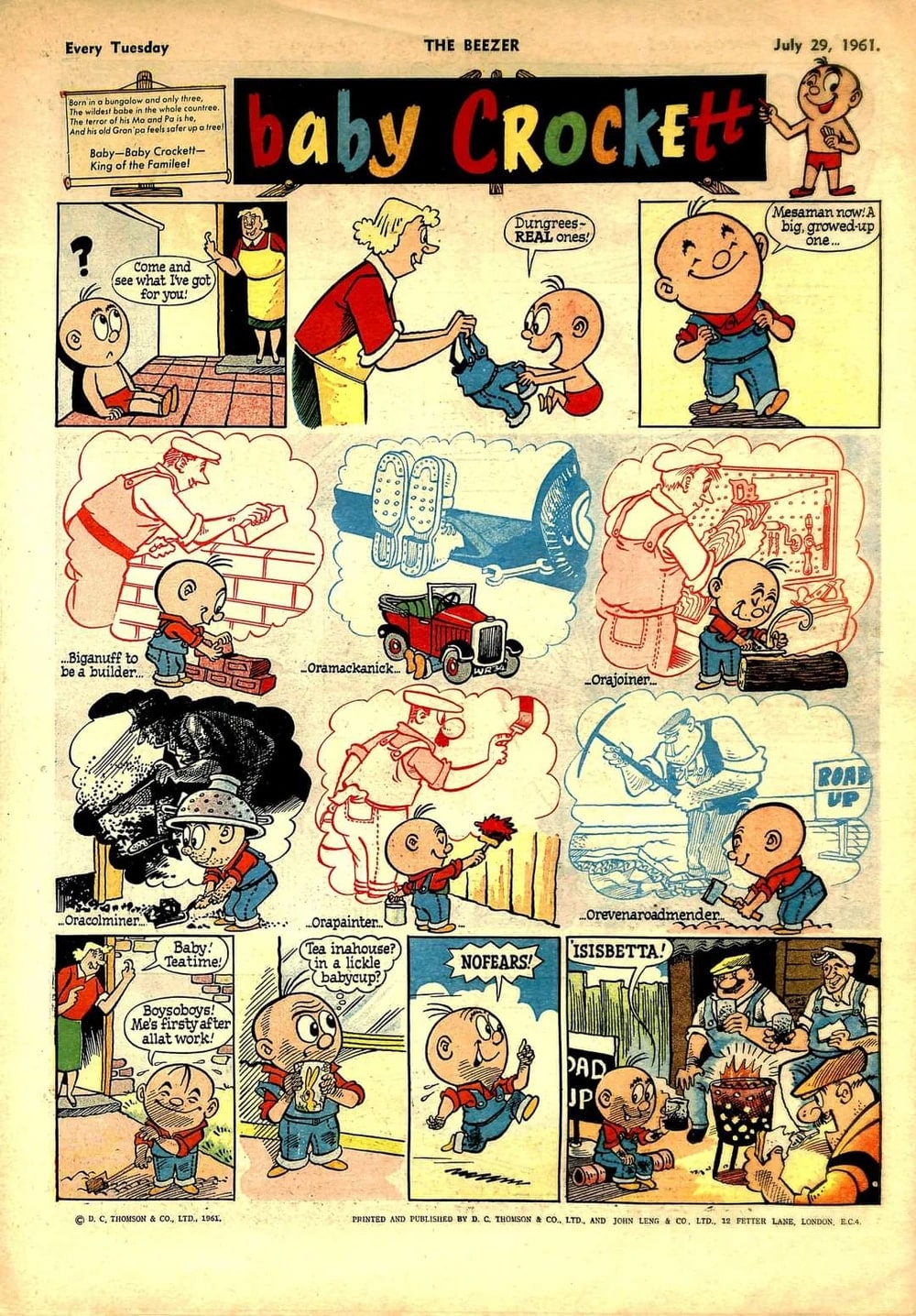
Baby Crockett in The Beezer, 29 July 1961. Any connection with the Wild West as long gone.
CAPTION-2
I can't forget something that happened on the Scope* on a snowy Christmas Day in the mid-1950s.
[ * Not that we ever called it the Scope — we always called it "Bushy Common", or the "Rough Bit". We'd never heard of the Craig Telescope. When was it first called the Scope? ]
In December 2020 I compiled some notes about childhood on the Common in the 1950s. Here's part of what I wrote.
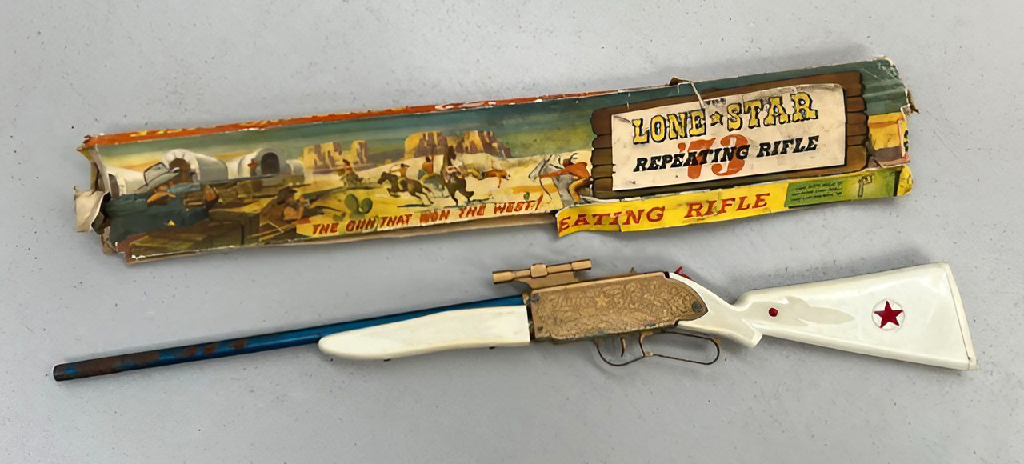
Lone Star Repeating Rifle, white, 1950s. This is very much like my happy gun of memory. Notice the distinctive red star on the stock.
I was terrifically excited to be given a Lone Star toy rifle with a white stock that fired caps. Being Christmas, I couldn't knock on anybody's door to find out if they could come out to play. So I went over Bushy Common by myself — to lie in the tussock grass, to edge forward through the mud, pretending to be a Sioux Indian brave, a Cavalry Scout or a Cowboy.
Two boys, a few years older than me, grabbed my gun and taunted me with it for while, raising it high above their heads and threatening to smash it on a tree trunk. I tried to get them to give it back, but they wouldn't. Over and over again they made to smash the gun. The more I pleaded, the more enthusiastically they tormented me.
Of course, eventually they tired of the game. They'd had enough of all the taunting and the tears. So they smashed the gun on a tree trunk anyway, and set off home in time for Christmas lunch.
Ah well, that was the 1950s for you, and as a child there was always a certain riskiness associated with the Common. Not only were there the "big boy" bullies, but there was a lot of talk about "Teddy Boys", who were said to carry an arsenal of flick-knives, razors, and bicycle chains. (As it happens, I was never troubled by Teds.)
On the one hand, parents and Parkies were very strict, and exercised absolute powers over us. On the other, we were left to our own devices away from our home for hours on end. Children brought each other up in those days, adults played little part. Especially on the Common.
[* Edward Thomas tells a wonderful story of receiving a toy sword, scabbard and belt for Christmas. Having no one to admire his sword, he too goes "up the Common" and walks backwards and forwards among the elms on Bolingbroke Grove. By great good fortune, he eventually meets Mabel Looms, out strolling with her family. He parades before her, believing her to be impressed by his "swinging sword" (pp.34-35).]
Reader David Ainsworth shared a gun-related reminiscence:
I think that my Lone Star or equivalent rifle survived a year or two of combat and many reels of caps, but my beautiful six-shooter had a very short life. Soon after being given it, showing it to a friend in the street who asked me to pretend to draw it and menace him with it, he showed me a recently-learned trick (from a film?).
He kicked it out of my hand and the pavement disassembled it, and repair was beyond even my dad. Very sad, but, I think, an unintentional result.
These memories stick. (There is always Ebay to soothe me).
Thanks, David!]
Indian Crafts and Lore was one of my all-time favourite non-fiction books at Earlsfield Primary School, Transmere Road School. I found a second-hand copy of it quite recently. It is exactly as I remembered it. Full of information about different tribes, but best of all it was in colour with lots of art and craft activities. In the largely leaden monochrome 1950s, this was a special treat.
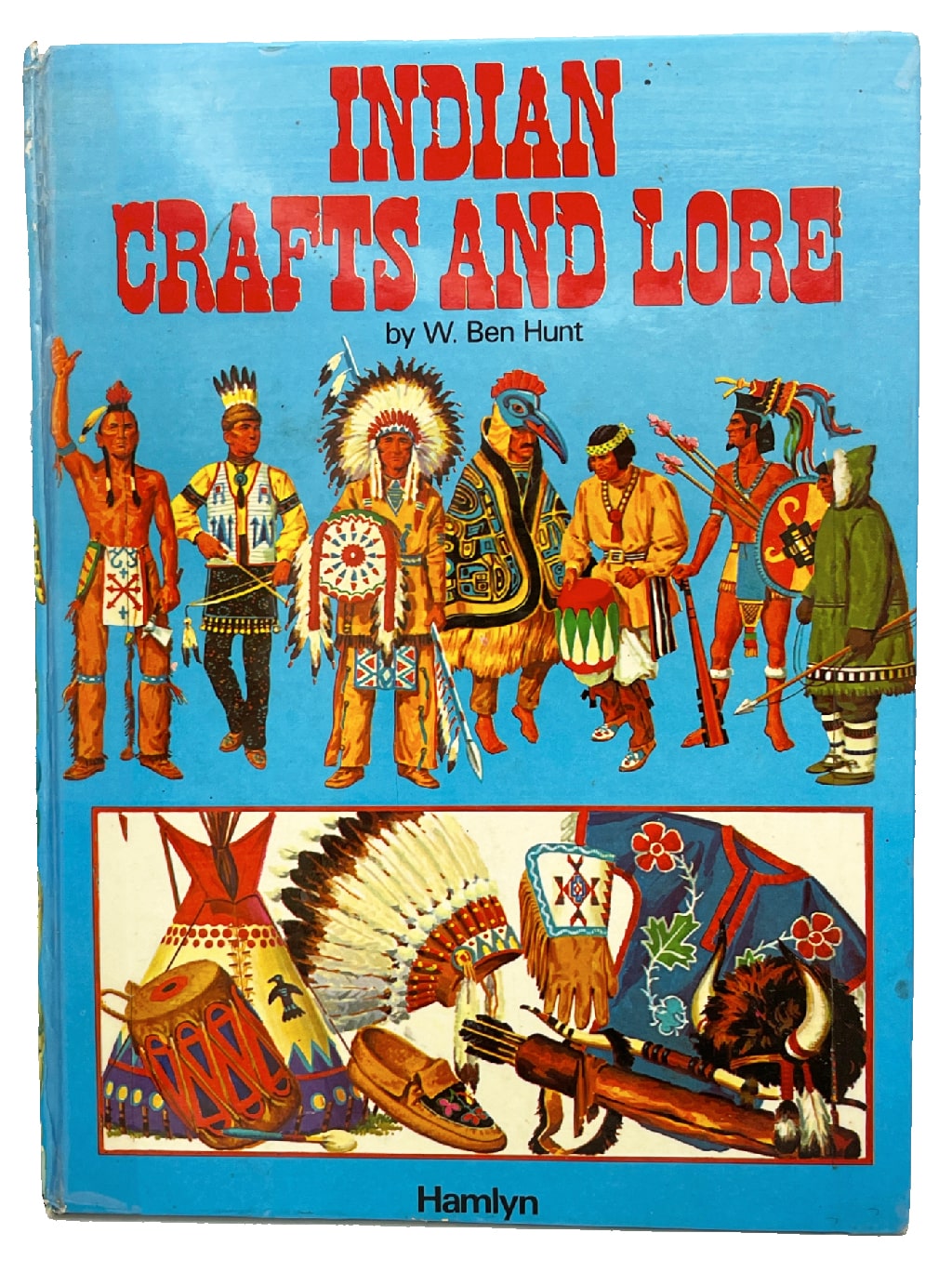
Indian Crafts and Lore, W. Ben Hunt (1954).
No, thinking about this again, I realise that something else that made this book so special was that it was deeply respectful of native Americans. The contrast with what we saw on the screen at Saturday Morning Pictures could not have been greater.]
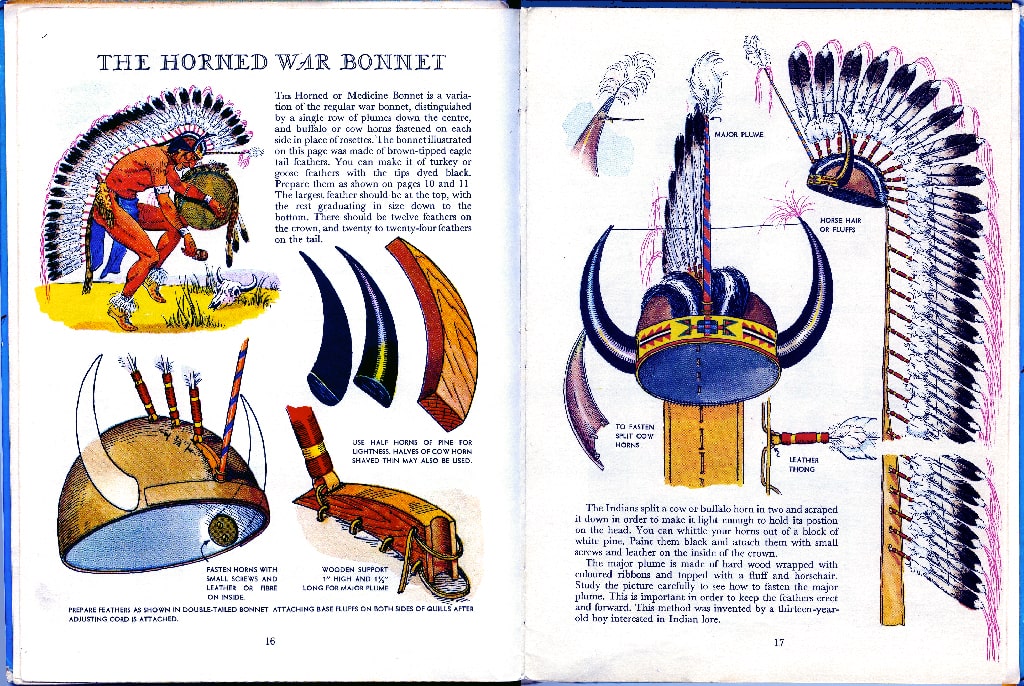
How to make a Horned War Bonnet
I was reminded of this in January 2021, when I saw images of the "QAnon Shaman", wearing horns with a coonskin hat.
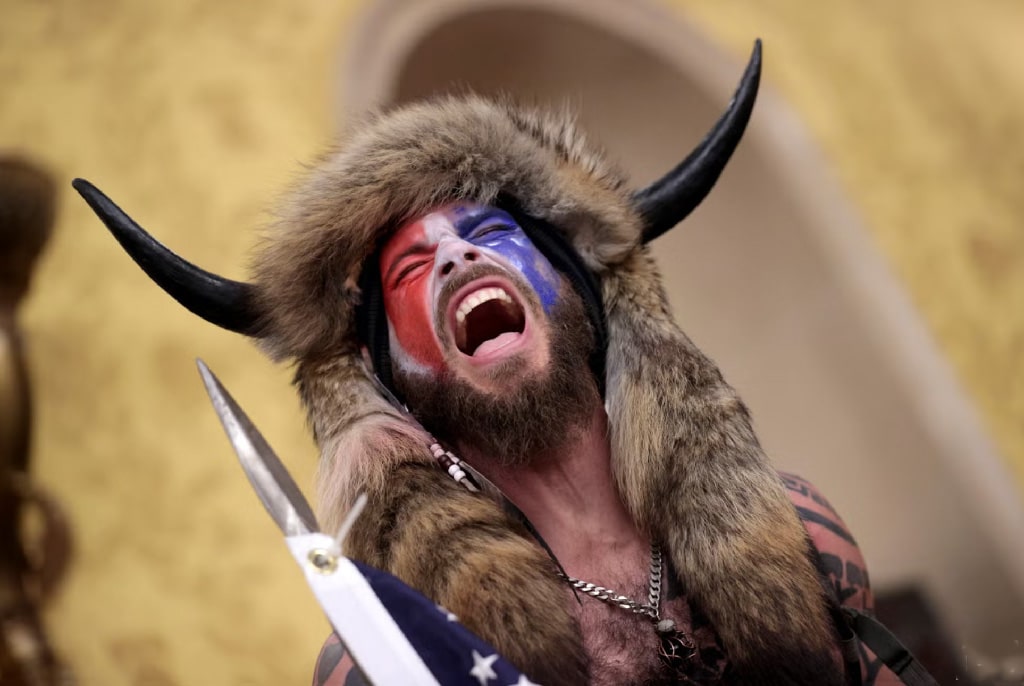
[Note to self, a few weeks after after publication of these Chronicles:
I've completely neglected to write anything about bows and arrows, which were a big part of our childhood between 8 and 10, when I was living at Heathfield Court. We spent hours and days selecting and cutting straight branches for bows, and sticks as arrows, adding weights (such as nuts) to the pointy ends of the arrows (but never, I think, flights, to make them go farther.
We did target practice in the back yard (I sometimes got up early to get some shooting in before setting off for school), or long-distance competitions on the lawn in front of the block. Our longest flights nearly (but not quite) reached from end to end.
How is it possible nobody lost an eye (though we often talked about someone who nobody knew personally who had indeed lost an eye that way)?]
.My candidate for a new Wandsworth Blue Plaque: the former St Mark's Infants School, Battersea Rise:
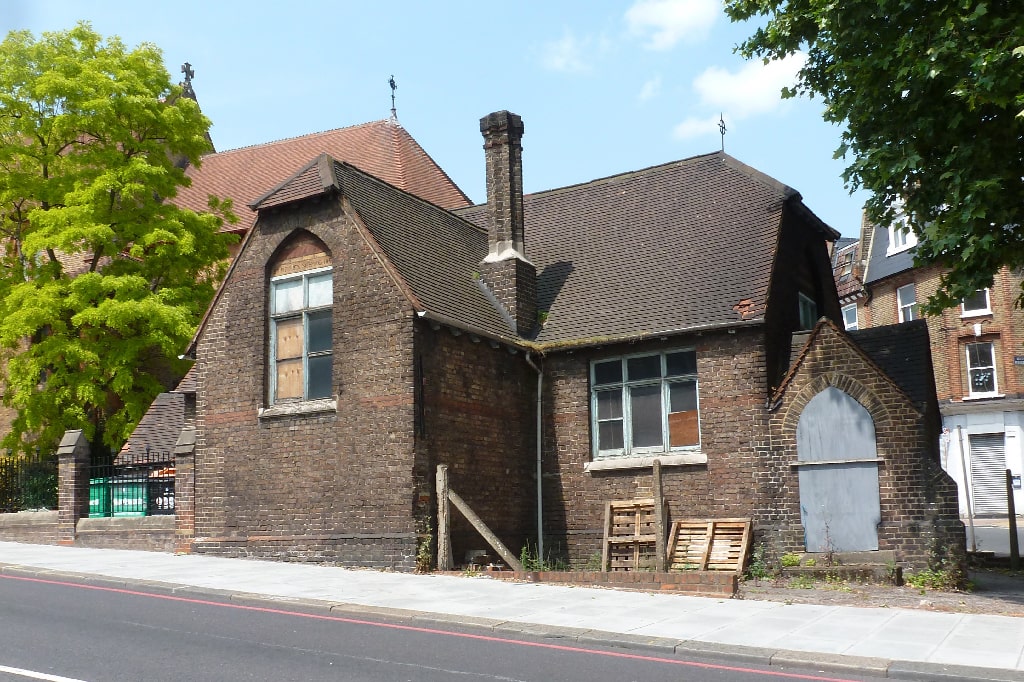
Tiny St Mark's (originally St Mary's) School was built on the Common 1866—67. (The church followed later.) This photograph shows it a few years ago, before a splendid restoration and rebirth as the studio of Dow Jones Architects.
This little school is hallowed ground for Wandsworth Common enthusiasts because Samuel Sullings, our very own martyr, was feted there on his release from prison in July 1870:

WANDSWORTH COMMON.
Samuel Sullings, who was imprisoned with hard labour for breaking down fences on Wandsworth-common, and subsequently released on a memorial presented to the Home Secretary by Sir C. W. Dilke M.P., was entertained by a number of his fellow workmen at the Infant School, Battersea, on the 9th inst.
Sullings appeared in a new suit of clothes, hat, and boots, which were paid for by a few friends. The workmen have made a subscription, which will placed in the Post-offce Savings Bank.
Mr. Churchwarden Buckmaster occupied the chair, and made a speech, in which he endeavoured to show that those who had erected the fences were more guilty than Sailings; and the idea saying to poor men, when their rights and enjoyments were taken away by rich people, that if they feit aggrieved they could proceed by action at law or indictment, was simply adding insult to injustice. (Cheers.)
The chairman then referred to various matters connected with the Common, and expressed a hope that would not again he necessary for poor working men to suffer imprisonment in defence of what they believed to be their rights; he looked with hope and confidence to the result the forthcoming City meeting.
Three cheers for Mr. Buckmaster, three groans for those who had enclosed the Common, and a vote of thanks for the vicar for allowing the use of the schoolroom, concluded the proceedings.
[BNA: Link]
I'll explain the background and implications in a few weeks' time.
SO many more stories still to tell. But that's all for now, folks.
Send me an email if you enjoyed this post / want to comment on something you've seen on the site / would like to know more — or just want to be kept in touch.
If you would like to receive notifications of new Chronicles, let me know . . .
Philip Boys ("History Boys")
March 2025
— Friends of Wandsworth Common
— Wandsworth Historical Society