The History of Wandsworth Common

Home›Mount Nod›Huguenots in the Newspapers

Last modified: 12 October 2026 · Build 1


Huguenots in the Newspapers

Newspaper cuttings about the Huguenots of Wandsworth and their burial ground at Mount Nod, in date order, transcribed in full. The spelling and punctuation are as printed; uncertain readings are in square brackets with a question mark. Click on any cutting to enlarge it. More will be added as I find them.

— 16 May 1896: “The Huguenot Burial Ground: an appeal to Wandsworth”, with Hedley Fitton’s drawing (Daily Chronicle)

— 8 January 1897: “The Huguenot Cemetery”, a protest against turning it into a recreation garden (Echo)

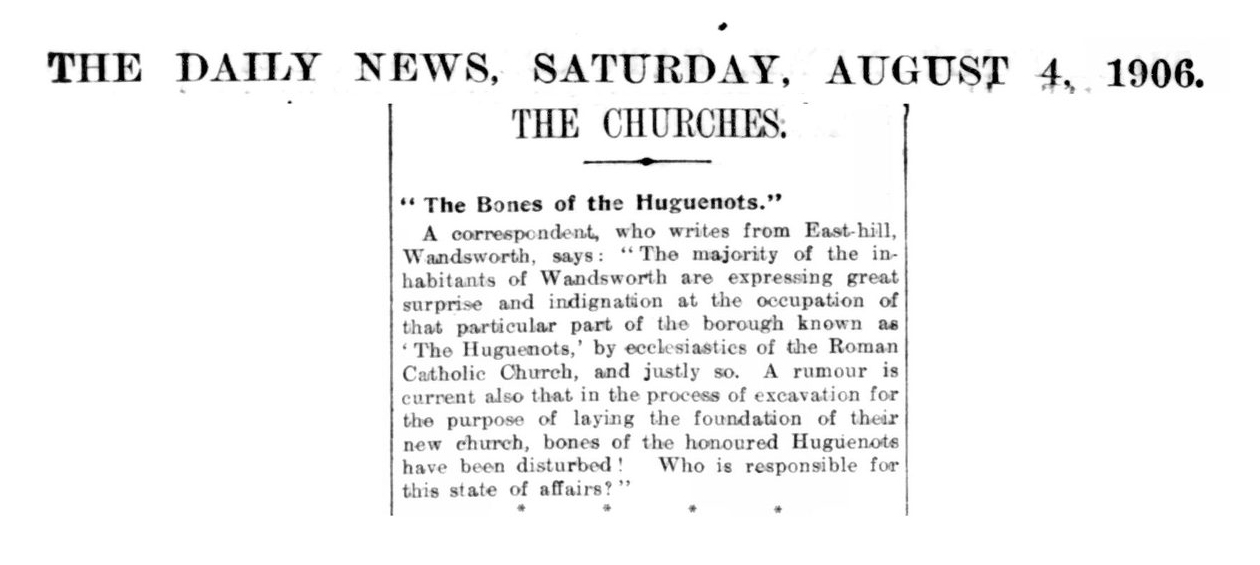
— 4 August 1906: “The Bones of the Huguenots” (Daily News)

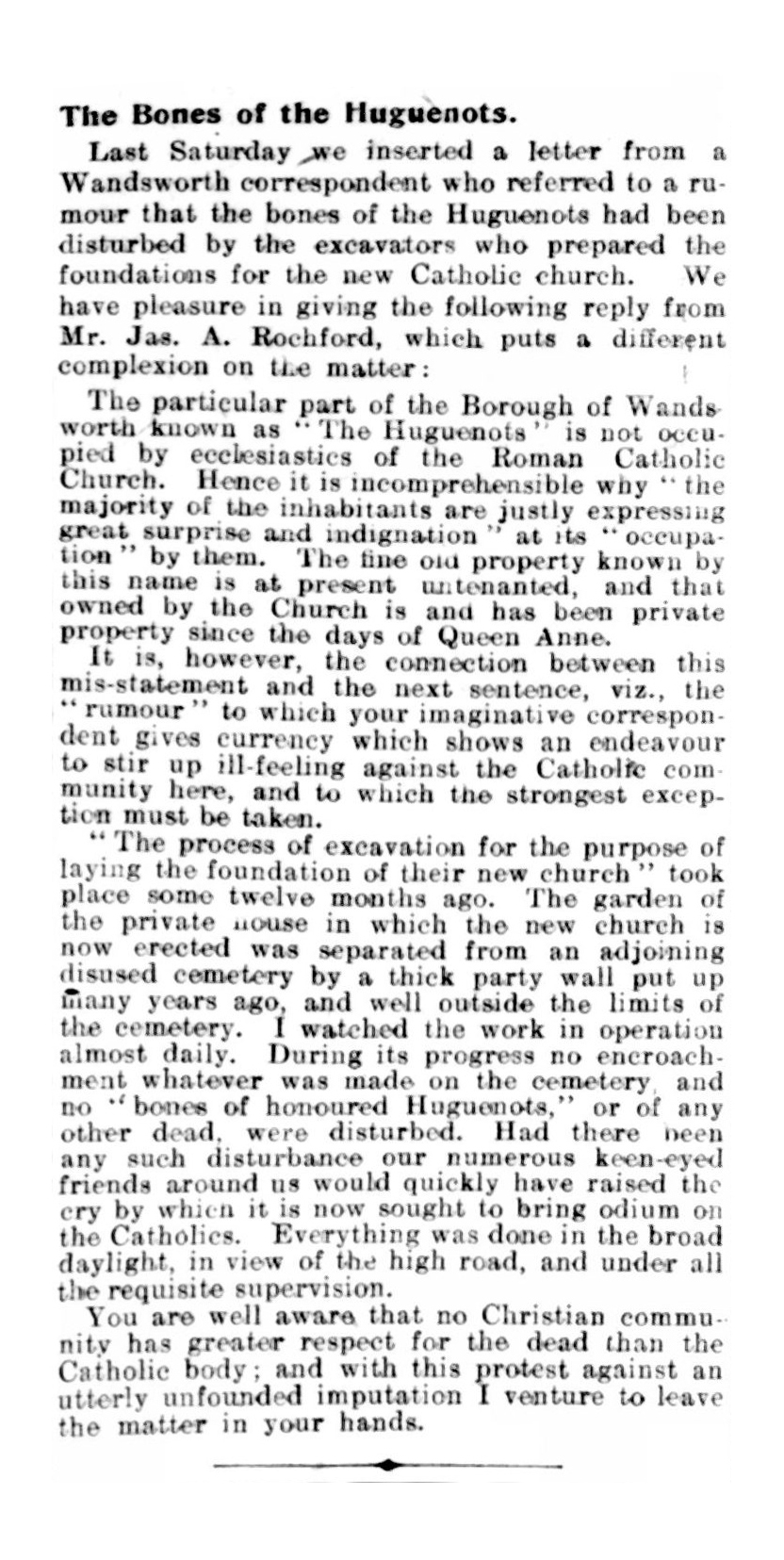
— 11 August 1906: “The Bones of the Huguenots”: the reply (Daily News)


16 May 1896: “The Huguenot Burial Ground: an appeal to Wandsworth”

Daily Chronicle, Saturday 16 May 1896. One of a series, “London’s Past”, illustrated by Hedley Fitton (engraved by C. Hentschel).
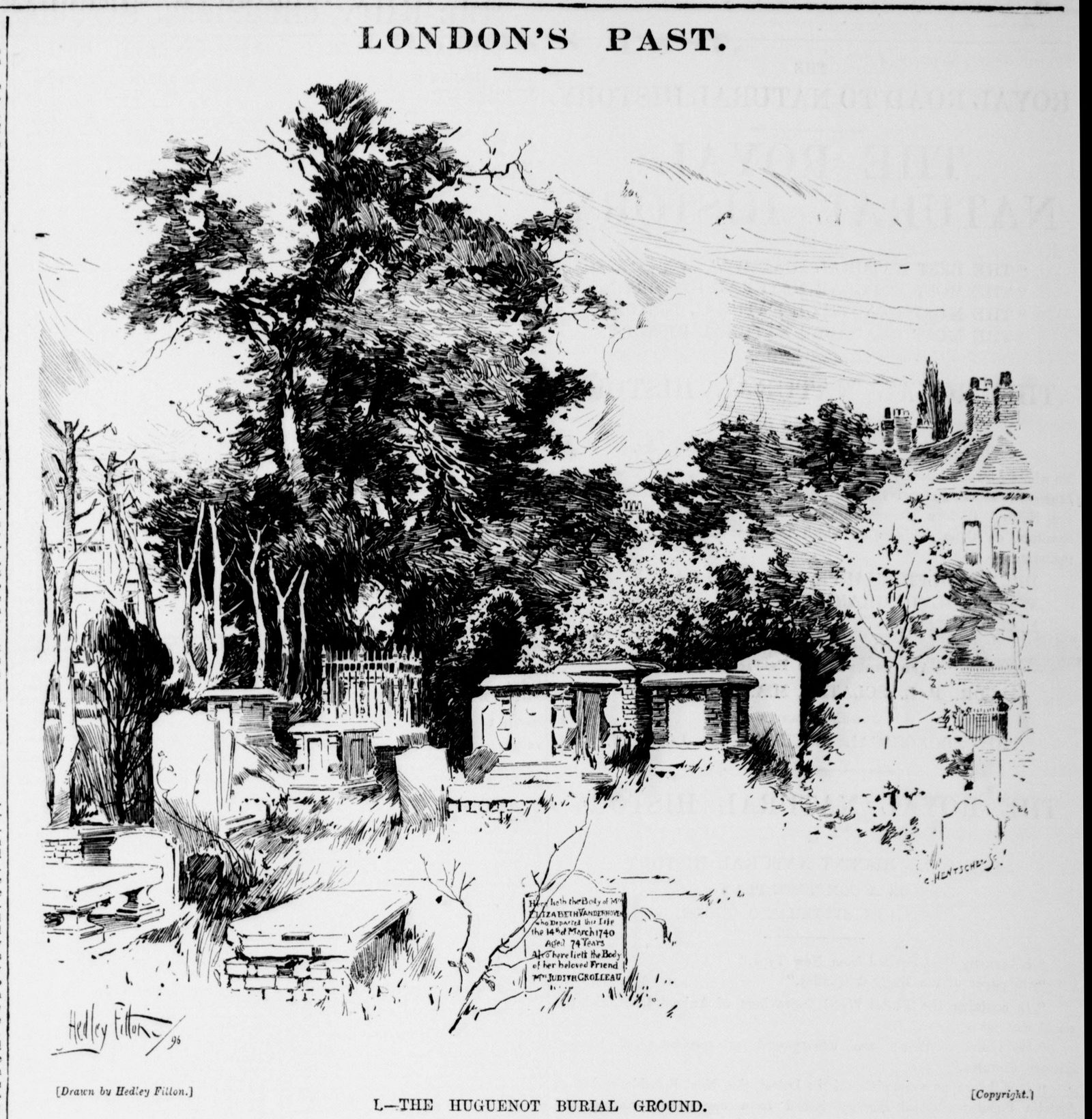
Hedley Fitton's drawing of the Huguenot Burial Ground, Mount Nod, Daily Chronicle, 16 May 1896
“London’s Past. I.—The Huguenot Burial Ground.” Drawn by Hedley Fitton, 1896.
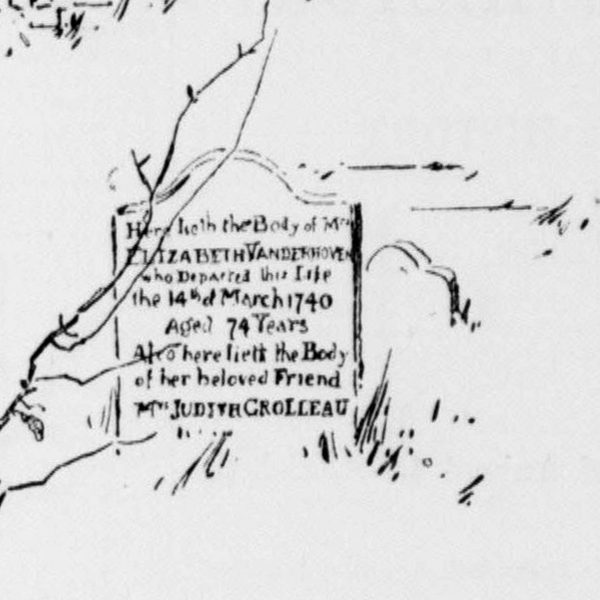
Detail of Hedley Fitton's drawing: the headstone of Elizabeth Vanderhoven and Judith Grolleau
Detail: the headstone of Elizabeth Vanderhoven and her “beloved Friend” Judith Grolleau, in the foreground of the drawing.

Fitton’s drawing makes the Vanderhoven headstone easy to read. It says she died on “the 14th of March 1740”. Squire read it as 1749, which fits her will (made in September 1749 and proved in August 1750). The “0” is probably Fitton’s slip, or a worn 9.

I.—THE HUGUENOT BURIAL GROUND.
AN APPEAL TO WANDSWORTH

In the hills over against Croydon and Addington, a pure and sparkling little stream takes its rise. It was famous as a salmon river, and still, in its upper pools and reaches, abundance of beautiful trout flash their silver fins, to the great pleasure of the followers of that “gentle craft” so quaintly extolled by Izaak Walton.

With many a bend and turn it flows through Carshalton and Beddington, and then with more devious windings it reaches Wandsworth—the hamlet on the sward of the Wandle; then, tired of its wanderings, it rushes into the arms of Father Thames and loses itself in his giant embrace.

Wandsworth lies in a deep hollow. West of it lies the high plateau of Wimbledon Common, east is Mount Nod, the “Land of the Setting Sun.” On the south is the high ground of Wandsworth Common, while north the land slopes gradually to the Thames.

In this pleasant valley human beings must have congregated from very early times. Doubtless men and women of the “Flint age” dwelt on the river’s bank, spearing with their sharp-pointed weapons the fish as they flashed by.

Painted Britons must have assembled there and crept up the slopes to Wimbledon to fight one of the severest battles ever fought in these isles against the Roman invaders, who after a desperate encounter with these long-haired Trinobantes entrenched themselves victoriously at the spot which to this day is called “Cæsar’s Camp,” though little if anything of the works remains.

Doubtless the victorious legions marched down West Hill, and forded the river by the town below, on their march for further fighting before they entered the great town, six miles off, which they were presently to colonise and call Londinium. Under Roman rule roads were made, the land cultivated, and the little place remained in peace; but when Honorius withdrew his legions, and left the way open to the Saxon pirates, Cedric and his tribes, pushing up from the south, joined hands probably somewhere about here with other Saxon forces coming up the Thames, and the Middle Saxons, finding it a pleasant spot, dotted a colony here, and gave it the name which it practically still retains, “Wandlesworth,” or Wandsworth.

Thus it remained for many centuries a quiet Saxon homestead, where Gurths and Wambas marched their masters’ pigs out to the commons which surrounded the place; Gurth complaining of the collar round his neck, and Wamba making friendly fun of him—bringing the swine home at night, and rewarded by a simple meal at the far end of some Cedric’s hall.

A Sleepy Hollow it remained for many more centuries, its people cultivating the fields and catching the trout and salmon, of which they duly paid tithe to their vicar. Occasionally a batch of its folk streamed off to the not far distant city to witness the baptism, the marriage, the coronation, or the funeral of a Henry, an Edward, a James, or a Charles.

At length suddenly the history of the little town was changed. A new invasion took place: this time not by Roman, Saxon, or Dane, nor by armed legions; but by peaceful and sorrow-stricken French folk—Huguenots (Eiguenots, religious confederates, in bonds to one another)—of all sorts and conditions, pastors, and farmers, dyers, weavers, millowners, and peasants—who had fled, or been driven for conscience’ sake, from their chateaux, their vineyards, their mills, their farms, or their chaumières on the Seine, the Loire, the Garonne, or the Rhone, and now begged for an asylum where they might carry on their various handicrafts and worship God after their own manner.

[Already a small colony of Walloons had been established there, who had fled from the rule of blood and iron of the Duke of Alva in the Low Countries, and now in turn welcomed their French kinsmen flying from their fatherland for the same cause.]

Many a high-cheeked Norman woman, many a dark-eyed Picardian girl, sat down and wept by the banks of the Wandle when they remembered the deserted chateaux by the Seine, the ancient walls of Tours, or the sunny lands and red and white vineyards of Bordeaux and Champagne.

A considerable number found vacant lands in the Valley of the Wandle, and here on the “sward” they availed themselves of the water for their mills, their tanneries, their weaving, dyeing, felting. The little town in the hollow now resounded to the noise of many new industries, and a foreign tongue was daily heard; and all day long Aumonier saluted a Giraud, as a Le Mesurier greeted a Le Marchant, or a Lafitte gave a “Bon soir” to a Chatelain or Chappuis.

Little children in clothes of quaint foreign cut—Pierres, Jeans, Maries, Louises, chased the butterflies in Southfields, or caught minnows in the pool of the Wandle, while their fathers worked in the mills and tanneries, made vessels of copper and iron, “fulled” linen, or wove and dyed silk, and by their steady industry enlarged and enriched the quaint old town.

So entirely was the felting industry in the hands of the Huguenots, that when a new Cardinal was made in France, his hat had to be ordered from the exiled French manufacturers on the Wandle. It was probably the French refugees who introduced the cultivation of lavender to these parts. “Lavender-hill,” and “Lavender Sweep” remain as names; and at Mitcham the plant is still largely cultivated.

Land was given to them for a church, which for a long time was served by two ministers, and here on Sundays the refugees assembled and sang the hymns that Clement Marot had composed for them at home. Hard by they acquired a piece of land wherein their bones should be laid when their earthly pilgrimage should be over. The site was a fine one—on the very crest of “Mount Nod,” as it is still called, with a lovely view of what was then open country to the Thames.

No doubt at first the Huguenot settlers dwelt apart; their language, dress, manners would be strange to the heavier English folk; but slowly and surely their industry, their sobriety, their social charm won on them, and while the male Dangelbourds, Groses, Laffittes, Lechiers, Payans, and De la Postes took unto themselves English wives, the young maidens—the Dormays, the Hantaines, the Merciers—lost their names, and became Williamses, Smiths, Wards, Barkers, Territts.

As years went by, many of the industries migrated. Watchmaking went to Clerkenwell, the silk-weaving to Coventry or Spitalfields, and the slow but sure wheels of Time gradually Anglicised the people and their names. Chatelaine became Chatting, Chappuis got converted into Shoppee, Duquesne into Du Cane, and there are not many uncorrupted French names remaining in Wandsworth now.

It is still a pleasant old-fashioned place, rich in red-brick houses and quaint old inns. Here and there is a fine old house with gables, the most notable one called “The Huguenots” still, and occasionally an old place with a front of timber-worn antiquity.

One most interesting relic of the French settlers remains, and that is their cemetery on Mount Nod. The eager eyes and loving hands of their descendants have examined their tombstones, and transcribed their inscriptions, which are all recorded in the transactions of the Huguenot Society of London.

“Here lye interred” the remains of Laffittes, Payans, Groses. There is a tombstone to “Louis de la Poste de Crouant, French gent., 1709”; to . . . Dormay, to Melancthon Strong, to Monsieur Poumies of Orthez, Bearn. John Poumies prospered and left many legacies, one to his grand-niece, Marie Thérèse, daughter of Peter Poumies, attorney at Orthez, “if she come to England and become a Protestant.” She appears not to have come. All honour to the sincerity of her convictions! A Mountaque (now Montague) lies there.

On one rather elaborate tombstone there is a heraldic device surmounted by helmet with plumes. The arms are: Three bells in fess; in chief a dove flying, carrying in its beak an olive branch; in base, the ark is floating on the waters. Inscribed on it is the statement: “Ici repose, Dame Isabeau Bories de Mantauban in Guyenne, Epouse de Jean de Comarqu (e), Escyer, décédée le XI. Auoust MDCCXXXI. La XXIII. Année de son age.”

Of course there were English folk buried there, too, amongst them being a Scott of Buccleugh, for tombstone No. 64 states that “Here also lieth the Body of the Honble. Alse Scott, Relict of Francis, late Duke of Buccleugh, who departed this life the 5th of December, 1765, in the 63rd year of her age.”

Now, this most interesting historical relic, while by no means in a desecrated state, is yet not in the condition it should be in. The parish of Wandsworth does something to it. It is walled and railed in. No refuse is allowed to remain there, and the grass is occasionally mown, and the side path sometimes swept; but it ought to be promptly taken in hand.

The grass should be relaid; trees should be planted all round it; a pathway should be made through its centre. The tombstones should be re-cut, and a tablet should be placed on a wall, or in the base of a sun-dial which might be erected in the centre, setting forth the history of the cemetery, and giving the names of all those French people who, giving up home or office, wealth and honours, for conscience’ sake, found a harbour of refuge on the banks of the Wandle, and a last resting-place, “until the day dawn,” in the Cimetière of Mount Nod.

A small fund collected by a few Huguenot descendants, for its preservation, is now nearly exhausted. Will not the wealthy inhabitants of Wandsworth, who love their still picturesque town, and cherish its ancient memorials and relics combine, and subscribe a sufficient sum, to put this most interesting historic burial-ground into proper and substantial condition?

Doubtless the Huguenot Society would gladly help them. The descendants of the Huguenots in England have prospered greatly, and they have ever been noted for their abundant charity, and the honour in which they hold the memories of their pious ancestors, whose industry so largely helped to make England rich.
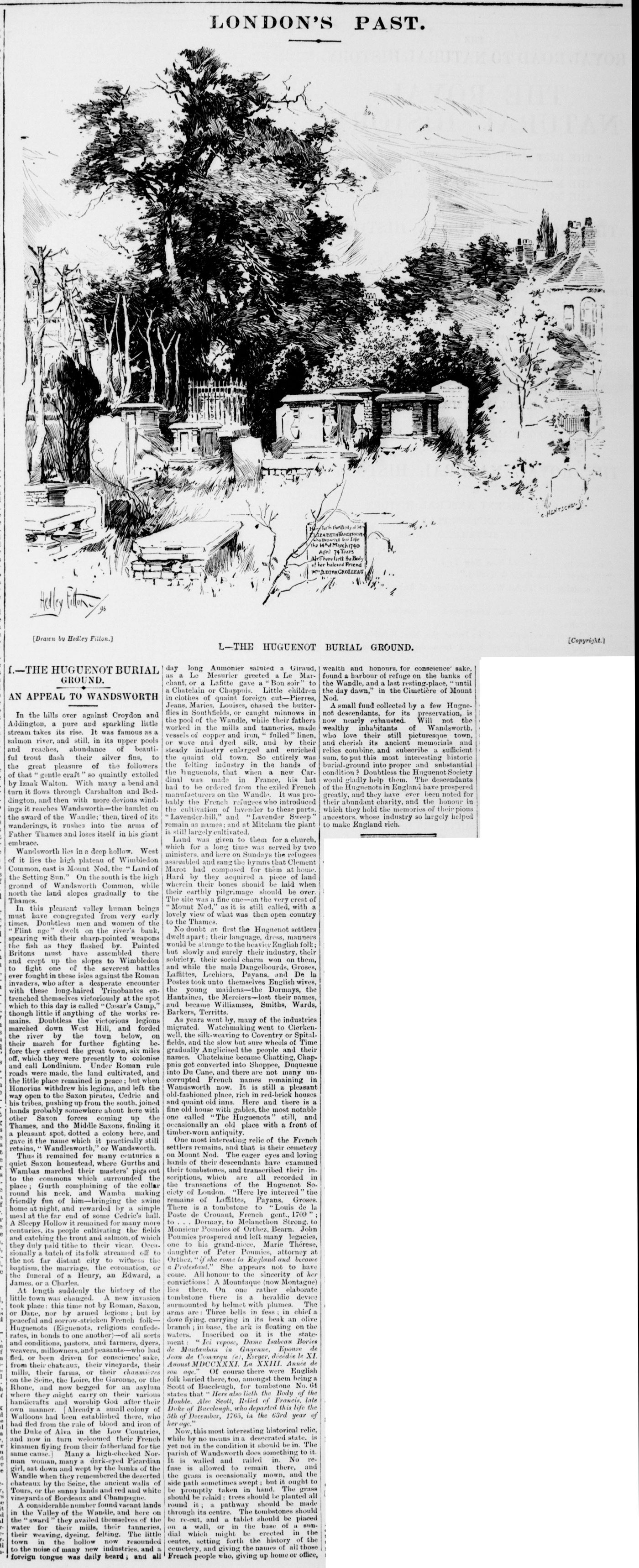

Daily Chronicle, 16 May 1896: The Huguenot Burial Ground, an appeal to Wandsworth (full cutting)
The whole cutting. Click to enlarge.

8 January 1897: “The Huguenot Cemetery”

The Echo, Friday 8 January 1897, page 4. A letter to the editor protesting against a plan to turn the burial ground into a “public recreation garden”.

THE HUGUENOT CEMETERY
TO THE EDITOR OF THE ECHO.

SIR,—Will you kindly allow me to protest against the proposed conversion of the Huguenot Burial Ground at Wandsworth into a “public recreation garden,” as such action would doubtless incur removal of the tomb-stones which mark where lie the mortal remains of many of those who endured and dared so much for their faith’s sake, and I consider that to disturb the tombstones and “lay out” the ground would be disgraceful sacrilege?

I could name one “Recreation Garden” where most of the tombstones have been removed from the graves, the flat ones being plastered against the boundary walls like theatrical posters on a hoarding, and where some of the larger monuments are daily used as “vaulting horses” and “Tom Tiddler’s Grounds” by “street arabs,” “gutter-snipes,” and vulgar boys, who, with their iron-tipped boots are slowly, but surely, defacing the inscriptions and destroying the monuments.

For this and other reasons I assert that it would be an act of desecration to convert the Huguenot Cemetery into a “public recreation ground.”

I am of opinion that it is the duty of all persons of Huguenot descent, and, indeed, of all Protestants who sympathise with the martyrs of 1572 and 1685, to combine with a view to putting the said cemetery into proper and decent condition, and preserving it as the sacred ground where lie many true Christians whose sufferings, anguish, and bravery are now forgotten, but whose influence and example have enhanced the religious, moral, and commercial welfare of England.

Why should not a committee of descendants of Huguenots be formed for the purpose of restoring and preserving the ground and its monuments?

I believe that Her Majesty, the Queen, can claim descent from the greatest of all Huguenot leaders, Gaspard de Coligny. Would not the ex-Lord Mayor Savory, Mr. Labouchere, and many others of Huguenot descent willingly give their aid and influence?

Are there no Layards, Fourdriniers, Gillots, Martineaus, Delanes, Fonblanques, Dollands, Romillys, Lefèvres, Bouveries, or Thelussons who will be able and willing to help in the preservation of the burial-places of Huguenots who came to England in company with some of their own ancestors?

When the wife of Coligny was urging him to join Condé in defence of the Huguenots she said, “Monsieur, your wife and the spilt blood of your brethren cry out to God that you will be the murderer of those you do not prevent being murdered.” I say, now, that if the desecration I protest against should occur, those who do not raise their voices against it will be as guilty as those who perpetrate it.

It would be well if every Protestant were to learn how much suffering was endured by the Huguenots who escaped to England. Many of them must have mourned for those of their kinsmen and friends who were amongst the 5,000 Huguenots slain in the disastrous battle of Moncontour, or the 6,000 who, a little later, perished of hardship and disease. Many of the latter were English auxiliaries, and of these only twelve men were left alive.

That Huguenots have been justly styled martyrs, the history of the merciless persecution to which they were subjected bears witness. Of this persecution and the sufferings it caused some idea may be formed by the following paragraphs:—

Pius V., the most fanatic of Popes, gave his military leaders the monstrous injunction to “take no Huguenot prisoner, but instantly to kill every one that should fall into his hands.”

When the infamous Duke of Alva—under Papal influence—met Catherine de Medicis at Bayonne he persuaded her that the only remedy for Protestantism was the extirpation of all of the Reformed Religion, and particularly the death of Coligny. Charles IX., the son of Catherine de Medicis, exclaimed, “Then let Coligny be killed, and let not one Protestant in all France be left to reproach me with the deed.”

At two o’clock on the morning of Sabbath, the 24th of August, 1572, the tocsin of St. Germain sounded the signal for the massacre of the Huguenots—since known as the massacre of St. Bartholomew’s Eve—which ere it ended resulted in the slaughter of a hundred thousand of the best subjects of France and depopulated some of its fairest provinces.

The head of the Christian patriot, Coligny, was cut off and carried in a sack to the Queen, Catherine de Medicis, that she might feast her eyes on the sanguinary spectacle, and the fine ladies of the Court went gaily to gloat over the sight of Coligny’s mangled and headless body hanging by the heels.

The Seine and the Rhone were purpled with the blood of the murdered Protestants: 18,000 were slaughtered in Orleans, 6,000 in Rouen, 3,000 in Poictiers, 1,800 in Lyons—from whence not one Protestant escaped, many in Bordeaux, Meaux, Troyes, &c., and 150 were hacked to pieces in the palace of the Roman Catholic Archbishop. Medals were struck at Paris and Rome to commemorate this “victory.” The original die of the latter—bearing the inscription “Ugonotorum Strages”—is said to be now in the Papal Mint.

During the “Dragooning” which succeeded the Revocation of the Edict of Nantes (in 1685), the Protestants of Montauban alone were stripped of above a million of money. The dragoons hung up one Isaac Favin, a Protestant citizen of Negreplisse, near Montauban, and they made a great fire around a boy about twelve years of age, who cried, “My God, help me!” and when they saw that he preferred to die rather than renounce his “heresy,” they snatched him from the fire just in time to save his life.

The soldiers applied red hot irons to the feet of men and the breasts of women, and at Nantes they hung up women and maidens naked by their feet, and others by their armpits; they bound suckling mothers to posts, and let their starving infants lie languishing in their sight for several days and nights, crying, moaning, and dying.

Some they half roasted, and then released them, a punishment worse than death. They hung men and women, some by the hair, some by their feet, in chimneys, and smoked them with wisps of wet hay until they were suffocated. They hung some by their arms and dipped them again and again into wells. Others they bound, put them to torture, and, with a funnel filled them with wine until they were delirious, when they made them promise to renounce their faith, and yet they then stripped them naked and stuck them with pins and needles from head to feet, after they had forced on them odious indignities.

They held some by the nose with red-hot pincers, and so dragged them about until some of the poor, tortured martyrs were obliged to renounce their “heresy,” as their Protestantism was called. They beat some with staves, broke their bones, then dragged their helpless bodies to church, and pretended that their enforced presence was a willing act of abjuration.

These were some of the methods used by the Apostolic dragoons of the “most Christian King,” Louis XIV., to “convert” his loyal Huguenot subjects.—I am, Sir, yours, &c.,

Colignpihone [sic?]

125, Judd-street, Euston-road, W.C.

The signature is printed “COLIGNPIHONE”, presumably a pen-name built on Coligny, perhaps garbled by the printer.

The Echo, 8 January 1897: The Huguenot Cemetery, letter to the editor (full cutting)
The whole cutting. Click to enlarge.

4 August 1906: “The Bones of the Huguenots”

The Daily News, Saturday 4 August 1906, in the column “The Churches”. The Catholic church of St Mary Magdalen on East Hill, next to the burial ground, had just been built.

Daily News, 4 August 1906: The Bones of the Huguenots

“The Bones of the Huguenots.”

A correspondent, who writes from East-hill, Wandsworth, says: “The majority of the inhabitants of Wandsworth are expressing great surprise and indignation at the occupation of that particular part of the borough known as ‘The Huguenots,’ by ecclesiastics of the Roman Catholic Church, and justly so.

A rumour is current also that in the process of excavation for the purpose of laying the foundation of their new church, bones of the honoured Huguenots have been disturbed! Who is responsible for this state of affairs?”


11 August 1906: “The Bones of the Huguenots”: the reply

The Daily News, Saturday 11 August 1906.

Daily News, 11 August 1906: The Bones of the Huguenots, reply from Jas. A. Rochford

The Bones of the Huguenots.

Last Saturday we inserted a letter from a Wandsworth correspondent who referred to a rumour that the bones of the Huguenots had been disturbed by the excavators who prepared the foundations for the new Catholic church. We have pleasure in giving the following reply from Mr. Jas. A. Rochford, which puts a different complexion on the matter:

The particular part of the Borough of Wandsworth known as “The Huguenots” is not occupied by ecclesiastics of the Roman Catholic Church. Hence it is incomprehensible why “the majority of the inhabitants are justly expressing great surprise and indignation” at its “occupation” by them. The fine old property known by this name is at present untenanted, and that owned by the Church is and has been private property since the days of Queen Anne.

It is, however, the connection between this mis-statement and the next sentence, viz., the “rumour” to which your imaginative correspondent gives currency which shows an endeavour to stir up ill-feeling against the Catholic community here, and to which the strongest exception must be taken.

“The process of excavation for the purpose of laying the foundation of their new church” took place some twelve months ago. The garden of the private house in which the new church is now erected was separated from an adjoining disused cemetery by a thick party wall put up many years ago, and well outside the limits of the cemetery.

I watched the work in operation almost daily. During its progress no encroachment whatever was made on the cemetery, and no “bones of honoured Huguenots,” or of any other dead, were disturbed. Had there been any such disturbance our numerous keen-eyed friends around us would quickly have raised the cry by which it is now sought to bring odium on the Catholics. Everything was done in the broad daylight, in view of the high road, and under all the requisite supervision.

You are well aware that no Christian community has greater respect for the dead than the Catholic body; and with this protest against an utterly unfounded imputation I venture to leave the matter in your hands.

Two clues here about the houses on the site. A fine old house called “The Huguenots” was still standing in 1896, and in 1906 it was empty but not owned by the Church. The new church had been built in the garden of a different “private house”, which had been private property “since the days of Queen Anne”. See St Mary Magdalen, East Hill.


See also: Mount Nod, the Huguenot Burial Ground · September 2026 Chronicles

Transcribed by Claude for Philip Boys, October 2026. Do you know of other cuttings about the Huguenots of Wandsworth? Please let me know.