
CHAPTER V
MORE RAIDS: DIFFICULTIES OF DEFENCE, AND THE "RAID BY ZEPPELINS" LAST
The raid of September 30th was an even more elaborate attack than that of the previous night, and lasted exactly twice as long. In order to appreciate adequately the work done by the defence during this raid, the following points must be borne in mind: First, the establishments of personnel in the defences had been then cut down to the very smallest number of men which would suffice to work the guns.
Secondly, these men were necessarily of indifferent physique, such as did not permit of their employment at the Front.
Thirdly, they were hurriedly and recently trained, and were, for the most part, quite unfamiliar with military discipline.
Fourthly, there were no reserves, and it was therefore necessary to keep every man, however exhausted, at his post at all costs.
Fifthly, the greater part of the previous night had been Min as already spent action," and, alright nothing could be more urgent than the necessity for preparation for a further attack, there had been
[205]
no rest for any member of the defence force for at least twenty-four hours. Lastly, and most important, the system of defence which these men were called upon to carry out was of a most elaborate nature, and its successful operation therefore depended absolutely upon the efficient co-operation of many widely scattered individual posts, the failure of any one of which would seriously impair the efficiency of the whole system.
If these facts are borne in mind, and also the fact that our empty magazines had not yet in all cases at that time been replenished after the heavy fire which had been kept up during the preceding night, it may perhaps be realized that it was with deep anxiety, and a certain diffidence as to our powers, that I, on this occasion, received the "warning" that the enemy were again on their way to attack us. This anxiety was still further increased by the receipt of the warning a full three hours before the time at which these attacks had usually been delivered, so that a final inspection of the preparations became impossible.
If any reader should, on reading the above, feel inclined to remark that those were "strenuous times," he will be quite justified by the facts. The description, however, would not be correct without the addition of several adjectives which I hesitate to write, but which keep constantly "dancing round the end of my pen."
So now for the fight. The first attack was made by three squadrons on
[207]
a broad front, advancing on London from the east at about 7.30 p.m. The southern of the three attacked first, on a north-westerly course, coming from the direction of Chatham and passing between Woolwich and Greenwich, their objective being evidently the West and West-Central Districts, upon which they proceeded to concentrate. The central squadron was some ten minutes later in delivering its attack upon the same district, their advance following a line just north of the river. The northern squadron arrived ten minutes later still, also concentrating upon the West End, but from the direction of Islington.
These attacks were well and effectively met by a succession of "barrages," from the moment of their coming within range of the guns of the defences, with the result that the regular formations of the attacking squadrons were most effectually broken up and their planes became widely scattered, though the general advance was continued till in sight of the Putney to Hammersmith reach of the river. Here a general and independent "turn" was made to the southward at about 8.10 p.m., and these groups then retreated south of the river on a general south-easterly course, though many small groups and individual machines swung very far wide of the general course both during the advance and the retreat. This attack was in full retreat at 8.15 p.m.
The Second Attack was signalled as approaching from the east at 8.16 p.m., again consisting of three squadrons, but on this occasion their attacks
[208]
were delivered simultaneously, two north and one south of the river. They also were met by a succession of the development of their attack to the westward, and the bulk of them were also in full retreat by 8.35 p.m. At 8.37 p.m. the approach of a Third Attack was barrages," which successfully frustrated signalled, again in three squadrons, but on a front rather wider than in the two previous attacks. This attack was also met " effectively by barrages." My note adds the gratifying information that M this attack was not pressed home with the same energy as the previous ones, and that a general retreat was in progress at 8.50 p.m. over all parts of the defences." The inference was, of course, unavoidable that the leaders had informed their supports (by wireless) of the class of reception which awaited them, which also must have been emphasized by the magnificent display of bursting shells and searchlight beams, doubtless visible for many miles to the approaching squadrons. I note without surprise that my "remarks" in my report on this raid were unusually short, and anxious and trying ordeal, as the responsibility was great, and the general action in the district for which I was responsible lasted over two hours without intermission. During the whole of that time the closest attention was needed in the " command " of the gunfire and in the " direction " of the searchlight work, as well as instant decisions in the many that I intimated that a detailed list of the would be forwarded later. It was, in fact, a terribly "" firing
[209]
cases of technical difficulty which arose at the various gun-stations owing to the long continuance of "rapid fire." A few of the latter may be found of interest by those who are unaware of the difficulties of maintaining so heavy a fire over such an extended period. Several of our guns on this occasion fired over 500 rounds apiece during the two hours the "action" lasted. In many instances the guns were red-hot, and "fire" had to be temporarily in busy lines "ceased" to allow them to cool, in spite of the constant streams of water which were poured over them. Everything breakable in the gun-stations quickly succumbed to the constant concussion; the men, in many instances, were temporarily "blinded" by the flashes of the guns, and "deafened" by the incessant concussions, until they became entirely bewildered and practically useless. Burnt hands from the hot guns also were the rule rather than the exception throughout, and the guns' crews were everywhere thoroughly exhausted by their well-sustained exertions. Several "" instances also occurred of rounds jamming in the hot guns; plaintive messages were then brought to me to the effect that " So-and-So " "round jammed in gun, and what shall he do?" My answer was instantly given, and was always the same, albeit one—which is in no way authorized by the regulations namely, "Jam another round in behind it and fire it out. such occasions the gun's crew were instructed to Needless to say, on M reports
[210]
"take precautions," which means to keep out of the way, as the danger of that "heroic" method "" of clearing the bore of a gun is considerable.
Late in the action a peculiar incident occurred, which gave rise to considerable controversy. The Wandsworth gun, having fired well over 500 rounds, announced that they had no further ammunition available.
I knew, however, that in their magazine were stored certain French "incendiary" shells which were intended for use against Zeppelins. These shells are of peculiar construction, but I was perfectly familiar with their peculiarities, the principle of which consists in the emission of a cloud of burning gas during a definite portion of their flight.
As this shortage of ammunition occurred in a vitally important gun-station at the culminating point of the last attack, I took the very considerable responsibility of ordering ten rounds of "incendiary" to be fired, with fuses "set" in a manner to insure the gas being all burnt before the projectile could reach the ground. This order was immediately carried out, and in a few moments magnificent clouds of burning gas were to be seen hurtling through the sky, with the result that the London newspapers next morning announced, with a " " which bloodthirsty glee they made no attempt to conceal, that towards the end of the attack enemy aeroplanes were observed "falling in flames" in several directions!
I note that in my report I refer to this incident as follows
[211]
"The fact that the attack at once ceased and the retreat began is not thought to be entirely due to the use of that form of ammunition having been adopted." It was perhaps unfortunate that one of these ten shells should have come to rest in the parlour of the Mansion House ! where, being still red-hot, it caused considerable excitement and inconvenience, the handling of red-hot shells forming no part of the elaborate training of the Lord Mayor's other wise irreproachably competent attendants ! With regard to this incident, however, it is no doubt the case that these flaming projectiles in the sky were by no means without their moral effect upon the attackers, who had probably never seen them previously, and whose already somewhat pronounced inclinations to " turn for home H were doubtless considerably strengthened by the vicinity of these unknown but extremely undesirable aerial fellow-travellers.
In considering this raid generally, it was undoubtedly a much more severe test of the efficiency of the defence than any to which we had previously been subjected; and, even if certain weaknesses became apparent in the course of such a strenuous action, that can hardly occasion surprise. I remember my own sentiment was most emphatically one of infinite relief at the fact that, having been tried so highly, my men had done so well; and I did not hesitate to tell them so at once in suitable terms.
In these times of " and " impiping peace"
[212]
we should consider the probably pecuniosity forty-eight hours' work just described, as having earned some rest for the workers. In war, however, it is not so. In fact, the reverse usually appears to be the case, for the more tired men may be, the more urgent are frequently the demands which must be made upon them. In this case, all hands were busily employed all next day in making good the damage, replenishing the magazines, binding up burnt hands, etc., so that when at 7.7 the M was received that the enemy were "at hand," our military vocabularies were sorely tried in our efforts adequately to describe our feelings. The attack on this occasion was again even more elaborate than its predecessor, the units employed and the " " being probably smaller, general linking of the small units into "formations" being probably "looser." The practical result produced by this was a constant stream of small units, or even individual machines, which advanced in succession from the east, with the West End of London as their general objective, though acting in each case quite independently of each other. This succession of attacks continued without intermission from 7.45 p.m. until 10 p.m., by which time the last planes had turned and were in retreat, being, however, still scattered over all parts of the defences, though the greater number retreated south of the river.
During the latter part of this continuous "action" of two hours and fifteen minutes the next October evening, 1st, a " warning again
[213]
course of individual machines became impossible to identify. Mercifully, however, that night there mist " over the valley of the Thames; this evidently interfered with the correctness with which the enemy were generally able to determine their position, and the erratic courses followed by the various units differed materially from the regularity of direction which had hitherto been invariably maintained in previous attacks. The course of one particular detachment which came under my observation offered certain points of special interest as indicating the selection of a new and particularly vulnerable objective. At 8.28 p.m. (whilst the main attacks were developing on the West End) I received a report that at least three separate aircraft were approaching Watford gun-station. The gun was immediately ordered to open fire " on sound " and the light to n search." Two enemy aircraft were " held in the beam " and fired at for some time, during which they and at least one other were circling round, evidently endeavouring to fix their position. These planes were flying at a high altitude and remained in the neighbourhood of Watford for upwards of twenty minutes. As the fire of the guns and the beams of the searchlights of the main defences, then all " in action," must have been clearly visible all the time to this detachment, it was evident that they must have been searching for a separate and definite objective lying to the north of the main defences. This could hardly be other was a considerable amount of " ground
[214]
than the Aerodrome and the Aircraft Factories at Hendon. This fact offered a valuable indication of the appreciation by the enemy of the great advantage they would have obtained by the destruction of those works, which were then producing that form of armament of whose powers the Germans were evidently most in dread. These facts were duly reported and commented upon, but there is no doubt that we had every reason to be thankful on that occasion for the protection afforded by that peculiar form of "London fog" of which on so many other occasions we have entirely failed to appreciate the possible value ! The damage caused by these three raids bore even less comparison to the expenditure incurred by the attack than had been the case on any previous occasion, the killed numbering eleven, two, and eleven, and the wounded sixty-five, fourteen, and thirteen, on the three nights respectively, and the structural damages amounting to ,£21,000, ,£7,000, and £45,000. In view of the numerous and special forces employed by the enemy, these figures were rightly considered as very creditable to the defence force, to whom the success resulting from their strenuous efforts was certainly very gratifying. During the development and organization by the enemy of these night attacks by their aeroplane squadrons, we had been well aware that modifications were simultaneously being carried out in their Zeppelin fleet. These had for their principal object " such an increase of"buoyancy as would enable these airships to fly at altitudes which could not be
]215]
reached by aeroplanes, so that they might by these means obtain that immunity from attack by incendiary bullets which past experience had shown to be indispensable to their successful employment. We were also aware that the undersides of the airships were now coated with a certain black paint which rendered them invisible from the direction of a searchlight, even when full in its beam; although, as in the case of a mirror, the reflection of the searchlight could be clearly seen on the hull of the airship from the corresponding angle in the opposite direction, where, of course, it could be of no value to the defence.
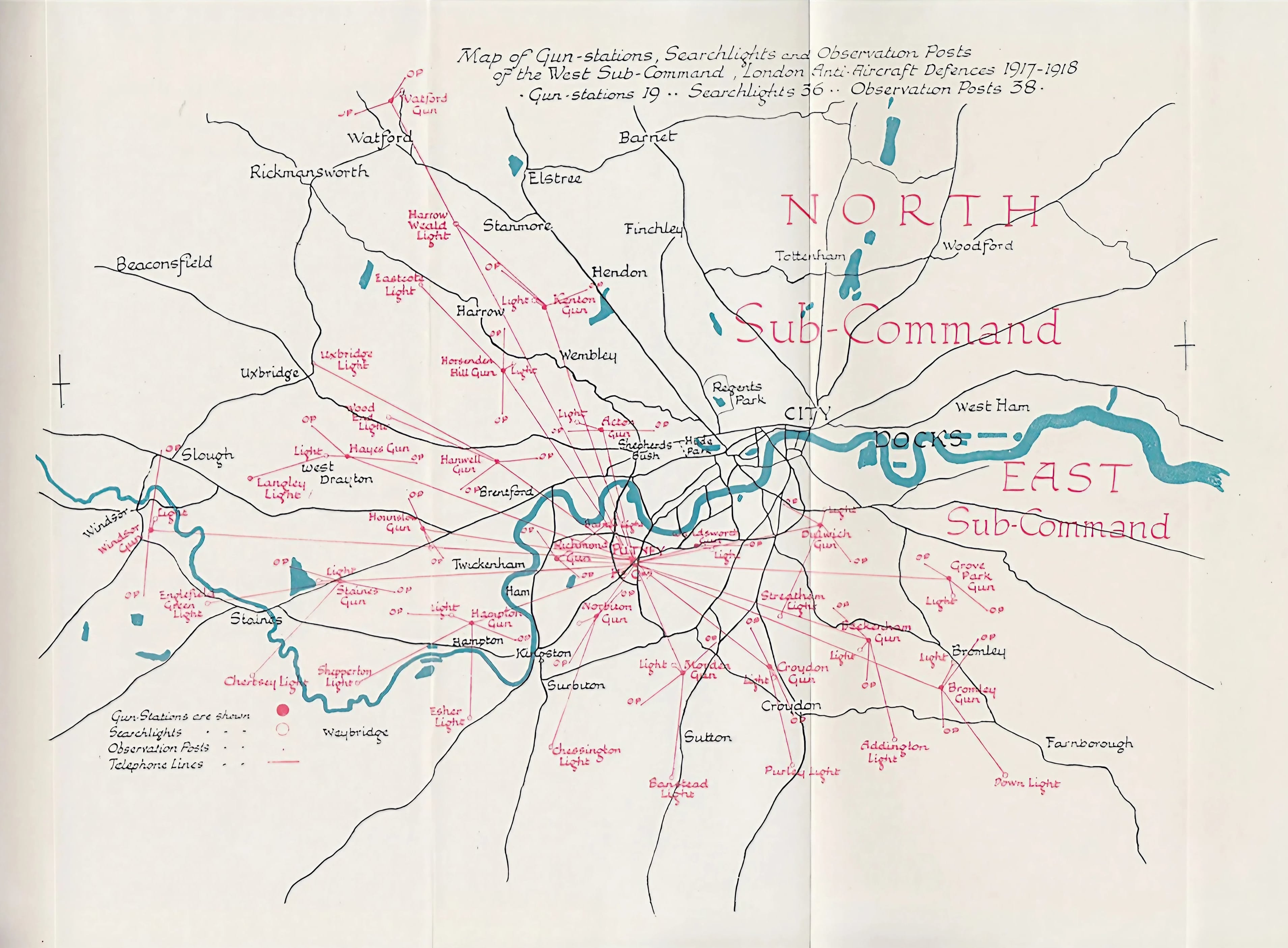
In consequence of these improvements, we felt certain we should soon receive a visit from the Zeppelin fleet so modified. It was without surprise, therefore, that on the night of October 19th we received information at 8 p.m. that Zeppelins had once more crossed the coast, and were again on their way to London after an absence of over twelve months. At 8.25 p.m. enemy airships were reported from 50 to 90 miles distant to the north-east of London. The first definite information, which was received from stations within the West Sub-Command, was a report from Watford gun-station at 9.10 p.m. of " bombs" some 15 miles to the north. This was confirmed by other stations, but no sounds of aircraft could afterwards be heard. A long, tedious, and most anxious wait ensued, without any further information of any kind being received until 10.10 p.m., when Watford again reported "bombs" to the north.
At 10.16 p.m. all lights north of the Thames
[216]
were ordered to "patrol"—that is, to " search." This order came direct to me from the Anti-Aircraft Defence Commander at the Horse Guards, and was immediately carried out, but without producing any satisfactory result.
At 10.29 p.m. I spoke myself to the A.A.D.C. at the Horse Guards, and explained to him the idea which was then forming in my mind as to the object of this very unusual procedure on the part of the enemy. I then promptly received instructions to cover all lights in succession from the westward," which was instantly done, and another long wait then ensued.
The point, to which I drew the A.A.D.C.'s special attention, was the rapidly increasing force of the wind. This at sundown had been a very gentle air from the north-west, but had been gradually "freshening," and was at 10.25 p.m. blowing at upwards of 10 miles an hour on the surface, and probably much"harder" at high altitudes. This point appeared to me to be of the utmost importance, as it was obviously the intention of the enemy to assemble their fleet in the neighbourhood of Watford, then to "float down wind" over London at a high altitude with their engines stopped; in which case we should neither be able to "see" them to shoot with our "eyes," nor to " hear " them to shoot with our " therefore be left with our intelligence only, with which to defend our charge, and with evidently very little " time " in which to make use of it.
Of all the raids of which I have had experience, ears," and should
[217]
this was far the most dangerous and at the same time unquestionably the most difficult to meet. On that night, however, London was once more defended " Powers " which were the by beyond control of the defence, whose only duty lay in taking instant and intelligent advantage of any and every opportunity which might occur to assist their efforts to defeat the enemy's murderous projects.
The one advantage, which the defence possessed over the attack, was that, being on the ground, they were in a position to know the M speed of the wind " the; this, at their altitude, had great enemy, mercifully no means of judging. This advantage we should retain, only as long as we kept all our lights covered. The moment our searchlights were "unmasked," the enemy would at once be able to judge the speed at which their ships were moving over the ground, by the change in the "bearing" of the various lights, with whose position they were, of course, perfectly familiar, and the small but vital advantage which the defence possessed would be instantly lost. I therefore called all stations," and, having called over all the officers by name, made sure of their personal presence at their telephones. I then briefly explained the position, as I conceived it to be, and gave the most definite and explicit orders that no light should be uncovered, under any consideration whatever, unless and until a special order to do so was received from headquarters. That essential precaution having been taken, no other was possible, and one could only await the turn of "
[218]
events, all the while most anxiously watching the instrument which recorded the " speed wind," which, most mercifully, still continued " " moment. freshening every At 1 1.1 1 p.m. Watford reported "sounds of aircraft to the north." This lasted barely three minutes, after which no further sound was heard.
As the sounds, which had just been heard, had been those of a single airship only, and we knew that the whole fleet of at least five, and more probably seven, ships were there; those sounds had been most probably caused by a late arrival manoeuvring for position with relation to the others. The fleet was therefore probably at last complete, and was presumably about to start on its " float " over London.
In the meanwhile our faithful and invaluable ally the wind still continued to "freshen" with most persistent and truly gratifying regularity; and the minutes slowly passed without a sound being heard from the air above, whilst London lay in pitch-darkness and absolute silence below. To us, who guessed rather than knew what was happening, and were in a position to appreciate correctly the awful danger to which the city lay exposed, each moment increased an anxiety no words can describe, as we waited in silence for the "roar" which we momentarily expected and so horribly dreaded to hear.
Ten more interminable minutes passed in absolute darkness and silence, and still no sign was given from the sky, but at 11.24 P-m- "bombs" were reported from the neighbourhood of Kenton, of the
[219]
south-east of Harrow, and fairly on the direct line from Watford to the heart of the city.
I thought then, and think still, that this was an attempt to induce us to uncover our lights, and so to give the show away; but, if so, the enemy must have been sadly disappointed at the result, as not a glimmer of light was shown, and no sign of any kind came from below which could serve to guide them on their sinister and murderous course. Four minutes later another single explosion was heard, bearing "north-east by east" from my headquarters at Putney, and about 4 miles distant, so that the crucial moment had then at last arrived,and the whole Zeppelin fleet, fully loaded with bombs, were in the position they had striven so long to attain, and the heart of London then lay below them, at their mercy indeed, but shrouded in an impenetrable darkness. This was the last resource of the whose " V now defence, intelligence remained their only available weapon. It will be for the public, who now learn for the first time the actual facts, to judge whether that last weapon was that night well and skilfully used in defence of the heart of our great empire in the hour of its need.
There can be no doubt that this single bomb was also discharged with the object of inducing the lights to uncover; as the accuracy of its aim was so astounding that, had its discharge been based on any definite knowledge of their actual position, it is certain that every bomb in the Zeppelin fleet would have been discharged simultaneously at that critical moment. One only was
[220]
dropped, however, and mercifully the darkness and silence below still remained impenetrable and unbroken. The succeeding minutes were charged with such an anguish of anxiety, and the horror of the awful tragedy which appeared likely to be enacted at any moment was so great, as to cause me an absolute spasm of nervous agony. This I found it almost impossible to control, and it threatened every moment to render me physically "sick" from apprehension. The good north-west wind, however, still stood our friend, as indeed was the case all that night and the next day, for it steadily gained in strength as the minutes dragged slowly by until six minutes later another bomb was dropped in the neighbourhood of Grove Park far to the south-east, and our agonizing anxiety was over, for in the freshening gale no airships could ever hope to return against the wind, and London was saved from a catastrophe of which the possible extent can never be accurately estimated. The narrowness of our escape may be better understood when it is known that the one large M bomb " at 11.28 was the actually dropped p.m.
one that fell at Piccadilly Circus, which demolished the premises of Messrs. Swan and Edgar at the corner of the Circus. From this fact may be appreciated what would have been the effect had the many tons of bombs, which were at that moment suspended in approximately the same above that central district, been all dropped at the same time as the single one. Be position
[...?]
Back to the top of this page . . .