"[RVPA AND HUMAN EXCREMENT]
Nottinghamshire Guardian — Thursday 9 February 1860
TOWN SEWAGE.
Mb. Ald. Mechi has just published a pamphlet on the folly of neglecting to turn to good account the sewage of large towns. We wish our municipal authorities could be brought to read Mr. Mechi's suggestions, and, if possible, apply them. We have room for the following extracts : -
How Farmers would benefit by Town Sewage.
lf farmers depended entirely on the sewage of towns for the supply of manure, it is quite dear that they might be perjmtj.b? their landlords to sell off, without damage to the ???? and green crops, provided they could find a market for them, or provided it was more advantageous to them than feeding cattle. They might also grow hemp, flax, rape for seed, potatoes, mustard and other crops, which would be considered, under our present system, scourging or exhausting.
Provided an abundant supply of town sewage were annually used, it would be impossible to exhaust the soil by any cropping; and our farm leases might be a great deal shorter than they are at present. The generality of farms are now only manured once in four years. Such a system would suit farmers of a limited capital. The only excuse for treading our straw under foot, and consuming our hay, straw, and green crops on the farm, is to produce manure to grow the cereals. It is quite clear that as sewage manure contains all the elements of every crop that can be grown, we need no longer feed out oil-cake at a loss, or pay away our money for guano, bones, blood and other manures.
Those who will read Fortune's, Davis's, and Oliphant's recent books on China, will see, that it is almost entirely by the use of human excreta that the 412 millions of Chinese can obtain their food. How much is their example in this respect needed by us, under our new sanitary arrangements? Where the Movement is Taking Place. — Although farmers and landlords have done little or nothing as regards the sewer movement, it is gratifying that several public bodies connected with lunatic and charitable asylums, are applying the sewage and waste of the numerous inmates to agricultural production.
This has been successfully done at the Colney Hatch Lunatic Asylum, and is proposed for the Royal Victoria Patriotic Asylum near Clapham Common, and some other Institutions.
When our prison discipline is connected with agricultural labour (as Itrust some day it will be), we may hope to see the "avails" of our criminals applied to the soil. The Messrs. Harvey, of Glasgow, who have over a thousand cows, still continue to force the sewage out of town to their farm, which supplies early and abundant resources of green and root crops. At Mr. Kennedy's and Mr. Teller's farms, in Scotland, the irrigation is continued. We should never forget that the sewage system at Messrs. Harvey's, of Glasgow, was suggested and carried into operation by that far-seeing and excellent friend to agriculture, the bite Mr. Smith, of Deanston, whose views ( I know by frequent personal conversation with him) were very early and very strongly in favour of sewage applications. Agriculture owes to his memory a debt of gratitude. Lord Essex's experience with the Watford sewage is important, and will be found in the Appendix.
The difficulty to which I have just referred has an important bearing. Oar thb Terms of Contract between Sanitary Boards and Sewage Companies. — lt is quite clear that, until a change is effected in the agricultural mind, sewage companies, formed for its general distribution, must be great experiments. As such, they should, in the first instance, be encouraged; and, even, probably, subsidized by the towns for the first few years, no charge being made to them for the sewage. In course of time, when the operation shall have resulted in good dividends to the shareholders, the sum to be paid to the towns, might bear an equitable relation to the per centage of profit realized by the share-holders. Except by such an arrangement, capital will not be advanced for such companies, for, it will take some years to convince agriculture that she will be benefited by using and paying for town sewage. If landholders desire to prevent the exhaustion of soil by the restoration of the sewage they must give practical evidence of that desire, by taking shares in, or giving other facilities to, any public companies who will devote their capital to such an object.
Some years ago a Company was formed, to pump sewage from the Counter's Creek Sewer to the market gardens at Fulham. This was like "carting coals to Newcastle," for we all know that the soil, naturally very fertile, receives annually, per acre, from 50 to 100 loads of London stable-dung, which is brought back free of cost for carriage, by the carts that have taken the vegetables to London.
It is on the poor soils, beyond this influence, that the water and sewage will be profitable. I foresee that the time will come when the towns will derive a huge revenue from their sewage ; but that can only be when agriculturalists have tested its value. In order to induce them to do this, every temptation and encouragement must be offered to them, and to those companies to propose to supply them.
[BNA: Link.]
The Times 22 March 1860
TO THE EDITOR OF THE TIMES.
Sir, — I hope you will agree with me in thinking that the following facts ought to be made public.
This day, at about half-past 3 p.m., I was walking on Wandsworth-common with my sister and some of my children. Four persons, dressed in the uniform of a rifle corps, were practising on the common; one of them aimed at and shot a very handsome dog belonging to my sister; one of my little girls was close to the dog at the time. These four "gallant defenders" of the nation immediately ran away, leaving us in great distress at the moans of our poor dog, to seek aid from a couple of workmen who presently came in sight, and who showed no lack of sympathy with the victim, nor of indignation against those whom they scrupled net So call cowards.
The shot might be attributed to ignorance or awkwardness; the flight needs no comment.
I am, Sir. your obedient servant,
E. G..
March 20.
[Source: Link]
href = "/years/1860/1860_03_dog.jpg" Target="_blank"> TO THE EDITOR OF THE TIMES. Sir, — I hope you will agree with me in thinking that the following facts ought to be made public. This day, at about half-past 3 p.m., I was walking on Wandsworth-common with my sister and some of my children. Four persons, dressed in the uniform of a rifle corps, were practising on the common; one of them aimed at and shot a very handsome dog belonging to my sister; one of my little girls was close to the dog at the time. These four "gallant defenders" of the nation immediately ran away, leaving us in great distress at the moans of our poor dog, to seek aid from a couple of workmen who presently came in sight, and who showed no lack of sympathy with the victim, nor of indignation against those whom they scrupled net So call cowards. The shot might be attributed to ignorance or awkwardness; the flight needs no comment. I am, Sir. your obedient servant, E. G.. March 20. [Source: link.gale.com/apps/doc/CS202544758/TTDA?u=whl_earl&sid=TTDA&xid=21204a37" target="_blank">Link,] "
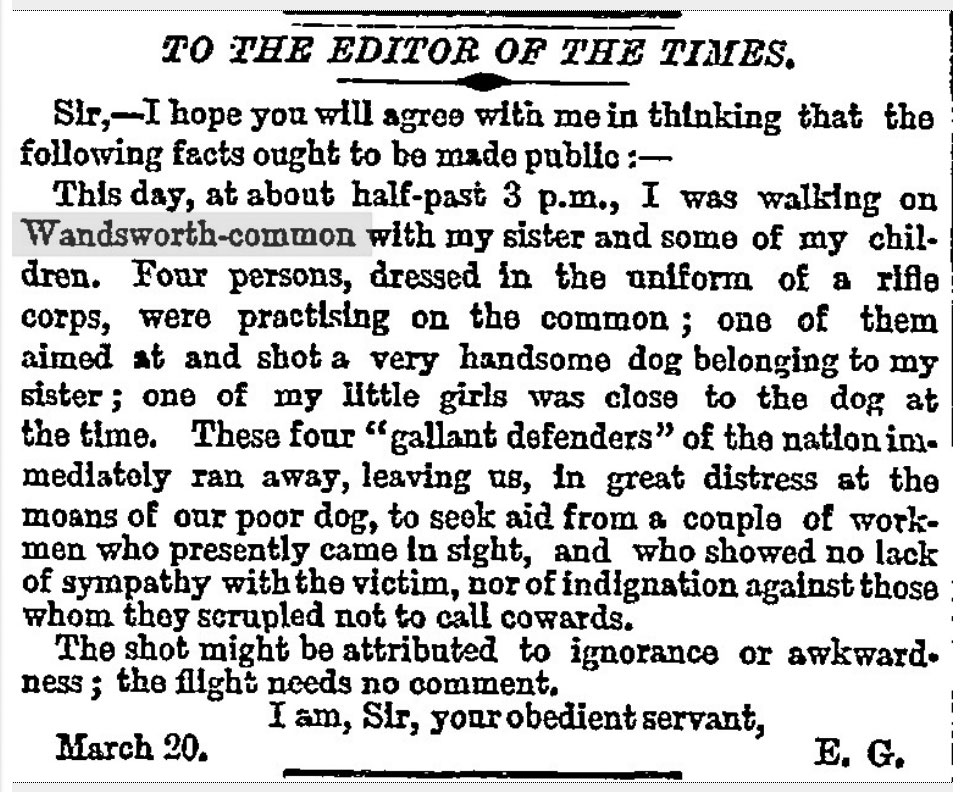
(Click on image to enlarge)
Sun (London) — Thursday 29 March 1860
THE RIFLEMEN ON WANDSWORTH COMMON.
Lord ASHLEY asked the Secretary of State for the Home Department whether his attention had been directed to a letter, signed E. G., which appeared in the Times of Thursday last, complaining that on the 20th of March four persons, dressed in the uniform of a rifle corps, while practising on Wandsworth Common, aimed at and shot the favourite dog of the writer's sister, immediately upon which fatal catastrophe they all ran away; and whether it would not be advisable to authorise the police to put a stop to sharp-shooting upon public footpaths ?
Sir G. C. LEWIS said that he understood the North Surrey Volunteers were drilled in the Neighbourhood in question on the day named, and that four men in the uniform of that corps were seen the same day on Wandsworth Common, but the police could not discover who they were. No sharp-shooting had taken place on the public footpaths. (Laughter.)
[BNA: Link.]
Weekly Mail (London) — Sunday 1 April 1860
A RIFLE CORPS ON WANDSWORTH COMMON.
Lord ASHLEY asked the Secretary of State for the Home Department whether his attention has been directed to a letter, signed E . G., which appeared in the Times of Thursday last, complaining that on the 20th of March four persons, dressed in the uniform of a rifle corps, while practising on Wandsworth Common, aimed at and shot the favourite dog of the writer's sister, immediately upon which fatal catastrophe they all ran away; and whether it would not be adtisable to authorise the police to put a stop to sharp-shooting upon public footpaths.
Sir G. C. LEWIS said that the Royal Surrey Rifle Corps was exercising there on the day mentioned. Four men were seen about the time alluded to, but they could not be identified by the police. There has been no sharpshooting there since (laughter).
[BNA: Link.]
Express (London) — Tuesday 3 April 1860
THE RIFLEMAN WHO SHOT THE DOG
The parties in this came, which has attracted so much attention, have been discovered. Yesterday, Mr. Alfred Jones, solicitor, residing at Wandsworth Common, applied for summons at Wandsworth Policecourt against Mr. John Kerrimo, a member of the Surrey Riles, of No. 25, Manor-street, Clapham, for cruelly torturing his dog by shooting it. The applicant stated the nature of the cam, from which it appeared that on the 20th ult. his sinter, with two young children and the dog, were walking along the avenue upon Wandsworth Common, which was a public footpath, when the lady was startled by hearing the report of a gun, which was immediately followed 17 the dog springing up in the air wounded. Upon looking in the direction of the smoke from the gun, four young men, dressed in the uniform of a rifle volunteer corps, were seen running off as feet as they were able, and very soon disappeared from the young Leis sight It was afterwards found that shot had pond through the body of the dog, and it bad been in the hands of veterinary surgeon ever eines, sad' it was now likely to recover. Information wee given to the pollee, and a reward of la was offered far the d of the parties, and it was only through Kerrie= having meationed the circumstance* to some of him' companions that they were traced. Mr. Ingham granted a summons against Earnsoz, who (red the gun, and also for the attendsnee of his three witnesses, via, Mr. E. Sykes, of No. 2, -villas, Binsald.road, Clapham ; Mr. R. Bertram, of No. 2, Stockwell.crescent ; and Mr. H. J. Jones, the address being unknown. The applicant also summons for discharging firearms in a ere, but the worthy magistrate thought con would be sufficient.
[BNA: Link.]
Naval & Military Gazette and Weekly Chronicle of the United Service — Saturday 7 April 1860
SurreyCaptain Eman writes" In reference to Lord Ashley's question in the House of Commons on Thursday evening, and to Sir George Lewis's reply, that the Surrey Rifle Volunteers had been drilling in the neighbourhood on the day on which dog was shot on Wandsworth common by a person in the uniform of the Surrey Rifle Volunteers, Iwill thank you to let it appear in your journal that the 4th Surrey or Brixton and Streatham Rifle Volunteers, under my command, were not out for drill on the 20th inst., either at Wandsworth or elsewhere, and could be no way implicated in the outrage in question. Thomas Eman, Capt. Commandant 4th Surrey Rifles. Foxley road, near Brixton, March 31."
[BNA: Link.]
Globe — Thursday 12 April 1860
The Bide movement hits brought with it a new class of what are called "accidents." A corporal of militia, a horse, and dog have been shot by incautious riflemen. The corporal was standing too near a target; the horse was pulling harrow over field nearly a mile from the spot where the shooters stood. The dog, as our readers know, was running about Wandsworth Common. Now the man driving the horse, and the little girl playing with the dog, might each have received the deadly bolt, and the human beings, instead of the brutes, have been killed. Three such "accidents," each coming under the head of " preventable accidents" from any reasonable point of view, ought to be warning sufficient. They reflect no credit on the good sense of the riflemen who caused them, nor on the management of the corps to which those riflemen belonged. It is quite time that commanding officers took up in earnest the consideration of the question, how can prevent these accidents.
One way would be to inflict punishment, by way of example, on the offenders, and that punishment might rise from a fine to a severe censure in regimental orders, and finally expulsion. Another way would be to reiterate the necessity of acting with the greatest caution on all oc casions, and to prevent any member of the corps, far possible, from shooting anywhere, except under! the eye of his officer or in .some public shooting ground. Regular soldiers would not be permitted to go out into the country and fire marks in any spot they chose to select, and see no reason why volunteers and the public generally should not be prohibited from rifle shooting anywhere except in places publicly notified as shooting places, secure natural forma lion or made secure art.
[BNA: Link.]
[BNA:
West Middlesex Advertiser and Family Journal — Saturday 14 April 1860
EXTRAORDINARY PAROCHIAL PROCEEDINGS AT BATTERSEA.
The proceedings in this parish on Easter Tuesday are very likely to engage the attention of the ecclesiastical or civil courts of law. The members of the representative Vestry met in the Lammas Hall, Battersea, at nine o'clock on the morning of the above day for the purpose of electing a churchwarden for the ensuing year.
Mr. Hart and Mr. Allen, both members of the Ratepayers' Association, were respectively nominated, but the choice fell on Mr. Hart by a majority of one vote. This Vestry, since the Metropolis Local Management Act came into operation in the parish, a period of about four years, have always elected the churchwarden. In the usual printed notice, however, which is annually issued by the churchwardens, calling an open or public vestry of the inhabitants, and which was held at half-past nine o'clock of the same day (Easter Tuesday), for sundry purposes, it stated, in addition, that the inhabitants were also, "according to annual custom, to proceed to the election ot churchwardens, sidesmen," &c, thereby repudiating the previous election of Mr. Hart by the representative Vestry in the earlier part of the morning.
Accordingly, at half-past nine o'clock, a numerous meeting of the ratepayers assembled in public Vestry, at the Evening School Room, Green Lane road. The first business was to receive the report of the Auditors on the Churchwardens Accounts for the past year, and to make a rate or assessment for and towards the necessary repairs and expenses of St. Mary's and St. George's Churches for the present year.
H. S. Thornton, Esq., the vicar's churchwarden, presided.
Mr. Buckmaster objected to two sum 3 in the churchwardens' accounts, and stated that one of them especially had been illegally placed there. He read a clause in the act showing the consequences or penalties attached to such a procedure.
The Chairman: If anything illegal has been done you have a remedy at law. After considerable discussion the accounts were passed.
Mr. Pariss moved that a church-rate be levied at 3d. in the pound.
Mr. Sellars rose to second the motion. He had no doubt it would appear strange that a dissenter from the Church of England should adopt such a course, but when he considered that church rates would soon be abolished, and kuowing the present need of repairs at both the churches, together w- r the fact that those holding minor offices had to paid their stipends, ha thought on the score justice a rate ought to continue for another year. After a stormy discussion a divi. ion took place, and the rate was only carried by the chairman giving his casting vote.
Mr. Paris* then rose to move that Mr. S Ncnfe he elected churchwarden for the "ensuing } v which being duly seconded produced considerable excitement.
Mr. Buckmaster protested against such a dishonoiable course of proceeding.
Mr. Reynolds, and other gentlemen who acted in concert with him, attended the Vestry held that morning at the Lammas Hall, and thus" admitted its legality, but. now came to the public Vestry, and declared the previous proceedings in the morning tc be illegal.
Mr. Reynolds here denied the inference drawn, and a very considerable altercation took place, when The Chairman stated that he could stop longer, and called on the meeting to appoint another cnairman, whereupon Mr, Alder was unanimous')' requested to occupy the chair, to which propositi 11 he consented. .
Mr. Buckmaster continued"lt was the duty ot the rateyayers to set their faces against this laid stratagem. If the present motion was carried and the proceedings of the Vestry annulled, alt the efforts they had made to obtain parochial reform* for the last four years, would be rendered entirely nugatory. .
Mr. Bridge vindicated the course be had pursued and denied that he had expressed any opinion on the subject as imputed to him. He contended that they were now acting legally.
Mr. Reynolds pursued a similar course of argument, and said that they had been acting under a mistake.
Mr. Juer wished to know how it was that Mr. Reynolds had for four years sanctioned the select Vestry in electing a churchwarden? The proceedings must have been illegal.
Mr. Reynolds explained that having been ecclesiastically admitted into the office the elections were? legal. He then said he should move an amendment,, which was that Mr. Allen be elected churchwarden. He did so to show that he was not actuated by party feelings.
Mr. Bridge would second the amendment for the same reason.
Mr. Buckmaster said (ironically), and Ipropose Mr. Reynolds for churchwarden, in consideration of the great services he has rendered to the parish. (Great laughter.) f A scene of the greatest confusion here ensued, and Mr. Juer moved an adjournment, which was lost.
Mr. Alder, as chairman, asked the Vestry Clerk which of the elections would be legal.
Mr. Chadwin, the vestry clerk, said he was incompetent to answer the question.
Mr. Juer referred to the second section of the amended Metropolis Local Management Act, July, 1856, and said he should most certainly gi v in a written protest against the election.
Mr. Poupart considered the proceedings altogether illegal, and he should therefore protest against the course adopted.
The chairman put the motion in favor of Mr* Neate, but only two hands were raised. The amendment was next put and carried by a large majority of those present. He then officially declared that Mr. Allen had been duly elected, in open and public Vestry, as the churchwarden far the year ensuing. Thus terminated these extraordinary proceedings for the present.
[BNA: Link.]
West Middlesex Advertiser and Family Journal — Saturday 14 April 1860
EXTRAORDINARY PAROCHIAL PROCE"
West Middlesex Advertiser and Family Journal — Saturday 28 April 1860
[BNA:
[BNA:
South London Chronicle — Saturday 28 April 1860 ART-UNION OF LONDON. The annual meeting the subscribers of thi* institution took place Tuesday in tlic New Adelphi theatre, Lord Montcagle occupying the chair. Mr. George Godwin, the secretary, read the report, the following are the principal portions: — 1 The Art-Union of London lias now been established 21 years. Exclusive of the current year's subscription, and the thousands added prizeSr., aS? i ' anJ distributed the sum of 251,143?., which 138,662/. have been paid to artists, anil for the production f statuettes bronzes, and other prizes; and 64,023/. to engravers, and for the supply of impressions to the subscribers. It has sent some hundreds of thousands of engravings over the world-to the gold-diggers Australia, the backwoodsmen of Canada, to New Zealand, China, the Indies, Egypt, the United States; in fact, to nearly every corner of the globe where there is an English settlement, as "!, cr — v cit y> towll > n village of the United Kingdom; and it finds itself, on the present occasion, with a subscription of 14,138/. The total sum which has been expended by the Art-Union of London on paintings, exclusive of the further large amount added by the prizeholders themselves, is 118,765/., while for bronze and porcelain statuettes, medals, works in iron, enaes, it lographs, and other pi oductions given as prizes, the sum of 19,807/. has beeu paid. the council have recently offered a premium of one hundred guineas for a series of designs in outline, or outline slightly shaded, illustrative of Tennyson poem, " The Idylls of the King." hey have further offered premium of seventy guineas for a group or statuette in plaster, representing some subject from English history, to be subsequently executed bronze or Parian, and thirty guineas for the work selected, as second in merit. They propose hereafter to invite designs for a vase, a tazza, or other similar art work. Ihe following a condensed statement of receipts and disbursements: — Subscriptions received £1-1,138 15 Printing, advertising, salaries, and other expenses, including reserve of 24 percent 3,393 16 0 Amount set apart for printing and volume of wood engravings . . 4,489 19 Amount allotted for prizes . . . . 6,255 18 The reserve fund now amounts to the Sllln of 9,383 Lord Monteagle, moving the adoption of the report, said that he never did so with greater satisfaction than at that moment. It spoke well of the past, and augured well for the future. His lordship went into the details connected with the laws and management of the Art Union, and referred to Mr. Labouchere having suggested a kind of National Gallery for themselves. He congratulated he members havings,, eh distinguished men a, the of St. Paul's, Mr. Monckton Milnes, and others of like eminence, added to their council (cheers) H e felt peculiarly happy in seeing that the Art-Union was able to illustrate that finest pro-I' f — " eate ' modern poet, Tennyson's i,n n i " £'_ ' Although he did not look 1 upon such undertakings as props to the line arts, for they wanted no props; he thought they were wing, to carry out abroad to the farthest corners of e ear 1 (cheers.) His lordship commented in evere terms upon the attempts now being made r, a nval ocety, having nothing in common w hthem, except unfairly appropriating their! So of the 6 reportf C e '"_* 1 Carried unanimously Mr. Monckton Milnes, M.l'., said felt much whTrt.?' elc;? tl0 " which had connected him The drawing was then proceeded with, the first prize of consequence being one of 100/., drawn for Miss Dunn, of e dale, Yorkshire; Commodore Hopkins, of Merthyr Tydvil, 200/ Mr Thomas Gallop, Albert-road, Regent's Park, the remaining 200/. prize. The other prizes occupied about an hour and a half ill drawing from the wheel, after which the proceedings were concluded. Prize 30/., J. Church, Walworth; prize of' 25/., W. Curling, Denmark Hill; prize of 20/., C. IGoocli, Camberwell; prizes of 10/., F. T. Bntchelor. Newington Butts, H. Cristall. Uotherhithe, J. Silva, Wandsworth Common, and T. Stirling, Lambeth. Group of Venus and Cupid. — J. Jones, Batter-j sea; 11. S. Robinson, Greenwich: Miss Swaine. 1 Pcckhain. [BNA: Link.] Art Union of London The Art Union of London, established in 1837, was an organisation which distributed works of art amongst its subscribers by lottery. Art Union of London From Wikipedia, the free encyclopedia Jump to navigation Jump to search The Art Union of London, established in 1837, was an organisation which distributed works of art amongst its subscribers by lottery. Contents 1 Art unions 2 Foundation 3 Membership and its benefits 4 Dissolution 5 See also 6 References Art unions Art unions were organisations created to function as patrons of art. Members would pay a small annual subscription. The union would spend the subscriptions on works of contemporary art, which were distributed among its members by means of a lottery. The idea emerged in Switzerland at the beginning of the 19th century, and was imitated in various German territories. It was introduced to England in the late 1830s on the recommendation of a House of Commons Select Committee on the Arts and Manufactures in the United Kingdom.[1] Foundation The Art Union of London was established in 1837, following the establishment of similar organisations in Edinburgh and Liverpool.[1] It described its aim as being "to aid in extending the love of the Arts of Design, and to give Encouragement to Artists beyond that afforded by the patronage of individuals."[2] Its first meeting was led by four young social radicals: Edward Edwards, Henry Hayward, George Godwin and Lewis Pocock. By the end of the year a formal management committee had been formed, which included the architect Charles Barry, William Ewart MP, chairman of the 1835 select committee, N.W. Ridley Colborne MP, who had also been a member of the select committee and Lord Prudhoe, later Duke of Northumberland.[1] The committee was to prove stable, with nine of the original members still serving in 1857.[1] In its first year, 1837, the union raised only £480; by 1842, however, annual subscription revenue stood at almost £13,000 a figure that would remain fairly stable for twenty years.[1] By 1876 there were more than 20,000 members.[3] The Union persuaded Samuel Carter Hall, editor of The Art Journal, to publish the Union's documents and reports in his magazine, and to promote the annual exhibition of its prizes.[1] Membership and its benefits Each member paid a subscription of one guinea a year. In return they all received a large engraving annually, said to be at least equal in value to their subscription. In addition they had the chance of winning a prize at a yearly draw,[3] initially either a proof copy of that year's print, or a painting.[4] The committees of earlier art unions had selected the prize works for their members, but the winners of Art Union of London prizes had a free choice of any painting, up to a given value, shown at any of the London exhibitions that year.[5] At a draw held early on in the Union's history, in 1839, there were 62 prizes. They consisted of 20 proof impressions of the annual engraving, twenty impressions on India paper; nine pictures valued at £10, two at £30, four at £50, one at £100 and one at £150.[4] At that year's meeting George Godwin announced the Committee's intention to hold the draw at an earlier date in the future, to allow the winners' selections to be made before most of the best pictures had been sold.[4] The annual engraving was, at least in the early years, selected from amongst the paintings chosen by the prize-winners.[4] As the number of subscribers increased, so did the value of the prizes, totalling about £9,000 annually at the peak of the Union's success.[3] From the 1840s there were yearly exhibitions of the prize selections.[1] In addition to paintings and proof engravings the Art Union of London began to offer various specially manufactured "art objects" as prizes. In 1842 it launched a series of medals illustrating the history of British art. Thirty of each were cast in silver as prizes, and bronze versions were offered as an alternative to the annual print.[3] In the same year the Union began to offer bronze statuettes as prizes. As a cheaper alternative they developed the idea of issuing sculptures in the unglazed porcelain known as "Parian Ware"; the first to be issued was John Gibson's Narcissus, produced by Copeland and Garrett in an edition of fifty in 1845 and offered in the following year's draw. The success of the venture led the Union to organise a competition for works that could be reproduced on a small scale in Parian.[6] Dissolution By 1895 the number of subscribers had fallen to below 5,000. The Union was wound up following a resolution passed in 1912.[3] References Sperling, Joy. ""Art, Cheap and Good:" The Art Union in England and the United States, 1840 — 60". Nineteenth-Century Art Worldwide. Retrieved 4 May 2013. [UNKNOWN PUBLICATION — header not detected. Please review.] "POLICE COURTS . . . parish of Battersea, for distress warranto against their goods and chattels, for the non-payment of precept issued by the board for the sum of los. as*ed upon the:r parish for the main drainage rate. Mr. Reynolds, solicitor, of Battersea, appeared for . . . Published: Wednesday 23 May 1860 Newspaper: Morning Advertiser
County: London, England [BNA: Link.] "Morning Herald (London) — Friday 25 May 1860 WANDSWORTH. THE DERBY DAY SPORTELHenry _Letts, who was described as a clerk at No.B, Bartlett's-buildings, Holborn, was placed in the dock before Mr. Ingham, charged with wilfully throwing crackers in a public throughfare to the danger and annoyance of the public.lnspector Proctor, of the V division, stated that about eight o'clock in the evening he was on dutyat Clapham-common, near the Windmill, where therewere crowds of persons waiting to see the return of the carriages from the Derby. He saw several young gentlemen throwing a number of crackers at the persons in carriages as they passed along the road. He cautioned several of them, and passed on. He returned shortly afterwards, and he then saw the crackers thrown at the carriages in perfect showers; they were thrown by the score at a time by different persons. Be hurried up a number of constables, and gave directions for the parties to be taken into custody. He saw the prisoner throw three crackers into carriages as they passed.The prisoner was fined 10s., or seven days imprisonment. The money was immediately paid.Several other young gentlemen were also fined for a similar offence. [BNA: Link.] South London Chronicle — Saturday 26 May 1860 [BNA: Link.] PAROCHIAL SQUABBLING IN BATTERSEA. Mr. Corsellis -, the clerk of the Wandsworth district board, attended before Mr. Wandsworth Police Coart in support of summonses against Messrs. George Alder, G. Ayles, W. F. Cross, S. Seldon, J. C. Buckmaster, T. Reeve Oinny, . Hillicr W. Pickering, and H. Sykea Thornton, oTerseers for the parish of Battersea for di warrants against their goods and chattels for the nonpayment of a precept issued the board for the sum of 938/. 15s. assessed upon their parish for the main drainage rate. * The facts of the case were theseOn the of November last the board issued the precept to ail the defendants, with the exception of Messrs- Buckmaster, Hillier, and Denny, and it set forth that the mcney should be paid on or before the 20th of April. The rate for that order was not made until January last, and Mr. Corsellis showed that part of the money had been collected, and not any of it paid over. It also appeared that there was a sum of 600/. which had been drawn from the current account of the overseers, and placed to the private account of the late overseers, Messrs. Alders, Ayles, Cross, and Seldon, and that proceeding had given rise to dispute. The board complained that they had money to pay over, but would not obey the order. Mr. Reynolds explained with respect to the 600/. He was formerly the legal adviser of the late overseers, and when the new ones came into power they thought that they could dispense with his services, the keeping of a lawyer was a dear article. He was in possession of certain papers which the new overseers called upon him to deliver up, but he declined until his claim was paid. Proceedings were taken, and the court ruled that the papers should be delivered up upon their paying his demand, something about 500/., and the overseers drew cheque from the current account and placed it to their own account in order to protect themselves. Mr. Corsellis said the 600/. had nothing to do with these proceeding, and eould be only mentioned to show that the overseers were in possession of Mr. Ingham inquired when the new overseers came into office. Mr. Reynolds. — On the 31st of March. Mr. Ingham thought the order should have been made upon th overseers to pay within their term of office. Mr. Corsellis contended that the duty was attached to the office and not to the officer. Mr. Reynolds differed in that opinion, and said that supposing the late overseers had collected the while of the rate, and had absconded before the new overseers were appointed, the subsequent overseers could never be made liable for the deeds of their predecessors. Mr. Ingham thought Mr. Reynolds was right. The question required consideration, more especially when he was asked levy a distress warrant. The late overseers might say that they had handed their books over to their successors perfectly correct, and on the other hand, the new overseers might say that they had not sufficient time to collect the money. Mr. Reynolds said there were now seven rates under the Metropolis Local Management Act in the course of collection in Battersea, and argued that the proceeding was quite hostile on the part of Battersea, which had been in arrears very considerably with their rates, and hence the difficulty. Several of the overseers said the rate had been . made, and if a sufficient time were allowed the money would be paid. The summonses, at Mr. Ingham's recommendation, were accordingly adjourned for a month. PAROCHIAL SQUABBLING IN BATTERSEA. Mr. Corsellis, the clerk of the Wandsworth district board, attended before Mr. Wandsworth Police Court in support of summonses against Messrs. George Alder, G. Ayles, W. F. Cross, S. Seldon, J. C. Buckmaster, T. Reeve Oinny, . Hillicr W. Pickering, and H. Sykes Thornton, overseers for the parish of Battersea for di warrants against their goods and chattels for the nonpayment of a precept issued the board for the sum of 938 15s. assessed upon their parish for the main drainage rate.' The facts of the case were these/ On the of November last the board issued the precept to ail the defendants, with the exception of Messrs Buckmaster, Hillier, and Denny, and it set forth that the money should be paid on or before the 20th of April. The rate for that order was not made until January last, and Mr. Corsellis showed that part of the money had been collected, and not any of it paid over. It also appeared that there was a sum of 600/. which had been drawn from the current account of the overseers, and placed to the private account of the late overseers, Messrs. Alders, Ayles, Cross, and Seldon, and that proceeding had given rise to dispute. The board complained that they had money to pay over, but would not obey the order. Mr. Reynolds explained with respect to the 600/. He was formerly the legal adviser of the late overseers, and when the new ones came into power they thought that they could dispense with his services, the keeping of a lawyer was a dear article. He was in possession of certain papers which the new overseers called upon him to deliver up, but he declined until his claim was paid. Proceedings were taken, and the court ruled that the papers should be delivered up upon their paying his demand, something about 500/., and the overseers drew cheque from the current account and placed it to their own account in order to protect themselves. Mr. Corsellis said the 600/. had nothing to do with these proceedings, and could be only mentioned to show that the overseers were in possession of Mr. Ingham inquired when the new overseers came into office. Mr. Reynolds. — On the 31st of March. Mr. Ingham thought the order should have been made upon the overseers to pay within their term of office. Mr. Corsellis contended that the duty was attached to the office and not to the officer. Mr. Reynolds differed in that opinion, and said that supposing the late overseers had collected the while of the rate, and had absconded before the new overseers were appointed, the subsequent overseers could never be made liable for the deeds of their predecessors. Mr. Ingham thought Mr. Reynolds was right. The question required consideration, more especially when he was asked levy a distress warrant. The late overseers might say that they had handed their books over to their successors perfectly correct, and on the other hand, the new overseers might say that they had not sufficient time to collect the money. Mr. Reynolds said there were now seven rates under the Metropolis Local Management Act in the course of collection in Battersea, and argued that the proceeding was quite hostile on the part of Battersea, which had been in arrears very considerably with their rates, and hence the difficulty. Several of the overseers said the rate had been made, and if a sufficient time were allowed the money would be paid. The summonses, at Mr. Ingham's recommendation, were accordingly adjourned for a month. [Source: www.britishnewspaperarchive.co.uk/viewer/bl/0000443/18600526/018/0004" target="_blank">Link "?? Weekly Mail (London) — Saturday 1 September 1860 during the day shot for a handsome rifle, which l'3B carried off by William 'Page, the wearer of several medals, . . . entry has most munificently offered the corps any portion of money. To be competed for with Enfield rifles, long or Wandsworth-common most saitable for the erection of a abort, government pattern. This cross was gained by Mr. b u t t . , Jahn teibb, of . . . Published: Saturday 1 September 1860 Newspaper: Weekly Mail (London) County: London, England Type: | Words: 3407 | Page: 5 | Tags: none [BNA: Link.] [UNKNOWN PUBLICATION — header not detected. Please review.] "May 14, 1860 --- A Perjurious Charge After two closely watched trials, featuring charges of "an indecent description," 11-year old Eugenia Plummer is convicted of perjury. In the first trial, the Wiltshire girl's testimony had sent her former tutor to jail for four years with hard labor. The Rev. Henry Hatch, chaplain at Wandsworth jail (left), had sought companions for his adopted daughter by advertising as a tutor for young girls. The Plummers placed Eugenia and her 4-year old sister Stephanie with Rev. Hatch but the arrangement lasted only two weeks. Mrs. Plummer retrieved the girls, claiming that her daughters were unhappy sleeping on calico sheets. Within days, however, the Plummers complained to their Bishop that the girls had been molested. Under the law of the day, neither Hatch nor his wife could testify at his trial. The jury was left with Eugenia's sordid tale, "narrated with steadfast countenance, with perfect mastery of the language descriptive of matters usually left in decent obscurity." Convicted, jailed and reviled, Rev. Hatch fought to clear himself from Newgate Prison. By filing perjury charges, he's now able to confront his accuser in court. His lawyer dismisses Eugenia's tale as "entire fiction, the result of a prurient and depraved imagination." While the exact charges are "unfit for publication," Hatch admits that he and his wife did permit the girls to come into their bed, but only beneath the coverlet. Indeed, Mrs. Plummer had suggested that her daughters — who had been to several schools — needed "petting." Hatch denies parading half-naked or worse in front of the girls. Lawyers for the girl ask what motive had she to lie but Eugenia was overheard telling her sister, " Ihate the Hatches." Summing up, the trial judge admits the case comes down to "contradiction upon contradiction." The jury finds Eugenia guilty but urges "the utmost mercy," given her "want of moral and religious education." The judge, placing much of the blame on the parents of the young liar, orders Eugenia to spend three weeks in a detention center. The child will then be placed in the care of "a lady of known benevolence and good judgement in the treatment of juvenile offenders." Hatch's career was wrecked and he ended his days as a rural clergyman in Essex. [BNA: victoriancalendar.blogspot.com/2011/04/"
South London Chronicle — Saturday 26 May 1860
<