A HISTORY OF
WANDSWORTH COMMON
IN PROGRESS — NOT FOR PUBLICATION
The Black Sea
DRAFT 3

(Click on image to enlarge)
Links
Hello, my name's Philip Boys. I sometimes masquerade as HistoryBoys.
I research just about anything I can find on the long history of Wandsworth Common. Every month I publish some of the findings as Chronicles of Wandsworth Common.
Tonight I'll be talking about the Black Sea, that once flourished in the north-west of the Common, in the angle between North Side and the London-South-Western Railway.
[Before we begin tonight's guitar recital, let's tune ourselves up...]
(Click on image to enlarge)
(Click on image to enlarge)
(Click on image to enlarge)
(Click on image to enlarge)
(Click on image to enlarge)
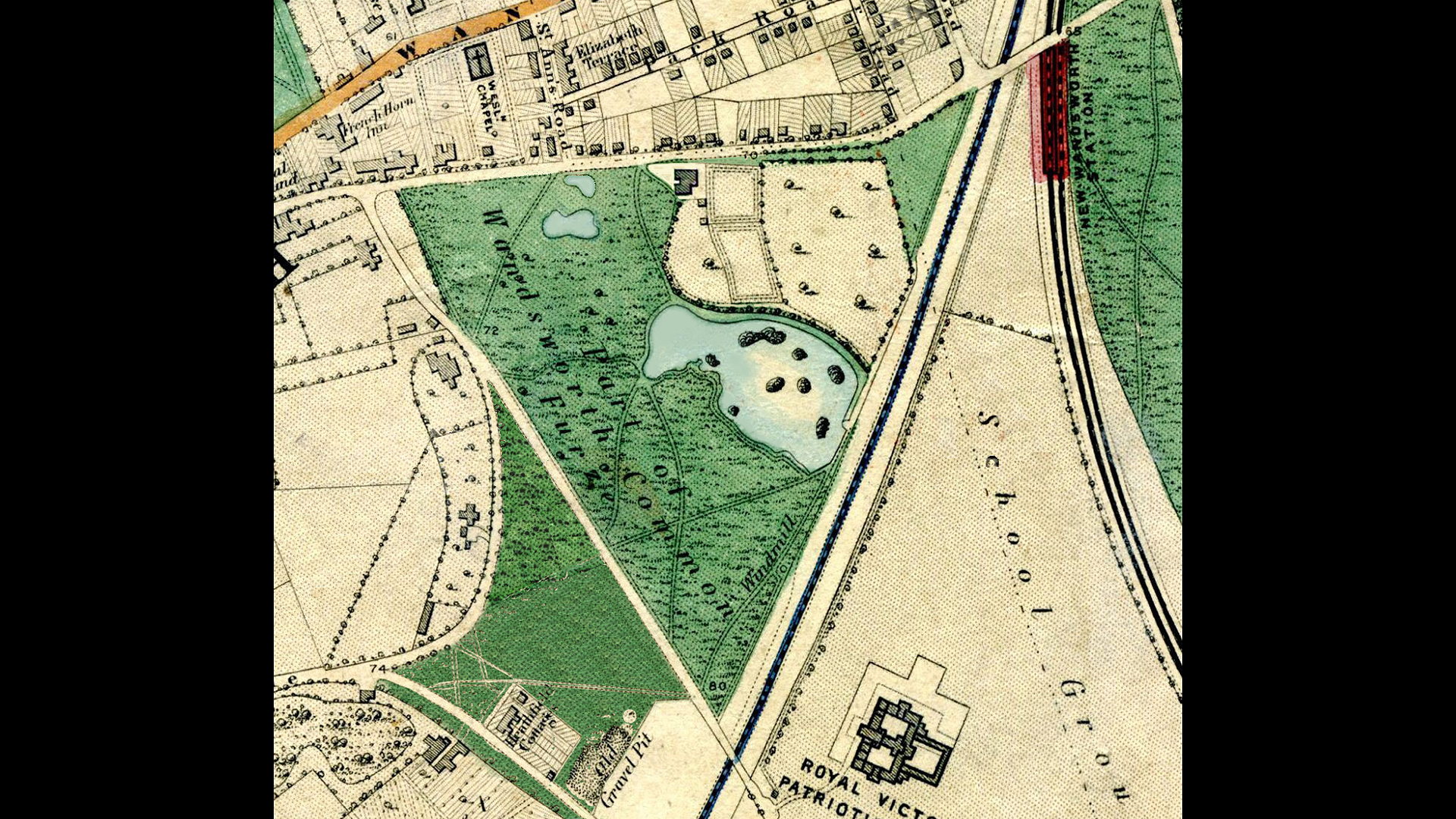
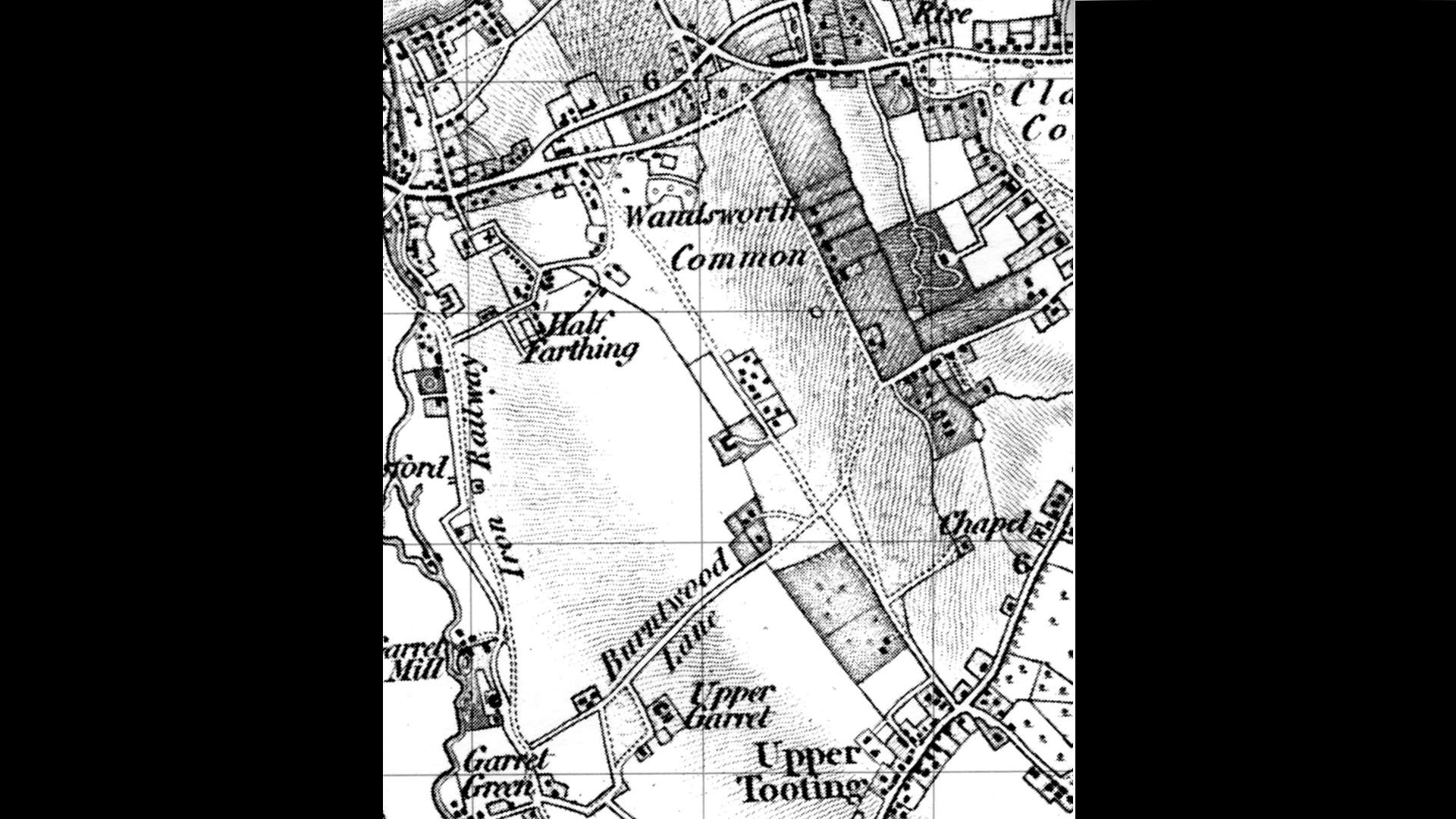
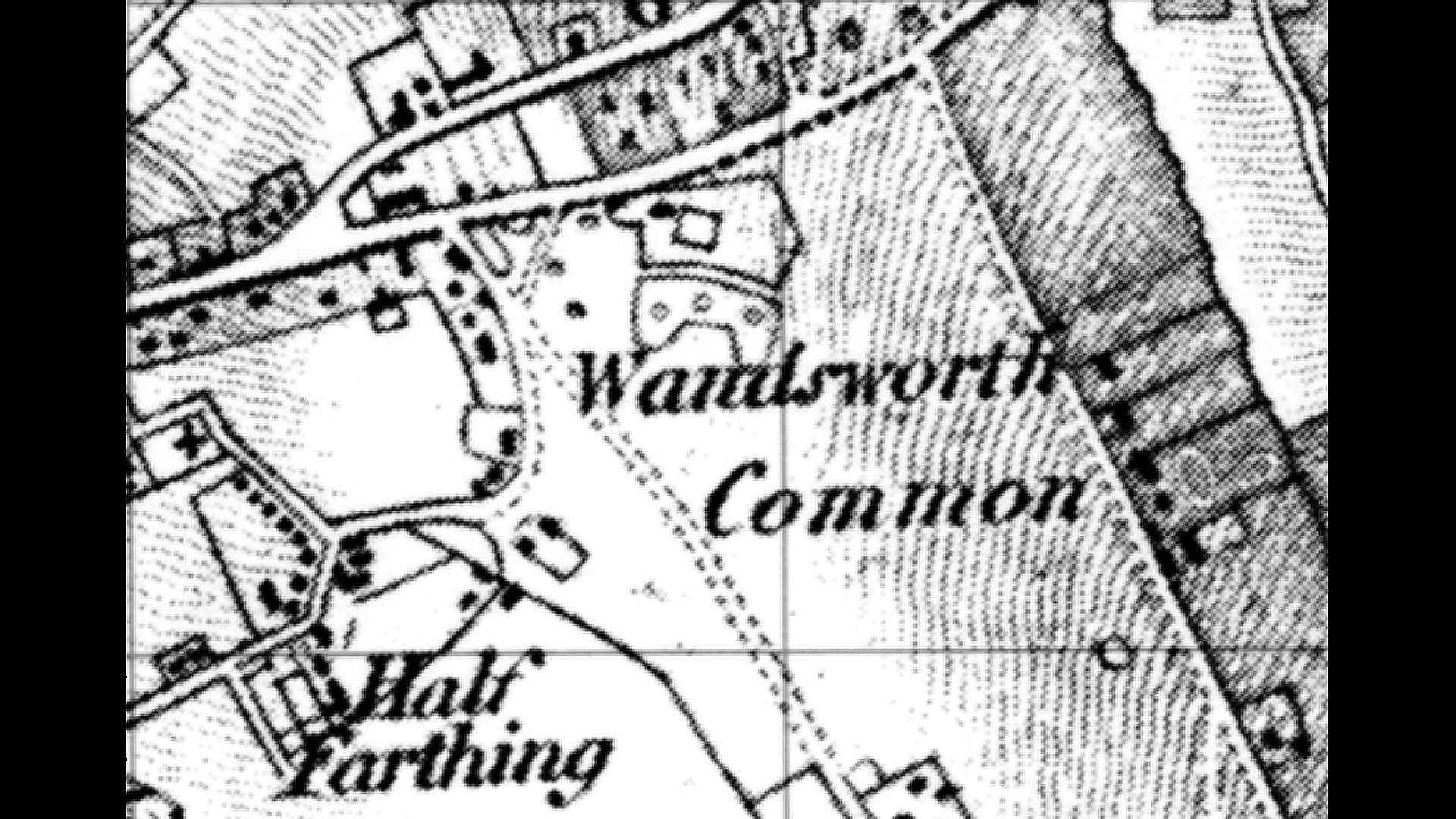
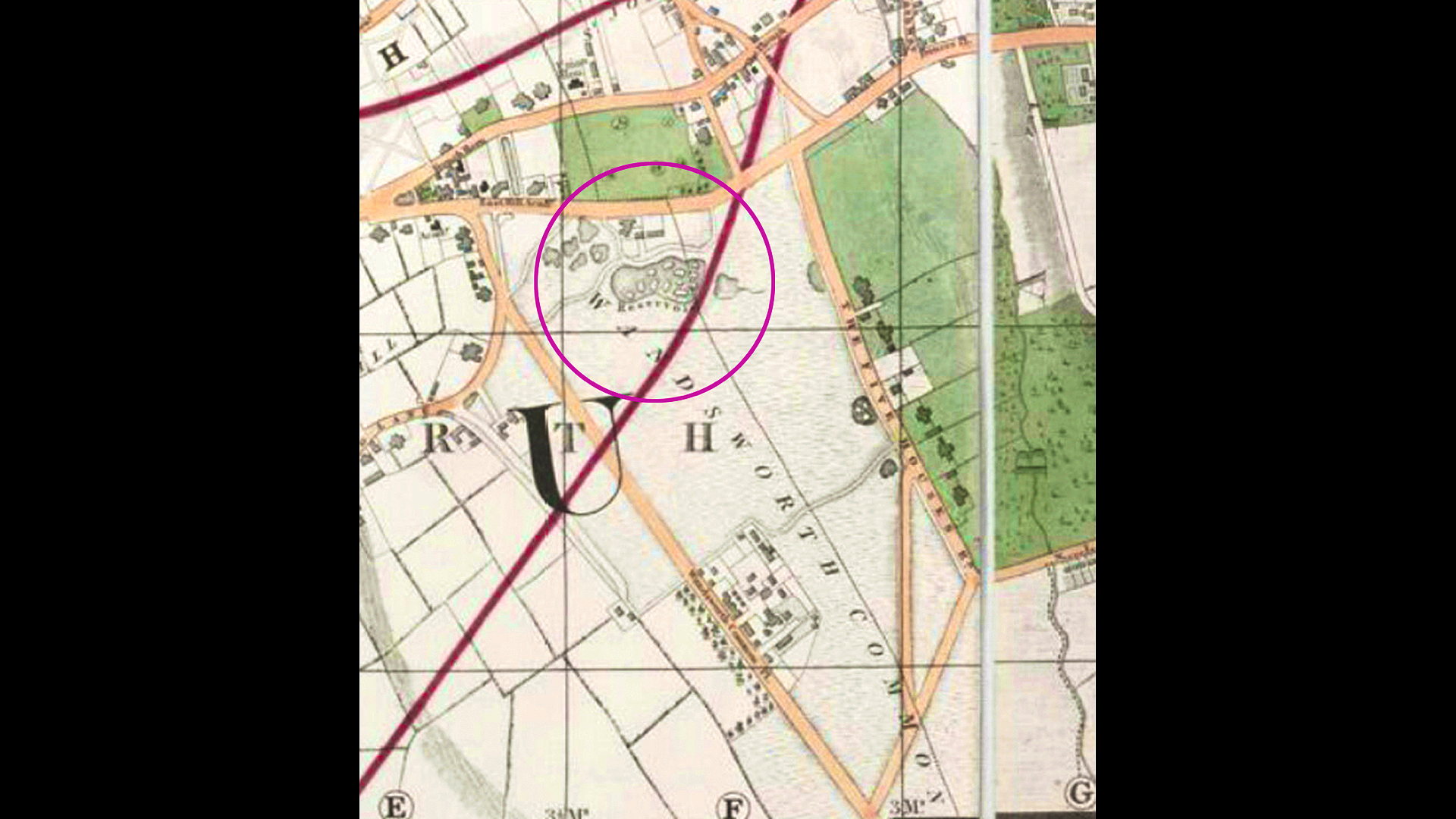
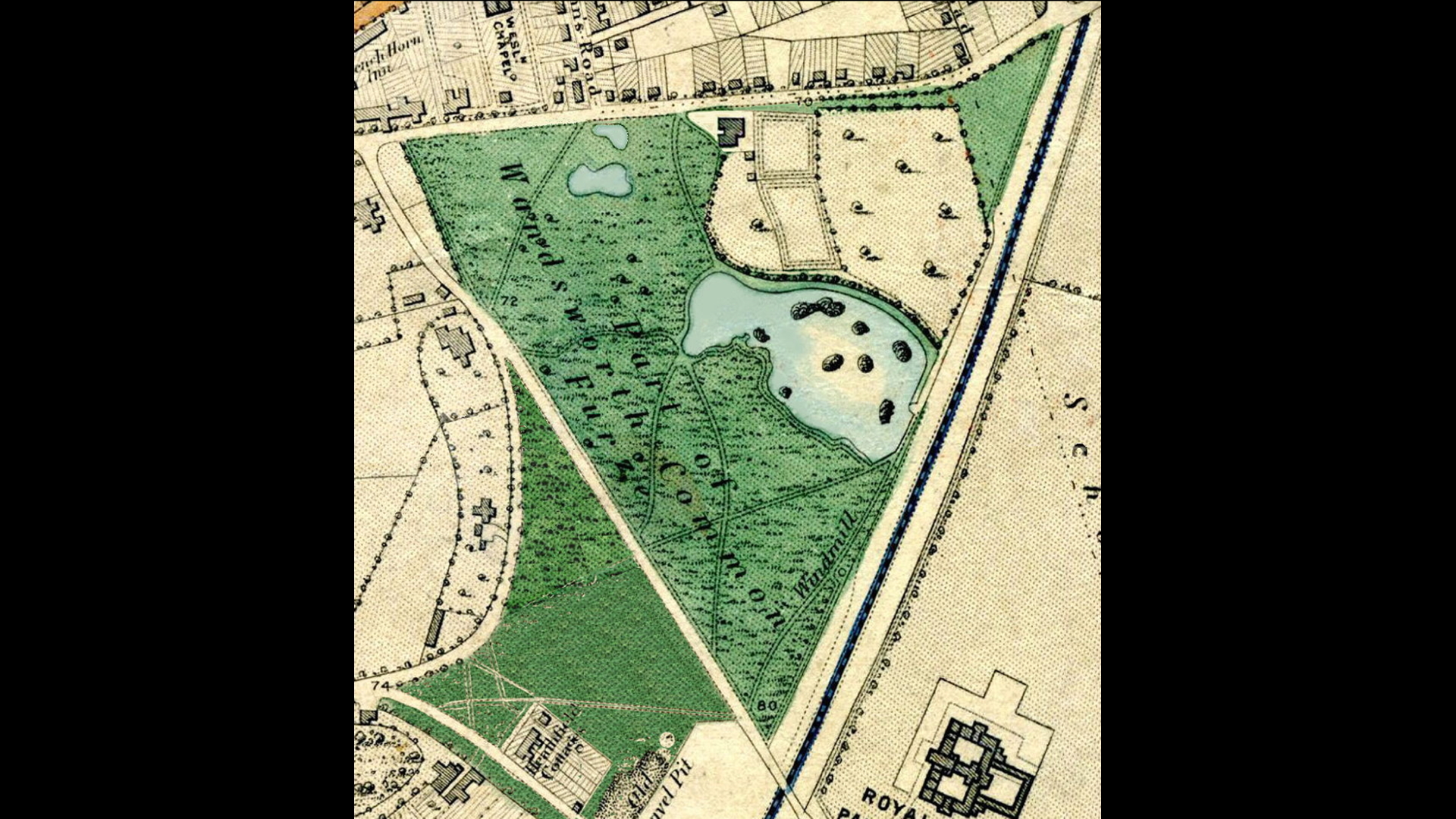
Here is the Black Sea, in a Stanford map of about 1864?
(Click on image to enlarge)
Let's take a minute or two to orientate outselves.
The railway line between London and Southampton, opened in ?
Here's North Side
Trinity Road
West Side
The old "New Wandsworth Station"
Does anybody need some more pointers?
Several things missing
And of course, Trinity Road is much narrower and there's no underpass...
The RVPA's there but no Emanuel School
No Spencer Park
No Earlsfield Road or Windmill Road...
At this time the Black Sea was a well-known beauty spot. But not just a place for strollers, or picnickers, or anglers.
Also for a range naturalists historians - the Black Sea was famous for its rare plants, insects, ? and ?. It features in many specialist listings...
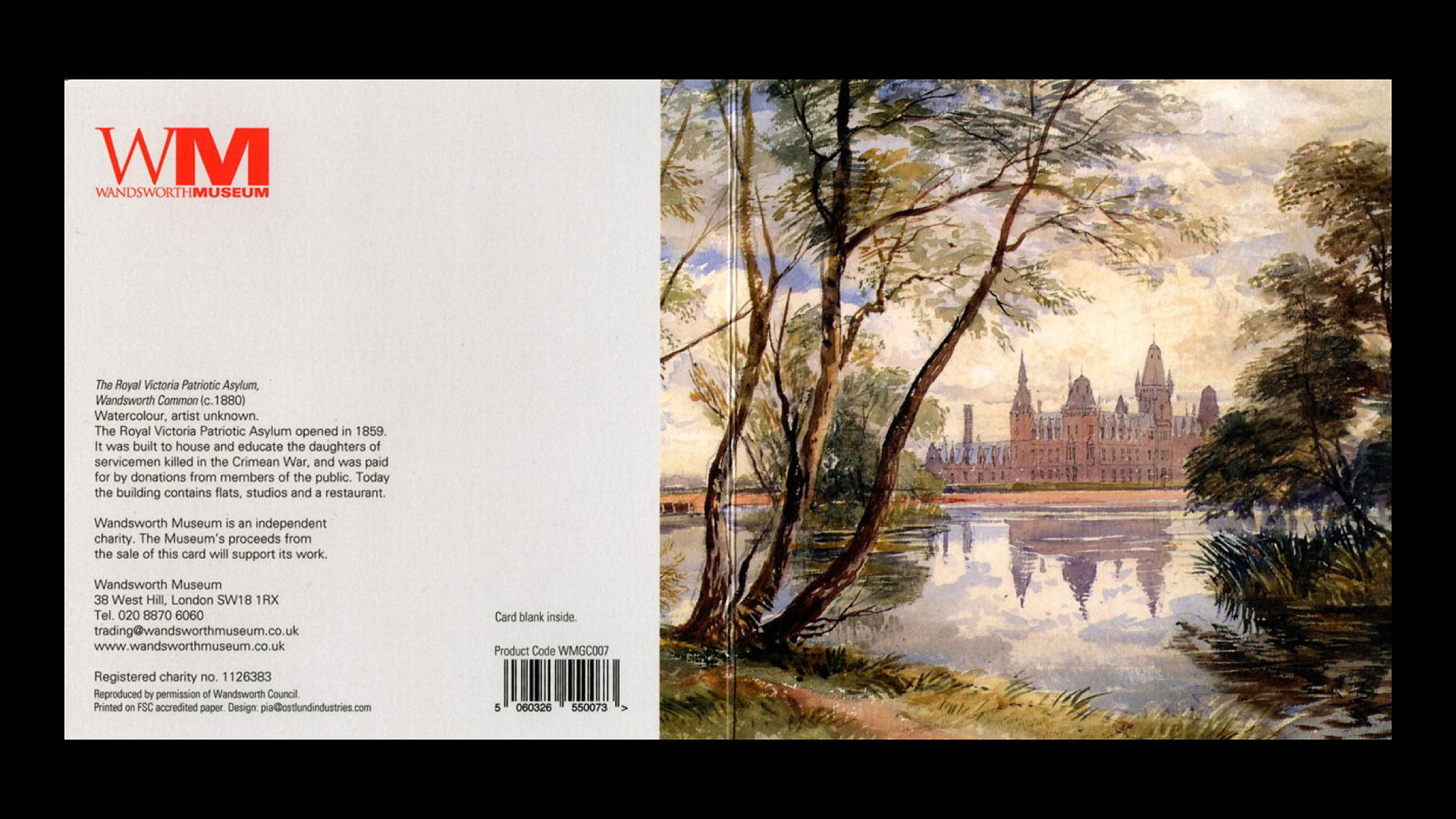
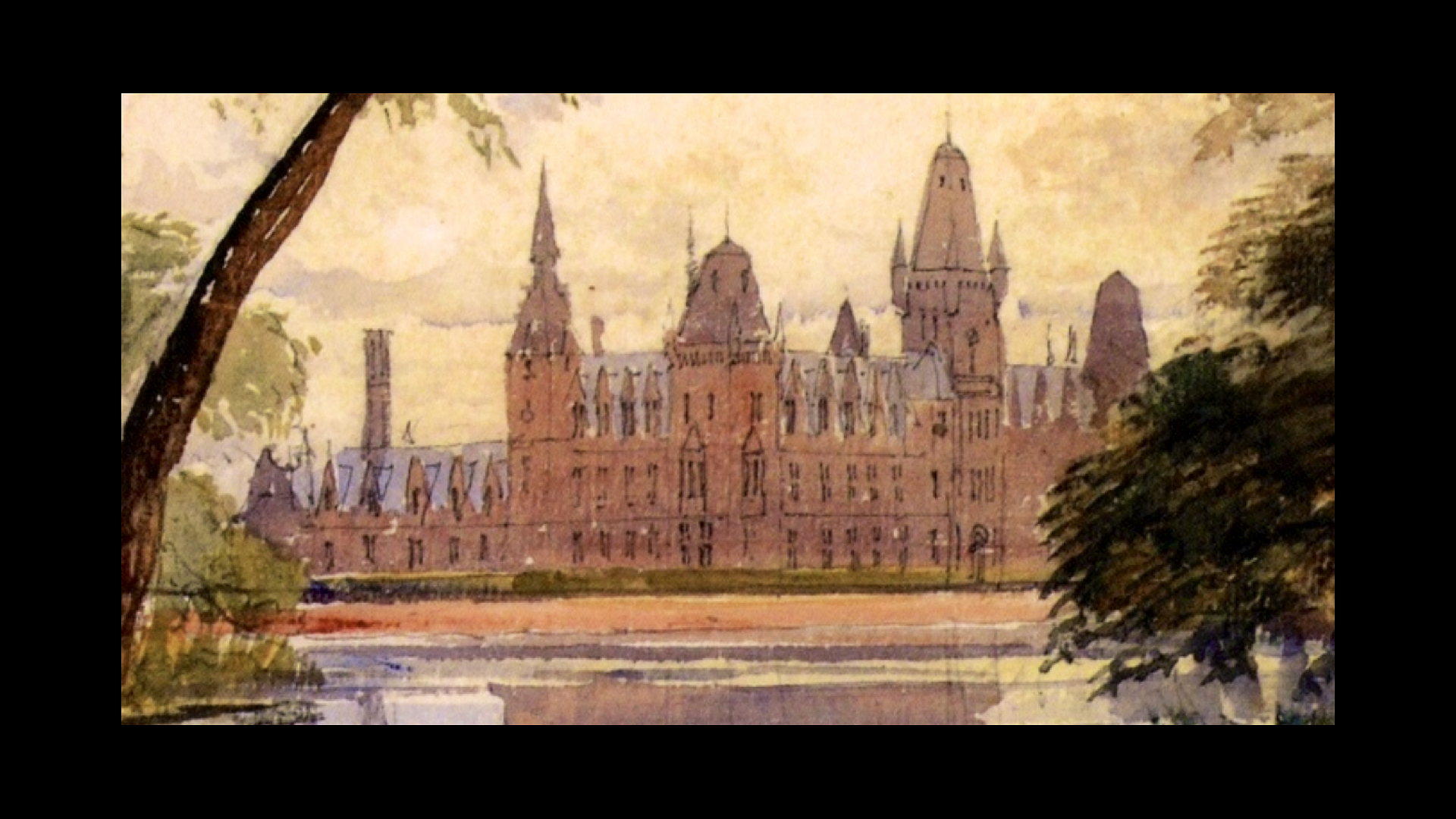
Here's one of my favourite images of the Black Sea, that gives an idea of what it was like in its heyday. [Though it may have been [scheduled for destruction already].]
(Click on image to enlarge)
I first saw this many years ago on a greetings card, published by the Wandsworth Heritage Service.
(Click on image to enlarge)
I've never seen the original, which I assume is safely stored somewhere in the basement at the old West Hill Library - where I'm told most of the much-missed Wandsworth Museum is located.
Many of the old images in Wandsworth's collection can be seen on ArtUK website.

(Click on image to enlarge)
But not, alas, this image.
If you don't know the ArtUK website, I strongly recommend it.
www.artuk.org
So what are we looking at?
It's a watercolour, and skilfully done (though I don't know by whom).
We appear to be peering out from the bank of a lake, with a small island to our left, partly obscured by a silver birch tree. There are flag irises and dense vegetation on our right, possibly alder trees.
In the foreground, probably a path, and more flourishing vegetation.
In the centre, some way away, quite clearly rendered, is the Royal Victoria Patriotic Asylum for Girls.
The surface of the lake is still, and the bulk of the building, with its many towers and pinacles, are reflected in the water.
There may be some grass, but are no trees around the school.
It was probably still quite young in 1858 [?] - it was built to house orphans whose fathers had been killed in the Crimean War of 1853-6.
It doesn't look like a painting from a photograph to me, though I suppose it might be. It looks as though it was painted from life.
And we can't know if it is a literal "photographic" depiction. It might have been tweaked.
But if we assume this is we appear to be somewhere along the north bank of the lake, possibly from one of these two positions:
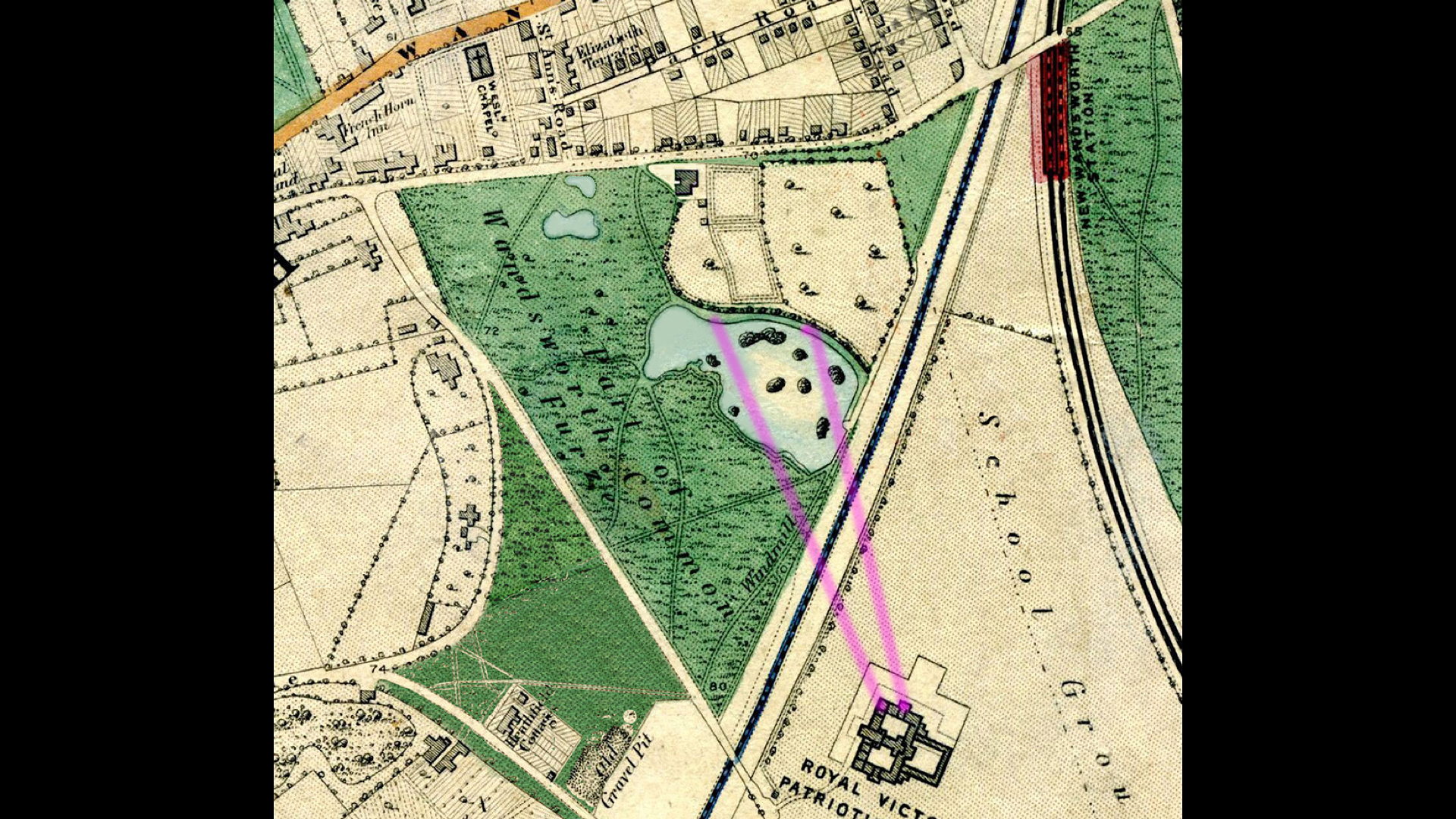
(Click on image to enlarge)
Coming in closer:
(Click on image to enlarge)
Frustratingly, there's no windmill to be seen. Did the artist ignore it? Or, more likely, it is obscured by the vegetation on the right.
In any case, as we shall see, it had already lost its sails so it had ceased to pump water.
Notice there are no signs of the railway line that crosses the picture right in front of the Asylum - admittedly in a deep cutting.
Nor of the road - Windmill Road parallel to it. An extension of what is now Earlsfield Road. At this time, neither road had yet been built. There was quite a hoo-hah from Conservators and other local people about the loss of common entailed.
Eventually, the roads were agreed.
We may return to this later.
Let's go back to the origins of the lake.
Shirley Passmore says it was most probably a disused gravel pit that was later utilised as a reservoir that supplied 12,000 gallons of water a day to properties around.
This seems reasonable.
John Rocque's maps of London and its surroundings, from 1740s onwards...
I'd like now to go back in time.
Here's the earliest map that I know of of Wandsworth Common as a whole - Rocque's ... of the 1740s, widely redrawn and republished for the next 20 or so years:
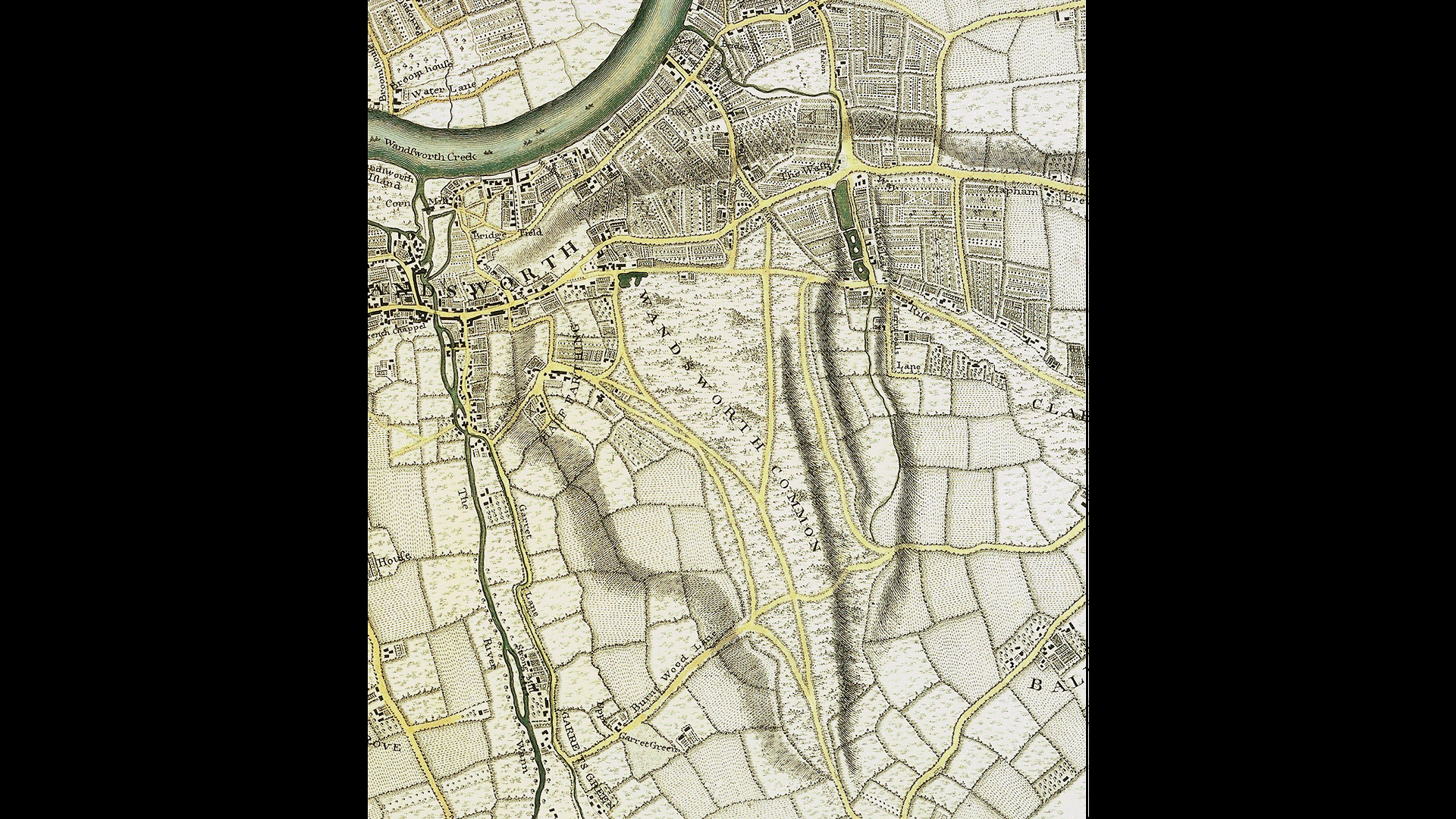
(Click on image to enlarge)
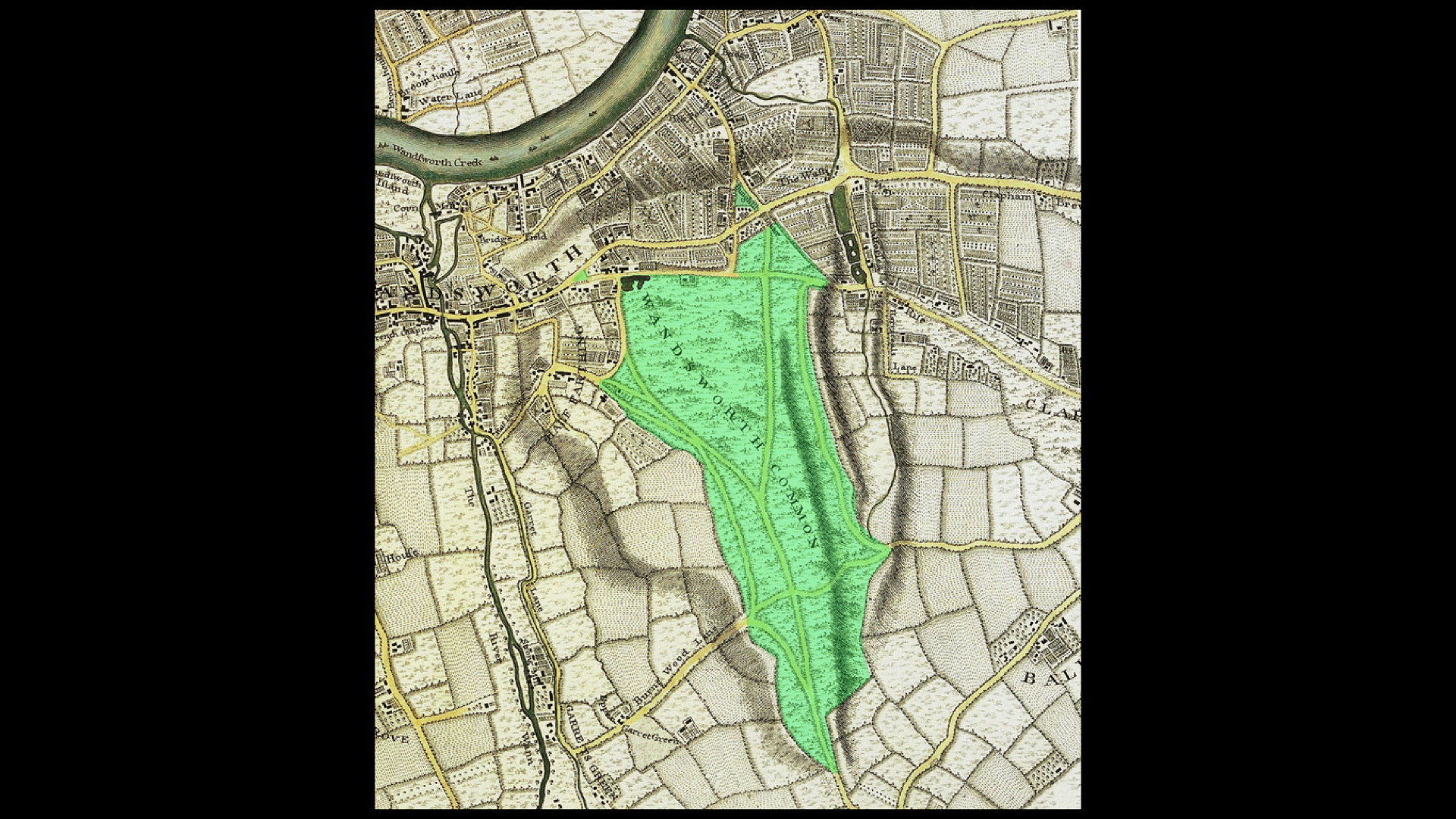
I've tinted the area covered by Wandsworth Common at this time - quite a lot larger than it is now - perhaps twice as big.
(Click on image to enlarge)
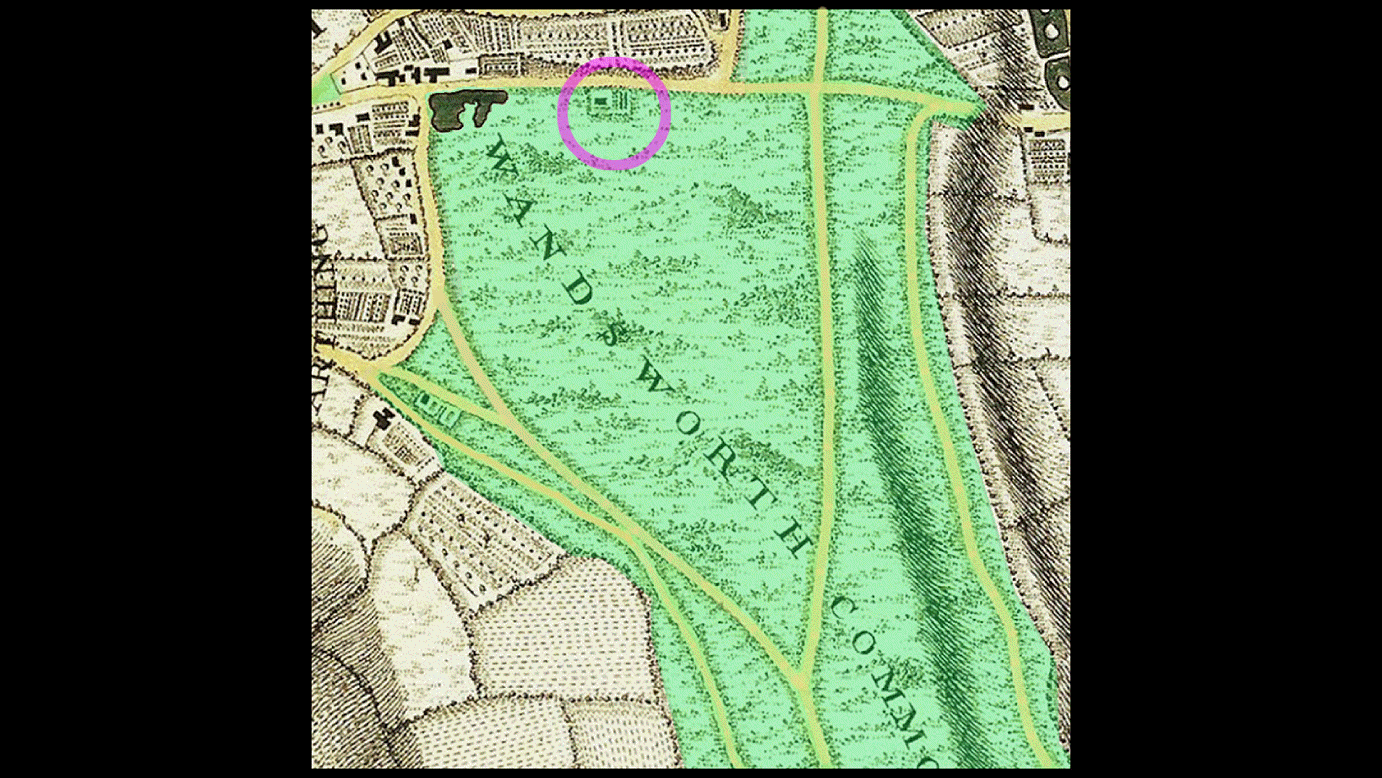
Here's a closeup
You can see a house and its grounds - fairly small at this point.
But no lake.
There is a lake in the area, but it is over here, a few hundred yards to the west.
Incidentally it was this lake that caused the otherwise dead straight Trinity Road to vere to the left at the top of East Hill.
It looks as though this was filled in and enclosed at more or less the same time as the Black Sea was created.
(Click on image to enlarge)
Let's have a quick look at different maps to see when the Black Sea arises...
Corris estate maps, 1770s?
Like Rocque, Corris shows the house and grounds, but no lake.
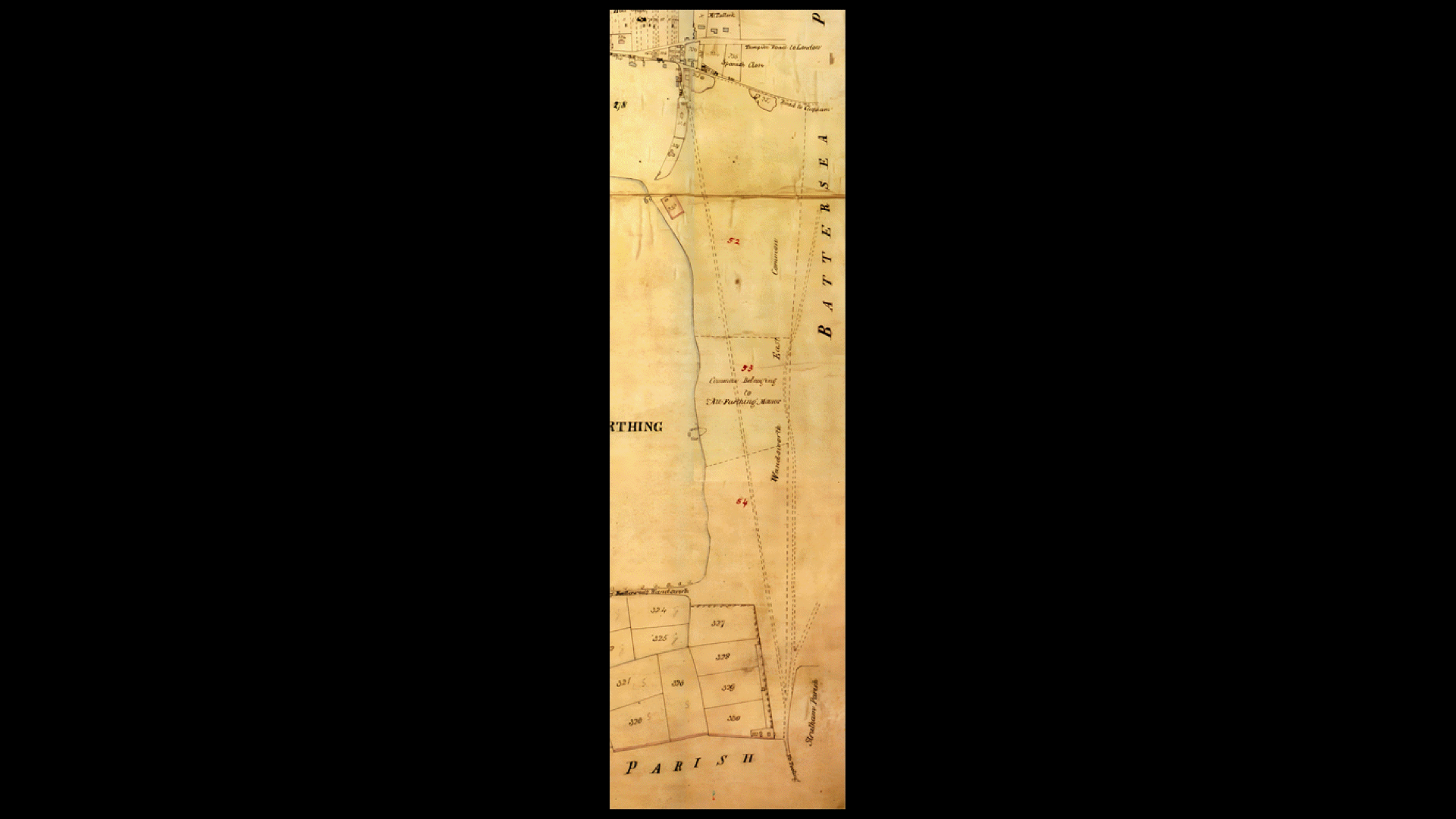
(Click on image to enlarge)
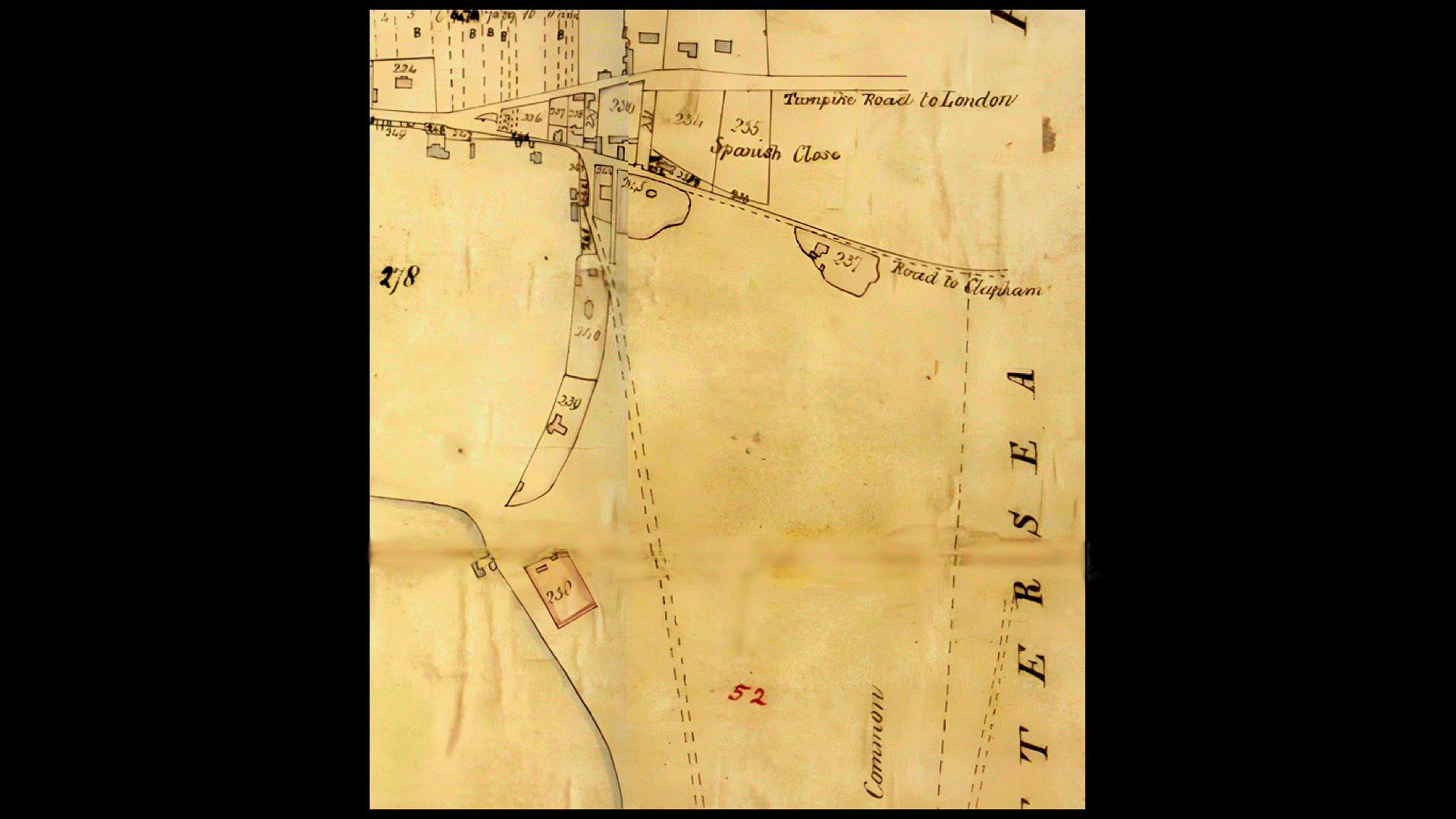
(Click on image to enlarge)
237 = Buildings & garden &c, leased by Revd Jonathan Brown. [Not Black!]
Though there is water, top left.
244 = Piece of ground & a pond and incroachment, leased by John Harris
And even larger:
245 = A pond, Richard Bush
These cause the future Trinity Road to vere to the left
These will eventually be drained and acquired by the Bevington family of Ivy House
Who will give it back to the Common after 1871.
1800 / Milne
Our house and grounds are clearly show - pink, means "little park" - but n lake.
There is a vague outline of the top left pond.
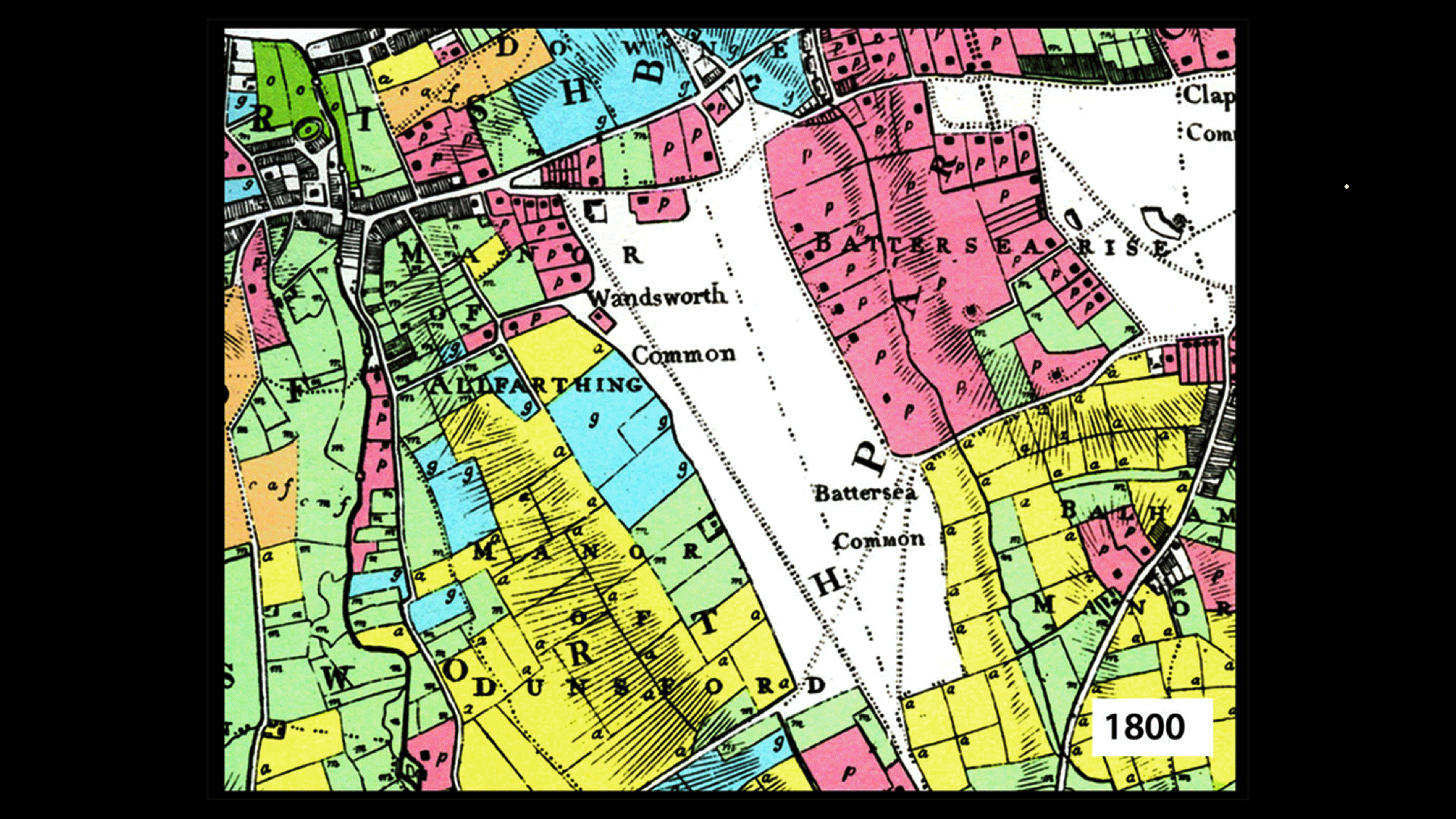
(Click on image to enlarge)
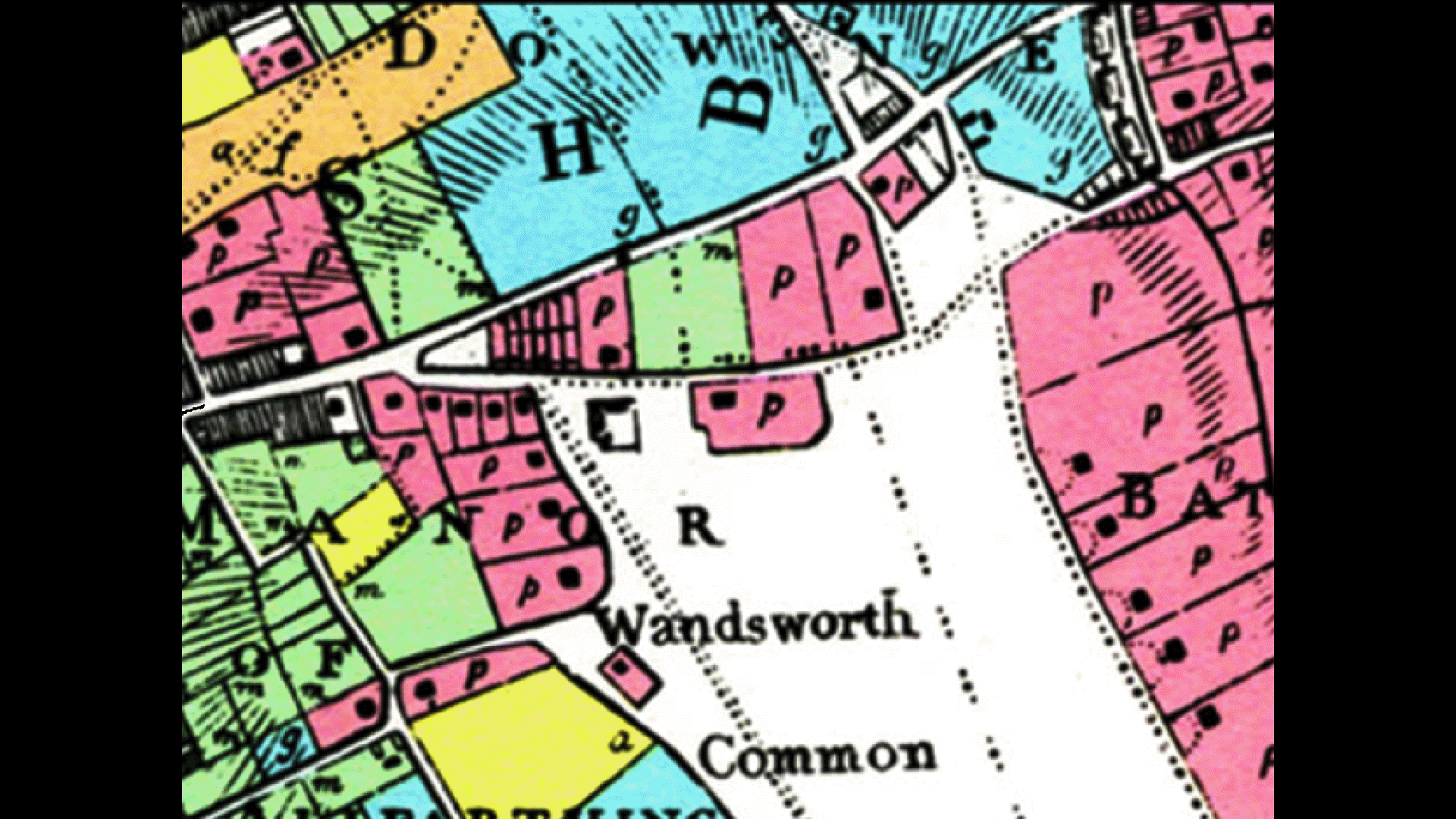
(Click on image to enlarge)
But shortly after, here it is on the earliest OS map, 18??-18??
OS c.1810 / OS
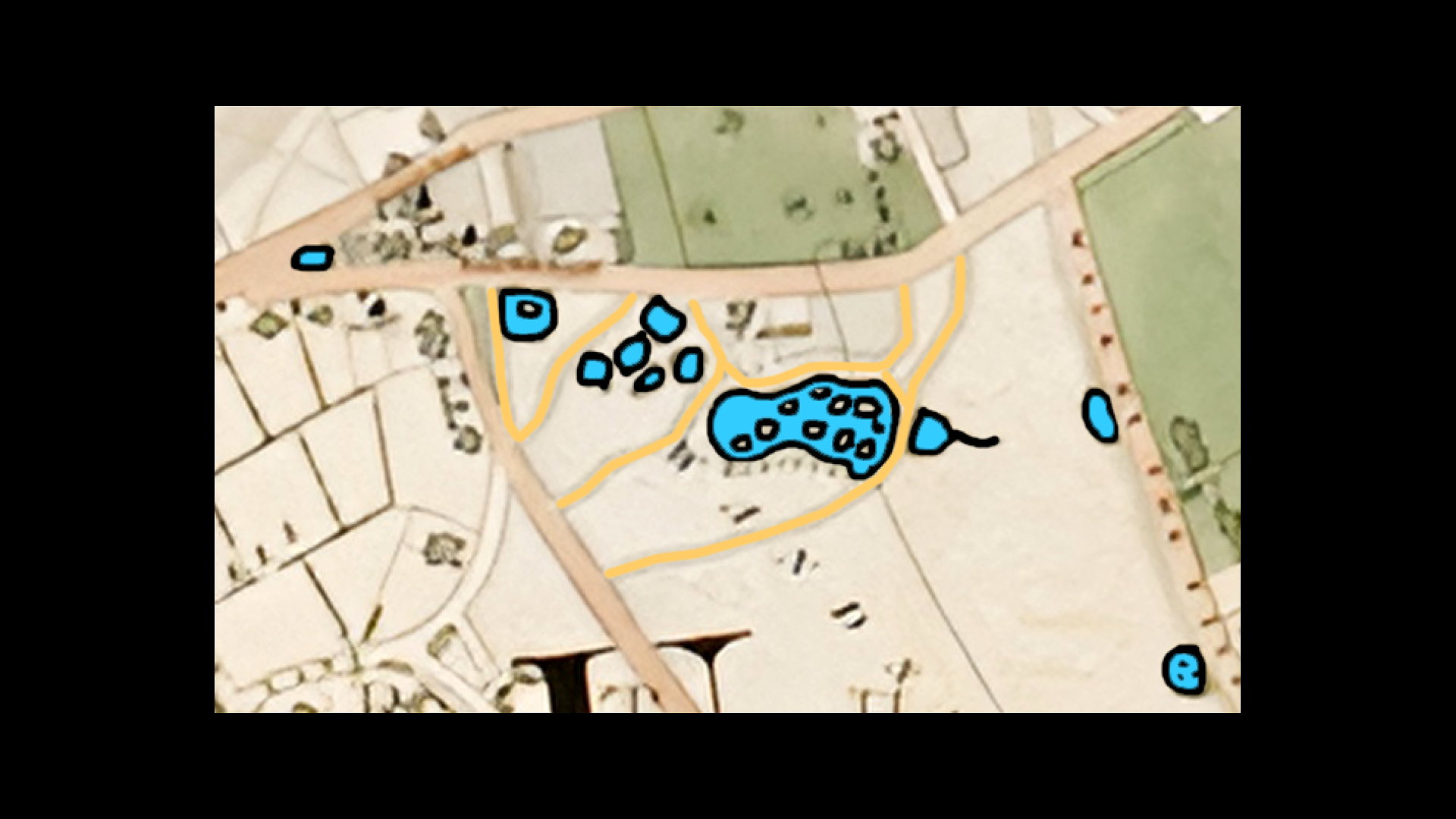
And now finally, we see the lake...
[TINT THE LAKE]
(Click on image to enlarge)
(Click on image to enlarge)
[ADD SOME INFO ABOUT WILSONS HERE?]
[1829?] Acquired a lease / grew the grounds/ enlarged and beautified the lake etc...They will lease this area until 1866, after which things will change absolutely. The house and garden will disappear. The lake will be filled in. Spencer Park will be built on the site.
I'd like to look at developments in more detail...
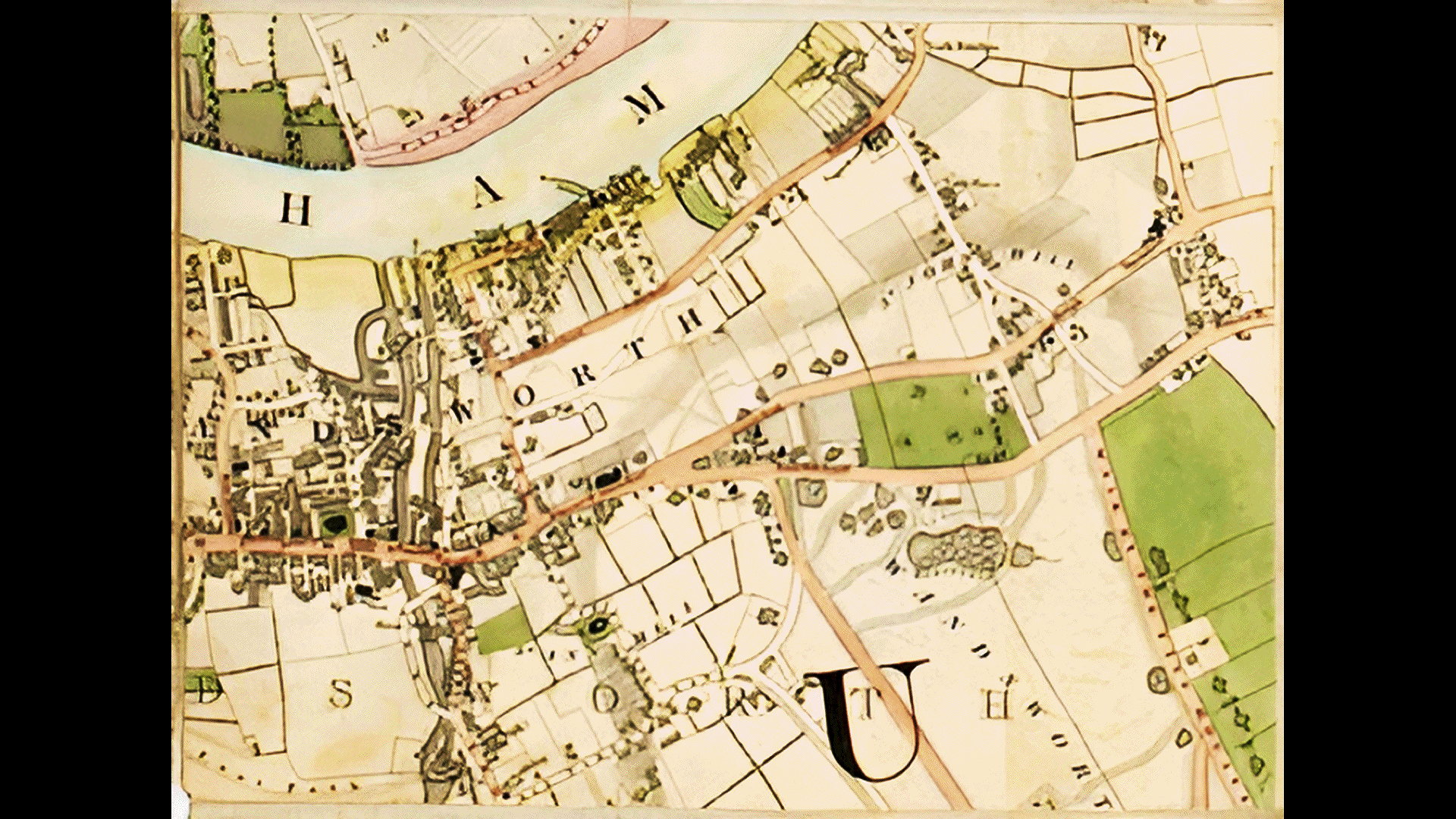
When they ;eased the house and garden, William Wilson did not know that something [ginormous] was going to happen...
(Click on image to enlarge)
(Click on image to enlarge)
But in the early 1830s, something important is about to happen...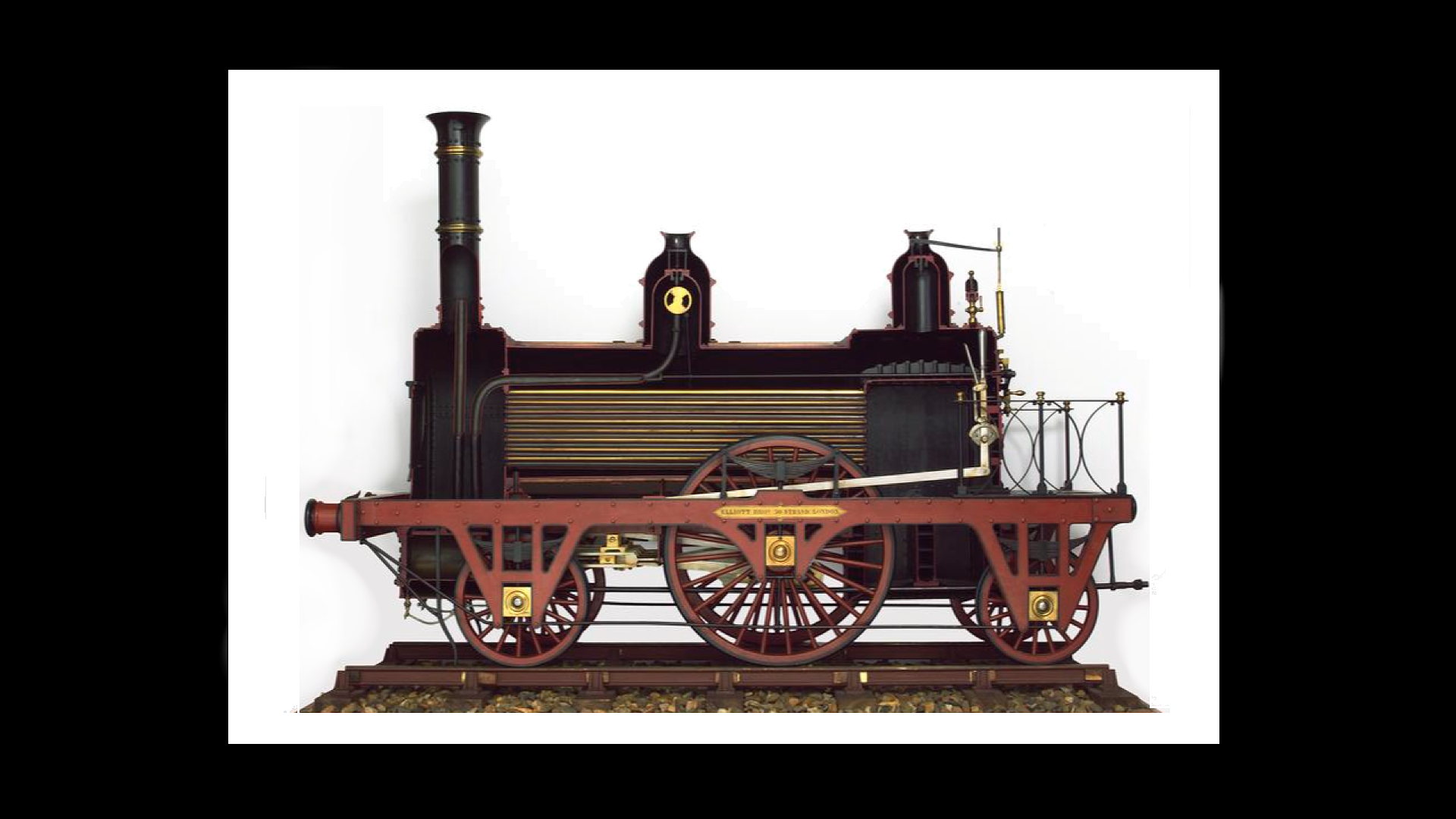
(Click on image to enlarge)
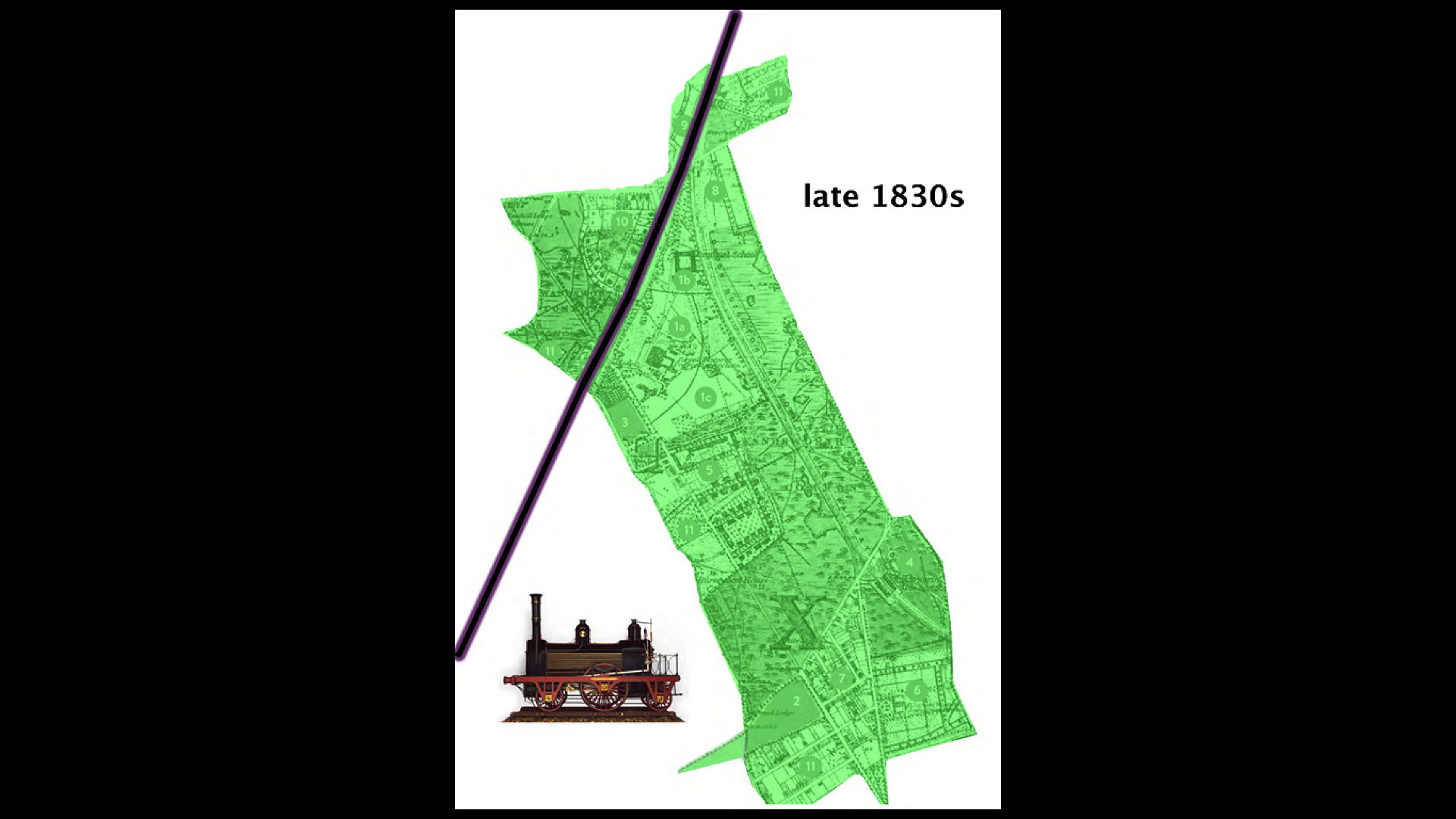
(Click on image to enlarge)
And this meant...
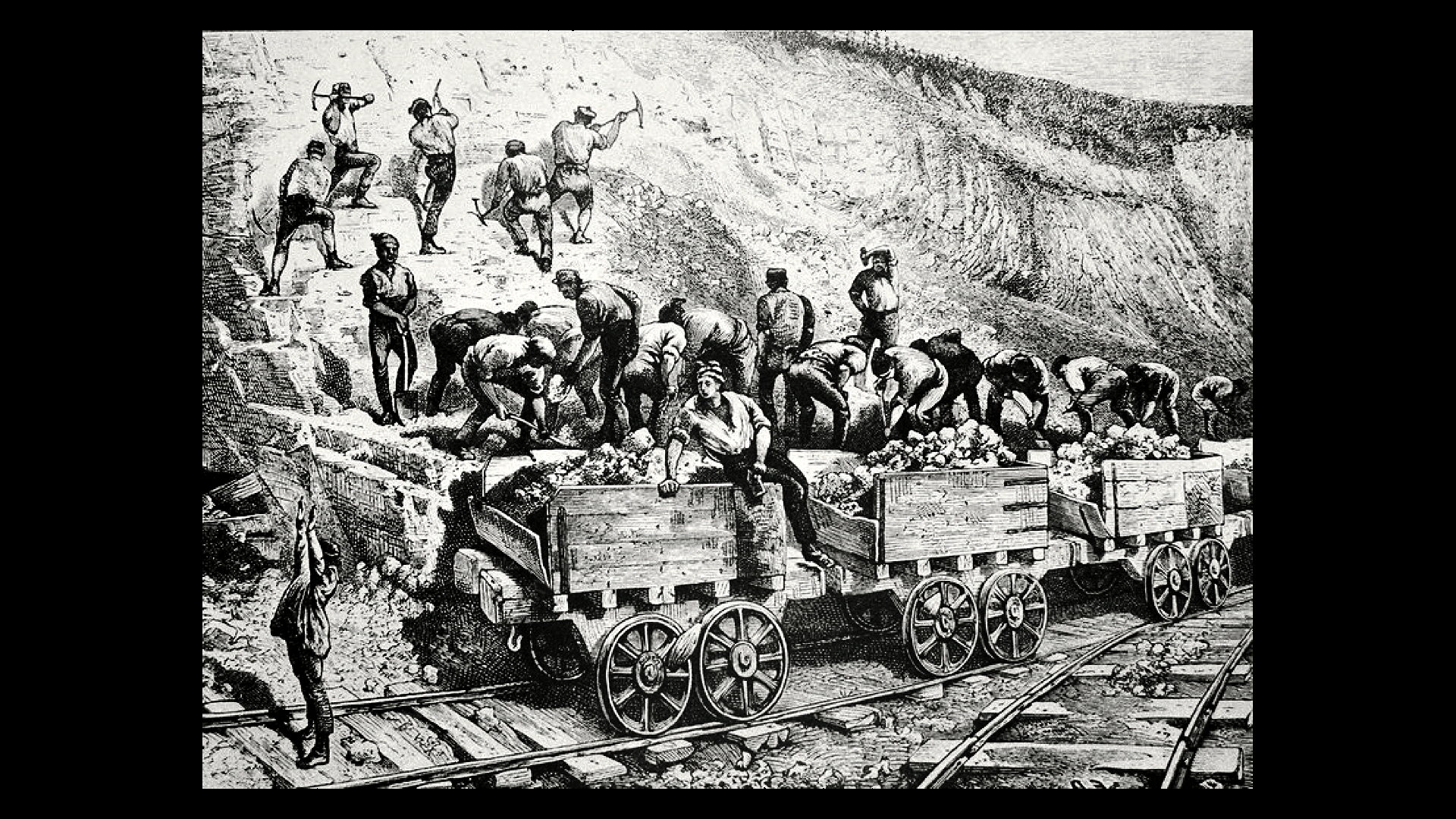
(Click on image to enlarge)
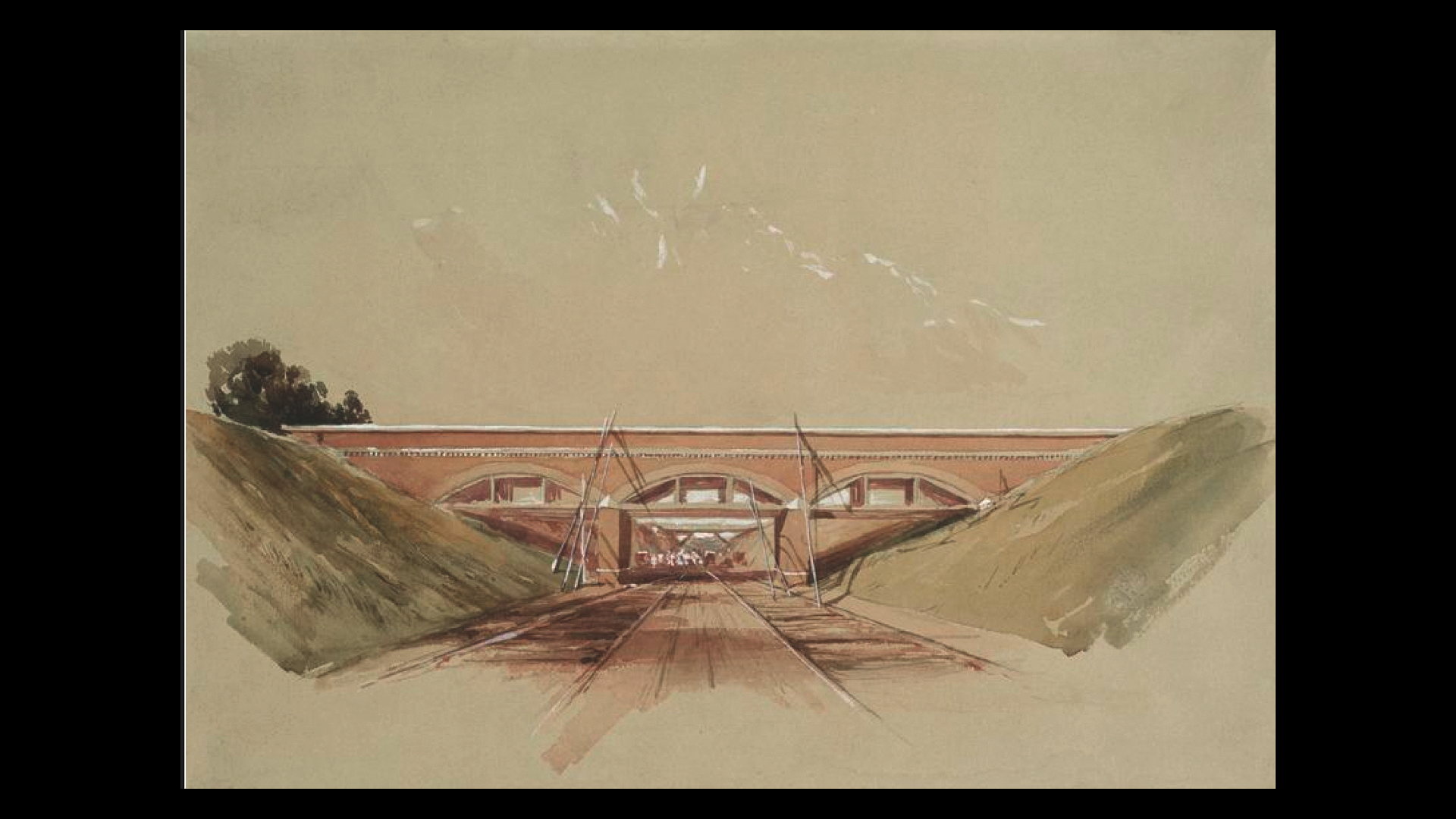
(Click on image to enlarge)
A great gouge - a chasm - a canyon - across the Common
Spencer compliant Not much local opposition [Landowners [and leaseholders?] compensated] But what route? From Nine Elms - through market gardens parallel to the Thames - cut into Wandsworth Common And what disruption ? Specifically, what were the implications for the Wilsons at "Black Sea House", and the Black Sea itself? Let's have a look at how it was envisaged...Cruchley maps, 1820s and 1830s
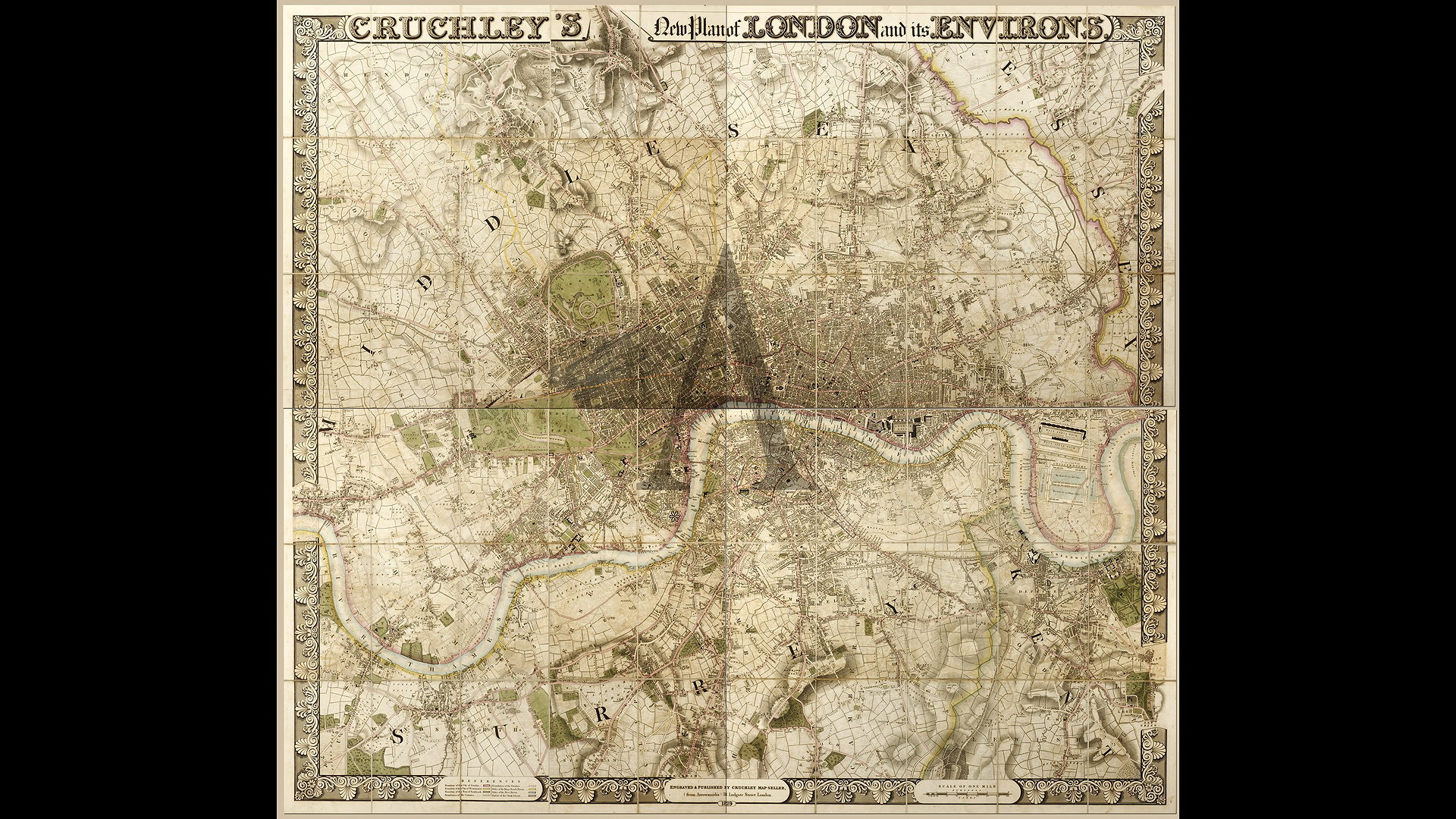
Now we come to the most curious sequence of maps by Cruchley
I've never found any decent high-resolution scans of the Cruchley maps but by using versions online (mainly in auction catalogues) I've been able to enlarge and digitally enhance them.
Here's the earliest, from 1828/9
[When the Wilsons took a lease from Earl Spencer on the house and grounds adjacent to the Lake. [When did they expand their lease? 184? Acquire rights over the lake? [Passmore] .
Buckmaster discusses the lapsed guarantees that people would be able to walk round the lake... ]
(Click on image to enlarge)
(Click on image to enlarge)
(Click on image to enlarge)
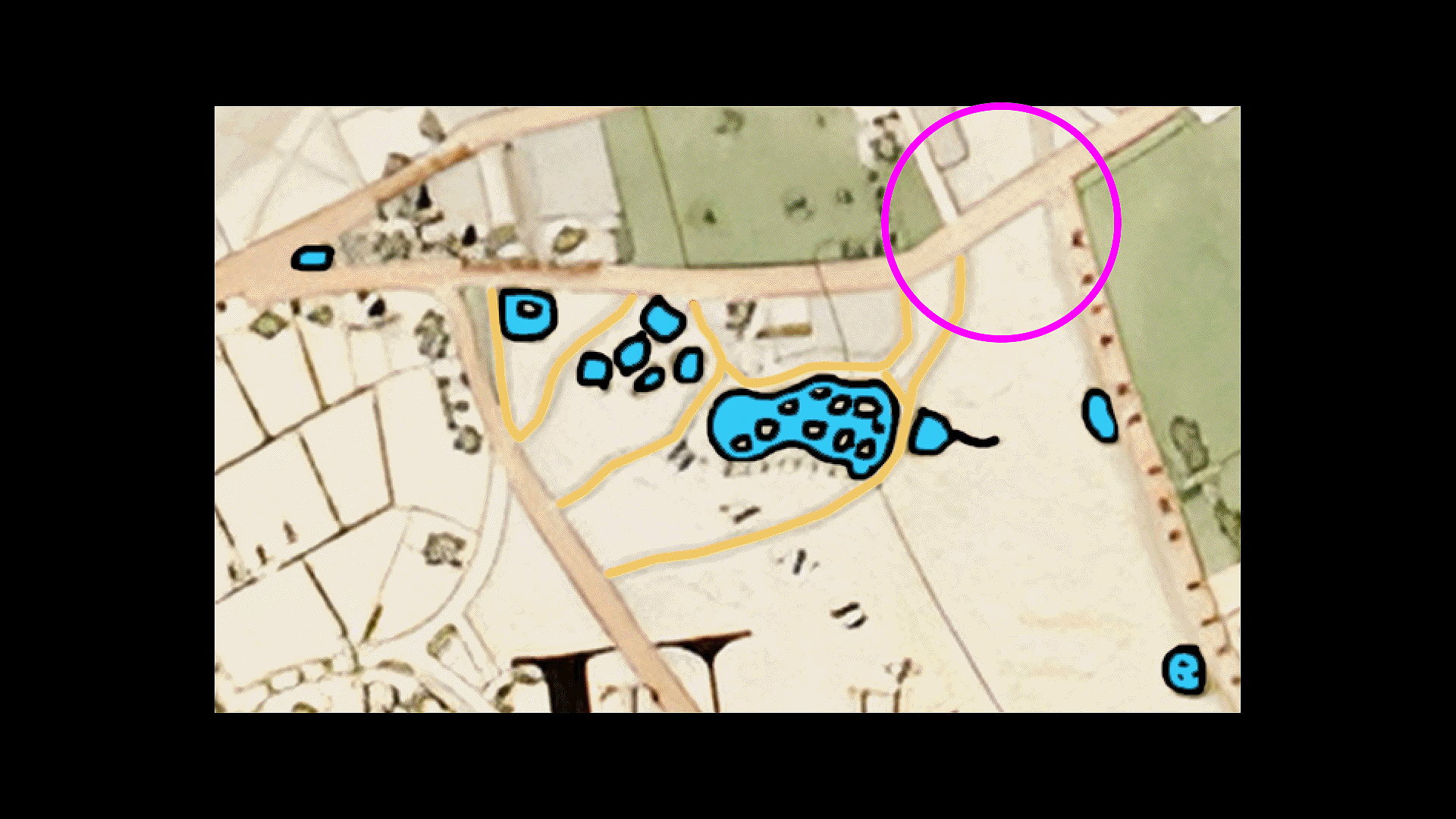
...the railway.
But its route has not been precisely determined
The line has going to come up from Battersea - where it has crossed common land and market gardens, but not destroyed many buildings...
..Cross Common land on St John's Hill...
...go under St John's Hill in a cutting through part of Plough Green...
...and then pass between two gentlemen's parks...[nb private parks but NOT commons were tinted green]
[At this time the angle between Battersea Rise and 5 Houses Lane / Bolingbroke was owned by ? Coutts, the Royal banker?]
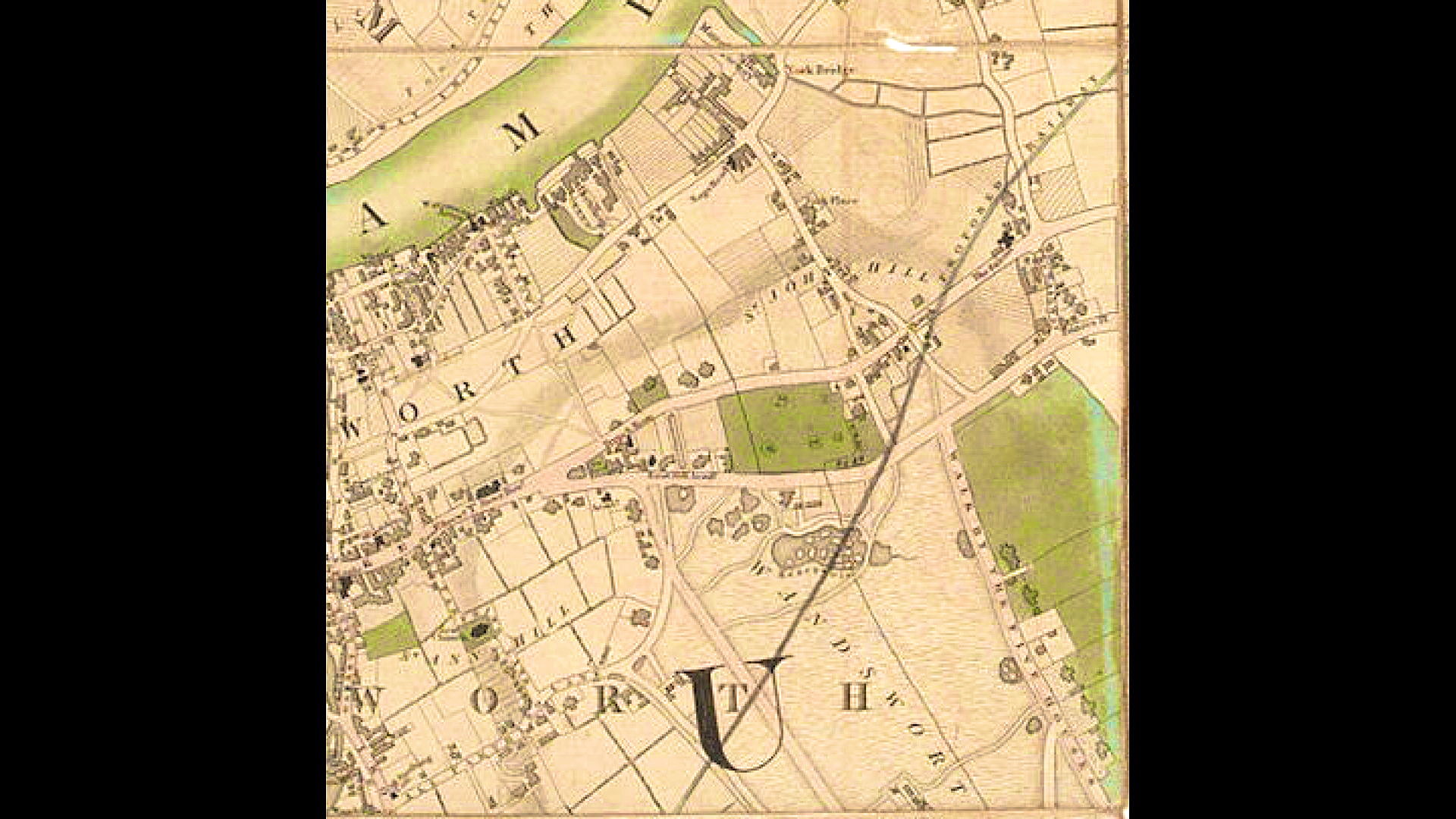
... and cross the Common...
(Click on image to enlarge)
1834 Act
acts of Parliament allowing the construction of railways, and the approximate route. But often with [line of deviation?]
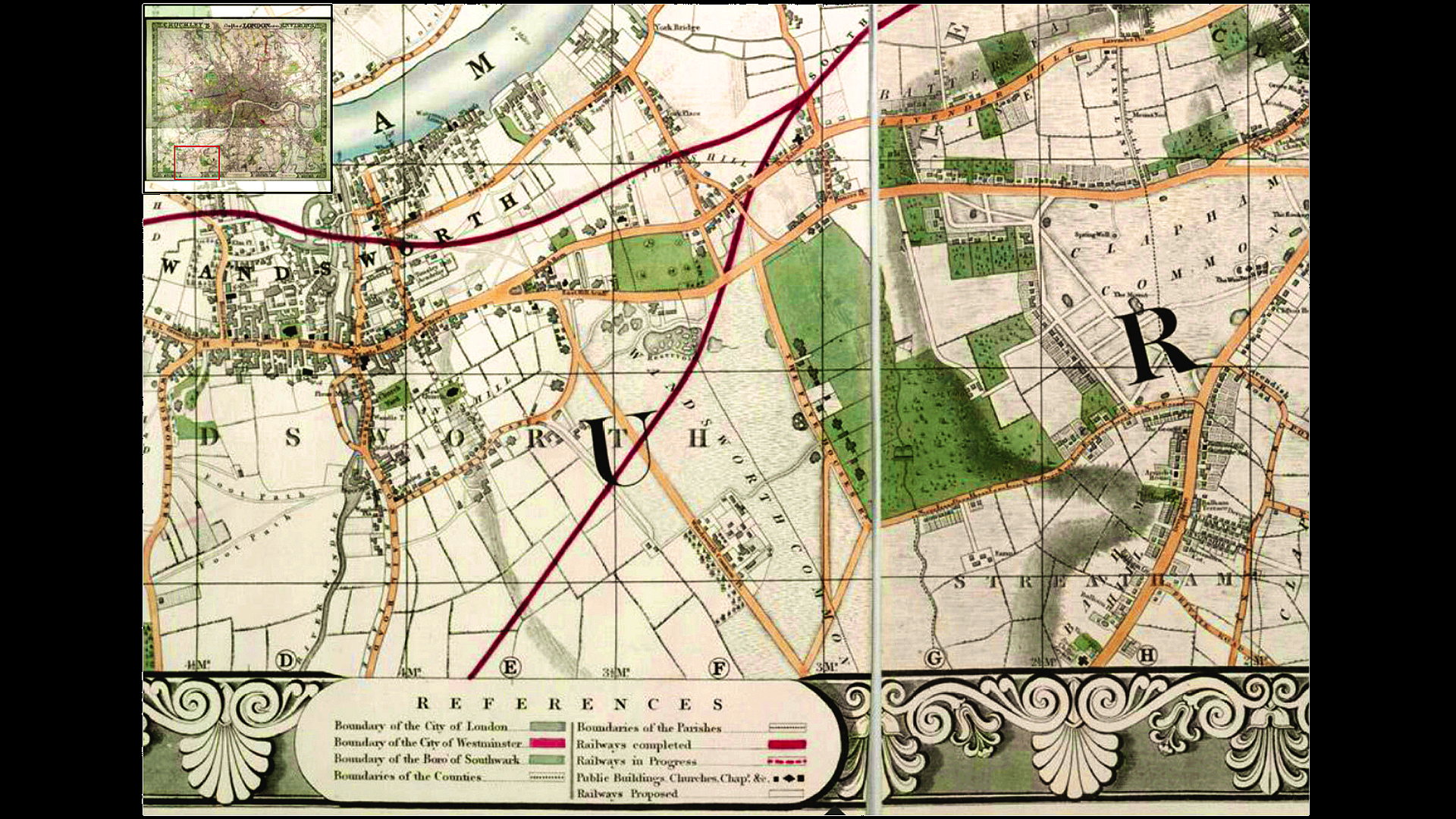
Here's one from ?, with a [red] line denoting the course of the future London and South Western Railway to Woking and Southampton
And here it is again a few years later, presumably after the line has been cut and trains are running.
(Click on image to enlarge)
(Click on image to enlarge)
(Click on image to enlarge)
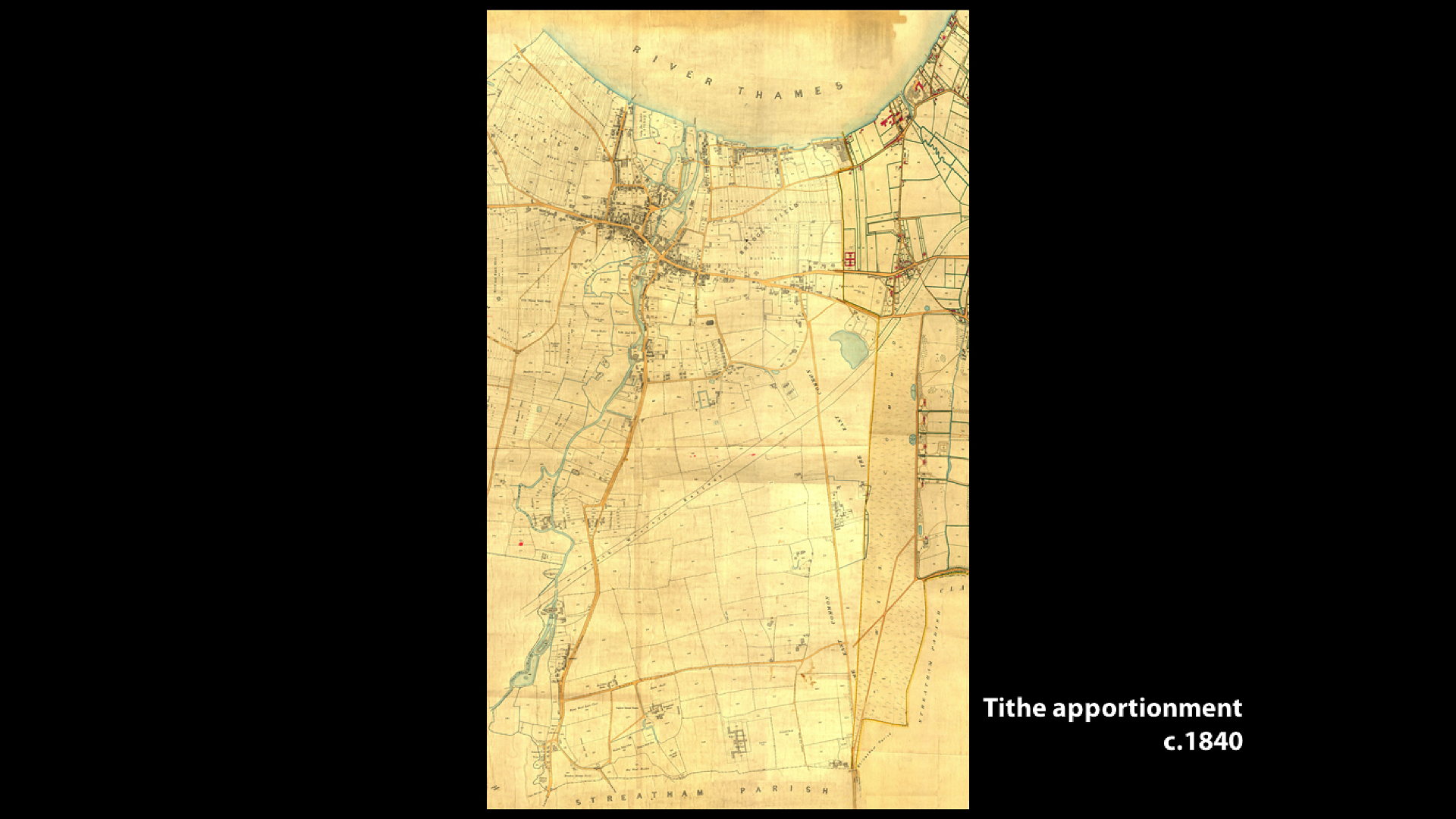
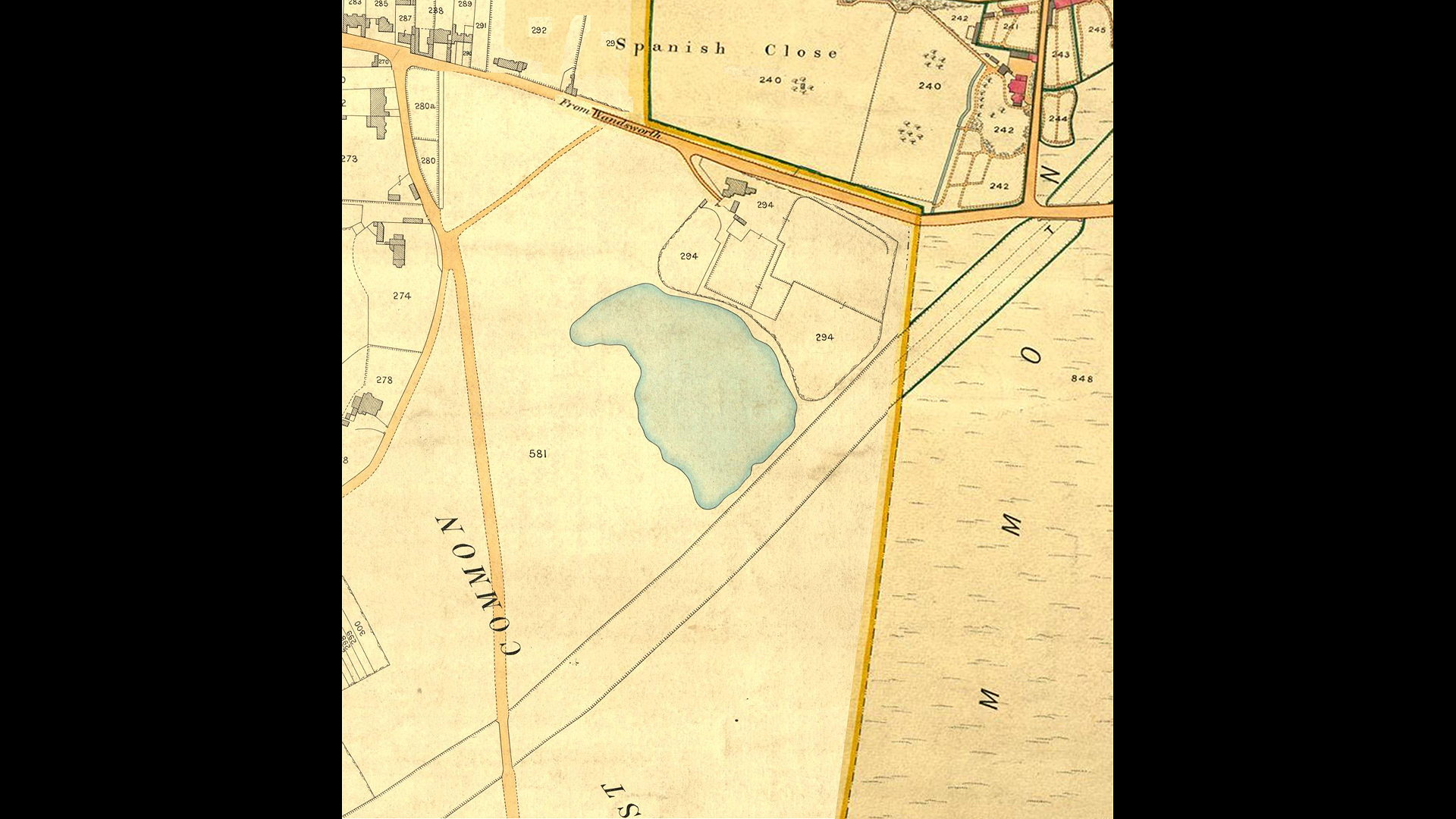
Tithe map / c1840 / Tithe
(Click on image to enlarge)
(Click on image to enlarge)
(Click on image to enlarge)
(Click on image to enlarge)
I'm going to have to leapfrog over the Wilsons - they are much too interesting and complex to deal with here - and a lot more research is needed.
I'll focus only on what's directly relevant to the Black Sea
That they leased it, and probably enlarged and planted it
Tradition has it that William Wilson created a new island for every child he and his wife Margaret produced...
And probably named it...
It seems likely that William Wilson was a prime mover in forcing the London and Southampton Railway to repair the damage caused by cutting through...
We know the Wilsons boated on it - there's a boat house marked on several maps
And we have a fine description of how they coped with an invasion of Elodea
In the longer term...
That the wetness of the area of the Black Sea - indeed, the Common as a whole - inspired George Fergusson Wilson's gardening enthusiasm
Hence GFW's experimental garden at Wisley...
(And his son Scott's passion for ornithology (and gardening).)
That when the last of the Wilsons - the mother, Margaret, sold their lease back to Earl Spencer the lake was filled in to make way for Spencer Park
How many islands? 13? [or 7? or?] - one for every child?
Did the railway cut through Black Sea?
Stops water flowing naturally off the Common, hence a clay lining and a wind pump were necessary...
Why is no water shown to east of [proposed?] railway line on the Tithe map?
Notice the projected rail tracks for Wandsworth and Battersea do not quite align - the Battersea line would have cut further into the lake. Which tithe map was completed first?
Earlsfield Road / Windmill Road / stops short at Battersea Rise railway bridge
Railways may solve many transport problems, but they create others - they cut through areas - interrupt roads - demand bridges and viaducts - many of which are very narrow - they create pinch points - up and make it harder for roads...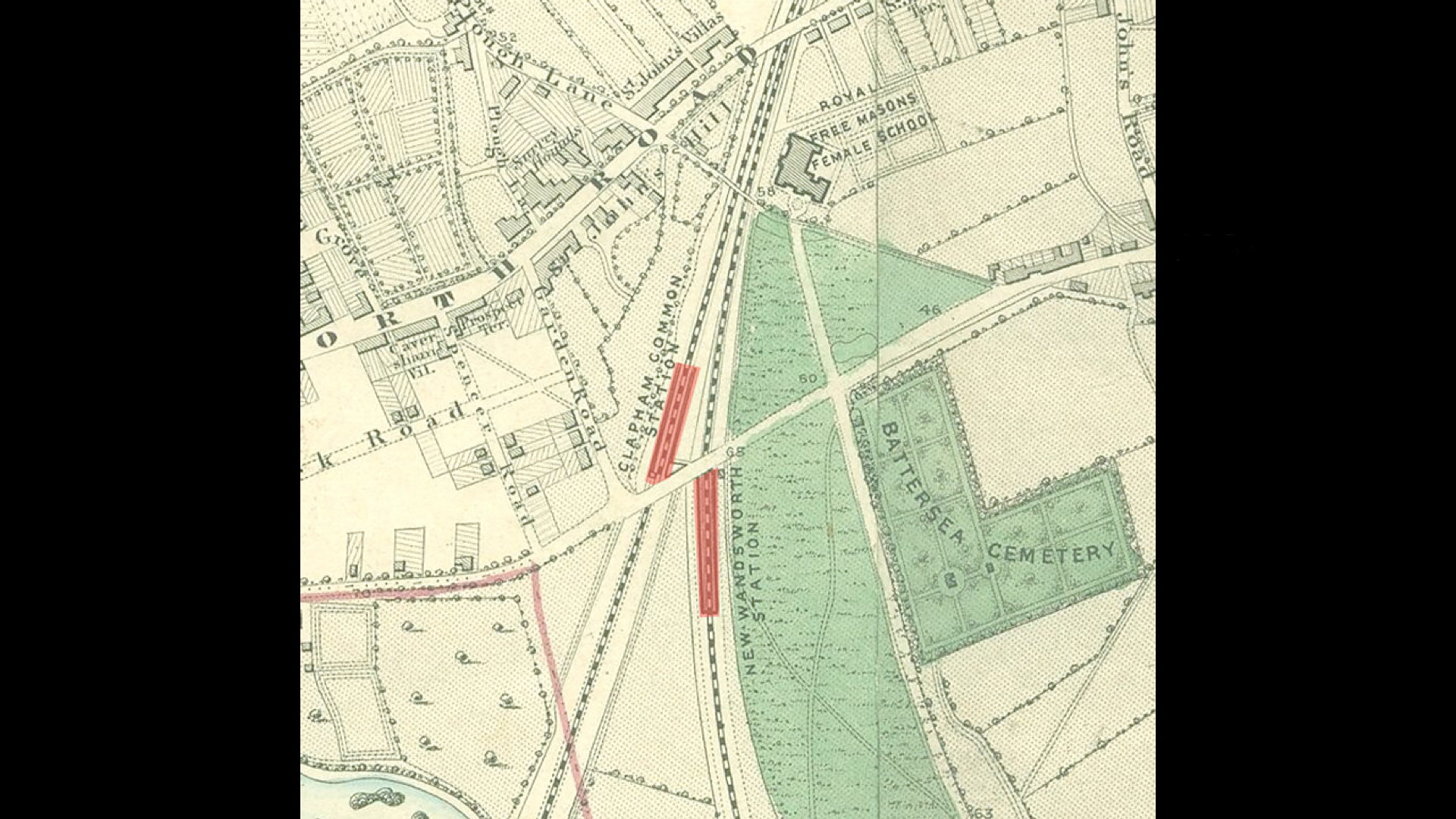
(Click on image to enlarge)
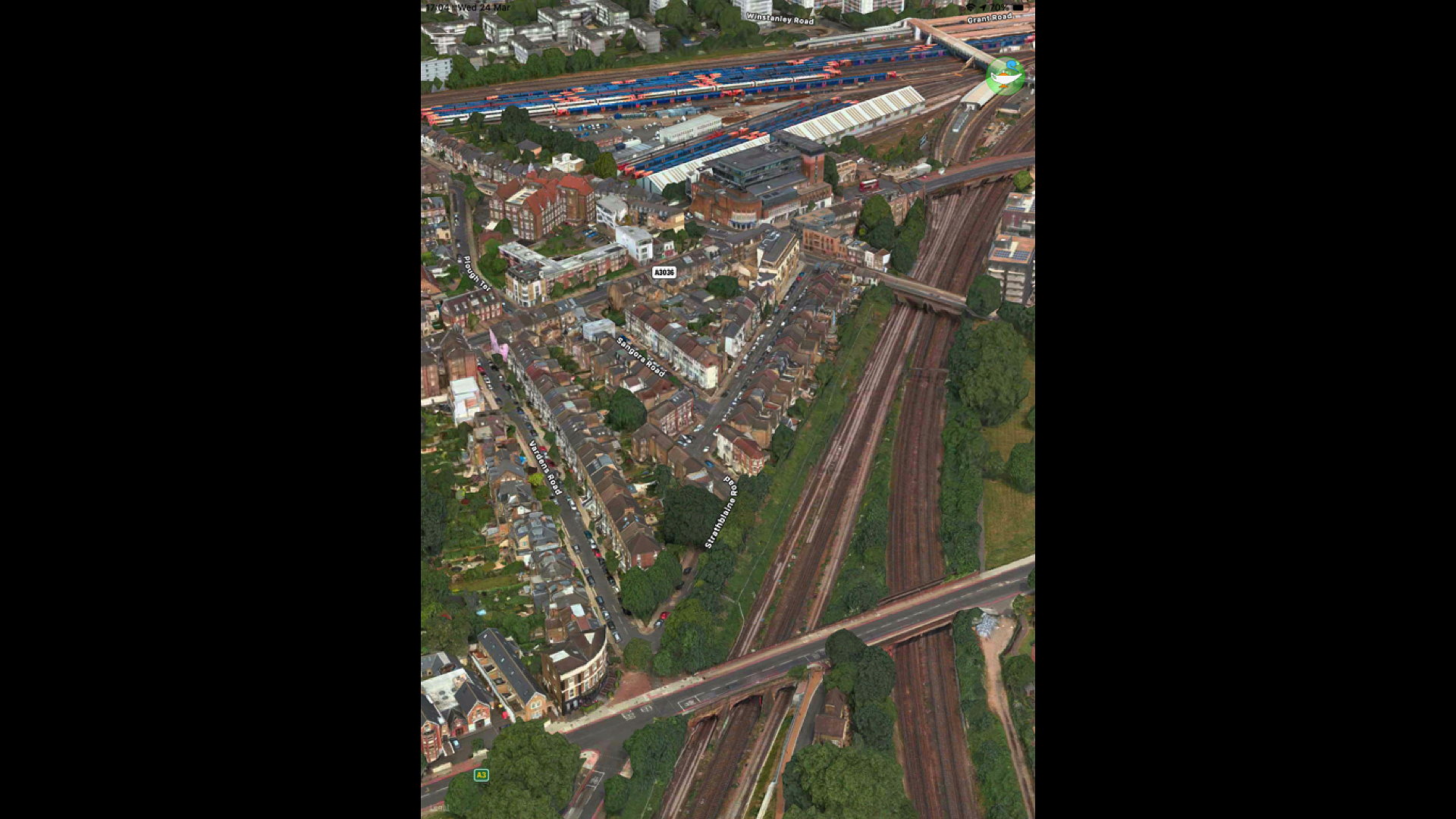
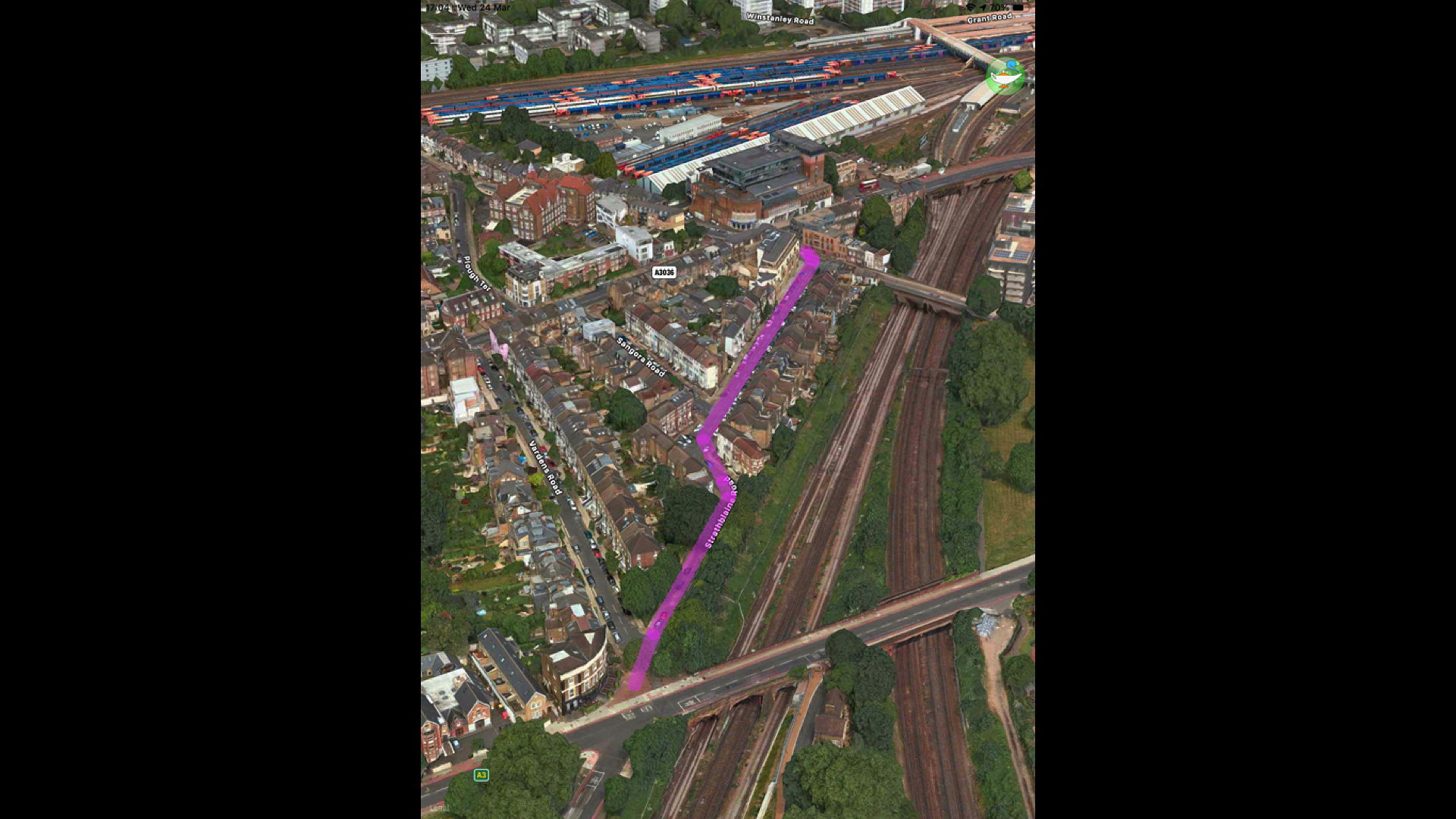
Incidentally, the original intention was to continue the road right through to St John's Hill, roughly along the line that Strath? now takes.
(Click on image to enlarge)
This is part of "Plough Green" - the site and cause of so much radical agitation in the 1860s.
Too much valuable building land was involved, and it never happened.
Which goes a long way towards explaining the awful muddle and congestion at the junction with the railway bridge.
This image is slightly earlier - date? - notice two stations - the absurdly named "Clapham Common" and "New Wandsworth"
(Click on image to enlarge)
(Click on image to enlarge)
(Click on image to enlarge)
Actually, this is not "incidental".One of the most loudly heard complaints during the Plough Green demonstrations was that the enclosures and barriers erected by [Forename?] Compton? Smith and [forename?] Costeker in this area impeded the access people had enjoyed "from time immemorial".
The railways lines- first the London Southampton, then the London-Crystal Palace / Brighton line had made access to this part of the Common for people of Battersea to cricket but also to the Black Sea was very difficult.
The agitation of the 1860s culminated in the 1871 Act, which saved the Common [for ever].
But at a price. A steep price. Negotiating with Earl Spencer [or rather, his lawyers and estate manager] was tough. He demanded £500 a year for the loss of his "rights". This was beyond the means of local people to raise in rates at this time [even if they were prepared to pay such an amount].
It was eventally agreed that local people would have to find be £250 a year in perpetuity.
I say in perpetuity - I still havent been able to find out whether the Earls Spencer continue to receive £250 a year or whether it was somehow paid off [which is what Wimbledon Common has done].
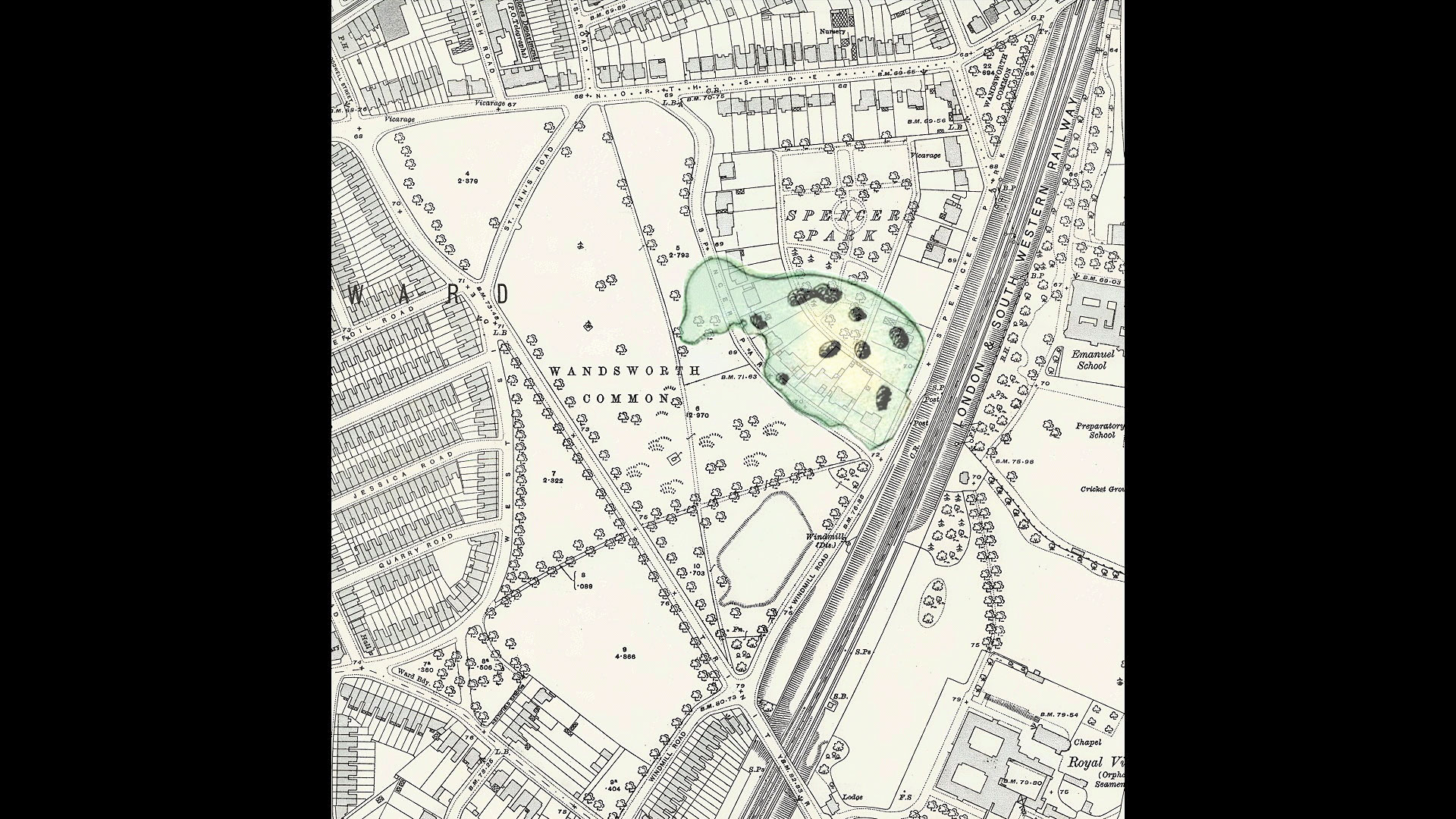
BUT the price was to return the Black Sea and nearby land one which Spencer could build a cherished project - "Spencer Park". [A vanity project?]
Here it is in the C19:
(Click on image to enlarge)
(Click on image to enlarge)
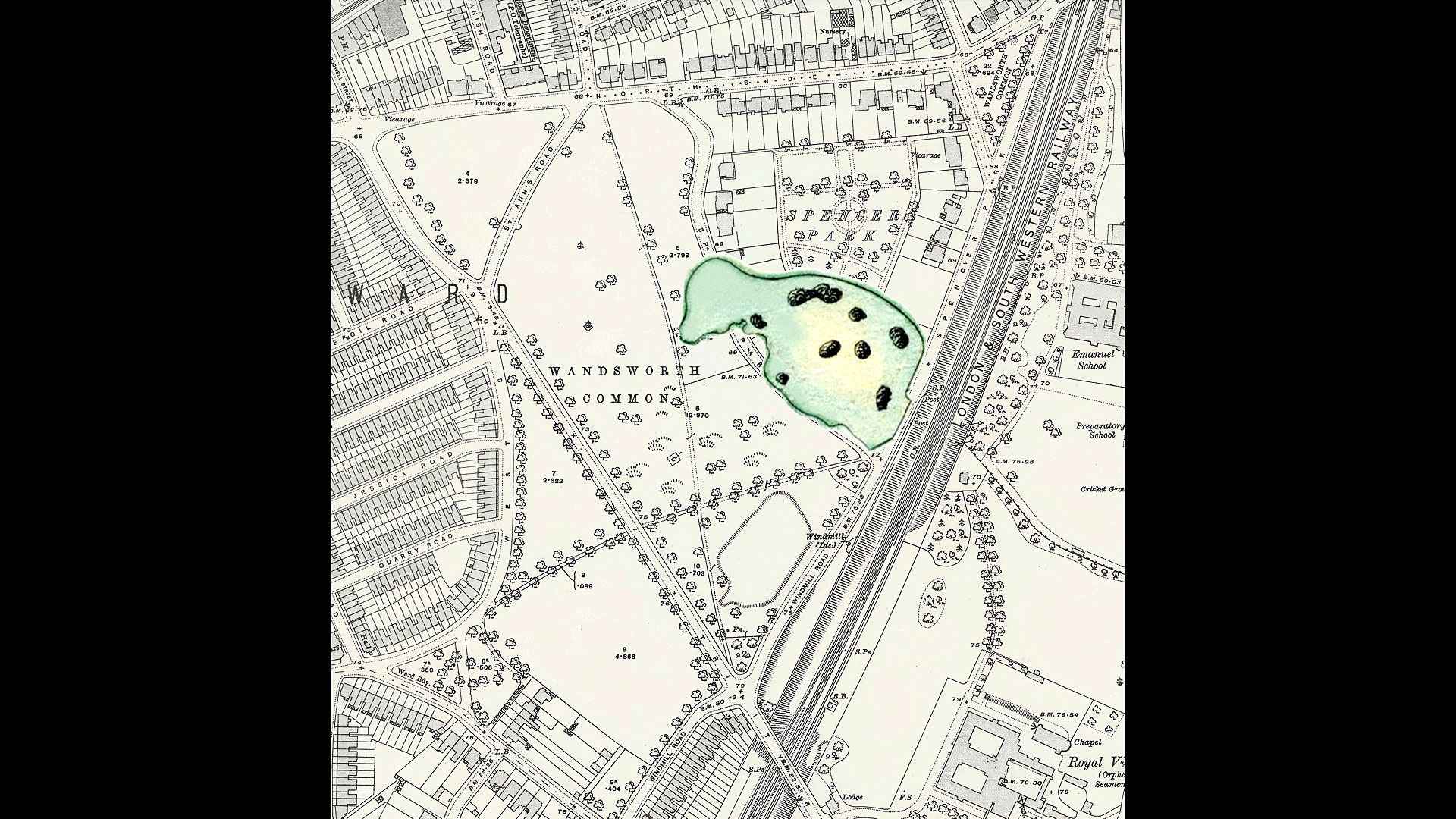
(Click on image to enlarge)
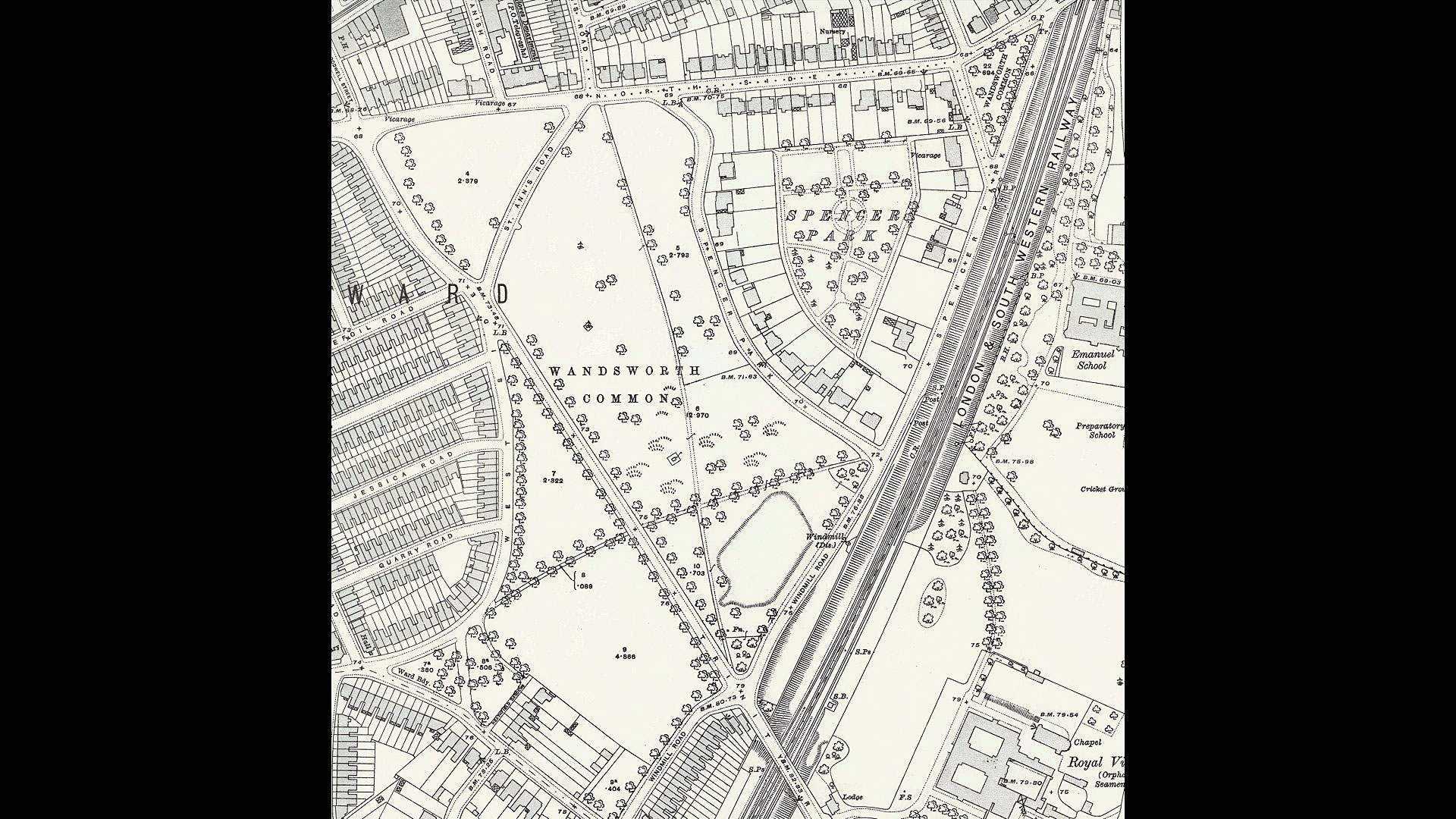
(Click on image to enlarge)
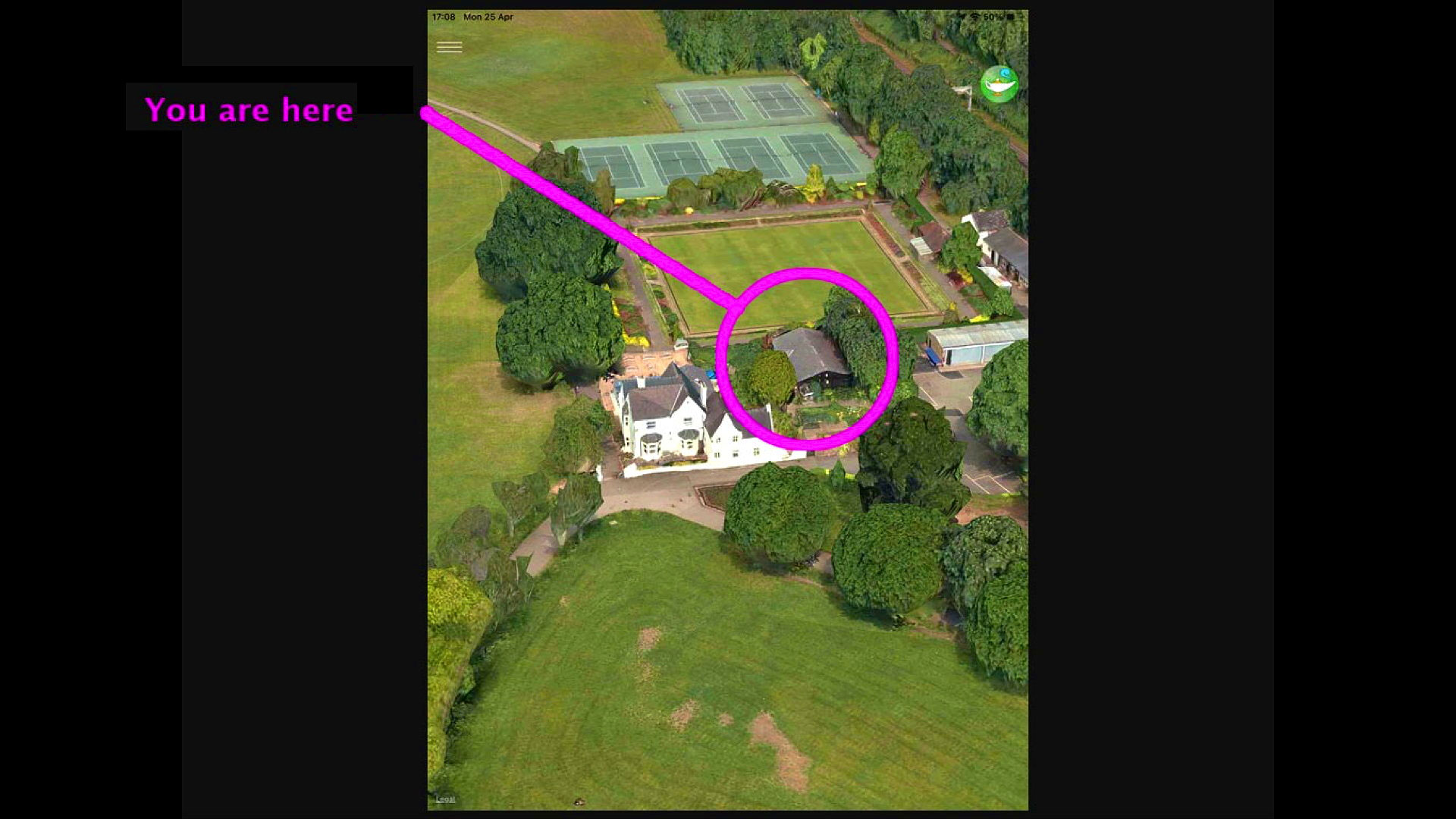
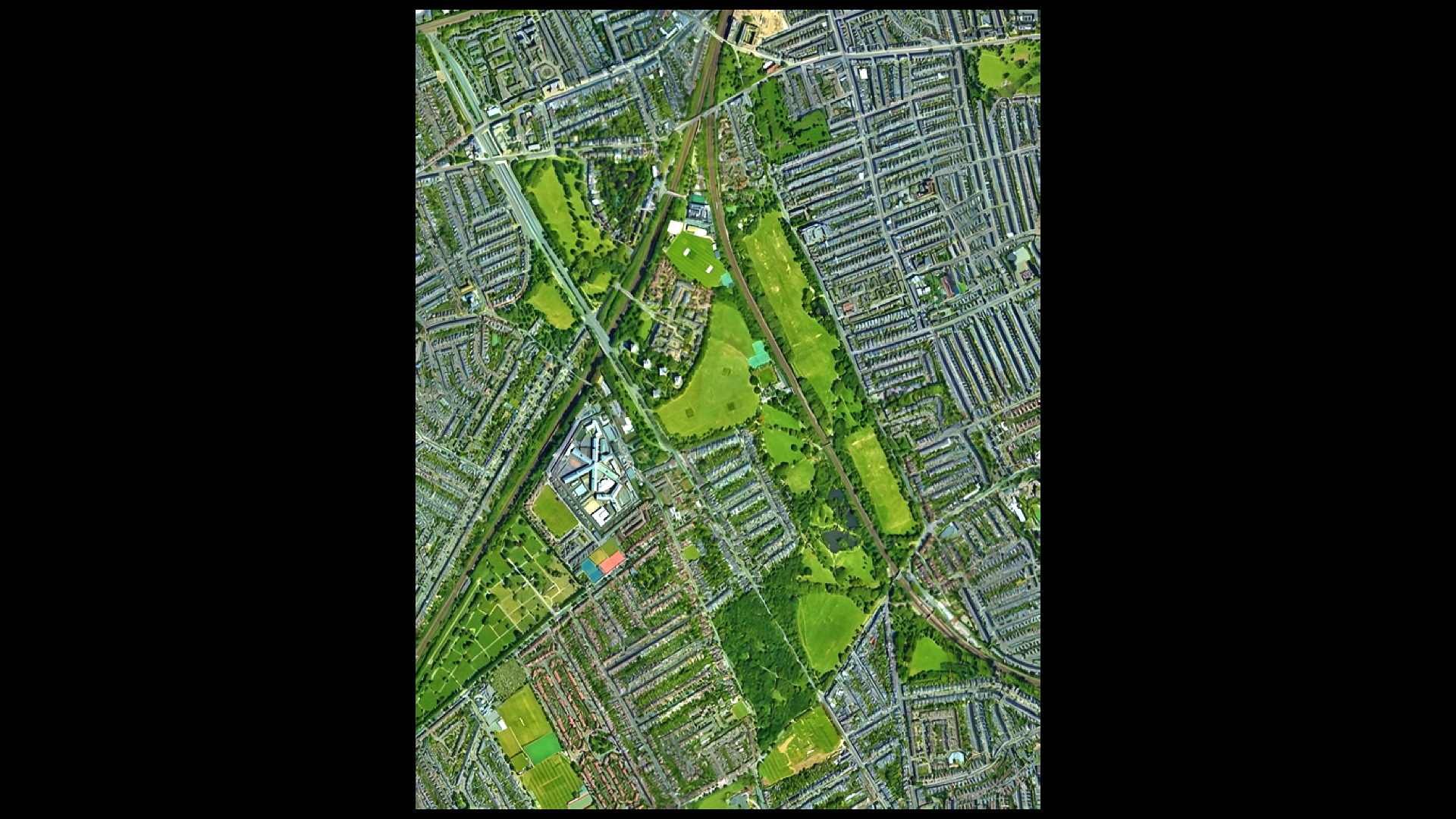
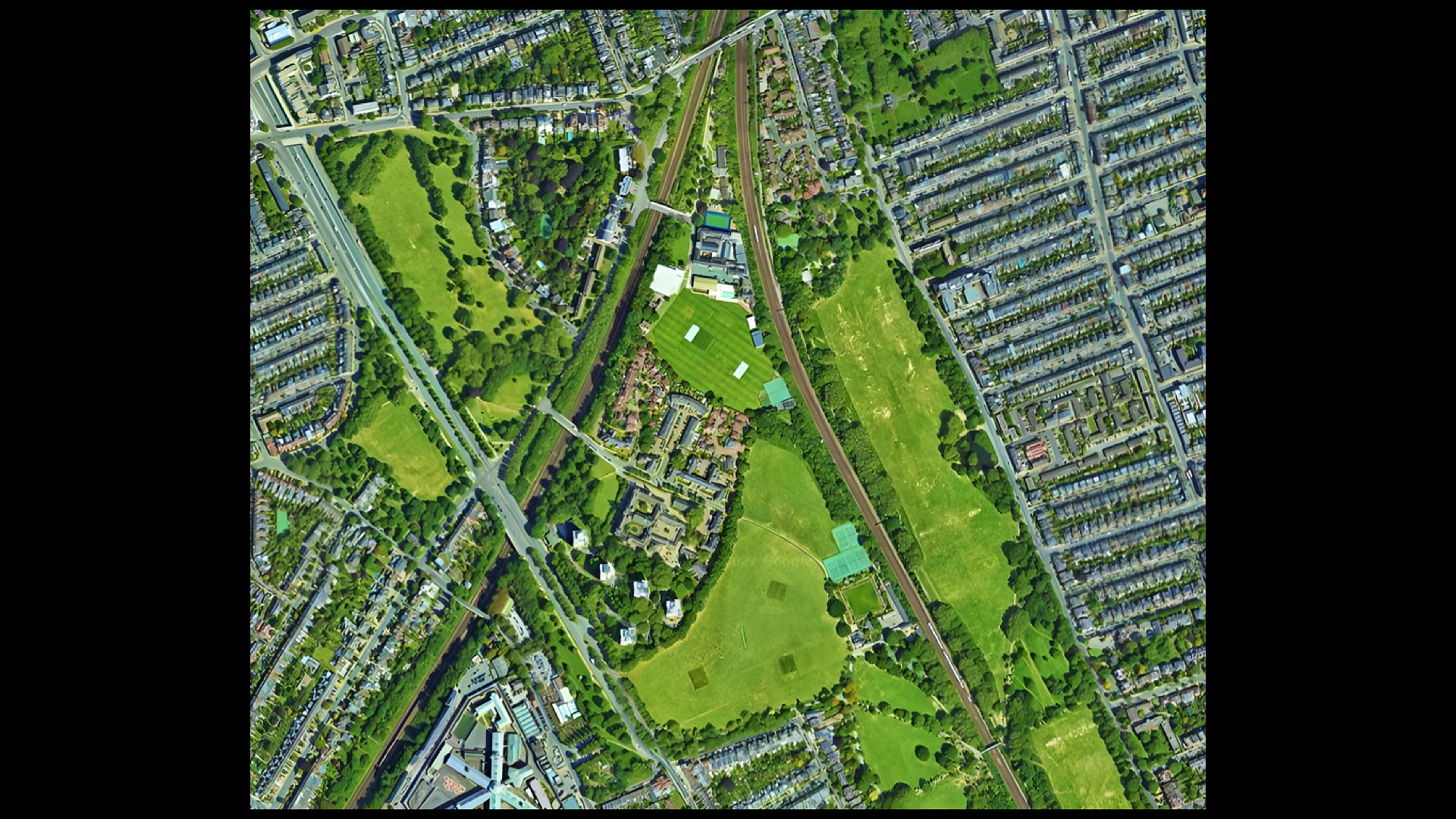
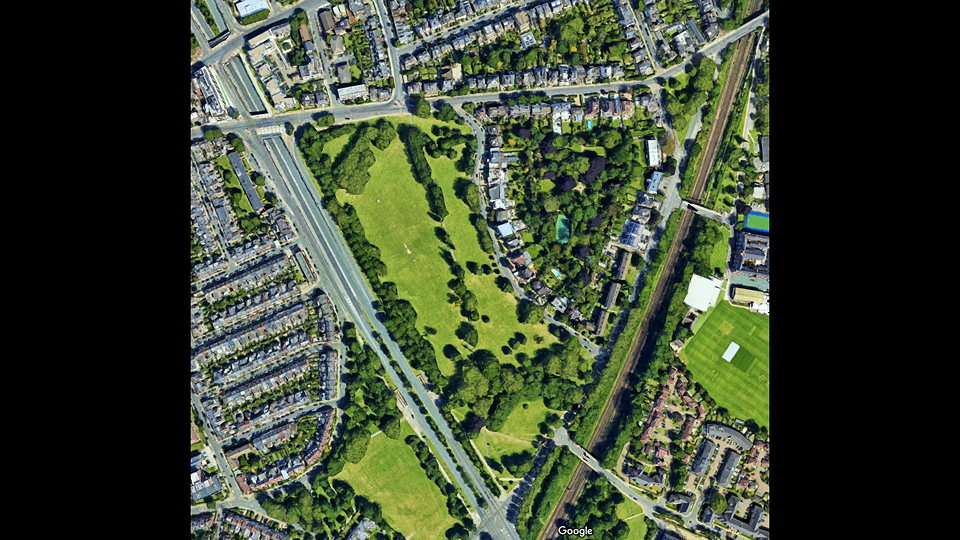
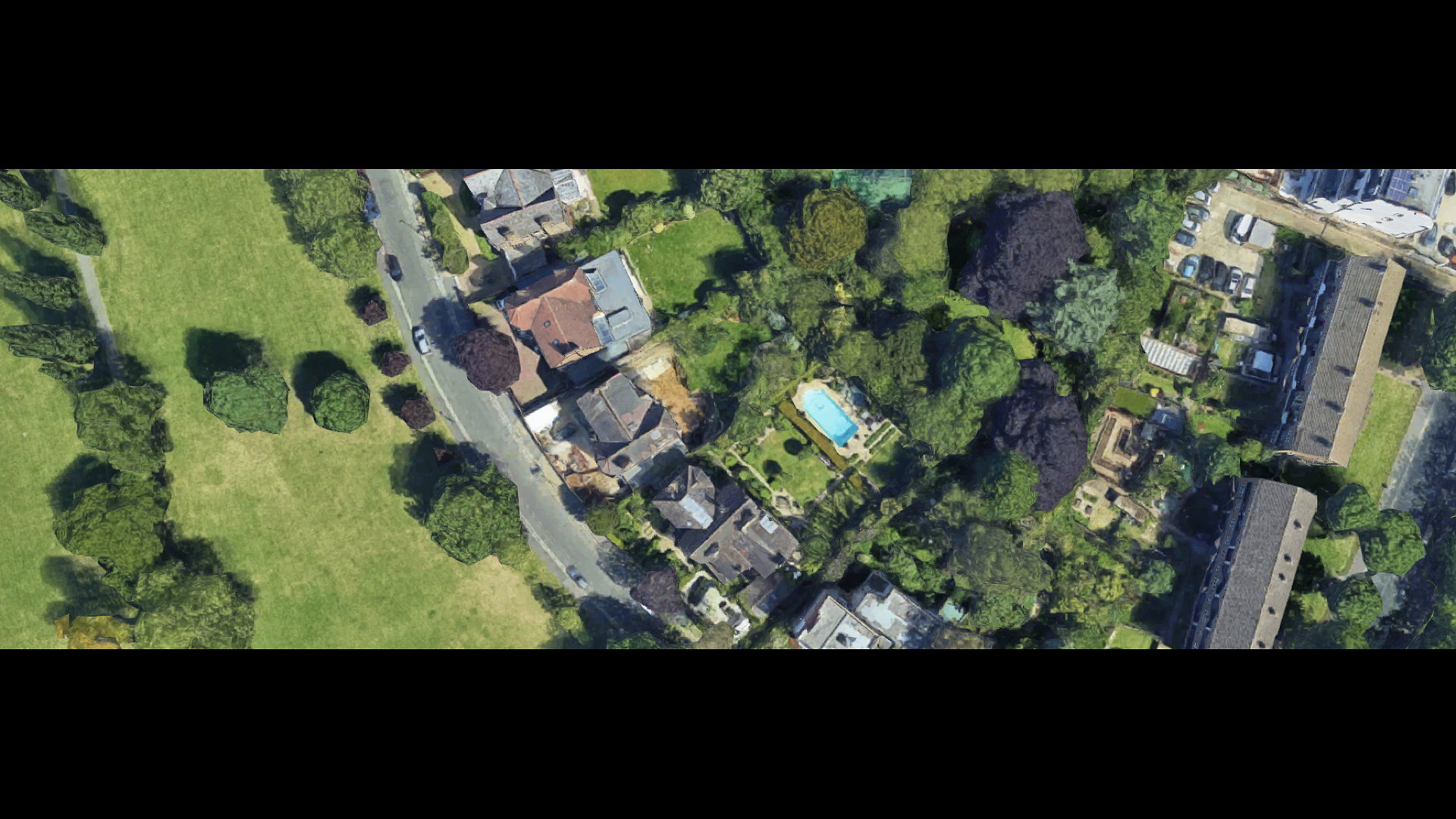
And here in an aerial photograph from the last couple of years:
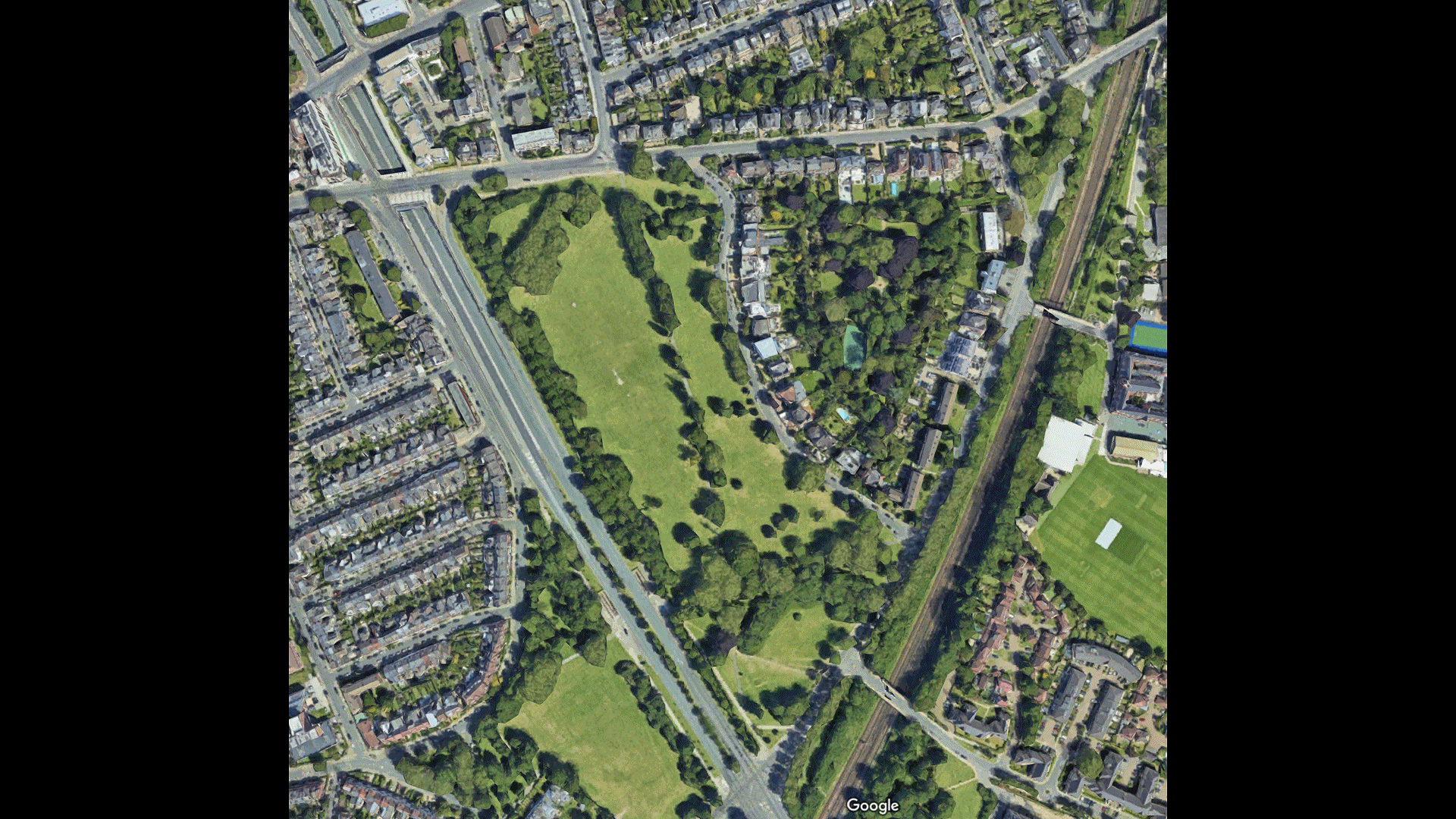
(Click on image to enlarge)
Within a few years, the lake was filled in.MOVE? DROP? The note on the back of the card says painted "around 1880"? Again, possibly. But if so, it was painted after the lake had been filled in - which (as we shall see) was some time between 1871, when the Wandsworth Common Act was passed, and the mid-1870s.
Let's go back to the map / look at a roughly contemporary map This is a hand-coloured Stanford map of 18?? There were numerous editions from ? to ? Given the sightlines, with a clear view of the RVPA, and with what is likely to be an small island on out ?, we must be somewhere here...or here Notice there is no evidence of a railway line in between "us" - the artists or viewer - and the enormous orphan asylum. Whenever this image was painted, it represents the last days of the lake. By 1880, it was gone, and Spencer Park built in its place. [Map from 1880s? Aerial pic?]
Now we have a problem. Did the railway line go through the Black Sea, or simply cut off its water supply? We know it did cut off the supply because.... hence court case? agreement for the railway company to provide a windpump and maintain the lake Are these maps accurate? Or at least accurate enough It certainly looks as though it went through...
Here are some images of this windpump - always called the Windmill, of course... Thanks to the efforts of the Wandsworth Society, a large part of it is still there today - though oddly camouflaged by trees as if it's lurking behind them
If so, the lake once spread into the grounds now occupied by Emanuel School. Now here's a little enigma. Until the 1930s [date?] there was strange wooded knoll "venerable elms" on what are now the school playing fields. Yes it got in the way, but it had its uses... ?picnics? ? military manoeuvres here are some photos from around But sport won , as it did more or less everywhere around. The knoll was removed etc Now what if this knoll was originally an island in the lake?
https://www.historyofwandsworthcommon.org/people/wilsons-prices/wilsons-prices.html https://www.historyofwandsworthcommon.org/water/black-sea/black-sea-talk-wilsons.html
Next bit... Some of the ways the Black Sea features in newspapers etc... to suggest its significance We read about it in memoirs of the great and good, such as Walter Besant, from his Autobiography. In the 1840s he was a pupil at Stockwell Grammar School. There were no organised games. The boys wandered at will, climbed trees, swam - and probably benefitrd more than they would have done from rugby or cricket:
But there were sports events, in the winter actually on the Sea itself: e..g. on the iceThere were many curious and pleasant places within reach of Stockwell. Clapham Common, on the south, the first of the Surrey heaths. It was surrounded by stately mansions, sacred to the memory of Wilberforce, Thornton, and Macaulay, standing amidst broad lawns with splendid cedars. The common itself was left absolutely untouched ; winter water-ways made little ravines; there were ponds, there were no roads, there was gorse and fern. It was our playground.
Beyond lay Wandsworth Common, another wild heath with a lake called the Black Sea, wherein, it was rumoured, gigantic pike attacked and bit great holes in the boy who ventured to swim across.
Bell's Life in London - 4 March 1855
Cricket on the ice

(Click on image to enlarge)
Cricket on the ice
The match was played on the Black Sea, Wandsworth Common, on Friday week, between 11 players of Battersea and 11 of Wandsworth, which, after a hard contest, ended in favour of Battersea by 21 runs.
On Saturday a match was played between 22 players from Messrs Price's Battersea. Score: J Allen's side 57 and 27 total 84 with seven wickets to go down; G Steer's side first innings 27.
[BNA: Link.]
Inevitably, there were drownings: Death on the ice
Morning Post — Thursday 17 January 1833
FATAL ACCIDENT ON THE ICE. CORONERS Inquest
>On Tuesday evening an Inquest was held at the Ram Inn, Wandsworth, before Richard Carter, Esq., Coroner, on view of the body of a fine youth eighteen years of age, named William Townsend, the son of Mr. Townsend, the shoemaker of Wandsworth, who met his death under the following melancholy circumstances: It was stated in evidence that the deceased, on Sunday morning last, was desirous of going skating, and prepared his skates for the occasion. His lather, however, knowing the ice was not sufficiently strong to bear, cautioned him and did all in his power to dissuade him from going, and contrived to secrete his skates. The ill-fated youth, however, persisted in his determination, and in the afternoon he, in the company or a lad a companion, proceeded to a large piece of water about twelve feet deep on Wandsworth Common, called the Black Sea. The surface of the water was covered with ice, but, nor of sufficient substance to allow of the weight of any person upon it. This, however, did not intimidate "the unfortunate youth, and both he and his companion ventured upon it and began to slide. They had not been many minutes there before the ice gave way. and young Townsend was immersed in the water. He called in vain for help, as no person was near him but his companion, who could atford liim noassistance. and the unhappy youth sunk under the icy surface. In aboui. a quarter of an hour after, assistance having l,een procured, the body was got out, and carried to the house of Mr. Wilson the Magistrate, where surgical aid was called in, and the means usually adopted to restore animation were resorted to. but all to no effect, as the vital spark was extinct. The Jury returned a verdict of " Accidental Death." [BNA: Link] Also brief accounts in: Morning Chronicle — Thursday 17 January 1833 [BNA: Link]
Bell's Life in London and Sporting Chronicle — Sunday 20 January 1833
Accident on the Ice. On Wednesday an Inquest was held the Ram Inn, Wandsworth, on the body of fine youth, aged i». the son Mr. Townsend, shoemaker, of Wandsworth. The deceased, notwithstanding the caution of his father, went to the Black Sea." piece of water Wandsworth Common, about twelve feet deep, and though the Ice was very thin, and no person was on It, ventured to slide. Shortly after this daring act, the ice gave way, and, no person was near, he was drowned. [BNA: Link]
Indeed the Black Sea is probably most frequently discussed is often associated with a deaths - particularly suicides and attempted suicides cheifly. of women and girls The most widely publicised of which was Amelia Alfery _________________ [ALFREY = ALFERY = ALFRID etc] Northern Star and Leeds General Advertiser - Saturday 03 August 1844 ATTEMPTED MURDER AND SUICIDE-On Monday evening, about five o'clock, a woman, about twenty-six years of age, named Amelia Alfrid, left her home at the water side, Wandsworth, with her two children, a girl and boy, aged respectively six and four years, and proceeded on to Wandsworth-common. She wandered about for nearly an hour, and then approached a large and deep pond, called the "Black Sea." It would appear that, whilst standing on the margin of this pond she tied the two children to her waist, and then precipitated herself into the water; the bank was shelring, and the water was rather shallow at that point; but so determined was the wretched woman upon making away with herself and her offspring, that she afterwards threw herself on her back, so that the water covered both the children and herself. At this critical period Wm. Alfrid, the brother of the unfortunate woman, a lad of not more than fourteen years of age, ran up to the spot, jumped into the water, and tried to rescue the children. Finding that he could not release them, he held their heads above water and halloed for assistance. Assistance arriving, the woman and her children were taken out of the water, the latter uninjured, but the former in a somewhat precarious state. She was conveyed to the Union Infirmary, where means were adopted for her recovery. There is little doubt but that the woman is Insane, and that that insanity has been brought on by ill-usage and distress. She had lived for years at Wandsworth, her native place, with a journeyman carpenter and cabinet-maker, by whom she had her children. This man, in November last, was charged at the Wandsworth police-court with stealing a silver watch, which had by accident been left in a drawer of a cheffonier he had to repair, and was committed for trial. The woman Alfrid, who was then supposed to be his wife, proved her great attachment for the fellow; for she never ceased petitioning persons to speak for him on the day of trial. The prosecutrix even recommended the prisoner to mercy on her account, and he consequently hadi but a slight sentence passed upon him. Since his release he had deserted her. This cruel conduct was not without its effect upon the | poor creature, who became insane, and was passed by the magistrate at Wandsworth Police Court as a lunatic, to the Surrey County Lunatic Asylum, at Garrett, where she remained a short time, but was eventually discharged as cured. Yesterday the superintendent of the V division made Mr. Clive, the sitting magistrate, acquainted with the particulars; and it is understood that so soon as the wretched woman is capable of being removed, she will be brought to court to undergo examination upon a charge of attempting to murder her children. https://www.britishnewspaperarchive.co.uk/viewer/bl/0000090/18440803/025/0008 [Alfery / Alferry etc] Illustrated London News - Saturday 10 August 1844 POLICE. The Attempted Murder and Suicide at Wandsworth.- Monday was fixed for the examination, at the Wandsworth Police-office, of Amelia Alferry, the young woman who, on Monday, the ypth ult., attempted the murder her two children and self-destruction, on Wandsworth-common. The prisoner is about 27 years of age, she was deadly pale, very weak, and had a vacant look. The children, one a girl six years of age, and the other a noble-looking boy about four [teen?] years old, were also brought into court. The charge, u« entered on the sheet against the prisoner, was as follows i-" Amelia Alferry, aged 27, single woman, charged with assaulting her children, Mary Ann, aged six years, and Henry, aged four years, with intent to murder them, by drowning, and also with attempting to commit suicide at the same time, to wit, on the 29th of July last." -William Alferry, a lad about 14 years of age. was sworn, and stated, I live near the White Horse, Water-side, Wandsworth, and am brother to the prisoner. On Monday evening, the 29th of July, between five and six o'clock, I was crossing Wandsworth-common, when I saw my sister sitting on the island near Mr. Wilson's; she had her two children with her; their names are Henry and Mary Ann French. I wished her to go home; she said, 'You can go home -l'm coming presently.' I went home alone, but came back shortly afterwards to play at cricket. My sister was still sitting on the island, and the children were playing near her ; she called them to her and said, We'll go home.' She then drew them to her, left the bench on which she had been sitting, walked to the water's edge and jumped in with them. The part info which the prisoner jumped is called the 'Black Sea.' I went in after the children and held their heads up to prevent them from drowning. I halloed for help, and kept the little children up until Mr. Steers came, and he walked into the pond and took the children out. Mr. Steers afterwards got sister out with a great deal of trouble, and laid her upon the grass. Prisoner had said nothing to me before she went into the water about drowning her children or herself. Ido not know whether she went into the pond accident. It was in her way home."-Mr. Burrell asked the prisoner if she had anything to say ?-The prisoner, in a faint voice, said No more than that it was trouble that caused me do so."-The prisoner was remanded till the next day.-On Tuesday the prisoner was again brought up. After several witnesses had been examined, Mr. Clive asked her if she had anything to say? The prisoner, in a low voice, uttered the words, further than it is trouble." The various witnesses were then bound over to prosecute. Mr. Clive then informed the prisoner it was his duty to commit her for trial, but she would be allowed to sec her children. The late Poisoning Case at Stepnkt.-Committal of Mr. Belanet. -At the Thames Police-court on Wednesday, alter the unusually long remand of six weeks, Mr. James Cockburn Belaney, surgeon, was brought up for final examination, charged with the wilful murder of Rachael Belaney, his wife, by administering to her quantity of prussic acid, at Stepney, on the Bth of June last. The prisoner was attired in deep mourning, and appeared haggard, and much thinner than he was on the last occasion, the effects, probably, of hi« long confinement. He bowed respectfully to the bench on being placed in the felons' dock. The court was excessively crowded, and a number of ladies were present. Mr. Reynolds, who appeared on the part of the Crown, said he did not intend to offer any further evidence against the prisoner, as he considered that which had already been given was ouite sufficient to justify the magistrate in sending the prisoner before another tribunal. The coroner's jury hud already returned verdict of wilful murder against the prisoner, and the warrant for his committal was made out. He now prayed that the prisoner be forthwith committed for trial. Mr. Clarkson, who defended the prisoner, applied to Mr. Broderip. the magistrate, for a remand to Clerkenwell prison, on the ground that the prisoner would there have better facilities for seeing his friends and legal advisers. After a long discussion, however, Mr. Broderip declined the request, and committed the prisoner to Newgate for trial. Mr. Clarkson submitted that the papers in the possession of Sergeant M'Car dell, who had apprehended the prisoner, ought to be restored. M'Cardell said he had taken one letter and a bottle of poison (acetate of morphine) from the prisoner, and he had sent them to the solicitor of the Treasury. Mr. Reynolds assuied Mr. Humphreys, the letter, which was of importance, should be delivered to him. https://www.britishnewspaperarchive.co.uk/viewer/bl/0001578/18440810/019/0003 London Evening Standard - Saturday 02 February 1867 WANDSWORTH, Attempted Suicidr in tub Black Sea. '-A Alatbimunial Si^uauule. -Annie Walters, 22, of Westmeon, Petersfield, North Hants, was placed in the dock, charged with attempting to commit suicide. Police-constable Wilson said that about eleven o'clock last night he was on duty on Wandsworth-common, when he heard the cries of a female for help. hastened to piece of water ailed the Black Sea," where he found the prisoner. She was reclining in the water with her left arm and head above the surface. went into the water and brought her to the bank, when, she appearing to l»e getting exhausted, he remained with her for several minutes and then took her to the station, ?»ir. Mr. Dayman.-Was she out of her depth Constable.-No, sir. Mr. Dayman.-Was :?he then leaning on the bank. Constable. -She could cot have been resting on the bank, the v atc-r was up breast. She said she had had a quarrel with her husband, and she meant to drown herself. Mr. Dayman (to the prisoner).-What have you to say Prisoner.-At present I can't say much. I should like to speak n 1 am more composed. The Constable. -Her friends are here. Mr. Dayman. -She is remanded for a week, and she can compose herself in the interim. The prisoner was then removed to the cells. It was stated that the constable had only been in the force about fortnight, and was quite ignorant of the depth of water in the sea." https://www.britishnewspaperarchive.co.uk/viewer/BL/0000609/18670202/047/0005 Attempted Suicide. At Wandsworth police-court on Saturday, Annie Walters, a young married woman, who gave the address Westmeen, near this town, was charged with attempting drown herself. Police-constable Wilson, No. 241 V., said that on the previous night was on duty on Wandsworth Common, when he heard the cries of woman for help. He hastened to piece of water called the "Black Sea," where he found the prisoner. was reclining in the water with her left arm and head above the surface. He went into the water and brought her to the bank, when she appeared to getting exhausted. He remained with her a few minutes, when he took to the station. She told him it was on account of her husband, and meant drown herself. In reply to the magistrate, the constable said she could not have been resting her arm, the water was up to his breast. In answer to the charge the prisoner said she would like to speak when she was more composed. Mr. Dayman remanded her for week. County Bench. https://www.britishnewspaperarchive.co.uk/viewer/BL/0001365/18670209/108/0008 PB: There are plausible Annie Walters on Ancestry, including one married recently to a musician It is also possible the "Westmeen" [Hants?] was actually West Meath, ireland.
BLACK SEA - SEVEN ISLANDS POND AMELIA MCDOUGAL PRINGLE?
The Era — Sunday 18 January 1846
ATTEMPTED SUICIDE ON WANDSWORTH COMMON
On Thursday morning, about half-past seven o'clock, William Marsh, a basket-maker, living in Garrat-lane, Wandsworth, was crossing the common near to a large and deep piece of water called the Black Sea, when he heard several distinct groans, and on looking towards the pond he saw a woman floating on the water. He called to some laborers who were at work on the South-Western Railway line, which is contiguous to the spot, and one of them, named William Spencer, at the risk of his life, jumped into the water, and with the assistance of his comrades got her out. Life was, to all appearance, extinct, but the men, aided by police constable Dempsey, hurried her to the Wandsworth Union, and in less than two minutes the unfortunate creature was placed between hot blankets, but it was not until more than an hour had expired that circulation was in part restored, and nearly another hour before she became conscious. After the poor woman had become sensible, police constable Daley questioned her, and ascertained that her name is Amelia M'Dougal Pringle; that she is the wife of a plasterer, who is working at Kensington, was in her twenty-ninth year, and that she had only been married four months. She said she was very wretched and did not wish to live. It was afterwards ascertained that she had called upon an old fellow-servant, who is married to a man named Cartwright, living in Love-lane, Wandsworth, and that she remained there until half past ten o'clock on Wednesday night, when Cartwright accompanied her to the foot of Battersea-bridge, and there left her, understanding she was going to her sister's at Islington. There was no money or property of any description found upon her, and it is probable that not having any means to pay the toll, she wandered back to Wandsworth-common, where she had formerly been in service, and at last driven to madness she threw herself into the water. She is still in a very weak state, but when sufficiently recovered will be brought before the sitting magistrate at Wandsworth Police court.
[BNA: Link]
I have spent quite a time trying to find her in Ancestry - but absolutely no luck From the article: born c.1817 married late 1845 Was McDougal her maiden name? Pringle? I have found Pringles in Islington [where her sister lived] See another entry for info about here former emplyrer - "Mr Rankin" - presumably John Ranking (father of Augustus Ranking) There is a Cartwright family fitting the bill at Point Pleasant in 1841, and Love Lane in 1861 Follow up? b.c.1818 Northern Star and Leeds General Advertiser - Saturday 14 February 1846 WANDSWORTH MONDAY - ATTEMPTED SUICIDE Amelia M'Dougal Pringle, a young woman about twenty-eight years of age, was brought up again for examination upon a charge of attempting self destruction, by throwing herself into the Seven islands Pond, Wandsworth-common. On the morning of the 15th of January the defendant was found floating in the above mentioned pond, and taken out by some labourers on the South Western Railway, and conveyed in an apparently dead state to the Wandsworth Union, where, however, the judicious treatment of the master and matron restored her to life. On the 27th ult. she was brought before Mr. Clive, and her answer to the charge was, that she had been three years in the service of Mr. Rankin, on the Common; that about four months since she left to marry a plasterer, who deceived her in his circumstances, and having expended what money she had, and pawned her clothes, she determined upon destroying herself. She also accused her husband of having tried to persuade her to cut her throat by giving her an open razor, and bidding her to kneel down and do it. She -has remanded, that the lady of the furnished room she and her husband had occupied, might attend a end speak to the husband's conduct. On Monday week Elizabeth Singer, of 51, Praed-street, Paddington, proved that the defendant had lodged at her house for three months, during which time she had thrice attempted to destroy herself; once with poison, the next time with a rope, and the last time with a razor; she did not consider that the husband was to blame, he gave her nearly all his wages when in work. She considered defendant of a very desponding nature. Other witnesses were called and proved that prior to the defendants marriage, she i had been of a happy and cheerful disposition. The husband said he would do his best to support her, and Mr. Rankin authorized police constable Daley, 127 V, to state that he would take her back into his service if the husband was not permitted to come near her. The defendant was again remanded for the attendance of the medical officer of the union to speak to her state of mind, Dr. Connor stated that the defendant was, although kt labouring under no delusion, decidedly depressed in It mind, and he considered naturally Inclined to melancholy constable Daley said that Mr. Rankin was io still desirous to receive the defendant back into his servies; and she having expressed her wish to return, Mr. is Olive, after addressing the defendant in the most feeling ig auntr, and pointing out to her the enormity of her offence, said he would return her into the bands of a sl good master, and trusted that she would regain her cheerfulness.- the defendant was then discharged. https://www.britishnewspaperarchive.co.uk/viewer/bl/0000091/18460214/029/0008 [Is "Rankin" the same as Augustus RANKING?Not just attempts at suicide... People's Paper - Saturday 16 April 1853 SUICIDE OF A GIRL THROUGH JEALOUSY. The body of a fine young woman, named Lucy Upton, the daughter of respectable parents residing at Wandsworth Plain, has been found lying in the water of a pond cal.ed the "Black Sea, " upon Wandsworth Common, and there is no doubt but that the deceased committed suicide while in a state of temporary insanity, caused by a fit of jealousy. It appears that the unfortunate young girl, who is only eighteen years of age, had become very much attached to a young man, the son of a licensed victualler in the neighbourhood, and she had latterly seen him in company with another young woman, which roused her jealousy, and she had been heard to declare that she would make a hole in the water for him. She seemed in her usual spirits, and her parents left her in the parlour, in which room she slept, washing her feet, previously to her going to bed. Thei went up stairs and retired to rest, and, before they did so, the deceased was heard to lock her door. Nothing more was heard of her until the following morning, when her body was found lying in the water of the Black Sea, on Wandsworth Common. Her bonnet and shawl were discovered lying on the edge of the pond, and it is supposed that the deceased waited until her parents were asleep, and then unlocked her door and made her way straight to the common. The water in the pond is very shallow, and where the body was found lying it is only three feet. https://www.britishnewspaperarchive.co.uk/viewer/bl/0002582/18530416/039/0005 Glasgow Free Press - Saturday 23 April 1853 SUICIDE OF A GIRL THROUGH JEALOUSY On Sunday morning last, the body of a fine young woman, the daughter of respectable parents, residing at Wandsworth Plain, was found lying in the water of a pond called the 'Black Sea,' upon Wandsworth Common, and there is o doubt but the deceased committed suicide while in a state of termporary insanity, caused by a fit of jealousy. It appears that the unfortunate young girl, who is only eighteen years of age, had become attached to a young man, the son of a licensed victualler the neighbourhood, and she had latterly seen him in company with another young woman, which roused her jealousy, and she had been heard to declare that she would make a hole in the water for him. https://www.britishnewspaperarchive.co.uk/viewer/BL/0001395/18530423/065/0004 Kentish Mercury - Saturday 16 April 1853
Or babies South London Chronicle - Saturday 08 February 1868 Suspected Suicide at the " Black Sea, " Wandsworth-common. On Saturday afternoon Mr. W. Carter, the coroner, proceeded with an inquiry, in the Board-room of the Wandsworth Union, Battersea Rise, respecting the death of a female child about five months old, who was found in pond called the Black Sea at Wandsworth-common. Evidence having been adduced respecting the finding of the child, and tending to the suspicion that its unfortunate mother had committed suicide, the jury returned the following verdict: That the deceased child was wilfully murdered by being thrown into a pond called the Black Sea, but they (the jury) further say by what person or persons the evidence before them fails to prove.' https://www.britishnewspaperarchive.co.uk/viewer/bl/0000443/18680208/018/0003 Cardiff and Merthyr Guardian, Glamorgan, Monmouth, and Brecon Gazette - Saturday 08 February 1868 EXTRAORDINARY MURDER OF A CHILD. - On Saturday afternoon Mr. W. Carter, the coroner, proceeded with an inquiry, in the Board-room of the Wandsworth Union, Battersea Rise, respecting the death of a female child about five months old, who was found in a pond called the Black Sea at Wandsworth Common. Evidence having been adduced respecting the finding of the child, and tending to the suspicion that its unfortunate mother had committed suicide, the jury returned the following verdict: - That the deceased child was wilfully murdered by being thrown into a pond called the Black Sea, but they (the jury) further say by what person or persons the evidence before them failed to prove. https://www.britishnewspaperarchive.co.uk/viewer/bl/0000914/18680208/012/0003 May newspapers around the country report the event. Why so many? e.g.
Even after the Black Sea had been lost to the Common... South London Press - Saturday 28 August 1875 Mysterious Murder of a Child. INQUIRY BEFORE MR. CARTER, AT WANDSWORTH. Considerable excitement has been caused in the neighbourhood of Wandsworth and Battersea by the discovery on Sunday last of a newly-born child, under circumstances of a suspicious if not mysterious character. From the information furnished to the police, they were induced to apprehend a Mrs. Turtle, of Providence Dairy, Usk-road, Battersea, a widow, well known in the locality and very much respected ; but the magistrate before whom she was charged with "having exposed the dead body of this child on Wandsworth Common" considered the evidence insufficient to aupport the charge, and he accordingly dismissed it. The magistailed inquiry took place on Monday. On Wednesday evening there was a further inquiry into the circumstances attending the death of the child by Mr. Carter, the coroner for East Surrey. It was held at the Red Lion public. house, and lasted several hours; the evidence adduced being of a very conflicting character. The first witness examined was Police. constable James Bellew, 106 V. lie said he was on duty in the High-street, Wandsworth, on Sunday morning. About half-past 7 o'clock. a man named John Smith met him, and from what he said be accompanied him to Wandsworth Common, close tea place known formerly as the Black Sea, but which was now enclosed all round, and called" Spencer Park." He there saw Henry Davis, who showed him the body of a female child wrapped up in a calico bed-gown, and there were three sheets of brown paper lying by it, and a piece of string underneath it. Witness sent for the coroner's officer, and handed the child and the articles he had mentioned to him. The coroner's officer (Mr. Planner) stated that he had received the child from the last witness. The child apparently had only recently been born. The nightdress had no name or mark upon it, and there was a needle in it. He received with the child three pieces of paper and some twine. The child weighed six pounds and a quarter. There did not appear to be any marks of violence upon the child. There was a caul attached to the child. Henry Davis. plasterer, 30, Paulk-road, Battersea, said he was in the habit of taking a walk every Sunday morning to Wimbledon Common. On Sunday morning last he took his usual walk, and on reaching the enclosed part alluded to by the previous witnesses, he had occasion to go inside for a purpose, and whilst there some cows entered, and he saw a woman also enter. Here the witness produced a plan, and entered into a minute description of the part where he had, as he asserted, seen the woman enter, and an opening in the fence from which, as he stated, he had seen her run away. Having no suspicion of her, he did not take notice where she went or the cows, until subsequently he was walking along outside the fence, and had his attention drawn to a parcel he could see in the small opening. The opening was too small for the parcel to have been pushed through without injuring it. The parcel was about one foot inside, he put in his hands through the opening of the fence, and lifted it uo bit and bit, until it reached the top of the fence, and then he was enabled to get hold of it in a proper manner. The parcel weighed about seven or eight pounds, and it was tied up with string. He cut the string and opened it, and then discovered the child in a chemise. He felt quite sick for a few motnents, and then called out to a boy who was passing at the time. Be sent the boy for a policeman, and he looked round and saw a neighbour, a Ir. Smith, and, at a little distance from him, the woman whom he had previously seen mar where he had found the parcel. He did not then see the cows. The cows were out on the Common. He spoke to the woman, remarking, "Here's a pretty thing! I have found a child." Mr. Smith and the woman came to where the child had been left. He told Mr. Smith where he would be able to find a policeman, and he went away. The woman then made the remark, "It is born with a caul on its head." The child was partly uncovered. The Coroner: How did she express herself ? Witness: That is all she said. The Coroner: What then? Witness: I saw no more of her. I have since seen her. I did not know the belonged to her. I had never seen her begun. BY a Juror Whew she mime in had a stick in her hand. I believe she told the detective she went in to take the cows out. I did not think of anything until I saw this parcel. Another Juror: Might it not have been put there before this woman went in? Witness: It would have been wet with the dew. By &Juror : Might it not have been placed there from the outside ? Witness: The opening was not sufficient to allow of it being pushed through. By &Juror : Could it not have been put over the ? Wicsiess - : If so, the piper would have boo broken from the distance the parcel would have fallen. By a Juror: Could the parcel not have been Pot there in the same way you say you took ft out ? Witness : It might have been done that way. The Coroner: Did you notice any other person before you found the parcel? 'Witness : None at all before. The Coroner: How far from the opening did you see the woman? Witness: About a dozen yards, running iway. Coroner: Was the dew knocked off the ? Witness: I did not go to see. I did not see any other person than the female before I saw the parcel. The Coroner: You saw the child; what part of the body was exposed? Witness: It was lying sideways. The Coroner: Could you see the child's face? Witness: Only a portion of it; the smell was ',,so bad I had to give up-it made me sick. [With the local knowledge of the jury and the coroner, together with the constant referenees to the plan, the evidence of this witness might have been intelligible to them. It certainly, however, was not at all clear to those not possessing the advantages referred to Detective-Sergeant Alfred Brook, of the V division, was then examined. The Coroner: Did you see the lad witness on Sunday? Witness: Yes; and in consequence of what he stated I went to Mrs. Turtle's house. I told her I was a police officer, and asked her to go with me to the police-court about a child that had been found exposed on the Common. She said, "Oh, dear! I went in to Spencer Park to drive my cows out, and a man spoke to me respecting the body of a child, and asked me to go for the police; but I did not see one until half-past 8 o'clock in Plough-lane, and I thought it was too late then." I told her all the circumstances, and she said, "I will go with you anywhere." I asked her if she had any lodgers, and she desired me to look over the house; but I found not the slightest indication of any one being there ill. Mrs. Turtle's husband is dead, but the business of a dairyman is still kept on. Cows are kept, and there is a van, and milk is sold. The cows are kept on the Common. She is in the habit of driving them there every day. She wra taken before the magistrate on Monday and discharged. The Coroner: You cannot trace this child to her possession? Witness: Not the slightest trace. The Coroner And the articles have not been identified by any one? Witness: No; these cases are very difficult. The Coroner: Have you seen the spot where the child was found? You know this man sees cows, and it is only reasonable to suppose that the woman would go in to drive them out, being private property, and aa there was some rough ground, she may have gone a little to the aide? _ Witness: The ground is very rough. The Coroner: The supposition of this man would seem to be that this woman put the parcel there. Looking at the nature of the qatrture, could it have been put through the fence? Witness: No; it might have been dropped over. , It was further stated to the coroner that the grass near the spot had not been disturbed, and that the woman could not have been within 10 yards of the spot on the inside. Dr. Hawkins, of 20, North-street, Wandsworth, was then examined. He said he went to the parish mortuary on Sunday morning at 11 o'clock, at the request of the coroner's officer, and there he saw the body of a female child. It was that of a well-nourished child. He was of opinion that the child had been dead some four or five days, as there were signs of external decomposition. The Child was lying in a night-shirt that had only ken half worked, the sleeves not being in; Ind numerous pieces of camphor were scattered around the child, presumably for the purpose taking of the smell. He then entered into various details of a scientific character respectlug the condition of the child as bearing upon the question whether or not it had had a separate existence, and also as to any violence having been used to cause Its death. The whole of the bones of the chest had been COZhiin. Great pressure must have been t to bear upon the child's chest, probably with the view to prevent its screaming sad breathing. There was every indication that the child had received no attention. On the had, and extending some distance down the back, was a caul-a most unusual thing. On the Monday he made a p44-tasortens examination of the body and the head of the child. There were no injuries to the head. The lungs were fully expanded. It was one of the clearest cases of a child having lived that he knew of. Decomposition would account for the weight of the child being so little, there were only two things against his assertion that the condition of the lung 3 indicated that the child had breathed, and these were absent. Death was, in his opinion, attributable to one of two causes: either hcemorxhage, resulting from causes which he explained, or the great Pressure which had been brought to bear on the child's chest. Witness asked to be allowed to make a statement in reference to Mrs. Turtle and those in her house, remarking that he wished to do so in justice to them. He then explained that he had, at the request of the magistrate, examined the inmates of the house, and that there were no grounds for the slightest suspicion in regard to their condition. The coroner here intimated that if Mrs. Turtle was desirous of making any statement, she could do so. At the same time she was not obliged to make any such statement, and if she did, it might be used against her. Mrs. Turtle said she felt justified in desiring to say something. She then explained that the man Davie had brought a charge against her for which she had suffered already, and it was so false that she felt in own mind- The Coroner: Do you wish to explain why you went into the field that morning? A young man here stated that there was a witness present who saw Mrs. Turtle go into the field on the morning in question. Henry Bromley, a warder, was accordingly examined. He said he was going to his duty on Sunday morning, when he noticed a, female go into Spencer Park. She had a stick her hand, and followed some cows Spencer Park, the rest being in the road. She had nothing in her hands but the stick; if she had had he could have seen it. There was a man who kept raising himself up from behind a heap of gravel. He stood at the gate and watched the woman about ten yards away from the gate, and he then saw the man raise himself up from behind the gravel. That took his attention more than anything else. 'Dm woman was going in the direction after the cows. The man raised himself up and down twice behind the heap of gravel, about 30 yards from the gate where he (witness) stood. Witness wondered what the man was watching the woman about for. The Coroner: Are you quite satisfied in your own mind that she really had nothing Witness: I am satisfied she only bed a stick in her hand. I was only 20 yards behind her. I should have been bound to have seen a parcel if she had had one _ _ _ _ The Coroner: Did you see any more of her? Witness: No, sir. I was obliged to hurry on to get to my duty in time. After she had got inside the gate, and I had seen the man raise himself up twice, I went on a little further and looked over the fence, remarking that it was not a very pleasant thing to go amongst the wet grass, but the woman did not make any answer back; she kept on driving the cows. The woman did not go near the fence within 10 or 12 yards, except when she went in at the gate. The Coroner: Did you see her 'come out again? Witness: I stopped, and then went on. The Coroner: Did the man see you? Witness: I don't know; his head was no sooner up than it was down again. By the Jury: I was in private clothes. She did not drive the cows in; she followed them in, as I believe, for the purpose of getting them out. I did not see her run at all, nor stoop down. The coroner, addressing the jury, asked them whether, after this testimony and that of the doctor, who had satisfied himself that there was no one in the house to whom the child could be traced, there was anything to lead them to think that the child could possibly have come from the house where Mrs. Turtle lived? As to the cause of death, the evidence of the doctor was very clear, and if the jury took his view, there would be no difficulty in regard to that point. The next question, however, was by whose hand the injury had been inflicted. Upon that there was really no evidence. If the jury thought the child had died from the injuries described by the doctor, they would either return an open verdict, or the inquiry could be adjourned. The , verdict would, in the former case, be that the child had died from injuries done by some person or persons unknown, or, in other words, "Murder." The evidence adduced by the various witnesses was not read over to them-a circumstance to be regretted, considering the peculiar character of the evidence of the witness Davis. .1 he room was cleared whilst the jury were considering their verdict. . . . _ . . On the public being again admitted, it was understood that the jury had returned a verdict of wilful murder against some person or persons unknown. https://www.britishnewspaperarchive.co.uk/viewer/BL/0000213/18750828/018/0004?browse=true# https://www.britishnewspaperarchive.co.uk/viewer/bl/0000213/18750828/018/0005
A caul or cowl (Latin: Caput galeatum, literally, "helmeted head") is a piece of membrane that can cover a newborn's head and face.[1] Birth with a caul is rare, occurring in fewer than 1 in 80,000 births.[2] The caul is harmless and is immediately removed by the attending parent, physician, or midwife upon birth of the child...Folklore developed suggesting that possession of a baby's caul would bring its bearer good luck and protect that person from death by drowning. Cauls were therefore highly prized by sailors. Medieval women often sold them to sailors for large sums of money; a caul was regarded as a valuable talisman.[7] https://en.wikipedia.org/wiki/Caul
The Black Sea crops up quite frequently in scientific discourse Bath? microsope exhibition Here is Geoffrey Bevington... The wonderful video of ceros ?? It must have been photographed many times, though finding these images can be frustrating Here is a Geoffrey Bevington Here is a Le Neve We read that...how frustrating is that I;ve written to the RSA but ...
But on a lighter note, as they say [Humorous - Count Caskowhisky]
Oxford Chronicle and Reading Gazette — Saturday 26 August 1865

(Click on image to enlarge)
Several other articles:LYNCH LAW AT WANDSWORTH - EXTRAORDINARY SCENE.
Lest it my ill fortune to witness an extraordinary on the th — Black Sea. Lest any readers should jiupfsise that I one the foreign correspondents th Star, or other than .Tew, I may state that the Black Sea is the local name f. r a pood of great extent or beauty the neighbourhood of Wandsworth. On the bank thi? not very pellucid lake, the scene last evening was the quietest description- Gentle nursery m ls led forth their interesting chargee enjoy the odour duckweed which arose from the lonely mere. Wandsworth Common wne beautiful under the placid influences sunset.
But in midst this general tranquillity there occurred a strife of elements which reminded one of the battles the ancient megalotheria in their homes ai mud. a peaceful preliminary the strife I noticed a lady descend from a cab, displaying in her right ind a white handkerchief. She looked wonderingly about for a few minutes. Presently a gentleman repeated the signal peace; and then, haring pocketed his handkerchief, walked forward the lady, and shook her warmly the hand. It was a singular but not extraordinary meeting; and I was about once more to dwell in mild contemplation on the beauties of wood and lake, when I observed the gentleman lead the lady in very affectionate manner towards a seat whi was from the pond by only a very narrow bank.
Nor was there much unusual in this occurrence; but no sooner had they prepared to seat themselves than the lady in a very wonderful way abruptly left her companion and ran off, while the gentleman seized by two rough looking men, who forthwith had the assurance lug him d-wn the banks the lake ami chock him into its waters.
Suddenly the delightful stillness of the Black Sea was broken a series of the most heartrending shriek and the was seen wallow out on all fours from the plain of mu l a vary deplorable condition. ben av emerged presented one the must unhappy spectacles that ever a gazer witnessed. He glistened from head to foot with mud like enormous boa-constrictor; his coat was rent across; his bat was smashed; while his face revealed the most hideous mass mud that ever made a human being look like a chimpanzee.
Immediately the scene of this extraordinary dip, which beat all to pieces the header" in the Colleen Bawn. was the pole whither everybody on the common was attracted; and it seemed as though the miserable experimenter this new sensation-seen' was well known most Wandsworthiana, for underwent a singular amount of hooting as he shuffled off. But these expressions of public disapproval were redoubled. They increased to groans, wild cries; they took visible form j sundry showers of inodorous eggs; and, finally, the j unhappy gentleman made humbling appeal to his feet, and ran off swiftly as they could carry him.
I was just about to transfer ray pocket book the closing — lines of a sonnet "Solitude in Wandsworth" when this untimely provocation occurred; and I forthwith i found it imperative run along with the crowd that was now collecting in wake the ducked one.
Opposite is a large public house (which shall mentioned in sonnet) [i.e. The Freemasons] the stranger turned upon assailants, and singling out one of them, knocked off his hat, and finally closed with him. of the crowd were alsmt to help their comrade when the English love of justice intervened, and a loud cry of "One to one" was raised. TTne to one it was; though I not consider that principle applies cases in which the one is covered with mud and the other | a decently-dressed Englishman. The gentleman attacked suffered more from mud than blows, though his 1 scarf and collar were torn open. His clothes received a j faint lithographic impression of the Black Sea, and his face presented faithful portrait thereof.
Finally live man who had been ducked backed off. and took refuge the tavern already mentioned, in front which assembled a crowd of native to discuss the matter. From these people I received, in snatch, the following details, which may may not be true, and which, if libellou, are attributed solely the Dogberries in question-
A foreign nobleman, whom I shall call Count Caskowhisky, and who is reputed to descended from the Caskowhiskies who invaded Bavaria in ha for some time back been in the habit of inveigling into a corrtspondence young ladies desirxaw of being wedded; and it is allege! that in not a few these foolish girl have been made pay the penalty of their folly being forced to contribute the count's yearly income under fear of exposure. Hitherto the count ha been slippery, and eluded conviction. But more recently gentleman in Wandsworth thought fit to reply to one the advertisement put forth by Count Caskowhisky, and succeeded in enticing the count into correspondence.
The letters, lam told,are sufficiently warm both side . Clorinda is gushing'; Philander is recklessly jnou . Clorinda talk of the dreams her youth; Philander displays his knowledge Scripture and swears it. Philander, in fact, indulges in what is called by the ugly name of blasphemy, and Clorinda represent herself being of £100 a year, Philander is more than ordinarily violent demonstratious his passion.
Finally, the story runs, a meeting was arranged Wandsworth-common; and a married lady who volunteered become a weapon of punishment on behalf of her suffering sisters, undert s k to personate Clonnda. Hence the scene which disturbed my poetic reverie; and which raised such commotion last evening in the peaceful neighbourhood of Wandsworth. I fear the proceedings were altogether very unjustifiable.
Revenge is a rude sort of justice; but it is a form justice which is not quite in accordance with the modem law of Great Britain. While, therefore, 1 lift v hands in horror the summary vengeance taken by the I venture to lay before your readers such details came under the observation of eye-witness.
[BNA: Link]
e.g. Particularly popular in Scotland?Fifeshire Journal — Thursday 31 August 1865
LYNCH LAW AT WANDSWORTH EXTRAORDINARY
YART BOWL A correspondent of the Star, writing on Friday, says: — brat evening it was my good or ill fortune to witness an extraordinary scene on the borders of a pond of no great extent or beauty in the neighbourhood of Wandsworth. On the banks of this not very pellucid lake, the scene last evening was of the quietest description. Gentle nursery-maids led forth their interesting charges to enj..iy the odour of duckweed which arose from the lonely mere. Wandsworth Common was beautiful under the placid influence of sunset.
But in the midst of this general tranquillity there occurred a strife of elements which reminded one of the battles of the ancient megalotheria in their homes of mud. As a peaceful preliminary to the strife I noticed a lady descend from a cab displaying in her right hand a white handkerchief. She looked wonderingly about for a few minutes. Presently a gentleman repeated the signal of peace; and then, having pocketed his handkerchief, be walked forward to the lady and shook her warmly by the band.
It was a singular but not an extraordinary meeting; and I wax about once more to dwell in mild contemplation on the beauties of wood and lake, when 1 observed the gentleman lead the lady Ma very affectionate manner towards seat which was separated from the pond by only a very Harrow bank. Nor was there much unusual in this occurrence; but no sooner had they prepared to seat themselves than the lady in a very wonderful way abruptly left her companion and ran off, while the gentleman was seized by two rough-looking men, who forthwith had the assurance to lug him down to the banks of the lake and chuck him into its waters.
Suddenly the delightful stillness of the pond was broken by a aeries of the toast heartrending shrieks; and the gentleman was seen to wallow out on all fours from the plain of mud in a very deplorable condition. When at last he emerged he presented one of the moat unhappy spectacles that ever a game whammed. He listened from bead to foot withiandlihe ba Victor; his coat was rent wren; his bet was entombed; while his face revealed the /wag hideous nen of 'nod that ever mate lumen he kick a the Mls Minh hest pines the 'Mier' he was the psis whither the emmon was; and it esemed the miserable se this Dew error wJ ale Melba as aL gm 'gumless pails They lamed to poem to wed nine; they Me in sen un happ dry y a @hewers Mimes Me bet, nes meg as thmid emery him. Mt attain a tavern, in front of which s_a natives
to disco= the matter. From these people I received, in snatches, the following details.
A foreign nobleman has for some time back been in the habit of inveigling /into a correspondence with young belles desirous of 'being wedded; and it is alleged that in nut a few instances th e se foolish girls have been made to pay the penalty of their folly by being forced to contrib ute to the count's yearly incr.me under fear of an exposure. Hitherto the count has been slippery, and eluded conviction. But more recently a gentleman in Wandsworth thought lit to reply to one of the advertisements put forth, and succeeded in enticing the count into a correspondence. A meeting was arranged on Wandsworth Common, awl a married lady who volunteered to become a weapon of punishment on behalf of her suffering sisters. undertook to personate elorinda. Hence the scene which rained such commotion last evening in the peaceful neighbourhood of Wandsworth.'
[BNA: Link]
Wells Journal — Saturday 16 September 1865
[Short version still running a fortnight later.
Alcester Chronicle - Saturday 07 October 1865 "The Matrimonial Chameleon ; or, The Adventures of Court Caskowhisky," is the name of a pamphlet which professes to give the fullest information conenrolee what is considered a most merited, if somewhat illegal, punishment inflicted on a so-called Polish count, tw i ce us is the neighbourhood of Wandsworth. The pam phletinformshow this man was in the habit of vitiating young girls, while still at school, into a oerrespondenee with him, and then of obtaining hush money from their relatives. A trap was, however, laid for him, and after mush ingenuity had been &played he wee decoyed to Wandsworth common, sad there dragged through a horse-pond. The letters written by the count and those of his fair correspondent are given. The lady's letters are exceedingly well weneged ; they are precisely those which silly romantic school-girl, foolish enough to answer a news. paper advertisement, would write; the count's are the mostbkleously blesphereouseverreed. Names are given i tall, and the pamphlet should be read by all who care to see the nature of the traps laid for youth, or the degree of vileness to which human nature may descend. The profits of the pamphlet will be given to the Society for the Protection of Women and Children and the Mendioity Society. https://www.britishnewspaperarchive.co.uk/viewer/BL/0002055/18651007/044/0004?browse=False The pamphlet was written by a "Herr Ingowater". Gwddit?An odd case is reported. A man who calls himself by some foreign title has been in the habit of advertising for a wife, and having procured interviews with certain foolish young women, has so far succeeded in compromising their characters that they have gladly paid a kind of black mail to secure his silence. This has been discovered by some indignant brothers and other relations, who last week entrapped the pseudo count to Wandsworth Common, where he was ducked in a most unsavoury pond and afterwards hunted out of the neighbourhood. The police appear to have looked with tolerance, if not with complacency.
Surrey Comet - Saturday 04 November 1865 THE MATRIMONIAL CHAMELEON. TO THE EDITOR. Sir, - Some years ago, when residing in Staffordshire, an English friend of position told me that an interesting young Polish refugee had been introduced to him, M. Waszkowaki name, whom he wished I should befriend. I consented to receive him house, and on his arrival I addressed him in my native language, but to my surprise he did not understand me. I pressed him hard as to what country he belonged,when he said he was a native of Prussia. After this I thought it my duty to make some inquiries as to his character and antecedents, and found him to be a worthless, idle, conceited adventurer, living upon the credulity and stupid sentimentality of silly old maids. Since residence here, met me in the street, when he made an effort to renew the acquaintance with the view of getting Into my debt. I took care, however, to caution some of the neighbouring tradesmen as to the character of the"distinguished foreigner,'' who was favouring Surbiton with his presence. In justice to my countrymen, I beg you will insert this in your widely-circulated journal, to show that the "Hero of the Black Sea of Wandsworth" is not a native of Poland. I am, Sir, Your obedient Servant, A POLE. Surbiton Hill, Oct. 3lst. P.S. the public know that the elderly lady mentioned is the pamphlet is in the enjoyment of national pension ? [MEANING?] https://www.britishnewspaperarchive.co.uk/viewer/bl/0000684/18651104/080/0004
The Death of the Black Sea
South London Press - Saturday 16 October 1869 BLACK SEA The chairman called attention to the filthy and unhealthy condition of the Black Sea. The water had been drawn off, and it was filled up with similar refuse to that which was placed in the holes in Wandsworth Common. It was agreed to draw the attention of the Wandsworth Board of Works to the subject. The vestry then adjourned. https://www.britishnewspaperarchive.co.uk/viewer/BL/0000213/18691016/020/0005 South London Press - Saturday 06 November 1869 Wandsworth Common. A letter was received from the vestry clerk of Battersea, enclosing copy of resolution passed such vestry, as follows: "That the attention of the Wandsworth Board of Works called the present filthy and unhealthy condition of the Black Sea on Wandsworth Common, with a hope that steps may be taken to remedy it." https://www.britishnewspaperarchive.co.uk/viewer/bl/0000213/18691106/032/0007 South London Press - Saturday 10 September 1870 ALLEGED "BLACK SEA" NUISANCE An application from the Patriotic Asylum was made to the board for the abatement of an alleged nuisance arising from" The Black Sea." Mr. Brown remarked that the best reply that could be made to them would be to say that they were the greatest nuisance of the two for occupying a portion of the Wandsworth Common. The surveyor was ordered to report on the subject.Campaigners' anxieties grew for a long time
There were complaints that part of the Common had been taken by the Wilsons and access restricted as a result [after 1848? later?]
Buckmaster remembers being able to walk round it ...
Rumours began to spread about
this thing of beauty under threat etc
Things moved to a climax after the death of Margaret Wilson in 1866?
Spencer...
What if anything remains to remind us of the Black Sea?
- Spencer Park: its footprint covers the Wilson House / Grounds / Black Sea
- The Windmill [stump of] that once fed the Black Sea...
- Windmill Road, that was squeezed in (against much local opposition) to extend Earlsfield Road towards Clapham Junction.
- and possibly, just possibly, this slight turn in the path - that appears to be a rationalisation of earlier paths to a very particular part of the Black Sea>
Finish with aerial view of Spencer Park?
Collect and review all maps
Shirley Passmore bits
Refs in newspapers etc
IMAGES
Paintings
There's a painting in the Wandsworth Heritage Centre/Borough Photos
Do I recall refs to watercolours e.g. possibly by [Ellen?] Barchard?
Seaford connection?Photos e.g. by
Geoffrey Bevington - probably took several photos of the Black Sea and Black Sea House - get better versions?
Geoffrey Bevington and his microsocope
Peter Le Neve Foster - I have a photo of the BS by him - but try to find the photo of his children boating there - said to be "his most charming photo"
Eels
Jack Black
Suicides e.g. the two Amelias
Infanticide
Deaths on the ice
"Botany Bay"?
The trap laid for the foreign seducer
Other plants, insects etc in the lake
The Elodea canadensis invasion
Westmorland Gazette - Saturday 03 October 1863 The American Water-weed. - In answer to your leading article*(see p. 889), inviting communications on the Anacharis, I beg to give you our experience. Several years ago the weed made its appearance in a fiveacre pond on Wandsworth Common. We were told that an aquarium owner, living more than half mile off, had pat small plant in a pond near his house, for the sake of getting good tank specimen. With spread very rapidly, soon overpowering all the old weeds, and destroying all pleasure in rowing. My brother, who had lately returned from India, suggested dragging it by means of boat oar pushed to the bottom and then twisted round and round; this brought a huge bunch of weeds, with their roots and some mud adhering to them. We found this by no means a bad gymnastic evening exercise, and two of us, one at each end of a pnnt, in little more than an hour had pulled up as great a load as it was pleasant to punt with Finding a greater impression had been made on the enemy than we at first anticipated would be the case, man was employed work constantly, and in about three weeks an immense pile on the bank was the result; this in a few months settled down into a solid black mass, cutting like cheese, which being nsed as manure for the garden has given such Peas and Cabbages as we never had before. Next year the weed came up again in about the same strength. Our friend the late Professor Henslow gave us some hopes that the great strength of growth was partly due to its having found, to it, a virgin soil. Next year came equally strong again, and was converted into another great heap of good manure. This year the growth has been stronger than ever. This is probably due not to the fine summer alone, but also to the fact that our windmill used keep up the water supply supply has been out of order, and that consequently the pond popularly known as the Black Sea " has been much shallower than for some years past. It took about five weeks to clear weed enough to make rowing pleasant, and now have still greater heap of the manure than , usual. We calculated that for our thin soil over gravel the value of this soil-like manure about paid for the man's 1 wages employed. In the country, where there are young men with leisure time and a boat, amateur extraction will be found by no means unpleasant muscular exercise. G. F. Wilson, Wandsworth Common. Gardeners' Chronicle. https://www.britishnewspaperarchive.co.uk/viewer/bl/0000399/18631003/036/0007George Fergusson Wilson models Wisley/future RHS on Wandsworth Common
GEORGE FERGUSSON WILSON AND WISLEYThe Windmill
Stories about the Frying Pan
Collect every photo and reference
Buckmaster et al's complaints about how they used to be able to walk all round.
Afterwards, how the rest of the ponds were filled in. How the lake was created and enlarged.
Collect info about how polluted, evil-smelling it had become
Find story about how it was blamed for deaths in the RVPA for Girls - then detail how the sewers worked, with human excrement spread on the grounds (and on Neal's bit of the Common? - the death of Dr Anstie blamed on the sewer gases (but was actually septicaemia briught in by a prick during dissection)
How the lake was filled in. And Spencer Park was built on the site. Who built the houses? Who lived there?

(Click on image to enlarge)
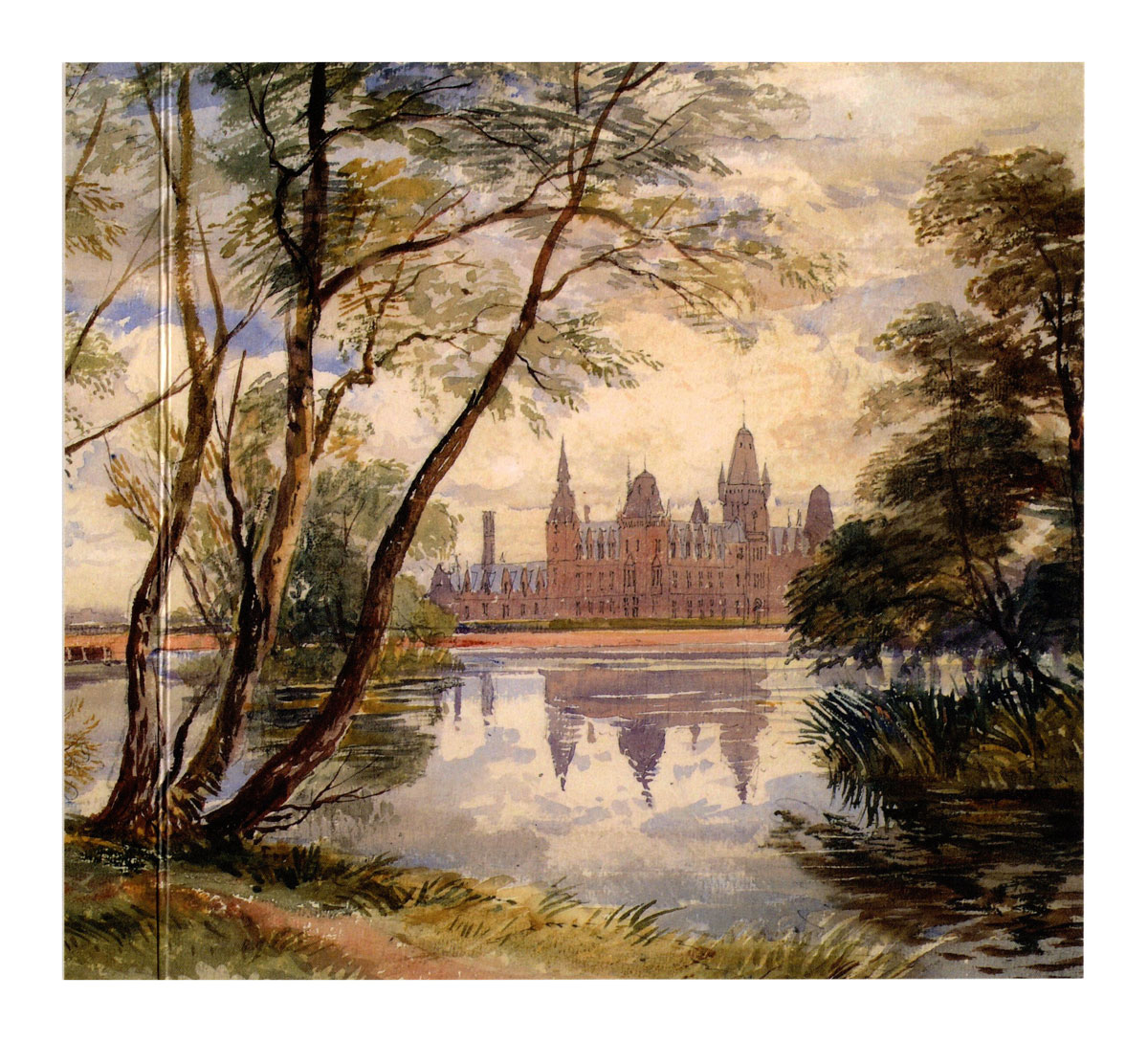
View from Black Sea towards the RVPA, c. 1880
[PB: This may (or may not) be the date of the painting - but the Black Sea had been filled in some years earlier - 1871-ish?]
'"The Royal Victoria Patriotic Asylum, Wandsworth Common" (c.1880). Watercolour, artist unknown. I scanned this from a Wandsworth Museum greetings card. I was unable to find it online in July 2019, but I assume it is in storage somewhere. Is it listed in ArtUK? No. [It might be now - check].
(Click on image to enlarge)
Why is it called "The Black Sea"? Is it Crimean-war connected? There is a painting dated 1858, so it could be. Or are there references prior to 1853/4? Was the house also called Black Sea House, as I recall one source saying?
[No, there are references to the Black Sea from well before the Crimean war [i.e. pre-mid-1850s] - find.]
Price's Candles certainly used an image of Cardigan and the Charge (and other battles) in their publicity [date?].
The Black Sea (Spencer Park)
Built by ? Wilson, owner of Price's Candles. According to Sexby Municipal Parks... [1905], an extra island was created for every new child. (Shirley Passmore pooh-poohs this on the grounds that the many islands can be seen on maps made before the children were born. Check.)
When the control of the common was transferred to the conservators, Lord Spencer reserved to himself a portion at the north adjoining the London and South-Western Railway main line on which was a sheet of ornamental water called the Black Sea, which was studded with thirteen small islands, and beautified with shrubs and flowers. This lake was formed by a Mr. Wilson, the founder of Price's Candle Works, who lived at Black Sea House. For every child added to his family, he constructed a little island in the lake, fringing each with yellow iris.
In the Act for the construction of the railway, the Black Sea was called Pond No. 3, and was said to be the property of Battersea and Wandsworth, [p.246] and by this Act the Company were compelled to place apart the sum of 8,000 for the purpose of covering the bed of the pond with clay, and making a drain into it from the cutting, and keeping it in good condition. Shortly afterwards in another Act certain sections enabled the Company to withdraw this sum, but still they were bound to repair and keep intact the pond and drain on both sides of the railway.
The Black Sea has now been filled up, and Spencer Park has been built upon its site so that one of the most picturesque and ornamental waters near London has disappeared. The old windmill, of which the stump remains (which is utilized as a tool-shed by the labourers on the common), was used for the purpose of pumping water into the Black Sea.
* "Old and New London", vol. vi., p. 482.
Shirley Passmore, The Black Sea
The Wilson Estate and the Black Sea
An early enclosure (date not known) on the north-west comer of the common was a house surrounded by a large garden that later expanded to about 8 acres of parkland. It is shown on the Rocque map of 1741.
The estate was leased in 1829 from Earl Spencer by William Wilson the founder of Price's Candle Factory. On later maps a 5-acre lake known as The Black Sea adjoins the park. This was most probably a disused gravel pit and later was utilised as a reservoir. It supplied 12,000 gallons of water a day to properties around.
[PB: her sources?
When the cutting for the London Southampton Railway was made it cut off the end of the lake and its feeder spring. The LSR Company was obliged under the 1834 Act to take various steps to "for ever thereafter keep up and maintain a supply of water in the said pond No 3 and two other ponds contiguous thereto" (or until the Lambeth Water Company would take over the supply). A pumping mill was installed on the railway embankment to pump back water from the cutting into the lake.
[The Black Sea, Stanford 1864. Source and further information: Link.]
At some stage, perhaps 1846 when a new lease is recorded between Anne Wilson and Earl Spencer, the estate was expanded right up to the edge of the lake taking in one and a half acres of common. The lake ceased to be a reservoir at about this time and it is suggested that the 1846 Lease also included the lake. However, the Battersea and Wandsworth parishes were stated to own the lake when used as a reservoir so the situation is unclear.
What is clear is that at least from this time, perhaps earlier, Wilson looked after the lake and was responsible to a large extent for turning it into "One of the most picturesque and ornamental waters near London". It has to be a myth that he put in an island to commemorate the birth of each of his 13 children because the islands are already there on the Cruchley map of 1829.
In November 1866 the fifth Earl Spencer bought back the lease of this estate from the widow of William Wilson and "the gravest apprehensions were entertained that the 13 acres would be turned into building sites". (It was to become Spencer Park).
[Shirley Passmore, 2010]
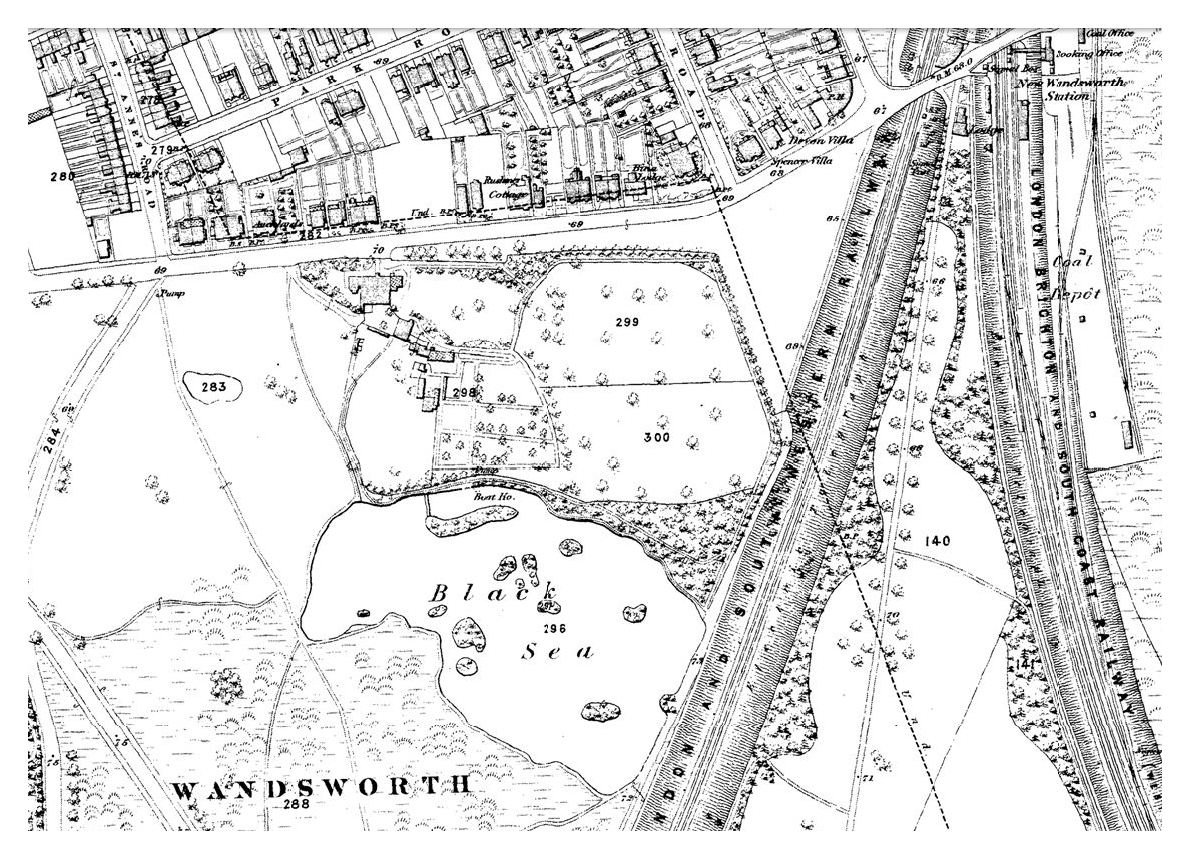
(Click on image to enlarge)
Bell's Life in London - 4 March 1855
Cricket on the ice
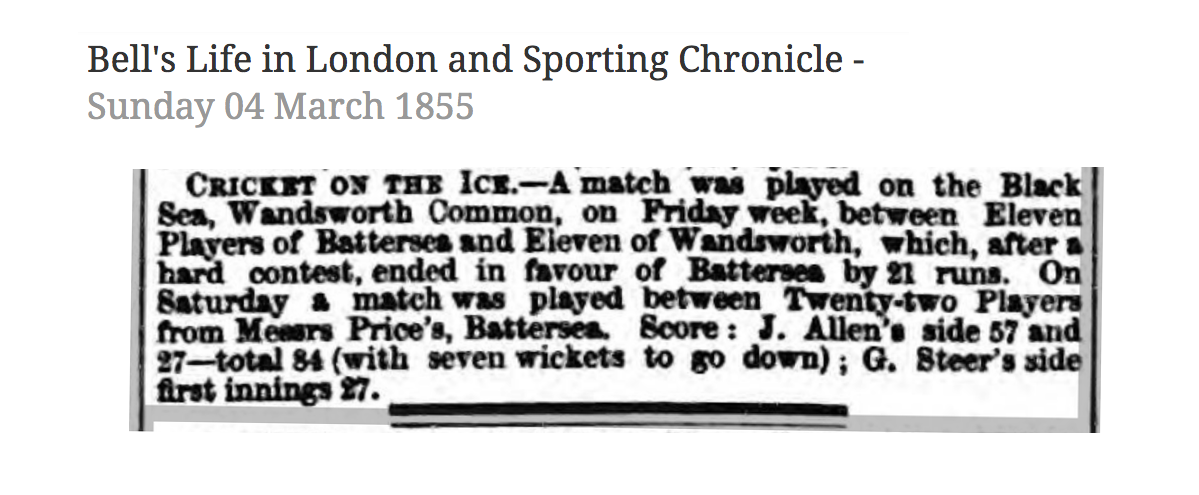
(Click on image to enlarge)
Cricket on the ice
The match was played on the Black Sea, Wandsworth Common, on Friday week, between 11 players of Battersea and 11 of Wandsworth, which, after a hard contest, ended in favour of Battersea by 21 runs.
On Saturday a match was played between 22 players from Messrs Price's Battersea. Score; J Allen's side 57 and 27 total 84 with seven wickets to go down; G Steer's side first innings 27.
[Source: Link.]
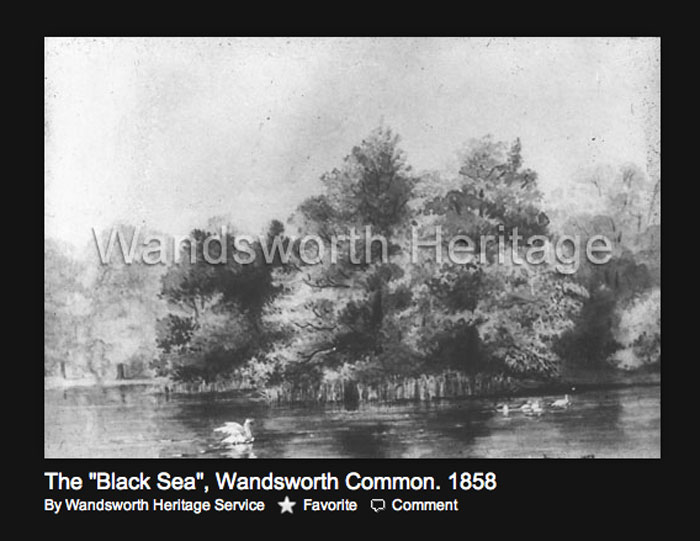
Black Sea, 1858, watercolour?
From Wandsworth Heritage Service. Link? Do they have a better copy? the original watercolour?
(Click on image to enlarge)
Jon Newman, Battersea's Global Reach: The Story of Price's Candles
Battersea's Global Reach tells the story of Price's Candles at Vauxhall and Battersea and how it helped to light the world. Price's Candles of Battersea was and still is a household name. Yet the company's history is so much more than the making of candles. From its inception in the 1830s it re-invigorated a sleepy and unchanged industry by the application of scientific research. Industrial chemistry allowed it to develop the first stearine candles and provide inexpensive good quality lighting.
Forty years later the discovery of oil and the use of paraffin wax for candle manufacture additionally turned it into an position oil company. As well as commercial success the company was noted for its ethical on products - particularly the use of Palm Oil for manufacture and the strong anti-slavery message that this sent out in the 1850s - and for its radical approach to employee relations, providing schools, housing and pensions for its workers. The story of the 20th century is a familiar one of decline and reinvention - from manufacturing industry to retailer to heritage brand.
Jon Newman, the author, is an archivist working freelance and for Lambeth Archives.
Published by History & Social Action Publications, 6 Oakhill Rd, London, SW16 5RG.
Launched at a talk by the author during the Wandsworth Heritage Festival (June 2009).
Price: £5 & £1 p&p.
To order:
Click Add Cart button below or send order with cheque payable to 'Sean Creighton' to the address above.
Or order via email: sean.creighton1947@btinternet.com.
https://sites.google.com/site/historysocialaction/battersea-s-global-reach
"WANDSWORTH COMMON BLACK SEA" SEARCH IN GOOGLE BOOKS
http://books.google.co.uk/books?id=gdlCAAAAIAAJ&q=black+sea+wandsworth+common&dq=black+sea+wandsworth+common&pgis=1
WC in he Municipal Parks, Gardens, and Open Spaces of London
By John James Sexby
[Source: Link.]
More details
The Municipal Parks, Gardens, and Open Spaces of London: Their History and Associations
By John James Sexby
Published by E. Stock, 1905
646 pages
Autobiography of Sir Walter Besant (1836-1901).
Besant moved from Portsmouth? to London (at age ?) to study at Stockwell Grammar School.
[p.61]
There were many curious and pleasant places within reach of Stockwell. Clapham Common, on the south, the first of the Surrey heaths. It was surrounded by stately mansions, sacred to the memory of Wilberforce, Thornton, and Macaulay, standing amidst broad lawns with splendid cedars. The common itself was left absolutely untouched; winter water-ways made little ravines; there were ponds, there were no roads, there was gorse and fern. It was our playground.
Beyond lay [p.62] Wandsworth Common, another wild heath with a lake called the Black Sea, wherein, it was rumoured, gigantic pike attacked and bit great holes in the boy who ventured to swim across.
On the west one could easily reach the Battersea Fields. As I recollect this place, it was most dreary and miserable; a broad flat, lower than the river, and protected by an embankment. On the bank stood the once famous Red House tavern, now long forgotten, and beside it the pigeon-shooting ground. This sport went on continually. If a pigeon escaped he was potted by men who carried guns and lay waiting for him outside the grounds. Battersea Church was on the wall of the Fields, the transformation of a great part of which into Battersea Park took place between 1851 and 1858.
In summer our favourite rambles were farther afield, in the direction of Champion Hill, Herne Hill, Dulwich, and even Penge. No one visiting these places at the present day can understand their loveliness before they were built over. Dulwich, with its ancient college and its inn, its greenery and its orchards, was surely the sweetest village in the world. I always looked about in case I might come upon Mr. Pickwick, who was then a resident, but I was never privileged to see him. The hanging woods of Penge in autumn were lovely beyond the power of words. Its Common on the Hill had been enclosed long before in 1824. Howe laments the fact in that year; but in the fifties Penge, Norwood and Sydenham formed a group of suburbs still rural, [p.63] still covered with woods and gardens, and as beautiful as any country village.
As yet there were neither omnibuses nor railway. The people who went into the City drove in their own carriages or rode their own horses. Any morning along the Clapham Road there were still many who rode into town.
We were not great at games at the school. There was a cricket club, but my short sight disqualified me from any game of ball; in the winter there was hockey on Clapham Common. I think that football had not yet come in; in fact athletics, in such schools as this was, hardly existed. On the other hand we took long walks; we walked to Richmond, and rode ponies in the Park; we walked to Putney, and took boats on the River; we jumped the Effra, in the Dulwich Fields; we had a gymnastic bar and did things of strength; sometimes we wrestled; sometimes we fought. On the whole it was a healthy kind of life, with plenty of outdoor exercise.
For my own part, I had a form of recreation all my own, of which I said nothing, because the other boys would not understand it. I had friends at Camberwell and Brixton, who asked me two or three times a term to dinner on a half-holiday. On such occasions I used to get away at two and walk all the way into the City of London, which was to me then, as it has been ever since, a place of mystery, full of things to be discovered. Nothing could be more delightful than to wander about, not knowing where, so long as one was in the City.
[Source: Autobiography of Sir Walter Besant, Hutchinson & co., 1902.
Various formats available at here. Downloaded and saved as e.g. "BESANT_AUTOBIOGRAPHY_OF_SIR_WALTER_BESANT_autobiographysi01besagoog.pdf". Also a text version (partly edited).]
- Wikipedia: Walter Besant
Times, 6 March 1868
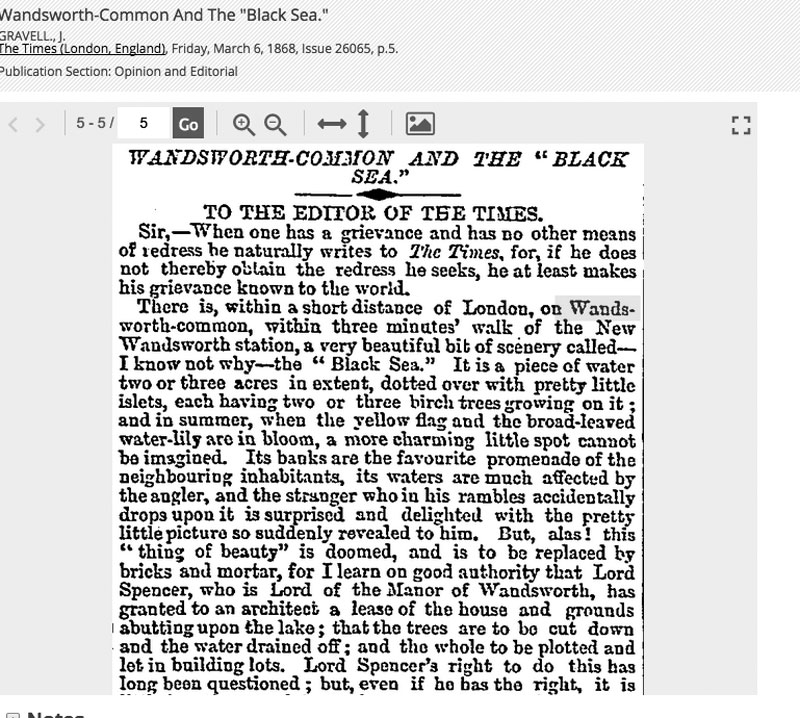
"But, alas! this thing of beauty is doomed", The Times, 6 March 1868
[to be completed]
(Click on image to enlarge)
The Popular Science Review: Animalcules, Wandsworth Common
Popular Science Review, date?
(Click on image to enlarge)
Nymphaea alba - Wikipedia: https://en.wikipedia.org/wiki/Nymphaea_alba
Beautiful short film of the rotifer Stephanoceros fimbriatus
Published Jun 29, 2017. The rotifer Stephanoceros fimbriatus. Collected from a Southern California mountain lake, this was filmed in full 4K using a Panasonic GH4 camera, an Olympus BHS microscope, SPlan objectives, and Olympus DIC.
Also Link.
NB Philip Gosse, 'On Stephanoceros,' 1862.
On distribution of Rotifera, including Stephanoceros: Link (fabulous last para!)
Windmill
- See The Windmill
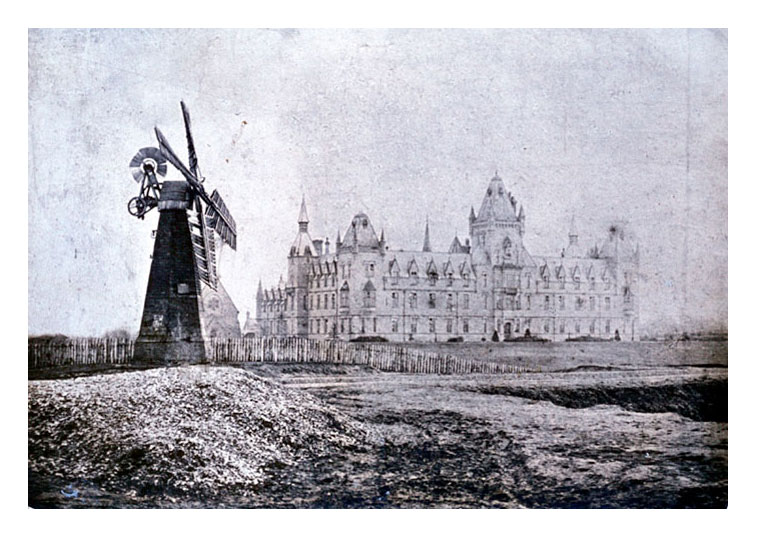
Windmill supplying water to Black Sea after railway cutting interrupted natural supply, date? Royal Victoria Patriotic Asylum for Girls in the background.
Notice how bleak and treeless the area is at this time.
windmill_in_front_of_rvpa.jpg
(Click on image to enlarge)
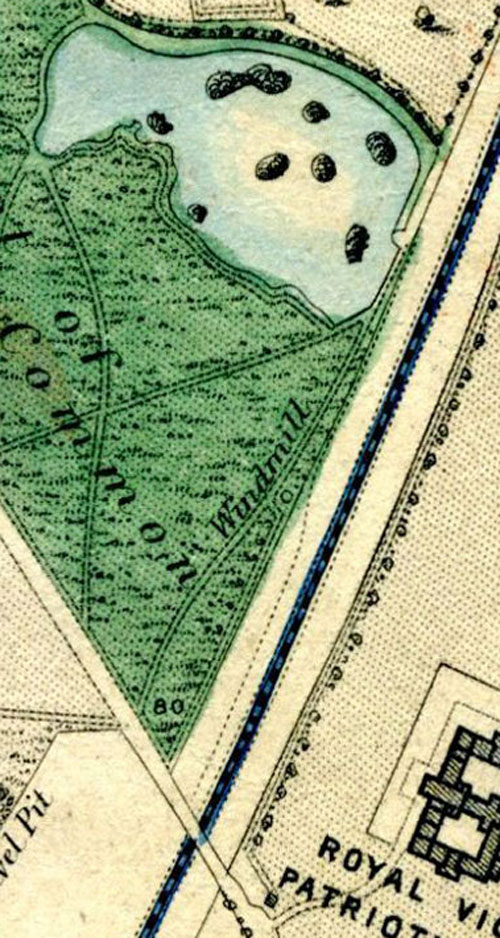
Map: Black Sea, Windmill, RVPA, railway line.
map_black_sea_windmill_rvpa.jpg
(Click on image to enlarge)
The Frying Pan
[PB: Notice there is no "Frying Pan" - the dead-flat depression on the other side of Windmill Drive opposite the RVPA. When did it appear? Find on maps. What was extracted and why? Was it to fill the Black Sea? This seems reasonable. I have seen a reference once [Greg Smye-Rumsby in his Scope website] that it was dug to make bricks for the Prison - but this seems unlikely. Was there much/any clay suitable for brickmaking on WC? Probably not. To build what? - the main part of the prison having already been built by the time of this image. No, it was a later sand pit. The "handle" is the approach path on the western side.]
Shirley Passmore: The Wilson Estate and the Black Sea
The Wilson Estate and the Black Sea
An early enclosure (date not known) on the north-west comer of the common was a house surrounded by a large garden that later expanded to about 8 acres of parkland. It is shown on the Rocque map of 1741.
The estate was leased in 1829 from Earl Spencer by William Wilson the founder of Price's Candle Factory. On later maps a 5-acre lake known as The Black Sea adjoins the park. This was most probably a disused gravel pit and later was utilised as a reservoir. It supplied 12,000 gallons of water a day to properties around.
When the cutting for the London Southampton Railway was made it cut off the end of the lake and its feeder spring. The LSR Company was obliged under the 1834 Act to take various steps to "for ever thereafter keep up and maintain a supply of water in the said pond No 3 and two other ponds contiguous thereto" (or until the Lambeth Water Company would take over the supply). A pumping mill was installed on the railway embankment to pump back water from the cutting into the lake.
At some stage, perhaps 1846 when a new lease is recorded between Anne Wilson and Earl Spencer, the estate was expanded right up to the edge of the lake taking in one and a half acres of common. The lake ceased to be a reservoir at about this time and it is suggested that the 1846 Lease also included the lake. However, the Battersea and Wandsworth parishes were stated to own the lake when used as a reservoir so the situation is unclear.
What is clear is that at least from this time, perhaps earlier, Wilson looked after the lake and was responsible to a large extent for turning it into "One of the most picturesque and ornamental waters near London". It has to be a myth that he put in an island to commemorate the birth of each of his 13 children because the islands are already there on the Cruchley map of 1829.
In November 1866 the fifth Earl Spencer bought back the lease of this estate from the widow of William Wilson and "the gravest apprehensions were entertained that the 13 acres would be turned into building sites". (It was to become Spencer Park).
[Shirley Passmore, 2010]
Follow up
- Jack Black
- Ornamental lake or reservoir (or both?)
- Refs to its decline in later years
- Info about filling in and our other lake created
Internal links
- The Black Sea, Wandsworth Commmon [link to page on this website]
- The Windmill, Wandsworth Commmon [link to page on this website]
NB Locate and add info about Peter Le Neve Foster's photograph of his children boating on the Black Sea c. 1850s.
Also his photo of a lake, whic may be the Black Sea.
Love, Death on the Black Sea
[https://www.historyofwandsworthcommon.org/people/amelia-alfrey/amelia-alfrey.html] [https://www.historyofwandsworthcommon.org/years/1827.html]AMELIA ALFREY/ALFERY/AFRID ETC
Monday, 29 July 1844 Amelia Alfery attempts to drown herself and her two youngest children in the Black Sea Twenty-six year-old Amelia was tried at the Old Bailey on 19 August 1844. Her son William was the first witness called. His stream-of-consciousness account, recorded almost verbatim, is extraordinarily evocative. The Black Sea was a large ornamental lake now covered by Spencer Park. (Click on image to enlarge) WILLIAM ALFERY: I do not know how old I am - the prisoner is my sister - I live with my father, by the White Horse, on the water side, Wandsworth. On the 29th of July I was on Wandsworth-common - I saw the prisoner there by herself, at a place called Black Sea - there was plenty there - she had her children with her, a little girl and a boy - their names were Henry French and Mary French - she has lived with a man of the name of French, and the children were called by his name - I went away for some time, and came back to play at cricket - I did not see her then - when I went over in the afternoon, I saw her walking about, and the children with her - I do not know what time it was - I did not see her do anything - I heard her scream - she was then in the water, in a pond there - the children were with her - I do not know whether they were tied to her - I went in - it was very shallow water - I held up the children's heads, and tried to hold her head up too - I kept the children's heads above water till somebody came - I saw her before I saw her in the water, and asked her to go home with me, and she told me to go home - I did not see her sitting on a bench, I saw her walking about - I did not hear her say anything to the children - I saw them with her before I saw them in the water - I did not hear her call to them - I did not see her do anything with a shawl before she went into the water - I did see her go into the water - I do not know how the children were taken into the water - I was not watching her - I saw her go in - I think the children walked in - nobody has talked to me about this since I was before the Magistrate - I think the children walked into the water - I did not see them go in - I did not see her carry them - I was looking another way when she went in. [Old Bailey Online: AMELIA ALFERY indicted for feloniously attempting to drown Mary Sarah French, with intent to murder her.] -->