Home›Primary sources›Lysons 1792

Last modified: 7 November 2026

The Environs of London, 1792

Daniel Lysons — Volume I, County of Surrey: Battersea, Streatham, Tooting, Wandsworth

A page-by-page, searchable transcription of the four parish accounts that meet at Wandsworth Common, from the first edition. Screen breaks follow the printed pages, so “p. 508” goes straight to that page.

    Lysons 1792

    The Environs of London: being an Historical Account of the Towns, Villages, and Hamlets, within Twelve Miles of that Capital, by the Rev. Daniel Lysons, was published in four volumes between 1792 and 1796. Volume I, County of Surrey (London: printed by A. Strahan, for T. Cadell, 1792), surveys the Surrey parishes alphabetically. This edition gives the four parishes that meet on and around Wandsworth Common:

    • Battersea, pp. 26–48, with the folding pedigree of the St. John family
    • Streatham, pp. 478–491, which then included Tooting Bec and Balham
    • Tooting (Tooting Graveney), pp. 497–501
    • Wandsworth, pp. 502–518

    Lysons revised his Wandsworth account for the second edition of 1810, adding the Surrey Iron Railway, the first Presbyterian congregation of 1572 and new population figures, but cutting the names of those buried in the Huguenot burial ground (Mount Nod) down to James Baudouin alone. The 1792 list on p. 508 is therefore the one to cite for the burial ground. The 1810 text is given separately: Lysons 1810: Wandsworth.

    How this transcription was made

    • Transcribed page by page from the printed text, with one screen for each printed page, so a citation such as “Lysons, p. 508” can be found at once with the page box above.
    • The long “ſ” is printed as a modern “s”. Spelling, capitals and punctuation are otherwise kept as printed, including Lysons’s own slips.
    • Lysons’s marginal notes are shown in italics in the right-hand margin, beside the line where they stand in the book, and the “Jump to” list uses them as a contents list.
    • Footnotes are given at the foot of each screen, numbered as printed; click a note number to go back to the text.
    • Anything added by the editor is in [square brackets]; a question mark marks a doubtful reading.

    Source: the University of California Libraries copy, scanned by the Internet Archive (environsoflondon01lyso), which is out of copyright. Transcribed for the History of Wandsworth Common by Claude, at Philip Boys’ request, November 2026.
    About this edition

    BATTERSEA.

    Etymology. THE parish of Battersea lies in the hundred of Brixton, and is situated near the river Thames, about three miles from Westminster-Bridge. The name has undergone several changes. In the Conqueror's Survey, it is called Patricesy; and has since been written Battrichsey, Battersey, and Battersea, each variation carrying it still farther from its original signification. Much vague conjecture has been bestowed upon the etymology of this name, both by those who have seen the more ancient records, and those who have attempted to derive it from the more recent mode of spelling it. Aubrey derives the name from St. Patrick1. Lambarde, who quotes Leland for his authority, (though I have not been able to find any thing on the subject in his printed works,) indulges in the most ridiculous conjectures2. Of the original signification of the word, I think there can be little doubt. Patricesy, in the Saxon, is Peter's water, or river; and as the same record which calls it Patricesy, mentions that it was given to St. Peter, it might then first assume that appellation; but this I own to be conjecture. Petersham, which is written precisely the same in Doomsday, Patriceham, belonged to St. Peter's Abbey, Chertsey, and retains it's original name a little modernised.

    1 Vol. i. p. 135. Aubrey was misled by seeing it written Patricesy, instead of Petricesy, in Doomsday; but the Normans were not very accurate spellers. Petersham was written in the same manner with an a.

    2 Battersey, says he, quasi Botersey; because it was near the waterside, and was the removing house of the archbishops of York. Topographical Dictionary, p. 48. To confute so absurd an etymology, it is scarcely necessary to say, that the archbishops of York had no property in Battersea till the reign of Edward. IV.

    Lysons, Environs of London, vol. I (1792) · page 26

    Boundary and extent. The parish of Battersea is bounded on the east by Lambeth; on the south by Camberwell, Stretham, and Clapham; on the west by Wandsworth; and on the north by the river Thames. The land is pretty equally divided between arable (garden ground included) and pasture. The greater part of Wandsworth common, which extends nearly two miles in length towards Stretham, and a considerable part of Clapham common are in the parish of Battersea. The northern extremity of the latter, is called Battersea-Rise; Battersea Rise. and is ornamented with several villas, it being a spot much admired for its pleasant situation, and fine prospect. Penge common, in a detached part of the parish adjoining to Beckenham in Kent, is two miles in circumference. The parish is rated to the land-tax, at the sum of 817l. 10s. which is supposed to be about 1s. 9d. in the pound.

    Market gardeners. Above three hundred acres of land in the parish of Battersea are occupied by the market gardeners, of whom there are about twenty who rent from five or six, to near sixty acres each. These gardeners employ, in the summer season, a considerable number of labourers, though perhaps not so many as is generally supposed; on an average, I am informed, not one to an acre. The wages of the men are from ten to twelve, of the women from five to seven shillings, by the week. Most of the women travel on foot from Shropshire and North-Wales in the spring; and, as they live at a very cheap rate3, many of them return to their own country much richer than when they left it. The soil of the ground occupied by the gardeners is sandy, and requires a great deal of rain. The vegetables which they raise, are in general very fine; their cabbages and asparagus,

    3 I am credibly informed, that many of them live upon 1s. 6d. per week. To account for which, it will be necessary to observe, that their diet consists in a great measure of the produce of the gardens, which they have gratis.

    Lysons, Environs of London, vol. I (1792) · page 27

    particularly, have acquired celebrity. Fuller, who wrote in the year 1660, speaking of the gardens in Surrey, says, "Gardening was first brought into England for profit, about seventy years ago; before which we fetched most of our cherries from Holland, apples from France, and had hardly a mess of rath ripe peas but from Holland, which were dainties for ladies, they came so far, and cost so dear. Since gardening hath crept out of Holland, to Sandwich, Kent, and thence to Surrey, where, though they have given 6l. an acre and upwards, they have made their rent, lived comfortably, and set many people on work. Oh, the incredible profit by digging of ground! for though it be confessed, that the plough beats the spade out of distance for speed, (almost as much as the press beats the pen,) yet what the spade wants in the quantity of the ground it manureth, it recompenseth with the plenty of the food it yieldeth, that which is set multiplying a hundred fold more than that which is sown. 'Tis incredible how many poor people in London live thereon, so that, in some seasons, the gardens feed more people than the field4." I hope to have it in my power, before the conclusion of the present work, to give a general view of the present state of gardening in the neighbourhood of London, and to ascertain, pretty nearly, what quantity of ground is occupied for that purpose. The rent of land in Fuller's time, appears to have been extremely high. The gardens at Battersea pay 7s. 6d. an acre for tithes to their vicar.

    Manor. The manor of Battersea, which before the Conquest belonged to earl Harold, was given by the Conqueror to Westminster-Abbey, in exchange for Windsor. The record of Doomsday mentions some dismemberments of the manor, by the bishop of Baieux and earl Morton. These lands probably formed the estate which afterwards came to the Stanleys. There is a hide of land

    4 Fuller's Worthies, pt. 3. p. 77.

    Lysons, Environs of London, vol. I (1792) · page 28

    likewise mentioned, which belonged to the Abbey of Chertsey, of which a singular circumstance is recorded; that, on account of some quarrel, the provost of the village5 detached it from the manor of Battersea, and threw it into that of Chertsey. The manor was valued in the Confessor's time at 80l. it afterwards sunk in value to 30l. and at the time of the Survey was estimated at 75l. In the taxation of 1291, the possessions of the Abbey of Westminster, in Battersea, were rated at 15l.6 Thomas Astle, Esq. has an original deed of archbishop Theobald, confirming a charter of king Stephen, by which he exempts the greater part of this manor from all taxes and secular payments. Dart mentions several charters relating to Battersea7; viz. William the Conqueror's original grant; a charter of privileges; and a grant to the Abbot of Westminster, of liberty to hunt in his manor; a charter of confirmation by Henry the First; and another of king Stephen; besides that of privileges before-mentioned.

    After the dissolution of monasteries, the manor was reserved in the hands of the crown; a lease of it was granted to Henry Roydon8, Esq. by queen Elizabeth, for twenty-one years, in the eighth year of her reign; it was afterwards granted for the same term to his daughter, then Joan Holcroft9; it was assigned, amongst others, for the maintenance of prince Henry, An. 161010. In the year 1627, it was granted in reversion to Oliver St. John, Viscount Grandison11.

    Lord Grandison died in 1630, and was succeeded in that title, and in the Battersea estate, by William Villiers, his great-nephew, who died of a wound received at the siege of Bristol, An. 1644. Sir

    5 Præfectus villæ. The provost, bailiff, or reeve.

    6 See note 38. p. 10.

    7 Dart's Hist. of Westminster Abbey, vol. i. p. 21.

    8 Pat. 8 Eliz. pt. 11. July 8.

    9 Pat 34 Eliz. pt. 15. Sept. 4.

    10 Harleian MSS. Brit. Mus. 642. f. 239. printed in the collection of Royal Establishments, by the Society of Antiquaries 1790, p. 315.

    11 Pat. 3 Car. 1. pt. 34. May 5. The whole of the descent of the manor of Battersea, from this period, I owe to the information of earl Spencer's steward.

    Lysons, Environs of London, vol. I (1792) · page 29

    John St. John, Bart. nephew of the first lord Grandison, inherited Battersea; from him it passed in a regular descent to Sir Walter St. John, Bart. his nephew; to Sir Walter's son, Henry Viscount St. John; and to his grandson Henry Viscount Bolingbrooke, who, by an act of parliament passed before his father's death, was enabled to inherit his estate, notwithstanding his attainder: the estate and manor continued in the St. John family till 1763, when it was bought in trust for John Viscount Spencer, and is now the property of the present earl Spencer.

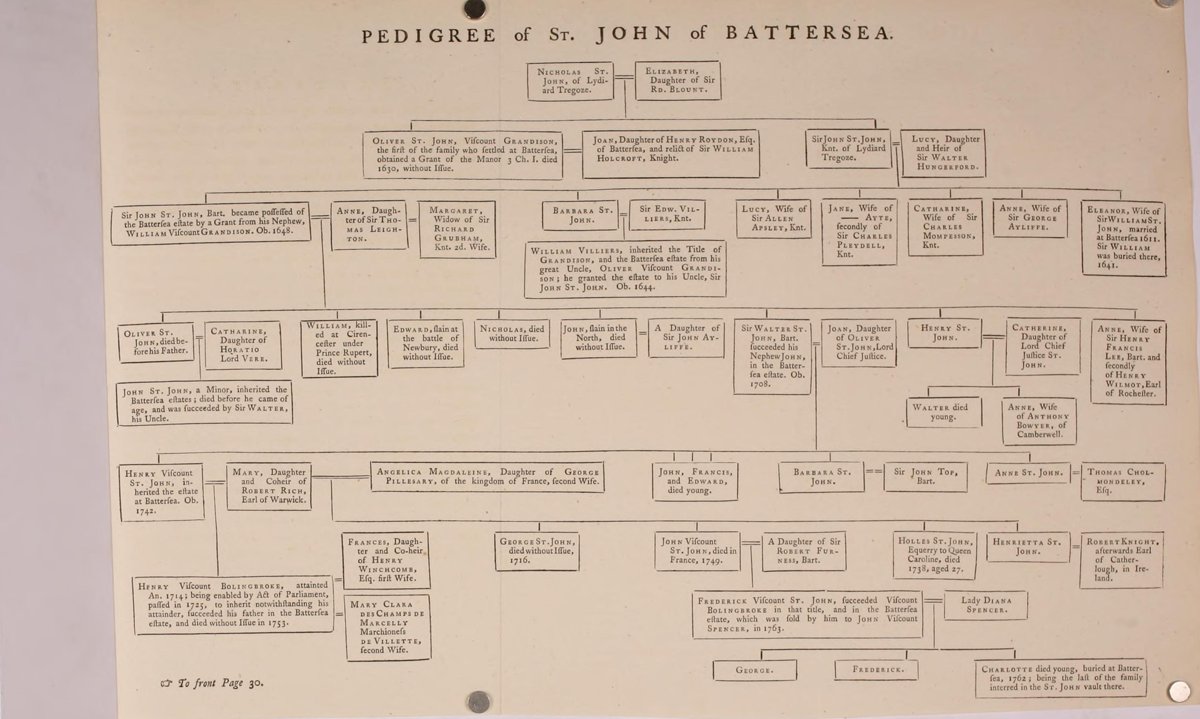
    A pedigree of the St. John family, from the time of their first settling at Battersea, explaining at one view the descent of the manor, which has been erroneously stated in the peerage12, is hereto annexed.

    Custom of the manor. In this manor lands descend to the youngest son; but in default of sons, they do not go to the youngest daughter, but are divided among the daughters equally.

    The Stanley family had a considerable estate here, which was alienated in the reign of Edward IV. by John Stanley, Esq. one moiety thereof became the property of Anne, duchess of Buckingham13, the king's aunt; the other consisting of near 400 acres of land, with houses, &c. was purchased by Lawrence Booth14, then bishop of Durham, and by him annexed to the see of York, of which he was afterwards archbishop. He is said to have built the York-house. house upon this estate, near the water-side, now called York-house15. It was intended as a residence for his successors, when their affairs should call them to London; and fourscore acres of land were reserved by a special clause in their farmer's lease to be surrendered to the archbishop, to use as demesne lands at a month's notice, whenever

    12 Collins's Peerage, edit. 1756.

    13 Pat. 11 Edw. IV. pt. 2. m. 10.

    14 Cl. 39 Hen. VI. m. 11 dorso. Thomas Dom. de Stanley, &c. ratif. statum and possess. Laur. Ep. Dunelm, &c.

    15 Morris's Lives of eminent Cambridge Men. Harleian MSS. Brit. Mus. 1776. p. 12.

    Pedigree of St. John of Battersea, folding plate facing page 30
    Folding plate: “Pedigree of St. John of Battersea” (marked “To front Page 30”). Click to enlarge.
    Lysons, Environs of London, vol. I (1792) · page 30

    he should be resident at Battersea, or within sixty miles of that place. This clause had been infringed before archbishop Grindall's time, and his predecessors had been unjustly deprived of the use of the aforesaid land. Grindall had a successful suit with the farmer, and leased the estate to a new tenant with the usual agreement. The house was formerly an occasional residence of the archbishops; but, for more than a century, it has been occupied only by tenants. Tradition, with its usual fondness for appropriation, speaks of Wolsey's residence there; and the room is yet shown in which he entertained Anne Bulleyn: but besides the improbability that Wolsey, who, when he was archbishop of York, lived in as great and sometimes in greater state than the king himself, and was owner of two most magnificent palaces, should reside in a house which would not have contained half his retinue; it is well known that these entertainments were given at York-house, Whitehall.

    Archbishop Holgate. To speak of a circumstance for which there is authority:—When archbishop Holgate was committed to the Tower by queen Mary, in 1553, the officers, who were employed to apprehend him, rifled his house at Battersea, and took away from thence "300l. of gold coin, 1600 ounces of plate, a mitre of fine gold, with two pendants set round about the sides and midst, with very fine pointed diamonds, sapphires, and balists; and all the plain, with other good stones and pearls; and the pendants in like manner, weighing 125 ounces; some very valuable rings, a serpent's tongue set in a standard of silver gilt, and graven; the archbishop's seal in silver; and his signet an antique in gold16." Holgate was afterwards deprived of his bishopric, to which he was never restored17.

    The church. The church of Battersea is situated on the banks of the Thames; it is a modern structure, and has neither aisles nor chancel; the communion-

    16 Strype's Life of Cranmer, p. 308.

    17 Archbishop Holgate was deprived for being a married man. Fuller's Worthies, pt. 3. p. 194.

    Lysons, Environs of London, vol. I (1792) · page 31

    table is placed within a small recess, at the east end. It was rebuilt by an act of parliament, passed 14 Geo. 3. and was opened on the 17th of November 1777. It is of brick, and has a tower, with a small conical spire at the west end. The east window consists of painted glass, which was carefully preserved at the rebuilding of the church, and contains portraits of Henry the Seventh; his grandmother, Margaret Beauchamp; and queen Elizabeth: they do not appear to have been coëval with the persons they represent, but of a more recent date. Over the portraits, are the royal arms in the central compartment; and on each side, the arms18 and quarterings of the St. Johns: the portraits are likewise surrounded with borders, containing the arms19 of the families allied to them by marriage. The former church was built of brick, and therefore probably not very ancient. A church is mentioned in Doomsday.

    18 St. John bears Arg. on a chief Gul. two mullets Or, and quarters, 1. Az. a bend Argent cottised between six martlets Or, for Delabere. 2. Arg. a fesse between six cinquefoils Gu. for Umfreville. 3. Erm. on a fesse Az. three crosses moline Or. 4. Gu. a fesse between six martlets Or, for Beauchamp. 5. Arg. a fesse Sab. between three crescents Gu. for Patishall. 6. Paly of six Arg. and Az. on a bend Gu. three eagles displayed Or, for Grandison. 7. Az. two bars gemelles, and in chief a lion passant Or, for Tregoze. 8. Arg a fesse Gu. between three mullets of six points Sab. for Ewyas. 9. Arg. a saltire engrailed Sab. on a chief of the second, two mullets of the first, for Iwarby or Ewarby. 10. Or, three lions passant, in pale Sab. for Carew. 11. Az. three battleaxes Arg. 12. Sab. two bars Arg. in chief three plates, for Hungerford. 13. Per pale indented Gu. and Vert, over all a chevron Or. 14. Arg. three toads Sab. for Botreux. 15. Paly Wavy Or and Gules. All these are quartered on one shield, with a Viscount's coronet; the eleven first are quartered by St. John, Bart. on another.

    19 In the border round Margaret Beauchamp's portrait, are the following arms: 1. Tregoze impaling Ewyas. 2. Grandison impaling them both, quartered. 3. Patishall impaling the three last, quartered. 4. St. John impaling the last four, quartered. 5. Arg. a chevron Az. over all a lion ramp. Gu. crowned Or, impaling St. John. 6. Az. fretty Arg. impaling St. John. 7. Az. a chevron engrailed between three owls Or, impaling St. John. 8. Arg. a cross patonce Az. between four mullets Gu. impaling St. John. 9. Az. two cinquefoils in chief, and a fleur-de-lis in base, Arg. impaling St. John. 10. Arg. a chief Az. over all a lion ramp. Gu. on a Canton Or, a shield of the second, charged with 3 mullets of the fourth; impaling Arg. on three bars Sab. six trefoils of the field 3, 2, and 1. 11. Arg. a cross patonce Az. between four mullets Gu. impaling Barry of six Arg. and Gu. 12. Az. fretty Arg. impaling quarterly indented Az.

    Lysons, Environs of London, vol. I (1792) · page 32

    Sir Edward Wynter. Besides the monuments of the St. John family, which will be noticed hereafter, there is a very singular one to the memory of Sir Edward Wynter, who lived at York-house, and whose exploits surpass even the heroic achievments of Lord Herbert of Cherbury18, who, alone and in his shirt, chased a host of midnight robbers from his house. Sir Edward Wynter's monument is against the south wall; on the top is his bust of a large size, with whiskers; underneath the inscription, is a basso-relievo representing him in the act of performing the two exploits mentioned in his epitaph; which is as follows:

    "P. M. S.

    Edwardi Wynter,

    Equitis, qui adhuc impuber, ex patriâ proficiscens in Orientalibus Indiis mercaturam feliciter exercuit, magnas opes comparavit, majores conflaturus si non sprevisset. Ibidem splendide vixit et honorifice. Post annos 42 Angliam revisit. Uxorem duxit Emmâ filiâ Rich. Howe armig. Norfolc. Decessit Mar. 2°. An. ætat. 64. Dni. 1685-6.

    Posuit Marito optime de se merito

    Uxor mœstissima."

    and Arg. 13. Az. a chevron engrailed Or, between three owls proper, impaling Az. a chevron Erm. between three fleurs-de-lis Arg. within a border engrailed Or. In the border which surrounds the portrait of queen Elizabeth, are these arms. 1. Az. three battle-axes Arg. 2. Carew impaling Az. three battle-axes Arg. 3. Iwarby impaling the two last, quartered. 4. St. John impaling the three last, quartered. 5. St. John impaling barry nebuly Or, and Sab. for Blount. 6. St. John impaling quarterly indented Or, and Gu. for Leighton. 7. Arg. a lion ramp. Sab. on his shoulder a martlet Or, impaling St. John. 8. Arg. a bend Gu. gutty of the first, between two birds of the second, a chief checky Or, and Sab. for Pleydell, impaling St. John. 9. Arg. on a cross Gu. five escallops Or, for Villiers, impaling St. John. 10. St. John impaling Hungerford, quartered with per pale indented Gu. and Vert, over all a chevron Or. 11. Arg. on a chevron engrailed Sab. three bucks' heads cabossed of the field, between three etoiles of six points Gu. impaling St. John. 12. St. John impaling St. John. 13. Barry of six Arg. and Gu. a canton Erm. for Apsley, impaling St. John.

    18 Life of Lord Herbert of Cherbury, p. 126.

    Lysons, Environs of London, vol. I (1792) · page 33

    "Born to be great in fortune as in mind,

    Too great to be within an isle confin'd;

    Young, helpless, friendless, seas unknown he tried;

    But English courage all those wants supplied.

    A pregnant wit, a painful diligence,

    Care to provide, and bounty to dispense;

    Join'd to a soul sincere, plain, open, just,

    Procur'd him friends, and friends procur'd him trust:

    These were his fortune's rise, and thus began

    This hardy youth, rais'd to that happy man.

    A rare example, and unknown to the most

    Where wealth is gain'd, and conscience is not lost:

    Nor less in martial honor was his name,

    Witness his actions of immortal fame:

    Alone unarm'd, a tyger he oppress'd,

    And crush'd to death the monster of a beast.

    Twice twenty mounted Moors he overthrew

    Singly on foot, some wounded, some he slew,

    Dispers'd the rest,—what more could Sampson do?

    True to his friends, a terror to his foes,

    Here now in peace his honor'd bones repose!"

    "Vita peregrinatio."

    His widow was married the year after his decease, to Sir James Fuller, and died in 1710. The monument was restored after the rebuilding of the church, by his great-grandson, Edward Hampson Wynter, Esq. On a tablet at the foot of it, are memorials for Mrs. Catharine Wynter, who died 1771; and William Woodstock Wynter, who died 1747; and on each side, the arms of Wynter and Howe21.

    21 Wynter, bears Sab. a fess. Erm. & impales Arg. a chevron between 3 wolves heads erased, Sable for Howe.

    Lysons, Environs of London, vol. I (1792) · page 34

    At the east end of the church, over the north gallery, is a monument to the memory of Sir John Fleet, alderman of London, who died in 1712. Over the south gallery is another, to the memory of Mr. James Bull, merchant, who died in 1713. The other monuments mentioned by Aubrey, were not preserved at the rebuilding of the church.

    Vicarage. The church of Battersea is dedicated to St. Mary; it is in the diocese of Winchester, and in the deanery of Southwark; the benefice is a vicarage. Laurence, Abbot of Westminster, first procured the appropriation of the great tithes for that abbey about the year 115922. The monks of Westminster were to receive out of it two marks, reserving sufficient to the vicar to support the episcopal burdens and himself. I find that the rectory was held by John23, bishop of Winchester, in the time of Philip and Mary; and that it was afterwards granted to Downing and Ashton24, with the advowson of the vicarage, which in a MS. of Sir John Dodderidge25, is mentioned amongst the livings in the gift of the crown. The advowson was granted, with the manor, to the St. Johns; and has continued annexed to it ever since.

    At the taxation, An. 129126, the rectory was rated at twenty-six marks and an half; the vicarage at six marks and forty pence. The vicarage is valued in the king's books, at 13l. 15s. 2½d. It was presented27 at the inquisition held at Kingston June 28th, 1658, that the rectory of Battersey, impropriated to Sir Walter St. John, was worth 80l. per An.; that the vicarage was worth about 100l. per An.; that Penge, a member of Battersey, was seven miles from the parish church, and contained twelve families; that they could not find a convenient place in the hundred, or county, to unite

    22 Widmore's Hist. of Westminster Abbey, p. 29.

    23 Terrier of Lands in Surrey. Brit. Mus. 4705. Ayscough's Cat.

    24 Ibid.

    25 Brit. Mus. 3479. Ayscough's Cat.

    26 See note p. 10.

    27 Parliamentary Surveys, Lambeth Library.

    Lysons, Environs of London, vol. I (1792) · page 35

    it to; that the nearest place of public worship, was Beckenham in Kent, about a mile distant: the commissioners were vested with powers to unite or separate parishes, as occasion required; but they did nothing in this case. The principal profits of the vicarage, arise from the tithes of the gardens. There are two terriers28 of Battersey in the register at Winchester, fastened together, of the dates of 1619 and 1636.

    Vicars of Battersea. Owen Ridley, who was instituted to the vicarage of Battersea, An. 1570, appears to have been involved in a tedious litigation with his parishioners, and to have encountered no small share of persecution from them. The circumstance would not have been worth recording but for two curious petitions which it produced; the originals of which are in the possession of the present vicar, by whom they have been obligingly communicated. One of them is from certain of the inhabitants to Dr. Swale, one of her majesty's high commissioners for causes ecclesiastical; in which they state many grievances which they had suffered from their vicar during the space of eighteen years; amongst other crimes alleged against him, is that of conversing with a witch. The object of their petition was, that he might be deprived: it is signed with thirteen names, and about thirty marks. The other petition, which is to lord Burleigh, being the more curious of the two, is here given at large:

    "To the right honourable the lord Burleigh, lord highe treasurer of England.

    "Most humbly shewe unto your honor, your daiely orators, the inhabitants of Battersey, besechinge you to extend your favor in all just cawses, to our mynister, Mr. Ridley: so it is (right honourable) that some have sought his deprivation, by many

    28 Ducarrel's Endowments of Vicarages. Lambeth Library.

    Lysons, Environs of London, vol. I (1792) · page 36

    trobles, many yeares together, and in divers courts; sometymes in the archdeacon's, sometymes by complayninge to the busshopp, sometymes before the highe commissioners, sometymes before the archbushopp of Canterbury, his grace; yea, and once he hath bene indicted at the assizes. But God, the defender of the innocent, hath so protected him, that his cawse beinge tryed and knowene, he hath hadd a good issue of all theis trobles; yet the adversarie will not cease, but seeketh to deprive him of his life, for seekinge after witches, and procuringe the death of a man by witchcraft. He hath byn our vicar theis twenty yeares; he is zealous in the gospell, honest in life, painefull to teache us, and to catechize our youth; charitable and liberall to the poore and needy, accordinge to his abilety; he never sued any of all his parisheoners for tythes, althoughe he hath hadd cawse gyven by some so to doe. Of our conscience, wee take him rather to hate wytches, than to seeke after them; for he hath spoken often very bitterly against them owt of the bible, neither doe wee thinke or suspect the woman to be a witche which is accused, but hath alwayes lyved honestly, quietly, and painefully here, to gett a poore lyvinge truely. Therefore, the man beinge such a one, whome for his vertues wee love, his trobles heretofore so greate, so many, and so chardgable to the undoinge of himselfe, his wife, and children, and now so daingerous for the losse of his life, doth move us to become suitors unto your honour for him, beseechinge your honor to take notice, and to make due triall of him and his cawse, so that the truth beinge fownd owte, justice maie take place; your honor will defend the innocent in his innocencie, putt an end to his longe, many, wearisome, and daingerous trobles, and be a patrone unto him in all his good and honest actions; so shall wee be bound to thancke God for you, and to pray for you for ever."

    Signed by Robert Cooke, alias Clarencieulx

    Lysons, Environs of London, vol. I (1792) · page 37

    Roy d'Armes, Robert Claye, preacher, and fourteen others.

    Dr. Temple. Thomas Temple, brother of Sir John Temple, the Irish master of the rolls, was instituted to the vicarage of Battersea in 163429, and continued there during the civil wars; he was one of the ministers appointed by Cromwell to assist the committee for displacing ignorant and insufficient schoolmasters and ministers; he was likewise one of the assembly of divines, and a frequent preacher before the long parliament: several of his sermons are in print.

    Bishop Patrick. Mr. Temple was succeeded in the vicarage of Battersea by the learned bishop Patrick30, who was educated at Queen's College, Cambridge, and was domestic chaplain to Sir Walter St. John, by whom he was presented to this benefice. Several of his tracts were published while he was vicar of Battersea, and are dedicated to his patron. He resigned the vicarage in 1675. He was a zealous champion of the protestant religion, both by his writings, and in conversation; particularly at a conference which he, in conjunction with Doctor Jane, held in the presence of James the Second, with two Roman catholic priests; in which he had so much the superiority over his opponents in argument, that the king retired in disgust, saying, that he never heard a good cause so ill defended, or a bad one so well. At the revolution, he was rewarded with the bishopric of Chichester31, and was afterwards translated to Ely. He died in 1707, and left behind him a very numerous collection of printed works; consisting of sermons, devotional and controversial tracts, and paraphrases on the scriptures, which are held in great estimation, and which were continued by William Lowth, father of the late bishop of London.

    29 Regist. Winton. Curle, f. 21. a. Ant. Wood.

    30 Ant. Wood; Biograph. Britannica; Morris's Lives of Eminent Cambridge Men; Harleian MSS. Brit. Mus. 7176, p. 284, 285.

    31 In 1689, on the deprivation of John Lake. He was translated to Ely in 1691, on the deprivation of Francis Turner.

    Lysons, Environs of London, vol. I (1792) · page 38

    Dr. Thomas Church. Dr. Thomas Church, of Brazen Nose College, Oxford, who was instituted to the vicarage of Battersea in the year 1740, distinguished himself much in the field of controversy, in which he engaged against Westley, Whitfield, and Middleton; for his successful attack upon the latter, and his defence of the miraculous powers during the early ages of christianity, the University of Oxford conferred on him the degree of D. D. by diploma. He was too zealously attached to his religion to let the opinions of Lord Bolingbroke pass unnoticed, notwithstanding he had been his patron. His publication upon this subject, however, was anonymous; it was called, An Analysis of the Philosophical Works of the late Lord Bolingbroke, and came out in 1755. Dr. Church published likewise several single sermons: he died in 1756, aged 49, having never obtained any farther preferment than the vicarage of Battersea, and a prebendal stall in St. Paul's cathedral.

    The present vicar is John Gardnor, M. A. who was instituted in 1778.

    Parish register. The register of this parish begins in the year 1559; and, excepting the former part of the present century, appears to be accurate. Dr. Church, soon after he was instituted to the vicarage, began to transcribe a considerable part of the registers, which, for many years preceding, had been kept by a very ignorant parish clerk. He proceeded so far as to copy the whole of the baptisms; and, with great industry, rectified a vast number of mistakes, and supplied many deficiencies. The difficulty of transcribing the burials, of which indeed for some years there were no entries, discouraged him from proceeding any farther in this laudable undertaking.

    Comparative state of population.
    YearsAverage of birthsAverage of burials
    1580 — 1589137
    1680 — 16895868
    1780 — 17896069
    Lysons, Environs of London, vol. I (1792) · page 39

    The increase of population in this parish, appears to have been very small during the last hundred years, in which respect it differs from most others in the neighbourhood of the metropolis. The reason of this difference appears to have been the inconvenience of the passage over the Thames. This could not be so much felt a century ago, when our ancestors were little accustomed to the luxury of bridges; but no doubt would act as a bar to population, since they have been more frequent. This obstacle was removed at Battersea, by the building of the bridge there, which was opened about twenty years ago, and which now begins to have the effect of increasing the number of buildings, above twenty houses having been lately erected, most of which are as yet uninhabited; including these, the number of houses in the parish is about 360.

    Plague years.
    The number of burials in 1603, was23.
    162561.
    1665113.

    These numbers prove, that the village was not free from the plague in either of those years; yet when we compare them with the average of those periods, they do not show its fatality to have been so great as might be expected in a village so near to London.

    St. John family. Battersea was long the residence, as well as the property, of the St. Johns; and many of the births, deaths, and marriages of that family are recorded in the parish register; the most interesting of which I shall insert:

    "The Lord Oliver St. John, buried Jan. 12. 1630-1."

    "The Ladie Grandison, her name Jone, buried Mar. 10. 1630-1."

    Oliver St. John, Viscount Grandison. Oliver St. John was the first of the family who settled at Battersea; he married Joan, daughter and heir of Henry Roydon Esq. of that place, and widow of Sir William Holcroft. He was general of the forces in Ireland, and was lord high treasurer, and

    Lysons, Environs of London, vol. I (1792) · page 40

    lord deputy of that realm; was created Viscount Grandison, of Ireland, by James I.; and in 1626, was made an English peer, by the title of Baron St. John: he died without issue. A monument to his memory, is fixed in the north wall of the church, ornamented with busts of himself and his lady, in white marble; over which are the arms and quarterings of St. John32 impaling Roydon33, underneath is the following inscription:

    "Deo trino and uno sacrum

    Olivero Nicholai Sct. John de Lydeard filio secundo eq. aurato antiquissimis et illustribus de Bellocampo, de Bletsoe, Grandisonis et Tregoziæ familiis oriundo. Terra marique, domi, forisque, belli pacisque artibus egregio, divæ Elizabethæ, e nobilissima pensionariorum cohorte, suis inde meritis et singulari divi Jacobi gratia, in Hibernia instrumentis bellicis præfecto, Conaciæ Pro-præside et Quæstori summo et Regis vicario, Procomiti de Grandisonis et Tregoziæ, de Hyworth, in Anglia, Baroni, eidem divo Jacobo et filio ejus piissimo a secretioribus et sanctioribus conciliis. Postquam is annos honoribus æquaverat et tranquillissime senuerat somnienti similiter extincto, Johannes de Sanct. John Eques et Baronettus ac fratre nepos et hæres avunculo mœrentissimo mæstissimus p. in ecclesia de Battersey.

    Vixit annos 70. Mor. 29 Decembris 1630."

    Funeral of Sir John St. John. In 1648, Sir John St. John (the nephew as I imagine of Lord Grandison34) was buried at Battersea with such unusual pomp, that it excited the attention of the heralds, who commenced a prosecution

    32 Lord Grandison quarters on his shield; 1. Beauchamp. 2. Grandison. 3. Tregoze. 4. Ewyas. 5. Ewarby. 6. Carew. 7. Az. three battle-axes, Arg.

    33 Per pale Arg. and Sab. a griffin segreant, counter-changed.

    34 Sir John St. John, nephew of Lord Grandison, was created a Baronet at the first institution of that order in 1711 [sic: 1611], being the 17th in precedency.

    Lysons, Environs of London, vol. I (1792) · page 41

    against Mr. Walter St. John the executor, for acting so contrary to the usage of arms and the laws of heraldry.

    In the British Museum35 is a MS. deposition of William Riley, one of the heralds, who declares, that the funeral of the deceased was conducted in a manner so much above his degree, that the escutcheons were more than were used at the funeral of a duke; and that he never saw so many pennons but at the funeral of one of the blood royal; and that he considered such a precedent to be destructive of all distinction, order, and degree of honour and nobility. The burial of Sir John St. John is omitted in the Register.

    "Sir Walter St. John, Bart. æt. 87, buried July 9, 1708."

    Sir Walter St. John. Sir Walter St. John, the third baronet of the family, succeeded his nephew Sir John, who died before he came of age. Sir Walter married one of the daughters of lord chief justice St. John:—he was eminent for piety and moral virtues. The parish of Battersea is indebted to him for the foundation of a free-school, which he endowed in the year 1700 for twenty poor boys, and to which both he and his lady left farther sums towards apprenticing some of them. A portrait of Sir Walter is preserved in the school-room.

    "Henry, the son of Mr. Walter St. John, baptized Oct. 17, 1652."

    "The Right Honorable Henry Lord Viscount St. John, buried April 16, 1742."

    Henry Viscount St. John. This was the father of Lord Bolingbroke. In 1684, being then Mr. Henry St. John, he was tried for the murder of Sir William Estcourt, Bart. and was convicted. Bishop Burnet speaking, no doubt, of this affair, tells the story thus:—That a young gentleman of a noble family, in the year 1684, being at supper with a large party, a sudden quarrel arose between him and another gentleman, very

    35 Harleian MSS. 5176.—15.

    Lysons, Environs of London, vol. I (1792) · page 42

    warm words passed, and swords were drawn, three persons were engaged in the rencounter, one of whom was killed on the spot, the other two were indicted for murder; it appeared uncertain by which the fatal wound was given, nor did the proof against either amount to more than manslaughter: yet the gentleman above-mentioned being one of the two, was advised to confess the indictment, and to let sentence pass for murder. He was threatened with the utmost rigour of the law if he neglected to follow this advice; if he complied, he was promised a pardon. He thought it prudent to comply, and was convicted accordingly: but to his cost found, that his pardon was to be purchased at the high rate of 16,000l.; one half of which the king converted to his own use; and bestowed the remainder upon two ladies who were in great favor. This is bishop Burnet's account36. It appears, however, that after the conviction, a doubt arose, whether the king could pardon him.—The matter was much debated, and bishop Barlow wrote one of his cases of conscience upon the subject37: he determines the point in the affirmative. It is said, that to obviate all doubts, the king granted him only a reprieve; in confirmation of this, no pardon appears to have been enrolled38: the reprieve was for a long term of years, which the extreme old age which he attained rendered it probable that he would survive. In 1716 he was created Baron St. John of Battersea, and Viscount St. John, and died in 1742, as mentioned above, on the verge of ninety.

    "Henry, son of Henry St. John, Esq. baptized Oct. 10, 1678."

    36 History of his own Times, fol. 1724. vol. i. p. 600.

    37 Bishop Barlow's Cases of Conscience, 8vo. 1692.

    38 Amongst the records at the Rolls' chapel, is a restitution of the estates of Mr. Henry St. John, which were forfeited to the crown by his feloniously killing and murdering Sir William Estcourt, bart. Pat. 36 Ch. II. It was for this restitution, I apprehend, that the sum mentioned by bishop Burnet was paid.

    Lysons, Environs of London, vol. I (1792) · page 43

    "Henry St. John, late Lord Viscount Bolingbroke, buried December 18, 1751."

    Lord Bolingbroke. These dates will serve to correct an inaccuracy in the Life of Lord Bolingbroke, in which it is asserted, that he died at the age of seventy-nine39; this has led the editors of the Biographia40 into an error, and has induced them to fix the date of his birth in 1672. They are inaccurate likewise in saying that his lady died many years before him, as will appear both by her epitaph, and the entry of her burial, in the register. Upon the death of his father, lord Bolingbroke became possessed of the paternal estate at Battersea, to which place he immediately retired, having long wished to spend the evening of his days there; which he did, we are informed, with that dignity which was the natural result of his elevated genius, perfected by long experience, many disappointments, and much reflection, resolving never more to meddle with public affairs41. Thus say his biographers; such of his contemporaries, however, as I have had an opportunity of conversing with, and some of them knew him personally, and visited him at Battersea, do not give him credit for his resolutions of retirement. As a sensible man, no doubt, he made that retirement, which was not the object of his choice, sit as easy upon him as possible; but I have been assured, that he endeavoured to the last to regain his seat in the house of lords, and to overthrow the minister, and that he would have rejoiced to have been again in power with the party to which he was attached. He always expressed a great partiality towards Battersea, and wished that he might breathe his last in the house of his ancestors there:—this wish was accomplished. He died December 12th, 175142. His second wife was widow of the Marquis de Villette, and niece of the celebrated Mad. de Maintenon. She died a

    39 Life of Lord Bolingbroke, p. 346.

    40 Edit. 1748.

    41 Biograph. Brit. edit. 1748.

    42 The editors of the Biographia say Nov. 11th, but erroneously.—See his epitaph.

    Lysons, Environs of London, vol. I (1792) · page 44

    short time before her husband, and lies buried in the same vault with him in Battersea church; where, on the north wall, is a monument to their memory by Roubiliac, of grey and black marble: the upper part is ornamented with lord Bolingbroke's arms43. The inscription is on a black tablet, on each side of which are medallions with profiles in basso-relievo of lord and lady Bolingbroke, well executed, in white marble. The inscription is as follows:

    "Here lies

    Henry St. John,

    In the reign of Queen Anne,

    Secretary of War—Secretary of State,

    And Viscount Bolingbroke:

    In the days of King George the first and King George the second,

    Something more and better.

    His attachment to Queen Anne,

    Exposed him to a long and severe persecution;

    He bore it with firmness of mind,

    The enemy of no national party,

    The friend of no faction;

    Distinguished (under the cloud of a proscription,

    which had not been entirely taken off)

    By zeal to maintain the liberty,

    And to restore the ancient prosperity,

    of Great Britain.

    He died the 12th of December,

    1751, aged 73."


    "In the same vault

    are interred, the remains of

    Mary Clara des Champs de Marcelly,

    43 St. John quartering Gu. a chevron betw. three crosses bottony Or, for Rich, and impaling Sab. three chevronels Arg. betw. three plates.

    Lysons, Environs of London, vol. I (1792) · page 45

    "Marchioness of Villette, and Viscountess

    Bolingbroke, of a noble family,

    bred in the court of Lewis 14th.

    She reflected a lustre on the former,

    by the superior accomplishments of her mind;

    She was an ornament to the latter,

    by the amiable dignity and grace of her behaviour.

    She lived,

    the honour of her own sex,

    the delight and admiration of ours:

    She dyed,

    an object of imitation to both:

    With all the firmness that reason,

    With all the resignation that religion,

    Can inspire.

    Aged 74 the 18th of March,

    1750."

    The last of the St. John family that was buried at Battersea, was an infant daughter of Lord Bolingbroke in 1762.

    Bolingbroke-house. In 1763 the estate was alienated; and about fifteen years ago, the greater part of Bolingbroke-house was pulled down: a few of the rooms remain, among which is one wainscotted with cedar, said to have been Lord Bolingbroke's favourite apartment. The pictures which were in the old house were sold by auction and dispersed. Vertue mentions a good portrait, on board, of a woman which he saw there, said to be the wife of St. Antonio More, painted by himself44:

    Horizontal air-mill. On the site of Bolingbroke-house was erected, about two years ago, a horizontal air-mill of a new construction, and of very large

    44 Vertue's MSS. in the possession of the right honourable the earl of Orford at Strawberry Hill.

    Lysons, Environs of London, vol. I (1792) · page 46

    dimensions: the shape of the dome or case which contains the moveable machine45, is that of a truncated cone; being circular, of fifty-two feet diameter at the bottom, and forty-five feet at the top: the height of the main shaft is 120 feet; that is, forty feet from the floor to the bottom of the dome, and eighty feet thence to the top. The moveable machine is of the same shape, and nearly of the same dimensions as the dome; having just space to turn round within it: the extremities of this machine are called floats, as in the wheel of a water-mill; the pieces of wood which connect them with the main shaft, are called the arms; there are ninety-six floats, and the same number of shutters in the dome, which, when open, admit, even when there is little wind, a sufficient current of air to turn the machine, and, by a particular contrivance, shut when the wind is so violent as to endanger the structure. This mill, at its first erection, was used for preparing of oil; it is now used as a corn-mill, and is occupied by Messrs. Hodgson and Co.

    A few other entries, which I thought deserving of notice, in the parish register, are here transcribed.

    Instances of longevity.

    "Goody Hazleton, aged 108 years, was buried Oct. 29, 1703."

    "William Abbots, ætat. 101, buried Jan. 5. 1733."

    4 Children at a birth.

    "Feb. 6, 1730, Mary, Sarah, and Rebecca, children of Richard and Rebecca Harding, baptized."

    "Feb. 8, Rebecca, wife of Richard Harding, buried."

    She died in labour of a fourth child, which was still-born; the three children were buried the 2d of March following.—The husband was a waterman.

    Charles Williams the actor.

    "Jan. 31, 1731, Charles Williams, from London, buried."

    Charles Williams was an actor of some eminence at the Theatre Royal in Drury-lane: he died in the prime of life, being only 38 years of age. He was buried in the church-yard, and was

    45 I could not procure any specific name for the moveable part of the machine taken collectively.

    Lysons, Environs of London, vol. I (1792) · page 47

    attended to the grave by the whole body of comedians; the pall was supported by Wilks, Griffin, the two Cibbers, and the two Mills's.—There is no memorial to him.

    Benefactions. The parish of Battersea enjoys 4l. per annum from Mr. Smith's charity; and has had legacies left to its poor by various benefactors, to the amount of above 400l., exclusive of the liberal benefaction of Sir Walter and Lady St. John.

    Lysons, Environs of London, vol. I (1792) · page 48

    STREATHAM.

    Etymology. THIS place derives its name from having been situated near the great Roman road from Arundel to London; strete signifying in the Saxon language a highway, and ham a dwelling. The Normans, with little attention to its derivation, call this village in Doomsday-book Estraham: in all records of a subsequent date it is written Stretham. In compliance with the universal custom which has prevailed perhaps for the last fifty years, I have spelt it Streatham, though the a seems an unnecessary and improper interpolation1.

    Situation, boundaries, soil, &c. Streatham lies in the eastern division of Brixton hundred, and is situated on the road from London to Croydon, at the distance of somewhat more than five miles from Westminster-bridge. The parish is bounded by those of Croydon, Mitcham, Wandsworth, Battersea, Clapham, Lambeth, and Camberwell. The greater part of the land is arable, the soil various, but clay is predominant. There are about 380 acres of common. Streatham is assessed the sum of 586l. 13s. 9d. to the land-tax, which is at the rate of 2s. 3d. in the pound.

    Manors. In Doomsday-book several manors or estates are recorded as lying within the parish of Streatham; they were held in the Confessor's time by Ulward, Edwin, Harold, the canons of Waltham, Erding, and Estarcher. Ulward's manor was of one carucate, valued at 20s.; and was held at the time of the survey by

    1 See Mr. Bray's paper in the Archæologia, vol. ix. p. 104.

    Lysons, Environs of London, vol. I (1792) · page 478

    Haimo the sheriff. Edwin's manor, which was of the same extent, but valued at 25s. was given by the Conqueror to the Bishop of Baieux, and was held under him by Ansgot. Earl Morton became proprietor of the land which had been divided between Earl Harold and the canons of Waltham. It contained two carucates, and at three several periods had been valued at 30s. 15s. and 43s. Richard de Tonebridge obtained of the Conqueror the two other manors; one of which, being valued at 100s. he gave to the monastery of Bec; the other, valued in the Confessor's time at 50s. and at the time of the survey at 60s. was held of him by the same convent. The former of these included the hamlet of Tooting, which, as well as the manor, was called afterwards Tooting Bec. The lands here are sometimes described as the property of the abbey of Bec, and sometimes of the priory of Okebourn, which was the principal cell to that monastery in England2. Priory at Tooting. Tanner speaks of a priory of Black Monks settled at Tooting; in support of which authority, a record of the reign of Edward IV. mentions the manor or priory of Tooting3. Manor of Tooting Bec. After the suppression of alien priories, the manor of Tooting Bec was granted to John Duke of Bedford, constable of France4; and was afterwards leased by the crown to John Arderne, Esq. for a rent of 19l. per annum, which formed part of the endowment of Eton college5. The manor was granted by Edward IV. to Lawrence Booth, Bishop of Durham, for life6; and was afterwards, by the same king, settled upon John Tiptoft Earl of Worcester, master, and Sir John Scott and others, wardens, of St. Mary's Guild, in the church

    2 Rymer, vol. xi. p. 488. In a register of Merton Abbey, in the Bodleian Library, is an account of a trial at law between the Abbot of Bec, and William Rector of Streatham, A° 1340, in which the former recovered a house and 60 acres of land, of which he had been disseized. Another trial relating to the same premises happened in 1368, between the Abbot and John Whiteman, in which the former was again successful. The Prior of Okebourn's property in Streatham was valued at 68s. 8d. in 1291. See note, p. 10.

    3 Rymer's Fœdera, vol. xi. p. 488.

    4 Esch. 14 Hen. VI.

    5 History of Alien Priories, vol. ii. p. 155.

    6 Rymer, vol. xi. p. 488.

    Lysons, Environs of London, vol. I (1792) · page 479

    of Allhallows-Barking7. Upon the suppression of the guild, John Dudley Earl of Warwick bought the manor of Tooting Bec of the crown, at 22 years purchase8. It afterwards became the property of the Pakenhams, and was aliened in the year 1600, by Henry Pakenham to Sir Giles Howland9. By the intermarriage of Wriothesley Duke of Bedford, with Elizabeth, daughter and sole heir of John Howland, Esq. it came into the Bedford family, and is now the property of the present Duke, who bears the title of Baron Howland of Streatham.

    Manor-house. The manor-house, which is situated at the corner of Streatham-common, on the road to Croydon, is large, but contains nothing remarkable. It was probably rebuilt by Sir Giles Howland, whose arms and those of his wife10 are upon two brick turrets, which appear to have formed the grand entrance to the house. Queen Elizabeth's arms, which were formerly in the hall, serve also to ascertain the date, and no doubt gave rise to a tradition, Tradition of Queen Elizabeth. that it was one of her palaces; a tradition so prevalent in Salmon's time11, that they showed the Earl of Essex's apartments, and supported it by other circumstantial proofs, yet so destitute of foundation, either from history or record, as to make one very cautious of trusting the village tale upon such occasions. The house appears to have undergone a total change in its external form about the beginning of this century.

    It does not appear what became of the other manors mentioned in Doomsday. King John granted a considerable estate at Streatham, which had been the property of Peter Feald, to William de Rivers

    7 Pat. 5 Edw. IV. pt. 1. m. 19.

    8 Certificate of the sale of chantry lands, in the Augmentation-office.

    9 Pat. 42 Eliz. pt. 10. Dec. 1.

    10 Howland bears Argent, two bars Sable, in chief, 3 lions rampant, Gules; Rivers bears Az. on a fesse Gules, engrailed Arg. between 3 swans proper, three roses of the third. Sir Giles Howland married Elizabeth, daughter of Sir John Rivers. Sir Giles's brother Richard was Bishop of Peterborough.

    11 Antiquities of Surrey, 8vo. 1736. p. 39.

    Lysons, Environs of London, vol. I (1792) · page 480

    Earl of Devonshire. This probably was afterwards given to the monastery of St. Mary Magdalen, Bermondsey.

    Manor of the dean and chapter of Canterbury. The dean and chapter of Canterbury have still a manor here, which, though not mentioned in Doomsday-book, is said to have been given to the monks of that cathedral by King "Egelred," in the year 95912.

    Manor of Leigham's Court. The manor of Leigham's or Legham's Court belonged to Bermondsey Abbey, and was granted, after the suppression of that monastery, to Henry Dowse13, Clerk; William Dowse appears to have alienated it about the year 1564 to John Southcott, Esq. afterwards one of the Justices of the Common Pleas14. About the year 1610, it came into the possession of Sir Matthew Carew, Knt. and LL. D. who two years afterwards appears to have alienated it to John Howland, Esq. from whom it descended to Walter Howland, alias Roberts, son of Thomas Roberts, Esq. and grandson of Sir Matthew Howland. George Duke of St. Albans married Jane sole heir of Sir Walter Roberts, whereby he became possessed of this manor, which was purchased of the late Duke's trustees by the Right Hon. Edward Lord Thurlow, who is the present proprietor.

    The lord of this manor has a court-leet, and view of franc-plege: the lands therein descend to the youngest son. The tenants are subject to the payment of pannage, or 1d. to the lord for every swine, and to another customary payment called rump-pence, being one penny to be paid by every person who has cattle to the value of 30s.

    Manor of Balham. The manor of Balgham, or, as it is now called, Balham, though now in Streatham parish, seems to be mentioned in Doomsday-book as an appendage to Clapham. It had been held of Earl Harold by Anschil. At the time of the survey it was in the possession

    12 Dugdale's Monast. vol. i. p. 21. There must be an error respecting the date: Eldred began to reign in 946, and died in 955. Ethelred began his reign in 979.

    13 Pat. 36 Hen. VIII. pt. 10. Oct. 15.

    14 Court-rolls of the manor, whence the subsequent alienations are taken.

    Lysons, Environs of London, vol. I (1792) · page 481

    of Godfrey Orlatele, who is there reported not to have had lawful seizure thereof. At three several periods it had been valued at 6l. 20s. and 40s. Sibyl de Tingria confirmed to the monks of Bec a hide of land in Balgham belonging to the manor of Clapham, which had been given them by her ancestors15. Nigel de Mandeville, in the year 1103, gave two hides of land in Balgham to Bermondsey Abbey16. The farm of Balams in Streatham continued in the crown some time after the dissolution of monasteries, and was leased by Queen Elizabeth to Edward Williams17. William Smith, Gent. who died 16 Car. I. was seized of a messuage called Balams in Streatham, which he had lately purchased of Nathaniel Bostock18. The manor has belonged to the family of Du Cane since the year 1701, and is now the property of Peter Du Cane, jun. Esq.

    Edward VI. granted lands at Streatham to Thomas Lord Darcy19, which afterwards came to the Carews20.

    Seat of Gabriel Piozzi, Esq. On the side of the small common between Streatham and Tooting, is a villa which belonged to the late Henry Thrale, Esq. and is now the residence of Gabriel Piozzi, Esq. who married his widow. The house, which is pleasant and commodious, has been much improved by Mr. Piozzi. Portraits in the library. In the library is a very valuable set of portraits, painted by Sir Joshua Reynolds for Mr. Thrale. Besides the master and mistress of the house, they consist, of Lord Sandys, Lord Westcote, Sir Joshua Reynolds, Dr. Johnson, Edmund Burke, David Garrick, Arthur Murphy, Oliver Goldsmith, Dr. Burney, Sir Robert Chambers, and Baretti, who spent many social hours in the room where their portraits now hang. Dr. Johnson's residence here. It is well known to those who have read any of the various writers of Johnson's life, that he spent much of his time beneath this hospitable roof. The little events which happened, and the peculiarities

    15 History of Alien Priories, vol. i. p. 164—167.

    16 Dugdale's Monast. vol. i. p. 640.

    17 Pat. 29 Eliz. pt. 3. Apr. 2.

    18 Cole's Escheats, Brit. Mus. Harl. MSS. N° 411. p. 188.

    19 Grants by Edw. VI. Augmentation-office.

    20 Terrier of Lands in Surrey, N° 4705. Ayscough's Cat. MSS. Brit. Mus.

    Lysons, Environs of London, vol. I (1792) · page 482

    which distinguished this eminent and worthy character during his residence here, are admirably pourtrayed by Mrs. Piozzi in her anecdotes of the last 20 years of his life. The kitchen-gardens belonging to this villa are remarkably spacious, and surrounded by brick-walls fourteen feet in height, built for the reception of forcing-frames, and producing a great abundance of fine fruit. Adjoining the house is an inclosure of about 100 acres, surrounded with a shrubbery and gravel walk of nearly two miles in circumference.

    The church. The church, which stands in the centre of the village, is dedicated to St. Leonard, and consists of a nave and chancel. The north-side is built of flints, and retains some traces of the architecture of the fourteenth century. The south-wall was rebuilt with brick, and a gallery added on that side about 16 years ago. At the west-end is a square tower supporting a taper spire, which, though of no great height, yet, being situated upon a high spot of ground, forms a conspicuous object for several miles.

    Ancient Gothic tomb. Upon an altar-tomb in the north-wall, under a rich Gothic canopy, lies the mutilated figure of an armed knight, having a pointed helmet, mail gorget, and plated cuirasses. The canopy is ornamented with quatrefoils, but the pinnacles and some of the other parts are imperfect. It seems probable, from the situation, that it is the founder's tomb, and its form ascertains it to be of the 14th century21. It has been absurdly called the tomb of John of Gaunt22, who it is well known was buried in St. Paul's Cathedral.

    In the same wall, higher in the chancel, is another Gothic canopy with a flat arch: beneath this is a marble slab fixed sideways in the wall, which has evidently been displaced. The inscription, which

    21 It very nearly resembles the tomb of Haimo de Hethe, Bishop of Rochester, who died in 1352; and that of Sir William de la Pole, at Hull, who died 1367. See Gough's Sepulchral Monuments, vol. i.

    22 See Aubrey's Antiquities of Surrey, vol. i. p. 201; and Salmon, p. 40.

    Lysons, Environs of London, vol. I (1792) · page 483

    is nearly covered with wainscot, records the death of Margaret wife of Henry Cantlowe, and daughter of Nicholas Aylwin, who died in 1486. It is printed in Aubrey, who says, that it was taken from the ground. In the pew belonging to the Thrale family are the following inscriptions, upon tablets of white marble, to the memory of Mr. Thrale, and Mrs. Salusbury, mother to Mrs. Piozzi. They were both written by Dr. Johnson.

    Epitaphs of Mr. Thrale and Mrs. Salusbury, written by Dr. Johnson.

    "Hic conditur quod reliquum est Henrici Thrale, qui res seu civiles, sive domesticas, ita egit, ut vitam illi longiorem multi optarent: ita sacras, ut quam brevem esset habiturus præscire videretur. Simplex, apertus, sibique semper similis, nihil ostentavit aut arte fictum aut curâ elaboratum. In Senatu, Regi, patriæque fideliter studuit, vulgi obstrepentis contemptor animosus; domi inter mille mercaturæ negotia, literarum elegantias minimè neglexit. Amicis quocunque modo laborantibus, consiliis, auctoritate, muneribus adfuit. Inter familiares, comites, convivas, hospites, tam facili fuit morum suavitate ut omnium animos ad se alliceret, tam felici sermonis libertate, ut nulli adulatus, omnibus placeret. Natus 1728, obiit 1781. Consortes tumuli habet Radulphum patrem, strenuum prudentemque virum et Henricum filium unicum, quem spei parentium mors inopina decennem præripuit. Ita domus felix et opulenta, quam erexit avus, auxitque pater, cum nepote decidit. Abi Lector! et vicibus rerum humanarum perspectis, æternitatem cogita!"

    "Juxta sepulta est Hestera Maria, Thomæ Cotton de Combermere Baronetti Cestriensis filia, Johannis Salusbury, Armigeri Flintiensis, uxor; formâ felix, felix ingenio, omnibus jucunda, suorum amantissima, linguis artibusque ita exculta ut loquenti numquam deessent sermonis nitor; sententiarum flosculi, sapientiæ gravitas, leporum gratia: modum servandi adeo perita ut domestica inter negotia literis oblectaretur; literarum inter delicias rem familiarem sedulò curaret. Multis illi multos annos precantibus, diro Carcinomatis

    Lysons, Environs of London, vol. I (1792) · page 484

    veneno contabuit, nexibusque vitæ paulatim resolutis, e terris, meliora sperans, emigravit. Nata 1707, nupta 1739, obiit 1773."

    Various monuments. In the chancel are also the monuments of Thomas Hobbes, Esq. (no date); his wife Susanna, who died in 1623, and his second wife Margaret Lady Chiborne, daughter of Sir George Younge, of York, who died in 1628; John Massingberd, who died in 1653; Sir Matthew Howland, Knt. gentleman pensioner to King James and King Charles, who died in 1648; (this tablet is mutilated, but the inscription is preserved in Aubrey;) Edmund Tilney, Esq. of Letherhead, master of the revels to Queen Elizabeth and King James (no date, the inscription records his alliances with the family of Howard, Duke of Norfolk); Cecilia, wife of Robert Goodwin, Esq. of the county of Sussex, who died in 1664; Walter Howland, alias Roberts, Esq. of Brixton-causey, who died in 1692; and Rebecca, wife of William Lynne, who died in 1653. Good wives. Her epitaph was written by her husband, who, after dwelling upon her several virtues, exclaims in the concluding lines:

    "Should I ten thousand years enjoy my life,

    I cou'd not praise enough so good a wife."

    On the south wall is a monument to a woman of equal excellence—Elizabeth, wife of Major General Hamilton, "who was married near 47 years, and never did one thing to displease her husband." She died in 1746.

    On the chancel floor are the tombs of Sir Giles Howland, who died in 1609; and Susanna, relict of John Evelyn, Esq. who died in 1680.

    On the north-wall are the monuments of Robert Livesay23, Esq. who died in 1608; John Howland, Esq. who died in 1686; and

    23 At the foot of this monument is the following quibbling couplet:— "Livesaye the name, God here them gave, / And now Lives—aye, indeed they have."

    Lysons, Environs of London, vol. I (1792) · page 485

    Major Henniker, Esq. who died in 1789. On the south-wall that of Priscilla Lavaysiere, a native of France, who left that kingdom during the persecutions of Lewis XIV. She died in 1748. In the middle of the church are the tombs of Elizabeth, wife of Mr. John Fry, of the county of Devon, who died in 1770; and Elias Durnford, Esq. who died in 1774. Under the gallery are those of the Honourable John Piers, one of his Majesty's Council in Barbadoes, who died in 1688, and his grandson John Piers, Esq. who died in 1761; William Hambly, Esq. of the county of Cornwall, who died in 1718, and Peter Hambly, Esq. who died in 1723. Towards the west-end are those of the Reverend Philip Morgan, rector of Wasing in Berkshire, who died in 1774; and Amelia, wife of James Strachan, Esq. who died in 1788.

    Tombs described by Aubrey. Aubrey has preserved the epitaphs of the following persons, which are either destroyed or covered with pews. John Eslifield, rector of Streatham, (no date)24; William Mowsarth25, rector of this church and Mickleham, who died in 1513; Roger Norton, sub-dean of the King's chapel, and rector of Streatham, who died in 1527; Michael Rabet, rector, who died in 1630; Thomas Holt, rector, who died in 1710; Anne, wife of Gabriel Livesey, Esq. who died in 1518; Cecilia, wife of George Lee, Esq. of Lincoln's-inn, who died in 1664; and Elizabeth, wife of Mark Wiseman, Gent. who died in 1643.

    In the chancel window, which is said in Roger Norton's epitaph to have been put up at his expence, are still some remains of painted glass.

    Tombs in the church-yard. In the church-yard are the tombs of Godfrey Lee, proctor in Doctors Commons, who died in 1720; Edward Theobald Gent. who died in 1738; William Jones, Esq. of Tooting Bec, who died in

    24 John Elsefield, as he is called in the Bishop's register, was instituted in 1390. Reg. Winton. William de Wykham, pt. 1. f. 208. a. 2d numbering.

    25 He is called Mountforth, in the Winchester Register, Fox, pt. 3. f. 446.

    Lysons, Environs of London, vol. I (1792) · page 486

    1753; John Jones, Esq. who died in 1762; the Reverend James Jackson, M. A. master of an academy, who died in 1766; William Hardy, Esq. who died in 1779; Ann, relict of the Reverend Pierson Lloyd, LL.D. who died in 1787; Mary, wife of Henry Bodicoate, merchant, who died in 1789; and Elizabeth, wife of John Painter, Esq. who died in 1791. Aubrey mentions also that of John Baker of Gray's-Inn, Gent. who died in 1703.

    The church of Streatham lies in the diocese of Winchester, and in the deanery of Southwark. The benefice is a rectory, the patronage of which has been always attached to the manor of Tooting Bec, and is now vested in his Grace the Duke of Bedford. In 1291 it was taxed at six marks and 40d. The Prior of Okebourn received a pension of 20s. from it; the Prior of Bec 4l.; and the Prior of Garsteyne 4s. The rectory is valued in the King's books at 18l. 13s. 9d. per annum.

    Bishop Hoadly. The celebrated Dr. Benjamin Hoadly, Bishop of Bangor, so well known for the controversy which from him took the name of Bangorian, was instituted to this rectory in the year 1710 on the presentation of Mrs. Howland; who gave it him without any previous acquaintance, because she admired his political principles26. Dr. Hoadly dedicated a volume of Sermons to his patroness. He left Streatham, which was his most beloved retirement, upon his promotion to the see of Salisbury in 172327.

    The present incumbent is the Reverend Richard Bullock, D.D.

    Parish register. The parish register begins in the year 1538, and, except during a part of the last century, appears to have been very accurately kept:

    Comparative state of population.
    YearsAverage of BaptismsAverage of Burials
    1580—1589118
    1680—16892025
    1780—17894263

    26 Biograph. Brit.

    27 Ibid.

    Lysons, Environs of London, vol. I (1792) · page 487

    The population of this place appears to have increased in a proportion of two to one, during each century. The burials considerably exceed the baptisms, especially during the last ten years, a circumstance which is to be accounted for from the great number of strangers who are interred here. The present number of houses is 265.

    Plague years. In the year 1545 there was a very great mortality at this place, the number of burials being 51; which exceeded the average of that period in a much greater proportion than in either of the great plague years in the last century. In 1603 there were 36 burials; in 1625, 34; in 1645, 40.

    Extracts from the Register.

    Richard Adams, the hermit.

    "April 19, 1545, Richard Adams the hermit was buried."

    There is still a place in the parish called the "Hermitage-Bridge."

    "Mr. Edmund Tilney, Esq. and master of the King's revels, buried Oct. 6, 1610."

    Marriage of Wriothesley, Duke of Bedford.

    "Wriothesley Marquis of Tavistock, was married to Madam Elizabeth Howland, junr, of this parish, in the chapel at Streatham-house, in the presence of the grandfathers and grandmothers, and other nobility, by the Right Reverend Father in God Gilbert Lord Bishop of Sarum, May 23, 1695."

    John Duke of Bedford.

    "John, son of Wriothesley and Elizabeth, Duke and Duchess of Bedford, baptised Oct. 20, and born Sept. 30, 1710."

    This John succeeded his elder brother Wriothesley as Duke of Bedford in the year 1732, and became a character of considerable eminence in the political world. In 1744 he was appointed one of the Lords of the Admiralty, and in 1748 succeeded the Earl of Chesterfield as one of his Majesty's principal secretaries of state. He was sent as ambassador plenipotentiary to the court of France in 1762, where he negotiated the peace which was finally ratified in the ensuing year. The Duke died Jan. 14th, 1771, and was buried at Cheneys in Buckinghamshire.

    Lysons, Environs of London, vol. I (1792) · page 488

    His mother Elizabeth, Duchess of Bedford, died of the small-pox in the month of June 1724.

    Extraordinary story of Elizabeth Russell.

    "—— Russel, buried April 14, 1772. N. B. This person was always known under the guise or habit of a woman, and answered to the name of Elizabeth, as registered in this parish Nov. 21, 1669, but at death proved to be a man."

    In speaking of this extraordinary person, whose history I have taken some pains to inquire into, it will be necessary, in order to avoid confusion among the relative pronouns, to make constant use of the masculine gender, however oddly it may be sometimes combined. The various adventures of his life, had they been collected by a contemporary, would have formed a volume as entertaining as those of the celebrated Bampfylde Moore Carew, whom he accompanied in many of his rambles, and from whom probably he first took the hint of disguising his sex to answer some temporary purpose. Upon examining the parish register, I find that John Russel had three daughters, and two sons; William, born in 1668, and Thomas, in 1672; there is little doubt therefore that the person here recorded was one of the two; and that when he assumed the female dress, he assumed also the name of his sister Elizabeth, who probably either died in her infancy, or settled in some remote part of the country; under this name, in the year 1770 he applied for a certificate of his baptism. He attached himself at an early period of life to the gypsies, and being of a rambling disposition visited most parts of the continent as a stroller or vagabond. When advanced in years he settled at Chipsted in Kent, where he kept a large shop. Sometimes he travelled the country with goods, in the character of a married woman, having changed his maiden name for that of his husband who carried the pack, and to his death was his reputed widow, being known by the familiar appellation of Bet Page. In the course of his travels he attached himself much to itinerant physicians, learned their nostrums, and practised their art. His long experience gained him the character of a most infallible doctress, to

    Lysons, Environs of London, vol. I (1792) · page 489

    which profession he added that of an astrologer, and practised both with great profit; yet such was his extravagance, that he died worth six shillings only. It was a common custom with him to spend whatever he had in his pocket at an alehouse, where he usually treated his companions. About twelve months before his death he came to reside at his native place. His extraordinary age procured him the notice of many of the most respectable families in the neighbourhood, particularly that of Mr. Thrale, in whose kitchen he was frequently entertained. Dr. Johnson, who found him a shrewd sensible person, with a good memory, was very fond of conversing with him. His faculties indeed were so little impaired by age, that a few days before he died, he had planned another ramble, in which his landlord's son was to have accompanied him. His death was very sudden: the surprise of the neighbours may be well imagined, upon finding that the person, who, as long as the memory of any one then living could reach, had been always esteemed and reputed to be a woman, was discovered to be a man; and the wonder was the greater as he had lived much among women, and had frequently been his landlady's bed-fellow when an unexpected lodger came to the house. Among other precautions, to prevent the discovery of his sex, he constantly wore a cloth tied under his chin; and his neighbours not having the penetration of Sir Hugh Evans, who spied Falstaff's beard through his muffler, the motive was unsuspected. After his death a large pair of nippers was found in his pocket, with which, it is supposed, he endeavoured to remove by degrees all tokens of manhood from his face. It may be observed, that supposing him to be the younger son of John Russell, he would have been 100 years of age; if we suppose him to have been the elder, his age would have been 104. He himself used to aver that he was 108. He had a mixture of the habits and employments of both sexes; for though he would drink hard with men, whose company indeed he chiefly affected, yet he was an excellent sempstress, and celebrated for making

    Lysons, Environs of London, vol. I (1792) · page 490

    a good shirt. There was a wildness and eccentricity in his general conduct which frequently bordered on insanity; and, at least, we may fairly conclude, to use a favourite expression of Anthony Wood the Oxford biographer, that he had "a rambling head and a crazy pate."

    Mrs. Howland's school. A school was founded in this parish about the beginning of the present century by Mrs. Elizabeth Howland, mother of the Duchess of Bedford, who gave 20l. per annum for clothing and educating ten children.

    Various benefactions. John Croft, in the year 1584, left 20s. per annum to the poor; Mrs. Anne Livesaye, in 1618, 3l.; Mr. Gabriel Livesaye, in 1620, the rent of a house which is now let for 8l. to be distributed among the poor at Christmas and Easter; Sir Giles and Sir John Howland left 10l. per annum, which after deducting 1l. 6s. 8d. for a sermon, was to be distributed in bread, a certain portion every Sunday; Mrs. Elizabeth Howland 3l. 15s. to be distributed annually to poor widows on St. Thomas's day; and the Reverend Thomas Holt, a former rector, the sum of 20l. to remain in the overseers' hands, for ready money for the present supply of the poor till the taxes were gathered. This parish receives also about 9l. per annum out of Mr. Smith's charity; and 15l. 4s. being a benefaction of Mrs. Dorothy Appleby, in the year 1681; of which, five pounds were appropriated to put out a child apprentice.

    Workhouse. A large and commodious workhouse was built on Tooting-common in the year 1790.

    Mineral water. A mineral water of a cathartic quality was discovered in this parish in the year 1660, which is still held in considerable esteem. There are no accommodations for persons who come to drink it on the spot, yet the well is much resorted to by those who cannot afford a more expensive journey; and the water is sent in considerable quantities to some of the hospitals in London.

    Lysons, Environs of London, vol. I (1792) · page 491

    TOOTING.

    Name. IN all records the name of this place is written with the addition of Graveney, which should more properly be Gravenel, being the name of a family who had considerable property here in the twelfth and thirteenth centuries. I find no satisfactory derivation of the word Tooting1, or, as it is written in Doomsday-book, Totinge. Ing is a frequent termination, and signifies a meadow.

    Situation, boundaries, &c. Tooting Graveney lies in the western division of Brixton hundred, and is situated on the road to Epsom about six miles from Westminster-bridge. The parish is bounded by that of Streatham on the east; Mitcham on the south and west; and Wandsworth on the north. The land is principally arable, and the soil, chiefly gravel intermixed with clay. Tooting is assessed the sum of 163l. to the land-tax, which is at the rate of 1s. in the pound.

    Manors. It appears that there were two manors in this parish at the time of the Conquest, exclusive of that of Tooting Bec, which belonged to Streatham. One of them had been held of King Edward by Swain. After Edward's death it was given by Swain to Earl Wallef, who sold it to Alnod a Londoner. Alnod gave it to the church of Westminster, under which it was held at the time of the survey by Osbert, who paid no taxes. This manor, which contained only one ploughland and a half, valued at 40s. was probably joined afterwards either to that of Tooting Bec or Tooting Graveney.

    1 Salmon's derivation of Tooting from theou, a slave, and ing, a meadow, does not seem to approach near enough to the word.

    Lysons, Environs of London, vol. I (1792) · page 497

    Manor of Tooting Graveney. The other manor contained three ploughlands, and was held at the time of the survey by Haimo the Sheriff, under the Abbot of Chertsey. It was valued at three several periods at 40s. 20s. and 70s. This manor appears to have been held in King John's reign under the same abbey by Richard Gravenel2, and at subsequent periods by the families of Lodelowe and Dymock3. After the suppression of monasteries it seems to have been kept for some time in the hands of the crown, and to have been granted by Queen Elizabeth to James Harrington4, who soon aliened it to Sir Henry Maynard5; from the Maynards it passed to Sir James Bateman, alderman of London, and after his death successively to Abraham Atkins, Esq.6 of Clapham, and Percival Lewis, Esq. of Putney. It was purchased of the latter about twenty years ago by Morgan Rice, Esq. the present proprietor.

    Bartholomew de Castello had a grant of free warren in Tooting in the reign of Edward I.7

    The church. The church, which is dedicated to St. Nicholas, is a small structure, and consists of a nave, chancel, and south aisle. On the north side is a low circular tower, with a small spire.

    Monuments. In the chancel is the monument of Esther, wife of Sir James Bateman, Knt. Lord Mayor of London, who died in 1709; and the tombs of Isaac Brand, Esq. who died in 1712; his son, who was killed by a fall from his horse, in 1701; and William, son of Timothy Turner, rector of this parish, who died in 1714.

    Sir John Hepdon. On the north wall of the church was the monument of Sir John Hepdon, Knt. who died in 1670. He was twice Envoy to the Emperor of Russia, and employed in various foreign negotiations during the reign of Charles I. and Charles II. This monument has been removed

    2 Harleian MSS. Brit. Mus. N° 313. f. 15.

    3 Esch. 7 Edw. II. N° 37. Esch. 15 Edw. III. N° 22. Esch. 17 Ric. II. N° 39. Esch. 4 Hen. V. N° 14.

    4 Terrier of Lands in Surrey, Brit. Mus. N° 4705, Ayscough's Cat.

    5 Pat. 38 Eliz. pt. 3. July 1.

    6 These alienations were obligingly communicated by the present proprietor.

    7 Cart. 13 Edw. I. N° 40.

    Lysons, Environs of London, vol. I (1792) · page 498

    into the belfry. In the nave are the tombs of Samuel Pashler, Gent. who died in 1759; and Mrs. Elizabeth Jennings, who died in 1779. Aubrey8 mentions also that of Deputy Joseph Scriven, who died in 1704.

    On the east wall of the south aisle is a brass plate to the memory of William Fitzwilliam, Esq. who died in 1597. On the south wall is the monument of Frances, wife of John Rice, who died in 1790; and on a pillar of the nave that of Ralph Plumbe, Esq. who died in 1776, and Samuel Plumbe, Esq. who died in 1784.

    Church-yard. In the church-yard are the tombs of Sir John Maynard, K. B. who died in 1658, and his son, Sir John Maynard, Knt. who died in 1664; Sarah, wife of John Crichton, M. D. (no date); Robert Papworth, of London, Gent. who died in 1755; the Reverend Thomas Barron, curate of this parish, who died in 1766; Peter Hamond, Esq. who died in 1769; John Greenway, Esq. of the Middle Temple, who died in 1781; and Page Keble, Esq. who died at Port l'Orient, in his return from Bengal, in 1786.

    Rectory. The church of Tooting is in the diocese of Winchester, and deanery of Southwark. The benefice is a rectory, the advowson of which was formerly given to the monastery of St. Mary Overie by Hamon de Gravenel9. After the suppression of that convent it was granted by Edward VI. to Edward Lord Clinton and Say10, by whom it seems to have been very soon aliened to Sir Richard Sackville11. It continued in the Sackville family till the middle of the last century12. George Earl of Berkeley appears to have been the proprietor in 168313. It afterwards came into the possession of Sir James Bateman14, and continued to be annexed to the manor till Mr. Lewis sold it to the Reverend Nicholas Brady, whose daughter married the

    8 Antiquities of Surrey, vol. i. p. 219.

    9 Dugdale's Monast. vol. ii. p. 940.

    10 5 Edw. VI. Grants in the Augmentation-office.

    11 Regist. Winton. Gardiner restored, f. 8. a.

    12 Parliamentary Surveys, Lambeth MS. Library.

    13 Regist. Winton. Morley, p. 102.

    14 Brown Willis's Papers, Bodleian Library.

    Lysons, Environs of London, vol. I (1792) · page 499

    Reverend Henry Allen, who thus became possessed of the patronage of the living of which he is the present incumbent. The rectory was taxed at 40s. in 129115; it is rated in the King's books at 8l. 8s. 6½d. and was valued at 52l. per annum in the year 165816. The prior of St. Mary Overie formerly received a pension of 4l. per annum out of this rectory17. There is a terrier of the glebe in the registry at Winchester.

    Samuel Lisle Bishop of Norwich. Samuel Lisle, who was instituted to this rectory in the year 1720, was promoted to the bishopric of St. Asaph in 1743, and translated to Norwich in 1748. He died the ensuing year.

    Parish register. The earliest date of the parish register is 1555.

    Comparative state of population.
    YearsAverage of BaptismsAverage of Burials
    1580—158963
    1680—168956
    1780—17893124

    The population of this village appears to have increased during the last century in a greater proportion than that of any other place which has been described. The present number of houses is about 150.

    There are no entries of burials in the years 1603 and 1665.

    Extracts from the Register.

    Sir John Maynard.

    "Sir John Maynard died the 29th of July, and was buried the 31st of that month, 1658."

    He was brother of the first Lord Maynard, and was made Knight of the Bath at the coronation of Charles I. He had a seat in the House of Commons in the year 1640, where having given offence to the prevailing party, he was impeached of high treason and committed to the Tower. Some little tracts ascribed to him are extant18.

    15 See note, p. 10.

    16 Parliamentary Surveys.

    17 Cotton MSS. Brit. Mus. Faustina, A. 8. f. 256.

    18 Wood's Athen. Oxon. vol. ii. col. 856.

    Lysons, Environs of London, vol. I (1792) · page 500

    "Phœbe, the daughter of Joshua Gearing, Gent. was baptised in the parish church of St. Austin, London, but the place being burnt by the raging fire, it was desired by the parents that she should be registered in this book—1666."

    Benefactions. This parish receives 2l. per annum out of Mr. Henry Smith's benefactions. John Maynard, Esq. in 1659 gave 20s. per annum to the poor19. Isaac Brand, Esq. in 1712 gave an annuity of 3l. to be divided between twelve poor persons on Easter Sunday. Sir James Bateman, in 1718, gave the interest of 100l. for apprenticing children. Thomas Man, in 1721, gave a sum of money out of the rent of some tenements in Kingston, to purchase annually six chaldrons of coals, to be divided between twelve poor persons. John Rogers, Esq. in 1778, gave 200l. to which his widow added 13l. 6s. 8d. to be laid out in Government securities, and the interest (which amounts to 10l.) to be divided among poor housekeepers not receiving alms; and Mrs. Martha Chivers gave the sum of 200l. to the same purpose.

    Bateman's alms-houses. The alms-houses founded by Sir James Bateman's mother in 1709 for six poor women, have been pulled down, and the benefaction is lost to the parish.

    Charity-school. A charity-school is now building by public subscription.

    Dissenters meeting-house. A new meeting-house is building for the presbyterian dissenters.

    Queen Elizabeth. Queen Elizabeth visited Tooting in the year 160020; it is probable that she was the guest of Sir Henry Maynard, who was then lord of the manor.

    Lords North and Grey. The Lords North and Grey had a seat in this parish for many years21.

    19 A copy of the deed is in the parish register.

    20 Sidney Papers, vol. ii. p. 210. Letter from Rowland White to Sir Robert Sidney, "The Queen removed on Tuesday to Tooting."

    21 British Compendium.

    Lysons, Environs of London, vol. I (1792) · page 501

    WANDSWORTH.

    Name. THIS place is so called from its situation upon the banks of the small river Wandle, which falls into the Thames in this parish. Worth, in the Saxon language, signifies either a village, or a shore. In Doomsday-book, the name of this place is spelt Wandesorde, and Wendlesorde; in other ancient records, Wandlesworth, and Wendlesworth.

    Situation, boundaries, soil, &c. The village is situated on the road to Kingston, about five miles and a half from Westminster-bridge, and lies in the western division of Brixton hundred. The parish is bounded by those of Battersea, Streatham, Merton, Mitcham, Tooting, Wimbledon, and Putney. The land is divided in nearly an equal proportion between arable and pasture. Two hundred and eighteen acres are occupied by the market gardeners. The soil is chiefly a sandy loam upon a bed of gravel. About one half of the common, which takes its name from Wandsworth, is in this parish: it contains about 400 acres, and extends nearly two miles in length towards Streatham. A part of Putney-heath is also in this parish. Wandsworth is assessed the sum of 1042l. 9s. to the land tax, which, in the year 1791, was at the rate of 2s. in the pound.

    Manufactures. Aubrey mentions1 a manufacture of brass plates for frying pans, kettles, and other culinary vessels, which was established here by Dutchmen, who kept it as a mystery. The houses where this manufacture

    1 Antiquities of Surrey, vol. i. p. 14.

    Lysons, Environs of London, vol. I (1792) · page 502

    was carried on, bore the name of the frying-pan houses. French refugees. Towards the close of the last century, when great numbers of French protestants fled from the persecution which prevailed in the reign of Lewis XIV. many of them settled at Wandsworth, where they established a French church2. Manufacture of hats established by them. Among these refugees was a considerable number of hatters, who introduced their manufacture at this place, and carried it on with great success. Though much diminished in its extent, the manufacture still exists; Mr. Chatting, a grandson of one of the refugees, being now a hatter in Wandsworth. Most of their descendants, who either remain here, or are dispersed into the neighbouring villages, have so Anglicised their names, that the memory of their extraction is almost lost. Dyers. The art of dying cloth has been practised at this place for more than a century. There are now two dyers here, Mr. Barchard and Mr. Williamson; the former carries on the branch of scarlet dying to a very considerable extent. There is also a manufactory here for bolting cloth; Mr. Henckell's iron mills; Mr. Gardiner's calico-printing manufactory, which is of considerable extent, and employs about 250 hands; another of the same kind, lately established by Messrs. Lawrence and Harris; Mr. Rigby's manufactory for printing kerseymeres; Mr. Dibble's manufactory for whitening and pressing stuffs; Mr. Were's linseed oil and white lead mills; Mr. Shepley's oil mills; Messrs. Gattey's vinegar works, and Messrs. Bush and Co.'s distilleries. These several manufactures, exclusive of Mr. Gardiner's, employ about 250 hands.

    The citizens of London meet Richard II. at Wandsworth. The citizens of London, who had been deprived of their privileges by Richard II. sent a deputation of 400 members of their corporation, with the Recorder, to meet the King at Wandsworth, in his road from Sheen, and implore his pardon, which he graciously

    2 The building is now used as a meeting-house by the people called Methodists.

    Lysons, Environs of London, vol. I (1792) · page 503

    granted; and upon their earnest intreaty, rode through the city on his return to Westminster, being received with great magnificence3.

    Manor. It appears by the Conqueror's survey, that the manor of Wandsworth, which contained four ploughlands, had been held of Edward the Confessor, by six freemen, who might go where they would; that Ansculf took possession of it when he obtained the sheriffalty, but the men of the hundred reported, that they never saw the King's seal, or the livery. His son William, however, inherited it, and was in possession when the survey was taken. In consequence of this representation, the king probably seized it into his own hands, for it is known that he gave it to the church of Westminster4. In 1291, the Abbot of Westminster's estates at Wandsworth were valued at 17l.5

    Manor of Wandsworth. The manor which bears the name of the village was connected with that of Battersea, and has undergone the same alienations6, being now the property of the right honourable George John Earl Spencer.

    Manor of Dunsford. The manor of Dunsford belonged to Merton-abbey. It was granted, after the suppression of that monastery, to Charles Brandon Duke of Suffolk7, and was by him sold for the sum of 403l. 6s. 8d. to Thomas Lord Cromwell8. It was granted in the year 1564 to Robert Lord Dudley, afterwards Earl of Leicester9, and was aliened by him to Sir William Cecil, (afterwards Lord Burleigh10). Within a few years it was again aliened

    3 Stow's Annals, p. 493. 4to.

    4 Dart's Hist. of Westminster-abbey, vol. i. p. 21.

    5 See note, p. 10.

    6 It was settled, with that of Battersea, upon Henry Prince of Wales: Royal Household Establishments, published by the Society of Antiquaries, 1790, p. 315.

    7 Grants by Henry VIII. Augmentation-office.

    8 Cart. Antiq. Brit. Mus. 47. A. 50. & Pat. 30 Hen. VIII. pt. 8. Jan. 15.

    9 Terrier of lands in Surrey, Brit. Mus. N° 4705, Ayscough's Cat.

    10 Ibid.

    Lysons, Environs of London, vol. I (1792) · page 504

    to John Swift, Esq.13 and by the latter to Thomas Smith, Esq.14, who died seized thereof in 157515. It was aliened in the year 1664 to the Brodrick family16, in whose possession it has continued for several generations, being now the property of George Brodrick Viscount Midleton, of the kingdom of Ireland, who has a seat at Pepperharrow in this county.

    Manor of Downe, or Downe-buys. The manor of Downe, or Downe-buys, parcel of the possessions of the monastery of Westminster, and situated, partly in this parish, and partly in that of Battersea, appears to have been kept in the hands of the crown till the thirty-third year of Queen Elizabeth's reign, when the fee-simple was purchased by William Cammock, Esq.17, for the sum of 191l. It was aliened the next year to Sir William Cecil18, and sold by the heirs of his grandson, Edward Viscount Wimbledon, to Thomas Hewett19, Esq. of whom it was purchased in 1698, by Mrs. Elizabeth Howland. It has since descended with the manor of Streatham, to his Grace the Duke of Bedford, who has lately aliened it to the right honourable George John Earl Spencer.

    Manor of Allfarthing. The manor of Allfarthing was also parcel of the possessions of the monastery of Westminster, and was afterward annexed to the honour of Hampton-court20. It was granted by Henry VIII. to Thomas Lord Cromwell21, and in 1598 was the property of John Bowyer, Esq.22 It was among the lands settled upon Charles I. when Prince of Wales, and in the year 1625 was demised, for 99 years, to Sir Henry Hobart and others23, under whom Endymion Porter,

    13 Pat. 7 Eliz. pt. 1. Mar. 10.

    14 Pat. 12 Eliz. pt. 3. Jan. 17.

    15 Cole's Escheats, Harleian MSS. Brit. Mus. N° 760. p. 398.

    16 Court-rolls of the manor.

    17 Pat. 33 Eliz. pt. 12. Nov. 12.

    18 Cl. 34 Eliz. pt. 23.

    19 Records in the office of his Grace the Duke of Bedford, whence the other alienations of the manor are obtained, through the favour of Mr. Beaumont.

    20 Fee-farm Rolls in the Augmentation-office.

    21 Ibid.

    22 Churchwardens' accounts at Wandsworth.

    23 Fee-farm Roll.

    Lysons, Environs of London, vol. I (1792) · page 505

    gentleman of the bedchamber, and one of the favourite attendants of King Charles, took a lease of thirty-one years, to commence in 164623. He afterwards procured the remainder of this term24, and in the year 1628, the fee-simple was granted in reversion to Thomas Porter, Esq. whose descendant, Pierce Patrick Walsh Porter, Esq.25 is the present proprietor.

    The manor house has been many years a school26.

    Various estates at Wandsworth. In the Conqueror's survey, mention is made of an estate in this parish, which belonged to the Abbot of Wandregisili, who held it for Ingulphus the monk. It was valued at 20s. and had been held of King Edward by Swein. It is probable that it was afterwards seized by the crown as the property of an alien priory; and may have been the same estate which, in the reign of Edward III., belonged to John Lord Molins, and for which he had a charter of free warren27.

    Richard Rook, in the reign of Edward III. granted 200 acres of land in Wandsworth, to Westminster-abbey28.

    Edward IV. granted certain messuages in this parish to his aunt, Ann Duchess of Buckingham, late wife of Walter Blount Lord Mountjoy29.

    A part of the estate which was annexed to the see of York, by the Archbishop Lawrence Booth, is in this parish. In Strype's Annals of the Reformation30, mention is made of an annuity of 13l. 6s. 8d. paid out of certain lands at Wandsworth, belonging to the Archbishop of York, towards the endowment of a school at Guildford.

    The church. The church, which stands nearly in the centre of the village, is dedicated to All Saints. It is a brick structure, and consists of a

    23 Fee-farm Roll.

    24 Pat. 2 Car. pt. 12. Apr. 20.

    25 Pat. 4 Car. pt. 18. July 2.

    26 Mist's Journal, Aug. 15, 1724.

    27 Cart. 8 Edw. III. m. 33.

    28 Esch. 40 Edw. III. N° 20. 2d numbering.

    29 Pat. 11 Edw. IV. pt. 2. m. 10.

    30 Vol. i. p. 309.

    Lysons, Environs of London, vol. I (1792) · page 506

    nave, chancel31, and two aisles. At the west end is a square tower, which was built in the year 1630, before which time there was a leaded steeple32. The greater part of the church was rebuilt in the year 1780, at the expence of about 3500l. The inside has been lately painted and ornamented.

    Tomb of an officer of Henry V. Near the pulpit is the tomb of an officer of Henry the Fifth's army, a sharer, probably, in the glory of the battle of Agincourt. He died in 1420. The part of the inscription which contained his name has been torn off, and his figure, which was engraved on brass, much mutilated.

    Various tombs. In the chancel are the monuments of Henry Smith, Esq. who died in 1627-833, and Susanna Powell, widow of John Powell, servant to Queen Elizabeth, who died in 1630. Near the communion table is the tomb of Robert Knaresborough, patron of the vicarage, who died in 1611. At the east end of the north aisle is the monument of Sir Thomas Broderick, who died in 1641, and his wife Katherine, who died in 1678. It is adorned with busts, well executed, in white marble. On the same wall, over the gallery, is the monument of John Powell, Esq. who died in 1611. At the west end of the same aisle, are the monuments of Thomas Morley, reader of this parish, who died in 1681; Samuel Palmer. Samuel Palmer, Esq. F. R. S. Surgeon of St. Bartholomew's hospital, who died in 1738; Edward Barker, Baron of the Exchequer. Edward Barker, Esq. Baron of the Exchequer, who was born at Wandsworth in 1678, and died in 1759; and Robert Buck, Gent. of London, who died in 1769. In the nave is the tomb of Mr. Martin Newport, merchant, who died in 1734; at the west end of the church is a tablet to the memory of

    31 At the rebuilding of the church, the chancel was so far incorporated with the nave, that it appears to be a part of it. The limits of each, however, are defined to adjust the separate interests of pews, and burial fees.

    32 Parish accounts.

    33 Mr. Smith's epitaph is given in p. 514.

    Lysons, Environs of London, vol. I (1792) · page 507

    Joseph Wight, Esq. who died in 1770; and near the vestry-door, one to the memory of Mr. Somerset Draper, who died in 1756.

    Aubrey mentions also the tomb of Edmund Snow, Esq. who deceased at the manor of Allfarthing in 158734, and Strype, in his Continuation of Stow's Survey35, takes notice of those of Eliz. Gale, widow, who died in 1545; Richard Breame, Gent. of the county of Suffolk, who died in 1610; and Thomas Tayer, Esq. of Rants, in the county of Northampton, who died in 1653, aged 101.

    Church-yard. In this church-yard are the tombs of Peter Sainthill, Esq. who died in 1775, and others of his family; and of Mary relict of Joachim Gerhard Baas, Esq. who died in 1789.

    Cemetery. At the distance of about half a mile from the church, where the roads branch off to Clapham and Vauxhall, is a cemetery, which was walled in and consecrated towards the latter end of the last century. Various tombs. It contains, among others, the tombs of Francis Hunt, citizen of London, who died in 1687; Peter Paggen, Esq. (1720); Nicholas Garrett, Esq. (1726); Dame Isabeau Bories de Montauban en Guyenne, epouse de Jean de Comarque, Ecuyer (1731); James Baudouin, Esq. born at Nismes in France, "who fled from tyranny and persecution in 1685," and died in 1739, aged 91; Mr. Melancthon Strong (1750), and others of his family; Samuel John, Esq. (1759); Mr. David Asterley (1761), and others of his family; William Vile, Gent. (1767); James Poumies, Esq. (1769); John Higginson, Esq. (1770); Malachi Hawtayne, Esq. (1772); the Reverend Evan Evans (1772); George Ward, Esq. of the county of York (1777); Matthew Green, Esq. (1785); Samuel Goodman, Esq. (1787); and Jane Betsy, daughter of Capt. James Williamson, who died in 1791.

    Aubrey mentions also the tomb of Elizabeth, wife of John Foster, who died in 1688; and "Thomas de Demfrene, Esquier, Sieur de Garende," who died in 170936.

    34 Vol. i. p. 132.

    35 Vol. ii. p. 738, 739.

    36 Antiquities of Surrey, vol. i. p. 134, 135.

    Lysons, Environs of London, vol. I (1792) · page 508

    The church of Wandsworth is in the diocese of Winchester, and in the deanery of Southwark. The benefice is a vicarage. The rectory was appropriated to Westminster-abbey by Richard Toclivius Bishop of Winchester37; and it was ordained by his successor, Godfrey de Lucy, that the monks should receive an annual pension of six marks out of the revenues of this church, leaving the vicar enough to support himself, and to pay the episcopal burdens38. After the suppression of monasteries, this rectory was granted to John Whyte Bishop of Winchester39. It was afterwards annexed to the honour of Hampton-court40. Queen Elizabeth granted it, with the advowson, to Edward Downing and Peter Ashton41. The advowson appears afterwards to have been the property of Robert Knaresborough42, and the rectory that of Mrs. Susanna Powell, widow43. The patronage of the vicarage was vested in the crown about the year 163044. In the year 1658, both the rectory and advowson belonged to Mr. Thomas Andrews45; some time afterwards they came to the Acworths, who were for many years proprietors of both. They alienated the former some time ago to the trustees of Mr. Marshall's charitable donations. The representatives of the late Gabriel Acworth, Esq. are still patrons of the vicarage.

    Vicarage. William de Raleigh Bishop of Winchester, about the year 1249, endowed the vicarage with the great tithes of Heyford and Dunsford, and all the lands of William Fawkner and William Fitzharvey46. The rectory was taxed at thirty marks in the year 1291; the vicarage at ten marks. In 1646, the sum of 50l. per annum, out of the manors of Walworth and Lambeth, was voted for the augmentation of the

    37 Ducarel's List of Endowments and Appropriations in the MS. Library at Lambeth. He quotes the register of the Abbot and Convent of Westminster.

    38 Ibid.

    39 Terrier of lands in Surrey, Brit. Mus. N° 4705, Ayscough's Cat.

    40 Fee-farm Rolls, Augmentation-office.

    41 Ibid.

    42 See his epitaph.

    43 She charged it with the payment of an annuity: see the account of benefactions.

    44 MS. of Sir J. Doddridge, Brit. Mus. N° 3479, Ayscough's Cat.

    45 Parliament. Surveys, Lambeth MS. Lib.

    46 The endowment is recited in W. de Edyndon's Register at Winchester, pt. 1. f. 97. b.

    Lysons, Environs of London, vol. I (1792) · page 509

    vicarage of Wandsworth. In 1650 the rectory was said to be 50l. 10s. 8d. clear yearly value; the vicarage 40l. In the King's books the latter is valued at 15l. 5s. 5d.

    Vicars. Griffith Clerke. In the year 1540 Griffith Clerke, vicar of Wandsworth, with his chaplain, servant, and Friar Waire, were all hanged and quartered at St. Thomas Watering, most probably for denying the King's supremacy; though Stow, who mentions the fact47, professes himself ignorant of the cause of their execution.

    John Field. Anthony Wood makes mention48 of John Field, a famous preacher and minister of Wandsworth, who died in 1586. He published several sermons and religious tracts, among which was a pamphlet called "God's Judgment at a Bear-baiting at Paris Garden."

    Nathan Resbury. Nathan Resbury, instituted to this vicarage in 1674, was author of several sermons and tracts against popery49.

    The present vicar is the Reverend Robert Holt Butcher, M. A.

    Parish register. The earliest date of the parish register is 1603.

    Comparative state of population.
    YearsAverage of BaptismsAverage of Burials
    1603—16123738
    1680—168952 |
    1780—1789134146
    1790152114
    1791131159

    The early part of the register appears to have been accurately kept, as it does during the greater part of the present century; but the intermediate period is too defective to admit of forming any average of burials, nor is that of baptisms by any means satisfactory. The population of this place appears to have increased in a proportion of nearly four to one since the beginning of the last century. The great numbers of children who are brought into this parish to be nursed,

    47 Annals, p. 972. 4to.

    48 Athen. Oxon. vol. i. col. 234. 1st edit.

    49 Ibid. vol. ii. fasti.

    Lysons, Environs of London, vol. I (1792) · page 510

    many of whom die and are buried here, will account for the average of burials exceeding that of baptisms. Present number of houses and inhabitants. The present number of houses, exclusive of the workhouse of this parish, and that of St. Mary le Strand, is 689. Of these 26 are empty, 11 of them being newly built. The inhabitants having been accurately numbered by Mr. Spencer, master of the charity-school, in the month of July 1792, were found to amount to 4,554. In this number are included 367 children at the various boarding-schools, and 46 poor belonging to the parish of St. Mary le Strand, and lodged in their workhouse. In that of Wandsworth are at present 91 poor. Mr. Spencer has remarked, in his list of the inhabitants, that the number of lodgers amounted to 843; that of servants to 460. Quakers' meeting-house. There are about 20 families of the people called Quakers in this place, and two schools for children of that persuasion. They have a meeting-house here also attended by a numerous congregation; adjoining which is a small burial-ground, given by Joan Stringer in the year 1697. Very few persons are buried there annually, perhaps not more than five on an average. The meeting-house was rebuilt in the year 1787.

    Plague years. The plague appears to have been particularly fatal at Wandsworth; the number of persons who died of that distemper at various periods is thus specified in the register:

    In 1603100In 1665245
    160425166699
    162552|

    Mention is made of a few persons who died of the plague in the years 1636, 1641, 1643, 1644, 1645, 1647, and 1648. It seems, by the following entries in the churchwardens' accounts, that this distemper was very fatal in the year 1643:

    | £.s.d.
    "For burying divers persons who died of the plague0144
    For strong waters for the sick at several times051
    For signing the assessment for the visited poor."| |
    Lysons, Environs of London, vol. I (1792) · page 511

    Among the persons who died of the plague in 1665 are "the Ladie Henderson, buried Aug. 19," and "Mr. Richard Bowden, (Dr. of physick) buried Oct. 10." Several of those who fell victims to this fatal malady in 1665 and 1666 were buried at the pest-house and in the fields adjoining.

    Extracts from the register.

    Instances of longevity.

    "Alice Palladaye, widow, aged 114 years, buried Mar. 25, 1622."

    "Mr. Thomas Tayer, aged 101, buried Dec. 30, 1653."

    "Mary Cross, widow, aged 102 years, buried Aug. 5, 1760."

    "Henry Smith, Esq. was buried the 14th day of Feb. 1627-8."

    Henry Smith's charities. Mr. Smith, whose name is well known on account of his various benefactions to the poor, died at his house in Silver-street on the 30th of January, and his funeral "was worshipfully solemnized at Wandsworth, it being his desire to be there buried, because it was the place of his nativity50." He was once married, but his wife dying many years before him without issue51, he made over his estate real and personal, in the year 1620, to trustees for charitable purposes, reserving out of the profits thereof 500l. per annum for his own maintenance. By his last will, bearing date Apr. 24, 1627, he bequeathed legacies to various persons to the amount of nearly 1,000l. among which was 200l. to the Countess of Dorset, and 100l. to Lady Delaware; 1,000l. to his nephew, Henry Jackson; 1,000l. to his poor relations; 10,000l. to buy impropriations for godly preachers; 150l. to found a fellowship in Cambridge for his own kindred; 1,000l. to redeem poor captives taken by Turkish pirates; 500l. to the parish of Wandsworth; 1,000l. to Richmond; and 1,000l. to Reigate to buy lands of inheritance for the use of the poor; the residue of his estates real and personal he bequeathed to his executors to be allotted to the poor of various parishes according to their discretion. In this distribution the county of Surrey has been principally regarded. It may be observed, that whenever it has been asserted

    50 Funeral certificate, Heralds' College.

    51 Ibid.

    Lysons, Environs of London, vol. I (1792) · page 512

    that Mr. Smith left a sum of money to any of the parishes here mentioned, (though they have recorded it as a specific bequest in their respective tables of benefactions,) it is erroneous, and would have been more accurately stated if it had been said that they received it as an allotment out of Mr. Smith's charity. It may be collected from his will and declaration of uses, that his object was to set such poor people to work as were able; to relieve the impotent with clothes and provisions; to educate children, and to bind them apprentices. A schedule of the present amount of the allotment to each parish mentioned in this volume, as paid in the year 1791, (obligingly communicated by William Bray, Esq. of Great Russel-street, the treasurer,) is given in the note50, with the names of

    50 Schedule of allotments, 1791:

    Parish£.s.d.Estate
    Addington100Bexhill, Sussex.
    Barnes5130Kemsing, Kent; Reigate, Surrey, &c.
    Battersea7100Ibid.
    Beddington200Bexhill.
    Camberwell7100Kemsing, &c.
    Carshalton200Bexhill.
    Cheam4120Worth, Sussex.
    Clapham200Bexhill.
    Lambeth18160Kemsing.
    Malden1100Warbleton, Sussex.
    Merton100Bexhill.
    Mitcham400Ibid.
    Morden100Ibid.
    Mortlake5130Kemsing, &c.
    Newington Butts18160Ibid.
    Petersham5140Iwood, Sussex.
    Putney1160Kemsing, &c.
    Richmond9700Kemsing, &c. and Tellescomb, Sussex.
    Rotherhithe18160Kemsing, &c.
    Streatham5130Ibid.
    Sutton200Bexhill.
    Tooting200Ibid.
    Wandsworth2700Stoughton, Leicestershire.
    Wimbledon5130Kemsing, &c.

    The allotments to Richmond and Wandsworth are exclusive of the sums left to those places by Mr. Smith's will. The estate at Bexhill being a fee-farm rent, is not improveable; a part of the Kent estate having been advantageously exchanged with the Duke of Dorset for lands at Reigate, the allotments paid out of it are much augmented, and are capable of further improvement. The parishes of Kingston and Croydon have their estates in their own hands, and receive therefore nothing from the trustees. The parish of Streatham, in addition to the sum above-mentioned, receives about 4l. per annum, out of an estate at Longney in Gloucestershire, which, from eventual circumstances, produced nothing in the year 1791.

    Lysons, Environs of London, vol. I (1792) · page 513

    the estates out of which they issue. The story of Smith's having been a beggar rests upon a very vague tradition: its fallacy, as far as relates to his excluding Mitcham from the benefits of his charity because he was whipped out of that parish, may be deduced from the foregoing account. It appears, nevertheless, that he was a person of very humble extraction, from his leaving money to his poor kindred, viz. such as were aged, impotent, and unable to help themselves. Upon being asked, which of his poor kindred he meant? he said, the poorest of his sisters' children, and their children successively51. Mr. Smith was buried in the chancel; on his tomb is the following inscription:

    "Depositum Henr. Smith, Senatoris Londinensis.

    Mole sub hac quæris quis conditur, optime lector,

    Cujus et qualis, quantus in orbe fuit.

    A dextris muri, statuam tu cernere possis

    Oranti similem, marmore de Pario;

    Subter quam statuam cernatur tabula sculpta

    Auratis verbis quæ tibi cuncta notant."

    On the east wall a monument has been erected to his memory, with his effigies kneeling at a desk in the attitude of devotion; underneath is a tablet inscribed as follows:

    "Here lyeth the body of Henry Smith, Esq. sometime citizen and alderman of London, who departed this life the 30th day of January A° Dom. 1627, being then neere the age of 79 yeares, whome while he lived gave unto these several townes in Surrey following:—One thousand pounds apeece to buy lands for perpetuity for the reliefe and setting poore people on worke in the said townes, viz. to the towne of Croydon, one thousand pounds; to the towne of Kingston, one thousand pounds; to the towne of Guildford, one thousand pounds; to the towne of Darking,

    51 See the codicil to his will.

    Lysons, Environs of London, vol. I (1792) · page 514

    one thousand pounds; to the towne of Farnham, one thousand pounds; and by his last will and testament did farther give and devise, to buy lands for perpetuity and setting the poore a-worke, unto the towne of Reigate, one thousand pounds; to the towne of Richmond, one especialtye or debt of a thousand pounds; and unto this towne of Wandsworth, wherein he was borne, the sum of five hundred pounds, for the same use as before; and did further will and bequeath one thousand pounds to buy lands for perpetuity, to redeem poore captives and prisoners from the Turkish tyranny; and not here stinting his charity and bounty, did also give and bequeath the most part of his estate, being to a great value, for the purchasing lands of inheritance for ever for the relief of the poor and setting them a-worke: a patterne worthy the imitation of those whom God has blessed with the abundance of the goods of this life to follow him therein."

    Praise Barbone.

    "Sarah, daughter of Praise Barbone, was buried Ap. 13, 1635."

    It is probable that this was the celebrated Puritan, commonly called "Praise God Barbone," a distinguished member of the parliament which took its name from him. He was a leather-seller in Fleet-street52.

    "Sir Thomas Brodrick, Knt. buried Feb. 4, 1641-2."

    "Allan Brodrick Lord Viscount Midleton, buried June 13th, 1747."

    "George Brodrick Viscount Midleton, aged 35, buried Aug. 28, 1765."

    Sir Allan Brodrick. Several others, of the Brodrick family have been interred at Wandsworth:—Sir Allan Brodrick, Knt. who died Nov. 25, and was buried here Dec. 3, 1680, was surveyor-general of the kingdom of Ireland. Anthony Wood says, that he was endowed with a poetical wit, of which several specimens were extant53. His burial is not entered in the register.

    52 Clarendon's History of the Rebellion, vol. iii. p. 482. 8vo.

    53 Athen. Oxon. vol. ii. fasti.

    Lysons, Environs of London, vol. I (1792) · page 515
    Tobias Whittaker.

    "Dr. Tobias Whittaker primarie physician to his Majs houshold, buried May 19, 1666."

    He wrote upon the small-pox, and was author also of "A Discourse of Waters;" and a treatise on "the possibility of maintaining human life (without sickness) from infancy to extreme old age, by the use of wine."

    "Abraham, Isaac, and Jacob, sons of John Rowton, were baptised Jan. 25, 1693-4."

    "David Montolieu, Baron de St. Hyppolite, aged 93, buried June 16, 1761."

    "The honourable Alice Scot, relict of Francis, late Duke of Buccleugh, aged 63, buried Dec. 13, 1765."

    Churchwardens' accounts. The churchwardens accounts in this parish begin in the year 1590. It appears by a minute in these books, that the bridge over the Wandle was built at the expence of Queen Elizabeth, between the 18th and 25th of July 160254.

    | £.s.d.
    "1607. Paid the ringers for ringing that day our King, with the King of Denmark, came through the towne0012
    1619. —— When the Queen's Matie dined in the towne040
    1630. Given by consent to a poor minister who preached in our church"026

    In the year 1638 the inhabitants were assessed 3s. for the King's hounds. During the civil war are entries of various sums of money paid for complying with the ordinances of those times.

    Charity-school. William Wickes, by his will bearing date 1710, bequeathed 200l. towards raising a sum of money for purchasing lands of inheritance of 25l. yearly value to clothe and educate 25 boys. Various persons having contributed towards the accomplishment of this object, an estate was purchased at Ashurst in Kent, which was vested in trustees,

    54 It was widened, and in a great measure rebuilt, in 1757.

    Lysons, Environs of London, vol. I (1792) · page 516

    and the school established in the year 1720. Other benefactions having since accrued, there is now 300l. in the stocks belonging to this charity, with the interest of which, joined to the collection at an annual sermon, the trustees are enabled to increase the number of children to 35. The school-house, in which the master lives rent-free, was leased to the trustees of the charity by Lord Midleton, upon their paying an annual acknowledgment of five shillings.

    Benefactions. Mr. Henry Smith left the sum of 500l. to purchase lands of inheritance for the relief of the poor of this place. Mrs. Elizabeth Blackwell, having left 100l. for the same purpose, the parish, with these two sums, and 60l. more added by themselves, bought an estate at Carshalton which formerly let for 40l. per annum, but now produces 86l. The parish receives an allotment also from the trustees of Mr. Smith's charities, which is paid out of an estate at Stoughton in Leicestershire; this was formerly 16l. per annum, now about 28l. Mrs. Elizabeth Tyroe, in 1625, left a house at Wandsworth to the poor, which in 1705 let at 6l. 4s. per annum. Mrs. Susanna Powell left an annuity of 20l. 16s. issuing out of the profits of the rectory to be distributed thus:—Four-pence in bread, and four-pence in money, to 24 poor widows, 12 on each Sunday alternately. The same person bequeathed 40s. per annum issuing out of the same rectory to bind a poor child apprentice. Sir Allan Brodrick, about the year 1680, gave to this parish the interest of 360l.; 5l. of which he directed to be paid to the minister for reading prayers; 20s. to the sexton, and six shillings a week to be divided among such of the poor as attended daily prayers. An estate at Willsden which was purchased with this money now produces 39l. 13s. 4d. per annum. Mr. Nicholas Tonnet, in 1680, gave the sum of 200l. to the poor of Wandsworth. Mr. W. Ford, in 1681, the sum of 100l. to be laid out in lands for the poor. Some of these legacies have been considerably improved.

    Lysons, Environs of London, vol. I (1792) · page 517

    Mr. Millington's benefaction. Mr. Francis Millington left the profits of an estate to purchase a coat annually, and to distribute portions of 4l. each to seamen and watermen of this parish of the age of 50 years and upwards. This benefaction was at first distributed among four persons only, but the revenues of the estate being improved, its benefits are now extended to ten.

    The parish have some other estates not appropriated to any particular purpose, and they receive 50l. per annum from the Right Honourable Earl Spencer, for land belonging to the parish, which he has inclosed in his park.

    Garrett. The hamlet of Garrett appears to have been about two centuries ago a single house called "the Garvett55." Garrett election. It now contains about fifty houses, and is well known as the scene of a mock election which took place there for many years upon the meeting of every new parliament; when several well-known characters in low-life appeared as candidates, being furnished with fine clothes and gay equipages for the occasion by the publicans, who made a good harvest of the day's frolic. This piece of burlesque had been some time in the decline, it was wholly dropped at the last general election, and a short time hence perhaps its memory will be preserved only in Foote's diverting comedy of the Mayor of Garrett.

    Wandsworth hills. Upon the hills on each side of Wandsworth are several good houses, which command a fine prospect over the river Thames, the metropolis, and a great part of the county of Middlesex.

    Mr. Rucker. A very handsome villa has been lately built by Mr. Gibson of Hackney, for John Anthony Rucker, Esq. It stands near Lord Spencer's park, on the site of a house which was built for the present Lady Rivers, and lately occupied by Lord Stormont. Its elevated situation renders it a conspicuous object in the neighbourhood, and gives it the advantage of a beautiful prospect.

    55 Records of the manor of Dunsford.

    Lysons, Environs of London, vol. I (1792) · page 518
    Top of page

    Text: Daniel Lysons, The Environs of London, vol. I, County of Surrey (London, 1792), pp. 26–48, 478–518 (Sutton, pp. 492–496, omitted). Transcribed from the Internet Archive scan of the University of California copy by Claude, at Philip Boys’ request, 7 November 2026. See also Lysons 1810: Wandsworth.