The Early History of Battersea
By A. Giraud Browning, F.S.A., and R. E. G. Kirk.
Writers on the manor and parish of Battersea have indulged in various conjectures as to the derivation and meaning of the name. Leland, whose investigations were carried on about the middle of the 16th century, considered Battersea to be equivalent to Botersey, and that the name proclaimed its position near the waterside, and its being “the removing house of the Archbishops of York”; and Lambarde, who shortly followed Leland, adopted his theory. Aubrey, writing at the end of the 17th century, supposed that Battersea was “perhaps once the residence of St. Patrick, the patron of Ireland”; while Lysons, writing yet a century later, after demonstrating the inaccuracy of all these earlier hypotheses, constructed one of his own, namely—that the place owes its name to its connection with the Abbey of St. Peter, Westminster. This in turn is seen to be hopelessly wrong when confronted with Anglo-Saxon charters which, though unknown to Lysons and the earlier writers mentioned, are now made accessible to every student of history.
Lysons takes the spelling of the name in Domesday as the basis of his conjecture, and thus states his conclusion:—
“Of the original signification of the word I think there can be little doubt. Patricesy (so spelt in Domesday) in the Saxon is Peter’s Water or River, and as the same record which calls it Patricesy mentions that it was given to St. Peter, it might then first assume that appellation; but this I own to be conjecture. Petersham, which is written precisely the same in Domesday—Patricesham—belonged to St. Peter’s Abbey, Chertsey, and retains its original name a little modernised.”1
1 Lysons’ Environs of London, I, 26.
p. 206If the various spellings to be found in the Anglo-Saxon charters above referred to do not afford an undoubted clue to the interpretation of the word, they at least show that neither St. Patrick nor St. Peter had anything to do with its origin. In these charters we find the following forms: Batrichesege, Badricesege, Badoricesheah, Batriceseie. In the charters of William I, however, the name is written Batriceseie, Patriceseia, Batrichesey, Patricesey, Patrichesey, Batericheseye. Other instances occur in Norman times of the name being spelt with a P, but very few indeed after the end of the 12th century. It is thus clear that the final syllable was originally ege, which represents either the Anglo-Saxon word eg, water, or the word íg, island, the latter being the more probable;1 but after whom was the locality named? We may suppose it to have been named after one Batrich, or Badric, the record of whose life, if ever written, is now among the things that have perished. Another place with a similar name occurs in the Chronicle of Fabius Ethelwerdus, written in the 10th century, where we find a reference to Beadoriceswyrthe; and the same place is referred to in Kemble’s Codex Diplomaticus with the following variations: Bædricesweorth, Beadricesworth, or Bydericeswyrth. Kemble and Bosworth identify this as Bedricksworth, which was subsequently altered to Bury St. Edmund’s. If that name meant Bedrick’s farm, so in the same way would Batrichesege mean Batrich’s island.
It will be observed that this view is largely based on Kemble’s identification, and there we might be content to leave it. Still it may be pointed out that he was
1 Both ea and eg signified “water;” ea, according to Mr. Toller, referring to rivers, eg to the sea or the sea-coast. In the sense of “water,” neither seems to be suitable to the name of a locality, but the latter is sometimes used in place-names, in the sense of “coast.” We might therefore perhaps translate ege in this case by “shore.” As our authority for preferring “island,” we may refer to the analogous name of Chertsey, originally Ceortesege, which both Bosworth and Mr. Toller interpret as Ceortes-íg, or Ceort’s island. We have, besides, the authority of the late Dr. J. R. Green, which will be quoted in the text.
p. 207probably influenced by the fact that in later chronicles “Beadoriceswyrthe” is Latinised thus—Bederici Villa.1 Camden, however, does not admit that the Anglo-Saxon form necessarily referred to any person whatever, and alleges that it implied a farm “full of happiness and prosperity.” The first part of his contention is certainly tenable, for such a name as “Bedrick” appears to be utterly unknown. His interpretation, it is true, is open to serious objection, but it is not a little remarkable that both the names in question, and even their variants, do admit of very simple explanations, of which we will here indicate the most probable. The form “Beadorices weorth” in Anglo-Saxon actually means “the farm of the battle-region”; while “Batrices ege” is equivalent to “the island of the boat-region.”2 Whether the former was ever applicable to the neighbourhood of Bury St. Edmund’s it does not fall within our province to determine; but it is obvious that the latter may well have been an original description of Battersea, so that Leland’s unauthorised guess was not so wide of the mark after all.3 At any rate, there is no absolute reason for supposing that either of these places derived its name from some person who lived in the far past.
The modern termination ea does not always signify either “water” or “island.” In Chelsea, for instance, the last syllable is a modification of the word hyth or hithe, meaning a haven or wharf. Lambeth in its last syllable retains the equivalent of hyth, though in some old records the place is found written Lamey and
1 Battely’s Antiquitates S. Edmundi Burgi, 1745.
2 The component parts of these words are—beado (battle), bat (boat), rice (region or district), weorth (farm or village), ege (island).
3 If the original form of the latter was Bædrices ege, the name would mean “the island of the bed-region,” i.e. the bed of the river, indicating perhaps that the district had at one time been wholly, or was still occasionally, covered with water; but this does not appear to be so likely an interpretation as the other. “Badoricesheah” may have been intended for “the water of the battle-region,” its ending being the word ea = water; but this form stands entirely alone and unsupported. The word beadorinc, a soldier, comes very near to some of the variations.
p. 208Lamhee, which might easily have been modernised into Lamhea. But Battersea was probably an island in Saxon times, with at least one island adjoining, as will presently be shown.
On the natural features of this neighbourhood in early times, Green makes the following apposite remarks:1—“All Pimlico and Westminster to the north, to the south all Battersea and Lambeth, all Newington and Kennington, all Bermondsey and Rotherhithe formed a vast lagoon, broken only by little rises, which became the eyes and hithes, the ‘islands’ and ‘landing-rises’ of later settlements.” This had no doubt been the primitive state of things, but it must have become greatly modified by the Roman embankments.
The name has thus been shown to be of Anglo-Saxon origin. For the earlier history of this part of our country the reader is referred to Mr. Elton’s Origins of English History, and Prof. Rhys’s Celtic Britain. The prehistoric aborigines seem to have been invaded by the Gaelic Celts, a description of whose corn-fields, threshing-barns, and beer-making was written by Pytheas of Marseilles, about 330 B.C. The Gaels were in turn invaded by the Brythonic Celts, who came from Gaul. A tribe of these, called the Atrebates,2 were probably in possession of Battersea when the Romans arrived.
Sundry Celtic and Roman remains have been discovered in the Thames, off Battersea, such as arms of bronze and iron, a great Roman seal made of lead and tin, a sword, and the sole of a Roman soldier’s caliga or shoe.3
For more than a century after the first settlement effected by the Saxons in Britain, the neighbourhood of Battersea remained in the occupation of the British Gauls. The dense forests and other natural obstacles had barred the previous advance of the Kentish settlers on the one hand, and of the West Saxons on the other.
1 The Making of England, p. 100.
2 This name is said to mean “dwellers,” and is therefore equivalent to the “manentes” of later records.
3 Proceedings of the Archæol. Association; those of the Archæol. Institute; and Archæologia, XLV, 254.
p. 209At length, both at once attempted to seize this as yet unconquered territory, and instead of a struggle with the Britons, we read of a battle between the forces of the rival kingdoms. It was fought on Wimbledon Heath, not far from Battersea, in the year 568, and resulted in a victory for the western invaders. As Green says, “the disputed district, the Surrey of after days, became from that moment a land of the West Saxons.”1 If the Britons had a village at Battersea, it would be swept away or converted into the Saxon township, which we hear of for the first time in the following century.
The earliest reference to Battersea is contained in an Anglo-Saxon charter, preserved at Westminster Abbey, which was unknown to historians until published by the Government among the reproductions of “National Manuscripts,” by the process of photo-zincography, with notes and translations by Mr. W. B. Sanders (1879). It is a grant of land in Battersea, made in the year 693. The names of the donor and donee do not appear in the photograph, and Mr. Sanders states that they have been “so carefully erased that it is impossible to recover a trace of either,” but the photograph shows no traces of the erasure, though the blanks are apparent. According to an endorsement of the 15th century, the gift was made by Agelric,2 Bishop of Dorchester, to the Church of St. Peter, at Westminster; though it is impossible to reconcile this statement with another charter which will be noticed hereafter.
The lands granted by this charter are described as follows:—
“Certain land . . . . marked out by these boundaries of places; that is—in Batriches ege 18 hides, and elsewhere in the vill which possesses the name of Watsingaham 20; also on the west shore of the stream,
1 The Making of England, p. 117.
2 There seems to have been no bishop of this name at the date in question, but there had been an Agilbert, Bishop of Dorchester, who flourished in 650 and following years.
p. 210the name of which is Hidaburna, 20 cassates; which land, forsooth, received from the revered King Cedwala, and confirmed by Æthelred in virtue of his royal preeminence, I acquired in due form, by the testimony of many.”
The donor then adds the customary blessings on all who should augment his gift, and curses on all who should dare to infringe it, but the actual words are worthy of quotation.
“If any one however shall desire to increase and amplify this bountiful gift, may God increase his portion in the Book of Life. But if any, trusting to tyrannical power, shall strive to make it void, let him know that in the tremendous trial of the quick and dead before Christ weighing the deeds of each with equal balance of discretion, and the nine orders of angels binding together the bundles of tares—the company of the blessed being set apart—he will have to render a strict account.”
Down to this point the charter is in Latin. Finally the donor sets out the extent of his gift in Anglo-Saxon words:—
“These are the boundaries of this land. These are the landmarks at Badrices ege and at Wendles wurthe. That is, first High Yfre (high Effra). From High Yfre to Ceockanege. From Ceockanege into Gryddeles elder. From Gryddeles elder to the small oak. From the small oak to Rysmere. From Rysmere to Leoddebeorge. From Leoddebyrg to Uckebyrge. From Uccebyrge to Bernneardes barrow (‘byriels’).1 From Byrnærdes barrow into the black moor. From the black moor as far as the middle of Hlid burn.2 From Hlid burn to Gibbe field. From Gibbe field into the black ditch. Along the black ditch to Befer rill.3 From Befer rill along the road to Fowl rill. Along Fowl rill to the Thames unto mid stream. Along stream again to High Yfre.”
In the foregoing extracts Mr. Sanders’ translation has been for the most part adopted, but in a few important passages, renderings which seem to be more satisfactory have been substituted. The suggestion
1 The barrow here mentioned was apparently Saxon, not Celtic. An ancient lead coffin and some skeletons were digged up in Battersea Fields in the last century. See Archæologia, XXXI, 311; and Manning and Bray.
2 Probably the same as Hidaburna above mentioned. “Hlid” means cover, or covered.
3 Befer means beaver; probably beavers were found in this stream, as in many other rivers at this period.
p. 211contained in the Notes, that Cedwalla, King of the West Saxons, from whom the donor obtained these lands, is represented as being alive at the date of the charter, can hardly be accepted. Mr. Sanders elsewhere shows that Cedwalla was baptized and died at Rome, A.D. 688,1 and the language of the grant is quite consistent with the fact of his being dead at the time it was made. The reason for obtaining the confirmation of King Æthelred is obvious. During the Heptarchy one of the seven Kings held pre-eminence over the rest, and this pre-eminence was enjoyed from 675 to 704 by Æthelred, King of Mercia. Most of the witnesses’ names agree with the date given, but they could not warrant us in referring this charter to the reign of Cedwalla.
Before we leave this charter one or two of the localities mentioned in it may be briefly noticed, though the tracing of the boundaries is not here attempted. The “vill of Watsingaham” is evidently the hamlet of Wassingham, which is frequently mentioned in later records as forming part of the parish of Battersea. In rather later times another “vill” or hamlet, called variously Bregge, Brygge, Brugge (Bridge), formed part of the parish. It may have been identical with Hidaburn. “High Yfre”2 evidently refers to the River Effra, with which the present generation has no ocular acquaintance, but which even till after the middle of the present century pursued its course for some distance by the side of Brixton Road, through the gardens in front of the houses on the east side, and “used to be seen winding its sluggish way into the Thames, through the gasworks at Nine Elms,” until it was “happily covered in.”
One other remark of Mr. Sanders is also worth quoting. “Among the boundaries is a place suggestive of the nickname given to Londoners, the etymology of which has been variously explained, ‘Ceockanege.’”3 This Anglo-
1 He was afterwards canonised as Saint Cedwalla.
2 Yfre is Anglo-Saxon for over, or above.
3 40th Report of the Deputy Keeper of the Public Records, p. 549.
p. 212Saxon form is certainly very suggestive; its literal meaning is “the island of the cheek,” or, “Cheek Island,” a name probably derived from the contour of the shore.1
The handwriting of this charter appears to be of the eleventh century rather than the seventh, and the document is therefore probably an apographum, or transcript. It is very different from the charter of Oedilred, of the same date, which will be noticed presently. This is not remarked by Mr. Sanders, though he points out that one of the witnesses, Brihtmær the Bishop, is not found in the list of early bishops: which seems to indicate a mistake.2 The endorsements of the twelfth and fourteenth centuries deserve notice for their spellings of the names mentioned in the charter, viz.: Patricheseia, Wassingham, and Hideborn.
We must now turn to a charter which is printed in Dugdale’s Monasticon, vol. IV, p. 438, by Kemble in his Codex Diplomaticus, No. 38, and by Mr. Birch in Cartularium Saxonicum, vol. I, p. 123. It records the gift by Erconwald, Bishop of London, to the abbey of Barking, of certain lands, which he had received from several kings and others. The bishop had founded one monastery at Chertsey for himself, and the monastery of Barking for his sister Æthelburga, who became its first abbess. Among the lands given to the latter is an estate which Mr. Sanders considers to be identical with that described in the charter of 693, in which very year, be it noted, the bishop died. The bishop’s precise words are these:—
“You (the Abbess and nuns) shall wholly and in peaceable right possess all the lands which have been granted by the donations of Kings to me in the name of the same monastery, in like manner as the same were given, and as they are contained in the charters of the gifts,
1 A portion of the shore at the east end of Battersea is shaped like a well-rounded cheek, according to Rocque’s Map of Surrey (1765?).
2 There was a Bishop of Lichfield of this name in 1039. Mon. Hist. Brit., Index, 894.
p. 213which I have at the present time delivered to you. . . . . . . . . The fifth [land] next Hydaburnan, given by King Cedwalla, [consisting] of seventy occupiers,1 is called Badoricesheah.” . . . . . .
The bishop finally denounces all who should contend against this charter, and who would find the gates of Heaven closed against them by Saint Peter, the key-bearer,
“by whom the licence of this privilege was given and allowed to me by the mouth of the most blessed Agatho, prelate of the Apostolic See, when I went to Rome . . . . . . years ago, in the year 677 from the Lord’s incarnation, in the first indiction.”
Lysons and Kemble express a doubt as to the genuineness of this charter, which is known to us only from a comparatively modern copy contained in the Cottonian MS., Vespasian, A. IX, f. 142. That doubt seems to rest on their reading of the last clause above quoted, in which they supply the number of years here left blank with the Roman numerals “XVIII.” As a matter of fact, the number is now at least illegible, having been sewn up in the binding of the book. The doubt is therefore inadmissible. Of course, if the bishop had been at Rome in 677, eighteen years before making this charter, its date would be 695; but, as we have seen, he died in 693. It must however be admitted that the date of 677 is incorrect, as Pope Agatho occupied the chair of St. Peter from 679 to 682. This error may be due either to the carelessness of the copyist, or to a lapse of memory on the part of the bishop, but is not fatal to the authenticity of the instrument.
Besides, there can be no question as to the genuineness of the very next copy in the same manuscript, relating to the same transaction, for the original is extant in the British Museum, and has been engraved by Lysons in his Environs of London, vol. IV, p. 59. This is a charter of Oedilred, or Oethilred, father of Sebbi, King of the
1 Manentium. This might be Englished by “settlers.” The term may however have included the servi mentioned at a later date, and who may have been Celts. Kemble was unable to identify Badoricesheah with Battersea.
p. 214East Saxons, who makes gifts to the abbey of Barking, which are also referred to in Bishop Erconwald’s charter; King Sebbi being witness to both charters. Oedilred’s deed was dated in March, 692 or 693, according to Kemble. After each transcript the copyist has given the following reference to his authority: “Regestum in regio regesto anno Domini 1535.—Rheseus Regester.—Exhibitum apud Berk’ (Barking?) coram Joan. de Colec’ quarto nonas Marcij anno Domini 1306.” The charter of “Hodelred” is moreover transcribed among the Abbess of Barking’s charters, which she produced in certain “Pleas of the Forest,” in 17 Edw. II.1
Thus the second copy lends countenance to the first copy, which is evidently only another version of the facts recorded in the charter of 693, so far as Battersea is concerned. We are therefore entitled to assume that King Cedwalla gave Battersea to Bishop Erconwald, in trust, as we now term it, for the nuns of Barking; and that the bishop, finding himself near the end of his life, made it over by charter to the abbey. In this way we can fill up the names which have been erased from the first charter, as above stated; but in coming to this conclusion we shall have to reject the endorsement on that charter as being of no authority. Possibly several charters were tied together in one bundle, and the endorser by mistake used a description which really belonged to another instrument, that being a charter of Agilbert, Bishop of Dorchester, who flourished somewhat earlier, though it could not have been given to St. Peter’s.
With regard to the donees of the first charter, it may further be observed, that the gift is more likely to have been made to the abbey of Barking than to the abbey of Westminster, for there is nothing in the latter’s large collections of charters to show that it had anything to do with Battersea until after the Norman Conquest.
Here a very nice question arises. If the seventy occupiers of Battersea were descendants of the original
1 County Placita, Essex, No. 6.
p. 215settlers of the township, and held their lands in common, as folkland, how came the King to grant them and their territory to the bishop? It may be doubted whether the township had belonged either to the Kings of Wessex as a royal estate, or to any private lord.1 It had more likely been a free township, in which all the characteristics of the “mark” system were to be found. How then could its freedom be abrogated? We might well be satisfied to follow Dr. Stubbs, and pass by the question “without conjecturing how the change took place.”2 But we seem to be dealing not with an ordinary grant of royal demesne, nor with an ordinary case of the conversion of “folkland” into “bookland,” made at the request and in favour of an owner; so we are compelled to inquire by what authority the King acted in the present instance.
Is not the solution to be found in the fact that the Anglo-Saxon Kings had the power of “conscription,” as it may be termed; that is, of conveying by “book” to themselves or to others lands which had previously been held in common by “manentes,” with the consent of their Witena-gemots?3 The confirmation of the pre-eminent King appears also to have been considered necessary. Such high-handed intervention was largely resorted to in favour of ecclesiastics, as in the case of Battersea. Up to this time the occupiers have owned no lord and paid no rents: henceforth they will have to do both. Their new lord will however hold the township as bookland; and therefore, as some compensation,
1 The latter, at any rate, seem to have been uncommon. Green says:—“Beside the free township there were no doubt, from the earliest times, townships which had grown up round the house of a noble or ætheling, and which were tenanted by his dependants. . . . . In the first days of the settlement they were probably exceptional.”—The Making of England, p. 182.
2 Const. Hist., I, 85.
3 See the instances quoted by Dr. Stubbs, I, 153. Most of these are late. In making such conveyances the Kings used the word “conscribere,” or “describere.” If the early Kings made many such “conscriptions,” the disappearance of the “mark” is accounted for.
p. 216they will be free from many burthens and exactions to which folkland was liable.1
Each free township originally had its own moot, in which the plough-land and meadow-land were yearly shared by lot among the townsmen;2 but after the loss of its freedom, though not perhaps entirely as a consequence, the holdings would become more permanent, and the necessity for the moot would cease. Its place would in some cases be usurped by the local courts which Anglo-Saxon lords held in virtue of grants of sac and soc; but we have not discovered any such grant to the lord of Battersea.
However this may he, it will hardly be disputed that we have here the origin of the institution which was afterwards known as “the manor,” though it was many centuries before it attained its full growth.
Returning to the Government facsimiles, we find a charter of King Eadwig in the year 957, granting to his thane Lyfing lands in Lockersley and Tunworth, the bounds of which are set out in the body of the document. At first sight this appears to have nothing whatever to do with Battersea, yet at the foot the boundaries of that township are given, with sundry variations from those specified in the charter of 693. Such a mistake could hardly have been made by the writer of an original charter, and for this reason the document must be a copy. It may be inferred that the Battersea boundaries have been quoted from another charter, which is now lost; certainly they were not copied from the first charter. The lost document may have been either another royal confirmation, or a conveyance from the abbey of Barking. That the latter suggestion is not improbable will be seen. But, before going further, it will be better to set out the boundaries.
“These are the land-marks at Batriceseie. First at High Efre; from High Efre to Gates hall; from Gates hall to Gryndeles post; from Gryndeles post to Russemere; from Ryssemere to Baelgenham
p. 217[Balham?]; from Baelgenham to Bernardes barrow, and so thence to the black moor; from [the] black moor to the copped thorn; from the copped thorn to Bænces bury; so thence to Bæver stream, as far as a man may cast a bill, and a free man five barley corns; so again to Fowl stream; thence north into Thames by mid stream, by half stream, again to High Efre. Hereto belongeth the wood that is called Penge, seven miles and seven furlongs and seven feet round about.”
This description is curious, and gives us the first reference to the wood or common of Penge, which, though so far distant, was afterwards treated as a portion of the manor and parish of Battersea, but was clearly not comprised in the boundaries of Battersea proper.1 As it is not mentioned at the end of the boundaries stated in the first charter, it might be supposed that the Abbess of Barking acquired this wood subsequently, for the benefit of her tenants in Battersea. But the connexion between Battersea and Penge may have existed from the first settlement. As Penge was on the border of the defeated Kentish men, it may for a time have been the joint duty of Battersea and other townships to defend it. There were, moreover, naturally no woodlands in the township itself, and as the “manentes” no doubt kept hogs, besides their herds and flocks, they would require a wood to keep them in.
For the rest of our information during the Anglo-Saxon period we are indebted to the retrospective notices contained in Domesday Book. There we find that “Patricesy” belonged to Earl Harold, in the time of King Edward the Confessor, this “Earl” being of
1 Mr. Sanders makes some interesting remarks on these localities in the 40th Report of the Deputy Keeper (1879):—“A detached portion of Battersea parish still lies in Penge, a wood no longer, and only about two-thirds of its ancient circumference, but retaining its connexion with the number seven, for its acreage is a fraction over 7,700 acres. In the same boundaries is the ‘Copped Thorn,’ which is not an unusual landmark, but possibly in this case it may be in some way associated with the ancient mansion called ‘Copped Hall,’ which formerly existed in this neighbourhood, on the banks of the Thames, and served as the prison of Arabella Stuart before her committal to the Tower.” It will, however, be shown that the wood was never so extensive as above stated.
p. 218course King Harold, who was killed at the battle of Hastings, but whose kingship was not recognised by the Normans, though he is called “King” in one of the charters of William I. How he acquired the manor is not stated, but we may assume that there had been a conveyance from the abbey of Barking to Earl Harold or one of his ancestors, possibly by way of exchange for some more convenient property.
During the occupancy of Earl Harold his estate in Battersea “defended itself for 72 hides,” which means that it was assessed towards the payment of Danegeld at that rate. This, therefore, appears at first sight to have been a larger estate than that of the abbey of Barking, which comprised in all only 58 hides or cassates. But it must be remembered that the charter professes to give the actual measurement, whereas the Domesday Survey was merely a valuation, in which many other things were taken into account besides the extent of territory. Thus a mill, a fishery, or a ferry might be reckoned as being equivalent to a certain number of hides. We are consequently bound to assume that the estate of the abbey of Barking and that of Earl Harold were identical. The value of “the whole in the time of King Edward” was £80.
One other statement in Domesday carries us back to earlier times, namely, that Battersea was in Brixton Hundred—“in Bricsistan Hundredo.” This at once reminds us of the elaborate divisions and subdivisions in which the Anglo-Saxons delighted, and some of which remained in force long after the Norman Conquest. First, there was the entire Kingdom with its Witena Gemot or Council of Wise Men, then the County with its Shire Moot or County Court, then the Hundred with its Hundred Court, then the town or borough with its folkmoot1 or burghmoot, then the tithing, or association of ten men, with its mutual responsibility.
1 Readers of Dr. Stubbs will remember that he uses the word “folkmoot” chiefly in connexion with the shire-moot; but according to the Anglo-Saxon Laws the word was of more general significance. It was forbidden to hold folkmoots and markets on Sundays. Drs. Stubbs and Green both appear to assume that there was an “assembly” in every “town.” A more specific word for it would be “markmoot” or “township’s moot,” but as these terms are seldom met with, we have used “folkmoot” in the text. Their absence from the Laws, and the presence of the word “burghmoot,” would suggest that only the more important towns—the boroughs—had assemblies of their own at this period. So we ought to draw the line somewhere. There were no villages in the modern sense of the term, as distinguished from towns. The smallest rural vicus or street was either a town or a member of a town, that is, a hamlet or berewick. This fact is often overlooked. With regard to the tithing, there has been much discussion whether it was a personal or territorial division: some have considered it identical with the township or parish. The hundred became territorial, while the tithing generally remained personal. It seems clear that at least in later times the town, if it were populous, contained several tithings, which of course were personal, as there could be no boundaries between the houses and outhouses of the inhabitants, to say nothing of their scattered acres in the common fields. If the town were small, or if it were the outlying hamlet of a larger town, it might contain only one tithing, by which term it naturally became known territorially.
p. 219It must not be imagined that the seventy “manentes” or occupiers, before referred to, lived on separate farms, scattered all over the township. On the contrary, their houses and barns would be grouped together in one or more clusters,2 the principal group forming the town proper, and the other smaller groups forming its hamlets; while the lands of each occupier would consist of separate acres, not all in one field, but scattered singly throughout the township, and intermixed with the acres of the other occupiers.3 The seventy occupiers were probably sufficient to constitute several tithings.
Applying these considerations to our particular locality, we can picture to ourselves the township of Battersea with its hamlets, the whole under the jurisdiction of a reeve, and divided into several tithings, at the head of each of which was a headborough, or decennarius, and the members of which were accountable for each other’s good behaviour, so that if any one member committed a crime, the rest were bound to bring him up for judgment, or to pay his fine if they failed to do so. Whether
2 An interesting example of this state of things survives to the present day at Northscale, in the Isle of Walney.
3 Mr. Seebohm’s English Village Community.
p. 220Battersea had a local assembly of its own there is no evidence to show: if it originally had a mark-moot or township-moot, that assembly had probably ceased to exist; but there can be no doubt that it sent representatives to the Hundred Court, which was held monthly, and to the County Court, which was held twice a year, the latter presided over by the reeve or sheriff, and the ealdorman and bishop being bound to attend when necessary. These courts had both civil and criminal jurisdiction. It must also be borne in mind that every man, besides being enrolled in a tithing, was also bound to place himself under the protection of some lord or great man; if he did not, he might be slain as a “lordless man.” The tenants in Battersea, it may be supposed, would be compelled to place themselves in dependence on the Abbot of Barking or Earl Harold; and thus the incipient manor here had made great progress, though its final development did not take place till after the Norman Conquest. These few remarks will suffice to give some idea of the state of things in this locality during the Anglo-Saxon period.
It should be added, that probably there were churches both in Battersea and in Wandsworth before the Norman Conquest. On their establishment, whenever it occurred, the manor was divided into two portions for ecclesiastical purposes. The township of Battersea proper was assigned to the church of Battersea as its parish; while that portion of Wandsworth which was in the manor of Battersea, and the other estates existing in that township, were assigned to the parish church of Wandsworth. At this time Penge was apparently uninhabited, but would of course belong to the parish of Battersea, as being the head of the manor.
After the death of Edward the Confessor, King Harold retained possession of Battersea during his short reign, and consequently it fell into the hands of William of Normandy, on his accession to the Crown, as a forfeiture. But William did not keep it long: in the very next year, 1067, he granted it to the Abbot and
p. 221Convent of Westminster in exchange for Windsor, as some records have it, or in exchange for the regalia of the late King Edward, as stated in William’s charter of gift. There are several documents relating to this transaction, and they set out the facts so fully, that it will be better to quote them than attempt to describe them.
The charter itself is enrolled among the Cartæ Antiquæ of Chancery,1 and in the Charter Roll of 9 Edward III,2 and there is a transcript of it in the Cartulary of Westminster Abbey.3 It commences thus:—
“In the name of the holy and undivided Trinity, in the year of the Dominical Incarnation 1067. I, William, by the grace of God, Duke of the Normans, by divine mercy and the aid of the most blessed Apostle Peter, our most pious patron, with the favour of the just judgment of God, coming to England, obtained the Kingdom of the English by the edge of the sword, having conquered King Harold with his accomplices, who endeavoured to take from me the Kingdom destined [for me] by the providence of God, and by the benefit of the grant of my Lord and Kinsman, the glorious King Eadward. When therefore I found that the same predecessor of blessed memory, the aforesaid King, had deposited the Crown and other prime Regalia4 of the Kingdom at the Church of St. Peter of Westminster, which, being divinely inspired, he had formerly rebuilt for the remedy of his soul in lieu of penance, . . . . . . I decreed entirely to exalt and honour all the churches of God, but especially that in whose maternal womb the body of the Lord my aforesaid predecessor, restored to sepulture,5 remains at rest, as we perceive, and in which I was fully anointed with
1 CC. 2.
2 No. 51. There are several later enrolments. See Deputy Keeper’s Reports, xxix, p. 36.
3 MS. Cott. Faustina, A. III, f. 37b.
4 Prima regalia. William here says that he was crowned with “the Crown of the Kingdom,” which seems to have been identical with that which had been deposited by Edward in the abbey. This does not agree with Mr. Freeman’s account of the coronation, derived from Guy of Amiens, according to whom a new crown was prepared for the occasion. Mr. Freeman expresses a doubt as to the correctness of the chronicler:—“One would have thought that Willlam would have made a special point of being crowned with the crown which had been worn by King Edward.” He certainly appears to have done so. It would not have been correct to describe a brand-new crown as the crown of the kingdom.
5 Refotum sepulturæ.
p. 222the oil of holy unction, and publicly crowned with the Crown of the Kingdom by God, by pontifical hands, in the first year of my victory, on the very day of the Lord’s Nativity.”
After referring once more to St. Peter as his protector, and to his appointment as best heir—optimus hæres—by King Edward, he gives an account of his visit to the abbey, where he made certain offerings of money and pallia on St. Peter’s altar and on the high altar, in the presence of bishops, abbots, and his “other great men,”1 French and English. He also refers to a grant of Wokendune and other lands which he had made to the abbey in exchange for Windlesor, which had been given to it by King Edward, but which he (King William) had found very convenient for a royal residence;2 this exchange being made with the consent of the Abbot and Convent. Then follows the clause with which we are more particularly concerned :—
“Moreover, with the like consent of the aforesaid Abbot and Brethren, for the redemption of the Crown of the same above-named King, and of other royal insignia3 which appertain to it, I have now given and granted to the aforesaid Church, in the county of Surrey,4 next the River Thames, not far from the same Monastery, in Brixtane5 Hundred, the manor called Batriceseie, with the berewick adjoining6 to it named Wendleswrthe, and with all its territories and appendages which belong to it, according to the ancient bounds and limits long established,7 to be possessed by perpetual right, as well and as freely as I myself have ever best and most freely possessed it at any time. In like manner also, for the aforesaid commutation, I have granted to the same honourable Convent, in the same county and in Godeley Hundred, the manor called Piriford, with all its appurtenances, with equal munificence of liberty as above. Moreover, I have also granted to them all the hunting of the wood [of] Penceat, which appertains to the aforesaid Batriceseie.8 And also in these two manors I have
1 Optimatum, here ; primatum, below.
2 His reasons are stated in the charter. See Dart’s History of St. Peter’s, Westminster, I, 21.
3 Regalium insignium.
4 In regione Suthregena.
5 So also in the Cartulary, but “Brixistane” in the Charter Roll.
6 Sibi subjacente.
7 Servatos.
8 Patriceseiam, here, in the Charter Roll and in the Cartulary ; but all copies have “Batriceseie” above.
p. 223given to them out of the wood of both1 whatsoever things are necessary for the enclosures of fields and the rebuildings of houses, and for making fuel, and for all implements, and rebuildings of mills, without any purchase, and without contradiction of the Royal Foresters. And all these things without contradiction, with churches, with lands tilled and untilled, issues and rents, ways,2 woods, crops, meadows, feedings, waters and water-courses, marshes, fishings, fisheries, mills and tolls thereto pertaining, and with all the benefit which can at any time arise therefrom, and with all their bounds and metes round about, and most free from all royal exaction, and from every kind of subjection to human servitude, by law, liberty, [or] custom, as well and as fully as Harold the Earl best held [the same] on the day on which King Eadward was alive and dead, and as I, having conquered the aforesaid Harold, royally possessed in my own lawful dominion when they fell to me3 by the favour of God, with the advice and consent of my chief men, I have granted to the Blessed Peter, to be had firmly for ever.”
Thus it would appear that Battersea was really given in exchange for the “redemption” of the regalia, rather than for Windsor. But it was not the King’s intention to remove the regalia from the abbey, as might be supposed from the terms employed above ; for he immediately subjoins a condition that none of his heirs should presume to “reclaim” any personal right, “as his patrimony,” to the aforesaid royal insignia, or to anything else granted to the said Church. That the abbot was to retain the regalia is also clear from another clause, by which the King grants that whenever he shall be crowned (redimitus) with the Crown during solemnities in the abbey, and also at the principal feast of St. Peter yearly, the convent should have two beasts of the King’s own hunting. Then he grants other possessions in several counties,4 including four hides in Tottingas (Tooting), and finishes with the following exemptions and liberties :—
“I will therefore and firmly command that the possessions and men of the aforesaid Saint shall be free and absolved from all royal custom
1 De utraque silva.
2 Viis et inviis.
3 Sub juris proprio dominio contingentes.
4 For these, see the late Mr. W. H. Hart’s abstract in the Deputy Keeper’s 29th Report, p. 35.
p. 224and from all debt and rendering which in English is called Danegeld or scot, and from all castle-work, and “expedition,” and from the building of bridge or fortress, and from all plaints, and disturbances, and pleas, and murders. I therefore release and grant to them sac and soc, and toll, the taking and releasing of thieves,1 and flemenesfurmthe, mischennynge, scawinge, hlantinge,2 and breaking of the peace, and invading of houses, and assaults, in their [own] right, and all laws and customs which pertain to me, in water and in land, in city and without, in highway and without, in feast and without, so loosed and quit and free from all trouble of whatsoever exaction, and forced service for whatsoever causes, as [they were] best and most fully and freely granted to Saint Peter and the Church aforesaid in the time of King Eadward.”
Many bishops, abbots, earls, and others are named as witnesses to these gifts, including the Abbot Eadwin, and Maurice, the King’s Chancellor. Four writs, founded on this charter, are transcribed in the Cartulary, one being addressed to the people of England in general, the rest to the principal personages, the officials, and the people of Surrey. As they show how early in his reign the Conqueror observed, if he did not institute, legal forms, which were practically identical with those found in much later records, it will be instructive to quote them here, for they furnish an unusually complete illustration of the modus operandi in transactions of this nature immediately after the Conquest. It will be seen that the last writ is in Anglo-Saxon, being no doubt intended for the special information of the King’s English subjects.
1. “William, King of the English, to Bishops, Abbots, Earls, Barons, Sheriffs, and all his faithful people3 and ministers in Suthreyascire, greeting. Know ye that I have given and granted to Saint Peter of Westminster and the Brethren of the same place, for [their] provision of victuals,4 the manors [of] Batrichesey and Wendlesworth and Piriford, with all their territories and berewicks and appendages, and with all things, to wit, in churches, in fields, in woods, in mills, in meadows, in places and out of places ; and with sac and socn, and tol and
1 Latronem et emissionem. “Furis captio et emissio” are mentioned in another charter contained in the Cartulary.
2 Hlastynge in the Charter Roll.
3 Fidelibus.
4 Ad victuale subsidium.
p. 225the[a]m, and the taking and releasing of thieves, and hamsocn, and forestal, and breaking of the peace, and flemenesfirmth, and with all laws and customs which appertain to me, so loosed and quit from all disquiet of whatsoever exaction, and forced service for whatsoever causes, in highway and without, in feast and without, [and] so free as Harold the Earl had [the same] on the day on which King Edward was alive and dead, [and] as he [Saint Peter] may best and most firmly have by the gift of my confirmation. Also I command that [his] men and lands shall be free from all castle-work, and from all pleas and plaints and difficulties, nor shall any one be troublesome to them, or dare to intermeddle in land or in water at any time or for any occasion, save only the Abbot and Monks for the benefit of the Monastery.” (Cartulary, f. 55b.)
2. “William, King of the English, to W. the Bishop and O. the Sheriff and all his ministers and faithful people, French and English, of Suthreye scire, greeting. Know ye that I will and firmly command that Saint Peter of Westminster and the Monks shall have the manors of Patricesey and Wendlesworth and Piriforde, with all their appendages, and with sac and socn, with tol and theam, and thief, and with all things and customs and laws, as Harold the Earl best and most fully and freely had on the day on which King Edward was alive and dead. I am not willing that any one shall take or diminish anything from them, or that any one shall have any intermeddling at any time in land or in water, save only the Abbot and Monks for the benefit of the Monastery. Witnesses : Lanfranc, the Archbishop ; and Odo, Bishop of Bayeux ; and Gosfridus, Bishop of Coutances ; and Richard the Earl Fitz Gilbert ; and Roger, Earl of Meulan.” (Cartulary, f. 55b.)
3. “William, King of the English, to Lanfranc, the Archbishop, and Odo, Bishop of Bayeux, and to all his faithful people of England, greeting. Know ye that I will that Abbot Vital and the Abbey of Saint Peter of Westminster shall have the hunting of the Wood which appertains to Patrichesey.” ∗ ∗ ∗ (Cartulary, f. 56.)
4. “Willem King gret Stigan arcebiscop and Eustacies eorll and alle mine thegnes on Surrey freondlice. And icc kithe eow that icc habbe se unnen [geunnen?] that land at Batericheseye and Piriford1 Crist and Sainte Petre into Westminstre, swa full and swa ford swa Harold is firmest hafde on allen thingen thas dæge the he was cwicu and dead.” (Cartulary, f. 112b.)
An important variation between the terms of the charter and those employed in the writs requires attention. The former conveys “the manor called Batriceseie, with the berewick adjoining to it named
1 According to other charters, Piriford was in Surrey, and within the bounds of the Forest of Windsor.
p. 226Wendleswrthe,”1 but the latter use the much terser description of “the manor of Batrichesey and Wendlesworth.” The estate was known by the latter description many centuries later, after it came to the Crown by the dissolution of the monasteries. But it must not be inferred that the whole of Wandsworth was included in the grant ; for Domesday Book shows that there were sundry small estates in that parish, chiefly under the lordship of William Fitz Ansculf.
That there was a church at Battersea at this time, and perhaps one at Wandsworth, may be inferred from the first writ, though the charter itself was not precise enough to enable us to determine the point, as the the general word “churches” applies to every place mentioned in the grant where a church was then in existence. Lastly, it is to be noticed that the King gives “the hunting of the wood of Penge,” without stating that he gives the wood itself, but no doubt the wood was included in “the manor.”
When this conveyance was made, the abbot of Westminster would receive the charter of 693, and perhaps other title-deeds ; hence the fact of that charter being found among the abbey’s muniments affords no proof whatever that King Cedwalla’s grant was made to it originally, and the endorsement, before quoted, receives no countenance from these instruments, or from Domesday.
We must now let Domesday Book describe in its own words the state of things which the Royal Commissioners or Surveyors found at Battersea about twenty years after the Conquest, as it is generally agreed that the Survey was not completed till the year 1086.
“The Land of the Church of Westminster. In Brixton Hundred.
“Saint Peter of Westminster holds Patricesy. Harold the Earl held it. Then it defended itself for 72 hides, and now for 18 hides. There
1 Manning and Bray quote Spelman’s Glossary, to show that “the word Bereuuica means a member of a manor disjoined from the main body, a vill, a hamlet.”
p. 227is land . In demesne there are 3 plough-teams, and 45 villains and 16 bordars with 14 plough-teams. There are 8 bondmen, and 7 mills of 42 pounds and 9 shillings and 8 pence. or corn of the same price, and four score and two acres of meadow, and wood for 50 hogs of pannage. And in Sudwerche 1 bordar of 12 pence. From the toll [of] Wandelsorde 6 pounds. From a villain having 10 hogs, one hog ; if less, he gives nothing. Of the land of this manor one knight holds 4 hides. His money is reckoned above with the other.
“The whole in the time of King Edward was worth four score pounds, and afterwards 30 pounds ; now, 75 pounds and 9 shillings and 8 pence.
“This manor King William gave to Saint Peter in exchange for Windesores.
“Of the land of this manor the Earl of Mortain holds 1 hide and a half, which was there in the time of King Edward, and some time afterwards. Gislebert the priest holds 3 hides ; they were [there] in the same manner. The Bishop of Lisieux [holds] 2 hides, of which the Church was seised in the time of King William, and afterwards the Bishop of Bayeux disseised it. The Abbot of Certesi holds one hide, which the reeve of this vill, on account of certain enmity, withdrew from this manor, and put in Certesi.”
First of all, it may be remarked that it is doubtful if the commissioners were authorised in spelling the name with a P. The name had been written with a B for nearly four centuries previously, and has generally been so written ever since Domesday was compiled ; but it has been seen that the letter P is occasionally used in charters of the Norman period. It may be that the Normans, not understanding the name, attempted to identify it with a name they did know, Patrick ; but their attempt to alter the spelling finally failed.
The next point is, that King William is here stated to have given Battersea to the Abbey of St. Peter of Westminster in exchange for Windsor. This is hardly borne out by the charter, but the same statement is repeated in a later record.
Then we notice a remarkable decrease in the value of the manor. Before the Conquest it had “defended itself” for 72 hides ; afterwards, at the time of the Survey, for only 18 hides. Now it is true that the value of the manor had fallen from £80 in the time of King Edward to £30 immediately after the Norman invasion, but at the time of the Domesday Survey it had so far recovered that its yearly value had reached
p. 228£75 : 9s. 8d. How then are we to account for what is a vast falling-off in the assessment? The most probable explanation is, that when King William gave this manor to Westminster Abbey, he at the same time exempted the abbey from a large portion of the usual tax, in consideration of the great decrease in the value of the manor, viz., from £80 to £30. It might, however, have been inferred, from the very ample terms of the royal charter, that King William had exempted the abbey from all payment of Danegeld and scot on account of their lands ; but in the face of this Domesday extract we are compelled to admit that the abbey was assessed upon at least 18 hides in Battersea. Therefore we must conclude that the charter in this respect could refer only to Westminster proper.1 The clause containing the exemptions refers, indeed, to their having originally been granted by Edward the Confessor, but that King never gave anything in Battersea to the abbey. That this is the correct view will appear from a later charter.
It is noticeable that the greater portion of the revenue, £42 : 9s. 8d., was derived from seven mills, i.e., water-mills. Whether they existed before the Conquest is not stated. If they were new erections, it would follow that the manor generally had not so far recovered from the effects of the Conquest as the total would lead us to suppose. The total indeed has precisely the same amount of shillings and pence as the separate item for the mills. This would lead one to suppose that the latter was quite a recent addition to the annual value, which would, but for this, have stood at the sum of £33, or only £3 above the value at which the abbey received it. It seems, therefore, not improbable that these mills had been erected by the new owners, or else that previously existing mills had been destroyed at the Conquest, and subsequently rebuilt.
1 Westminster is not assessed in Domesday, though the number of hides is stated ; but the monks appear to have been unable to maintain its exemption, for at a later date they obtained partial relief as a royal favour, as we shall see.
p. 229With regard to the extent of the manor, Domesday fails us on a very important point ; it does not state the number of plough-teams which the land was capable of supporting, a blank being left for the insertion of this information. The number of plough-teams actually employed on the land is however stated ; there were three belonging to the lord, or “in demesne,” which is as much as to say “in hand,” and fourteen belonging to the 45 villains and 16 “bordars,”1 making seventeen plough-teams in all. A plough-team usually consisted of eight oxen, and the quantity of land which it was able to plough varied in different parts of the country, and according to the nature of the soil, such quantity being known as a carucate, and normally consisting of 120 acres. Thus 17 × 120 = 2,040 acres, and if there were, as usual in many townships, three common fields, one being ploughed in the winter, the second in the spring, and the third lying fallow, we should get a total acreage of 6,120 acres. To this must be added the 82 acres of meadow and the “wood for 50 hogs,” probably the wood at Penge before noticed, also included in the Survey. It is never safe to rely absolutely on such calculations, but in this case we are able to compare our reckoning with the extent as stated previously in the charter of 693. There it is given as 58 hides, and as the hide before the Conquest and the carucate afterwards may be assumed to be identical, we can place the acreage at about 6,960 acres at the earlier date. The two estimates agree therefore pretty closely.
The acreage thus calculated is, however, largely in excess of the modern acreage, as given in the Census Returns of 1831, where the latter is stated thus :—
1 Bordarii were cottagers, but distinguished in some way from the cottarii. Ellis ridicules the notion that Bordarii were so called because they lived on the borders of the town, and he gives an instance where a bordar is said to have resided near a hall, or manor-house. But this is not conclusive, as the hall itself would be outside the town, somewhat removed from the cluster of houses and barns of which the town consisted.
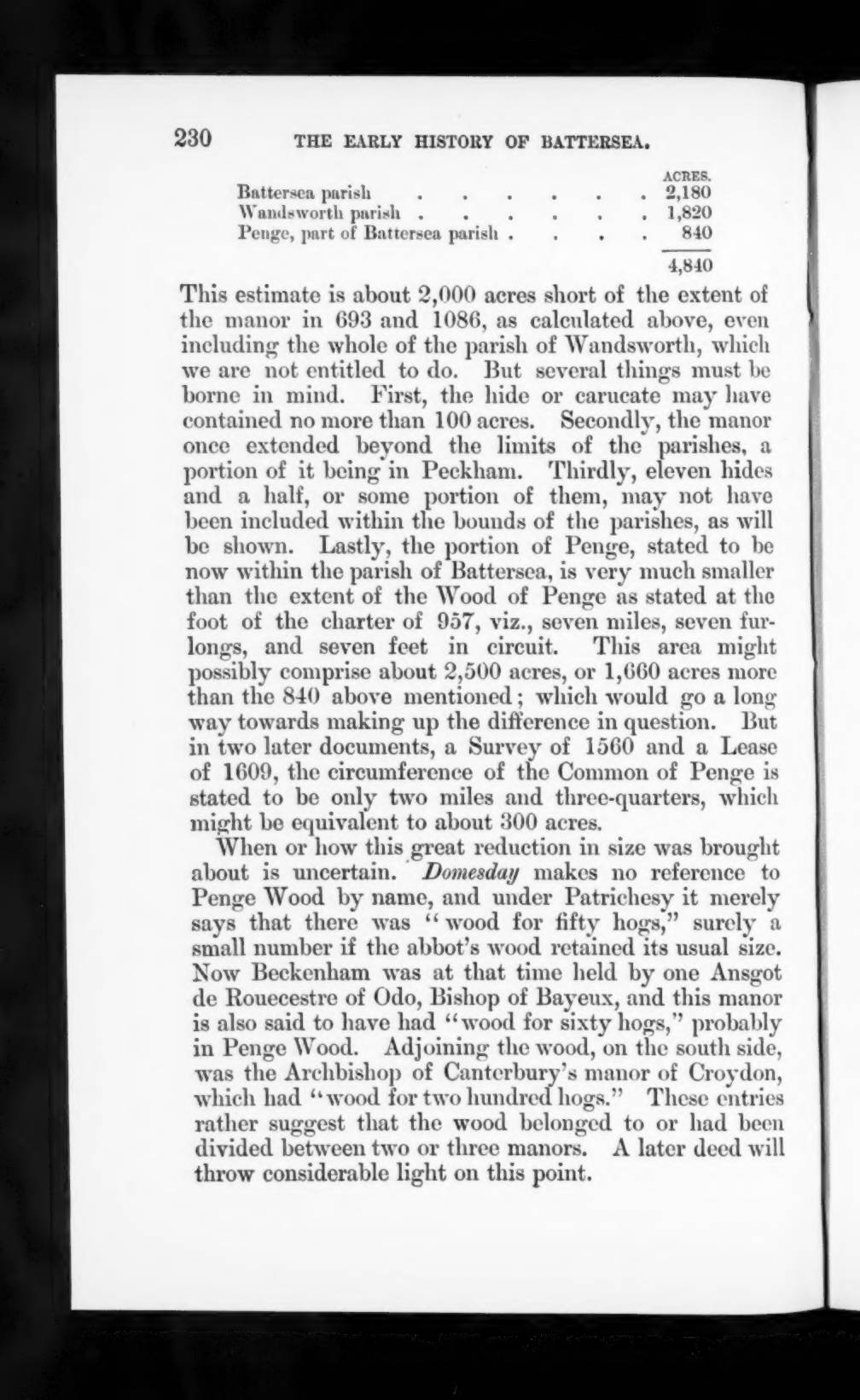
| Acres. | |
|---|---|
| Battersea parish | 2,180 |
| Wandsworth parish | 1,820 |
| Penge, part of Battersea parish | 840 |
| 4,840 |
This estimate is about 2,000 acres short of the extent of the manor in 693 and 1086, as calculated above, even including the whole of the parish of Wandsworth, which we are not entitled to do. But several things must be borne in mind. First, the hide or carucate may have contained no more than 100 acres. Secondly, the manor once extended beyond the limits of the parishes, a portion of it being in Peckham. Thirdly, eleven hides and a half, or some portion of them, may not have been included within the bounds of the parishes, as will be shown. Lastly, the portion of Penge, stated to be now within the parish of Battersea, is very much smaller than the extent of the Wood of Penge as stated at the foot of the charter of 957, viz., seven miles, seven furlongs, and seven feet in circuit. This area might possibly comprise about 2,500 acres, or 1,660 acres more than the 840 above mentioned ; which would go a long way towards making up the difference in question. But in two later documents, a Survey of 1560 and a Lease of 1609, the circumference of the Common of Penge is stated to be only two miles and three-quarters, which might be equivalent to about 300 acres.
When or how this great reduction in size was brought about is uncertain. Domesday makes no reference to Penge Wood by name, and under Patrichesy it merely says that there was “wood for fifty hogs,” surely a small number if the abbot’s wood retained its usual size. Now Beckenham was at that time held by one Ansgot de Rouecestre of Odo, Bishop of Bayeux, and this manor is also said to have had “wood for sixty hogs,” probably in Penge Wood. Adjoining the wood, on the south side, was the Archbishop of Canterbury’s manor of Croydon, which had “wood for two hundred hogs.” These entries rather suggest that the wood belonged to or had been divided between two or three manors. A later deed will throw considerable light on this point.
p. 231In passing, we may note the instructive lesson, that what are called “woods” in Domesday, sometimes became known as “commons” in later times.
Domesday says nothing about any subdivisions or hamlets of Battersea, but it mentions the toll of “Wandelsorde” as yielding six pounds yearly. What this toll was derived from does not appear. In later times there was a ferry over the Thames, but the Survey does not mention any “passagium” here. There was also a bridge between “Bruges” and Wandsworth, and it seems probable that the toll was taken there. Certainly a large portion of Wandsworth was within this manor, and the spelling just quoted does not indicate so great a difference of pronunciation as it seems to do ; for the Norman scribe has merely omitted a letter w in the middle of the name, as he was prone, and substituted the second d for the Anglo-Saxon ð = th. We have indeed seen that this place was called Wendleswrthe at at least as early as 1067, and it retained that or the similar form, Wandlesworth, for some centuries before it became abridged in the modern manner. The meaning of this name is not so difficult to ascertain as was that of Battersea : it was obviously the “worth,” farm, or street on the River Wandle.
It has been observed that there were forty-five villains and sixteen bordars in the manor. There were also eight bondmen—“servi”—in the manor proper, and a bordar in occupation of an outlying tenement in Sudwerche or Southwark. It is not a little remarkable that these figures, added together, make 70 in all, which is precisely the same number as that of the “manentes” specified in the second charter of Bishop Erconwald, above quoted.
The word villanus properly means “a townsman,” nothing more : it does not of itself show whether the man was a freeman or a bondman. No doubt these villains were the direct representatives of the original settlers, who of course were freemen. Much of their freedom was curtailed by the grant made over their heads to the Bishop of London, as we have seen : what
p. 232remained was swept away by the Conquest, although the manor was given to the Church in frank-almoign, for we find that villains in this neighbourhood were “regardant,” or bondmen, at a later date. Certainly they were greatly impoverished by the Conquest, as the assessment shows. Some of them had probably perished with their lord at Hastings.
It seems to have been customary for every villain having ten hogs, to deliver one of them yearly to the lord. They could not all have kept so many, or at least could not all have turned them into “the wood,” the capacity of which was limited to fifty hogs. The word “pannage” implies that they paid a duty to the lord for the privilege of turning their hogs into the wood.
In the spelling of Southwark we have another example of the liberties taken by the Norman scribes, d being substituted for ð as before, and ch for k.1 Several other manors of Surrey had tenements in Southwark, and even in London : probably they were originally used by the lords when residing in Southwark or London.
The abbot of Westminster did not however possess the whole of the original manor, as there were several estates which may be regarded either as being independent, or as sub-infeudations or tenements, viz. :—
1. A knight held 4 hides “of the land of this manor.” This was no doubt a freehold of the manor held by the tenure of knight service, or what we should call a sub-infeudation, probably made by the abbot himself.
2. The Earl of Mortaine held 1½ hide “of the land of this manor ;” which estate had existed “in the time of King Edward and some time afterwards.” This may have been independent of the abbot’s manor.
3. Gislebert the Priest held 3 hides, which estate had existed previously “in the same manner.” This was no doubt what was afterwards known as the
1 Another peculiarity of Norman spelling occurs in “Certesi,” where the letter C is used for Ch. In this case, however, the Saxon form may have been followed.
p. 233Rectory, though the church is not positively mentioned. If so, it was probably held in frank-almoign, independently of the manor.
4. The Bishop of Lisieux held 2 hides, which had been included in the grant made by King William to Westminster, but which had been taken away by Odo, Bishop of Bayeux, the King’s brother. As Odo fell into disgrace, the King, on depriving him of his possessions, may have given these two hides with other property to the Bishop of Lisieux. This also seems to have been an independent estate, and to have been in Peckham (Pecheham), where the bishop is returned as holding two hides which had “lain in Battersea.”
5. Lastly, there is a somewhat obscure entry referring to one hide held by the abbot of Chertsey. It had apparently been transferred to the manor of Chertsey as an outlying tenement, and this is said to have been done by “the reeve of this vill,” Battersea, out of some spite. Perhaps he owed a grudge to the abbot of Westminster, but how he could have done what is stated is not quite clear. No doubt he had great authority, as his knowledge of the rights of the lords and the dues of the tenants was almost unchallengeable. Possibly, when the grant was made to the abbey, he represented that a portion of Battersea already belonged to Chertsey, and so managed to defraud the grantee.
Thus we find that in one way or another 11½ hides had been taken out of the abbot’s manor. Such of these estates as were mere usurpations may have found their way back again into the abbot’s hands. The rest may perhaps subsequently be identified with more modern descriptions.
On this subject Manning and Bray, in their History of Surrey, make the following questionable remarks, after quoting Domesday :—
“The lands thus lopt off from the Manor, it is reasonable to suppose, were those which lie between the present Town and Penge, including part of Wandsworth, Lambeth, Camberwell, Peckham, Streatham, and Tooting (perhaps also of Clapham). This conjecture seems justified by the great extent of Battersea in its original state as here mentioned,
p. 234and by Penge being still considered as part of the Manor. . . . . . . Of Peckham, at least, this is certainly true, since what Earl Harold held there in the time of the Confessor is expressly said in Domesday to have been in the parish of Battersea.”
The idea of the historians evidently was, that because land in Penge belonged to Battersea, therefore the whole of the land between those two places must have been comprised within the manor. It is a very common error to look upon a manor as a solid block of land within a ring-fence, but such a view receives no countenance from Domesday, wherein we frequently meet descriptions of manors comprising outlying lands and tenements. Manning and Bray refer to “the great extent of Battersea in its original state,” but the extent as stated in the charter of 693 and in Domesday, and the boundaries mentioned in both the charters before quoted, do not warrant us in supposing that the manor included lands in all the parishes mentioned above, or that Penge was at any time united to Battersea within one unbroken boundary. In fact, the wood of Penge is very distinctly shown to be outside the boundaries of the vill of Battersea. The reference to Peckham does not help their view, as the lords of Battersea had a very small estate in that vill, and the “parish” is not mentioned.
Besides, the words of Domesday do not justify us in supposing that anything was “lopt off” the manor except the two hides in Peckham, and perhaps the “one hide” which was “withdrawn” by the reeve of the vill, but it is obvious there were many more than three hides between Battersea and Penge. The rest of the 11½ hides above referred to, and probably even the one hide, though no longer in the abbot’s own hands, may well have been situate in the vill or parish of Battersea itself, or in Wandsworth. Even if they all lay between Battersea and Penge, they would go but a very short way towards filling up the intervening space.
The manor of Battersea has now been traced from the Anglo-Saxon charter of 693 (the first-known document relating to it) into the possession of the Abbot and Convent of St. Peter, Westminster, in whose ownership
p. 235it continued for nearly five centuries—until the dissolution of the monasteries by Henry VIII. To some extent such a devolution is a drawback to the local chronicler, for much information which grows round a manor in the possession of lay owners is absent. There are no Inquisitiones post mortem, or periodical surveys, taken after the deaths of the successive owners, to say nothing of an occasional attainder or forfeiture. It is true that this dearth of information is sometimes compensated by the discovery of a series of ancient court rolls and bailiffs’ accounts, but in the present case very few early records of this kind have rewarded a long and careful search. There may be some among the archives of Westminster Abbey, and possibly also among the series of early Ministers’ Accounts at the Public Record Office, but these latter are at present under arrangement, and therefore inaccessible.
Sundry charters by the Norman and Plantagenet Kings to Westminster Abbey are set out in Dart’s History of that abbey, and in Lysons’ Environs, and the originals are still probably among its archives. Transcripts of the more important, if not of all, are preserved either on the Charter Rolls and the Rolls of Cartæ Antiquæ, or in the Cartulary of the Abbey. Most of them are grants of liberties and franchises in general terms, but the following charter of King Henry I relates to Battersea in particular, and shows that the manor had by some means been in the hands of the Royal Chancellor. Possibly he obtained possession during one of the vacancies of the abbacy.
“Henry, King of the English, to Roger, Bishop of Salisbury, and Geoffrey de Clinton, and all his sheriffs and ministers of Oxnefordescire and Sudrey and Middelsex, greeting. Know ye that I have rendered to the Church and Abbot Herbert and the whole Convent of Westminster all their lands which the Chancellor held of them, namely, Patricesey, Gythslepe, Piriforde, [and] Scepirton, as well and honorably and freely as they best held in the time of my father. Witness, Nigel de Oly, at Wodestoc.” (Cartulary, f. 67.)
Both Lysons and Manning and Bray refer to a charter of exemption from Danegeld made by King Stephen to
p. 236the abbey in respect of a portion of its lands in Battersea. After search in many more likely quarters, the deed was at length found in the collection known as “the Campbell Charters.” It is not really the actual charter of that King, but a confirmation by Archbishop Theobald.1 The portion which concerns us is as follows :—
“Theobald, by the grace of God, Archbishop of Canterbury, Primate of the English, and Legate of the Apostolic See, to all the faithful people of Holy Church, greeting. Know all of you as well present as to come, that our Lord the illustrious King Stephen, for the love of God and the health of his soul and [the souls] of his predecessors, and also for the preservation of his children, has quitclaimed the manor of Westminster, in which the Royal Hall (Regia Aula) and other royal houses have been built, for ever, from the geldation of six hides and a half in all things which belong either to the King’s Crown or the custom2 of his administrators. He has also quitclaimed the manor of the Blessed Peter and of the Monks of the same place which is called Patricheseia, from the geldation of 44 hides in all things likewise which are said to belong either to the King’s Crown or to the customs3 of his administrators ; [so] that those 44 hides shall no longer pay geld, nor owe anything to the secular powers ; but the remaining 28 hides of the same manor shall pay geld and render all things appertaining to the King.”
The church of Hanewell is also mentioned, and then the Archbishop confirms this “new liberty,” with an anathema against infringers.
While considering Domesday, we had reason to conjecture that the abbey had obtained a large reduction in the assessment, probably owing to the great decrease in the value of the manor which was brought about by the Conquest ; and although the value had increased, the assessment remained unaltered. From the charter of King Stephen, as above quoted, it is clear that the abbey managed to secure a permanent reduction from their assessment for 44 hides out of 72, leaving only 28
1 It was formerly in the possession of Thomas Astle, Keeper of the State Papers at Whitehall, who seems to have been a resident in Battersea, where he was buried in 1803. King Stephen granted several charters to the abbey. See Dart’s History, I, 22, 23.
2 Consuetudinem.
3 Consuetudines.
p. 237hides subject to royal demands. If we may trust these figures, the assessment was thus raised to the extent of ten hides, as according to Domesday the abbey then paid only on 18 hides.
On King Stephen’s charter Manning and Bray make the following remark :—“By this we see that the Abbey had not then recovered the parts which had been taken from them.” They refer no doubt to the “lopping off” before mentioned, but it is difficult to see why, even if the whole of the 11½ hides mentioned in Domesday had been taken out of the manor,—which is doubtful,—the abbey should have obtained exemption in respect of 54 hides from the Conqueror, and 44 hides from King Stephen. It is much more reasonable to suppose that the exemption was first obtained in consideration of decrease in value, for such decrease was pretty general all over the kingdom ; and that the continuance of the exemption was due to royal favour. How far the abbot’s tenants in Battersea benefited by this relaxation is another matter, for their lord would still be able to tallage them on his own account.
The earliest positive reference to ecclesiastical matters in the parish of Battersea occurs in the reign of Henry II. Under the head of “The Rectory,” Manning and Bray make the following statement1 :—“Lawrence, Abbot of Westminster, procured the appropriation of the great tithes for that abbey about 1159. The monks of Westminster were to receive out of it [the Rectory] two marks, reserving sufficient to the Vicar to support himself and the episcopal burdens.” There was certainly a church at Battersea at this time, as well as another church at Wandsworth, both being appropriated to the abbey, as appears from the authority quoted by the historians, and subsequently in the Taxation of Pope Nicholas IV. By such appropriation the Rectory
1 Vol. II, p. 334. The authority given is Widmore’s History of Westminster Abbey, p. 29. Widmore’s actual words are : “This abbot Laurence procured the appropriation of the churches of Battersea and Wandsworth.” He gives as his authority a manuscript History of the Abbey, by J. Flete, a monk thereof.
p. 238estate would probably become merged in the larger manor, and the distinction between the two would stand a good chance of becoming lost.
In the reign of Henry II (1166), all the tenants of the King in chief, including the greater barons, and such ecclesiastics as held lands by knight service, returned to the Exchequer the names of all knights who held of them. These returns are preserved in the Black Book of the Exchequer. The abbot of Westminster returns the knights who owed service to his church, among whom “Walkelin in Surrey owes the service of a third part of a knight.”1 The name of the place where this knight’s lands were situate is not given, but it is pretty certain that he was a descendant of the knight who is returned in Domesday as holding four hides of the land of the manor of Battersea. The abbot, it is true, had other manors in Surrey, but if this conjecture be correct, it will be of service in helping to trace the later devolution of the estate.
Immediately after his accession, King Richard I commanded, by letters patent, that “all the land and men of the abbey of Westminster shall be in peace, and quit from all pleas, and gelds, and Danegelds, and murders, and aids of sheriffs, and all other things which are required from them” ; but Battersea is not specially mentioned, and therefore it is doubtful whether this exemption superseded that of King Stephen, in respect of that township.2
We have now come to the period when “legal memory” begins, and with it the vast series of records of proceedings in the Courts of Law, which all had their origin in the King’s Court. Of the earliest of such records relating to Battersea it will not be out of place to give a few specimens, the rather because they help to show what was going on among the tenants and inhabitants of the manor, of whom we have hitherto heard little. The first record of this nature relating to Battersea is
p. 239a Fine in the 10th year of Richard I (1198), relating to two separate parcels of land in Battersea, which the abbot obtained by exchange. The following is an abstract:—
Final agreement in the King’s Court at Westminster, on Wednesday, the feast of St. Martin, 10 Richard I, before the Bishops of Ely and Durham, and others, between Stephen de Turnham and Edelina his wife, demandants, and the Abbot of Westminster, tenant, concerning ‘one virgate of land and a half, and two hides of land, with appurtenances, in Patrichesie.’ Stephen and Edelina release and quitclaim to the Abbot and his successors for ever; and the Abbot gave them, for this release, certain land in Westminster over against (contra) the church of the Holy Innocents, its breadth towards the street (vicum) being 31 ells, in the middle 37 ells, and towards the Thames 34 ells; the length including whatever is contained between street (vicum) of Westminster and the Thames: to hold to them and their heirs, of the Abbot, rendering yearly one pound of pepper, or six pence, for all service.1
Probably other Fines of a similar character may be found among that class of records, during the reign of King John and subsequent reigns, but they are unindexed. One or two of the more important will be noticed.
In the “Curia Regis” Roll of Hilary term, 1 John, in the year 1200, is the record of a Fine, which is to be found among the “Feet of Fines.”
“William Pentecost, demandant, and Roger Enganet, tenant, are agreed concerning one hide of land with appurtenances in Batricheshéé;” the latter quitclaiming to the former for twenty marks of silver.
The first record of an action relating to this locality is contained in the “Curia Regis” Roll of Michaelmas term, 2 John, in the year 1200, and is as follows:—
1 Feet of Fines, Divers Counties, Rich. I, No. 61. This is referred to in Dart’s History, I, 21. There are a few earlier Fines relating to lands in Hese and Wandleswrd. In 1198, Gunilda de Hese demanded against Peter, son of Walter de Badericheseie one perch and a half of land “which is beyond the sluice of Hese, between the land of the abbot of Westminster and the sluice of Hese.” Gunilda quitclaimed this land to Peter, who quitclaimed to her a moiety of the land late of Godefrey de Hese, in Hese, except the capital messuage.
p. 240“Theobald de Fering demands two hides of land with appurtenances in Batricheseia and Wandleswrth against Richard de Dol, as his right and inheritance, whereof Angod his father was seised as of fee and right on the day and year when King Henry the grandfather died, taking the explees [or issues] to the value of five shillings and more. Richard comes and defends his right, and puts himself on a great assize, [to say] which of them has the greater right in that land. A day is given them at the coming of the Justices &c., and then let four Knights come to choose twelve.”
This action was settled by a Fine in 4 John, 1202, when Theobald de Fering remised to Richard de Dol two hides and a half of land with appurtenances in Bedricheshee and Wanlesworth; for which the latter gave to the former rents amounting to 7s. 7d. in the vill of Westminster, to wit, all the service of John Fitz-Edward and others, named.1
The next Fine is of so much importance and interest that we have no choice but to quote it at large. It relates to land which, though described as lying in Battersea, really appears to have been near Beckenham; but it is most curious for its minute details of common rights in Penge Wood, and for the provisions made in it in view of a possible enclosure.
“This is the final Agreement made in the Court of the Lord the King at Westminster, from the day of Easter in one month, in the fifth year of the reign of King John, before G. Fitz Peter, Richard de Her’, Simon de Pat’hull, Eustace de Faucunberge, John de Gestling, Osbert Fitz Hervey, Godefrey de Insula, Walter de Creping’, Justices, and other Barons of the Lord the King then and there present, between Ralph, Abbot of Westminster, demandant, and William de Ginnei and Matilda his wife, tenants, concerning one carucate of land with appurtenances in Badricheseia, as the watercourse bounds it,2 as far as the proper land of the aforesaid William, and from the wood3 of the Archbishop of Canterbury to the park4 of Bekenham, whereof there was a plea between them in the aforesaid Court; to wit, that the aforesaid
1 This action is referred to in Mr. Baildon’s Select Civil Pleas, i, 8. (Selden Society.) Here we have a very good instance of the fact that Fines were originally the results of actual disputes, and not the legal fictions which they afterwards became.
2 Sicut aquæ ductus designat.
3 Nemore. This must refer to the wood belonging to the manor of Croydon, before mentioned.
4 Parcum (pound ?).
p. 241William and Matilda acknowledged all the aforesaid land with appurtenances to be the right of the same Abbot and of the Church of Saint Peter of Westminster. And for this acknowledgement and fine and agreement the aforesaid Abbot granted to the aforesaid William and Matilda and the heirs of the same Matilda all the aforesaid land with appurtenances; to hold of the same Abbot and his successors for ever, by the free service of twenty shillings by the year for all service, to be rendered at two terms of the year, to wit, at Easter ten shillings, and and at the feast of Saint Michael ten shillings. And for this grant the aforesaid William and Matilda remised and quitclaimed to the aforesaid Abbot and his successors all their right and claim which they had in the wood and land of Pange, from them and the heirs of the same Matilda for ever, so that the aforesaid Abbot and his successors may do their will of the aforesaid wood and land without contradiction of the aforesaid William and Matilda and the heirs of the same Matilda. So nevertheless that the aforesaid Abbot granted to the aforesaid William and Matilda and the heirs of the same Matilda common of herbage1 in his wood of Pange for all the proper cattle2 of Bekenham, except goats and other people’s cattle, so long as the wood shall not be closed.3 And moreover the same Abbot granted to the aforesaid William and Matilda and the heirs of the same Matilda thirty hogs in the aforesaid wood of Pange quit from pannage; and all other hogs and all cattle of the vill of Bekenham shall be removed from the aforesaid wood of Pange so long as pesson lasts,4 to wit, between the feast of Saint Michael and the feast of Saint Martin. And if perchance it shall happen that the aforesaid Abbot or his successors shall enclose the aforesaid wood of Pange, the aforesaid William and Matilda and the heirs of Matilda shall have, in the aforesaid wood, pasture for forty animals5 and for one hundred sheep, and the aforesaid thirty hogs quit from pannage. And if perchance it shall happen that the same Abbot or his successors shall please to assart [part] of the aforesaid wood, it shall be good and lawful to do so;6 and this without contradiction of the aforesaid William and Matilda or the heirs of the same Matilda. But nevertheless there shall remain [part] of the aforesaid wood and herbage not assarted, so that the same William and Matilda and the heirs of the same Matilda may have sustenance for the aforesaid thirty hogs, and for forty animals, and for one hundred sheep. And the same Abbot took the homage of the same William for the aforesaid land in the same Court. Surrey.”
It may be conjectured that William de Ginnei was lord of the manor of Beckenham in right of his wife,
1 Communam herbagii.
2 Averiis.
3 Quamdiu boscum clausum non fuerit.
4 Quamdiu pessio durat; i.e., mast-time.
5 Animalia.
6 Licet bene facere.
p. 242Matilda, who would in that case be a descendant of Ansgot de Rouecestre, mentioned above; though Hasted does not help us to identify them. Hasted states that only a portion of Beckenham is in Kent, the rest being in Surrey, and therefore we should expect to find the remainder described by Manning and Bray, but they do not mention it; so it is to be presumed that the portion of Beckenham not dealt with by Hasted is identical with the carucate of land given by the abbot, which must have been part of the wood of Penge, as he had no other land in the neighbourhood. In consideration of this gift the abbot was to be at liberty to enclose the whole wood, and even to reduce to tillage some portion of it; the common rights of the people of Beckenham being safeguarded. This carucate was clearly identical with the “hundred acres of heath in the vill of Beckenham,” which were held by a subsequent lord of that manor as a tenant of the abbot’s manor of Battersea.1
The returns of Knights’ Fees contained in the volume known as Testa de Nevill, are mostly without dates, but from the original rolls it appears that one of the returns for the county of Surrey is dated in the 14th year of King John (1212–13). That return refers to Battersea in these terms:—
“The Hundred of Brixistan.”
“William the King gave Baterichesee in exchange for Wyndlesor in alms to the monks of Westminster.”
This supports the view of the transaction taken by the Domesday Commissioners, but was probably derived from that Survey.
Two other returns in Testa de Nevill, made in the earlier portion of the reign of Henry III, have this instructive entry:—
“Robert de la Dune holds a third part of one Knight’s fee in Wendlewrth (or Wendleswurth) of the Abbot of Westminster.”
1 Inquis. p. m., Sir William Bruyn, 36 Edw. III, 1362.
p. 243Here we meet once more with the estate held by knight service which we remarked in Domesday Book, and again as having been held by Walkelin in 1166; now (about 1222) we find it in the possession of Robert de la Dune.1
A very ample charter of liberties was granted to the abbey by King Henry III, in 1235, which was confirmed by a later charter, though Battersea is not mentioned by name.2 It granted exemption from hidage, carucage, Danegeld, tallage, shires, hundreds, &c. If this applied to Battersea, the abbey may now be said to have at length enjoyed that manor “in frank almoign,” which does not appear to have been the case previously, though one or two records use the expression, as we have seen. A few extracts will serve to show its drift.
“Out of reverence for the blessed King Edward, our predecessor, and for the soul of our father King John, . . . we have confirmed to God and the Church of St. Peter of Westminster, and to the glorious King Edward our special patron, . . . all their lands, . . . with soc and sac, toll and theam, infangenthef, utfangenthef, wesgeldethef3, . . . and quit from scot and geld, aids of Kings and sheriffs, amercement and fine of the county, hidage, carucage, Danegeld, hornegeld, wapentage, tallage, lastage, schewing, . . . shires, hundreds, swainmotes, pleas and plaints, assizes, views, and summonses . . . . They shall have view of frankpledge in all their lands and tenements, with plea of withernam, and with fines for licence to agree.4 . . . . If they have not used any one of the aforesaid liberties, nevertheless henceforth
1 In the “Curia Regis” Rolls of 1199, there are two references to an action brought by Walter Fitz Gilbert, otherwise Walter de Wenlesworth, who was “in the service of the Lord Duke,” against Henry de la Dune, concerning one virgate of land in Wenlesworth, but Walter failed to appear at the trial. This Henry was probably a predecessor of Robert de la Dune, above mentioned. The same rolls contain other notices of lands in Wendlesworth, and of one Pentecoste de Wendlisworth, who appeared as attorney for some one else, and who also occurs in a Fine dated 1197.
2 Dart’s description of Henry III’s charters, preserved in the Abbey archives, is very meagre.
3 Qu. wergildtheof?
4 i.e., to enter into the agreements which are known as Fines. It is remarkable that there are no Fines relating to Battersea between 1—19 Henry III. Had the abbot already exercised this jurisdiction?
p. 244they may use it. All these things we grant in pure and perpetual almoign. We forbid any Justice, Sheriff, &c. to intermeddle concerning any of their lands . . . contrary to this charter.—Wodestok, 1st July.”1
By another charter dated at Bordeaux, 18th June, 1243, the King granted to the Abbot and Convent the fines of all their men who should be amerced before any justices, and the return of the King’s writs, so that no sheriff or bailiff of the King should enter into their lands.2
We may now profitably consult the important records known as Assize Rolls, which consist partly of “Pleas of Juries and Assizes,” and partly of “Pleas of the Crown,” all held before the King’s Justices itinerant, or “in eyre.” The latter especially give such varied details that they must be allowed to tell their own tale without much comment. They consist of presentments made by juries of twelve men from each Hundred, who were summoned to appear before the Justices, and to present all accidental deaths, murders, thefts, deodands, &c., and also to reply to all the articles of inquiry specified in the instructions given to the Justices. Dr. Stubbs states that Justices in eyre were established by Henry II, and that “the courts in which they preside are the ancient county courts, under new conditions, but substantially identical with those of the Anglo-Saxon times.” The remarks which have already been made in this paper on Hundreds, Townships, and Tithings will help to make these extracts intelligible.
A.D. 1235.
Pleas of Juries and Assizes before the King’s Justices at Bermundese, Michaelmas term, 19–20 Henry III. (m. 12.)
“Paulina who was the wife of Ranulph de Badricheseye, who brought a writ of dower against William Faukes, concerning three acres of land and one messuage with appurtenances in Wendelwrth, does not prosecute,” &c.
1 Charter Roll, 19 Henry III, m. 5; Cartulary, f. 83.
2 Charter Roll, 27 Henry III, m. —; Cartulary, f. 86.
Pleas of the Crown before the King’s Justices at Bermundese, [Michaelmas term,] 19–20 Henry III. (m. 6.)
“The Verdict of the Hundred of Brixistan.”
“Alice wife of Robert de Kingeston found Robert her husband drowned, and did not come; and she was attached by Bernard de Brigges and William his son; therefore let her be in mercy [i.e., amerced or fined]. And Thomas de la Burne, one of the neighbours, was attached by John, the reeve of Wandleswurth, and John Linge; therefore let him be in mercy.”
“A certain strange woman was found killed in the vill of Wandleswurth: it is not known who killed her. And Nicholas Gray, one of the neighbours, did not come, and therefore let him and his pledges be in mercy, to wit, John the Smith of Wandleswurth and Lewin of the same.”
The four vills of Lamhee, Totinge, Batrichese, and Wymbeldon give testimony as to an alleged murder at Wymbledon.
“Thomas the Vintner was found dead in his bed at Batrichese, and John of St. Alban’s, who was his servant, is suspected of that death, and therefore let him be put in exigent and outlawed. He was not in a tithing, and had no chattels.”
“Saul de Batricheseye (and three others) being charged with larceny, fled, and it was testified by the 12 jurors and four townships that they are not guilty. Therefore let them return if they will, and find pledges.”
A.D. 1241.
Pleas of the Crown before the King’s Justices in Eyre at Bermundese, Easter term, 25 Henry III. (m. 4 d.)
“The Hundred of Brixistan comes by 12 [Jurors].”
“A certain man unknown was found dead in the Thames upon the fee of the Prior of Merton. No one is suspected thereof. No Englishry [i.e., he was not proved to be an Englishman];1 therefore murder [is charged upon the Hundred]. Reginald the first finder comes, and is not suspected. Afterwards it was convicted by the Coroner that one Richard Fitz Simon, then Reeve of Badrichesey, Henry le Bedel, and Walter of the Moor first found the same dead man; and because they did not announce this to the Sheriff or the Coroner, nor to the Bailiff of the Lord the King of the Hundred, therefore let them all be in mercy. And Henry does not come, and was attached by Roger Fitz Edith of Wenleswrth and William de la
1 Unless this was done, the deceased was held to be a Norman, and a fine was levied on the Hundred.
p. 246Care of the same: therefore let them be in mercy. And Thomas Whateman, one of the recognitors, did not come: therefore let him be in mercy.”
“Henry de la Mare, of the county of Dorset, fled to the church of Wendeleswrth, and acknowledged himself to be a thief, and abjured the kingdom. He was not in a tithing, because he was a stranger and journeying; and he had no chattels.”
Down to this date it is doubtful whether the Abbot of Westminster held any court in Battersea, in spite of his ample general charters of liberties, for it is evident that the vill still joined with the neighbouring vills in the presentments of the Hundred; consequently, the manor was yet incomplete. One cannot imagine a perfect manor without a court; or even if there were a court, the manorial system would be imperfect if the tenants owed a divided allegiance, and had to attend outside courts. But some time between 1241 and 1255 the abbot withdrew his tenants from the Hundred Court, and then, if not before, he established a Court Baron and a Court Leet of his own. Thus the manor became finally developed; and what is true of this manor is equally applicable to many other manors, though the dates of their full development may have varied.1
Finality in this case was probably brought about by a peremptory mandate of King Henry. In spite of his ample charter, the sheriff and other royal officers continued to exercise jurisdiction and make exactions. Dropping the royal “we,” which savoured of mere formality, and had been so regarded, the King writes as if he took a personal interest in the matter.
“Henry, King of England, &c. to all his sheriffs and ministers of all England in whose bailiwicks the Church of Westminster has lands and men, greeting. I command that the Church of Westminster shall fully have its entire liberty, as in my charter and those of my predecessors it is granted to it; and I forbid that you any longer presume to exact anything from it. Witness, the Chancellor, at Rouen.”2
1 Dr. Stubbs says that the manor was “largely if not completely developed” in the reign of Henry I.—Const. Hist., I, 451. He considers that the Court leet was cut out of the Hundred Court. It was however held twice a year, like the County Court.—Ibid., 452.
2 Cartulary, f. 87ᵇ.
p. 247The result appears in later Assize Rolls; but before referring to these, we must refer once more to the Feet of Fines. The only Fine in which the name of Battersea occurs in the reign of Henry III is the following:—
Fine in the King’s Court at Canterbury, in Trinity term, 25 Henry III (1241), between John de Berkinges and Alice his wife, plaintiffs, and William de Stocwell, impedient, concerning five acres of land with appurtenances in Betrichseye. William acknowledges the right of John and Alice, who had the land by the gift of John de Stokwell, William’s father, whose heir he is: to hold to them and their heirs, rendering [to William] 1½d. yearly at Easter, for all service.
The same John and Alice were parties to other Fines relating to Wandsworth, Bruges, and Lambeth.1
Here it will be convenient to mention that Dart, in referring to Abbot Richard de Berkyng, who died in 1247, says: “He defended the church of Batrichsey against some attempts of Peter de Rupibus, of Winchester”; but no particulars are given. The bishop may have attempted to claim some jurisdiction which was inconsistent with the impropriation.
In the year 1253, a very interesting Fine was levied between Richard Auberkin and John de Berekinge and Alice his wife, relative to one messuage and eighteen acres of land in Wandlesworth. Richard and his heirs were to hold of John and Alice and the heirs of Alice, “together with Reginald Strang, villain, with all his sequel; . . . . the aforesaid Reginald being present, and acknowledging himself to be a villain.” It further appears that Alice was the daughter and heiress of Margery de Bruges.
A Fine relating to Bruges, a hamlet of Battersea, next requires attention. Bruges seems to have been a sub-manor.
Fine in Trinity term, 42 Henry III (1258), between Hugh le Bigot, plaintiff, by Walter de Gernemuta (Yarmouth), his attorney, and Alan Basset and Petronilla his wife, deforciants, concerning one carucate of land in Bruges, which deforciants hold as the dower of Petronilla, of
1 In 32, 36, 37, and 41 Henry III.
p. 248the inheritance of Hugh de Doyl: to hold to plaintiff, his heirs, or assigns, of Alan and Petronilla, during her life, rendering 10l. yearly, payable at their house at Babington, in Sussex. Plaintiff is not “to make waste or destruction of the houses, gardens, and trees being in the capital messuage of the same land.”
The ensuing extracts from the Assize Rolls pointedly draw attention to the withdrawal of the vill from the Hundred, though in 1263 an attempt seems to have been made to get the abbot and the vill to attend, which they failed to do.
A.D. 1255.
Pleas of Juries and Assizes before the Justices in Eyre at Bermundese, Trinity term, 39 Henry III. (m. 8, 13d, 15d, 17.)
“A jury comes to acknowledge whether three acres of land with appurtenances in Wendlesworth are frank almoign appertaining to the church of Wendlesworth, whereof the Abbot of Westminster is parson, or the lay fee of Simon le Barbur and Matilda his wife: who come, and cannot deny that the aforesaid land is frank almoign appertaining to the church of the aforesaid Abbot in Wendlesworth. Therefore it is considered that the aforesaid Abbot shall recover his seisin of the aforesaid land, and let Simon and Matilda be in mercy.”
Hugh Fitz Richard v. Thomas Fitz Ralph and John le Blund, concerning one messuage, one mill, and 40 acres of land in Wendleswrth.
Levina, widow of Augustin Cruste, v. Thomas Fitz Andrew, concerning a third part of a messuage and lands in Wendlesworth.
“An assize comes to recognise whether Master Alan de Stocwell, father of Henry de Stocwell, who is under age, was seised in his demesne as of fee of one messuage, 60 acres of land, and two acres of meadow, with appurtenances in Lamheth and Batricheseye on the day on which he died.” John de Stocwell is in possession of two parts of the messuage, 40 acres of land, and two acres of meadow, and Alice de Stocwell has the rest [as dower?]. John claimed as brother and heir. The result is not stated.
Pleas of the Crown, before the King’s Justices in Eyre at Bermundese, Trinity term, 39 Henry III. (m. 31.)
“The Hundred of Brixistan comes by 12 Jurors.”
“Richard de Brensted, carter of the Abbot of Waverle, was crushed by a certain cart full of wax, herrings, figs, almonds, and fish in the Heath (Bruera) of Badrecheshegh; so that he immediately died thereof. The first finder and four neighbours come, and are not
p. 249suspected, nor any one else. Judgment: misadventure. Price of the cart, horses, wax, herrings, figs, almonds, and fish, 118s. 3d.; for which G. the Sheriff shall answer [i.e., account to the King]. And the townships of Batrecheshegh and Clopham falsely appraised the aforesaid deodands; therefore let them be in mercy.”
“Matilda, daughter of Ranulph, was crushed by the wheel of a water-mill in Wendlisworth,” &c.
“A certain stranger was found dead in the field of Sparfeud in Baterecheshegh by misadventure. The first finder and four neighbours come, and are not suspected, nor any other. No Englishry. Judgment: murder upon the township of Baterecheshegh, because it does not participate (participat) with the Hundred.”
“A certain man unknown was found killed in the water next Walles in Batrecheshegh. The first finder and four neighbours come, and are not suspected. No Englishry. Judgment: murder upon the township of Batrecheshegh, because they do not participate with the Hundred. It is not known who killed him. And the townships of Waleworth and Hechesham1 did not come to the inquest: therefore let them be in mercy.”
A.D. 1263.
[Pleas of Juries and Assizes before the King’s Justices in Eyre at Guldeford, Hilary term, 47 Henry III.] (m. 5d, 7d.)
p. 250“An assize comes to recognise whether Robert le Blunt, Henry son of Ralph de Stocwell, Amicia Countess of Devon, and others unjustly and without judgment disseised Margery Malemeyns of her free tenement in Lamheythe and Baudricheseye . . . . . . viz., of one messuage, 75 acres of land, and 5 acres of meadow in Lamheythe, and 5 acres of land in Baudrycheseye, with appurtenances, &c. And Robert and all the others did not come, except the aforesaid Ralph de Suthlambheyth,2 who comes and answers for himself and all the others as their Bailiff.” He refers to a previous action, and to feoffments made by Geoffrey son of William de Stokwelle to Master John of Gloucester, mason, and by the latter in 40 Hen. III to the said Amicia. In the end, Margery was amerced for making a false claim.
“Robert, Vicar of the church of Batricheseye,” was one of the defendants in action relating to a free tenement in Whiseleg’, of which the plaintiff complained that they had disseised him. The jurors found that such disseisin had been made, but not by the Vicar.
Pleas of the Crown before the King’s Justices in Eyre at Guldeford, Hilary term, 47 Henry III. (m. 19.)
“The Hundred of Brixistane comes by twelve.”
“A certain unknown man was found killed upon the Heath of Pannescroft in Baudricheseghe. The first finder has died. It is not known who killed him. Judgment: murder upon Baudricheseghe, because it does not participate with the Hundred. And because it is testified by the County, and by the twelve [Jurors], that every one of twelve years [of age], being summoned by the Sheriff or his bailiffs, ought to come to an inquest on a man’s death, and the Townships of Clopham, Totinge le Bek, Baudricheshegh, and Wendleswrth did not come, as they were summoned to do: therefore let them be in mercy.”
“William Golding fell from a certain boat in the Thames between Batrichesweye and Westminster, and by misadventure was drowned. Alan de Ethe, the first finder, does not come, and is not suspected. And he was attached by Geoffrey de Heyse and Thomas of the same: therefore let him be in mercy. And Richard de Gates, one of the neighbours, does not come, and he was attached by John Waryn and William le Provost: therefore let him be in mercy. Price of the boat, 3s., for which the Sheriff shall answer. And it is testified by the twelve that the Abbot of Westminster took that deodand without [view of] the Coroner, and now he does not answer for it: therefore let him be in mercy.”
The Abbot was also amerced, among others, for not attending on the first day.
“Concerning indicted persons,” the jurors say that several persons of Wendleswrth had withdrawn themselves, and were suspected. They are to be put in exigent and outlawed, and their chattels, worth a few shillings, are to be seized. One of them, “William le Wythyene, was in the tithing of Alan in the Hale in Baudrichese: therefore [that tithing is] in mercy.”
After this date we find no more Pleas of the Crown relating to Battersea. From a charter of King Henry III, in the fiftieth year of his reign, which is not extant among the Charter Rolls, because the roll for that year is missing, but which is twice enrolled among the Cartæ Antiquæ, and recited in the inspeximus of 9 Edw. III, we learn that King Henry again confirmed numerous privileges to the abbey, including the exemption of their tenants from attending at shire courts and hundred courts, and power to hold courts and views of frank-pledge in all their tenements.
p. 251The grants of privileges of this kind by various kings had been so numerous and conflicting, and under colour of such grants so many encroachments had been made on the royal prerogative, that King Edward the First, soon after his accession, issued special instructions to special Commissioners to inquire as to all liberties which had been “withdrawn” from the Crown, or for which no warrant could be shown by charter or prescription, and also as to such liberties as, although enjoyed by charter, were opposed to the public weal. The inquisitions taken thereupon are preserved in the “Hundred Rolls,” and soon after they had been returned the King issued writs of quo waranto against a large number of ecclesiastical and lay lords who had been reported as having usurped any of the rights of the Crown. There is a set of so-called Hundred Rolls for Surrey, according to an old list of miscellaneous records of the Exchequer, but they are not printed in the two large volumes published by the Record Commission, and it is probable that they are not really Hundred Rolls, though of a similar nature.1 One of these rolls, without date, contains the verdict of twelve jurors of the Hundred of Brixton, in reply to the articles of the iter. They say that “the Abbot of Westminster claims to have in his Manor of Batrichesey all liberties which appertain to the Crown—they know not by what warrant.”
The proceedings before the Justices in eyre on the writs of quo waranto are however preserved among the Assize Rolls of 7 Edward I, and have been printed in the large folio volume issued by the same Commission.2 So many curious and obsolete terms are used in describing the privileges claimed by the abbot of Westminster, that it is thought better to give an extract from one of the original rolls. The abbot’s claims are indeed set out so fully that we are enabled to ascertain exactly what rights he enjoyed in Battersea,
p. 252and to judge how far they had been increased during the two centuries which had elapsed since the manor came to the abbey. The Justices in eyre assembled at Guildford in Michaelmas term, 1279, and the proceedings before them are recorded in the following terms:
“The Liberties of the Abbot and Convent of Westminster.
“The same Abbot, by Richard de Koventre his attorney, claims these liberties underwritten, to wit, in the vills of Pireford and Horshull, with their members, Batricheseye, Wandlesworthe, Cleygate, Mordon, Hetlegh, Wassingham, Tonge, and Heyford, with their members, according to the tenor of the charters of the Kings of England, that is to say, mundebruche, borghebruche, myskennynghe, scauwynge, lonynge, frythsokne, flemenesfrente, wesegeldef, utlep, foxfuge, infeng, ferdwyte, faglwite, blodwite, wardwyte, hengwyte, homsokne, forstal, infongenethef, sockne, tol and them. He also claims that his Abbey shall be quit from plaints, pleas, shires, hundreds, and from all other things and exactions, murder, and larceny.
“He also claims to hold his churches, alms, goods (res), rents and possessions, with all liberties and free customs in meadows, pastures, waters, mills, ways, paths, ponds, fishponds, marshes, fisheries, granges, coppices, within borough and without, and in all other places, in market and without, with sac, soc, thol and them, infangenethef, utfangenethef, wesegeldesweyf,1 and with grytbreche, forfang, leyrwite, and escapes of thieves.
“He also claims that he and his men shall be quit from all amercements, scot, and geld, and all other aids of King and Sheriff, Danegeld, hidage, carucage, homegeld, wapentak’, tallage, lestage, thewing,2 views, assizes, and summonses, and conveying treasure, ward, wardpeny, averpeny, hundredespeny, boruhalpeny, tythengpeny, and from all works of bridges and building of royal houses, and all [building] work. And that their woods shall not be taken for royal works, nor their corn for provisioning castles. And that they shall take at their pleasure from all their woods without disturbance of foresters, and without any demand for cheminage; nor shall they on this account be put in mercy or forfeiture for waste.3
“He also claims that all lands and purprestures [or encroachments] now made, and assarts [or enclosures] of himself and his men who are not Earls or Barons now made, and which in future shall be made with the royal assent, [shall be] for ever quit from waste, regard and view of foresters, and from all things which appertain to the Forest or foresters.”
1 “Wesgeldthef” in the charter of 50 Henry III. (L. 18.)
2 “Sthewinge” in the same charter. (L. 16.)
3 Nec propter hoc in forisfactum de vasto in misericordia ponantur.
p. 253“He also claims that they shall be free from all expeditation [or lawing of dogs]; and that they and their men shall be quit from all toll in every market, and in all fairs, and in all passage of bridges, waters, ways, and sea, through the whole Kingdom of England, and through all lands in which liberties can be given them by the King of England.
“He also claims view of frank pledge, plea of withernam, fines and amercements of his men, except of Earls and Barons, chattels of felons and fugitives, year and waste, murder, and escape, and weyf. He also claims the estreats of fines and amercements of his men by the hands of the Justices in eyre, so that those estreats shall not be delivered to the Exchequer, but to the Cellarer of the same Convent, in whose presence their men ought to be amerced.1
“He also claims to have the custody of prisoners attached upon his lands, and the execution of the judgments of the same, and the return of writs; and free warren in all demesne lands which they have or hereafter shall have by the charters of Kings.2 And [he alleges, in reply to the case stated on the King’s behalf,] that they have occupied or usurped nothing upon the Lord the King or his ancestors; and he puts himself upon the country.
“And the Knights chosen for this matter say upon their oath that the aforesaid Abbot and Convent and all their predecessors have used the liberties aforesaid, except that they are not quit from works of bridges, because the aforesaid Abbot shall make the bridge of Brugges between Wendlesworthe and Brugges, and the bridge at Faukeshale. And that they are not quit from the amercements of their men amerced before the Justices in eyre; and they (the Knights) do not know whether they take estreats by the hands of the Justices in eyre, or not. And except that he (the Abbot) has not warren nor has used any in this county [of Surrey], save only in his manors of Piriford and Horshull. And whereas he claims to be quit from pleas and plaints, they say that he used to answer in the County [court] concerning plea of withernam. And because in his manors of Piriford and Horshull he claimed to have warren, which he has not, nor ought to have, let him be in mercy. And as to the other liberties, they (the Knights) say that they (the Abbot and Convent) have occupied or usurped nothing upon the Lord the King or his ancestors.
“Therefore it is said to them that they may go sine die with the liberties aforesaid, saving always right to the Lord King and to his heirs when he or they shall choose to speak thereof.”
1 Cf. Charter Roll, 37 Henry III, m. 6, where “Bailiff” occurs instead of “Cellarer;” but the Cellarer occurs in another charter of 39 Henry III. (Cartæ Antiquæ, LL. 40.) In yet another charter of the latter year, it is conceded that all tenants of the abbey who shall be arrested are to be delivered to the Abbot’s Bailiff, to be kept in his prison. (Ibid., L. 19.)
2 See Charter Roll, 32 Henry III, m. 3.
p. 254Thus the abbot of Westminster succeeded in maintaining the greater portion of his claims, which were allowed by the judgment of the Court, as expressed in the last clause above quoted. And here we can close our description of the Early History of Battersea, for the state of things thus established, by slow degrees, remained without alteration for several centuries. The abbot evidently had his own courts, in which his tenants had to appear, no longer attending as of yore the County Court and the Hundred Court.
Explanation of all the obscure terms used by the abbot in making his claims is not here attempted, but it is abundantly clear from this and other similar documents that our forefathers had come to live under a highly complex system of conflicting jurisdictions, of abilities and disabilities, of impositions and exemptions, which to us are in many respects unintelligible, and which to them must often have been intolerable.
We cannot close this paper without acknowledging our indebtedness to Mr. G. H. Overend, F.S.A., of the Public Record Office, for many important references and suggestions.