Home › Sources › Brayley › Wimbledon
Last modified: 7 October 2026
Transcribed in full, keeping Brayley’s spelling, capitals and punctuation, and checked line by line against the printed pages. The original page numbers are shown in grey, like this: [500]. Brayley’s footnotes are numbered as in the book and collected at the end; passages he set in small type are shown slightly smaller; click any of the engravings to enlarge it. This volume was issued in 1850, but the text was written in the 1840s and brought up to about July 1847, so “the present vicar” and the like mean then, not now. Compare the earlier account in Manning and Bray (1814).
[499] This parish is bounded on the north by Putney and Roehampton; on the east, by Wandsworth; on the south, by Merton and Cheam; and on the west, by Kingston. The soil varies much, consisting in some places of gravel, in others of clay, or black sand, or loam, with a sub-soil of clay or gravel; and in the meadows, the soil is described as a black moorish earth. The ground is frequently marshy, springs occurring near the surface; yet when an Artesian well was dug at Wimbledon park, the late seat of Earl Spencer, in 1798, the excavators (having shut out the land springs) penetrated to the depth of five hundred and sixty-three feet before water was found, but it then rose in great abundance.1 Wimbledon is thought to have derived its name from some Saxon proprietor named Wymbald, and dun, or dune, a hill in the Saxon language; possibly, by adoption from the British:—hence the appellations Wymbaldon, and Wymbeldon, by which this place is distinguished in old records. In the Registers of archbishop Walter Reynolds, who held the see from 1313 to 1327, (fol. 79, b), preserved at Lambeth, it is styled Wimbledon.
At the time of the Domesday survey, Wimbledon was included in the very extensive manor of Mortlake, belonging to the archbishop of Canterbury; and in all the more ancient documents it is described as a grange, or farm, in that manor.
In the Testa de Nevill it is stated that Robert de Wymbeldon held one-third of a knight’s fee, in Wymbeldon, of the archbishop of Canterbury, in the time of Henry the Third, or Edward the First. On an inquisition taken in 1398, on an alleged forfeiture of archbishop Arundel, who had been attainted of treason against Richard the Second, the manor of Wimbledon is mentioned as pertaining to that of Croydon, which also belonged to the see of Canterbury. In the [500] following year, Arundel returned from his exile in France with Henry of Bolingbroke (afterwards Henry the Fourth), and was restored to his see and its possessions, including the manor of Mortlake, or Wimbledon, as it has since continued to be denominated. His successors held it till exchanged by archbishop Cranmer with Henry the Eighth, for other lands; and shortly after, it was granted to Cromwell, earl of Essex; on whose attainder and decapitation in 1540, his estates escheated to the crown. Wimbledon was next settled for life on queen Catherine Parr; after whose decease in 1548, queen Mary bestowed it on Cardinal Pole, who dying in 1558, the crown resumed its possession. Queen Elizabeth, in her 18th year, gave this estate to Sir Christopher Hatton, who sold the manor-house to Sir Thomas Cecil, eldest son of Lord Burghley; and the manorial estate (though by what means it had again come into her hands does not appear), was conveyed to Sir Thomas by the queen in exchange for the manors of Langton and Wiberton in Lincolnshire. He rebuilt the manor-house in a most magnificent style about the year 1588; and having succeeded to his father’s title in 1598, he had the honour in the beginning of August 1599, to receive and entertain his royal mistress during three days at his new house in Wimbledon; after which, she removed to Nonsuch.2 In 1605, this nobleman was created earl of Exeter; and at his death in 1622, he left this estate to his third son, Sir Edward Cecil, who was raised to the peerage by Charles the First, by the titles of Baron of Putney, and Viscount Wimbledon. He died at Wimbledon in November, 1638; and his daughters and coheirs sold the manor to the earl of Holland and others, who acted as trustees for the queen Henrietta Maria. While it belonged to the queen, she and her royal consort sometimes resided at this place; and the mansion is mentioned among the possessions of the crown, in an inventory of the jewels and pictures of king Charles the First, referred to by Walpole. After the suppression of the monarchy, the crown lands being set to sale by the parliament, this estate, valued at 386l. 19s. 8d. a year, was purchased by Adam Baynes, esq., of Knowstrop, in the county of York, at eighteen years’ purchase. It was afterwards sold to the parliamentary general, John Lambert, who, as appears from the court-rolls, was lord of the manor in 1656.3
[501] On the restoration of Charles the Second, the queen-mother recovered her estates; and in 1661, she sold Wimbledon to George Digby, earl of Bristol, who, dying in 1676, devised it to his widow; of whom it was purchased by Thomas Osborne, earl of Danby, the lord-treasurer, afterwards marquess of Carmarthen, and in 1694 created duke of Leeds. He died in 1712; and the trustees under his will, authorized by a decree of Chancery, sold the manor in 1717, to Sir Theodore Janssen, bart., a director of the South-sea company. Shortly afterwards he began to pull down the mansion of the Cecils, intending to replace it by a new one, but before that could be finished, his estates were seized and sold, with those of other directors, for the benefit of the many persons who had been ruined by the nefarious speculations connected with the management of the above company. On this occasion, Wimbledon was purchased for 15,000l., by the celebrated Sarah, duchess of Marlborough; by whom, at her decease in 1744, it was devised with Chilworth and other estates to John Spencer, M.P. for Woodstock, the youngest son of Charles, earl of Sunderland, by her grace’s second daughter, lady Anne Churchill. He died in June, 1746, when this property devolved on John, his only son, who was created baron and viscount Spencer in 1761, and earl Spencer viscount Althorp in 1765; and from him it has descended to Frederick, the fourth and present earl Spencer.
The mansion of the Cecils in Wimbledon Park was of a very sumptuous character, consisting of a centre, with spacious wings extending at right angles, and having square pavilions at the inner corners surmounted by high turrets, each pyramidically roofed, and terminated “by two faier gilded wether-cocks, perspicuous to the countrie round about.”4 Fuller calls it “a daring structure,” and remarks that “by some it has been thought to equal if not to exceed Nonsuch.” An avenue of elms and other trees, 231 perches in length, led from Putney heath, through the park, to the house. It stood upon the brow of the hill, and had two courts on the ascent in front; the uppermost rising about twelve or fourteen feet above the other.
In a Survey made by order of parliament, in 1649, the house is described to be of “excellent good brick,” and “the angles, window- [502] staunchions, and jambs, are all of ashler stone.” It comprised a basement and two upper stories, with numerous apartments singularly and curiously ornamented.5 The surveyors valued the house at 150l. per annum; and reported the materials to be worth 2,840l. 7s. 11d.
When the duchess of Marlborough became owner, she pulled down the unfinished house which Sir Theodore Janssen had raised (and on which nearly 4,000l. had been expended), and built a new mansion upon the north side of the eminence on which the present house stands; but not liking its aspect, she caused it to be taken down, and had another built in a far preferable situation on the south side.6 That building was entirely destroyed by an accidental fire, on Easter Monday, 1785; after which some of the offices were fitted up for the occasional residence of earl Spencer’s family. The present house, [503] which was completed in the year 1801, from designs by Mr. Holland, has no particular characteristics requiring notice. Its situation is remarkably fine: on the south it commands extensive prospects over Surrey and Kent; and on the north, the home-scenery of the park, which was planted and laid out with much taste by “Capability” Browne, afford some beautiful views. This mansion, with its surrounding grounds, is now in the occupation of the duke of Somerset; but the park has been sold to a company for building purposes, and is partly allotted for the erection of numerous detached villas. In its entire state it comprised about twelve hundred acres, of considerable diversity of surface, enlivened by a fine expanse of water covering fifty acres of ground.
Advowson, &c.—Henry the Eighth, after the exchange with archbishop Cranmer, mentioned before, granted the advowson, right of patronage, &c., of the church and parsonage of Wymbylton, and its annexed chapels in Surrey, to the dean and chapter of Worcester, to hold in frank-almoign, but reserving a rent of 3l. 10s. 9½d. to the office of first-fruits and tenths; and Edward the Sixth, soon after his accession, confirmed this grant to the dean and chapter, with license to appropriate. Since then, the patronage has been usually granted on leases of three lives to the lords of the manor; the lessees covenanting, among other charges, to keep the chancels of Wimbledon, Putney, and Mortlake, and the parsonage-house at Wimbledon, in repair.7 This living is in the deanery of Ewell; and is valued at 60 marcs in the Valor of the 20th of Edward the First. In the King’s books its value is stated at 35l. 2s. 11d.; paying 6s. 8d. for procurations and synodals.—In the Register of burials, which commences in 1593, is the following entry:—
Francis Trevor, aged 103, was buried February 8, 1778.8
Perpetual Curates of Wimbledon in and since the year 1800:—
Herbert Randolf, B.D. Licensed July 3rd, 1777: died in 1819. During his incumbency, on the 24th of May, 1811, Edward Bullock, A.M., was licensed to perform the duties here, with a yearly salary of 100l.
Henry Lindsay, A.M. Licensed on the 25th of June, 1819: vacated by cession, and collated to Sundridge in January, 1846.
[504] Richard Leonard Adams, A.M. Licensed May the 22nd, 1846; by the bishop of London.
Adjacent to Wimbledon park, about the distance of half a mile from the village, is the parish Church, which is dedicated to St. Mary, and appears to have had origin in the Saxon times;—but of the church mentioned in the Domesday book not a vestige remains. Except the chancel, which is supposed to be a work of the fourteenth century, the present structure was entirely rebuilt in the years 1833 and 1834, from the designs of Messrs. Scott and Moffatt,—who have in many instances displayed a very skilful knowledge of ecclesiastical architecture. Its cost was about 6,000l., which was defrayed partly by subscription, and partly by loan; and the church was re-opened for divine worship in March, 1834. It is a handsome composition in the perpendicular style of pointed architecture, consisting of a nave and aisles, with a well-proportioned square tower, of four stories, at the west end, surmounted by a lofty spire and weather-cock. The walls and buttresses are faced with flint, within stone dressings; but the window and door frames, &c., are all of the latter material. The chief entrance is from the tower, above which is an elegant window; and there are five similar windows on either side of the church, of three principal divisions each, cinquefoil-headed, with smaller lights above. The nave is separated from the aisles by light piers, from which spring five pointed arches on each side. The frame-work of the roof is of oak; the rafters are supported by brackets resting upon corbels. Spacious galleries extend over the aisles and west end of the nave; and above the western gallery is an organ-loft or singing-gallery, containing a fine-toned organ by Walker, which was presented to the church by James Courthorpe Peach, esq., of Belvidere-house, an adjacent seat. Above the arch separating the nave from the chancel, are the arms of Queen Victoria, in artificial stone, the gift of Mrs. Marryatt, of Wimbledon-house. The font, which is of stone, and octagonal in form, was given by Henry Bowden, esq. The pewing is neat and uniform; but being low, with raised ends, it has the appearance of open sittings.
In the east window are various shields of arms, in stained glass, exhibiting the bearings of Sir Thomas Cecil, afterwards earl of Exeter; of Thomas, first duke of Leeds; and of the Spencer family; part of which was removed from some side windows of the chancel that have been recently filled up. Lysons has delineated the figure of an ancient Crusader, which was in a window on the north side, completely armed, with a spear in his right hand, and a shield with the cross of St. George upon his left arm.
[505] On the south side of the chancel is a small chapel, erected by Sir Edward Cecil, viscount Wimbledon, in the reign of James the First, as a burial-place for himself and family. In the middle space is an altar-tomb, with an inscription on the verge, and others on each side recording the descent and various offices of the deceased, both civil and military. His armour is arranged in detached portions round the chapel; and over his tomb is a viscount’s coronet suspended by a chain. He died at Wimbledon on the 16th of November, 1638.
Under the south gallery is a neat monument, by Westmacott, erected at the expense of the Fox Club, in memory of James Perry, esq., and as a testimony of his zeal, courage, and ability in the defence of public liberty. He was for many years both proprietor and editor of the “Morning Chronicle”; and is represented by a small whole-length figure, in white marble, seated at a table with papers before him. He was born on the 30th of October, 1756, and died on the 5th of December, 1821; having long been resident in this parish.—Over the north gallery are tablets in commemoration of the late Judge Sir James Allan Park; and Sir William Beaumaris Rush; the latter had an elegant villa near the church.
In the church-yard are numerous tombs and other sepulchral memorials of a superior kind to those generally raised. One of the most remarkable is the Columbarium, erected by Benjamin Bond Hopkins, esq., formerly of Wimbledon-house, and Pains’-hill; in which he himself lies interred, with others of his family. He died in the 49th year of his age, on the 30th of January, 1794.—Another sepulchre, or mausoleum, constructed like a pyramid, incloses the earthly remains of Gerard de Visme, esq., who died on the 20th of November, 1797. In front is a sculpture of his arms, and the sentence,—Sepulchrvm hoc Gerardvs de Visme, pro Si et Svis Extrvxit.6—The memory of Margaret, Countess of Lucan, who died in 1814, relict of the first earl of Lucan, is preserved by an Ionic column surmounted by an urn; and that of the lady Georgiana-Charlotte, wife of lord George Quin, by a handsome Grecian monument: she died on February the 21st, 1823.—Among the many other tombs is that covering the vault of John Hopkins, of London, esq.; who died on the 25th of April, 1732, aged 69 years. This was the person whom Pope, in his Moral Essays, has consigned to an unenviable fame by the epithet Vulture Hopkins, from his grasping practices in the acquirement of opulence.
[506] On the high ground at the south-west side of Wimbledon common, and about a mile and a half from the upper part of Kingston hill, is an ancient Entrenchment of a circular form, which the country people call the Rounds, an appellation by which it has been known for a long series of years;7 although, of late, it has been introduced into some of our modern maps by the name of Cæsar’s Camp. In Camden’s time, it was called Bensbury, which that writer supposed to be derived from Cnebba’s-bury; Cnebba and Oslac, two of the principal generals of Ethelbert, king of Kent, having been slain in the battle fought at Wibandune, (or Wimbledon), between that sovereign and Ceaulin, king of the West Saxons. Its area comprises about seven acres of ground; and is, to a considerable extent, overgrown by prickly furze. It is crossed by a cart-road leading towards Combe-lane and Kingston; and on one side, appears to have been defended by outworks. It is not exactly circular, but inclines to an oval form. The surrounding ditch, which is from eight or ten, to about fifteen feet deep, is partially overshadowed by scrubby oaks.
The origin of this Encampment has, by different authors, been attributed to the Britons, the Romans, the Saxons, and the Danes; and the probability is, that it was originally a British stronghold, subsequently occupied by soldiers of the other nations in succession.
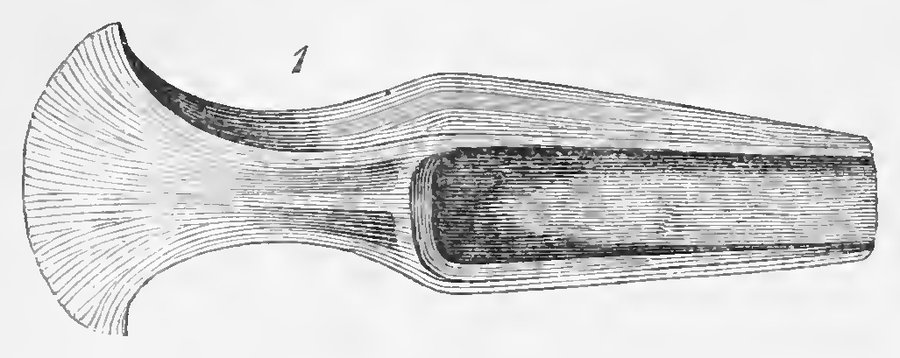
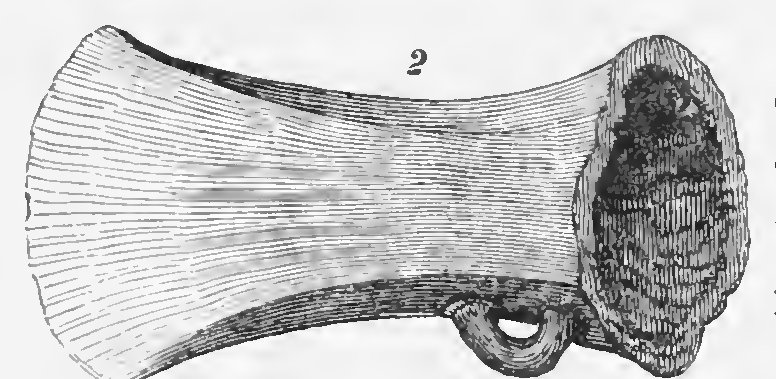
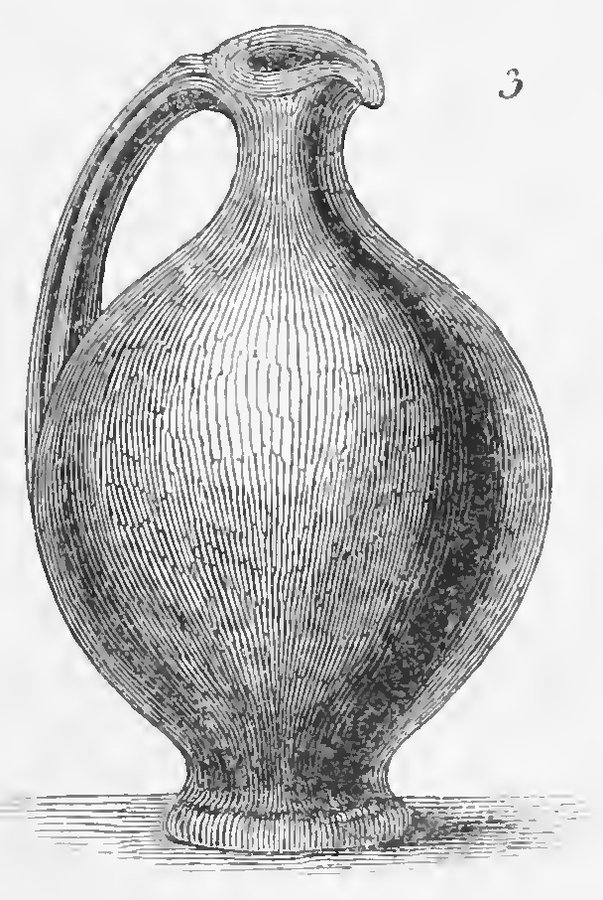
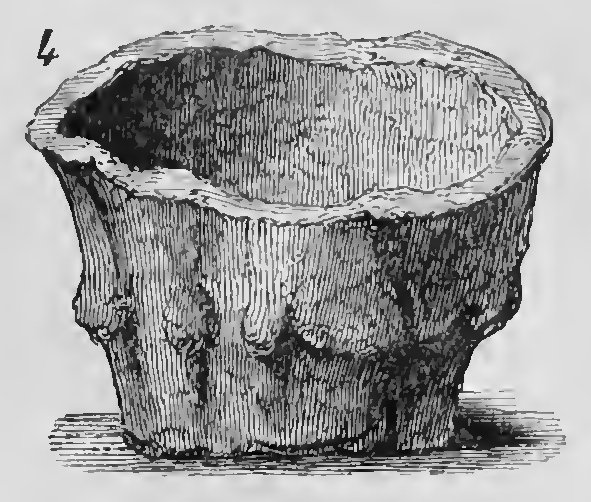
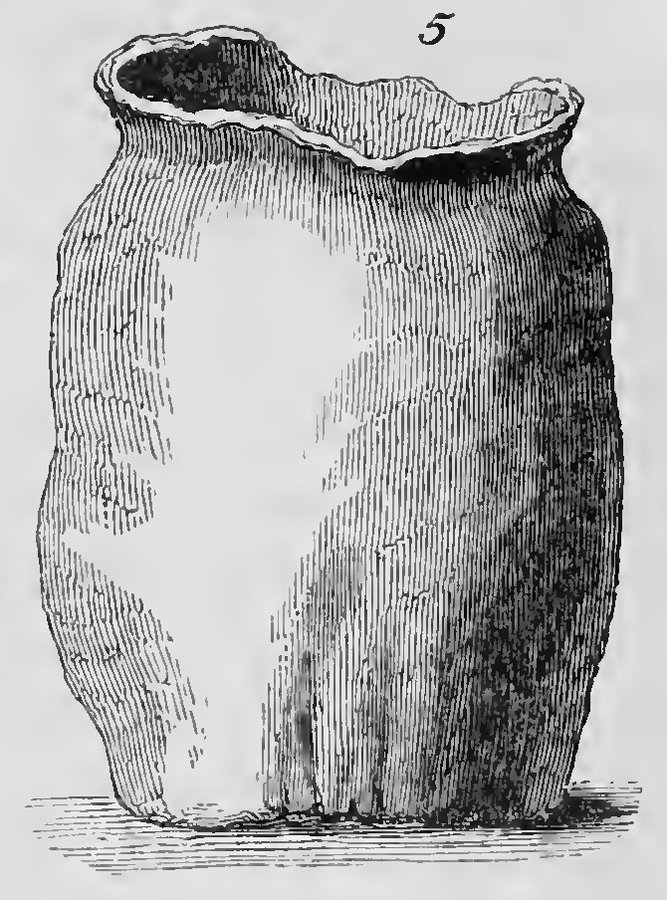
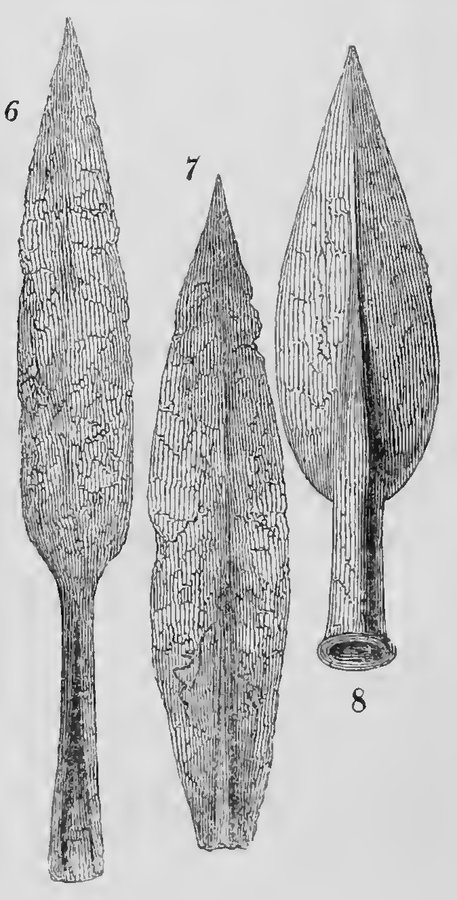
In the annexed lignographs, several antiquities found in this vicinity, apparently Roman, are delineated. We are indebted for them to the kindness of Dr. Wm. Roots, of Surbiton, who possesses the originals. Our friend Dr. Roots is strongly of opinion that Cæsar crossed the Thames at Kingston,—anciently Moreford, or the Great ford,—at least, with his infantry, and that he occupied this entrenchment whilst preparing for the conflict. It is within his own recollection, that “sixty years ago,” this stronghold was designated as “Cæsar’s camp”; and he imagines the fierce struggle [507] with the troops of Cassivelaunus to have taken place on the Middlesex banks of the river immediately above Kingston, where many relics of a warlike description have been found by the ballast-heavers; similar to those discovered in this neighbourhood.8 There is an ancient track called the Ridgeway, extending from Wimbledon, in a south-west direction along an elevated brow, and leading through a wood into Combe lane.
No. 1. A missive Hatchet of bronze, found on Kingston hill: its length is five inches and a half. Near the same locality several masses of unwrought bronze have been met with.
No. 2. Another missive weapon, or Celt, of the length of two inches and a half, found in digging gravel near Combe wood, between Kingston hill and the old Entrenchment, and close to the spot where the urn No. 5 was found.
No. 3. A Roman Jug, dug up on Kingston hill; height, six inches; circumference, thirteen inches.
No. 4. A Lachrymatory, or Thuringium, found on Kingston hill, very near the spot where the urn and celt were discovered: the wood-cut is nearly the size of the original.
No. 5. A Sepulchral Urn, dug up on Kingston hill; and when found was half full of ashes: height, six inches; width, four inches.
No. 6 and 7. Spear Heads of iron, much corroded, dug up from the bed of the Thames, near Surbiton: one of them is ten inches long; and the other, eleven inches and a half.
No. 8. A Spear Head, of bronze, found on Wimbledon common, near Kingston hill. Aubrey, speaking of this eminence, says, “On the rising of the Hill stands the gallows, in a dry gravel-ground, where they often find Roman Urns.”—Surrey, vol. i. p. 16.
[508] Wimbledon House.—In the last century this estate belonged to Benjamin Bond Hopkins, esq., the inheritor of the accumulated riches of his maternal relative, John Hopkins, whose burial-place has recently been noticed. Whilst in his possession, the grounds were laid out, and a cascade and grotto constructed under the direction of the celebrated Bushell, by whom the more elaborate grottos on Pains’-hill and Oatlands were designed. Subsequently, and on his own removal to Pains’-hill, Mr. Bond sold the estate to Mons. de Calonne, comptroller-general of the French finances before the revolution in 1789; and that gentleman, about 1791, re-sold this property to Earl Gower, for 15,000l. The Prince de Condè was afterwards an occupant; but eventually, this estate was purchased by the late Joseph Marryat, esq., M.P., an affluent West-India merchant, who died suddenly on January the 12th, 1824; and whose widow now enjoys it. The house is extensive, and the apartments are conveniently arranged and well adapted both for private comfort, and splendour and ceremony. The principal dining and withdrawing rooms are spacious, and fitted up with much elegance. Among the other chief apartments is the saloon, a library, an excellent conservatory, and a billiard room. But the great attraction of these premises arises from its horticultural establishment, which Mrs. Marryat, F.H.S. (possessing an enthusiastic admiration for flowers), has carried to an extent that is, probably, unrivalled in the vicinity of London. The flower garden occupies about three acres of ground, and contains, in numerous beds of great diversity of shape, between seven and eight hundred species, of almost every description of form and colour, exclusive of many varieties of the dahlia, tulip, and honeysuckle tribes. Many of the hardy green-house and hot-house exotics have flowered here for the first time in England; and among them, “that most elegant and singular of climbing plants, the Tacsònia pinnatistípula.”
The full extent of the grounds is about one hundred acres, of no considerable irregularity in surface, but occasionally exhibiting very beautiful home-scenery, enlivened by an expansive lake of seven acres, and other sheets of water inhabited by aquatic birds, or appropriated as fish stews.9 In the park are some fine old oaks and beeches, a large [509] cork tree, a very fine ligústrum lùcidum, some large evergreen oaks, a red cedar, and a rhododendron pónticum, upwards of one hundred feet in circumference. Other remarkable trees diversify the views in different parts; among which is the magnòlia accuminàta, the pinus serótina, and other American trees, which were originally planted in these grounds when first introduced into England.—It must not be forgotten that our celebrated novelist, Captain Marryat, is Mrs. Marryat’s son. She herself is the third daughter of Frederick Gear, esq., of Boston, in North America.
About half a mile westward, on the common, is another well-built mansion, which is now the property of Peter Mac Evoy, esq., whose father married the widow of Michael Bray, esq., its former possessor. In the reign of George the Second, this was the seat of William Benson, esq., auditor of the Imprests. He had previously been surveyor-general of the Board of Works, although greatly inferior in ability to his predecessor, Sir Christopher Wren, who was displaced by courtly intrigues to make room for him. He accompanied George the First to Hanover, where he planned the celebrated water-works at Herenhausen. He was a great patron of literary men; and the monument to Milton, in Westminster abbey, was erected at his expense from respect to the poet’s genius: he died here in 1754.
Douglas, in his “Nænia Britannica,” speaks of a group of ancient Barrows that was formerly to be seen on Wimbledon common. They were “about twenty-three in number, situated on the left side of the high road from London to Kingston, at a small distance from Mr. Hartley’s Fire-house, but on the other side of the road.” Most of the largest (none of which exceeded twenty-eight feet in diameter,) were said to have been opened by a person from London, supposed to have been Dr. Stukeley, about twenty-eight years before Mr. Douglas opened the remainder; which appears to have been in 1786. His researches were little successful; the only relic which he found being “a small vessel of dark-brown greyish earth, three inches in height, and three inches in diameter.” This he has figured in one of the plates which accompany his work. He also mentions “a very large barrow of the more ancient class,” as remaining at about five furlongs from the group.10 All of them were afterwards remorselessly swept away to mend the roads.
In May 1789, a hostile meeting took place on Wimbledon common between his royal highness the Duke of York and Lieut.-Col. Lenox; when the duke received the colonel’s fire, which grazed his hair, but declining to fire in return, the proceedings terminated.—In May 1807, [510] a duel was fought here by Sir Francis Burdett and John Paull, esq., in which both parties were wounded by pistol shots, though not dangerously.—In September 1810, Mr. George Payne, a person of considerable fortune, was mortally wounded on the common, in a duel with Mr. Clark, with whose sister he had formed an illicit attachment. He died at the Red Lion, Putney, on the second day afterwards.—On the 13th of June, 1839, the marquis of Londonderry and Mr. Henry Grattan, M.P., had a meeting here; when the latter, after receiving his opponent’s fire, fired into the air, and the duel ended.—Another duel was fought near the mill, on the 21st of September, 1840, between the Earl of Cardigan and Capt. Harvey Garnett Phipps Tuckett, in which the latter was grievously wounded by a shot beneath the ribs. The Earl was tried by the House of Peers for this offence against the statute laws, on the 16th of February, 1841; but, from a deficiency of proof as to the identity of the person wounded with the Captain Tuckett named in the indictment, (although it was impossible, conscientiously, to doubt the fact), the Earl was pronounced “not guilty.”
1 Manning, Surrey, vol. iii. p. 272.—Lysons states, that on the common, near the village, “is a well, the water of which is never known to freeze in the most severe winter.”—Environs, vol. i. p. 520.
2 Queen Elizabeth, Progresses, vol. ii. In the Churchwardens’ Accounts, at Kingston, is this entry, 1599:—“Paid for mending the wayes when the Queen went from Wimbledon to Nonsuch, 20d.”
3 It is stated by Roger Coke, in his “Detection of the Court and State,” that Lambert, after he had been “discarded by Cromwell, betook himself to Wimbledon-house, where he turned florist, and had the finest tulips and gilliflowers that could be got for love or money; yet in these outward pleasures he nourished the ambition which he entertained before he was cashiered by Cromwell.” He also amused himself with painting flowers, in which art he attained considerable skill: according to Walpole, some specimens of his pictorial ability were for many years preserved at Wimbledon.
4 In the tenth volume of the Archæologia is a minute account of the house and premises, copied from the original Survey made by order of parliament in 1649, and preserved in the Augmentation office: there are also prints extant, though extremely scarce, both of the principal front and the garden front, which have been copied for Lysons’s Environs.
5 Many of these apartments are particularly described in the Survey, from which a few extracts are subjoined.—“On the ground-floor was a room called the Stone gallery: this was 108 feet long, and “pillared and arched with gray marble, waynscotted with oake, varnished with greene, and spotted with starrs of gold.” In the midst was “a grotto wrought in the arch and sides thereof with sundry sorts of shells of great lustre and ornament, formed into the shapes of men, lyons, serpents, antick formes, and other rare devices;” also “fortie sights of seeing-glass sett together in one frame, much adorning and setting forth the splendour of the roome.” Both the hall, in which was “a table of one intire piece of wood 21 feet long, and 6 inches thick; and a fayer and riche payer of organs,” and the chapel were paved with black and white marble, and “painted with landskips.” On the first floor was the King’s chamber and the Queen’s chamber; and another Stone gallery 62 feet long; having “many compendious sentences” upon the walls. The Great gallery on the second floor was 109 feet 8 inches long, and 21 feet broad: this was “floored with cedar-boards, casting a pleasant smell,—and in the middle thereof a very faire and large chimney-piece of black and white marble ingraved with coates of armes and adorned with several curious and well-guilded statues of alabaster.” The Summer chamber, 45 feet long and 20 feet broad, was also floored with cedar, and “seeled with fret-work, in the midst of which was a picture of good workmanship representing a flying angel.” At each end of the house was a staircase 20 feet square, the westernmost containing 82 steps. “These staires were adorned with one large picture of Henry the Fourth, of France, in armes, on Horseback, set in a large frame, placed at the head thereof, and with landskipps of battayles, anticks, heaven and hell, and other curious works; and under the staires a little compleate room called the Den of Lyons, painted round with lyons and leopards.” In the Orangerie were forty-two orange trees in boxes valued at 10l. each; a lemon-tree, “bearing greate and very large lemmons,” valued at 20l.; a “pome-citron tree,” valued at 10l.; six “pome-granet trees,” at 3l. each; and “eighteen young orange trees,” at 5l. each. In the several gardens, which were laid out in knots, mazes, wildernesses, &c., was a great variety of fruit-trees; among which were every sort now cultivated except the nectarine.
6 The designs for both houses were made by the earl of Burlington, the most successful architectural amateur of his time. Views of the south and north fronts, and plans of the offices and principal floors, are given in the 5th volume of the “Vitruvius Britannicus;” which states that the chief apartments, and particularly the Saloon, were ornamented with some very capital pictures, “among which are the stories of Apollo rewarding Merit, and Apollo flaying Marsyas, both by Guido, and esteemed capital pieces of that master.”
7 Manning and Bray, Surrey, vol. iii. p. 272.
8 Among the entries is recorded the birth, on Saturday the 13th day of July, 1616, “about half an hour before 10 of the clocke,” a.m., of the lady Georgi-Anna, daughter of Thomas, earl of Exeter, and the lady Frances, his countess. She was baptized on the 30th of the same month, “Queen Anne [of Denmark], and the earl of Worcester, Lord Privy-seal, being witnesses.”
6 Mr. de Visme, on returning from Lisbon, where he had been long settled as a merchant, built an elegant villa in the Italian style, called Wimbledon Lodge, on the north side of the common. During the minority of his daughter, it was occupied by the late Earl Bathurst.
7 Vide Salmon’s Antiquities of Surrey, p. 31, under Wimbledon.
8 In the Archæologia, vol. xxx. pp. 490—492, is a paper on this subject by Dr. Roots, F.S.A.; and in vol. xxxi. pp. 518—521, is a communication from A. J. Kempe, esq., F.S.A., respecting the Entrenchment described above. In 1810, the two regiments of Life Guards were encamped for a short time, on Wimbledon common, near this spot, previous to their departure to the Continent to share in the dangers and the glory of Waterloo.
9 In Loudon’s “Suburban Gardener” is a detailed description of these grounds, illustrated by plans shewing the general arrangement of the buildings, gardens, &c.; and also by geometrical sections and bird’s-eye views, sketched from those points which best shew the leading features of this estate. Mr. Loudon remarks, that the “chief merit of the place, as a suburban residence, consists in its completeness, the whole lying compactly within a ring fence, and there being a most commodious mansion, with complete domestic offices, a park, a farm (including a dairy and a poultry yard), a kitchen garden, and a flower garden.”
10 Douglas, Nænia Britannica, p. 93; plate 23.
Transcribed by Philip Boys, with Claude, October 2026. Build 1.