Last modified: 21 October 2026 · Build 1
Home›Schools›Emanuel School›Lady Dacre and Emanuel School
Work in progress, not yet for publication. These are notes towards a fuller piece on how a Tudor widow’s will, a Norman coat of arms, a Wandsworth school and a post-war council estate all fit together. Corrections and ideas very welcome.
Anne Sackville was the daughter of Sir Richard Sackville, Treasurer of the Exchequer to Elizabeth I, and sister of Thomas Sackville, Lord Buckhurst, later Earl of Dorset. Through her grandmother, a Boleyn, she was a cousin of the Queen.
She married Gregory Fiennes, 10th Baron Dacre, whose father had been executed in 1541. The title was restored to Gregory and his sister in 1558. The couple had no surviving children. Gregory died at Chelsea on 25 September 1594.
Three months later, on 20 December 1594, Anne made her will. In it she directed her executors to build “a meet and convenient house to be called Emanuel Hospital in Westminster for the relief of twenty aged people and for the bringing up of twenty children in virtue and good and laudable arts”. The children were to be ten boys and ten girls. She died on 14 May 1595, and the hospital received its charter in 1601.
Lord and Lady Dacre are buried in Chelsea Old Church, beneath a fine monument with their effigies and the Dacre arms. (See the September 2026 Chronicles.)
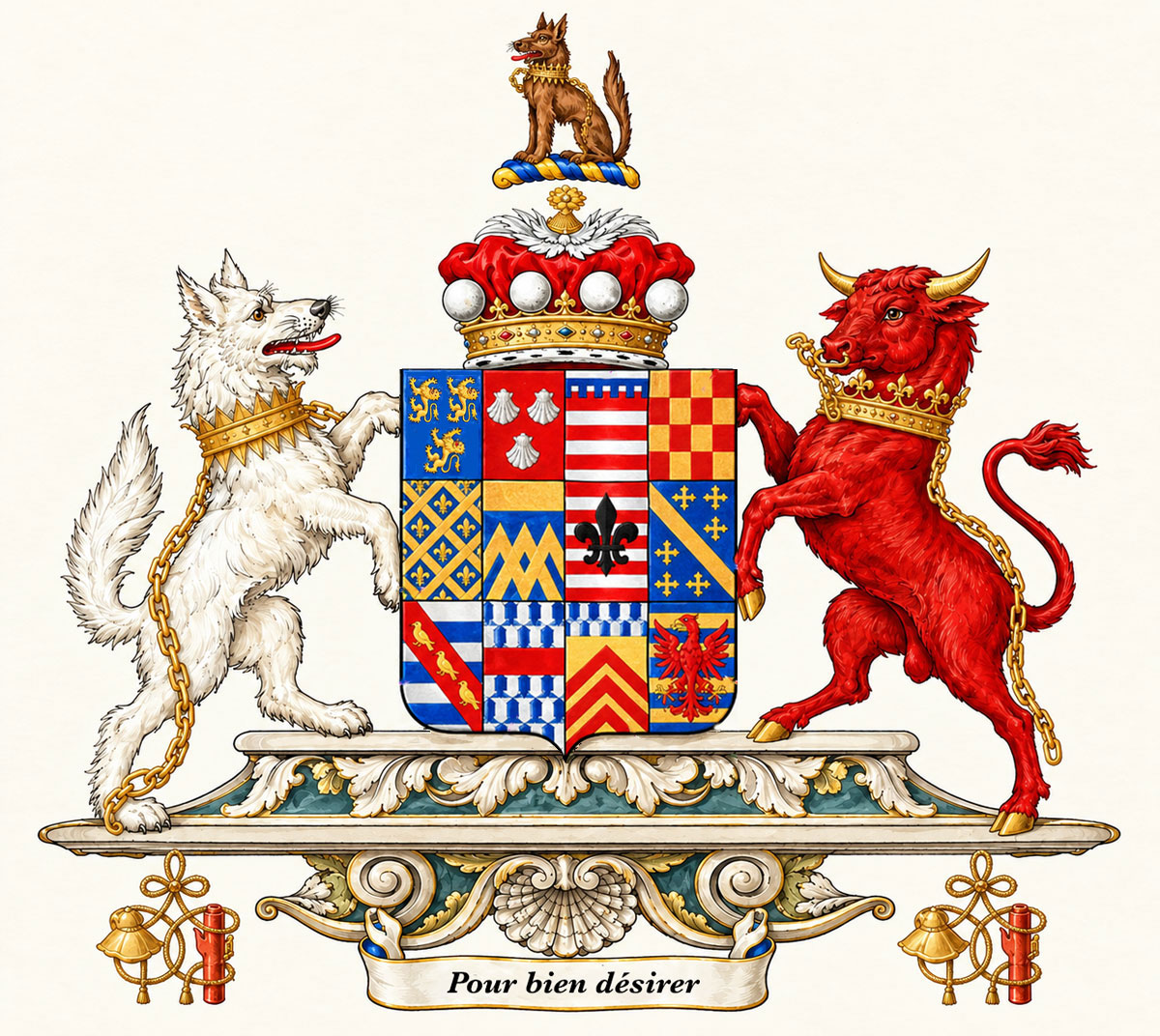
Gregory Fiennes’s arms gather up, in twelve quarters, the families whose heiresses had married into his line over four centuries. Above the shield is a baron’s coronet. The crest is a wolfhound, collared and chained. The supporters are a silver wolf and a red bull. Two mottoes are found with these arms: Fortem posce animum, “Ask for a brave spirit” (from Juvenal), the Fiennes motto; and Fort en loialté, “Strong in loyalty”, the Dacre motto, carved over the gateway of Naworth Castle. Emanuel’s own motto, Pour bien désirer, is that of the Brand family, who inherited the Dacre barony in the nineteenth century. [How and when did the school adopt it?] On either side are the Dacre badges: a knot of gold cord and a ragged staff.
| 1 | Fiennes | Azure, three lions rampant Or. |
| 2 | Dacre | Gules, three escallops argent. |
| 3 | Multon | Three bars gules, a label azure. |
| 4 | Vaux | Checky Or and gules. |
| 5 | Morville | Azure, semy-de-lys and fretty Or. |
| 6 | FitzHugh | Azure, three chevronels interlaced in base, a chief Or. |
| 7 | Staveley | Barry of eight argent and gules, a fleur-de-lis sable. |
| 8 | Furneaux | Azure, a bend between six cross crosslets Or. |
| 9 | Grey | Barry of six argent and azure, on a bend gules three martlets Or. |
| 10 | Marmion | Vair, a fess gules. |
| 11 | St Quentin | Or, three chevronels gules, a chief vair. |
| 12 | Gernigan | Barry of ten Or and azure, an eagle displayed gules. |
Quarters 1–4 run across the top row, 5–8 across the middle and 9–12 across the bottom. Highlighted: the four families whose names were given to the Fitzhugh Estate. [Source: European Heraldry: House of Dacre.]
In 1953–55 the London County Council built five eleven-storey point blocks off Trinity Road, beside the old Royal Victoria Patriotic building and a stone’s throw from Emanuel. It was meant to be the “Victoria Estate”. But in December 1954, the Norwood News reported, the LCC “changed their mind”, and it became the Fitzhugh Estate.
Its blocks are Morville, St Quentin and Gernigan Houses, all named from quarters of the Dacre arms like the estate itself. The other two, Skipsea and Woodhall Houses, take their names from Yorkshire manors that descended from the St Quentins to the FitzHughs and then to the Fienneses. Anne’s executor sold the Woodhall estate after her death.
So modernist tower blocks for London working families carry the names of Norman and Plantagenet landowners who had never set foot in Wandsworth. And they do so only because those names had been gathered into a Tudor coat of arms, and that coat of arms had come to Wandsworth Common with Emanuel School in 1883.
Do you know who chose the Fitzhugh names, or where the LCC’s papers on them are? Please let me know.