IN PROGRESS — NOT FOR PUBLICATION
The Roundhouse
Formerly Freemason's Arms, Hotel etc.
Built 1862-3 or slightly later?
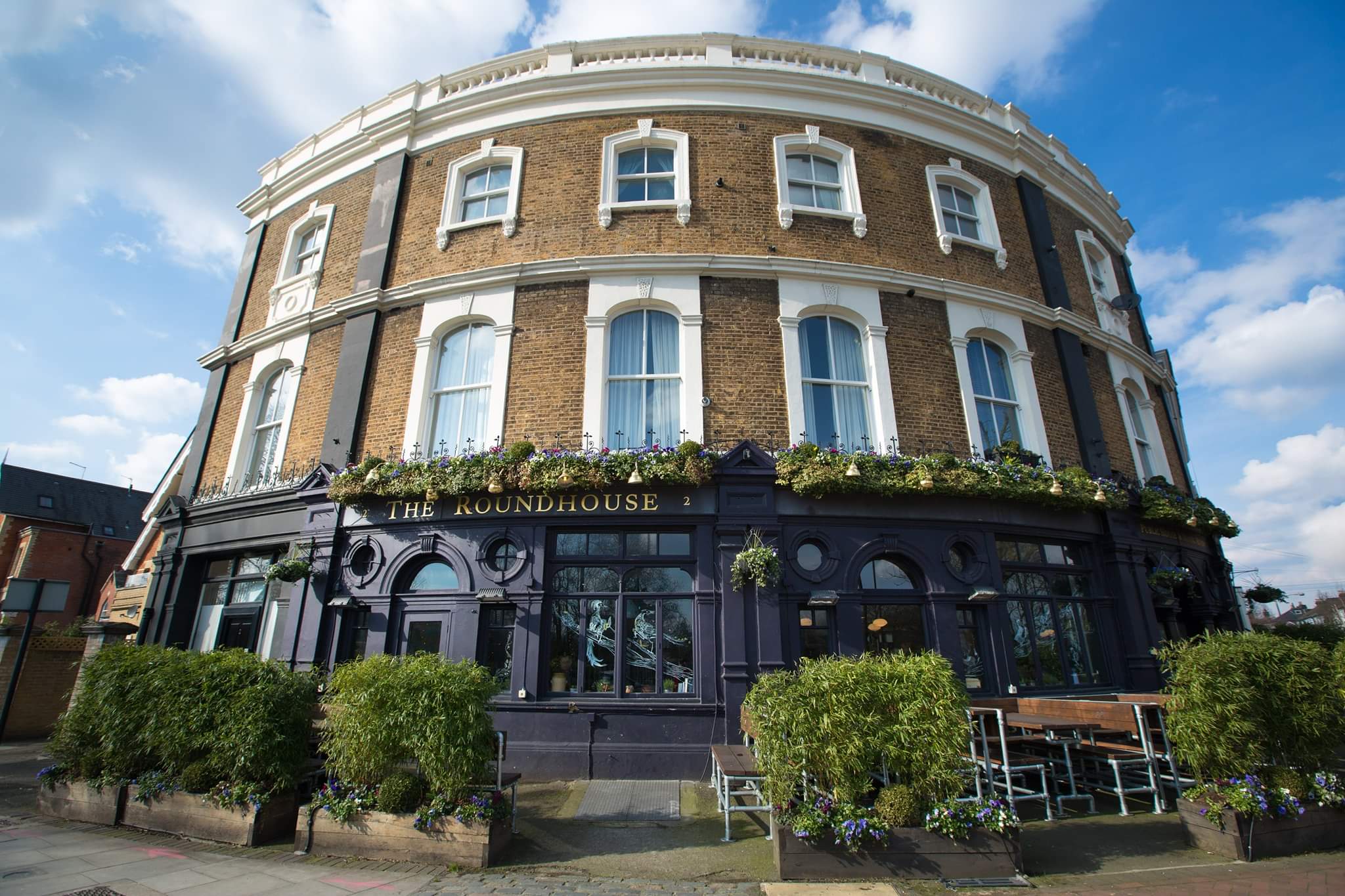
Photo 2019
(Click on image to enlarge)
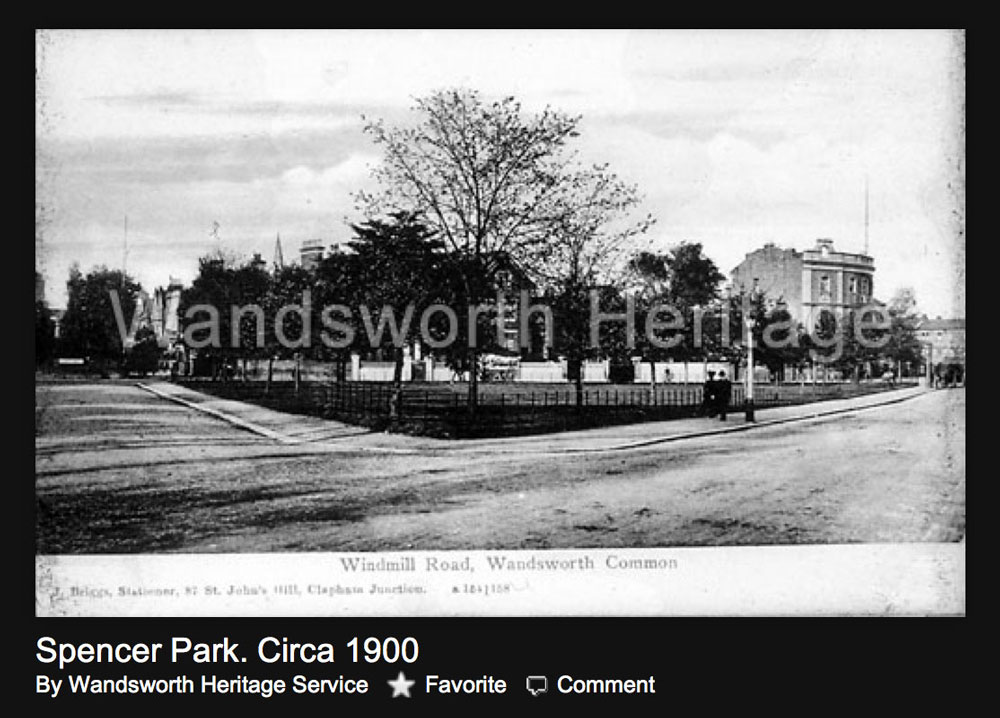
The Freemasons Arms c.1900 shown at the extreme right of the photograph.
(Click on image to enlarge)
- "The Roundhouse" (renamed 2009), 2 North Side/Vardens Road [formerly "The Freemasons", "The Freemasons' Hotel" (opened 1868?)]
- It seems far too large for its location (and proximity to other pubs in the area.)
- Why was it built round? True, it's a corner site, but even so. Surely it couldn't be a nod towards Solomon's Temple, could it? How could I found out? [James Stevens Curl's, The Art and Architectire of Freemasonry may be relevant, but I have yet to find a copy.)
- Why was the pub called The Freemasons? Because it was close to the Freemasons' School for Girls (opened 1853?)? According to Andrew Sherwell, it was used for meetings of Freemasons in the 1860s, and later by the "Earl Spencer Lodge", formed by members of the Battersea Vestry, consecrated 1872 or 1873. Was it designed to be the [headquarters of] local Freemasonry (which might support the Solomon's Temple theory) or just used as such in an area where there were few suitable premises?
- Was Earl Spencer (the 5th) himself a Freemason? I can find no record, so it would seem not: Ancestry: All England, United Grand Lodge of England Freemason Membership Registers, 1751-1921.]
- Could follow this up, e.g. via Lane's Masonic Records: Earl Spencer Lodge (1420). Masons certainly met at the Freemasons' Hotel in 1873, and elsewhere in Battersea soon after. (Earl Spencer Lodge still meets, but not in our area.)
- The most useful source is likely to be Andrew Prescott, Collected Studies in the History of Freemasonry, 2000-3. The whole book is published as a pdf online, downloaded here.
- Prescott: Freemasonry in Greater London.
- Prescott: Freemasonry and the History of the Labour Party.
- Prescott: Freemasonry and the Problem of Britain.
- I have made a Word document here:: Andrew Prescott, Collected Studies in the History of Freemasonry, 2000-3 .
- The Roundhouse is in Battersea so presumably the Survey of London discuss the pub? Yes:
Directly relevant essays in this volume include:
Curving round the corner into Vardens Road is The Round House [surely one word?] pub at No. 2 (until 1967 the Freemasons' Hotel). It was built in 1862 — 3, only a short step from New Wandsworth Station, which operated as a passenger stop from 1858 - 69.
Following the Italianate styling of the neighbouring houses in Vardens Road, it has a sturdy character deriving from its long, continuously curving front, running between pilastered ends. The ground storey incorporates hefty Venetian windows and the whole is topped off by a balustraded parapet (Ill. 16.18).
The original name came either from the Freemasons' Girls School to the north-east, or reflected the incidence of masons among local residents, e.g. in Spencer Road; the Earl Spencer Lodge, in which the Todds were prominent, was inaugurated here in 1873.
[Survey of London: St John's Hill]
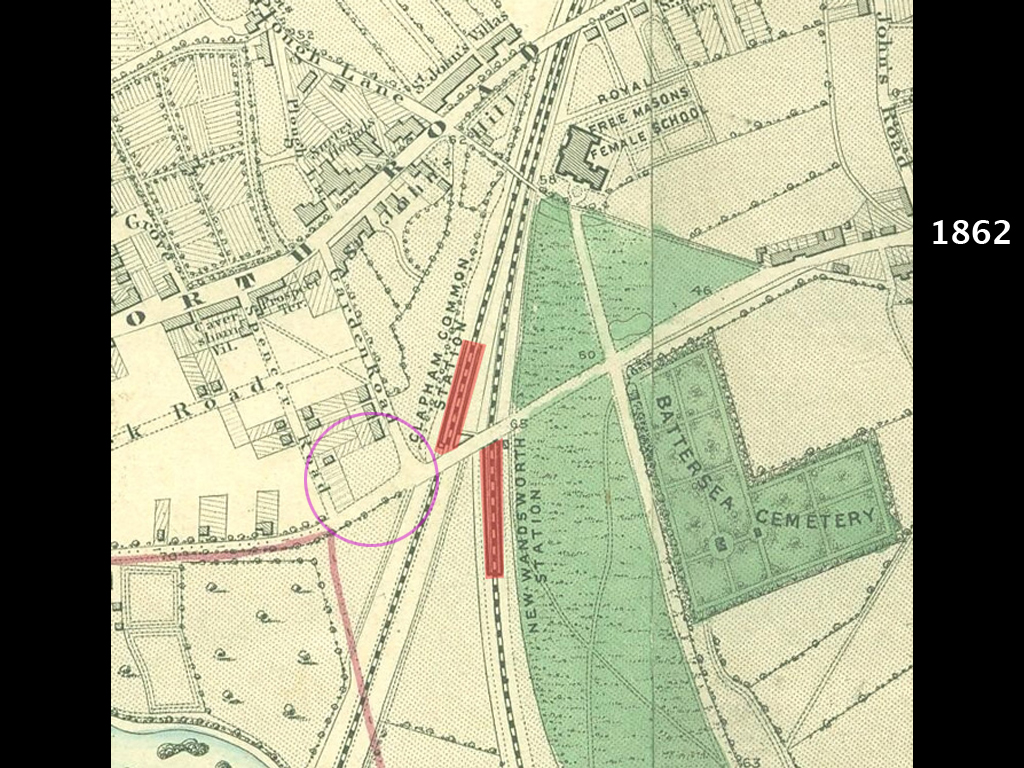
The plot (circled) on which the Freemasons will shortly be built to serve "Clapham Common" and "New Wandsworth" railway stations.
(Click on image to enlarge)
The pub is probably as grand as it is because its expected local clientele was affluent. At this time railways were generally too expensive to be used by the working classes. The assumption must have been that the railway stations would always be there, but of course they had both disappeared [by 1869?]. So how did it survive until its reinvention as a "gastropub", with a new name (The Roundhouse)? Teachers at Emanuel School (whose entrance is less than 50 yards away) once frequented the pub (and for all I know still do), but can they really have provided enough custom to keep the place open?
10. A Mr. Todd and a Mr. Hewitt are building a Public-house on the Common-land so illegally enclosed by the Brighton Railway Company...
13. The width of the main road to Kingston, Richmond, Guildford, &c., at the place where the public-house is now being erected is quite insufficient for the traffic. The width of the main road is twenty-five feet only from kerb to kerb. The width of the road has been adapted to the width of the road at the Railway-bridge, which, measured between the walls, including the paths, is only twenty five feet wide, and the carriage road is only eighteen feet four inches.
[Source: Link.]
Links
- Pubology: Roundhouse
- Routledge Companion to Design Studies: Fiona Fisher, "Regulating design: spaces and boundaries of the late-nineteenth century public house", pp., which mentions the Freemasons' Arms several times. Interesting.
- Brief listing: Masonic records, 1717-1894: being lists of all the lodges at home and abroad... By John Lane: Earl Spencer Lodge <1420]
South London Chronicle - Saturday 26 February 1870
WANDSWORTH. A Scene in Court. - Catherine Howell, 29 alias Mary Ann Lewis, Ann Morgan, 64, Johanna Morgan, 20, and Margaret Morgan, 26, were charged as suspected persons
Inspector Egerton, Y division, said that on Friday afternoon his attention was called to the prisoners, who were with three other persons, on the platform of the Clapham Junction Station. They were under the influence of liquor, and knowing two of them to have been convicted, he instructed an officer to stop Howell.
On opening her bundle, a quart pewter pot was found, belonging to the landlord of the Freemasons' Hotel, Wandsworth Common. The old woman began to scream, causing a great disturbance, and the other three persons made their escape in the confusion.
The inspector further said that Howell and Margaret Morgan only came out of prison on Friday morning. Howell afterwards told him that her husband had been transported for uttering counterfeit coin, and was her intention to set in that line.
The prisoner said she told the inspector that the man that transported her husband wished her to make counterfeit coin to put her the same position. -
Mr. Dayman discharged the Morgans, and committed Howell for two months for the unlawful possession of the pot.
The prisoner here became very excited, and exclaimed, "Don't do it, it will ruin me for life; deal leniently with me."
To the officer, who went into the dock to take hold of her: "I shall commit suicide if you take me into the cell."
The officer had to nee force to remove her and she left the court screaming.
BNA: Link
- [Add info from the piece about "ON THE ANZAC TRAIL BEING EXTRACTS FROM THE DIARY OF A NEW ZEALAND SAPPER BY "ANZAC " WILLIAM HEINEMANN [1916] - which alludes to the Frying Pan and the Freemasons.]
Freemasonry in Battersea
Extracts from a paper by Andrew Prescott of the Centre for Research into Freemasonry, University of Sheffield:
Freemasonry emerged in its modern form in Britain at the beginning of the eighteenth century. From the 1840s, it became a popular social activity of the respectable male middle class. The Shaftesbury Park Estate may have been built without pubs, but by 1882 the Shaftesbury Hall was being used as a masonic meeting place.
Battersea is best remembered in masonic history as the home from 1853 to 1934 of the Royal Masonic Institution for Girls, a school established in 1788 for the daughters of freemasons, 'who from circumstances arising from the death, illness or misfortune of either or both parents, are reduced to a position requiring the benefits of the Institution'. The impressive gothic buildings of the R.M.I.G. stood on St John's Hill opposite Wandsworth Common, on the site of the present Peabody Estate. The opening in 1853 was marked by a public procession of Grand Lodge and a huge garden party was held in the grounds, attended by between three and four thousand visitors. By the 1930s, the school had outgrown these premises, and it was moved to a new site in Rickmansworth.
Education was a prominent theme in the development of freemasonry in Battersea. In 1894, some former students of Battersea Training College who were enthusiastic masons formed Sir Walter St Johns Lodge No. 2513. Sir Walter St Johns Lodge sponsored the creation in 1907 of a lodge for old boys of Sir Walter St John's Grammar School and Battersea Grammar School, Old Sinjins Lodge No. 3232. Old Sinjins was one of the first school lodges. One of its masters was the headmaster of Sinjuns and historian of Battersea, John George Taylor, and during his period of office a meeting of the lodge was held in the school's Great Hall. Old Sinjins Lodge held services at St Mary's church, and among the vicars of the church who were either members of the lodge or attended lodge meetings were Charles Maxwell, Henry Foster Pegg, Barzillai Beckerleg and Stephan Hopkinson.
A lodge for old boys of Emanuel School was not established until 1933, but this lodge, Old Emanuel No. 5399, was to play an important part in the formation of the Federation of School Lodges, which was established at a meeting at the school in 1947.
The first masonic lodge to be formed in Battersea was the Wandsworth Lodge No. 1044, afterwards renamed the New Wandsworth Lodge, which was established in 1865 at the Freemasons' Hotel, near the Masonic Girls' School, but shortly afterwards moved to the Spreadeagle Hotel in Wandsworth.
More closely associated with Battersea was Earl Spencer Lodge No. 1420, formed by members of the Battersea Vestry in 1872. The lodge met in various hotels in Battersea, but, after an attempt in 1894 to move to the Municipal Buildings on Lavender Hill was thwarted by socialist opposition, met at Stanley's Restaurant at 51-53 Lavender Gardens (now Jongleurs).
Masters of the Earl Spencer Lodge included Peter Proctor Haythornthwaite, the conservative Mayor of Battersea from 1909-10.
Masonic business was such that by 1923 Stanley's Restaurant had been renamed Stanley's Masonic Halls. Stanley's was to be the main centre of Battersea freemasonry until the 1950s. It was the first meeting place of Bolingbroke Lodge No. 2417, established in 1892. Bolingbroke Lodge organised a major commemoration of the end of the First World War at Battersea Town Hall in 1919, which was opened by a large masonic procession in which the Mayor and Aldermen of Battersea took part.
Other lodges which met in Battersea included Mount Edgcumbe Lodge No. 1446, which met in the Old Swan, Battersea Church Road, from 1873-1881; Duke of Albany Lodge No. 1963, a lodge initially consisting chiefly of teachers which was formed in 1882, and met in the Shaftesbury Hall and afterwards at the Albert Palace; and Lavender Hill Lodge No. 3191, established in 1906.
Following the creation of the metropolitan borough councils in 1900, masonic lodges for council members and staff were formed in some boroughs. No such lodge was formed for Battersea Borough Council, possibly because Earl Spencer Lodge already performed this function. In Wandsworth, however, Wandsworth Borough Council Lodge No. 2979 was formed in 1903. A number of Mayors of Wandsworth served as masters of the lodge, and it was the custom for the mayor to attend the annual Ladies' Night Festival.
The lodge attracted notoriety during the corruption scandal involving Sidney Sporle, former Labour leader of Wandsworth Council. Sporle was convicted in 1971 of accepting bribes from the notorious Newcastle politician and fixer, T. Dan Smith, and from contractors involved in the building of the Doddington Road estate.
Even after police investigations began into Sporle, his Conservative opposite number, Ronald Ash, nominated him for membership of the South London Housing Consortium, which oversaw the letting of local authority housing contracts. Ash's own firm of builders' merchants had received a large contract from the consortium. Both Sporle and Ash, it turned out, were members of the Wandsworth Borough Council Lodge.
By this time, many of the masonic lodges which had begun in Battersea held their meetings in such central London facilities as Freemasons' Hall at Great Queen Street and Mark Masons' Hall in St James's Street.
When Earl Spencer Lodge celebrated its centenary in 1972-3, no members of the lodge lived in Battersea and they had no idea why the lodge had been named after Earl Spencer. At the time of writing, no masonic lodges meet in Battersea, although the Old Sinjins Lodge holds its committee meetings in the former premises of Sir Walter St John's School in Battersea High Street, and the possibility of holding lodge meetings there in the future has been discussed.
[I found this online at Diger Lisanlar > Universal Masonry Freemasonry in Battersea, but I think the source must be elsewhere. ]
A longer, more detailed account of the development of Freemasonry in Battersea and nearby from the same author, Andrew Prescott:
Until the middle of the nineteenth century, Battersea was a small riverside village whose main occupation was market gardening. In 1838, the London and South Western Railway was opened, whose terminus was at Nine Elms in the east of the parish. During the next thirty years, the area was criss-crossed by new railways, and large railway workshops were opened. The huge station at Clapham Junction emerged as the heart of the new urban area. The population grew from 6,887 in 1841 to 150,558 by 1891. To the north of the railway, bordering the river, was an area characterised by manufacturing industry and mostly working class housing, some very poor quality. Around Clapham Junction station and to the
south of the railway, major retailing centres developed from the 1870s, together with middle class housing, particularly around the two green lungs of Clapham and Wandsworth Commons. Battersea was best known at the beginning of the last century for its radical politics. Its MP was John Burns, the first working man to serve in a cabinet. Battersea Borough Council pioneered municipal socialism, creating one of the first direct labour schemes, opening state-of-the-art baths, wash-houses and libraries, and providing high-quality council housing. The Council refused for many years to fly the Union Jack from the town hall, and courted national controversy with its support of the anti-vivisection movement. This radical tradition continued well into the twentieth century; in 1913 its mayor was the Black Pan-Africanist John Archer and from 1922-9 Battersea was represented in parliament by the Indian communist Saklatvala.197
The earliest Battersea masons belonged to a Moderns lodge which met at the King's Arms in nearby Wandsworth.198 This lodge was established as early as 1723, but the earliest information about its membership dates from 1794. Wandsworth was at this time a small river port at the confluence of the River Wandle with the Thames. The membership of the lodge reflected the industries then established in Wandsworth, and included a miller, a calico printer and two coal merchants. The lodge also contained members from places further up the Wandle, such as Beddington and Merton, reflecting links between the industries along the small river. While some members of the lodge were well-to-do, there was a large
from Wandsworth, but as the years went by men from Battersea increasingly joined the lodge. Many of these Battersea recruits were lower class, including a bricklayer, a coachman and a number of market gardeners. The large artisan membership of the lodge would have made it vulnerable to the economic downturn after 1814, and indeed it disappears from sight after 1813, being finally erased some years later.
Battersea is best known in masonic history as the home from 1853 to 1934 of the Royal Masonic Institution for Girls. The opening in 1853 was marked by a public procession of Grand Lodge and a huge garden party in the grounds, attended by between three and four thousand visitors. However, it seems that the presence of the R.M.I.G. did not help spread freemasonry in the locality. The first lodge to be firmly based in Battersea was the Earl Spencer lodge no. 1420, named after the local Lord of the Manor and consecrated in 1872. The history of this lodge encapsulates many major themes of the development of freemasonry in this area. First, the founders came mostly from New Wandsworth, reflecting how freemasonry was associated with the growth of the politically conservative middle class areas of south Battersea.199 Second, the greater professionalisation of
local government led to a new class of salaried officials who were to play a significant role in the local growth of freemasonry. The first master of the Earl Spencer lodge was Edward Spooner, who was an officer of the Westminster Vestry, and the other founders included engineers and surveyors connected with local vestries. Some of the founders of the Earl Spencer lodge were involved in the development of other societies and associations in the area. Spooner, for example, was an officer of the New Wandsworth Philanthropic Society.200
Although Earl Spencer lodge was created to provide a masonic meeting place for the inhabitants of south Battersea, it suffered constant problems with its accommodation. It met at a succession of taverns and hotels in the district, eventually moving north to the Albert Palace, an ambitious attempt to create a new Crystal Palace adjacent to Battersea Park. The Albert Palace went bankrupt in 1887, and the lodge sought permission to move to Cannon Street in the centre of London. These moves caused constant anxiety to the
lodge by an Assistant Grand Secretary at the time of the collapse of the Albert Palace suggests complete bewilderment: 'Is New Wandsworth in Battersea?', he wrote, 'Is the Swan Hotel in New Wandsworth?'. A final despairing note suggests that, for this official at least, south London was a foreign country: 'Dodd tells me there really is no decent place for a lodge in Battersea, he lives at Lavender Hill and therefore knows something of the neighbourhood'.201
Despite these difficulties, the lodge had at this time 52 members, mostly from south Battersea.202 While the membership comprised a mixture of tradesmen and professional classes, particularly notable was the involvement of men connected with the vestry, such as Peter Haythornthwaite, who served as Secretarry and Master of the lodge, was a member of both the Vestry and the Borough Council, and was the conservative Mayor of Battersea in 1909-10. Also striking is the contribution to the lodge of the new class of local government employees, including for example, a librarian, the steward of the local dispensary, a workhouse master, and a vestry clerk.
When the Albert Palace finally closed, the lodge was forced briefly to move to Putney, but, following the opening in Lavender Hill of a new restaurant, Stanley's, the lodge was able to return to Battersea. The owner and manager of the restaurant became members of the lodge, and Stanley's became a major centre of freemasonry in Battersea for many years. In 1908, a refurbishment of the restaurant prompted the Earl Spencer lodge to move to the Criterion Restaurant in the Strand. Immediately, the character of the lodge changed. The number of Battersea initiates declined, and new members of the lodge began to be drawn from further afield. This process became more marked after the First World War. Of 22 initiates between 1918 and 1925, only three were from Battersea; increasingly members lived in such new suburbs as Hanwell, South Ealing and Lee. The lodge now meets in Freemasons' Hall. When the lodge celebrated its centenary in 1972, no members lived in Battersea and its members had forgotten why their lodge bore its eminently local name.203
A similar process of divorce from the locality took place even more rapidly in a lodge consecrated shortly after the Earl Spencer lodge, Mount Edgcumbe lodge no. 1446. This was based in north Battersea, and the founders included owners of riverside wharves and factories, as
well as a local doctor.204 A letter accompanying the petition again emphasised the need for a local masonic venue. It described how a lodge had previously met in Chelsea, but had moved to the city. This necessitated members travelling more than five miles to attend each lodge meeting, and many had resigned their membership of the craft for this reason alone. The letter claimed that they would take up freemasonry again if they could meet in the immediate vicinity. The warrant was granted on condition that the lodge met in Battersea. Within eight years, however, the inn where the lodge met was demolished and the lodge asked for permission to move, claiming that it was impossible to find a suitable meeting place in Battersea and that it was unable to recruit members in the locality. Eventually, permission was given for the lodge to move to the Bridge House Hotel a London Bridge.205 It quickly lost its Battersea connection
altogether. Its members began to be drawn chiefly from south-east London, with a large proportion connected with the building trade.206
The lack of masonic lodges in Battersea became a matter of concern to some inhabitants, and Dr Philip Davis, a food scientist and journalist, who claimed to be 'the leading journalistic confectionary-trade expert in the world', launched a campaign for a local lodge, and in 1891 he wrote forcefully to the Grand Secretary as follows: 'Ten years ago the population of this district was 107,262 persons and at that time (if I am accurately informed) two, if not more, craft lodges met within its limits; this year's census shows that the population has increased to 150,458 - nearly equal to that of Newcastle-on-Tyne - and today not one lodge meets within its confines. They have all removed on the plea that there is no suitable accommodation for them; have gone beyond the local radius; are scarcely recognised any longer as local lodges, and freemasonry is at a much lower ebb in this vicinity than it should otherwise be under any circumstances'. Davis stressed that the lack of a lodge meant that there were many lapsed masons in the area, and felt confident that a new lodge would quickly recruit a hundred members. He outlined ambitious plans to build
a large masonic hall opposite Clapham Junction station, and asked for his petition to be quickly granted to enable him to purchase the land for the hall.207
Thus was established Bolingbroke lodge no. 2417, but difficulties about shared use of the premises meant that the proposed masonic hall was never established, and Bolingbroke lodge was again dogged by the familiar accommodation problems. Nevertheless, the lodge rapidly grew to more than 50 members, drawn mainly from the area around Clapham Junction.208 With the opening of a new town hall in 1894, the lodge moved
In 1904, the lodge moved to Stanley's Restaurant. It continued to be the principal focus of freemasonry in the locality until after the First World War, organising for example a masonic service of commemoration at the Town Hall in 1919, which was attended by the mayor and other local dignitaries.Although the lodge was there, taking the precaution of initiating the caretaker first.209 The use of the town hall encouraged employees of the vestry and borough council to join: in 1903, the Council's Superintendent of Works was initiated.210 The lodge had strong connections with local conservative groups - Charles Munslow who was lodge secretary was for example secretary of the Clapham Conservative Association211 - and the socialist Borough Council made increasing difficulties about the lodge's use of the town hall.212 213
still meeting at Clapham Junction in the 1960s, its local links had been substantially weakened as a result of the expansion of membership in the 1920s. In 1924-5, 22 new members were initiated, but only two of these were from Battersea, while eight were from north London. It now meets at Freemasons' Hall in central London.
One of the most imaginative attempts to promote masonry in Battersea was associated with the building of the Shaftesbury Park Estate in the 1870s, an estate of model cottages designed for clerks and respectable members of the working class built by the Artisans Labourers and General Dwellings Company Limited, which also built similar estates in Queen's Park, Forest Gate and elsewhere.214 The foundation stone, laid by Lord Shaftesbury, declared 'Healthy Homes the First Condition of Social Progress'. This pioneering
'workman's city' included a lecture hall and recreation ground. In the words of a report by the company: 'It is proposed to erect on this estate 1200 houses suited respectively for clerks, artisans and labourers, in addition to a lecture hall, co-operative store, school rooms, baths, wash-houses, etc. A reservation of three acres is allotted for recreations and pleasure grounds...The houses will be so constructed as to combine elegance and comfort with economy; but as the Directors regard a healthy house as the cheapest, and in the long run the most comfortable, strict attention has been paid to secure dry and well roofed habitations.'215 The estate was visited by Disraeli and others, who expressed their enthusiasm for the development.
The Artisans Labourers and General Dwellings Company was founded by William Austin, an illiterate Northampton builder, who felt that he owed his success to having renounced drink at the age of 47. In difference to Austin's strict temperance views, there were no pubs on the Shaftesbury Park Estate. In 1870, Austin was replaced as chairman of the company by a radical journalist and social reformer, Dr. John Baxter Langley.216 Austin afterwards grumbled that 'I'm no
scholar, so they outvoted me. I was too honest for them, so that's why they voted me out'. Langley himself was a controversial figure. He had cut his teeth as a radical journalist on the Manchester Times in the 1840s. He was one of the prime movers of the Reform League, which agitated for an extension of parliamentary suffrage. In 1858, Langley gave the 'physical force' chartist Ernest Jones financial support for his weekly newspaper, the People's Paper, but Jones was unhappy with Langley's more moderate political stance and the two soon fell out, with Jones eventually accusing Langley of selling out bytaking a paid lectureship in support of a more moderate reform programme.217 Langley was also deeply interested
in social questions, supporting Charles Bradlaugh and Annie Besant when they were prosecuted for obscenity for publishing a book on methods of birth control. Langley supported Josephine Butler's campaign against the Contagious Diseases Acts, and at her behest stood as a parliamentary candidate in against this legislation at Colchester in 1870. During a public meeting in this campaign, rotten vegetables, chairs, and plaster and mortar from the ceiling were thrown at Langley and the clothes were literally torn from his back. Nevertheless, by splitting the liberal vote, Langley's candidature at
etc etc
_______________
195 Ibid., pp. 15, 29, 31.
196 Ibid ., pp. 23-31.
197 For overviews of Battersea's history, see Patrick Loobey, ed., Battersea Past (London: Historical Publications, 2002); Reginald J. Prescott, 'Village Under the Smoke: The Story of Battersea and its People', The Battersea Booklist Quarterly, 2nd ser., nos. 11-14; Roger Logan, South Battersea: The Formative Years 1851-1900 (Wandsworth: Wandsworth Historical Society, 1977); Priscilla Metcalf, The Park Town Estate and the Battersea Tangle: a Peculiar Piece of Victorian London Property Development and its Background (London: London Topographical Society, 1978); Chris Wrigley, Changes in the Battersea Labour Movement 1914-1919 (Loughborough: Loughborough University, 1978); Janet Roebuck, Urban Development in 19th-Century London: Lambeth, Battersea and Wandsworth (Chichester: Phillimore, 1979); Sandra Wallman, ed., Living in South London: Perspectives on Battersea 1871-1981
(London: Gower, 1982), pp. 17-82; Coral Lansbury, The Old Brown Dog: Women, Workers and Vivisection in Edwardian England (Madison: University of Wisconsin Press, 1985), pp. 3-25; Ben Rudder, Builders of the Borough: A Century of Achievement by Battersea and Wandsworth TradesUnion Council from 1894 to 1994 (Battersea: Battersea and Wandsworth Trades Union Council, 1994); Sean Creighton, 'Battersea and the New Unionism', South London Record 4 (1989), pp. 31-46; Sean Creighton, 'Organised Cycling and Politics: the 1890s and 1900s in Battersea', available on-line at http://www2.umist.ac.uk/sport/Creighton.html. Sean Creighton has also published in photocopied form a number of very useful articles, including 'The Ancient Order of Foresters in Battersea and neighbouring districts', 'John Archer: Battersea's black progressive and labour activist' and 'From Exclusion to Political Control: Radical and Working Class Organisation in Battersea 1830s-1908', available from Agenda Services, 18 Ridge Road, Mitcham, CR4 2ET. [Ruddock; Jo Stanley, Battersea Town Hall]
198 Bailey and Cryer, op. cit., p. 115. Information about membership is taken from returns at the Library and Museum of Freemasonry.
199 The founders who signed the petition for this lodge were: Edward Spooner, gentleman, of 2 Spencer Road, New Wandsworth; William Christopher Todd, gentleman, of New Wandsworth; Charles
Jackson, gentleman, of Clyde Villa, Southfields; Thomas Buckham, civil engineer, of Spencer Road, New Wandsworth; James Neal, contractor, of Spencer Road, New Wandsworth; Arthur Southam, surveyor, of Clapham; and Joseph Hiscox, gentleman, of Lavender Hill; cf. John Monk, The History of the Earl Spencer Lodge No. 1420 1873-1973 (n.p.p., n.d.).
200 Spooner used stationery of the Westminster Vestry and the Philanthropic Society in his correspondence about the establishment of the new masonic lodge.
201 These peregrinations are recorded in the returns of the lodge in the Library and Museum of Freemasonry; cf. Monk, op. cit.
202 For details of lodge membership, see the returns in the Library and Museum of Freemasonry.
203 The lodge wrote to Freemasons' Hall asking for an explanation of the name: Lodge file, Library and Museum of Freemasonry.
204 The founders who signed the petition for the lodge in 1873 were: William Ough of the Wellington Lime and Ancient Wharf, Lambeth; A C Burrell, tailor, of Piccadilly; John Coates of Oak Wharf, Battersea; Robert William Whiteley, wine merchant, of Devonshire Place, New Wandsworth; Frederick Pemberton of Worcester College, Falcon Road; William Kempston, M.D., of Oak House, Battersea; T. White of Home Road, Battersea; and Daniel Parlabean of Harroway Works, Battersea.
205 The Freemason, 3 (1870), p. 95, carried the following advertisement: 'Bridge-House Hotel, London Bridge. This hotel has facilities for Masonic Meetings, arbitrations, public dinners, balls, &c., and is allowed to be in real domestic comfort one of the best in the metropolis, possessing the advantage of a moderate scale of charges, which, with excellent cuisine, Wines of the first quality, and
the care and attention shown to guests, justifies the preference accorded to it. Tariffs on application to Joseph H. Spencer'.
206 This change can be traced in the lodge's returns in the Library and Museum of Freemasonry.
207 Letter accompanying the petition for the lodge in the Library and Museum of Freemasonry.
208 Davis quickly fell out with the brethren of the Bolingbroke lodge. By 1894, he was petitioning enthusiastically for the establishment of a lodge based in the City to be called the Chinook Lodge. In August 1894, a mason called Combeil wrote to the Grand Secretary forwarding a notice of Davis's bankruptcy and stating that ''This man - I learn - was bankrupt in Manchester some years ago. I wish we had some means of getting rid of such blots on masonry...' He also sent a list of Davis's creditors who included the firm of Jones and Aylett in Battersea who were owed seven hundred pounds. Charles Munslow wrote as expressing the concern of Bolingbroke lodge concern about Davis's petition: 'It is very difficult indeed to convey in a letter and I am even not sure that I am not committing a very great masonic sin in doing so, but really the facts are such that before allowing Bro Davis to put forward an application for a warrant to another lodge you ought to know the facts of the case..'. The petition for the Kohinoor lodge was refused, and on 15 February 1895, Davis was excluded from freemasonry: Refused Petitions, Library and Museum of Freemasonry.
209 A letter of 28 February 1894 in the lodge returns in the Library and Museum of Freemasonry requested permission to initiate John Pigott, the messenger-caretaker of Battersea Town Hall, as a serving brother who would supply the lodge with refreshments. The letter pointed out that initiation of Pigott would be advantageous for Bolingbroke lodge and any other lodge which would meet in the town hall.
210 Hubert Mark Green.
211 Munslow used notepaper of the Conservative Association when writing to Freemasons' Hall.
212 The returns of the lodge contain repeated requests for dispensations to meet elsewhere because the council had refused permission for the lodge to use the town hall.
213 A dispensation was necessary to wear masonic clothing during the service, and a copy of the announcement for the service was included in the letter requesting dispensation, preserved among the
lodge's returns at the Library and Museum of Freemasonry: 'A masonic service has been organised by the Bolingbroke Masonic Association, assisted by members of all lodges of instruction and regular lodges of the South West District ... to piously celebrate victory and peace after the Great War, thus affording an opportunity to express the truly masonic teachings of which our Order is founded. Freemasons residing within an easy radius of the Town Hall will assist by their presence at this festival of thanksgiving'.
214 Loobey, op. cit., p. 128; Creighton, 'Battersea and the New Unionism', loc. cit., p. 34; Metcalf, op. cit., pp. 35, 44, 46; Artizans Centenary 1867-1967 (London: The Artizans and General Properties Company Limited, 1967); Erica McDonald and David J. Smith, Artizans and Avenues: a History of the Queen's Park Estate (London: City of Westminster Libraries, 1990).
215 Artizans Centenary, p. 9.
216 On Langley, see further The Era of the Reform League: English Labour and Radical Politics, ed. J. Breuilly, G. Niedhart and A. Taylor (Mannheim, 1995), p. 333,. In 1876, Langley caused a storm in freemasonry by his trenchant opposition to the use of masonic funds for the restoration of cathedrals: Andrew Prescott, 'Charles
Bradlaugh and Freemasonry' Ars Quatuor Coronatorum, forthcoming.
217 Miles Taylor, Ernest Jones, Chartism and the Romance of Politics 1819-1869 (Oxford: Oxford University Press, 2003), pp. 181, 183-5.
218 Jane Jordan, Josephine Butler (London: John Murray, 2001), pp. 121-5.
219 [F. O. Raynaud], Era Lodge No. 1423: The First Hundred Years (n.p.p., 1973), pp. 2, 19; Era Chapter No. 1423: One Hundred Years of Progress 1876-1976 (n.p.p., 1976), p. 2.
220 Correspondence accompanying the petition for the lodge, Library and Museum of Freemasonry. It seems that it proved impracticable to lay the memorial stone with masonic honours; a letter from Hervey to Langley on 16 August 1878, states that 'With regard to the laying of the memorial stone of the Artizan's buildings, I am afraid that at this season of the year it will be difficult to obtain the attendance of sufficiently distinguished and influential men': Grand Secretary's Letter Book 1876-7, Library and Museum of Freemasonry, f. 108.
221 They were: Langley; Thomas Horton, secretary, of Oakley Street, Chelsea; Edward Fithian, Secretary, of Great College Street, Westminster; Frank John Lancaster, of the Architect's Department of the Metropolitan Board of Works, who lived in Tipthorpe Road, Lavender Hill; E Mallett, of Little Britain; Frankenburg; G. Mallick, physician, of Herne Bay; J. Elgood, solicitor, of Brunswick Square; John Shuttleton, confectioner, of Mare Street, Hackney; John Johnson, engineer, of Goswell Road; Stephen Lacey, gentleman, of
Canonbury Place; Michael Underwood, manager, of Ludgate Hill; and Joshua Hollings Grigg, physician, of Albemarle Street, Piccadilly. None of these petitioners appear to have been Directors of the Artizans', Labourers' and General Dwellings Company, suggesting that the masonic mission to the Shaftesbury Park Estate was a personal enthusiasm of Langley's.
222 The Artizans', Labourers', and General Dwellings Company Ltd., Report of a Commitee of Investigation appointed at an Extraordinary General Meeting of the Shareholders on the 2nd of June 1877 (London: National Press Agency, 1877), pp. 8-10.
223 Ibid., pp. 8-9; Artizans' Centenary, p. 16; McDonald and Smith, op. cit., pp. 8-9.
224
225 The petition was cancelled on 28 August 1877.
226 The petition is printed and discussed in Andrew Prescott, 'The Study of Freemasonry as a New Academic Discipline', proceedings of OVN conference at Leiden March 2003, forthcoming.
227 On Voisey, see further below. The founders who signed the petition for the Duke of Albany Lodge were: Voisey; Robert James Vincent, schoolmaster, of Larkhall Lane, Clapham; Charles Wilson, schoolmaster, of Bloom Grove, Lower Norwood; William Thomas Pink, schoolmaster, of 29 Bridge Road West, Battersea; Robert Stokoe, schoolmaster, of Grayshott Villas, Shaftesbury Park Estate; Henry Maidment, schoolmaster, of Raywood Street, Battersea; John James White, schoolmaster, of Stormont Road, Lavender Hill; Vincent Marché, schoolmaster, of Gloucester Road, Camberwell; Charles Henry Stone, schoolmaster, of Soames Terrace, Denmark Park' George Gill, publisher, of Ramsden Road, Battersea; Thomas Harrap, vestry clerk, of Crown Terrace, Lavender Hill.
etc etc
[Prescott: Freemasonry in Greater London.]